
Revision Notes
AQA GCSE Sociology (8192): Functions of families – Revision Notes
Condensed AQA GCSE Sociology 8192 notes on 3.3.1 functions of families: the four functions, Parsons, Marxist and feminist views, traps and a self-test.
- Subject
- Sociology
- Level
- GCSE
- Topic
- Families
- Author
- Marlbridge Academic Team
- Updated
- Reviewed by
- Naqiya Yousaf (what this means)
Aligned to AQA GCSE Sociology (8192), first teaching 2017. Official specification .
Syllabus page (what it covers and how it is assessed): AQA GCSE Sociology.
Syllabus points this page covers
8192
- 3.3.1 Functions of families
Found an error? Report a correction.
Need help with this topic? Request a free trial class for GCSE Sociology (8192).
These notes condense 3.3.1 Functions of families from the AQA GCSE Sociology (8192) specification, assessed in Paper 1. The specification asks you to “identify, describe and explain the functions of families (sexual, reproductive, economic and educational)”, to know Parsons on “primary socialisation and the stabilisation of adult personalities”, and to compare functionalist, feminist and Marxist views.
For full explanations and worked answers, read the functions of families study guide. When you have finished, try the functions of families practice questions.
Key terms
| Term | Meaning |
|---|---|
| Function | The contribution an institution makes to keeping society going |
| Sexual function | Regulating sexual behaviour by giving it an approved place, such as marriage |
| Reproductive function | Producing the next generation to replace members of society |
| Economic function | Providing for members’ material needs; once production, now mainly consumption |
| Educational function | Teaching children the norms, values and skills of their culture |
| Primary socialisation | The first stage of learning a culture, which takes place in the family |
| Secondary socialisation | Later learning from schools, peers, media and work |
| Stabilisation of adult personalities | Parsons’ idea that families give adults emotional support against the stress of work |
| Unit of production | A family that works together to produce goods, as on a pre-industrial farm |
| Unit of consumption | A family that pools income to buy goods and services |
| Instrumental role | Parsons’ term for the providing, breadwinning role he linked to husbands |
| Expressive role | Parsons’ term for the caring, emotional role he linked to wives |
| Dependent family members | Those who rely on others for support, such as children or frail older relatives |
| Patriarchy | A system of male dominance |
| Canalisation | Steering children towards toys and activities seen as suited to their sex |
| Conventional family | Oakley’s term for the married nuclear family with children, which she argued is an idea with great power |
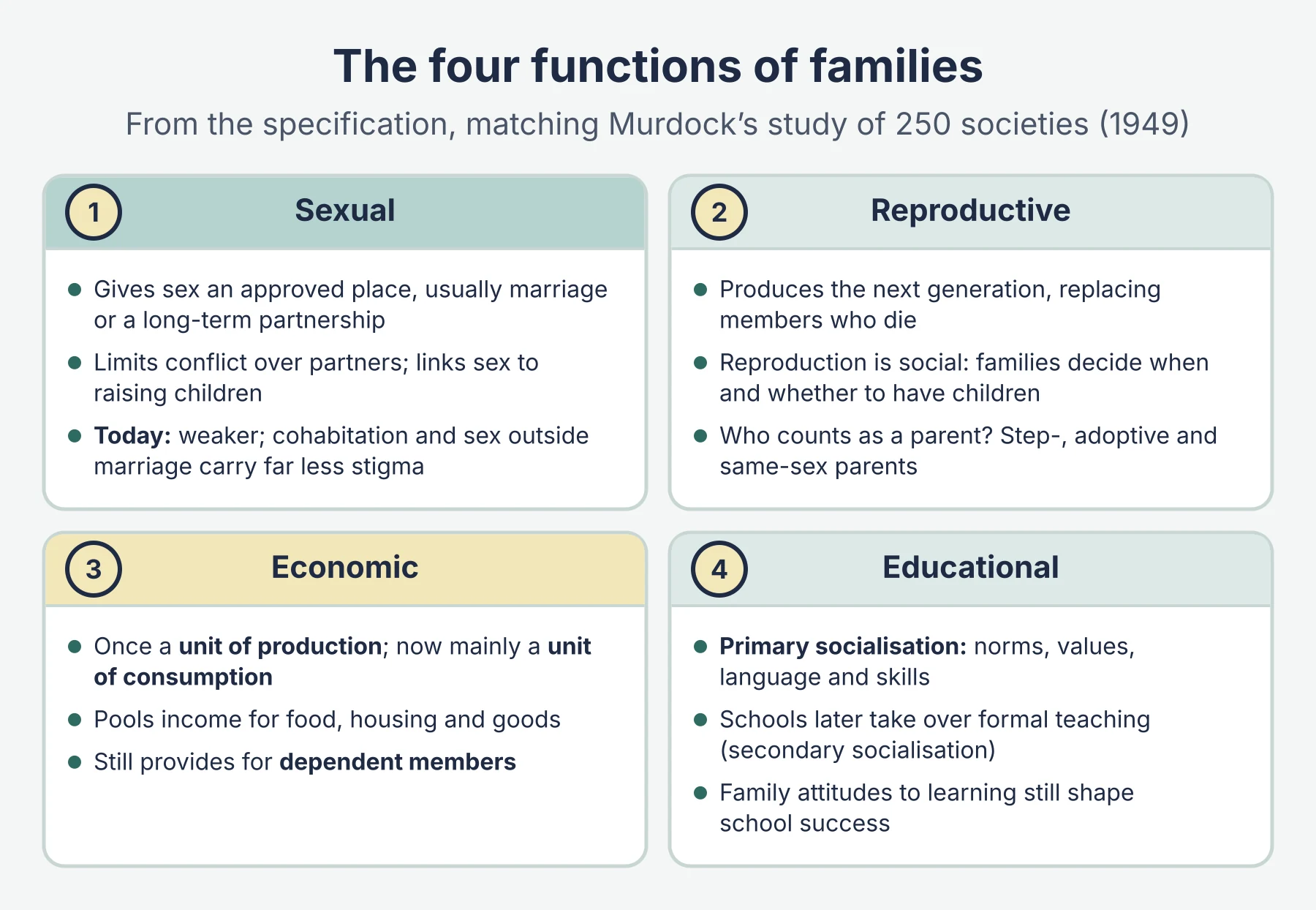
The four functions in one line each
- Sexual: controls who has sex with whom; weaker now cohabitation and sex outside marriage carry less stigma.
- Reproductive: replaces the population; decisions about whether and when to have children are social, not just biological.
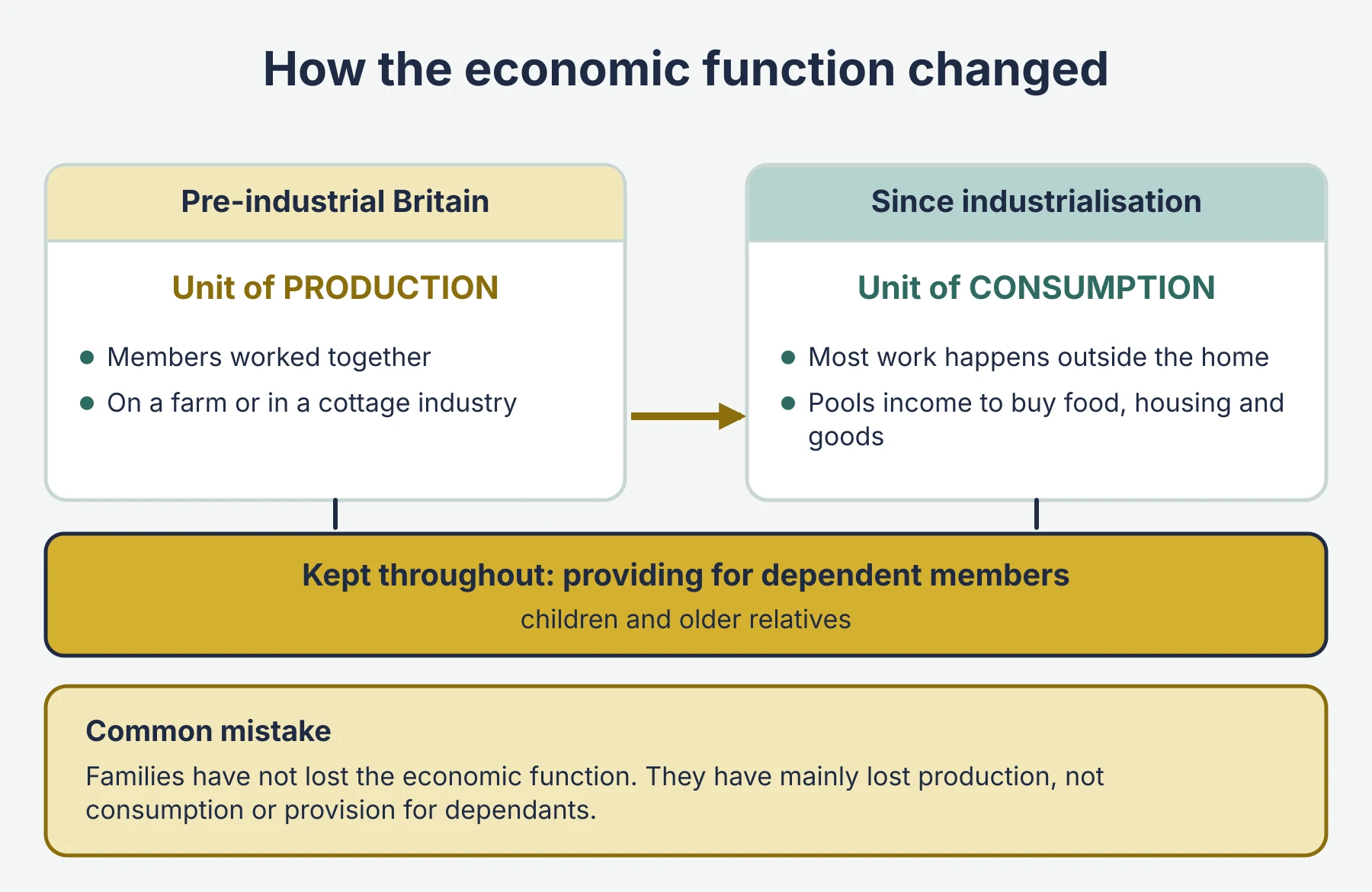
- Economic: a unit of production before industrialisation, mainly a unit of consumption now; still supports dependants.
- Educational: primary socialisation; schools later take over formal teaching.
The list matches the four functions Murdock (1949) claimed to find in all the societies he studied.
Parsons at a glance
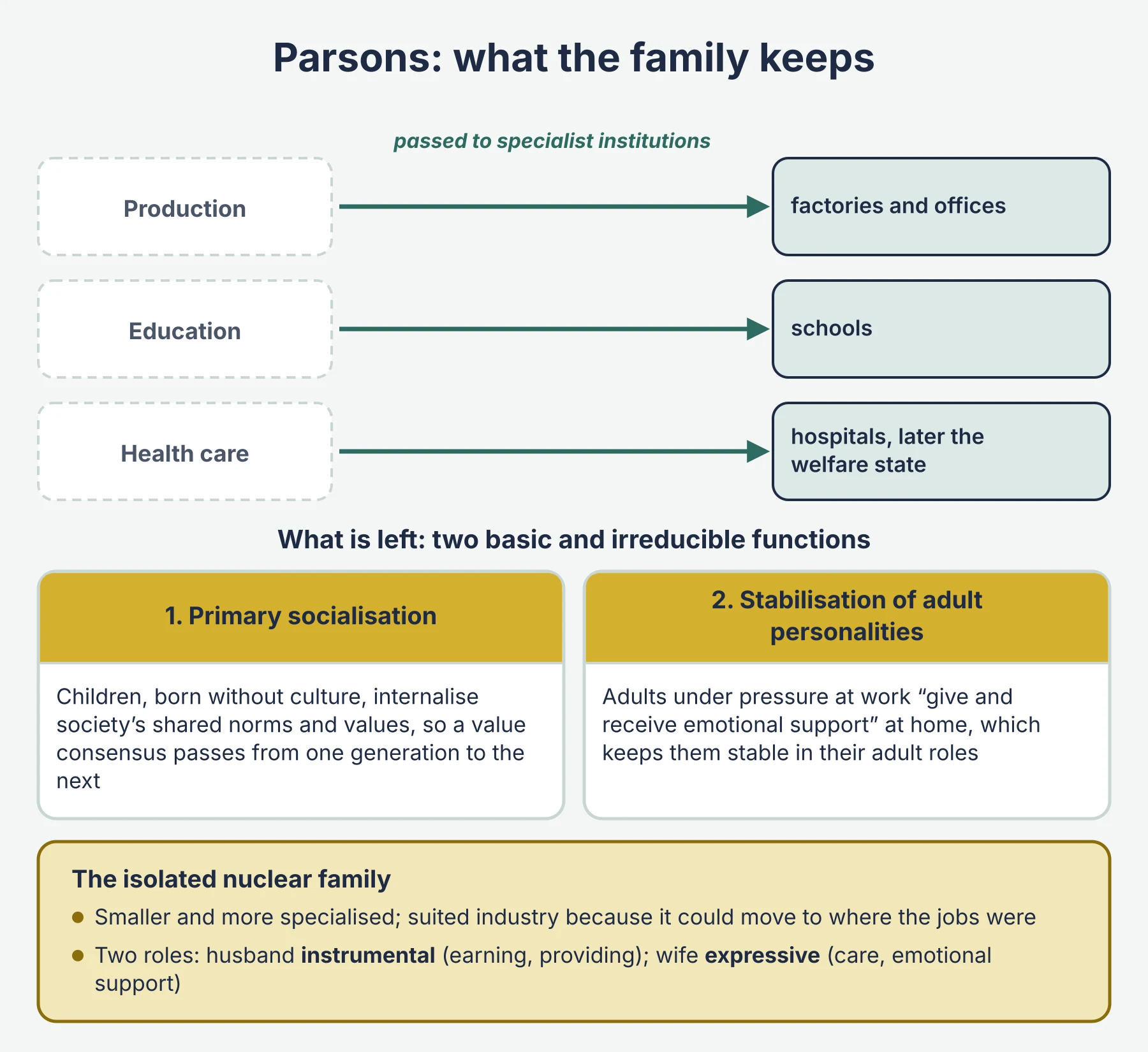
- Perspective: functionalist, writing about the American family.
- Two “basic and irreducible” functions: primary socialisation of children; stabilisation of adult personalities.
- Why only two? Industrial society moved other functions (production, education, health) to specialist institutions.
- Isolated nuclear family: small and mobile, so it suits industry.
- Roles: instrumental (husband) and expressive (wife).
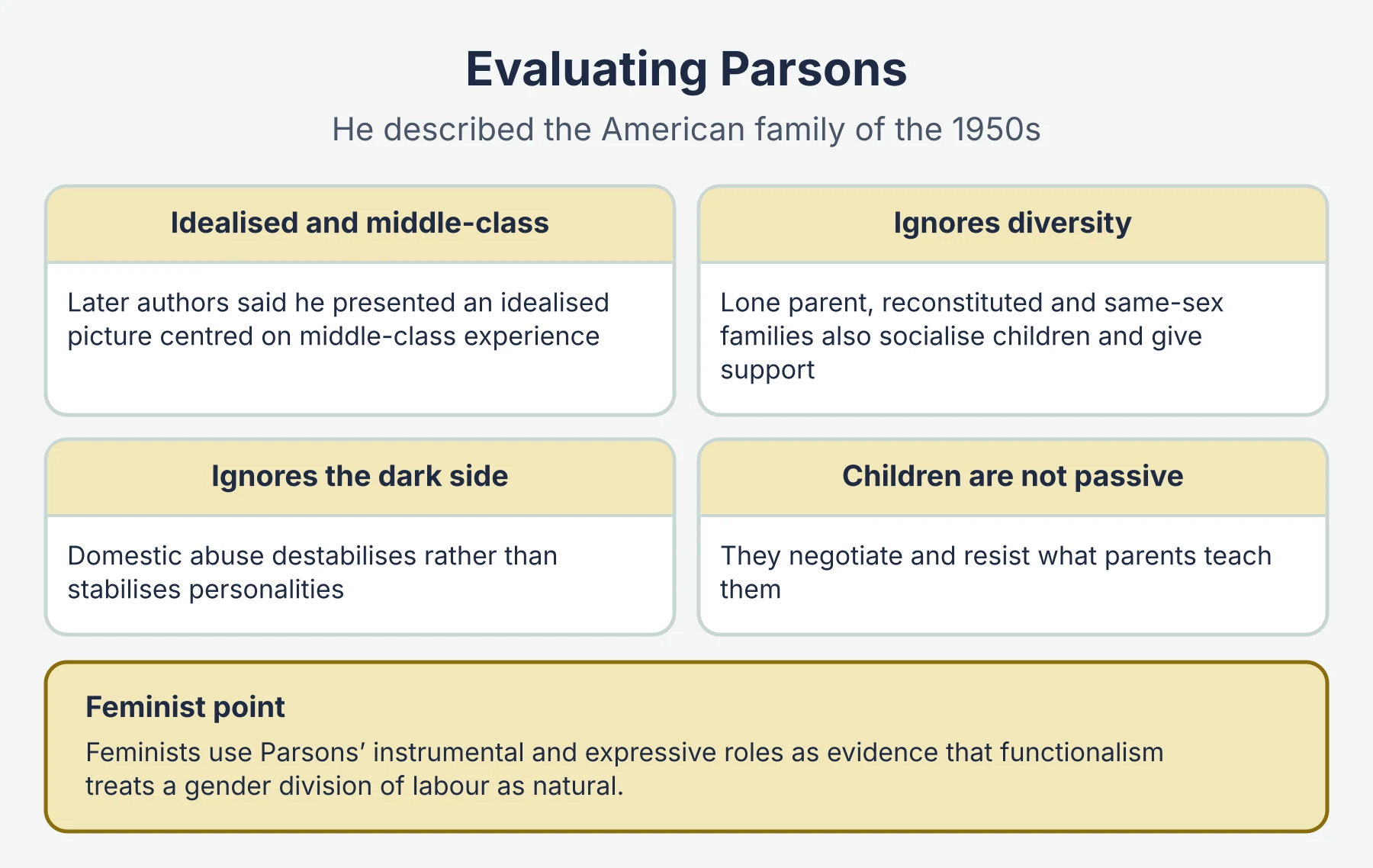
- Specification criticism: an “idealised picture of family life centred on the middle-class experience”.
- Further criticisms: ignores diversity, ignores abuse and conflict, treats children as passive.
Marxist and feminist replies
| Function | Functionalist reading | Marxist reading | Feminist reading |
|---|---|---|---|
| Socialisation | Passes on shared values | Teaches acceptance of hierarchy and authority | Teaches gender roles (canalisation) |
| Economic | Provides for all members | Unit of consumption that boosts profit | Rests on women’s unpaid work |
| Reproductive | Replaces society’s members | Reproduces the labour force cheaply | Childcare falls mainly on women |
| Emotional support | Stabilises adults | A cushion that hides alienation (Zaretsky) | Women give more support than they receive |
Writers to name:
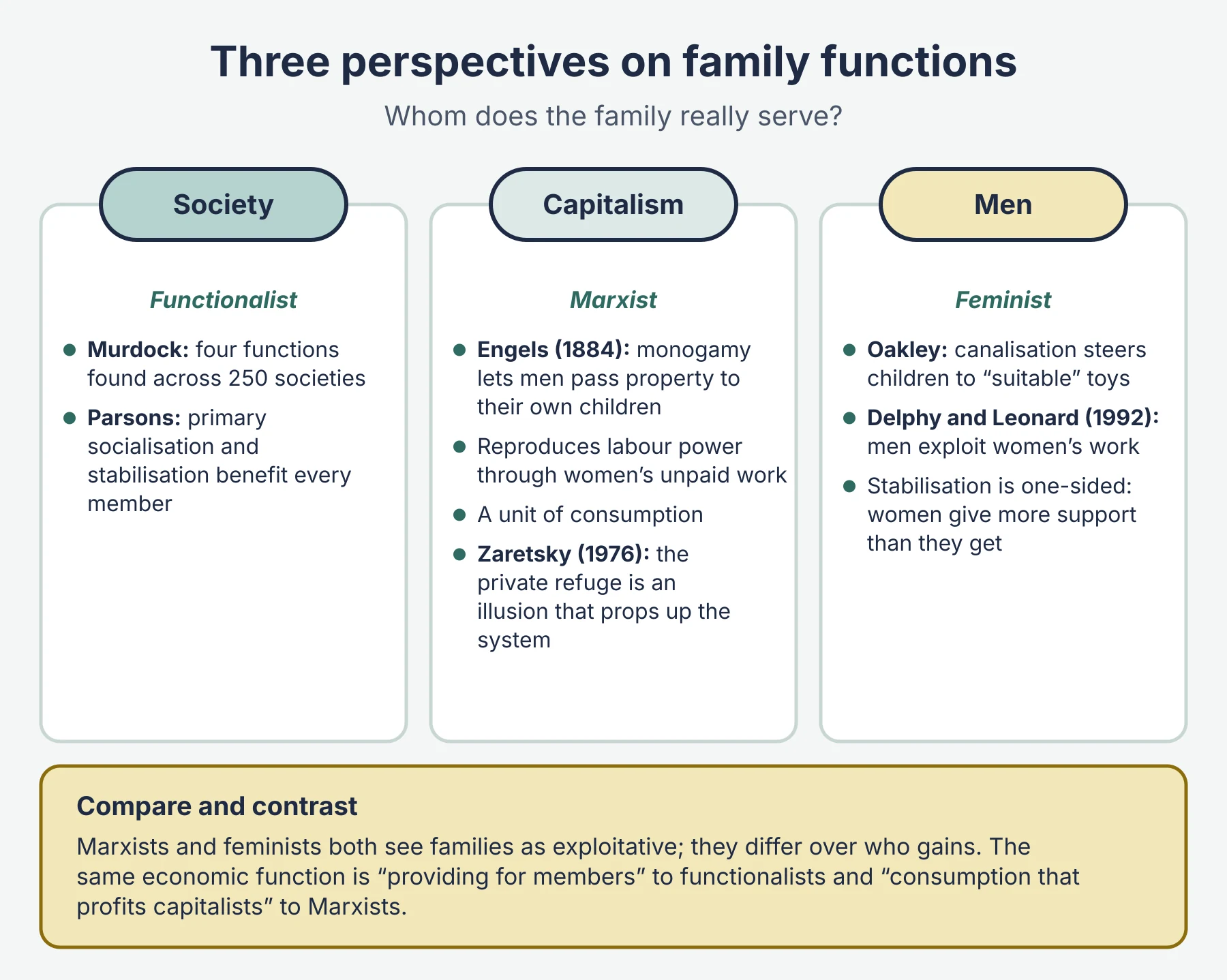
- Engels (1884): monogamous marriage developed so men could pass private property to their own children.
- Zaretsky (1976): the “private life” of the family is an illusion; the family props up capitalism through domestic labour and consumption.
- Delphy and Leonard (1992): the family is an economic system in which men exploit women’s work.
- Oakley: canalisation; the power of the idea of the conventional family.
Must-know distinctions
- Four functions versus Parsons’ two. The four are the specification’s list; Parsons’ two are primary socialisation and stabilisation of adult personalities.
- Primary versus secondary socialisation. Family first; school, peers and media later.
- Production versus consumption. The family lost most production, not its economic role altogether.
- Marxist versus feminist. Both see exploitation; Marxists say capitalism gains, feminists say men gain.
- Functions versus dysfunctions. A function benefits the system; a dysfunction, such as domestic abuse, harms it.
Mini essay plan
Question type: “Discuss how far sociologists would agree that the family’s most important function today is primary socialisation.”
- Define primary socialisation and say functionalists stress it.
- For: Parsons; children internalise shared values; schools build on what families start.
- For, with development: loss of other functions to specialist institutions makes socialisation central.
- Against (Marxist): the economic function as a unit of consumption, and reproducing labour power, matter as much to capitalism.
- Against (feminist): socialisation is gender socialisation; women carry most of it; Delphy and Leonard on exploitation.
- Evaluation: Parsons is idealised and middle-class; diverse families also socialise children.
- Judgement: socialisation remains central, but whom it serves is disputed.
Exam traps
- Calling the four functions “Parsons’ four functions”.
- Writing about “the economic function” as if families still mainly produce goods.
- Using the stabilisation function without explaining why adults need stabilising (the stress of work).
- Forgetting the specification’s own criticism of Parsons: idealised and middle-class.
- Writing “Marxists say the family is bad” with no mechanism (inheritance, consumption, reproducing labour power).
- Giving a feminist view with no named writer.
Quick self-test
- Name the four functions of families listed in the specification.
- Which two functions did Parsons call basic and irreducible?
- What does stabilisation of adult personalities mean?
- What is the difference between a unit of production and a unit of consumption?
- Why, according to Parsons, did the family lose many of its functions?
- Which roles did Parsons link to husbands and wives?
- What criticism of Parsons does the specification itself give?
- What did Engels argue about monogamy and property?
- According to Zaretsky, what illusion has capitalism created?
- What is canalisation?
- Who, according to Delphy and Leonard, benefits most from women’s work in families?
- Give one way in which Marxist and feminist views of the family are similar.
Answers
- Sexual, reproductive, economic and educational.
- Primary socialisation of children and the stabilisation of adult personalities.
- Giving adults emotional support, so they can cope with the stress of adult life and work.
- A unit of production makes goods together; a unit of consumption pools income to buy goods.
- Industrial society moved functions such as production, education and health care to specialist institutions.
- Instrumental (breadwinning) for husbands and expressive (caring) for wives.
- That it presents an idealised picture of family life centred on the middle-class experience.
- Monogamous marriage developed so men could be sure of their children and pass private property on to them.
- That the private life of the family is separate from the economy.
- Steering children towards toys and activities seen as suitable for their sex.
- Men, rather than capitalists as such.
- Both see the family as serving a powerful group rather than everyone, and both point to women’s unpaid domestic labour.
Official syllabus
AQA GCSE Sociology (8192) specification, Version 1.2 (June 2026), for GCSE exams 2019 onwards: section 3.3.1 Functions of families and Appendix B, 7.1 Families.
Related resources
-
Study guides
AQA GCSE Sociology (8192): Changing relationships within families
In-depth AQA GCSE Sociology 8192 guide to 3.3.4: family change from pre-industrial to today, Willmott and Young's four stages, and contemporary family issues.
Sociology · AQA · GCSE
Read guide -
Practice questions
AQA GCSE Sociology (8192): Changing relationships within families – Practice Questions
Original AQA GCSE Sociology 8192 practice on 3.3.4: family change over time, Willmott and Young, parenting, teenagers, elder care and arranged marriage.
Sociology · AQA · GCSE
Try questions -
Revision notes
AQA GCSE Sociology (8192): Changing relationships within families – Revision Notes
Condensed AQA GCSE Sociology 8192 notes on 3.3.4: three periods of family change, Willmott and Young's stages, four contemporary issues and a self-test.
Sociology · AQA · GCSE
Revise topic
Related articles
Get free revision emails (optional)
Occasional emails with practice questions, worked explanations and links to free resources for the qualification and subjects you choose. No spam, and you can unsubscribe from any email. The free tools on this site never need an email.