
Study Guides
AQA GCSE Sociology (8192): Changing relationships within families
In-depth AQA GCSE Sociology 8192 guide to 3.3.4: family change from pre-industrial to today, Willmott and Young's four stages, and contemporary family issues.
- Subject
- Sociology
- Level
- GCSE
- Topic
- Families
- Author
- Marlbridge Academic Team
- Updated
- Reviewed by
- Naqiya Yousaf (what this means)
Aligned to AQA GCSE Sociology (8192), first teaching 2017. Official specification .
Syllabus page (what it covers and how it is assessed): AQA GCSE Sociology.
Syllabus points this page covers
8192
- 3.3.4 Changing relationships within families
Found an error? Report a correction.
Need help with this topic? Request a free trial class for GCSE Sociology (8192).
This guide goes deep on one sub-section of the AQA GCSE Sociology (8192) specification: 3.3.4 Changing relationships within families, assessed in Paper 1: The sociology of families and education. The specification names “the theory of the symmetrical family and the principle of stratified diffusion developed from the functionalist perspective of Willmott and Young”, and asks you to:
- explain “how relationships within families have changed over time (pre-industrial, industrial and contemporary/modern)”;
- explain “contemporary family related issues, the quality of parenting, the relationships between teenagers and adults, care of the disabled/elderly and arranged marriage”;
- compare functionalist, feminist and Marxist perspectives, and describe the key ideas of Willmott and Young.
For the whole of Paper 1, start with the Families and Education overview. To revise this sub-section, use the changing relationships within families revision notes, then test yourself with the changing relationships within families practice questions. For how couples divide roles today, see the conjugal role relationships guide.
Three periods of change
Pre-industrial families
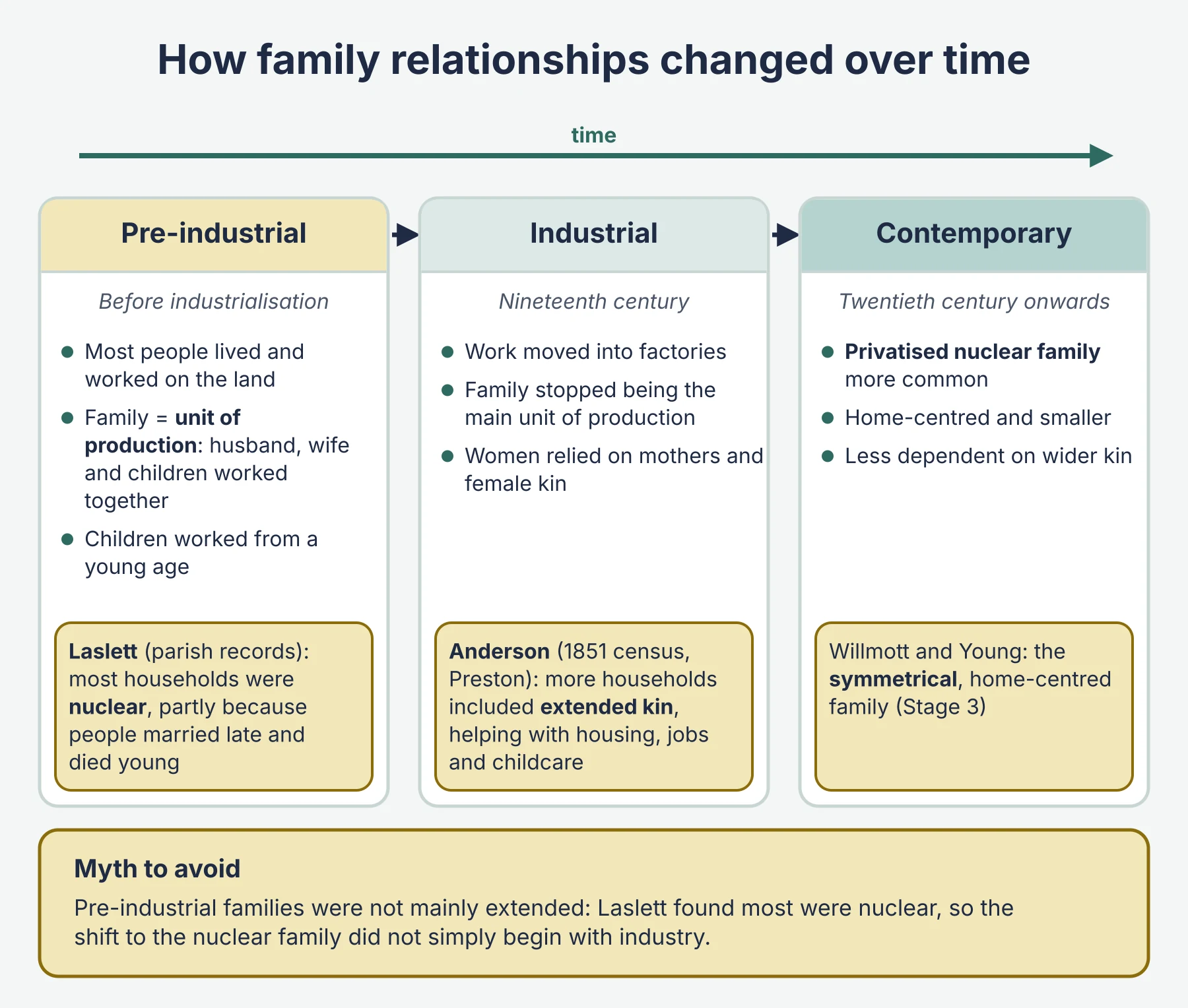
Before industrialisation, most people lived and worked on the land. The family was a unit of production: husband, wife and children worked together, and children were expected to work from a young age. Marriage was often an economic arrangement as much as a romantic one.
A common belief is that pre-industrial households were large and extended. The historian Peter Laslett’s research on English parish records challenged this: he found that most households were nuclear, partly because people married late and died relatively young. So the shift to the nuclear family did not simply begin with industry.
Industrial families
Industrialisation in the nineteenth century moved work into factories, so the family stopped being the main unit of production. Michael Anderson’s study of the 1851 census for Preston found that, in early industrial towns, more households included extended kin, because relatives helped each other with housing, jobs and childcare when there was no welfare state.
Willmott and Young called this Stage 2, the early industrial family. Men worked long hours and often spent their leisure away from home. Women, especially in poor working-class areas, relied on their own mothers and other female kin for support. Their earlier study of Bethnal Green in east London (published in 1957) described these close mother-daughter ties.
Contemporary families
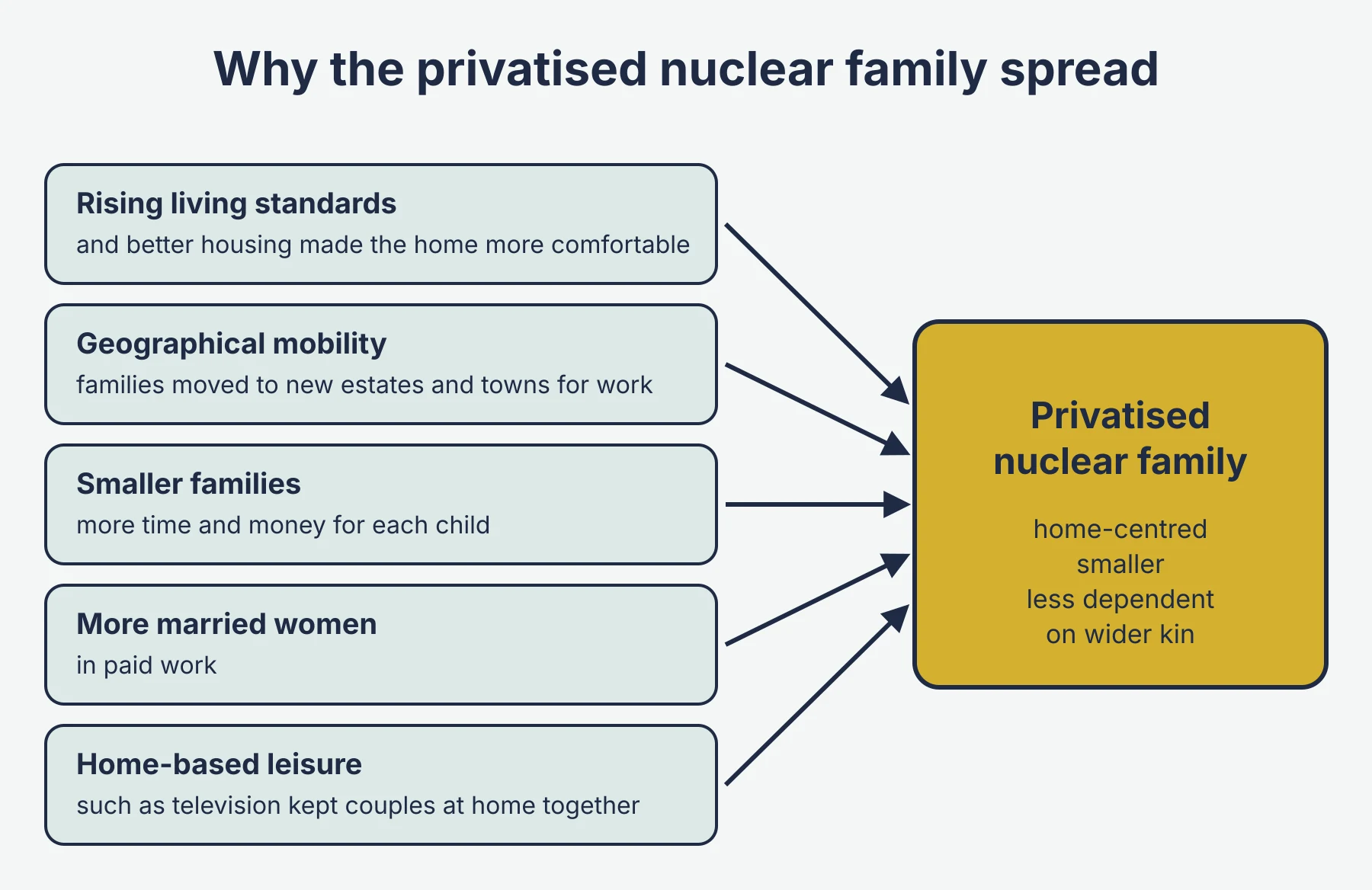
In the twentieth century the privatised nuclear family became more common: home-centred, smaller and less dependent on wider kin. Reasons include:
- rising living standards and better housing, making the home more comfortable;
- geographical mobility, as families moved to new estates and towns for work;
- smaller families, giving parents more time and money for each child;
- more married women in paid work;
- home-based leisure, such as television, which kept couples at home together.
Willmott and Young: the symmetrical family
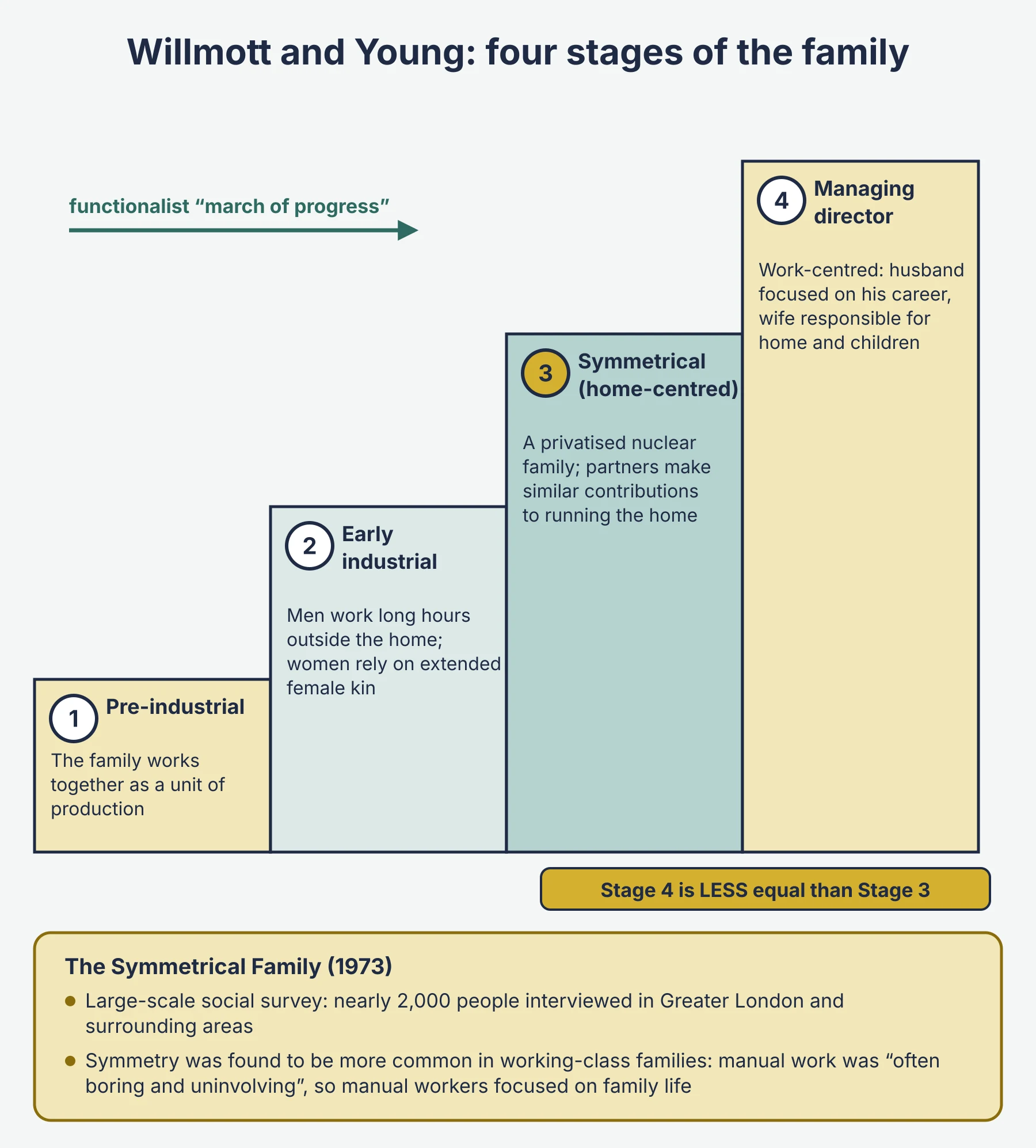
Willmott and Young wrote The Symmetrical Family (1973) from a functionalist perspective. It was based on “a large scale social survey” in which “nearly 2,000 people were interviewed in Greater London and surrounding areas”.
The four stages.
| Stage | Family type | Key features |
|---|---|---|
| 1 | Pre-industrial | The family works together as a unit of production |
| 2 | Early industrial | Men work long hours outside the home; women rely on extended female kin |
| 3 | Symmetrical (home-centred) | A privatised nuclear family; partners make similar contributions to running the home |
| 4 | Managing director | Work-centred, with the husband focused on his career and the wife responsible for home and children |
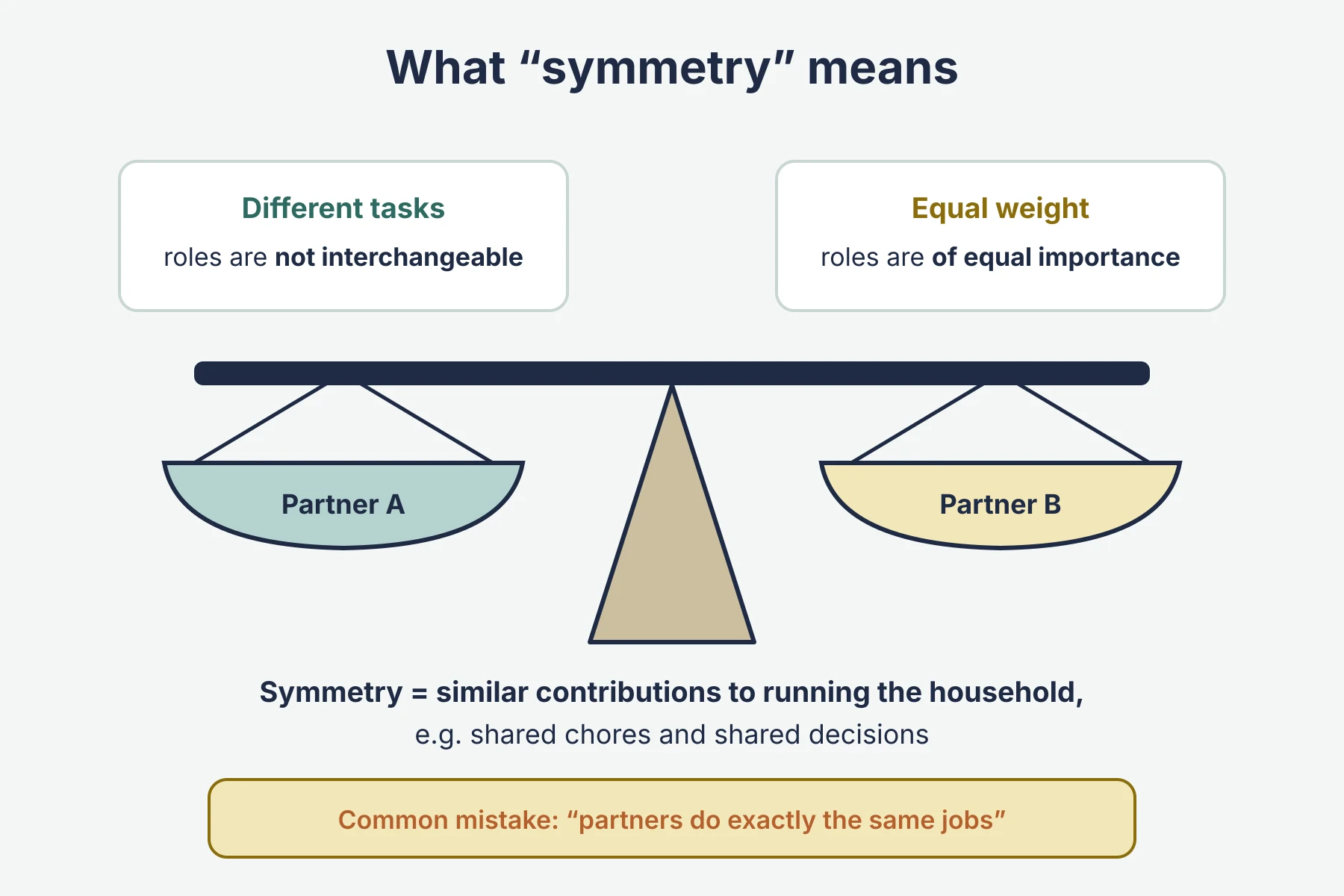
Symmetry. “Symmetry” refers to “the similar contributions made by each spouse to the running of the household eg shared chores and shared decisions”. Note the specification’s detail: conjugal roles are “not interchangeable but they are of equal importance”. Symmetry is not the same as identical roles.
Class. They found the arrangement “more common in working class families” and argued this reflected manual work being “often boring and uninvolving”, which led manual workers to focus on family life.
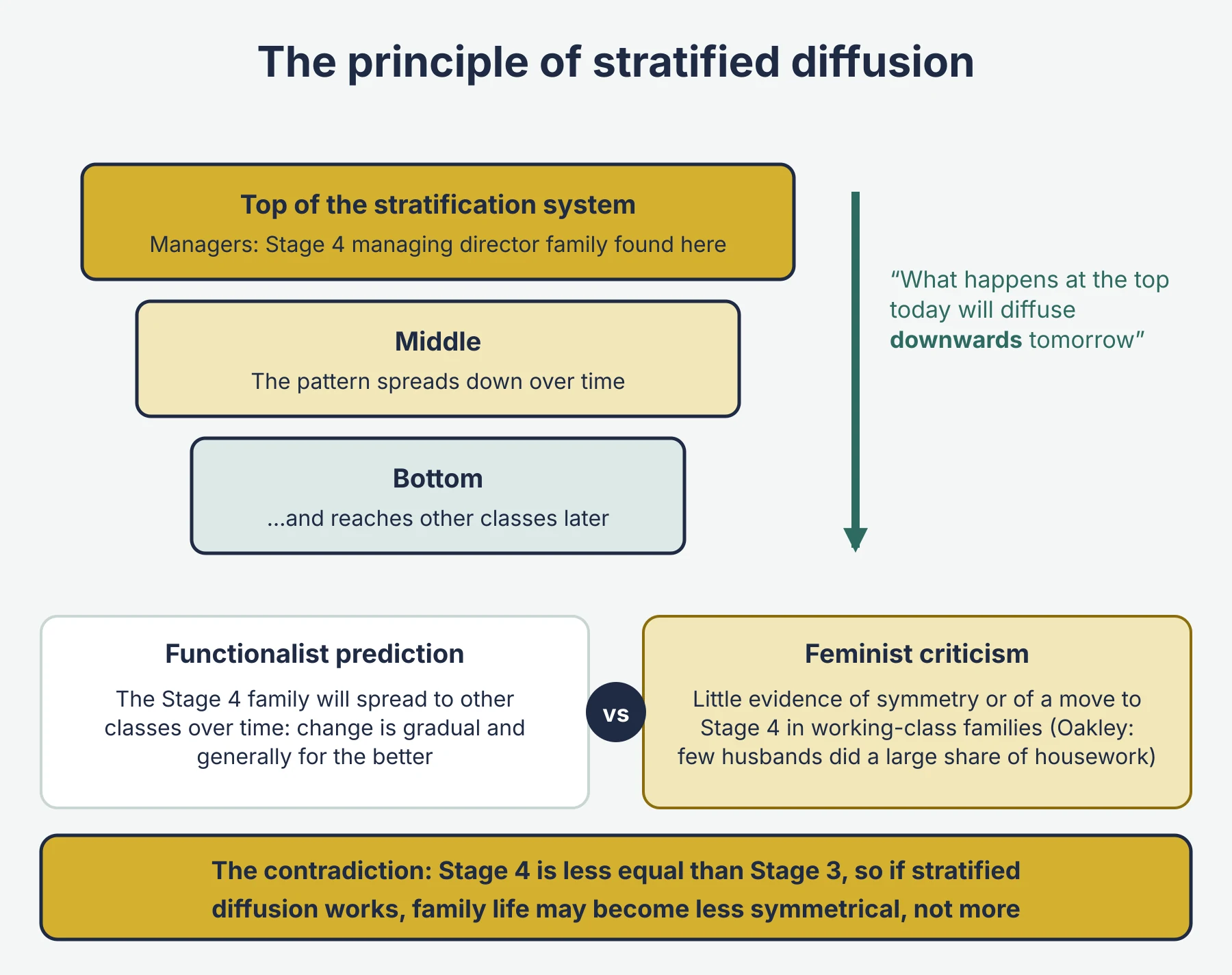
The principle of stratified diffusion. This is “the theory that what happens at the top of the stratification system today will diffuse downwards tomorrow”. Willmott and Young used it to predict that the Stage 4 managing director family found among managers would spread to other classes over time. It is a functionalist “march of progress” view: family change is gradual and generally for the better.
Criticism. The theory “has been criticised by feminists who saw little evidence of either ‘symmetry’ or a move towards Stage 4 amongst working class families”. Oakley’s research on housework is the usual evidence: few husbands did a large share. Note the contradiction feminists point out: Stage 4 is less equal than Stage 3, so if stratified diffusion works, family life may become less symmetrical, not more.
Contemporary family issues
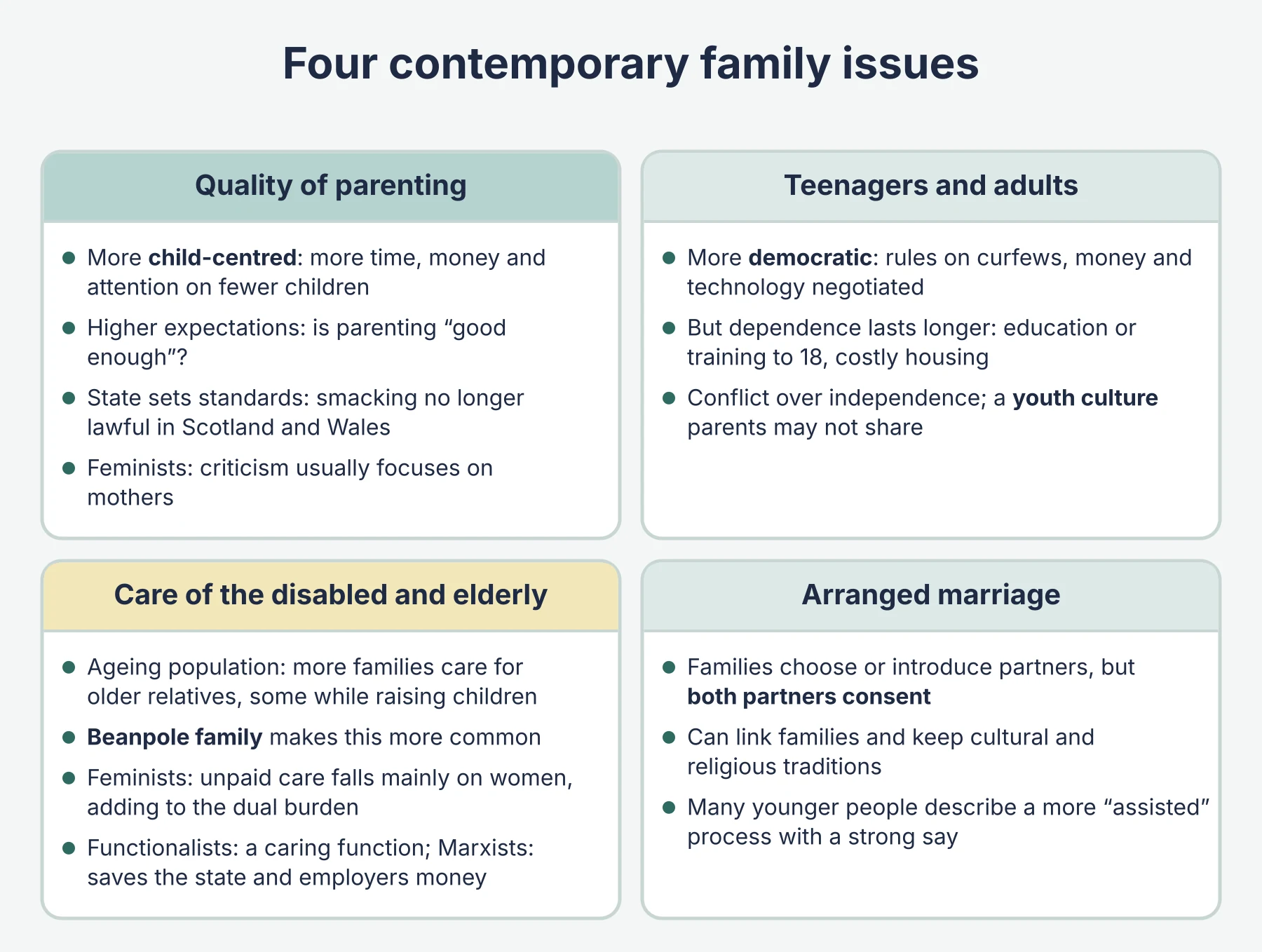
Quality of parenting. Families are now more child-centred: parents spend more time, money and attention on fewer children, and childhood is seen as a protected stage. This has raised expectations of parents, and politicians and the media often debate whether parenting is “good enough”. The state increasingly sets standards: Scotland and Wales have removed the defence of reasonable punishment, so smacking a child is no longer lawful there. Feminists note that criticism of parenting usually focuses on mothers.
Relationships between teenagers and adults. Relationships have generally become more democratic, with teenagers negotiating rules about curfews, money and technology rather than simply obeying. At the same time, dependence lasts longer: young people in England must stay in education or training until 18, and the cost of housing keeps many young adults living with parents into their twenties. This can create conflict over independence, and a youth culture that parents may not share.
Care of the disabled and elderly. An ageing population means more families care for older relatives, sometimes while still raising children. The beanpole family, with several living generations, makes this more common. Much informal care is unpaid and, feminists argue, falls mainly on women, adding to the dual burden. Functionalists see this as the family still performing a caring function alongside the welfare state; Marxists note that unpaid family care saves the state and employers money.
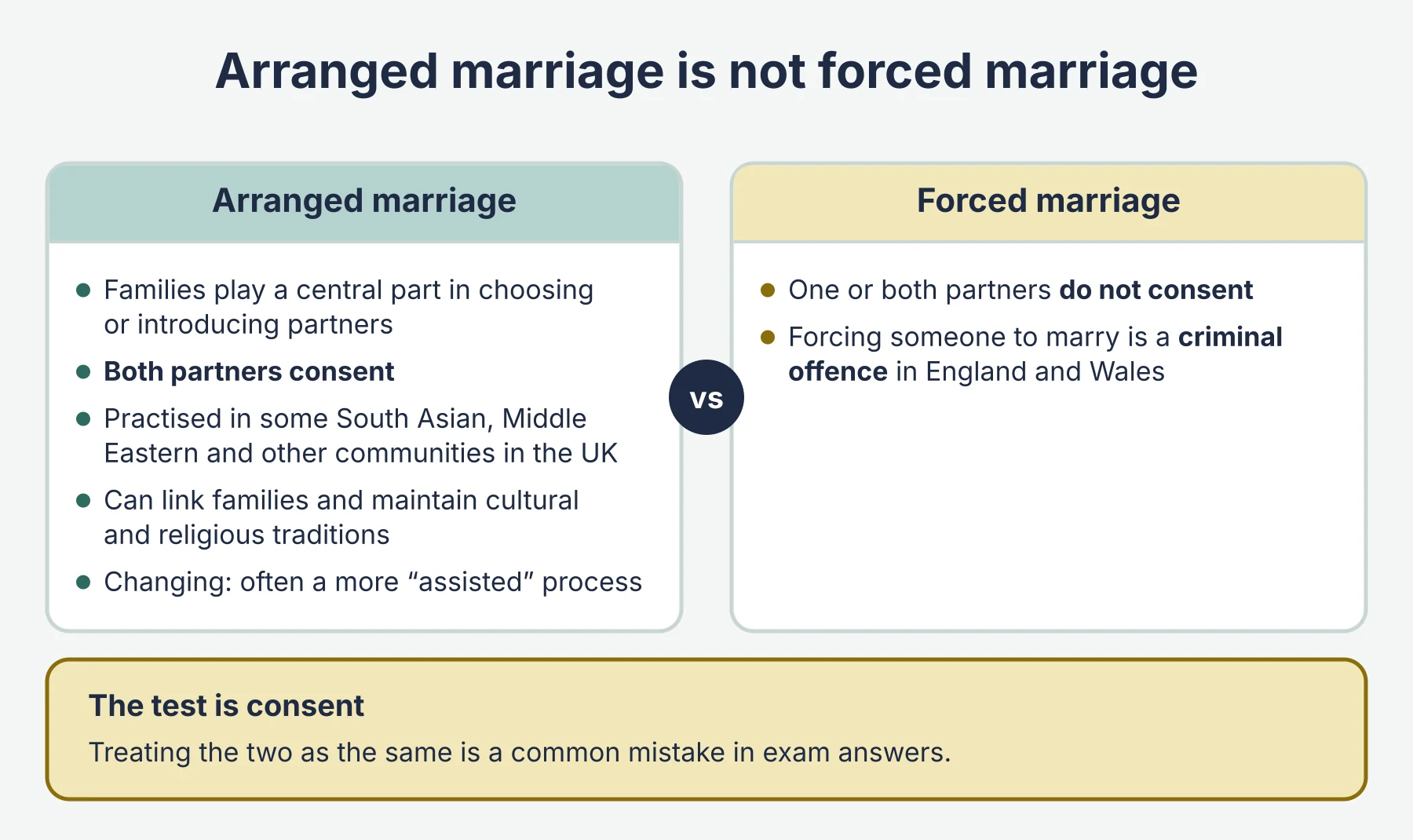
Arranged marriage. In an arranged marriage, families play a central part in choosing or introducing partners, but both partners consent. It is practised in some South Asian, Middle Eastern and other communities in the UK, and can link families and maintain cultural and religious traditions. It must not be confused with forced marriage, in which one or both partners do not consent; forcing someone to marry is a criminal offence in England and Wales. Many younger people from these communities describe a more “assisted” process, in which they have a strong say, which shows arranged marriage itself changing over time.
Perspectives compared
| Perspective | View of changing relationships |
|---|---|
| Functionalist | Change is progress: families adapt to the needs of industrial society and become more equal and home-centred (Willmott and Young) |
| Feminist | Women’s position has improved, but symmetry is exaggerated; women still carry most housework, childcare and elder care |
| Marxist | The privatised, home-centred family is a unit of consumption that suits capitalism; unpaid family care reduces costs for employers and the state |
Worked example: 3 marks
Question: Describe what Willmott and Young meant by the symmetrical family. [3]
The symmetrical family is Willmott and Young’s Stage 3, home-centred nuclear family. Symmetry means each spouse makes a similar contribution to running the household, such as sharing chores and decisions. Their roles are not interchangeable, but they are of equal importance.
Three distinct points: the stage, the meaning of symmetry, and the specification’s qualification about equal importance.
Worked example: an evaluative paragraph
Question: Discuss how far sociologists would agree that relationships between parents and children have become more equal. [12]
Relationships between parents and teenagers have become more democratic. Many families negotiate rules about phones, curfews and pocket money rather than parents simply imposing them, which suggests children have more say. This fits the functionalist view that families adapt to wider social change, in this case longer education and a stronger idea of children’s rights. However, children remain dependent for longer, because they stay in education or training until 18 and housing is expensive, so parents keep economic power. Equality in discussion is not the same as equality of power.
Common mistakes
- Saying pre-industrial families were mainly extended. Laslett found most households were nuclear.
- Defining symmetry as “partners do exactly the same jobs”. The roles are of equal importance, not interchangeable.
- Getting stratified diffusion backwards. Change starts at the top and spreads down.
- Describing Stage 4 as more equal than Stage 3.
- Treating arranged marriage and forced marriage as the same.
- Writing about contemporary issues with no link to change over time.
Exam technique
- Describe key ideas of Willmott and Young: stage, meaning of symmetry, class finding, stratified diffusion and the feminist criticism.
- Identify and explain a contemporary issue: name one of the four issues, explain how it has changed, and link it to a perspective.
- Discuss how far: set Willmott and Young against feminist evidence, use one contemporary issue as a test case, and finish with a judgement about how much has changed and for whom.
Official syllabus
AQA GCSE Sociology (8192) specification, Version 1.2 (June 2026), for GCSE exams 2019 onwards: section 3.3.4 Changing relationships within families and Appendix B, 7.1 Families (Willmott and Young).
Related resources
-
Practice questions
AQA GCSE Sociology (8192): Changing relationships within families – Practice Questions
Original AQA GCSE Sociology 8192 practice on 3.3.4: family change over time, Willmott and Young, parenting, teenagers, elder care and arranged marriage.
Sociology · AQA · GCSE
Try questions -
Revision notes
AQA GCSE Sociology (8192): Changing relationships within families – Revision Notes
Condensed AQA GCSE Sociology 8192 notes on 3.3.4: three periods of family change, Willmott and Young's stages, four contemporary issues and a self-test.
Sociology · AQA · GCSE
Revise topic -
Study guides
AQA GCSE Sociology (8192): Conjugal role relationships
In-depth AQA GCSE Sociology 8192 guide to 3.3.3: joint and segregated roles, the domestic division of labour, Oakley, decision making and money management.
Sociology · AQA · GCSE
Read guide
Related articles
Get free revision emails (optional)
Occasional emails with practice questions, worked explanations and links to free resources for the qualification and subjects you choose. No spam, and you can unsubscribe from any email. The free tools on this site never need an email.