
Revision Notes
AQA GCSE Sociology (8192): Conjugal role relationships – Revision Notes
Condensed AQA GCSE Sociology 8192 notes on 3.3.3 conjugal roles: joint and segregated roles, Oakley, the five contemporary issues, perspectives and a self-test.
- Subject
- Sociology
- Level
- GCSE
- Topic
- Families
- Author
- Marlbridge Academic Team
- Updated
- Reviewed by
- Naqiya Yousaf (what this means)
Aligned to AQA GCSE Sociology (8192), first teaching 2017. Official specification .
Syllabus page (what it covers and how it is assessed): AQA GCSE Sociology.
Syllabus points this page covers
8192
- 3.3.3 Conjugal role relationships
Found an error? Report a correction.
Need help with this topic? Request a free trial class for GCSE Sociology (8192).
These notes condense 3.3.3 Conjugal role relationships from the AQA GCSE Sociology (8192) specification, assessed in Paper 1. The specification names “the feminist perspective of Oakley on the idea of the conventional family” and asks you to explain joint and segregated roles, the domestic division of labour in traditional and contemporary families, and five issues: “decision making, money management, dual career families, child rearing and leisure activities”.
For full explanations and worked answers, read the conjugal role relationships study guide. Then try the conjugal role relationships practice questions.
Key terms
| Term | Meaning |
|---|---|
| Conjugal roles | The roles partners take on in a marriage or partnership |
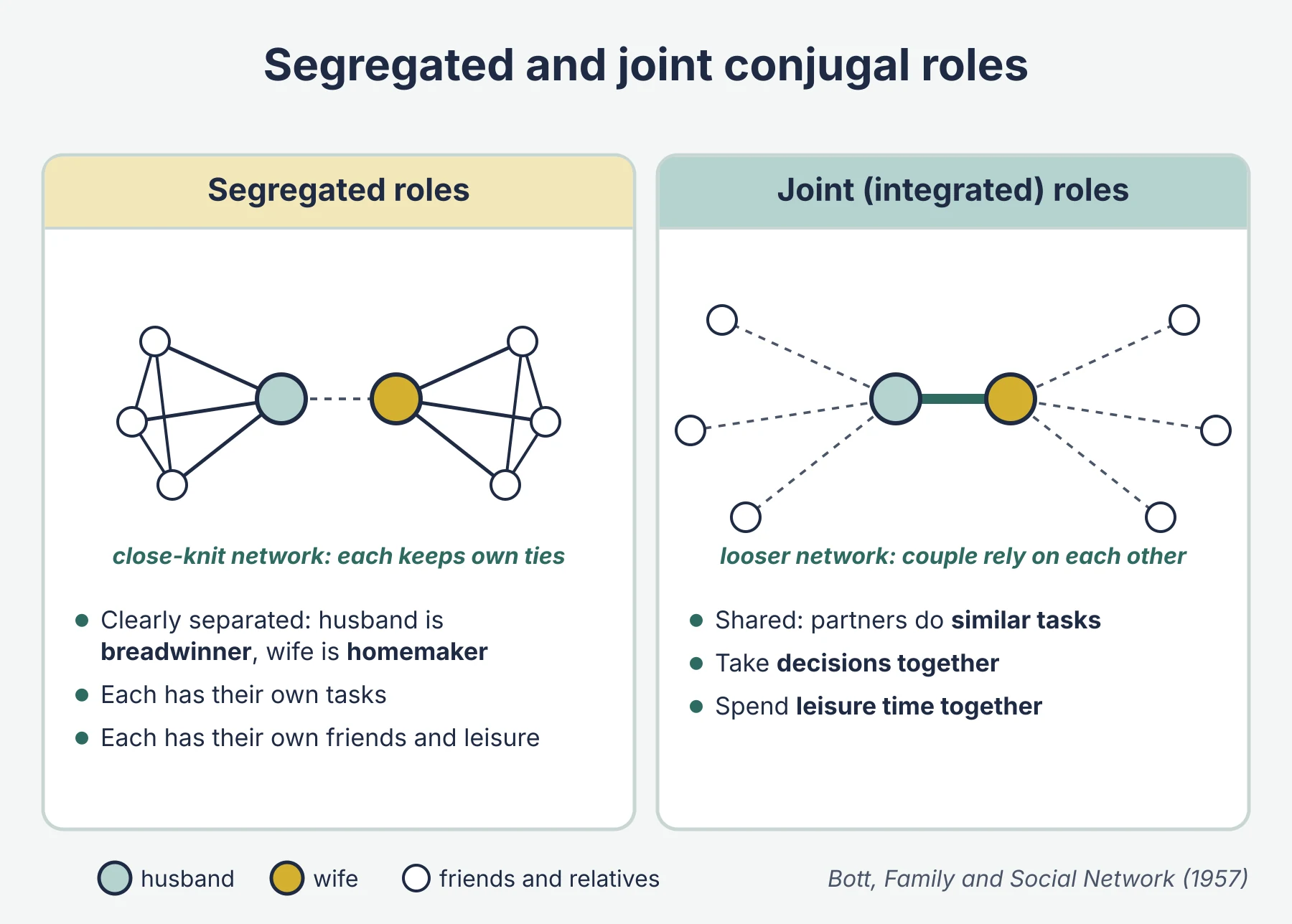
| Segregated conjugal roles | Separate tasks, decisions and leisure for each partner |
| Joint (integrated) conjugal roles | Shared tasks, decisions and leisure |
| Domestic division of labour | How housework, childcare and unpaid work are divided |
| Traditional family roles | Male breadwinner and female homemaker |
| Instrumental role | Parsons: the providing role he linked to husbands |
| Expressive role | Parsons: the caring role he linked to wives |
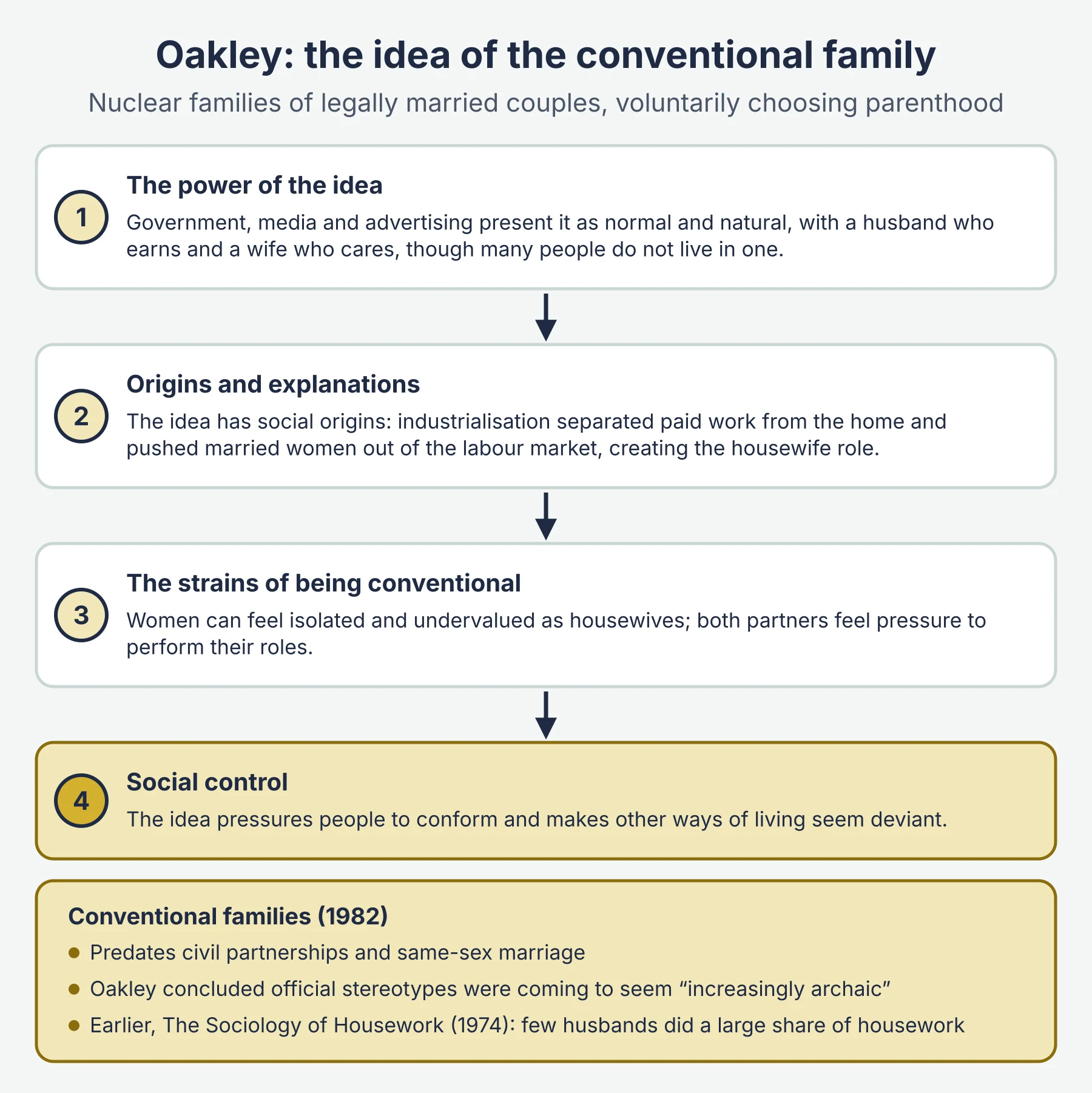
| Conventional family | Oakley: nuclear family of a legally married couple who chose to have children |
| Dual career family | Both partners pursue careers (term introduced by the Rapoports) |
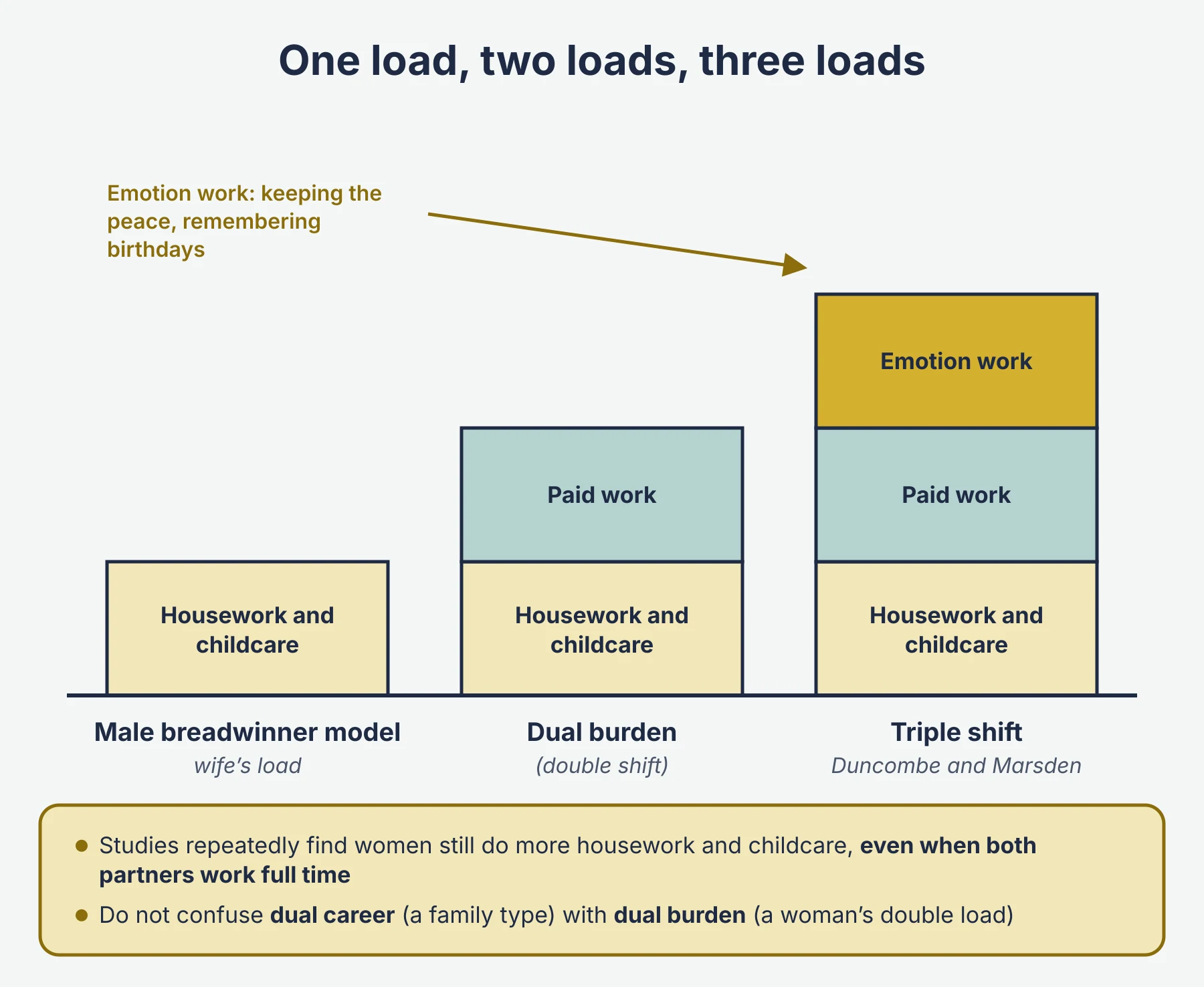
| Double shift (dual burden) | Paid work plus most of the housework and childcare |
| Triple shift | Paid work, domestic work and emotion work (Duncombe and Marsden) |
| New man | A man who shares housework, childcare and emotional work |
| Role conflict | Clashing demands of two roles, such as worker and parent |
| Work life balance | Fitting paid work around family and personal life |
| Egalitarian | Based on equality between partners |
| Patriarchy | A system of male dominance |
Joint versus segregated at a glance
| Segregated | Joint | |
|---|---|---|
| Paid work | Husband earns; wife at home or part time | Both may earn |
| Housework | Wife’s responsibility | Shared |
| Decisions | Separate spheres | Taken together |
| Leisure | Separate friends and activities | Shared, often home-centred |
| Bott (1957) | Linked to close-knit networks | Linked to looser networks |
Oakley in four steps
- Definition: the conventional family is a nuclear family of a legally married couple who voluntarily chose parenthood.
- Power of the idea: it is presented as normal by government, media and advertising, even though many people live otherwise.
- Strains: being conventional brings isolation and low value for housewives, and pressure on both partners.
- Social control: the idea pressures people to conform and makes alternatives look deviant.
Conclusion: official stereotypes were coming to seem “increasingly archaic”. Earlier evidence: The Sociology of Housework (1974), interviews with London housewives, found few husbands doing a large share of housework.
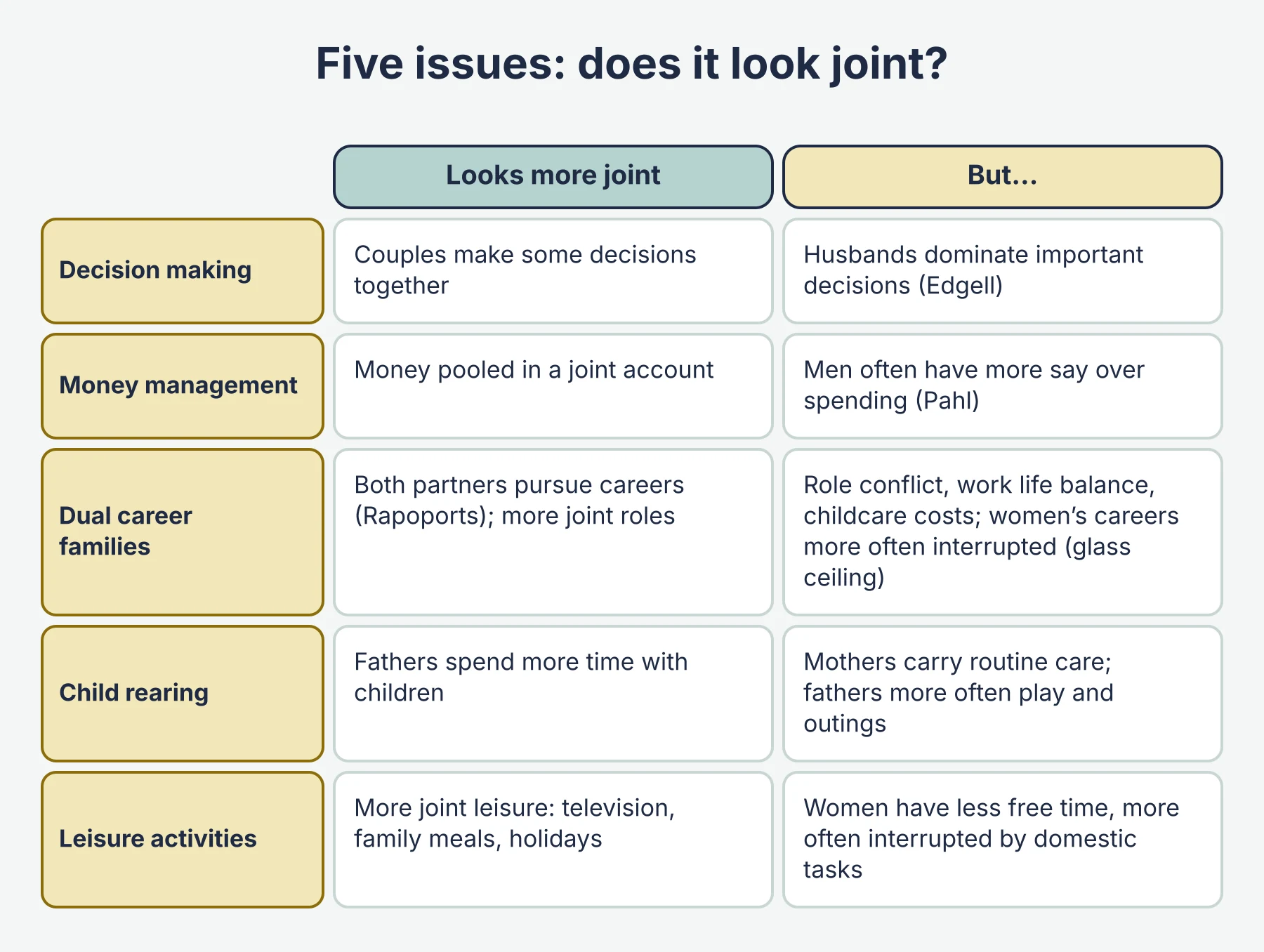
The five issues in one line each
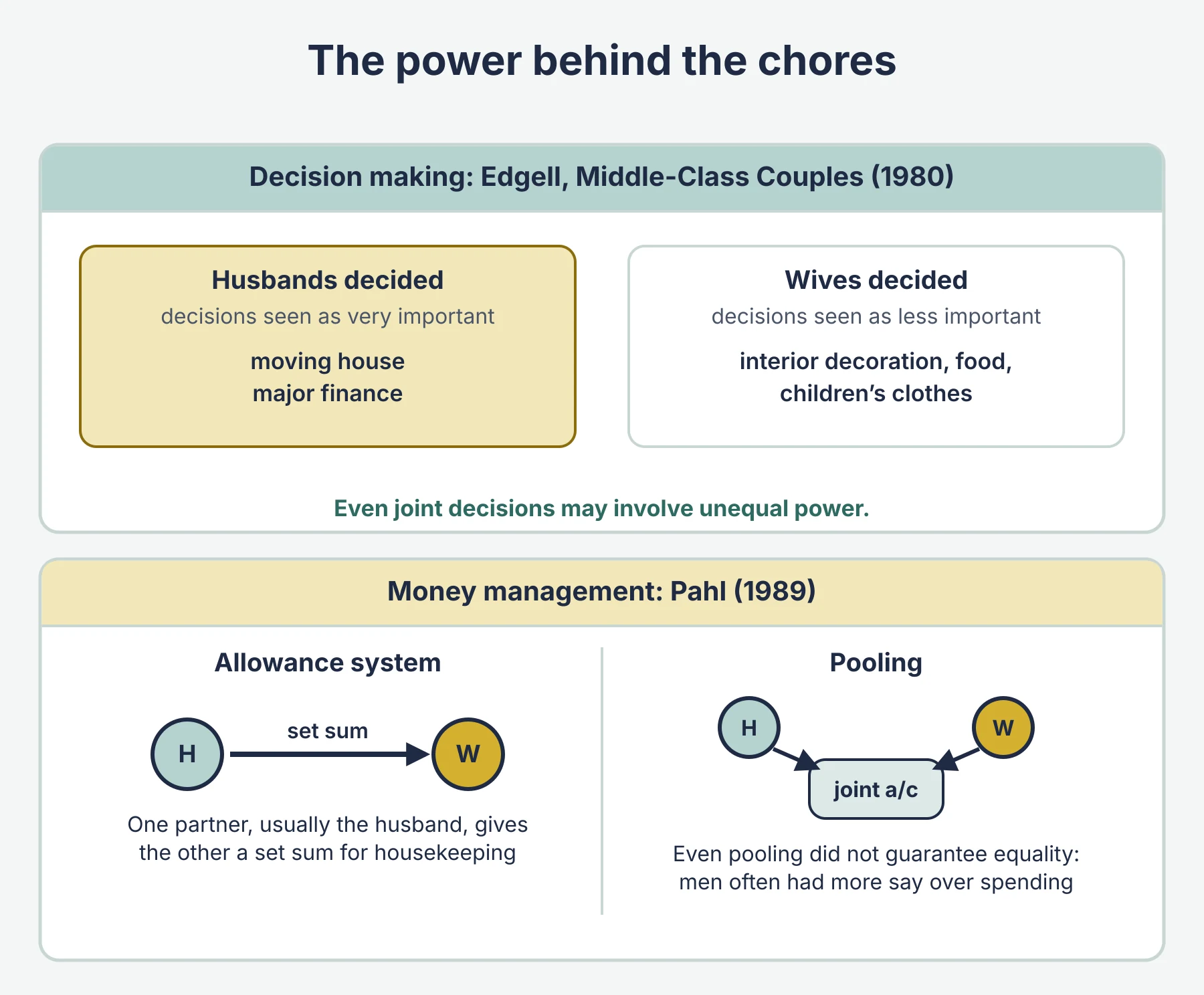
- Decision making: Edgell (1980) found husbands dominated the most important decisions, such as moving house and finance; wives decided less important ones, such as decoration and children’s clothes.
- Money management: Pahl (1989) described allowance and pooling systems; pooling did not guarantee equal control.
- Dual career families: more sharing is possible, but role conflict, childcare costs and interrupted careers for women remain.
- Child rearing: fathers are more involved, but mothers usually do more routine care.
- Leisure activities: more joint, home-centred leisure; women have less free time and more interruptions.
Perspectives
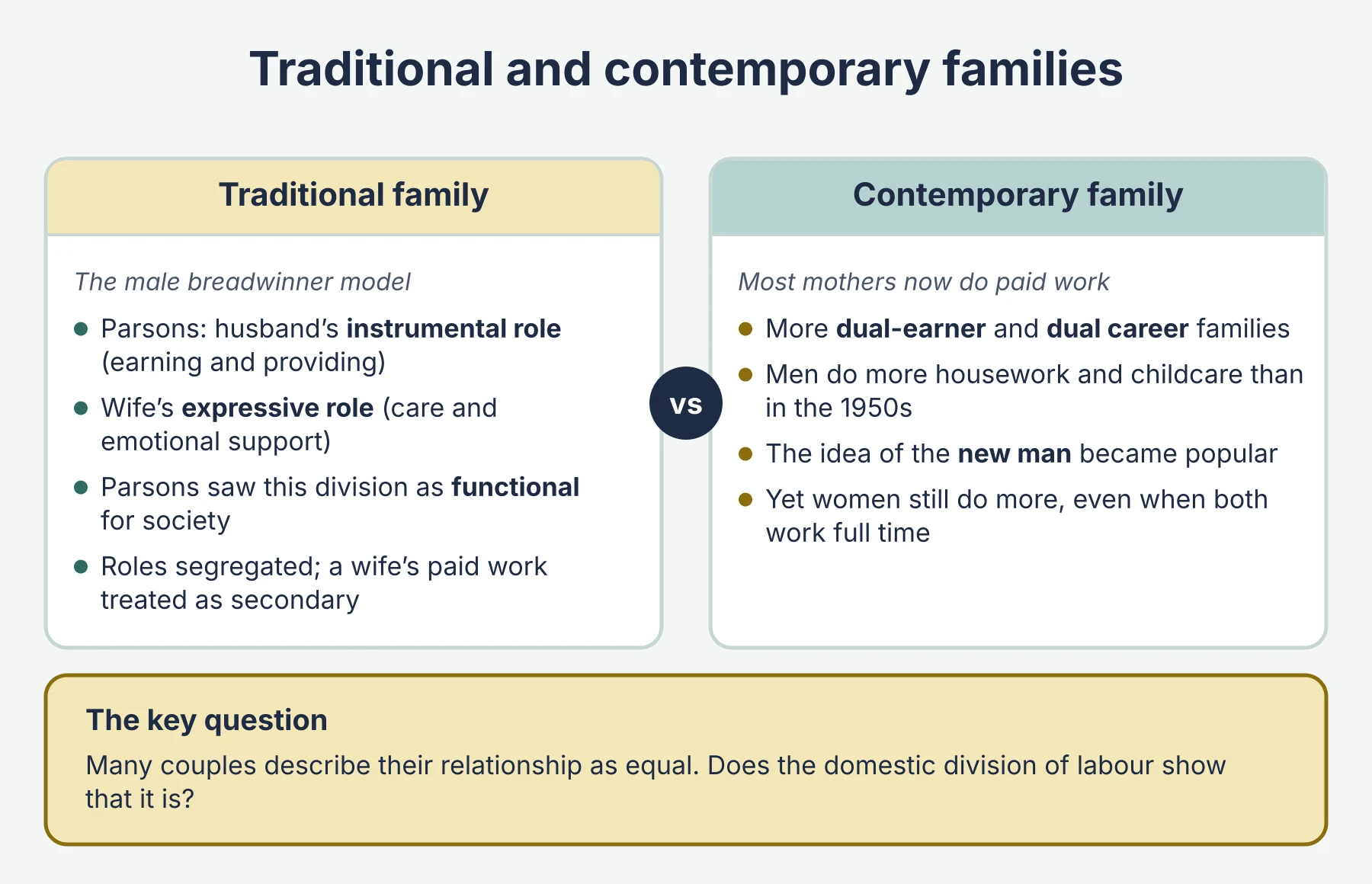
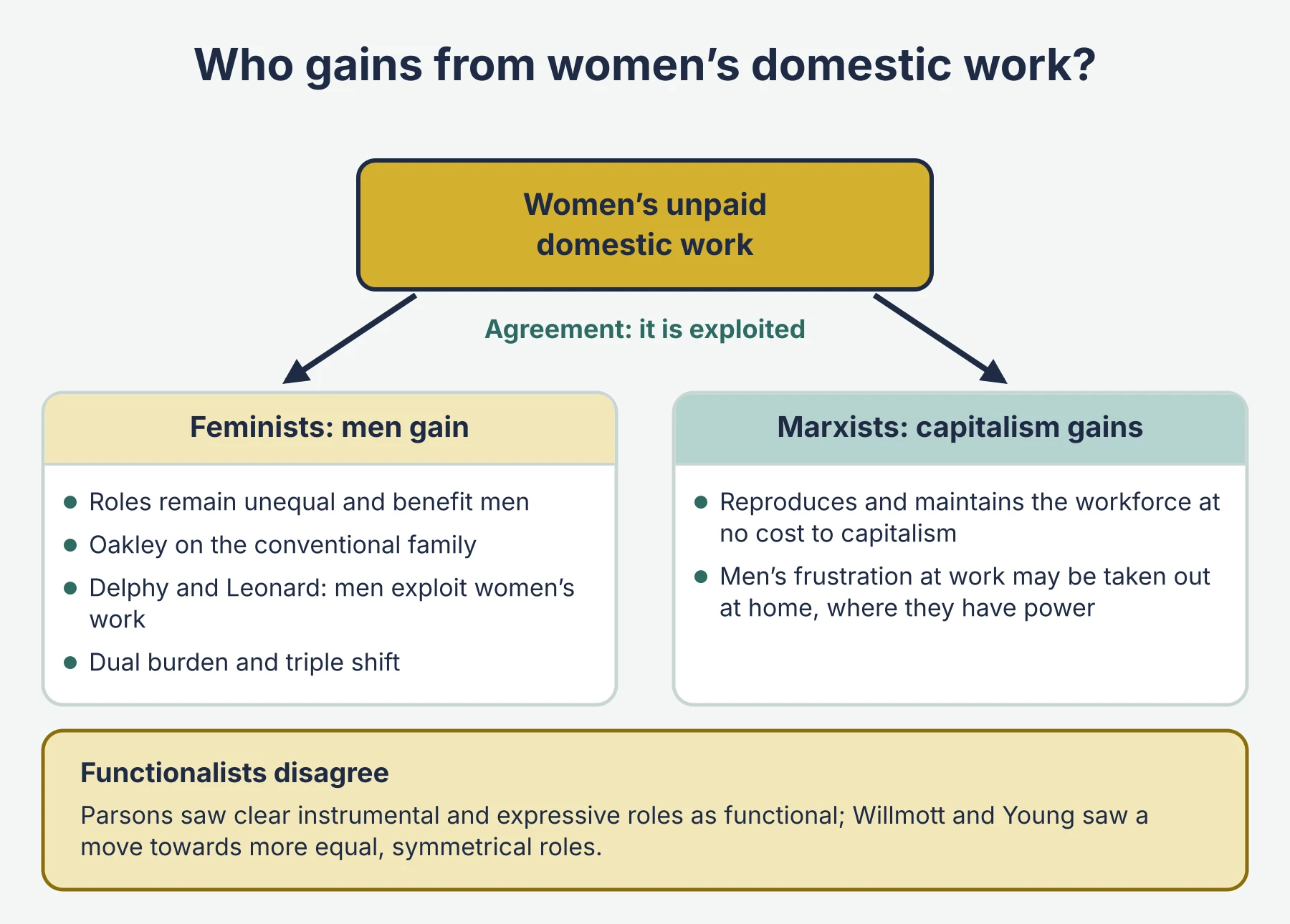
- Functionalist: Parsons saw instrumental and expressive roles as functional. Willmott and Young, also functionalists, saw a trend towards symmetry.
- Feminist: Oakley; Delphy and Leonard (men exploit women’s work, even when wives have paid jobs); dual burden and triple shift.
- Marxist: women’s unpaid labour maintains the workforce free of charge for capitalism; the home is where alienated men hold power.
Exam traps
- Saying joint roles just mean both partners have jobs.
- Using Oakley only for housework statistics and forgetting the conventional family.
- Confusing dual career family (a family type) with dual burden (a woman’s load).
- Listing chores and ignoring power over money and decisions.
- Forgetting that Parsons saw segregated roles as positive.
- Answering an item question without naming the concept the item shows.
Quick self-test
- What are segregated conjugal roles?
- What are joint conjugal roles?
- What did Bott link to segregated roles?
- How does the specification define Oakley’s conventional family?
- Give two parts of Oakley’s argument about the conventional family.
- What did Edgell find about decision making?
- What is an allowance system of money management?
- What problem did Pahl find with pooling?
- What is a dual career family?
- What is the difference between the dual burden and the triple shift?
- How do Marxists explain women’s domestic labour?
- Which perspective is Willmott and Young’s work linked to in the specification?
Answers
- Roles in which partners have separate tasks, decisions and leisure, usually male breadwinner and female homemaker.
- Roles in which partners share tasks, decisions and leisure.
- Close-knit social networks, where each partner kept strong ties with their own friends and relatives.
- “Nuclear families composed of legally married couples, voluntarily choosing the parenthood of one or more children.”
- Any two: the power of the idea; its origins; the strains of being conventional; social control.
- Husbands dominated very important decisions; wives made less important ones.
- One partner, usually the husband, gives the other a set sum for housekeeping.
- Men often still had more say over how shared money was spent.
- A family in which both partners pursue careers.
- The dual burden is paid work plus domestic work; the triple shift adds emotion work.
- It reproduces and maintains the workforce at no cost to employers, so it benefits capitalism.
- Functionalist.
Official syllabus
AQA GCSE Sociology (8192) specification, Version 1.2 (June 2026), for GCSE exams 2019 onwards: section 3.3.3 Conjugal role relationships and Appendix B, 7.1 Families.
Related resources
-
Study guides
AQA GCSE Sociology (8192): Criticisms of families
In-depth AQA GCSE Sociology 8192 guide to 3.3.5: the six criticisms of families, Zaretsky's Marxist view and Delphy and Leonard's feminist critique compared.
Sociology · AQA · GCSE
Read guide -
Practice questions
AQA GCSE Sociology (8192): Criticisms of families – Practice Questions
Original AQA GCSE Sociology 8192 practice on 3.3.5 criticisms of families: isolation, dysfunction, Zaretsky and Delphy and Leonard, with marked answers.
Sociology · AQA · GCSE
Try questions -
Revision notes
AQA GCSE Sociology (8192): Criticisms of families – Revision Notes
Condensed AQA GCSE Sociology 8192 notes on 3.3.5: the six criticisms of families, Zaretsky and Delphy and Leonard side by side, exam traps and a self-test.
Sociology · AQA · GCSE
Revise topic
Related articles
Get free revision emails (optional)
Occasional emails with practice questions, worked explanations and links to free resources for the qualification and subjects you choose. No spam, and you can unsubscribe from any email. The free tools on this site never need an email.