
Revision Notes
AQA GCSE Sociology (8192): Criticisms of families – Revision Notes
Condensed AQA GCSE Sociology 8192 notes on 3.3.5: the six criticisms of families, Zaretsky and Delphy and Leonard side by side, exam traps and a self-test.
- Subject
- Sociology
- Level
- GCSE
- Topic
- Families
- Author
- Marlbridge Academic Team
- Updated
- Reviewed by
- Naqiya Yousaf (what this means)
Aligned to AQA GCSE Sociology (8192), first teaching 2017. Official specification .
Syllabus page (what it covers and how it is assessed): AQA GCSE Sociology.
Syllabus points this page covers
8192
- 3.3.5 Criticisms of families
Found an error? Report a correction.
Need help with this topic? Request a free trial class for GCSE Sociology (8192).
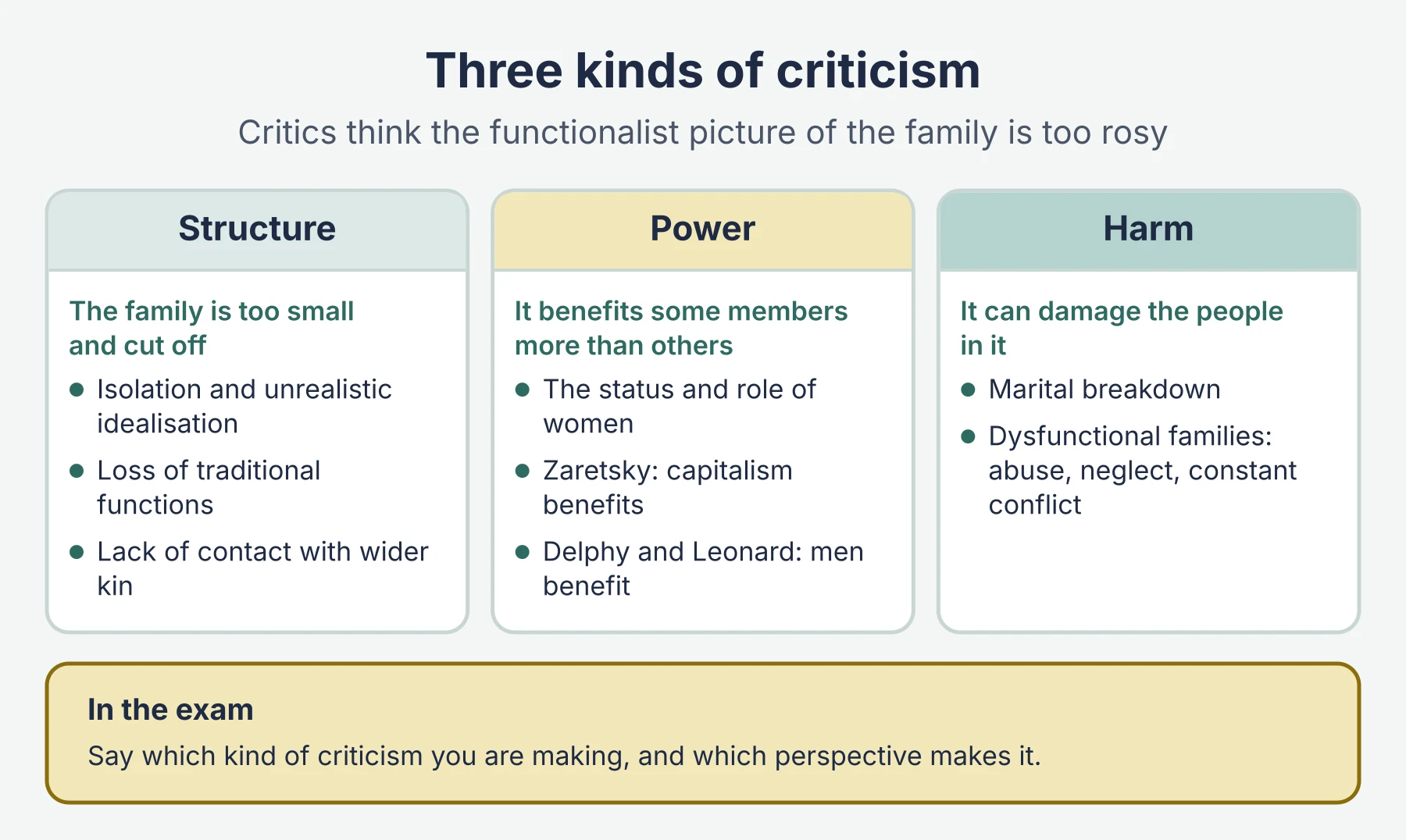
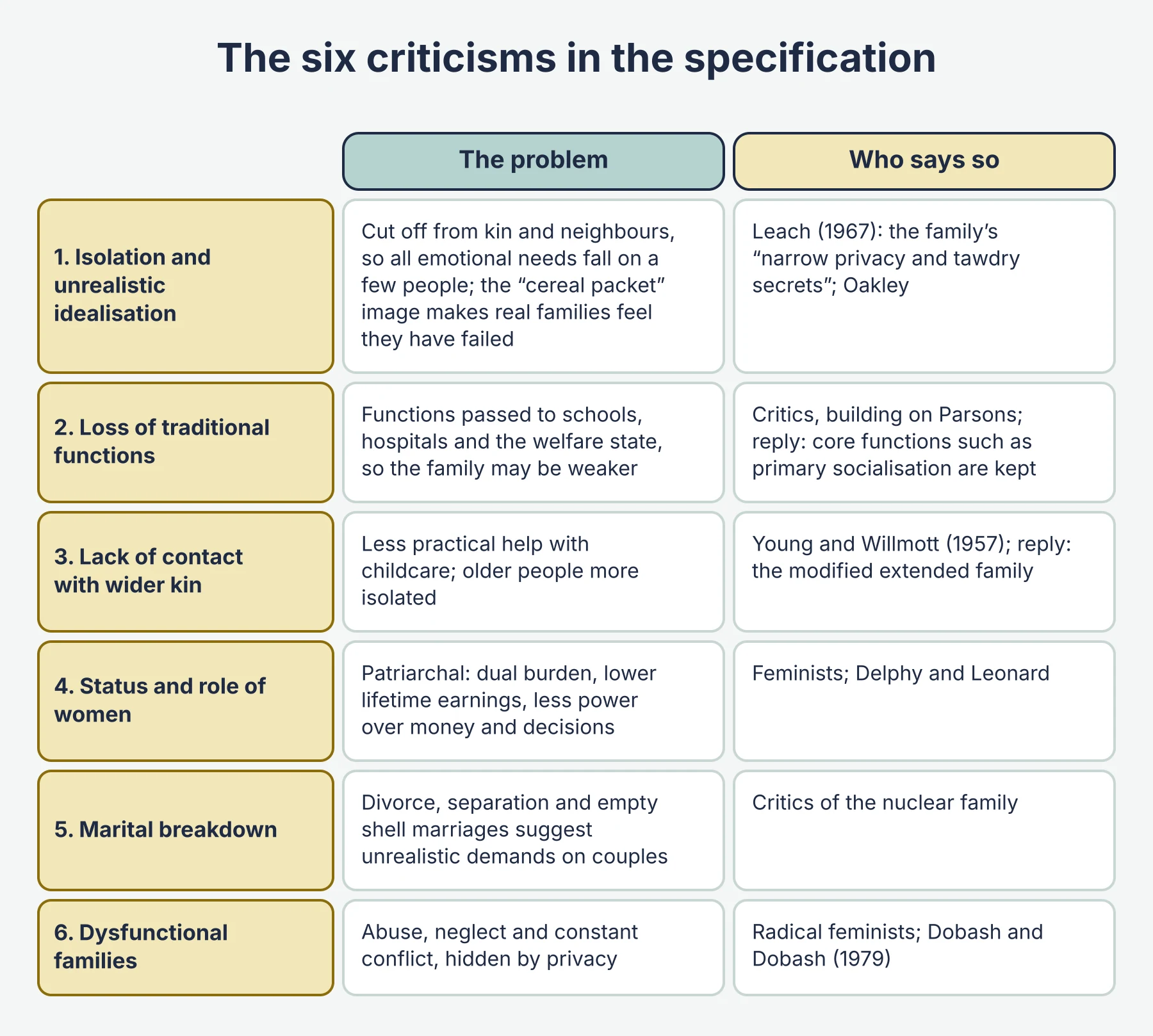
These notes condense 3.3.5 Criticisms of families from the AQA GCSE Sociology (8192) specification, assessed in Paper 1. The specification lists six criticisms (“isolation and unrealistic idealisation, loss of traditional functions, lack of contact with wider kinship networks, the status and role of women within families, marital breakdown, dysfunctional families”) and names Zaretsky (Marxist) and Delphy and Leonard (feminist).
For full explanations and worked answers, read the criticisms of families study guide. Then try the criticisms of families practice questions.
Key terms
| Term | Meaning |
|---|---|
| Isolation (social and family) | Being cut off from neighbours, kin and wider support |
| Idealisation | Presenting family life as more perfect than it really is |
| Privatised nuclear family | A home-centred family with weak ties outside the home |
| Kinship network | The web of relatives beyond the household |
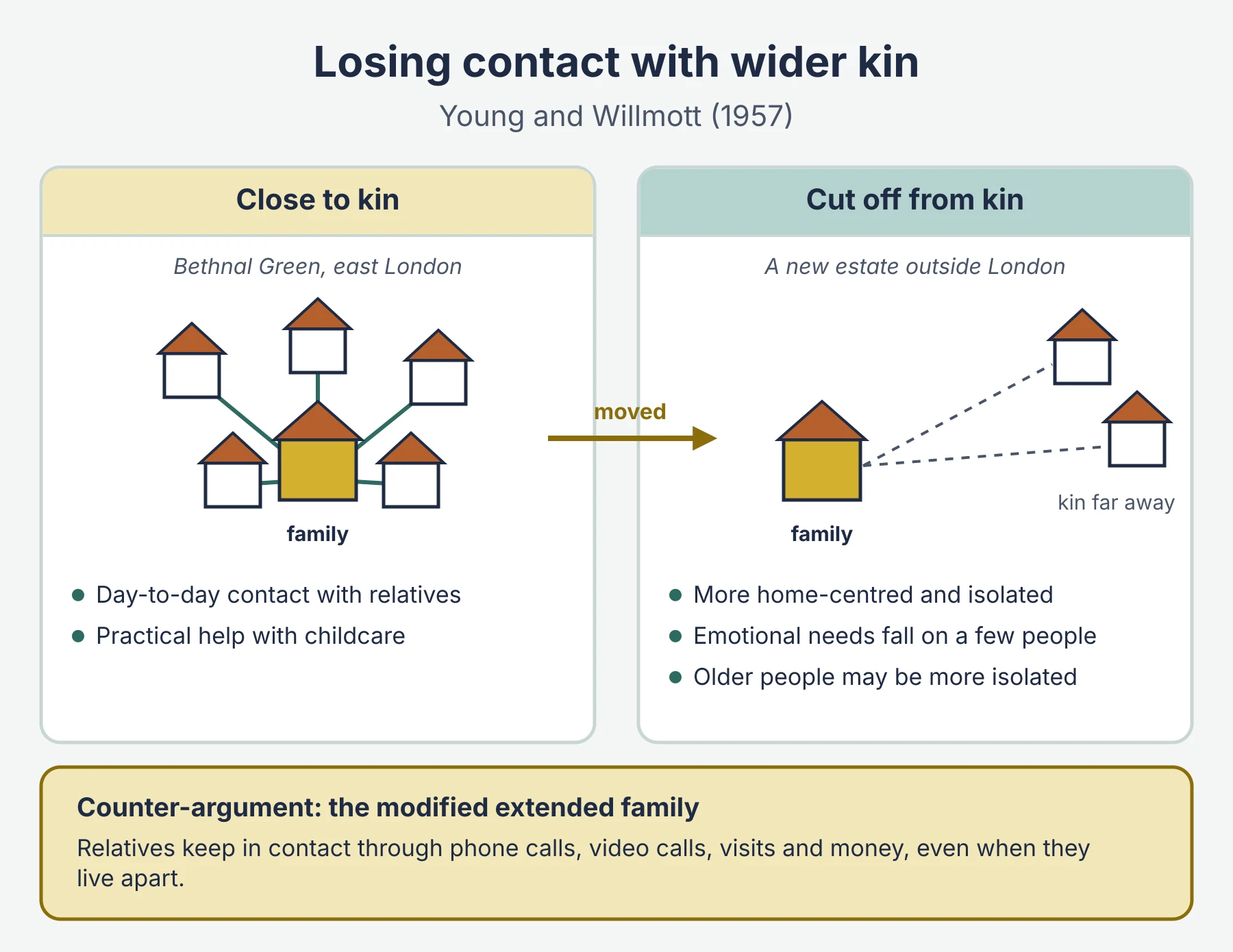
| Modified extended family | Kin who live apart but keep close contact |
| Marital breakdown | The end of a marriage in practice, through divorce, separation or an empty shell marriage |
| Empty shell marriage | A couple who stay married but no longer share a loving relationship |
| Dysfunctional family | A family that harms its members rather than meeting their needs |
| Patriarchy | A system of male dominance |
| Alienation | Marx’s idea that workers lack control and meaning in their work |
| Unit of consumption | A family that buys goods and services, providing profit for capitalism |
| Appropriation | Taking something, here women’s labour, for another’s benefit |
| Dual burden | Paid work plus most domestic work |
The six criticisms in one line each
| Criticism | The problem | Usually made by |
|---|---|---|
| Isolation and unrealistic idealisation | Small, inward-looking families overload a few people; ideal images create pressure and stigma (Leach; Oakley) | Critics of the privatised family; feminists |
| Loss of traditional functions | Functions passed to schools, hospitals and the state may weaken the family | Developed from Parsons’ account |
| Lack of contact with wider kin | Mobility leaves families without practical support (Young and Willmott’s 1957 study of families leaving Bethnal Green) | Various |
| Status and role of women | Unpaid, low-status work and the dual burden | Feminists |
| Marital breakdown | Divorce, separation and empty shell marriages show families failing to meet expectations | Various |
| Dysfunctional families | Abuse, neglect and conflict hidden by privacy | Radical feminists and others |
Leach (1967): the family, “with its narrow privacy and tawdry secrets, is the source of all our discontents”.
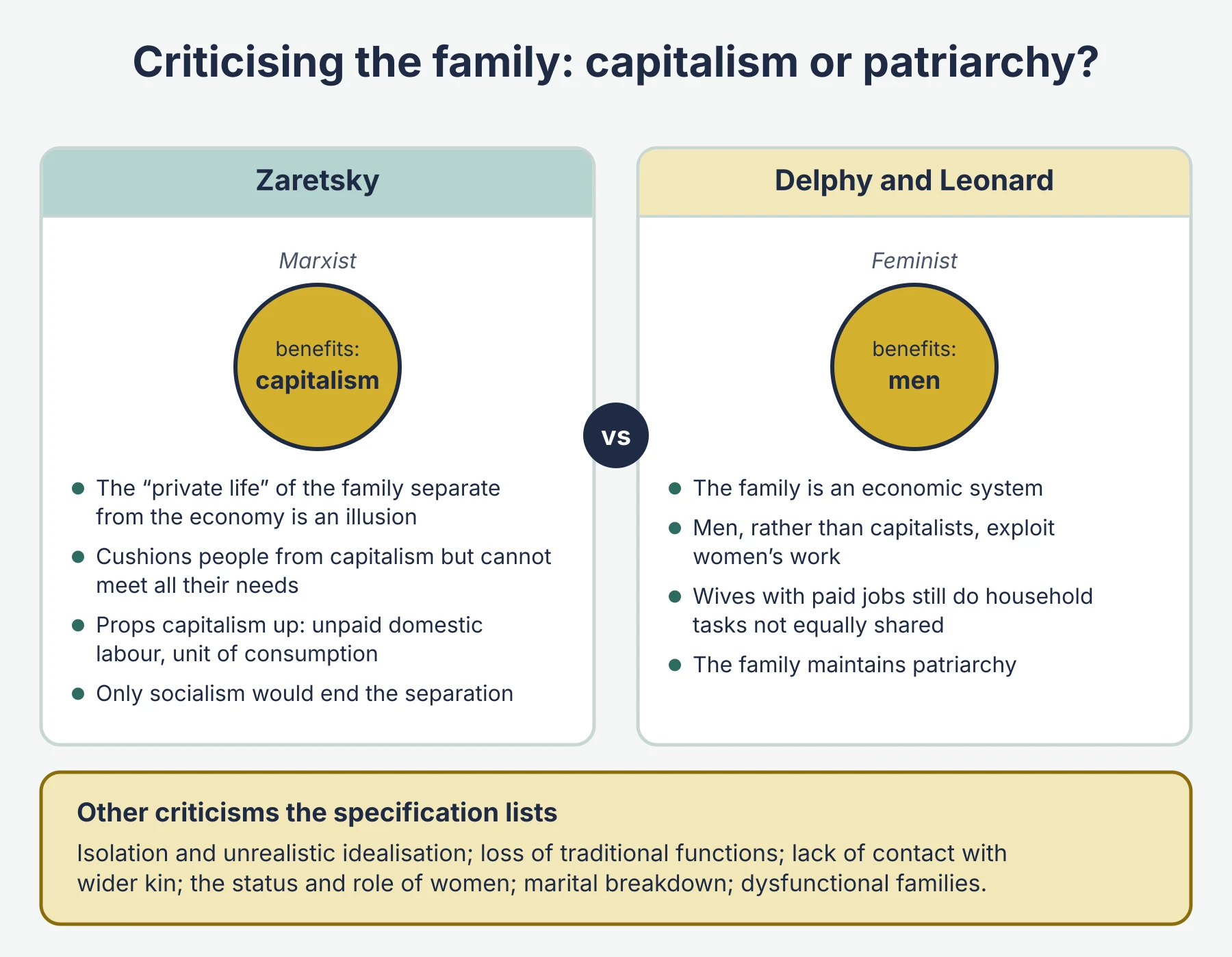
Zaretsky in six bullets
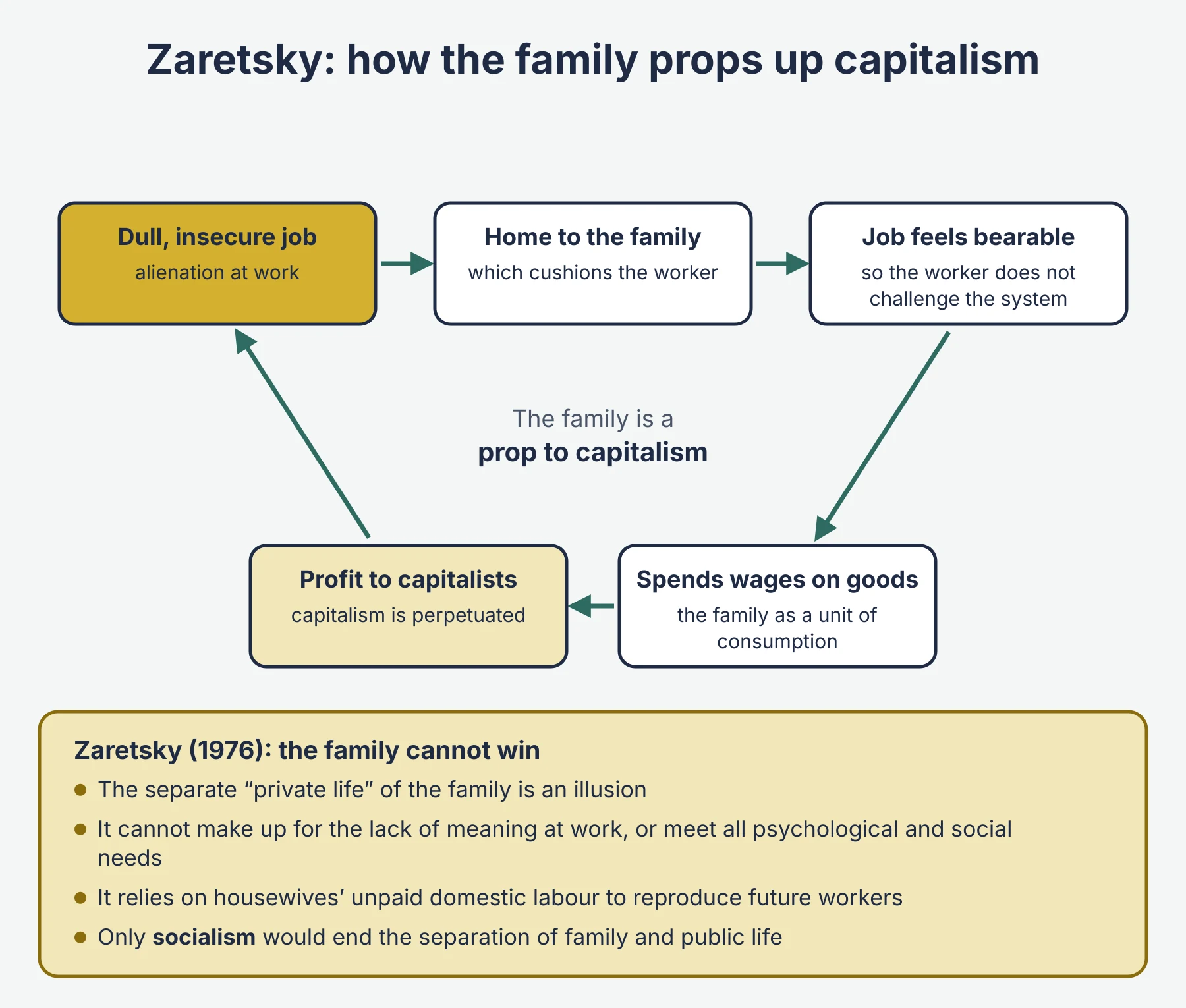
- Marxist: Capitalism, the Family and Personal Life (1976).
- Capitalism creates an illusion that family “private life” is separate from the economy.
- The family cannot meet individuals’ psychological and social needs.
- It cushions the effects of capitalism but perpetuates it, and cannot make up for alienation.
- It props up capitalism: housewives’ domestic labour reproduces future workers; it is a vital unit of consumption.
- Only socialism will end the separation of family and public life.
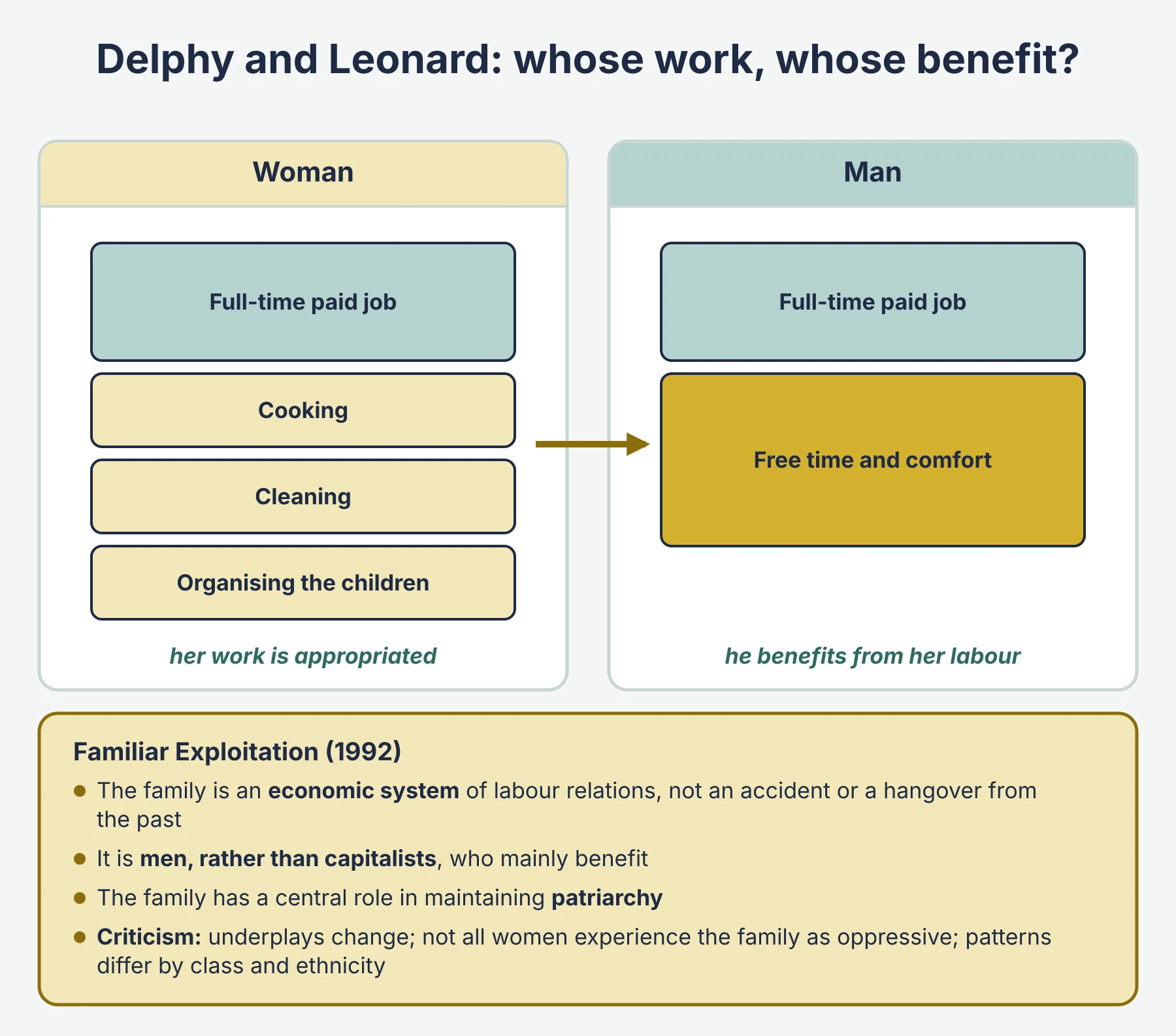
Delphy and Leonard in five bullets
- Feminist: Familiar Exploitation (1992).
- They emphasise the importance of work.
- Men, rather than capitalists as such, are the prime beneficiaries of women’s labour.
- The family is an economic system of labour relations with a central role in maintaining patriarchy.
- Women’s work is appropriated; wives with paid jobs still do unshared household tasks.
Side by side
| Zaretsky | Delphy and Leonard | |
|---|---|---|
| Who benefits? | Capitalism | Men |
| Main idea | The private family is an illusion that props up capitalism | The family is an economic system that exploits women |
| Solution | Socialism | End patriarchal relations |
| Shared ground | Both conflict views; both focus on domestic labour; both reject the functionalist view | Same |
The functionalist reply
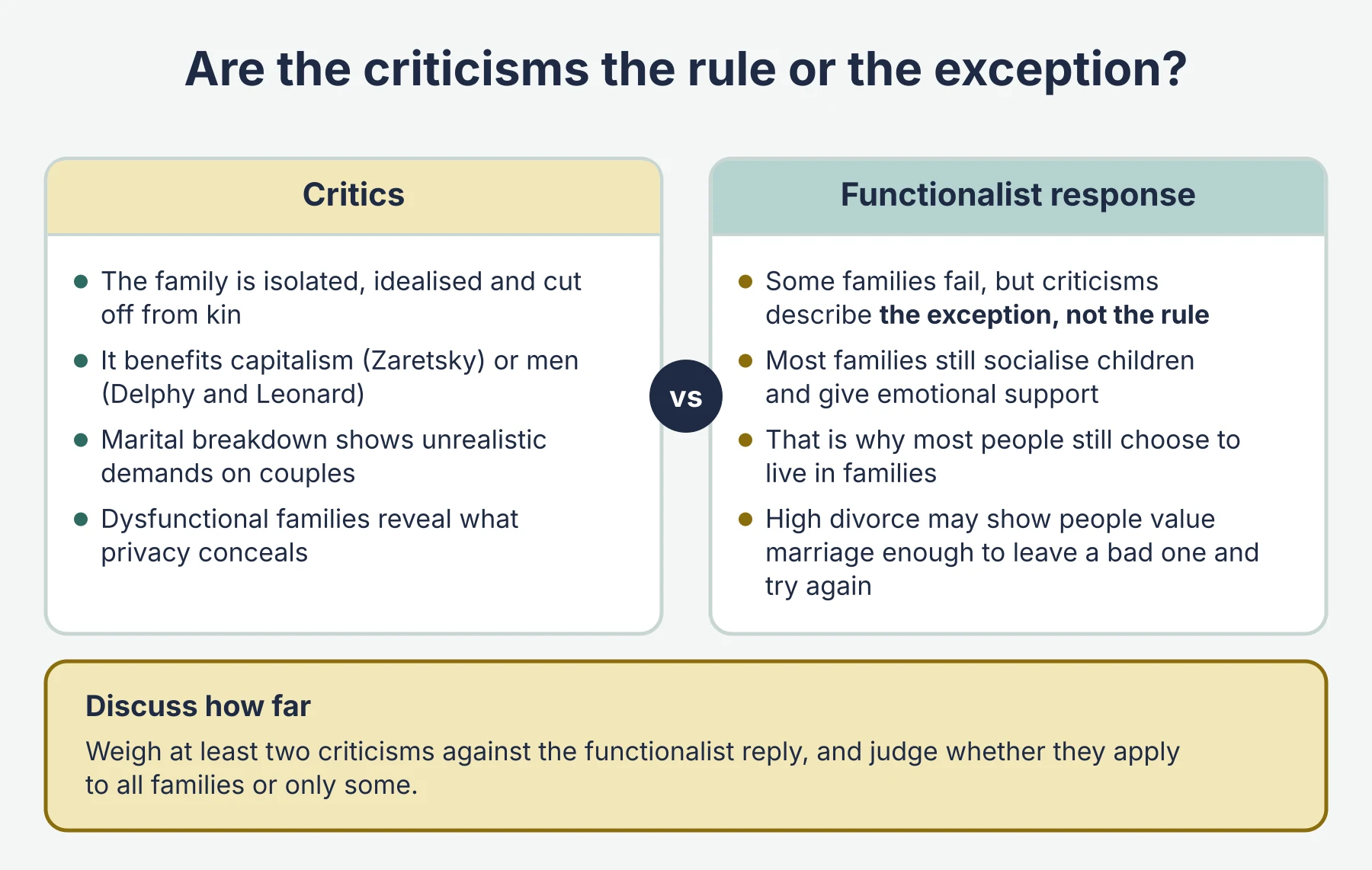
- Criticisms describe exceptions, not most families.
- Families still perform core functions: primary socialisation and emotional support.
- Most people still choose to live in families.
- High divorce may show that people value marriage enough to try again.
Exam traps
- Calling Zaretsky a feminist or Delphy and Leonard Marxists.
- Writing that Zaretsky blames men.
- Defining a dysfunctional family as an unusual family form.
- Naming criticisms without an example or perspective.
- Forgetting that loss of functions comes from Parsons’ own account.
- Giving one side only in “discuss how far”.
Quick self-test
- Name the six criticisms of families listed in the specification.
- What is unrealistic idealisation?
- What did Leach say about the family?
- What is an empty shell marriage?
- What is a dysfunctional family? Give one example.
- Which perspective does Zaretsky write from?
- What illusion does Zaretsky say capitalism has created?
- Give two ways the family props up capitalism, according to Zaretsky.
- According to Zaretsky, what would end the separation of family and public life?
- Who, according to Delphy and Leonard, are the prime beneficiaries of women’s labour?
- Give the example the specification uses for Delphy and Leonard’s idea of appropriation.
- Give one similarity between Zaretsky and Delphy and Leonard.
Answers
- Isolation and unrealistic idealisation; loss of traditional functions; lack of contact with wider kinship networks; the status and role of women; marital breakdown; dysfunctional families.
- Presenting family life as more perfect than it is, so real families feel they have failed.
- That the family, with its narrow privacy and tawdry secrets, is the source of all our discontents.
- A marriage in which the couple stay together legally but no longer share a loving relationship.
- A family that harms its members; for example, domestic abuse or child neglect.
- Marxist.
- That the private life of the family is separate from the economy.
- Any two: housewives’ unpaid domestic labour reproduces future workers; it is a unit of consumption; it cushions workers so they do not challenge the system.
- Socialism.
- Men, rather than capitalists as such.
- Wives with paid jobs outside the home still do household tasks that are not equally shared.
- Both are conflict views that reject the functionalist claim that families benefit everyone, and both focus on women’s domestic labour.
Official syllabus
AQA GCSE Sociology (8192) specification, Version 1.2 (June 2026), for GCSE exams 2019 onwards: section 3.3.5 Criticisms of families and Appendix B, 7.1 Families.
Related resources
-
Study guides
AQA GCSE Sociology (8192): Divorce
In-depth AQA GCSE Sociology 8192 guide to 3.3.6 divorce: the pattern since 1945, four reasons for the rise, consequences for family members and perspectives.
Sociology · AQA · GCSE
Read guide -
Practice questions
AQA GCSE Sociology (8192): Divorce – Practice Questions
Original AQA GCSE Sociology 8192 practice on 3.3.6 divorce: a fictional data table, divorce law, reasons for the rise, consequences and 12-mark answers.
Sociology · AQA · GCSE
Try questions -
Revision notes
AQA GCSE Sociology (8192): Divorce – Revision Notes
Condensed AQA GCSE Sociology 8192 notes on 3.3.6 divorce: the trend since 1945, key laws, four reasons, consequences, perspectives and a self-test.
Sociology · AQA · GCSE
Revise topic
Related articles
Get free revision emails (optional)
Occasional emails with practice questions, worked explanations and links to free resources for the qualification and subjects you choose. No spam, and you can unsubscribe from any email. The free tools on this site never need an email.