
Study Guides
AQA GCSE Sociology (8192): Criticisms of families
In-depth AQA GCSE Sociology 8192 guide to 3.3.5: the six criticisms of families, Zaretsky's Marxist view and Delphy and Leonard's feminist critique compared.
- Subject
- Sociology
- Level
- GCSE
- Topic
- Families
- Author
- Marlbridge Academic Team
- Updated
- Reviewed by
- Naqiya Yousaf (what this means)
Aligned to AQA GCSE Sociology (8192), first teaching 2017. Official specification .
Syllabus page (what it covers and how it is assessed): AQA GCSE Sociology.
Syllabus points this page covers
8192
- 3.3.5 Criticisms of families
Found an error? Report a correction.
Need help with this topic? Request a free trial class for GCSE Sociology (8192).
This guide goes deep on one sub-section of the AQA GCSE Sociology (8192) specification: 3.3.5 Criticisms of families, assessed in Paper 1: The sociology of families and education. The specification lists “different criticisms of families (isolation and unrealistic idealisation, loss of traditional functions, lack of contact with wider kinship networks, the status and role of women within families, marital breakdown, dysfunctional families)”. It names “the work of Zaretsky on developments in families from a Marxist perspective and Delphy and Leonard’s feminist critique of families”, and asks you to compare functionalist, feminist and Marxist perspectives.
For the whole of Paper 1, start with the Families and Education overview. To revise this sub-section, use the criticisms of families revision notes, then test yourself with the criticisms of families practice questions. The functions these critics are responding to are covered in the functions of families guide.
Why criticise the family?
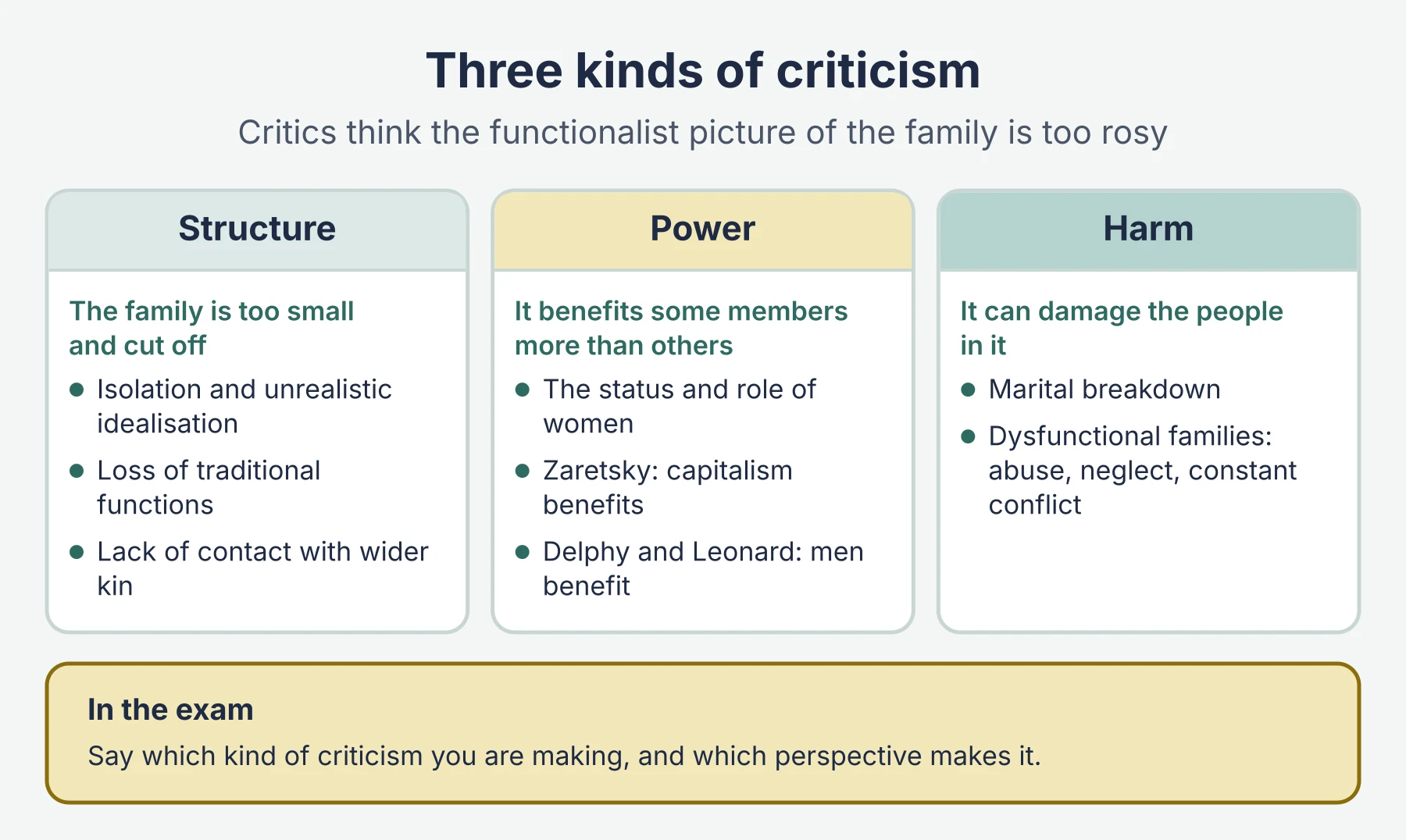
Functionalists such as Parsons present the family as meeting the needs of its members and of society. The criticisms in 3.3.5 come from people who think this picture is too rosy. Some criticisms are about structure (the family is too small and cut off); some are about power (the family benefits some members more than others); some are about harm (families can damage the people in them). In an exam, say which kind of criticism you are making and which perspective makes it.
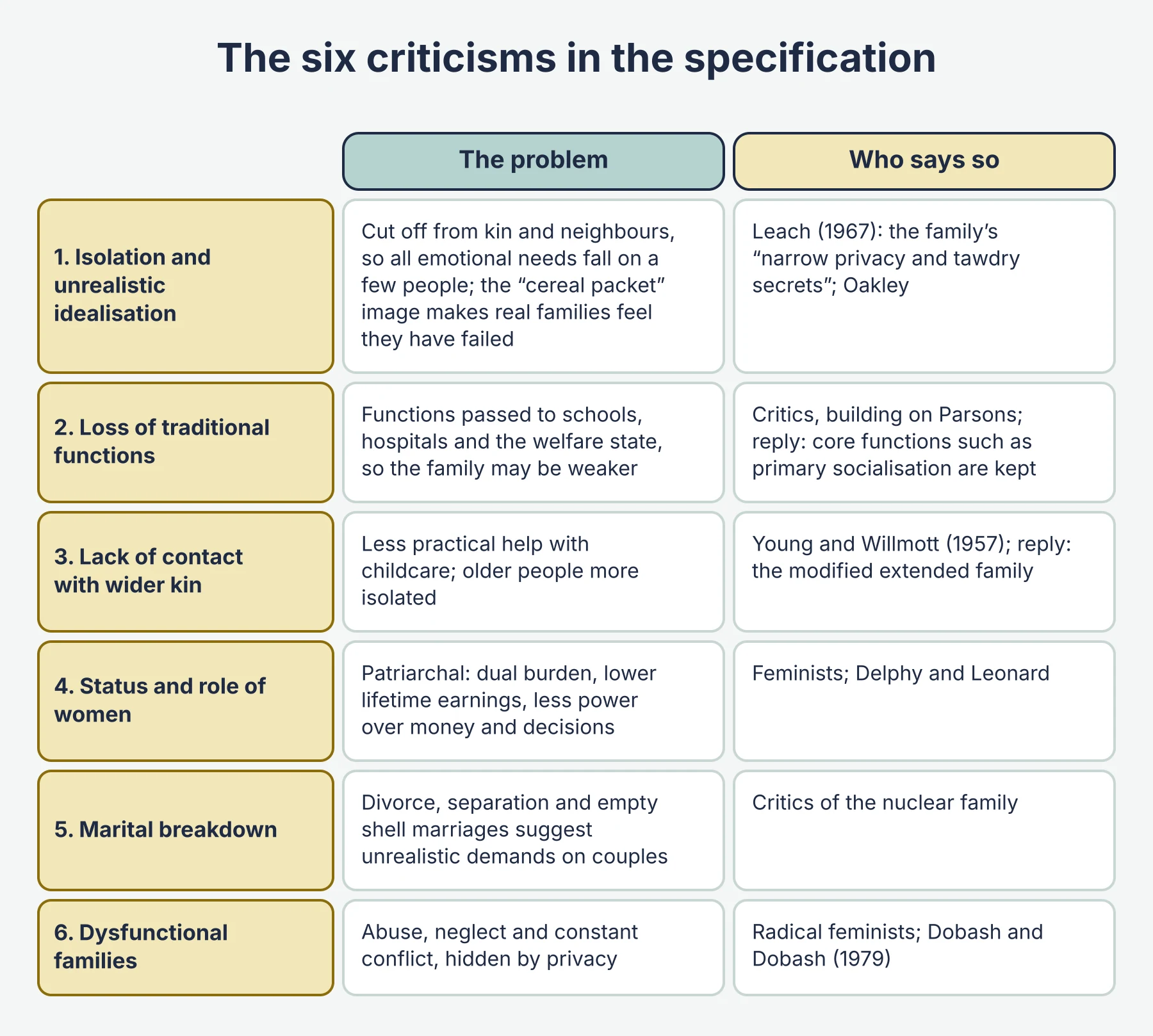
The six criticisms in the specification
1. Isolation and unrealistic idealisation
The privatised nuclear family can be isolated: cut off from neighbours and kin, so all emotional needs fall on a few people. The anthropologist Edmund Leach, in his 1967 Reith Lectures A Runaway World?, argued that the family, “with its narrow privacy and tawdry secrets, is the source of all our discontents”. In a small, inward-looking family, tensions have nowhere to go.
Unrealistic idealisation means presenting family life as more perfect than it is. Advertising and the media show a happy, conventional family (sometimes called the “cereal packet” image), and Oakley argued that this idea of the conventional family has great power. When real families fall short of the ideal, members may feel they have failed, and families that look different may be stigmatised.
2. Loss of traditional functions
Parsons argued that many functions passed to specialist institutions, such as schools, hospitals and the welfare state. Critics turn this into a criticism: if the family no longer produces goods, educates children formally or cares for the sick, it may be weaker and less able to hold society together. Others reply that the family has kept core functions, such as primary socialisation and emotional support, and still does much informal care.
3. Lack of contact with wider kinship networks
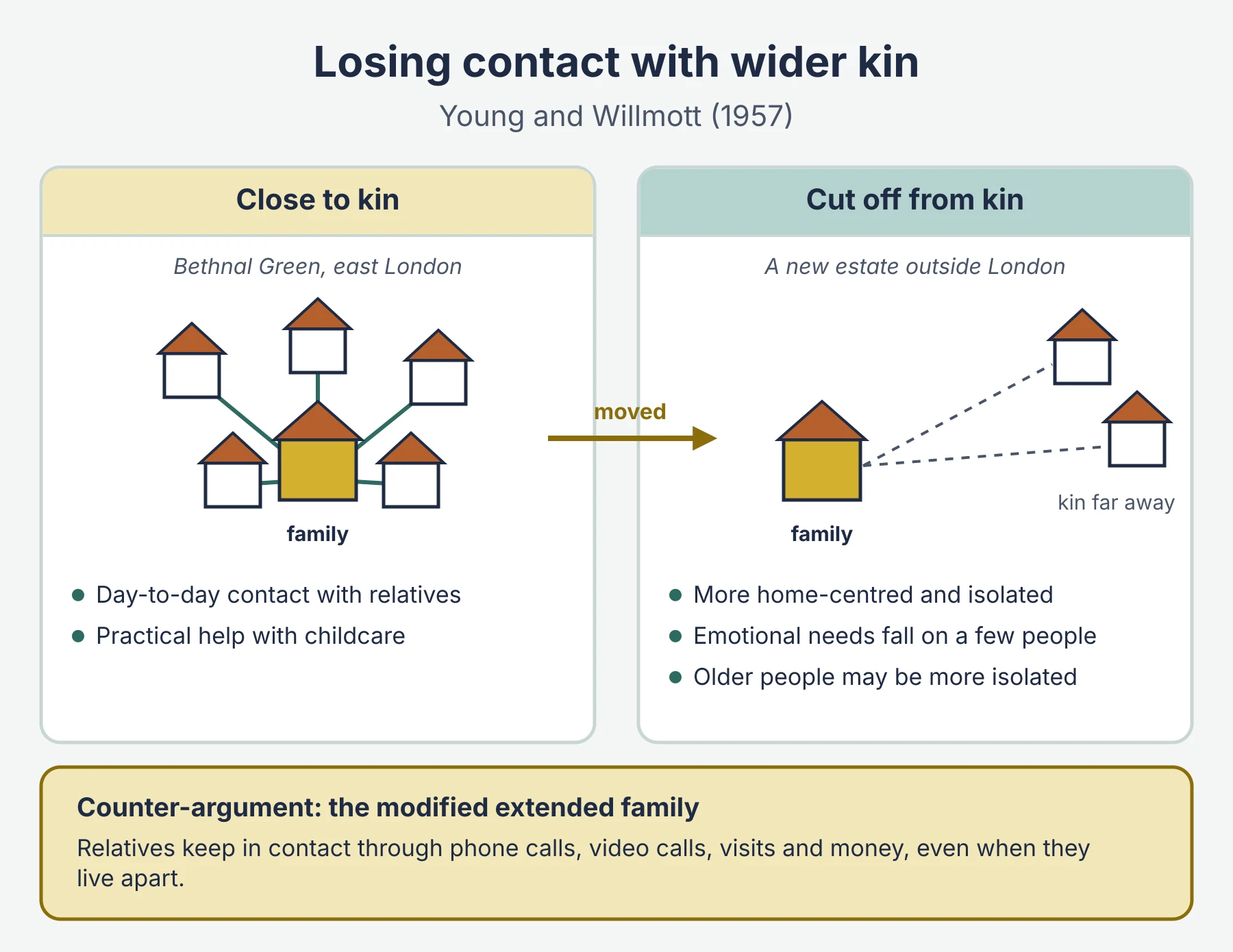
Geographical mobility and smaller families mean many nuclear families live far from relatives. In their 1957 study, Young and Willmott found that families who moved from Bethnal Green to a new estate outside London lost day-to-day contact with kin and became more home-centred. Without nearby kin, parents have less practical help with childcare, and older people may be more isolated. The counter-argument is the modified extended family: relatives keep in contact through phone calls, video calls, visits and money, even when they live apart.
4. The status and role of women within families
Feminists argue that families are patriarchal. Women do more housework, childcare and care of relatives, even when they have paid jobs, so they carry a dual burden. They may sacrifice careers, earn less across their lives, and have less power over money and decisions. The housewife role is unpaid and of low status. This is the criticism Delphy and Leonard develop most fully.
5. Marital breakdown
Marital breakdown includes divorce, separation and empty shell marriages, in which a couple stay together legally but no longer share a loving relationship. Critics see high levels of breakdown as evidence that the nuclear family places unrealistic demands on couples. Its consequences, such as lone parent families and reconstituted families, are covered in the divorce guide.
6. Dysfunctional families
A dysfunctional family is one that harms its members rather than meeting their needs. Examples include domestic abuse, child abuse and neglect, and constant conflict. Because the family is private, harm can be hidden for a long time. Radical feminists see domestic violence as a product of male power; Dobash and Dobash’s research in Scotland (1979) linked husbands’ violence to their sense of authority over wives. Functionalists tend to treat dysfunctional families as exceptions; critics argue they reveal what the private family can conceal.
Zaretsky: a Marxist view of developments in families
Eli Zaretsky wrote Capitalism, the Family and Personal Life (1976). His key ideas, from the specification’s summary:
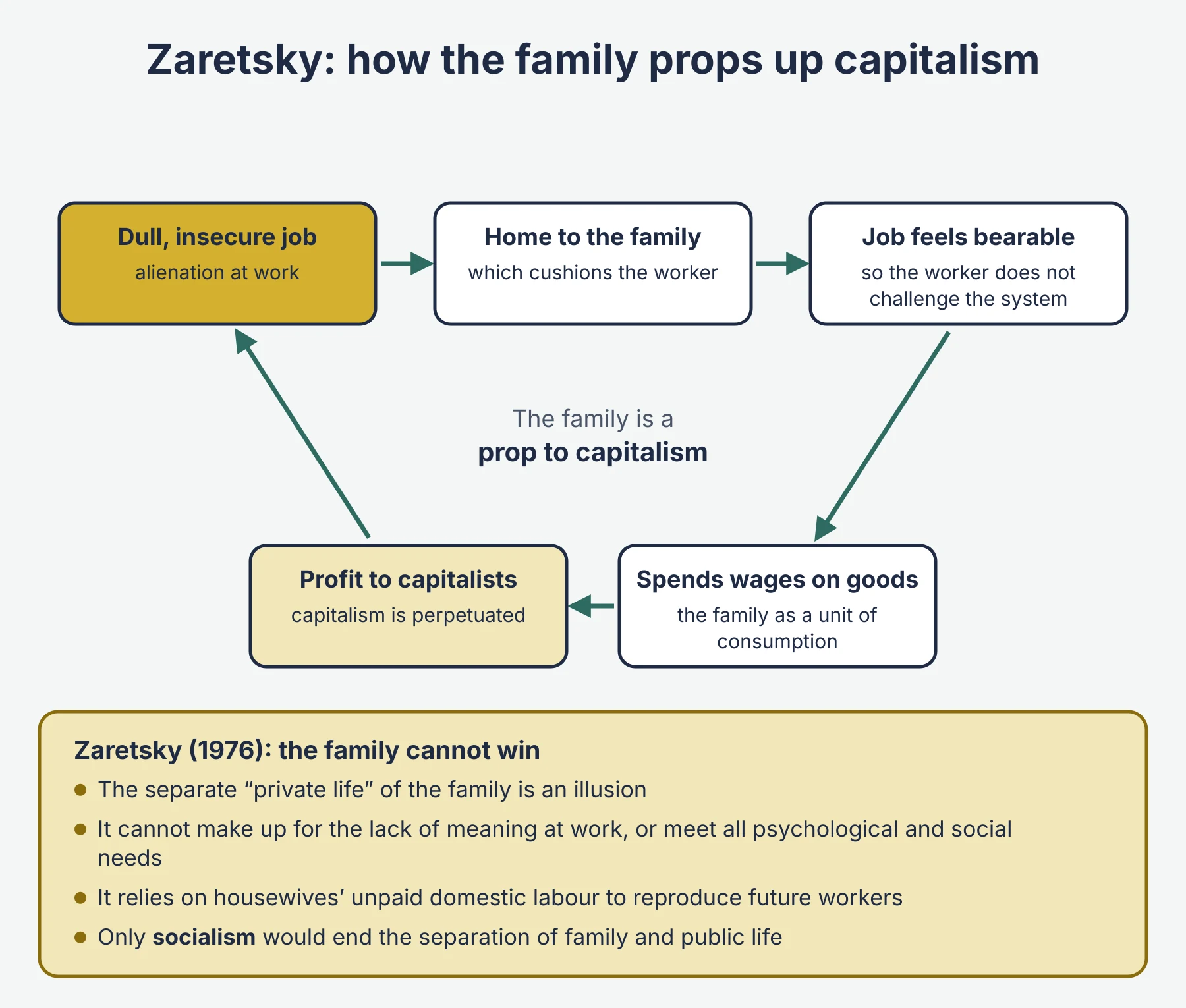
- Modern capitalist society has created an illusion that the “private life” of the family is separate from the economy.
- The family cannot provide for the psychological and social needs of the individual.
- It cushions people from the effects of capitalism, but in doing so it perpetuates the system, and it cannot compensate for the general alienation capitalism produces.
- It is a prop to the capitalist economy: the system depends on the unpaid domestic labour of housewives, who reproduce future generations of workers.
- It is also a vital unit of consumption.
- Only socialism will end the artificial separation of family and public life and make personal fulfilment possible.
Applying Zaretsky. A worker in a dull, insecure job comes home and relaxes with the family. The family makes the job bearable, so the worker does not challenge the system, but the family cannot make up for the lack of meaning at work. Meanwhile, the family spends its wages on goods that return profit to capitalists.
Evaluating Zaretsky. Feminists argue he says too little about men’s power over women within the family. Functionalists argue the family does meet many emotional needs. His solution, socialism, is hard to test, and family inequality has existed in socialist as well as capitalist societies.
Delphy and Leonard: a feminist critique
Christine Delphy and Diana Leonard wrote Familiar Exploitation (1992). Their key ideas:
- They “emphasise the importance of work”.
- It is men, rather than capitalists as such, who are the prime beneficiaries of the exploitation of women’s labour.
- The family has a central role in maintaining patriarchy.
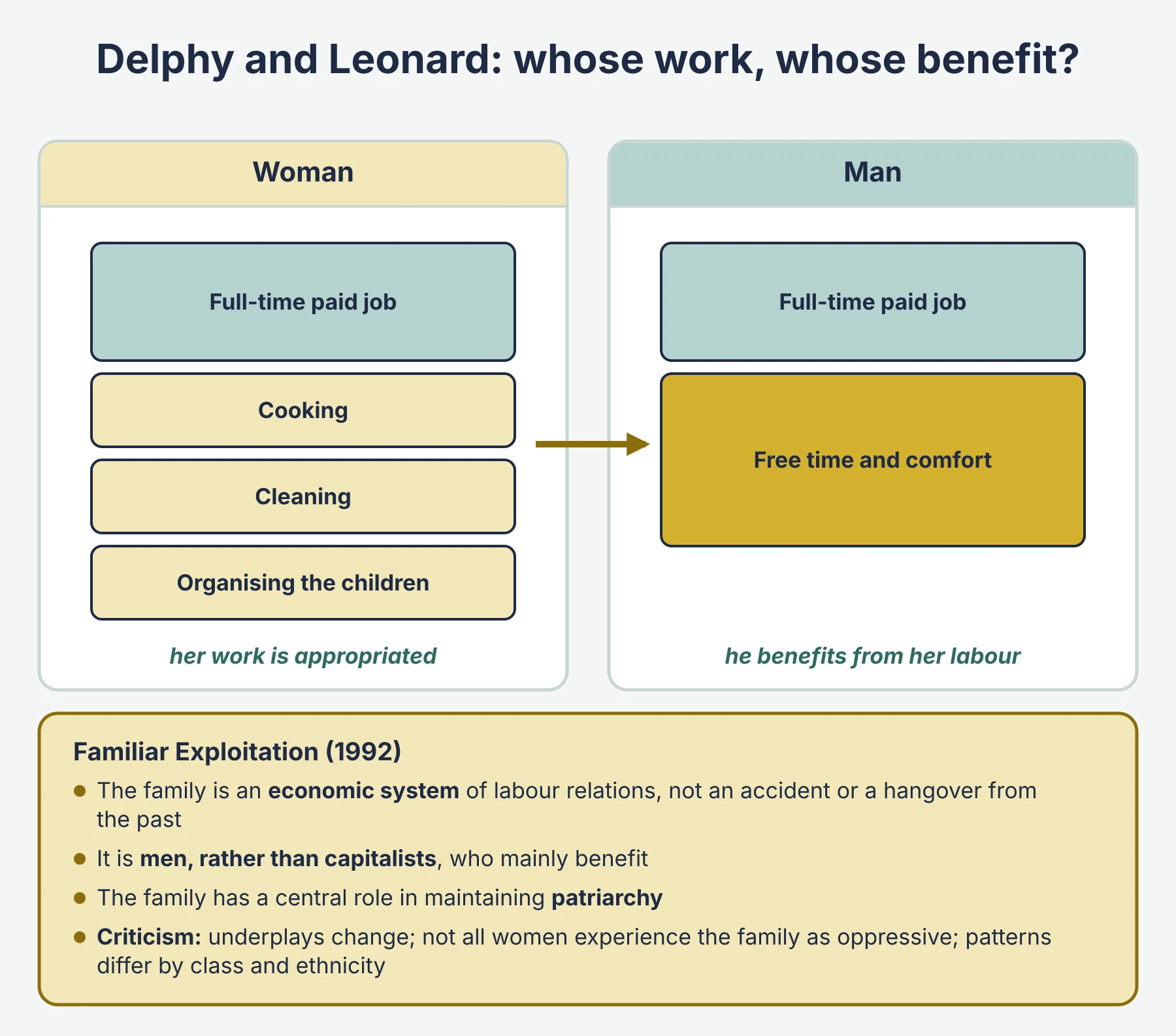
- The family is an economic system involving a particular set of labour relations, in which men benefit from and exploit women’s work.
- Women are oppressed because their work is appropriated (taken) within the family; for example, when wives have paid jobs, they still do household tasks that are not equally shared.
Applying Delphy and Leonard. In a dual-earner couple, both partners work full time, but the woman cooks, cleans and organises the children. Her labour gives her partner free time and comfort. For Delphy and Leonard this is not an accident or a hangover from the past: it is how the family works as an economic system.
Evaluating Delphy and Leonard. Critics argue they underplay change, such as men doing more domestic work and couples choosing more equal arrangements. Not all women experience the family as oppressive, and patterns differ by class and ethnicity.
Comparing Zaretsky with Delphy and Leonard
| Zaretsky | Delphy and Leonard | |
|---|---|---|
| Perspective | Marxist | Feminist |
| Who benefits? | Capitalism | Men |
| Key mechanism | Cushioning alienation, domestic labour, consumption | Appropriation of women’s work within the family |
| Is the private family what it seems? | No: its separation from the economy is an illusion | No: it is an economic system of labour relations |
| What would end the problem? | Socialism | Ending patriarchal relations within the family |
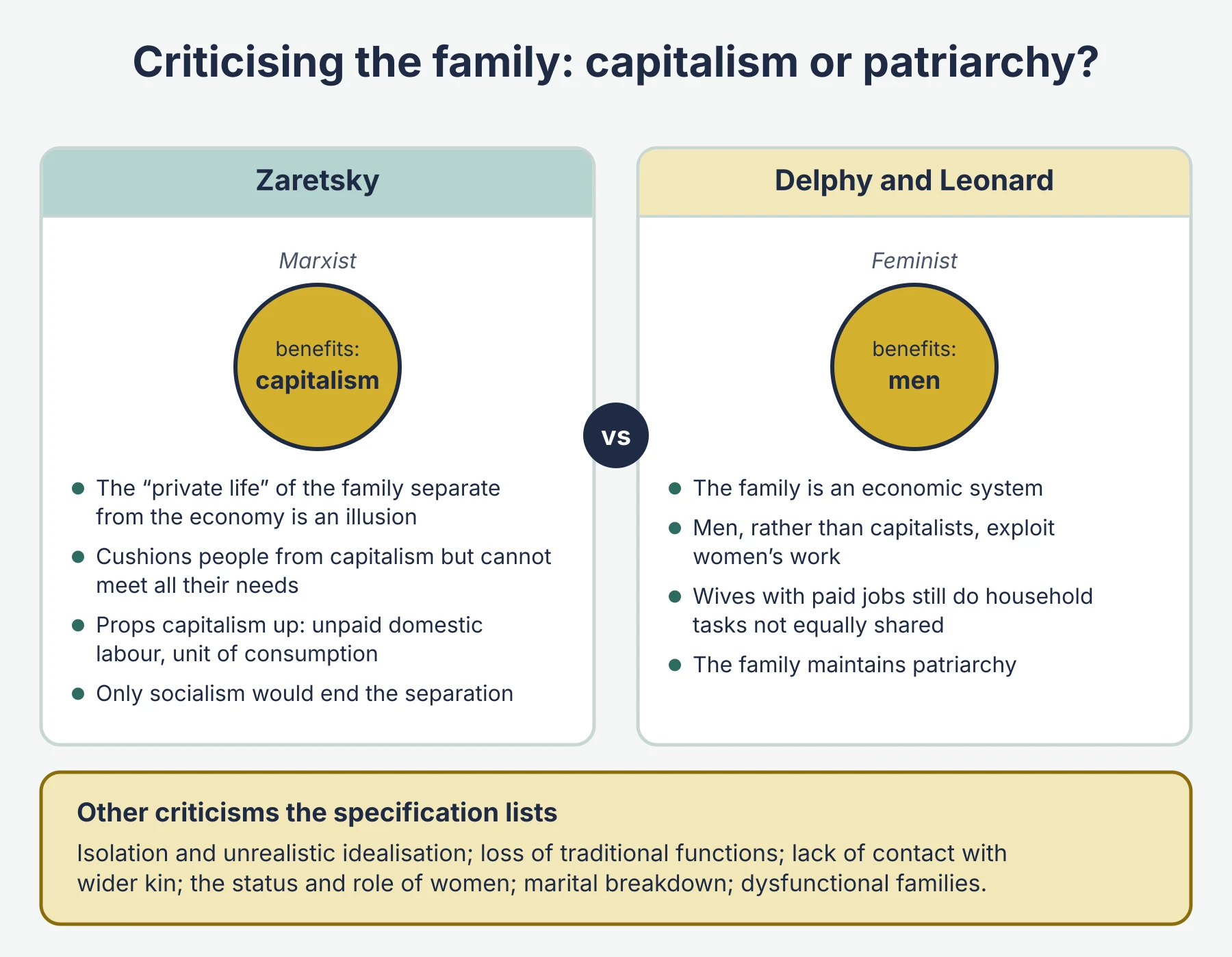
Similarities: both are conflict perspectives; both reject the functionalist view that the family benefits everyone; both focus on women’s domestic labour. Difference: for Zaretsky, the family’s problems come from capitalism; for Delphy and Leonard, from patriarchy, which could survive the end of capitalism.
The functionalist response
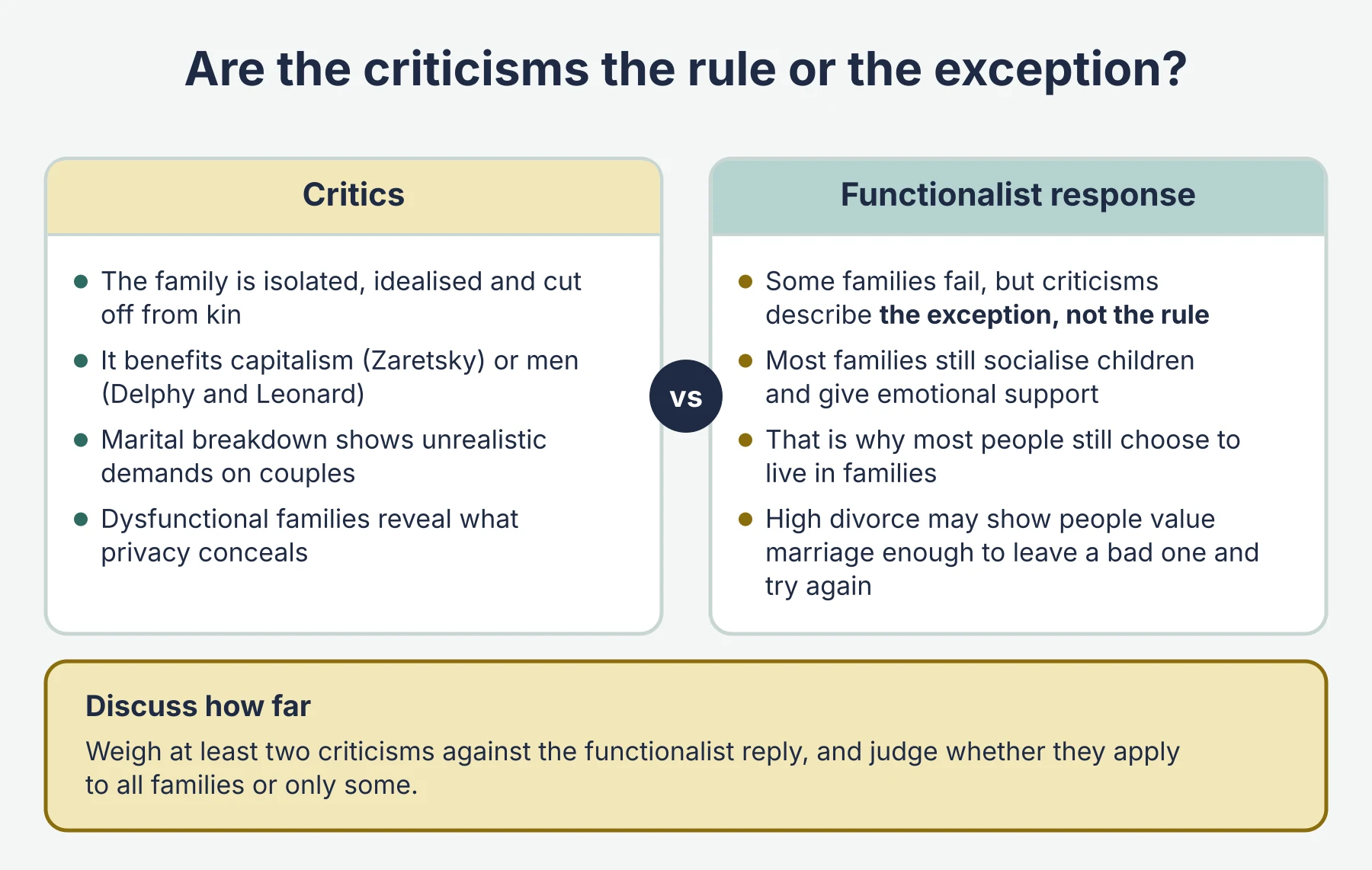
Functionalists accept that some families fail but argue that criticisms describe the exception, not the rule. Most families still socialise children and give emotional support, which is why most people still choose to live in families. They may see high divorce as a sign that people value marriage enough to leave a bad one and try again.
Worked example: 4 marks
Question: Identify and explain one criticism of families made by Delphy and Leonard. [4]
Men exploit women’s labour within the family (identifies). Delphy and Leonard see the family as an economic system in which women’s work is appropriated by men (explains the idea). For example, a wife who works full time may still do most of the cooking and cleaning, giving her husband more free time (applies). They argue this keeps patriarchy going, and that it is men rather than capitalists who mainly benefit (develops with the specification’s key distinction).
Common mistakes
- Swapping the writers: Zaretsky is Marxist; Delphy and Leonard are feminist.
- Saying Zaretsky blames men. His target is capitalism.
- Listing the six criticisms without explaining or applying any of them.
- Treating “dysfunctional” as meaning any unusual family form. It means a family that harms its members.
- Forgetting the functionalist side in a “discuss how far” answer.
Exam technique
- Identify and explain a criticism: name it, explain the problem it identifies, give an example, and say which perspective makes it.
- Compare and contrast: use the table above; one similarity and one difference is the minimum.
- Discuss how far: weigh at least two criticisms against the functionalist reply, and judge whether they apply to all families or some.
Official syllabus
AQA GCSE Sociology (8192) specification, Version 1.2 (June 2026), for GCSE exams 2019 onwards: section 3.3.5 Criticisms of families and Appendix B, 7.1 Families (Zaretsky; Delphy and Leonard).
Related resources
-
Practice questions
AQA GCSE Sociology (8192): Criticisms of families – Practice Questions
Original AQA GCSE Sociology 8192 practice on 3.3.5 criticisms of families: isolation, dysfunction, Zaretsky and Delphy and Leonard, with marked answers.
Sociology · AQA · GCSE
Try questions -
Revision notes
AQA GCSE Sociology (8192): Criticisms of families – Revision Notes
Condensed AQA GCSE Sociology 8192 notes on 3.3.5: the six criticisms of families, Zaretsky and Delphy and Leonard side by side, exam traps and a self-test.
Sociology · AQA · GCSE
Revise topic -
Study guides
AQA GCSE Sociology (8192): Divorce
In-depth AQA GCSE Sociology 8192 guide to 3.3.6 divorce: the pattern since 1945, four reasons for the rise, consequences for family members and perspectives.
Sociology · AQA · GCSE
Read guide
Related articles
Get free revision emails (optional)
Occasional emails with practice questions, worked explanations and links to free resources for the qualification and subjects you choose. No spam, and you can unsubscribe from any email. The free tools on this site never need an email.