
Study Guides
AQA GCSE Sociology (8192): Divorce
In-depth AQA GCSE Sociology 8192 guide to 3.3.6 divorce: the pattern since 1945, four reasons for the rise, consequences for family members and perspectives.
- Subject
- Sociology
- Level
- GCSE
- Topic
- Families
- Author
- Marlbridge Academic Team
- Updated
- Reviewed by
- Naqiya Yousaf (what this means)
Aligned to AQA GCSE Sociology (8192), first teaching 2017. Official specification .
Syllabus page (what it covers and how it is assessed): AQA GCSE Sociology.
Syllabus points this page covers
8192
- 3.3.6 Divorce
Found an error? Report a correction.
Need help with this topic? Request a free trial class for GCSE Sociology (8192).
This guide goes deep on one sub-section of the AQA GCSE Sociology (8192) specification: 3.3.6 Divorce, assessed in Paper 1: The sociology of families and education. The specification covers “changes in the pattern of divorce in Britain since 1945 and the consequences of divorce for family members and structures”. You must be able to:
- “identify, describe and explain the pattern of divorce in Britain since 1945 using relevant statistical data”;
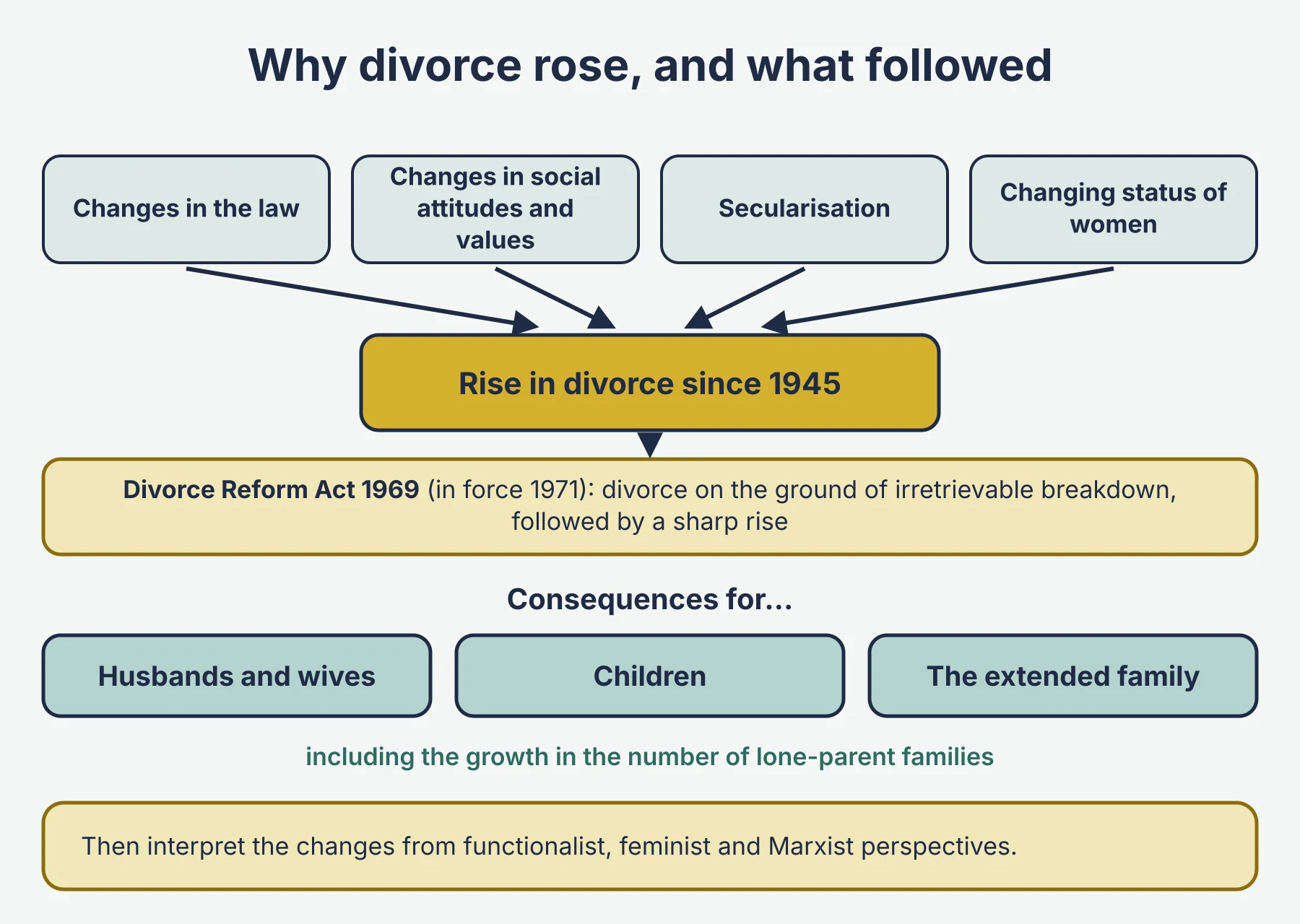
- “explain reasons for the rise in divorce since 1945 including: changes in the law, changes in social attitudes and values, secularisation, changes in the status of women in society”;
- “describe the consequences of divorce for family members (husband and wife, children and extended family) and the increase in the numbers of lone parent families”;
- compare functionalist, feminist and Marxist perspectives.
For the whole of Paper 1, start with the Families and Education overview. To revise this sub-section, use the divorce revision notes, then test yourself with the divorce practice questions. Marital breakdown as a criticism of families is covered in the criticisms of families guide.
Key terms
- Divorce: the legal ending of a marriage.
- Separation: a couple living apart without a legal divorce.
- Empty shell marriage: a marriage that continues in law but no longer as a loving relationship.
- Divorce rate: the number of divorces per 1,000 married people in a year. Sociologists use the rate as well as the raw number, because the number of divorces depends partly on how many people are married.
- Serial monogamy: a series of marriages or partnerships, one after another.
- Secularisation: the declining influence of religion on society and on people’s lives.
The pattern of divorce since 1945
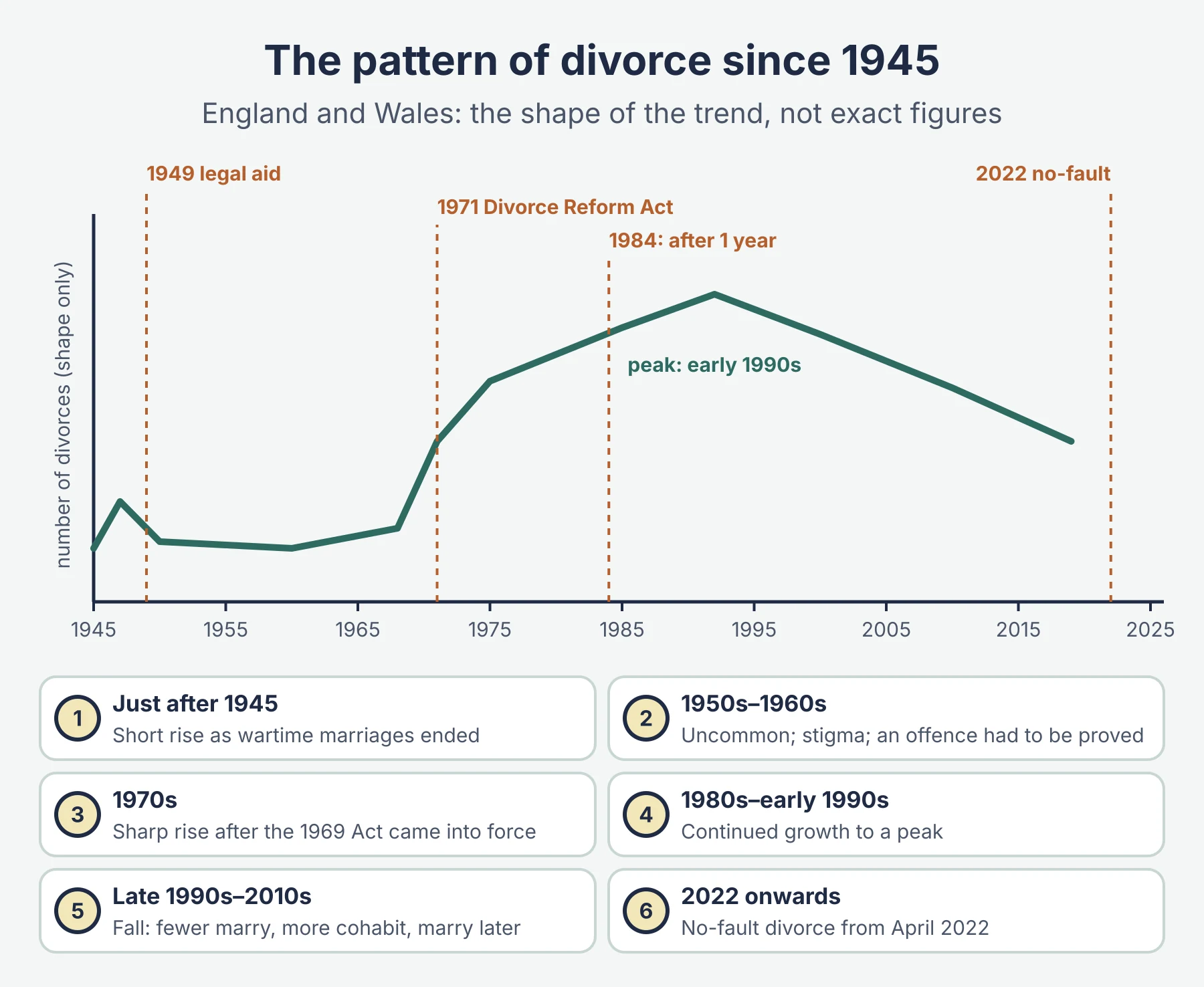
The specification asks for the pattern “using relevant statistical data”. Learn the shape of the trend for England and Wales and the legal changes that mark it.
- Just after 1945: a short-lived rise as many hurried wartime marriages ended and couples reunited after long separations. Legal aid for divorce, introduced under the Legal Aid and Advice Act 1949, began to make divorce affordable for people on lower incomes.
- 1950s and 1960s: divorce was relatively uncommon and carried strong stigma; it required one partner to prove a “matrimonial offence”, such as adultery or cruelty.
- 1970s: a sharp rise after the Divorce Reform Act 1969 came into force in 1971.
- 1980s to early 1990s: continued growth. The Matrimonial and Family Proceedings Act 1984 allowed couples to apply for divorce after one year of marriage instead of three. The number of divorces peaked in the early 1990s.
- Late 1990s to 2010s: a general fall in the number of divorces, partly because fewer people married and more cohabited, and those who married did so later.
- 2022 onwards: the Divorce, Dissolution and Separation Act 2020 introduced “no-fault” divorce from April 2022.
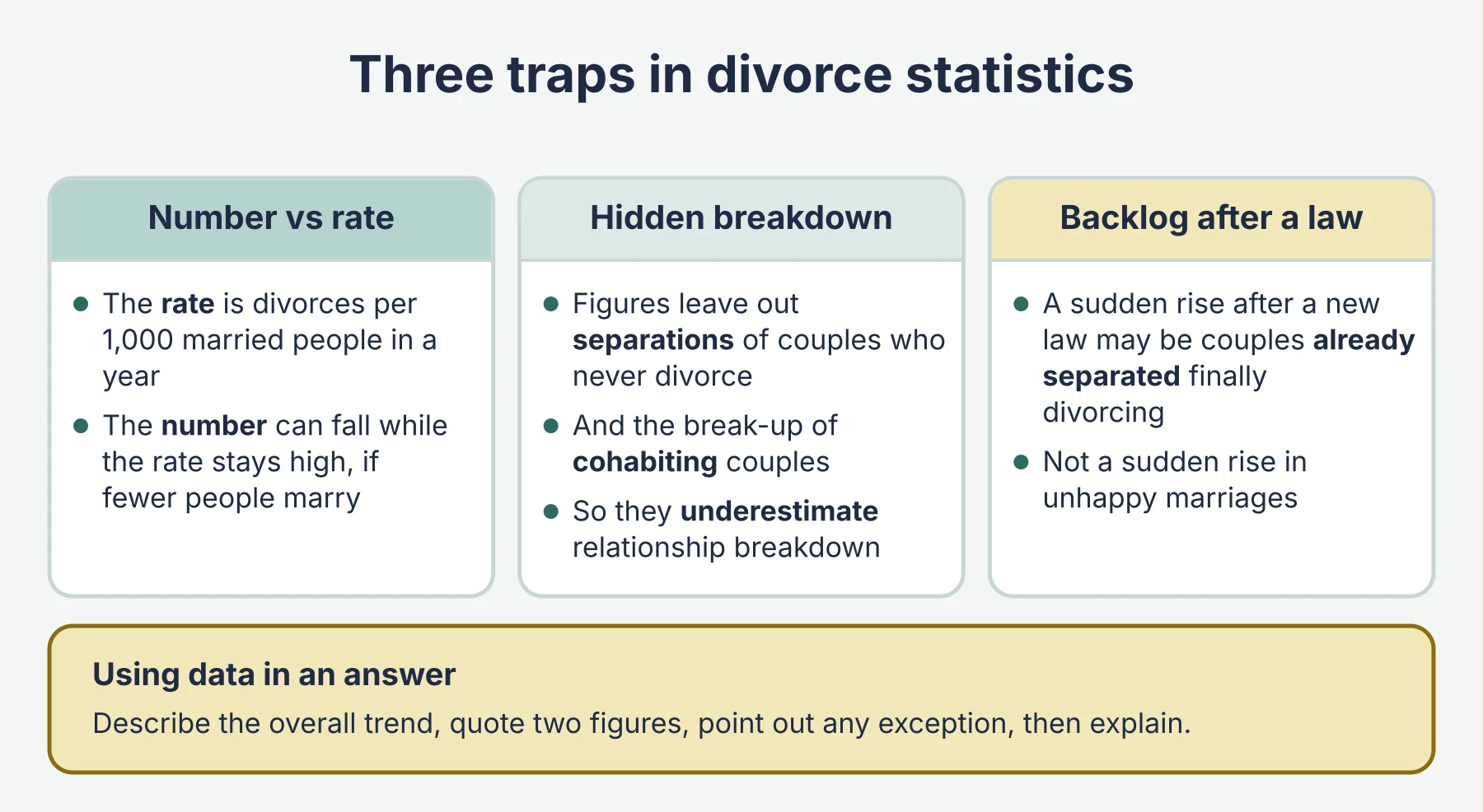
Using statistics in an answer. Exams may give you a table or graph. Use the data actively: describe the overall trend, quote two figures to show it, point out any exception, and then explain. Watch three traps.
- The number of divorces can fall while the rate stays high, if fewer people marry.
- Divorce figures do not include separations of married couples who never divorce, or the break-up of cohabiting couples, so they underestimate relationship breakdown.
- A sudden rise after a new law may show a backlog of couples who were already separated finally getting a legal divorce, not a sudden rise in unhappy marriages.
Reasons for the rise in divorce since 1945
1. Changes in the law
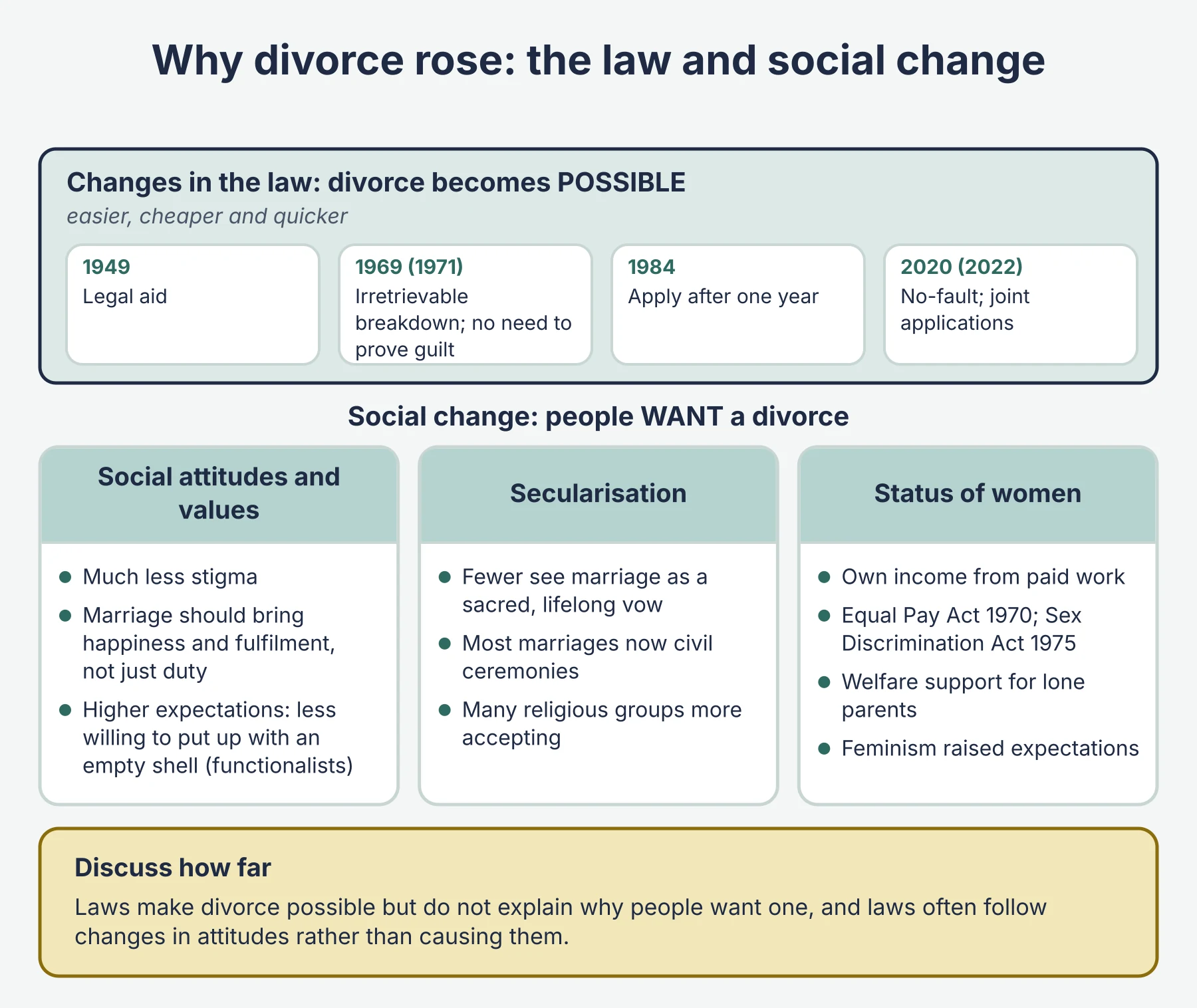
Divorce law has made divorce easier, cheaper and quicker.
- Legal Aid and Advice Act 1949: legal aid helped those who could not afford lawyers.
- Divorce Reform Act 1969 (in force 1971): divorce could be granted on the single ground of irretrievable breakdown of the marriage, which could be shown, for example, by two years’ separation if both agreed. Couples could now divorce without either partner proving the other guilty of an offence.
- Matrimonial and Family Proceedings Act 1984: couples could apply after one year of marriage.
- Divorce, Dissolution and Separation Act 2020: from 2022 couples no longer had to blame each other or wait through long separations, and could apply jointly.
Evaluation: law changes make divorce possible, but they do not explain why people want one. Laws also often follow changes in attitudes rather than causing them.
2. Changes in social attitudes and values
Divorce carries much less stigma than in the 1950s. It is common enough that most people know someone who is divorced, and the media treat it as a normal part of life. People increasingly see marriage as a relationship that should bring personal happiness and fulfilment, not simply a duty. Functionalists argue that these higher expectations of marriage mean people are less willing to put up with an empty shell marriage.
3. Secularisation
As religion has lost influence, fewer people see marriage as a sacred, lifelong vow. Most marriages in England and Wales are now civil ceremonies rather than religious ones, and religious disapproval of divorce affects fewer people’s choices. Even many religious groups have become more accepting of divorce and remarriage.
4. Changes in the status of women in society
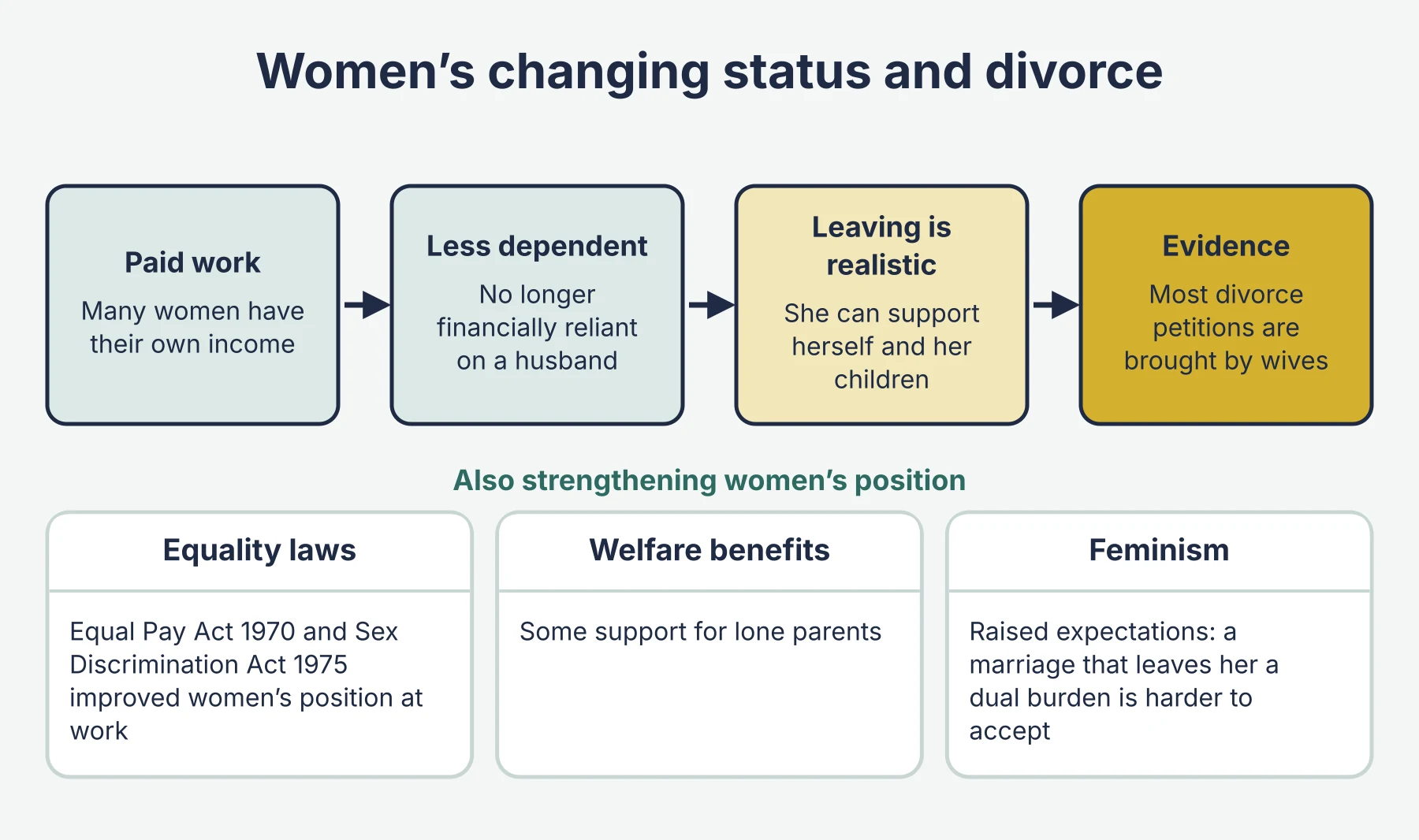
Women’s position has changed in ways that make divorce more possible and more attractive to them.
- Paid work gives many women their own income, so they are less financially dependent on a husband.
- Equality laws, such as the Equal Pay Act 1970 and the Sex Discrimination Act 1975, improved women’s position at work.
- Welfare benefits give some support to lone parents.
- Feminism has raised women’s expectations of equality. If a marriage still leaves a woman with a dual burden, she may be less willing to accept it.
Most divorce petitions in England and Wales have been brought by wives, which supports the view that women’s changing status is a key reason.
Consequences of divorce
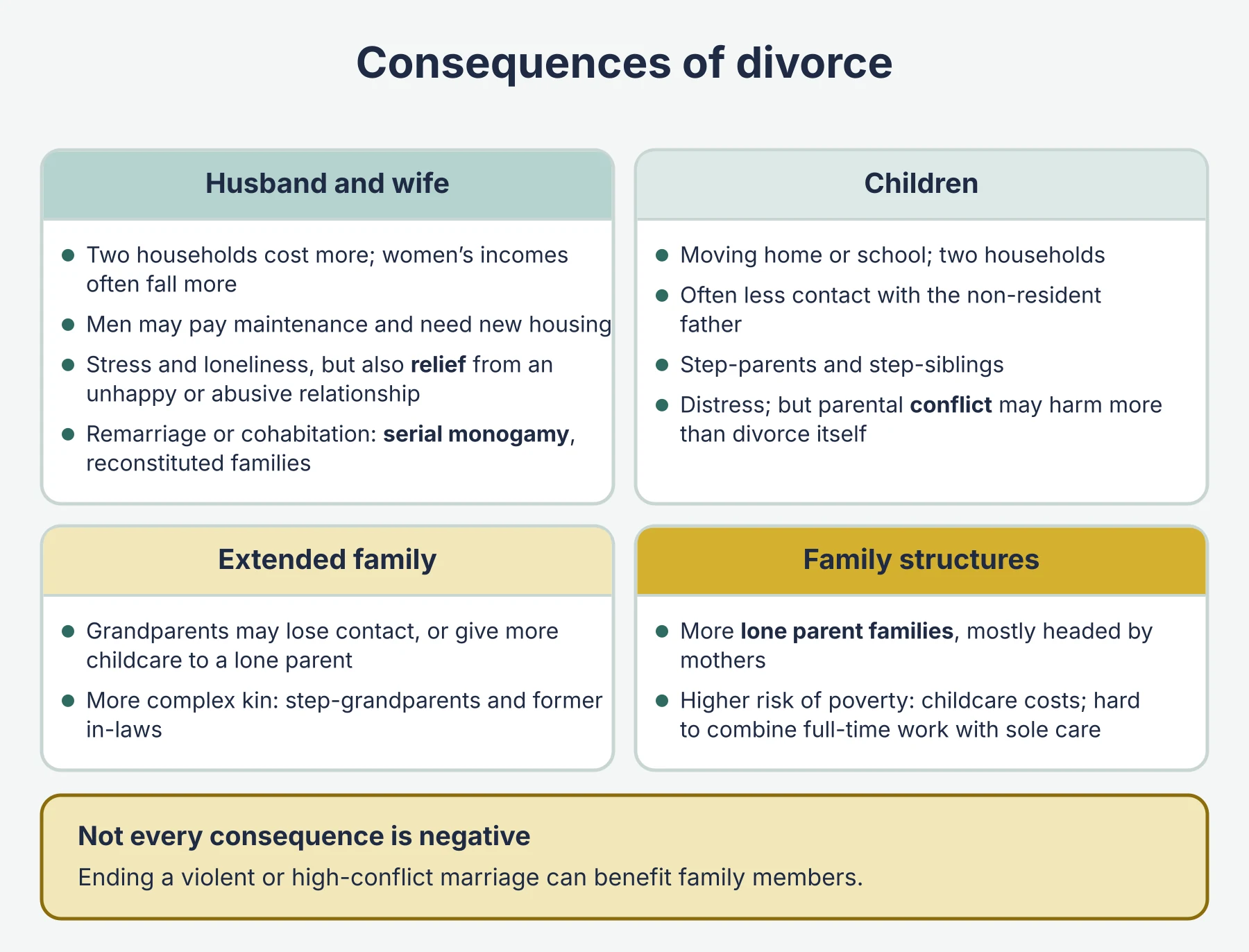
For husband and wife
- Financial: two households cost more than one. Women’s incomes often fall more after divorce, particularly if they have children living with them; men may pay child maintenance and need new housing.
- Emotional: stress, loneliness and a sense of failure, but also relief from an unhappy or abusive relationship.
- New relationships: many remarry or cohabit, leading to serial monogamy and reconstituted families.
For children
- Moving home or school, and dividing time between two households.
- Less contact with the non-resident parent, usually the father, in many cases.
- Gaining step-parents and step-siblings in a reconstituted family.
- Emotional distress, especially around the time of separation. Many sociologists argue that conflict between parents, before or after divorce, harms children more than the divorce itself, so ending a high-conflict marriage can benefit children.
For the extended family
- Grandparents may lose contact with grandchildren, especially on the non-resident parent’s side, or may provide more childcare and support to a lone parent.
- Kinship networks become more complex, with step-grandparents and former in-laws.
For family structures: more lone parent families
Divorce is one main route into lone parenthood. Most lone parent families are headed by mothers, and they face a higher risk of poverty, partly because of the cost of childcare and the difficulty of combining full-time work with sole care of children.
Perspectives on divorce
| Perspective | View |
|---|---|
| Functionalist | Rising divorce reflects higher expectations of marriage; high remarriage shows marriage is still valued. But divorce can disrupt primary socialisation and the stabilisation of adult personalities |
| Feminist | Divorce allows women to escape patriarchal or abusive marriages and reflects women’s greater independence. But women often bear the economic costs afterwards, as lone parents on lower incomes |
| Marxist | Capitalism puts strain on families through financial pressure, insecure work and alienation; Zaretsky argued the family cannot meet psychological needs, so breakdown is predictable. More households also means more consumption |
Worked example: 4 marks
Question: Identify and explain one way in which changes in the status of women may have contributed to the rise in divorce. [4]
Women’s increased participation in paid work (identifies). Many women now have their own income, so they are no longer financially dependent on a husband (explains). A woman in an unhappy marriage can therefore support herself and her children after divorce, which makes leaving a realistic option (develops). This may explain why most divorce petitions are brought by wives (supports with evidence).
Common mistakes
- Describing the trend as a steady rise since 1945. It rose, peaked in the early 1990s, then fell.
- Saying the 1969 Act allowed “instant” divorce. It introduced irretrievable breakdown, shown through set facts.
- Confusing the number of divorces with the divorce rate.
- Listing reasons without explaining how each makes divorce more likely.
- Treating every consequence as negative. Ending a violent or high-conflict marriage can benefit family members.
- Ignoring the extended family in a consequences question.
Exam technique
- Data questions: trend, two figures, exception, explanation.
- Identify and explain a reason: name it, give the mechanism, and add an example such as a named Act.
- Discuss how far: weigh the law against social change (attitudes, secularisation and women’s status), and judge whether laws caused or followed the change.
Official syllabus
AQA GCSE Sociology (8192) specification, Version 1.2 (June 2026), for GCSE exams 2019 onwards: section 3.3.6 Divorce.
Related resources
-
Practice questions
AQA GCSE Sociology (8192): Divorce – Practice Questions
Original AQA GCSE Sociology 8192 practice on 3.3.6 divorce: a fictional data table, divorce law, reasons for the rise, consequences and 12-mark answers.
Sociology · AQA · GCSE
Try questions -
Revision notes
AQA GCSE Sociology (8192): Divorce – Revision Notes
Condensed AQA GCSE Sociology 8192 notes on 3.3.6 divorce: the trend since 1945, key laws, four reasons, consequences, perspectives and a self-test.
Sociology · AQA · GCSE
Revise topic -
Practice questions
AQA GCSE Sociology (8192): Family Functions, Forms, Relationships and Criticisms – Practice Questions
Original AQA GCSE Sociology 8192 practice on Parsons, the Rapoports, Willmott and Young, Zaretsky and Delphy and Leonard, with item-based and 12-mark answers.
Sociology · AQA · GCSE
Try questions
Related articles
Get free revision emails (optional)
Occasional emails with practice questions, worked explanations and links to free resources for the qualification and subjects you choose. No spam, and you can unsubscribe from any email. The free tools on this site never need an email.