
Study Guides
AQA GCSE Sociology (8192): Conjugal role relationships
In-depth AQA GCSE Sociology 8192 guide to 3.3.3: joint and segregated roles, the domestic division of labour, Oakley, decision making and money management.
- Subject
- Sociology
- Level
- GCSE
- Topic
- Families
- Author
- Marlbridge Academic Team
- Updated
- Reviewed by
- Naqiya Yousaf (what this means)
Aligned to AQA GCSE Sociology (8192), first teaching 2017. Official specification .
Syllabus page (what it covers and how it is assessed): AQA GCSE Sociology.
Syllabus points this page covers
8192
- 3.3.3 Conjugal role relationships
Found an error? Report a correction.
Need help with this topic? Request a free trial class for GCSE Sociology (8192).
This guide goes deep on one sub-section of the AQA GCSE Sociology (8192) specification: 3.3.3 Conjugal role relationships, assessed in Paper 1: The sociology of families and education. The specification names “the feminist perspective of Oakley on the idea of the conventional family” and asks you to:
- “identify, describe and explain joint and segregated conjugal roles”;
- “describe and explain the domestic division of labour in both traditional and contemporary families”;
- understand issues “including decision making, money management, dual career families, child rearing and leisure activities”;
- compare functionalist, feminist and Marxist perspectives.
For the whole of Paper 1, start with the Families and Education overview. To revise this sub-section, use the conjugal role relationships revision notes, then test yourself with the conjugal role relationships practice questions. How these roles have changed over time, including Willmott and Young’s symmetrical family, is covered in the changing relationships within families guide.
Key concepts
Conjugal roles are the roles a couple take on within their relationship, at home and in paid work. Conjugal role relationships describe how those roles fit together: who does what, who decides, and who controls money and time.
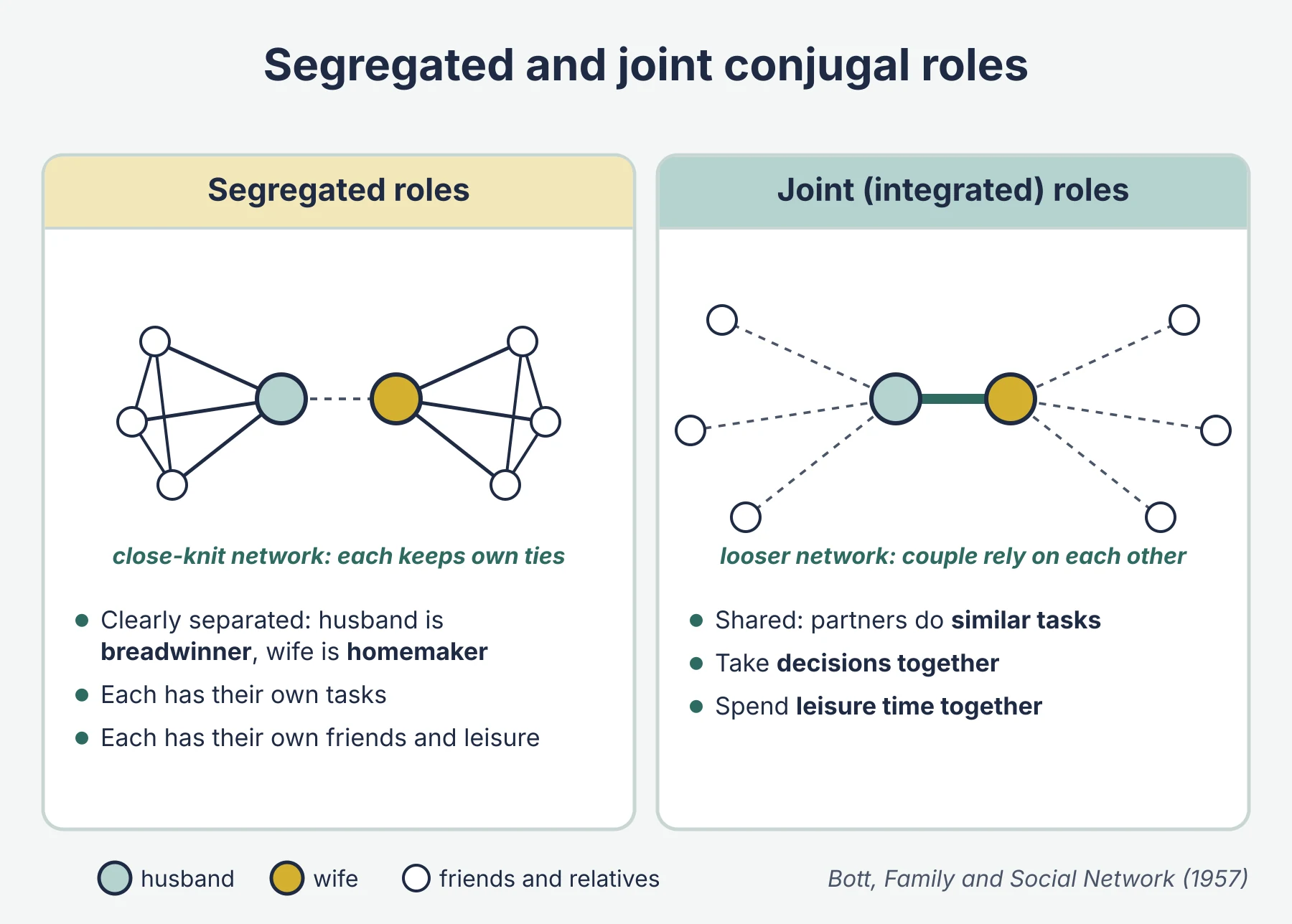
Segregated conjugal roles are clearly separated. The husband is the breadwinner and the wife the homemaker, and each has their own tasks, friends and leisure. Elizabeth Bott’s study of London couples, Family and Social Network (1957), linked segregated roles to close-knit social networks, where each partner kept strong ties with their own friends and relatives.
Joint (or integrated) conjugal roles are shared. Partners do similar tasks, take decisions together and spend leisure time together. Bott linked these to looser networks, where the couple relied on each other more.
The domestic division of labour is how housework, childcare and other unpaid work are divided between partners. It is the main evidence sociologists use to judge whether roles are joint or segregated.
Traditional and contemporary families
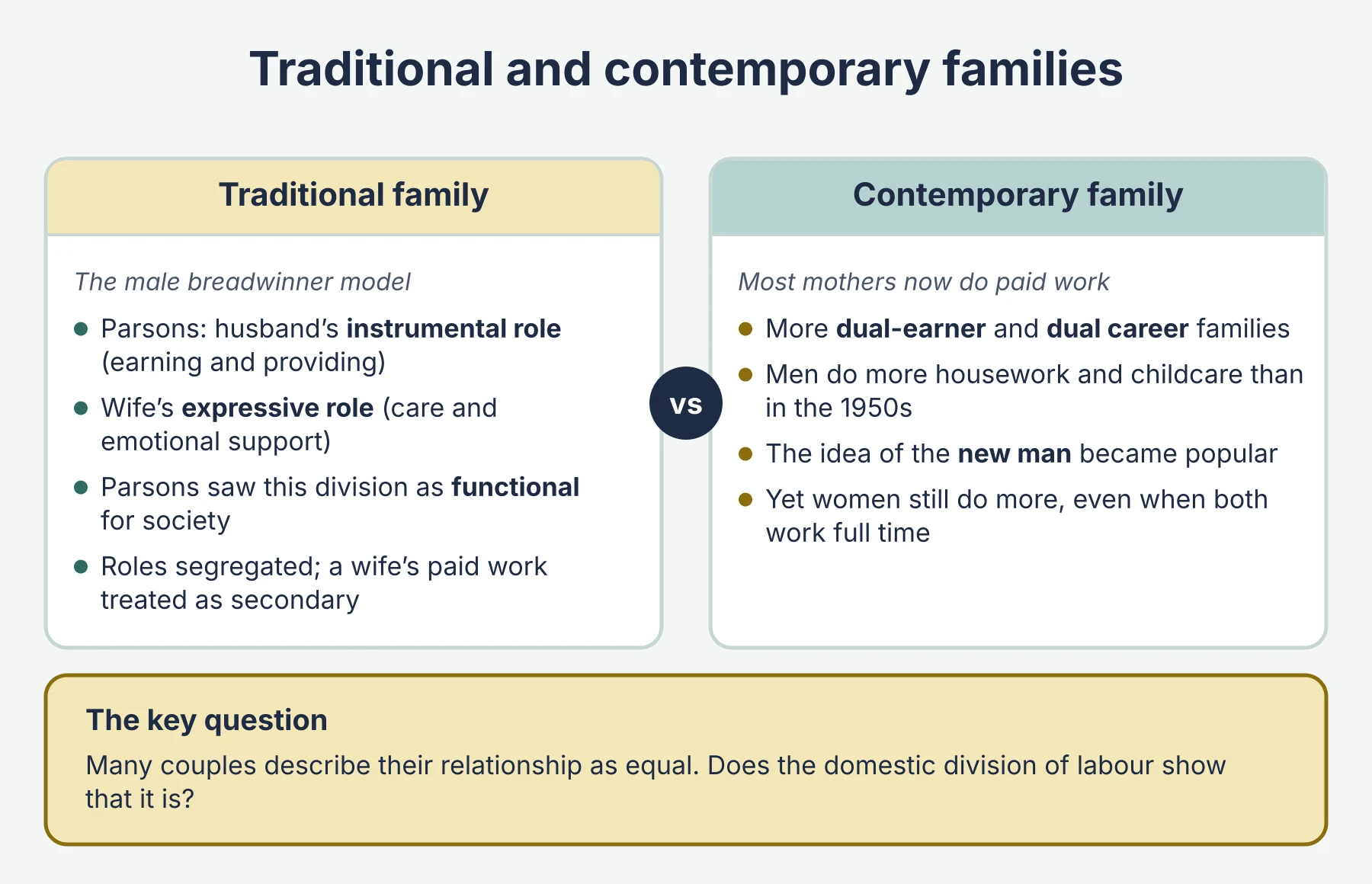
Traditional families. The specification’s “traditional family” usually means the male breadwinner model. Parsons described an instrumental role for husbands (earning and providing) and an expressive role for wives (care and emotional support), and saw this division as functional for society. Roles were segregated, and a wife’s paid work, if any, was treated as secondary.
Contemporary families. Most mothers now do paid work, and many couples describe their relationship as equal. Key features:
- More dual-earner and dual career families.
- Men do more housework and childcare than in the 1950s, and the idea of the new man, who shares domestic tasks and emotional work, became popular.
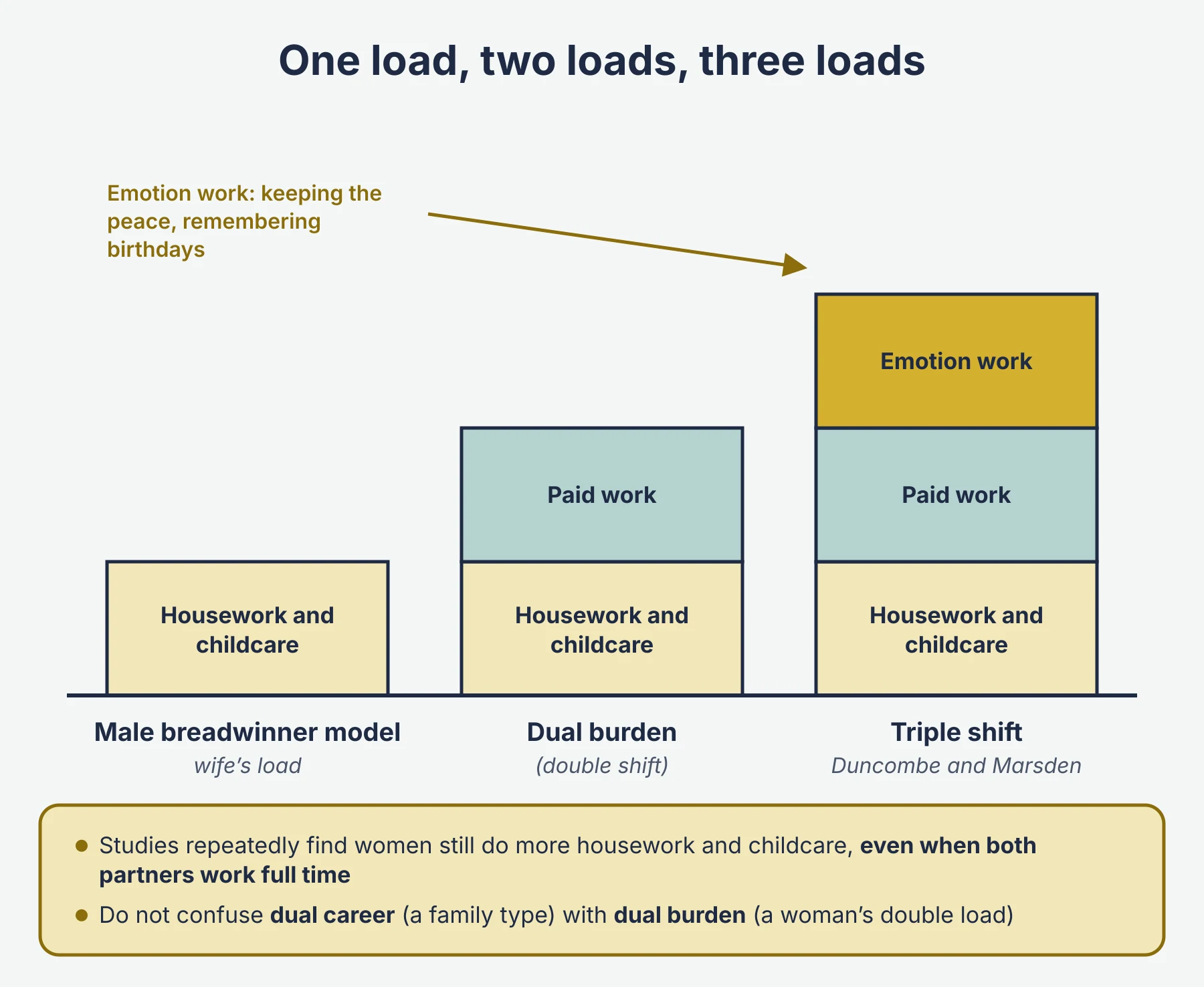
- Yet studies repeatedly find that women still do more housework and childcare, even when both partners work full time. Feminists call this the dual burden or double shift.
- Duncombe and Marsden added emotion work, such as keeping the peace and remembering birthdays, to make a triple shift.
Oakley and the conventional family
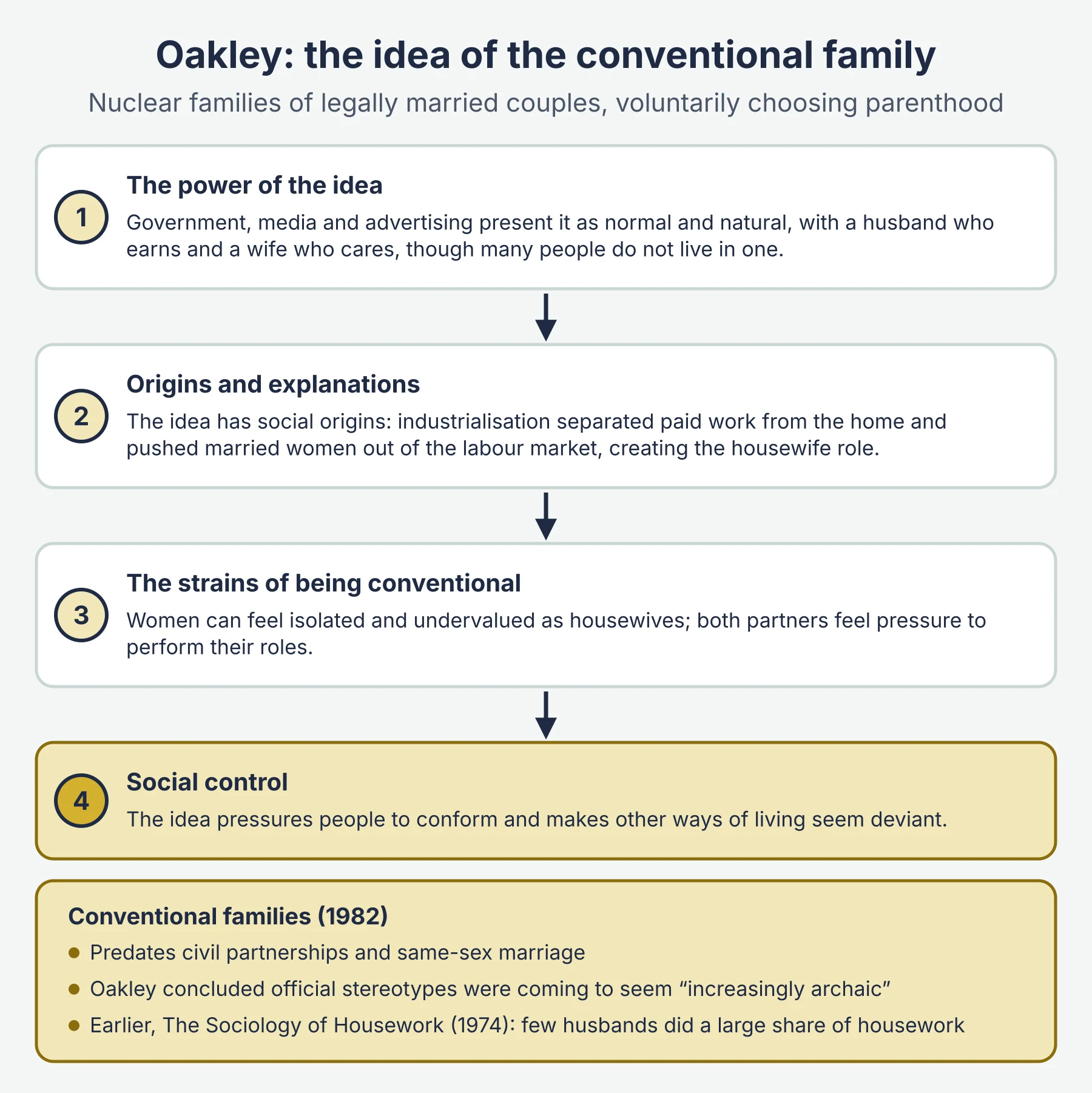
Ann Oakley is the writer the specification names for 3.3.3. In “Conventional families” (1982) she addressed the idea of the conventional family, defined in the specification as “nuclear families composed of legally married couples, voluntarily choosing the parenthood of one or more children”. Her argument has four parts, and you should be able to explain each.
- The power of the idea. The conventional family is presented as normal and natural by government, media and advertising, even though many people do not live in one. The image includes a particular division of roles: a husband who earns and a wife who cares.
- Origins and explanations. The idea has social origins. Oakley’s wider work argues that the housewife role was created by industrialisation, which separated paid work from the home and pushed married women out of the labour market.
- The strains of being conventional. Living up to the ideal causes strain. Women can feel isolated and undervalued as housewives, and both partners can feel pressure to perform their roles.
- Social control. The idea acts as social control, pressuring people to conform and making other ways of living seem deviant.
The specification notes that her paper predates civil partnerships and same-sex marriage, but that she concluded official stereotypes were coming to seem “increasingly archaic”. In earlier research, The Sociology of Housework (1974), Oakley interviewed London housewives and found few husbands who did a large share of housework, which she used to challenge claims that marriage had become equal.
The five contemporary issues
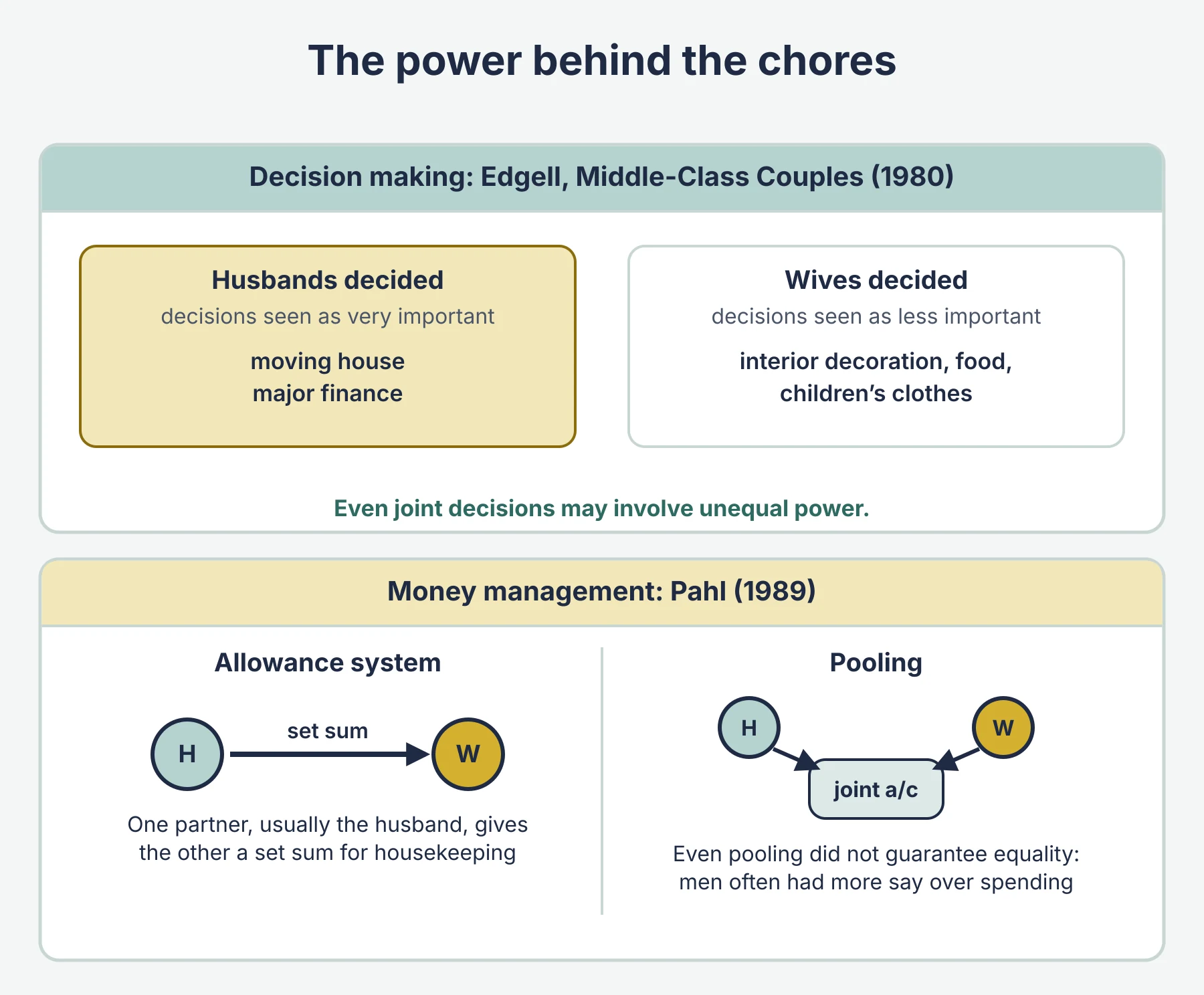
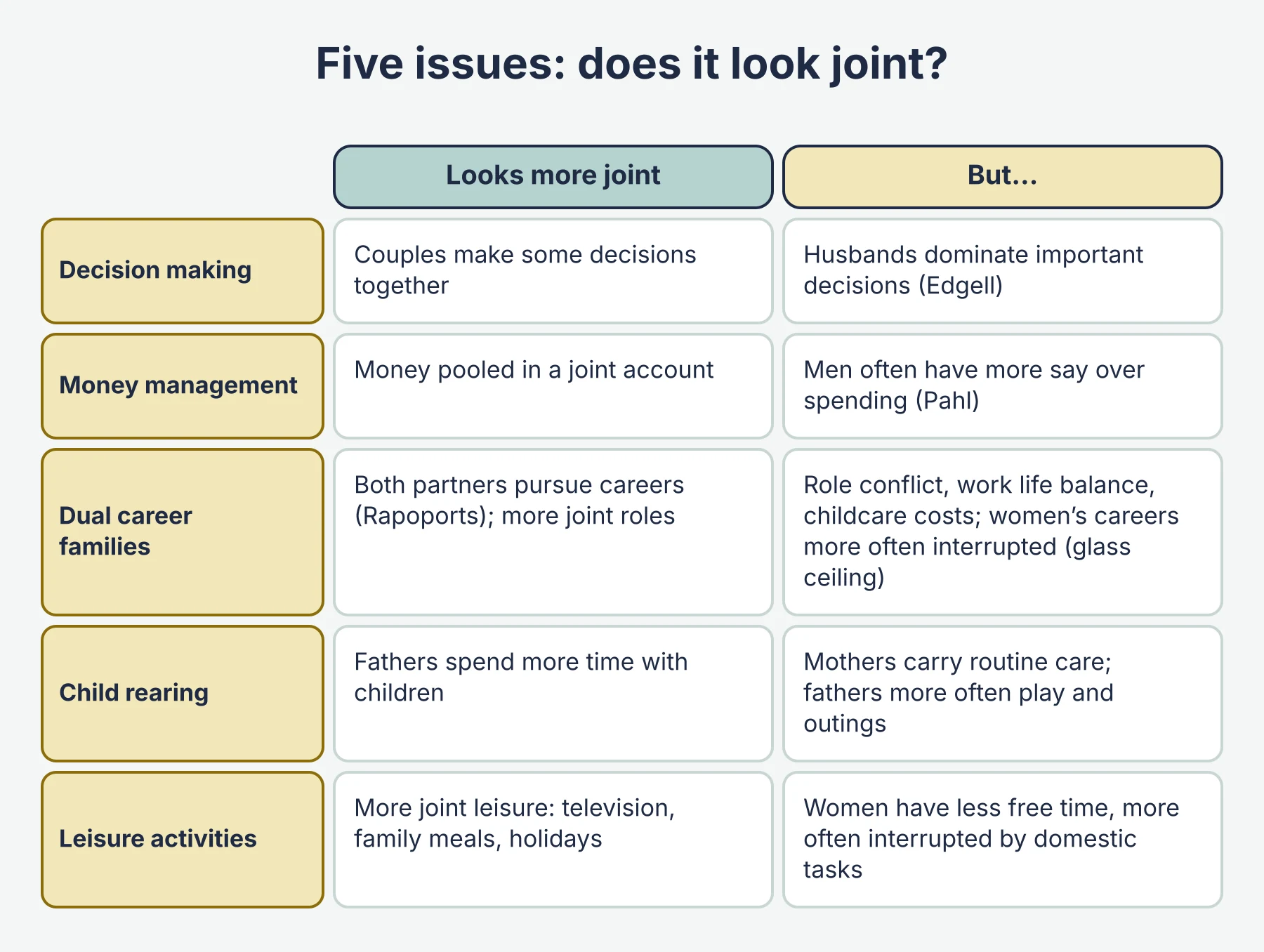
Decision making. Who decides matters as much as who does the chores. Stephen Edgell’s study Middle-Class Couples (1980) found that husbands dominated decisions seen as very important, such as moving house and major finance, while wives decided on matters seen as less important, such as interior decoration, food and children’s clothes. Even joint decisions may involve unequal power.
Money management. Jan Pahl’s research on money in marriage (1989) described different ways couples organise money. In an allowance system one partner, usually the husband, gives the other a set sum for housekeeping. In pooling, money goes into a joint account. Pahl found that even pooling did not guarantee equality, as men often had more say over how shared money was spent.
Dual career families. The term was introduced by the Rapoports for couples in which both partners pursue careers, not just jobs. These families may have more joint roles and shared decisions, but they also face role conflict between work and family, problems of work life balance, and the cost of childcare. Women’s careers are more often interrupted, which links to the glass ceiling.
Child rearing. Fathers spend more time with children than in the past, but mothers usually still carry routine care, such as feeding, bathing and arranging appointments, while fathers’ involvement is more often play and outings. Child-centred parenting has raised the amount of care expected, which can widen the gap if it falls on mothers.
Leisure activities. In segregated relationships, leisure was often separate: men’s leisure outside the home, women’s mainly in the home and combined with childcare. Joint leisure, such as watching television, family meals and holidays, became more common in home-centred families. Feminists argue women still have less free time, and their leisure is more often interrupted by domestic tasks.
Perspectives compared
| Perspective | View of conjugal roles |
|---|---|
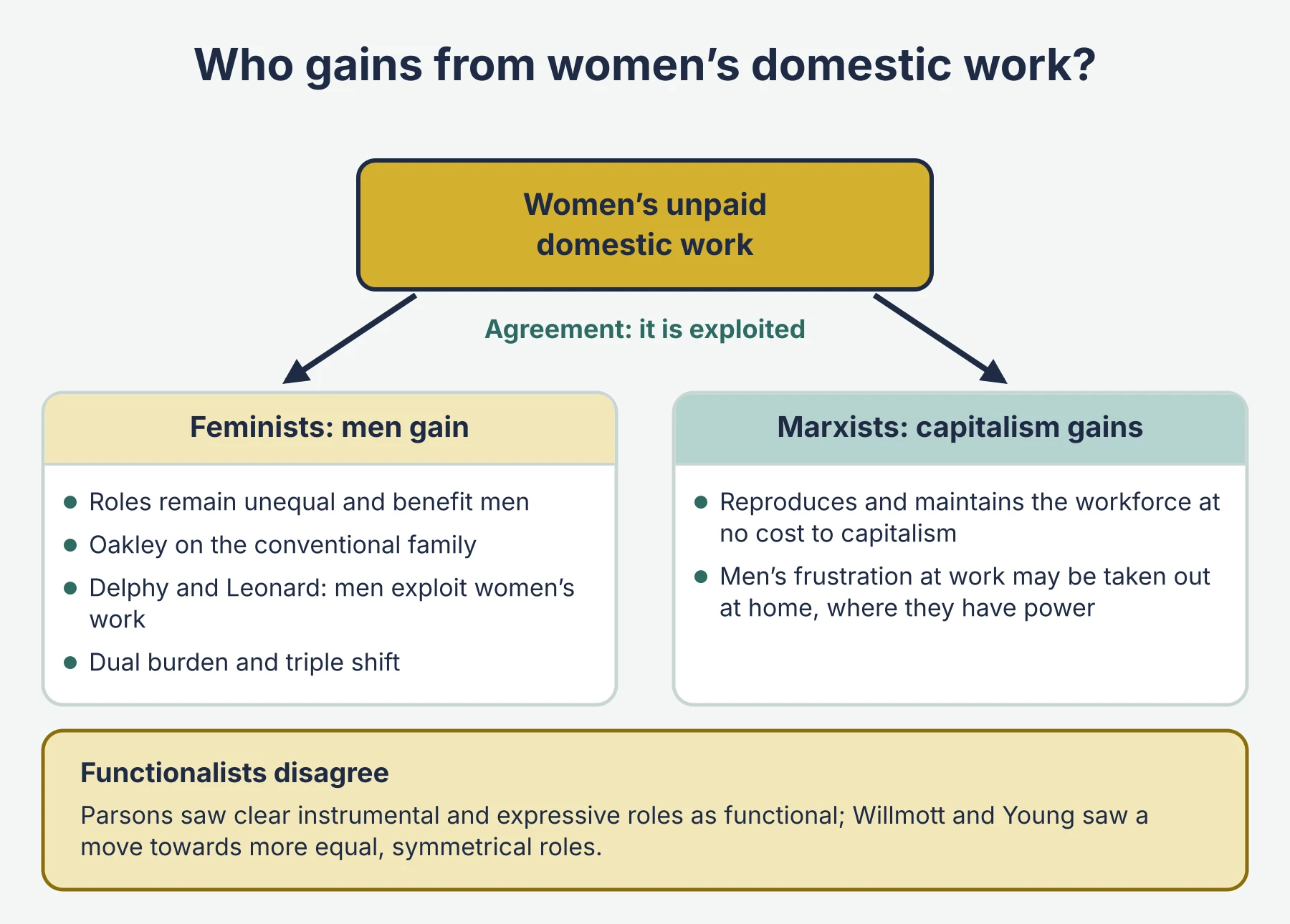
| Functionalist | Clear instrumental and expressive roles suit society (Parsons); Willmott and Young, also functionalists, saw a move towards more equal, symmetrical roles |
| Feminist | Roles remain unequal and benefit men: Oakley on the conventional family, Delphy and Leonard on men exploiting women’s work, the dual burden and triple shift |
| Marxist | Women’s unpaid domestic labour reproduces and maintains the workforce at no cost to capitalism; men’s frustration at work may be taken out at home, where they have power |
Worked example: 4 marks
Question: Identify and explain one issue that affects conjugal role relationships in the contemporary family. [4]
Money management (identifies). Pahl found that couples organise money in different ways, such as an allowance system or pooling into a joint account (describes). Even when money is pooled, men often have more control over how it is spent, so a couple who appear to share everything may still have an unequal relationship (explains). This suggests that roles are not fully joint, because control of resources gives one partner more power in decisions (links to the concept).
Worked example: an evaluative paragraph
Question: Discuss how far sociologists would agree that conjugal roles in the contemporary family are now joint. [12]
Feminists argue that conjugal roles remain segregated in practice. Oakley showed how the idea of the conventional family, with a caring wife and a breadwinning husband, has great power, so even dual-earner couples may assume that the home is mainly the woman’s responsibility. For example, a mother working full time may still organise meals, school forms and medical appointments, carrying a dual burden. Decision making supports this: Edgell found husbands dominated important decisions. However, the rise of dual career families and the idea of the new man suggest that roles are more joint than in the past, especially among younger couples, so change is real even if equality is not complete.
Common mistakes
- Defining joint roles as “both partners work”. Joint roles are about sharing tasks, decisions and leisure, not just paid work.
- Using Oakley only for “women do more housework”. The specification names her work on the idea of the conventional family.
- Treating “dual career” and “dual burden” as the same. One is a family type; the other is a woman’s double load.
- Ignoring power. Decision making and money management show inequality that a list of chores misses.
- Writing that Parsons wanted equality. He saw segregated roles as functional.
Exam technique
- Identify and explain an issue: name one of the five issues, give a named study or example, then say what it shows about equality.
- Compare perspectives: feminists and Marxists both see women’s domestic work as exploited; they disagree over whether men or capitalism gains.
- Item-based questions: look for clues in the item about who decides, who controls money and who does routine tasks, and name the concept each shows.
Official syllabus
AQA GCSE Sociology (8192) specification, Version 1.2 (June 2026), for GCSE exams 2019 onwards: section 3.3.3 Conjugal role relationships and Appendix B, 7.1 Families (Oakley; Delphy and Leonard).
Related resources
-
Practice questions
AQA GCSE Sociology (8192): Conjugal role relationships – Practice Questions
Original AQA GCSE Sociology 8192 practice on 3.3.3 conjugal roles: Oakley, decision making, money, dual career families and leisure, with marked answers.
Sociology · AQA · GCSE
Try questions -
Revision notes
AQA GCSE Sociology (8192): Conjugal role relationships – Revision Notes
Condensed AQA GCSE Sociology 8192 notes on 3.3.3 conjugal roles: joint and segregated roles, Oakley, the five contemporary issues, perspectives and a self-test.
Sociology · AQA · GCSE
Revise topic -
Study guides
AQA GCSE Sociology (8192): Criticisms of families
In-depth AQA GCSE Sociology 8192 guide to 3.3.5: the six criticisms of families, Zaretsky's Marxist view and Delphy and Leonard's feminist critique compared.
Sociology · AQA · GCSE
Read guide
Related articles
Get free revision emails (optional)
Occasional emails with practice questions, worked explanations and links to free resources for the qualification and subjects you choose. No spam, and you can unsubscribe from any email. The free tools on this site never need an email.