
Revision Notes
AQA GCSE Sociology (8192): Family forms – Revision Notes
Condensed AQA GCSE Sociology 8192 notes on 3.3.2 family forms: definitions, the Rapoports' five types of diversity, global family forms, traps and a self-test.
- Subject
- Sociology
- Level
- GCSE
- Topic
- Families
- Author
- Marlbridge Academic Team
- Updated
- Reviewed by
- Naqiya Yousaf (what this means)
Aligned to AQA GCSE Sociology (8192), first teaching 2017. Official specification .
Syllabus page (what it covers and how it is assessed): AQA GCSE Sociology.
Syllabus points this page covers
8192
- 3.3.2 Family forms
Found an error? Report a correction.
Need help with this topic? Request a free trial class for GCSE Sociology (8192).
These notes condense 3.3.2 Family forms from the AQA GCSE Sociology (8192) specification, assessed in Paper 1. The specification asks how “family forms differ in the UK and within a global context”, names “the work of the Rapoports on family diversity”, and lists five forms to “identify, describe and explain”: nuclear, extended, reconstituted, lone parent and single sex.
For full explanations and worked answers, read the family forms study guide. Then try the family forms practice questions.
Key terms
| Term | Meaning |
|---|---|
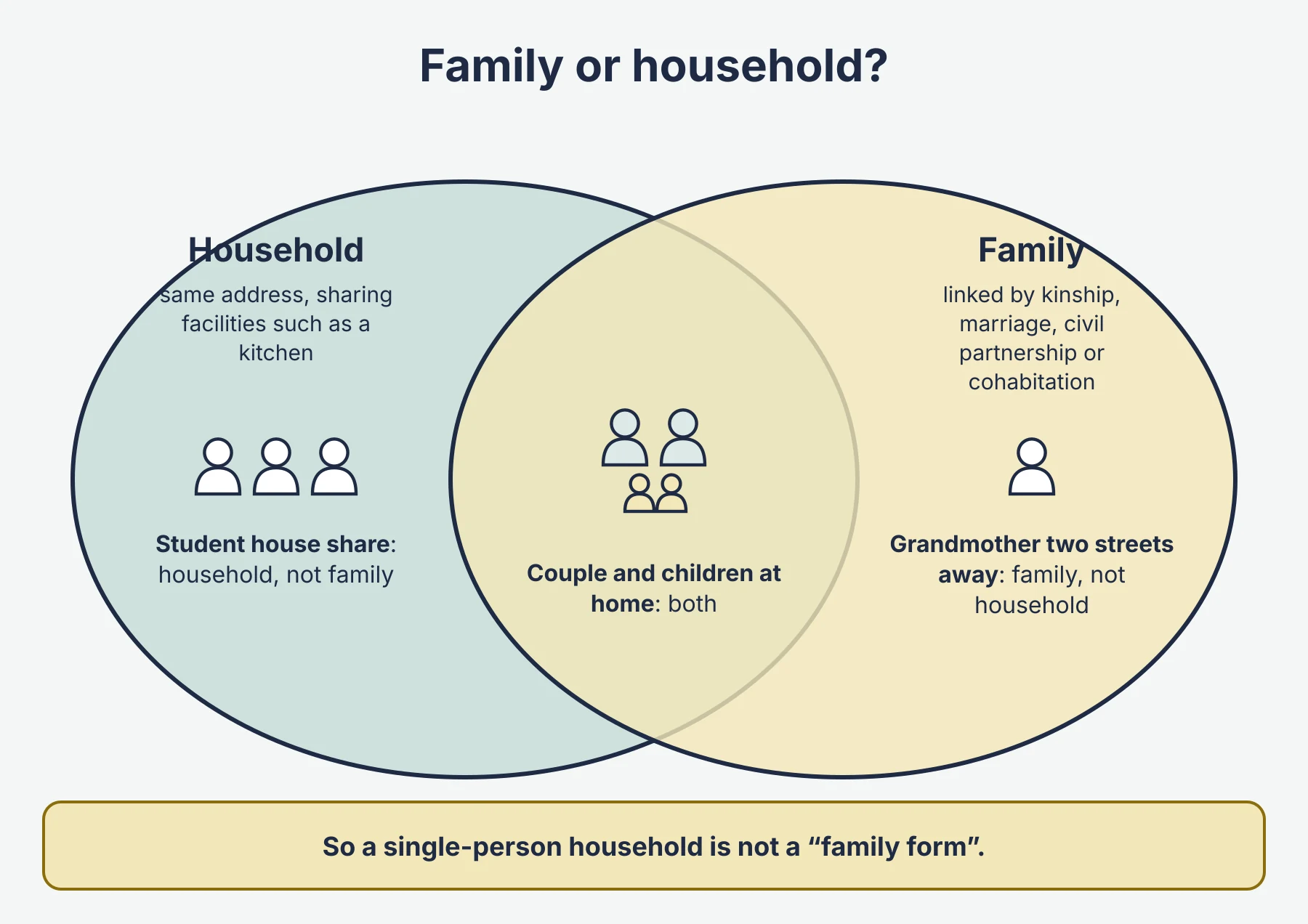
| Household | People living at one address and sharing facilities |
| Family | A group linked by kinship, marriage, civil partnership or cohabitation |
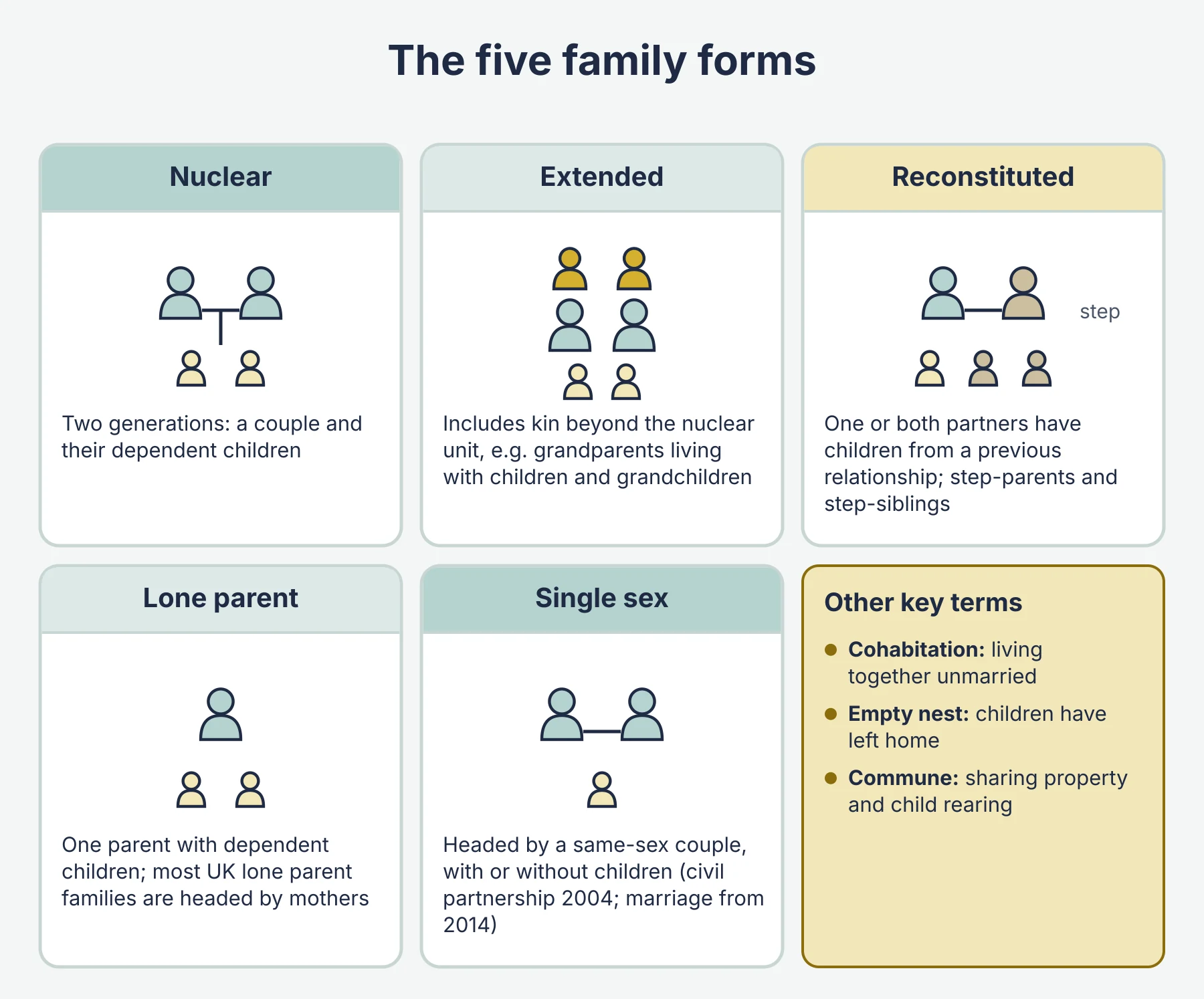
| Nuclear family | A couple and their dependent children |
| Conventional family | Oakley’s term: a nuclear family of a legally married couple who chose to have children |
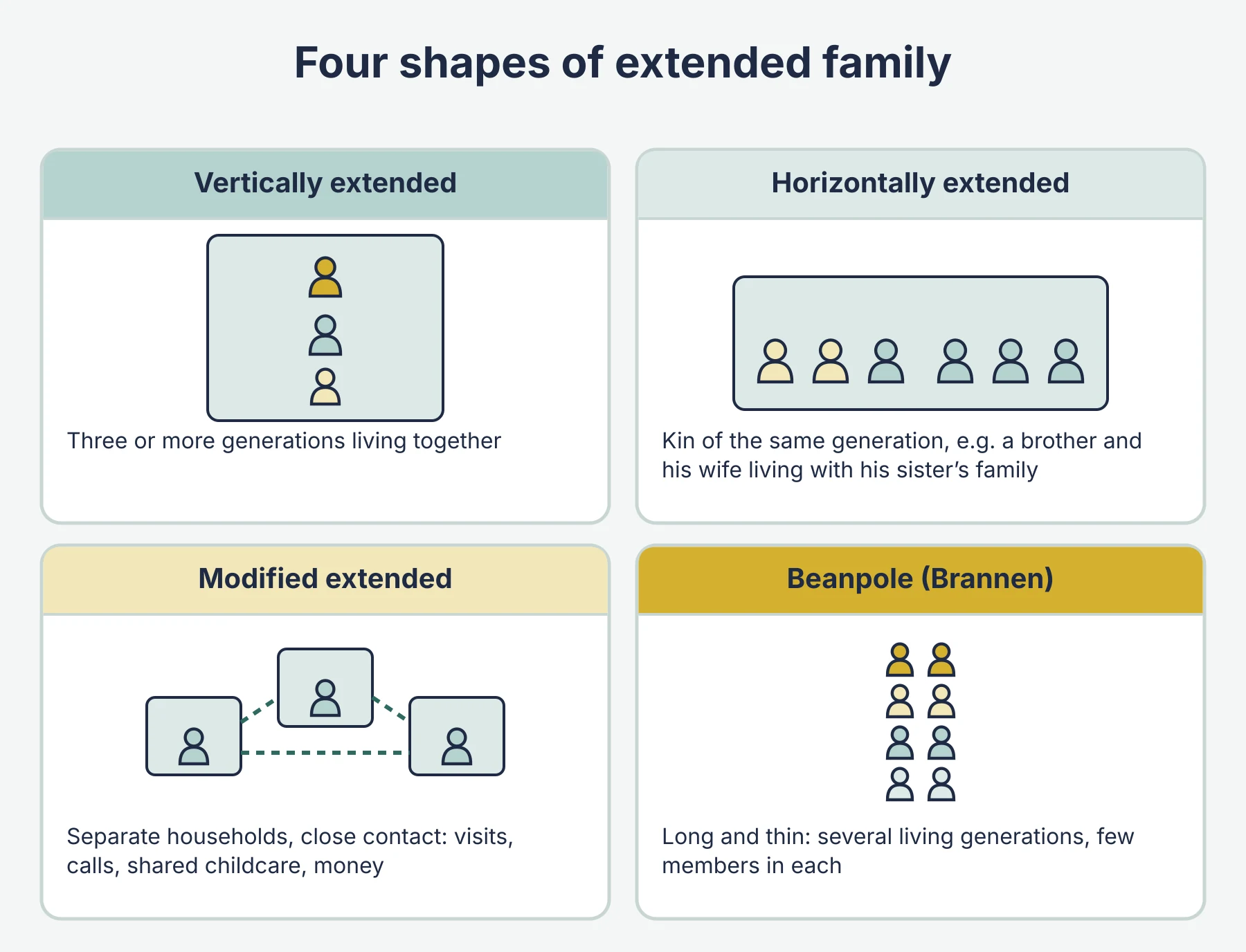
| Vertically extended family | Three or more generations living together |
| Horizontally extended family | Kin of the same generation, such as siblings and their partners, living together |
| Modified extended family | Kin living apart but keeping close contact and support |
| Beanpole family | Many living generations, few members in each (Brannen) |
| Reconstituted (blended) family | A family including children from a previous relationship of one or both partners |
| Step parent | The partner of a child’s parent, who is not the child’s biological or adoptive parent |
| Lone parent family | One parent living with dependent children |
| Single sex family | A family headed by a same-sex couple |
| Cohabitation | A couple living together without being married |
| Empty nest family | A couple whose children have left home |
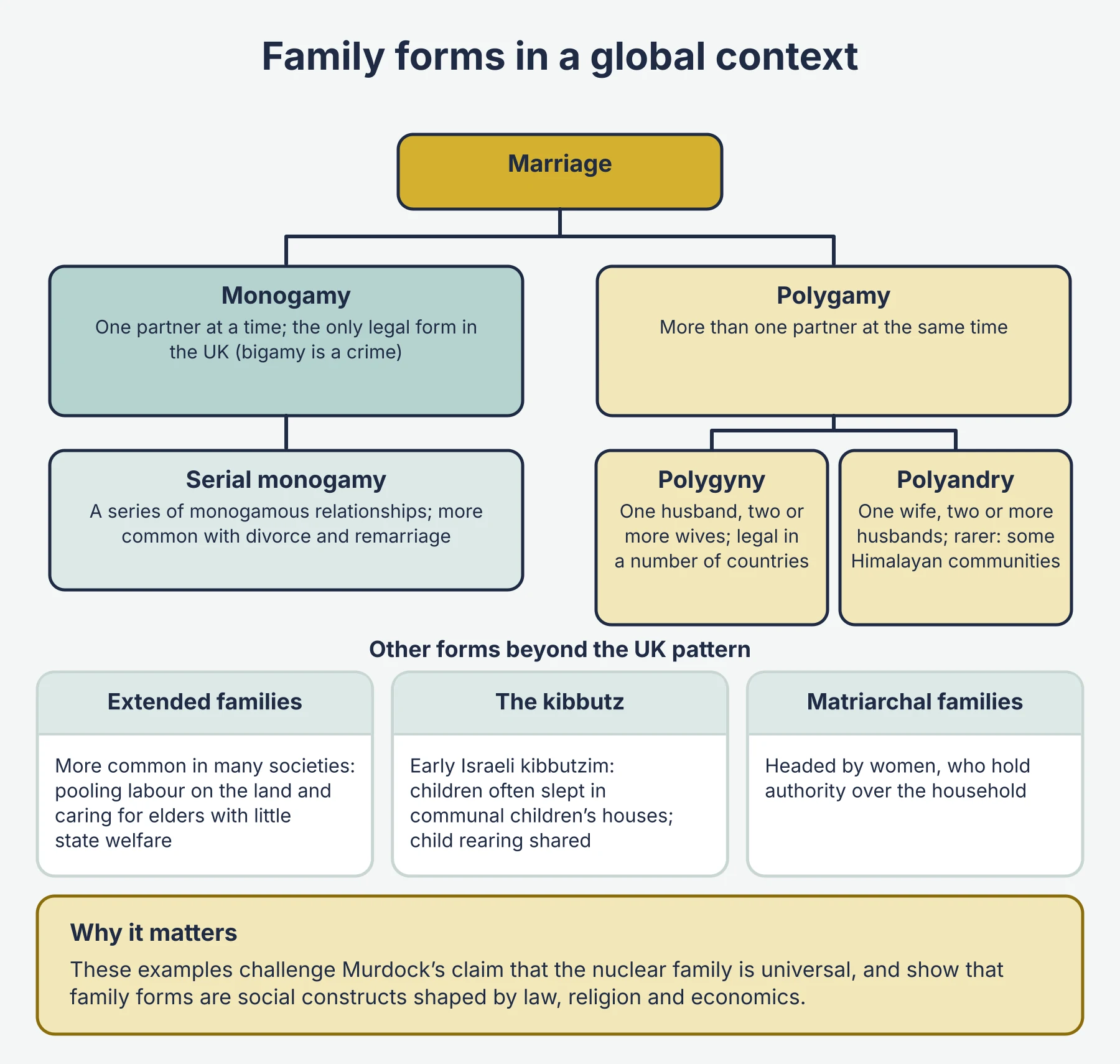
| Monogamy | Marriage to one partner at a time |
| Serial monogamy | A series of monogamous partnerships over a lifetime |
| Polygamy | Marriage to more than one partner at once |
| Polygyny | One husband with two or more wives |
| Polyandry | One wife with two or more husbands |
| Bigamy | Marrying while still legally married to someone else; a crime in the UK |
| Kibbutz | An Israeli collective community where child rearing was historically shared |
| Matriarchal family | A family in which women hold authority |
| Family diversity | The range of different family forms and ways of living |
The five forms: how each forms
- Nuclear: couple has or adopts children.
- Extended: kin move in together, often to share care, costs or housing.
- Reconstituted: a parent forms a new partnership after divorce, separation or bereavement.
- Lone parent: divorce, separation, death of a partner, or choice; most are headed by mothers.
- Single sex: same-sex couples; legal recognition through the Civil Partnership Act 2004 and same-sex marriage in England and Wales from 2014.
The Rapoports in a grid
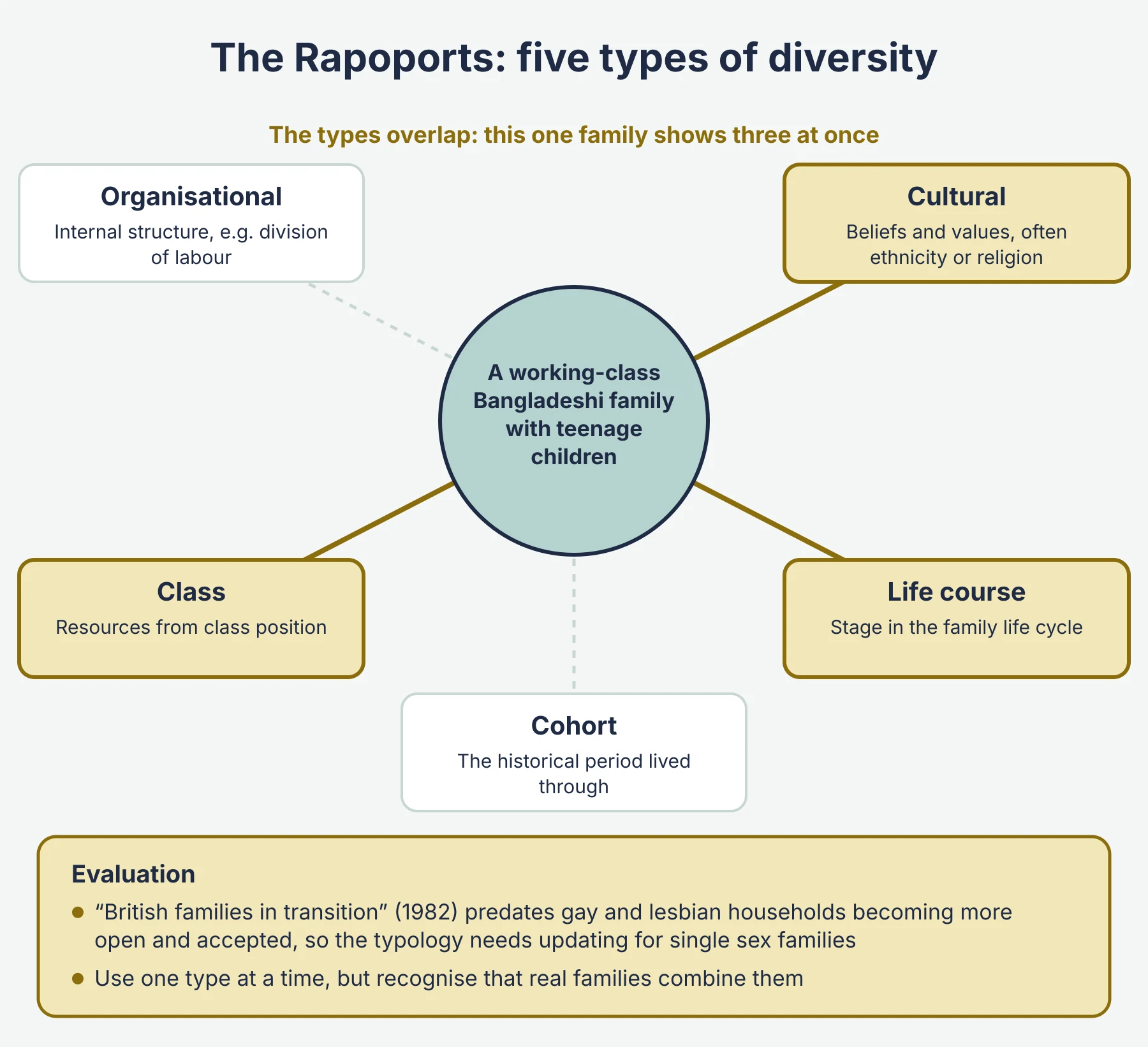
The Rapoports (“British families in transition”, 1982) saw diversity as the central feature of British families.
| Type | Key word | Quick example |
|---|---|---|
| Organisational | Internal structure and division of labour | Dual earners versus a full-time homemaker |
| Cultural | Beliefs and values | Religion shaping marriage or the role of elders |
| Class | Resources from class position | Paid nanny versus help from grandparents |
| Life course | Stage in the family life cycle | Newly-weds versus retired couple |
| Cohort | Historical period | Marrying in the 1950s versus today |
Evaluation: their work predates the open acceptance of gay and lesbian households; the five types overlap in real families.
Global context in five bullets
- Monogamy is the only legal form of marriage in the UK.
- Polygyny is legally permitted in a number of countries; polyandry is rare and has been recorded in some Himalayan communities.
- Extended families remain common where families farm together or the state gives little welfare.
- The kibbutz shows child rearing shared by a community.
- Global variety challenges the claim, associated with Murdock, that the nuclear family is universal.
Perspectives in one line each
- Functionalist: the nuclear family fits industrial society best (Parsons).
- Feminist: diversity can widen women’s choices beyond the conventional family (Oakley).
- Marxist: every family form still consumes and reproduces labour for capitalism.
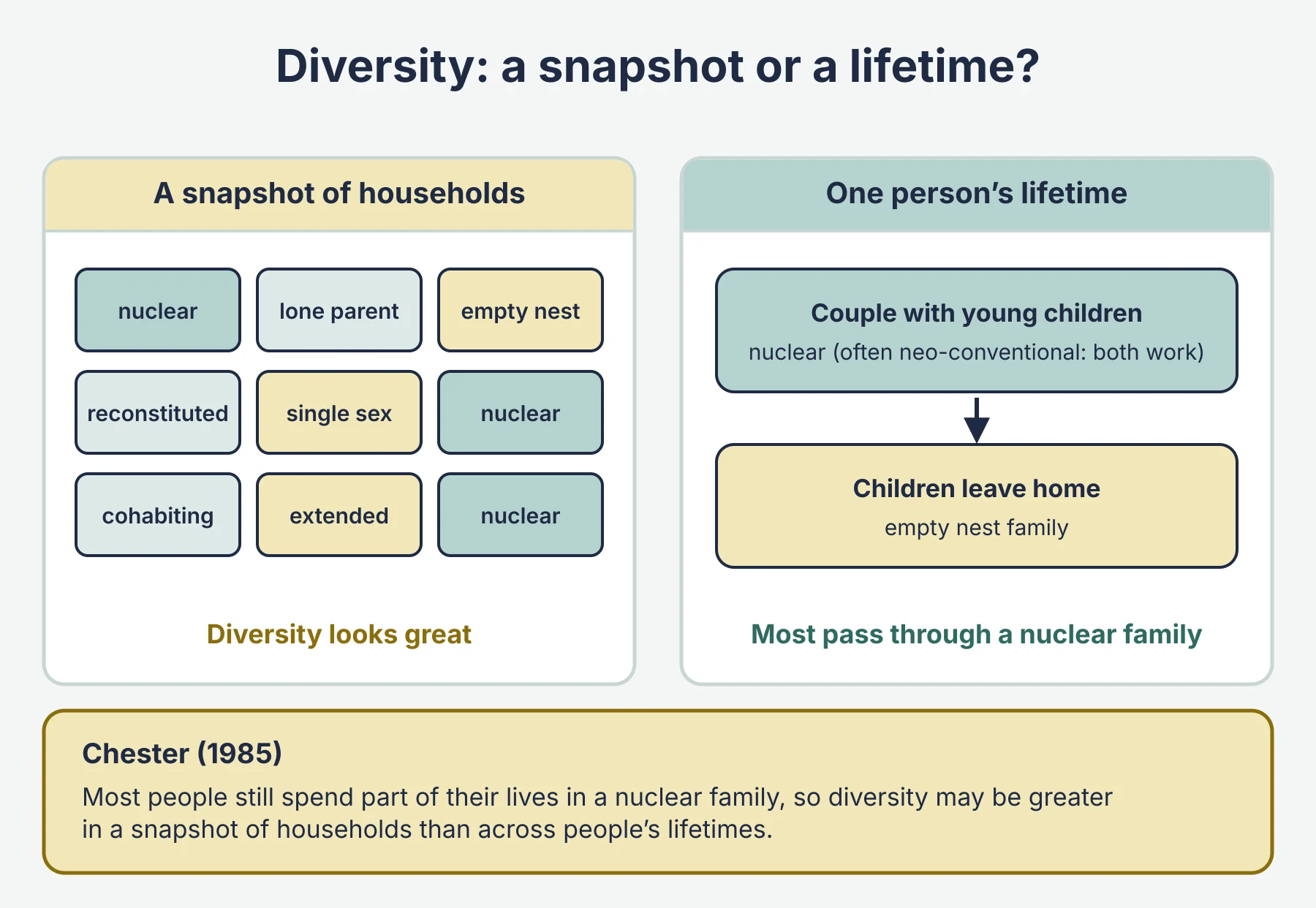
- Counter-view: Chester’s neo-conventional family; most people still live in a nuclear family at some stage.
Exam traps
- Confusing a household with a family.
- Mixing up reconstituted and extended families.
- Leaving dependent children out of the definition of a lone parent family.
- Naming the Rapoports’ types with no examples.
- Using “polygamy” when you mean polygyny, or the reverse.
- Claiming the Rapoports wrote about same-sex families.
- Writing that the nuclear family has “disappeared”.
Quick self-test
- Name the five family forms listed in the specification.
- What is the difference between a household and a family?
- What is a vertically extended family?
- What is a modified extended family?
- Give two ways a lone parent family can form.
- What is a reconstituted family?
- Name the Rapoports’ five types of diversity.
- Give an example of life course diversity.
- What limitation of the Rapoports’ work does the specification point out?
- What is the difference between polygyny and polyandry?
- What did Chester mean by the neo-conventional family?
- How does global evidence challenge the view that the nuclear family is universal?
Answers
- Nuclear, extended, reconstituted, lone parent and single sex.
- A household is people sharing an address and facilities; a family is linked by kinship, marriage, civil partnership or cohabitation.
- Three or more generations living together, such as grandparents, parents and children.
- Extended kin who live apart but keep close contact and support each other.
- Any two: divorce, separation, death of a partner, choosing to parent alone.
- A family in which one or both partners have children from a previous relationship.
- Organisational, cultural, class, life course and cohort.
- A couple with young children living very differently from the same couple once retired.
- It predates gay and lesbian households becoming a more open and accepted feature of society.
- Polygyny is one husband with several wives; polyandry is one wife with several husbands.
- A nuclear family in which both partners often do paid work; he argued most people still live in one at some stage.
- Forms such as polygamous families, extended households and the kibbutz show that the nuclear family is not the only way societies organise family life.
Official syllabus
AQA GCSE Sociology (8192) specification, Version 1.2 (June 2026), for GCSE exams 2019 onwards: section 3.3.2 Family forms and Appendix B, 7.1 Families.
Related resources
-
Study guides
AQA GCSE Sociology (8192): Functions of families
In-depth AQA GCSE Sociology 8192 guide to 3.3.1: the four functions of families, Parsons on socialisation and stabilisation, and Marxist and feminist replies.
Sociology · AQA · GCSE
Read guide -
Practice questions
AQA GCSE Sociology (8192): Functions of families – Practice Questions
Original AQA GCSE Sociology 8192 practice on 3.3.1 functions of families: Parsons, Engels, Zaretsky and feminist views, with marked answers and 12-mark plans.
Sociology · AQA · GCSE
Try questions -
Revision notes
AQA GCSE Sociology (8192): Functions of families – Revision Notes
Condensed AQA GCSE Sociology 8192 notes on 3.3.1 functions of families: the four functions, Parsons, Marxist and feminist views, traps and a self-test.
Sociology · AQA · GCSE
Revise topic
Related articles
Get free revision emails (optional)
Occasional emails with practice questions, worked explanations and links to free resources for the qualification and subjects you choose. No spam, and you can unsubscribe from any email. The free tools on this site never need an email.