
Study Guides
AQA GCSE Sociology (8192): Roles and functions of education
In-depth AQA GCSE Sociology 8192 guide to 3.4.1: the three functions of education, Durkheim and Parsons, types of school, home schooling and de-schooling.
- Subject
- Sociology
- Level
- GCSE
- Topic
- Education
- Author
- Marlbridge Academic Team
- Updated
- Reviewed by
- Naqiya Yousaf (what this means)
Aligned to AQA GCSE Sociology (8192), first teaching 2017. Official specification .
Syllabus page (what it covers and how it is assessed): AQA GCSE Sociology.
Syllabus points this page covers
8192
- 3.4.1 Roles and functions of education
Found an error? Report a correction.
Need help with this topic? Request a free trial class for GCSE Sociology (8192).
This guide goes deep on one sub-section of the AQA GCSE Sociology (8192) specification: 3.4.1 Roles and functions of education, assessed in Paper 1: The sociology of families and education. The specification names “the functionalist perspective of Durkheim on education as the transmission of norms and values and Parsons on achieved status and the operation of schools on meritocratic principles”. You must be able to:
- “identify, describe and explain the functions of education including serving the needs of the economy, facilitating social mobility and fostering social cohesion”;
- “identify and describe a variety of different types of school including primary and secondary, state and private”;
- “describe alternative forms of educational provision including home schooling and de-schooling”;
- compare functionalist, feminist and Marxist perspectives, and describe the key ideas of Durkheim and Parsons.
For all four Education sub-sections, see the Education study guide. To revise this sub-section, use the roles and functions of education revision notes, then test yourself with the roles and functions of education practice questions.
Roles, functions and perspectives
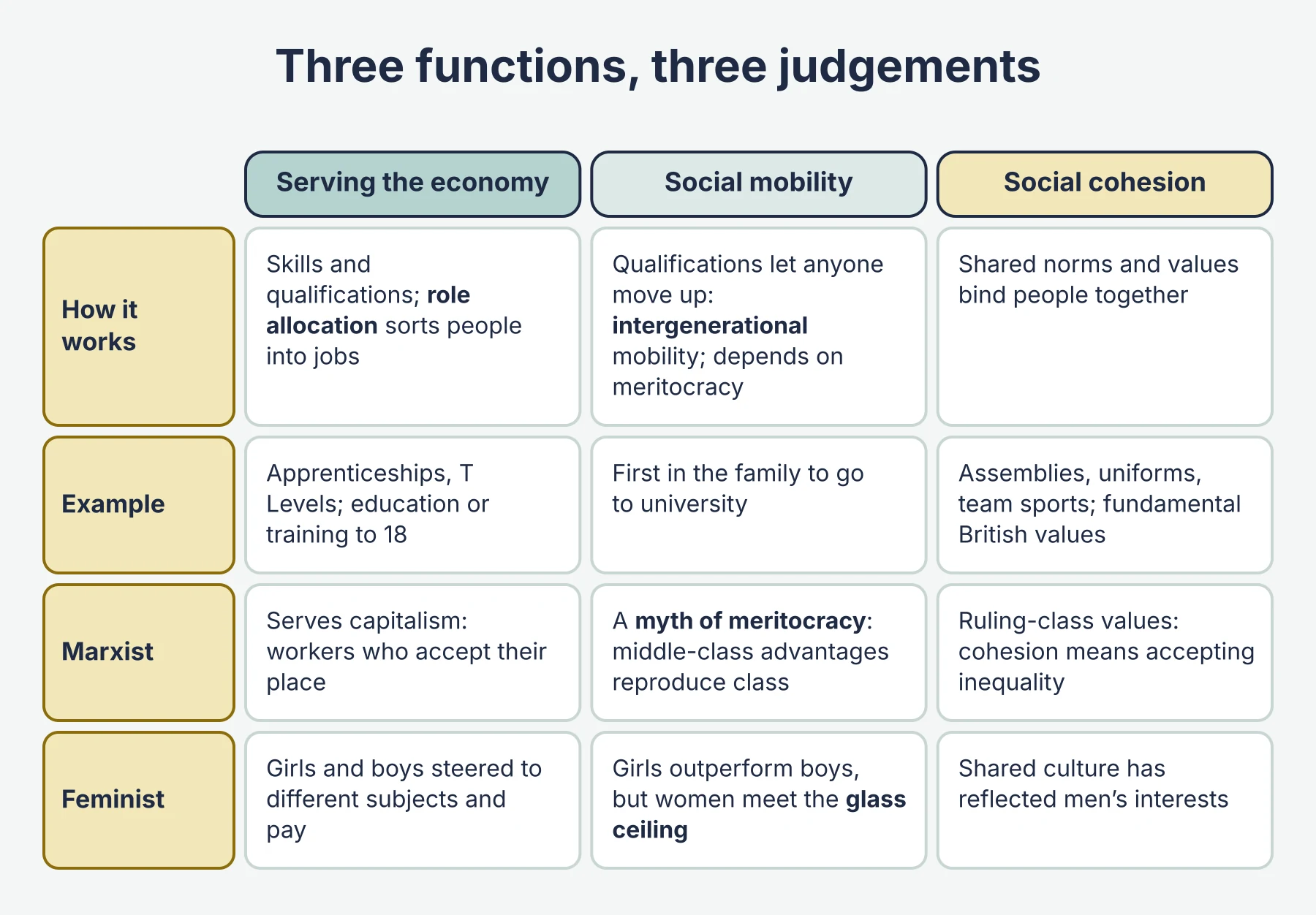
A function is what an institution does for society as a whole. A role is the part it plays in people’s lives. Functionalists see education’s functions as positive and shared. Marxists and feminists accept that schools perform these functions but ask who really benefits. Every answer in 3.4.1 is stronger if you show both what a function is and how each perspective judges it.
The three functions in depth
Serving the needs of the economy
Modern economies need workers with literacy, numeracy and specialist skills. Schools, colleges and universities provide them, and qualifications tell employers who can do which job. This is role allocation: education sifts and sorts people into roles that match their abilities.
Examples you can use: vocational courses and apprenticeships that train for particular jobs, technical qualifications such as T Levels in England, and computing and science subjects promoted because employers say they need them. In England young people must stay in education or training until 18, partly so that the workforce is better qualified.
Marxist view: schools serve the needs of capitalism rather than “the economy” in general, producing workers who accept their place. Feminist view: girls and boys have been steered towards different subjects and so towards differently paid jobs.
Facilitating social mobility
Social mobility is movement up or down the class structure. Education can make this possible because, in principle, anyone who gains qualifications can move into a better-paid, higher-status job than their parents. This is intergenerational mobility. A pupil whose parents left school at 16 becoming the first in the family to go to university is a typical example.
The function depends on meritocracy: rewards based on ability and effort, not background. It links directly to Parsons’ idea of achieved status.
Marxist view: this is a myth of meritocracy. Middle-class pupils have more resources and cultural capital, so the system mainly reproduces class positions while making failure look like the individual’s fault. Feminist view: girls now outperform boys at most levels, which shows mobility can happen, but women still meet the glass ceiling at work.
Fostering social cohesion
Social cohesion means people feel bound together by shared norms and values. Schools create this by teaching a shared culture and bringing children from different backgrounds together. Examples: assemblies, school uniforms, house systems and team sports; citizenship lessons; and the requirement for schools in England to promote fundamental British values, such as democracy and the rule of law.
Marxist view: the “shared” values are those of the ruling class, so cohesion means accepting inequality. Feminist view: a shared culture has often reflected men’s interests, for example in which historical figures are taught.
Durkheim on education
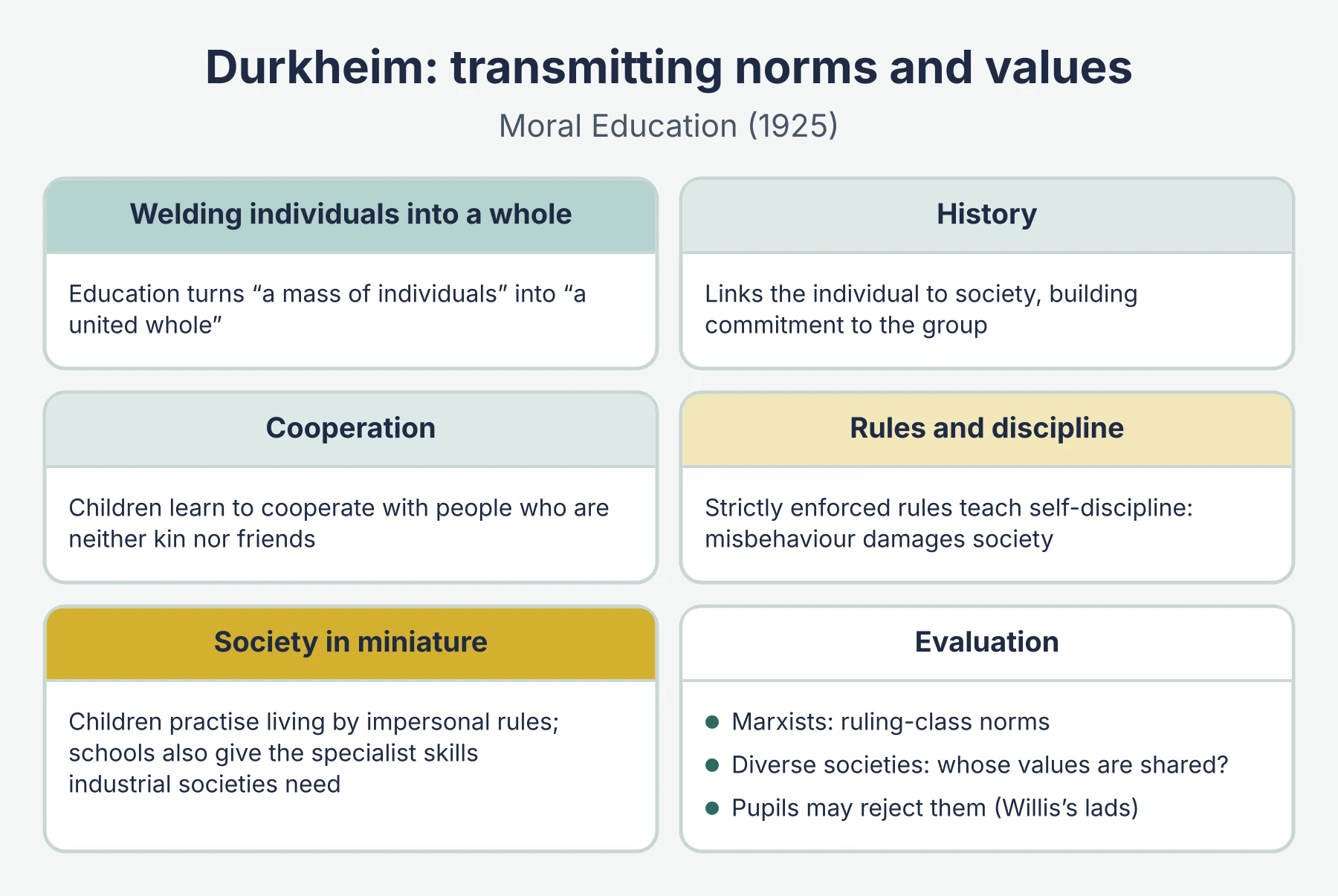
Émile Durkheim (Moral Education, 1925) saw the major function of education as the transmission of society’s norms and values. Build an answer from five ideas.
- Welding individuals into a whole. Every society must turn “a mass of individuals” into “a united whole”, and education does this.
- History. Teaching history links the individual to society, so children see they are part of something larger and develop commitment to the group.
- Cooperation. School is where children learn to cooperate with people who are neither their kin nor their friends, which is how adult society works.
- Rules and discipline. Rules should be strictly enforced, so that children learn self-discipline and see that misbehaviour damages society as a whole.
- Society in miniature. Durkheim described the school as a small version of society, in which children practise living by impersonal rules. He also argued that complex industrial societies need people with specialist skills, which schools provide.
Evaluation. Marxists argue the norms passed on are ruling-class norms. In diverse societies it is harder to say which values are “shared”. Pupils may reject school values, as Willis’s lads did.
Parsons on education
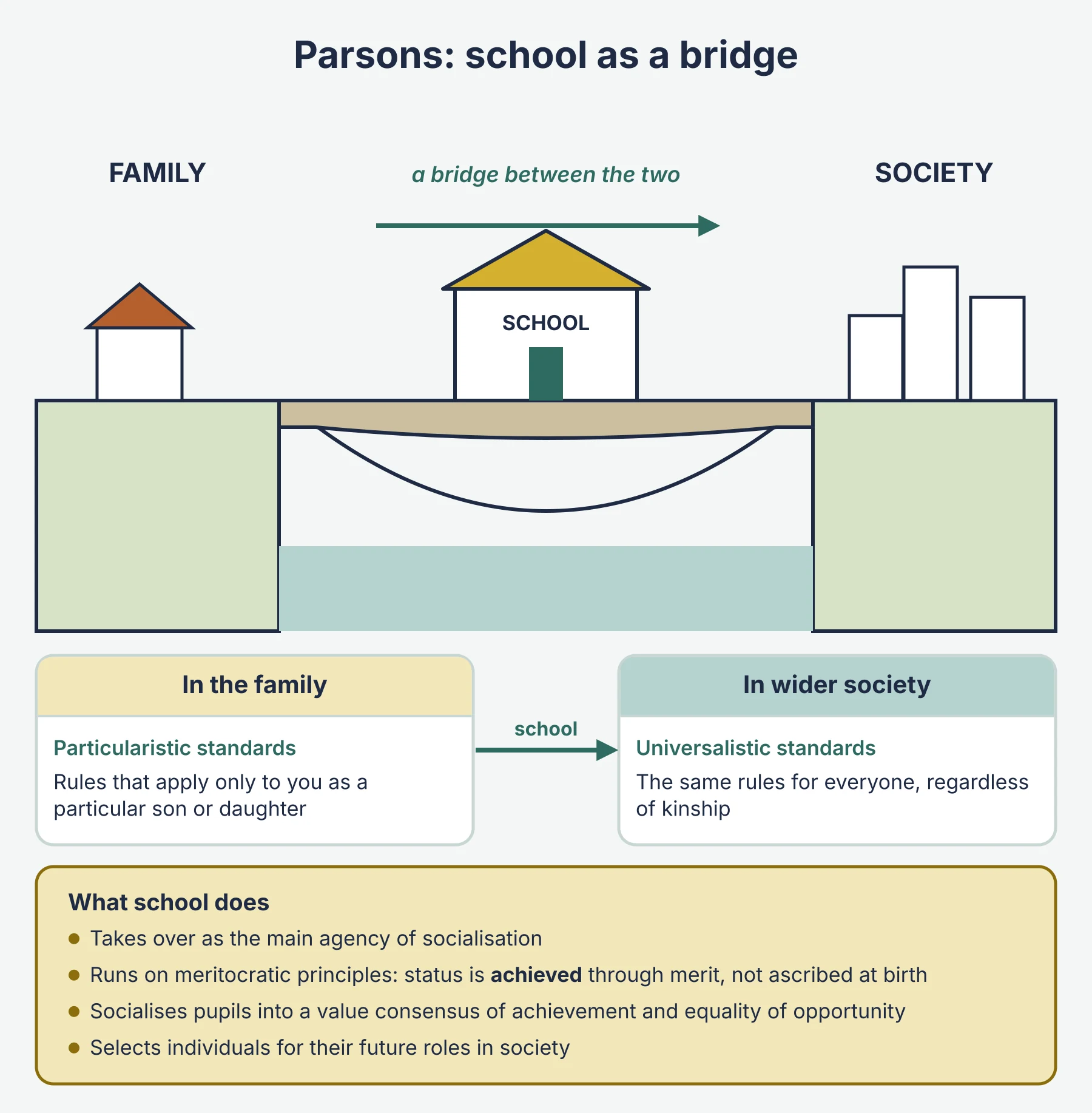
Talcott Parsons (“The school class as a social system”, 1961) also wrote from a functionalist perspective. His key ideas:
- The school is a bridge between the family and wider society, taking over as the main agency of socialisation.
- Families judge children by particularistic standards; school and society use universalistic standards that apply to everyone.
- Schools operate on meritocratic principles: status is achieved through merit, not ascribed by birth.
- Schools socialise children into a value consensus that emphasises achievement and equality of opportunity.
- Schools select individuals for their future roles.
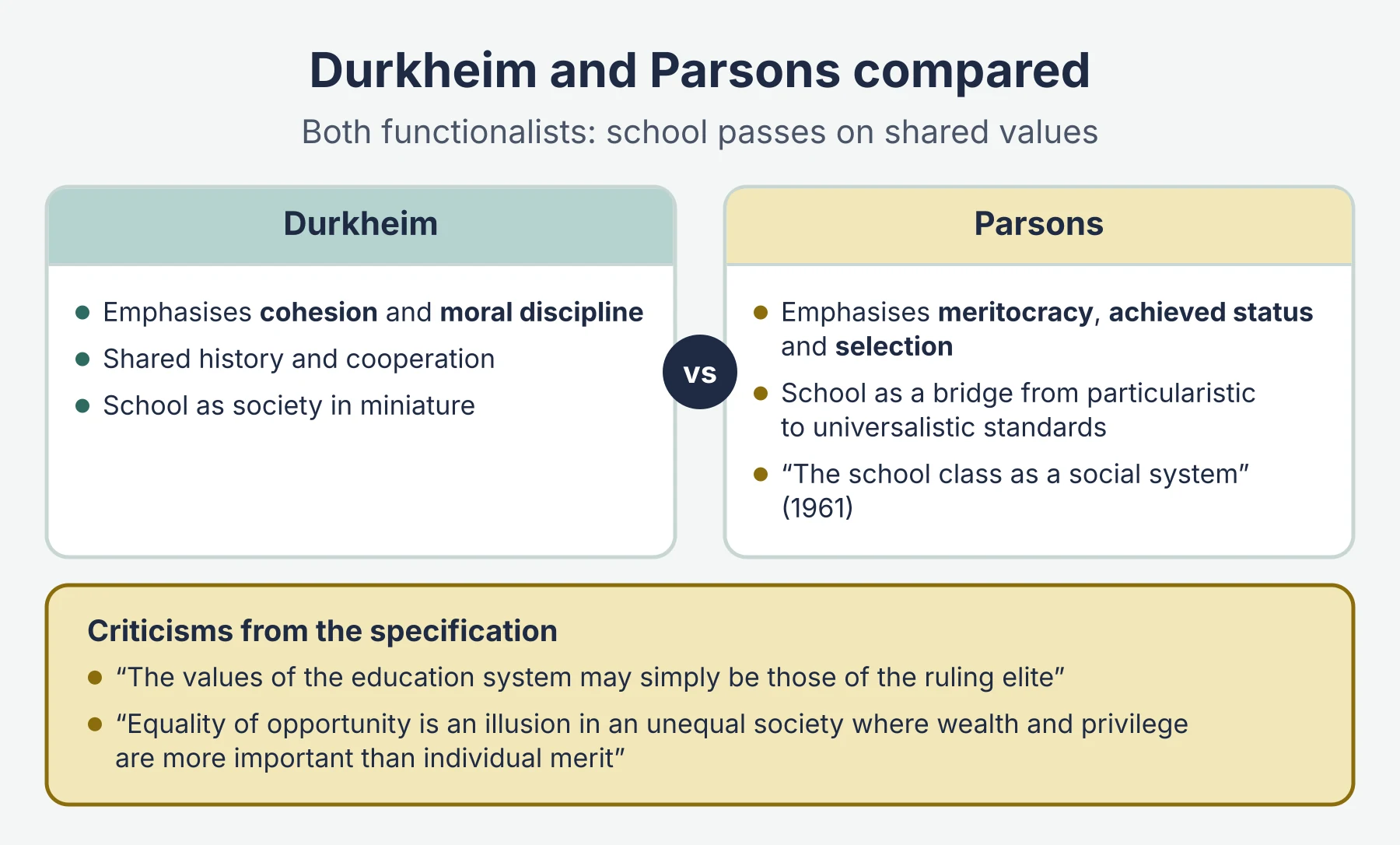
Evaluation from the specification. Critics argue that “the values of the education system may simply be those of the ruling elite”, or that “equality of opportunity is an illusion in an unequal society where wealth and privilege are more important than individual merit”.
Durkheim and Parsons compared. Both are functionalists who see school as passing on shared values. Durkheim emphasises cohesion and moral discipline; Parsons emphasises meritocracy, achieved status and selection.
Types of school
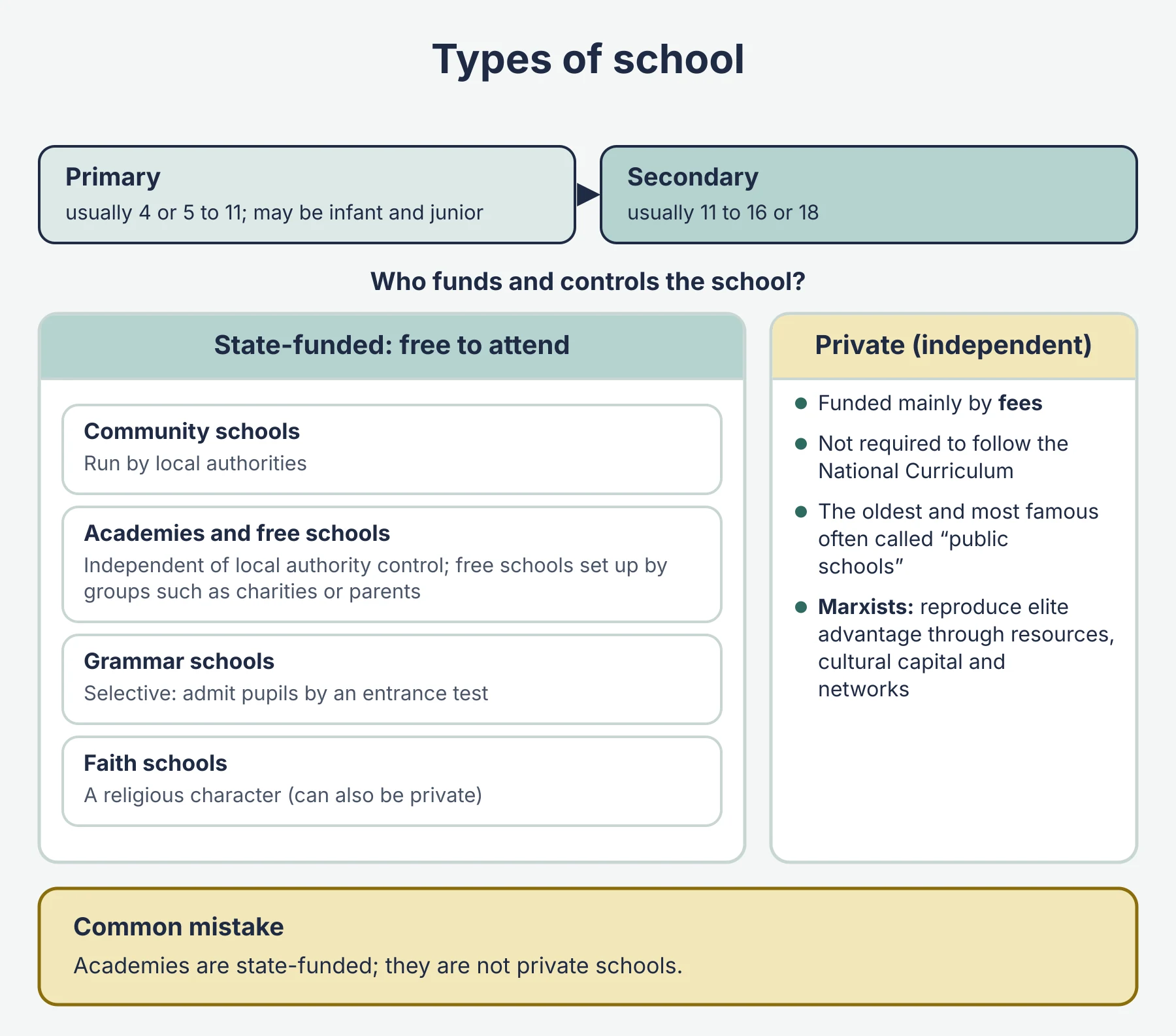
| Type | Description | Sociological issue |
|---|---|---|
| Primary | Usually ages 4 or 5 to 11; may be split into infant and junior schools | Where formal secondary socialisation begins |
| Secondary | Usually ages 11 to 16 or 18 | Where setting and subject choice start to shape futures |
| State (maintained) | Funded by taxation and free to attend; includes community schools run by local authorities | Most pupils attend state schools |
| Academies and free schools | State-funded but independent of local authority control; free schools are new academies set up by groups such as charities or parents | Debate over choice, competition and accountability |
| Faith schools | State or private schools with a religious character | Cohesion within a faith versus separation between groups |
| Grammar schools | Selective state schools that admit pupils by an entrance test | Whether selection helps mobility or favours better-off families |
| Private (independent, fee-paying) | Funded mainly by fees; not required to follow the National Curriculum; the oldest and most famous are often called “public schools” | Marxists see them as reproducing elite advantage through resources, cultural capital and social networks |
Alternative forms of educational provision
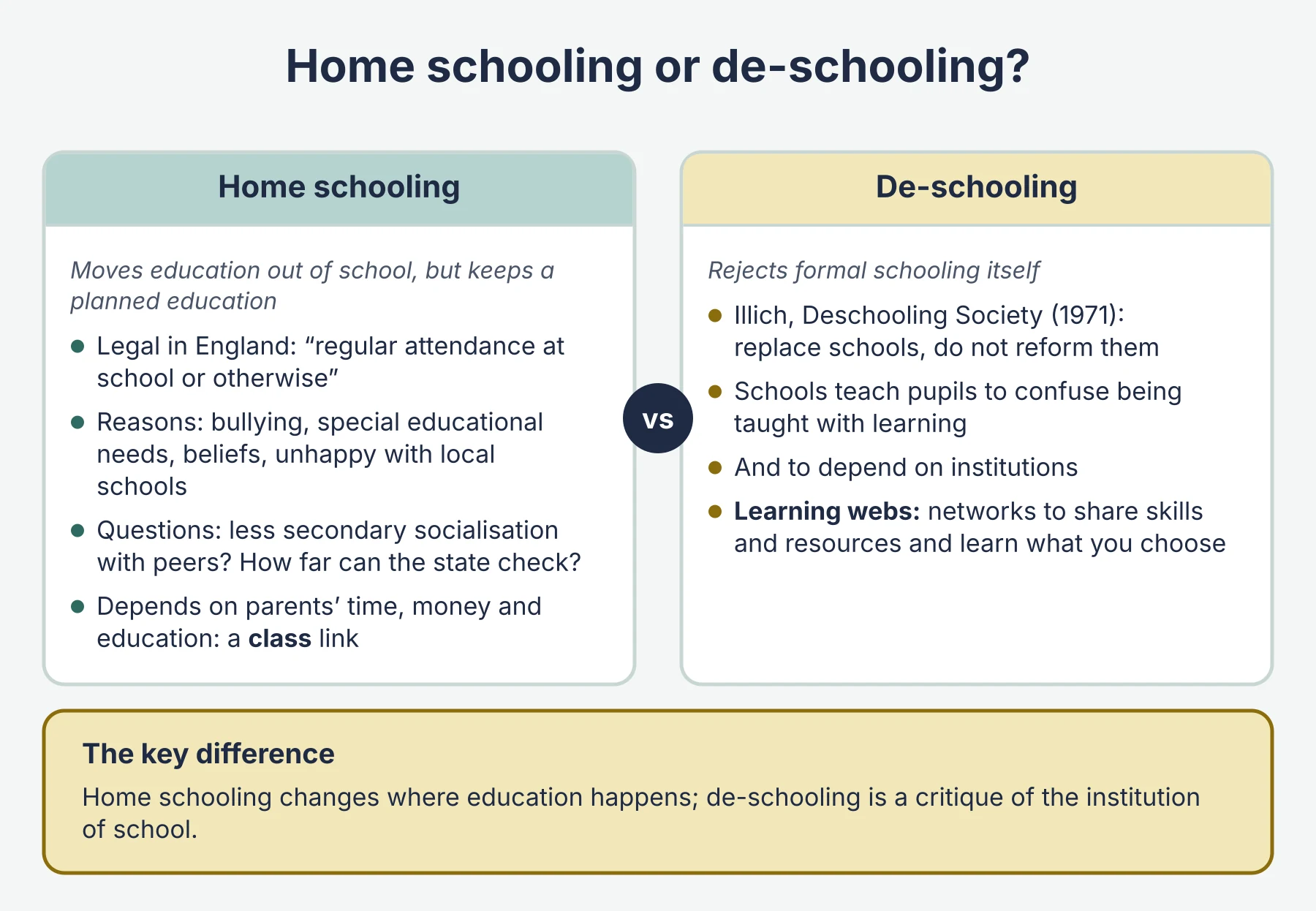
Home schooling. In England, parents must make sure their child receives a suitable, efficient full-time education, “either by regular attendance at school or otherwise”, so educating a child at home is legal. Parents may choose it because of bullying, special educational needs, religious or philosophical beliefs, or dissatisfaction with local schools. Sociological questions include whether home-schooled children miss out on secondary socialisation with peers, and how far the state can check what they learn. Home schooling also depends on parents’ time, money and education, which links it to class.
De-schooling. Ivan Illich, in Deschooling Society (1971), argued that schools should be replaced rather than reformed. He claimed schools teach pupils to confuse being taught with learning, and to depend on institutions to meet their needs. He proposed learning webs: networks through which people could share skills and resources and learn what they chose. De-schooling is a critique of the institution of school, not just a different place to learn.
The key difference: home schooling moves education out of school but keeps a planned education; de-schooling rejects formal schooling itself.
Worked example: 4 marks
Question: Identify and explain one way in which education may foster social cohesion. [4]
Teaching a shared history (identifies). Durkheim argued that history lessons link the individual to society (names the source). When pupils from many backgrounds learn about the same national events, they come to see themselves as part of one larger society (applies). This builds commitment to the group, which helps hold society together rather than leaving it as a mass of separate individuals (explains the function).
Common mistakes
- Giving Durkheim’s ideas to Parsons, or the reverse. Cohesion and discipline: Durkheim. Meritocracy and universalistic standards: Parsons.
- Writing “education helps the economy” with no mechanism (skills, qualifications, role allocation).
- Confusing private schools with academies. Academies are state-funded.
- Treating home schooling and de-schooling as the same.
- Giving only the functionalist view of a function, so the answer has no comparison.
Exam technique
- Identify and describe a type of school: name it and give two features, such as funding and admissions.
- Describe key ideas of Durkheim or Parsons: use the specification’s language and add one example.
- Discuss how far: set a functionalist claim against Marxist and feminist replies, and judge whether education performs the function for everyone or mainly for some groups.
Official syllabus
AQA GCSE Sociology (8192) specification, Version 1.2 (June 2026), for GCSE exams 2019 onwards: section 3.4.1 Roles and functions of education and Appendix B, 7.2 Education (Durkheim; Parsons).
Related resources
-
Practice questions
AQA GCSE Sociology (8192): Roles and functions of education – Practice Questions
Original AQA GCSE Sociology 8192 practice on 3.4.1: functions of education, Durkheim and Parsons, school types and home schooling, with marked answers.
Sociology · AQA · GCSE
Try questions -
Revision notes
AQA GCSE Sociology (8192): Roles and functions of education – Revision Notes
Condensed AQA GCSE Sociology 8192 notes on 3.4.1: three functions of education, Durkheim, Parsons, school types, home schooling, de-schooling and a self-test.
Sociology · AQA · GCSE
Revise topic -
Study guides
AQA GCSE Sociology (8192): The relationship between education and capitalism
In-depth AQA GCSE Sociology 8192 guide to 3.4.2: Bowles and Gintis, the correspondence principle, the myth of meritocracy and rival views such as Willis.
Sociology · AQA · GCSE
Read guide
Related articles
Get free revision emails (optional)
Occasional emails with practice questions, worked explanations and links to free resources for the qualification and subjects you choose. No spam, and you can unsubscribe from any email. The free tools on this site never need an email.