
Revision Notes
AQA GCSE Sociology (8192): Roles and functions of education – Revision Notes
Condensed AQA GCSE Sociology 8192 notes on 3.4.1: three functions of education, Durkheim, Parsons, school types, home schooling, de-schooling and a self-test.
- Subject
- Sociology
- Level
- GCSE
- Topic
- Education
- Author
- Marlbridge Academic Team
- Updated
- Reviewed by
- Naqiya Yousaf (what this means)
Aligned to AQA GCSE Sociology (8192), first teaching 2017. Official specification .
Syllabus page (what it covers and how it is assessed): AQA GCSE Sociology.
Syllabus points this page covers
8192
- 3.4.1 Roles and functions of education
Found an error? Report a correction.
Need help with this topic? Request a free trial class for GCSE Sociology (8192).
These notes condense 3.4.1 Roles and functions of education from the AQA GCSE Sociology (8192) specification, assessed in Paper 1. The specification lists three functions (“serving the needs of the economy, facilitating social mobility and fostering social cohesion”), types of school (“primary and secondary, state and private”), alternative provision (“home schooling and de-schooling”), and the key ideas of Durkheim and Parsons, with functionalist, feminist and Marxist views.
For full explanations and worked answers, read the roles and functions of education study guide. Then try the roles and functions of education practice questions. For all of section 3.4, see the Education revision notes.
Key terms
| Term | Meaning |
|---|---|
| Function | What an institution does for society as a whole |
| Role allocation | Sorting people into jobs that match their abilities |
| Social mobility | Movement up or down the class structure |
| Intergenerational mobility | A change in class position compared with one’s parents |
| Social cohesion | People bound together by shared norms and values |
| Meritocracy | Rewards based on ability and effort, not background |
| Achieved status | Status gained through one’s own efforts |
| Ascribed status | Status fixed at birth |
| Particularistic standards | Rules applied to a child as a particular person, as in the family |
| Universalistic standards | The same rules for everyone, as in school and society |
| Value consensus | Broad agreement on society’s main values |
| Secondary socialisation | Learning norms and values outside the family, as in school |
| Myth of meritocracy | Marxist idea that schools only appear to reward merit |
| Glass ceiling | An invisible barrier stopping women reaching top jobs |
| State school | Funded by taxation and free to attend |
| Academy | State-funded school independent of local authority control |
| Free school | A new academy set up by a group such as a charity or parents |
| Grammar school | A selective state school with an entrance test |
| Private (independent) school | Funded mainly by fees; need not follow the National Curriculum |
| Home schooling | Parents educate their child at home |
| De-schooling | Replacing formal schooling altogether (Illich) |
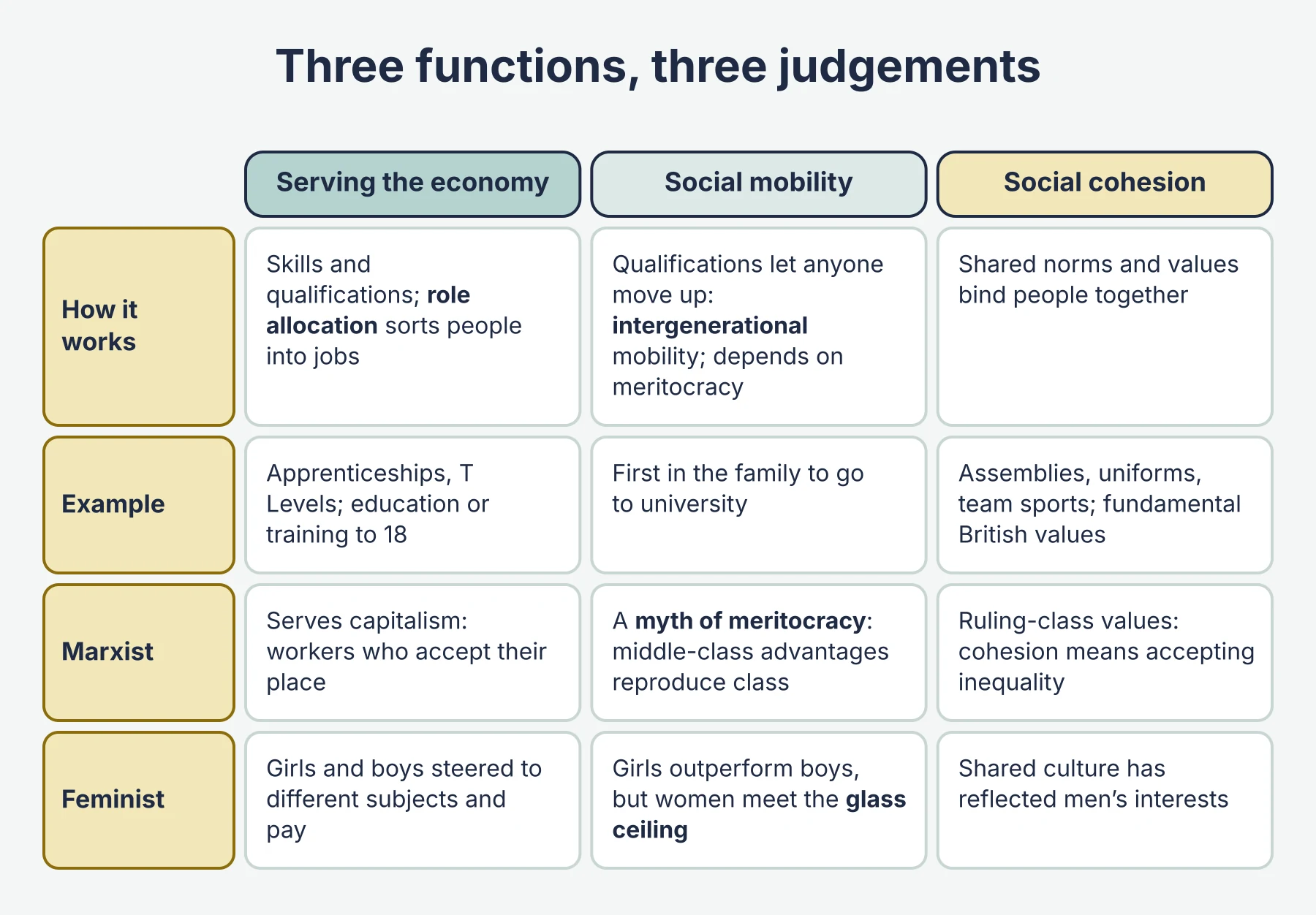
The three functions in one grid
| Function | Functionalist claim | Example | Marxist reply | Feminist reply |
|---|---|---|---|---|
| Serving the economy | Teaches skills; qualifications allocate roles | Apprenticeships, T Levels, staying in education or training to 18 | Serves capitalism, producing compliant workers | Gendered subject choice leads to unequal jobs |
| Social mobility | Meritocracy lets talent rise | First-generation university students | Myth of meritocracy; class is reproduced | Girls outperform boys, but the glass ceiling remains |
| Social cohesion | Shared values bind society | Assemblies, citizenship, British values | Values are ruling-class values | Shared culture has reflected men’s interests |
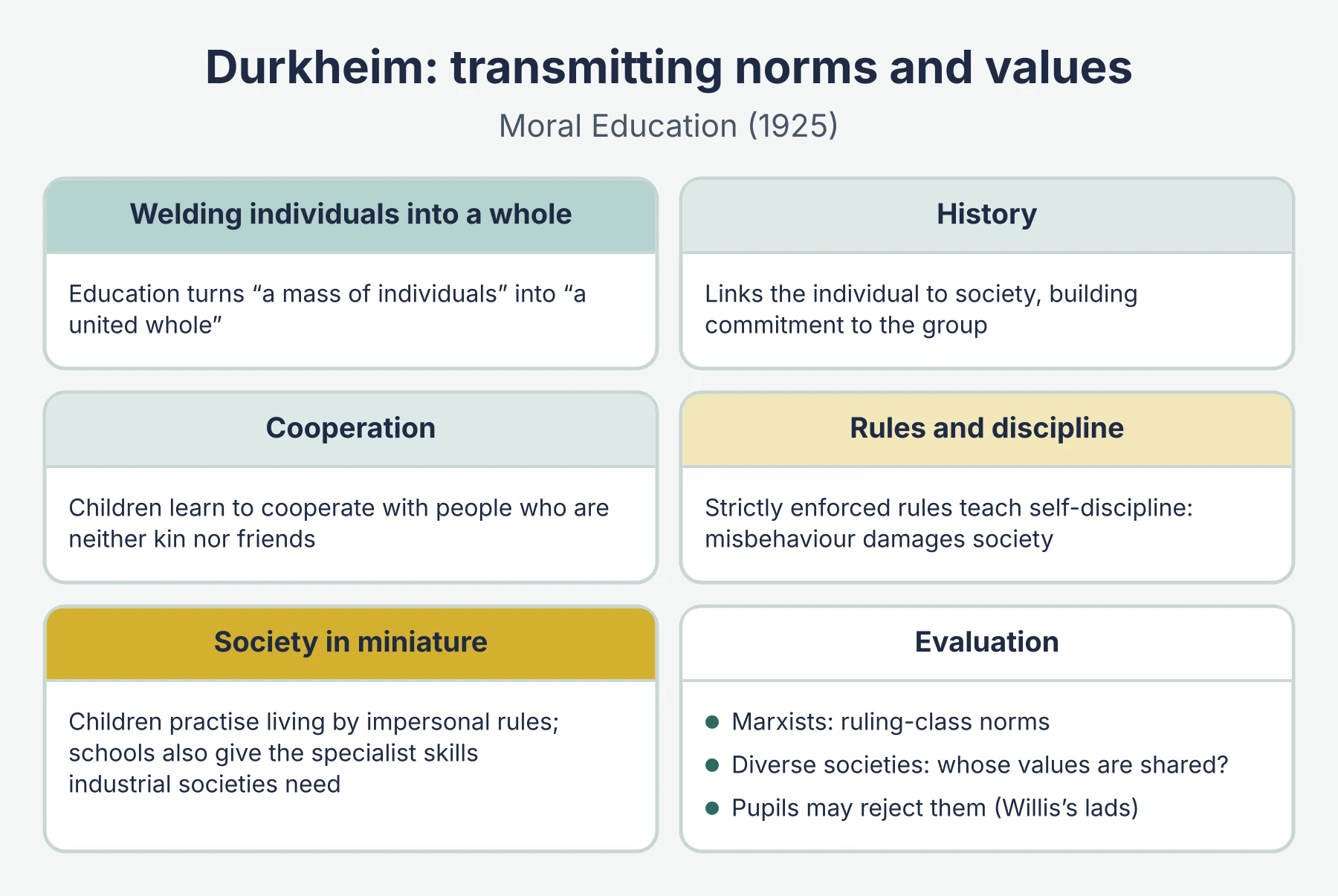
Durkheim in five bullets
- Moral Education (1925): education transmits society’s norms and values.
- Welds “a mass of individuals” into “a united whole”.
- History links the individual to society and builds commitment to the group.
- Children learn to cooperate with those who are neither kin nor friends.
- Strict rules teach self-discipline and show that misbehaviour damages society; school is society in miniature.
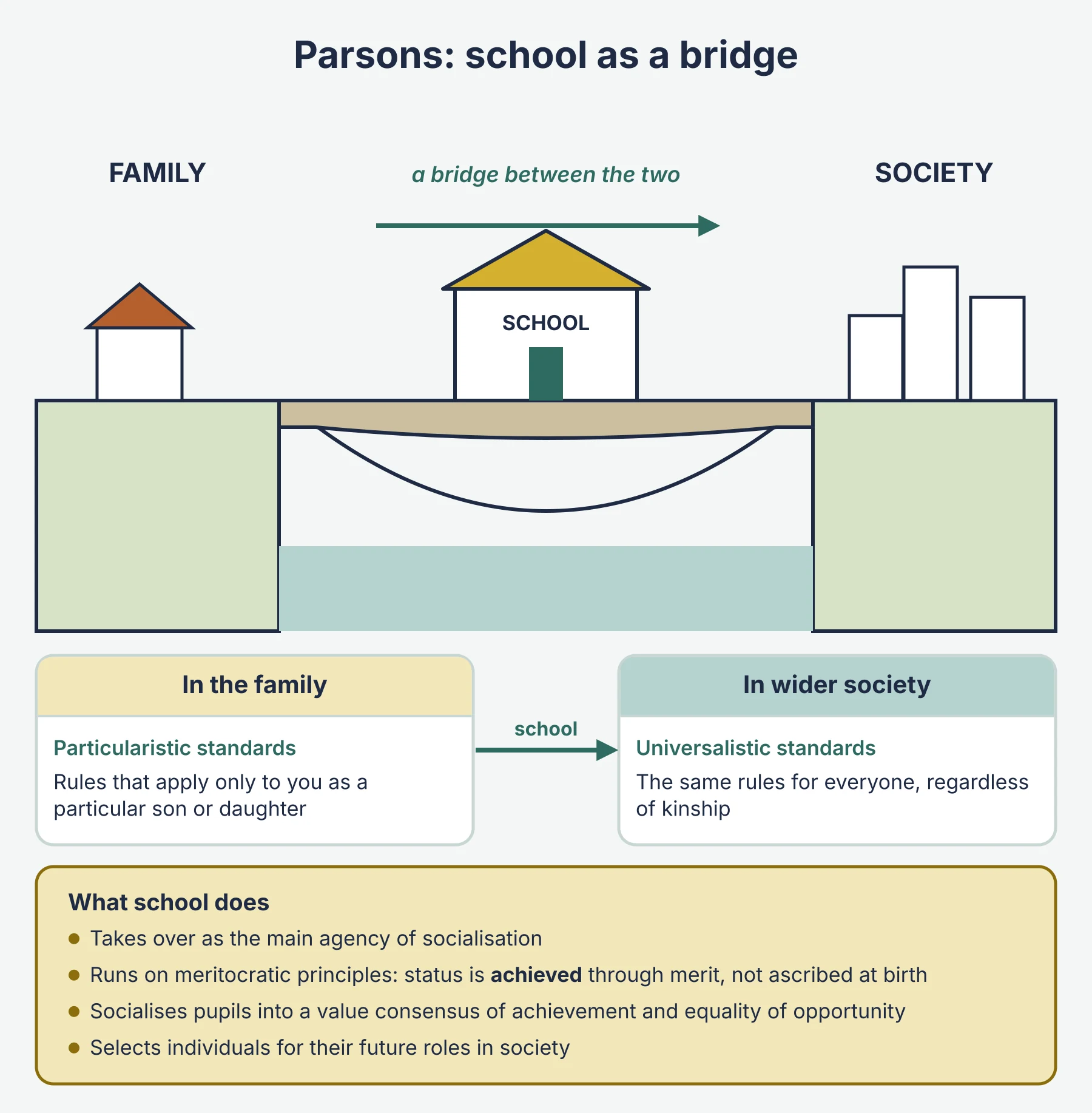
Parsons in five bullets
- “The school class as a social system”: school is a bridge between family and society.
- Particularistic standards in the family; universalistic standards in school and society.
- Meritocratic principles: status is achieved, not ascribed.
- Socialises children into a value consensus of achievement and equality of opportunity.
- Selects individuals for future roles.
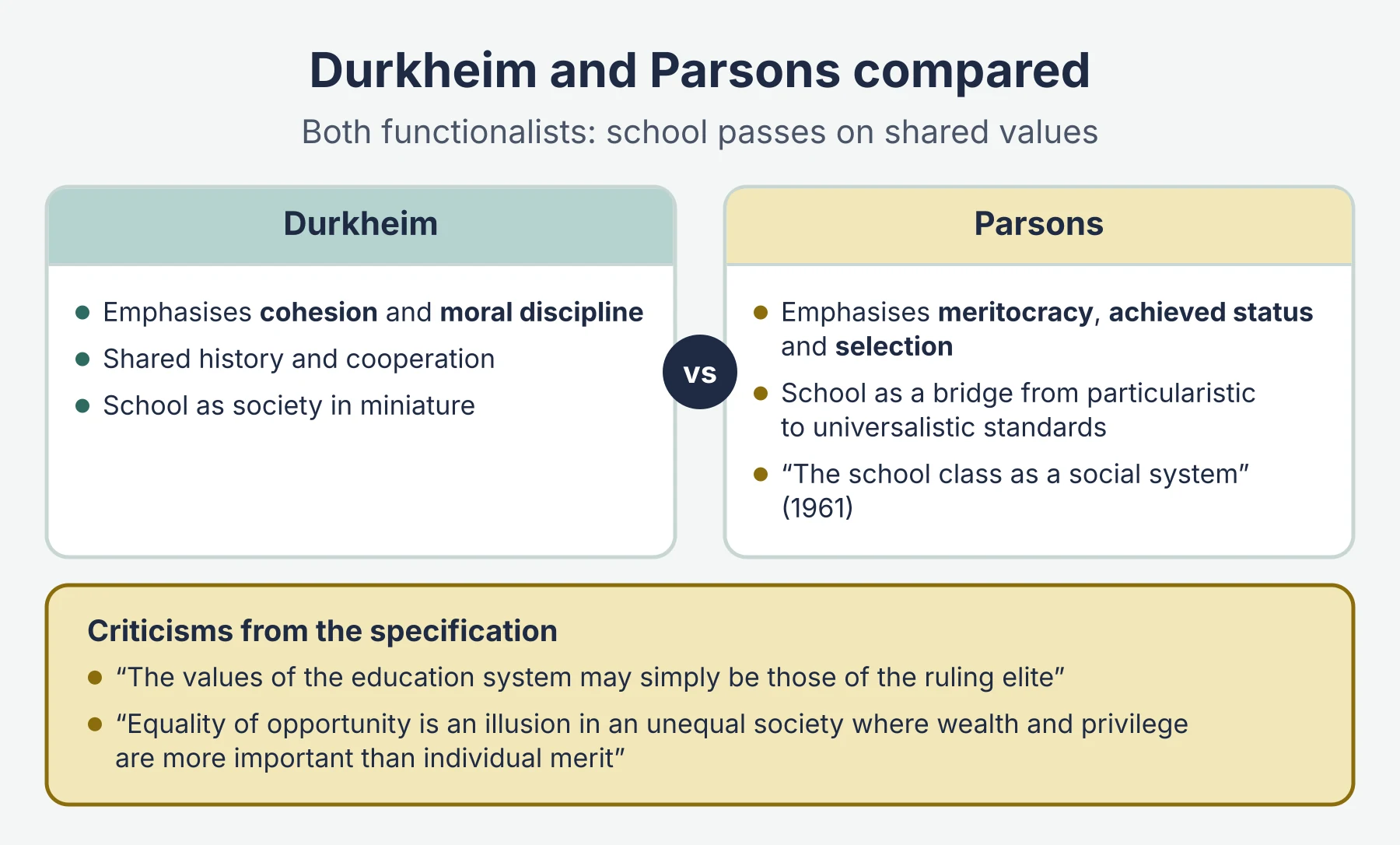
Criticisms (from the specification): school values may be those of the ruling elite; equality of opportunity may be an illusion where wealth and privilege outweigh merit.
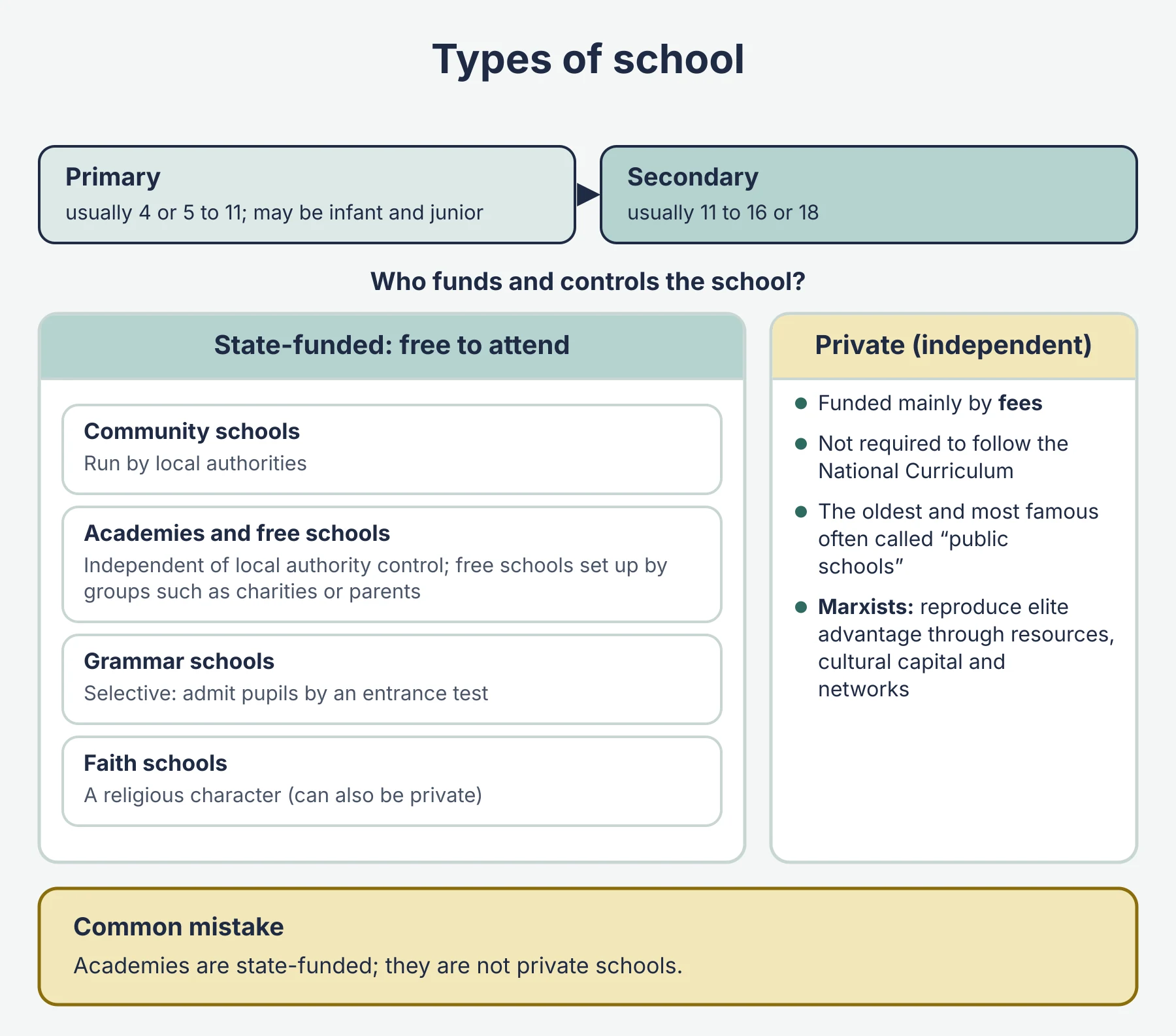
Types of school in one line each
- Primary: usually 4 or 5 to 11.
- Secondary: usually 11 to 16 or 18.
- State: free, taxpayer-funded; includes community schools, academies, free schools, many faith schools and grammar schools.
- Private: fee-paying, independent of the National Curriculum; Marxists link them to elite reproduction.
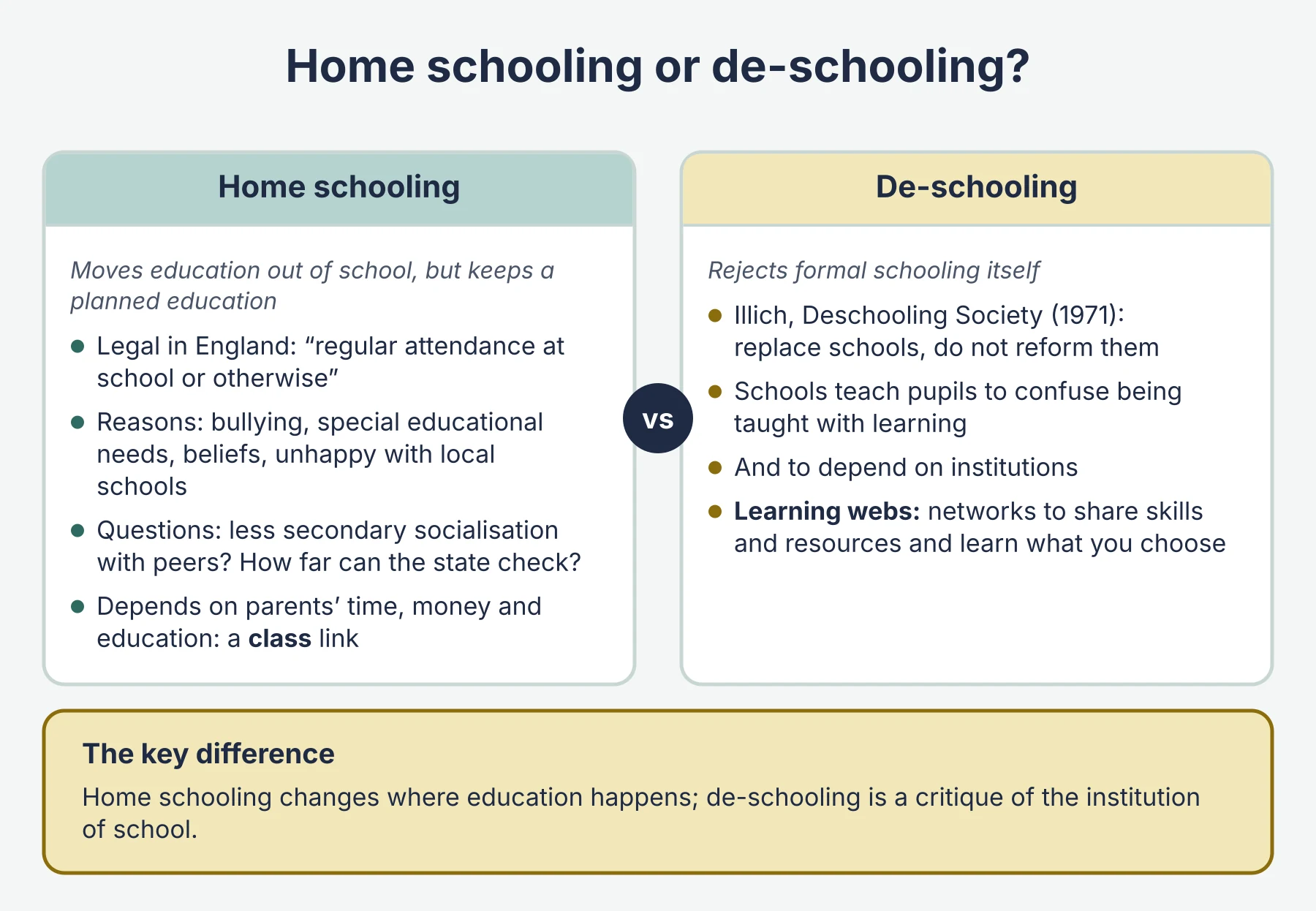
Home schooling versus de-schooling
| Home schooling | De-schooling | |
|---|---|---|
| What it is | Parents educate their child at home | Replacing schools as institutions |
| Legal basis or source | Parents must ensure suitable full-time education, “by regular attendance at school or otherwise” | Illich, Deschooling Society (1971) |
| Reasons or argument | Bullying, special needs, beliefs, dissatisfaction | Schools confuse teaching with learning and create dependence on institutions |
| Alternative proposed | Planned education at home | Learning webs |
| Issue | Peer socialisation, state oversight, class | Practicality; who would ensure everyone learns? |
Exam traps
- Swapping Durkheim’s and Parsons’ ideas.
- Calling academies private schools.
- Describing a function with no mechanism or example.
- Treating home schooling and de-schooling as the same.
- Giving the functionalist view only.
- Writing “Parsons said school is meritocratic” without explaining achieved status or universalistic standards.
Quick self-test
- Name the three functions of education in the specification.
- What is role allocation?
- What is intergenerational social mobility?
- Give one example of how schools foster social cohesion.
- What did Durkheim say about the teaching of history?
- Why did Durkheim want rules strictly enforced?
- What did Parsons mean by calling school a bridge?
- What is the difference between ascribed and achieved status?
- Give one criticism of Parsons from the specification.
- How does an academy differ from a private school?
- What is the legal position of home schooling in England?
- What did Illich mean by learning webs?
Answers
- Serving the needs of the economy, facilitating social mobility and fostering social cohesion.
- Sorting people into jobs that match their abilities, using qualifications.
- A change in class position compared with one’s parents.
- Any one: assemblies; uniforms; citizenship lessons; promoting British values; teaching shared history.
- It links the individual to society, so children see they are part of something larger and develop commitment to the group.
- So that children learn self-discipline and see that misbehaviour damages society as a whole.
- School links the family to wider society, moving children from particularistic to universalistic standards.
- Ascribed status is fixed at birth; achieved status is gained through effort and merit.
- School values may simply be those of the ruling elite; or equality of opportunity is an illusion where wealth and privilege matter more than merit.
- An academy is state-funded and free to attend; a private school is funded mainly by fees.
- It is legal: parents must ensure a suitable full-time education, at school or otherwise.
- Networks through which people share skills and resources and learn what they choose, instead of attending school.
Official syllabus
AQA GCSE Sociology (8192) specification, Version 1.2 (June 2026), for GCSE exams 2019 onwards: section 3.4.1 Roles and functions of education and Appendix B, 7.2 Education.
Related resources
-
Study guides
AQA GCSE Sociology (8192): The relationship between education and capitalism
In-depth AQA GCSE Sociology 8192 guide to 3.4.2: Bowles and Gintis, the correspondence principle, the myth of meritocracy and rival views such as Willis.
Sociology · AQA · GCSE
Read guide -
Practice questions
AQA GCSE Sociology (8192): The relationship between education and capitalism – Practice Questions
Original AQA GCSE Sociology 8192 practice on 3.4.2 with marked answers: Bowles and Gintis, the correspondence principle, Willis and rival perspectives.
Sociology · AQA · GCSE
Try questions -
Revision notes
AQA GCSE Sociology (8192): The relationship between education and capitalism – Revision Notes
Condensed AQA GCSE Sociology 8192 notes on 3.4.2: Bowles and Gintis's five key ideas, the hidden curriculum, rival views of correspondence and a self-test.
Sociology · AQA · GCSE
Revise topic
Related articles
Get free revision emails (optional)
Occasional emails with practice questions, worked explanations and links to free resources for the qualification and subjects you choose. No spam, and you can unsubscribe from any email. The free tools on this site never need an email.