
Revision Notes
AQA GCSE Sociology (8192): The relationship between education and capitalism – Revision Notes
Condensed AQA GCSE Sociology 8192 notes on 3.4.2: Bowles and Gintis's five key ideas, the hidden curriculum, rival views of correspondence and a self-test.
- Subject
- Sociology
- Level
- GCSE
- Topic
- Education
- Author
- Marlbridge Academic Team
- Updated
- Reviewed by
- Naqiya Yousaf (what this means)
Aligned to AQA GCSE Sociology (8192), first teaching 2017. Official specification .
Syllabus page (what it covers and how it is assessed): AQA GCSE Sociology.
Syllabus points this page covers
8192
- 3.4.2 The relationship between education and capitalism
Found an error? Report a correction.
Need help with this topic? Request a free trial class for GCSE Sociology (8192).
These notes condense 3.4.2 The relationship between education and capitalism, from the AQA GCSE Sociology (8192) specification, assessed in Paper 1. The specification asks you to “describe the key ideas of Bowles and Gintis on education and capitalism” and to “describe, compare and contrast a variety of alternative sociological perspectives on the correspondence principle”.
For full explanations and annotated answers, read the education and capitalism study guide. For the whole topic, see the Education revision notes. Then try the education and capitalism practice questions.
The argument in one chain
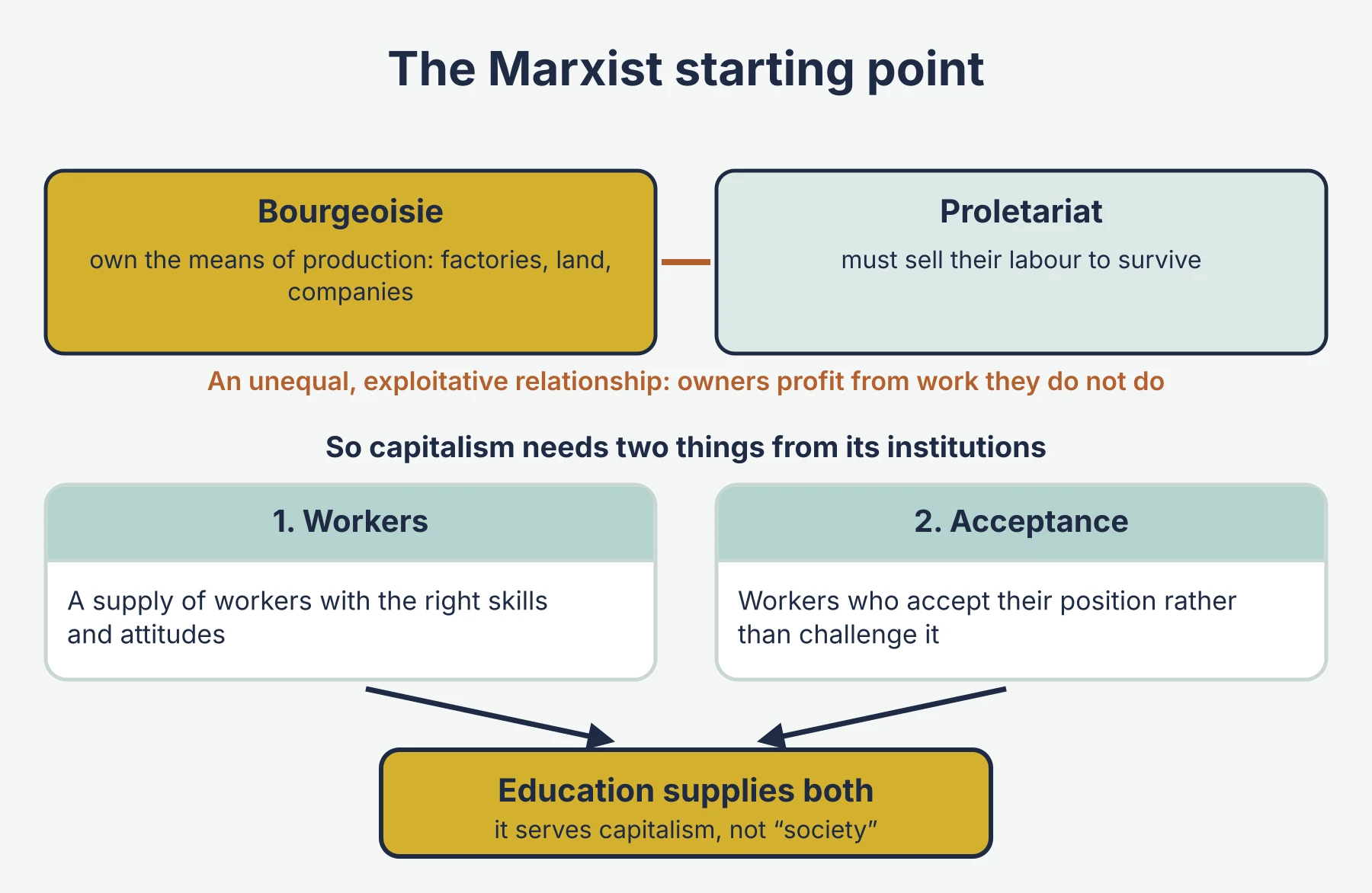
Capitalism needs obedient, motivated workers who accept inequality → school organises pupils’ daily life to mirror work (the correspondence principle) → the hidden curriculum teaches the habits work requires → pupils who fail blame themselves (myth of meritocracy) → class inequality is reproduced and looks fair.
Key terms
| Term | Meaning |
|---|---|
| Capitalism | An economic system in which a minority own the means of production and most people sell their labour for wages |
| Bourgeoisie | The ruling class who own the means of production |
| Proletariat | The working class who sell their labour |
| Reproduction of labour power | Producing the next generation of workers in the form capitalism needs |
| Correspondence principle | Social relationships at school mirror social relationships at work |
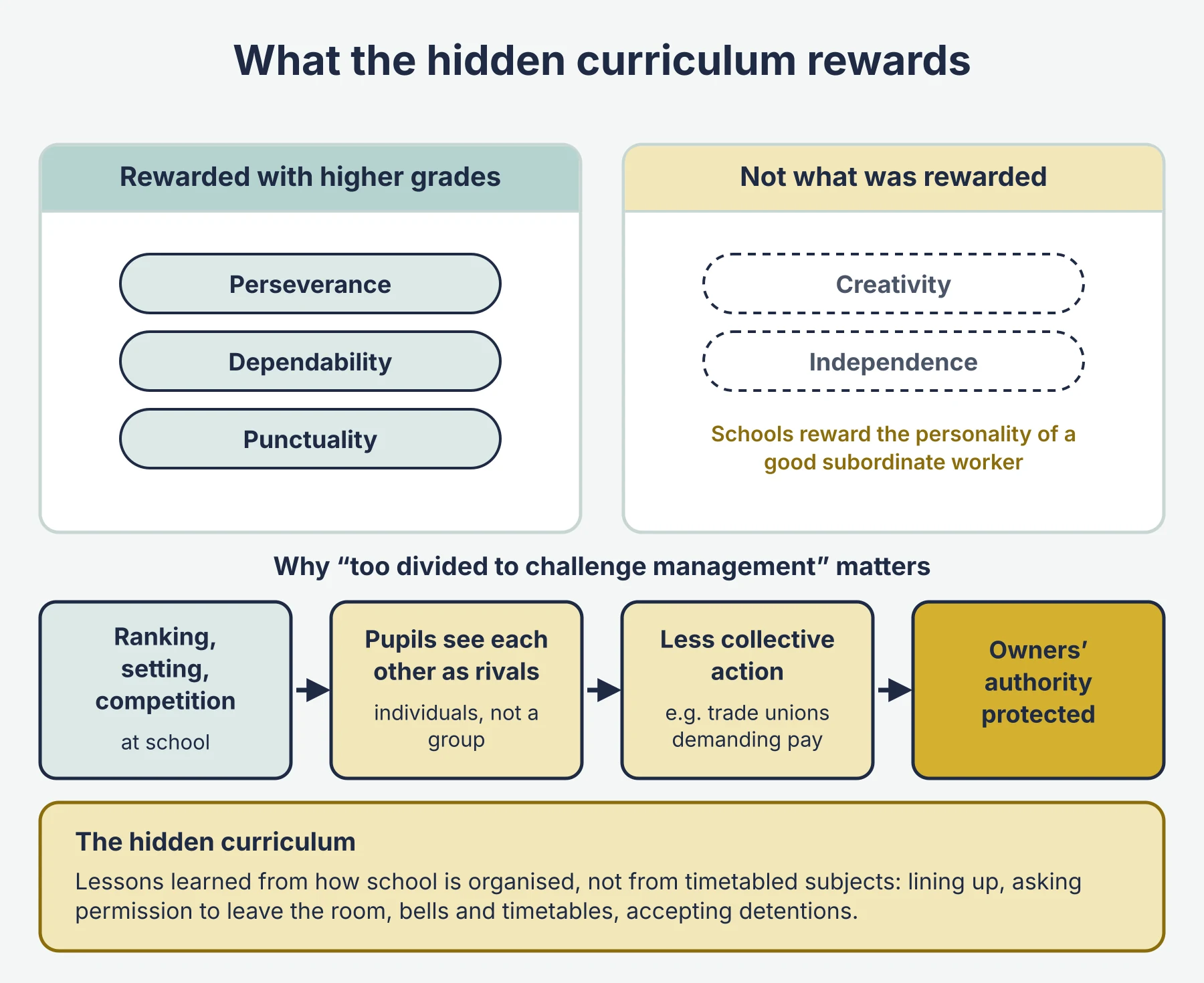
| Hidden curriculum | Lessons learned from how school is organised rather than from timetabled subjects |
| Formal curriculum | The subjects and content officially taught |
| Meritocracy | Rewards based on ability and effort rather than background |
| Myth of meritocracy | The Marxist claim that schools only appear to reward merit, which legitimises inequality |
| Legitimation | Making an unequal arrangement seem fair and acceptable |
| Alienation | Lack of control over, and satisfaction in, one’s work |
| Vocationalism in education | Work-related courses and training within education |
| Counter school subculture | A pupil group whose values oppose the school’s (Willis) |
Bowles and Gintis: five key ideas
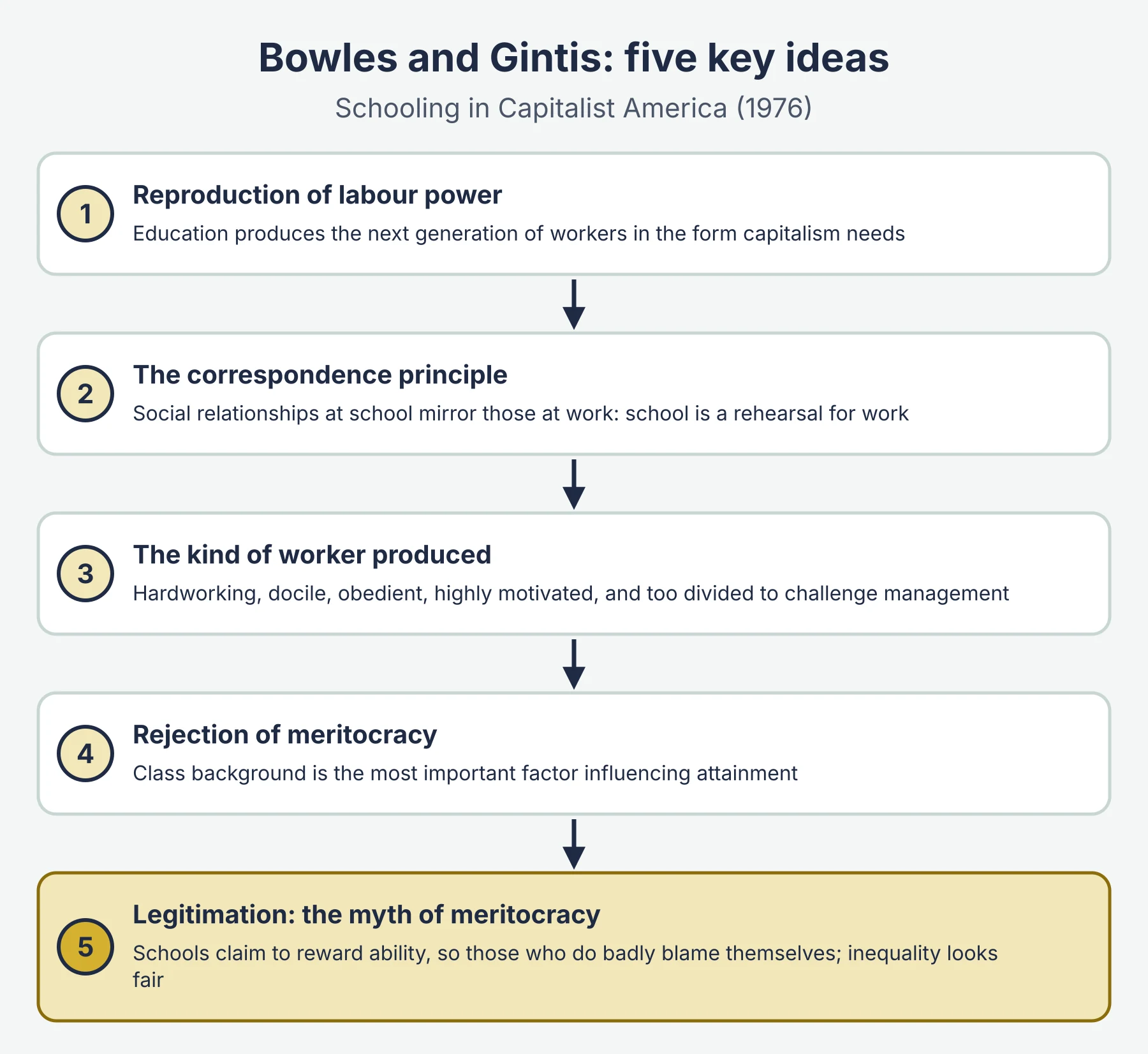
- Education’s major role in capitalist societies is the reproduction of labour power.
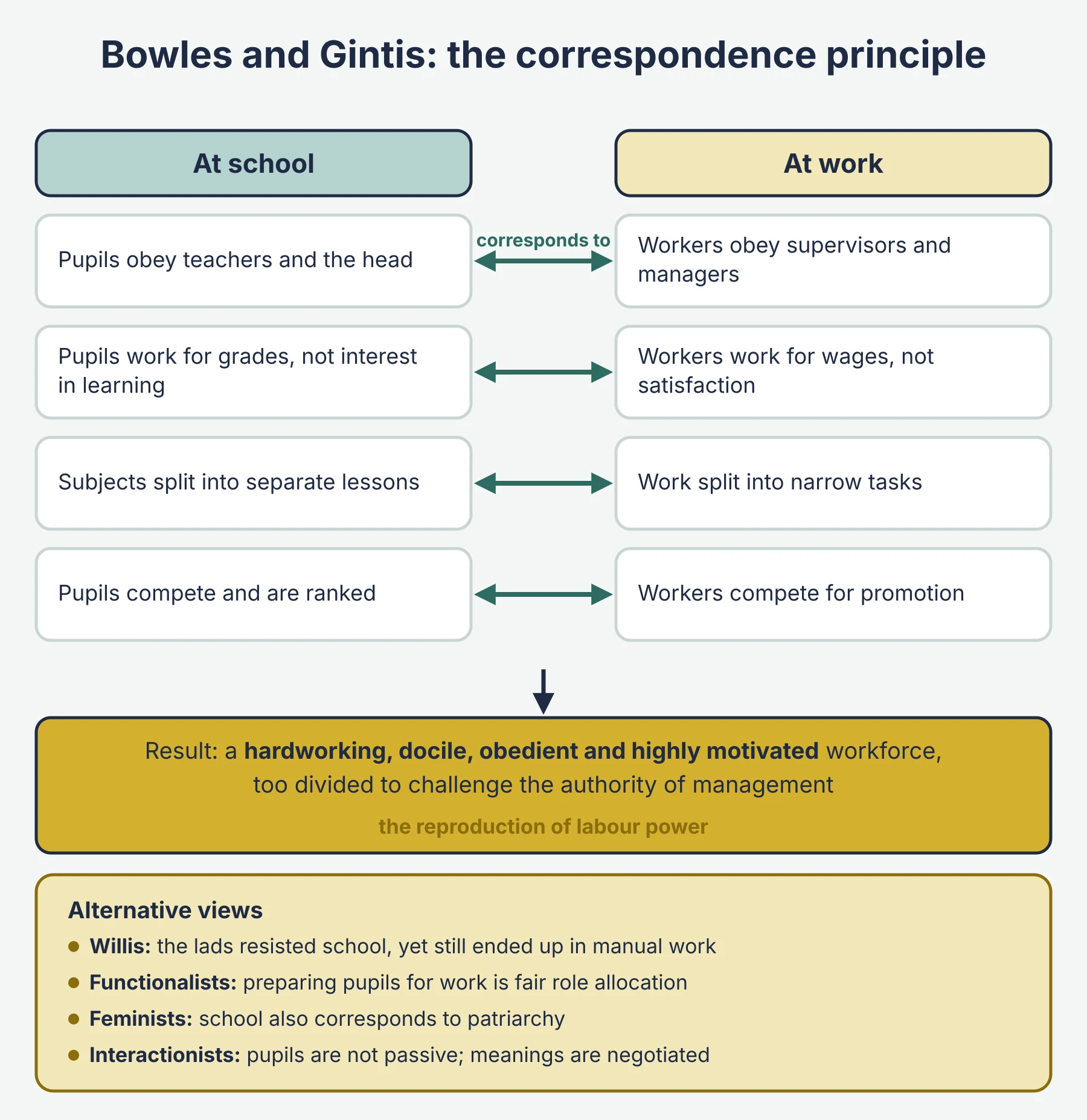
- A close correspondence exists between relationships at school and at work.
- School creates a hardworking, docile, obedient and highly motivated workforce too divided to challenge management.
- Capitalist societies are not meritocratic; class background is the most important factor influencing attainment.
- Those who fail are encouraged to blame themselves, so inequality is legitimised.
Source: Schooling in Capitalist America (1976), a Marxist study of American schooling. They also reported that higher grades tended to go to pupils showing perseverance, dependability and punctuality rather than creativity or independence.
Five correspondences to learn
| School | Work |
|---|---|
| Head teacher, teachers, pupils | Managers, supervisors, workers |
| Working for grades and certificates | Working for wages |
| Separate subjects in fixed lessons | Narrow, fragmented tasks |
| Ranking and competition between pupils | Competition between workers for jobs and promotion |
| Bells, timetables, punctuality rules | Clocking in, shifts, fixed hours |
Alternative views: compare and contrast
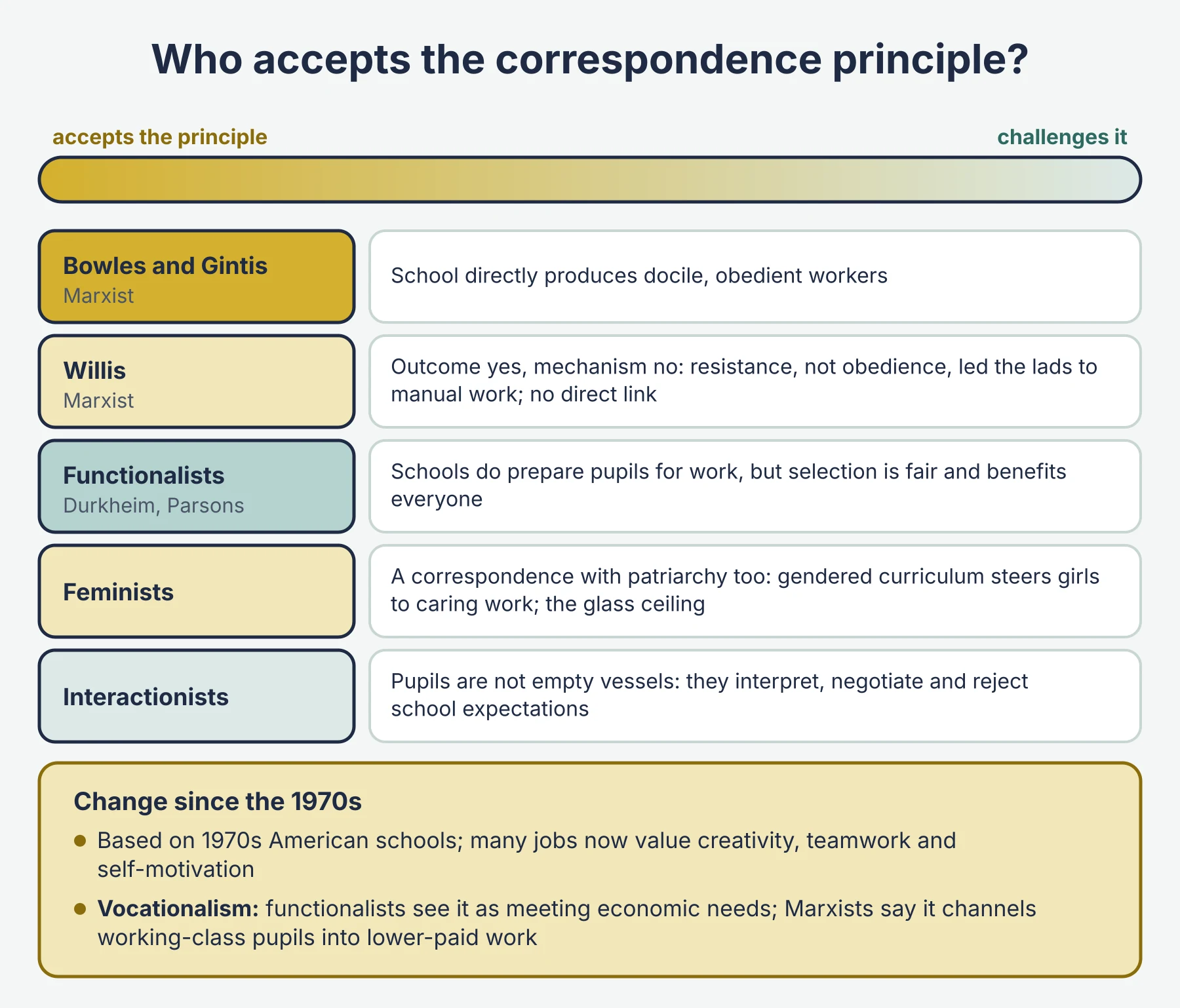
| View | Accepts that school prepares for work? | Main difference from Bowles and Gintis |
|---|---|---|
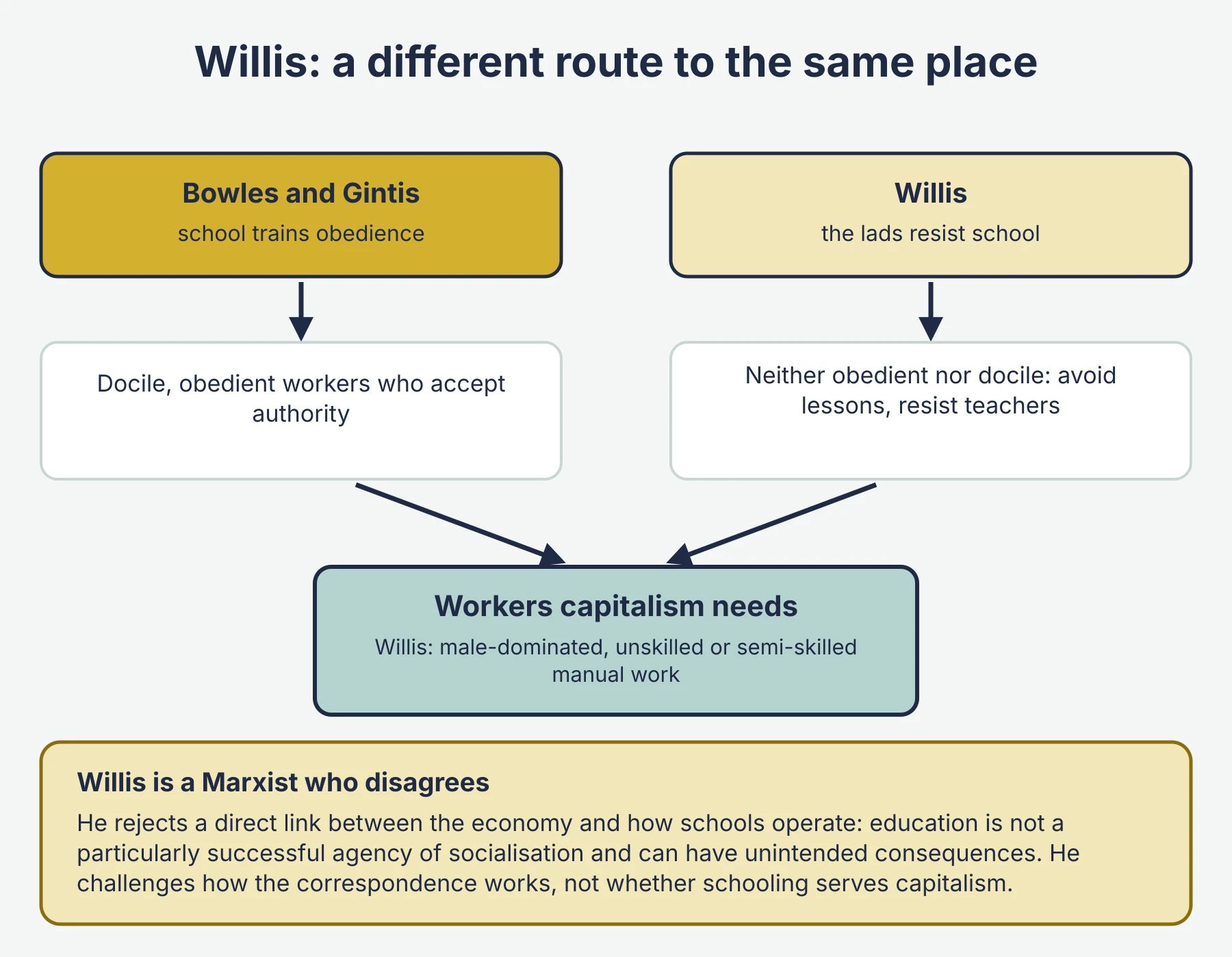
| Willis (Marxist, 1977) | Yes, the outcome still suits capitalism | No direct link; schooling is a weak agency of socialisation; the lads resisted, with unintended consequences |
| Functionalist (Durkheim, Parsons) | Yes | Preparation is fair: specialist skills and meritocratic selection benefit all of society |
| Feminist | Yes, but for gendered roles | Correspondence is with patriarchy as well as capitalism; the theory ignores gender |
| Interactionist | Partly | Pupils actively interpret and resist; they are not passive receivers of the hidden curriculum |
Same side, different mechanism: Bowles and Gintis say capitalism is served through successful socialisation into obedience. Willis says it is served through pupils’ resistance, which still leads them into manual work.
Evaluation points
- Strength: continuing class gaps in attainment support the rejection of meritocracy.
- Strength: the hidden curriculum idea explains why rules about uniform, punctuality and obedience matter so much in schools.
- Weakness: based on 1970s American schools; many jobs now reward creativity, problem-solving and teamwork.
- Weakness: overstates pupils’ passivity (Willis, interactionists).
- Weakness: ignores gender and ethnicity (feminists).
- Debate: functionalists see vocationalism as serving the economy; Marxists see it as channelling working-class pupils into lower-paid work.
Exam traps
- The correspondence principle is Bowles and Gintis, never Durkheim, Parsons or Willis.
- Every correspondence needs both halves: the school feature and the work feature.
- Willis is Marxist. He challenges the mechanism, not the Marxist conclusion.
- “Too divided to challenge management” is a key phrase; explain it through competition between pupils.
- A “today” question needs a point about change since the 1970s.
- “Hidden curriculum” is used by both Marxists (class) and feminists (gender); say which use you mean.
Self-test
- What book did Bowles and Gintis publish, and in what year?
- What do Marxists mean by “reproduction of labour power”?
- State the correspondence principle in one sentence.
- Give two features of the workforce that schooling creates, according to Bowles and Gintis.
- What do Bowles and Gintis say is the most important factor influencing attainment?
- What is the myth of meritocracy?
- Give one example of the hidden curriculum and the workplace feature it matches.
- Why does competition between pupils help capitalism, according to Bowles and Gintis?
- Which perspective did Willis write from?
- How does Willis’s view of school as an agency of socialisation differ from Bowles and Gintis’s?
- How would a functionalist respond to the correspondence principle?
- Give one feminist criticism of the correspondence principle.
Answers
- Schooling in Capitalist America, 1976.
- Producing the next generation of workers with the skills and attitudes capitalism needs.
- Social relationships at school closely mirror social relationships at work.
- Any two: hardworking, docile, obedient, highly motivated, too divided to challenge management.
- Class background.
- The idea that schools only appear to reward ability and effort, so failure looks deserved and inequality seems fair.
- For example, working for grades matches working for wages; obeying teachers matches obeying managers.
- Ranking and competition make pupils see each other as rivals, so as workers they are less likely to unite against management.
- Marxist.
- Willis sees school as not a particularly successful agency of socialisation, with unintended consequences; Bowles and Gintis see it as successfully producing obedient workers.
- Agree that schools prepare pupils for work, but argue this is fair role allocation in a meritocracy that benefits all of society.
- It ignores gender: the hidden and gendered curriculum prepare girls and boys for unequal roles, so schools also serve patriarchy.
Official syllabus
AQA GCSE Sociology (8192) specification, Version 1.2 (June 2026), for GCSE exams 2019 onwards: section 3.4.2 The relationship between education and capitalism, with Appendix B summaries.
Related resources
-
Study guides
AQA GCSE Sociology (8192): Education – Study Guide
Study guide to AQA GCSE Sociology 8192 Education 3.4.1-3.4.4: Durkheim, Parsons, Bowles and Gintis, Halsey, Ball and Willis, with evaluation.
Sociology · AQA · GCSE
Read guide -
Practice questions
AQA GCSE Sociology (8192): Education – Practice Questions
Original AQA GCSE Sociology 8192 Education practice questions with marked answers on functions, the correspondence principle, achievement and labelling.
Sociology · AQA · GCSE
Try questions -
Revision notes
AQA GCSE Sociology (8192): Education – Revision Notes
Condensed AQA GCSE Sociology 8192 Education notes: key terms, the six named writers at a glance, must-know distinctions, an essay plan and a self-test.
Sociology · AQA · GCSE
Revise topic
Related articles
Get free revision emails (optional)
Occasional emails with practice questions, worked explanations and links to free resources for the qualification and subjects you choose. No spam, and you can unsubscribe from any email. The free tools on this site never need an email.