
Study Guides
AQA GCSE Sociology (8192): Educational achievement
In-depth AQA GCSE Sociology 8192 guide to 3.4.3: class, gender and ethnicity in achievement, Halsey on class inequality and Ball on parental choice.
- Subject
- Sociology
- Level
- GCSE
- Topic
- Education
- Author
- Marlbridge Academic Team
- Updated
- Reviewed by
- Naqiya Yousaf (what this means)
Aligned to AQA GCSE Sociology (8192), first teaching 2017. Official specification .
Syllabus page (what it covers and how it is assessed): AQA GCSE Sociology.
Syllabus points this page covers
8192
- 3.4.3 Educational achievement
Found an error? Report a correction.
Need help with this topic? Request a free trial class for GCSE Sociology (8192).
This guide goes deep on one sub-section of the AQA GCSE Sociology (8192) specification: 3.4.3 Educational achievement, assessed in Paper 1: The sociology of families and education. The content is “factors affecting educational achievement”, with “the work of Halsey on class-based inequalities and Ball on parental choice and competition between schools”. You must be able to “identify, describe and explain various factors affecting educational achievement including class, gender and ethnicity” and compare functionalist, feminist and Marxist perspectives.
For the whole Education topic, start with the Education study guide. To revise this sub-section, use the educational achievement revision notes, then test yourself with the educational achievement practice questions.
What “factors affecting achievement” means
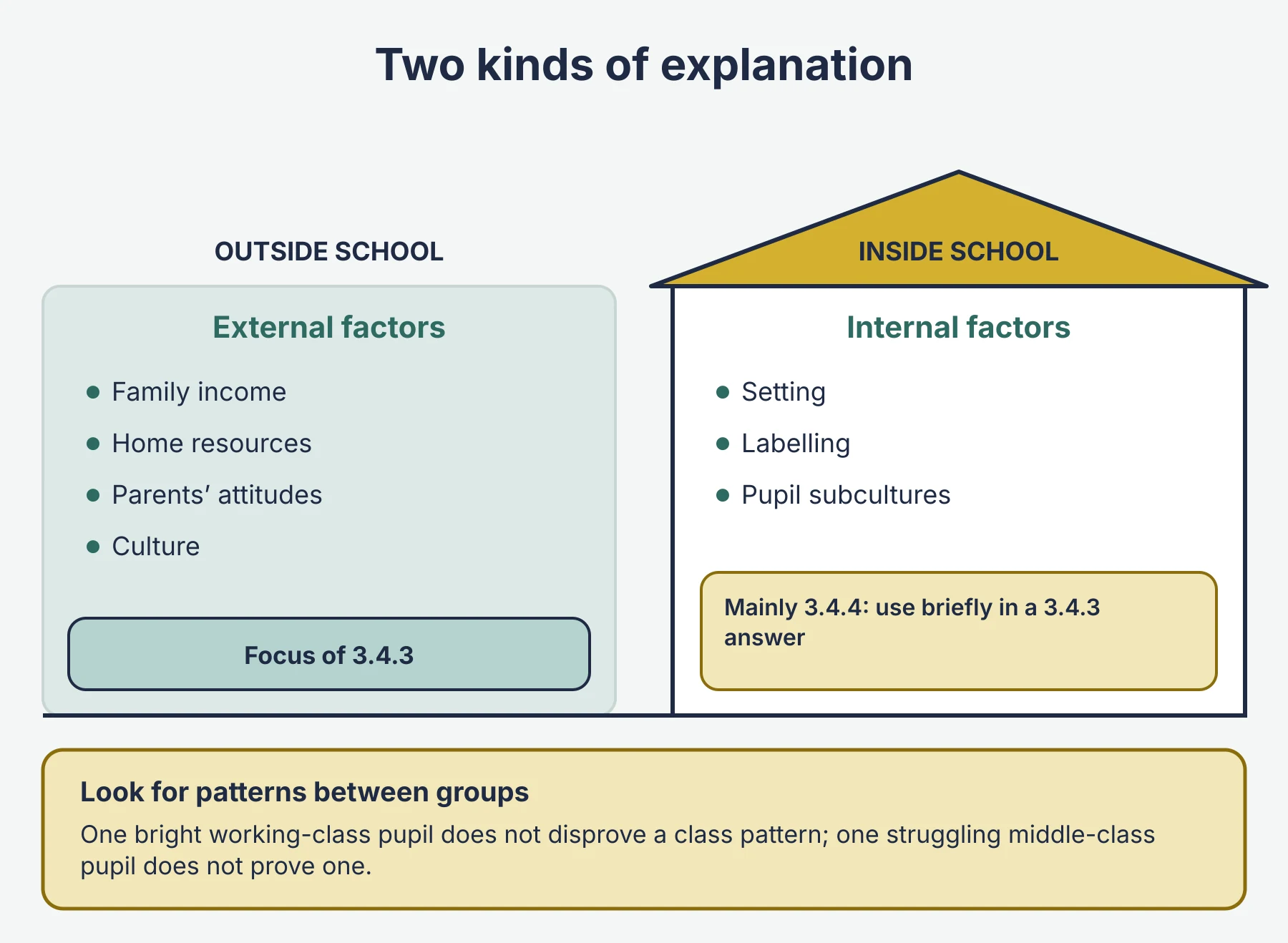
Achievement means how well pupils do in education: test and examination results, staying on after 16, and entry to higher education. Sociologists look for patterns between groups, not individual cases. A single bright working-class pupil does not disprove a class pattern, and a struggling middle-class pupil does not prove one.
A useful way to organise any answer is to split explanations into two kinds:
- External factors: influences from outside school, such as family income, home resources, parents’ attitudes and culture.
- Internal factors: influences inside school, such as setting, labelling and pupil subcultures. These belong mainly to 3.4.4, so in a 3.4.3 answer use them briefly and focus on the wider factors.
Social class
Halsey, Heath and Ridge on class-based inequalities
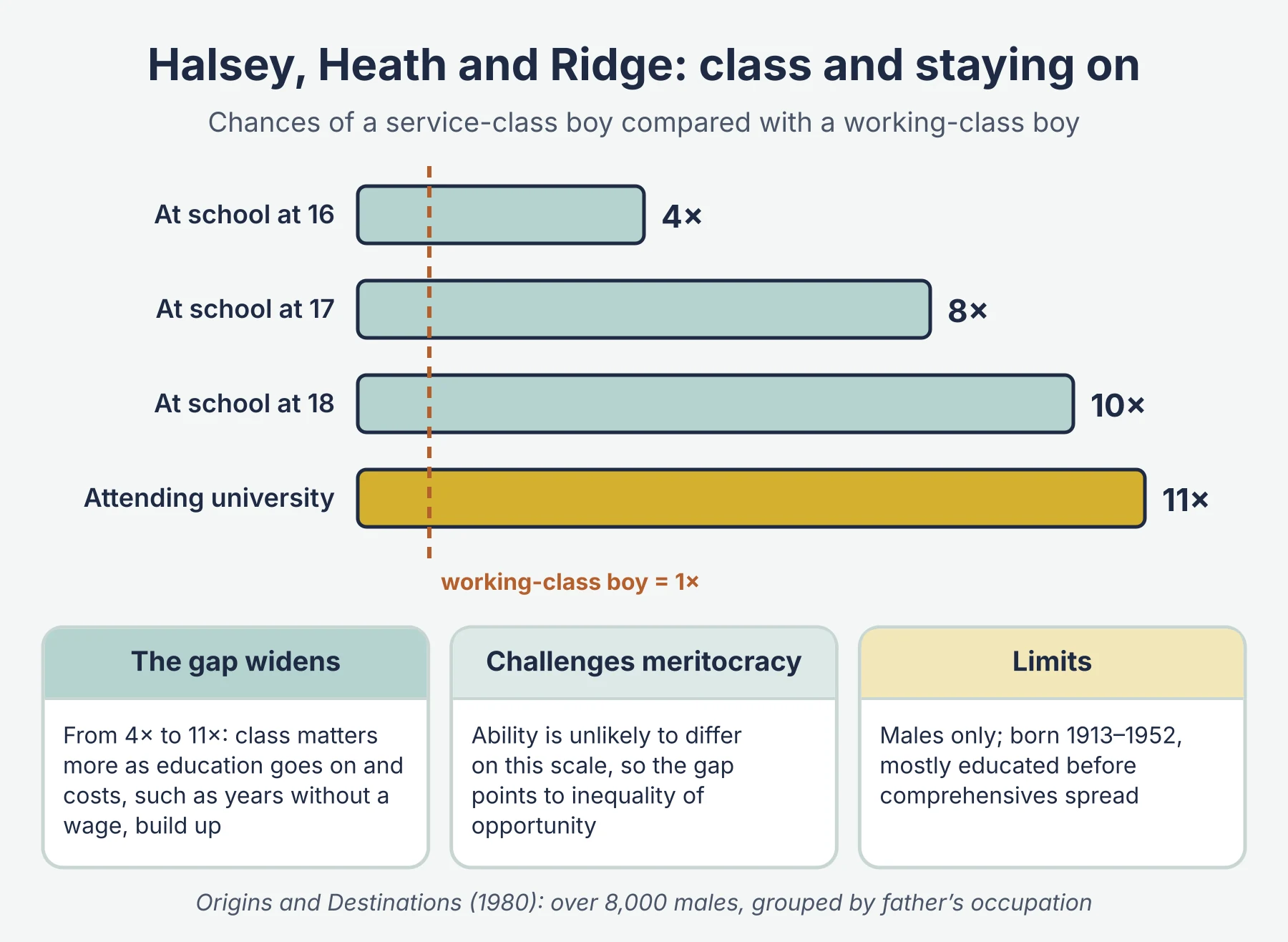
Origins and Destinations (1980) is the study the specification names for class. The authors used a sample of over 8,000 males born between 1913 and 1952 and divided them by father’s occupation into the service class, the intermediate class and the working class. Compared with a working-class boy, a service-class boy had four times the chance of being at school at 16, eight times at 17, ten times at 18, and eleven times the chance of attending university.
How to use the study well:
- The pattern widens with each stage. The gap grows from four times to eleven times. This suggests class matters more, not less, as education goes on and costs (for example, years without a wage) build up.
- It challenges meritocracy. Ability is unlikely to differ between classes on anything like this scale, so the gap points to inequality of opportunity.
- Its limits. The research excluded females, which might have made a significant difference to the findings. The men were born between 1913 and 1952, so most were educated before comprehensive schools spread, and the findings may not describe education today.
Explanations of class differences
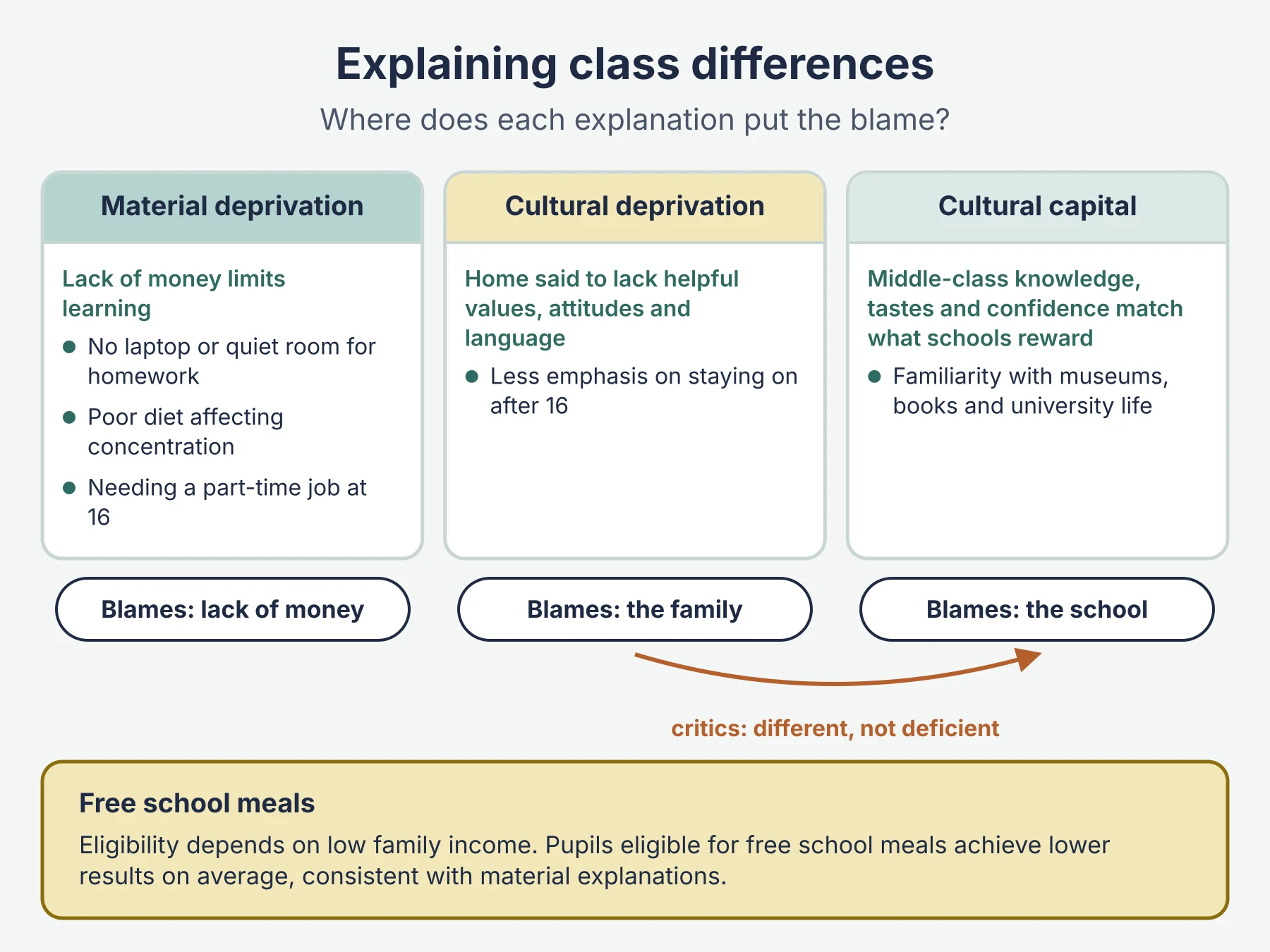
| Explanation | What it argues | Example |
|---|---|---|
| Material deprivation | Lack of money limits learning | No laptop or quiet room for homework; poor diet affecting concentration; needing a part-time job at 16 |
| Cultural deprivation | Some working-class families are said to lack the values, attitudes and language that help at school | Less emphasis on staying on after 16 |
| Cultural capital | Middle-class knowledge, tastes and confidence match what schools reward | Familiarity with museums, books and university life |
Cultural deprivation is criticised for blaming working-class families. Critics argue working-class culture is different, not deficient, and that schools favour middle-class culture, which is the cultural capital argument.
An indicator often used in official figures for England is eligibility for free school meals, which depends on low family income. Pupils eligible for free school meals achieve lower results on average than other pupils, a pattern consistent with material explanations.
Ball on parental choice and competition between schools
The specification names a second key study for this sub-section: Ball, Bowe and Gewirtz, “Market forces and parental choice” (1994). The specification prints the third author’s name as “Gerwitz”.
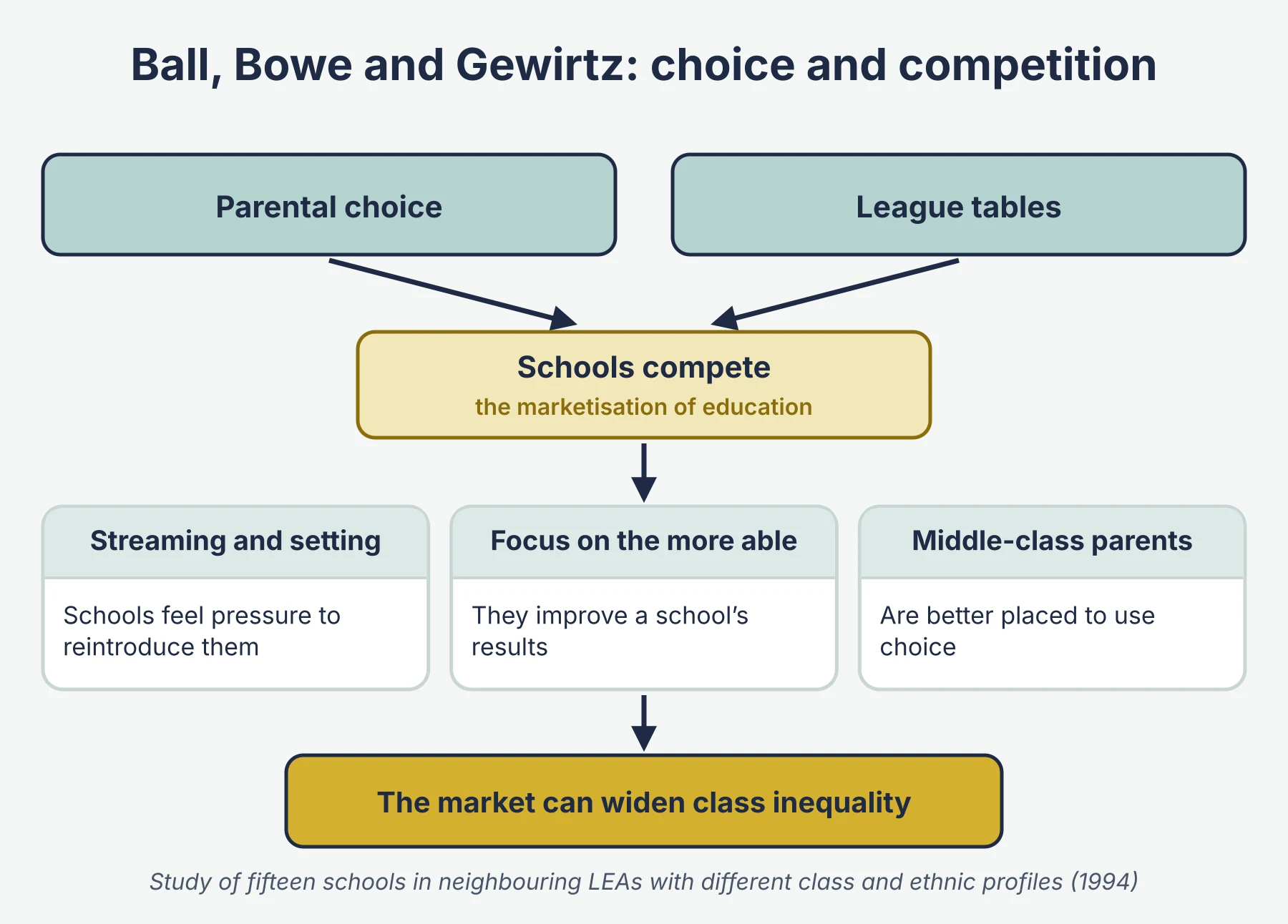
- They studied fifteen schools in neighbouring local education authorities with different population profiles, for example in class and ethnicity.
- They examined the effects of parental choice and the publication of league tables: the marketisation of education, where schools compete for pupils like businesses competing for customers.
- Competition put pressure on schools to reintroduce streaming and setting and led some schools to focus on the more able, whose results improve a school’s league table position.
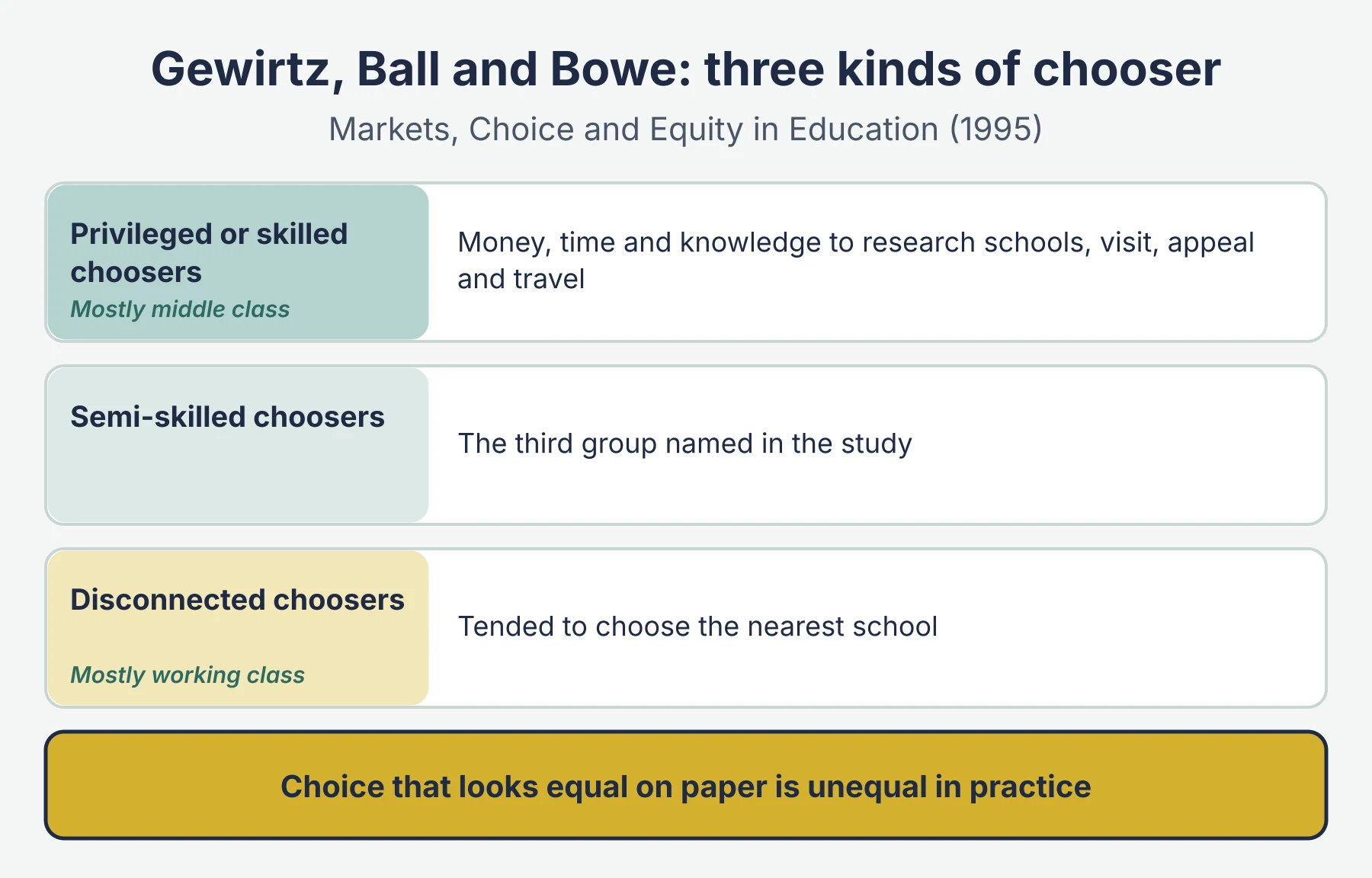
In a related book, Markets, Choice and Equity in Education (1995), Gewirtz, Ball and Bowe described parents as privileged or skilled choosers, semi-skilled choosers and disconnected choosers. Skilled choosers, mostly middle class, had the money, time and knowledge to research schools, visit, appeal and travel. Disconnected choosers, mostly working class, tended to choose the nearest school. Choice that looks equal on paper is unequal in practice.
Why this matters for achievement: if successful schools fill with middle-class pupils and less successful schools concentrate on their most able pupils, inequality between classes may widen. This links class inequality to the way the education system is organised, not just to families.
Gender
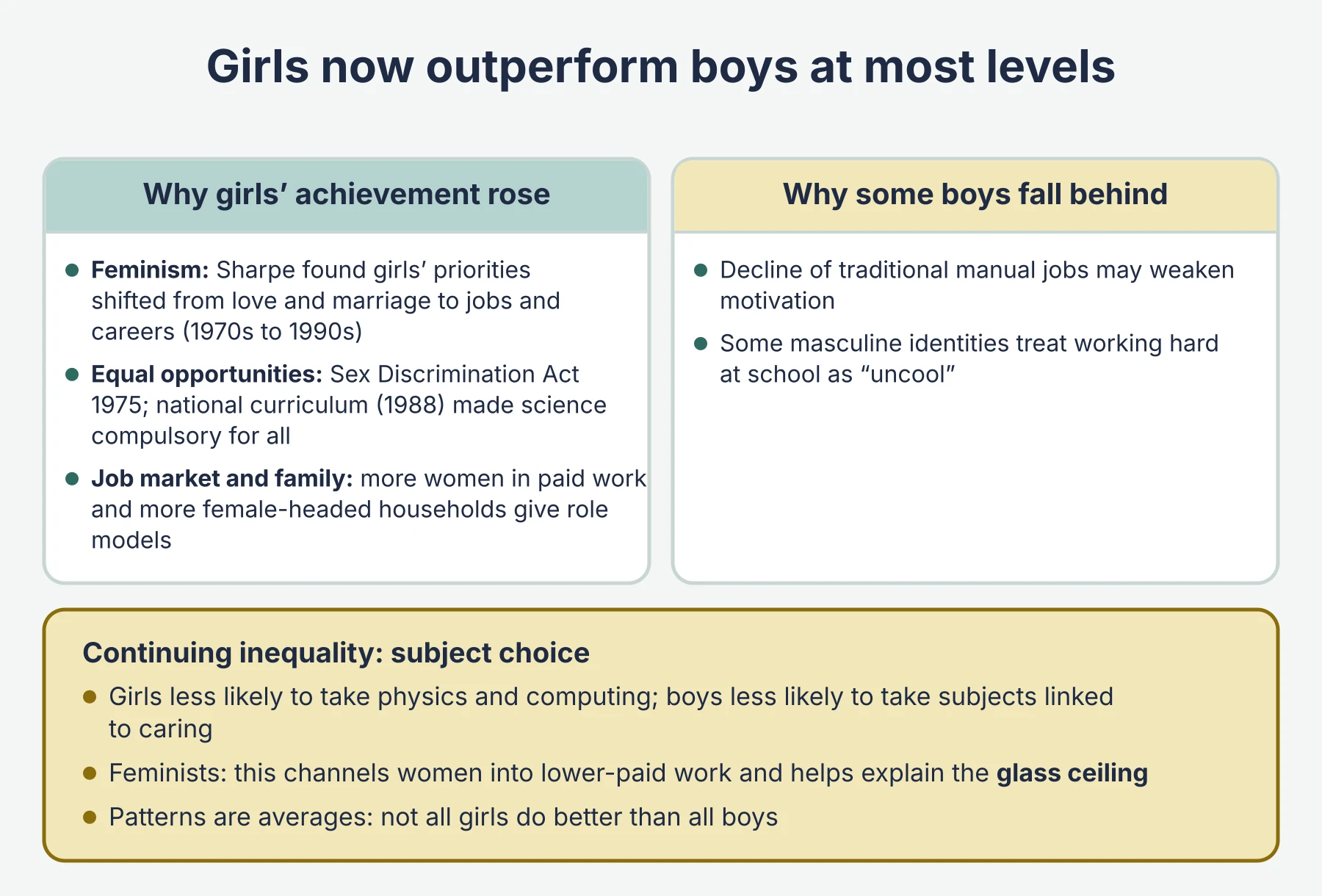
Girls now outperform boys at most levels, including GCSE. The specification asks you to explain gender as a factor, so explain both sides: why girls’ achievement rose and why some boys fall behind.
Why girls’ achievement has risen:
- The impact of feminism on girls’ ambitions and self-image. Sue Sharpe’s study of girls’ priorities, first in the 1970s and repeated in the 1990s, found a shift from love and marriage towards jobs and careers.
- Equal opportunities policies and laws, such as the Sex Discrimination Act 1975, and a national curriculum (from the Education Reform Act 1988) that made core subjects such as science compulsory for girls and boys.
- Changes in the job market and family, including more women in paid work and more female-headed households, giving girls role models of independent women.
Why some boys fall behind:
- The decline of traditional manual jobs may weaken some boys’ motivation.
- Some forms of masculine identity treat working hard at school as “uncool”.
Continuing inequality: subject choice remains gendered. Girls remain less likely to take subjects such as physics and computing, and boys less likely to take subjects linked to caring. Feminists argue this channels women into lower-paid work and helps explain the glass ceiling.
Ethnicity
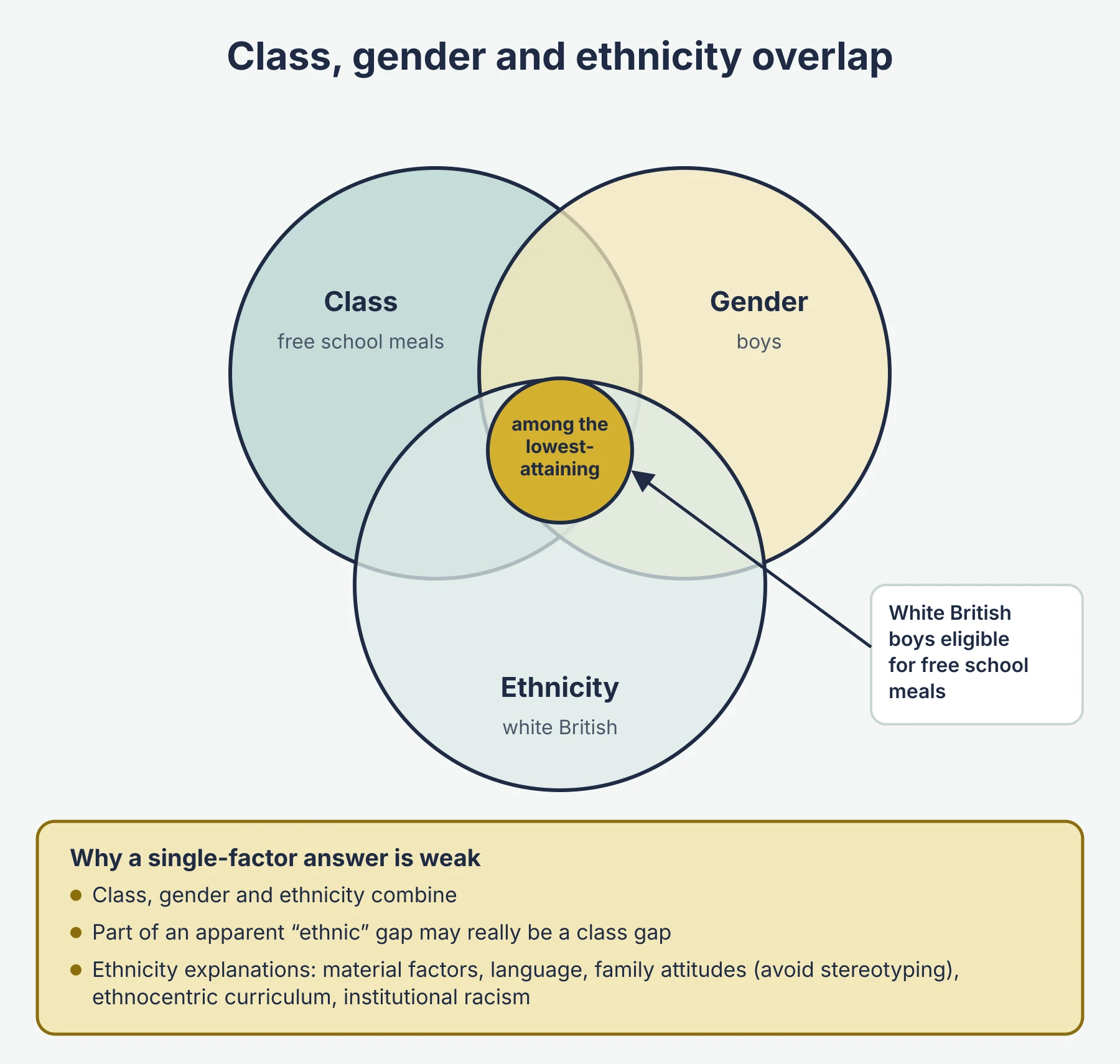
Achievement varies widely between ethnic groups, and between pupils within each group. Explanations include:
- Material factors: some ethnic minority groups are more likely to live in poverty.
- Language: pupils who are new to English may need time to catch up, although many bilingual pupils achieve highly.
- Family and cultural attitudes to education, though sociologists warn against stereotyping whole groups.
- The ethnocentric curriculum: a curriculum centred on one culture’s history and values may alienate some pupils.
- Institutional racism: policies and practices that disadvantage some groups without anyone intending it, such as higher exclusion rates for some groups.
Class, gender and ethnicity together
The factors overlap. Official figures for England have shown that white British pupils eligible for free school meals, especially boys, are among the lowest-attaining groups. This shows why a single-factor answer is weak: class, gender and ethnicity combine, and part of an apparent “ethnic” gap may be a class gap.
Perspectives compared
| Perspective | Explanation of differences | Key support |
|---|---|---|
| Functionalist | Differences reflect ability and effort in a broadly meritocratic system | Parsons on achieved status |
| Marxist | Differences reflect class inequality; the myth of meritocracy hides it | Halsey’s class gaps; Ball on unequal choice |
| Feminist | Girls’ progress is real but limited; gendered subjects and the glass ceiling show patriarchy continues | Sharpe; gendered subject choice |
Worked example: an annotated 4-mark answer
Question (practice): Identify and explain one way in which parental choice may affect educational achievement. [4]
Parental choice may widen class differences in achievement [identifies: 1]. Ball and colleagues found that league tables and choice make schools compete for pupils [links to the named study: 1]. Middle-class parents have more money, time and knowledge to research schools and move near successful ones, so their children tend to get places at the best-performing schools [explains the mechanism: 1]. Working-class children are more likely to attend schools that are under pressure and may focus on their most able pupils, so the gap in results grows [explains the effect on achievement: 1].
Common mistakes
- Using Halsey’s figures to describe girls. The sample was male only.
- Quoting Halsey’s numbers without saying they compare service-class and working-class boys.
- Mixing Ball’s 1994 study on parental choice with his Beachside Comprehensive study on teacher expectations (3.4.4).
- Treating cultural deprivation and cultural capital as the same idea. One blames home culture; the other blames schools for rewarding middle-class culture.
- Writing that “all girls do better than all boys”. Patterns are averages.
- Writing about one factor only when the question says “factors”.
Exam technique for the command words
- Identify: name a factor, such as material deprivation.
- Describe: give its features or the findings of a study.
- Explain: show how the factor produces a difference in achievement, step by step.
- Discuss how far: weigh class against gender and ethnicity, or external factors against internal ones; use Halsey and Ball as evidence; finish with a judgement.
Then move on to the educational achievement practice questions.
Official syllabus
AQA GCSE Sociology (8192) specification, Version 1.2 (June 2026), for GCSE exams 2019 onwards: section 3.4.3 Educational achievement, and the summaries of Halsey, Heath and Ridge and of Ball, Bowe and Gerwitz in Appendix B.
Related resources
-
Practice questions
AQA GCSE Sociology (8192): Educational achievement – Practice Questions
Original AQA GCSE Sociology 8192 practice on 3.4.3 with marked answers: class, gender and ethnicity, Halsey, Ball on parental choice, and a data question.
Sociology · AQA · GCSE
Try questions -
Revision notes
AQA GCSE Sociology (8192): Educational achievement – Revision Notes
Condensed AQA GCSE Sociology 8192 notes on 3.4.3: class, gender and ethnicity factors, Halsey's findings, Ball on parental choice, perspectives and a self-test.
Sociology · AQA · GCSE
Revise topic -
Study guides
AQA GCSE Sociology (8192): Processes within schools
In-depth AQA GCSE Sociology 8192 guide to 3.4.4: streaming, setting, mixed ability, labelling, the self-fulfilling prophecy, Ball at Beachside and Willis.
Sociology · AQA · GCSE
Read guide
Related articles
Get free revision emails (optional)
Occasional emails with practice questions, worked explanations and links to free resources for the qualification and subjects you choose. No spam, and you can unsubscribe from any email. The free tools on this site never need an email.