
Revision Notes
AQA GCSE Sociology (8192): Educational achievement – Revision Notes
Condensed AQA GCSE Sociology 8192 notes on 3.4.3: class, gender and ethnicity factors, Halsey's findings, Ball on parental choice, perspectives and a self-test.
- Subject
- Sociology
- Level
- GCSE
- Topic
- Education
- Author
- Marlbridge Academic Team
- Updated
- Reviewed by
- Naqiya Yousaf (what this means)
Aligned to AQA GCSE Sociology (8192), first teaching 2017. Official specification .
Syllabus page (what it covers and how it is assessed): AQA GCSE Sociology.
Syllabus points this page covers
8192
- 3.4.3 Educational achievement
Found an error? Report a correction.
Need help with this topic? Request a free trial class for GCSE Sociology (8192).
These notes condense 3.4.3 Educational achievement, from the AQA GCSE Sociology (8192) specification, assessed in Paper 1. You must “identify, describe and explain various factors affecting educational achievement including class, gender and ethnicity”, compare functionalist, feminist and Marxist views, and describe the key ideas of Halsey on class-based inequalities and Ball on parental choice and competition between schools.
For full explanations, read the educational achievement study guide. For the whole topic, see the Education revision notes. Then try the educational achievement practice questions.
Key terms
| Term | Meaning |
|---|---|
| Achievement (in education) | How well pupils do: results, staying on, entry to higher education |
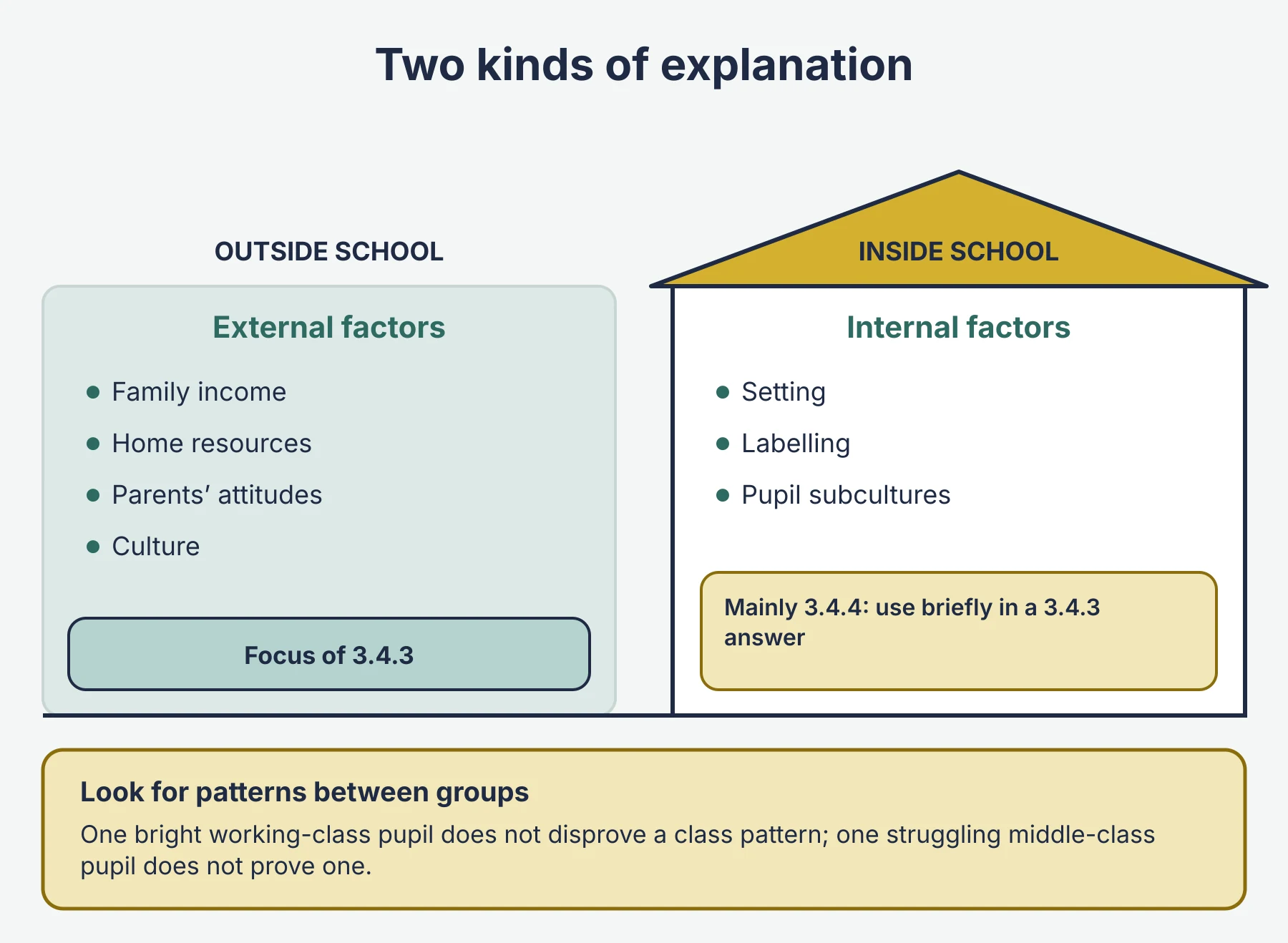
| External factors | Influences from outside school, such as home and income |
| Internal factors | Influences inside school, such as setting and labelling |
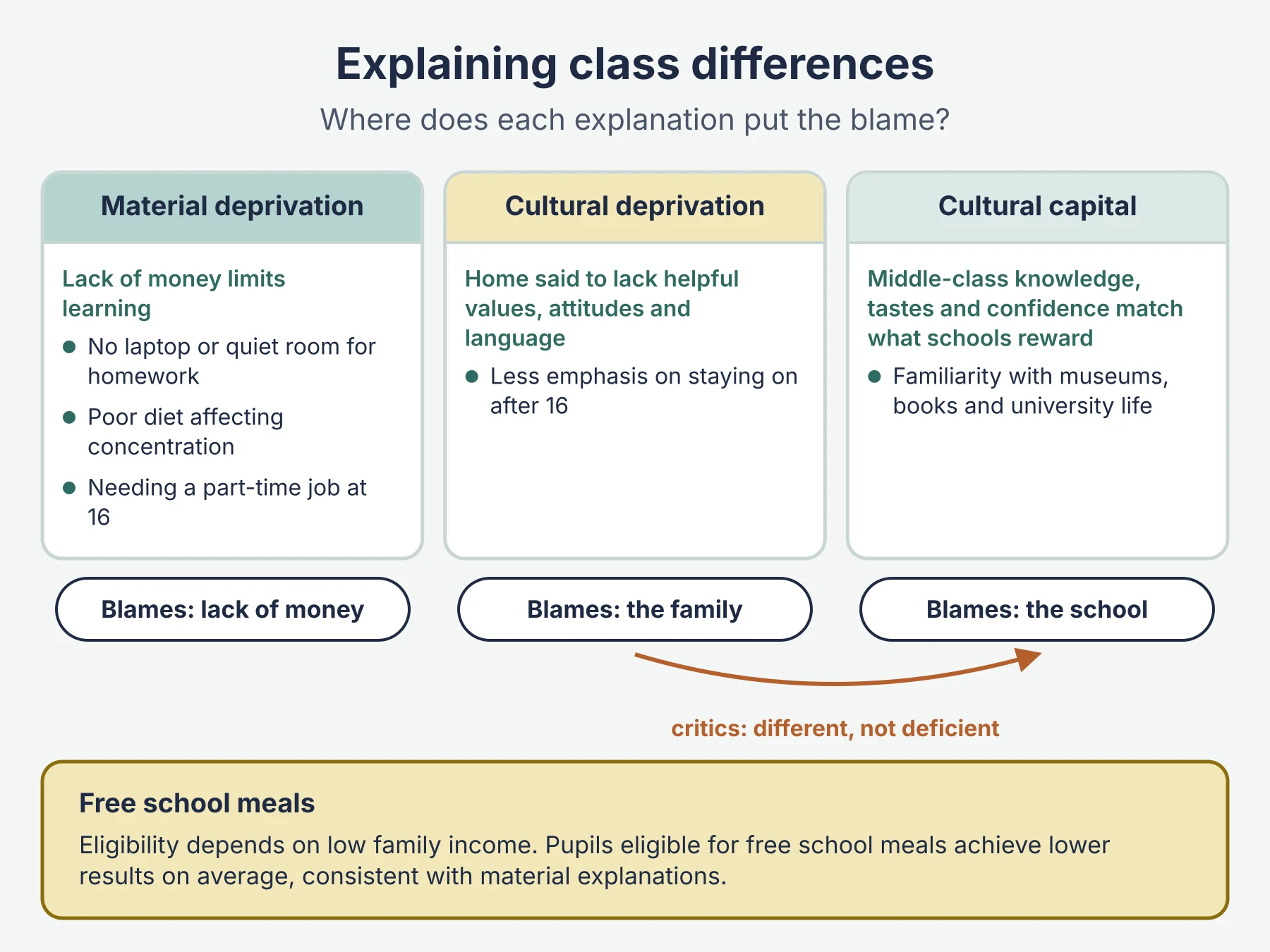
| Material deprivation | Lack of money and resources that support learning |
| Cultural deprivation | The claim that some families lack values, attitudes or language that help at school |
| Cultural capital | Middle-class knowledge, tastes and confidence that schools reward |
| Marketisation of education | Schools competing for pupils through parental choice and league tables |
| League tables in education | Published rankings of schools by results |
| Ethnocentric curriculum | A curriculum centred on one culture |
| Institutional racism | Policies and practices that disadvantage some ethnic groups, intended or not |
| Gendered curriculum | Subjects and expectations that differ by gender |
| Glass ceiling | An invisible barrier stopping women reaching top jobs |
| Meritocracy | Rewards based on ability and effort, not background |
Halsey, Heath and Ridge (1980) in five lines
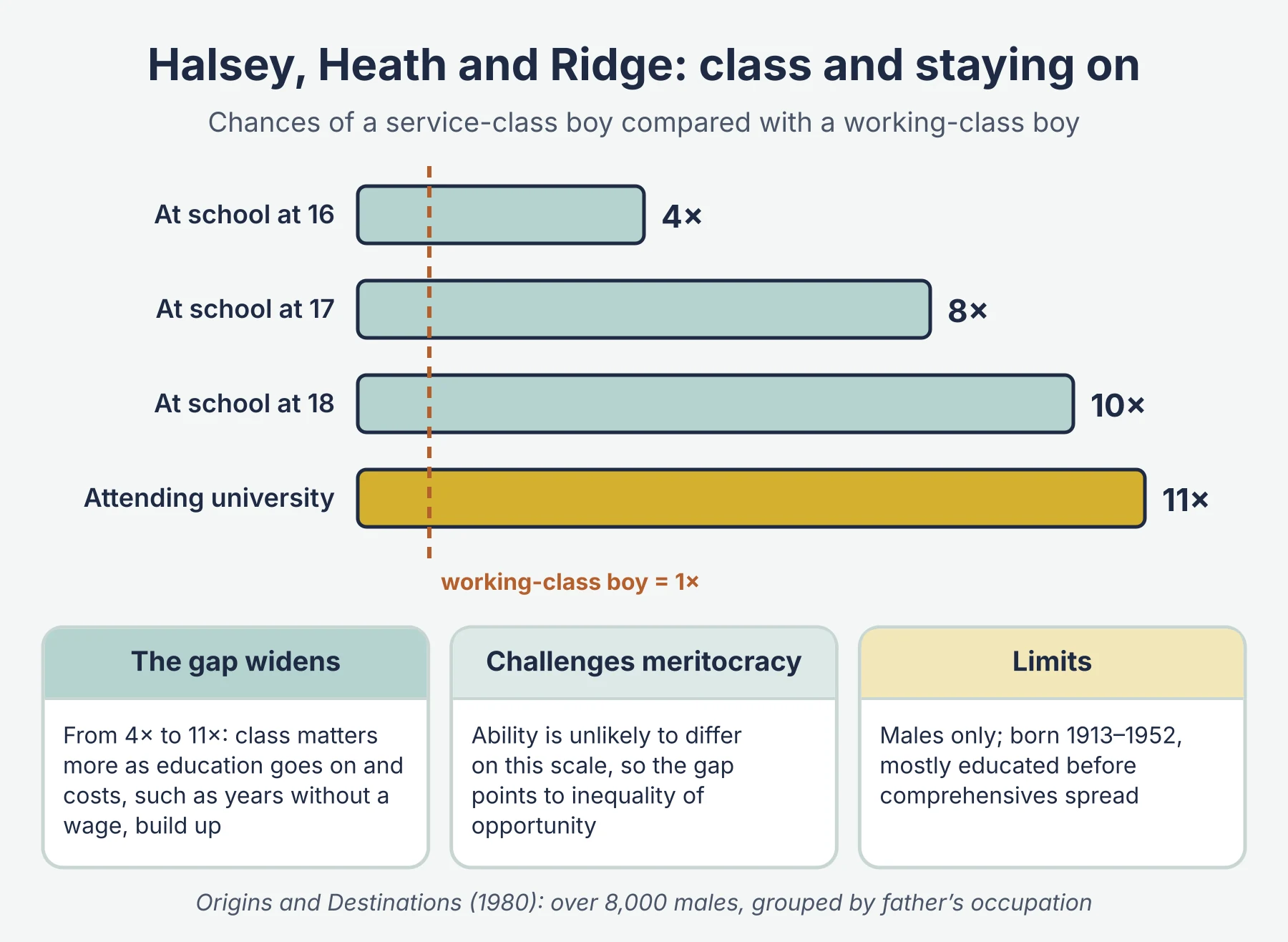
- Origins and Destinations; over 8,000 males born 1913 to 1952.
- Three classes by father’s occupation: service, intermediate, working.
- Service-class boy compared with working-class boy: 4x at school at 16, 8x at 17, 10x at 18, 11x at university.
- Conclusion: clear class inequalities in education; the gap widens at each stage.
- Limitation flagged by the specification: females were excluded.
Ball, Bowe and Gewirtz (1994) in five lines
- “Market forces and parental choice”; the specification prints “Gerwitz”.
- Fifteen schools in neighbouring LEAs with different class and ethnic profiles.
- Studied effects of parental choice and league tables.
- Found pressure to reintroduce streaming and setting and a tendency to focus on the more able.
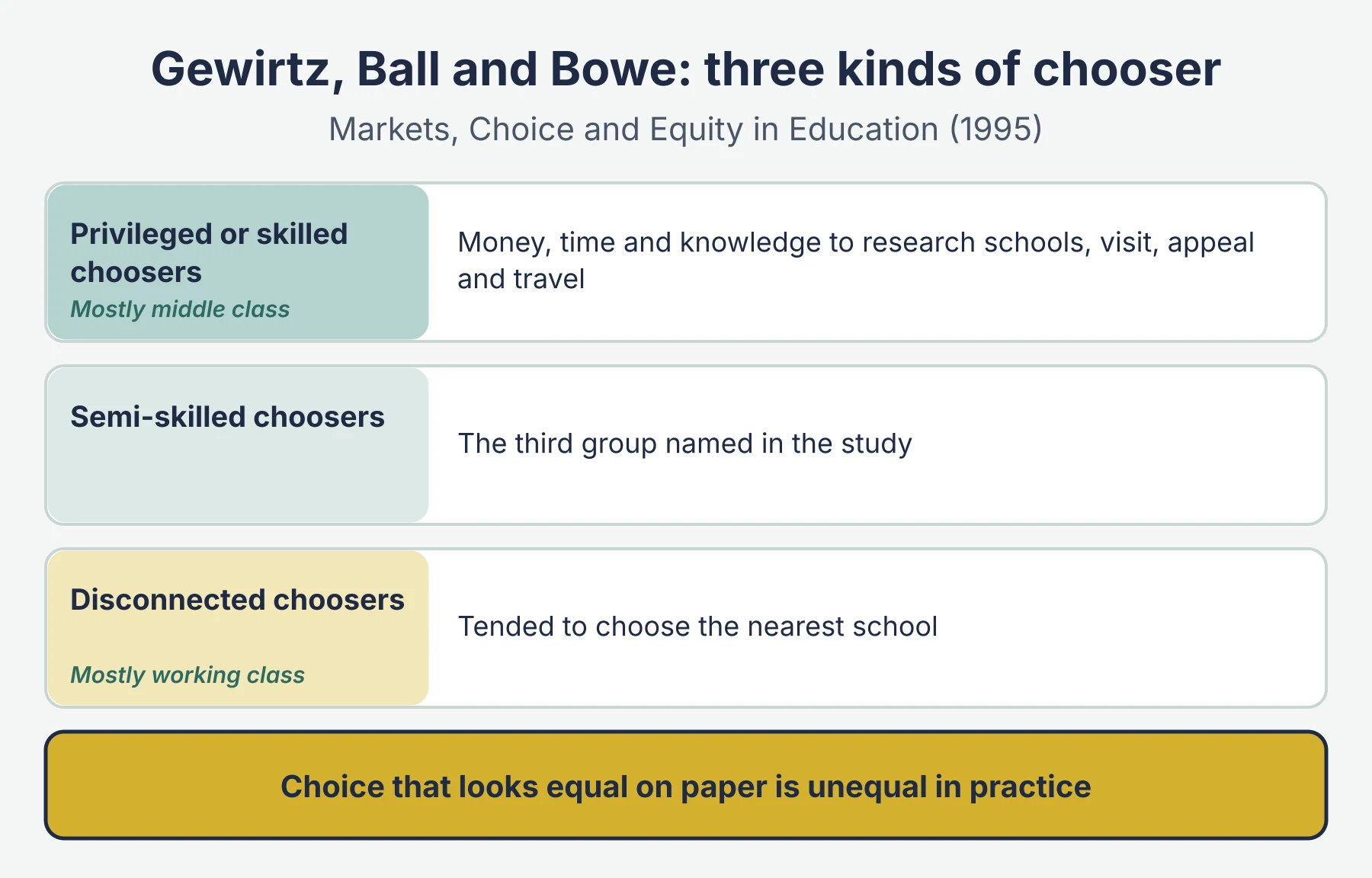
- Related 1995 book: skilled (privileged), semi-skilled and disconnected choosers; middle-class parents better placed to use choice.
Factors at a glance
| Factor | Main explanations | Evaluation |
|---|---|---|
| Class | Material deprivation; cultural deprivation; cultural capital; unequal use of choice (Ball) | Cultural deprivation may blame the victim; Halsey’s data are historical and male only |
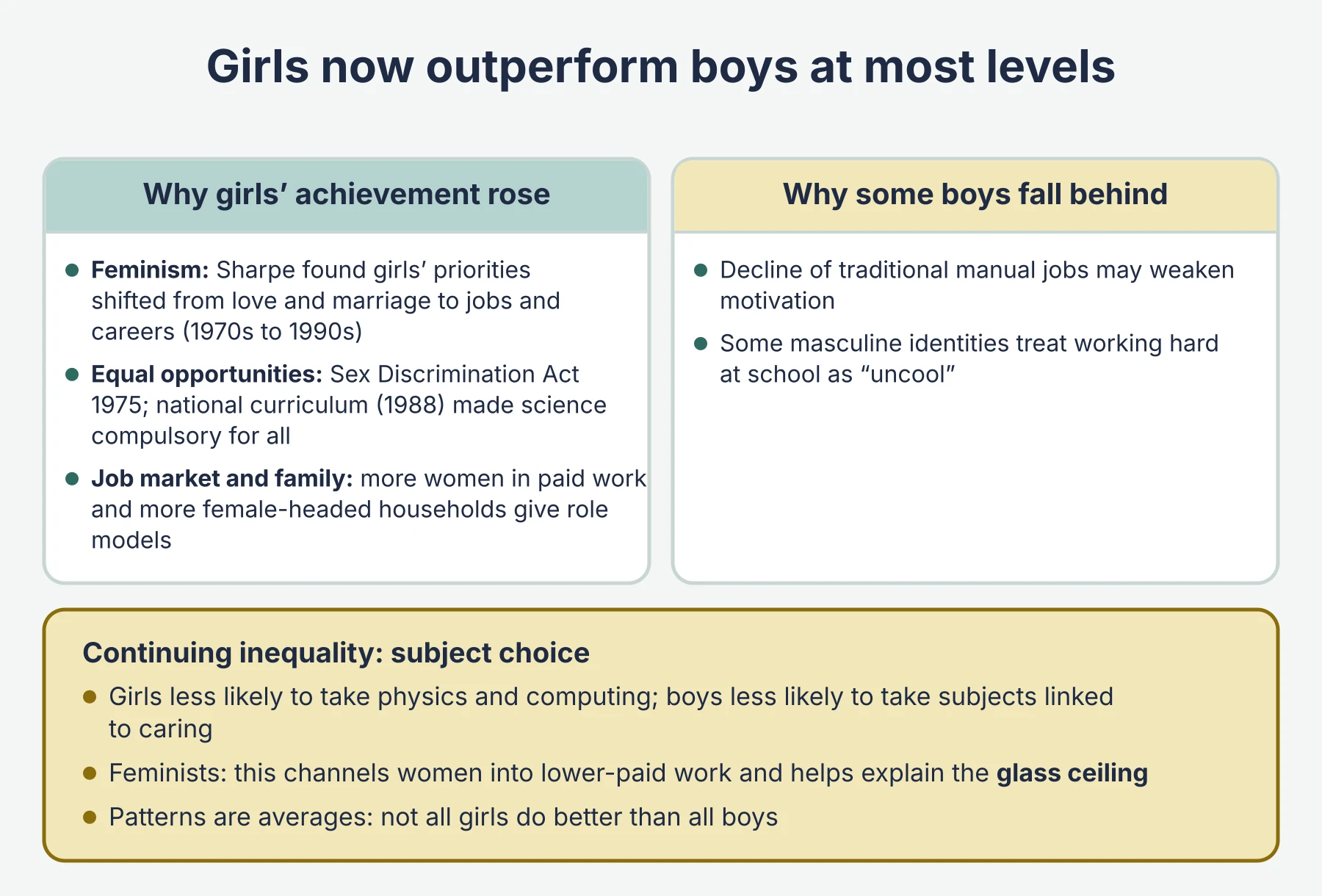
| Gender | Feminism and changing ambitions (Sharpe); equal opportunities laws and policies; job market changes; some boys’ anti-school masculinity | Subject choice stays gendered; not all girls succeed, not all boys fail |
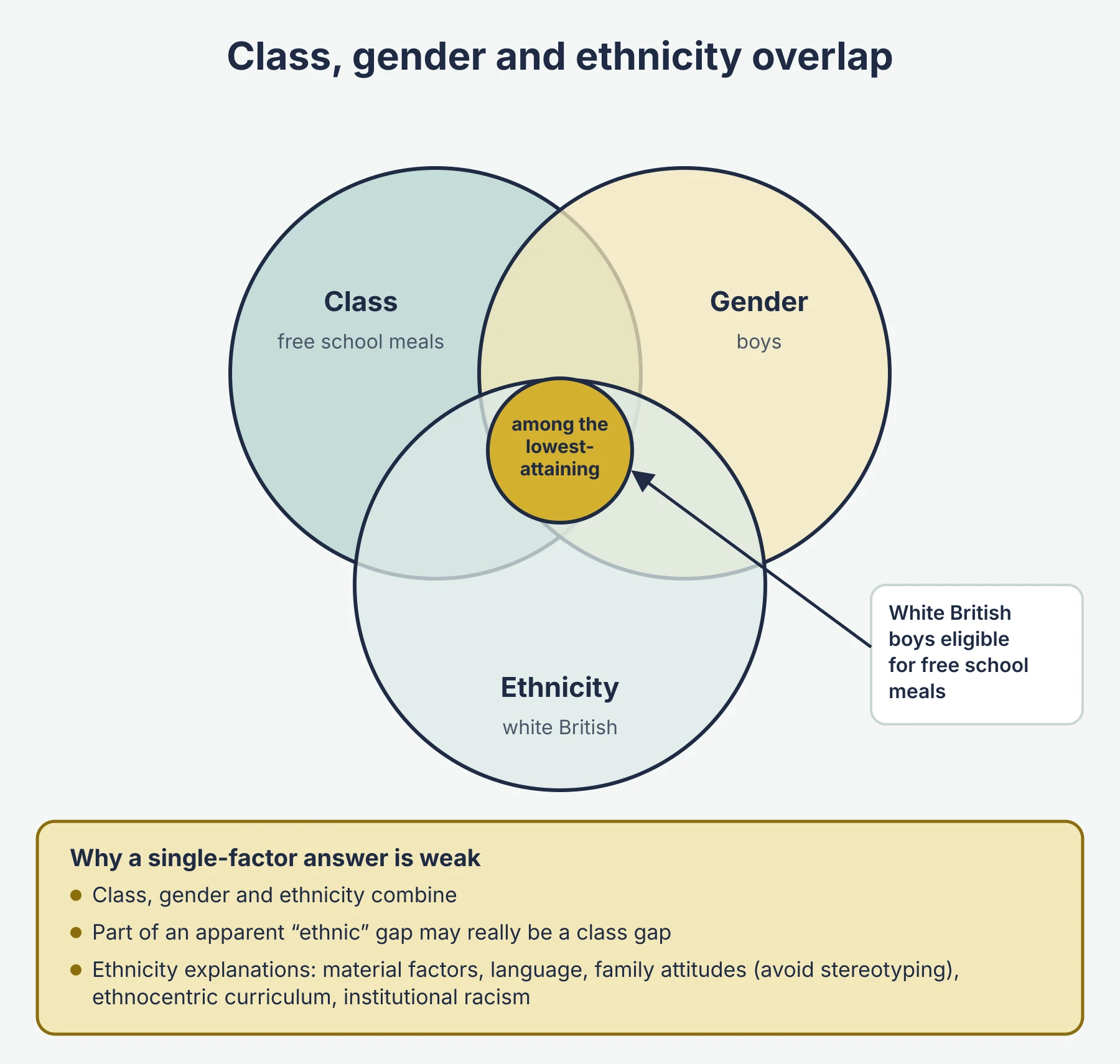
| Ethnicity | Material factors; language; family attitudes; ethnocentric curriculum; institutional racism | Wide variation within groups; class overlaps with ethnicity |
Overlap: official figures for England have shown white British pupils eligible for free school meals, especially boys, among the lowest-attaining groups, so class, gender and ethnicity combine.
Perspectives in one line each
- Functionalist: differences reflect ability and effort; the system is broadly meritocratic.
- Marxist: differences reflect class inequality; schools legitimise it through the myth of meritocracy.
- Feminist: girls’ rising results are progress, but gendered subject choice and the glass ceiling show patriarchy continues.
Must-know distinctions
- Cultural deprivation vs cultural capital: the first locates the problem in working-class homes; the second locates it in schools rewarding middle-class culture.
- Material vs cultural: money and resources versus values, knowledge and language.
- Ball 1994 vs Ball 1981: parental choice and competition (3.4.3) versus teacher expectations at Beachside (3.4.4).
- External vs internal: home and society versus school processes.
Exam traps
- Halsey’s figures compare service-class with working-class boys; never say “children” or “pupils” in general.
- “Factors” questions need more than one factor.
- Gender answers should explain why girls improved and why some boys fall behind, plus the remaining inequality.
- Do not stereotype ethnic groups; refer to averages and variation.
- In “discuss how far” questions, a judgement is needed, such as weighing class against gender.
Self-test
- How large was Halsey, Heath and Ridge’s sample, and who was in it?
- How were the three classes in Halsey’s study defined?
- How many times greater was a service-class boy’s chance of being at school at 18?
- What limitation of Halsey’s study does the specification itself point out?
- How many schools did Ball, Bowe and Gewirtz study?
- Name two effects of parental choice and league tables on schools found by Ball and colleagues.
- What is a “disconnected chooser”?
- Define cultural capital.
- Give one criticism of cultural deprivation theory.
- Give two reasons why girls’ achievement has risen.
- What is an ethnocentric curriculum?
- How would a Marxist explain class differences in achievement?
Answers
- Over 8,000 males born between 1913 and 1952.
- By father’s occupation: service, intermediate and working class.
- Ten times.
- It excluded females, which might have made a significant difference to the findings.
- Fifteen.
- Pressure to reintroduce streaming and setting; a tendency to focus on the more able.
- A parent, usually working class, with less money, time or knowledge to research schools, who tends to choose the nearest school.
- Middle-class knowledge, tastes and confidence that schools reward.
- It blames working-class families and treats their culture as deficient rather than different.
- Any two: impact of feminism on ambitions; equal opportunities laws and policies; more women in paid work as role models; changes in the job market.
- A curriculum centred on one culture’s history, language and values.
- Class inequality outside school shapes results, and schools hide this through the myth of meritocracy, so working-class failure looks deserved.
Official syllabus
AQA GCSE Sociology (8192) specification, Version 1.2 (June 2026), for GCSE exams 2019 onwards: section 3.4.3 Educational achievement, with Appendix B summaries.
Related resources
-
Study guides
AQA GCSE Sociology (8192): Processes within schools
In-depth AQA GCSE Sociology 8192 guide to 3.4.4: streaming, setting, mixed ability, labelling, the self-fulfilling prophecy, Ball at Beachside and Willis.
Sociology · AQA · GCSE
Read guide -
Practice questions
AQA GCSE Sociology (8192): Processes within schools – Practice Questions
Original AQA GCSE Sociology 8192 practice on 3.4.4 with marked answers: setting, streaming, labelling, the self-fulfilling prophecy, Ball and Willis.
Sociology · AQA · GCSE
Try questions -
Revision notes
AQA GCSE Sociology (8192): Processes within schools – Revision Notes
Condensed AQA GCSE Sociology 8192 notes on 3.4.4: streaming, setting, labelling, the self-fulfilling prophecy, Ball, Willis, four perspectives and a self-test.
Sociology · AQA · GCSE
Revise topic
Related articles
Get free revision emails (optional)
Occasional emails with practice questions, worked explanations and links to free resources for the qualification and subjects you choose. No spam, and you can unsubscribe from any email. The free tools on this site never need an email.