
Revision Notes
AQA GCSE Sociology (8192): Processes within schools – Revision Notes
Condensed AQA GCSE Sociology 8192 notes on 3.4.4: streaming, setting, labelling, the self-fulfilling prophecy, Ball, Willis, four perspectives and a self-test.
- Subject
- Sociology
- Level
- GCSE
- Topic
- Education
- Author
- Marlbridge Academic Team
- Updated
- Reviewed by
- Naqiya Yousaf (what this means)
Aligned to AQA GCSE Sociology (8192), first teaching 2017. Official specification .
Syllabus page (what it covers and how it is assessed): AQA GCSE Sociology.
Syllabus points this page covers
8192
- 3.4.4 Processes within schools
Found an error? Report a correction.
Need help with this topic? Request a free trial class for GCSE Sociology (8192).
These notes condense 3.4.4 Processes within schools, from the AQA GCSE Sociology (8192) specification, assessed in Paper 1. You must explain “streaming, setting, mixed ability teaching, labelling and the self-fulfilling prophecy”, compare interactionist, functionalist, feminist and Marxist views, and describe the key ideas of Ball on teacher expectations and Willis on the creation of counter school cultures.
For full explanations, read the processes within schools study guide. For the whole topic, see the Education revision notes. Then try the processes within schools practice questions.
Key terms
| Term | Meaning |
|---|---|
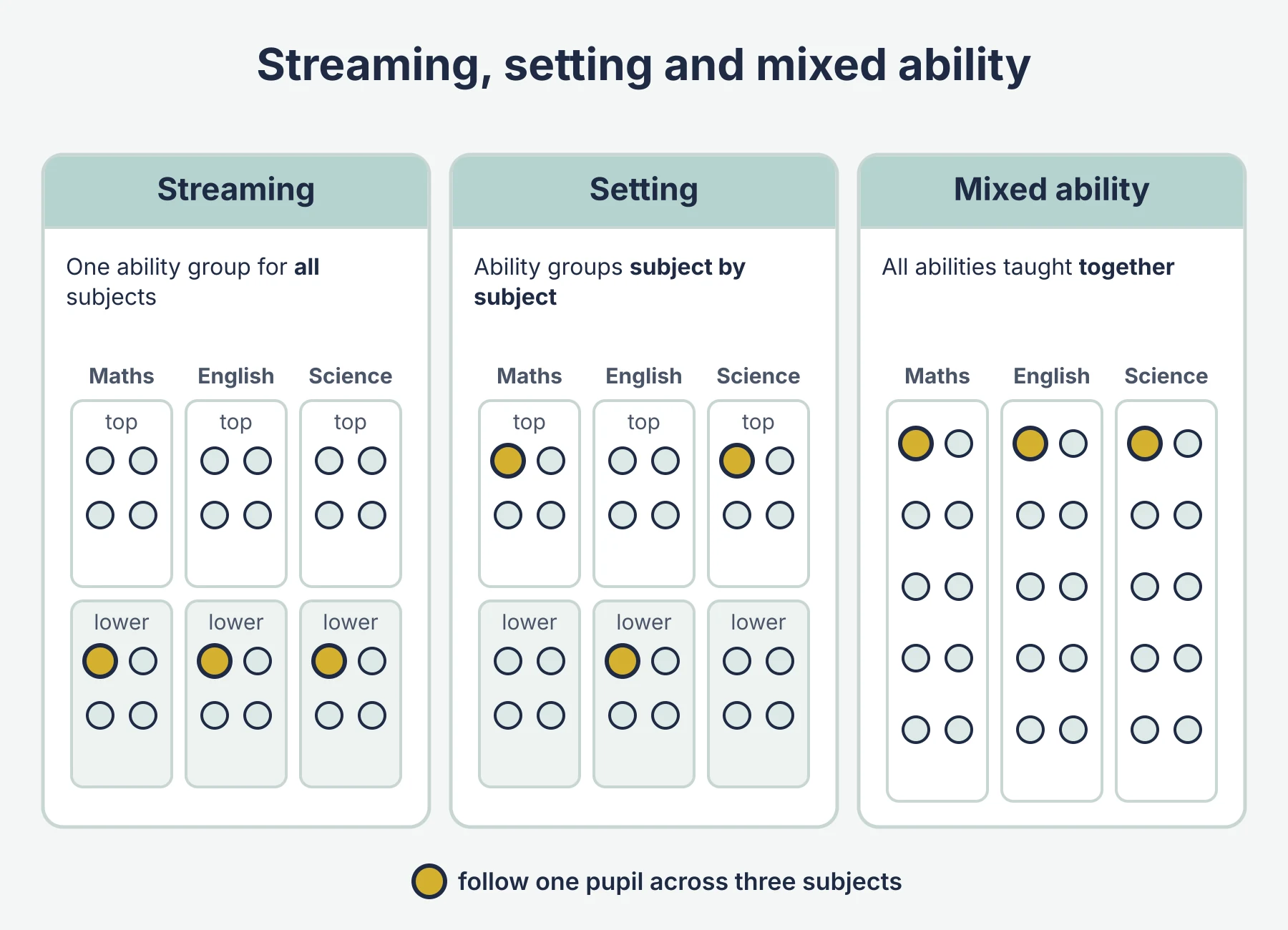
| Streaming (banding) | One ability group for all subjects |
| Setting in education | Ability groups subject by subject |
| Mixed ability | Pupils of all abilities taught together |
| Labelling | Attaching a definition to a pupil, such as “bright” or “troublemaker” |
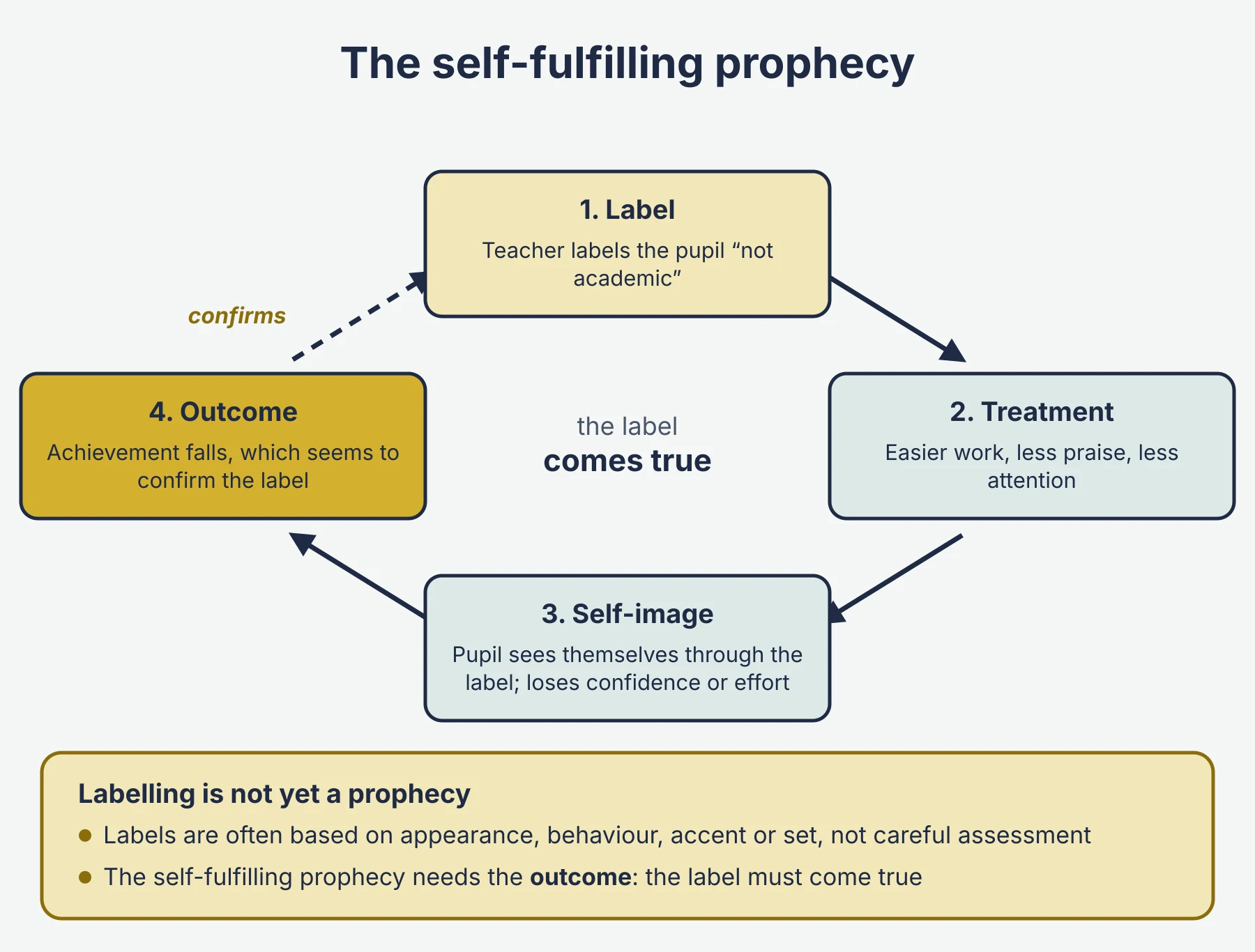
| Self-fulfilling prophecy | A label changes treatment and self-image until the prediction comes true |
| Teacher expectations | What teachers believe a pupil or group can achieve |
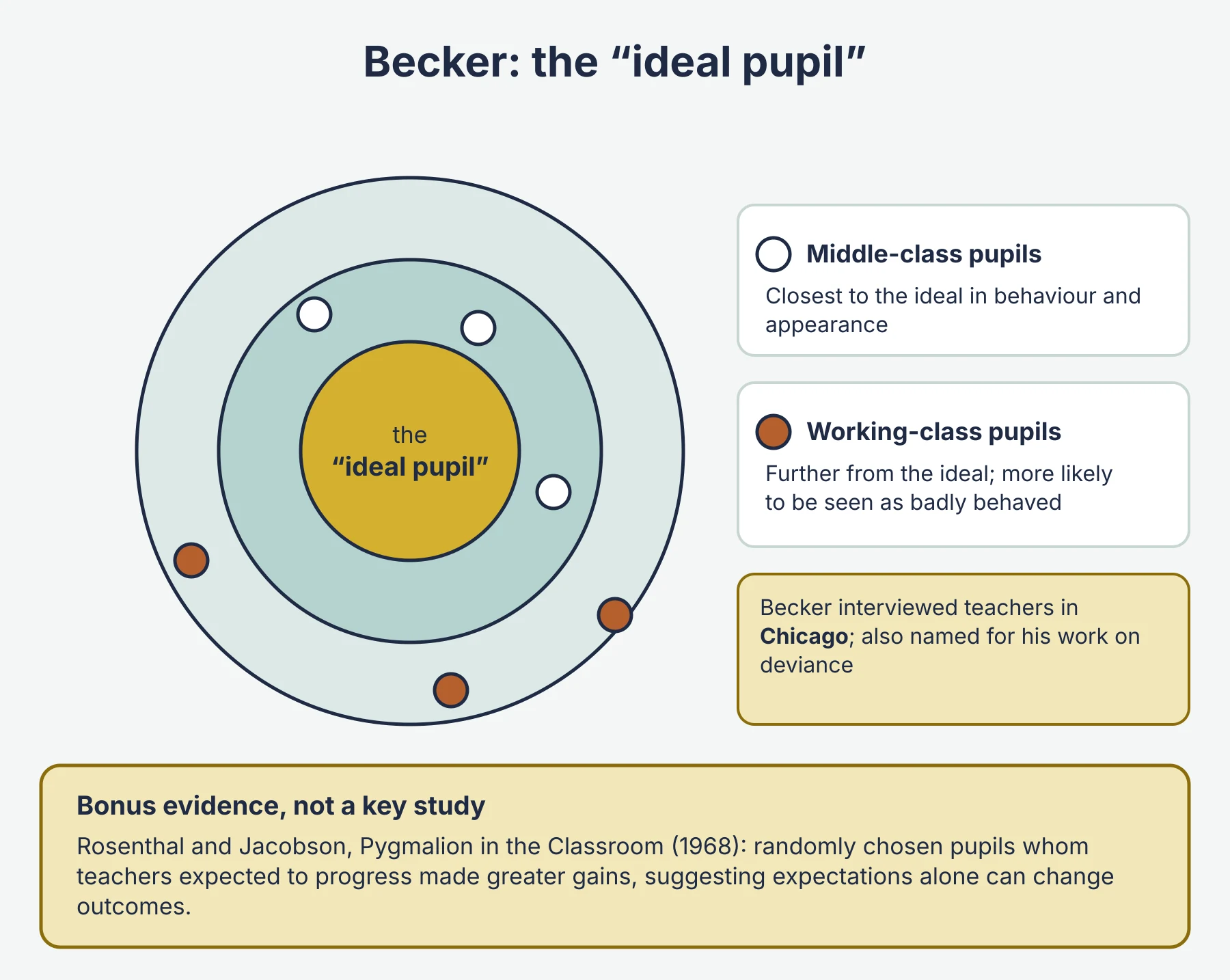
| Ideal pupil | Becker’s term for the teacher’s image of the perfect pupil, closest to middle-class pupils |
| Polarisation | Pupils splitting into pro-school and anti-school groups |
| Counter school subculture | A pupil group whose values oppose the school’s |
| Anti-school sub-culture | The specification’s alternative wording for a counter school group |
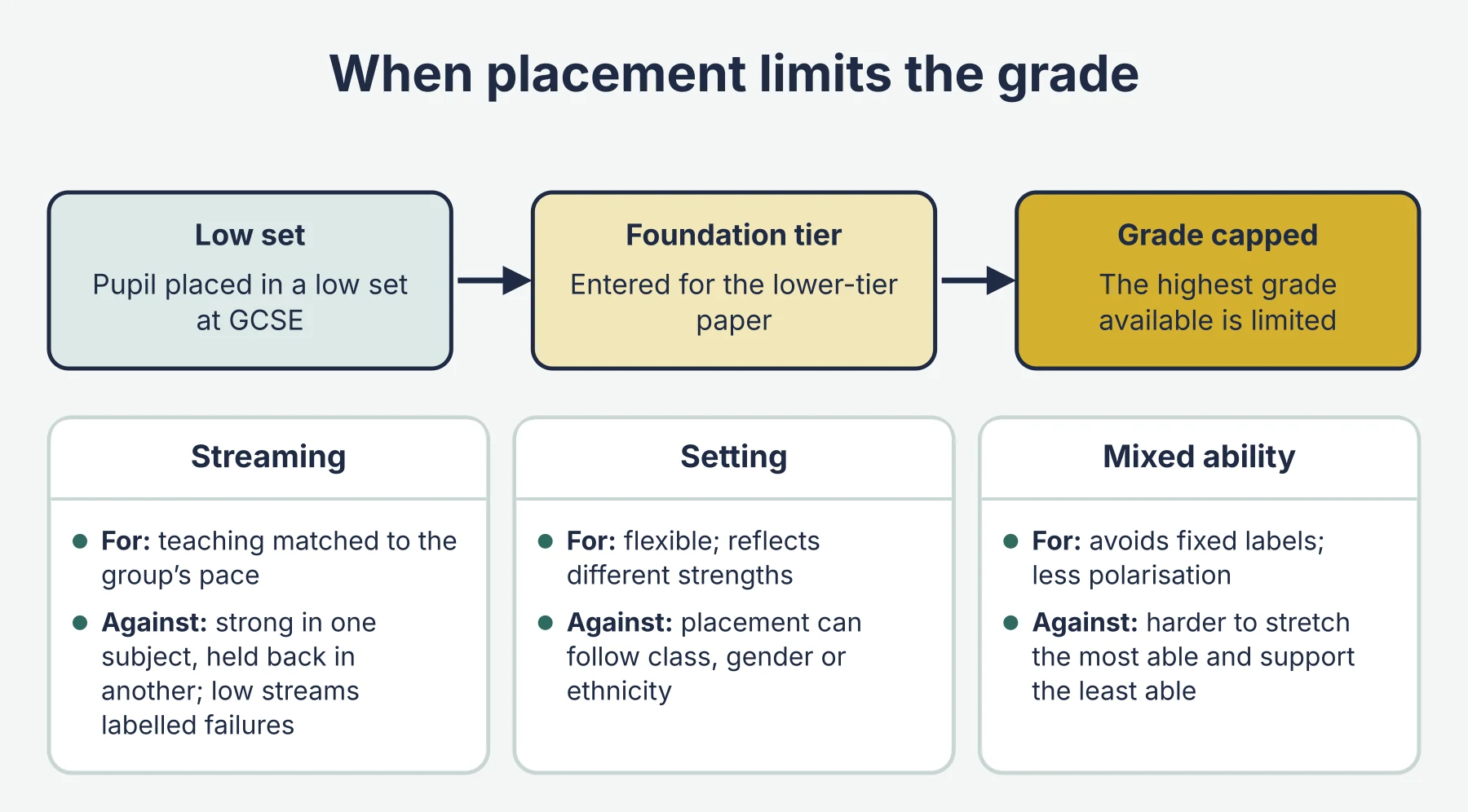
| Tiered entry | Entering pupils for a foundation or higher paper, which affects the grades available |
| Participant observation | The researcher joins in the life of the group being studied |
The self-fulfilling prophecy in four steps
- Label: the teacher defines the pupil (“weak”, “not academic”).
- Treatment: easier work, lower set, less praise, lower-tier entry.
- Self-image: the pupil accepts the label and loses confidence or effort.
- Outcome: lower achievement that seems to prove the label right.
Key studies at a glance
| Study | Method | Findings | Evaluation |
|---|---|---|---|
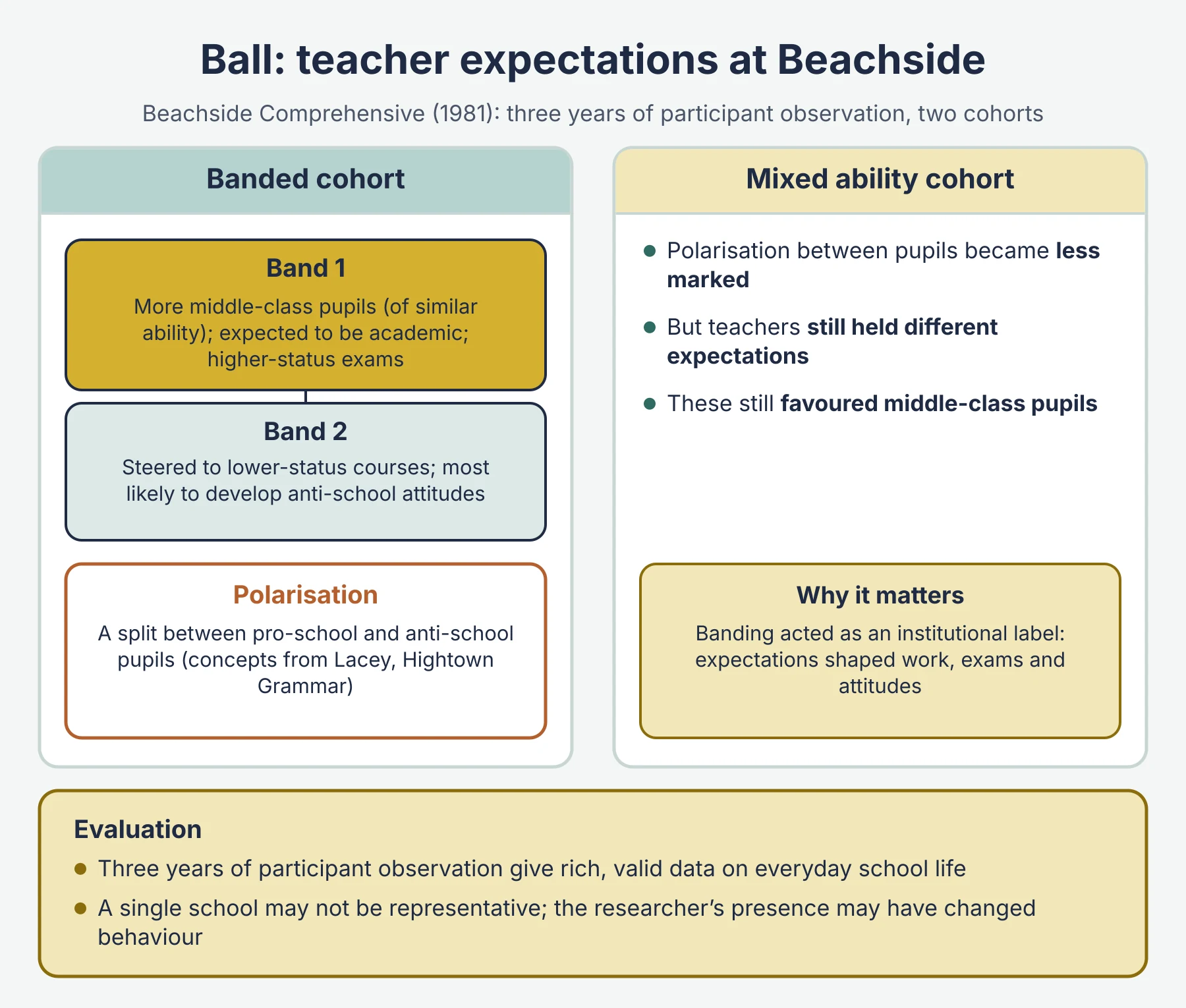
| Ball, Beachside Comprehensive (1981) | Three years as a participant observer in a south coast comprehensive; two cohorts, one banded and one mixed ability | Middle-class pupils more likely to be placed in band 1 with higher expectations; band 2 most likely to become anti-school (polarisation); with mixed ability, polarisation less marked but teacher expectations still differed | Rich, valid data; one school, so may not be representative; researcher may affect behaviour |
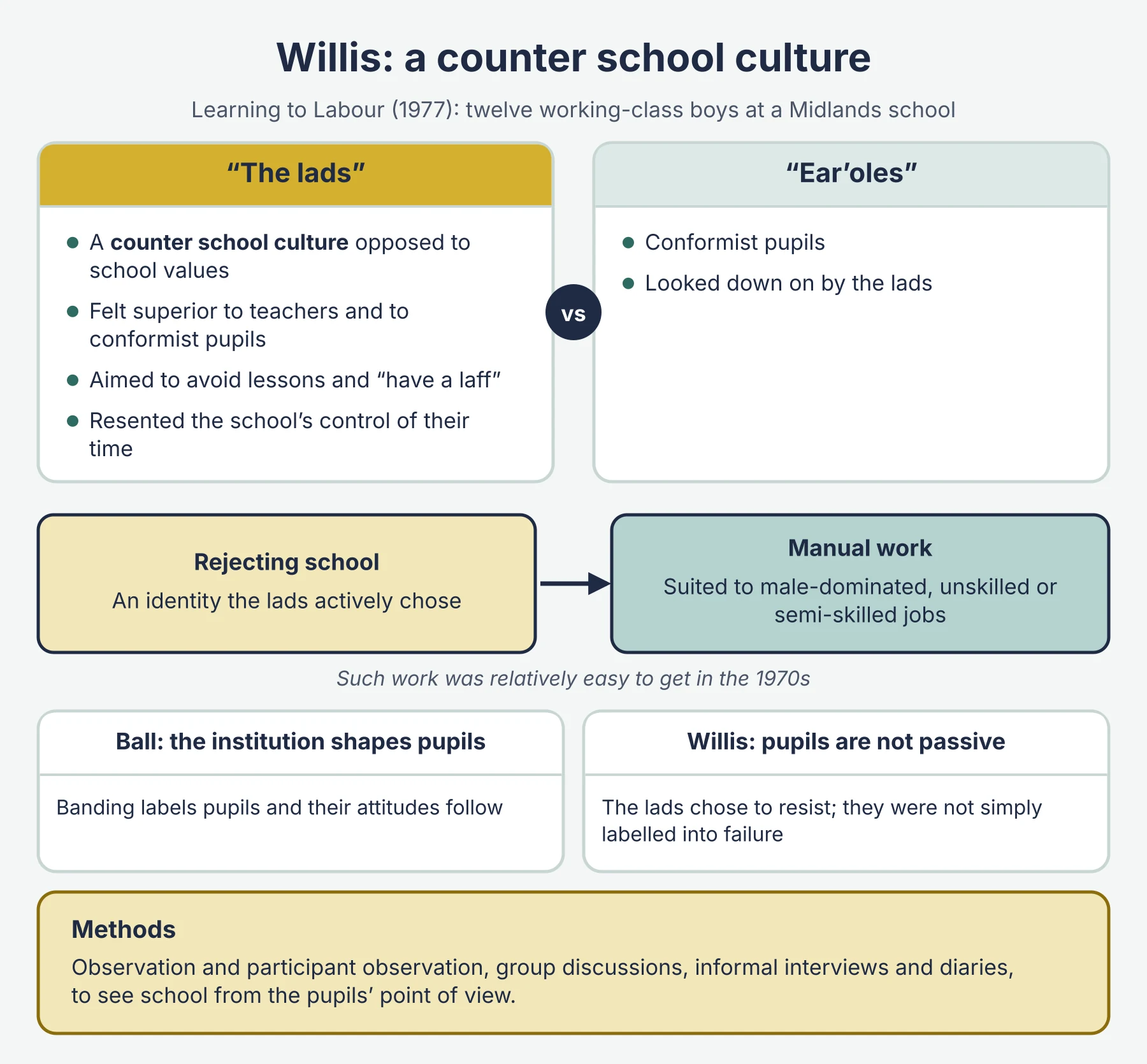
| Willis, Learning to Labour (1977) | Observation, participant observation, group discussions, informal interviews and diaries; twelve working-class lads in a Midlands school | Counter culture; felt superior to teachers and “ear’oles”; avoided lessons; rejection of school suited them to manual work | Small all-male sample; manual jobs now far scarcer |
| Becker (Chicago teachers) | Interviews with teachers | Teachers judged pupils against an “ideal pupil” closest to middle-class pupils | American and dated; not named for 3.4.4 in the specification, so use as support |
Perspectives in one line each
- Interactionist: classroom interaction, labels and pupils’ responses shape achievement.
- Functionalist: setting and streaming sort pupils fairly by ability, preparing them for different roles.
- Marxist: grouping and labelling reproduce class inequality; Willis shows resistance can still lead to manual work.
- Feminist: teacher expectations and the hidden curriculum steer girls and boys into gendered subjects and roles.
Must-know distinctions
- Streaming vs setting: all subjects versus each subject.
- Labelling vs self-fulfilling prophecy: the act versus the outcome.
- Ball vs Willis: Ball shows the institution’s grouping shaping attitudes; Willis shows pupils actively creating an anti-school identity.
- Ball 1981 vs Ball 1994: teacher expectations (3.4.4) versus parental choice (3.4.3).
- Internal vs external: in-school processes versus home and income factors.
Exam traps
- A self-fulfilling prophecy answer must reach the outcome.
- Always say which grouping method you mean; do not use “streaming” for setting.
- Willis is Marxist, and his lads were not docile.
- 3.4.4 adds the interactionist perspective; include it in “discuss how far” answers.
- Name Ball’s method (participant observation) when evaluating.
- Avoid claiming internal processes explain all differences; link back to external factors.
Mini essay plan
Question type: “Discuss how far sociologists would agree that labelling is the main reason some pupils underachieve.”
- Define labelling and the self-fulfilling prophecy in two sentences.
- For (interactionist): Becker’s ideal pupil; Ball’s band 1 and band 2; the four-step prophecy applied to a low set.
- For, with institutional detail: setting and tiered entry turn a label into a cap on grades.
- Partly against: Willis’s lads chose resistance rather than simply accepting a label.
- Against (external factors): material deprivation, cultural capital and Halsey’s class gaps start before school.
- Feminist angle: gendered expectations affect girls and boys differently.
- Judgement: labelling can widen gaps that start outside school, so it is one important reason rather than the main one.
Self-test
- What is the difference between streaming and setting?
- Give one argument for mixed ability teaching.
- Put the four steps of the self-fulfilling prophecy in order.
- What method did Ball use at Beachside, and for how long?
- How were Ball’s two cohorts organised?
- Which band was most likely to develop anti-school attitudes?
- What did Ball find about class and band placement?
- How many lads did Willis study, and where?
- What did the lads call conformist pupils?
- What did Willis conclude about the lads’ futures?
- What is Becker’s “ideal pupil”?
- How would a functionalist view setting?
Answers
- Streaming places pupils in one ability group for all subjects; setting groups them separately for each subject.
- Any one: avoids fixed labels; reduces polarisation; all pupils have access to the same content.
- Label, treatment, self-image, outcome.
- Participant observation, over three years of fieldwork.
- One cohort was banded by ability; the other was taught in mixed ability classes.
- Band 2.
- Middle-class pupils were more likely than working-class pupils of similar ability to be placed in band 1.
- Twelve working-class boys at a Midlands school on a working-class housing estate.
- “Ear’oles”.
- Their rejection of school made them suitable for male-dominated, unskilled or semi-skilled manual work.
- Teachers’ image of the perfect pupil, which was closest to middle-class pupils’ behaviour and appearance.
- As an efficient, meritocratic way of matching teaching to ability and preparing pupils for different roles.
Official syllabus
AQA GCSE Sociology (8192) specification, Version 1.2 (June 2026), for GCSE exams 2019 onwards: section 3.4.4 Processes within schools, with Appendix B summaries.
Related resources
-
Study guides
AQA GCSE Sociology (8192): Roles and functions of education
In-depth AQA GCSE Sociology 8192 guide to 3.4.1: the three functions of education, Durkheim and Parsons, types of school, home schooling and de-schooling.
Sociology · AQA · GCSE
Read guide -
Practice questions
AQA GCSE Sociology (8192): Roles and functions of education – Practice Questions
Original AQA GCSE Sociology 8192 practice on 3.4.1: functions of education, Durkheim and Parsons, school types and home schooling, with marked answers.
Sociology · AQA · GCSE
Try questions -
Revision notes
AQA GCSE Sociology (8192): Roles and functions of education – Revision Notes
Condensed AQA GCSE Sociology 8192 notes on 3.4.1: three functions of education, Durkheim, Parsons, school types, home schooling, de-schooling and a self-test.
Sociology · AQA · GCSE
Revise topic
Related articles
Get free revision emails (optional)
Occasional emails with practice questions, worked explanations and links to free resources for the qualification and subjects you choose. No spam, and you can unsubscribe from any email. The free tools on this site never need an email.