
Study Guides
AQA GCSE Sociology (8192): Processes within schools
In-depth AQA GCSE Sociology 8192 guide to 3.4.4: streaming, setting, mixed ability, labelling, the self-fulfilling prophecy, Ball at Beachside and Willis.
- Subject
- Sociology
- Level
- GCSE
- Topic
- Education
- Author
- Marlbridge Academic Team
- Updated
- Reviewed by
- Naqiya Yousaf (what this means)
Aligned to AQA GCSE Sociology (8192), first teaching 2017. Official specification .
Syllabus page (what it covers and how it is assessed): AQA GCSE Sociology.
Syllabus points this page covers
8192
- 3.4.4 Processes within schools
Found an error? Report a correction.
Need help with this topic? Request a free trial class for GCSE Sociology (8192).
This guide goes deep on one sub-section of the AQA GCSE Sociology (8192) specification: 3.4.4 Processes within schools, assessed in Paper 1: The sociology of families and education. The content is “processes within schools affecting educational achievement”, with “the work of Ball on teacher expectations and Willis on the creation of counter school cultures”. You must be able to explain “streaming, setting, mixed ability teaching, labelling and the self-fulfilling prophecy” and compare interactionist, functionalist, feminist and Marxist perspectives. This is the only Education sub-section that adds the interactionist perspective.
For the whole Education topic, start with the Education study guide. To revise this sub-section, use the processes within schools revision notes, then test yourself with the processes within schools practice questions.
Why “processes within schools” matters
Sub-section 3.4.3 looks mostly at factors outside school, such as family income. This sub-section asks a different question: does what happens inside school, between teachers and pupils and among pupils themselves, help create differences in achievement? Two schools with similar intakes can get different results, and pupils of similar ability in the same school can end up with different grades. Internal processes help explain why.
Ways of grouping pupils
| Method | How it works | Argument for | Argument against |
|---|---|---|---|
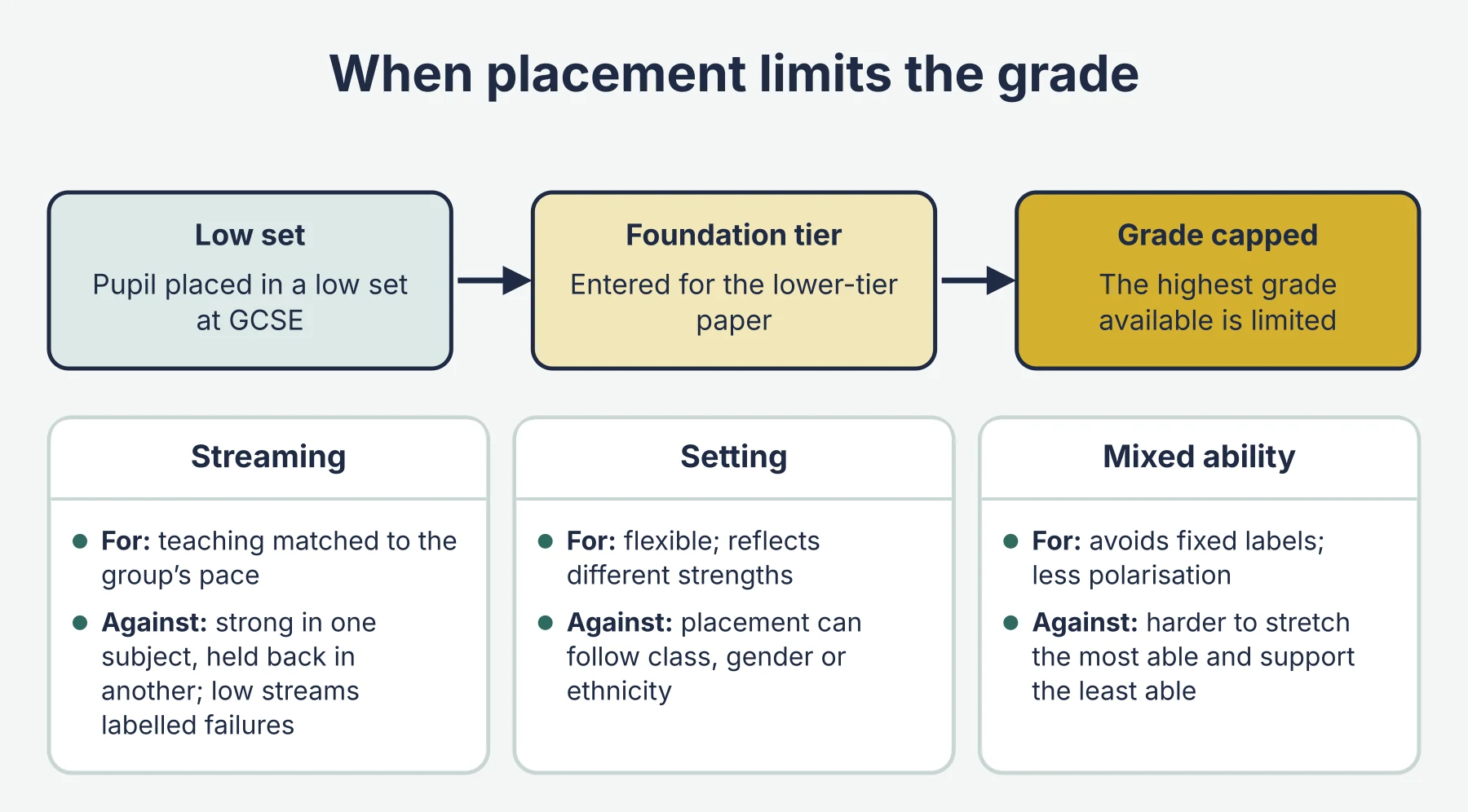
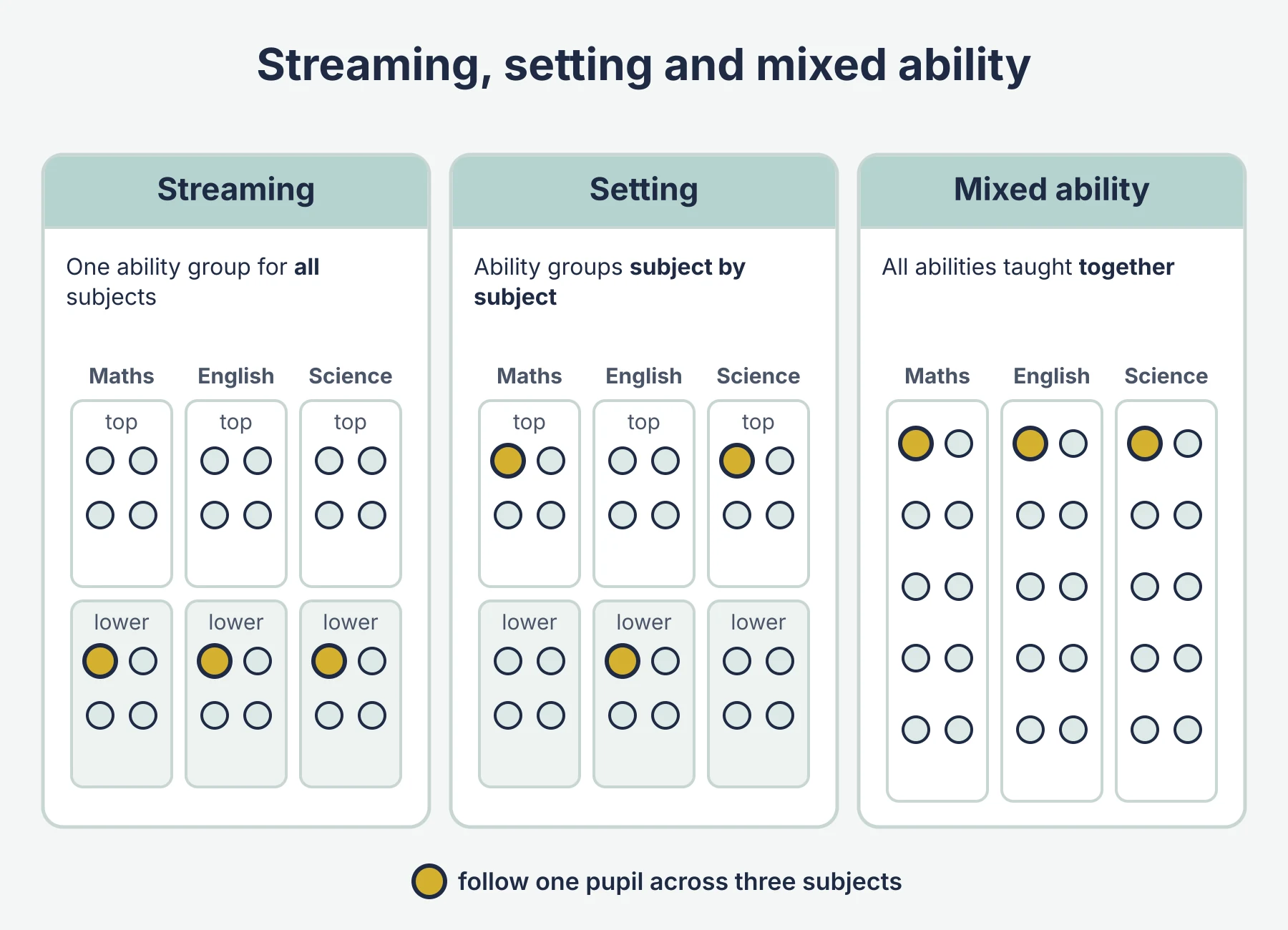
| Streaming (or banding) | Pupils placed in one ability group for all subjects | Teaching can be matched to the group’s pace | A pupil strong in one subject but weak in another is held back; low streams may be labelled as failures |
| Setting | Pupils placed in ability groups subject by subject | More flexible than streaming; reflects different strengths | Set placement can still follow class, gender or ethnicity; low sets may be entered for lower-tier exams |
| Mixed ability teaching | Pupils of all abilities taught together | Avoids fixed labels; less polarisation between pupils | Harder to stretch the most able and support the least able in one room |
A practical consequence of setting at GCSE is tiered entry: some subjects offer a foundation tier, which caps the highest grade available. A pupil in a low set may be entered for that tier, so the placement directly limits the grade they can achieve.
Labelling and the self-fulfilling prophecy
Labelling means attaching a definition to a pupil, such as “bright”, “lazy” or “troublemaker”. Labels are often based on surface features such as appearance, behaviour, accent or which set a pupil is in, rather than on careful assessment of ability.
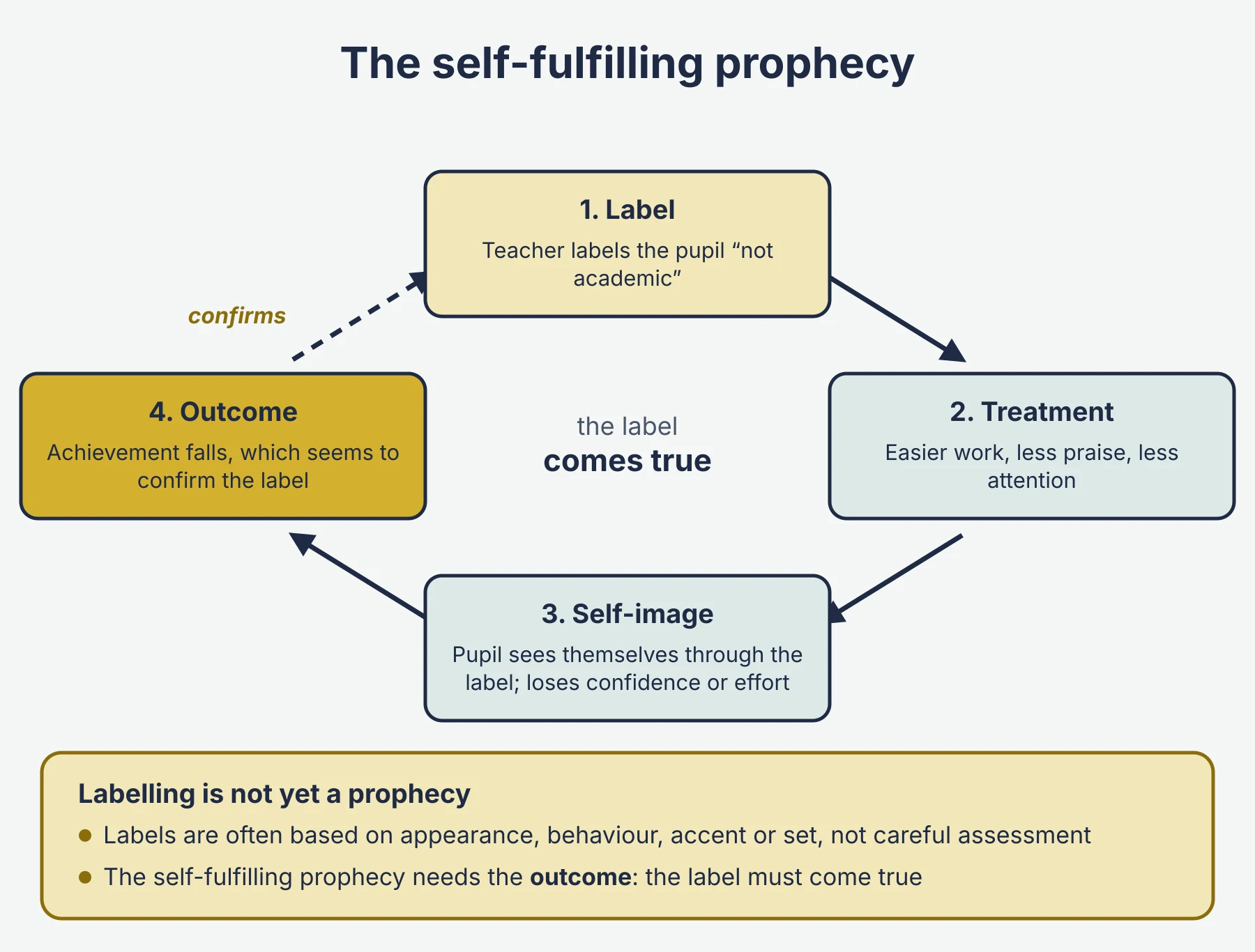
The self-fulfilling prophecy is the process by which a label comes true. Learn it as a chain:
- The teacher labels the pupil, for example as “not academic”.
- The teacher treats the pupil according to the label, giving easier work, less praise or less attention.
- The pupil comes to see themselves through the label and loses confidence or effort.
- The pupil’s achievement falls, which appears to confirm the original label.
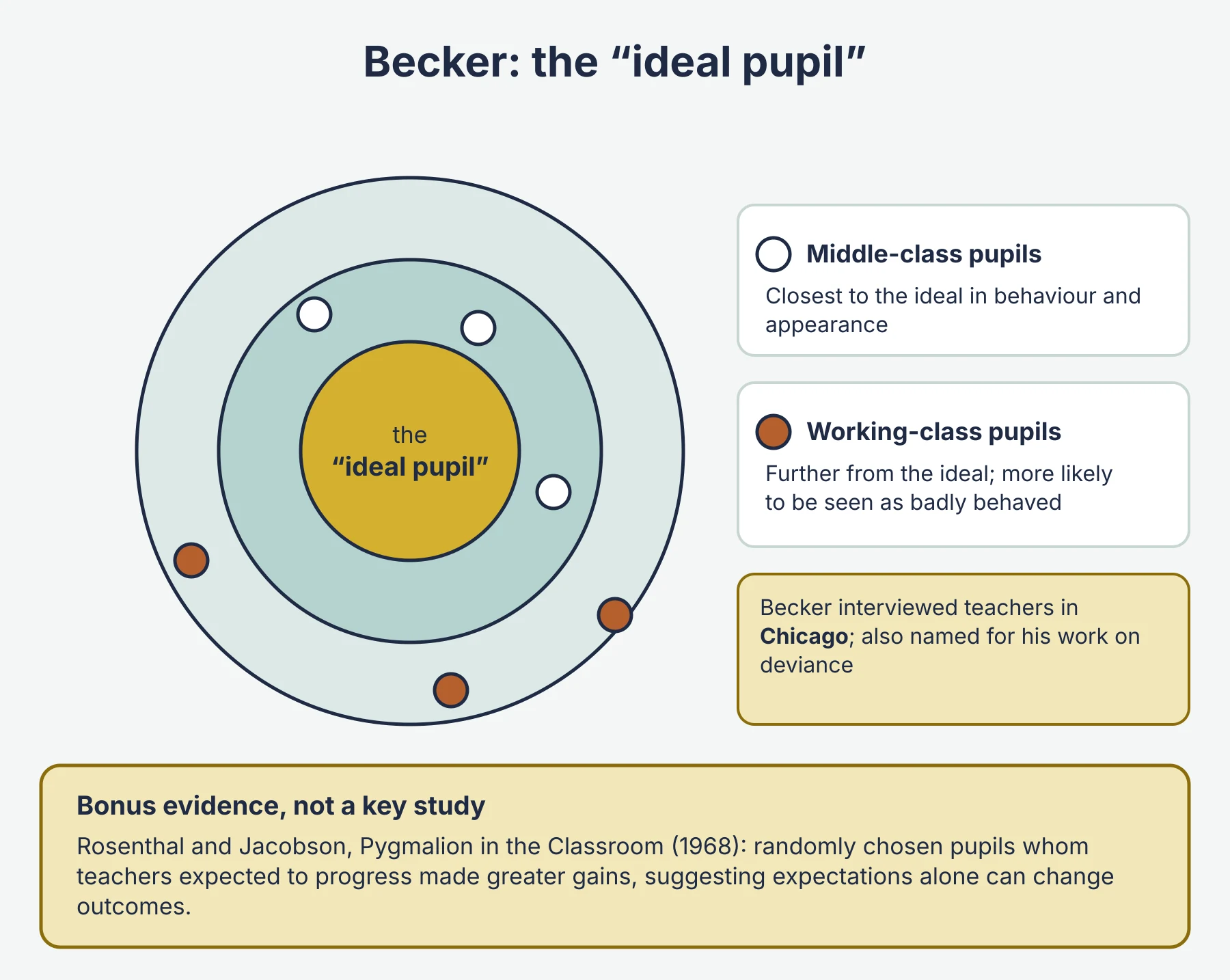
Becker, who is named elsewhere in the specification for his work on deviance, also studied teachers. He interviewed teachers in Chicago and found they judged pupils against an image of the “ideal pupil”, which was closest to middle-class pupils’ behaviour and appearance. Working-class pupils were further from the ideal and more likely to be seen as badly behaved.
A well-known experiment that is not named in the specification, Rosenthal and Jacobson’s Pygmalion in the Classroom (1968), told teachers that a randomly chosen group of pupils were about to make rapid progress. Many of those pupils did make greater gains, suggesting teacher expectations alone can change outcomes. It is useful supporting evidence, but treat it as a bonus rather than a key study.
Ball on teacher expectations
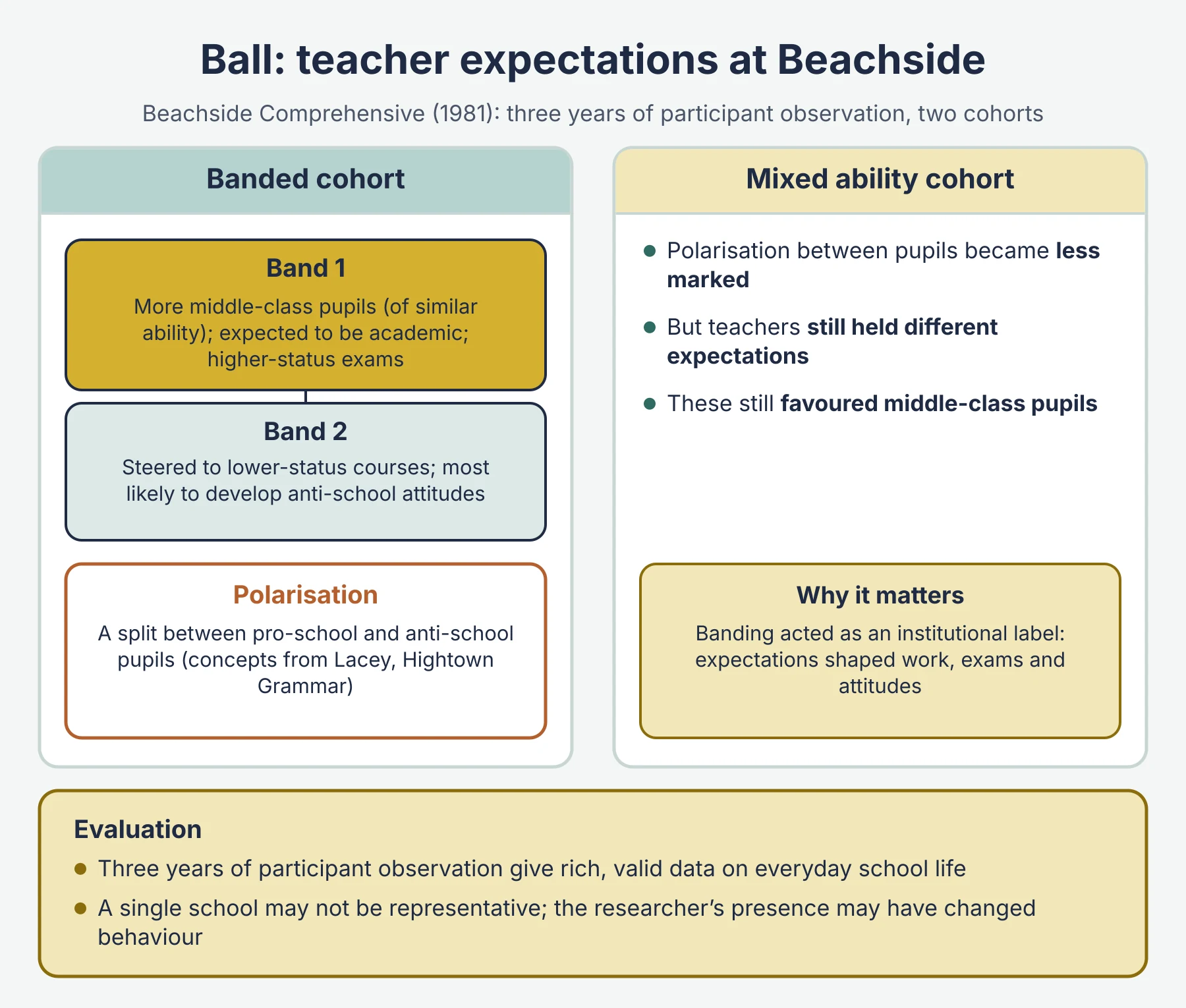
Stephen Ball’s Beachside Comprehensive (1981) is based on three years of fieldwork as a participant observer in a south coast comprehensive. It followed two cohorts: one banded by ability and one taught in mixed ability classes.
- In the banded cohort, middle-class pupils were more likely than working-class pupils of similar measured ability to be placed in band 1.
- Band 1 pupils were expected to be academic and were prepared for higher-status examinations; band 2 pupils were more often steered towards lower-status courses.
- Band 2 pupils were the most likely to develop anti-school attitudes. Ball described this split between pro-school and anti-school pupils as polarisation, using concepts developed by Colin Lacey, whose Hightown Grammar the specification mentions in its summary of Ball.
- When the school moved to mixed ability teaching, the polarisation between pupils became less marked, but teachers still held different expectations of pupils, which continued to favour middle-class pupils.
Why it matters: banding acted as an institutional label. Teachers’ expectations of each band shaped the work set and the exams entered, and pupils’ attitudes followed.
Evaluation: participant observation over three years produces rich, valid data on everyday school life. But it is a single school, so it may not be representative, and the researcher’s presence might have changed how people behaved.
Willis on counter school cultures
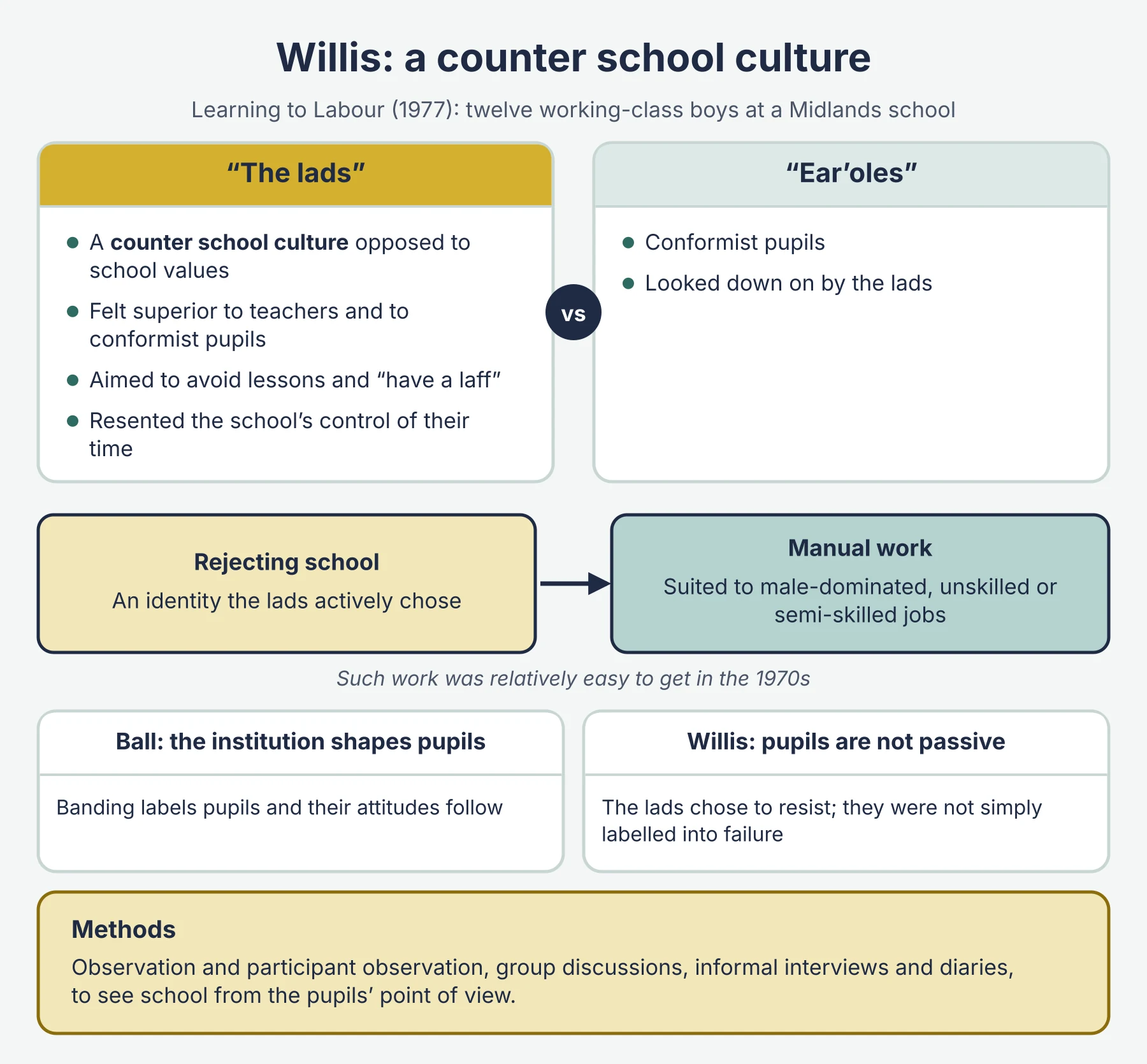
Paul Willis’s Learning to Labour (1977) focused on twelve working-class boys, “the lads”, at a Midlands school on a working-class housing estate. He used observation and participant observation, group discussions, informal interviews and diaries to understand school from the pupils’ point of view.
- The lads formed a counter school culture opposed to the values of the school.
- They felt superior both to teachers and to conformist pupils, whom they called “ear’oles”.
- Their main aim was to avoid lessons and “have a laff”; they resented the school’s attempts to control their time.
- Willis concluded that rejecting school made them suitable for male-dominated, unskilled or semi-skilled manual work, which was relatively easy to get in the 1970s.
Link to labelling: Willis shows pupils are not passive. The lads were not simply labelled into failure; they actively chose an identity that rejected school. This is a different process from Ball’s, where the institution’s grouping shaped pupils’ attitudes.
Perspectives compared
| Perspective | View of processes within schools | Example |
|---|---|---|
| Interactionist | Achievement is shaped by classroom interaction, labels and pupils’ responses | Ball’s banding; Becker’s ideal pupil |
| Functionalist | Setting and streaming sort pupils efficiently by ability, which is meritocratic and prepares them for different roles | Setting by test results |
| Marxist | Grouping and labelling sort pupils by class and prepare them for unequal jobs; resistance can still lead to manual work | Willis; Ball’s class bias in banding |
| Feminist | Teacher expectations and the hidden curriculum steer girls and boys towards different subjects and behaviour | Gendered option choices; differing expectations of girls’ and boys’ behaviour |
Worked example: an annotated 4-mark answer
Question (practice): Identify and explain one way in which setting may lead to a self-fulfilling prophecy. [4]
A pupil placed in a low set may be labelled as less able [identifies the label: 1]. Teachers may give the set easier work and enter it for a foundation tier paper [shows changed treatment: 1]. The pupil may come to see themselves as “bad at the subject” and stop trying [shows changed self-image: 1], so their result is lower than it might have been, which seems to confirm the original placement [completes the prophecy: 1].
Common mistakes
- Mixing up streaming (one group for all subjects) and setting (subject by subject).
- Describing labelling and calling it a self-fulfilling prophecy. The prophecy needs the outcome.
- Using Ball’s 1994 parental choice study for a teacher expectations question.
- Treating Willis’s lads as passive victims of labels. They chose to resist.
- Forgetting the interactionist perspective in 3.4.4 answers.
- Writing that internal processes explain everything. External factors from 3.4.3 still matter.
Exam technique for the command words
- Identify: name the process, such as setting.
- Describe: set out the features of a process or study, such as Ball’s two cohorts.
- Explain: show the steps by which a process changes achievement.
- Discuss how far: weigh internal processes against external factors, and interactionist views against structural ones (functionalist and Marxist), then reach a judgement.
Then move on to the processes within schools practice questions.
Official syllabus
AQA GCSE Sociology (8192) specification, Version 1.2 (June 2026), for GCSE exams 2019 onwards: section 3.4.4 Processes within schools, and the summaries of Ball’s Beachside Comprehensive and Willis’s Learning to Labour in Appendix B.
Related resources
-
Practice questions
AQA GCSE Sociology (8192): Processes within schools – Practice Questions
Original AQA GCSE Sociology 8192 practice on 3.4.4 with marked answers: setting, streaming, labelling, the self-fulfilling prophecy, Ball and Willis.
Sociology · AQA · GCSE
Try questions -
Revision notes
AQA GCSE Sociology (8192): Processes within schools – Revision Notes
Condensed AQA GCSE Sociology 8192 notes on 3.4.4: streaming, setting, labelling, the self-fulfilling prophecy, Ball, Willis, four perspectives and a self-test.
Sociology · AQA · GCSE
Revise topic -
Study guides
AQA GCSE Sociology (8192): Roles and functions of education
In-depth AQA GCSE Sociology 8192 guide to 3.4.1: the three functions of education, Durkheim and Parsons, types of school, home schooling and de-schooling.
Sociology · AQA · GCSE
Read guide
Related articles
Get free revision emails (optional)
Occasional emails with practice questions, worked explanations and links to free resources for the qualification and subjects you choose. No spam, and you can unsubscribe from any email. The free tools on this site never need an email.