
Study Guides
AQA GCSE Sociology (8192): The relationship between education and capitalism
In-depth AQA GCSE Sociology 8192 guide to 3.4.2: Bowles and Gintis, the correspondence principle, the myth of meritocracy and rival views such as Willis.
- Subject
- Sociology
- Level
- GCSE
- Topic
- Education
- Author
- Marlbridge Academic Team
- Updated
- Reviewed by
- Naqiya Yousaf (what this means)
Aligned to AQA GCSE Sociology (8192), first teaching 2017. Official specification .
Syllabus page (what it covers and how it is assessed): AQA GCSE Sociology.
Syllabus points this page covers
8192
- 3.4.2 The relationship between education and capitalism
Found an error? Report a correction.
Need help with this topic? Request a free trial class for GCSE Sociology (8192).
This guide goes deep on one sub-section of the AQA GCSE Sociology (8192) specification: 3.4.2 The relationship between education and capitalism, assessed in Paper 1: The sociology of families and education. The specification covers “different views of the correspondence principle on the relationship between education and capitalism as developed from a Marxist perspective by Bowles and Gintis”. You must be able to “describe the key ideas of Bowles and Gintis on education and capitalism” and to “describe, compare and contrast a variety of alternative sociological perspectives on the correspondence principle”.
For the whole Education topic, start with the Education study guide. To revise this sub-section, use the education and capitalism revision notes, then test yourself with the education and capitalism practice questions.
The Marxist starting point
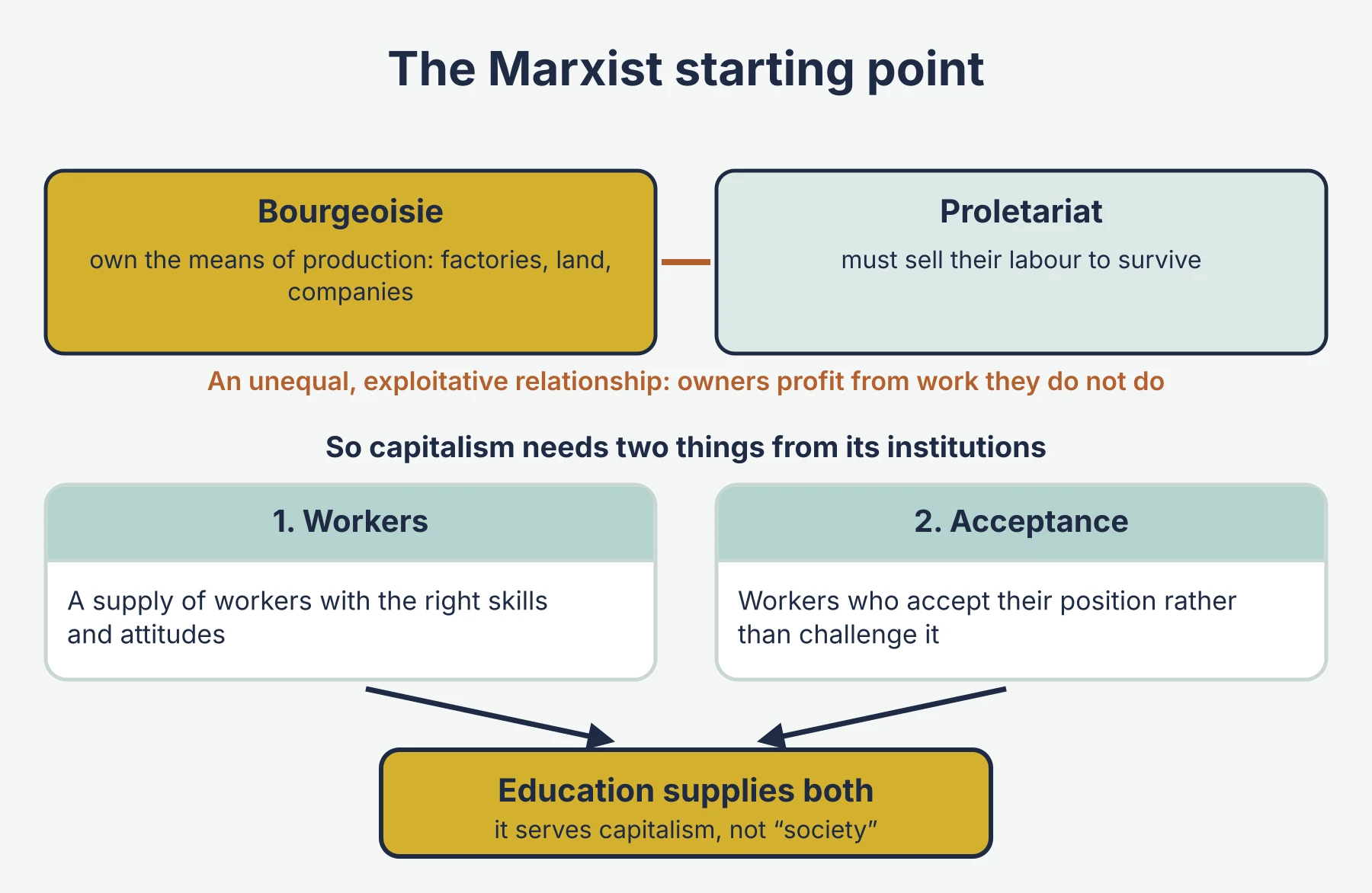
Marxists see capitalist society as divided into two main classes: the bourgeoisie, who own the means of production (factories, land, companies), and the proletariat, who must sell their labour to survive. The relationship is unequal and, for Marxists, exploitative, because owners profit from work they do not do themselves.
A society built on that inequality needs two things from its institutions. It needs a supply of workers with the right skills and attitudes, and it needs those workers to accept their position rather than challenge it. Marxists argue that education supplies both. This is why the sub-section is called the relationship between education and capitalism, not between education and “society”: Marxists reject the functionalist idea that schools serve everyone equally.
Bowles and Gintis: the key ideas
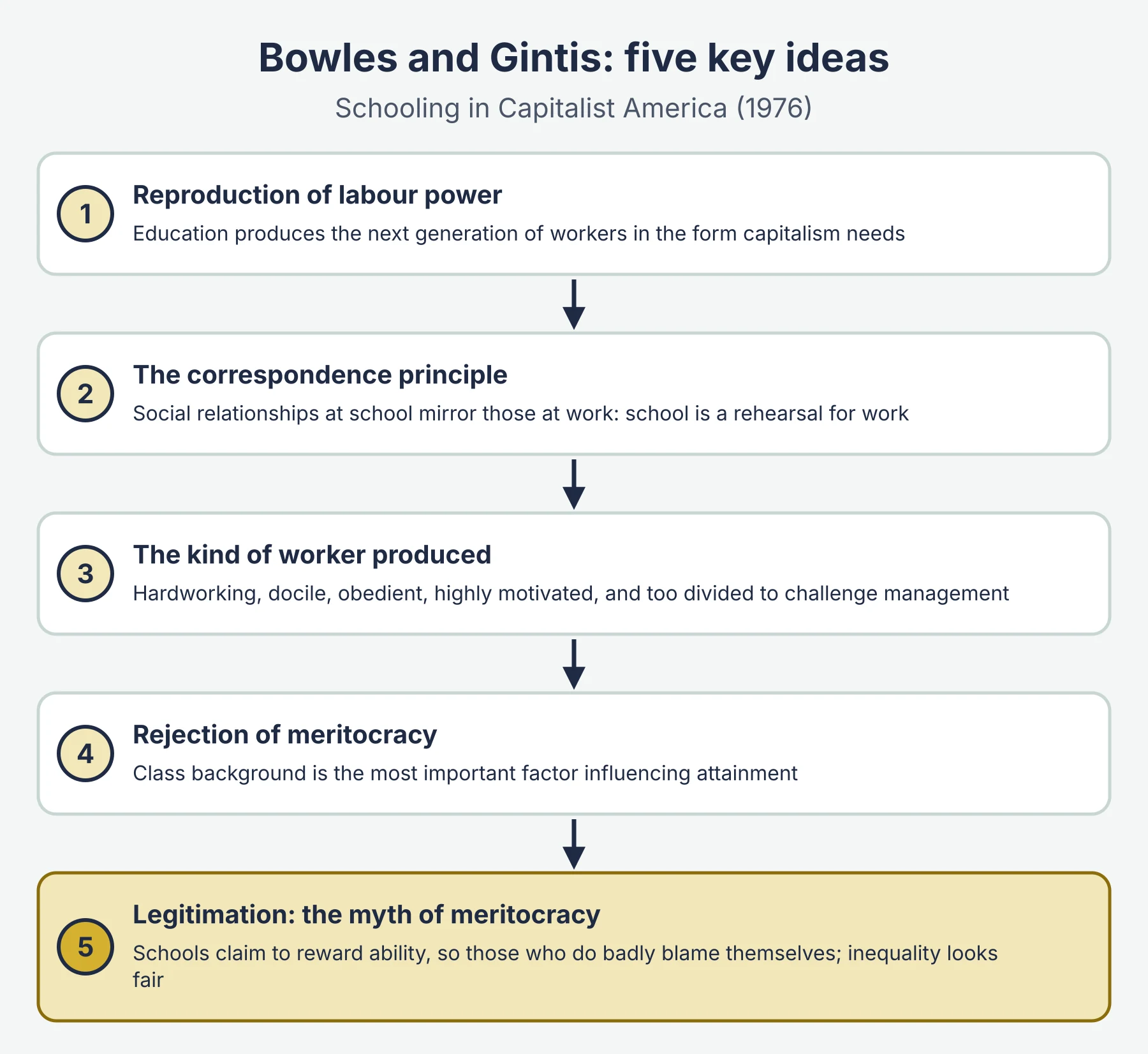
Samuel Bowles and Herbert Gintis set out their argument in Schooling in Capitalist America (1976). Five ideas make up the core of what the specification expects.
- Reproduction of labour power. The major role of education in capitalist societies is to produce the next generation of workers in the form capitalism needs. “Labour power” means a person’s capacity to work. Schools shape it.
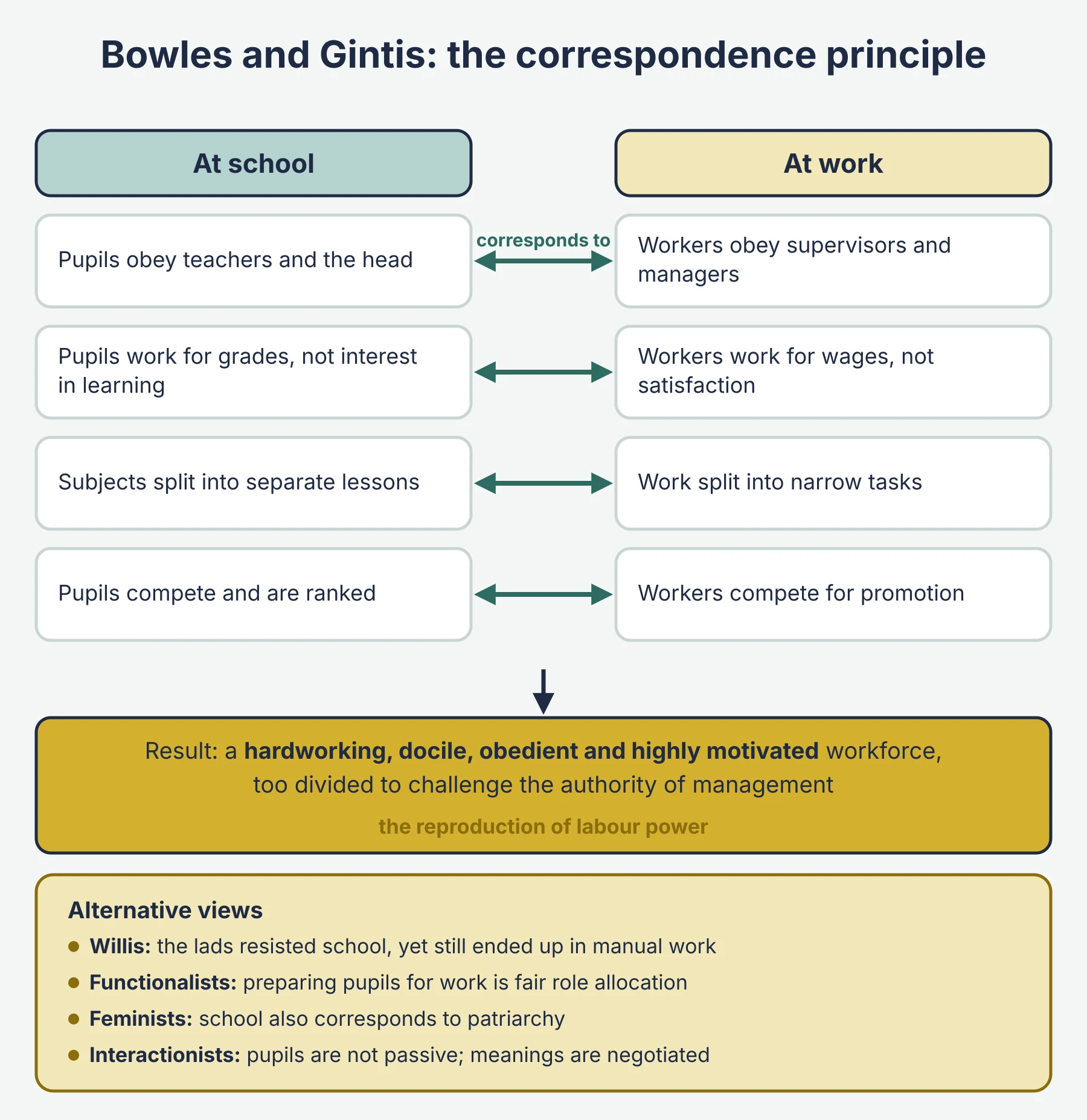
- The correspondence principle. There is a close correspondence between the social relationships that govern interaction at work and those in the education system. School is a rehearsal for work.
- The kind of worker produced. Schooling creates a hardworking, docile, obedient and highly motivated workforce, which is too divided to challenge the authority of management.
- Rejection of meritocracy. Bowles and Gintis reject the view that capitalist societies are meritocratic. They argue that class background is the most important factor influencing levels of attainment.
- Legitimation. Because schools claim to reward ability, those who do badly are encouraged to blame themselves. Marxists call this the myth of meritocracy: inequality is made to look fair.
How the correspondence works: the hidden curriculum
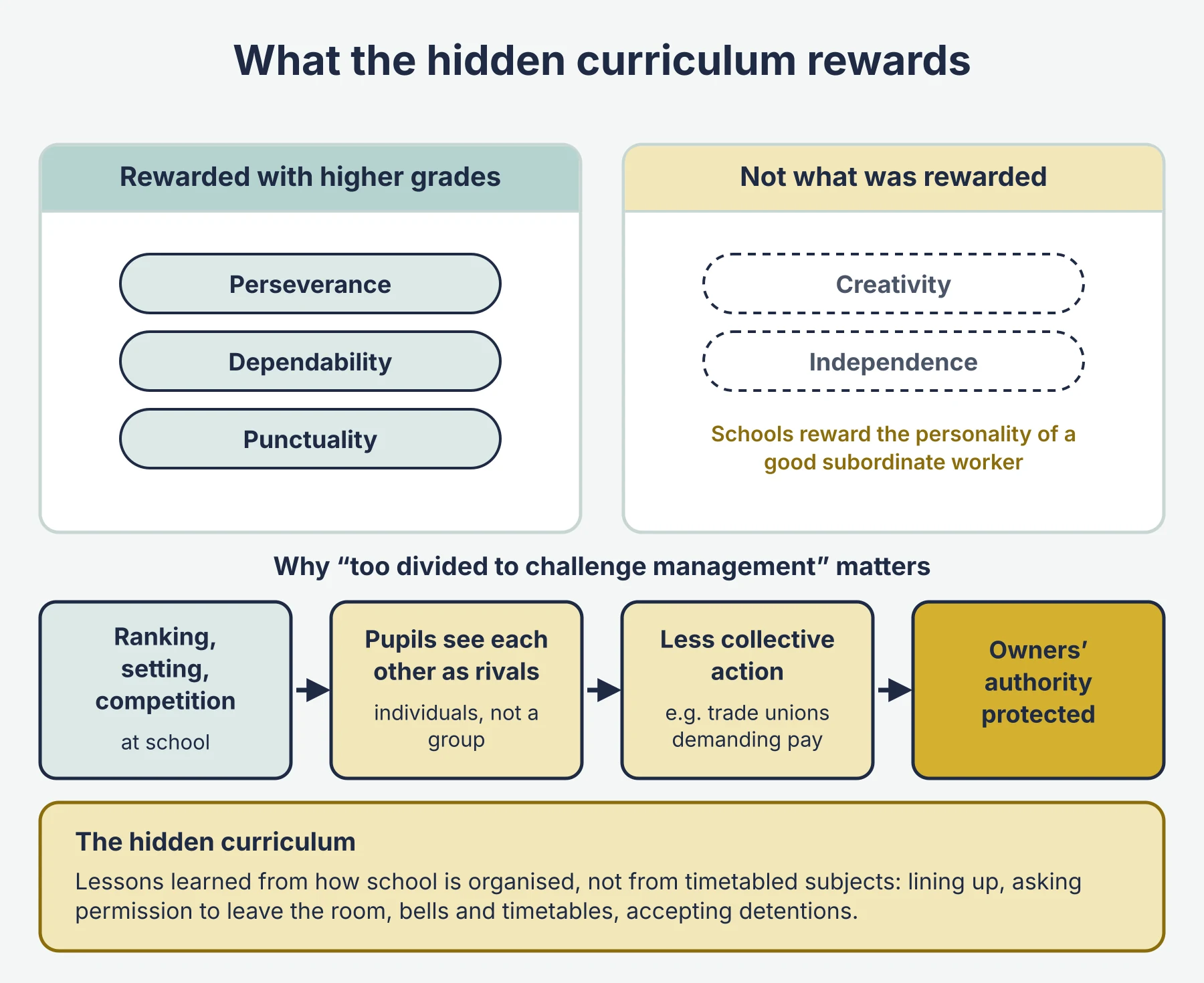
The correspondence is taught mainly through the hidden curriculum: the lessons pupils learn from the way school is organised rather than from the subjects on the timetable. Nobody teaches “obedience” as a subject. Pupils learn it by lining up, asking permission to leave the room and accepting detentions they think are unfair.
| Feature of school | What pupils learn | Feature of work it matches |
|---|---|---|
| A hierarchy from head teacher to pupil, with pupils at the bottom | To accept orders from people above them | A hierarchy from managers to shop-floor workers |
| Grades, merits and certificates as the reason to work | To work for an external reward rather than for interest | Working for a wage rather than for satisfaction |
| Knowledge split into separate subjects in fixed periods | To accept fragmented, repetitive tasks | Work divided into narrow tasks, which Marxists link to alienation |
| Pupils ranked against each other in tests and sets | To compete rather than cooperate | Workers competing for jobs and promotion, too divided to act together |
| Bells, timetables and punctuality rules | That time belongs to the institution | Clocking in and fixed shifts |
Bowles and Gintis also reported that pupils given higher grades tended to show traits such as perseverance, dependability and punctuality, rather than creativity or independence. For them, this showed that schools reward the personality of a good subordinate worker, not just academic ability.
Why “too divided to challenge management” matters
Students often skip this phrase, but it is central to the Marxist argument. Ranking, setting and competition encourage pupils to see each other as rivals. Adults who learned at school to compete as individuals are less likely to organise collectively, for example through trade unions, to demand better pay or conditions. Division protects the authority of the owners.
Alternative perspectives on the correspondence principle
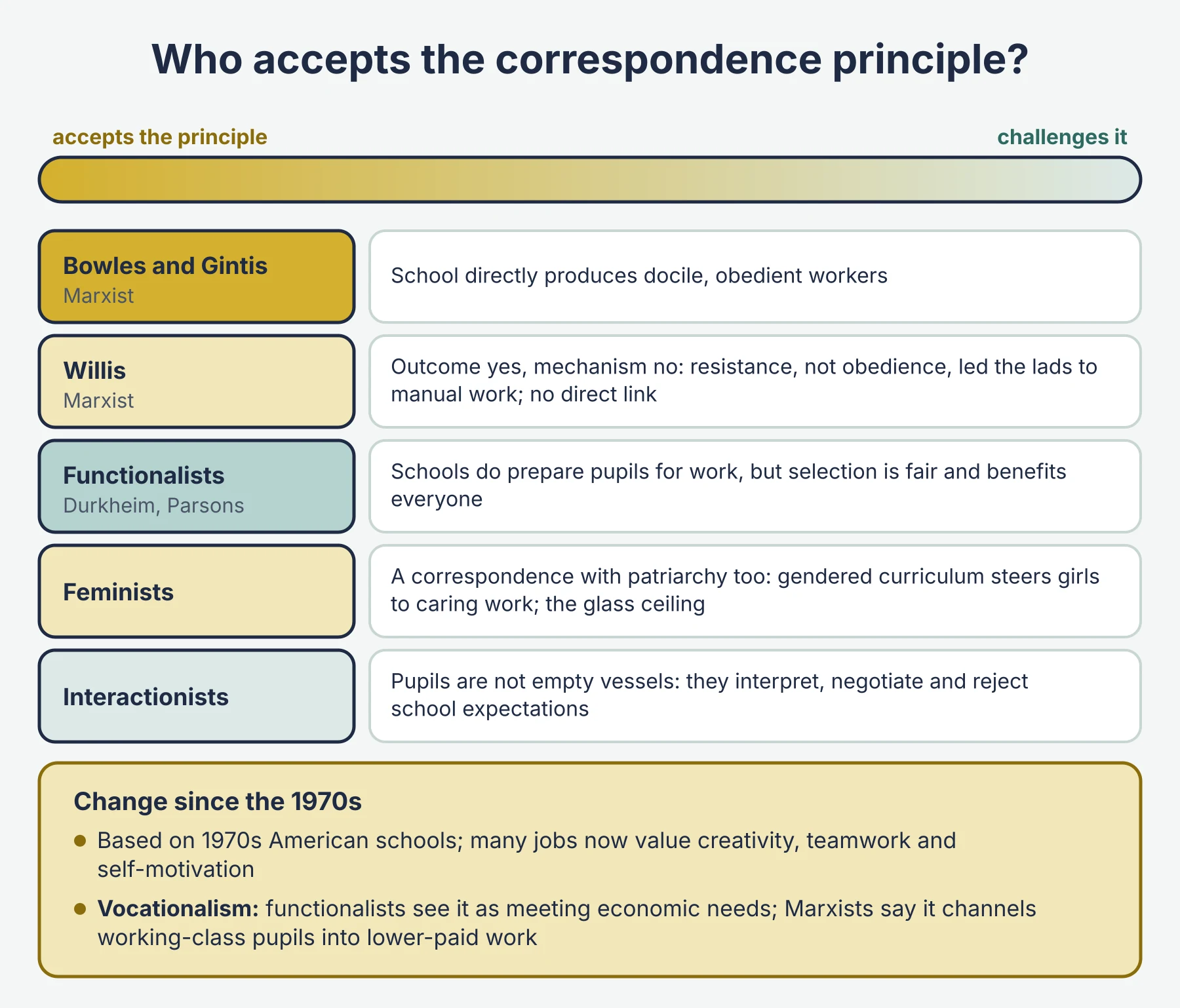
The specification asks you to compare and contrast other views. Organise them by how far each accepts the principle.
Willis: a Marxist who disagrees
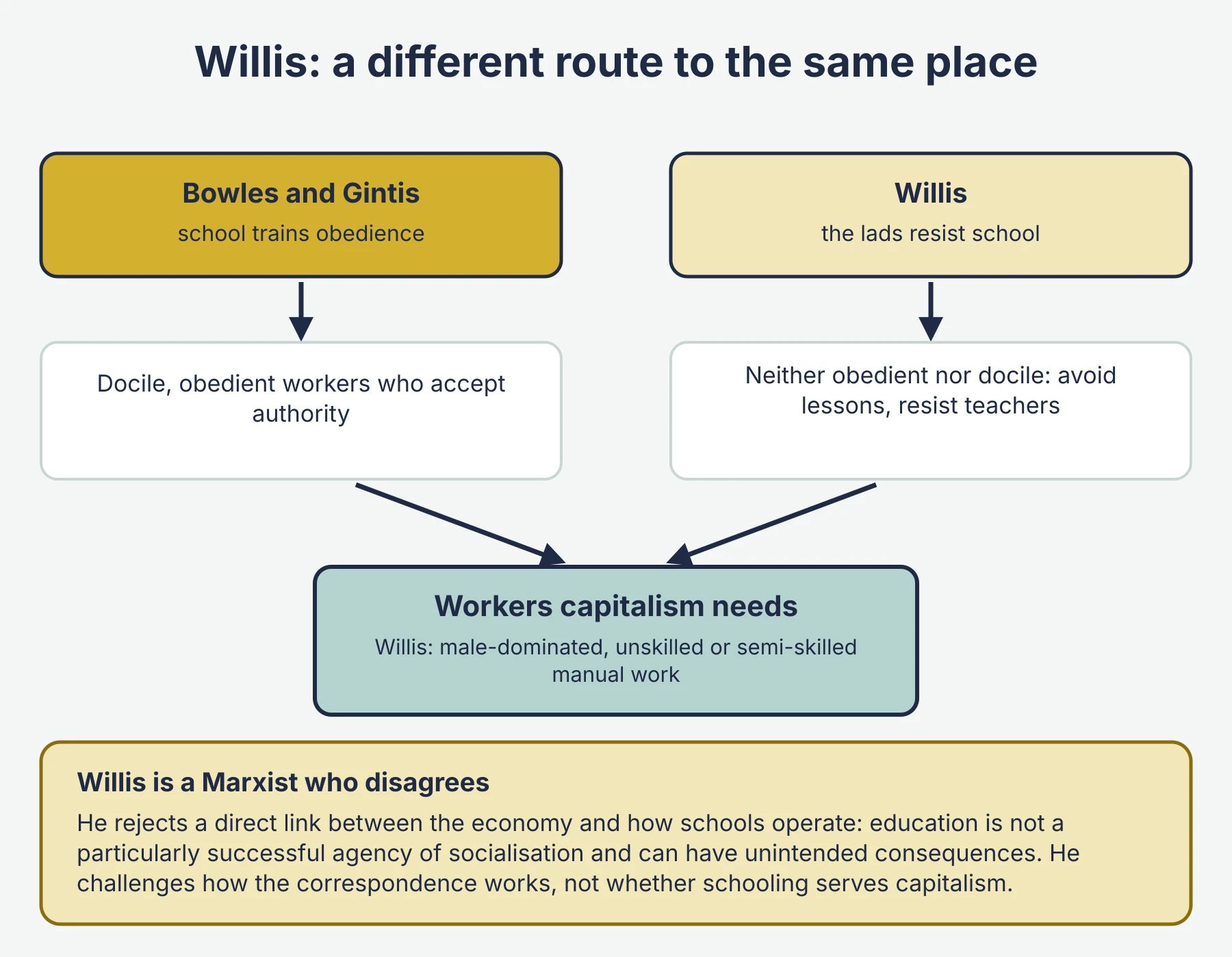
Paul Willis (Learning to Labour, 1977) also wrote from a Marxist perspective, so do not present him as an opponent of Marxism. He rejects the idea of a direct relationship between the economy and the way the education system operates. In his view, education is not a particularly successful agency of socialisation, and it can have unintended consequences that may not be beneficial to capitalism.
His twelve working-class “lads” were neither obedient nor docile: they resisted teachers and tried to avoid lessons. Yet their rejection of school made them suitable for male-dominated, unskilled or semi-skilled manual work. Capitalism still got the workers it needed, but through pupils’ own resistance rather than through successful training in obedience. Willis therefore challenges how the correspondence works, not whether schooling ends up serving capitalism.
Functionalists: preparation for work, but fair
Functionalists agree that schools prepare pupils for work. Durkheim argued that schools teach the specialist skills an advanced division of labour needs, and Parsons argued that schools select individuals for their future roles in society on meritocratic principles. The disagreement is about fairness. For functionalists, matching people to jobs by ability benefits everyone; for Bowles and Gintis, the matching is driven by class and benefits the owners of capital.
Feminists: a correspondence with patriarchy too
Feminists argue that the theory focuses on class and ignores gender. Through a gendered curriculum and the hidden curriculum, schools have historically prepared girls and boys for different roles, including steering girls towards caring work and domestic responsibilities. The correspondence, they argue, is with a patriarchal labour market as well as a capitalist one. This helps explain why girls’ rising results have not removed the glass ceiling in employment.
Interactionists: pupils are not passive
Interactionists focus on meanings created in classrooms. They argue that Bowles and Gintis treat pupils as empty vessels who absorb the hidden curriculum. In practice, pupils interpret, negotiate and sometimes reject what school expects of them, as Willis’s study shows.
Change since the 1970s
The study was based on American schools in the 1970s. Many jobs today, particularly in services and technology, value creativity, teamwork and self-motivation rather than simple obedience. Schools have also expanded vocationalism in education (work-related courses). Functionalists see this as meeting the needs of the economy; Marxists reply that vocational routes often channel working-class pupils into lower-paid work, which would support the correspondence principle in a new form.
Worked example: an annotated 4-mark answer
Question (practice): Identify and explain one way in which, according to Bowles and Gintis, the hidden curriculum prepares pupils for work in a capitalist society. [4]
Bowles and Gintis argue that schools teach pupils to work for external rewards [identifies the feature: 1]. Pupils are motivated by grades, merits and certificates rather than by enjoyment of the subject itself [describes how it works in school: 1]. This matches the workplace, where most people work for wages rather than satisfaction in the task [makes the correspondence explicit: 1]. As a result, pupils become workers who accept boring or alienating work as long as they are paid, which benefits employers [explains the consequence for capitalism: 1].
Notice the structure: feature, school example, workplace match, why it helps capitalism. Answers that only describe school life without the workplace link usually stop at two marks.
Worked example: planning a 12-mark answer
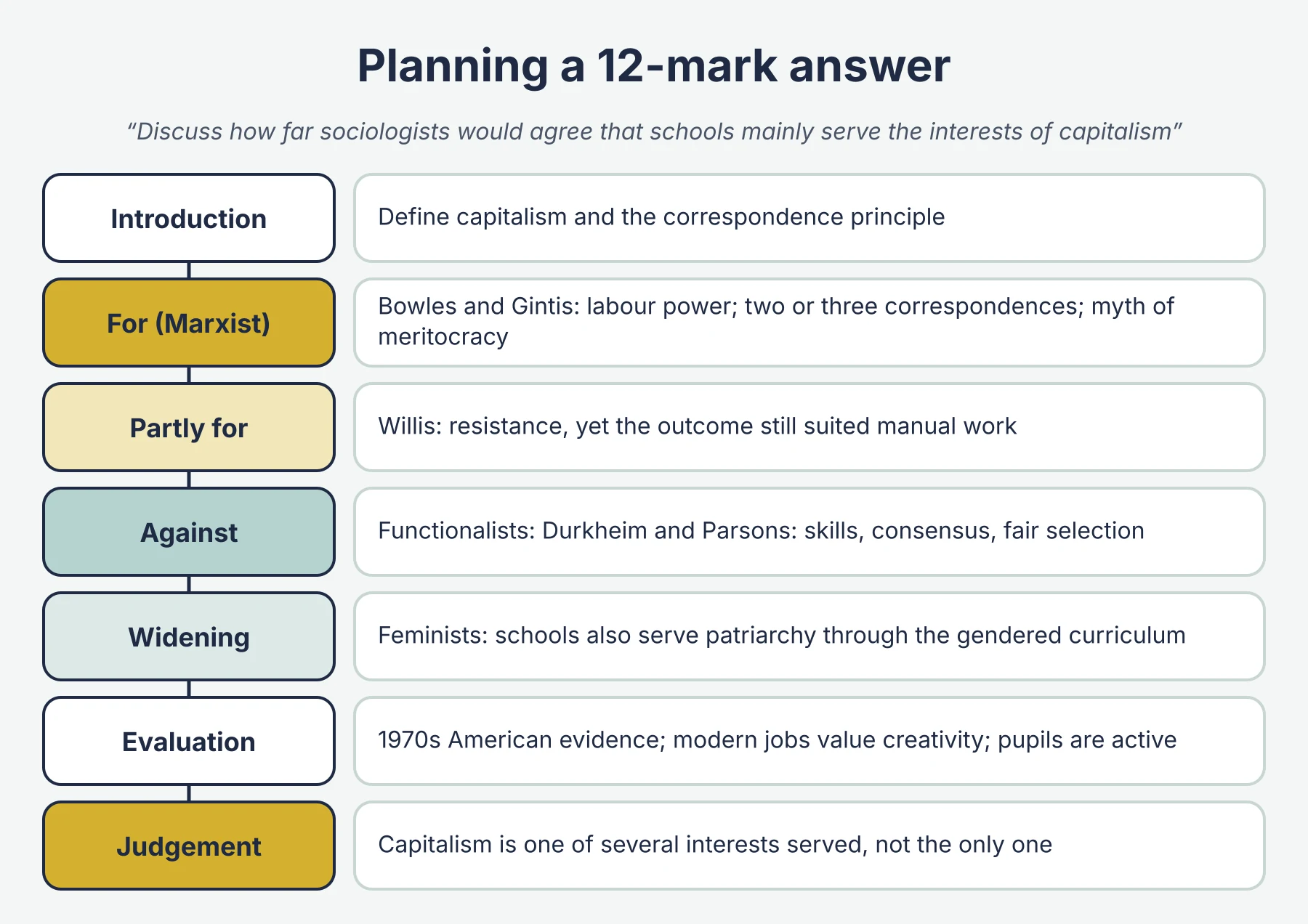
Question (practice): Discuss how far sociologists would agree that schools mainly serve the interests of capitalism. [12]
- Introduction. Define capitalism and the correspondence principle in one sentence each.
- For (Marxist). Bowles and Gintis: reproduction of labour power; two or three correspondences with examples; myth of meritocracy and class background as the main influence on attainment.
- Partly for (Marxist, different mechanism). Willis: resistance rather than obedience, yet the outcome still suited manual work. This shows capitalism may be served in unintended ways.
- Against (functionalist). Durkheim and Parsons: schools serve society as a whole through specialist skills, value consensus and fair selection.
- Against or widening (feminist). Schools also serve patriarchy through the gendered curriculum, so class is not the only interest served.
- Evaluation. 1970s American evidence; modern jobs value creativity; interactionists say pupils are active.
- Judgement. For example: schools do reward conformity useful to employers, but the evidence of resistance and of gender inequality suggests capitalism is one of several interests served, not the only one.
Common mistakes
- Crediting Durkheim or Parsons with the correspondence principle. It belongs to Bowles and Gintis.
- Describing school features without stating the matching feature of work. The principle is a comparison.
- Calling Willis a functionalist, or saying he proves Bowles and Gintis right. He is a Marxist who rejects a direct link.
- Forgetting that the key idea includes the rejection of meritocracy and the role of class background.
- Treating “hidden curriculum” as a feminist-only idea. Marxists and feminists both use it, for different purposes.
- Evaluating only with “it is old”. Explain what has changed, such as the rise of jobs that reward creativity.
Exam technique for the command words
- Identify: name the feature or idea in a few words; no explanation needed.
- Describe: give the features of the idea or study, for example the five key ideas of Bowles and Gintis.
- Explain: show why or how; for this topic, always finish the link to the workplace or to capitalism.
- Discuss how far: weigh Bowles and Gintis against Willis, functionalists, feminists and interactionists, and end with a reasoned judgement that answers the exact question.
When you are ready, move on to the education and capitalism practice questions.
Official syllabus
AQA GCSE Sociology (8192) specification, Version 1.2 (June 2026), for GCSE exams 2019 onwards: section 3.4.2 The relationship between education and capitalism, and the summaries of Bowles and Gintis and of Willis in Appendix B.
Related resources
-
Practice questions
AQA GCSE Sociology (8192): The relationship between education and capitalism – Practice Questions
Original AQA GCSE Sociology 8192 practice on 3.4.2 with marked answers: Bowles and Gintis, the correspondence principle, Willis and rival perspectives.
Sociology · AQA · GCSE
Try questions -
Revision notes
AQA GCSE Sociology (8192): The relationship between education and capitalism – Revision Notes
Condensed AQA GCSE Sociology 8192 notes on 3.4.2: Bowles and Gintis's five key ideas, the hidden curriculum, rival views of correspondence and a self-test.
Sociology · AQA · GCSE
Revise topic -
Study guides
AQA GCSE Sociology (8192): Education – Study Guide
Study guide to AQA GCSE Sociology 8192 Education 3.4.1-3.4.4: Durkheim, Parsons, Bowles and Gintis, Halsey, Ball and Willis, with evaluation.
Sociology · AQA · GCSE
Read guide
Related articles
Get free revision emails (optional)
Occasional emails with practice questions, worked explanations and links to free resources for the qualification and subjects you choose. No spam, and you can unsubscribe from any email. The free tools on this site never need an email.