
Study Guides
AQA GCSE History (8145): Civil Rights Campaigns in the 1950s and 1960s
AQA GCSE History 8145 America 1920-1973: segregation laws, Martin Luther King, Malcolm X, Black Power and the Civil Rights Acts of 1964 and 1968.
- Subject
- World History
- Level
- GCSE
- Topic
- Understanding the Modern World
- Author
- Marlbridge Academic Team
- Updated
- Reviewed by
- Azam Siddique (what this means)
Aligned to AQA GCSE World History (8145), first teaching 2016. Official specification .
Syllabus page (what it covers and how it is assessed): AQA GCSE World History.
Syllabus points this page covers
8145
- 3.2.1 Section A: Period studies
This page covers 1 of the 2 subtopics in topic 1, Understanding the modern world.
Found an error? Report a correction.
Need help with this topic? Request a free trial class for GCSE World History (8145).
This guide covers one content statement in Part three of AD America, 1920-1973: Opportunity and inequality. The specification names: “Racial tension and developments in the Civil Rights campaigns in the 1950s and 1960s: Segregation laws; Martin Luther King and peaceful protests; Malcolm X and the Black Power Movement; Civil Rights Acts of 1964 and 1968.” The Section A period studies study guide gives the outline in two sentences; this page explains how segregation worked, how campaigns developed, why the movement divided, and what the two Acts changed.
Segregation laws
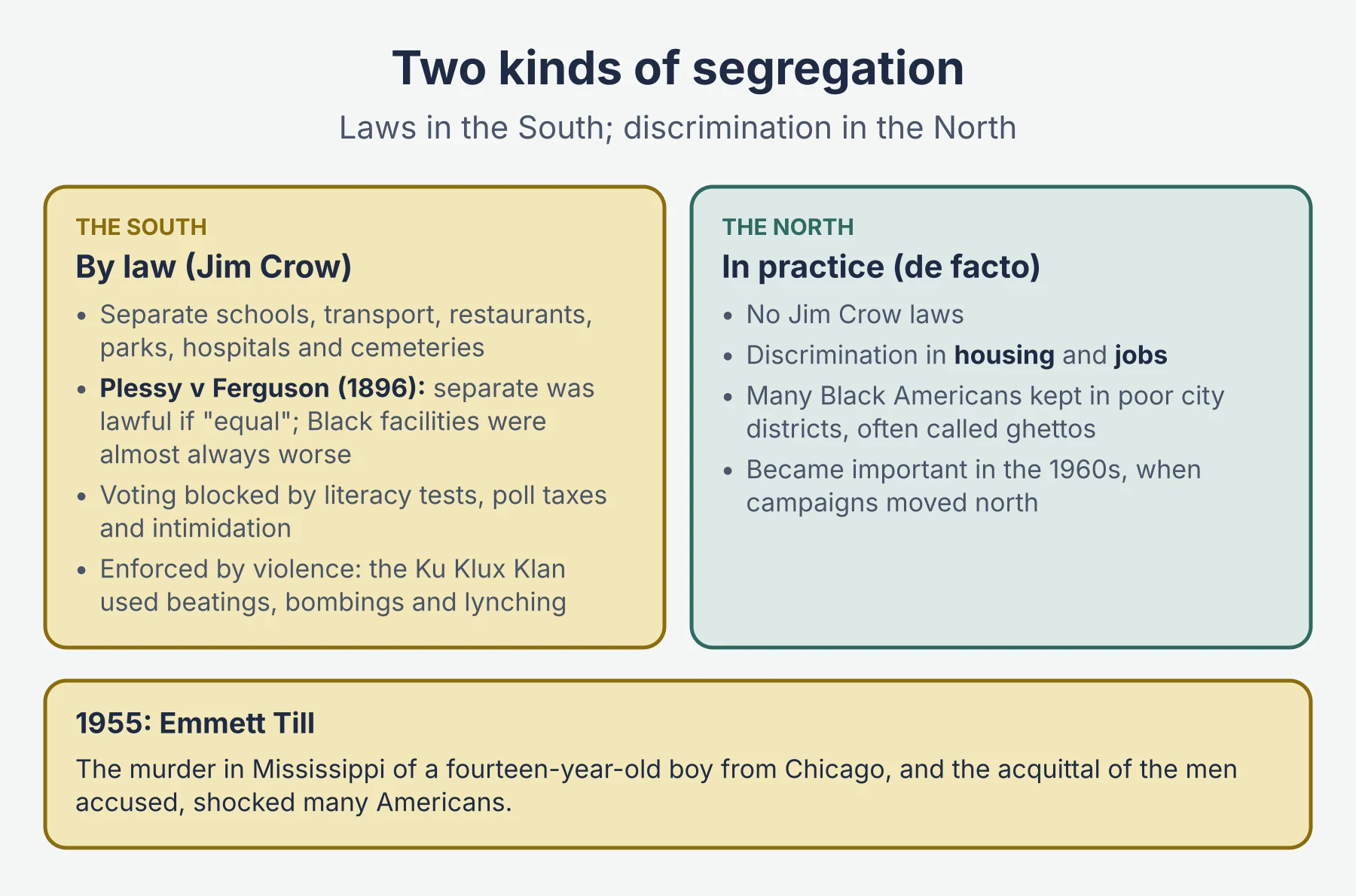
After the Civil War, Southern states passed Jim Crow laws that separated Black and white Americans in schools, transport, restaurants, parks, hospitals and even cemeteries. In Plessy v Ferguson (1896) the Supreme Court ruled that separate facilities were lawful if they were “equal”; in practice, those for Black Americans were almost always worse. Most Black Southerners were also kept from voting by literacy tests, poll taxes and intimidation. Segregation was enforced by violence: the Ku Klux Klan and other white groups used beatings, bombings and lynching. In 1955 the murder in Mississippi of Emmett Till, a fourteen-year-old boy from Chicago, and the acquittal of the men accused, shocked many Americans.
Outside the South there were no Jim Crow laws, but discrimination in housing and jobs kept many Black Americans in poor city districts, often called ghettos. This de facto segregation became important in the 1960s, when campaigns moved north.
Legal challenges: Brown and Little Rock
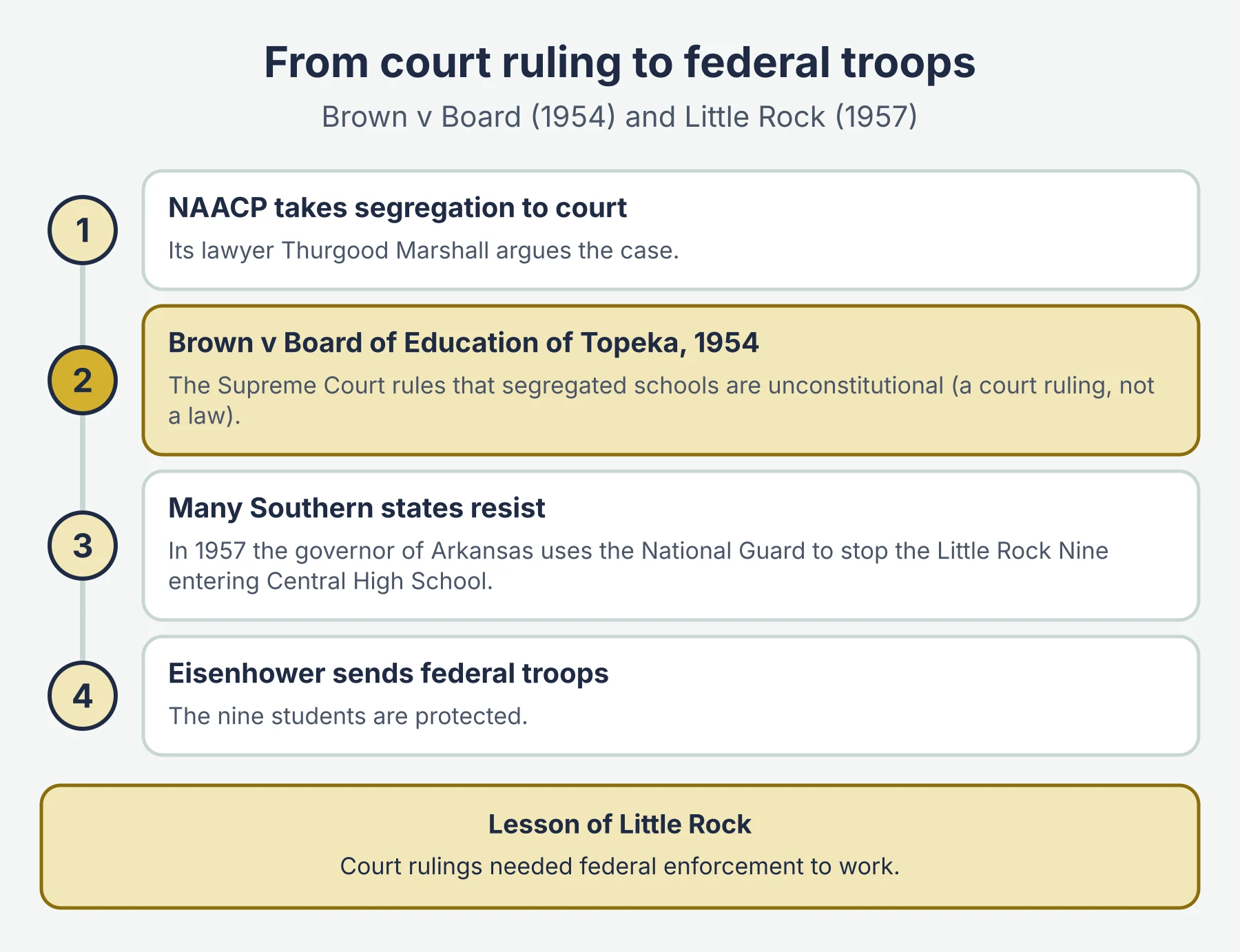
The NAACP (National Association for the Advancement of Colored People) challenged segregation in the courts. Its lawyer Thurgood Marshall won Brown v Board of Education of Topeka (1954), in which the Supreme Court ruled that segregated schools were unconstitutional. Many Southern states resisted. In 1957 the governor of Arkansas used the state’s National Guard to stop nine Black students, the Little Rock Nine, entering Central High School; President Eisenhower sent federal troops to protect them. Little Rock showed that court rulings needed federal enforcement.
Martin Luther King and peaceful protest
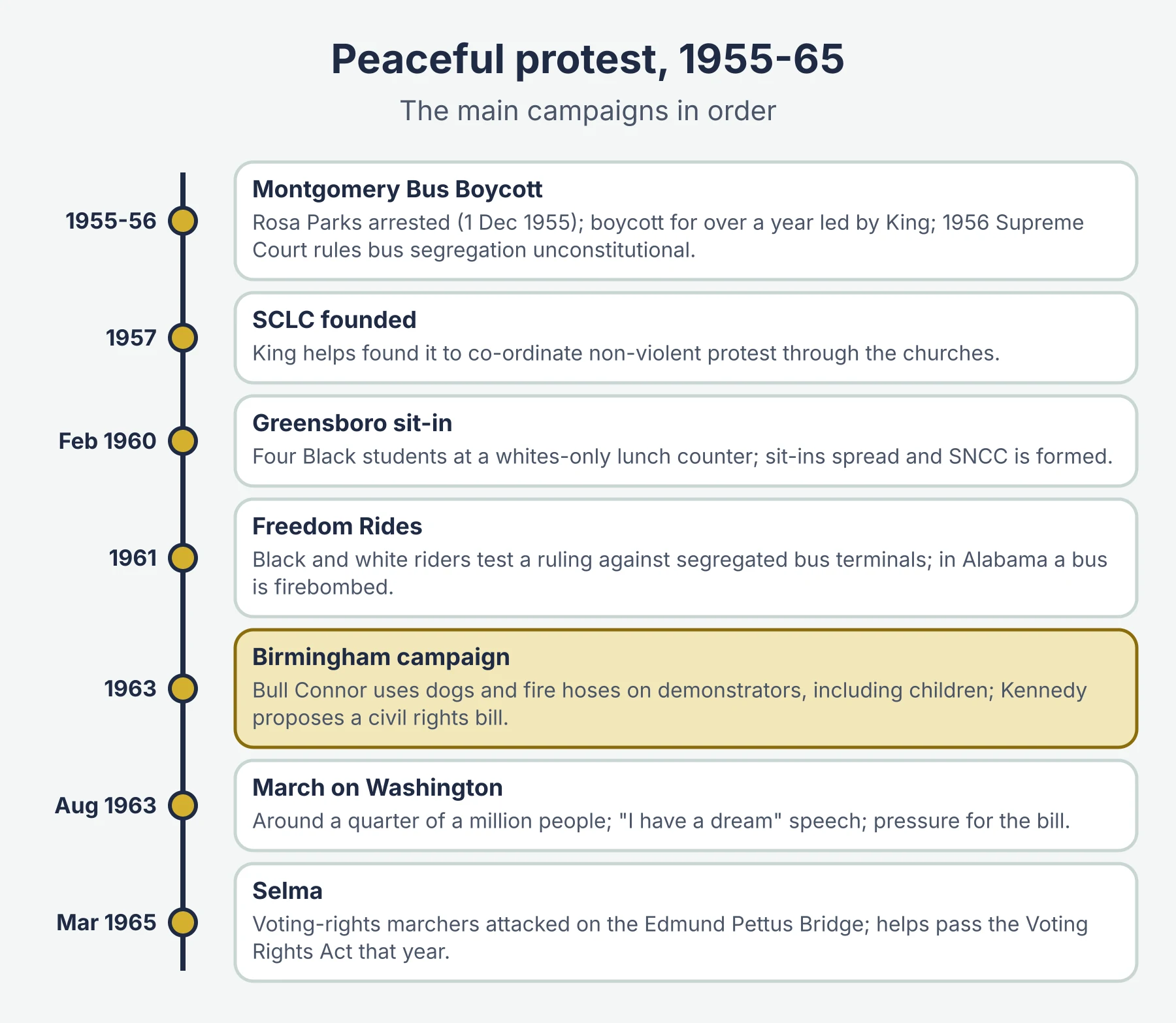
Montgomery Bus Boycott (1955-56). On 1 December 1955 Rosa Parks, a local NAACP activist, was arrested for refusing to give up her seat to a white passenger. Black residents boycotted the buses for over a year, led by the young Baptist minister Martin Luther King. In 1956 the Supreme Court ruled bus segregation unconstitutional. The boycott made King a national figure, and in 1957 he helped found the Southern Christian Leadership Conference (SCLC) to co-ordinate non-violent protest through the churches.
Sit-ins and Freedom Rides. In February 1960 four Black students sat at a whites-only lunch counter in Greensboro, North Carolina; sit-ins spread across the South, and the Student Nonviolent Coordinating Committee (SNCC) was formed. In 1961 Freedom Riders, Black and white, rode interstate buses to test a ruling against segregated bus terminals; in Alabama one bus was firebombed and riders were beaten.
Birmingham (1963). King chose Birmingham, Alabama, one of the most segregated cities, for a campaign of marches and boycotts. Police chief Eugene “Bull” Connor used dogs and high-pressure fire hoses on demonstrators, including children. Television pictures of the violence shocked the nation; King’s Letter from Birmingham Jail defended non-violent direct action. President Kennedy then proposed a civil rights bill.
The March on Washington (August 1963). Around a quarter of a million people marched for jobs and freedom; King gave his “I have a dream” speech. The march built public pressure for the bill.
Selma (1965). Marchers demanding voting rights were attacked by state troopers on the Edmund Pettus Bridge in March 1965. The violence, again televised, helped pass the Voting Rights Act that year.
Why was peaceful protest effective?
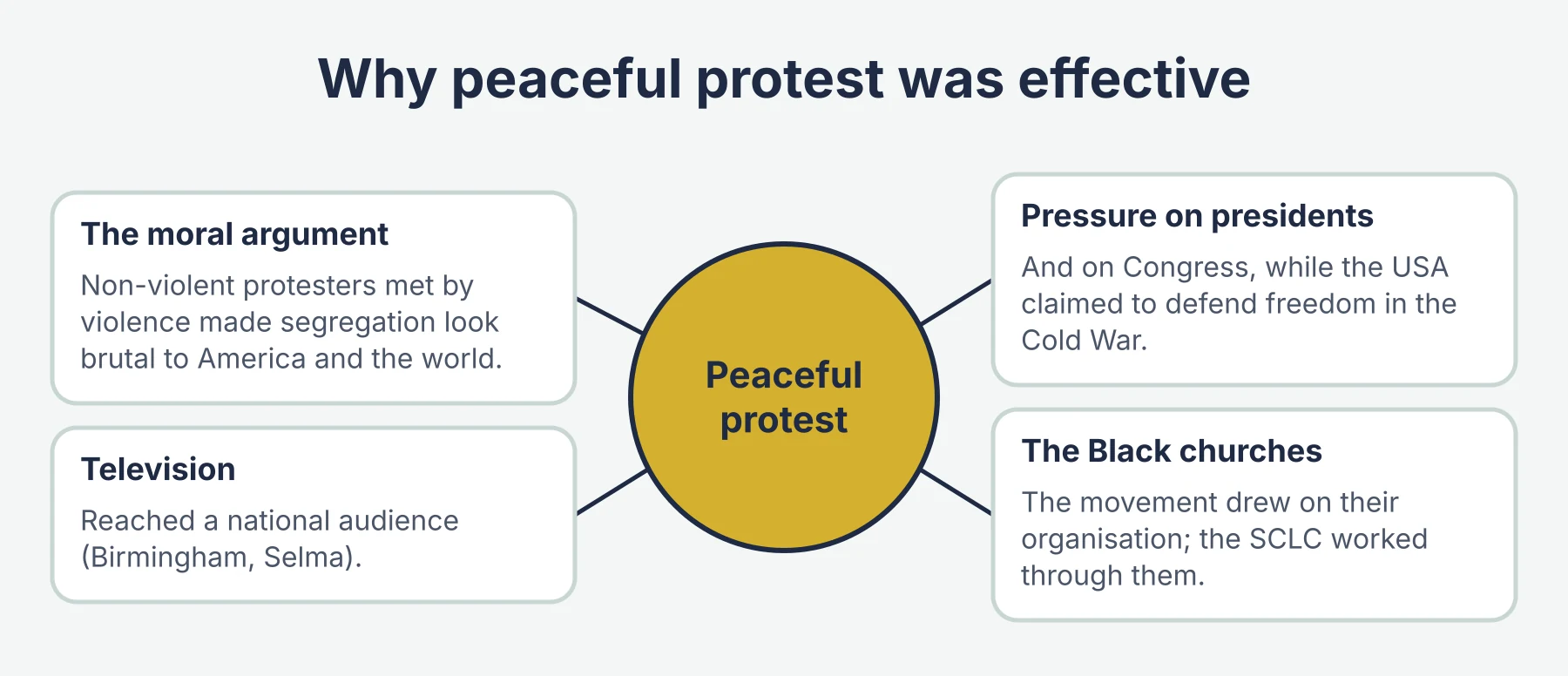
It won the moral argument: non-violent protesters met by violence made segregation look brutal to the rest of America and the world. It used television to reach a national audience. It put pressure on presidents and Congress at a time when the USA claimed to defend freedom in the Cold War. It drew on the organisation of the Black churches.
Malcolm X and the Black Power Movement
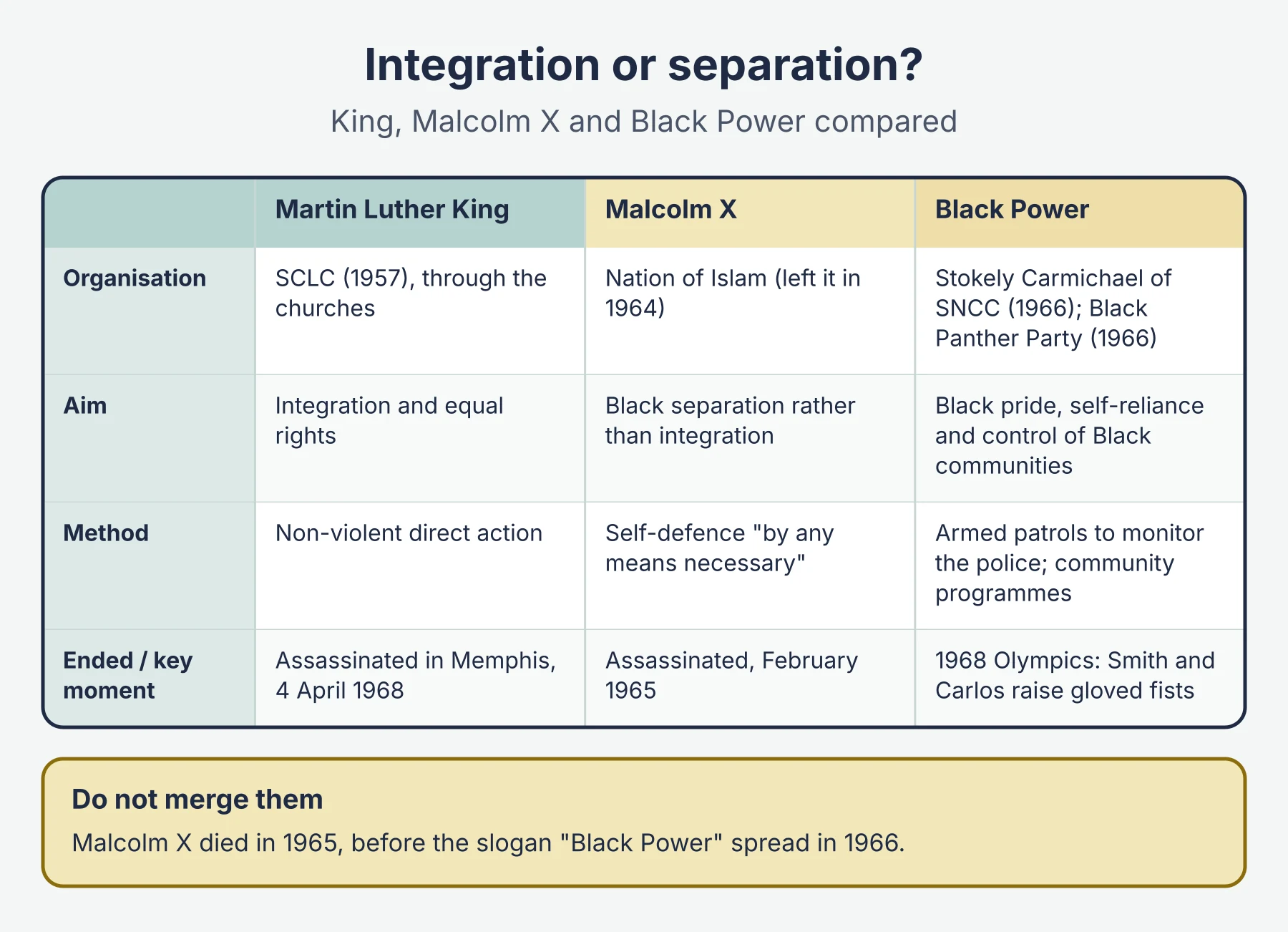
Malcolm X became the best-known spokesman of the Nation of Islam, which argued that white America would never treat Black people equally and called for Black separation rather than integration. He criticised King’s non-violence and argued that Black people had the right to defend themselves “by any means necessary”. He left the Nation of Islam in 1964, began to speak of co-operation with other groups, and was assassinated in February 1965.
By the mid-1960s many young activists were frustrated by slow progress, poverty in the northern cities and continued violence. In 1966 Stokely Carmichael of SNCC popularised the slogan “Black Power”, emphasising Black pride, self-reliance and control of Black communities. The Black Panther Party, founded in Oakland, California, in 1966, organised armed patrols to monitor the police and community programmes such as free breakfasts for children. At the 1968 Olympics in Mexico City, the American sprinters Tommie Smith and John Carlos raised gloved fists on the medal podium.
Riots broke out in many cities, beginning with Watts in Los Angeles in 1965, reflecting anger at poverty, unemployment and police treatment. After King was assassinated in Memphis on 4 April 1968, riots spread to over a hundred cities.
The Civil Rights Acts
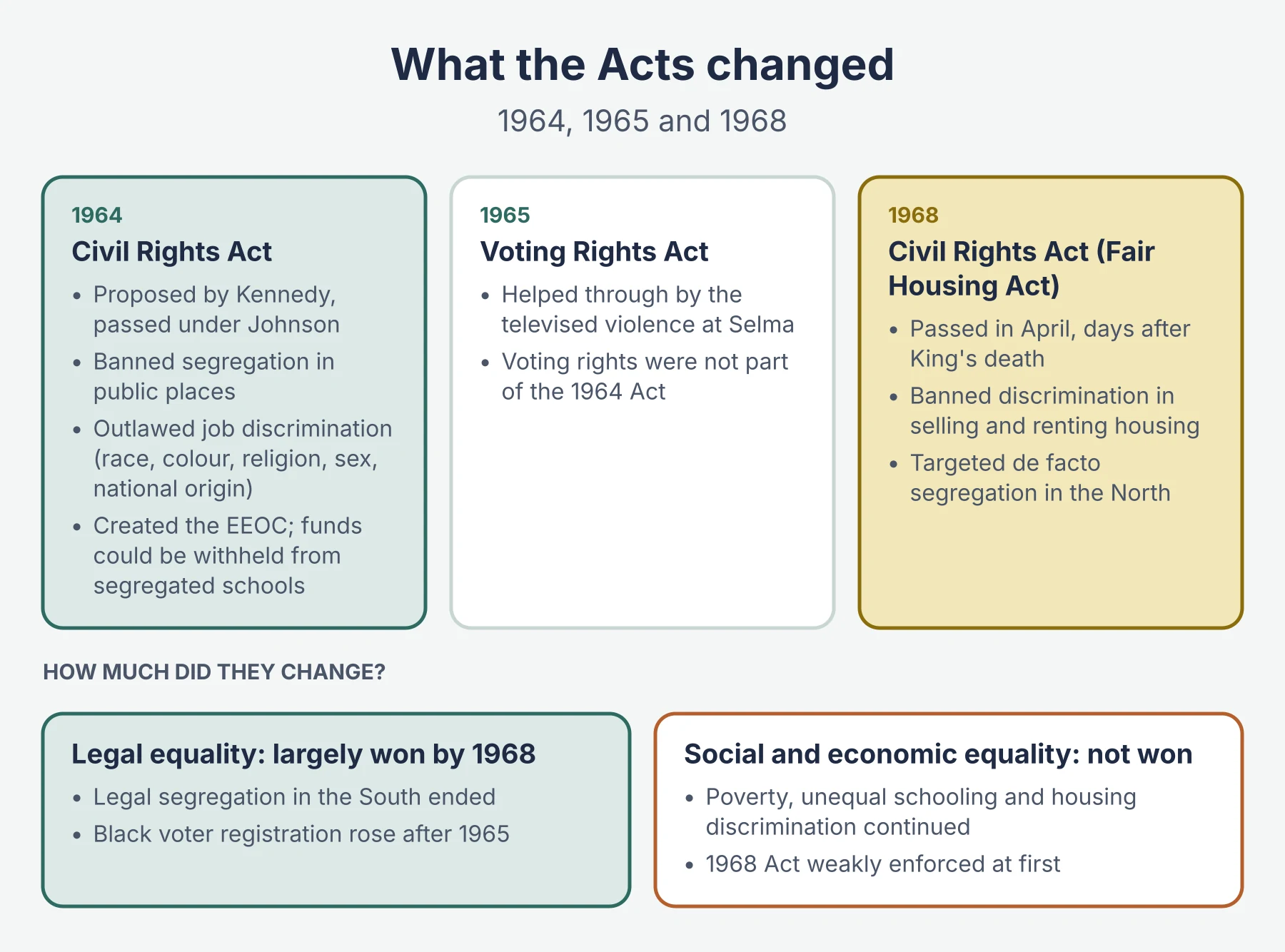
Civil Rights Act, 1964. Proposed by Kennedy and passed under President Lyndon Johnson after Kennedy’s assassination, it banned segregation in public places such as restaurants, hotels and cinemas, and outlawed discrimination in employment on grounds of race, colour, religion, sex or national origin. It created the Equal Employment Opportunity Commission and allowed the federal government to withhold funds from segregated schools.
Civil Rights Act, 1968. Passed in April 1968, days after King’s death, it is often called the Fair Housing Act. It banned discrimination in the sale and renting of housing, targeting the de facto segregation of northern cities.
How much did they change?
Legal segregation in the South was ended, and Black voter registration rose after 1965. But poverty, unequal schooling and housing discrimination continued; the 1968 Act was weakly enforced at first. A judgement should distinguish legal equality, largely won by 1968, from social and economic equality, which was not.
Worked example: a question 6 plan
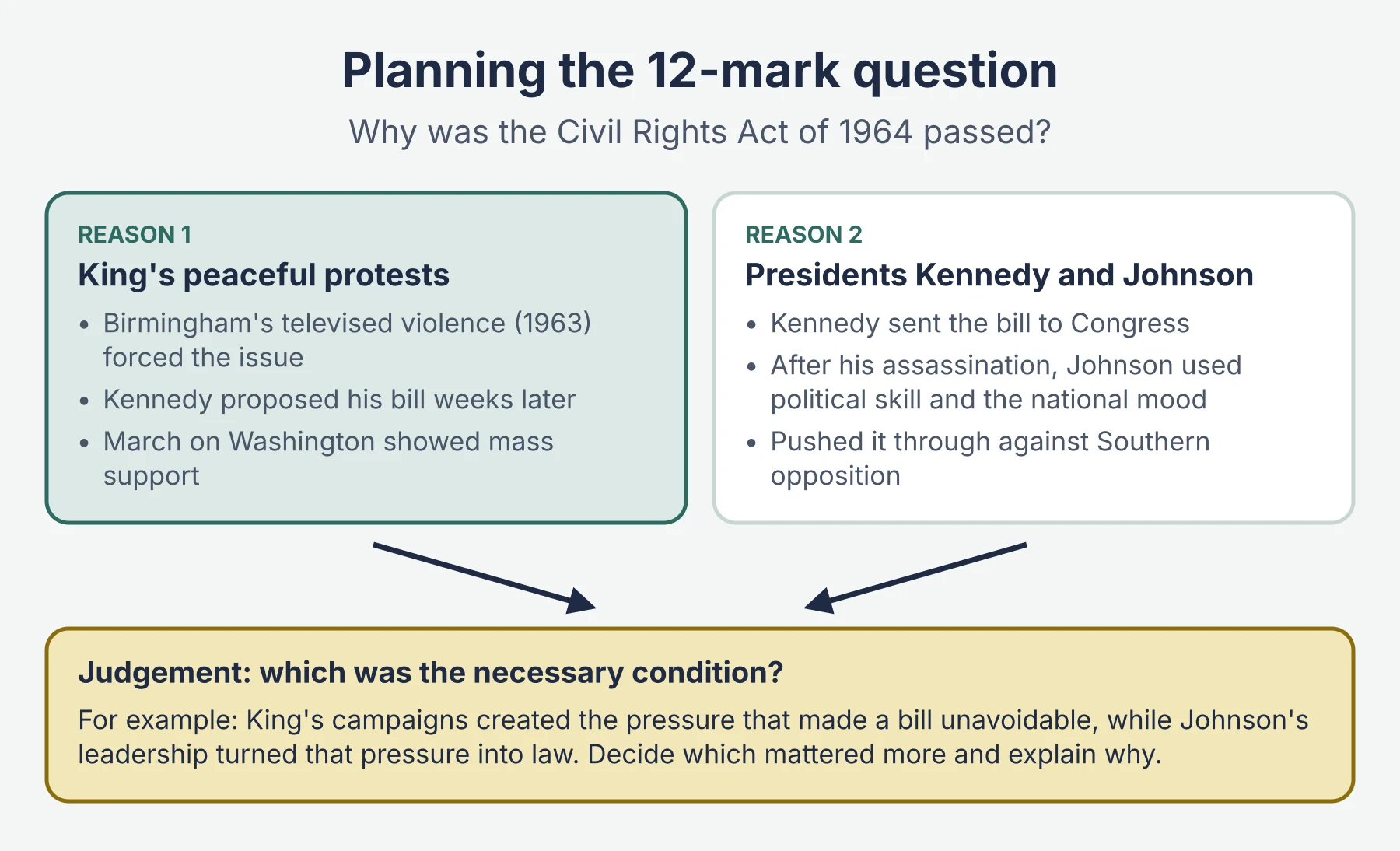
Which of the following was the more important reason for the passing of the Civil Rights Act of 1964: Martin Luther King’s peaceful protests; the actions of Presidents Kennedy and Johnson? Explain your answer with reference to both reasons. [12]
- King: Birmingham’s televised violence (1963) forced the issue; Kennedy proposed his bill weeks later; the March on Washington showed mass support.
- Presidents: Kennedy sent the bill to Congress; after his assassination Johnson used his political skill and the national mood to push it through Congress against Southern opposition.
- Judgement: for example, King’s campaigns created the pressure that made a bill unavoidable, while Johnson’s leadership turned that pressure into law; decide which was the necessary condition and explain why.
Common mistakes
- Dating Brown v Board to 1955 (it was 1954) or calling it a law rather than a court ruling.
- Describing Malcolm X and Black Power as the same thing: Malcolm X died in 1965, before the slogan spread.
- Saying the 1964 Act gave the vote: voting rights were the subject of the 1965 Voting Rights Act.
- Forgetting the 1968 Act’s focus on housing.
- Treating the movement as only King: name the NAACP, SNCC, students and local activists.
Further practice
- Civil rights campaigns revision notes
- Civil rights campaigns practice questions
- Section A period studies practice
Specification
AQA GCSE History (8145) specification, section 3.2.1, AD America, 1920-1973, Part three: Post-war America – aqa.org.uk.
Related resources
-
Practice questions
AQA GCSE History (8145): Civil Rights Campaigns in the 1950s and 1960s – Practice Questions
Original AQA GCSE History 8145 America practice on civil rights: segregation, King, Malcolm X, Black Power and the 1964 and 1968 Acts, with full answers.
World History · AQA · GCSE
Try questions -
Revision notes
AQA GCSE History (8145): Civil Rights Campaigns in the 1950s and 1960s – Revision Notes
Revision notes for AQA GCSE History 8145 America: segregation, King's campaigns, Malcolm X, Black Power and the 1964 and 1968 Acts, with a self-test.
World History · AQA · GCSE
Revise topic -
Study guides
AQA GCSE History (8145): Interpretation Questions 1-3
How to answer AQA GCSE History 8145 Paper 1 questions 1-3 on two interpretations: how they differ, why they differ and which is more convincing.
World History · AQA · GCSE
Read guide
Get free revision emails (optional)
Occasional emails with practice questions, worked explanations and links to free resources for the qualification and subjects you choose. No spam, and you can unsubscribe from any email. The free tools on this site never need an email.