
Study Guides
AQA GCSE History (8145): Interpretation Questions 1-3
How to answer AQA GCSE History 8145 Paper 1 questions 1-3 on two interpretations: how they differ, why they differ and which is more convincing.
- Subject
- World History
- Level
- GCSE
- Topic
- Understanding the Modern World
- Author
- Marlbridge Academic Team
- Updated
- Reviewed by
- Azam Siddique (what this means)
Aligned to AQA GCSE World History (8145), first teaching 2016. Official specification .
Syllabus page (what it covers and how it is assessed): AQA GCSE World History.
Syllabus points this page covers
8145
- 3.2.1 Section A: Period studies
This page covers 1 of the 2 subtopics in topic 1, Understanding the modern world.
Found an error? Report a correction.
Need help with this topic? Request a free trial class for GCSE World History (8145).
This guide covers one named part of the AQA 8145 specification: the three interpretation questions that open Paper 1 Section A. The specification says questions 1, 2 and 3 “test AO4” and “are based on two written interpretations of around 50–100 words with an accompanying ascription”, testing “in turn, how interpretations differ, why interpretations differ” and how convincing they are. The Section A period studies study guide sets out the whole section and the content of the four options; this page goes deeper into the 16 marks these three questions carry, with a fresh worked example on the New Deal.
What an interpretation is (and is not)
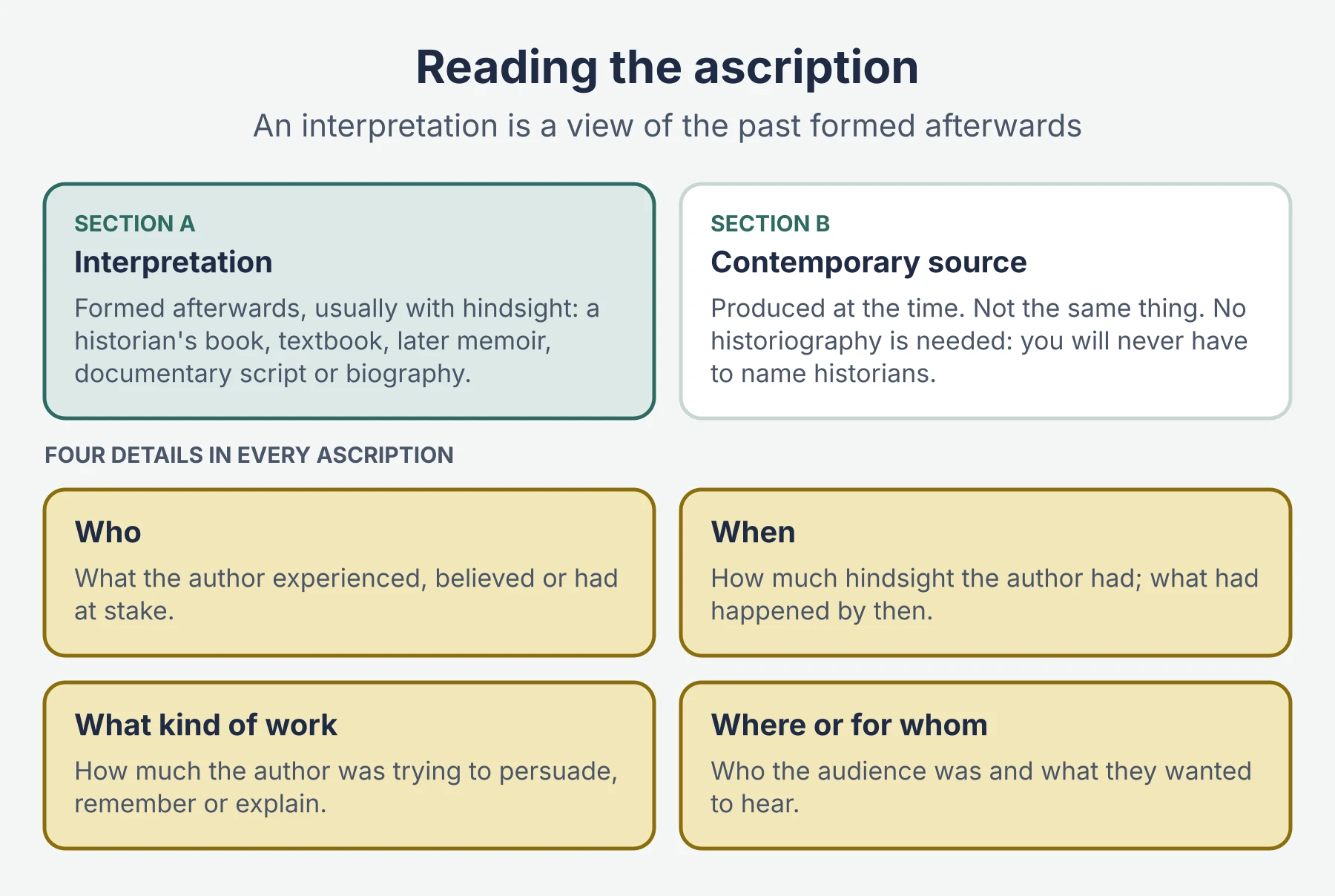
An interpretation is a view of the past formed afterwards, usually with the benefit of hindsight: a historian’s book, a school textbook, a memoir written decades later, a documentary script or a biography. It is not the same as a contemporary source, which Section B uses. The specification is clear that the interpretations “do not require an understanding of historiography”, so you will never be asked to name historians or schools of thought. What you are tested on is your ability to read two short views closely, explain why people saw the same events differently, and judge them against what you know.
Every interpretation comes with an ascription: a line telling you who wrote it, when and in what kind of work. Treat the ascription as part of the evidence. It usually contains four useful details:
| Detail in the ascription | What it can tell you |
|---|---|
| Who – a farmer, a politician, a historian, a former soldier | What the author experienced, believed or had at stake |
| When – the date of writing | How much hindsight the author had; what had happened by then |
| What kind of work – memoir, textbook, speech, newspaper column | How much the author was trying to persuade, remember or explain |
| Where or for whom – a national history, a local newspaper, a party pamphlet | Who the audience was and what they wanted to hear |
Question 1: how do the interpretations differ? (4 marks)
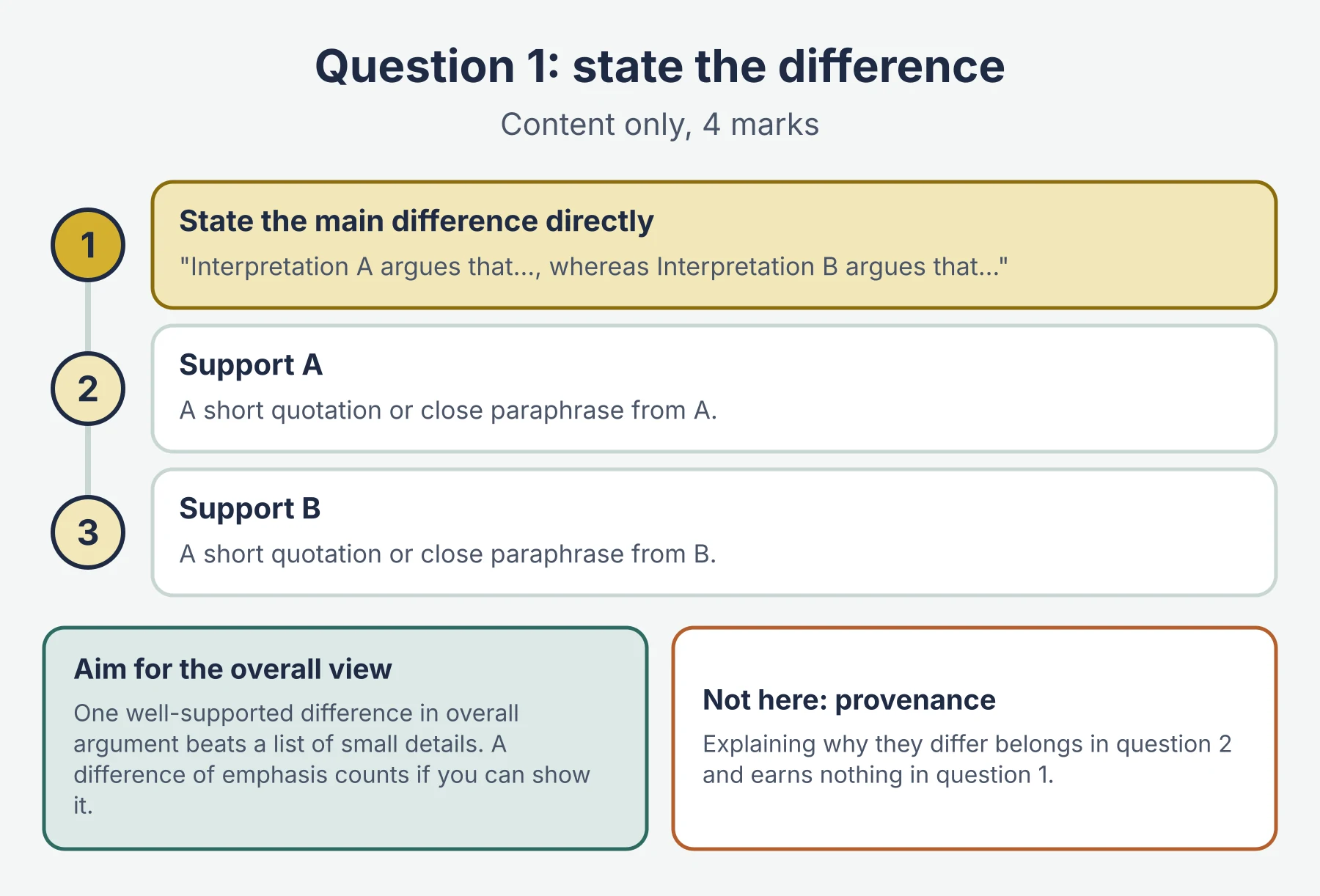
The task is to identify a difference in what the interpretations say about the issue in the question, and support it from both. This question is about content only: you do not yet need to explain why they differ.
- Start with a sentence that states the difference directly: “Interpretation A argues that…, whereas Interpretation B argues that…”
- Support each half with a short quotation or close paraphrase.
- Aim for the main difference in overall view, not a small detail. If A and B disagree about how much something changed, say so; a difference of emphasis counts if you can show it.
A list of small differences rarely does better than one well-supported difference in their overall argument.
Question 2: why might the authors have different interpretations? (4 marks)
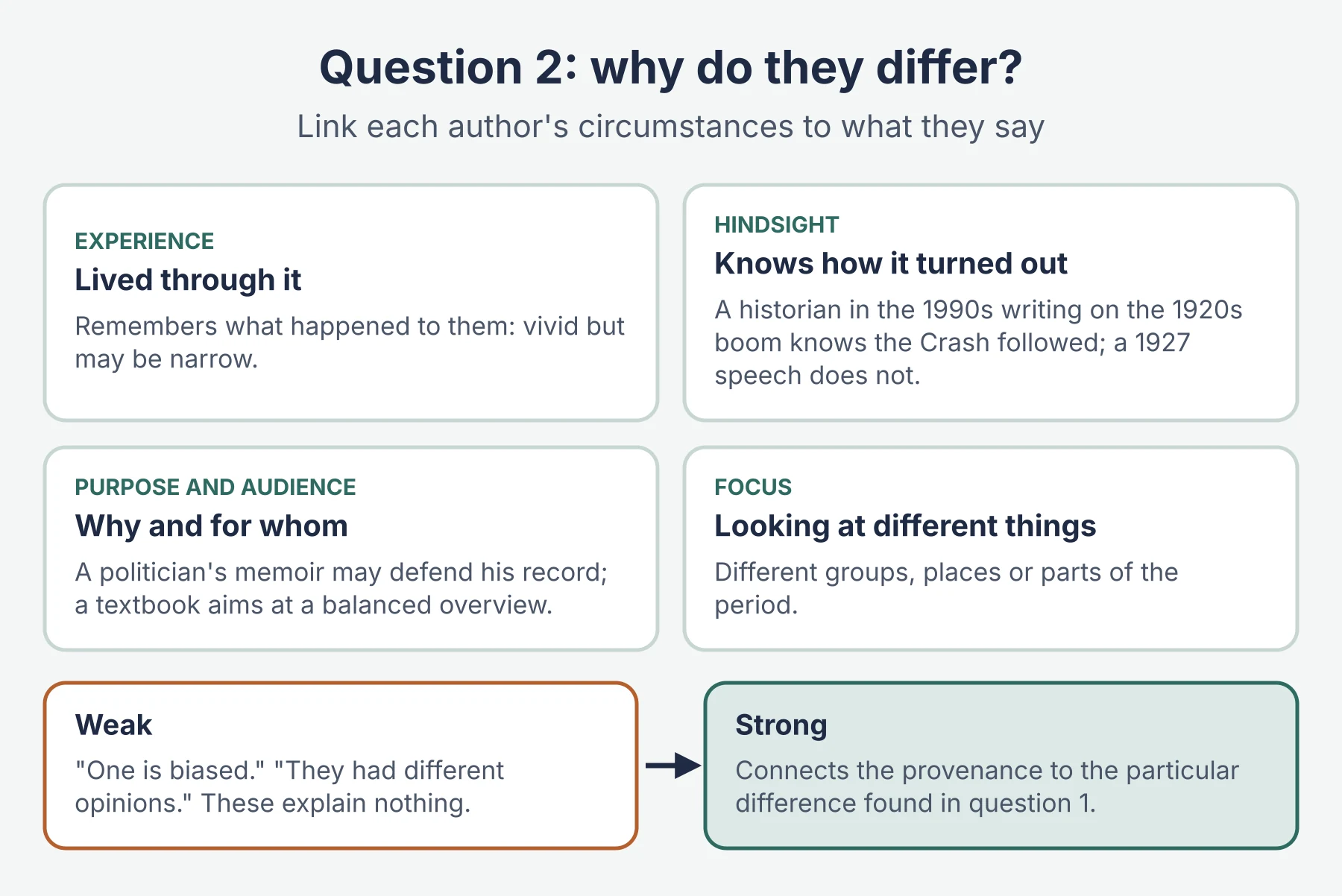
Here the ascriptions do the work. You explain the difference identified in question 1 by referring to the authors’ circumstances: their experience, date, purpose and audience. The best answers connect the provenance to what each author actually says. Weak answers say “one is biased” or “they had different opinions”, which explains nothing.
Useful lines of reasoning:
- Experience: someone who lived through an event remembers what happened to them; their view may be vivid but narrow.
- Hindsight: an author writing later knows how things turned out. A historian writing in the 1990s about the 1920s boom knows the Crash followed; a speech from 1927 does not.
- Purpose and audience: a politician’s memoir may defend his record; a textbook aims to give a balanced overview for students.
- Focus: two authors may simply be looking at different groups, places or parts of the period.
Question 3: which interpretation is more convincing? (8 marks)
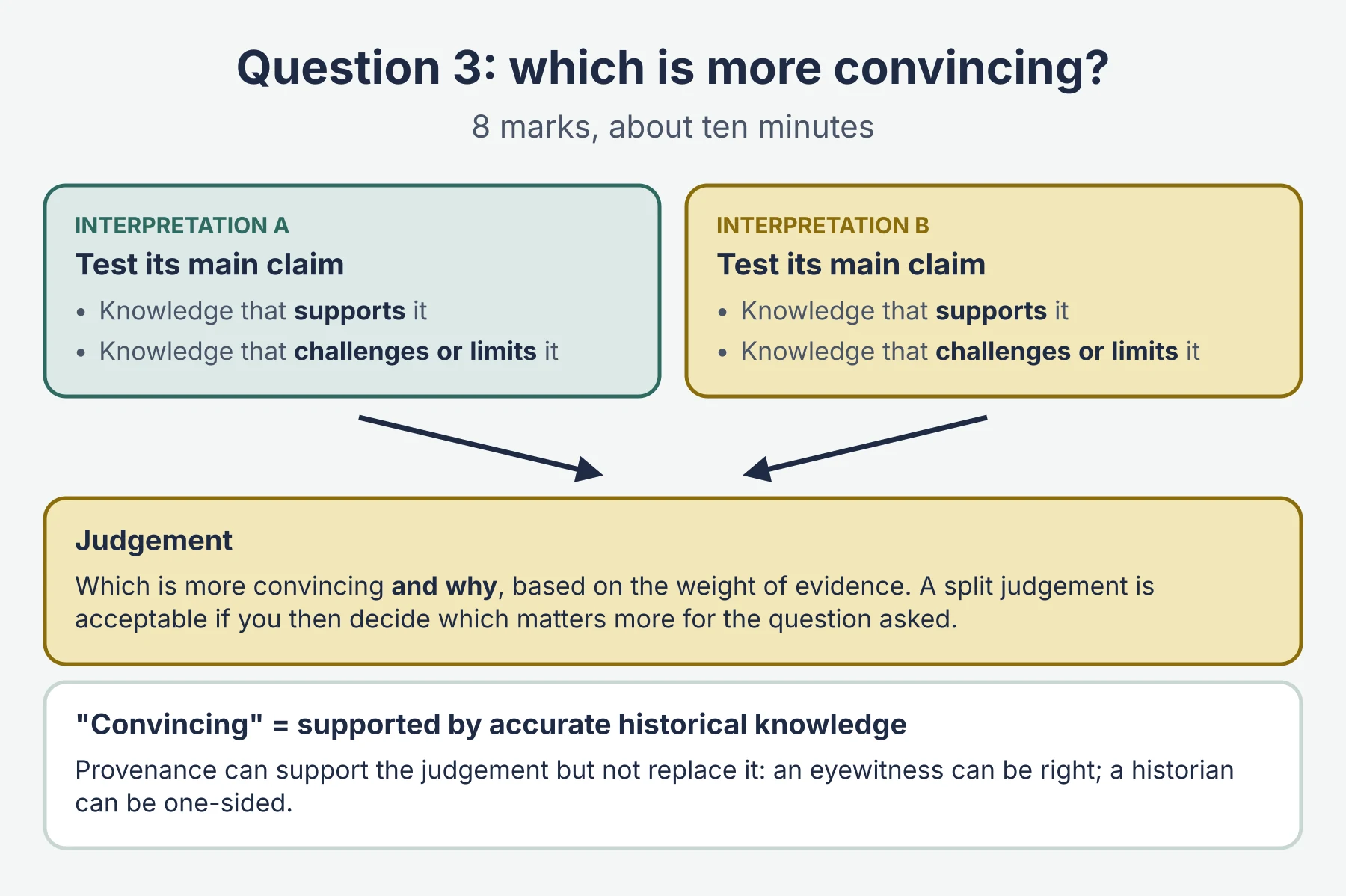
This is the highest-tariff interpretation question, so give it about ten minutes. “Convincing” means supported by accurate historical knowledge. You test each interpretation against what you know, then reach a judgement.
- Interpretation A: pick out its main claim; bring in precise knowledge that supports it; then add knowledge that challenges or limits it.
- Interpretation B: do the same.
- Judgement: say which is more convincing and why, based on the weight of the evidence. A judgement such as “A is more convincing about the scale of change, but B is right that it did not reach everyone” is acceptable if you then decide which matters more for the question asked.
Provenance can support your judgement but should not replace it. An eyewitness can be right; a historian can be one-sided. The deciding factor is how well each view fits the evidence you know.
Worked example: AD America, the New Deal
Interpretation A (invented for practice) – From a history of the 1930s written in 1985 by an American historian for university students: “The New Deal did not end the Depression, but it changed Americans’ relationship with their government for ever. For the first time, Washington accepted responsibility for the unemployed, the elderly and the farmer. Banks reopened with confidence, millions worked on public schemes, and Social Security gave security in old age.”
Interpretation B (invented for practice) – From the memoir of a Chicago factory owner, published in 1952: “Roosevelt’s schemes buried business under rules and taxes. Men raked leaves for government wages while real jobs failed to appear. In 1938 my factory was laying men off again. It was the war, not the New Deal, that filled America’s workshops.”
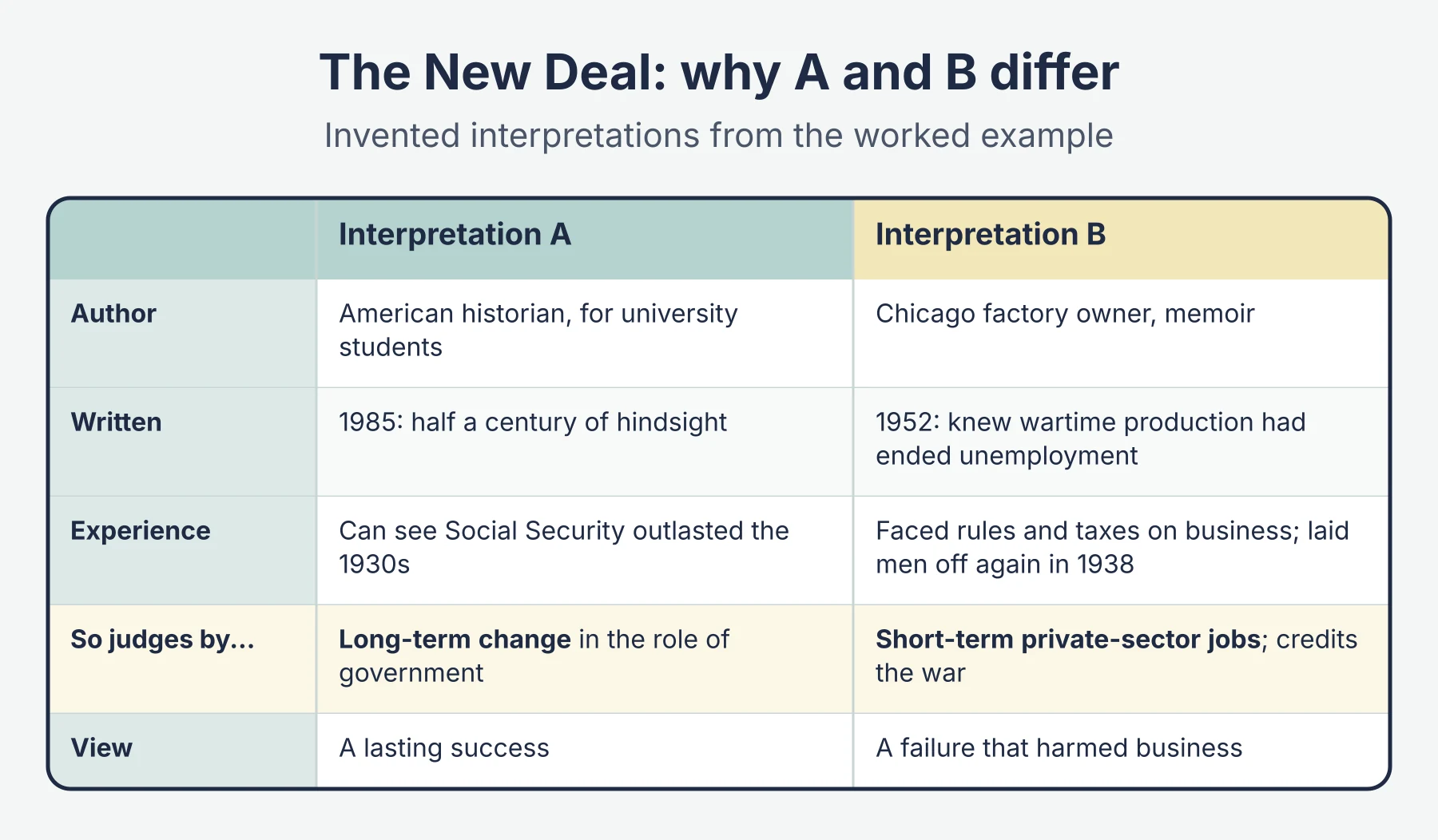
Question 1 model answer. Interpretation A argues that the New Deal was a lasting success because it made the federal government responsible for helping groups such as “the unemployed, the elderly and the farmer”. Interpretation B argues that it failed and harmed business, describing public works as men raking leaves “for government wages” and claiming that “the war, not the New Deal” brought recovery. So A stresses long-term change in the role of government, while B stresses the New Deal’s failure to create real jobs.
Question 2 model answer. The author of B owned a factory, so he experienced the New Deal through regulations and taxes on business; his own workforce was cut again in 1938, which explains why he judges it by whether it produced private-sector jobs. Writing in 1952, he also knew that wartime production had ended unemployment, so he credits the war. The author of A is a historian writing in 1985 for university students, with half a century of hindsight; she can see that programmes such as Social Security outlasted the 1930s, so she judges the New Deal by its long-term effect on government rather than by short-term job figures.
Question 3 annotated plan.
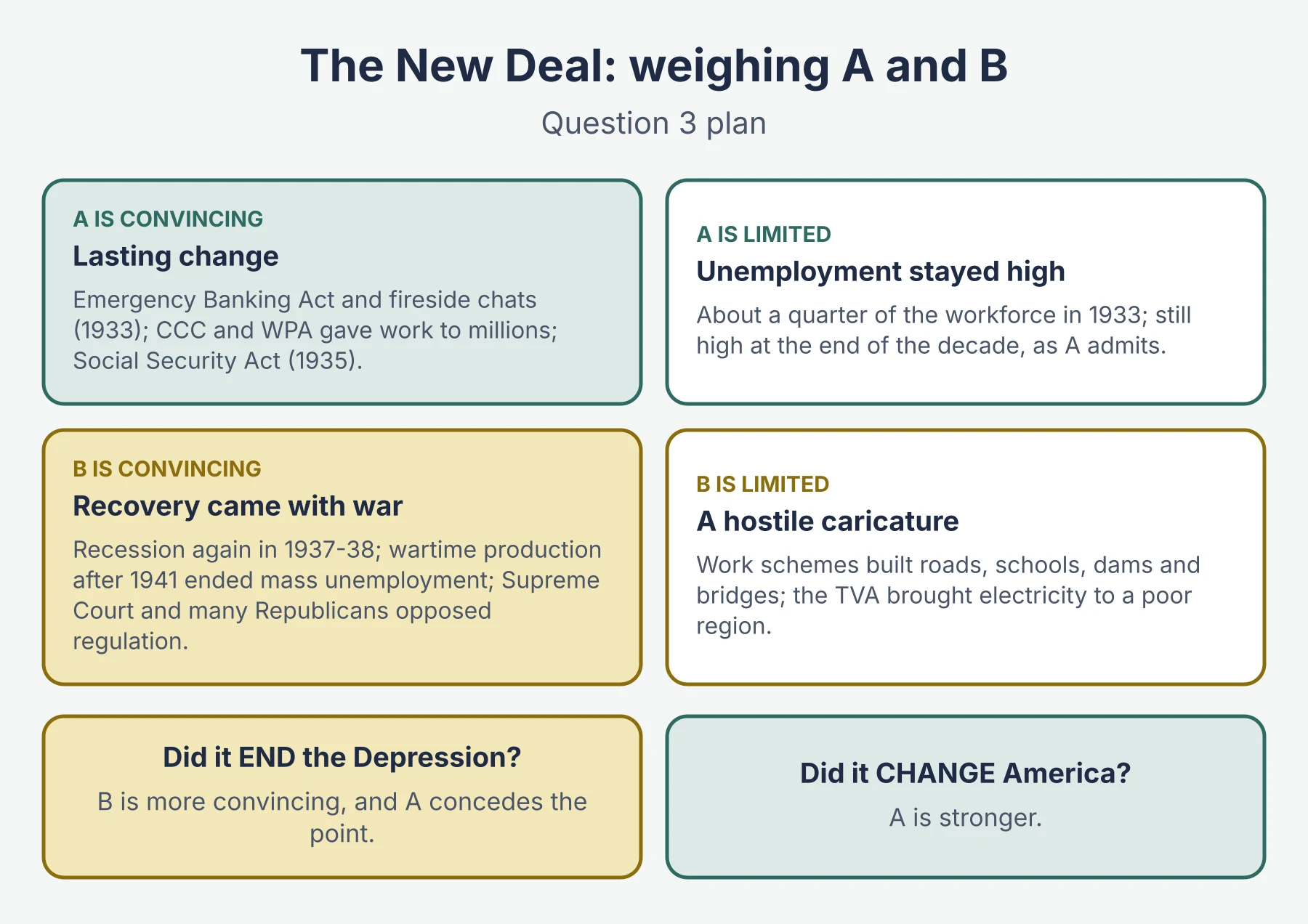
- A is convincing because the Emergency Banking Act and fireside chats restored confidence in 1933; agencies such as the Civilian Conservation Corps and the Works Progress Administration gave work to millions; the Social Security Act (1935) created pensions and unemployment insurance.
- A is limited because unemployment, about a quarter of the workforce in 1933, was still high at the end of the decade, as A itself admits.
- B is convincing because the economy fell back into recession in 1937-38, and wartime production after 1941 ended mass unemployment. The Supreme Court and many Republicans did oppose New Deal regulation of business.
- B is limited because the leaf-raking image is a hostile caricature: work schemes built roads, schools, dams and bridges, and the Tennessee Valley Authority brought electricity to a poor region.
- Judgement: for the issue of whether the New Deal ended the Depression, B is more convincing, and A concedes the point. For whether it changed America, A is stronger. A top answer commits to one view in relation to the question’s exact wording.
Common mistakes
- Question 1: summarising A, then summarising B, with no sentence that states the difference.
- Question 1: explaining provenance, which belongs in question 2 and earns nothing here.
- Question 2: generic comments (“historians are more reliable”) that could apply to any pair of interpretations.
- Question 2: ignoring the content: provenance must explain the particular difference you found.
- Question 3: judging only by the author (“B is a memoir so it is less convincing”).
- Question 3: writing everything you know about the topic without linking it back to what each interpretation claims.
Exam technique and timing
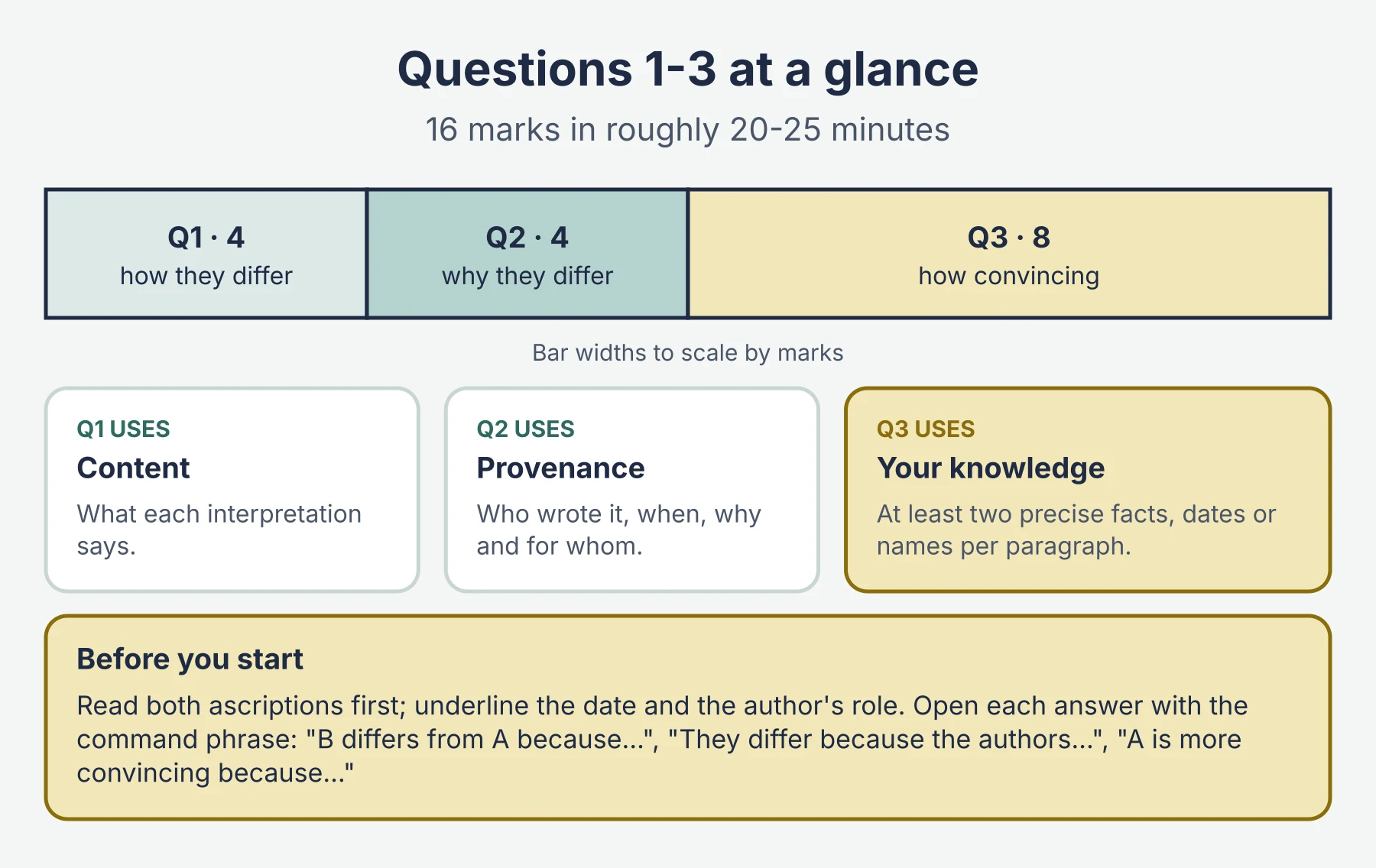
Section A is worth 40 marks in about an hour, so the three interpretation questions together deserve roughly 20-25 minutes. Read both ascriptions before the interpretations; underline the date and the author’s role. Use the command phrase in your opening line each time: “B differs from A because…”, “They differ because the authors…”, “A is more convincing because…”. Question 3 is where your period-study knowledge is rewarded, so make sure every paragraph contains at least two precise facts, dates or names.
Practice and revision
- Interpretation questions revision notes: the method in condensed form, key terms and a self-test.
- Interpretation questions practice: invented interpretation pairs for all four options with mark-scheme-style answers.
- Section A period studies revision notes for the key dates you will use in question 3.
Specification
AQA GCSE History (8145) specification, section 4.4.1 (Paper 1 Section A, questions 1-3) and section 3.2.1 (period studies) – aqa.org.uk.
Related resources
-
Practice questions
AQA GCSE History (8145): Interpretation Questions 1-3 – Practice Questions
Original AQA GCSE History 8145 interpretation practice: four invented pairs, one for each period study, with questions 1-3 and full worked answers.
World History · AQA · GCSE
Try questions -
Revision notes
AQA GCSE History (8145): Interpretation Questions 1-3 – Revision Notes
Revision notes for AQA GCSE History 8145 Paper 1 questions 1-3: reading ascriptions, difference, provenance and convincing, with traps and a self-test.
World History · AQA · GCSE
Revise topic -
Study guides
AQA GCSE History (8145): Nazi Control, Propaganda and Opposition
AQA GCSE History 8145 Germany 1890-1945: how Goebbels, Himmler, the SS and Gestapo controlled Germans, and the opposition and resistance they faced.
World History · AQA · GCSE
Read guide
Get free revision emails (optional)
Occasional emails with practice questions, worked explanations and links to free resources for the qualification and subjects you choose. No spam, and you can unsubscribe from any email. The free tools on this site never need an email.