
Revision Notes
AQA GCSE History (8145): Interpretation Questions 1-3 – Revision Notes
Revision notes for AQA GCSE History 8145 Paper 1 questions 1-3: reading ascriptions, difference, provenance and convincing, with traps and a self-test.
- Subject
- World History
- Level
- GCSE
- Topic
- Understanding the Modern World
- Author
- Marlbridge Academic Team
- Updated
- Reviewed by
- Azam Siddique (what this means)
Aligned to AQA GCSE World History (8145), first teaching 2016. Official specification .
Syllabus page (what it covers and how it is assessed): AQA GCSE World History.
Syllabus points this page covers
8145
- 3.2.1 Section A: Period studies
This page covers 1 of the 2 subtopics in topic 1, Understanding the modern world.
Found an error? Report a correction.
Need help with this topic? Request a free trial class for GCSE World History (8145).
These notes condense the interpretation questions in AQA 8145 Paper 1 Section A. The specification describes them as testing “how interpretations differ, why interpretations differ” and how convincing they are, using “two written interpretations of around 50–100 words with an accompanying ascription”. For the full method and a worked New Deal example, use the interpretation questions study guide; for the rest of Section A, see the period studies revision notes.
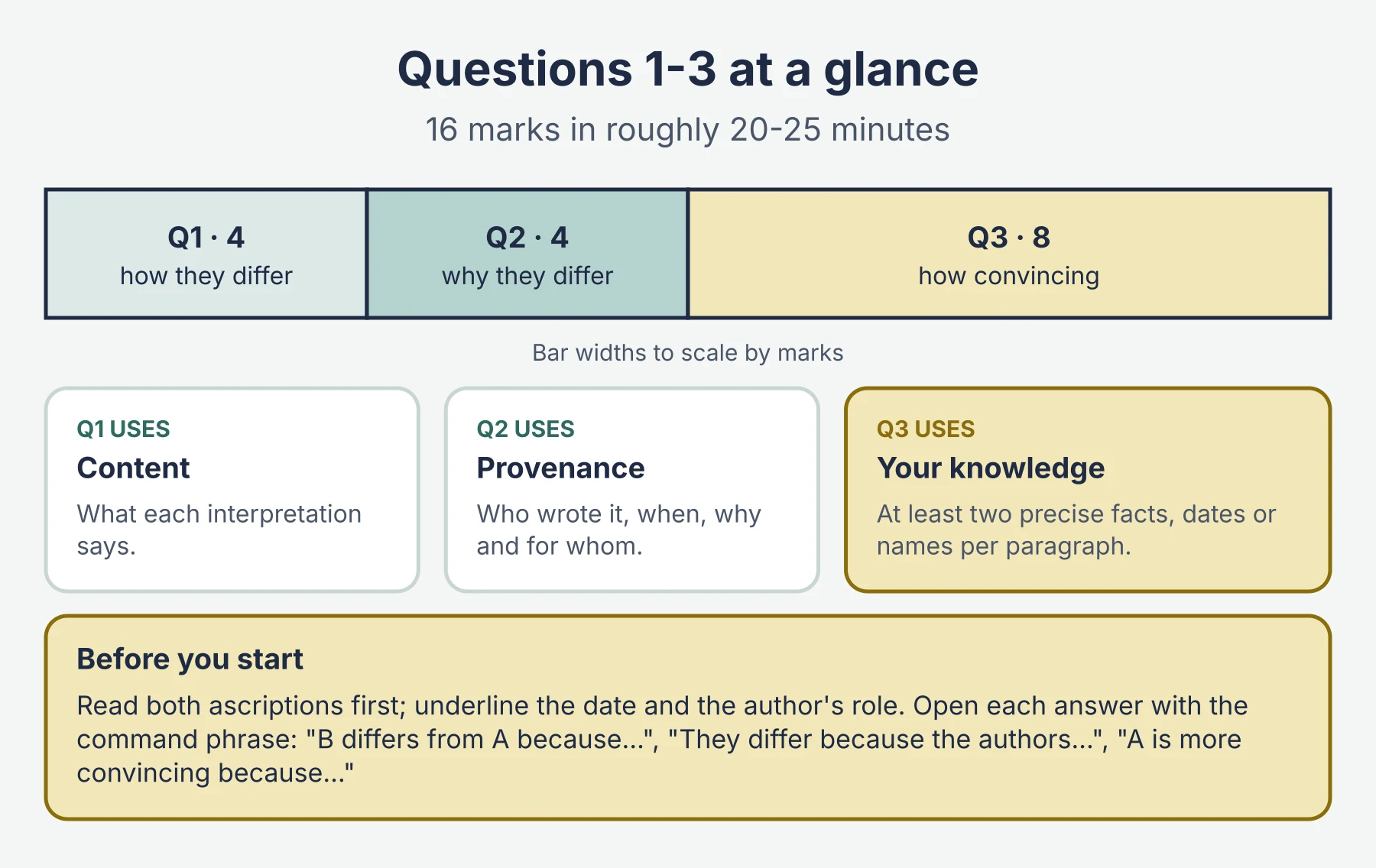
The three questions at a glance
| Question | Marks | Skill | One-line method |
|---|---|---|---|
| 1 How does B differ from A? | 4 | Compare content | State the main difference in what they say; support from both |
| 2 Why might the authors differ? | 4 | Explain provenance | Link each author’s situation to what they say |
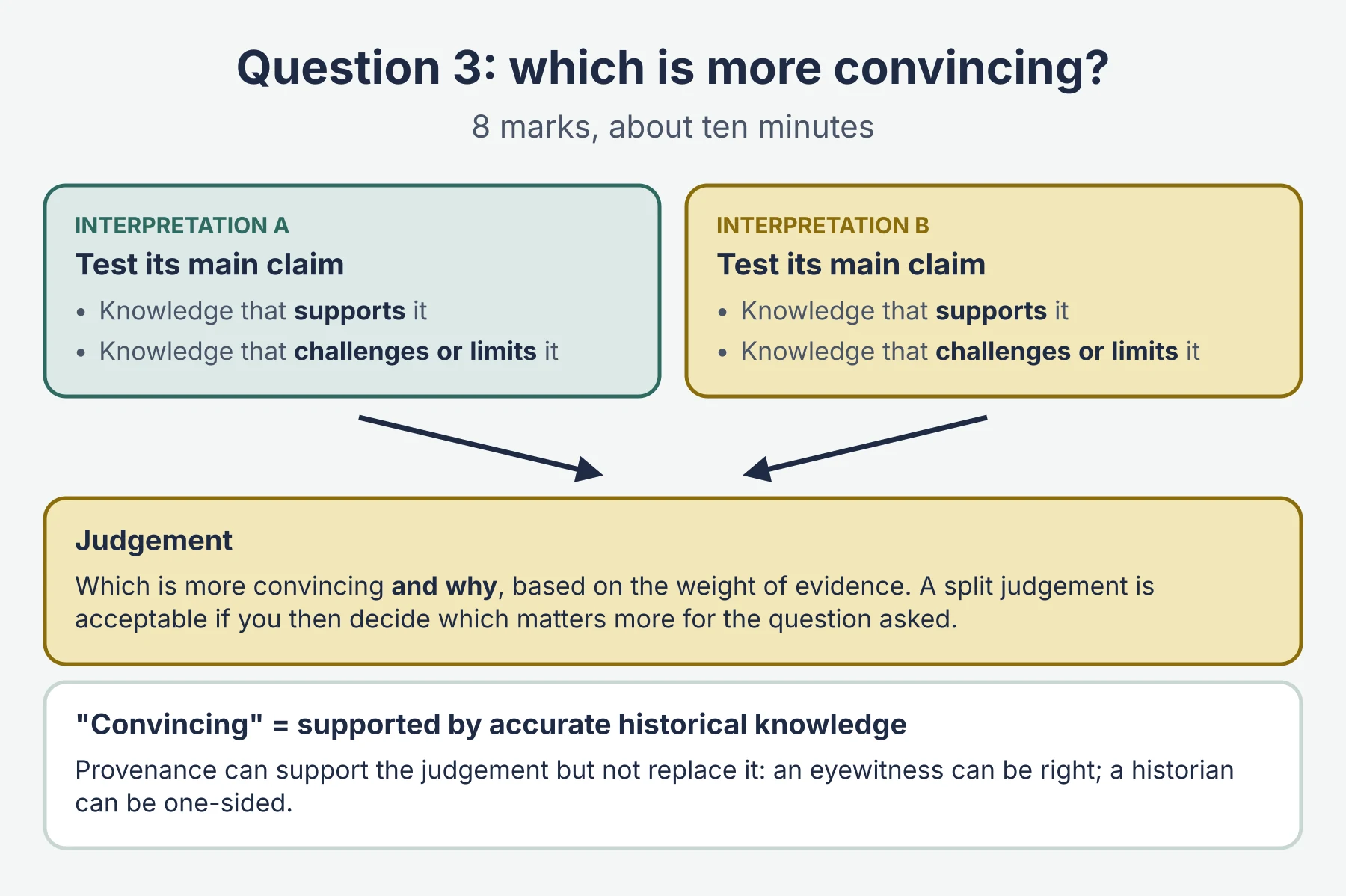
| 3 Which is more convincing? | 8 | Evaluate with knowledge | Test both against facts; judge which fits the evidence better |
All three test AO4. Together they are 16 of Section A’s 40 marks, so spend roughly 20-25 minutes on them, with about ten minutes on question 3.
Reading an ascription in thirty seconds
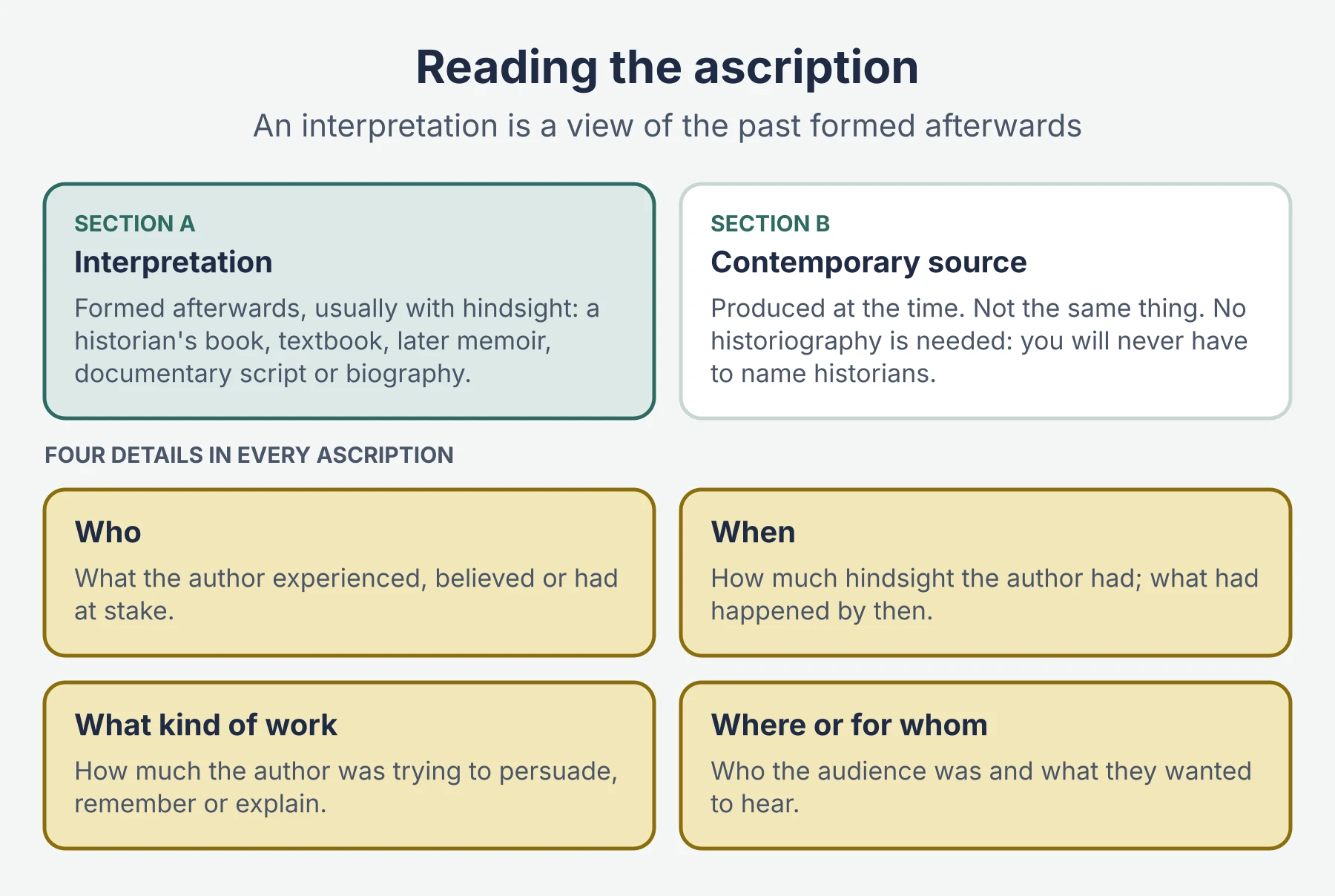
Underline four things before you read the interpretation itself:
- Author’s role – a soldier, a peasant, a politician, a historian, a journalist.
- Date – at the time, a few years later, or decades later with hindsight.
- Type of work – memoir, textbook, speech, biography, newspaper article, documentary.
- Audience – students, voters, readers in another country, the author’s own community.
Then ask: what would this person have seen, wanted or known?
Question 1 recall
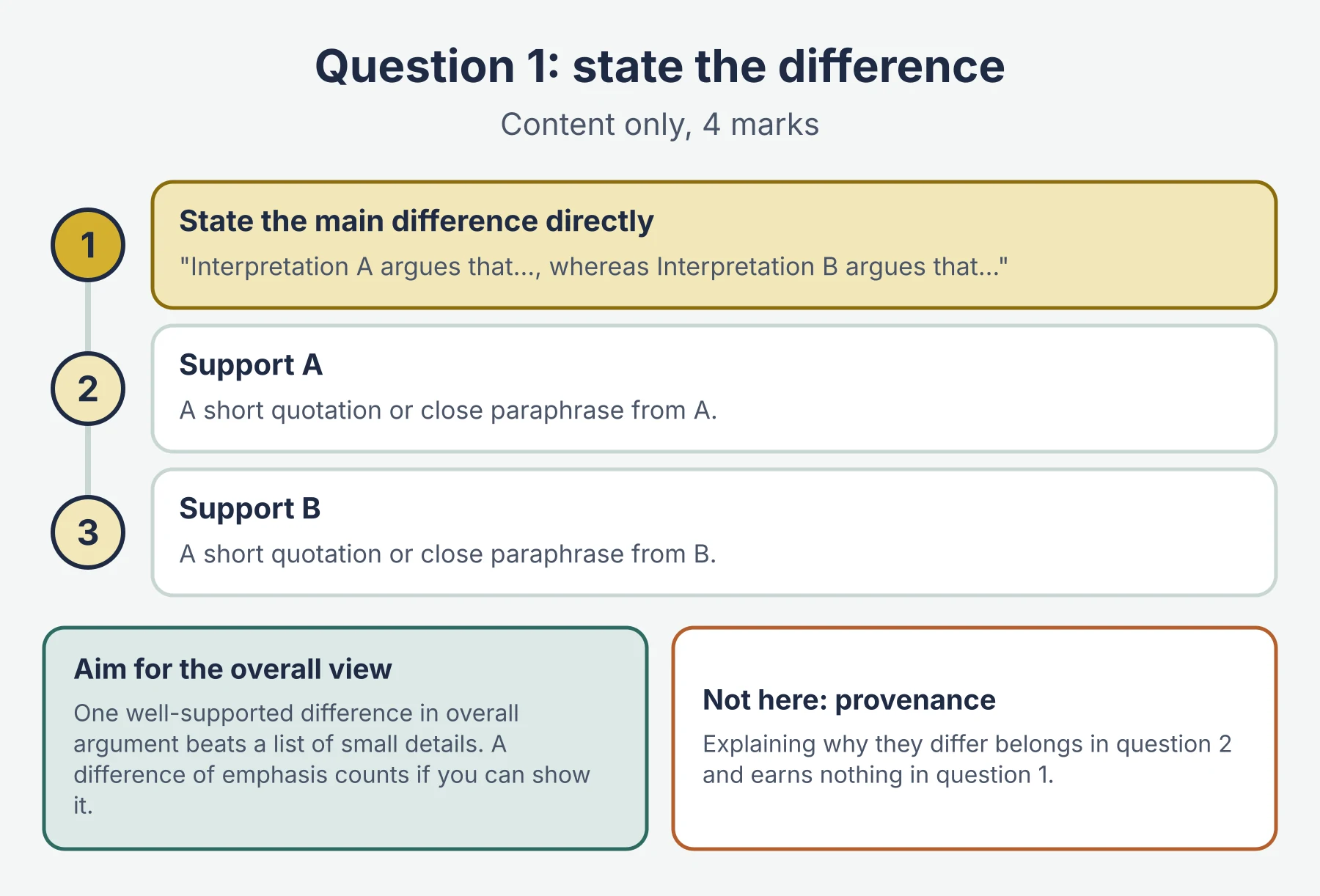
- One clear sentence of difference: “A argues…, whereas B argues…”.
- Back each side with a short quotation (a few words is enough).
- Choose the overall difference, not a minor detail.
- Content only: no provenance, no own knowledge needed.
- A difference of emphasis counts (“A stresses success; B stresses limits”).
Question 2 recall
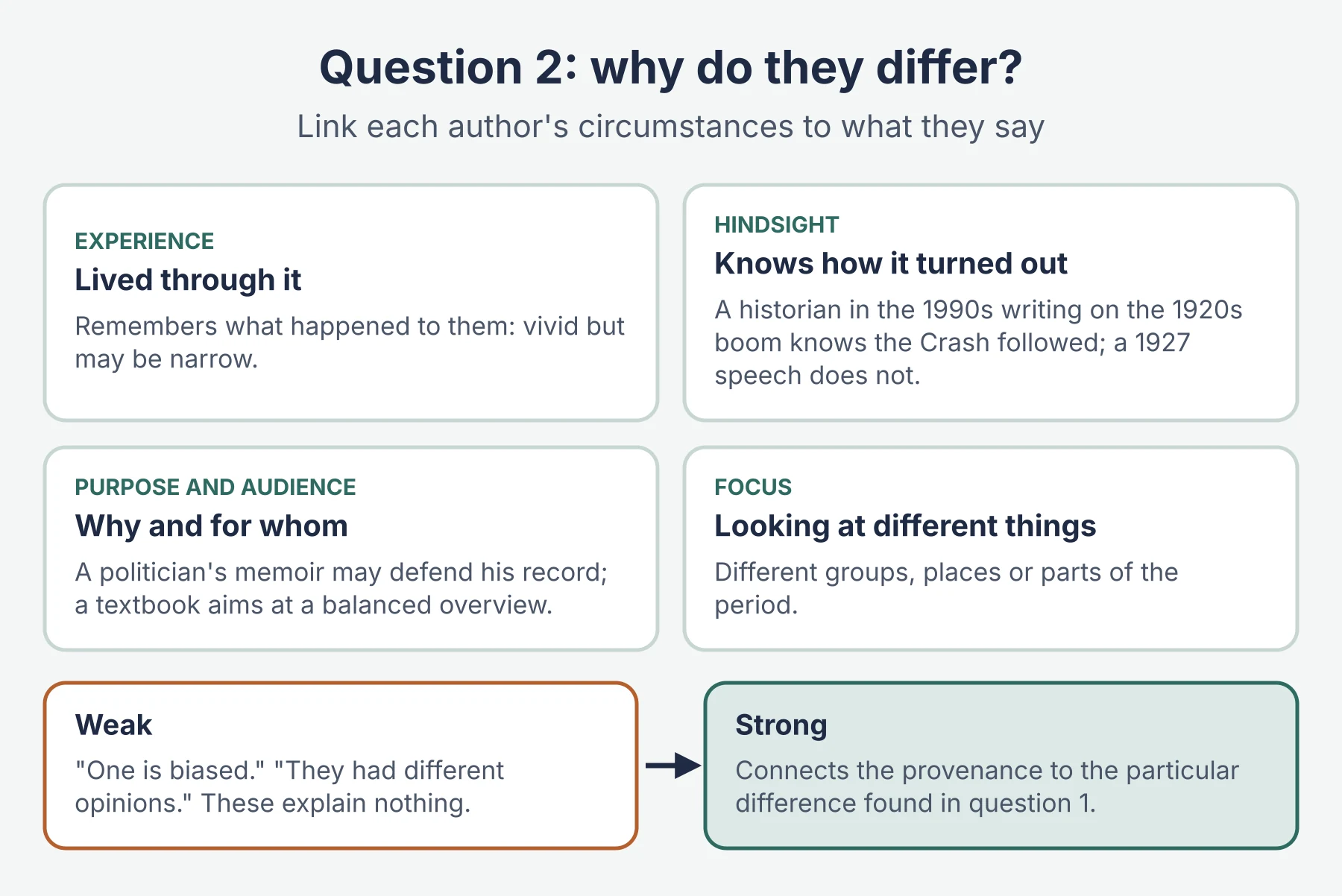
Explain the difference you found in question 1 using provenance:
| Reason | Typical wording |
|---|---|
| Different experience | “As a farmer, B suffered falling prices, so he…” |
| Hindsight | “Writing in 1990, A knew that…, so she…” |
| Purpose | “A memoir defending his own record, so B…” |
| Audience | “Written for students, A aims at a balanced overview…” |
| Different focus | “A looks at the cities; B at the countryside” |
Always tie the reason to what the author says. “B is biased” with no explanation earns little.
Question 3 recall
- Paragraph 1 (A): main claim + supporting knowledge + limiting knowledge.
- Paragraph 2 (B): main claim + supporting knowledge + limiting knowledge.
- Judgement: which is more convincing for the issue in the question, and why.
- Every paragraph needs precise facts: dates, names, laws, numbers you are sure of.
- Provenance may support the judgement but the deciding test is knowledge.
Key terms
| Term | Meaning |
|---|---|
| Interpretation | A later view of the past, such as a historian’s book, memoir or textbook |
| Ascription | The caption saying who produced the interpretation, when and where |
| Provenance | The origin of a text: author, date, type, purpose and audience |
| Hindsight | Knowing what happened next, which shapes how earlier events are judged |
| Emphasis | What an author chooses to stress or leave out |
| Contextual knowledge | Your own factual knowledge of the period, used to test a claim |
| Convincing | Well supported by accurate historical evidence |
| Corroborate | To confirm a claim with other evidence |
| AO4 | The assessment objective for analysing and evaluating interpretations |
Exam traps
- Writing two summaries for question 1 and leaving the examiner to find the difference.
- Bringing provenance into question 1: it is rewarded in question 2, not here.
- Treating interpretations as sources: they are views written later, so “it was written at the time” is usually wrong.
- Assuming historians are always right: a historian’s interpretation can be challenged by facts as much as a memoir can.
- Forgetting B in question 3: an answer that tests only one interpretation is capped.
- Fence-sitting: “both are convincing” with no reason why one is more convincing for this question.
- Spending too long on questions 1 and 2: they carry 4 marks each; question 6 still needs about 20 minutes.
Quick model sentences
- Question 1: “Interpretation A presents Stalin’s Five-Year Plans as a triumph that made the USSR an industrial power, whereas Interpretation B presents them as a tragedy built on fear and forced labour.”
- Question 2: “The author of B had been a prisoner in a labour camp, so his view of industrialisation is shaped by what it cost people like him; the author of A wrote an official history in 1950, when the regime wanted to celebrate victory in the war.”
- Question 3: “B is more convincing about the human cost because labour camps supplied workers for projects such as the White Sea Canal, but A is right that output of heavy industry rose sharply in the 1930s.”
Self-test
- How many interpretations are there in Section A, and roughly how long is each?
- Which assessment objective do questions 1-3 test?
- What is an ascription?
- Does question 1 require provenance?
- Name four things to look for in an ascription.
- Why is “Interpretation B is biased” a weak answer to question 2?
- How many marks is question 3?
- What does “convincing” mean in question 3?
- Do you need to know the names of historians or schools of thought?
- What should every paragraph of a question 3 answer contain?
- Can a difference of emphasis count as a difference in question 1?
- Roughly how long should all three interpretation questions take?
Answers
- Two, each around 50-100 words.
- AO4.
- The caption saying who wrote the interpretation, when and in what kind of work.
- No. It asks only how the content differs.
- Author’s role, date, type of work and audience (purpose is also useful).
- It does not explain how the author’s situation shaped the particular view expressed.
- Eight.
- Well supported by accurate historical knowledge of the events.
- No. The specification states that the interpretations do not require an understanding of historiography.
- Precise contextual knowledge that supports or challenges the interpretation, linked back to its claim.
- Yes, if you show from both interpretations that they stress different things.
- About 20-25 minutes out of Section A’s hour.
Try the interpretation questions practice, which has invented interpretation pairs for each period-study option, then check timing against a full set in the period studies practice questions.
Related resources
-
Study guides
AQA GCSE History (8145): Nazi Control, Propaganda and Opposition
AQA GCSE History 8145 Germany 1890-1945: how Goebbels, Himmler, the SS and Gestapo controlled Germans, and the opposition and resistance they faced.
World History · AQA · GCSE
Read guide -
Practice questions
AQA GCSE History (8145): Nazi Control, Propaganda and Opposition – Practice Questions
Original AQA GCSE History 8145 Germany practice on Nazi propaganda, the police state and opposition: describe, in what ways, interpretation and essay.
World History · AQA · GCSE
Try questions -
Revision notes
AQA GCSE History (8145): Nazi Control, Propaganda and Opposition – Revision Notes
Revision notes for AQA GCSE History 8145 Germany: Goebbels and propaganda, Nazi culture, Himmler's police state and four named opposition groups.
World History · AQA · GCSE
Revise topic
Get free revision emails (optional)
Occasional emails with practice questions, worked explanations and links to free resources for the qualification and subjects you choose. No spam, and you can unsubscribe from any email. The free tools on this site never need an email.