
Revision Notes
AQA GCSE History (8145): Nazi Control, Propaganda and Opposition – Revision Notes
Revision notes for AQA GCSE History 8145 Germany: Goebbels and propaganda, Nazi culture, Himmler's police state and four named opposition groups.
- Subject
- World History
- Level
- GCSE
- Topic
- Understanding the Modern World
- Author
- Marlbridge Academic Team
- Updated
- Reviewed by
- Azam Siddique (what this means)
Aligned to AQA GCSE World History (8145), first teaching 2016. Official specification .
Syllabus page (what it covers and how it is assessed): AQA GCSE World History.
Syllabus points this page covers
8145
- 3.2.1 Section A: Period studies
This page covers 1 of the 2 subtopics in topic 1, Understanding the modern world.
Found an error? Report a correction.
Need help with this topic? Request a free trial class for GCSE World History (8145).
Condensed notes for the “Control” content statement in AB Germany, 1890-1945, Part three. The specification names “Goebbels, the use of propaganda and censorship; Nazi culture; repression and the police state and the roles of Himmler, the SS and Gestapo; opposition and resistance, including White Rose group, Swing Youth, Edelweiss Pirates and July 1944 bomb plot.” Explanations are in the Nazi control and opposition study guide; dates for the whole option are in the period studies revision notes.
Control in one line
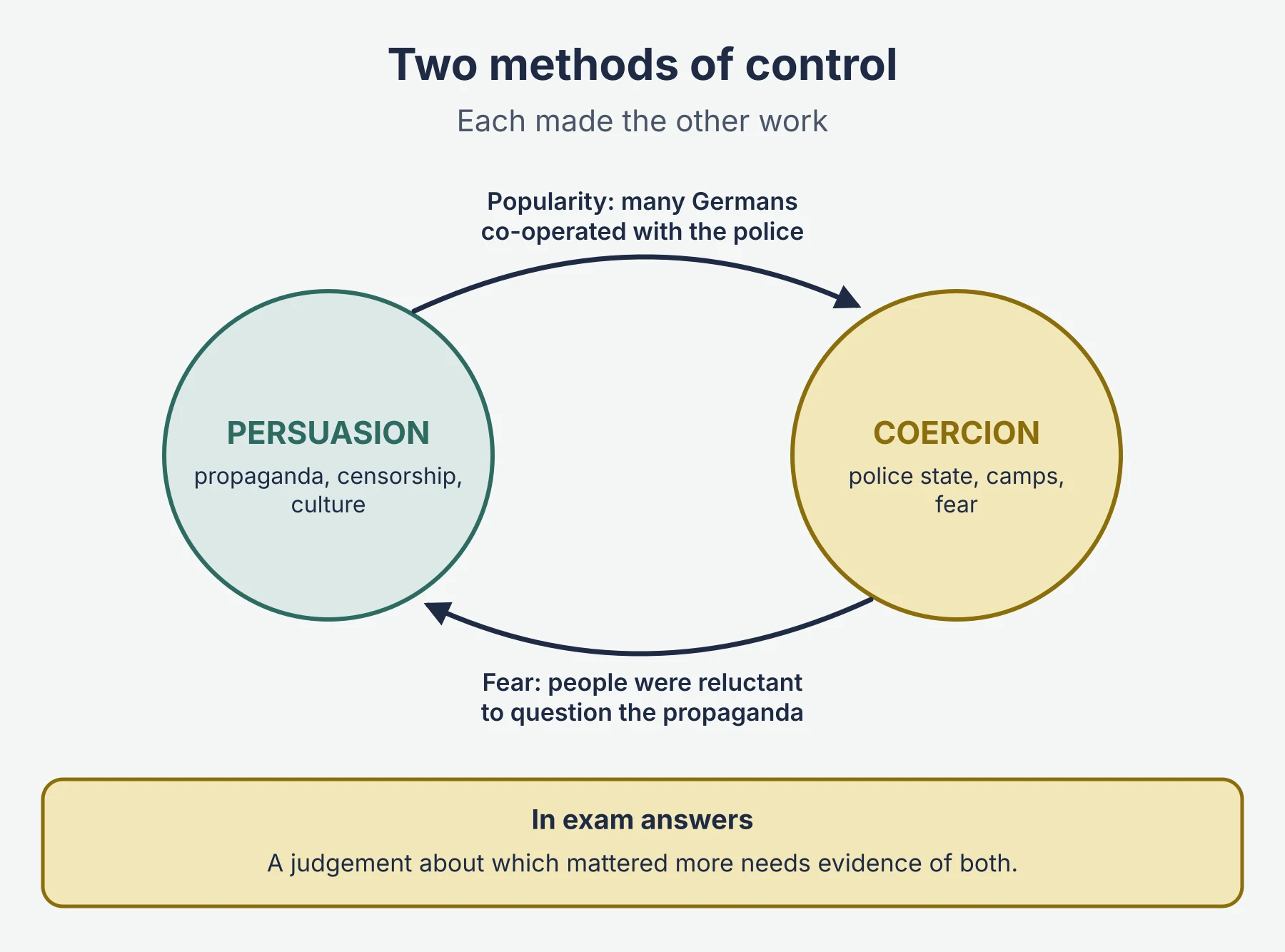
Persuasion (propaganda, censorship, culture) kept most Germans loyal; coercion (SS, Gestapo, camps) silenced the rest; each strengthened the other.
Timeline
| Date | Event |
|---|---|
| 1929 | Himmler becomes leader of the SS |
| March 1933 | Goebbels made Propaganda Minister; Dachau camp opens |
| 1933 | Gestapo set up in Prussia |
| 10 May 1933 | Book burnings |
| September 1933 | Reich Chamber of Culture created |
| 1934 | People’s Court set up; Himmler controls the Gestapo |
| 1935 | Triumph of the Will released |
| 1936 | Berlin Olympics; Himmler chief of all German police |
| 1937 | Degenerate Art exhibition, Munich |
| 1938 | Niemöller sent to concentration camp |
| 1942 | Himmler orders crackdown on Swing Youth |
| February 1943 | White Rose leaders arrested and executed |
| 20 July 1944 | Stauffenberg’s bomb plot fails |
| November 1944 | Public hanging in Cologne of a group linked to the Edelweiss Pirates |
Propaganda and censorship: methods
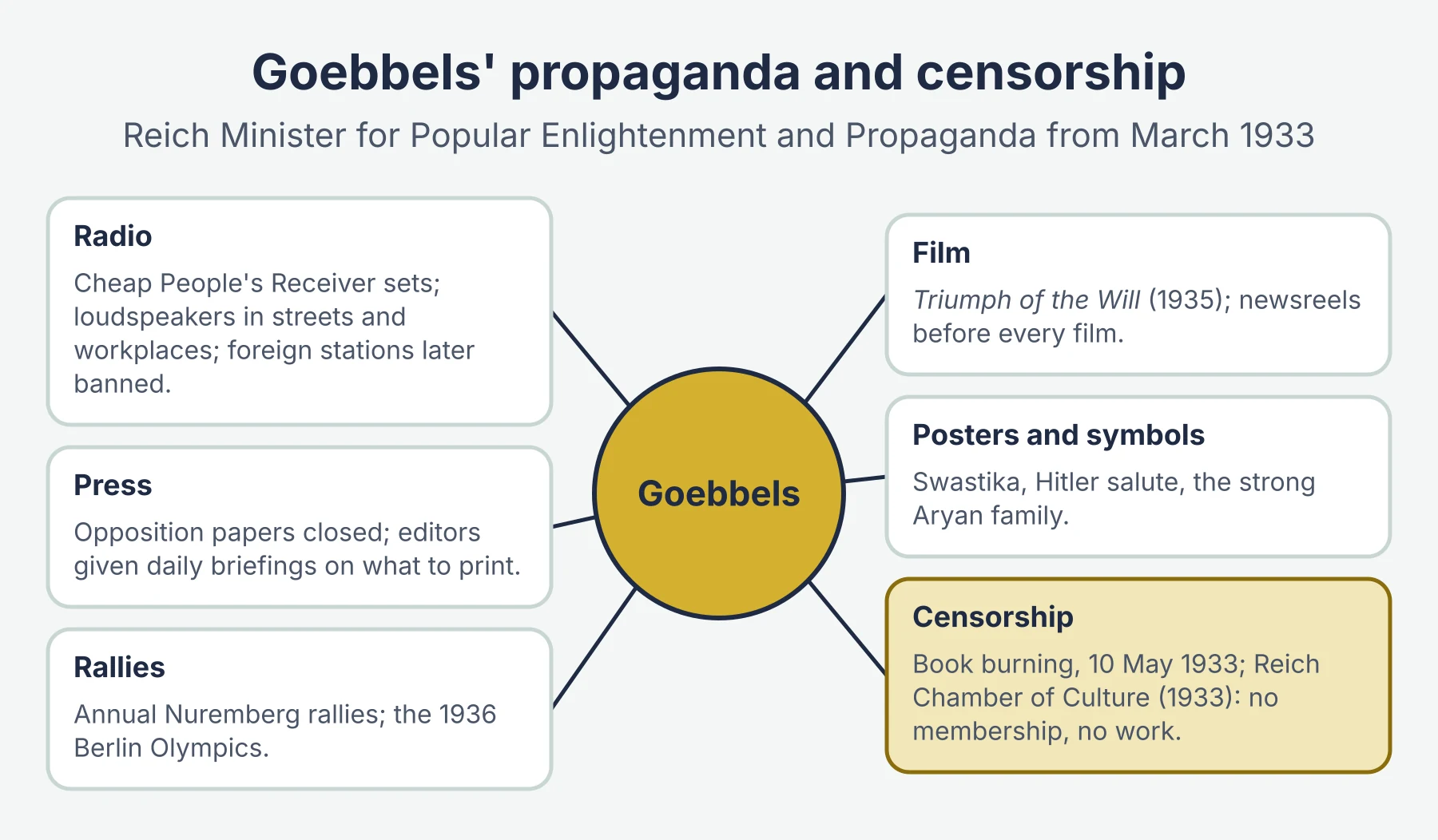
- Radio: cheap People’s Receiver sets; loudspeakers in public places; foreign stations banned in wartime.
- Press: opposition papers closed; editors told what to print.
- Rallies: Nuremberg, showing unity and discipline.
- Film: Riefenstahl’s Triumph of the Will; newsreels before every film.
- Sport: the 1936 Olympics as a show of German strength and organisation.
- Censorship: book burning; Reich Chamber of Culture decided who could work in the arts.
Nazi culture
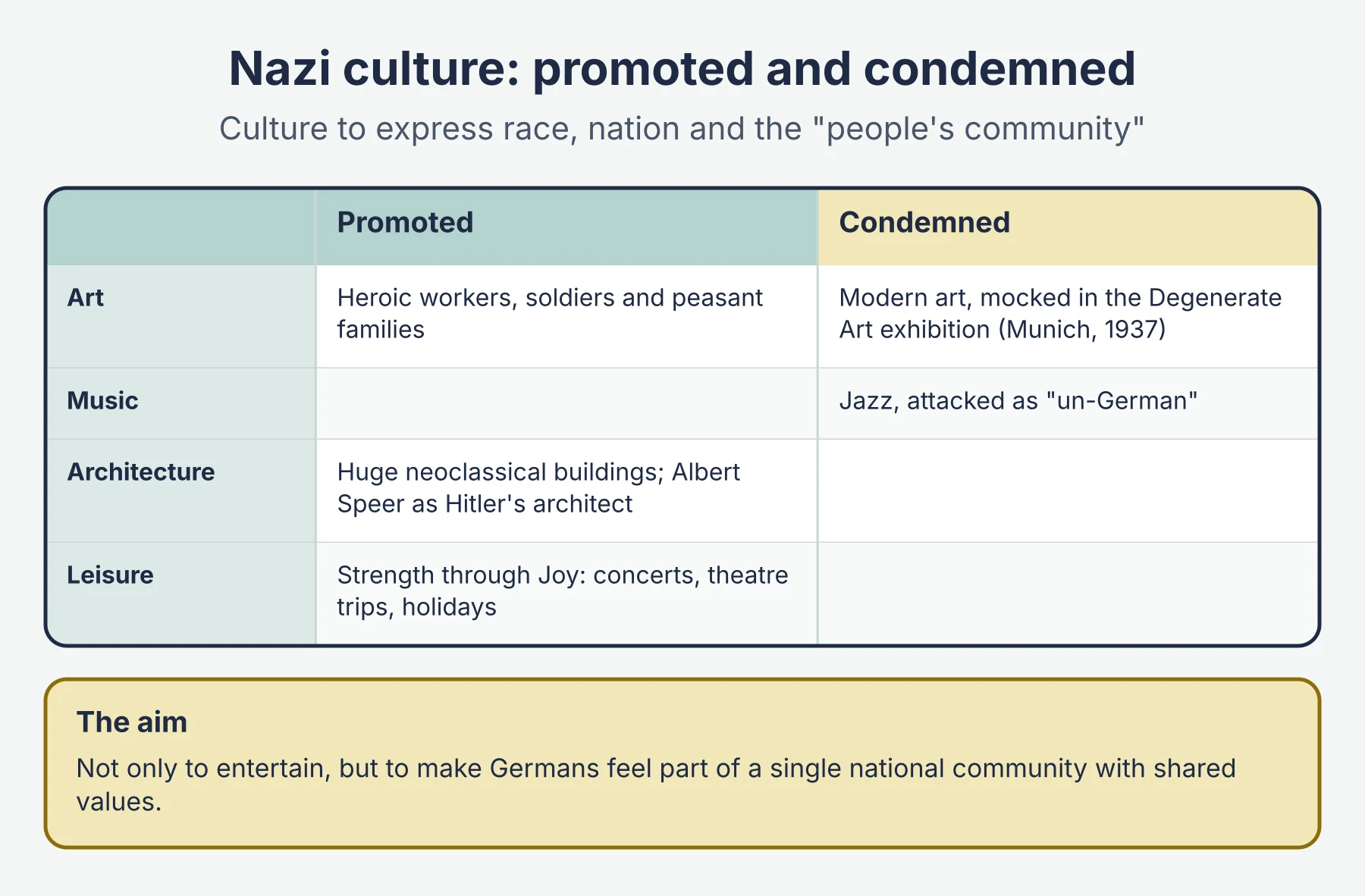
- Art of heroic workers, soldiers and peasant families; modern art labelled “degenerate”.
- Jazz condemned as “un-German”.
- Monumental architecture (Speer).
- Strength through Joy: organised leisure as part of the “people’s community”.
The police state
| Organisation | Role |
|---|---|
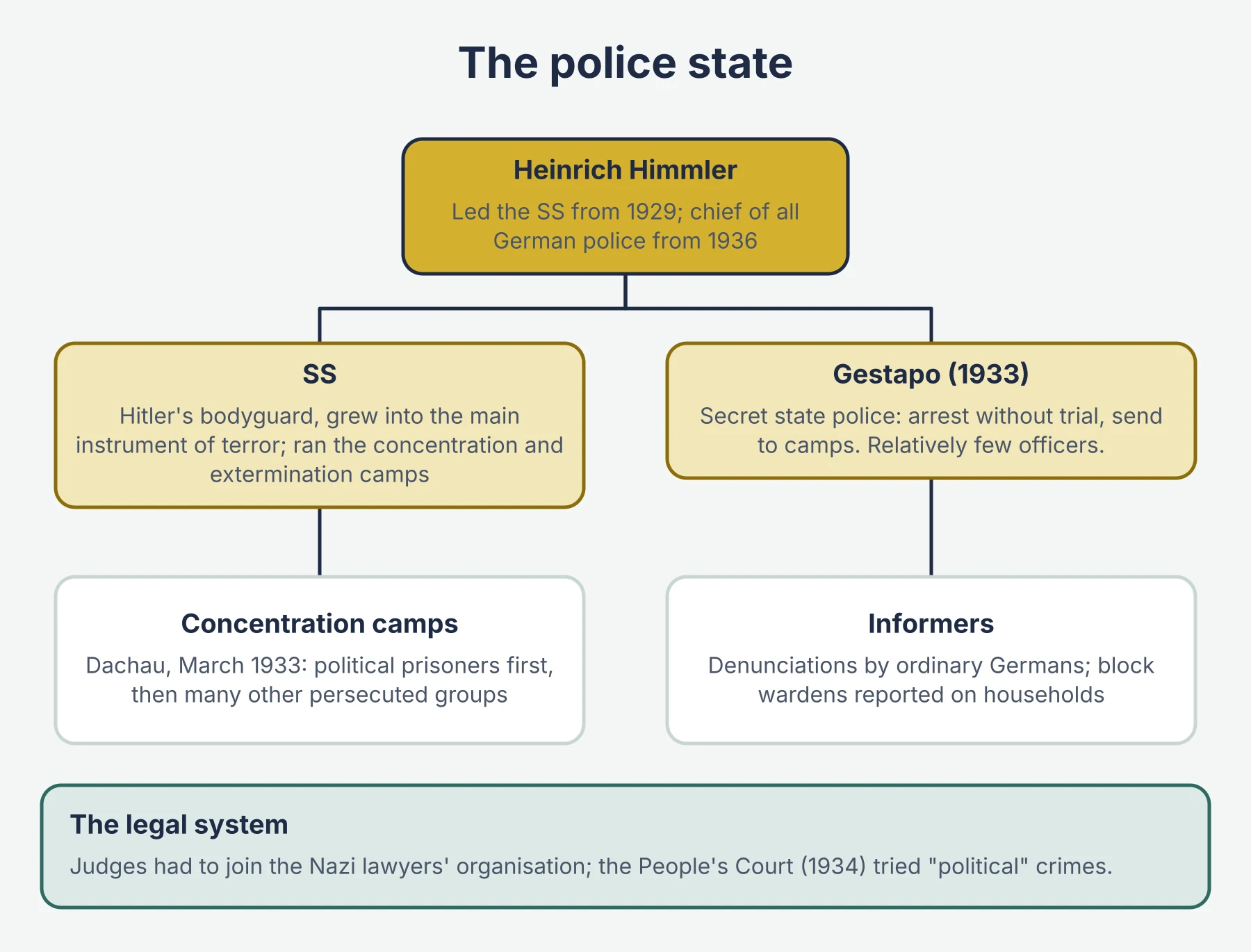
| SS | Elite force led by Himmler; ran the camps; grew into the main arm of terror |
| Gestapo | Secret state police; arrest without trial; relied on informers and denunciations |
| SD | The SS’s intelligence service |
| Concentration camps | Dachau first (1933); political opponents, then other persecuted groups |
| People’s Court | Tried political crimes from 1934 |
| Block wardens | Reported on households in their area |
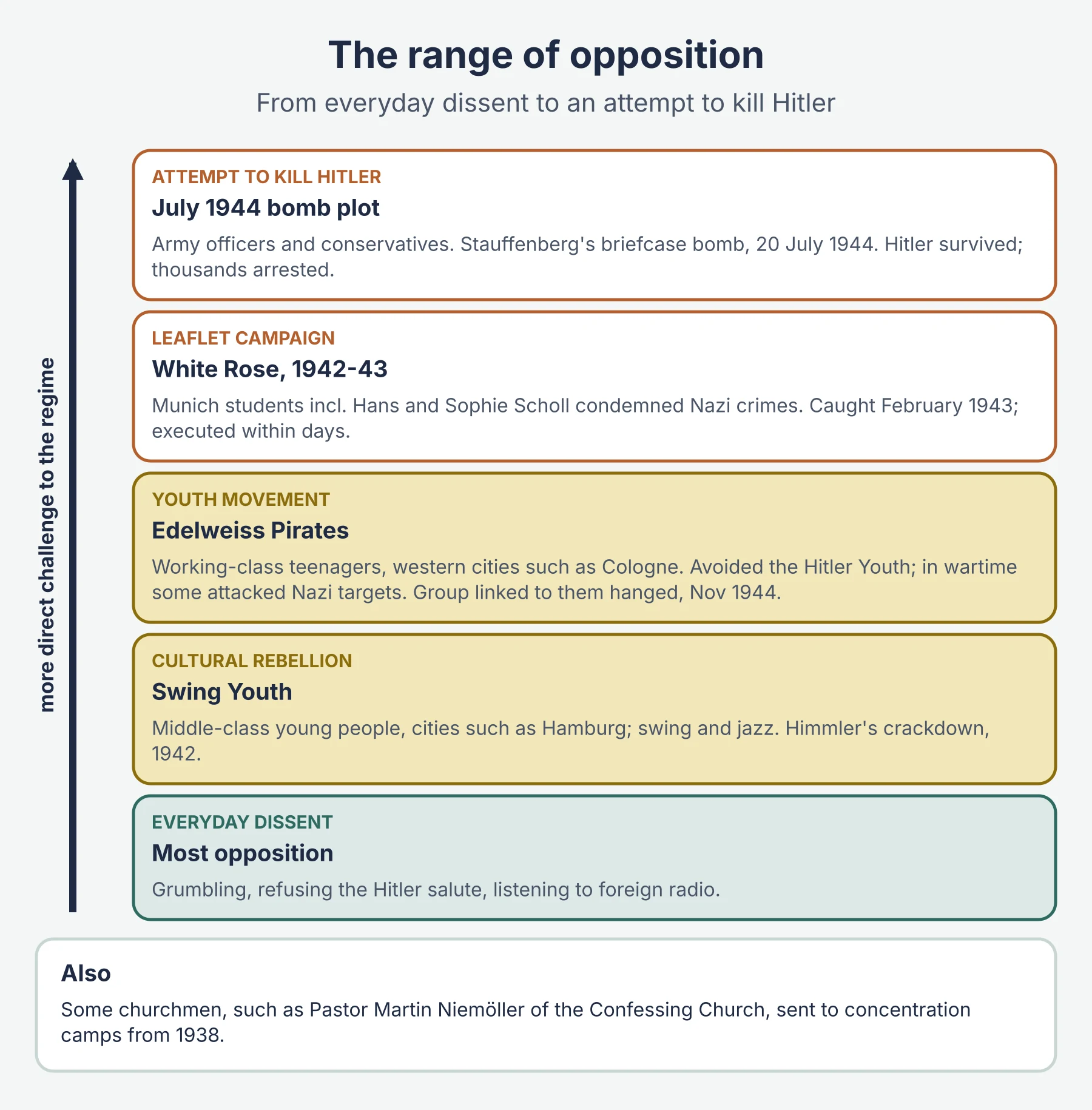
Opposition and resistance
| Group | Who | What they did | Fate |
|---|---|---|---|
| Swing Youth | Middle-class young people, e.g. Hamburg | Jazz, swing dancing, foreign fashions | Crackdown 1942; some leaders sent to camps |
| Edelweiss Pirates | Working-class teenagers, e.g. Cologne | Avoided Hitler Youth, banned songs, fights; wartime help to deserters | Arrests; public hanging in Cologne, 1944 |
| White Rose | Munich students incl. Hans and Sophie Scholl | Leaflets against Nazi crimes, 1942-43 | Executed February 1943 |
| July 1944 plotters | Army officers and conservatives; Stauffenberg | Bomb at Hitler’s East Prussian headquarters | Hitler survived; Stauffenberg shot; thousands arrested |
| Churchmen | e.g. Pastor Niemöller (Confessing Church) | Opposed Nazi control of the Protestant church | Concentration camps from 1938 |
Why opposition stayed small
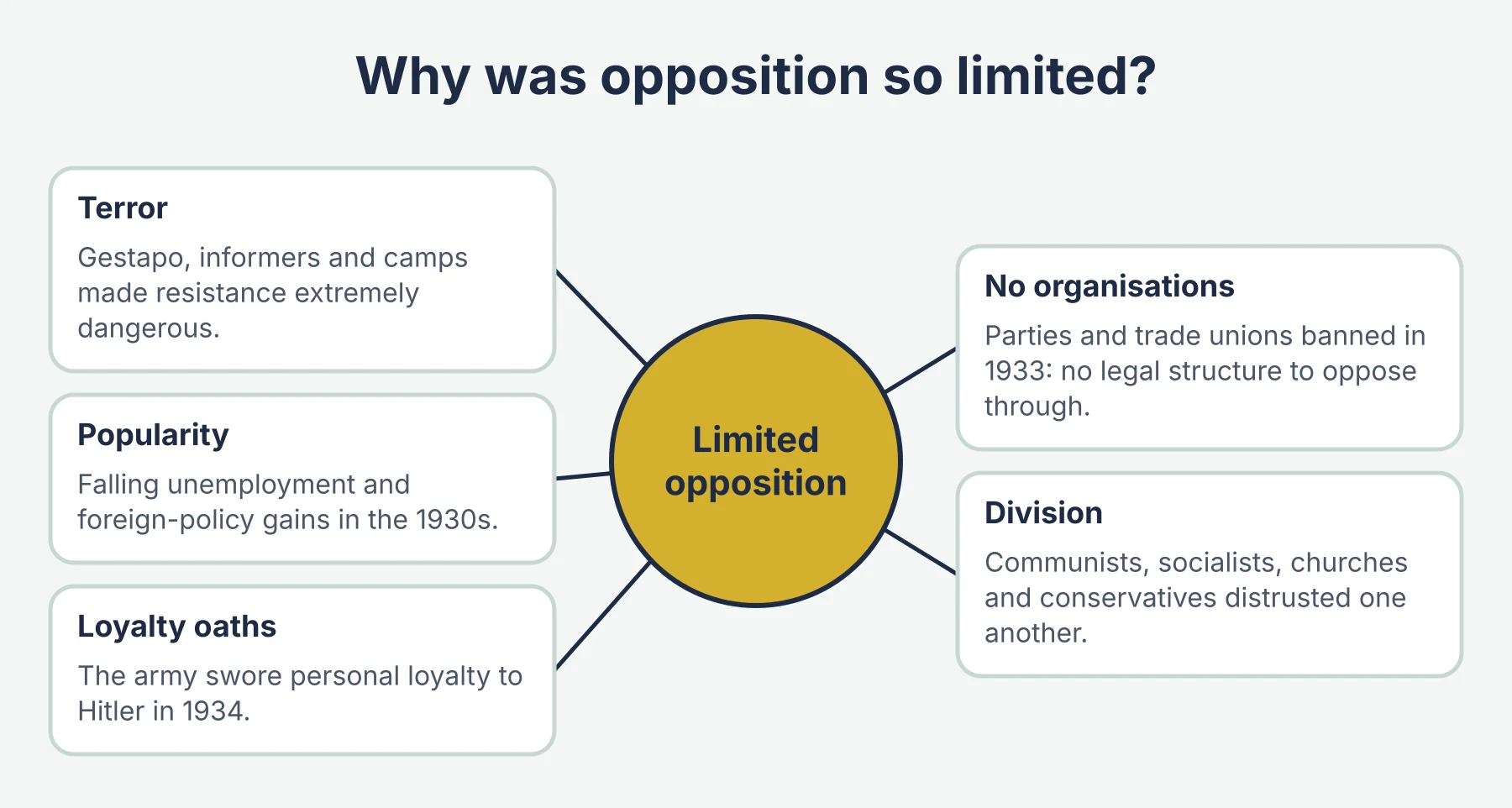
Terror and informers; popularity of jobs and foreign-policy gains; parties and unions banned in 1933; opponents divided; the army’s oath of loyalty to Hitler (1934).
Key terms
| Term | Meaning |
|---|---|
| Propaganda | Spreading ideas to shape what people think |
| Censorship | Controlling or banning what can be published, broadcast or performed |
| Police state | A state where the police control people through surveillance and fear |
| Denunciation | Reporting someone to the authorities |
| Concentration camp | Camp where people were imprisoned without trial |
| People’s community | Nazi ideal of a united racial nation (Volksgemeinschaft) |
| Degenerate art | Nazi label for modern art they rejected |
| Nonconformity | Refusing to behave as the regime expected, without organised resistance |
Exam traps
- Confusing Goebbels (propaganda) with Himmler (SS and police).
- Saying the Gestapo had huge numbers of officers watching everyone: its strength came from informers.
- Mixing up the White Rose (students, leaflets) and the Edelweiss Pirates (working-class youth groups).
- Dating the bomb plot to 1943 or Stauffenberg’s attempt to Berlin: it was 20 July 1944 at Hitler’s headquarters in East Prussia.
- In a question 6 essay, explaining propaganda and terror separately without a linked judgement.
Self-test
- Who led the Ministry of Propaganda from March 1933?
- What was the People’s Receiver?
- What happened on 10 May 1933?
- What did the Reich Chamber of Culture control?
- Which 1937 exhibition mocked modern art?
- Who led the SS?
- Why did the Gestapo depend on ordinary Germans?
- Where and when did the first concentration camp open?
- Which group was based at Munich University?
- Which youth group was linked with jazz and swing music?
- Who planted the bomb on 20 July 1944?
- Give two reasons why opposition to the Nazis was limited.
Answers
- Joseph Goebbels.
- A cheap radio set that helped put Nazi broadcasts into millions of homes.
- Book burnings of works by banned authors.
- Who could work in the arts, journalism and entertainment.
- The Degenerate Art exhibition in Munich.
- Heinrich Himmler.
- It had relatively few officers, so it relied on informers and denunciations.
- Dachau, March 1933.
- The White Rose.
- The Swing Youth.
- Claus von Stauffenberg.
- Any two: fear of the Gestapo and camps; popularity of Nazi successes; parties and unions banned; opponents divided; the army’s oath of loyalty.
Test yourself with the Nazi control and opposition practice questions.
Related resources
-
Study guides
AQA GCSE History (8145): Source Analysis and Usefulness Questions
How to answer AQA GCSE History 8145 Paper 1 Section B questions 1 and 2: reading cartoons and written sources, provenance, context and usefulness.
World History · AQA · GCSE
Read guide -
Practice questions
AQA GCSE History (8145): Source Analysis and Usefulness Questions – Practice Questions
Original AQA GCSE History 8145 Section B source practice: invented cartoons, letters and speeches for all five depth studies, with full worked answers.
World History · AQA · GCSE
Try questions -
Revision notes
AQA GCSE History (8145): Source Analysis and Usefulness Questions – Revision Notes
Revision notes for AQA GCSE History 8145 Paper 1 Section B questions 1 and 2: content, provenance and context, cartoon reading, usefulness and a self-test.
World History · AQA · GCSE
Revise topic
Get free revision emails (optional)
Occasional emails with practice questions, worked explanations and links to free resources for the qualification and subjects you choose. No spam, and you can unsubscribe from any email. The free tools on this site never need an email.