
Study Guides
AQA GCSE History (8145): Source Analysis and Usefulness Questions
How to answer AQA GCSE History 8145 Paper 1 Section B questions 1 and 2: reading cartoons and written sources, provenance, context and usefulness.
- Subject
- World History
- Level
- GCSE
- Topic
- Understanding the Modern World
- Author
- Marlbridge Academic Team
- Updated
- Reviewed by
- Azam Siddique (what this means)
Aligned to AQA GCSE World History (8145), first teaching 2016. Official specification .
Syllabus page (what it covers and how it is assessed): AQA GCSE World History.
Syllabus points this page covers
8145
- 3.2.2 Section B: Wider world depth studies
This page covers 1 of the 2 subtopics in topic 1, Understanding the modern world.
Found an error? Report a correction.
Need help with this topic? Request a free trial class for GCSE World History (8145).
This guide covers the two source questions that open Paper 1 Section B, the wider world depth study. The specification lists question 1 as “Source analysis” (4 marks) and question 2 as “How useful are sources…” (12 marks), adding that both “test AO3 and require the analysis and evaluation of sources. One source is supplied for the first question and two sources for the second. Different types of sources will be used, including visual and written sources.” The wider world depth studies study guide introduces these in a table and one short plan; this page teaches the reading skills behind them, with a full worked example on the Korean War.
What a source is
A source in Section B is evidence from the time: a cartoon, poster, photograph, speech, diary, letter, newspaper report, government document or memoir. Unlike the interpretations in Section A, sources are not later judgements; they are traces of what people saw, believed or wanted others to believe at the time. A source is never simply “true” or “false”. The question is always what it can tell an historian.
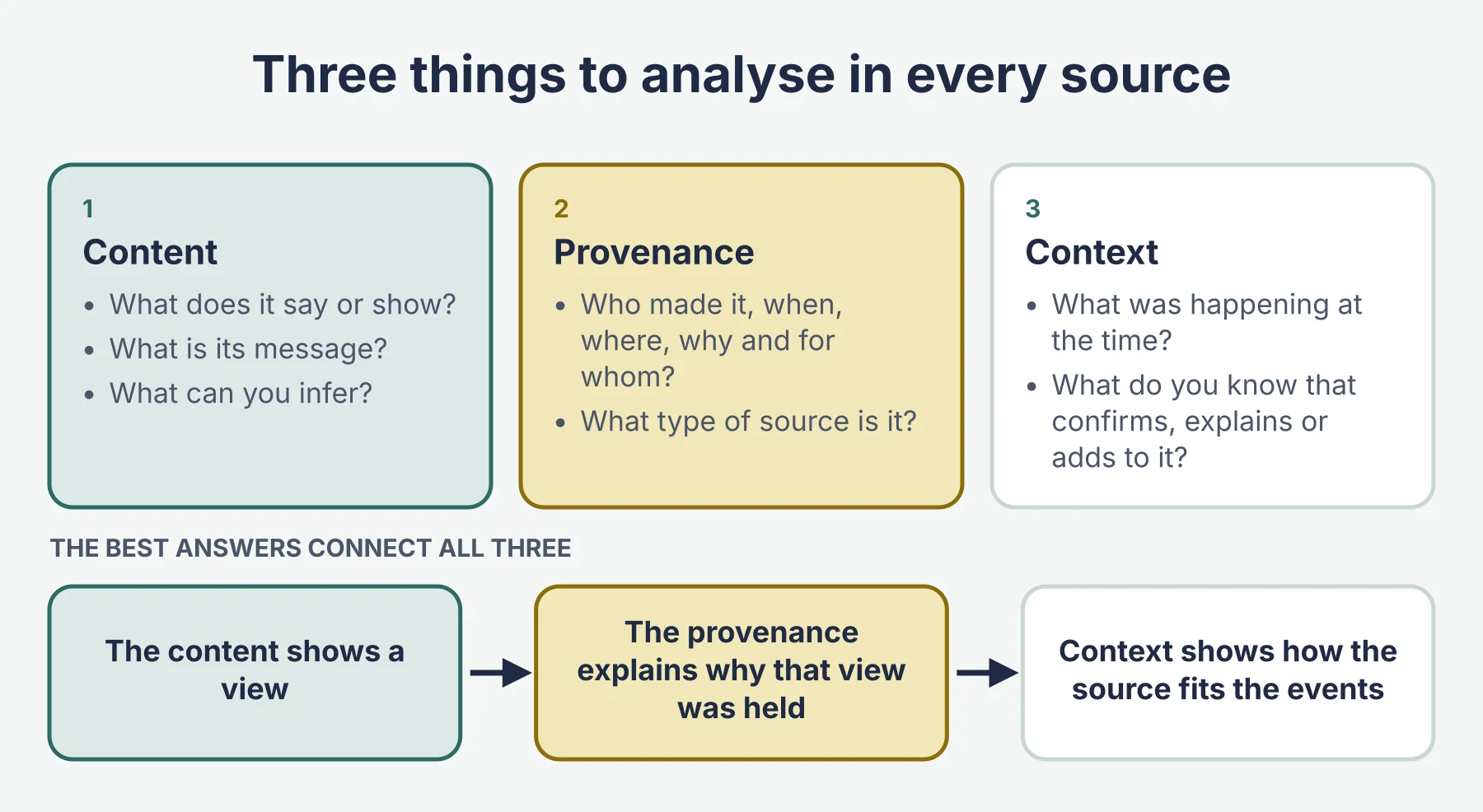
Three things to analyse in every source
| Element | Questions to ask |
|---|---|
| Content | What does it say or show? What is its message? What can you infer? |
| Provenance | Who made it, when, where, why and for whom? What type of source is it? |
| Context | What was happening when it was made? What do you know that confirms, explains or adds to it? |
The best answers connect all three: the content shows a view, the provenance explains why that view was held, and contextual knowledge shows how the source fits the events.
Reading a cartoon
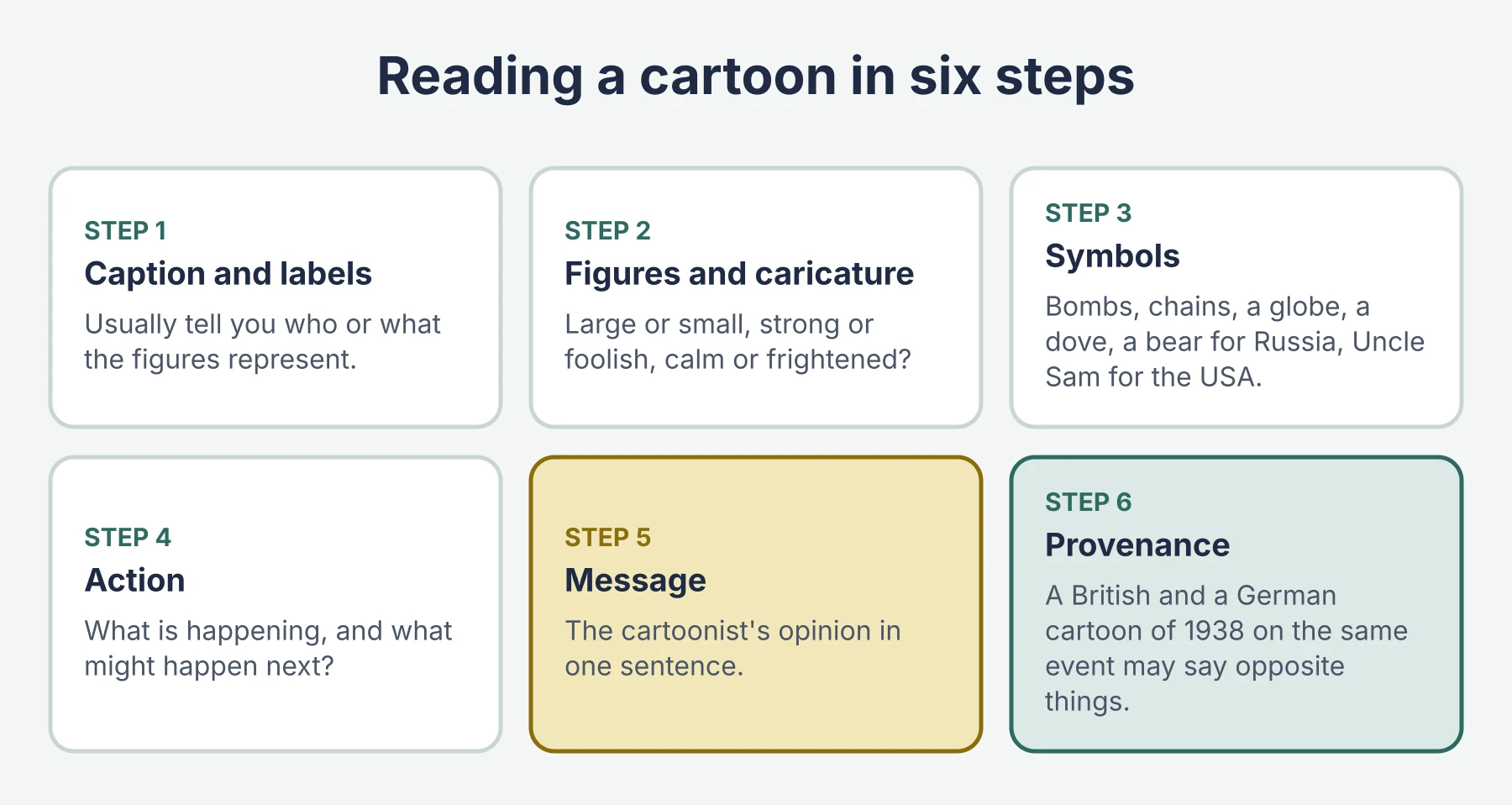
Cartoons appear often because they compress an argument into one image. Work through them in order:
- Caption and labels. These usually tell you who or what the figures represent.
- Figures and caricature. How are leaders drawn: large or small, strong or foolish, calm or frightened?
- Symbols. Bombs, chains, a globe, a dove, a bear for Russia, Uncle Sam for the USA.
- Action. What is happening, and what might happen next?
- Message. Put the cartoonist’s opinion into one sentence.
- Provenance. A British cartoon of 1938 and a German one of 1938 on the same event may say opposite things; the publication and date tell you why.
Question 1: source analysis (4 marks)
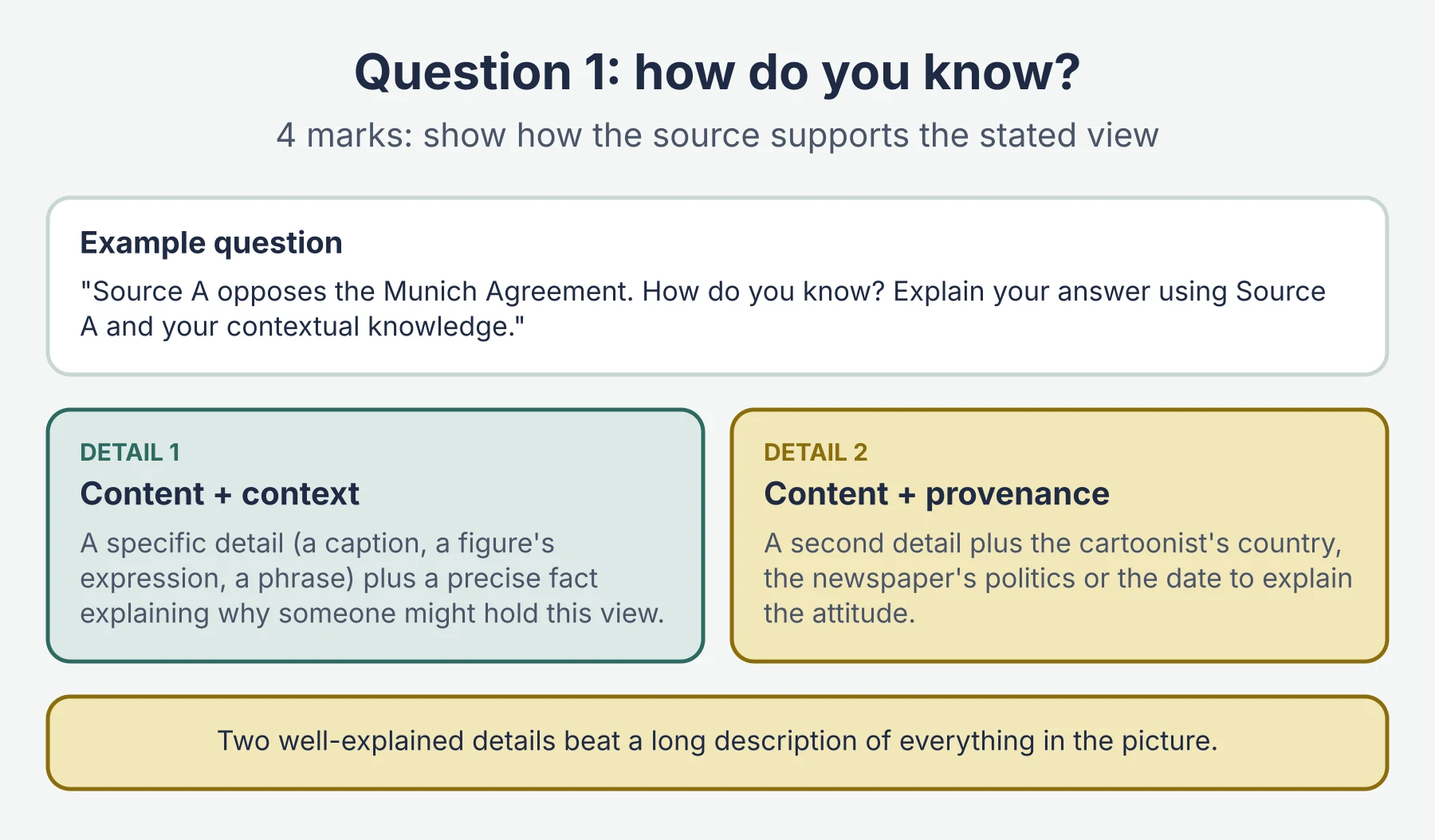
The question typically states a view and asks how you know the source supports it, for example: “Source A opposes the Munich Agreement. How do you know? Explain your answer using Source A and your contextual knowledge.” To answer:
- Use the content. Point to specific details in the source, such as a caption, a figure’s expression, a phrase, that show the view.
- Use contextual knowledge. Add a precise fact that explains why someone at the time might hold this view.
- Use provenance where it helps. The cartoonist’s country, the newspaper’s politics or the date may explain the attitude.
Two well-explained details, one supported by context and one by provenance, are better than a long description of everything in the picture.
Question 2: how useful are two sources? (12 marks)
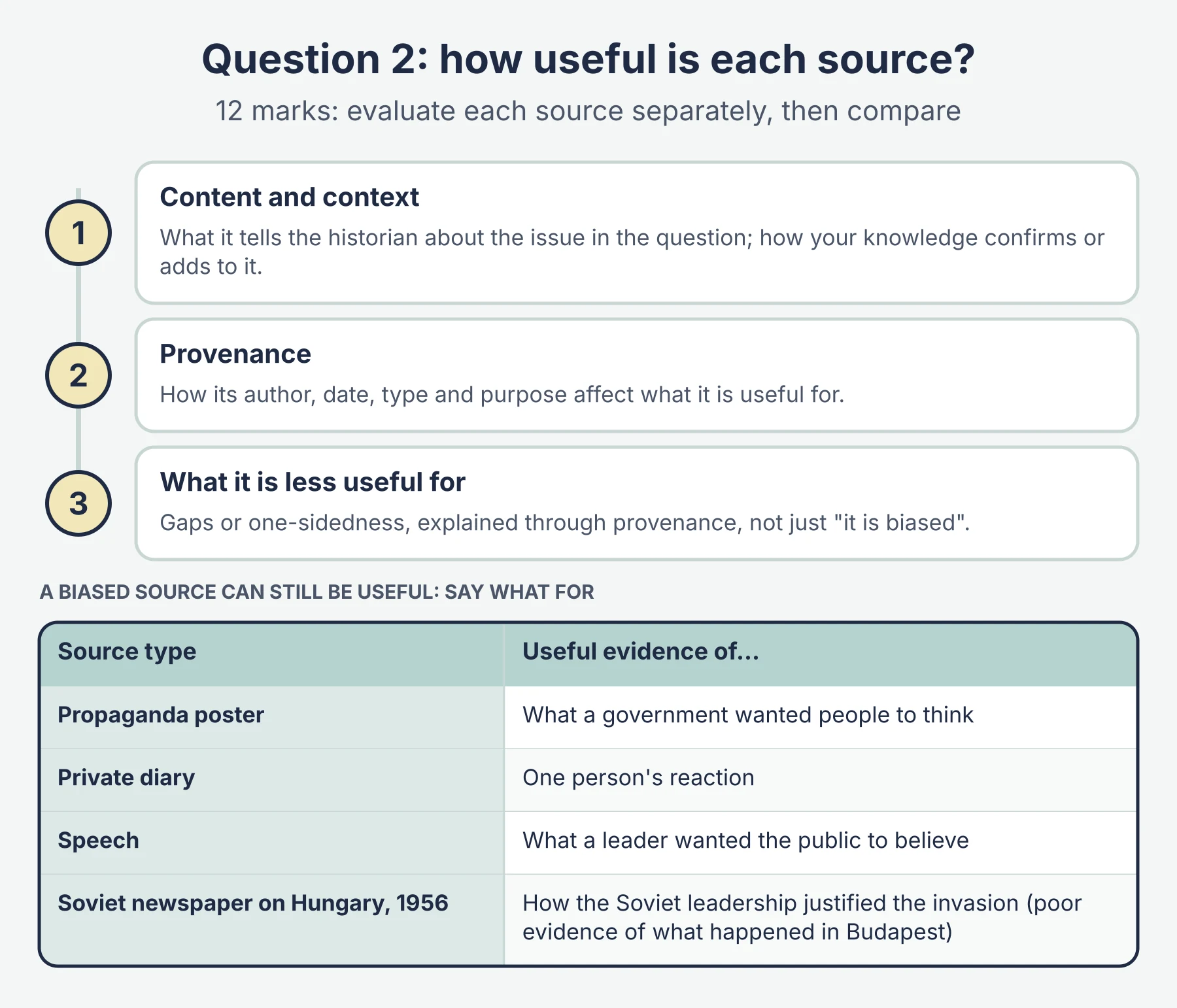
The question asks “How useful are Sources B and C to an historian studying…?” Evaluate each source separately, then compare them if you can.
For each source:
- Content and context: what it tells the historian about the issue named in the question, and how your knowledge confirms or adds to it.
- Provenance: how its author, date, type and purpose affect what it is useful for. A propaganda poster is useful evidence of what a government wanted people to think. A private diary is useful for one person’s reaction. A speech is useful for what a leader wanted the public to believe.
- What it is less useful for: gaps or one-sidedness, explained in terms of provenance, not just “it is biased”.
A biased source can still be very useful; the skill is to say what for. A Soviet newspaper’s account of the Hungarian rising of 1956 is poor evidence of what happened in Budapest, but good evidence of how the Soviet leadership justified the invasion.
Worked example: BD Conflict and tension in Asia
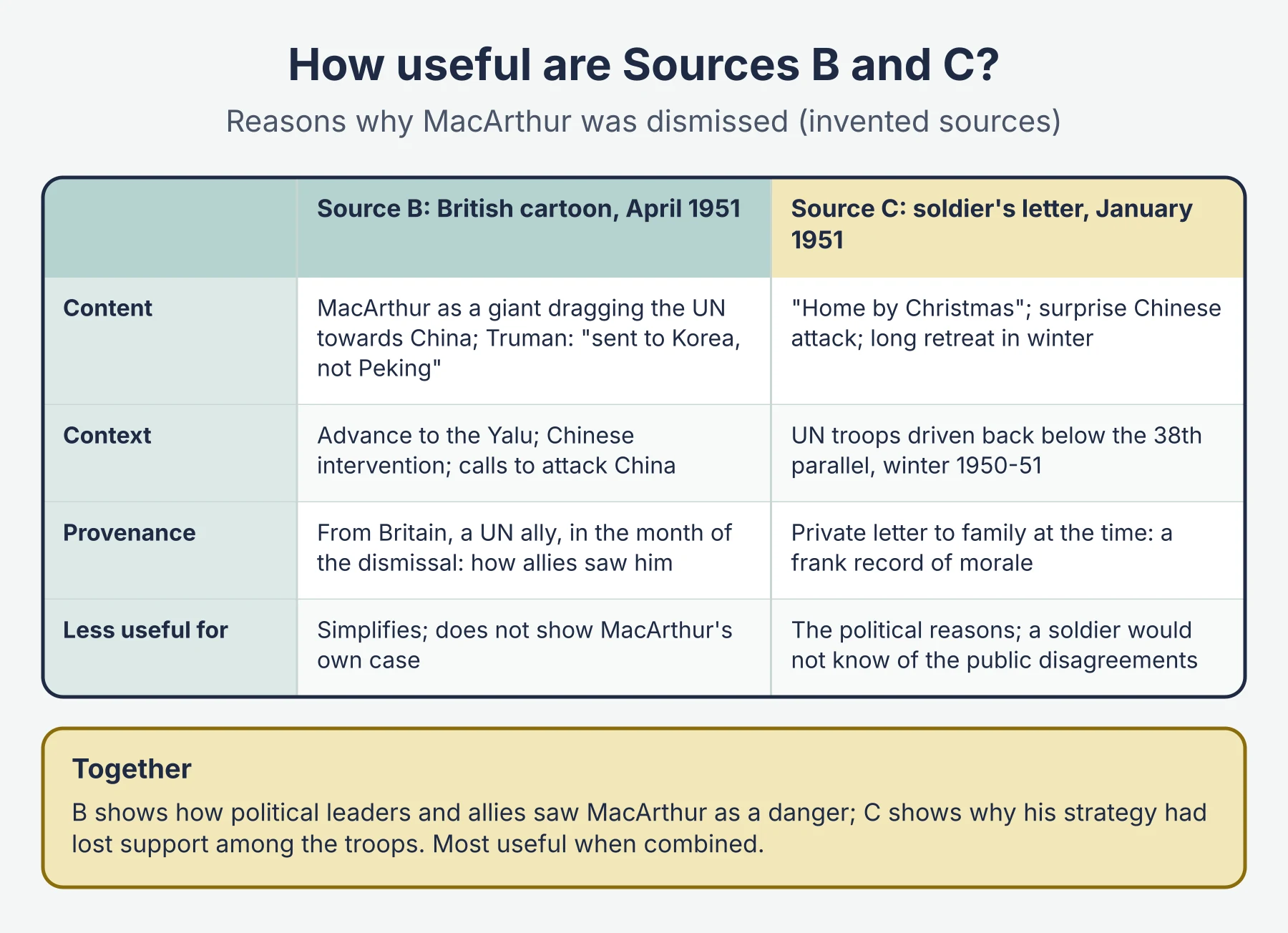
Source B (invented for practice) – A description of a cartoon imagined as published in a British newspaper in April 1951. A tall general in sunglasses, labelled “MacArthur”, strides towards a map marked “China”, dragging behind him a small, worried figure labelled “UN”. President Truman, holding a telephone, calls after him: “General, you were sent to Korea, not Peking.”
Source C (invented for practice) – From a letter imagined as written by an American soldier in Korea to his parents, January 1951. “We were told we would be home by Christmas. Then the Chinese came over the hills at night, thousands of them, blowing whistles and bugles. We pulled back through the snow for days. Nobody here wants to fight all of China. We just want to hold the line and go home.”
How useful are Sources B and C to an historian studying the reasons why MacArthur was dismissed? [12]
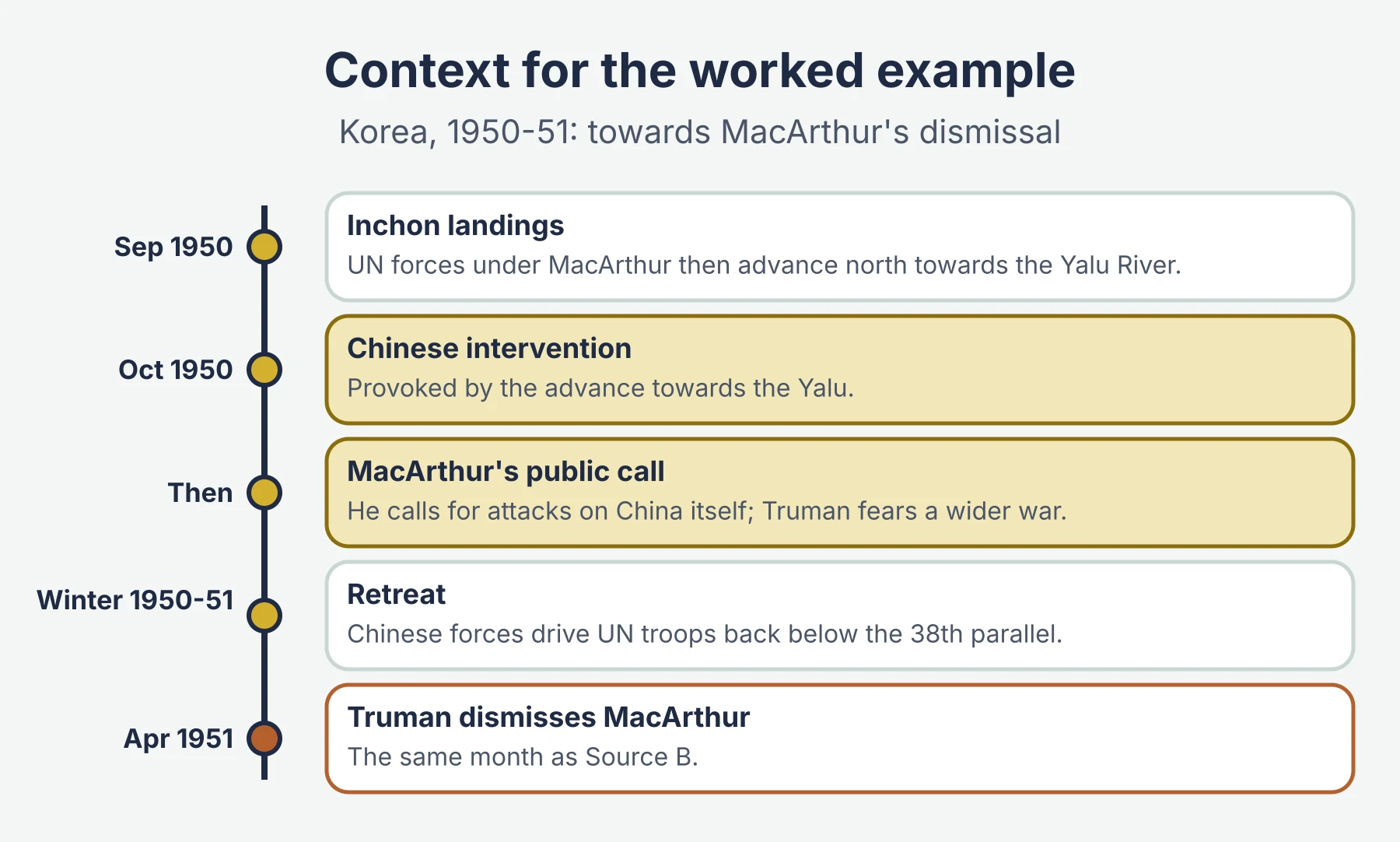
Source B is useful because its content shows a fear that MacArthur was going beyond the limited war the United Nations had agreed to fight. He is drawn as a giant pulling the UN along behind him towards China, while Truman reminds him that his task was Korea. This fits my knowledge: after the Inchon landings of September 1950, UN forces under MacArthur advanced north towards the Yalu River, provoking Chinese intervention in October 1950, and MacArthur then publicly called for attacks on China itself, which Truman feared would start a wider war. The provenance adds to its usefulness: it was published in Britain, a UN ally, in April 1951, the month Truman dismissed MacArthur, so it shows how America’s allies viewed the general’s actions. As a cartoon, it simplifies the issue and does not show MacArthur’s own case, that only total victory would end the war.
Source C is useful in a different way. It shows the effect of MacArthur’s strategy on ordinary soldiers: the promise to be “home by Christmas”, the surprise of the Chinese attack and the long retreat in winter. My knowledge confirms that Chinese forces drove UN troops back below the 38th parallel in the winter of 1950-51. Its provenance as a private letter from a soldier, written at the time to his family, makes it a frank record of morale, and it shows that many soldiers wanted a limited war, which supports Truman’s decision. It is less useful on the political reasons for the dismissal, because a soldier would not know about MacArthur’s public disagreements with the President.
Together, B shows how political leaders and allies saw MacArthur as a danger, while C shows why his strategy had lost support among the troops, so they are most useful when combined.
Common mistakes
- Describing the source in detail without saying what it shows about the question.
- “It is biased so it is not useful.” Every source is useful for something; say what.
- Generic provenance: “it was written at the time so it is reliable” without explaining why that matters here.
- No contextual knowledge, or knowledge not linked to the source.
- Evaluating only one source in question 2.
- Confusing usefulness with reliability: an unreliable source can be useful evidence of attitudes.
Exam technique
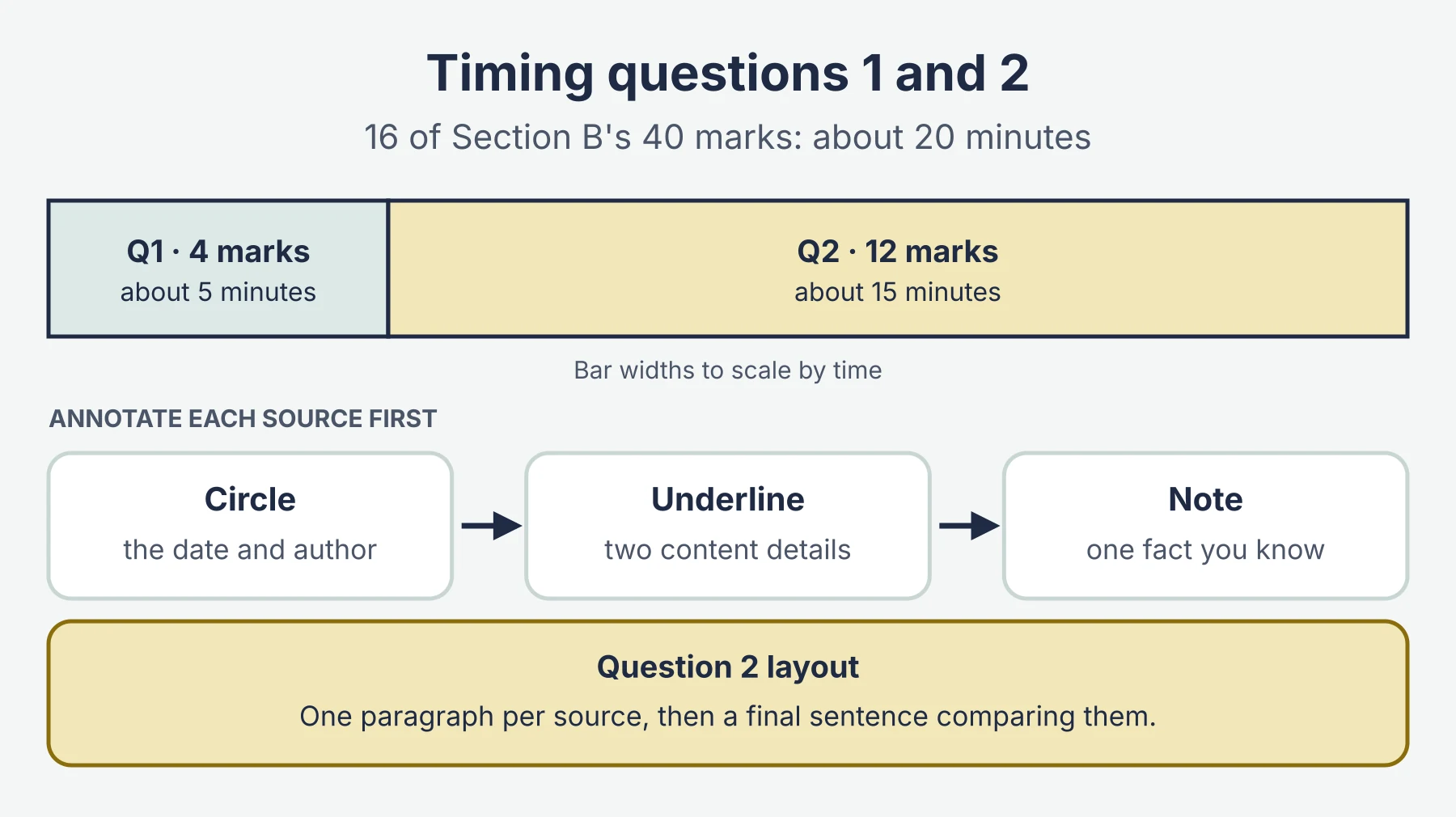
Questions 1 and 2 together are 16 of Section B’s 40 marks, so allow around 20 minutes: about five for question 1 and fifteen for question 2. Annotate each source quickly: circle the date and author, underline two content details, note one fact you know. Write a paragraph per source in question 2, and finish with a sentence comparing them.
Further practice
- Source analysis and usefulness revision notes
- Source analysis and usefulness practice questions
- Wider world depth studies practice
Specification
AQA GCSE History (8145) specification, section 4.4.1 (Paper 1 Section B, questions 1 and 2) and section 3.2.2 (wider world depth studies) – aqa.org.uk.
Related resources
-
Practice questions
AQA GCSE History (8145): Source Analysis and Usefulness Questions – Practice Questions
Original AQA GCSE History 8145 Section B source practice: invented cartoons, letters and speeches for all five depth studies, with full worked answers.
World History · AQA · GCSE
Try questions -
Revision notes
AQA GCSE History (8145): Source Analysis and Usefulness Questions – Revision Notes
Revision notes for AQA GCSE History 8145 Paper 1 Section B questions 1 and 2: content, provenance and context, cartoon reading, usefulness and a self-test.
World History · AQA · GCSE
Revise topic -
Study guides
AQA GCSE History (8145): Stalin's Modernisation of the USSR
AQA GCSE History 8145 Russia: collectivisation, the Five-Year Plans, their impact on kulaks, city dwellers, women and workers, and how far the USSR modernised.
World History · AQA · GCSE
Read guide
Get free revision emails (optional)
Occasional emails with practice questions, worked explanations and links to free resources for the qualification and subjects you choose. No spam, and you can unsubscribe from any email. The free tools on this site never need an email.