
Study Guides
AQA GCSE History (8145): Stalin's Modernisation of the USSR
AQA GCSE History 8145 Russia: collectivisation, the Five-Year Plans, their impact on kulaks, city dwellers, women and workers, and how far the USSR modernised.
- Subject
- World History
- Level
- GCSE
- Topic
- Understanding the Modern World
- Author
- Marlbridge Academic Team
- Updated
- Reviewed by
- Azam Siddique (what this means)
Aligned to AQA GCSE World History (8145), first teaching 2016. Official specification .
Syllabus page (what it covers and how it is assessed): AQA GCSE World History.
Syllabus points this page covers
8145
- 3.2.1 Section A: Period studies
This page covers 1 of the 2 subtopics in topic 1, Understanding the modern world.
Found an error? Report a correction.
Need help with this topic? Request a free trial class for GCSE World History (8145).
This guide covers “Stalin’s modernisation of the USSR”, a content statement in Part three of AC Russia, 1894-1945: Tsardom and communism. The specification lists: “collectivisation; the Five Year Plans; social and economic consequences for Kulaks, city dwellers, women, professional and industrial workers; the extent of modernisation.” The Section A period studies study guide gives this a single sentence; this page explains why Stalin modernised, how each policy worked, what it meant for each named group, and how to judge the “extent of modernisation” in an essay.
Why did Stalin modernise?
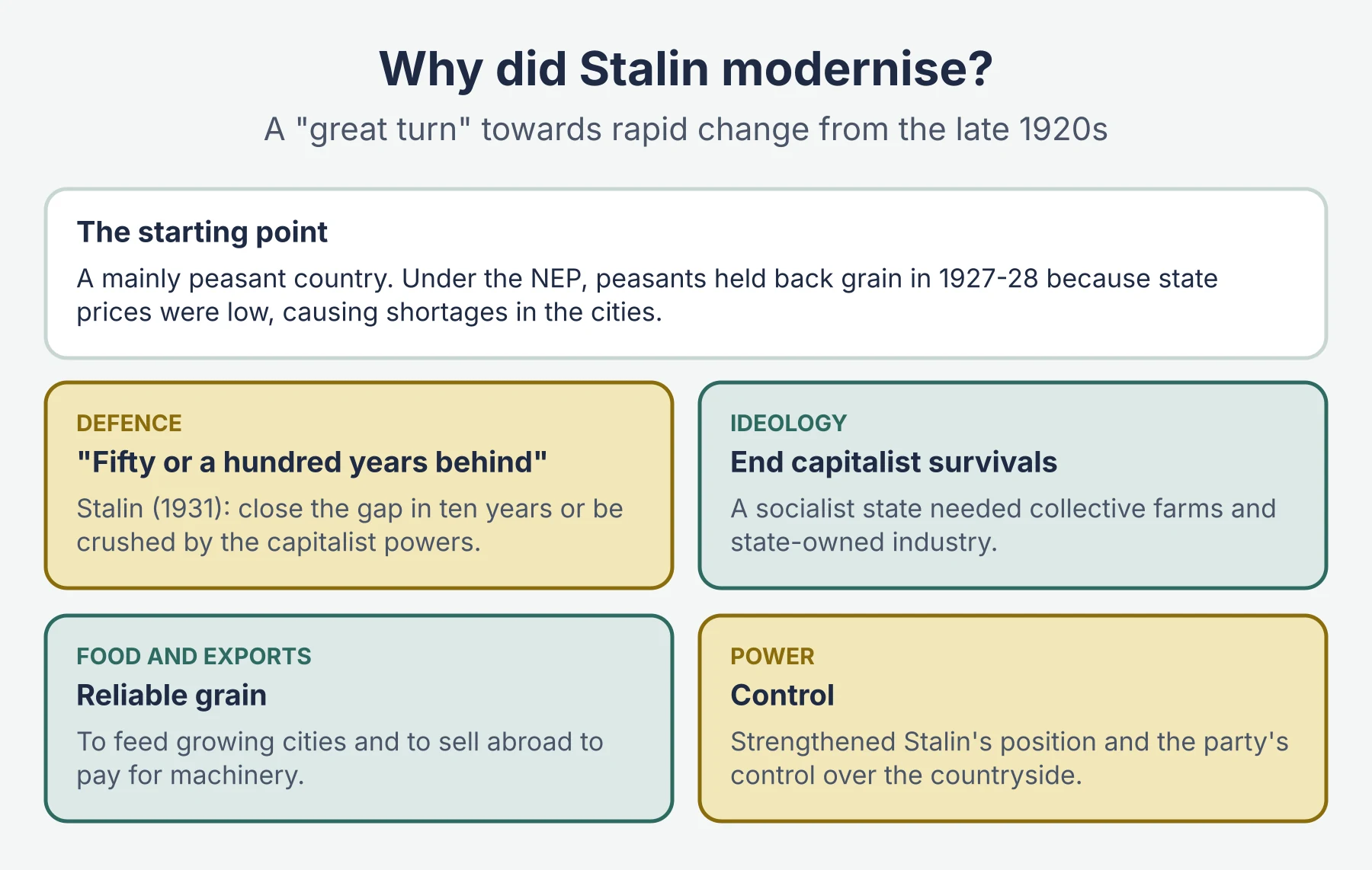
When Stalin had won the power struggle by the late 1920s, the USSR was still a mainly peasant country. Lenin’s New Economic Policy had allowed private trade, and in 1927-28 peasants held back grain because state prices were low, causing shortages in the cities. Stalin’s reasons for a “great turn” towards rapid change combined several aims:
- Defence. Stalin believed the capitalist powers would attack the USSR. In 1931 he warned that the country was “fifty or a hundred years behind the advanced countries” and must close the gap in ten years or be crushed.
- Ideology. Communists saw private farming and trade as capitalist survivals; a socialist state needed collective farms and state-owned industry.
- Food and exports. The state needed reliable grain supplies to feed growing cities and to sell abroad to pay for machinery.
- Power. Driving the economy forward strengthened Stalin’s position and the party’s control over the countryside.
Collectivisation
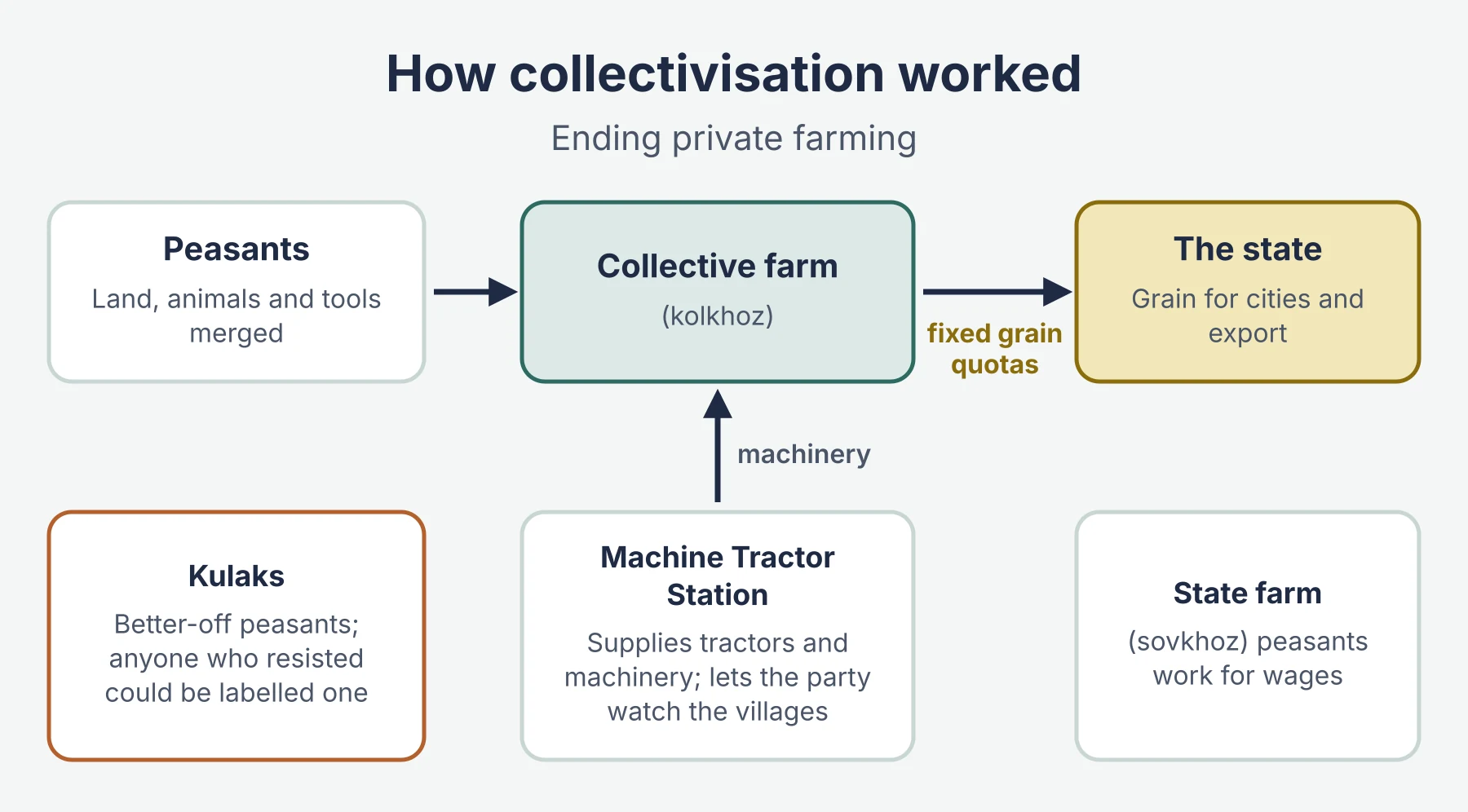
Collectivisation meant ending private farming. Peasant land, animals and tools were merged into collective farms (kolkhozy), which had to deliver fixed quotas of grain to the state; some land became state farms (sovkhozy), where peasants worked for wages. Tractors and machinery were supplied through Machine Tractor Stations, which also let the party keep watch on the villages.
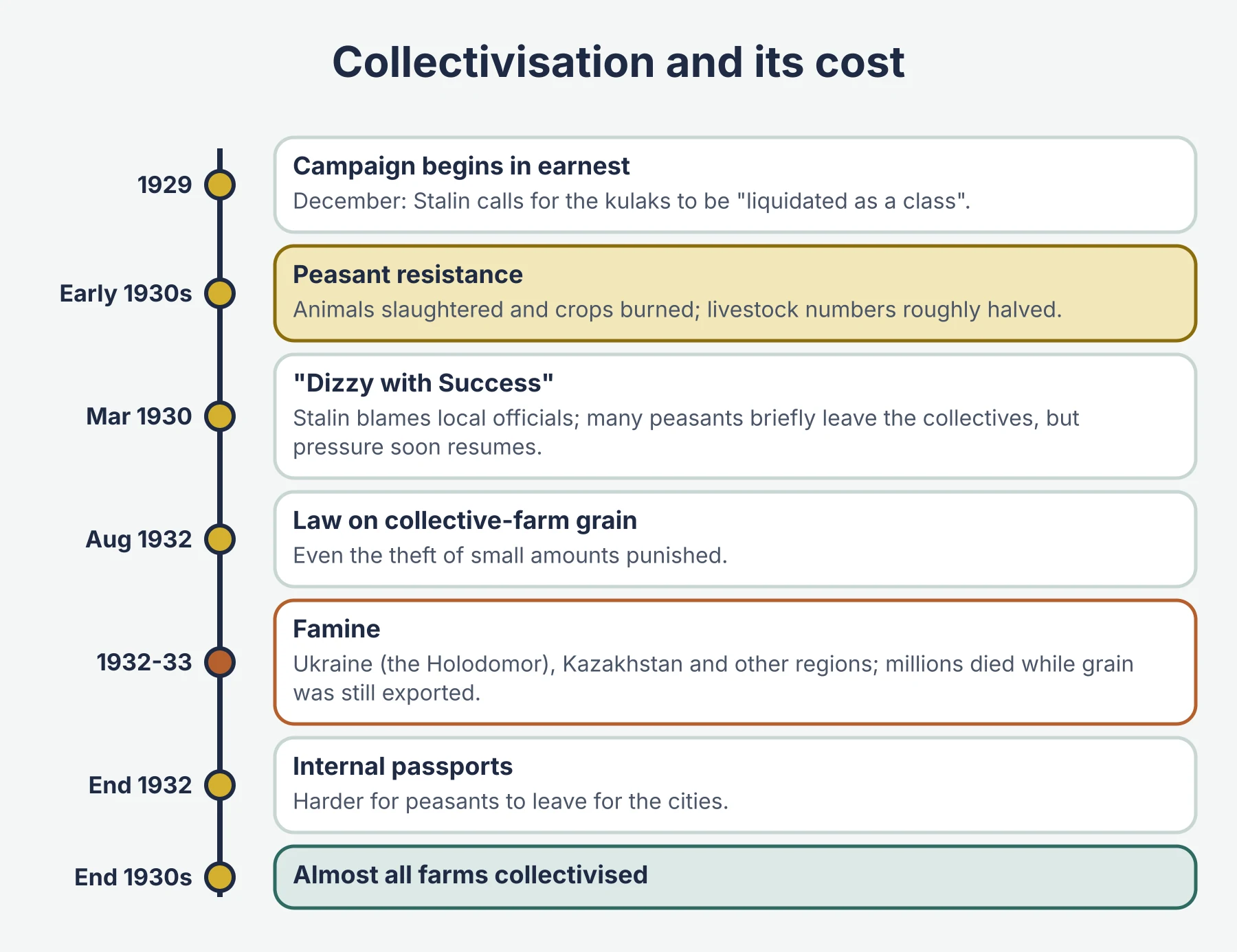
The campaign began in earnest in 1929. In December 1929 Stalin called for the kulaks, the better-off peasants, to be “liquidated as a class”. In practice anyone who resisted could be labelled a kulak. Many peasants slaughtered their animals and burned crops rather than hand them over; livestock numbers roughly halved in the early 1930s. In March 1930 Stalin’s article “Dizzy with Success” blamed local officials for going too fast, and many peasants briefly left the collectives, but pressure soon resumed. By the end of the 1930s almost all farms had been collectivised.
The consequences were catastrophic. Quotas were set so high that in 1932-33 famine struck Ukraine, Kazakhstan and other regions; millions died. In Ukraine the famine is known as the Holodomor. Grain continued to be exported, and a law of August 1932 punished even the theft of small amounts of collective-farm grain. Internal passports, introduced at the end of 1932, made it harder for peasants to leave for the cities.
The Five-Year Plans
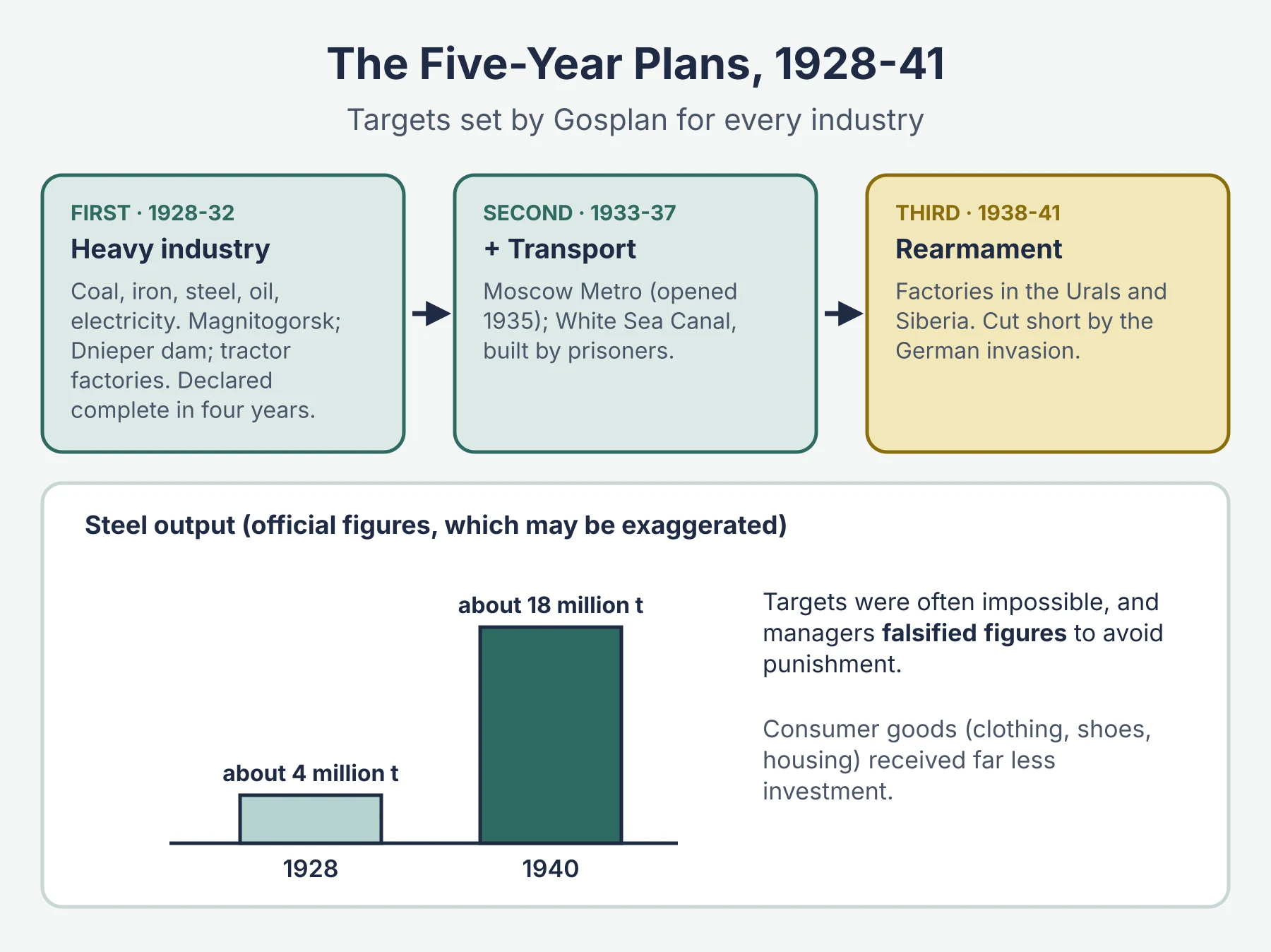
The Five-Year Plans, drawn up by the state planning agency Gosplan, set production targets for every industry and enterprise.
| Plan | Years | Main focus | Examples |
|---|---|---|---|
| First | 1928-32 (declared complete in four years) | Heavy industry: coal, iron, steel, oil, electricity | New steel city of Magnitogorsk; Dnieper dam; tractor factories |
| Second | 1933-37 | Heavy industry plus transport and communications | Moscow Metro (opened 1935); White Sea Canal, built by prisoners |
| Third | 1938-41 (cut short by the German invasion) | Rearmament and defence industries | Factories in the Urals and Siberia |
Targets were often impossible, and managers falsified figures to avoid punishment. Official figures, which may be exaggerated, claimed that steel output rose from about 4 million tonnes in 1928 to about 18 million in 1940. Consumer goods such as clothing, shoes and housing received far less investment.
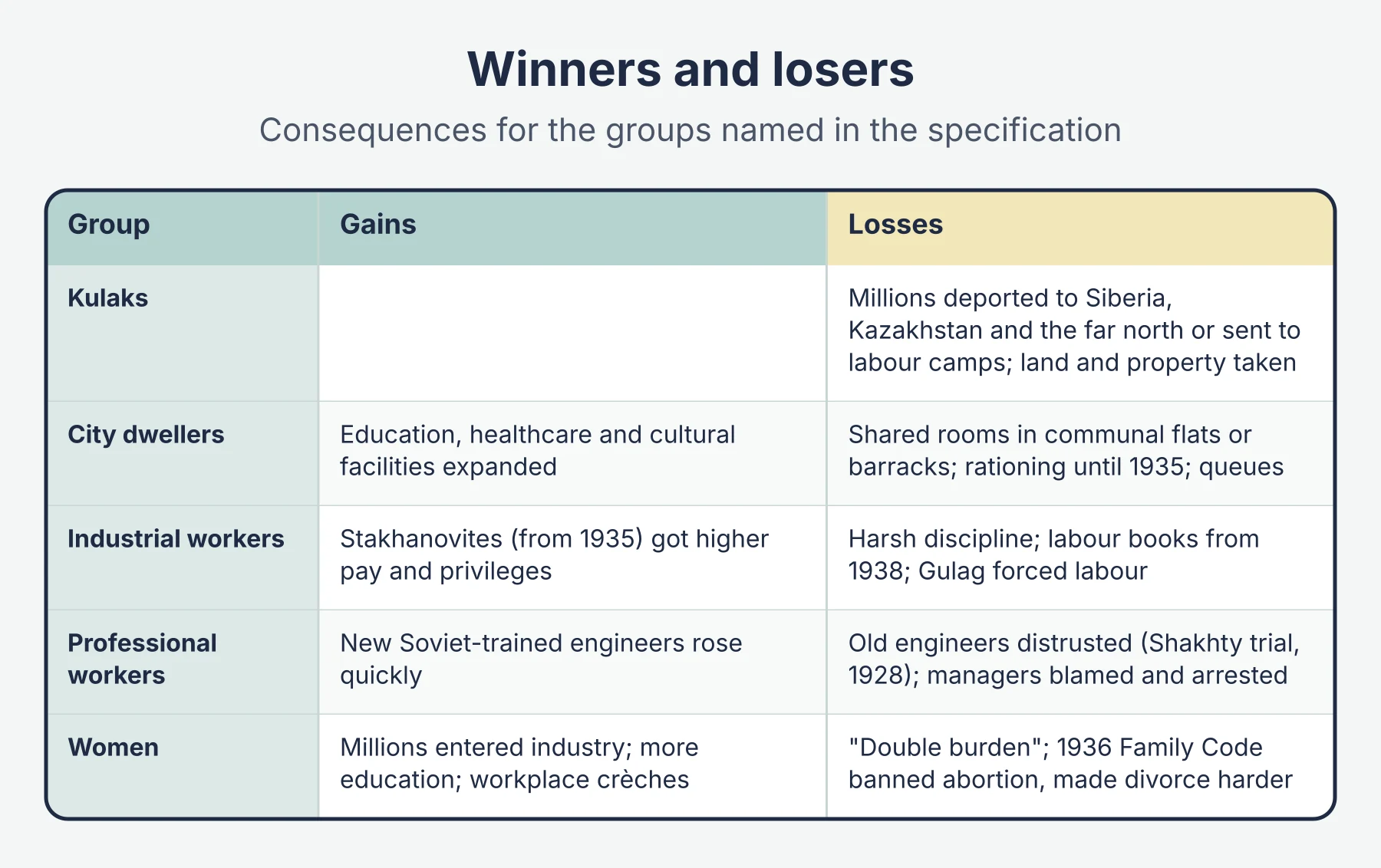
Consequences for the groups named in the specification
Kulaks. Millions were deported to Siberia, Kazakhstan and the far north or sent to labour camps; many died on the journey or in the settlements. Their land and property were taken by the collectives.
City dwellers. Cities grew rapidly as millions of peasants moved to work in factories. Housing could not keep up, so many families shared a single room in a communal flat or lived in barracks. Food was rationed until 1935, and queues for scarce goods were part of daily life. On the other hand, education, healthcare and cultural facilities expanded.
Industrial workers. Discipline was harsh: lateness or absence could mean losing a job, housing or ration card, and from 1938 workers had to carry labour books recording their employment. Wages varied according to output. In 1935 the miner Alexei Stakhanov was reported to have cut many times his quota of coal in a single shift, and the Stakhanovite movement held up record-breaking workers as models, with higher pay and privileges. Prisoners in the Gulag provided forced labour for projects such as canals, mines and railways.
Professional workers. Engineers and managers trained before the revolution were distrusted; in the Shakhty trial of 1928 engineers were accused of sabotage. Managers faced constant pressure to meet targets and could be blamed and arrested if they failed, a danger that grew during the purges. At the same time, a new generation of Soviet-trained engineers and technicians rose quickly into these posts.
Women. Millions of women entered industry, construction and transport, and more girls received education; crèches were provided in many workplaces. However, women usually kept full responsibility for housework and children, a “double burden”. The 1936 Family Code banned abortion and made divorce more difficult, reflecting Stalin’s push to raise the birth rate.
The extent of modernisation
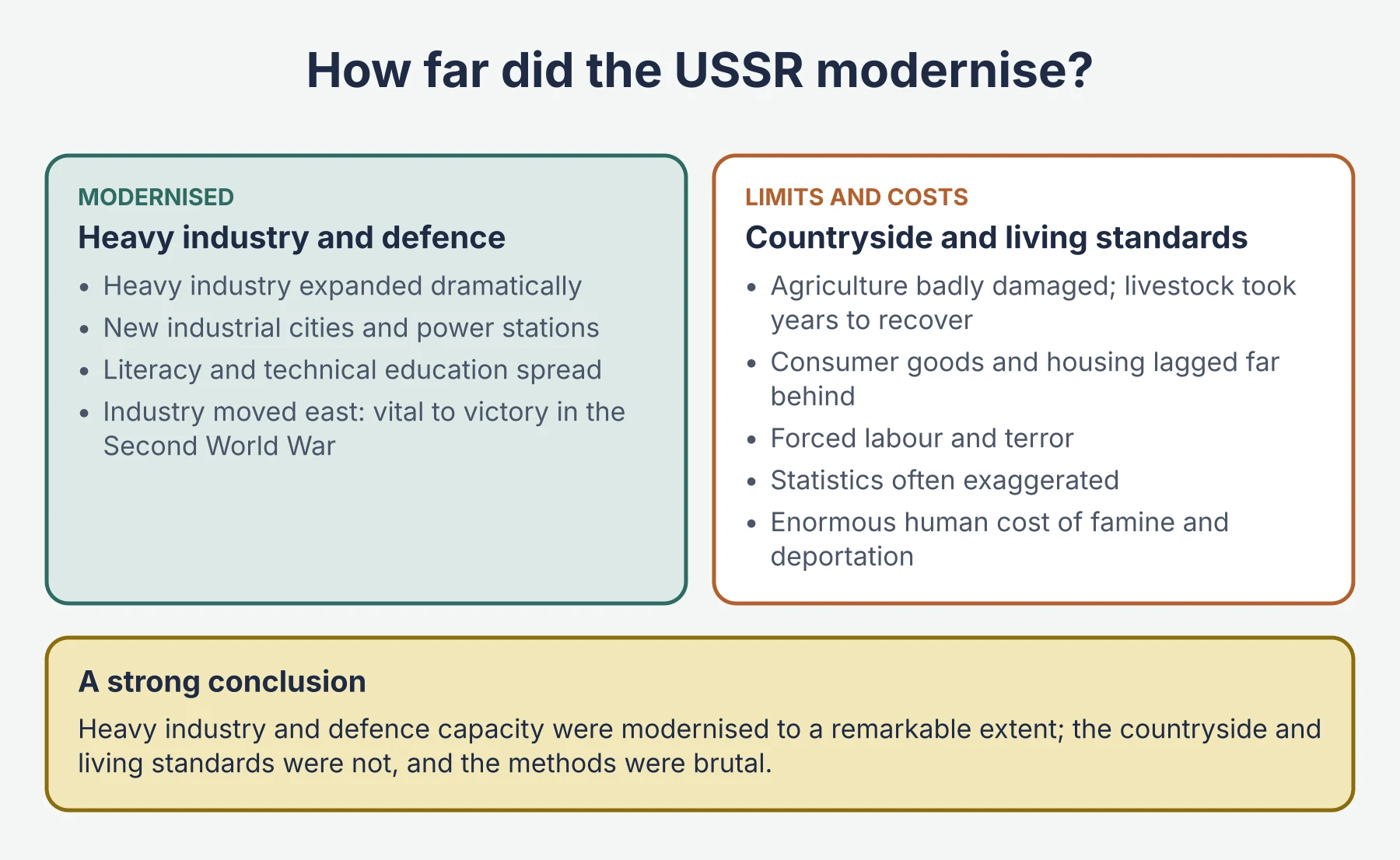
A judgement on “the extent of modernisation” needs to weigh different kinds of evidence.
Evidence of modernisation: heavy industry expanded dramatically; new industrial cities and power stations were built; literacy and technical education spread; industry relocated eastwards was vital to Soviet victory in the Second World War.
Evidence of limits and costs: agriculture was badly damaged and livestock losses took years to recover; consumer goods and housing lagged far behind; many achievements relied on forced labour and terror; statistics were often exaggerated; the human cost of famine and deportation was enormous.
A strong conclusion might argue that the USSR modernised its heavy industry and defence capacity to a remarkable extent, but that the countryside and living standards were not modernised in the same way, and that the methods used were brutal.
Worked example: question 5
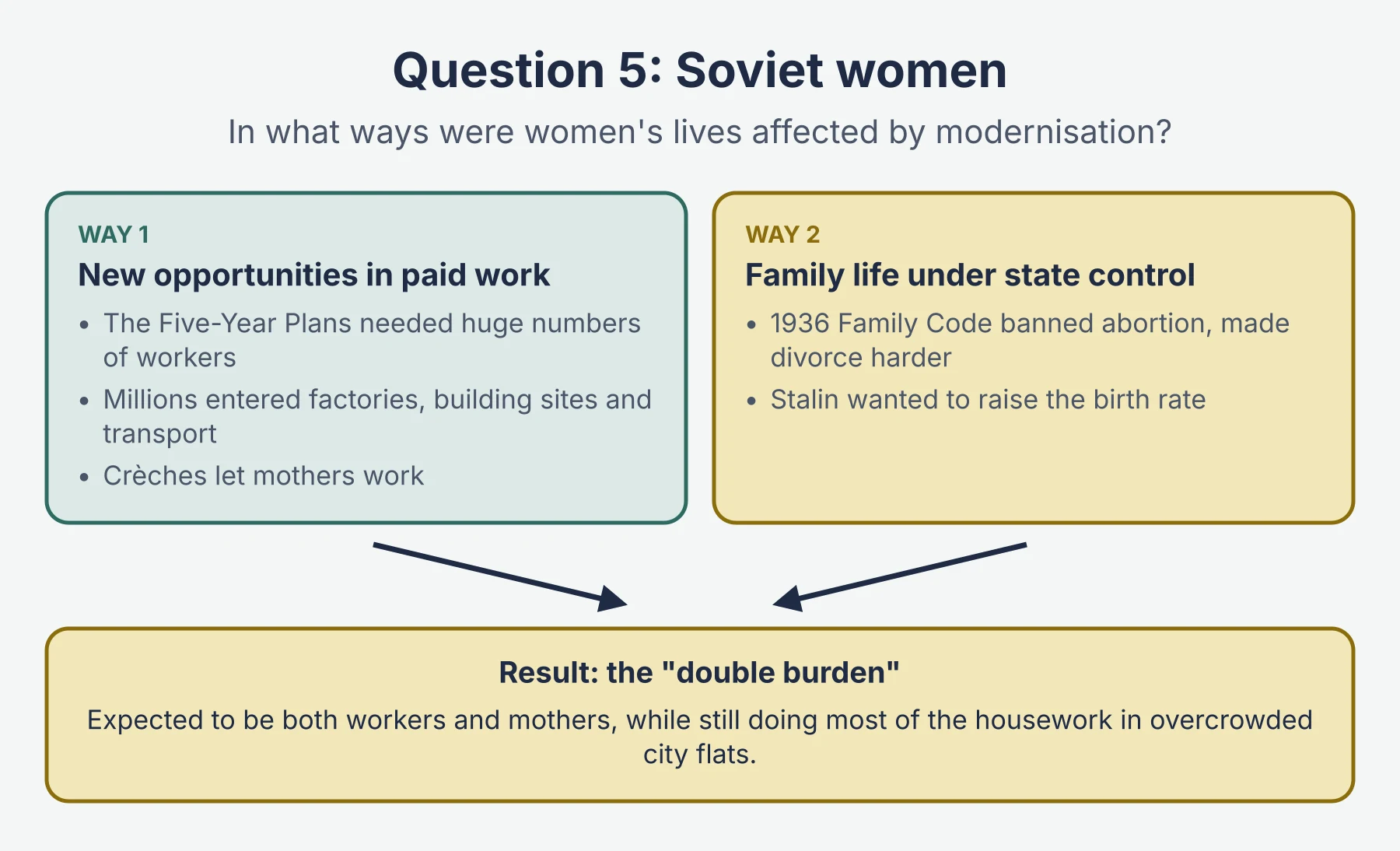
In what ways were the lives of Soviet women affected by Stalin’s modernisation? Explain your answer. [8]
One way was that many women gained new opportunities in paid work. The Five-Year Plans needed huge numbers of workers, so millions of women entered factories, building sites and transport, and crèches were opened to allow mothers to work. This changed their lives because, for many, paid employment and technical training replaced work only on the family plot or in the home. A second way was that family life came under tighter state control. The 1936 Family Code banned abortion and made divorce harder because Stalin wanted to raise the birth rate. Combined with full-time work, this meant women carried a double burden: they were expected to be both workers and mothers, while still doing most of the housework in overcrowded city flats.
Common mistakes
- Confusing collectivisation (agriculture) with the Five-Year Plans (industry); they were linked but distinct.
- Writing about the purges in general rather than how fear affected managers and workers.
- Treating official production figures as fact; say they were claimed or may be exaggerated.
- Ignoring women and professional workers, both named in the specification.
- Making a one-sided judgement on the extent of modernisation.
Further practice
- Stalin’s modernisation revision notes
- Stalin’s modernisation practice questions
- Section A period studies revision notes
Specification
AQA GCSE History (8145) specification, section 3.2.1, AC Russia, 1894-1945, Part three: Stalin’s USSR – aqa.org.uk.
Related resources
-
Practice questions
AQA GCSE History (8145): Stalin's Modernisation of the USSR – Practice Questions
Original AQA GCSE History 8145 Russia practice on collectivisation and the Five-Year Plans: describe, in what ways, interpretations and two judgement essays.
World History · AQA · GCSE
Try questions -
Revision notes
AQA GCSE History (8145): Stalin's Modernisation of the USSR – Revision Notes
Revision notes for AQA GCSE History 8145 Russia: collectivisation, the Five-Year Plans, effects on each named group, the extent of change and a self-test.
World History · AQA · GCSE
Revise topic -
Study guides
AQA GCSE History (8145): The Schlieffen Plan and Stalemate on the Western Front
AQA GCSE History 8145 First World War: why the Schlieffen Plan failed, trench warfare, attrition, and Verdun, the Somme and Passchendaele in depth.
World History · AQA · GCSE
Read guide
Get free revision emails (optional)
Occasional emails with practice questions, worked explanations and links to free resources for the qualification and subjects you choose. No spam, and you can unsubscribe from any email. The free tools on this site never need an email.