
Revision Notes
AQA GCSE History (8145): Civil Rights Campaigns in the 1950s and 1960s – Revision Notes
Revision notes for AQA GCSE History 8145 America: segregation, King's campaigns, Malcolm X, Black Power and the 1964 and 1968 Acts, with a self-test.
- Subject
- World History
- Level
- GCSE
- Topic
- Understanding the Modern World
- Author
- Marlbridge Academic Team
- Updated
- Reviewed by
- Azam Siddique (what this means)
Aligned to AQA GCSE World History (8145), first teaching 2016. Official specification .
Syllabus page (what it covers and how it is assessed): AQA GCSE World History.
Syllabus points this page covers
8145
- 3.2.1 Section A: Period studies
This page covers 1 of the 2 subtopics in topic 1, Understanding the modern world.
Found an error? Report a correction.
Need help with this topic? Request a free trial class for GCSE World History (8145).
Condensed notes on the civil rights content in AD America, 1920-1973, Part three. The specification names “Racial tension and developments in the Civil Rights campaigns in the 1950s and 1960s: Segregation laws; Martin Luther King and peaceful protests; Malcolm X and the Black Power Movement; Civil Rights Acts of 1964 and 1968.” For explanation and an essay plan, use the civil rights campaigns study guide; the option’s wider timeline is in the period studies revision notes.
Timeline
| Date | Event |
|---|---|
| 1896 | Plessy v Ferguson: “separate but equal” |
| 1954 | Brown v Board of Education: school segregation unconstitutional |
| 1955 | Emmett Till murdered; Rosa Parks arrested (1 December) |
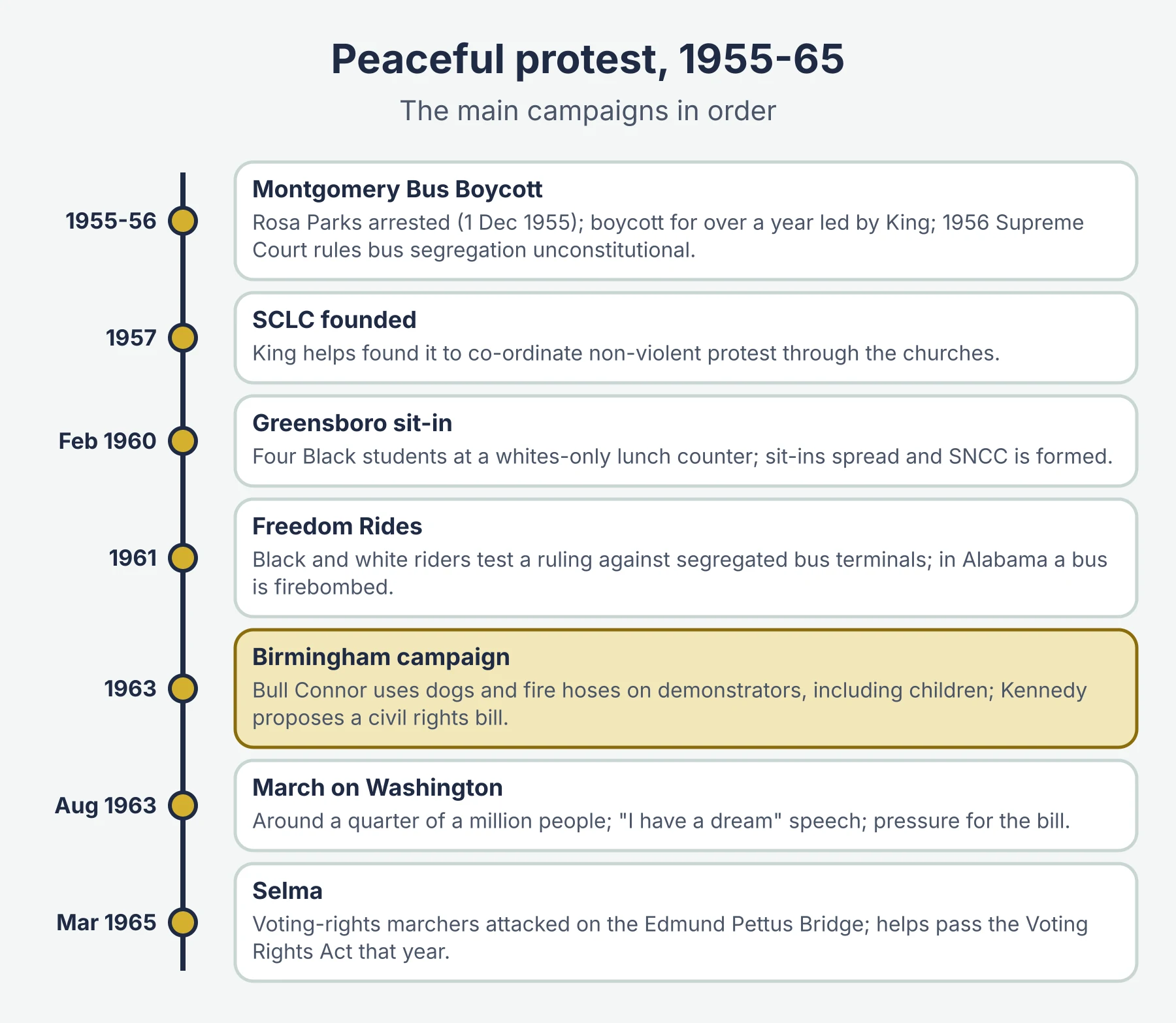
| 1955-56 | Montgomery Bus Boycott; Supreme Court bans bus segregation (1956) |
| 1957 | Little Rock Nine; SCLC founded |
| 1960 | Greensboro sit-ins; SNCC formed |
| 1961 | Freedom Rides |
| 1963 | Birmingham campaign; March on Washington (August) |
| 1964 | Civil Rights Act; Malcolm X leaves the Nation of Islam |
| 1965 | Malcolm X assassinated (February); Selma; Voting Rights Act; Watts riot |
| 1966 | “Black Power” slogan (Carmichael); Black Panther Party founded |
| April 1968 | King assassinated (4 April); riots; Civil Rights Act (Fair Housing) |
| 1968 | Olympic Black Power salute in Mexico City |
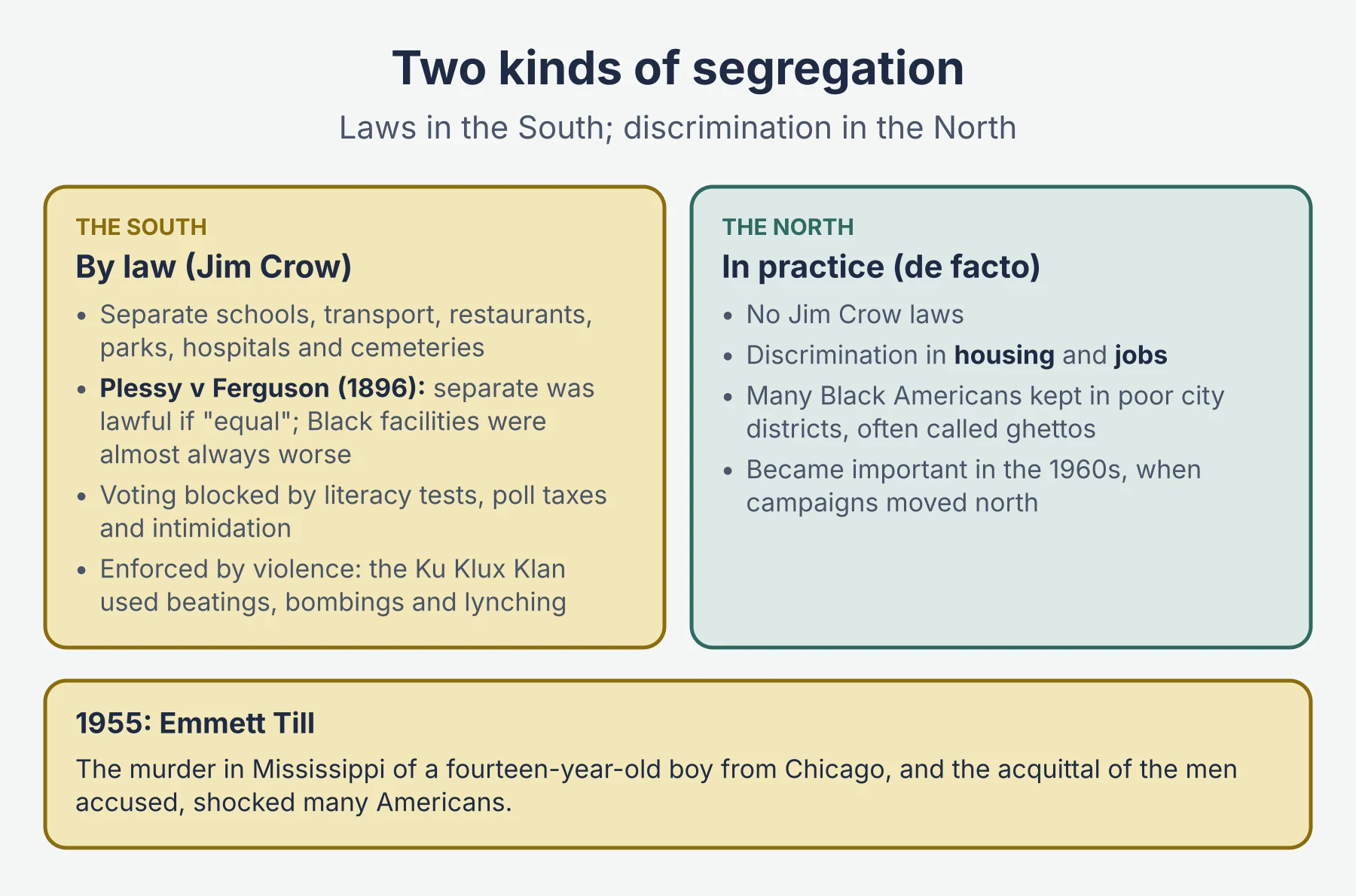
Segregation in two kinds
- De jure (by law) in the South: Jim Crow laws in schools, transport, public places; voting blocked by literacy tests, poll taxes, intimidation; enforced by violence.
- De facto (in practice) in the North: housing and job discrimination; poor city districts.
Peaceful protest: methods and examples
| Method | Example | Why it worked |
|---|---|---|
| Court cases | Brown (1954), NAACP and Thurgood Marshall | Overturned “separate but equal” in schools |
| Boycott | Montgomery (1955-56) | Economic pressure; unity; King’s leadership |
| Sit-ins | Greensboro (1960) | Spread quickly; students; media attention |
| Freedom Rides | 1961 | Exposed violence; forced federal action |
| Marches | Birmingham, Washington (1963), Selma (1965) | Televised violence; pressure on Congress |
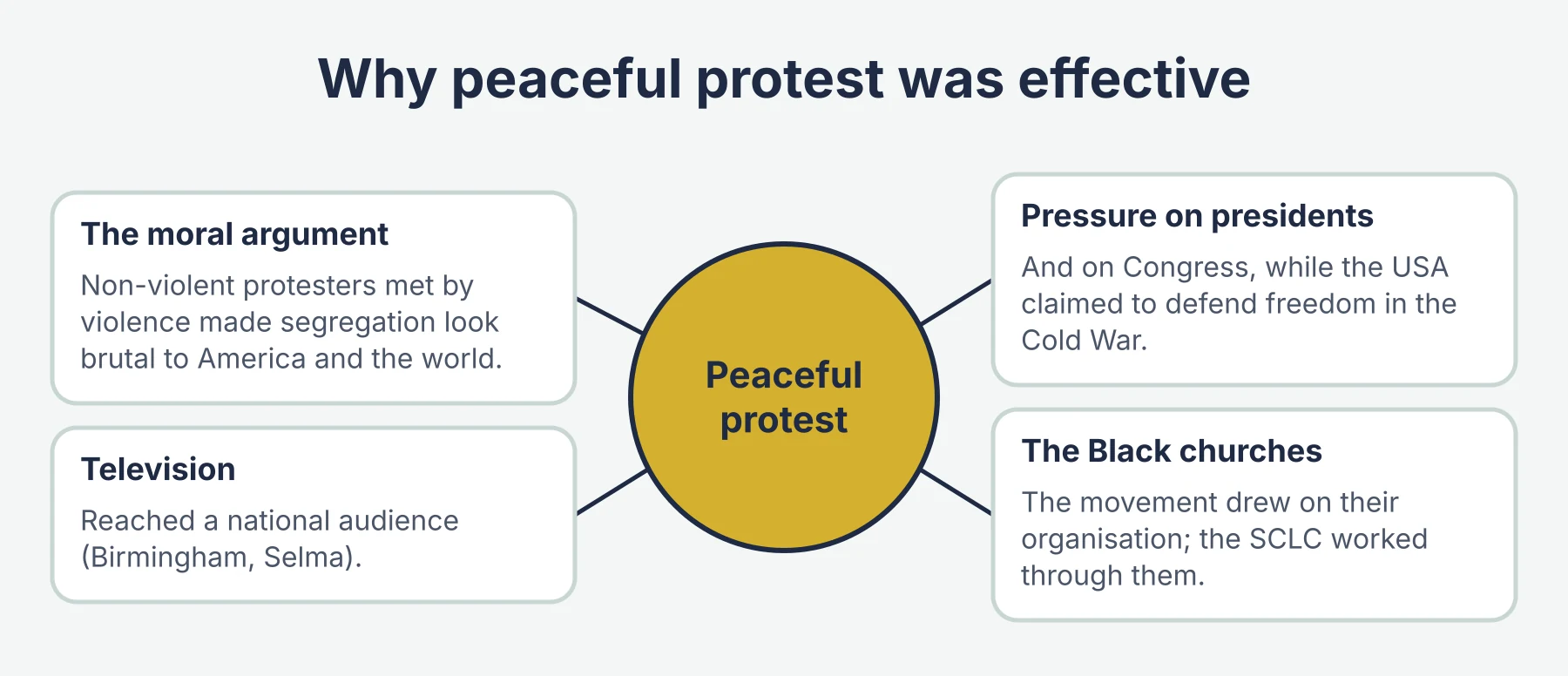
Reasons for success: moral contrast with violent opponents; television; Cold War pressure on presidents; church organisation.
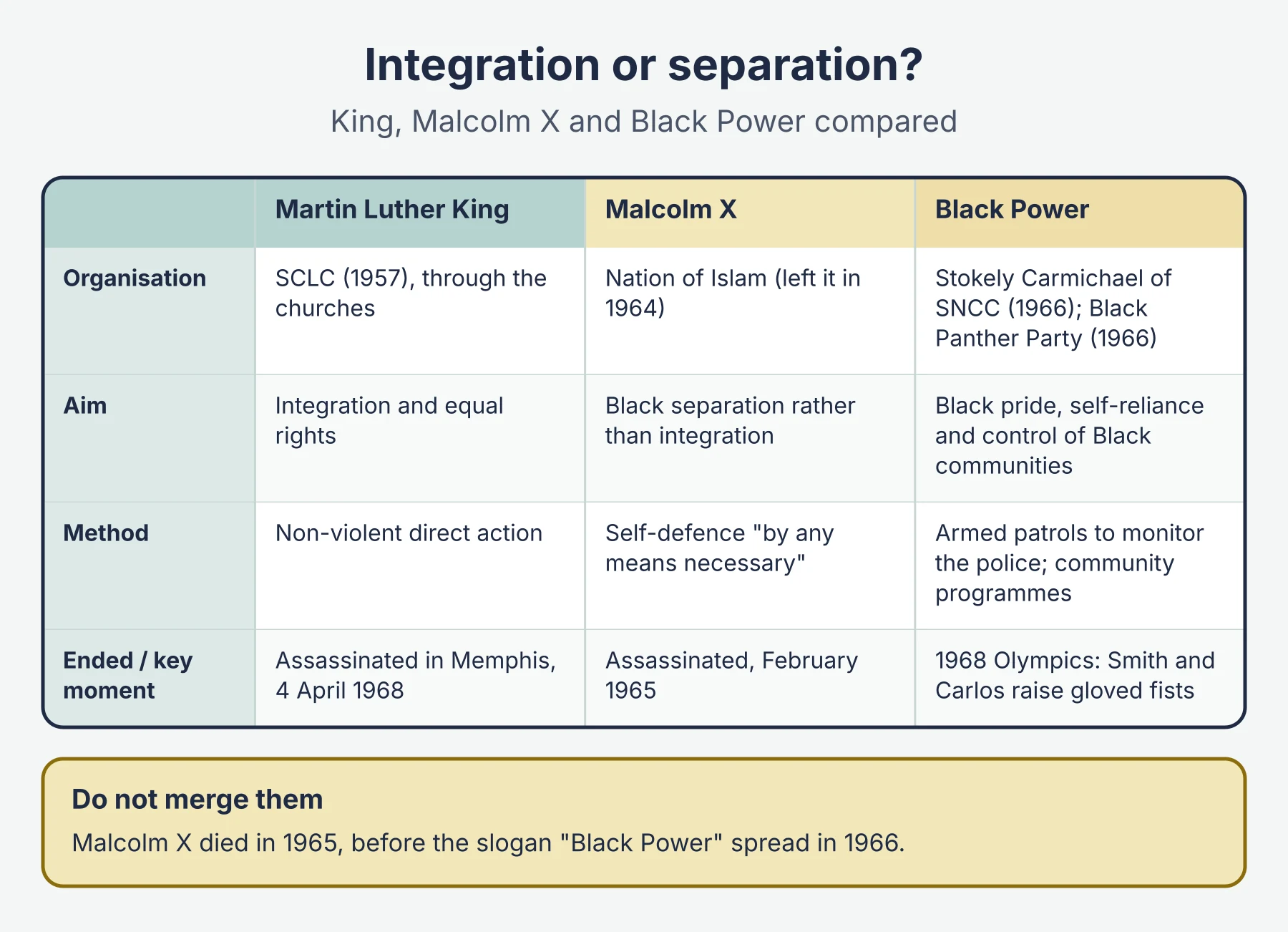
Malcolm X and Black Power
- Malcolm X: Nation of Islam; separation not integration; self-defence “by any means necessary”; left the Nation in 1964; killed February 1965.
- Black Power: Carmichael, 1966; pride, self-reliance, community control.
- Black Panthers: Oakland, 1966; armed patrols watching police; free breakfasts.
- Causes of the shift: slow progress; northern poverty; continuing violence; impatience among the young.
- Riots: Watts 1965; after King’s death in 1968.
The two Acts
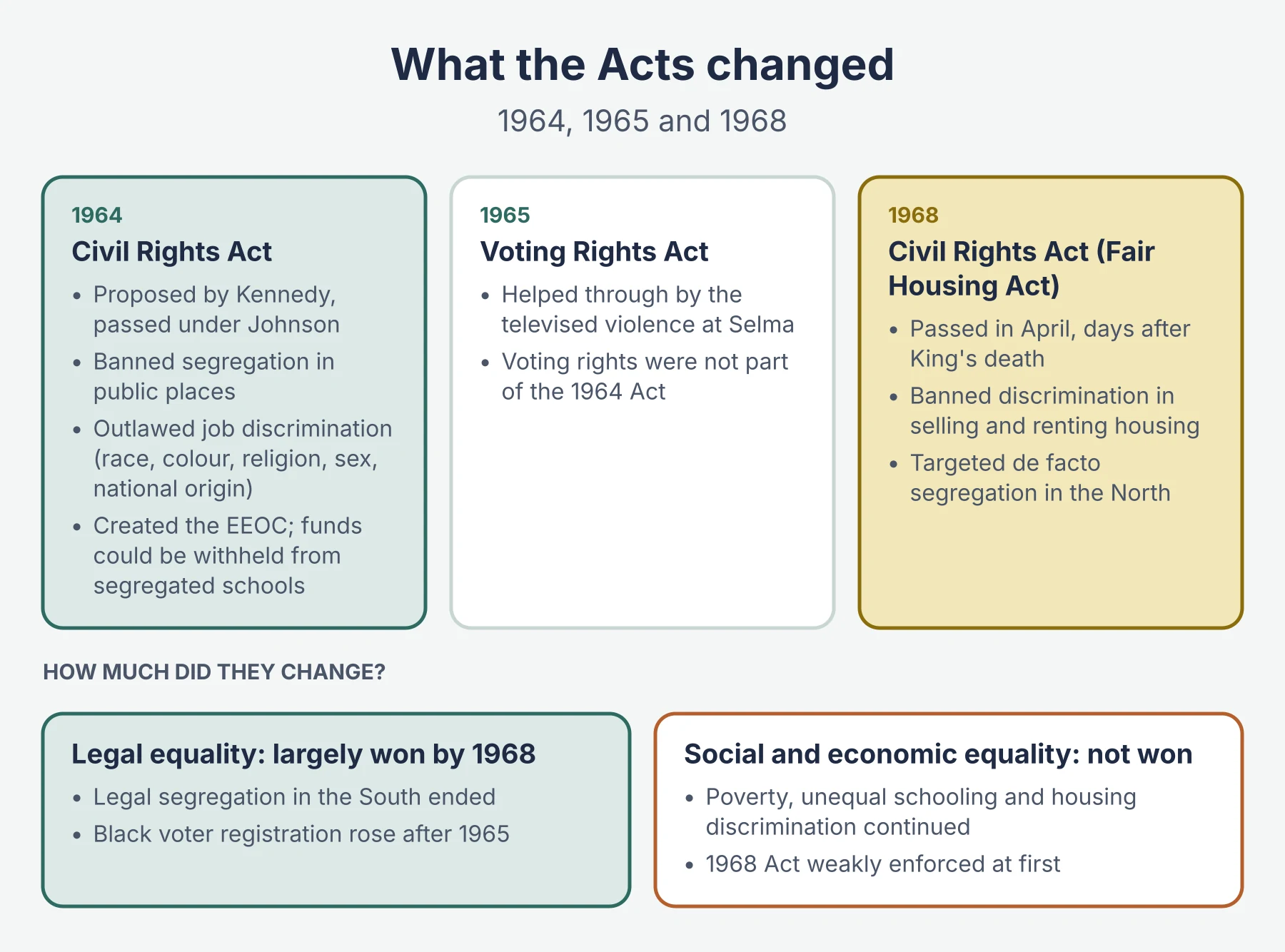
| Act | Main terms | Limits |
|---|---|---|
| 1964 Civil Rights Act | Banned segregation in public places; banned job discrimination (race, colour, religion, sex, national origin); Equal Employment Opportunity Commission; funds withheld from segregated schools | Did not deal with voting (1965 Act did) or housing |
| 1968 Civil Rights Act | Banned discrimination in selling and renting housing (Fair Housing Act) | Weakly enforced at first; poverty and segregated districts remained |
Linking the strands for a judgement
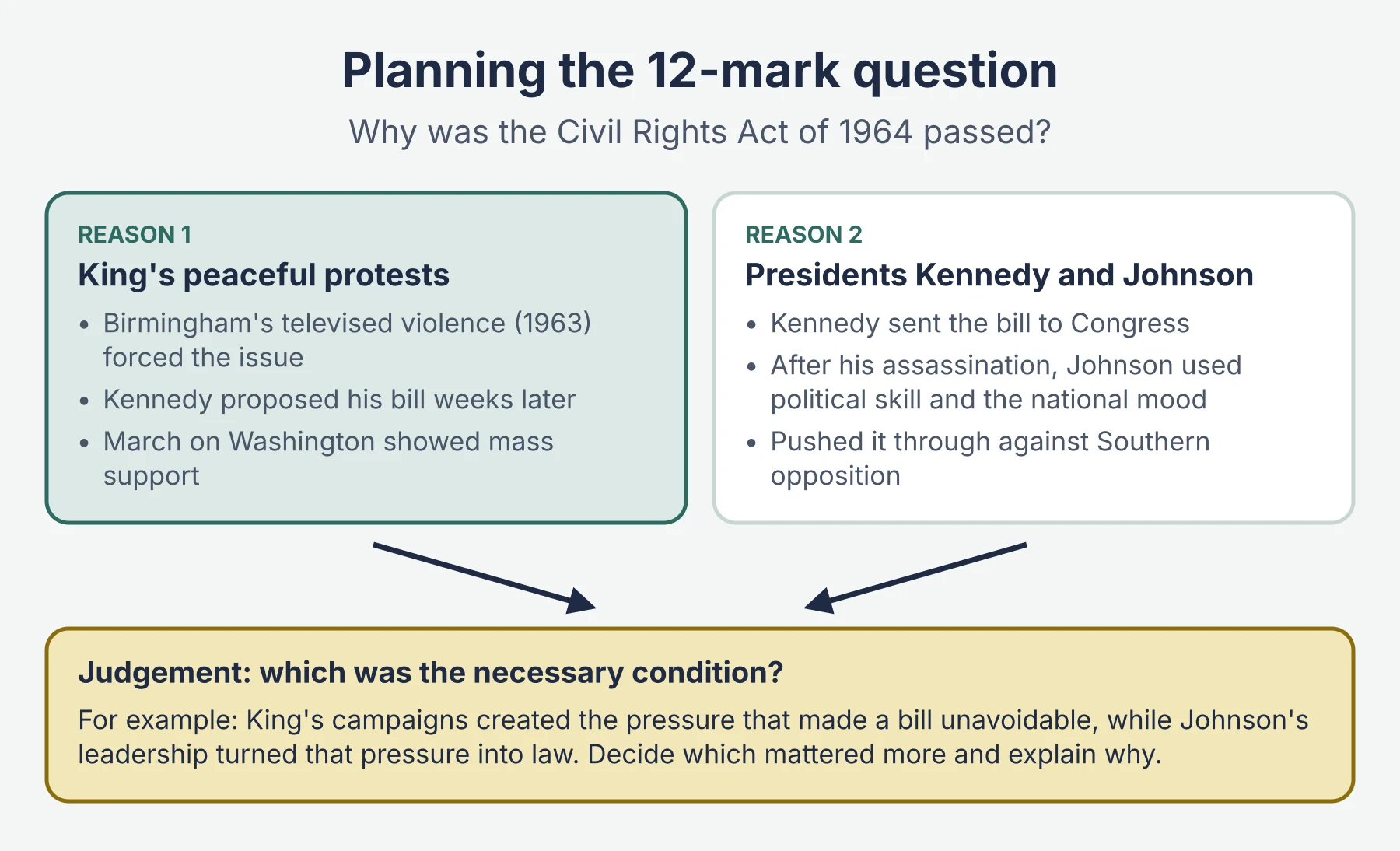
- Protest and presidents worked together: Birmingham (1963) led Kennedy to propose the bill; Johnson steered it through Congress in 1964; Selma (1965) preceded the Voting Rights Act.
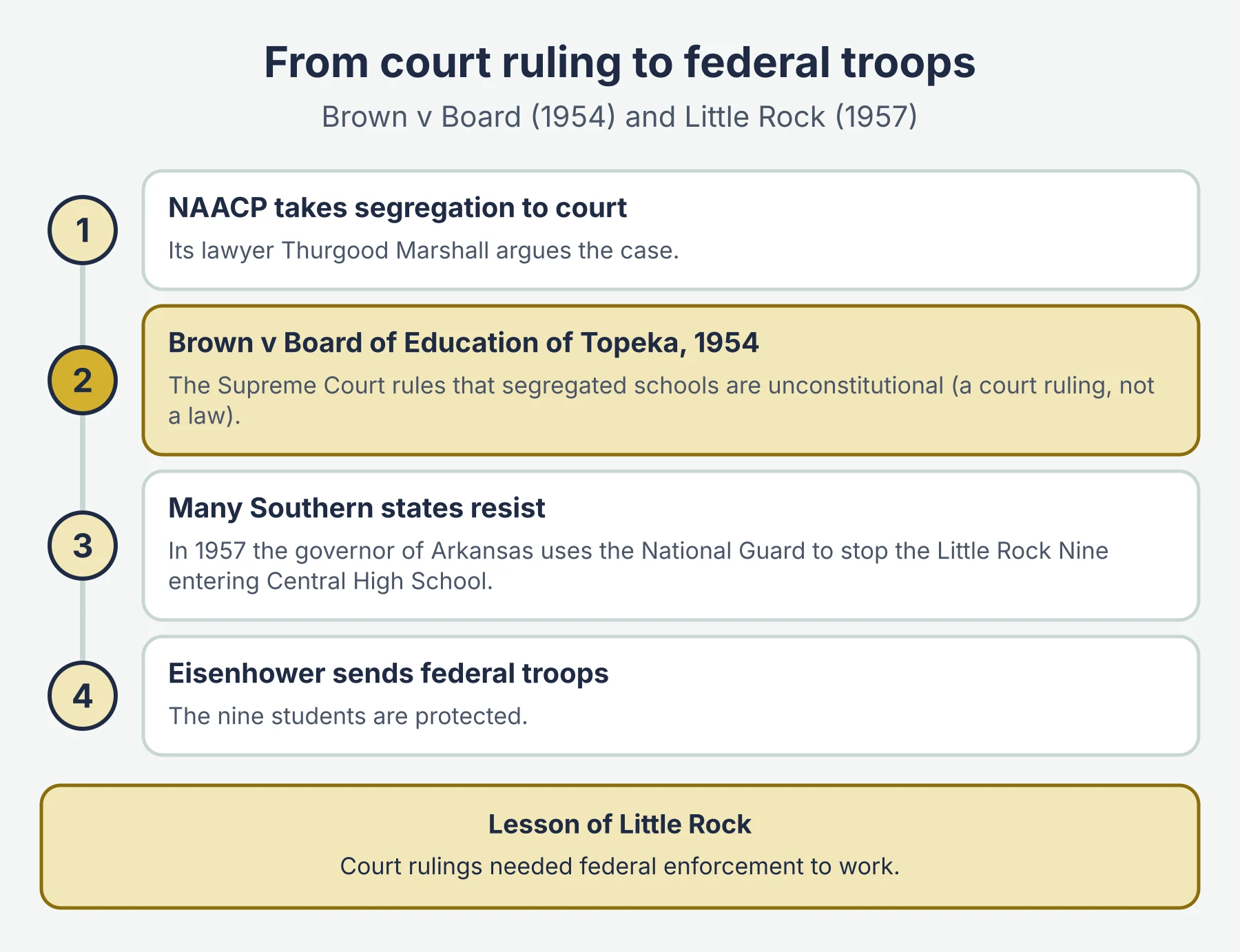
- Law and practice differed: Brown (1954) needed troops at Little Rock (1957) to be enforced.
- South and North differed: non-violent campaigns ended legal segregation in the South but did little for northern poverty, which helps explain the rise of Black Power.
Key terms
| Term | Meaning |
|---|---|
| Jim Crow laws | Southern laws enforcing racial segregation |
| Segregation | Separation of people by race |
| De facto | Existing in practice though not by law |
| Integration | Bringing groups together on equal terms |
| Civil disobedience | Peacefully breaking unjust laws |
| Sit-in | Occupying a segregated space in protest |
| Black Power | Movement for Black pride, self-reliance and community control |
| NAACP | National Association for the Advancement of Colored People |
| SCLC | Southern Christian Leadership Conference, King’s organisation |
| SNCC | Student Nonviolent Coordinating Committee |
Exam traps
- Brown was a 1954 court ruling, not an act of Congress.
- The 1964 Act did not give the vote; the Voting Rights Act came in 1965.
- Malcolm X and Black Power overlap but are not identical; the slogan spread after his death.
- The 1968 Act is about housing.
- In question 5 (“In what ways…”), explain change for a group, not just events.
Self-test
- What did Plessy v Ferguson (1896) allow?
- Who was the NAACP lawyer in Brown v Board?
- Why was Rosa Parks arrested?
- How did Eisenhower respond at Little Rock?
- Where did the 1960 sit-ins begin?
- Who was police chief in Birmingham in 1963?
- When was the March on Washington?
- What did the Nation of Islam call for?
- Who popularised the slogan “Black Power”?
- Name two terms of the 1964 Civil Rights Act.
- What did the 1968 Civil Rights Act ban?
- Give one limit of what had been achieved by 1968.
Answers
- Segregation, if facilities were “separate but equal”.
- Thurgood Marshall.
- For refusing to give up her bus seat to a white passenger in Montgomery, December 1955.
- He sent federal troops to protect the nine students.
- Greensboro, North Carolina.
- Eugene “Bull” Connor.
- August 1963.
- Black separation rather than integration.
- Stokely Carmichael, in 1966.
- Any two: segregation in public places banned; job discrimination banned; Equal Employment Opportunity Commission created; federal funds could be withheld from segregated schools.
- Discrimination in the sale and renting of housing.
- Any one: continued poverty; housing segregation in northern cities; unequal schooling; weak enforcement of the 1968 Act.
Related resources
-
Study guides
AQA GCSE History (8145): Interpretation Questions 1-3
How to answer AQA GCSE History 8145 Paper 1 questions 1-3 on two interpretations: how they differ, why they differ and which is more convincing.
World History · AQA · GCSE
Read guide -
Practice questions
AQA GCSE History (8145): Interpretation Questions 1-3 – Practice Questions
Original AQA GCSE History 8145 interpretation practice: four invented pairs, one for each period study, with questions 1-3 and full worked answers.
World History · AQA · GCSE
Try questions -
Revision notes
AQA GCSE History (8145): Interpretation Questions 1-3 – Revision Notes
Revision notes for AQA GCSE History 8145 Paper 1 questions 1-3: reading ascriptions, difference, provenance and convincing, with traps and a self-test.
World History · AQA · GCSE
Revise topic
Get free revision emails (optional)
Occasional emails with practice questions, worked explanations and links to free resources for the qualification and subjects you choose. No spam, and you can unsubscribe from any email. The free tools on this site never need an email.