
Study Guides
AQA GCSE History (8145): The Schlieffen Plan and Stalemate on the Western Front
AQA GCSE History 8145 First World War: why the Schlieffen Plan failed, trench warfare, attrition, and Verdun, the Somme and Passchendaele in depth.
- Subject
- World History
- Level
- GCSE
- Topic
- Understanding the Modern World
- Author
- Marlbridge Academic Team
- Updated
- Reviewed by
- Azam Siddique (what this means)
Aligned to AQA GCSE World History (8145), first teaching 2016. Official specification .
Syllabus page (what it covers and how it is assessed): AQA GCSE World History.
Syllabus points this page covers
8145
- 3.2.2 Section B: Wider world depth studies
This page covers 1 of the 2 subtopics in topic 1, Understanding the modern world.
Found an error? Report a correction.
Need help with this topic? Request a free trial class for GCSE World History (8145).
This guide covers two content statements in Part two of BA Conflict and tension: the First World War, 1894-1918. The specification names “The Schlieffen Plan: the reasons for the plan, its failure, including the Battle of Marne and its contribution to the stalemate” and “The Western Front: military tactics and technology, including trench warfare; the war of attrition; key battles, including Verdun, the Somme and Passchendaele, the reasons for, the events and significance of these battles.” The wider world depth studies study guide summarises stalemate in two sentences; this page gives the detail needed for an account or a “how far” essay.
The Schlieffen Plan
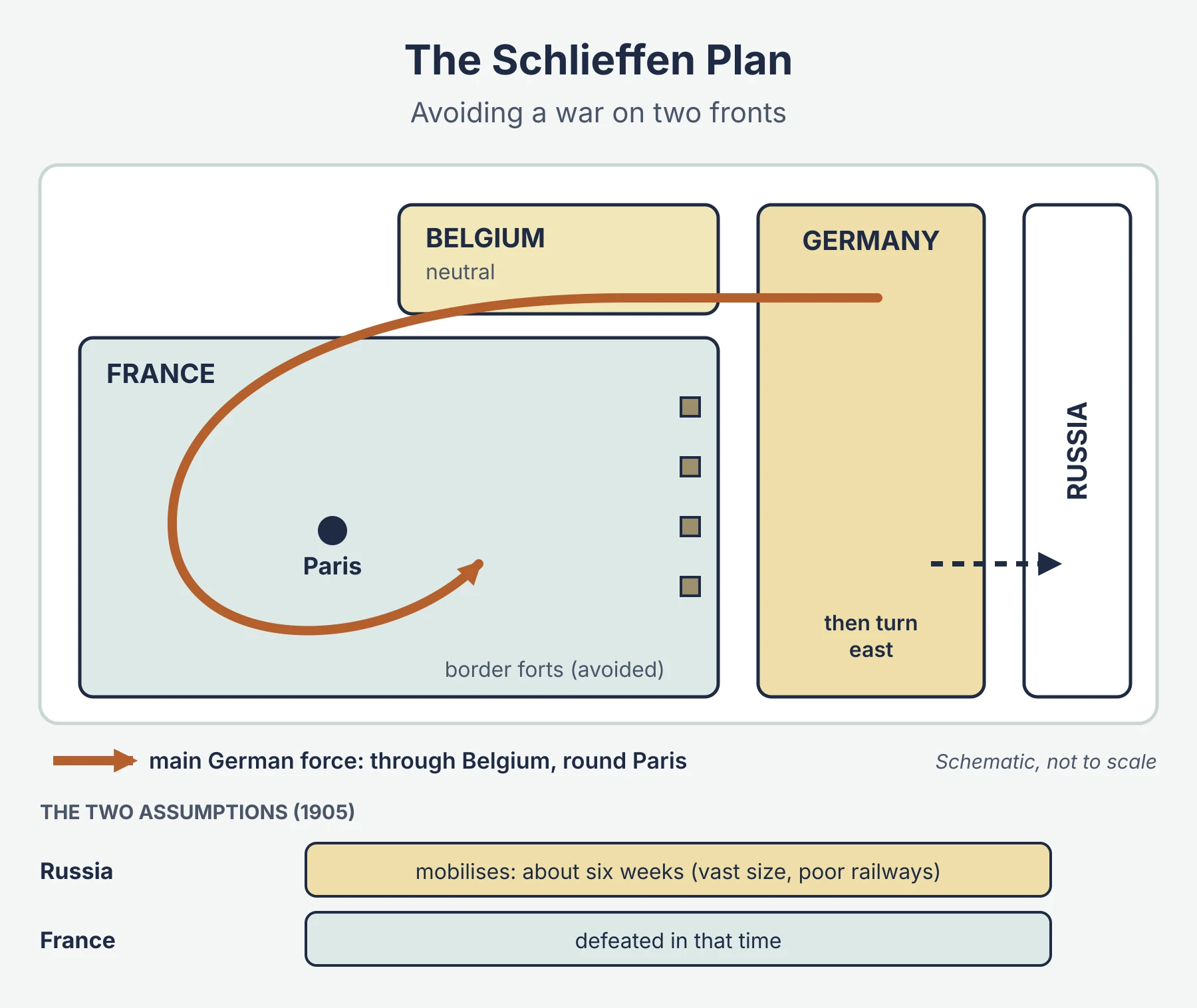
Reasons for the plan. Germany feared a war on two fronts against France in the west and Russia in the east, allied since 1894. Count Alfred von Schlieffen, chief of the German General Staff, drew up a plan in 1905 based on two assumptions: that Russia, with its vast size and poor railways, would take about six weeks to mobilise, and that France could be defeated in that time. The main German force would sweep through neutral Belgium, avoiding the French border forts, encircle Paris and trap the French armies, before turning east to face Russia.
Why it failed.
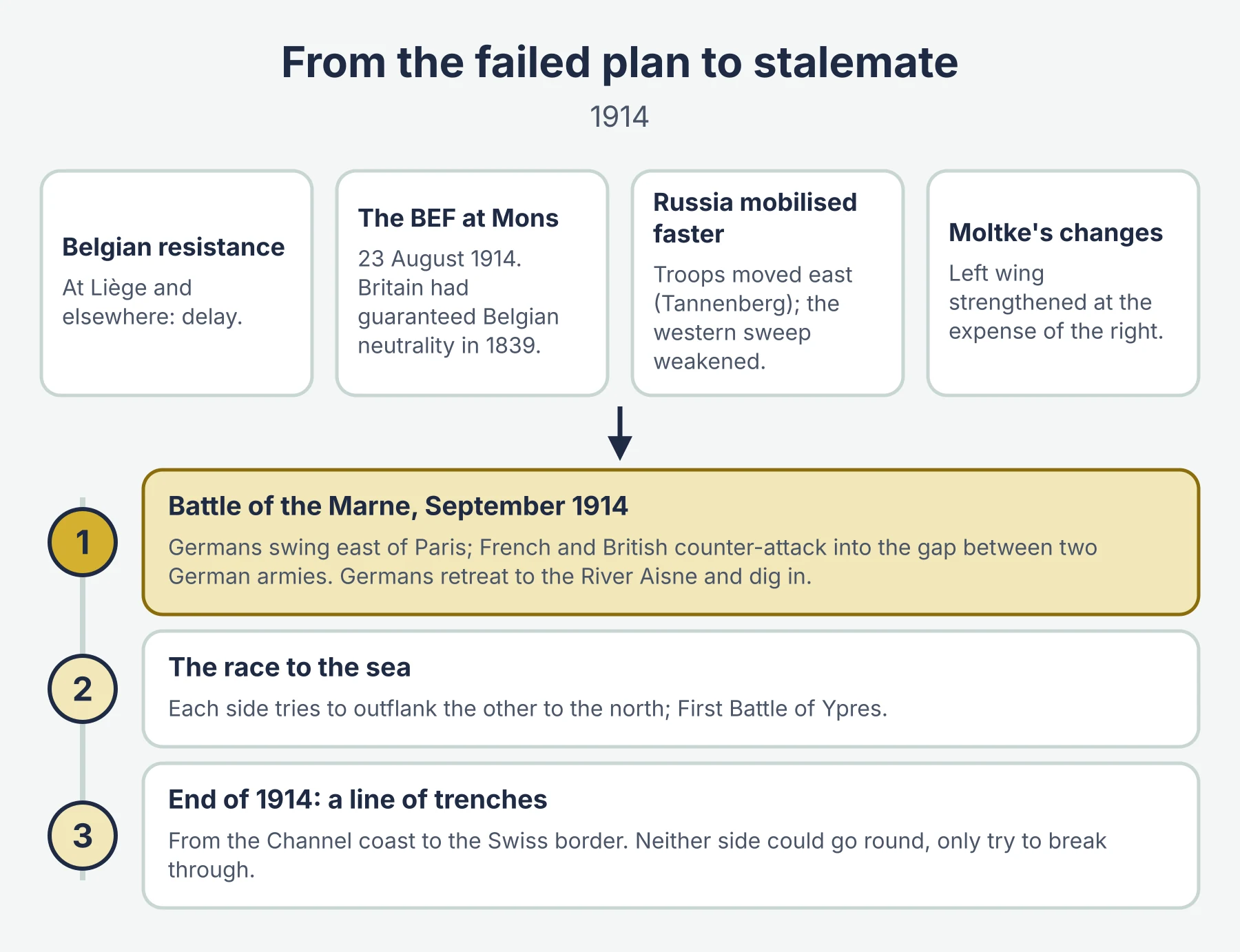
- Belgian resistance at Liège and elsewhere delayed the German advance.
- The British Expeditionary Force arrived quickly and slowed the Germans at Mons (23 August 1914). Britain had entered the war because of the invasion of Belgium, whose neutrality it had guaranteed in 1839.
- Russia mobilised faster than expected, and German troops were moved east, where they won at Tannenberg; the western sweep was weakened.
- Changes by Moltke, Schlieffen’s successor, who had already strengthened the left wing at the expense of the right.
- The Battle of the Marne (September 1914). As the Germans swung east of Paris rather than around it, French and British forces counter-attacked into the gap between two German armies. Reinforcements were rushed from Paris, some in requisitioned taxis. The Germans retreated to the River Aisne and dug in.
Contribution to stalemate. After the Marne, each side tried to outflank the other to the north, the race to the sea. By the end of 1914, after the First Battle of Ypres, a line of trenches ran from the Channel coast to the Swiss border. Neither side could go round the other; they could only try to break through.
Trench warfare, tactics and technology
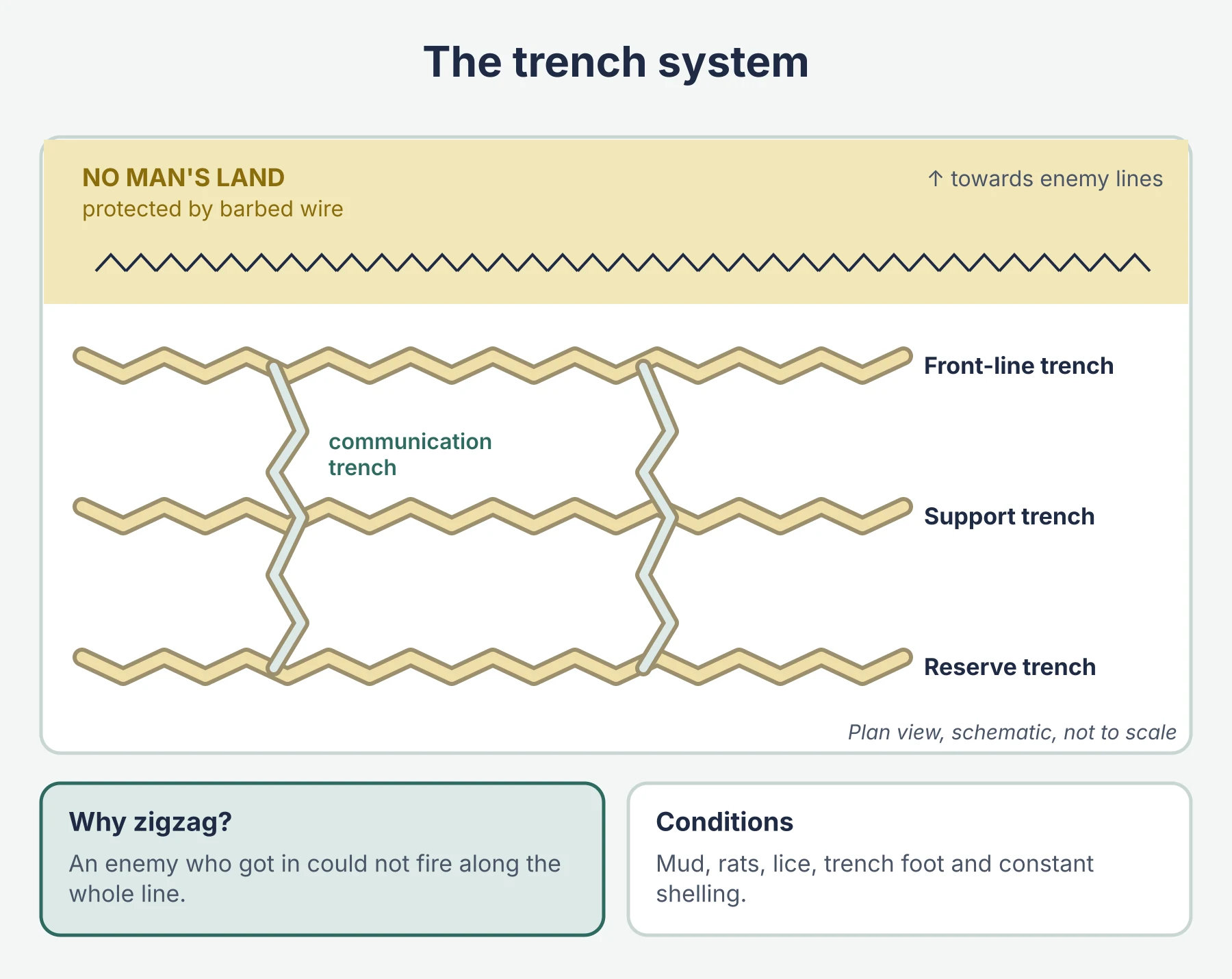
The trench system. Front-line trenches were backed by support and reserve trenches, linked by communication trenches. Between the two sides lay no man’s land, protected by barbed wire. Trenches were dug in zigzags so an enemy who got in could not fire along the whole line. Conditions included mud, rats, lice, trench foot and constant shelling.
Why defence was stronger than attack.
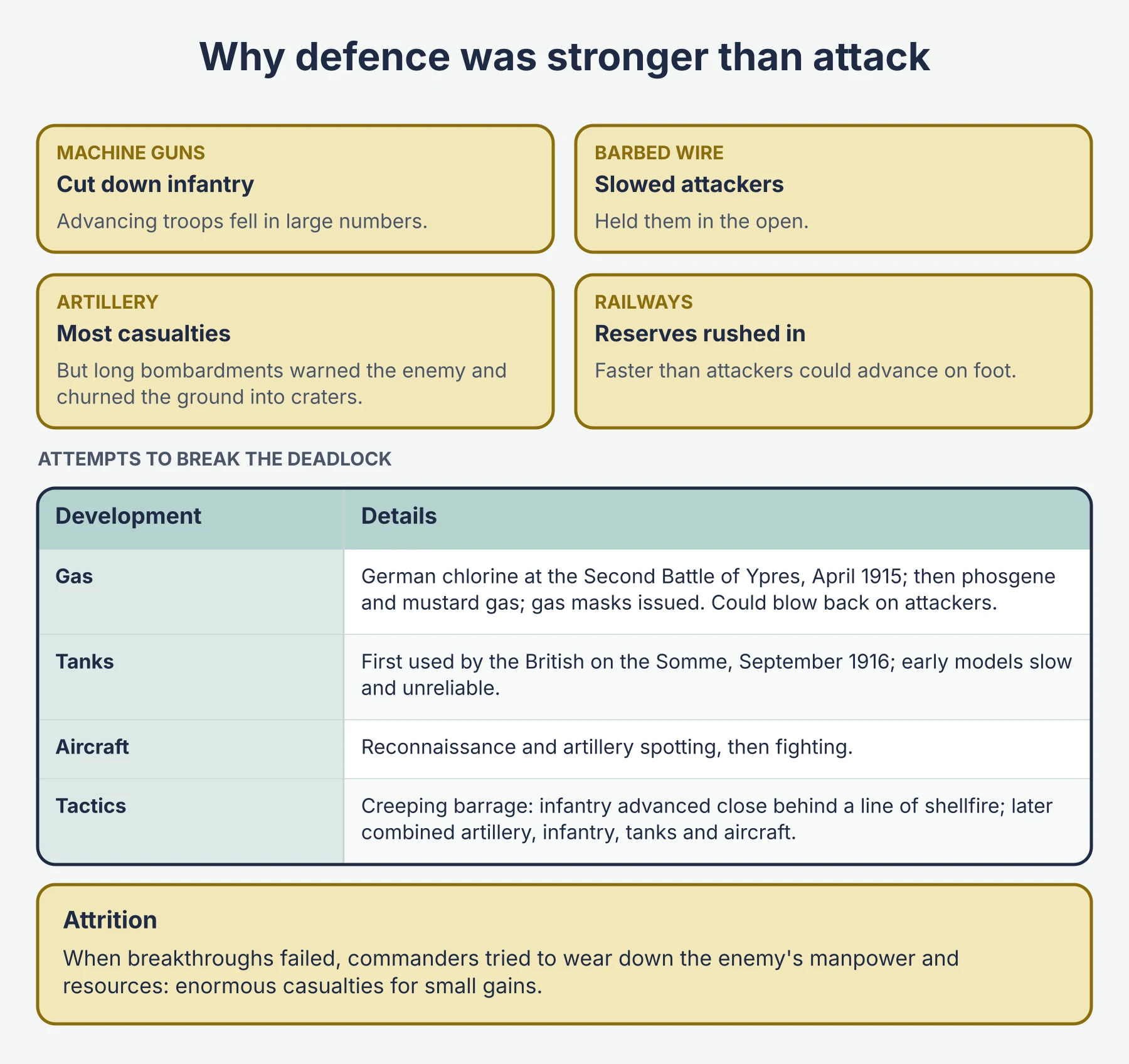
- Machine guns could cut down advancing infantry in large numbers.
- Barbed wire slowed attackers in the open.
- Artillery caused the majority of casualties, but long bombardments warned the enemy of an attack and churned the ground into craters.
- Railways allowed defenders to rush reserves to a threatened point faster than attackers could advance on foot.
New technology. The Germans first used chlorine gas on a large scale at the Second Battle of Ypres in April 1915; phosgene and mustard gas followed, and gas masks were issued. Tanks were first used by the British on the Somme in September 1916, though early models were slow and unreliable. Aircraft were used for reconnaissance and artillery spotting, then for fighting. Tactics developed too: the creeping barrage, in which infantry advanced close behind a line of shellfire, and later combined use of artillery, infantry, tanks and aircraft.
The war of attrition. When breakthroughs failed, commanders aimed to wear down the enemy’s manpower and resources until they could no longer fight. Attrition meant enormous casualties for small gains of ground.
Verdun, February-December 1916
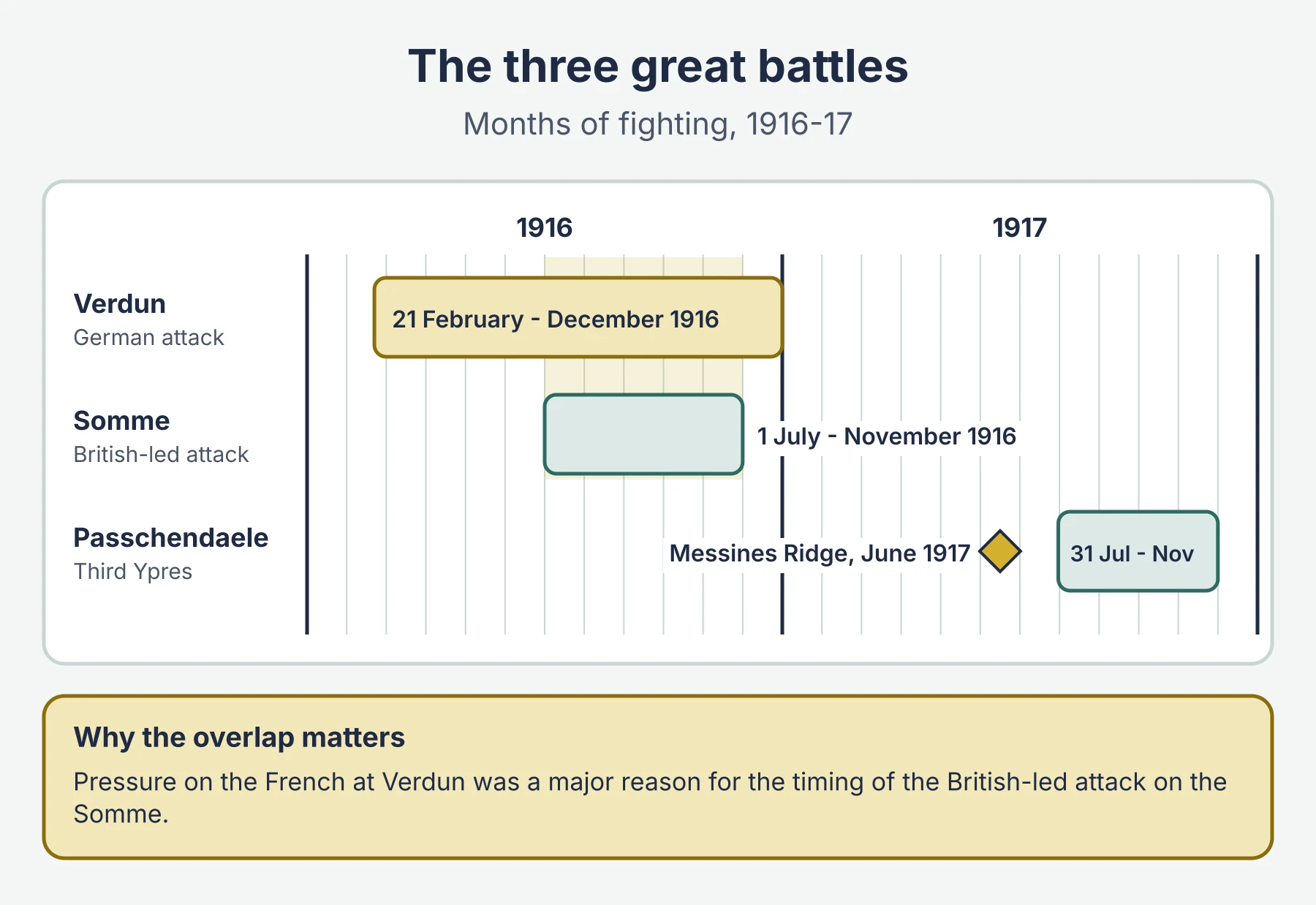
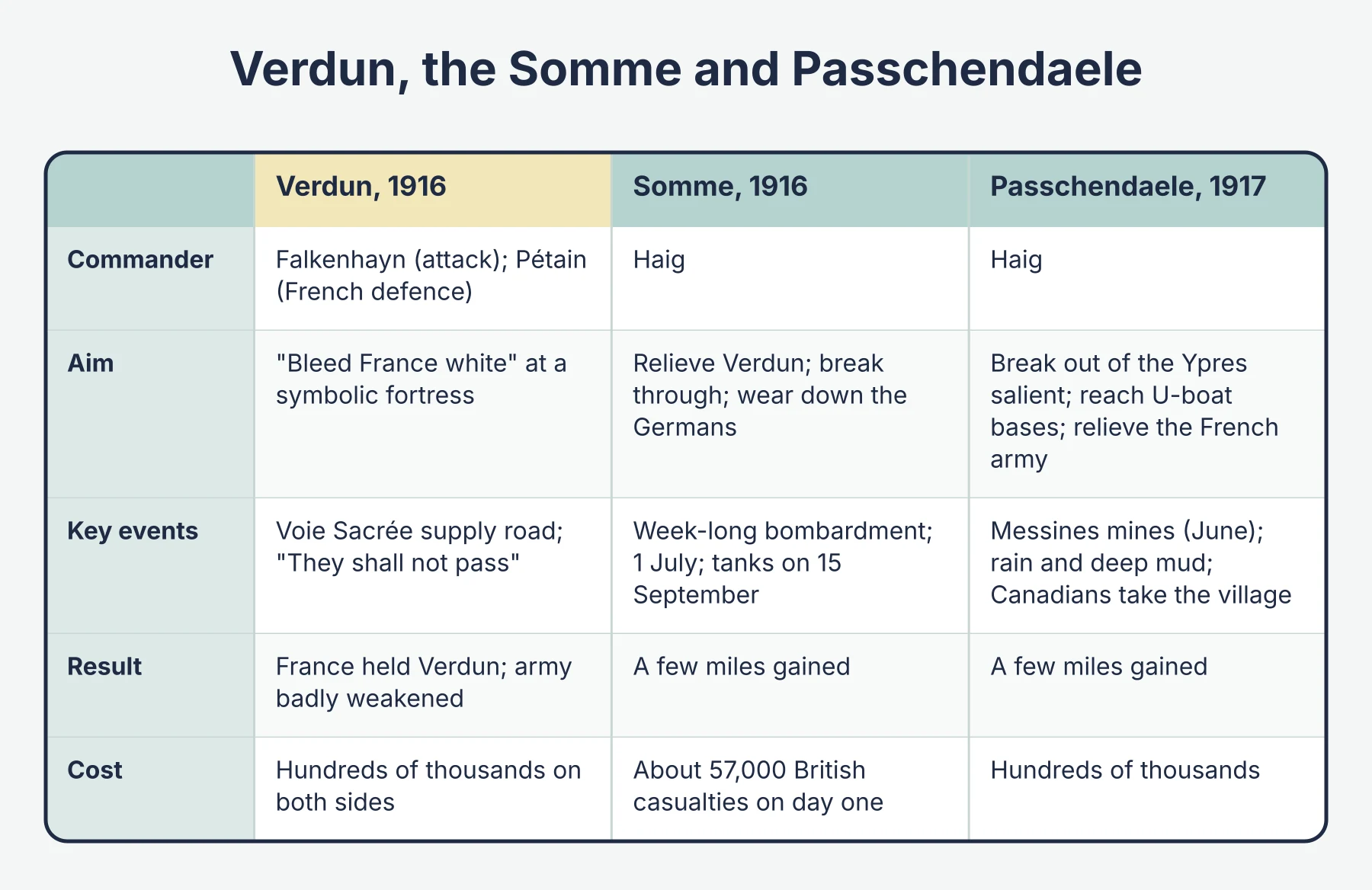
Reasons. The German commander Erich von Falkenhayn chose Verdun, a fortress city of great symbolic importance to France, believing France would defend it at any cost. His aim was to “bleed France white” by drawing French troops into a killing ground.
Events. The attack began on 21 February 1916 with a massive bombardment. Forts fell early, but under General Pétain the French held on, supplied along a single road, the Voie Sacrée (Sacred Way), by a constant stream of lorries. The slogan “They shall not pass” became famous. Fighting continued until December, when the French recaptured most of the lost ground.
Significance. Both sides suffered hundreds of thousands of casualties. France held Verdun, and it became a symbol of national endurance, but the French army was badly weakened. Pressure on Verdun was a major reason for the timing of the British-led attack on the Somme.
The Somme, July-November 1916
Reasons. The offensive, commanded for the British by Sir Douglas Haig, aimed to relieve pressure on the French at Verdun, to break through the German lines and to wear down the German army.
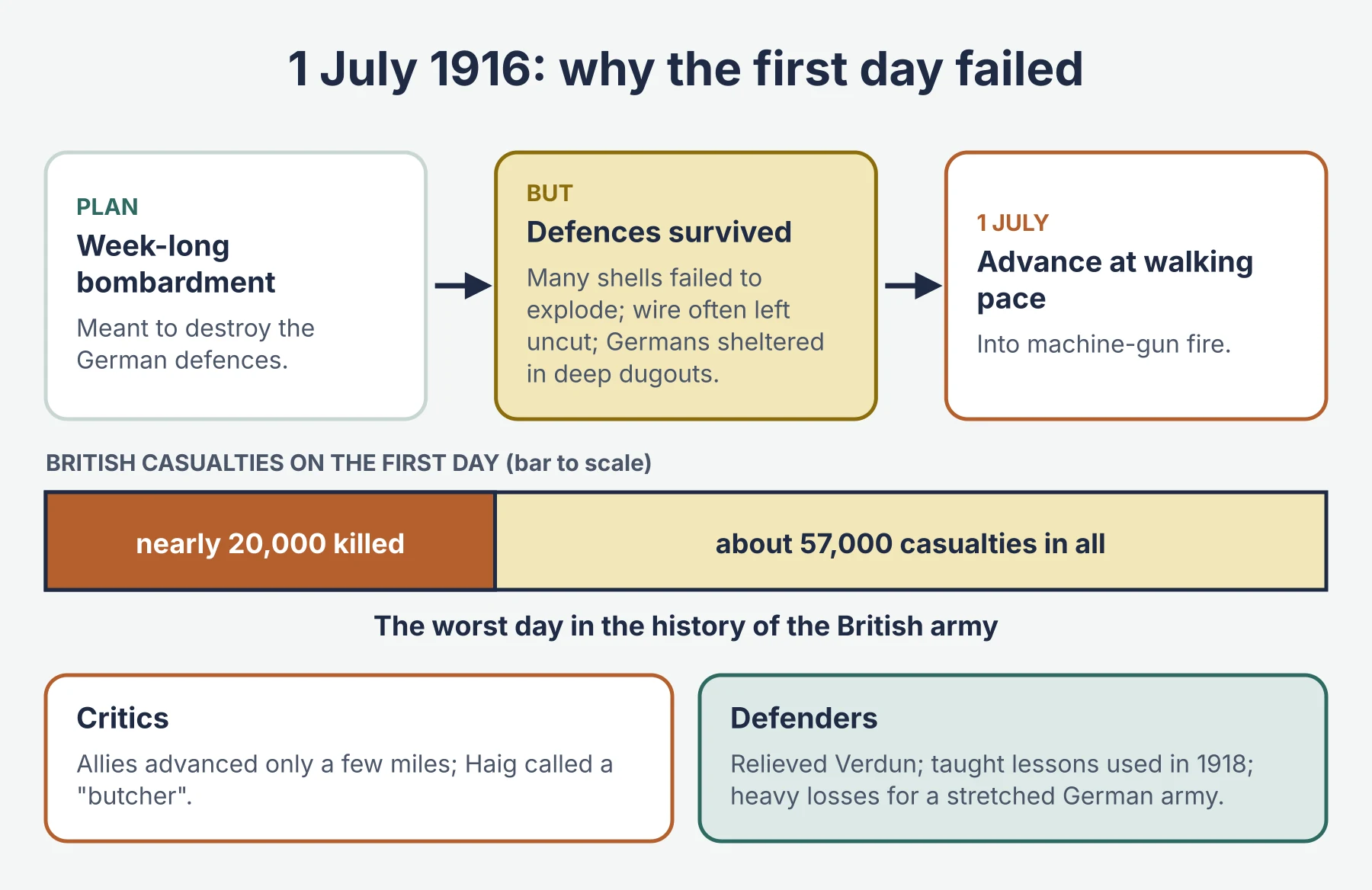
Events. A week-long bombardment was meant to destroy German defences, but many shells failed to explode, the wire was often left uncut, and Germans sheltered in deep dugouts. On 1 July 1916 British troops advanced at walking pace into machine-gun fire; there were about 57,000 British casualties on the first day, nearly 20,000 of them killed, the worst day in the history of the British army. The battle continued until November; tanks were used for the first time on 15 September.
Significance. The Allies advanced only a few miles. Haig’s critics called him a “butcher”; his defenders argue the battle relieved Verdun, taught the British army lessons it used in 1918 and inflicted heavy losses on an increasingly stretched German army.
Passchendaele, July-November 1917
Reasons. Also known as the Third Battle of Ypres, Haig’s offensive aimed to break out of the Ypres salient and reach the Belgian coast, where German U-boats were based, and to take pressure off a French army weakened by mutinies after the failed Nivelle Offensive of spring 1917.
Events. It followed the successful capture of Messines Ridge in June 1917, where huge mines were exploded under German lines. The main attack began on 31 July. Heavy rain and shelling destroyed the drainage of the low-lying ground, producing deep mud in which men, horses and guns sank. Canadian troops finally took the ruined village of Passchendaele in November.
Significance. The advance was only a few miles, at a cost of hundreds of thousands of casualties. Passchendaele became, for many, the symbol of the futility of the Western Front, while others stress that the German army too was worn down before 1918.
Worked example: question 3 account
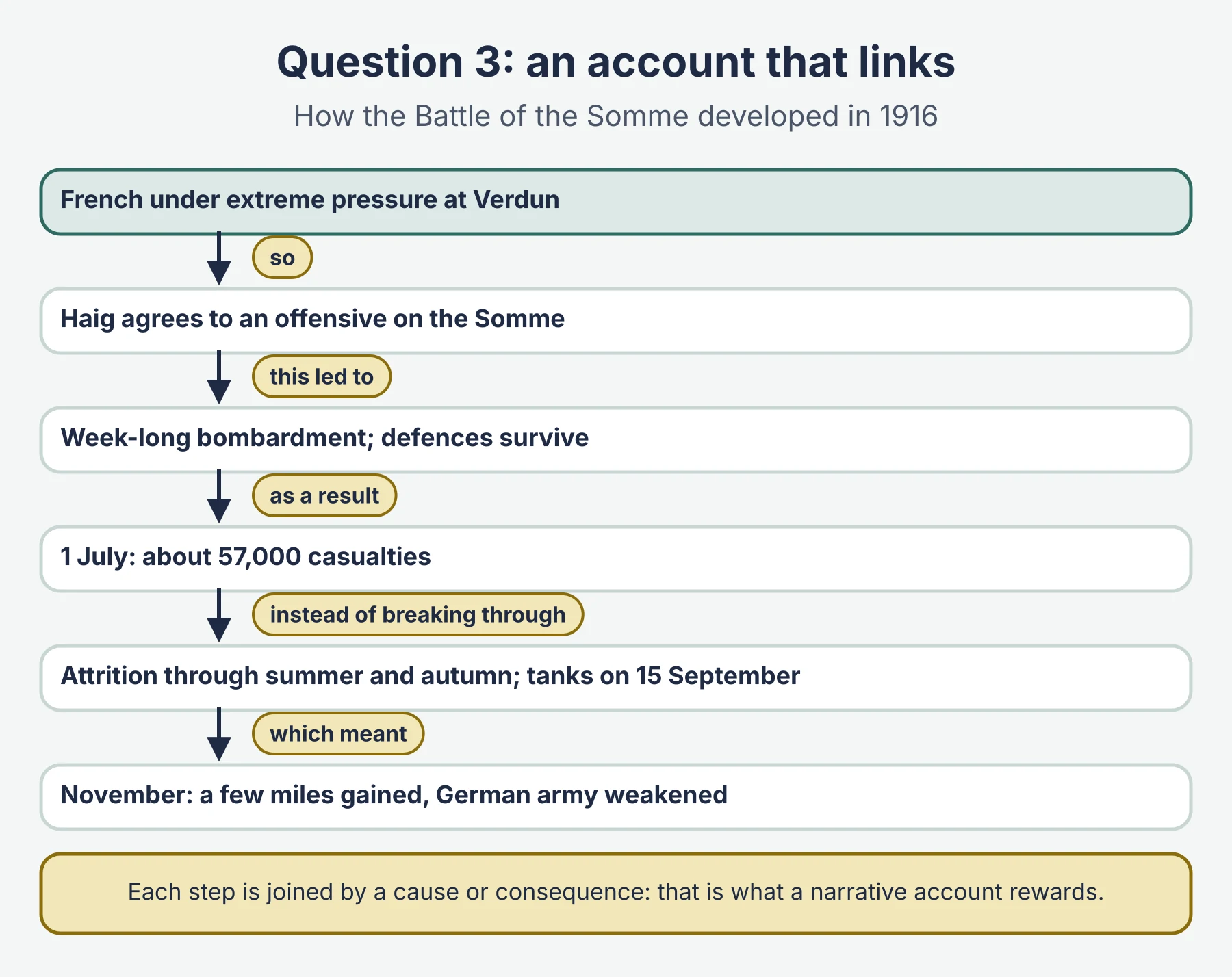
Write an account of how the Battle of the Somme developed in 1916. [8]
The battle was planned because the French army was under extreme pressure at Verdun, so Haig agreed to an offensive on the Somme to draw German troops away. This led to a week-long bombardment intended to destroy the German wire and trenches, but because many shells were duds and the Germans sheltered in deep dugouts, the defences survived. As a result, when British troops advanced on 1 July they were met by machine-gun fire and suffered about 57,000 casualties on the first day alone. Instead of breaking through, Haig turned the battle into one of attrition, continuing to attack through the summer and autumn and introducing tanks on 15 September. By the time the battle ended in November, the Allies had gained only a few miles, but German losses were also heavy, which meant the German army was weakened going into 1917.
Each step is linked by a cause or consequence (“so”, “this led to”, “as a result”), which is what a narrative account rewards.
Common mistakes
- Saying the Schlieffen Plan failed “because of trenches”: trenches were the result of its failure.
- Confusing Verdun (German attack, 1916, French defence) with the Somme (British-led attack, 1916).
- Dating Passchendaele to 1916; it was 1917.
- Giving casualty figures you are not sure of; “hundreds of thousands” is acceptable when exact numbers are uncertain.
- Treating new technology as instantly decisive: early tanks broke down, and gas could blow back on the attackers.
Further practice
- Schlieffen Plan and stalemate revision notes
- Schlieffen Plan and stalemate practice questions
- Wider world depth studies practice
Specification
AQA GCSE History (8145) specification, section 3.2.2, BA Conflict and tension: the First World War, 1894-1918, Part two – aqa.org.uk.
Related resources
-
Practice questions
AQA GCSE History (8145): The Schlieffen Plan and Stalemate on the Western Front – Practice Questions
Original AQA GCSE History 8145 practice on the Schlieffen Plan, trench warfare, Verdun, the Somme and Passchendaele: source, account and essay questions.
World History · AQA · GCSE
Try questions -
Revision notes
AQA GCSE History (8145): The Schlieffen Plan and Stalemate on the Western Front – Revision Notes
Revision notes for AQA GCSE History 8145 First World War stalemate: the Schlieffen Plan, the Marne, trench technology, attrition and three key battles.
World History · AQA · GCSE
Revise topic -
Practice questions
AQA GCSE History (8145): Paper 1 Section A Period Studies — Practice Questions
Original AQA GCSE History 8145 Paper 1 Section A practice: a full six-question Germany set with invented interpretations, plus the other period studies.
World History · AQA · GCSE
Try questions
Get free revision emails (optional)
Occasional emails with practice questions, worked explanations and links to free resources for the qualification and subjects you choose. No spam, and you can unsubscribe from any email. The free tools on this site never need an email.