
Revision Notes
AQA GCSE History (8145): Source Analysis and Usefulness Questions – Revision Notes
Revision notes for AQA GCSE History 8145 Paper 1 Section B questions 1 and 2: content, provenance and context, cartoon reading, usefulness and a self-test.
- Subject
- World History
- Level
- GCSE
- Topic
- Understanding the Modern World
- Author
- Marlbridge Academic Team
- Updated
- Reviewed by
- Azam Siddique (what this means)
Aligned to AQA GCSE World History (8145), first teaching 2016. Official specification .
Syllabus page (what it covers and how it is assessed): AQA GCSE World History.
Syllabus points this page covers
8145
- 3.2.2 Section B: Wider world depth studies
This page covers 1 of the 2 subtopics in topic 1, Understanding the modern world.
Found an error? Report a correction.
Need help with this topic? Request a free trial class for GCSE World History (8145).
Condensed notes on the source questions in Paper 1 Section B. The specification lists question 1, “Source analysis” (4 marks), and question 2, “How useful are sources…” (12 marks), both testing AO3, with “one source… for the first question and two sources for the second” and “visual and written sources”. The method is explained in full, with a Korean War example, in the source analysis and usefulness study guide; the other two Section B questions are summarised in the wider world depth studies revision notes.
The two questions
| Question | Marks | Wording pattern | Core task |
|---|---|---|---|
| 1 | 4 | “Source A supports/opposes… How do you know?” | Show how content and provenance reveal the view, with context |
| 2 | 12 | “How useful are Sources B and C to an historian studying…?” | Evaluate each source’s content, provenance and context for the named enquiry |
Together they are 16 of the 40 Section B marks: around 5 minutes for question 1, 15 for question 2.
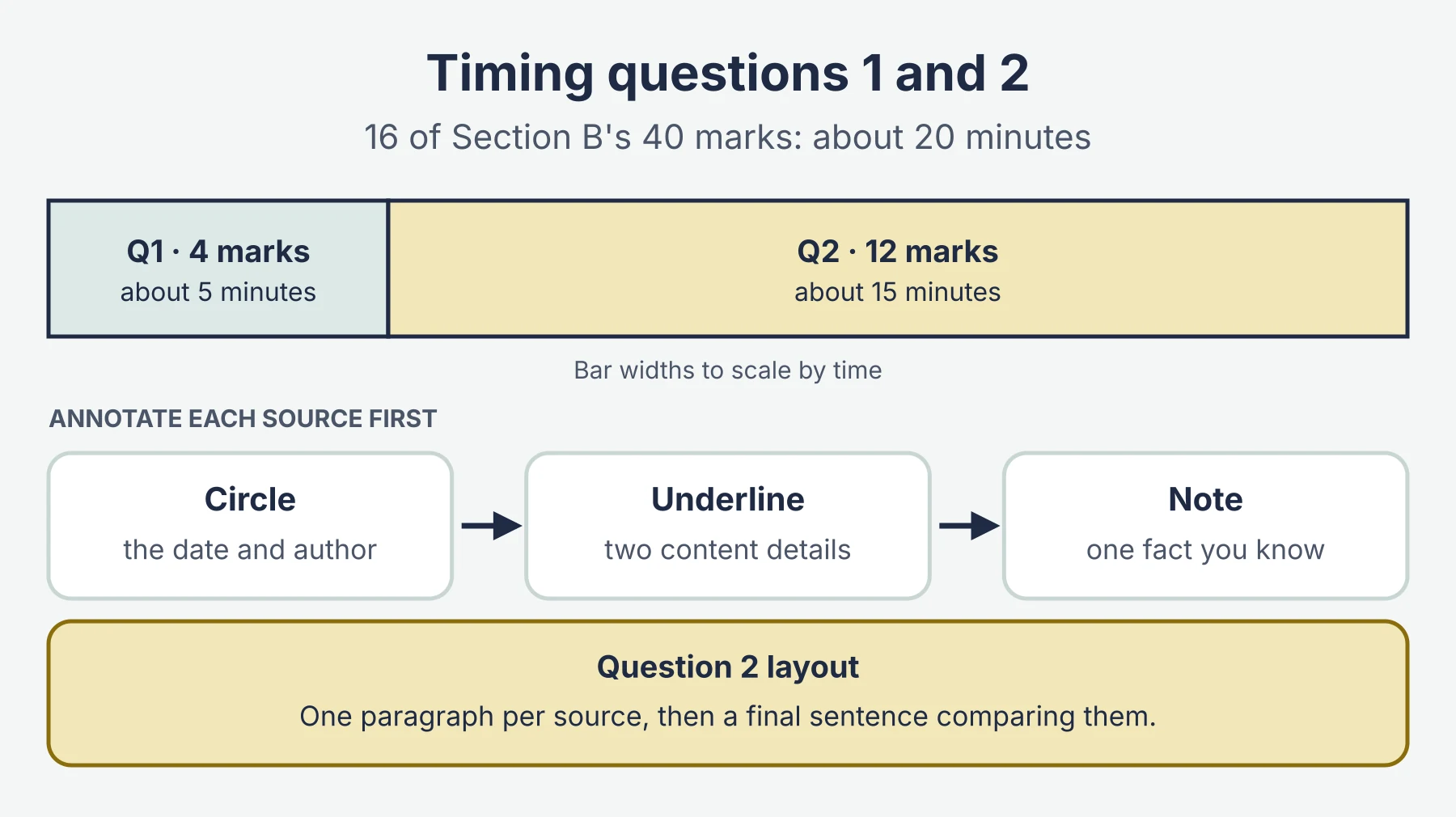
Content, provenance, context
- Content: what it says or shows; the message; what you can infer.
- Provenance: nature (type), origin (author, place, date), purpose (why made, for whom). Remember NOP.
- Context: what was happening at the time; your knowledge that confirms, explains or adds.
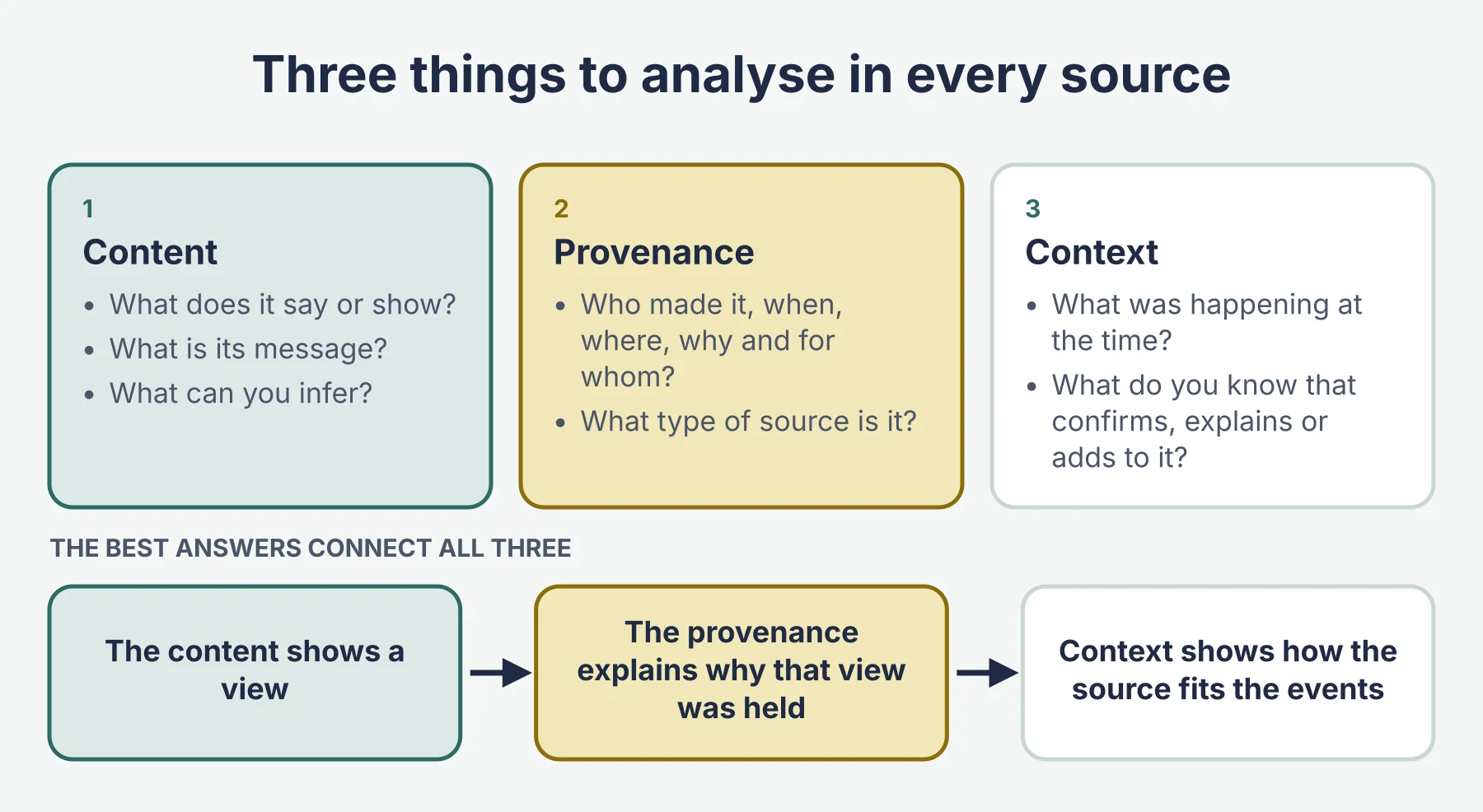
Cartoon checklist
- Caption and labels
- Figures: size, expression, caricature
- Symbols: bear (Russia), Uncle Sam (USA), dove (peace), chains, bombs
- Action: what is happening, what might happen next
- Message in one sentence
- Provenance: country, publication, date
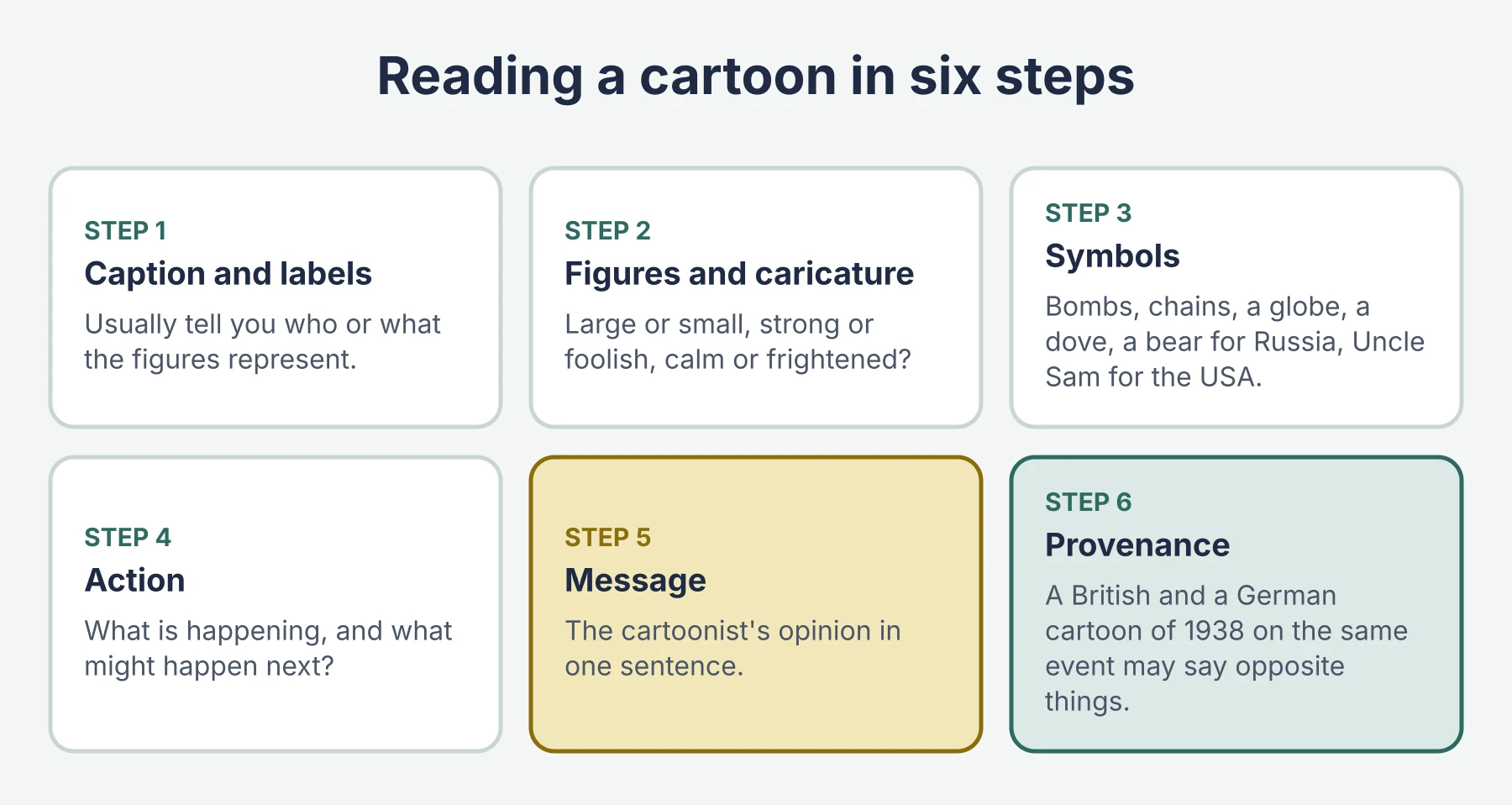
Question 1 recipe
- Detail from the source + what it shows about the view.
- Second detail + contextual knowledge explaining why this view was held then.
- Provenance (publication, country, date) + why the maker would take this line.
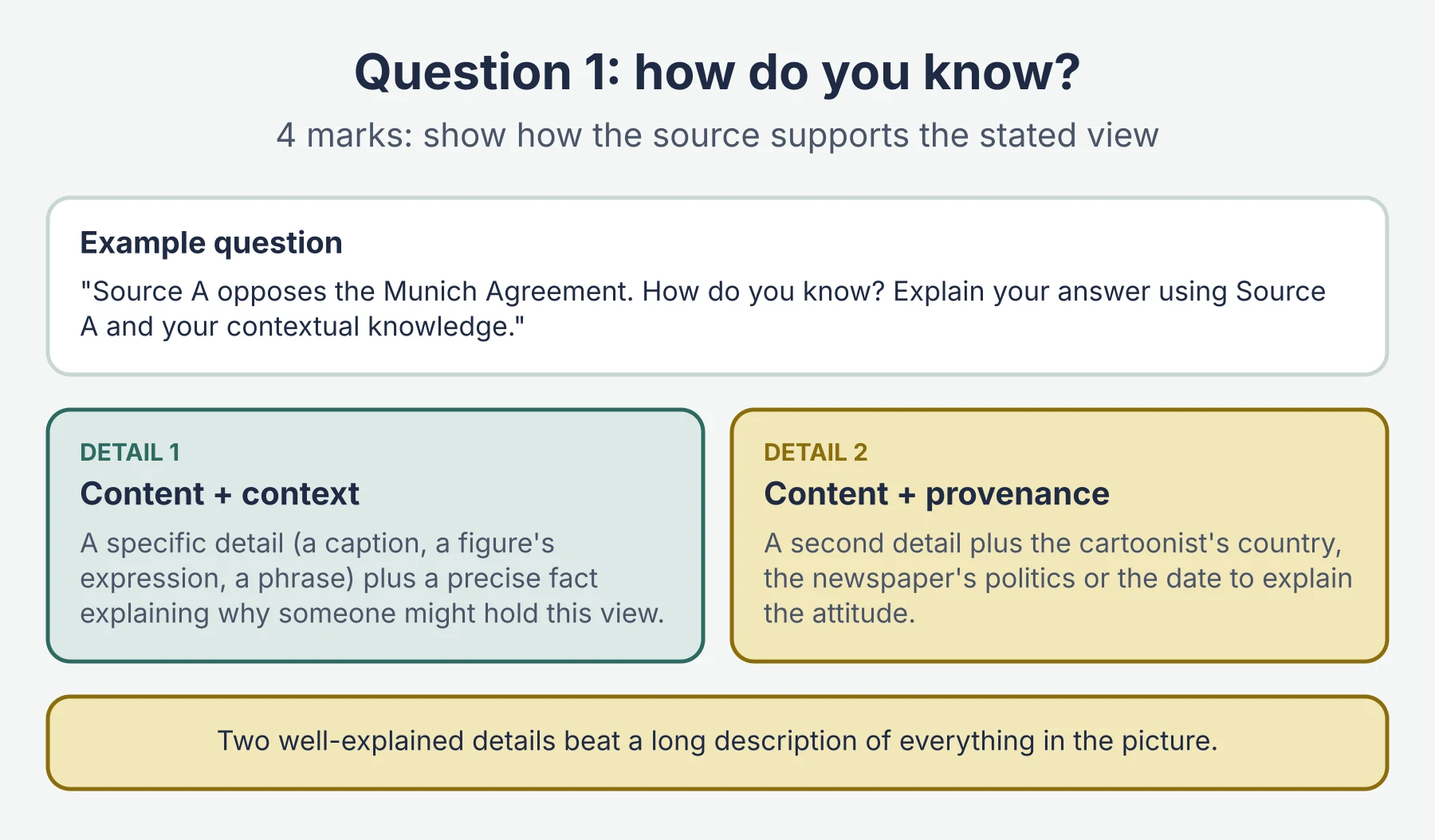
Question 2 recipe (for each source)
- Useful for – content linked to the enquiry, confirmed or extended by knowledge.
- Because of who made it – provenance explained: what the type, author and date make it good evidence of.
- Less useful for – gaps or one-sidedness, explained by provenance.
- Compare – a final sentence on how the two sources work together or which is more useful for this enquiry.
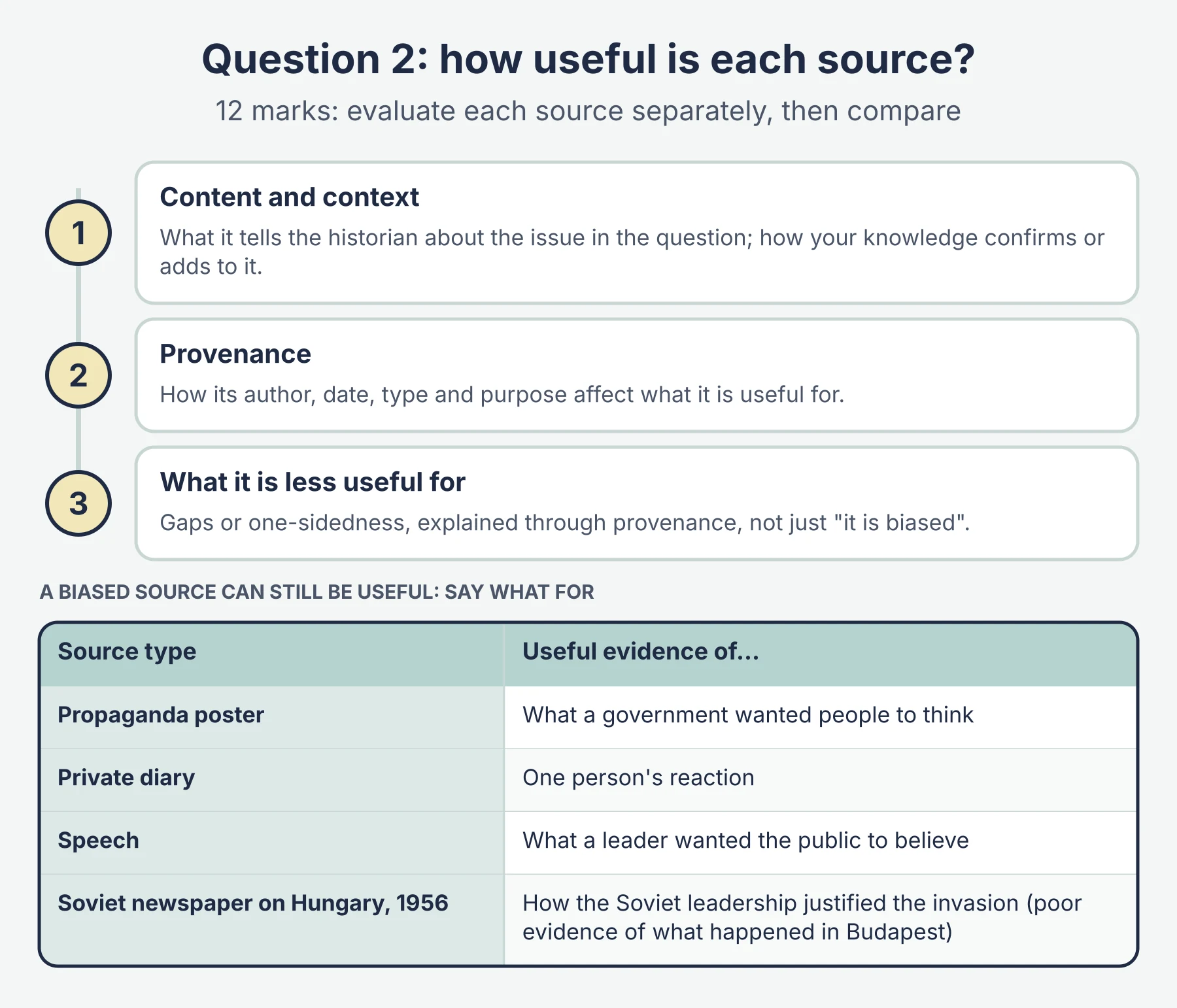
What different types of source are useful for
| Type | Good evidence of | Watch for |
|---|---|---|
| Propaganda poster | What a government wanted people to believe | Exaggeration; deliberate omissions |
| Cartoon | Public or press opinion in one country | Simplification; satire |
| Speech | A leader’s public aims and justifications | Purpose to persuade |
| Private letter or diary | Personal experience and feelings | Narrow viewpoint |
| Official report | Government information and decisions | What officials wanted recorded |
| Photograph | A moment, place or scale | Selection, staging, caption |
| Newspaper report | Events as reported, and the paper’s stance | Editorial line; censorship |
Key terms
| Term | Meaning |
|---|---|
| Source | Evidence produced at the time being studied |
| Provenance | Nature, origin and purpose of a source |
| Inference | A conclusion drawn from what a source suggests, not just states |
| Usefulness | What a source can tell an historian about a particular enquiry |
| Reliability | How far a source can be trusted as an accurate account |
| Propaganda | Material designed to persuade |
| Caricature | Exaggerated drawing of a person for effect |
| Contextual knowledge | Your own knowledge of the period |
| Enquiry | The issue the historian is studying, named in the question |
Usefulness versus reliability
An unreliable source can be very useful. A Nazi poster attacking the Treaty of Versailles is unreliable as an account of the treaty, but it is excellent evidence of how the Nazis exploited German anger. Always answer the enquiry in the question: useful for what? A strong sentence pattern: “Source C is useful for showing how the East German government justified the Berlin Wall, precisely because it is government propaganda.”
Exam traps
- Describing the cartoon without stating its message.
- Writing “biased so not useful” with no explanation.
- Using provenance that could fit any source (“it is primary so it is reliable”).
- Leaving out contextual knowledge.
- Answering on only one source in question 2.
- Ignoring the named enquiry and evaluating the source in general.
Self-test
- How many sources does question 1 use, and how many does question 2 use?
- Which assessment objective do the source questions test?
- What does NOP stand for?
- Name three things to check in a cartoon.
- What is the difference between usefulness and reliability?
- Why can a propaganda poster be useful?
- What is an inference?
- What should a question 2 answer include for each source?
- What is a weak way to use provenance?
- Roughly how long should you spend on question 2?
- What makes a private letter useful?
- What is the “enquiry” in a usefulness question?
Answers
- One for question 1; two for question 2.
- AO3.
- Nature, origin, purpose.
- Any three: caption, labels, figures, symbols, action, message, provenance.
- Usefulness is what a source can tell an historian about an enquiry; reliability is how far it can be trusted as accurate.
- It shows what its makers wanted people to believe, and how they tried to persuade them.
- A conclusion drawn from what a source suggests rather than states directly.
- Content linked to the enquiry, contextual knowledge, provenance and what it is less useful for.
- A general comment that could apply to any source, such as “it was written at the time so it is true”.
- About fifteen minutes.
- It gives a frank, personal reaction, not written for publication.
- The issue the historian is studying, named in the question.
Practise on invented sources for each depth study in the source analysis and usefulness practice questions.
Related resources
-
Study guides
AQA GCSE History (8145): Stalin's Modernisation of the USSR
AQA GCSE History 8145 Russia: collectivisation, the Five-Year Plans, their impact on kulaks, city dwellers, women and workers, and how far the USSR modernised.
World History · AQA · GCSE
Read guide -
Practice questions
AQA GCSE History (8145): Stalin's Modernisation of the USSR – Practice Questions
Original AQA GCSE History 8145 Russia practice on collectivisation and the Five-Year Plans: describe, in what ways, interpretations and two judgement essays.
World History · AQA · GCSE
Try questions -
Revision notes
AQA GCSE History (8145): Stalin's Modernisation of the USSR – Revision Notes
Revision notes for AQA GCSE History 8145 Russia: collectivisation, the Five-Year Plans, effects on each named group, the extent of change and a self-test.
World History · AQA · GCSE
Revise topic
Get free revision emails (optional)
Occasional emails with practice questions, worked explanations and links to free resources for the qualification and subjects you choose. No spam, and you can unsubscribe from any email. The free tools on this site never need an email.