
Revision Notes
AQA GCSE History (8145): Stalin's Modernisation of the USSR – Revision Notes
Revision notes for AQA GCSE History 8145 Russia: collectivisation, the Five-Year Plans, effects on each named group, the extent of change and a self-test.
- Subject
- World History
- Level
- GCSE
- Topic
- Understanding the Modern World
- Author
- Marlbridge Academic Team
- Updated
- Reviewed by
- Azam Siddique (what this means)
Aligned to AQA GCSE World History (8145), first teaching 2016. Official specification .
Syllabus page (what it covers and how it is assessed): AQA GCSE World History.
Syllabus points this page covers
8145
- 3.2.1 Section A: Period studies
This page covers 1 of the 2 subtopics in topic 1, Understanding the modern world.
Found an error? Report a correction.
Need help with this topic? Request a free trial class for GCSE World History (8145).
Condensed notes on “Stalin’s modernisation of the USSR” in AC Russia, 1894-1945, Part three. The specification lists “collectivisation; the Five Year Plans; social and economic consequences for Kulaks, city dwellers, women, professional and industrial workers; the extent of modernisation.” For full explanations see the Stalin’s modernisation study guide; for dates across the whole option, the period studies revision notes.
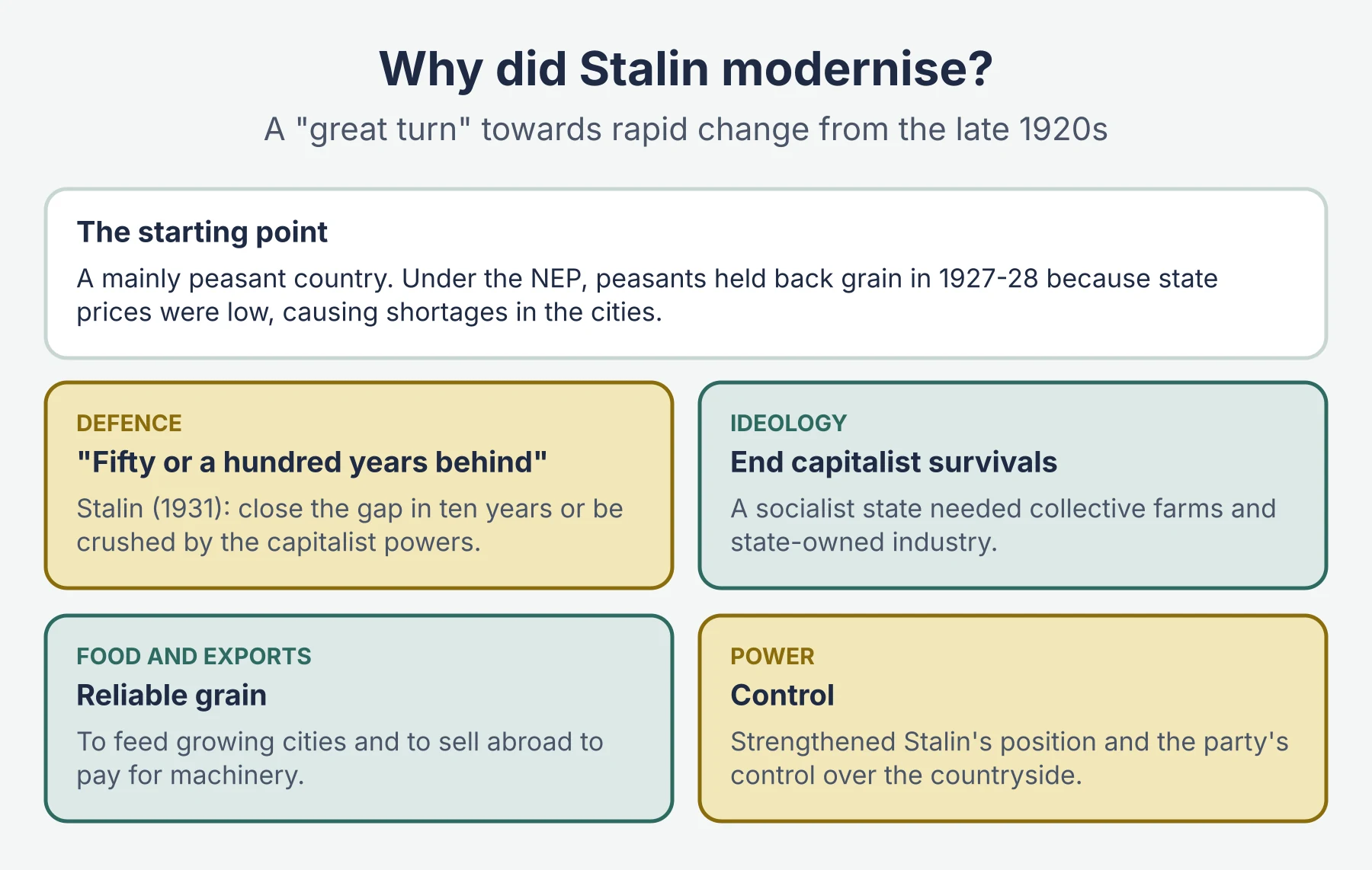
Why modernise? Four reasons
- Defence: fear of attack by capitalist powers (“fifty or a hundred years behind”, 1931).
- Ideology: replace private farming and trade with socialist collective ownership.
- Grain: feed the cities and export grain to pay for machinery after the 1927-28 grain crisis.
- Power: strengthen Stalin and the party, especially in the countryside.
Timeline
| Date | Event |
|---|---|
| 1927-28 | Grain procurement crisis |
| 1928 | First Five-Year Plan begins; Shakhty trial of engineers |
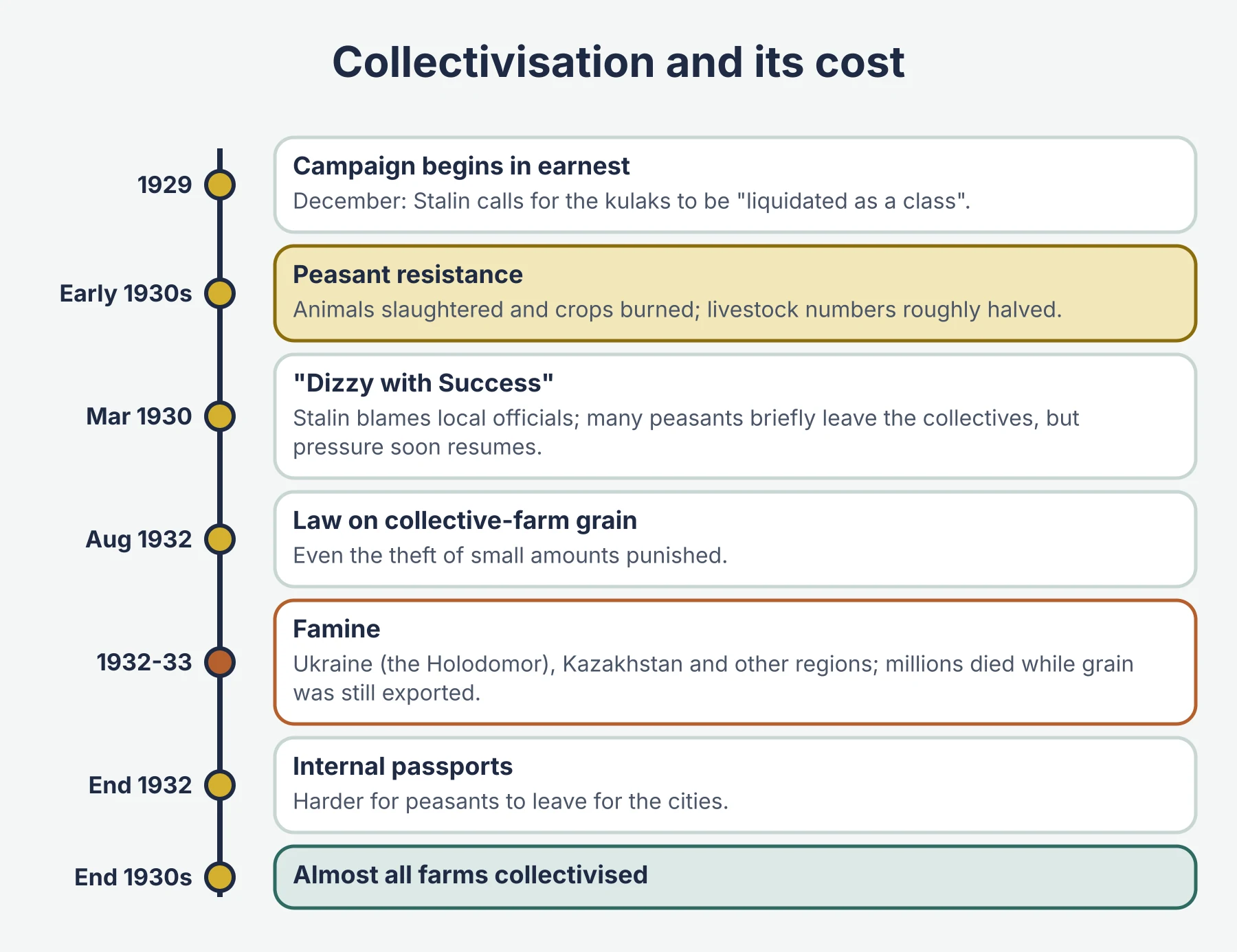
| 1929 | Mass collectivisation begins; December: call to “liquidate the kulaks as a class” |
| March 1930 | “Dizzy with Success” article; temporary retreat |
| 1932 | First Plan declared complete; August law on theft of collective property; internal passports |
| 1932-33 | Famine, including the Holodomor in Ukraine |
| 1933 | Second Five-Year Plan; White Sea Canal completed |
| 1935 | Moscow Metro opens; Stakhanov’s record; bread rationing ends |
| 1936 | Family Code bans abortion |
| 1938 | Third Five-Year Plan; labour books for workers |
| June 1941 | German invasion cuts the Third Plan short |
Collectivisation in brief
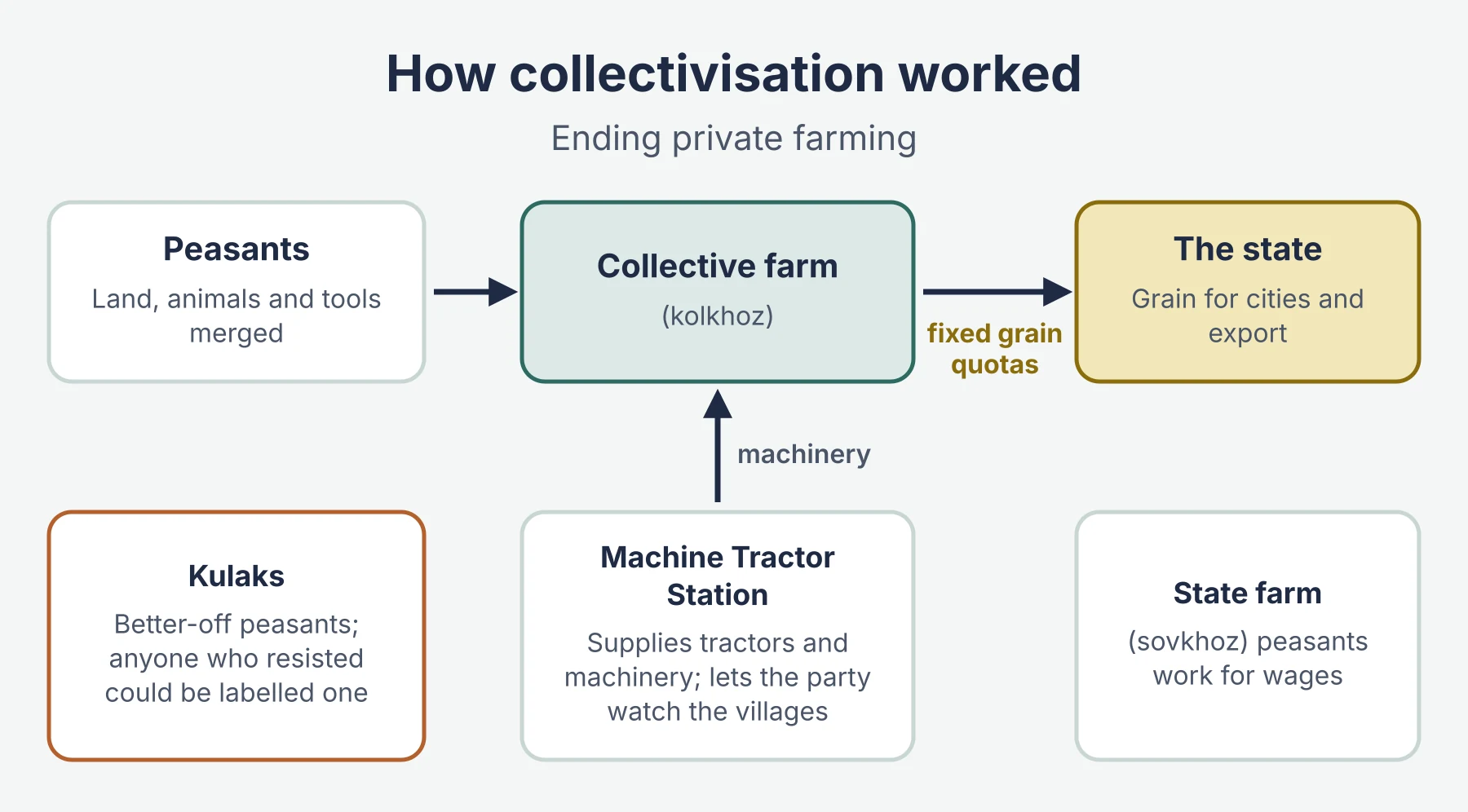
- Kolkhoz: collective farm with grain quotas for the state. Sovkhoz: state farm, wage labour.
- Machine Tractor Stations: supplied machinery and kept party control over villages.
- Resistance: slaughtering animals, burning crops; livestock roughly halved.
- Kulaks: deported or sent to camps; anyone resisting could be labelled a kulak.
- Famine 1932-33: millions died; grain still exported.
- By the end of the 1930s almost all farms were collectivised.
Five-Year Plans in brief
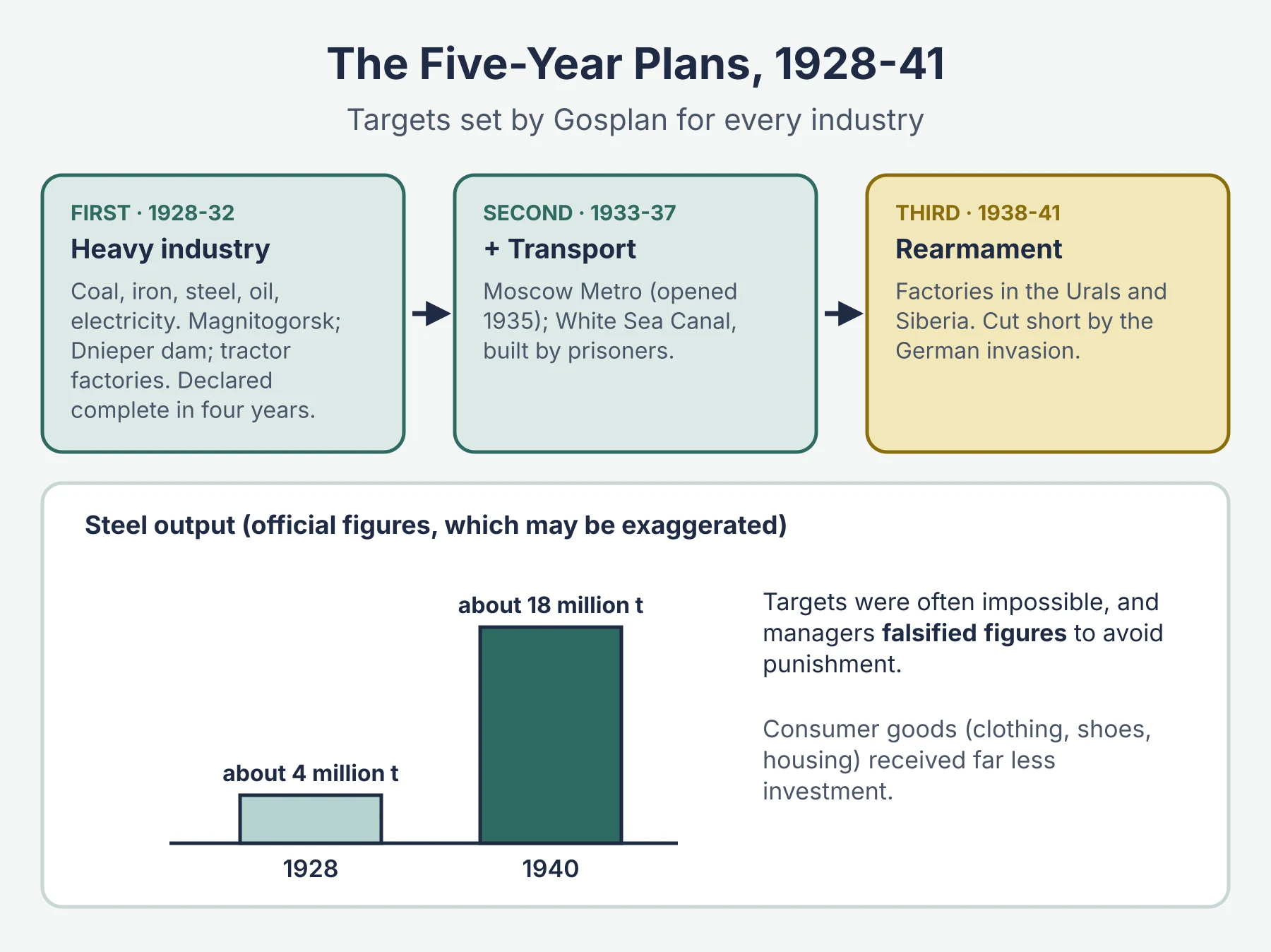
- Set by Gosplan; targets for each industry and factory.
- First (1928-32): coal, iron, steel, oil, electricity; Magnitogorsk; Dnieper dam.
- Second (1933-37): plus transport; Moscow Metro; prisoner-built White Sea Canal.
- Third (1938-41): rearmament; industry in the Urals and Siberia.
- Official claim: steel from about 4 million tonnes (1928) to about 18 million (1940), figures that may be exaggerated.
- Consumer goods and housing neglected.
Consequences by group
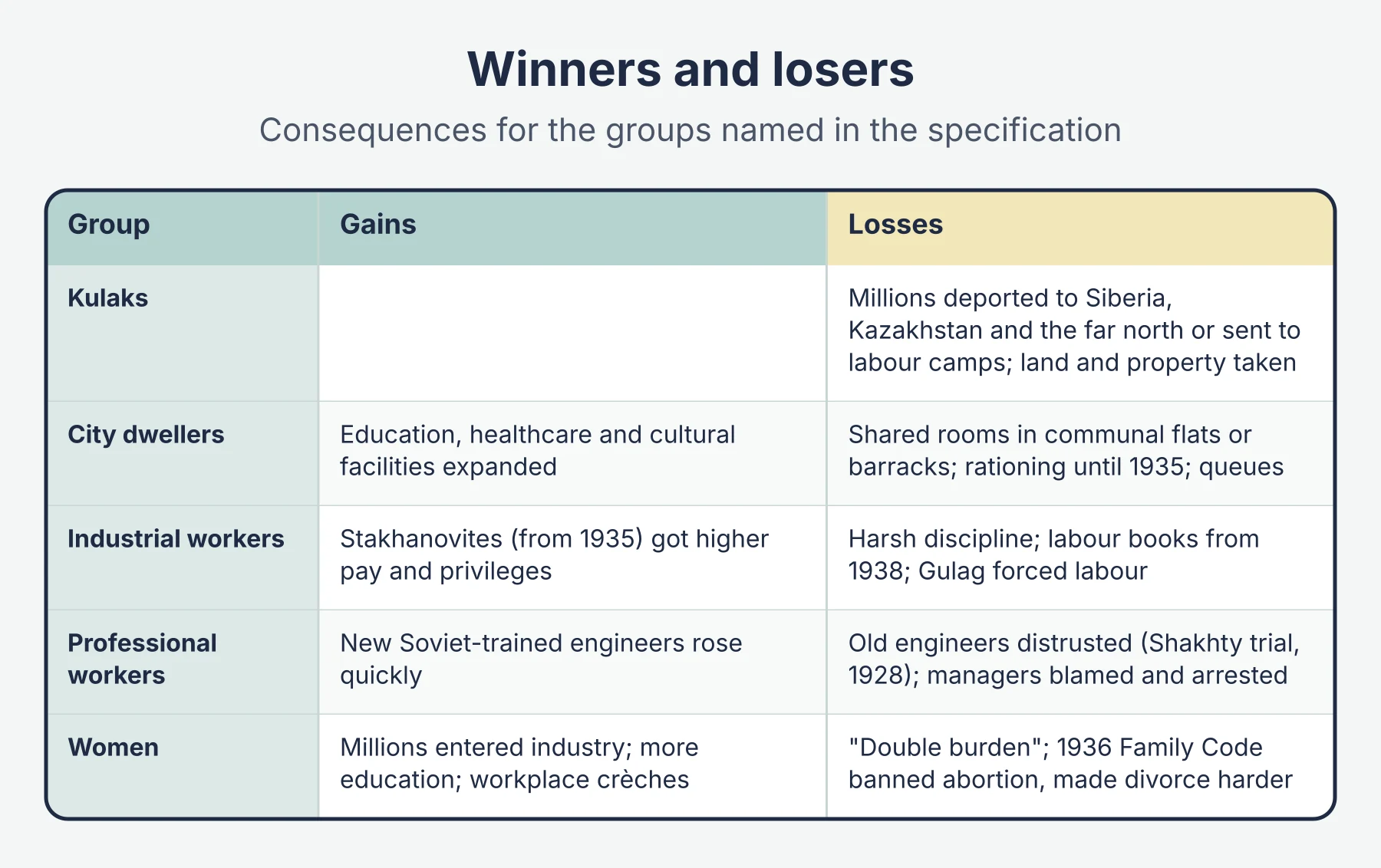
| Group | Gains | Losses |
|---|---|---|
| Kulaks | None | Land seized; deportation, camps, death |
| Other peasants | Some machinery via MTS | Loss of land and animals; quotas; famine; restricted movement |
| City dwellers | Jobs, education, healthcare, culture | Overcrowded communal flats, rationing to 1935, queues |
| Industrial workers | Stakhanovite bonuses and privileges; training | Harsh discipline; labour books; fear; forced labour for prisoners |
| Professional workers | Fast promotion for Soviet-trained engineers | Distrust of older specialists (Shakhty); arrest if targets failed |
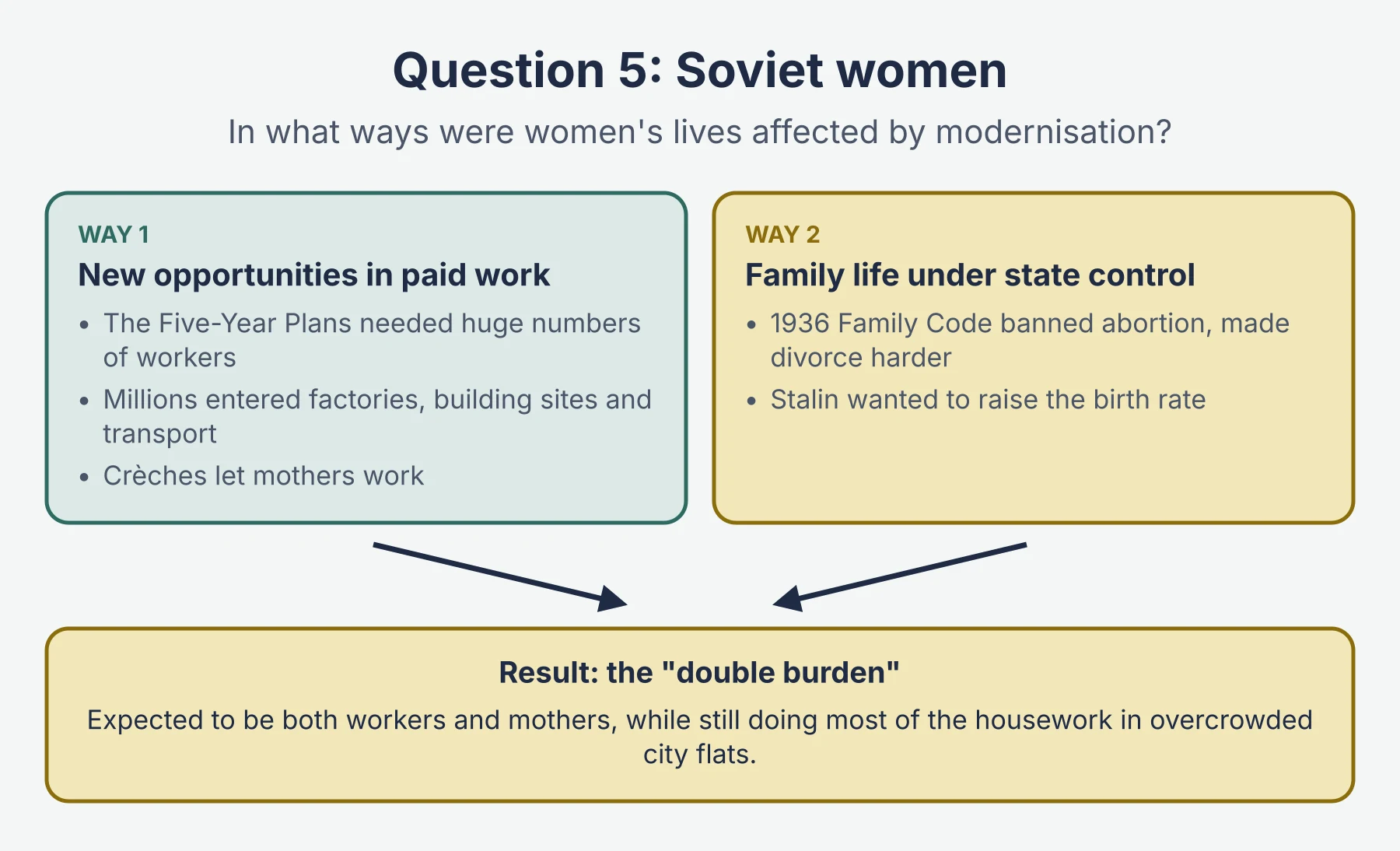
| Women | Paid work, training, crèches | Double burden; 1936 abortion ban; divorce harder |
Extent of modernisation: for and against
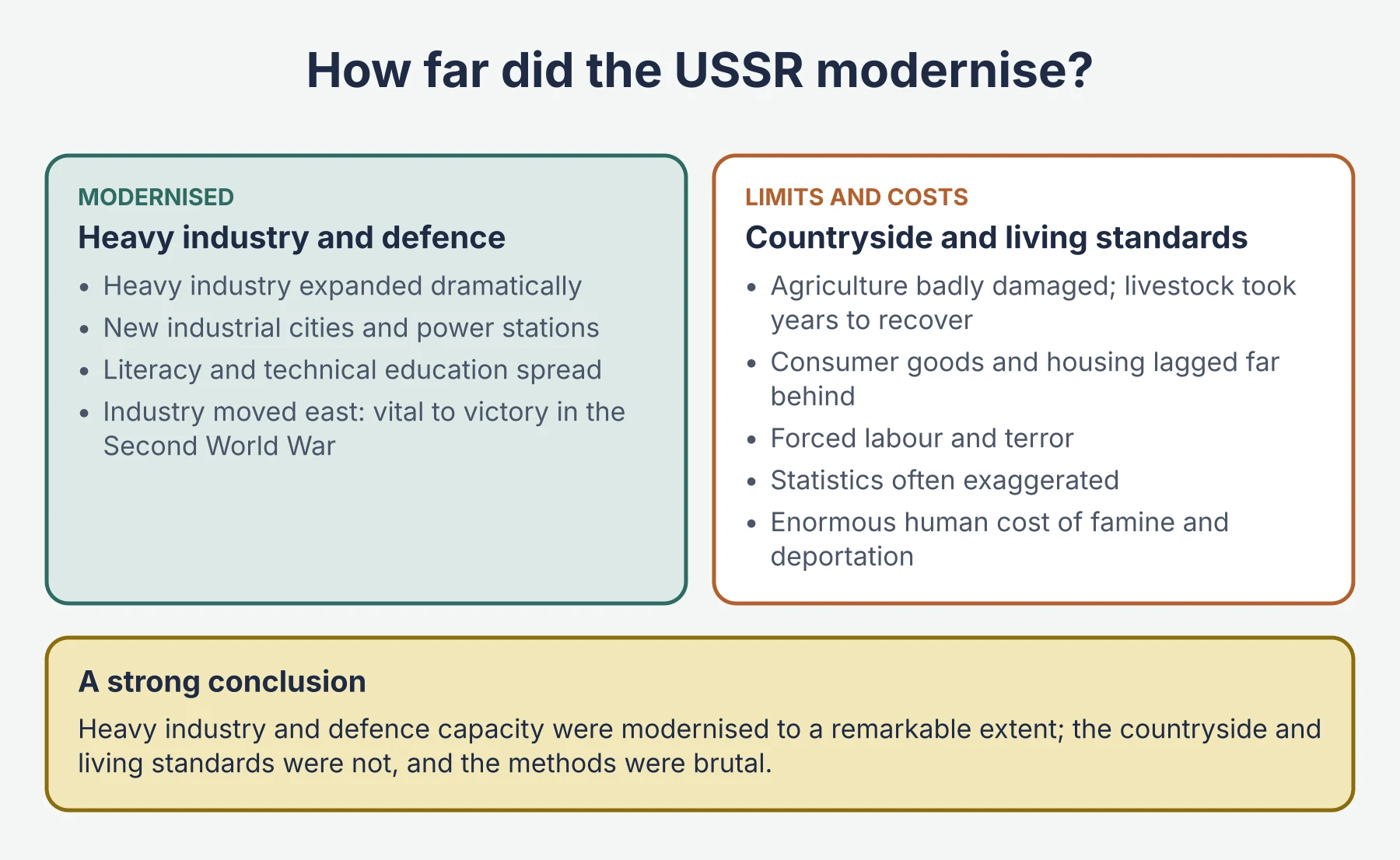
Modernised: heavy industry; new cities and power stations; education and literacy; industrial base for victory in 1941-45. Not modernised or at great cost: agriculture damaged; consumer goods and housing lagged; forced labour and terror; exaggerated statistics; famine.
Judgement line to adapt: “Stalin modernised heavy industry and defence to a remarkable extent, which mattered in 1941, but the countryside and living standards were not modernised in the same way, and the methods relied on famine, deportation and forced labour.” Decide which half matters more for the exact question asked.
Key terms
| Term | Meaning |
|---|---|
| Collectivisation | Merging private farms into collective and state farms |
| Kulak | Better-off peasant; label used against resisters |
| Kolkhoz | Collective farm |
| Gosplan | State planning agency |
| Five-Year Plan | Set of production targets for five years |
| Stakhanovite | Worker who exceeded targets, after Alexei Stakhanov |
| Gulag | System of labour camps |
| Holodomor | The 1932-33 famine in Ukraine |
| Double burden | Women’s paid work plus housework and childcare |
Exam traps
- Mixing up collectivisation and the Five-Year Plans.
- Giving official figures as facts without saying they were claimed.
- Writing about the purges generally instead of their effect on managers and workers.
- Forgetting women and professional workers, both named groups.
- In a question 6 essay on “extent”, arguing only one side.
- Dating the famine to 1921 (that was the Civil War era); the collectivisation famine was 1932-33.
Self-test
- What was the grain crisis of 1927-28?
- What was a kolkhoz?
- What did Stalin call for in December 1929?
- What was the purpose of the “Dizzy with Success” article?
- Name the 1932-33 famine in Ukraine.
- Which agency drew up the Five-Year Plans?
- Name two projects of the first two Five-Year Plans.
- Who was Alexei Stakhanov?
- What was the Shakhty trial?
- What did the 1936 Family Code do?
- Give one gain and one loss for city dwellers.
- Give one argument that modernisation was limited.
Answers
- Peasants held back grain because state prices were low, causing shortages in the cities.
- A collective farm that delivered grain quotas to the state.
- The “liquidation of the kulaks as a class”.
- To blame local officials for excesses and slow the pace of collectivisation for a time.
- The Holodomor.
- Gosplan.
- Any two: Magnitogorsk; the Dnieper dam; tractor factories; the Moscow Metro; the White Sea Canal.
- A miner reported in 1935 to have cut many times his coal quota in one shift; model for the Stakhanovite movement.
- A 1928 trial of engineers accused of sabotage, showing distrust of older specialists.
- Banned abortion and made divorce more difficult.
- Gain: jobs, education or healthcare. Loss: overcrowded housing, rationing or queues.
- Any one: agriculture damaged; consumer goods neglected; reliance on forced labour; exaggerated statistics; famine.
Related resources
-
Study guides
AQA GCSE History (8145): The Schlieffen Plan and Stalemate on the Western Front
AQA GCSE History 8145 First World War: why the Schlieffen Plan failed, trench warfare, attrition, and Verdun, the Somme and Passchendaele in depth.
World History · AQA · GCSE
Read guide -
Practice questions
AQA GCSE History (8145): The Schlieffen Plan and Stalemate on the Western Front – Practice Questions
Original AQA GCSE History 8145 practice on the Schlieffen Plan, trench warfare, Verdun, the Somme and Passchendaele: source, account and essay questions.
World History · AQA · GCSE
Try questions -
Revision notes
AQA GCSE History (8145): The Schlieffen Plan and Stalemate on the Western Front – Revision Notes
Revision notes for AQA GCSE History 8145 First World War stalemate: the Schlieffen Plan, the Marne, trench technology, attrition and three key battles.
World History · AQA · GCSE
Revise topic
Get free revision emails (optional)
Occasional emails with practice questions, worked explanations and links to free resources for the qualification and subjects you choose. No spam, and you can unsubscribe from any email. The free tools on this site never need an email.