
Revision Notes
AQA GCSE History (8145): The Schlieffen Plan and Stalemate on the Western Front – Revision Notes
Revision notes for AQA GCSE History 8145 First World War stalemate: the Schlieffen Plan, the Marne, trench technology, attrition and three key battles.
- Subject
- World History
- Level
- GCSE
- Topic
- Understanding the Modern World
- Author
- Marlbridge Academic Team
- Updated
- Reviewed by
- Azam Siddique (what this means)
Aligned to AQA GCSE World History (8145), first teaching 2016. Official specification .
Syllabus page (what it covers and how it is assessed): AQA GCSE World History.
Syllabus points this page covers
8145
- 3.2.2 Section B: Wider world depth studies
This page covers 1 of the 2 subtopics in topic 1, Understanding the modern world.
Found an error? Report a correction.
Need help with this topic? Request a free trial class for GCSE World History (8145).
Condensed notes on Part two of BA Conflict and tension: the First World War, 1894-1918. The specification names “The Schlieffen Plan: the reasons for the plan, its failure, including the Battle of Marne and its contribution to the stalemate” and “The Western Front: military tactics and technology, including trench warfare; the war of attrition; key battles, including Verdun, the Somme and Passchendaele”. Full explanations are in the Schlieffen Plan and stalemate study guide; the whole option’s timeline is in the wider world depth studies revision notes.
Timeline
| Date | Event |
|---|---|
| 1905 | Schlieffen draws up the plan |
| August 1914 | Germany invades Belgium; Britain declares war (4 August); Mons (23 August) |
| Late August 1914 | Tannenberg: German troops diverted east |
| September 1914 | Battle of the Marne; Germans retreat to the Aisne and dig in |
| Autumn 1914 | Race to the sea; First Battle of Ypres; trench line from Channel to Switzerland |
| April 1915 | Germans use chlorine gas at the Second Battle of Ypres |
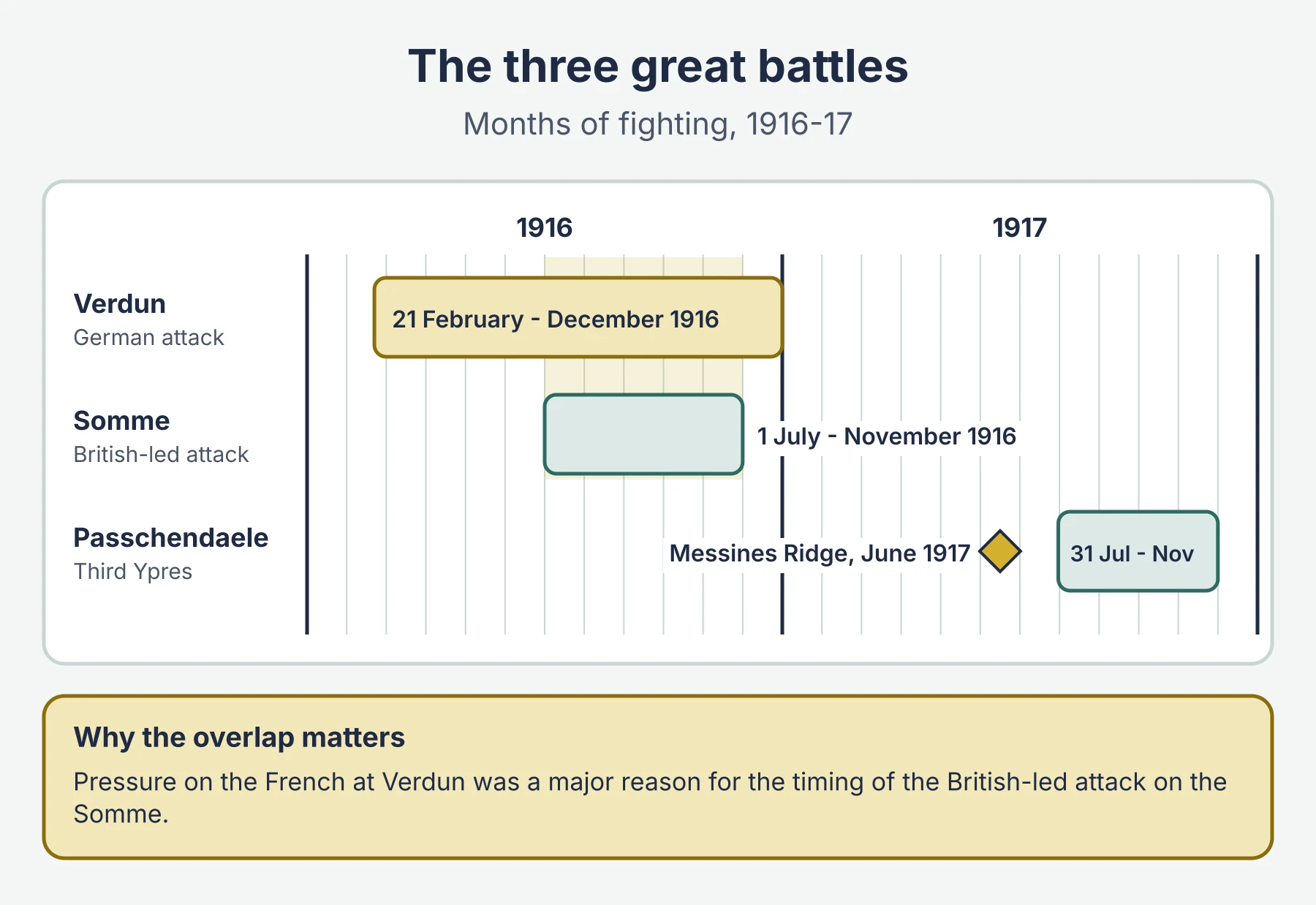
| 21 February 1916 | Verdun begins |
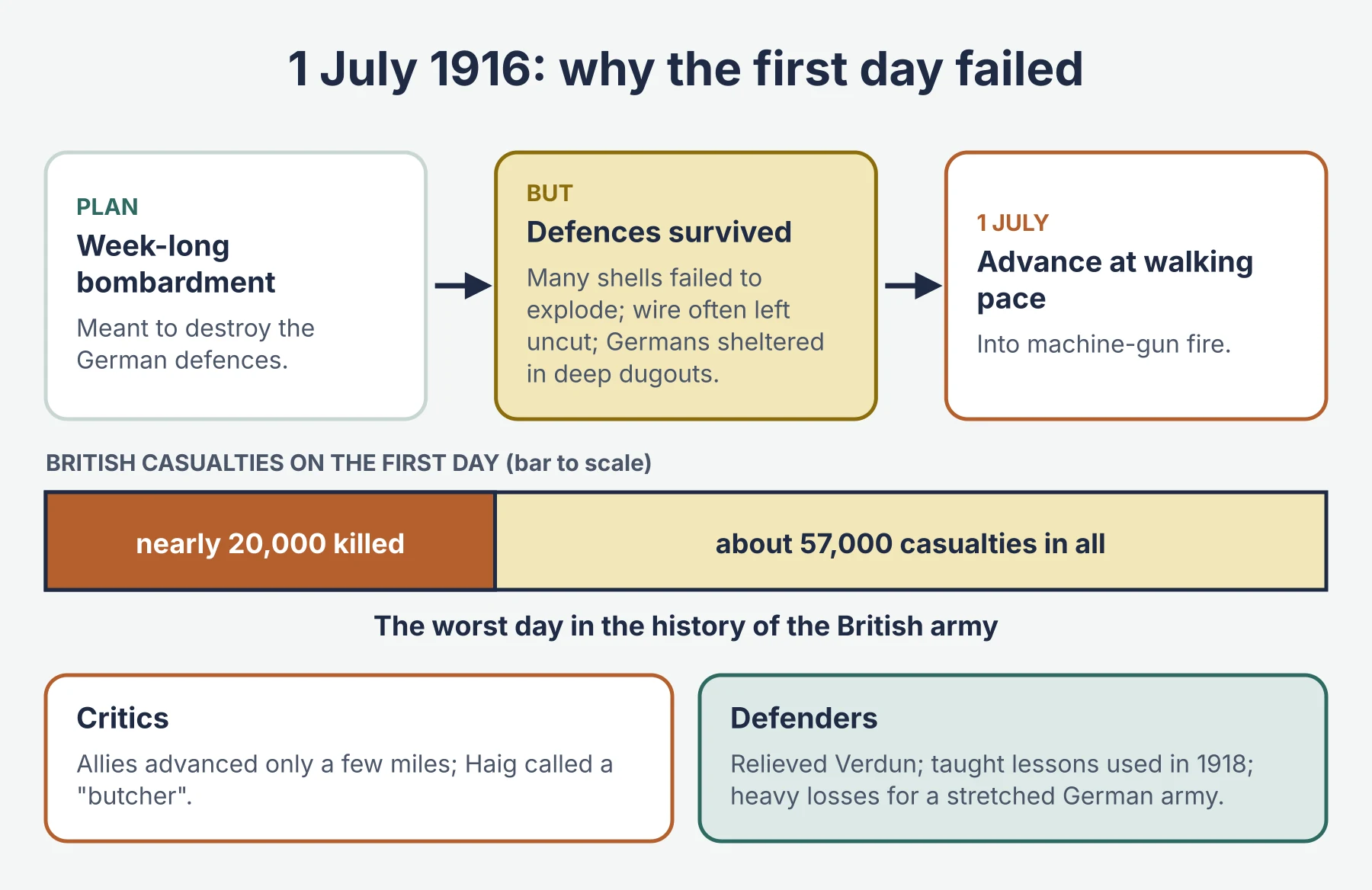
| 1 July 1916 | Somme begins: about 57,000 British casualties on the first day |
| 15 September 1916 | Tanks first used, on the Somme |
| November 1916 | Somme ends |
| December 1916 | Verdun ends; French recover most lost ground |
| Spring 1917 | Nivelle Offensive fails; French army mutinies |
| June 1917 | Messines Ridge mines |
| 31 July 1917 | Passchendaele (Third Ypres) begins |
| November 1917 | Canadians take Passchendaele village |
Schlieffen Plan
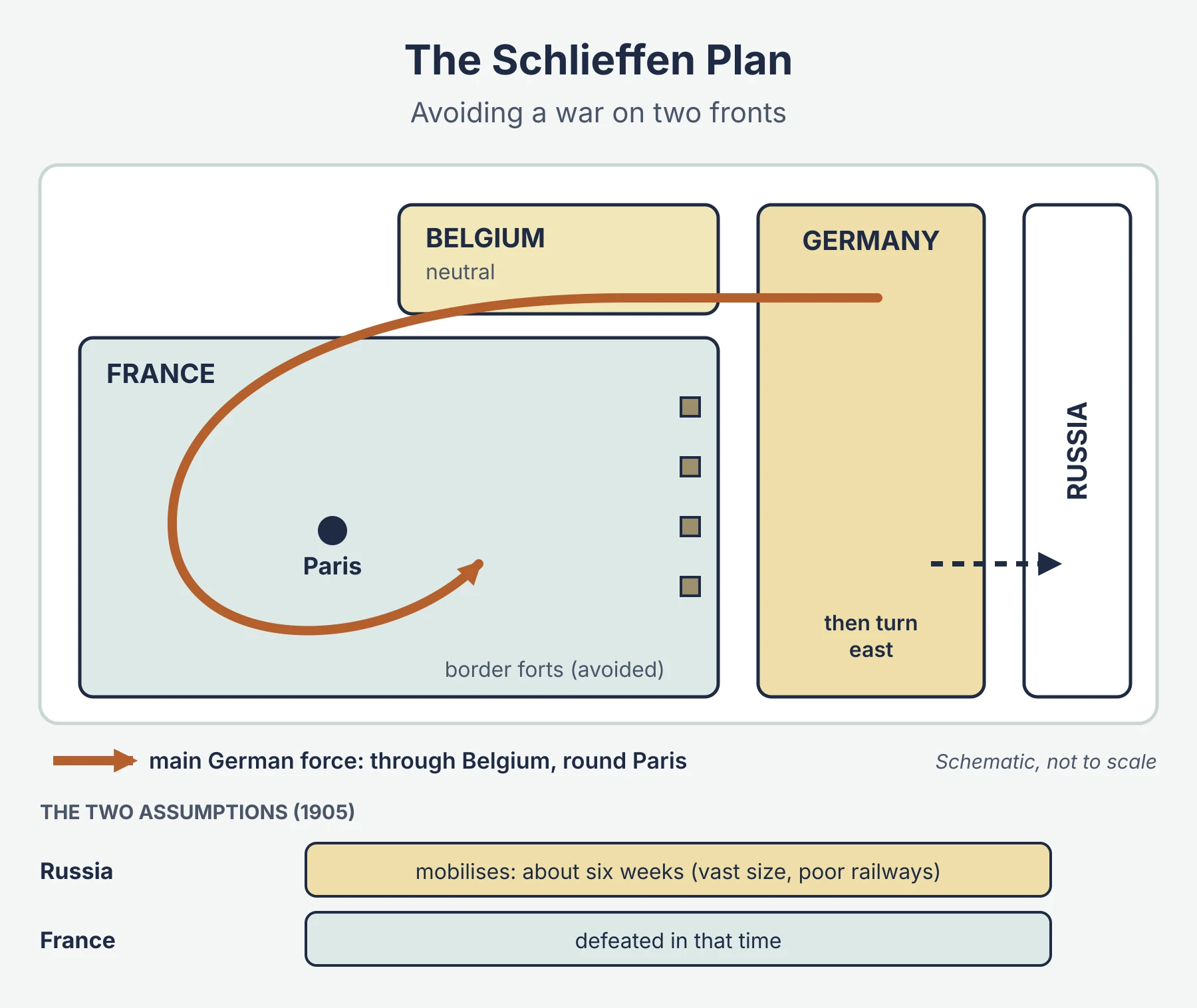
- Why: avoid a two-front war; defeat France in about six weeks before Russia mobilised; go through Belgium to avoid French forts; encircle Paris; then turn east.
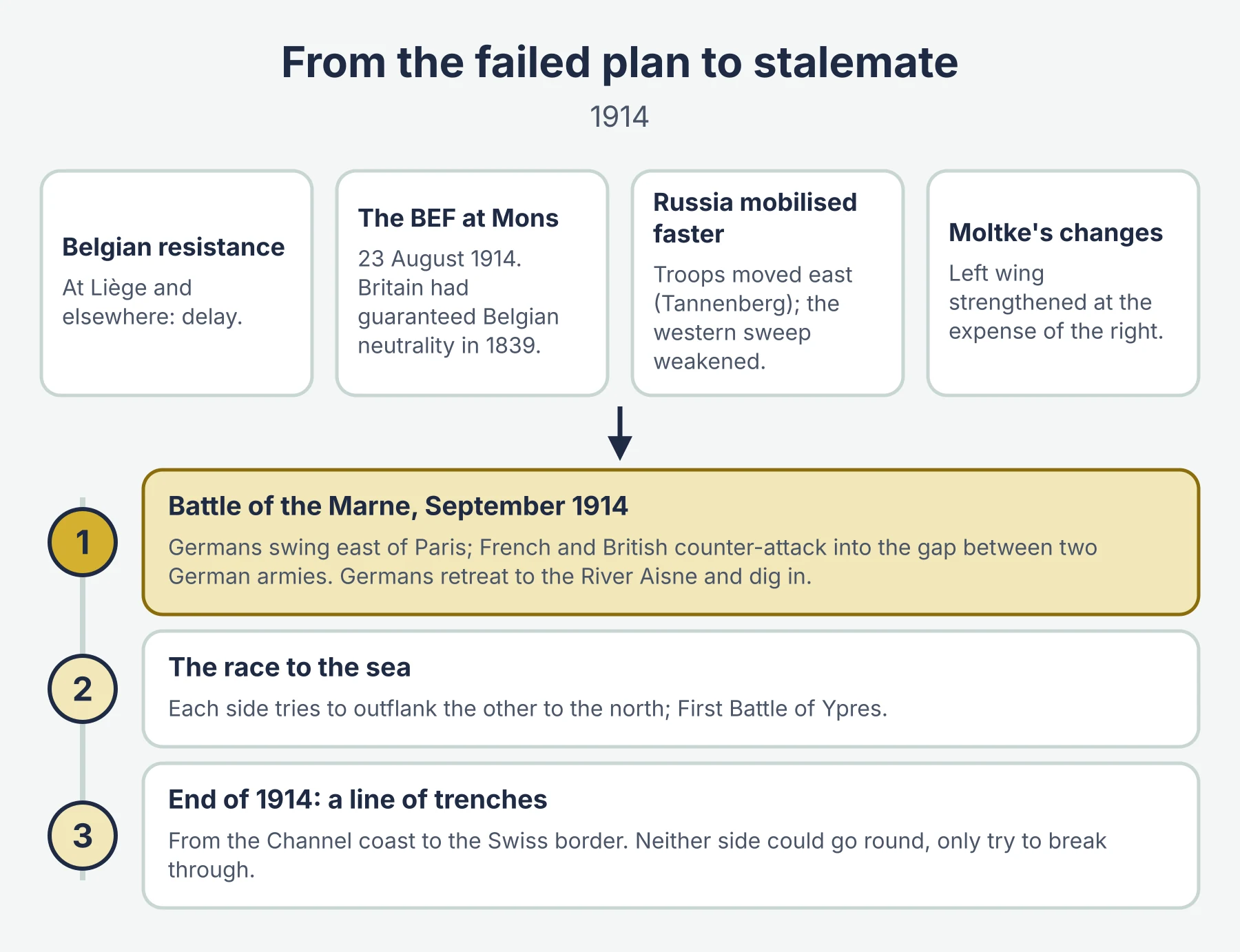
- Why it failed: Belgian resistance; BEF at Mons; Russia mobilised faster; troops sent east; Moltke’s changes; Germans turned east of Paris; Battle of the Marne.
- Link to stalemate: Germans dug in on the Aisne; race to the sea; continuous trench line by end of 1914.
Why defence beat attack
| Factor | Effect |
|---|---|
| Machine guns | Cut down infantry crossing no man’s land |
| Barbed wire | Slowed attackers in the open |
| Artillery | Most casualties; bombardments warned of attacks and churned the ground |
| Railways | Defenders brought reserves faster than attackers advanced |
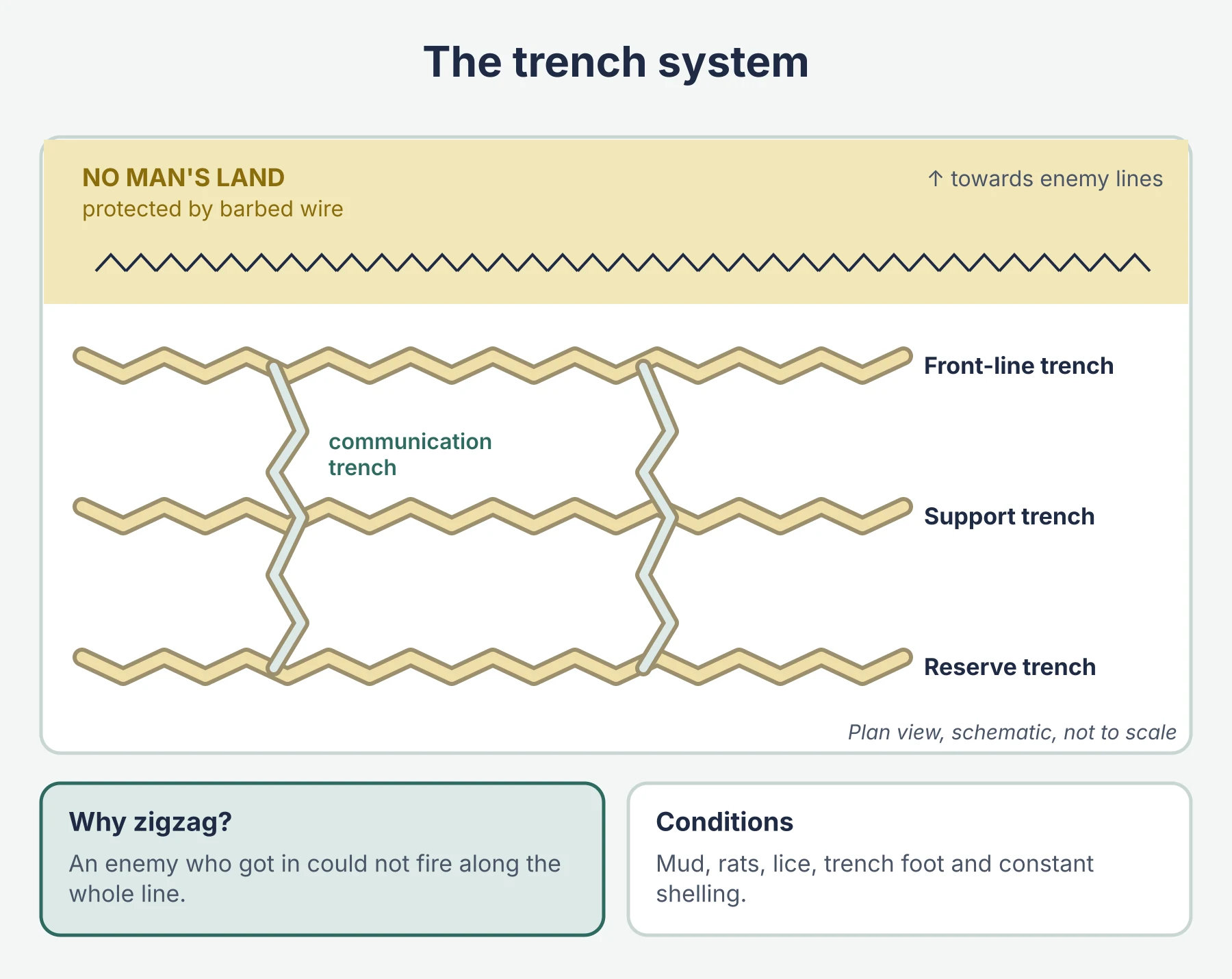
| Trench design | Zigzags, dugouts, support and reserve lines |
New technology and tactics
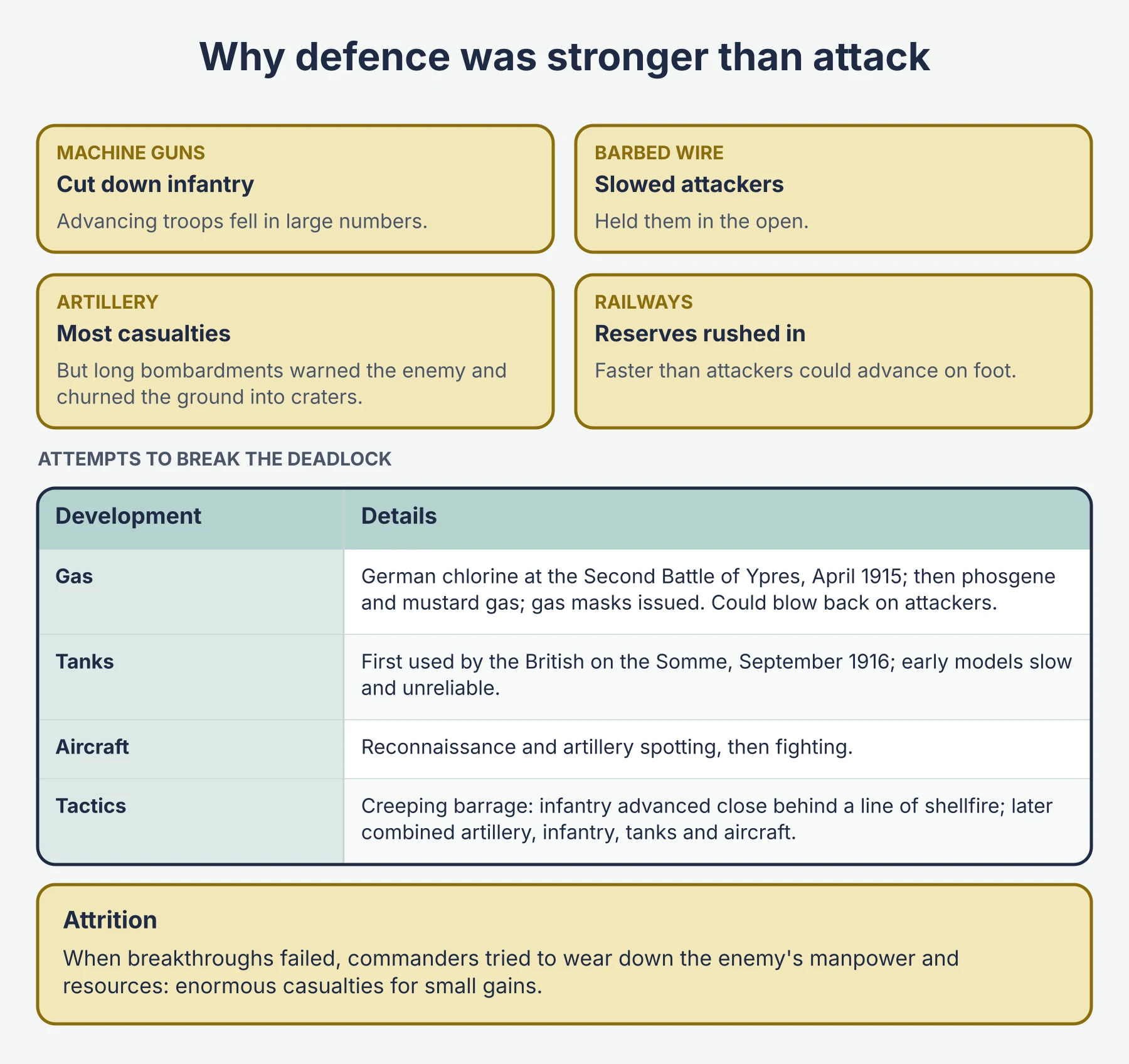
- Gas (chlorine 1915; later phosgene and mustard): frightening, but masks reduced its effect; wind could blow it back.
- Tanks (first used September 1916): crossed wire and trenches, but early models broke down.
- Aircraft: reconnaissance, artillery spotting, then air combat.
- Creeping barrage: infantry advanced behind a moving line of shellfire.
- Attrition: wearing down the enemy’s men and resources when breakthrough failed.
Three battles compared
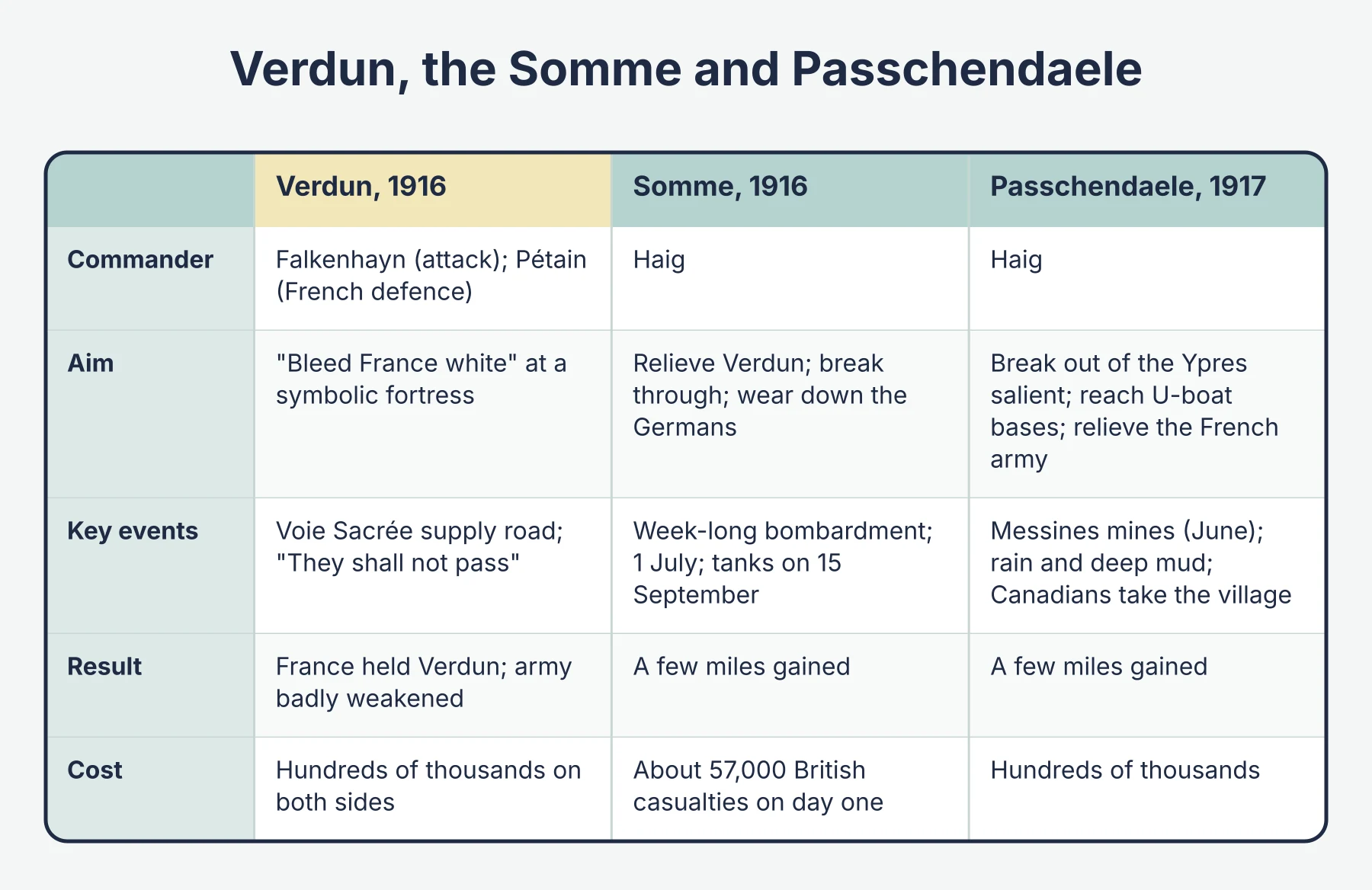
| Verdun (1916) | Somme (1916) | Passchendaele (1917) | |
|---|---|---|---|
| Attacker | Germany (Falkenhayn) | Britain and France (Haig) | Britain and Empire (Haig) |
| Reasons | “Bleed France white” at a symbolic fortress | Relieve Verdun; break through; wear down Germany | Reach Belgian coast and U-boat bases; relieve French after mutinies |
| Key events | Bombardment; forts lost; Pétain; Voie Sacrée | Week-long bombardment; 1 July disaster; first tanks | Messines mines; rain and mud; Canadians take the village |
| Significance | France holds on; huge losses; led to timing of the Somme | Few miles gained; “butcher” debate; lessons learned; German army weakened | Symbol of futility; Germany also worn down |
Key terms
| Term | Meaning |
|---|---|
| Stalemate | A situation in which neither side can win |
| Schlieffen Plan | German plan to defeat France quickly through Belgium, then fight Russia |
| BEF | British Expeditionary Force |
| Race to the sea | Attempts to outflank each other northwards in autumn 1914 |
| No man’s land | Ground between opposing trenches |
| Attrition | Wearing down the enemy through continual losses |
| Creeping barrage | Shellfire moving ahead of advancing infantry |
| Salient | A bulge in the front line surrounded on three sides by the enemy |
| Voie Sacrée | The supply road to Verdun |
Exam traps
- Trenches were a result of the plan’s failure, not its cause.
- Verdun was a German attack; the Somme was a British-led attack.
- Passchendaele was 1917, not 1916.
- In a question 3 account, link events with “this led to” and “as a result”.
- In a question 4 essay on stalemate, weigh the Schlieffen Plan’s failure against technology and tactics; do not just describe the battles.
- Use casualty figures only when you are sure of them.
Self-test
- What two assumptions was the Schlieffen Plan based on?
- Why did the plan bring Britain into the war?
- Where did the BEF first fight the Germans?
- Name the battle in September 1914 that stopped the German advance.
- What was the race to the sea?
- Which weapon caused the majority of casualties?
- When and where was chlorine gas first used on a large scale?
- What was Falkenhayn’s aim at Verdun?
- What happened on 1 July 1916?
- When were tanks first used?
- Why did Haig attack at Passchendaele?
- Why did the ground at Passchendaele become so muddy?
Answers
- Russia would take about six weeks to mobilise, and France could be defeated in that time.
- It required the invasion of Belgium, whose neutrality Britain had guaranteed.
- At Mons, on 23 August 1914.
- The Battle of the Marne.
- Each side’s attempt to outflank the other northwards, ending at the Channel.
- Artillery.
- April 1915, at the Second Battle of Ypres.
- To “bleed France white” by forcing it to defend Verdun at any cost.
- The first day of the Somme: about 57,000 British casualties, nearly 20,000 killed.
- 15 September 1916, on the Somme.
- To reach the Belgian coast and U-boat bases, and to relieve the French army after its mutinies.
- Heavy rain and shelling destroyed the drainage of the low-lying ground.
Practise accounts and essays in the Schlieffen Plan and stalemate practice questions.
Related resources
-
Practice questions
AQA GCSE History (8145): Paper 1 Section A Period Studies — Practice Questions
Original AQA GCSE History 8145 Paper 1 Section A practice: a full six-question Germany set with invented interpretations, plus the other period studies.
World History · AQA · GCSE
Try questions -
Revision notes
AQA GCSE History (8145): Paper 1 Section A Period Studies — Revision Notes
Revision notes for AQA GCSE History 8145 Paper 1 Section A: key dates for all four period studies, a technique sheet for questions 1-6 and common exam traps.
World History · AQA · GCSE
Revise topic -
Study guides
AQA GCSE History (8145): Paper 1 Section A, the Four Period Studies — Study Guide
Study guide to AQA GCSE History 8145 Paper 1 Section A: all four period studies part by part, and how questions 1-6, from interpretations to essay, work.
World History · AQA · GCSE
Read guide
Get free revision emails (optional)
Occasional emails with practice questions, worked explanations and links to free resources for the qualification and subjects you choose. No spam, and you can unsubscribe from any email. The free tools on this site never need an email.