
Study Guides
AQA GCSE History (8145): Nazi Control, Propaganda and Opposition
AQA GCSE History 8145 Germany 1890-1945: how Goebbels, Himmler, the SS and Gestapo controlled Germans, and the opposition and resistance they faced.
- Subject
- World History
- Level
- GCSE
- Topic
- Understanding the Modern World
- Author
- Marlbridge Academic Team
- Updated
- Reviewed by
- Azam Siddique (what this means)
Aligned to AQA GCSE World History (8145), first teaching 2016. Official specification .
Syllabus page (what it covers and how it is assessed): AQA GCSE World History.
Syllabus points this page covers
8145
- 3.2.1 Section A: Period studies
This page covers 1 of the 2 subtopics in topic 1, Understanding the modern world.
Found an error? Report a correction.
Need help with this topic? Request a free trial class for GCSE World History (8145).
This guide covers the “Control” content statement in Part three of AB Germany, 1890-1945: Democracy and dictatorship. The specification lists: “Goebbels, the use of propaganda and censorship; Nazi culture; repression and the police state and the roles of Himmler, the SS and Gestapo; opposition and resistance, including White Rose group, Swing Youth, Edelweiss Pirates and July 1944 bomb plot.” The Section A period studies study guide summarises the whole option in a few lines; this page explains how the two halves of Nazi control, persuasion and terror, worked together, and why opposition took the forms it did.
Two methods of control
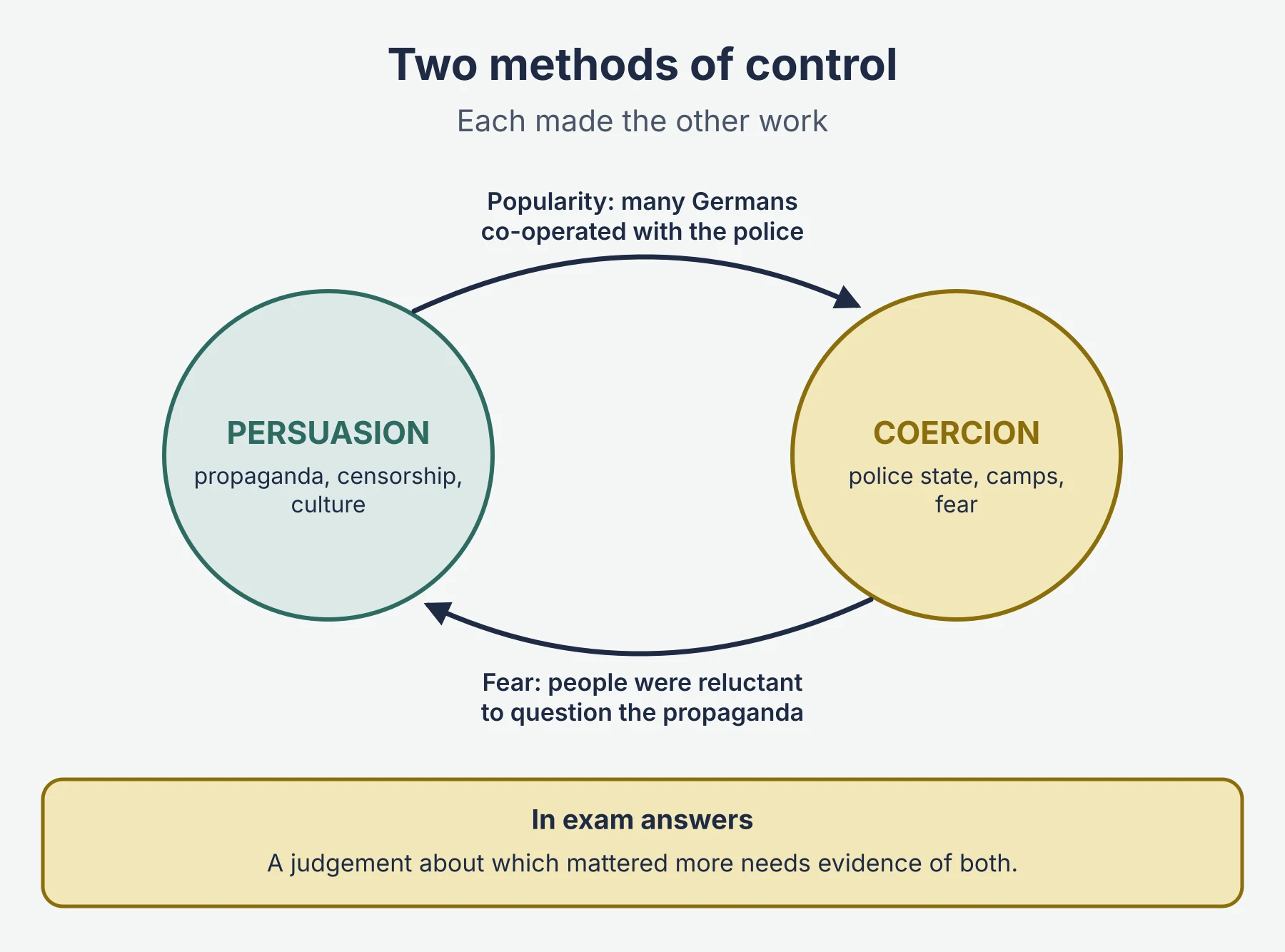
Historians often describe Nazi control as resting on persuasion (propaganda, censorship, culture) and coercion (the police state, camps and fear). For exam answers, the key point is that each made the other work. Propaganda made the regime popular enough that many Germans co-operated with the police, while fear made people reluctant to question the propaganda. A judgement about which mattered more needs evidence of both.
Goebbels, propaganda and censorship
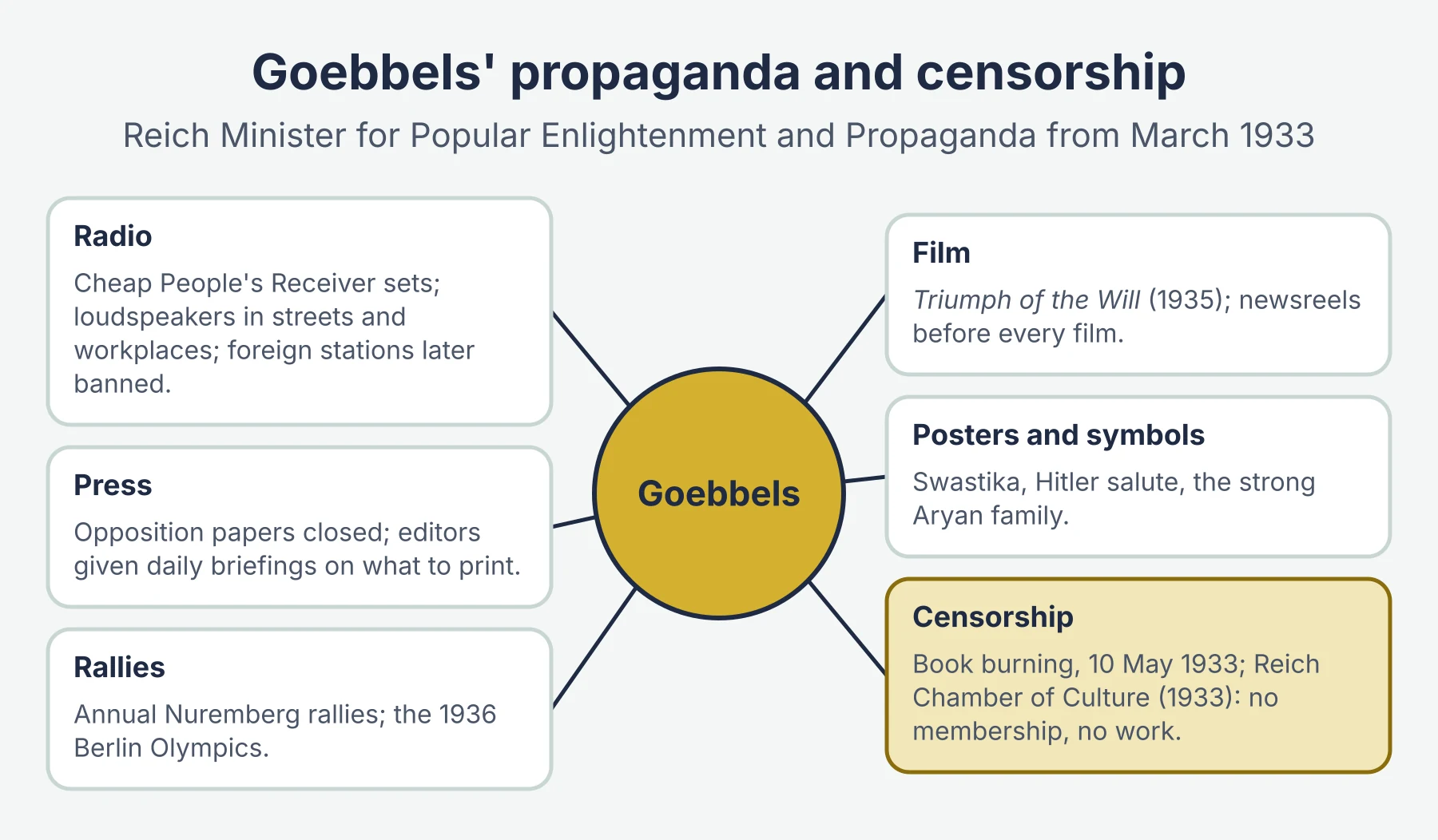
Joseph Goebbels became Reich Minister for Popular Enlightenment and Propaganda in March 1933. His task was to make Germans think as the regime wished, through every medium:
- Radio. Cheap radio sets, the People’s Receiver, put Hitler’s speeches into millions of homes; loudspeakers carried broadcasts into streets and workplaces. Listening to foreign stations was later made a crime.
- Press. Newspapers that opposed the Nazis were closed; editors were made responsible for following government instructions, and daily briefings told them what to print.
- Rallies and spectacle. The annual Nuremberg rallies, with massed ranks, searchlights and speeches, presented a united, disciplined nation; the 1936 Berlin Olympics showed the regime to the world.
- Film. Leni Riefenstahl’s Triumph of the Will (1935) glorified the 1934 rally; newsreels shown before every film carried the regime’s message.
- Posters and symbols. The swastika, the Hitler salute and posters of the strong Aryan family were everywhere.
Censorship was the other side of propaganda. On 10 May 1933 students burned books by Jewish, socialist and other banned authors. The Reich Chamber of Culture (1933), under Goebbels, controlled who could work as a writer, musician, artist, actor or journalist: anyone not accepted could not work.
Nazi culture
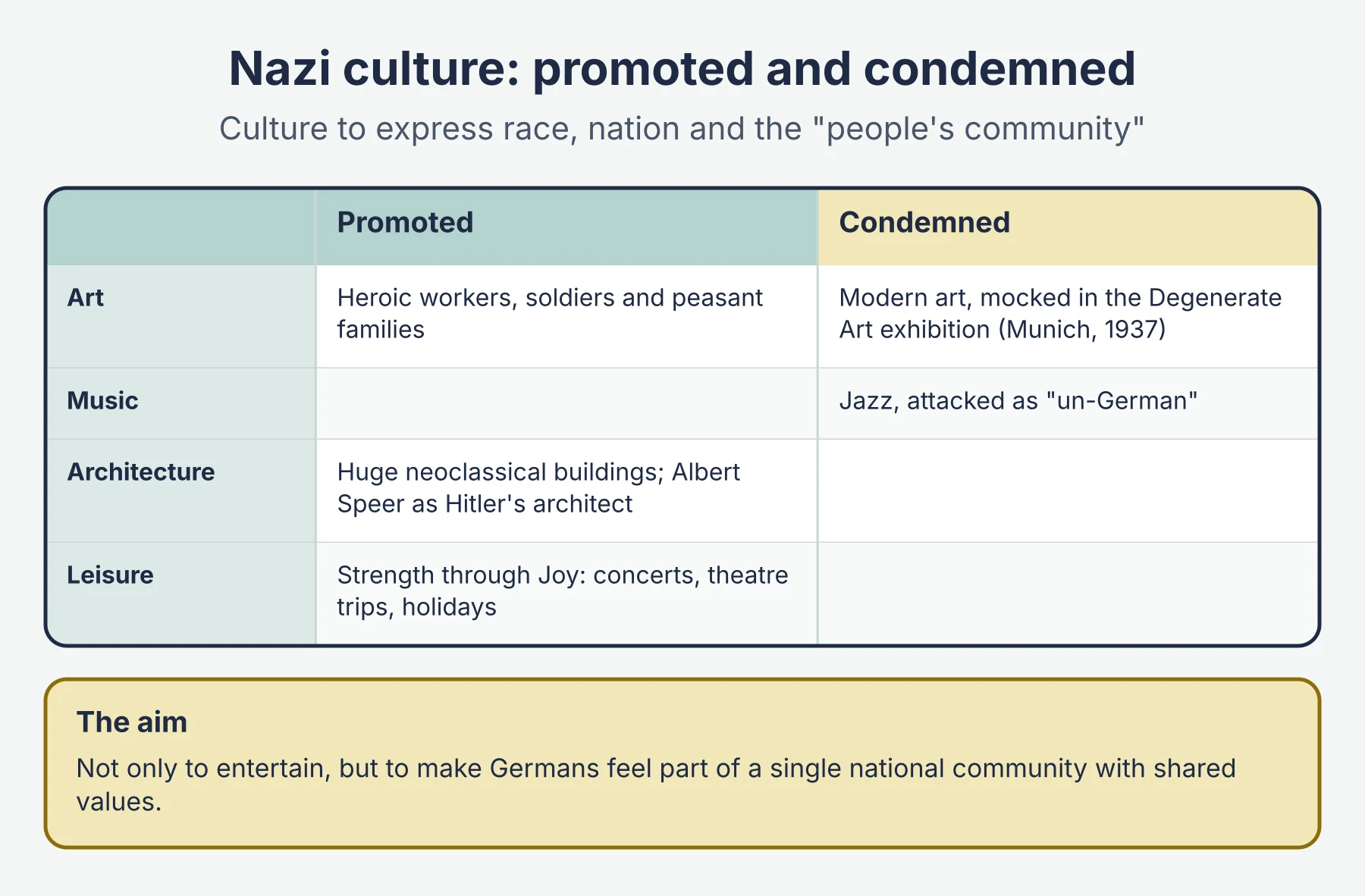
The regime wanted culture to express its ideas about race, nation and the “people’s community”. Art was meant to show heroic workers, soldiers and peasant families; modern art was condemned, and the Degenerate Art exhibition of 1937 in Munich mocked works by artists the regime rejected. Jazz was attacked as “un-German”. Architecture favoured huge neoclassical buildings, with Albert Speer as Hitler’s architect. Culture was also tied to leisure through Strength through Joy, which organised concerts, theatre trips and holidays. The aim was not only to entertain but to make Germans feel part of a single national community with shared values.
Repression and the police state
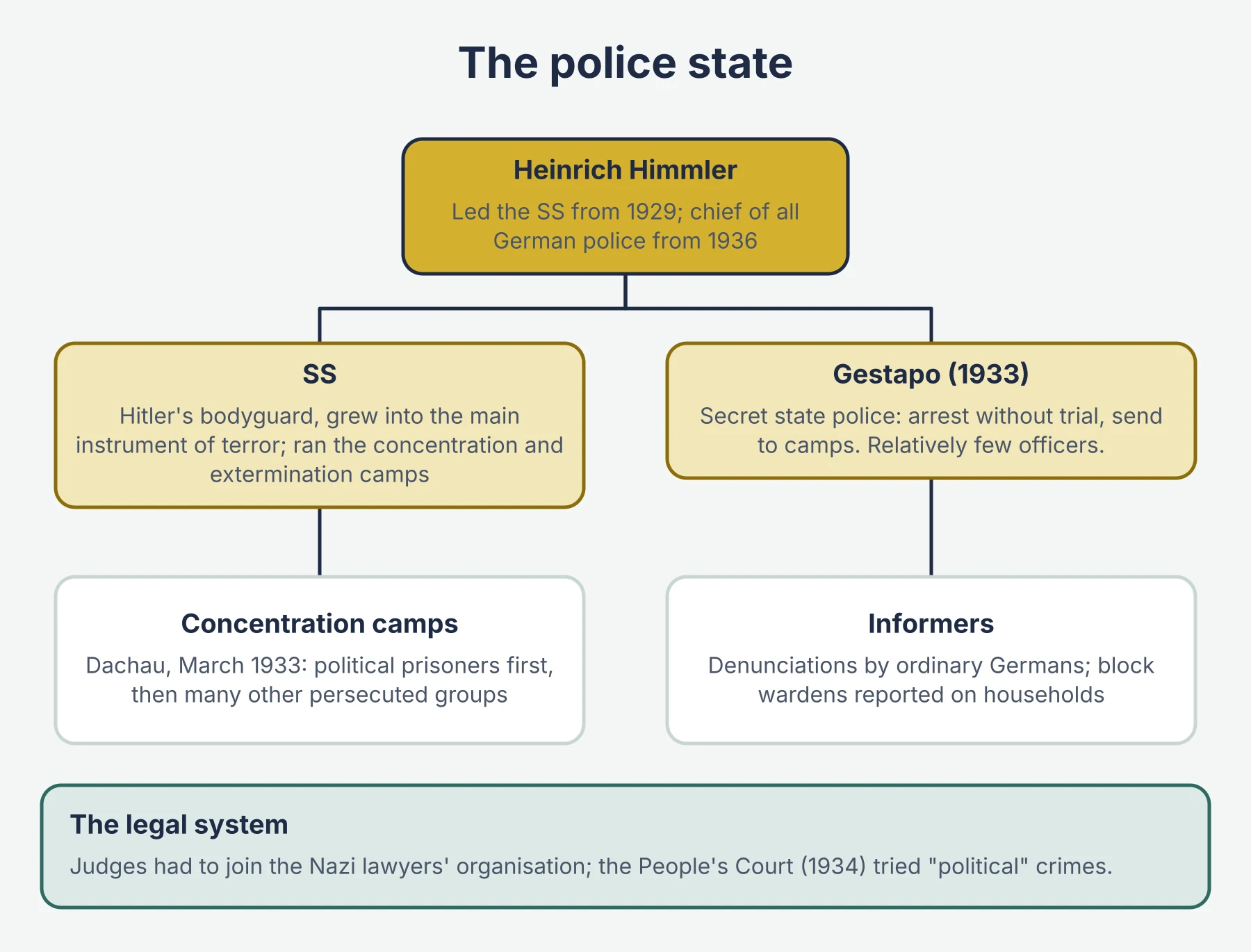
Heinrich Himmler led the SS (Schutzstaffel) from 1929. Originally Hitler’s bodyguard, it grew into the regime’s main instrument of terror, running the concentration camps and, later, the extermination camps. In 1936 Himmler became chief of all German police.
The Gestapo, the secret state police, was set up in Prussia in 1933 and came under Himmler’s control. It could arrest people without trial and send them to concentration camps. It had relatively few officers for a country of Germany’s size, so it relied heavily on informers and on denunciations from ordinary Germans, sometimes made for personal reasons. Block wardens reported on the households in their area.
The first concentration camp, Dachau, opened in March 1933 for political prisoners such as communists and socialists. Later the camps held trade unionists, church critics, Jews, Roma and Sinti, homosexual men and others the regime persecuted. The legal system was brought under control: judges had to join the Nazi lawyers’ organisation, and the People’s Court (1934) tried “political” crimes.
Opposition and resistance
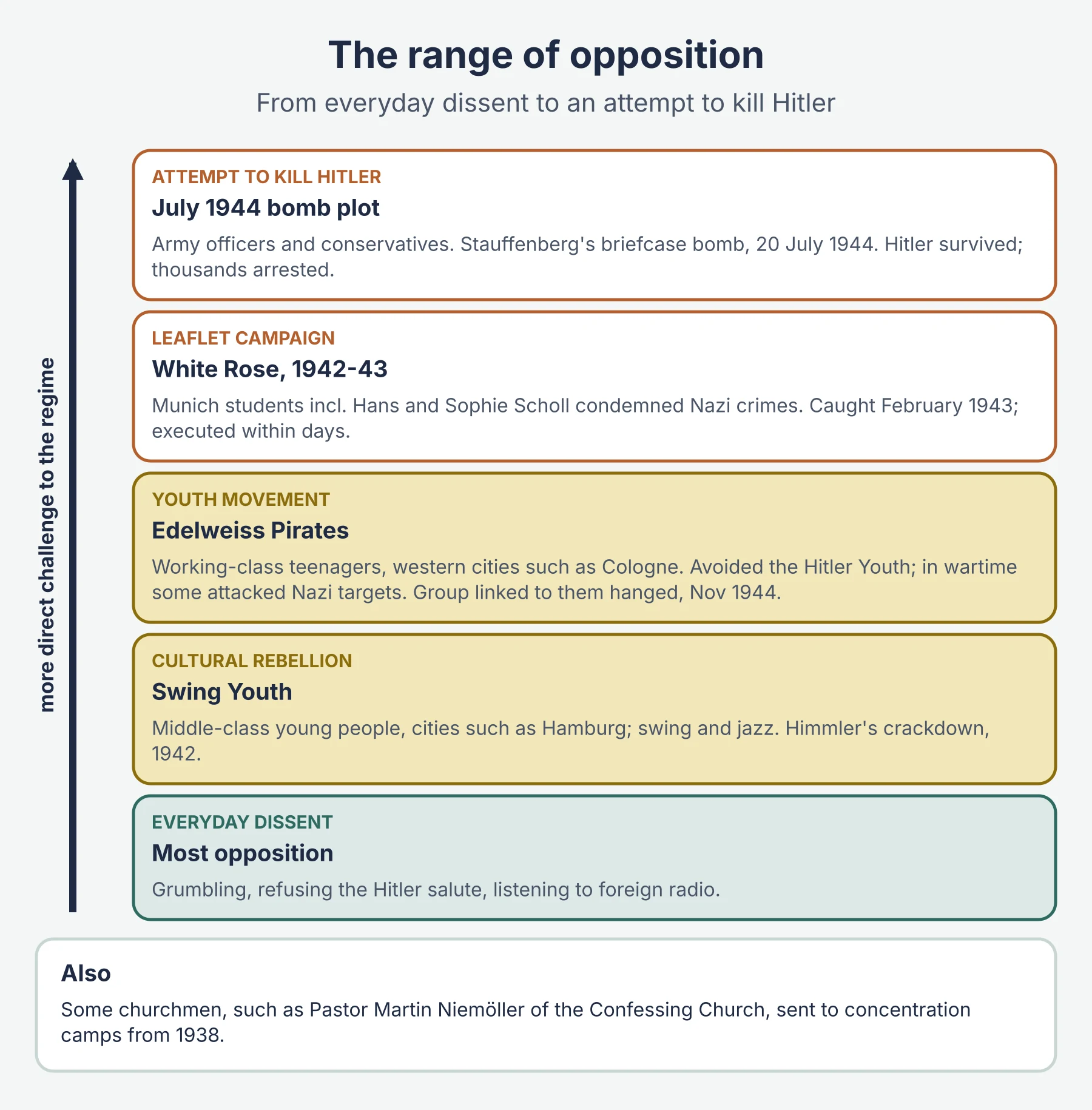
Because open opposition meant arrest, most dissent was small-scale: grumbling, refusing the Hitler salute, listening to foreign radio. The four groups named in the specification show the range from youth nonconformity to an attempt to kill Hitler.
Swing Youth. Mostly middle-class young people in cities such as Hamburg who loved American swing music and jazz, danced to it and dressed in English or American styles. Their rebellion was cultural rather than political, but the regime saw it as a rejection of Nazi values; in 1942 Himmler ordered a crackdown, and some leaders were sent to camps.
Edelweiss Pirates. Groups of mainly working-class teenagers in western cities such as Cologne who avoided the Hitler Youth, went on hikes, sang banned songs and sometimes fought Hitler Youth patrols. During the war some helped deserters and escaped prisoners and attacked Nazi targets. In November 1944 a group connected with them was publicly hanged in Cologne.
The White Rose. A group of students at Munich University, including Hans and Sophie Scholl, who wrote and distributed leaflets in 1942-43 condemning Nazi crimes, including the murder of Jews, and calling for passive resistance. They were caught distributing leaflets at the university in February 1943 and executed within days.
The July 1944 bomb plot. Army officers and conservatives who believed Hitler was leading Germany to destruction planned to kill him and take over the government. On 20 July 1944 Claus von Stauffenberg left a bomb in a briefcase at Hitler’s headquarters in East Prussia. Hitler survived; Stauffenberg was shot that night, and thousands of suspects were arrested in the weeks that followed.
Opposition also came from some churchmen, such as Pastor Martin Niemöller of the Confessing Church, who was sent to concentration camps from 1938.
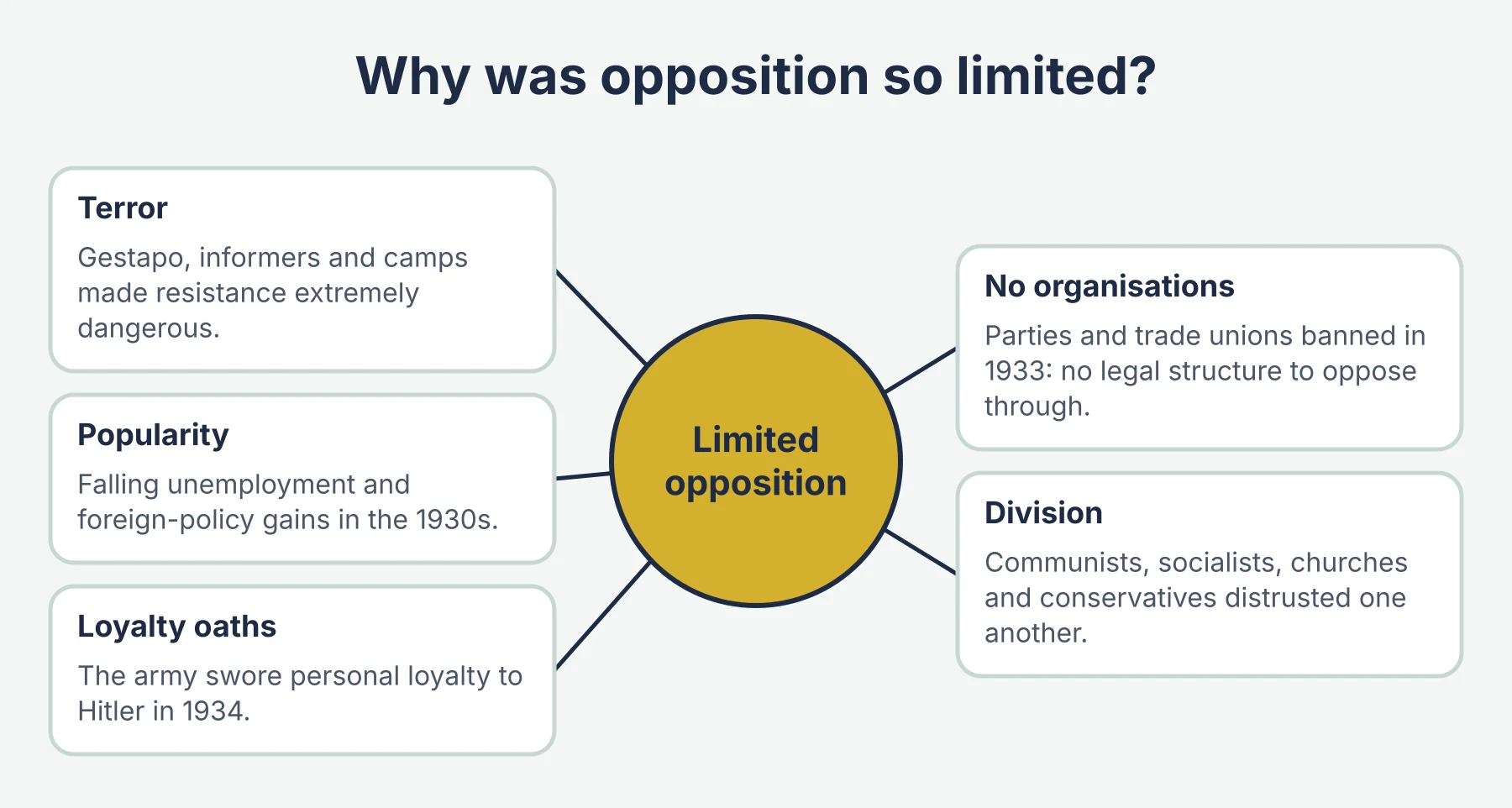
Why was opposition so limited?
- Terror: the Gestapo, informers and camps made resistance extremely dangerous.
- Propaganda and popularity: many Germans approved of the regime’s successes, such as falling unemployment and foreign-policy gains in the 1930s.
- Destruction of organisations: parties and trade unions were banned in 1933, so there was no legal structure through which to oppose.
- Division: communists, socialists, churches and conservatives distrusted one another.
- Loyalty oaths: the army had sworn personal loyalty to Hitler in 1934, making many officers reluctant to act.
Worked example: a question 5 answer
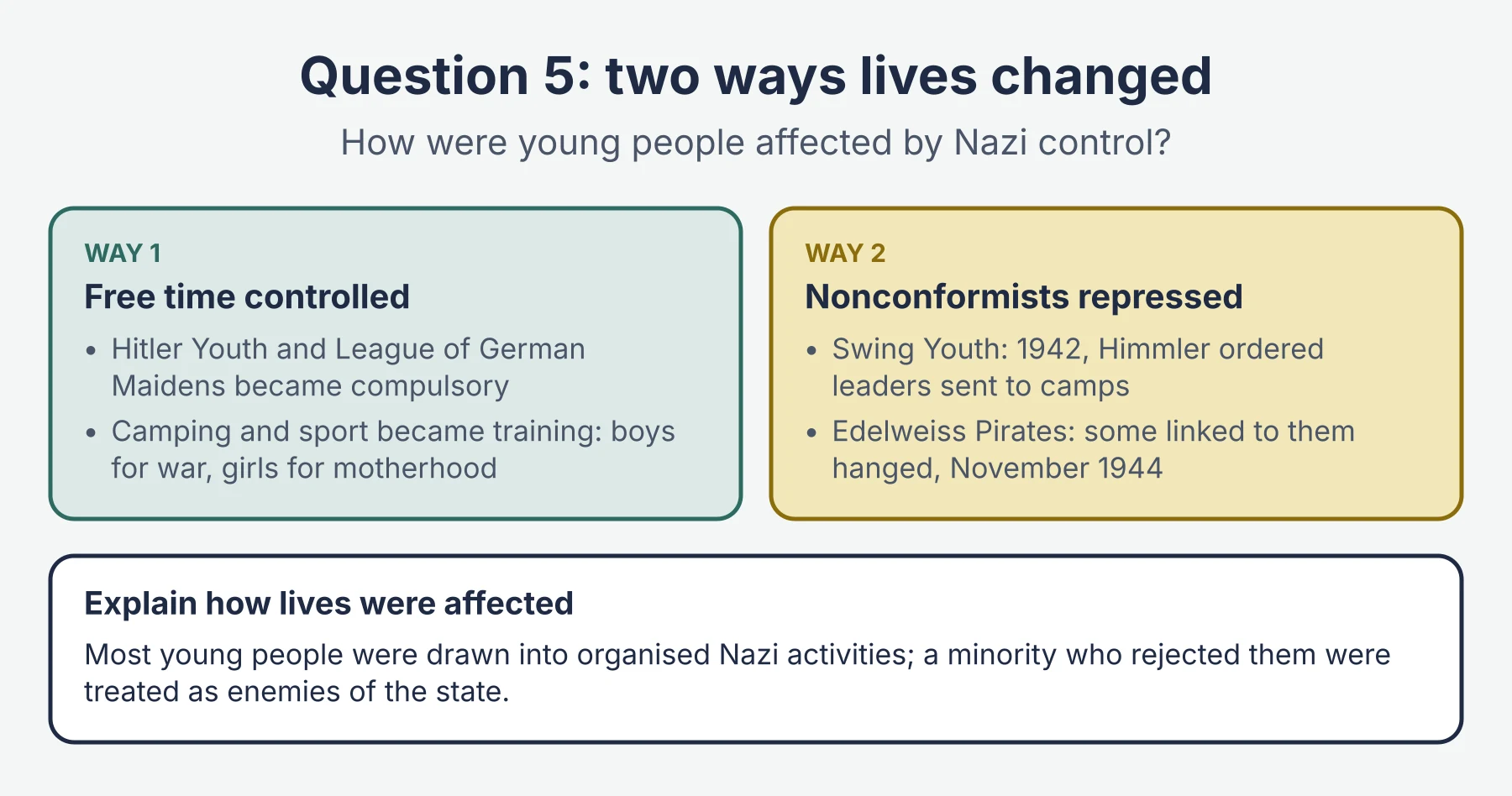
In what ways were the lives of young people in Germany affected by Nazi control? Explain your answer. [8]
One way was that young people’s free time was brought under the regime’s control. Membership of the Hitler Youth and League of German Maidens became compulsory, so activities that had been a matter of choice, such as camping and sport, became a means of training boys for war and girls for motherhood. A second way was that young people who did not conform faced repression. The Swing Youth in Hamburg listened to American jazz, which the regime called un-German, and in 1942 Himmler ordered that leaders be sent to concentration camps. The Edelweiss Pirates in Cologne avoided the Hitler Youth and some attacked Nazi targets during the war; in November 1944 some of those linked to them were publicly hanged. This shows that control changed young lives in two directions: most were drawn into organised Nazi activities, while a minority who rejected them were treated as enemies of the state.
The answer identifies two changes, gives precise evidence for each, and explains how lives were affected, which is what question 5 rewards.
Common mistakes
- Treating propaganda and terror as separate topics, when exam questions often ask you to weigh one against the other.
- Describing the White Rose and the Edelweiss Pirates as if they had the same aims; one was a leaflet campaign by students, the other a youth movement.
- Claiming the Gestapo watched everyone directly, rather than explaining its reliance on informers.
- Overstating opposition: name the groups, but explain why they remained small.
- Muddling Himmler (SS, police) with Goebbels (propaganda).
Exam technique
In a question 6 essay such as “Which was the more important reason for Nazi control: propaganda; the police state?”, explain each bullet with precise evidence, then link them in your judgement: for example, that terror silenced the minority who opposed the regime while propaganda kept the majority loyal. Question 4 (“Describe two…”) might ask for two features of Nazi propaganda or of the July bomb plot: give two developed features, not explanations.
Further practice
- Nazi control and opposition revision notes
- Nazi control and opposition practice questions
- Section A period studies practice
Specification
AQA GCSE History (8145) specification, section 3.2.1, AB Germany, 1890-1945, Part three: The experiences of Germans under the Nazis – aqa.org.uk.
Related resources
-
Practice questions
AQA GCSE History (8145): Nazi Control, Propaganda and Opposition – Practice Questions
Original AQA GCSE History 8145 Germany practice on Nazi propaganda, the police state and opposition: describe, in what ways, interpretation and essay.
World History · AQA · GCSE
Try questions -
Revision notes
AQA GCSE History (8145): Nazi Control, Propaganda and Opposition – Revision Notes
Revision notes for AQA GCSE History 8145 Germany: Goebbels and propaganda, Nazi culture, Himmler's police state and four named opposition groups.
World History · AQA · GCSE
Revise topic -
Study guides
AQA GCSE History (8145): Source Analysis and Usefulness Questions
How to answer AQA GCSE History 8145 Paper 1 Section B questions 1 and 2: reading cartoons and written sources, provenance, context and usefulness.
World History · AQA · GCSE
Read guide
Get free revision emails (optional)
Occasional emails with practice questions, worked explanations and links to free resources for the qualification and subjects you choose. No spam, and you can unsubscribe from any email. The free tools on this site never need an email.