
Study Guides
A Level Accounting: Computerised accounting systems (Cambridge 9706)
Study guide to moving a business's accounts onto a computerised system and keeping the data complete and accurate, for Cambridge A Level Accounting.
- Subject
- Accounting
- Level
- A LEVEL
- Topic
- Financial accounting
- Author
- Marlbridge Academic Team
- Updated
- Reviewed by
- Zain Ud Din Ahmed (what this means)
Aligned to Cambridge A Level Accounting (9706), 2026-2028. Official specification .
Syllabus page (what it covers and how it is assessed): Cambridge A Level Accounting.
Syllabus points this page covers
9706 (A Level)
- 3.4 Computerised accounting systems
Found an error? Report a correction.
Need help with this topic? Request a free trial class for A Level Accounting (9706).
This guide covers section 3.4 Computerised accounting systems (A Level) of the Cambridge International AS & A Level Accounting 9706 syllabus for examination in 2026, 2027 and 2028. The section has one content point, 3.4.1, and it is examined in Paper 3 (Financial Accounting), which assumes the AS Level content. The syllabus says knowledge of specific applications or software is not required, so this page describes the process and the safeguards, never a particular program. All amounts are in dollars. Use it with the revision notes, the practice questions, the course hub, the printable checklist and the free diagnostics.
What the syllabus asks you to understand
| Outcome in 3.4.1 | Where this guide covers it |
|---|---|
| The process of transferring the business accounts to a computerised accounting system | Stages of the transfer; Worked example 1 |
| Ways in which the integrity of the accounting data can be ensured during the transfer | What integrity means; the three groups of safeguards; Worked examples 2 to 4 |
| Managing the transfer so that manual data arrives completely and accurately (the section’s introduction) | Approaches to the changeover; Evaluating the choices |
Where this sits with your AS Level work
At AS Level you met the reasons for computerising: speed, fewer arithmetic slips and easier reports, set against set-up cost, training and reliance on the system, with passwords, access levels and backups as security measures. The business entities guide and its practice set cover that ground, and the reconciliation and verification guide covers the checks used below.
Section 3.4 asks a narrower question. At one moment the records move from the manual books to the new system, and any error made then is carried into every report the system produces afterwards. The skill is knowing the steps and the checks that catch such errors.
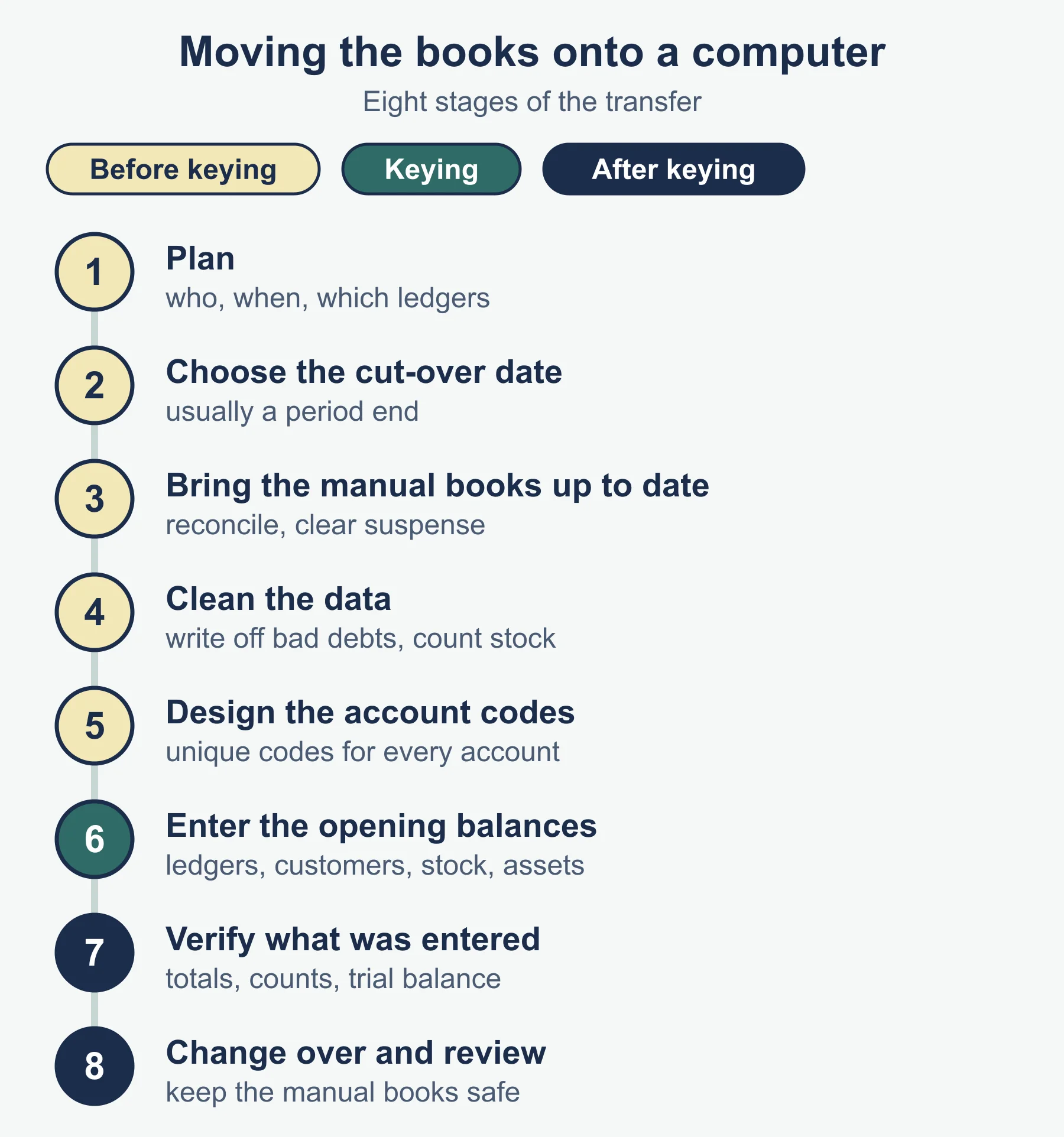
Stages of the transfer
- Plan. Decide which ledgers move, who is responsible, the timetable, how accounts will be coded and which changeover approach to use.
- Choose the cut-over date. A period end is usual, so the opening balances are the closing balances of a finished period.
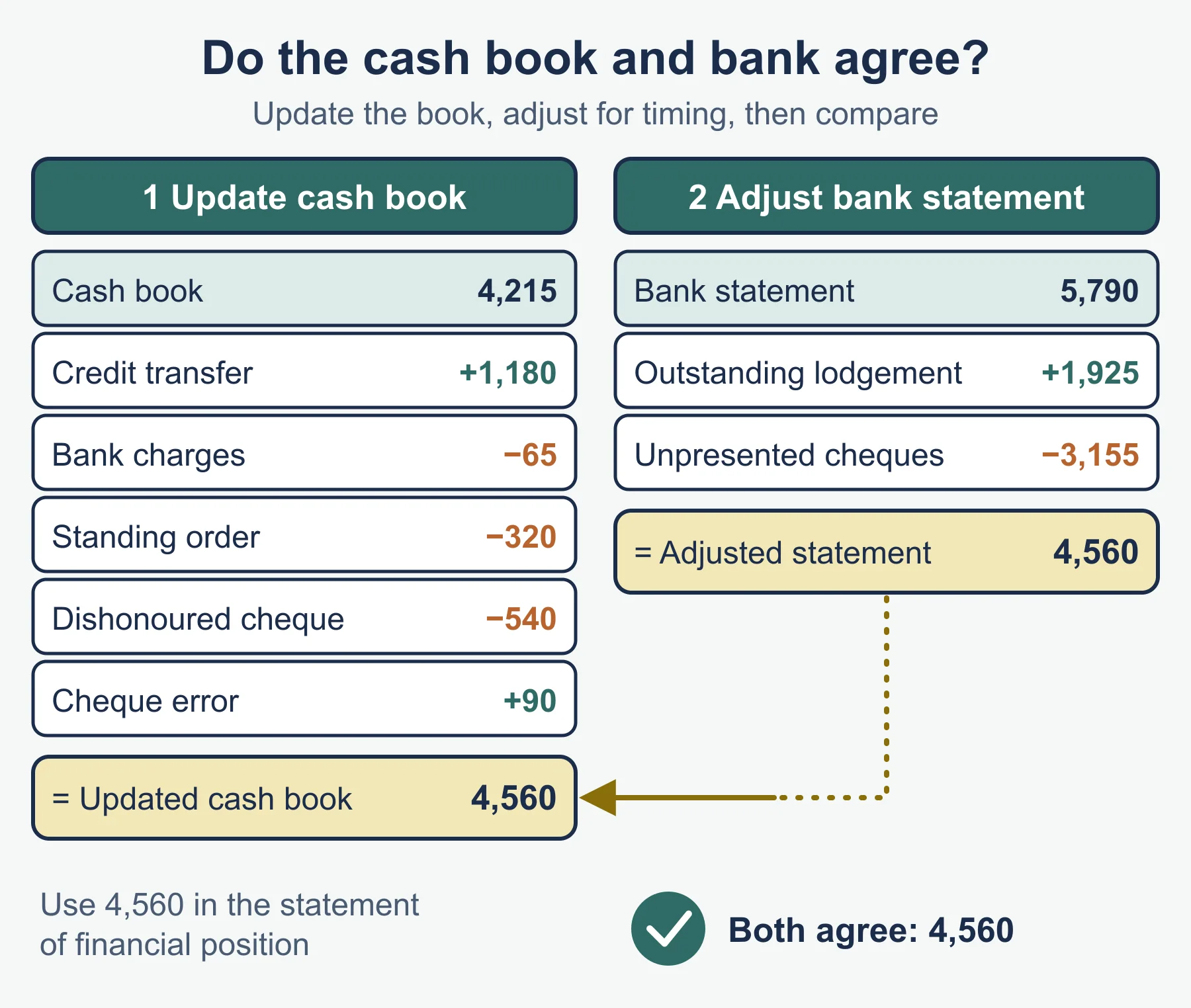
- Bring the manual books up to date. Post every book of prime entry, prepare bank reconciliation statements, agree control accounts to their ledgers, clear any suspense account and correct known errors.
- Clean the data. Write off irrecoverable debts, remove accounts that are no longer used, and agree inventory and non-current asset records to what physically exists.
- Design the structure. Create a chart of accounts with unique codes, numbered customer and supplier accounts, inventory item codes and asset categories with their depreciation rules.
- Enter the opening balances. Nominal ledger accounts, individual trade receivables and trade payables accounts, inventory records and the non-current asset register.
- Verify what was entered (the safeguards below).
- Change over and review. Begin entering new transactions, keep the manual records safe, and investigate differences.
Worked example 1: opening balances
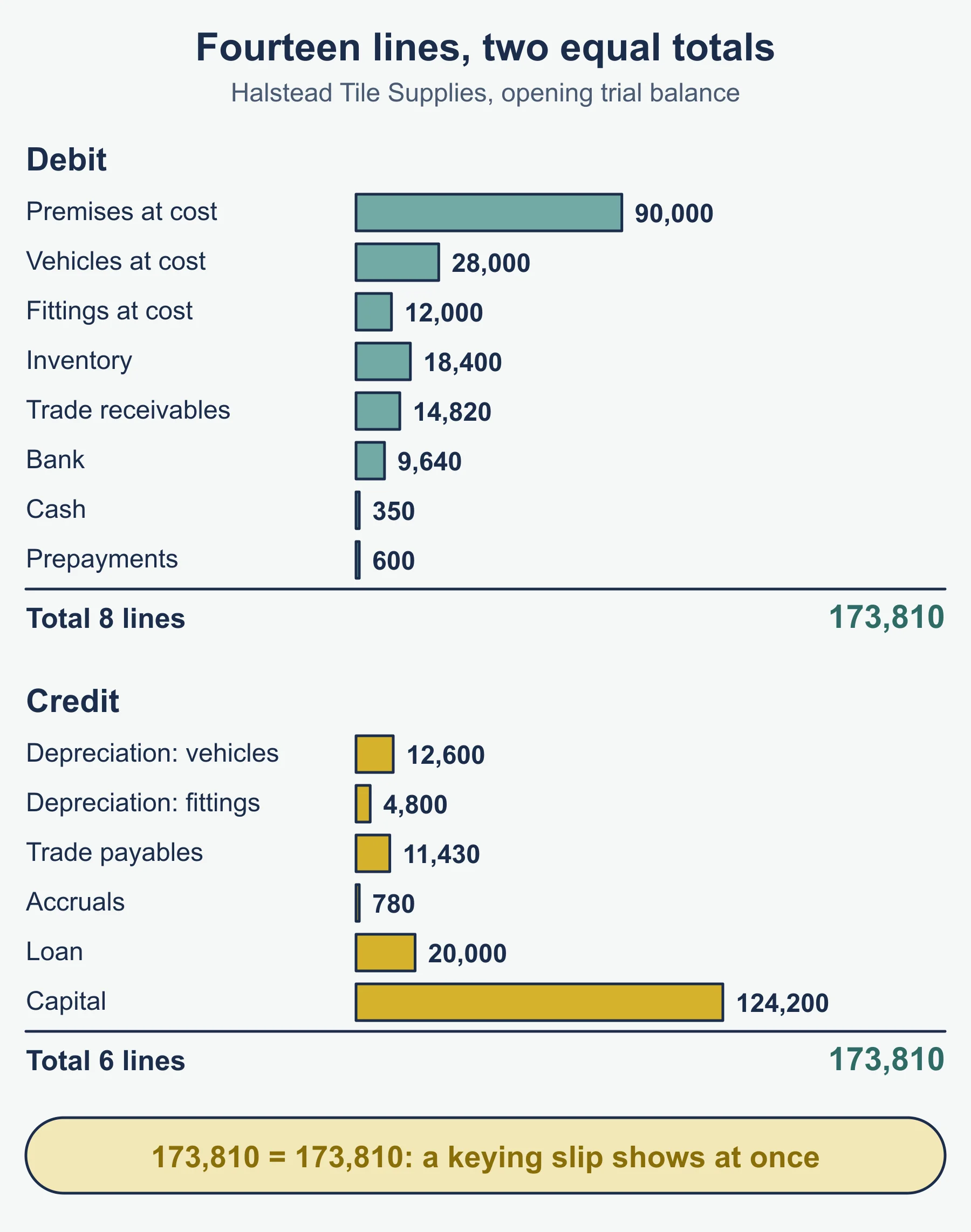
Halstead Tile Supplies, a sole trader, moves to a computerised system on 1 April 2027. After its final accounts, the manual trial balance at 31 March 2027 is:
| Account | Debit | Credit |
|---|---|---|
| Premises at cost | 90,000 | |
| Delivery vehicles at cost | 28,000 | |
| Shop fittings at cost | 12,000 | |
| Accumulated depreciation: vehicles | 12,600 | |
| Accumulated depreciation: fittings | 4,800 | |
| Inventory | 18,400 | |
| Trade receivables | 14,820 | |
| Bank | 9,640 | |
| Cash | 350 | |
| Prepayments | 600 | |
| Trade payables | 11,430 | |
| Accruals | 780 | |
| Loan | 20,000 | |
| Capital | 124,200 | |
| Total | 173,810 | 173,810 |
Entering all fourteen lines as one opening journal means a keying slip shows up at once, because debits will not equal credits. The individual accounts then have to support the control totals.
| Code | Trade receivable | Balance |
|---|---|---|
| 3101 | Gantry Lettings | 4,260 |
| 3102 | Kingsmead Builders | 3,150 |
| 3103 | Mortlake Interiors | 2,075 |
| 3104 | Varley Hotel | 1,980 |
| 3105 | Seaford Homes | 2,130 |
| 3106 | Thistlewood Cafe | 1,225 |
| Total | 14,820 |
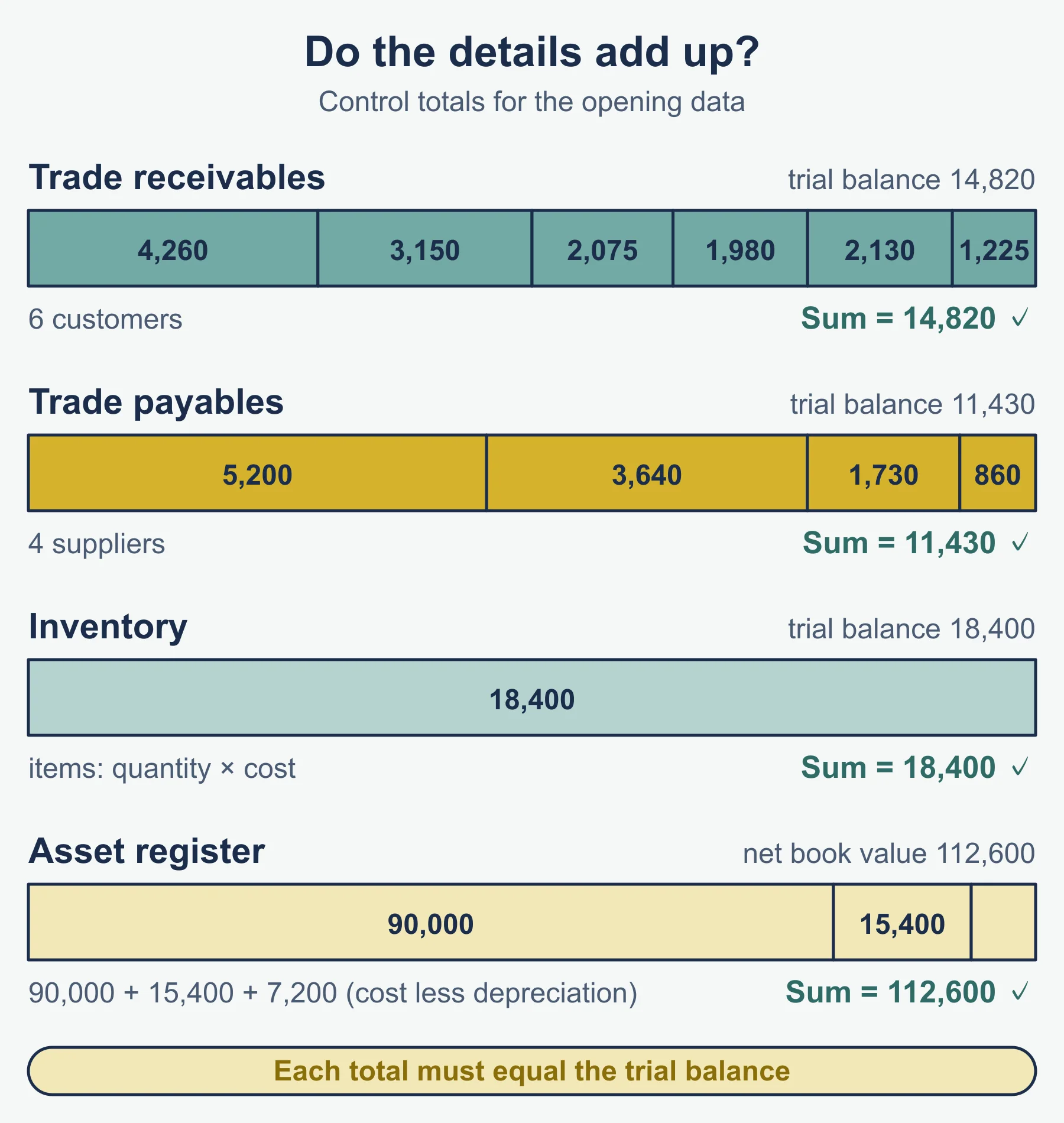
The six balances sum to the 14,820 in the trial balance. The four supplier balances (5,200, 3,640, 1,730 and 860) sum to 11,430. Inventory is entered item by item, as quantity multiplied by cost, and must total 18,400. The asset register holds cost and accumulated depreciation for each asset, with the depreciation rule (vehicles 15% of cost, fittings 10% of cost, straight line). Net book value is 90,000 + 15,400 + 7,200 = 112,600.
What integrity means
Accounting data has integrity when it is complete (nothing left out or entered twice), accurate (right amounts, right accounts), valid (it relates to real balances and transactions), authorised (entered by someone entitled to enter it) and unchanged by anything other than a recorded correction. These are working terms for this guide, not wording from the syllabus. Each safeguard below protects one or more of them.
Safeguards before the data is entered
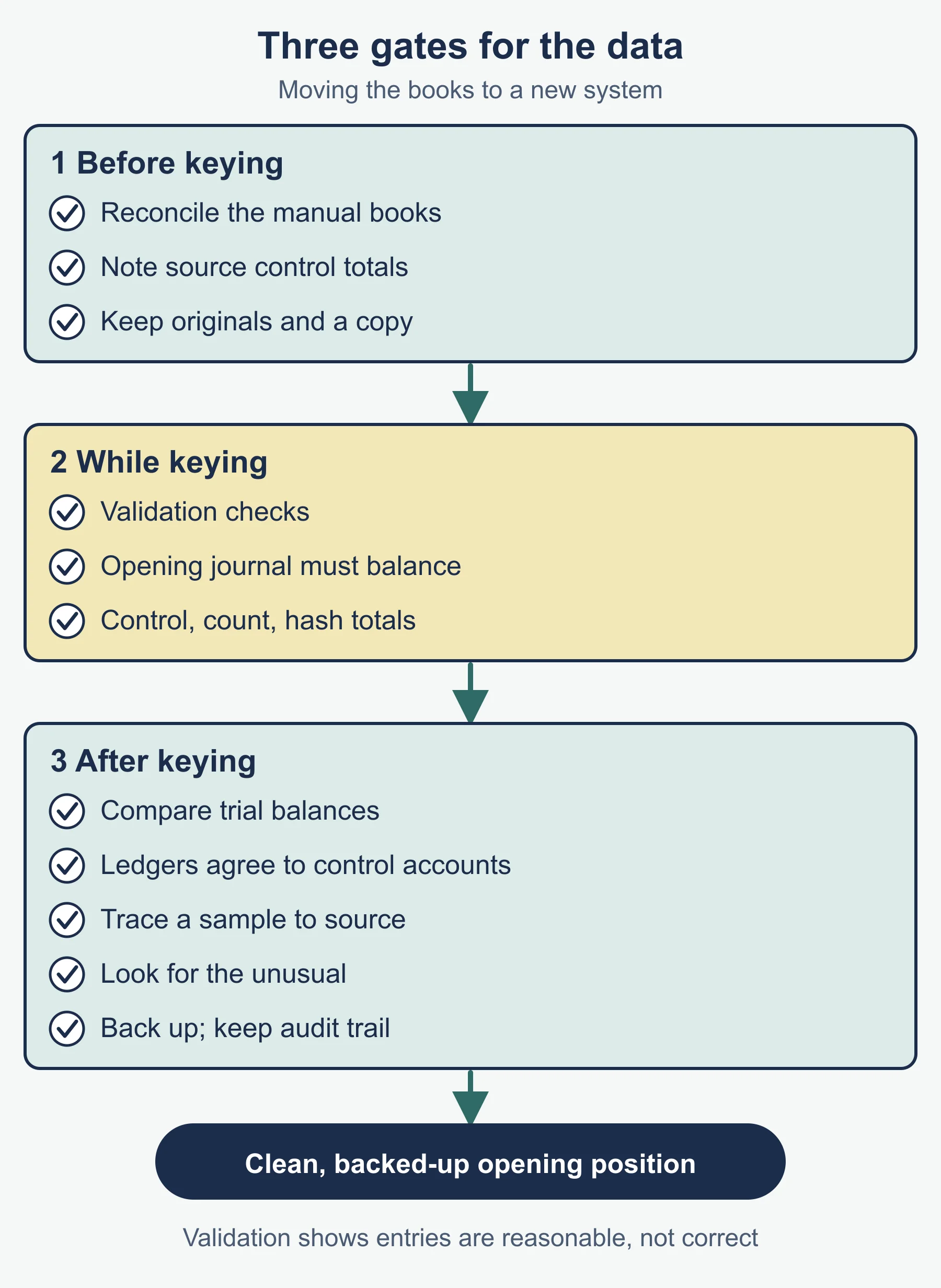
- Reconcile and correct the manual books first. Moving an unreconciled bank balance or a ledger that disagrees with its control account only moves the error.
- Record the source totals. Take control totals from the manual records (the trial balance, each ledger list, the inventory valuation) before keying starts, so there is something independent to compare with.
- Agree the coding scheme on paper. Unique account codes prevent one customer being set up twice or two accounts sharing a code.
- Keep the manual records. Retain the originals and take a copy, so the transfer can be restarted if the data is damaged.
- Control who enters data. Give access to authorised staff, and arrange for a second person to check the entries rather than the person who keyed them.
- Fix the cut-off rule. Write down which documents belong in the manual closing balances and which are keyed as new transactions, so none is missed or counted twice.
Safeguards while the data is entered
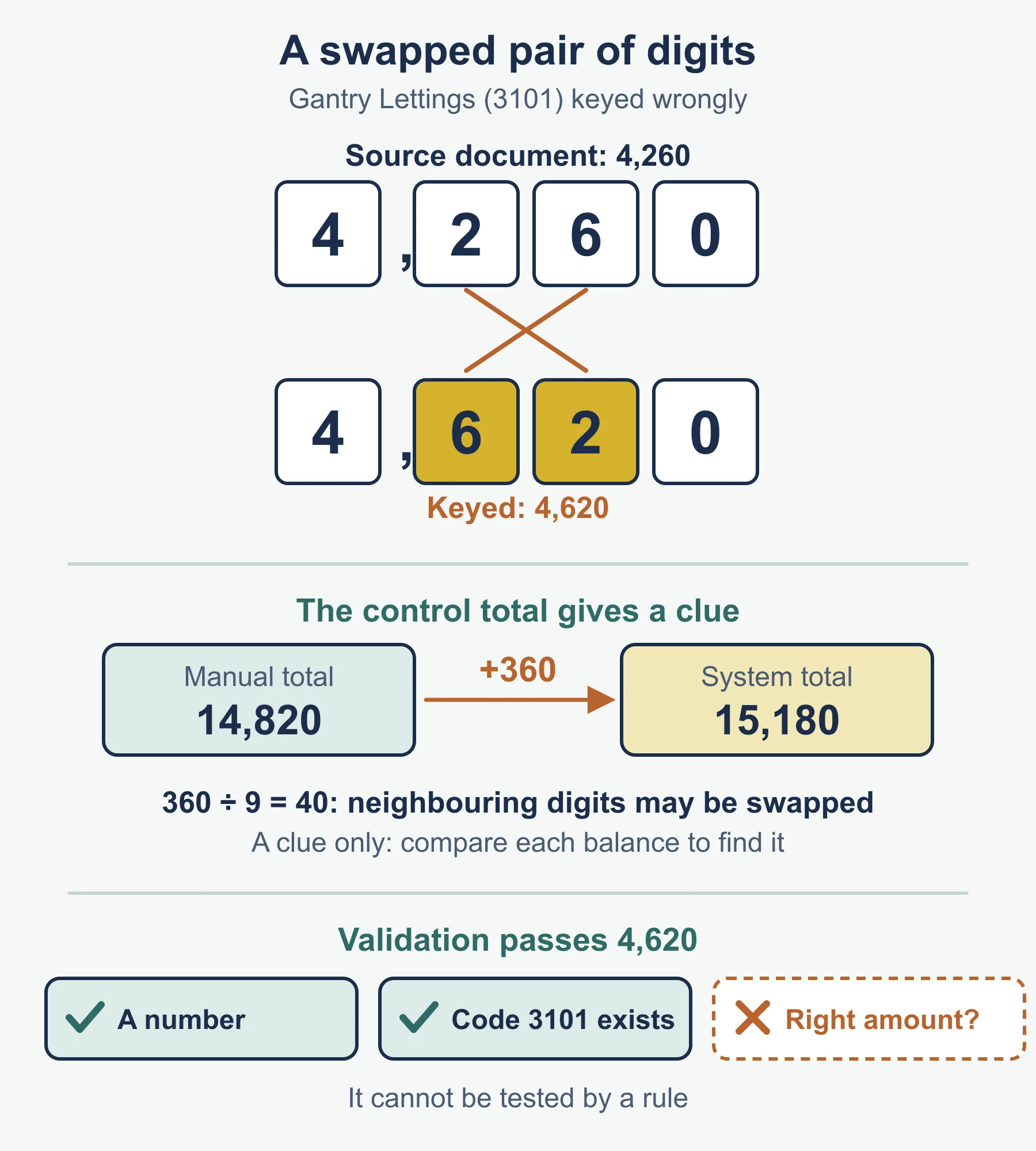
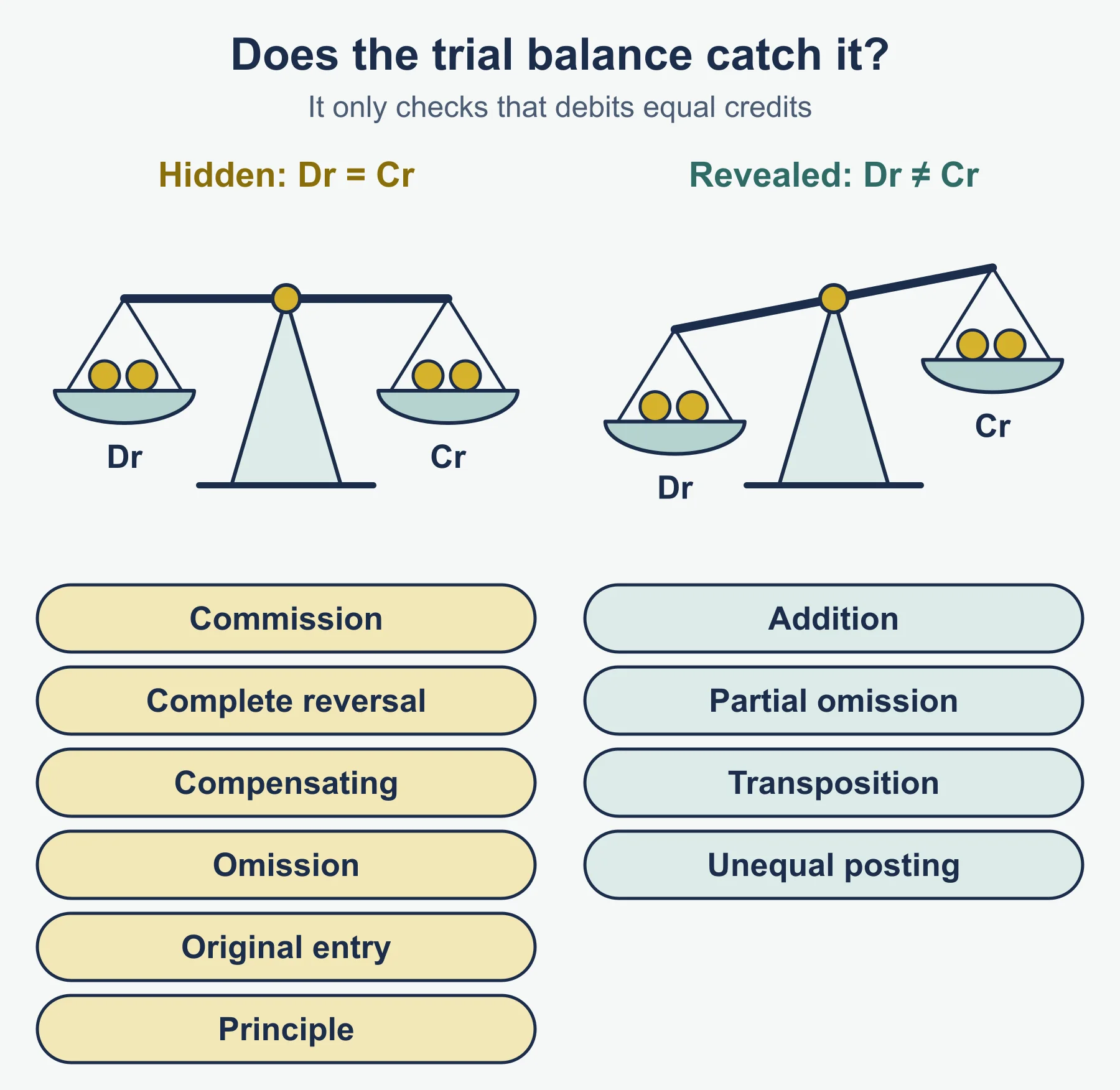
- Validation checks on input. The system tests entries against rules, such as a field that must be numeric, an account code that must already exist, or a date that must fall in the period. Validation shows an entry is reasonable. It cannot show it is correct: 4,620 passes a numeric test even when the source says 4,260.
- A balanced opening journal. Debits must equal credits before the journal is accepted or posted.
- Batch controls. Compare the system with figures calculated from the source: a control total (a meaningful sum, such as total balances), a record count (the number of accounts) and a hash total (a sum with no meaning in itself, such as the total of the account codes).
Worked example 2: a control total catches a transposition
Gantry Lettings (code 3101) is keyed as 4,620 instead of 4,260. The system total is 15,180 against a manual total of 14,820, a difference of 360. Because 360 is divisible by 9 (360 ÷ 9 = 40), two adjacent digits may have been swapped. That is only a clue, so the next step is to compare each keyed balance with the list until the figure is found.
Worked example 3: a record count and hash total catch an omission
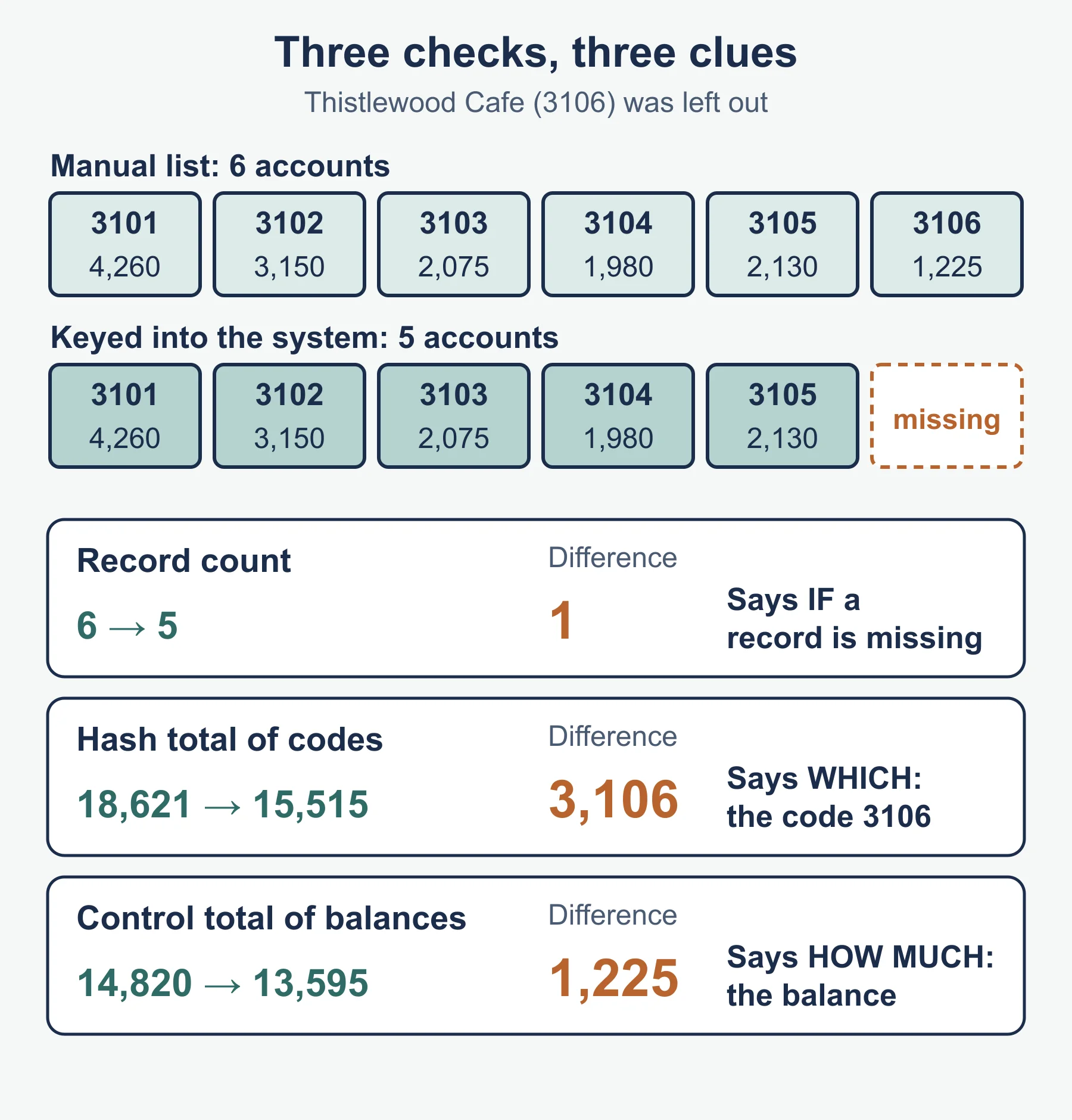
This time Thistlewood Cafe (3106) is left out. The system shows these figures against the manual list:
| Check | Manual list | System | Difference |
|---|---|---|---|
| Record count | 6 | 5 | 1 |
| Hash total of codes | 18,621 | 15,515 | 3,106 |
| Control total of balances | 14,820 | 13,595 | 1,225 |
The hash difference of 3,106 is the missing account’s code, and the control total difference of 1,225 is its balance. The record count alone says a record is missing. The hash total says which. The control total says how much.
Safeguards after the data is entered
- Compare trial balances. Print the trial balance from the new system and compare it with the manual trial balance line by line, not just at the total, because two errors can offset each other.
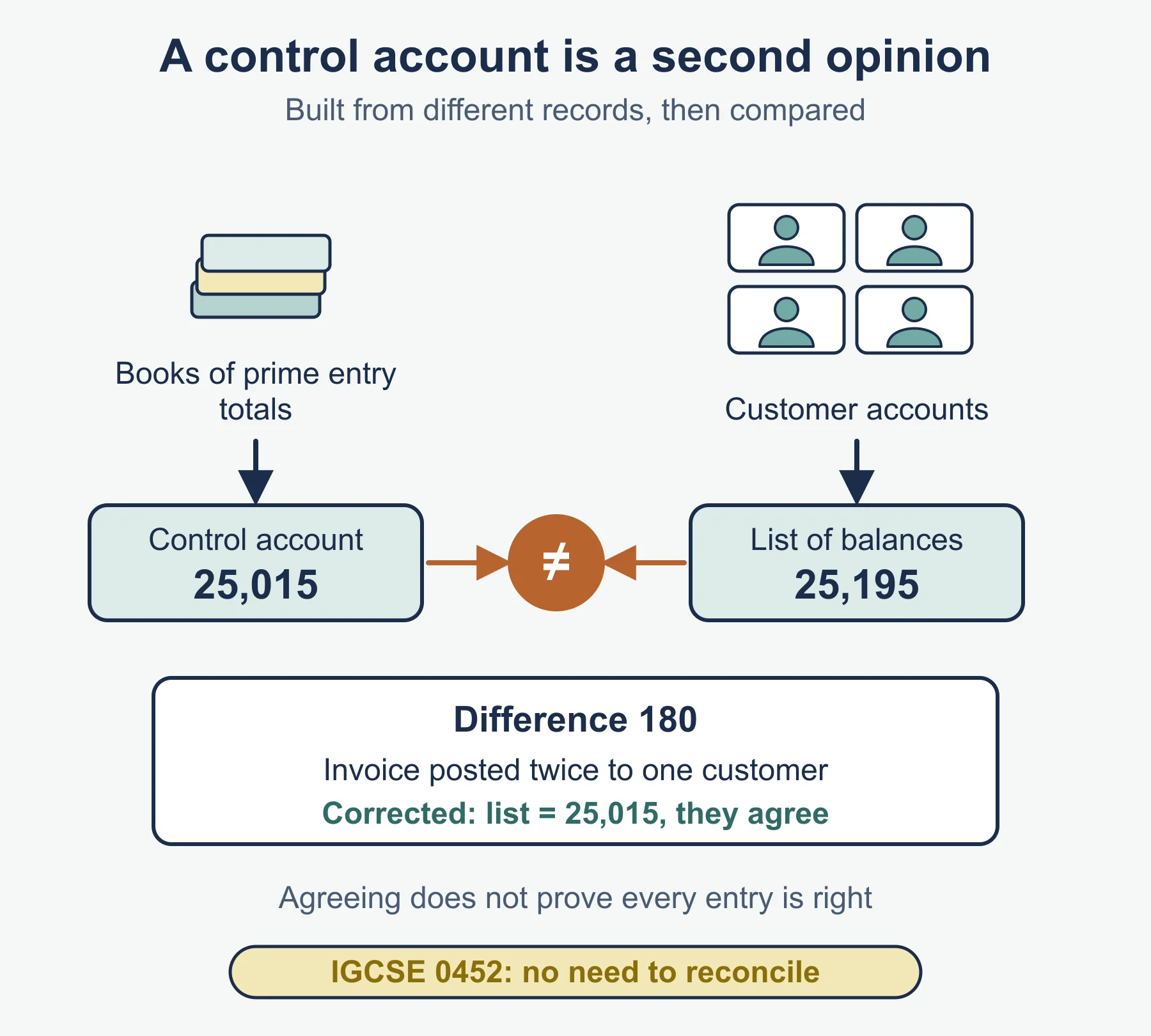
- Agree subsidiary ledgers to control accounts. The individual customer and supplier balances must sum to the control account balances.
- Trace a sample back to source. Select entries and agree them to invoices, statements, the inventory count and the asset records.
- Look for the unusual. A credit balance on a customer, a negative inventory quantity or an asset with no depreciation rule suggests an input error.
- Back up straight after verification, so a clean copy of the opening position exists.
- Keep an audit trail. The system records who entered or changed each item and when. Mistakes are put right by a dated correcting journal, not by overwriting the original entry.
Worked example 4: a parallel run exposes set-up errors
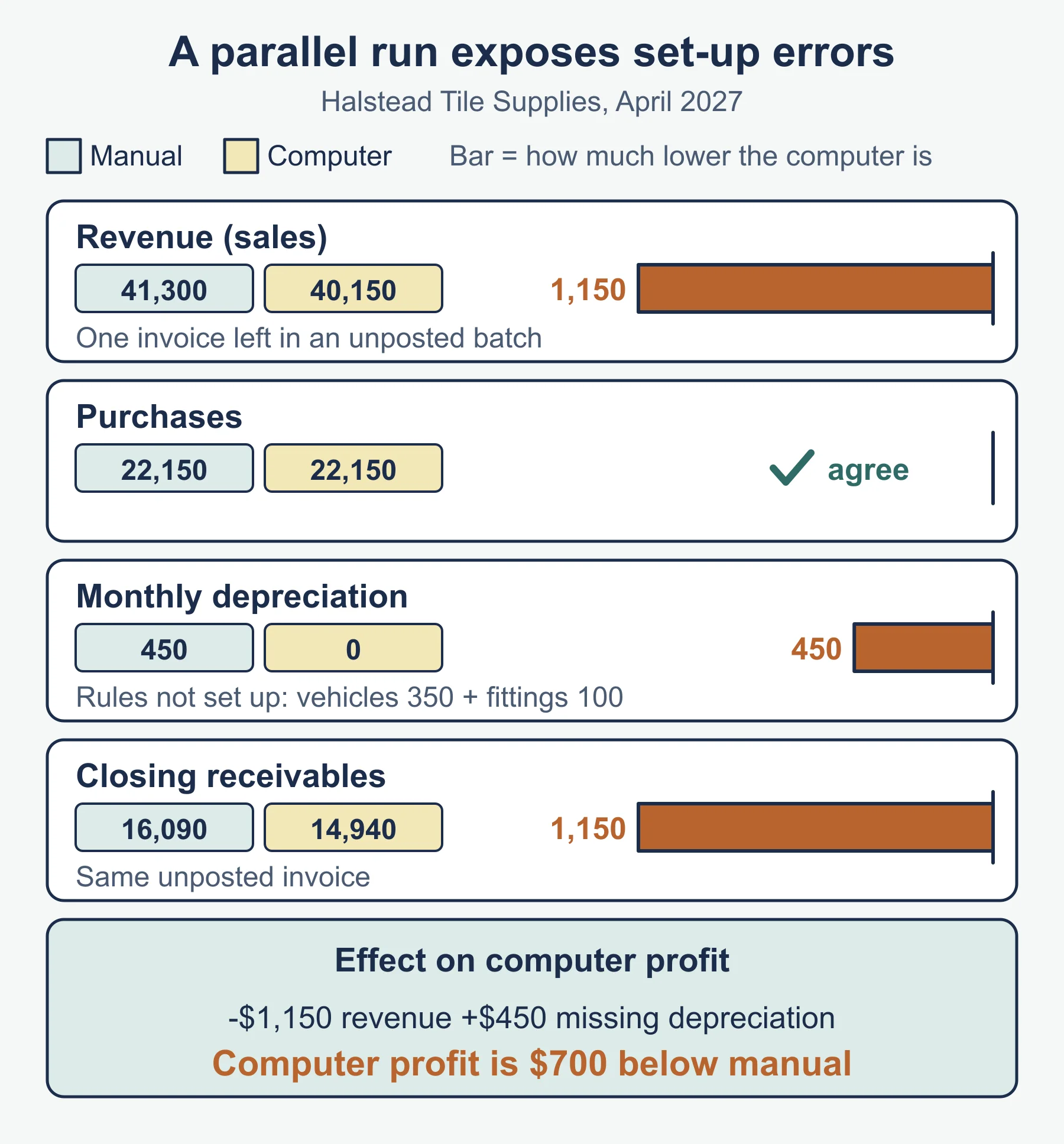
Halstead keeps both sets of books through April 2027 and compares them:
| Item | Manual books | Computer | Difference |
|---|---|---|---|
| Revenue (sales) | 41,300 | 40,150 | 1,150 |
| Purchases | 22,150 | 22,150 | 0 |
| Monthly depreciation charge | 450 | 0 | 450 |
| Closing trade receivables | 16,090 | 14,940 | 1,150 |
The 1,150 gap in revenue and receivables is one invoice left in an unposted batch. The missing depreciation arises because the rules for vehicles (28,000 × 15% ÷ 12 = 350 a month) and fittings (12,000 × 10% ÷ 12 = 100 a month) were not set up. Before any inventory effect, the computer profit is 1,150 lower for the missing revenue and 450 higher for the missing expense, so it is 700 below the manual figure. The parallel run found both faults before the manual books were abandoned.
Approaches to the changeover
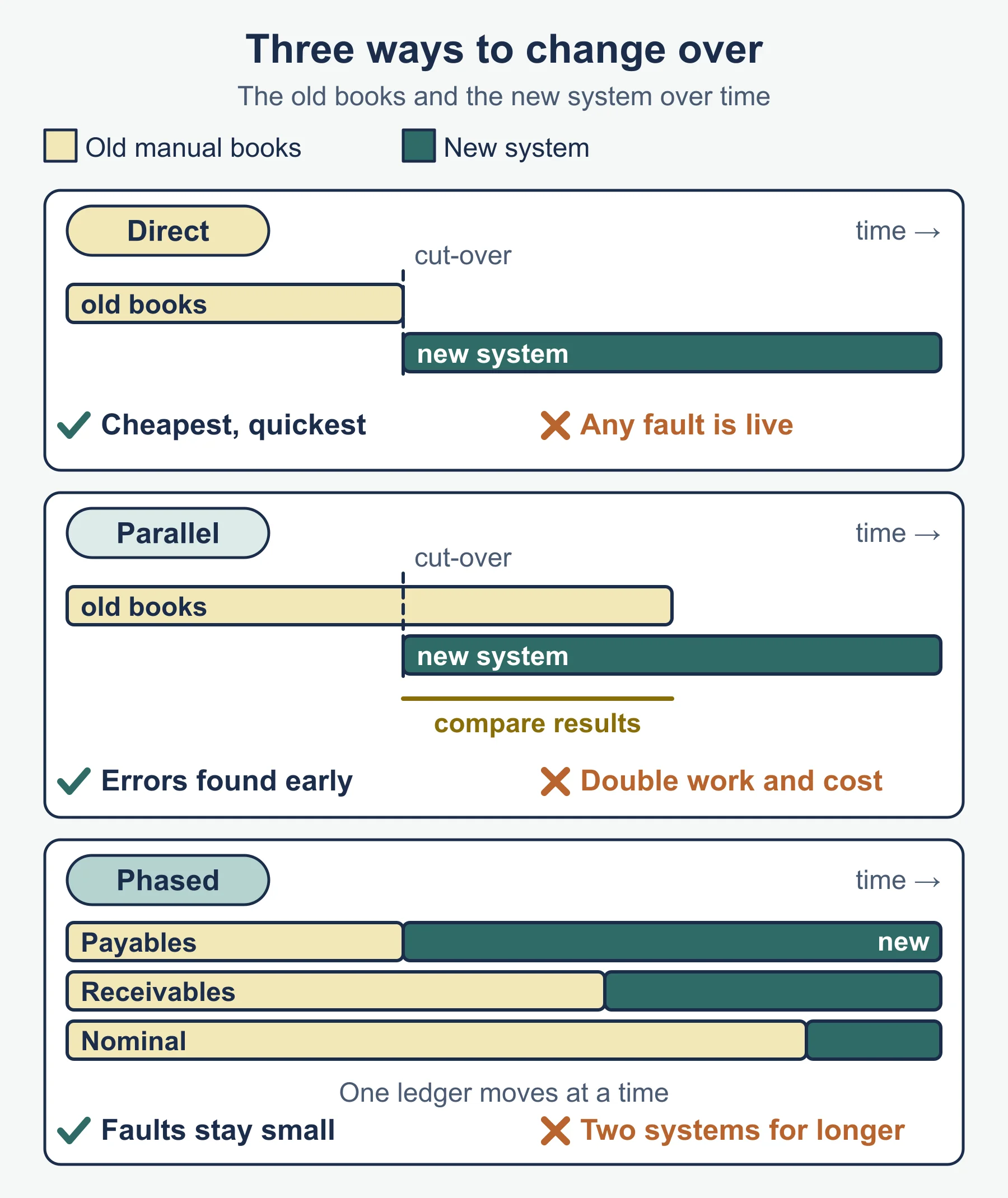
The syllabus does not name changeover methods, but each is a way of managing the risk to data.
| Approach | How it works | Gain | Drawback |
|---|---|---|---|
| Direct | The old books stop and the new system starts on the cut-over date | Cheapest and quickest | Any fault is live, with no second set to compare |
| Parallel | Both are run for a period and results compared | Differences reveal errors before the old books are dropped | Double work and cost |
| Phased | One ledger moves at a time, such as trade payables first | Faults are contained to a small area | The business runs two systems for longer |
Evaluating the choices
Paper 3 asks for recommendations supported by a balance of reasons and a justified decision. Weigh the cost and time of each safeguard against the size of the possible error and the business’s circumstances. A small business with six customers can compare every balance by hand, so extra parallel running may cost more than it protects. A business with thousands of accounts cannot check line by line, so control totals, record counts and a sample trace become essential. State which you recommend and why.
Common errors
- Describing the benefits of computerising (speed, reports) when the question is about the transfer.
- Naming “backups” or “passwords” and stopping, without saying what each protects during the transfer.
- Treating validation as proof that data is correct.
- Entering the opening balances without first reconciling the manual books.
- Forgetting cut-off, so a March invoice appears in the opening balance and again as an April transaction.
- Recommending a method with no reasons or no mention of the drawbacks.
Frequently asked questions
What does Cambridge 9706 section 3.4 Computerised accounting systems cover? Section 3.4 is A Level content on transferring a business’s accounting records from manual books to a computerised system and keeping the data complete and accurate during and after the transfer. The benefits of computerising were met at AS Level.
What does data integrity mean in accounting? Accounting data has integrity when it is complete, with nothing left out or entered twice, and accurate, with the right figures in the right accounts.
Does a validation check prove data is correct? No. Validation tests that entries are reasonable against rules, such as a field that must be numeric, but it cannot prove the figures are right. Treating validation as proof of accuracy is a common error.
What is a hash total? A hash total is a control figure with no accounting meaning, such as the sum of account codes, compared before and after entry. A difference can identify a missing or duplicated record, alongside a record count and a control total.
Why is cut-off important when changing accounting systems? A written cut-off rule decides which documents belong in the manual closing balances and which are entered as new transactions. Without it, an invoice can be missed or counted twice.
Next steps
Test yourself with the practice questions, then condense this guide with the revision notes.
Official syllabus
Cambridge International, Cambridge International AS & A Level Accounting 9706 syllabus for examination in 2026, 2027 and 2028, section 3.4 Computerised accounting systems (A Level), 3.4.1.
Get free revision emails (optional)
Occasional emails with practice questions, worked explanations and links to free resources for the qualification and subjects you choose. No spam, and you can unsubscribe from any email. The free tools on this site never need an email.
Related resources
-
Study guides
A Level Accounting: Accounting for Non-Current Assets (Cambridge 9706)
Capital versus revenue spending, why assets depreciate depreciation methods, cost and revaluation models and disposals, for Cambridge 9706 Accounting topic 1.3.
Accounting · Cambridge · AS Level
Read guide -
Practice questions
A Level Accounting: Computerised accounting systems (Cambridge 9706) – Practice Questions
Eleven original questions with worked answers on moving accounts to a computerised system and checking data integrity, for Cambridge A Level Accounting.
Accounting · Cambridge · A Level
Try questions -
Revision notes
A Level Accounting: Computerised accounting systems (Cambridge 9706) – Revision Notes
Condensed revision notes on moving accounts to a computerised system and protecting data integrity, with a self-test, for Cambridge A Level Accounting.
Accounting · Cambridge · A Level
Revise topic
Related articles
-
teaching
A Level tuition in Dubai: Cambridge or Pearson Edexcel International A Level?
Schools in Dubai and Abu Dhabi teach either Cambridge International AS & A Level or Pearson Edexcel International A Level. How the two are structured, why it matters for tuition, and how online classes from Lahore work.
9 October 2026
-
curriculum guides
Choosing subjects at IGCSE and A Level
How subject choices at 14 and 16 affect university options later, and how to keep pathways open without overloading a timetable.
28 July 2026
Studying this with a teacher
Working through Accounting A LEVEL?
This page is free and stays free. If you would rather be taught it, Marlbridge runs Accounting classes one-to-one and in small groups of up to 15, online in your own time zone. The first trial class is free. WhatsApp replies within an hour (8am–11pm Pakistan time, every day); email the same day.
Cambridge Accounting teachers at Marlbridge

