
Revision Notes
A Level Accounting: Business acquisition and merger (Cambridge 9706) – Revision Notes
Condensed notes on goodwill, merger and acquisition entries and evaluation for Cambridge A Level Accounting 9706 section 3.3, with a self-test.
- Subject
- Accounting
- Level
- A LEVEL
- Topic
- Financial accounting
- Author
- Marlbridge Academic Team
- Updated
- Reviewed by
- Zain Ud Din Ahmed (what this means)
Aligned to Cambridge A Level Accounting (9706), 2026-2028. Official specification .
Syllabus page (what it covers and how it is assessed): Cambridge A Level Accounting.
Syllabus points this page covers
9706 (A Level)
- 3.3 Business acquisition and merger
Found an error? Report a correction.
Need help with this topic? Request a free trial class for A Level Accounting (9706).
These notes condense section 3.3 Business acquisition and merger (A Level content) of the Cambridge International AS & A Level Accounting 9706 syllabus for 2026, 2027 and 2028. For full explanations and worked ledgers, read the study guide first. Then test yourself with the practice questions. Other links: the course hub, the printable checklist and the free diagnostics. All businesses and figures are invented and amounts are in dollars.
Key terms
| Term | Meaning |
|---|---|
| Merger | Two or more businesses join to form a new business entity |
| Acquisition | One entity buys another business |
| Purchase consideration | What the buyer gives: cash, shares, debentures or a mixture |
| Fair (agreed) value | The value agreed for each asset and liability, used instead of book value |
| Net assets acquired | Assets at agreed values less liabilities taken over |
| Purchased goodwill | Consideration paid above net assets acquired |
| Inherent goodwill | Built up by trading over time; not recorded until paid for |
| Business purchase account | Ledger account in the buyer’s books that collects the price and is cleared when it is settled |
| Realisation account | Ledger account in the seller’s books that records the sale of the assets and liabilities |
The three routes and what changes
| Route | New entity | Owners receive | Typical entry |
|---|---|---|---|
| Two or more sole traders merge | Partnership | Capital accounts | Debit assets and goodwill, credit liabilities and capital |
| Two or more sole traders merge | Limited company | Shares | Debit assets and goodwill, credit liabilities and share capital |
| Sole trader joins existing partnership | New partnership | Capital account | Revalue partnership first, then admit the sole trader’s net assets |
| Company acquires sole trader or partnership | The company enlarged | Shares, debentures, cash | Business purchase account, then settle |
Method boxes
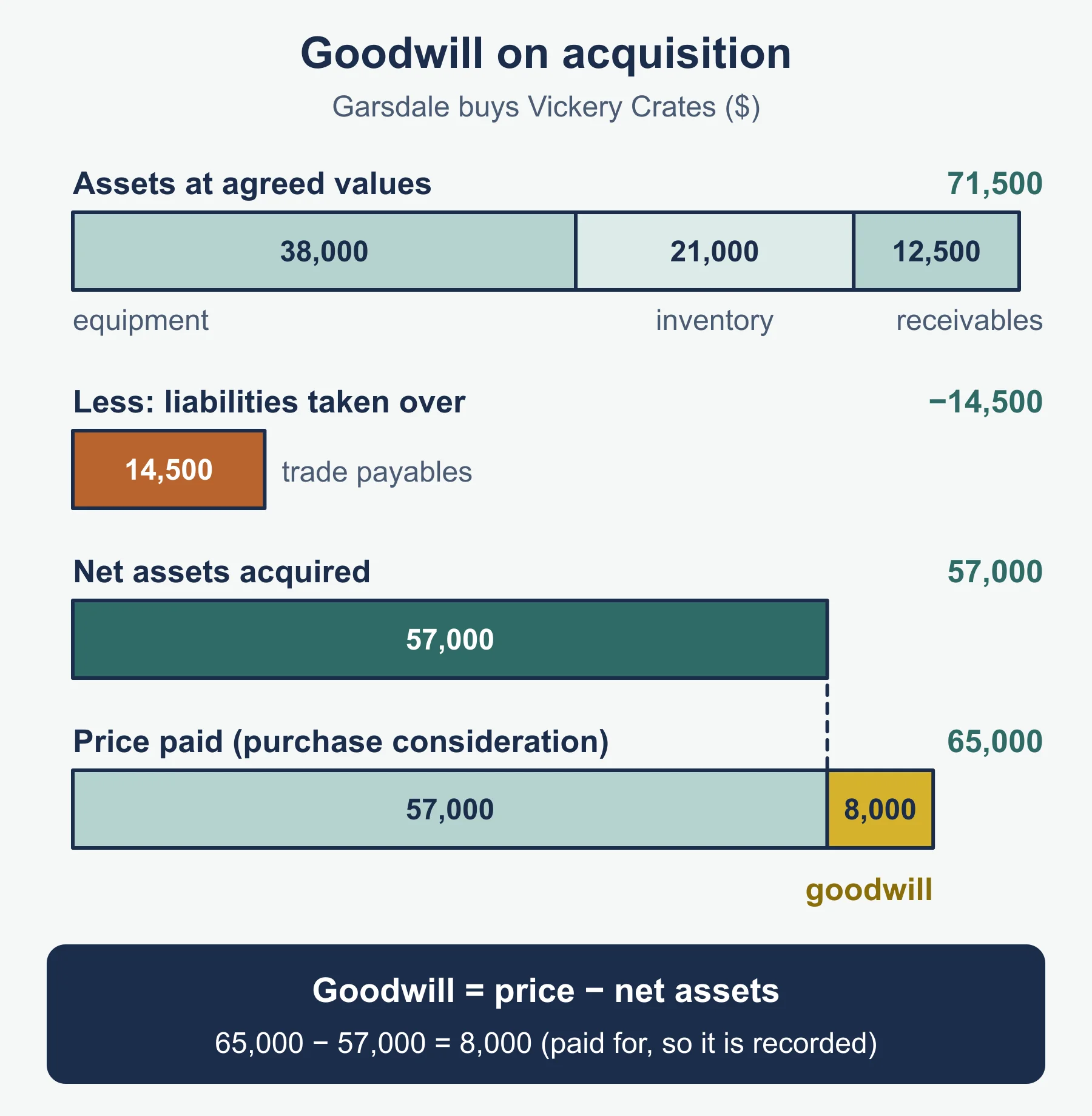
Goodwill on acquisition
- List each asset at its agreed value.
- Deduct the liabilities the buyer takes over.
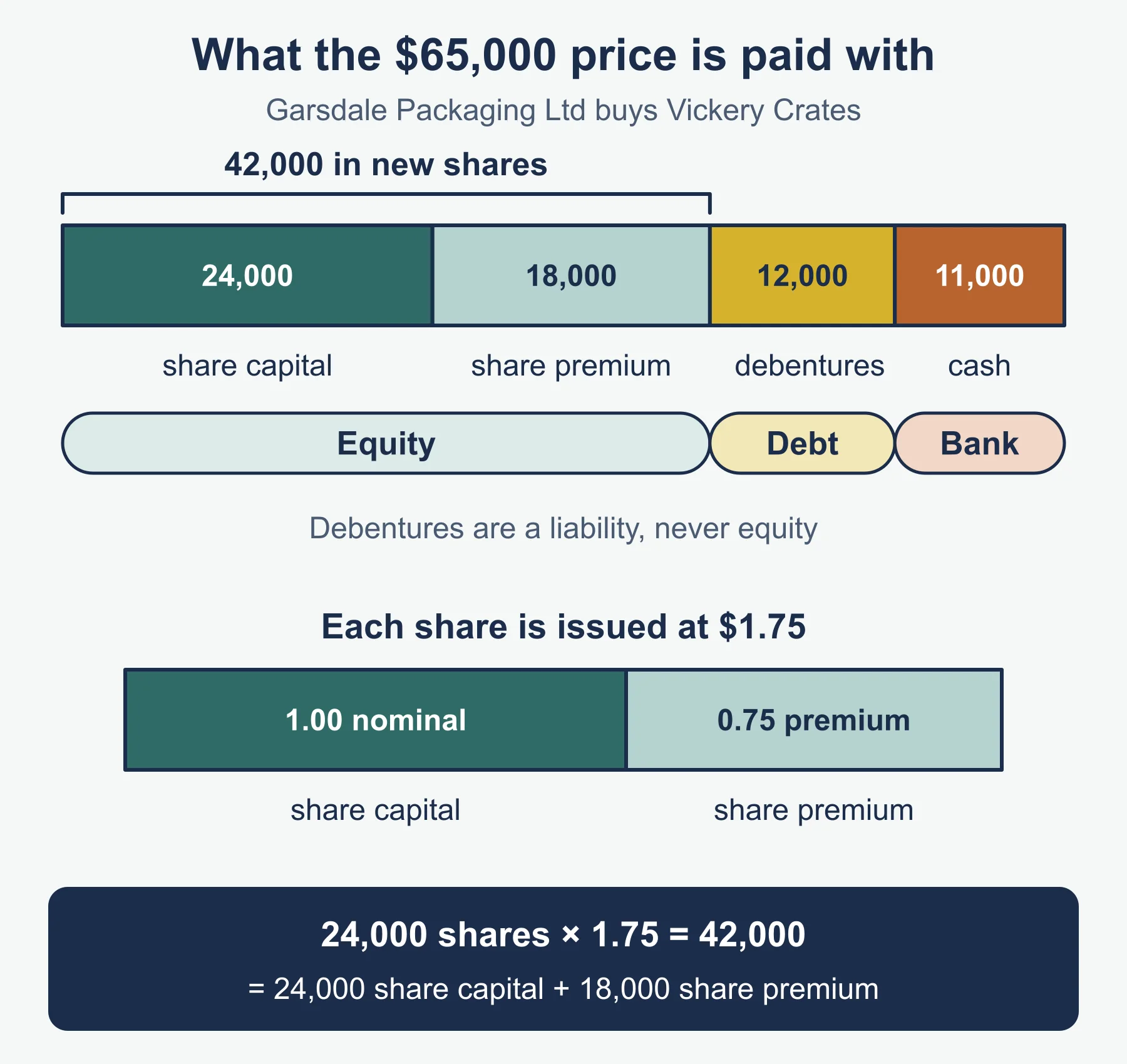
- Value the consideration: shares at issue price, plus debentures, plus cash.
- Goodwill is consideration minus net assets. It is debited as an intangible non-current asset.
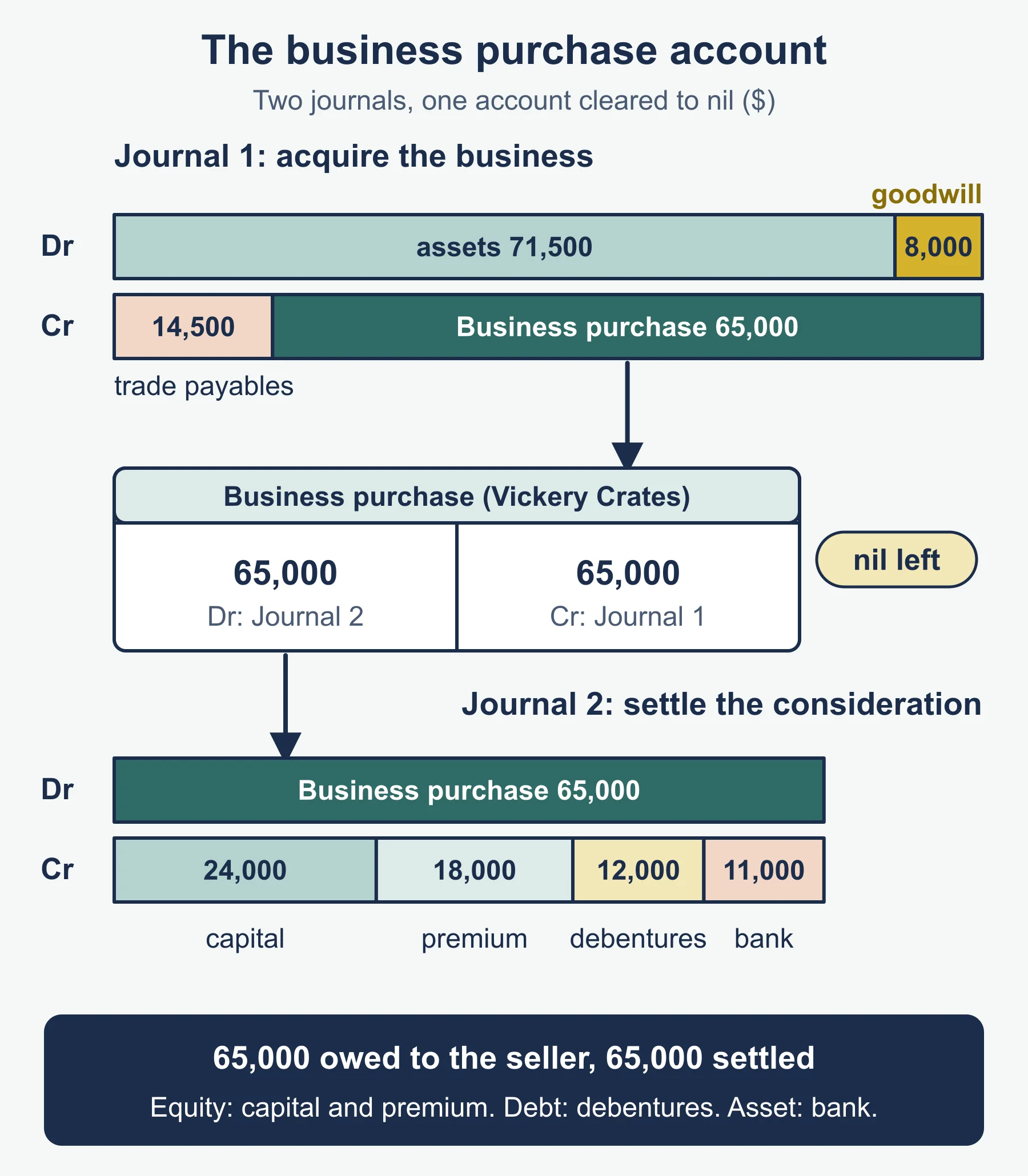
Acquisition by a limited company (two journals)
- Debit each asset and goodwill, credit liabilities taken over, credit the business purchase account with the total price.
- Debit the business purchase account, credit ordinary share capital (nominal value), share premium, debentures and bank.
- Check that the business purchase account balances to nil.
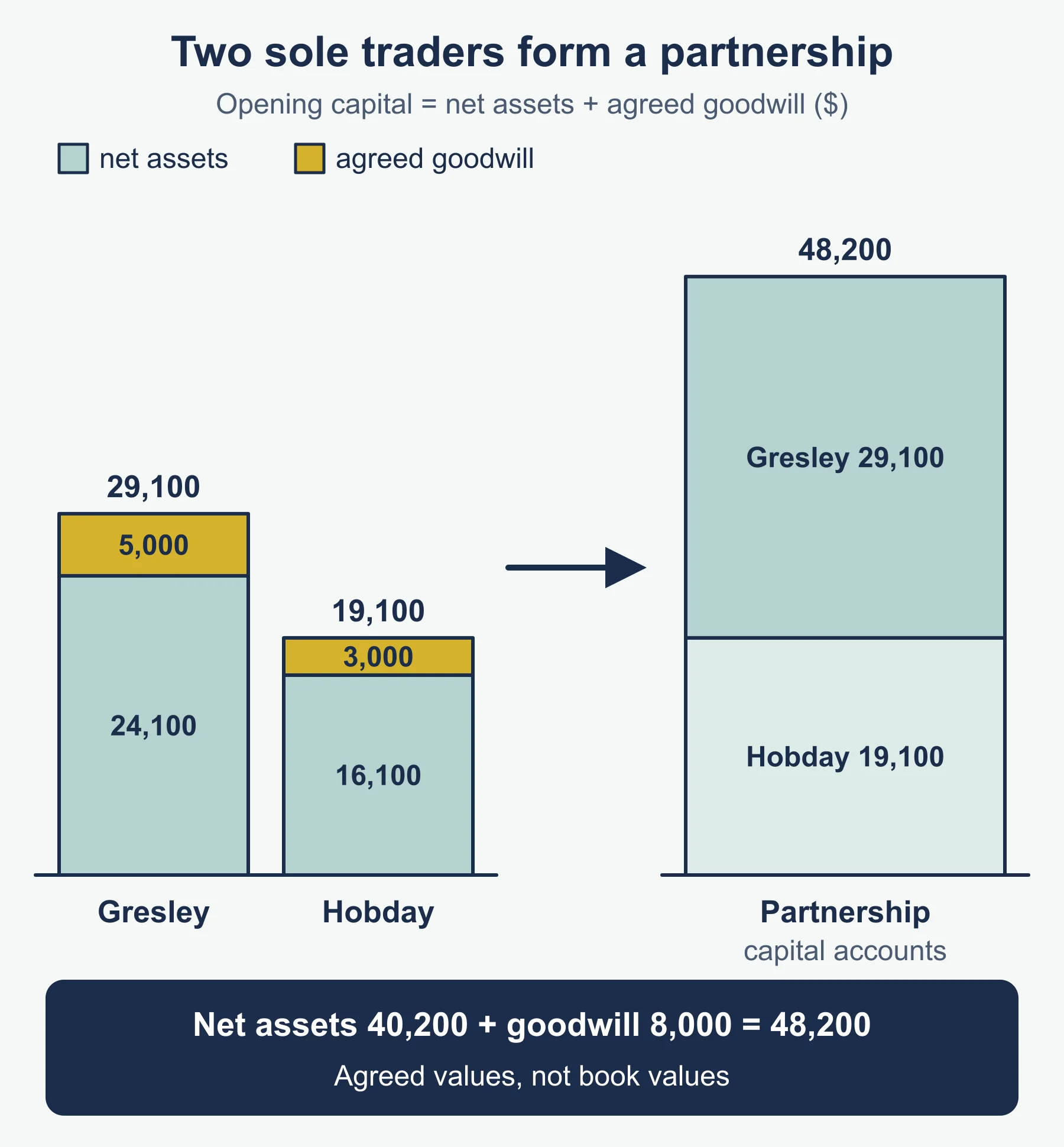
Merger into a partnership
- Put each owner’s assets and liabilities at agreed values.
- Add the goodwill agreed for each business.
- Credit each owner’s capital account with net assets plus goodwill.
- Check that total capital equals total net assets.
Sole trader joins an existing partnership
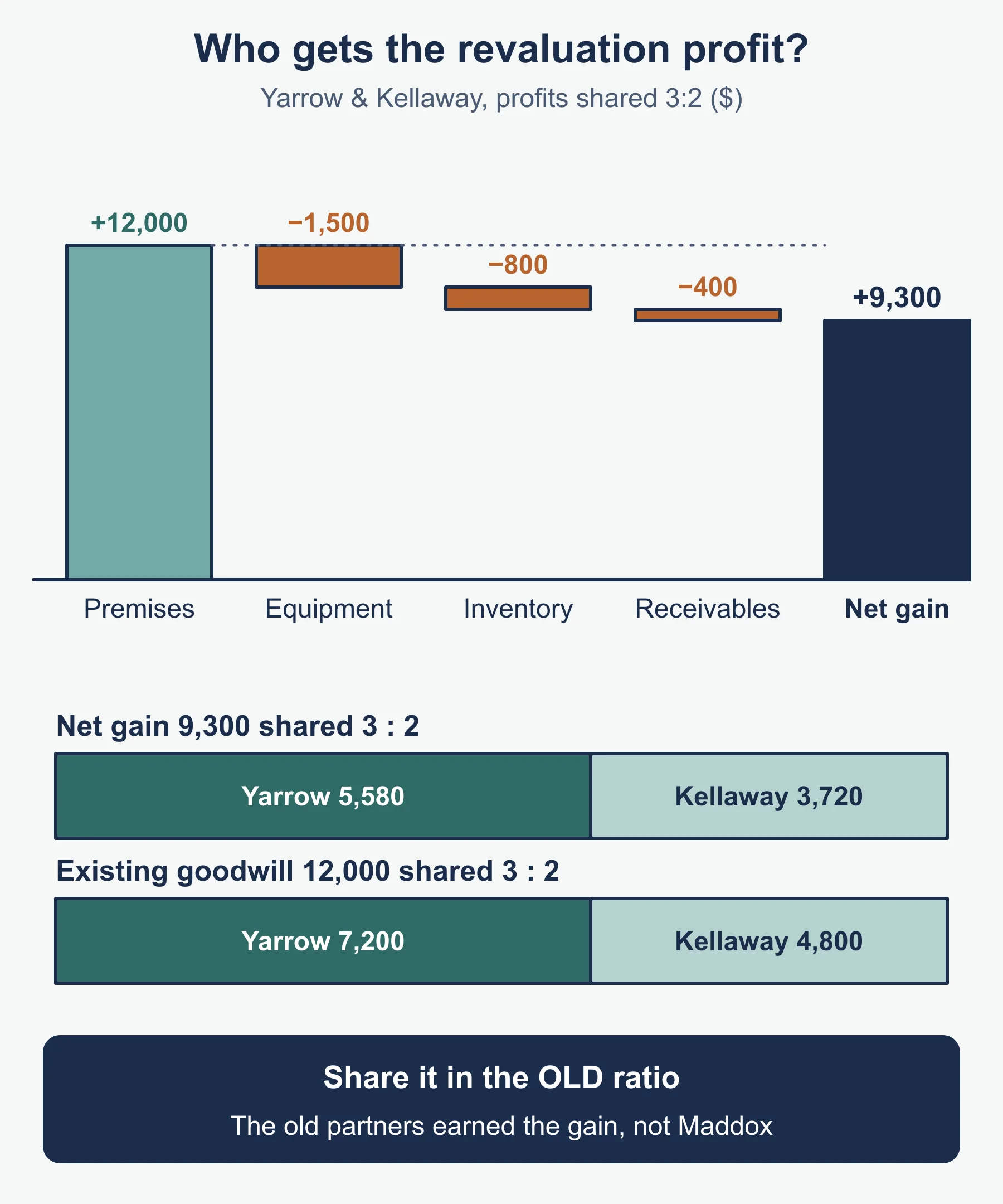
- Revalue the partnership’s assets in a revaluation account; share the profit or loss in the old ratio.
- Record goodwill and credit it to the old partners in the old ratio.
- Bring in the sole trader’s net assets and agreed goodwill and credit the new partner’s capital.
- Use the new ratio for profits from then on.
Worked reminders
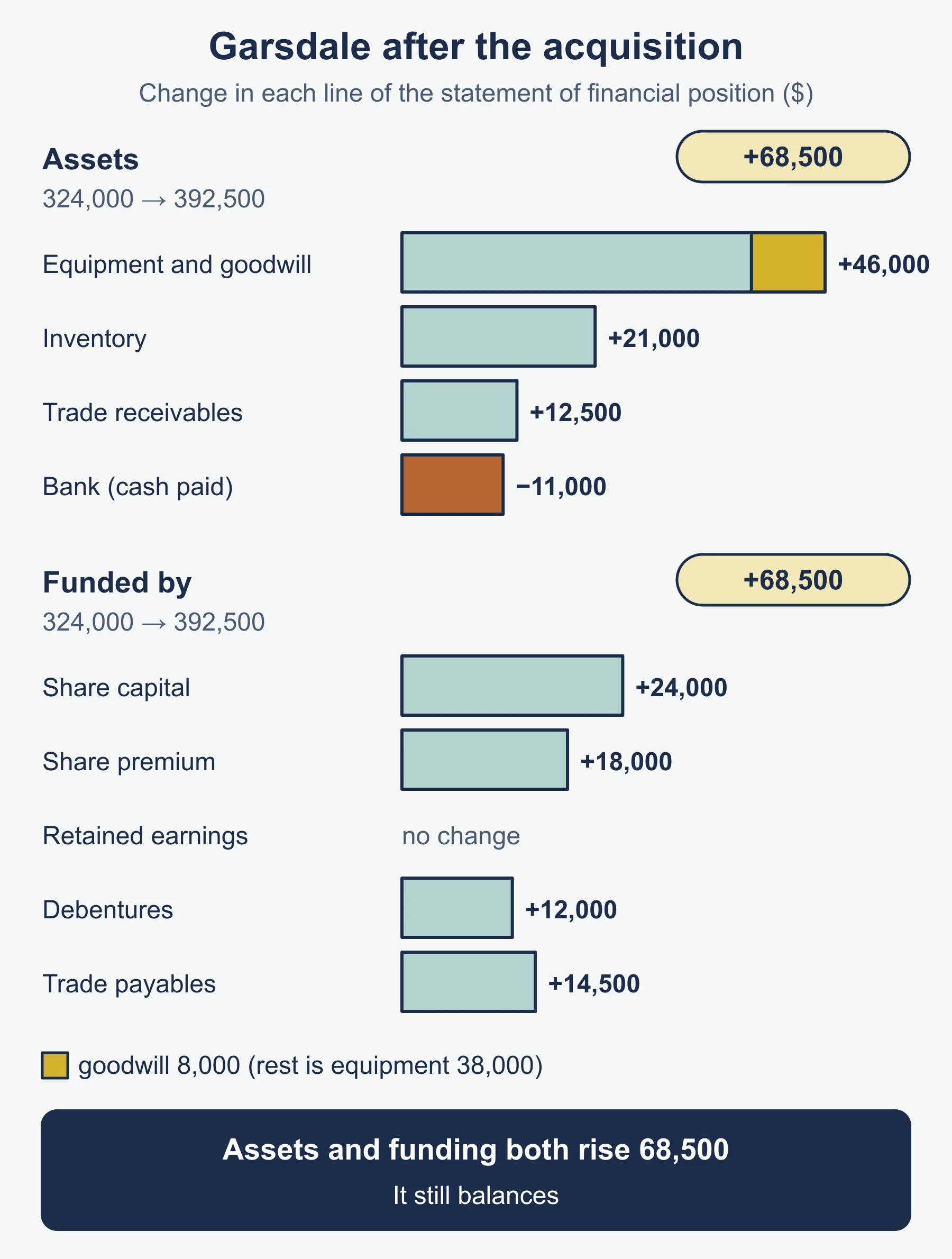
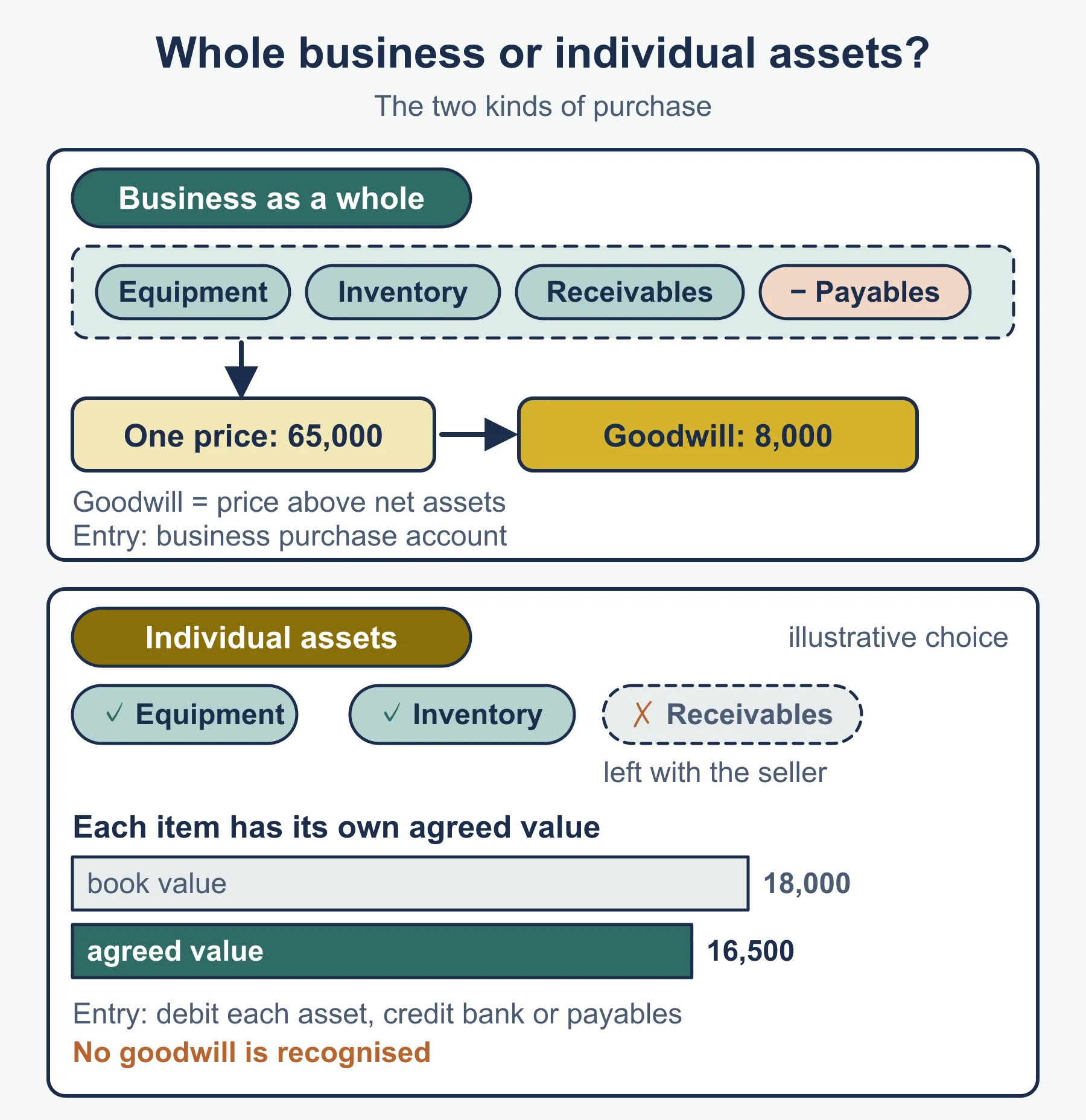
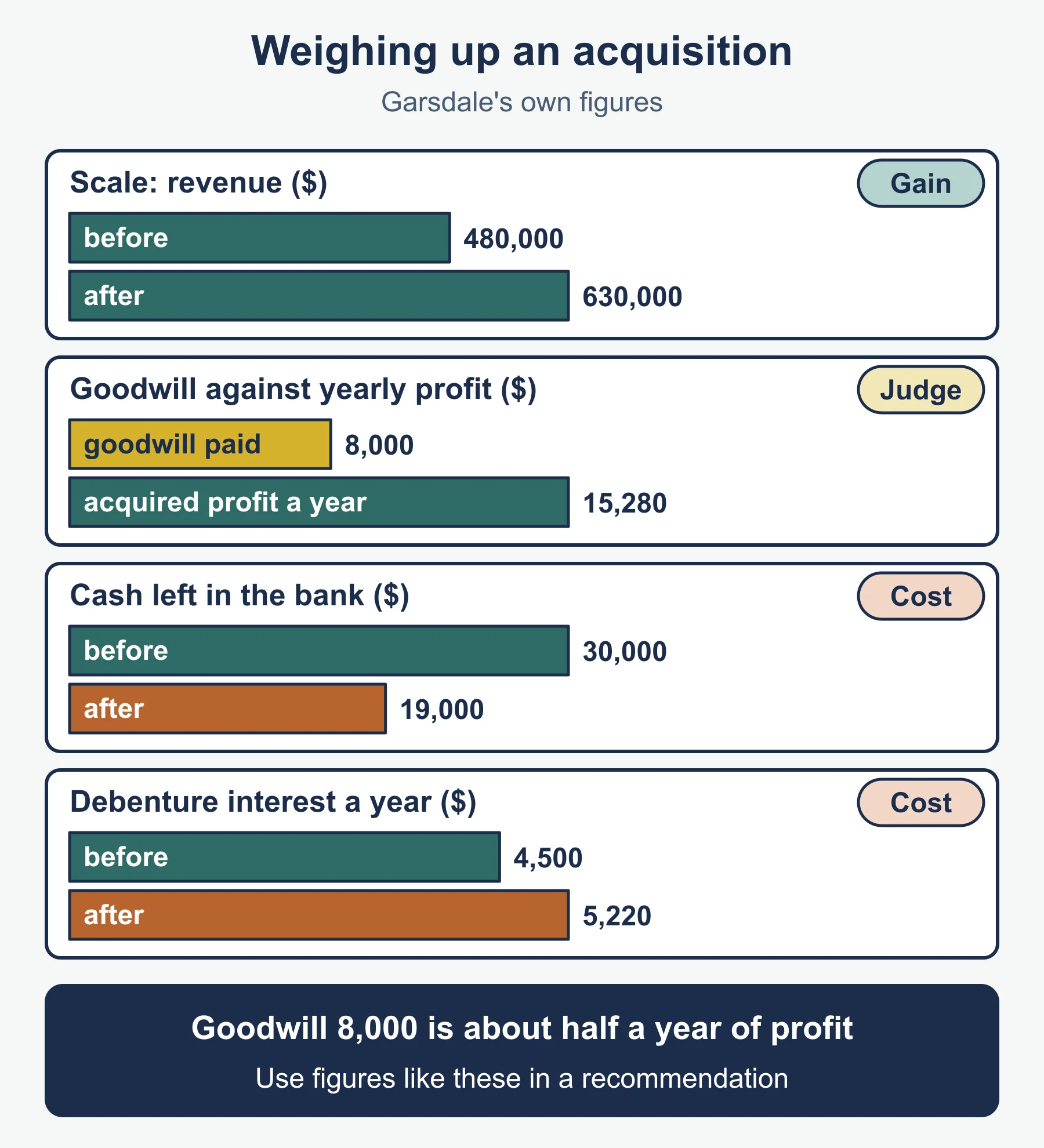
Goodwill. Bellfield Ltd buys a business. Assets at agreed values are 52,000 and liabilities taken over are 9,500, so net assets are 42,500. It pays 18,000 ordinary shares of 1 issued at 2.50 (45,000) and 5,500 cash: 50,500. Goodwill is 50,500 - 42,500 = 8,000. Share capital rises by 18,000 and share premium by 18,000 x 1.50 = 27,000.
Merger into a company. A trader’s net assets are agreed at 31,000 and goodwill at 4,500. The new company issues 35,500 shares of 1 at par. Debit the assets at agreed values and goodwill 4,500, credit the liabilities taken over, and credit share capital 35,500 (net assets 31,000 plus goodwill).
Revaluation before a new partner joins. A partnership shares profits 3:1. Premises rise by 6,000 and inventory falls by 600, so the revaluation profit is 5,400: 4,050 and 1,350. Goodwill of 8,000 is credited 6,000 and 2,000. Opening capitals of 20,000 and 10,000 become 30,050 and 13,350 before the newcomer’s capital is added.
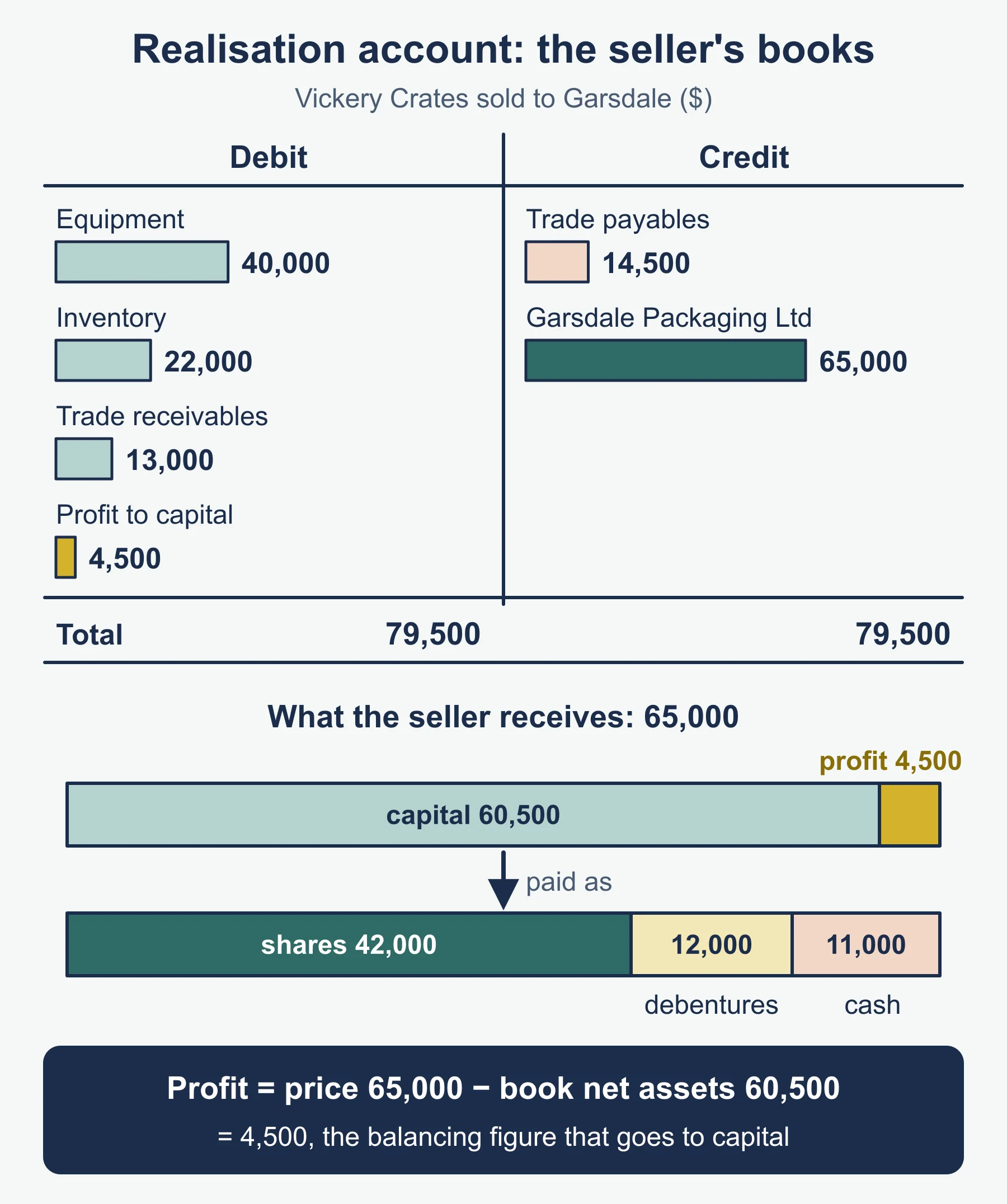
Layout reminders. In the buyer’s books the business purchase account has the consideration on the credit side first, then the settlement entries clear it on the debit side. In the seller’s books the realisation account has the assets at book value on the debit side, the liabilities taken over and the price on the credit side, and the balancing profit or loss goes to capital.
Seller’s profit. If the buyer pays 65,000 for a business with book net assets of 60,500, the realisation profit is 4,500. It goes to the seller’s capital account, or to the partners in their profit-sharing ratio.
Statements after the combination
- Statement of financial position: add the acquired assets at agreed values, add goodwill, remove the cash paid, add the liabilities taken over, add new share capital, share premium and debentures. Retained earnings do not change on acquisition.
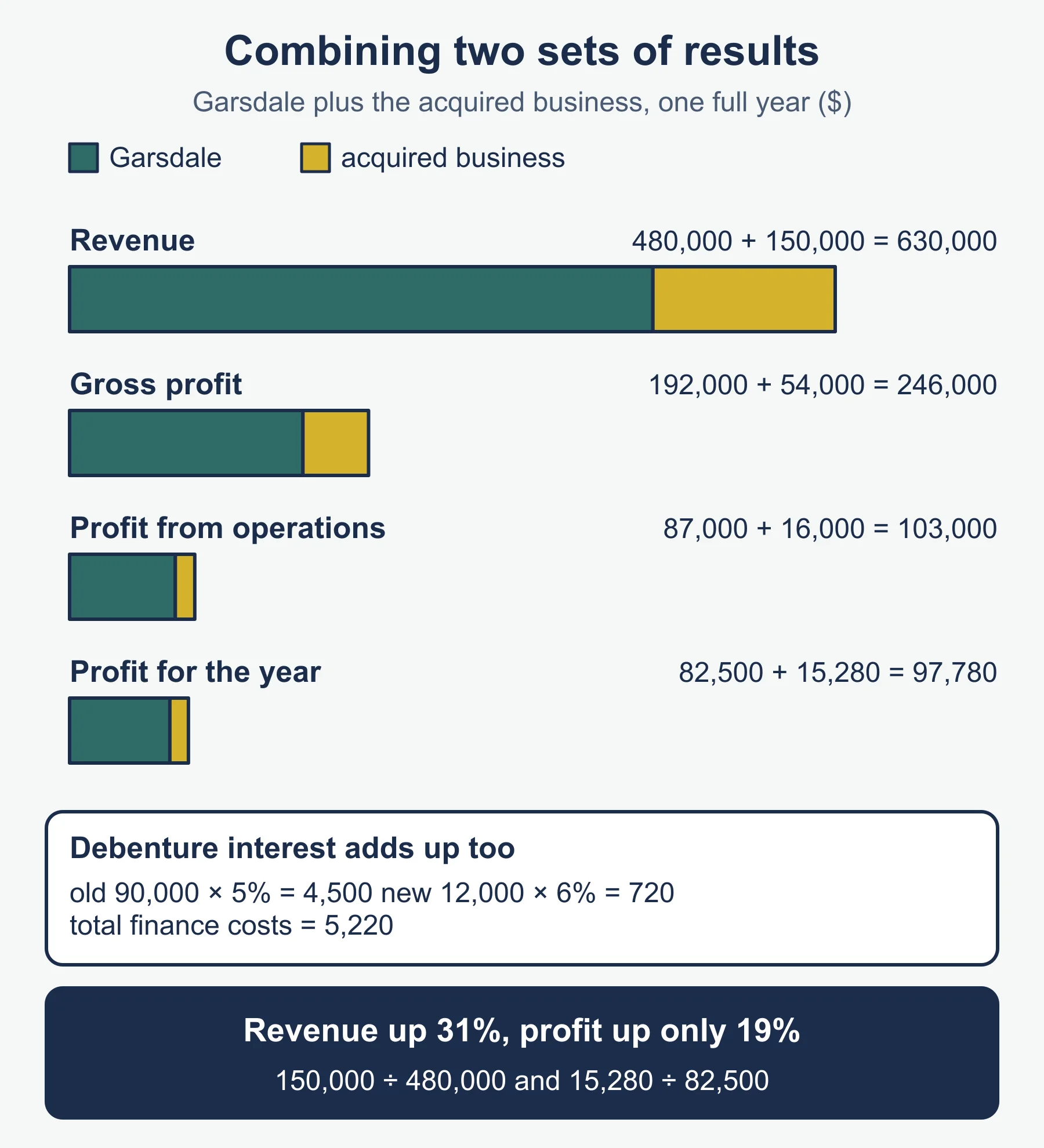
- Statement of profit or loss: include the acquired business’s results only from the date of acquisition, plus debenture interest on any new debentures, plus depreciation on acquired assets.
- Goodwill appears among non-current assets (intangible), not among current assets.
- Debentures are liabilities, not equity.
Advantages and disadvantages
| Advantages | Disadvantages | |
|---|---|---|
| Acquirer | Growth, bigger market share, wider range, economies from sharing premises and staff, competitor removed | Price paid above net assets, integration difficulties, interest on debentures, cash outflow |
| Seller or merging owner | Realises value; limited liability in a company; shared skills and workload | Loss of control, smaller share of profit, disputes with new owners |
| Using shares as payment | Saves cash | Dilutes existing shareholders |
| Using debentures or cash | No dilution | Interest or lower bank balance |
For evaluation, always use the figures given, state whether the benefit outweighs the cost, and justify the recommendation with a balance of reasons.
Must-know distinctions
- Merger versus acquisition: a merger creates a new entity; an acquisition makes one entity larger.
- Whole business versus individual assets: only the first normally creates goodwill, because only the first has a single price for the business.
- Purchased versus inherent goodwill: only purchased goodwill appears in the books.
- Business purchase account (buyer) versus realisation account (seller).
- Old ratio for revaluation and existing goodwill; new ratio for profits afterwards.
Quick self-test
- State the difference between purchased and inherent goodwill.
- Net assets at agreed values are 31,400 and the consideration is 38,000. Calculate goodwill.
- A company issues 15,000 shares of 1 at 1.60. State the credit to share capital and to share premium.
- Which account is credited with the price in the buyer’s books before the consideration is settled?
- A partnership revaluation gives a profit of 6,000. The old ratio is 2:1. How is the profit shared?
- A sole trader’s net assets are 22,000 and agreed goodwill is 3,500. What is the opening capital in a new partnership?
- When a company buys only individual assets, what goodwill arises?
- Debentures of 20,000 pay 7%. Calculate the annual interest.
- A buyer issues 5,000 shares at 1.20, 4,000 of debentures and pays 2,000 cash. State the purchase consideration.
- On which side of the seller’s realisation account is the purchase consideration entered?
- Give two disadvantages for a company that pays for an acquisition with debentures.
- A partnership shares profits 3:1 and credits goodwill of 12,000 to the old partners. State each credit.
Answers
- Purchased goodwill has been paid for and is recorded; inherent goodwill is built up by the business and is not recorded until someone pays for it.
- Goodwill is 38,000 - 31,400 = 6,600.
- Share capital 15,000; share premium 15,000 x 0.60 = 9,000.
- The business purchase account.
- 4,000 to the first partner and 2,000 to the second.
- 22,000 + 3,500 = 25,500.
- None. The purchase is recorded asset by asset at cost.
- 20,000 x 7% = 1,400.
- 6,000 + 4,000 + 2,000 = 12,000.
- The credit side.
- Interest must be paid every year, and the debentures must be repaid or refinanced; gearing rises.
- 9,000 and 3,000.
Where marks are usually lost
- Using book values where the question gives agreed values.
- Calculating goodwill before deducting the liabilities taken over.
- Splitting the issue price wrongly between share capital and share premium.
- Sharing revaluation profit in the new ratio.
- Debiting goodwill but forgetting to credit the owner’s capital account for it.
- Totals that do not balance: the journal or opening statement of financial position is not checked.
- Listing advantages and disadvantages with no reference to the business in the question.
- Giving a recommendation with no justification.
Frequently asked questions
Which section of Cambridge 9706 covers business acquisition and merger? Section 3.3 Business acquisition and merger is A Level content in Cambridge International AS and A Level Accounting 9706. It covers goodwill, journal entries, ledger accounts and the resulting statements for mergers and acquisitions.
Should goodwill be calculated using book values or agreed values? Use the agreed values given in the question, not the seller’s book values, and deduct the liabilities taken over before finding goodwill.
In which ratio is a revaluation profit shared when a new partner joins? A revaluation profit, and the existing goodwill, are shared between the existing partners in the old profit-sharing ratio, not the new one.
How do I check a merger journal is correct? The journal and the opening statement of financial position should both balance. If they do not, check for a missing goodwill debit or a capital account not credited for goodwill.
Official syllabus
Cambridge International AS & A Level Accounting 9706 syllabus for examination in 2026, 2027 and 2028, section 3.3 Business acquisition and merger, published by Cambridge University Press & Assessment (Cambridge International).
Get free revision emails (optional)
Occasional emails with practice questions, worked explanations and links to free resources for the qualification and subjects you choose. No spam, and you can unsubscribe from any email. The free tools on this site never need an email.
Related resources
-
Study guides
A Level Accounting: Accounting for Non-Current Assets (Cambridge 9706)
Capital versus revenue spending, why assets depreciate depreciation methods, cost and revaluation models and disposals, for Cambridge 9706 Accounting topic 1.3.
Accounting · Cambridge · AS Level
Read guide -
Study guides
A Level Accounting: Computerised accounting systems (Cambridge 9706)
Study guide to moving a business's accounts onto a computerised system and keeping the data complete and accurate, for Cambridge A Level Accounting.
Accounting · Cambridge · A Level
Read guide -
Practice questions
A Level Accounting: Computerised accounting systems (Cambridge 9706) – Practice Questions
Eleven original questions with worked answers on moving accounts to a computerised system and checking data integrity, for Cambridge A Level Accounting.
Accounting · Cambridge · A Level
Try questions
Related articles
-
teaching
A Level tuition in Dubai: Cambridge or Pearson Edexcel International A Level?
Schools in Dubai and Abu Dhabi teach either Cambridge International AS & A Level or Pearson Edexcel International A Level. How the two are structured, why it matters for tuition, and how online classes from Lahore work.
9 October 2026
-
curriculum guides
Choosing subjects at IGCSE and A Level
How subject choices at 14 and 16 affect university options later, and how to keep pathways open without overloading a timetable.
28 July 2026
Studying this with a teacher
Working through Accounting A LEVEL?
This page is free and stays free. If you would rather be taught it, Marlbridge runs Accounting classes one-to-one and in small groups of up to 15, online in your own time zone. The first trial class is free. WhatsApp replies within an hour (8am–11pm Pakistan time, every day); email the same day.
Cambridge Accounting teachers at Marlbridge

