
Study Guides
A Level Accounting: Business acquisition and merger (Cambridge 9706)
Goodwill, journals and ledger accounts for mergers and acquisitions, and the new entity's statements, for Cambridge A Level Accounting 9706 section 3.3.
- Subject
- Accounting
- Level
- A LEVEL
- Topic
- Financial accounting
- Author
- Marlbridge Academic Team
- Updated
- Reviewed by
- Zain Ud Din Ahmed (what this means)
Aligned to Cambridge A Level Accounting (9706), 2026-2028. Official specification .
Syllabus page (what it covers and how it is assessed): Cambridge A Level Accounting.
Syllabus points this page covers
9706 (A Level)
- 3.3 Business acquisition and merger
Found an error? Report a correction.
Need help with this topic? Request a free trial class for A Level Accounting (9706).
This guide covers section 3.3 Business acquisition and merger (A Level content) of the Cambridge International AS & A Level Accounting 9706 syllabus for 2026, 2027 and 2028. It sits in topic 3, Financial accounting, which is the A Level content that Paper 3 assesses. AS Level content is assumed knowledge, so you should be comfortable with journals, ledger accounts and the statement of financial position first. All businesses and figures are invented and all amounts are in dollars.
Use it with the revision notes and the practice questions. Related background is in Business entities and the accounting system and Accounting for non-current assets. See also the course hub, the printable checklist and the free diagnostics.
What section 3.3.1 asks you to do
| Syllabus point | Where it is covered |
|---|---|
| Nature and purpose of merging different types of business | Why businesses combine |
| Journals and ledger accounts: sole traders merging into a partnership or limited company | Cases A and C |
| Sole trader merging with an existing partnership to form a new partnership | Case B |
| Sole trader or partnership acquired by a limited company | Case C |
| Goodwill on acquisition | Goodwill and purchase consideration |
| Statement of profit or loss and statement of financial position of the new entity | Case C and the statements |
| Advantages and disadvantages | Evaluating the decision |
Why businesses combine
A merger joins two or more businesses into a new entity. An acquisition is when one entity buys another. Owners do it to grow faster than they could alone. The purposes are usually to gain customers or a wider product range, to share premises and equipment, to combine skills, to raise more finance than one owner can, or to remove a competitor.
The entity types matter. Sole traders merging into a partnership pool capital and skills. Sole traders merging into a limited company gain limited liability and can raise capital by issuing shares. A limited company acquiring a partnership pays with shares, debentures, cash or a mixture.
Whole business or individual assets
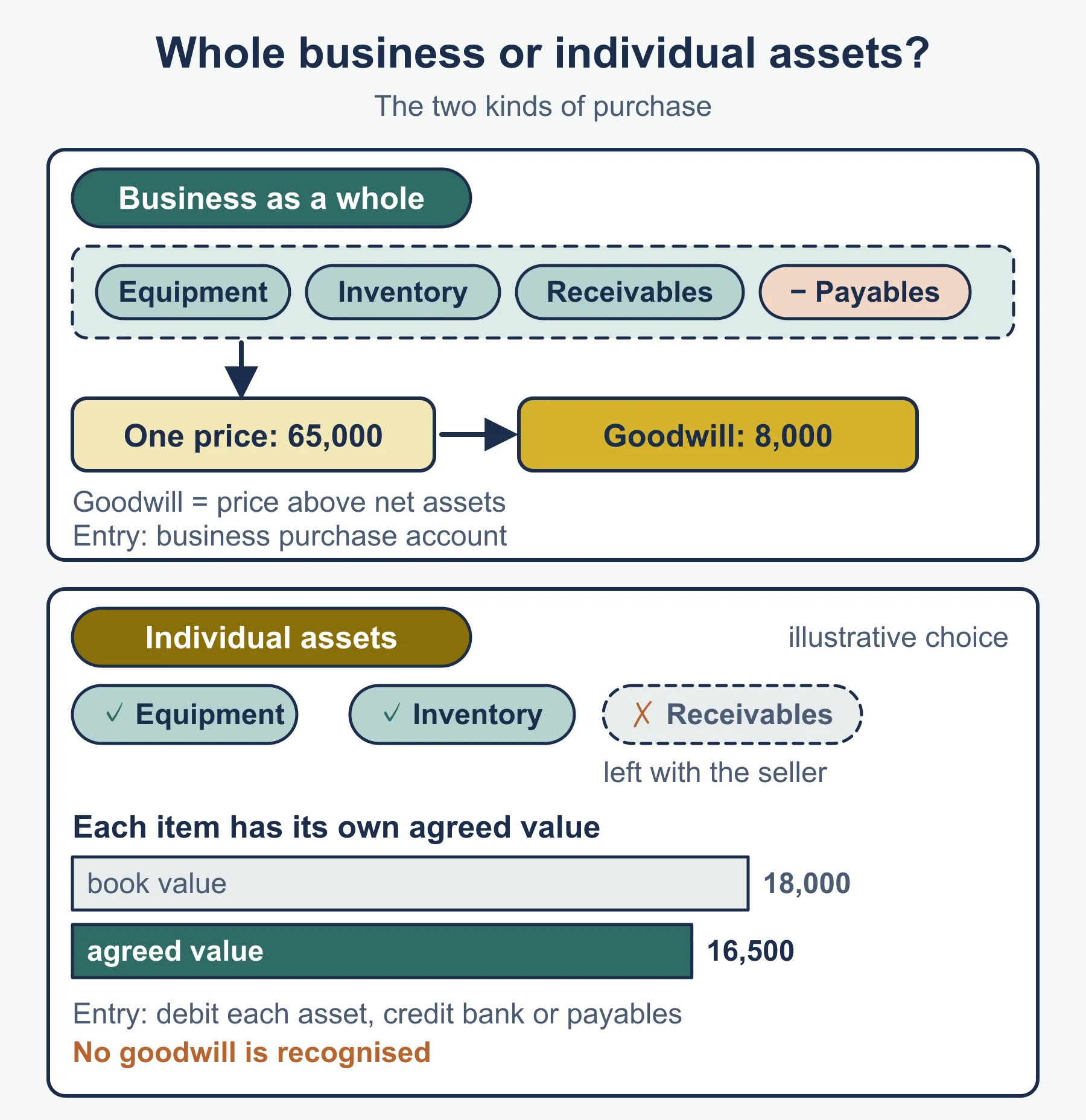
The syllabus separates two kinds of purchase.
| Business as a whole | Individual assets | |
|---|---|---|
| What is bought | All the assets and usually the liabilities | Only the assets chosen |
| Price | One negotiated figure, often above the net assets | The value of each asset |
| Goodwill | Arises if the price exceeds net assets at fair value | None is recognised |
| Entry | Business purchase account | Debit each asset, credit bank or payables |
Fair value means the value the buyer and seller agree for each asset, which can differ from the seller’s book value. A seller’s equipment might be carried at 18,000 but agreed at 16,500.
Goodwill and purchase consideration
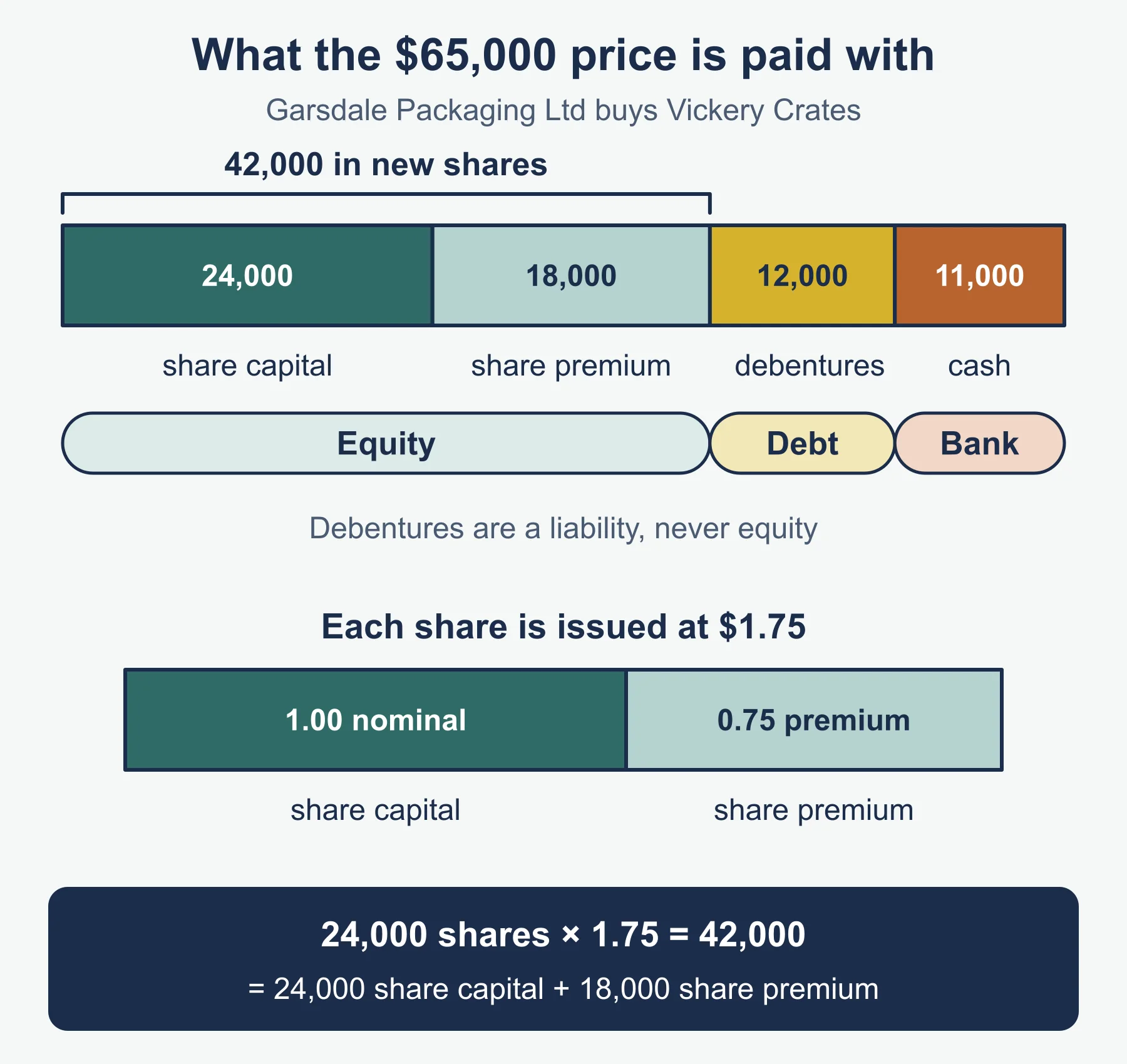
Purchase consideration is what the buyer gives: cash, shares, debentures, or a mixture. Shares are recorded at the value they are issued for, so shares with a nominal value of 1 issued at 1.75 give share capital of 1 and share premium of 0.75 each.
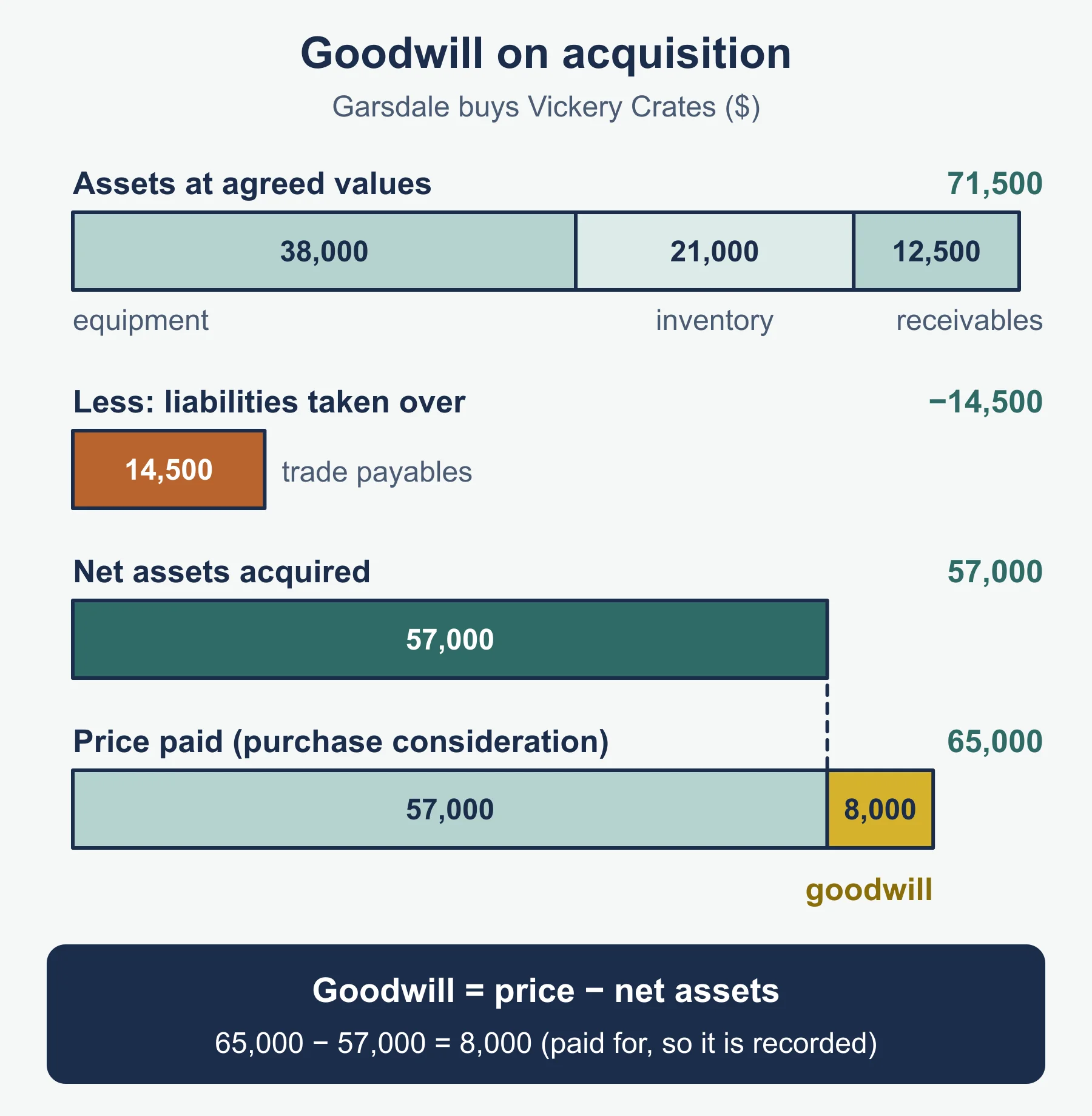
Goodwill on acquisition is the excess of the purchase consideration over the fair value of the net identifiable assets acquired.
Goodwill = purchase consideration - (assets at agreed values - liabilities taken over)
This is purchased goodwill: it is paid for. Inherent goodwill is built up by a business over time and is not recorded until someone pays for it. In a merger forming a partnership, the partners agree a goodwill figure for each business and credit it to that owner’s capital account.
Case A: two sole traders form a partnership
Ines Gresley (Gresley Bindery) and Yaron Hobday (Radley Papers) merge to form Gresley & Hobday Press. The agreed values are below, with Gresley’s book values in brackets where they differ.
| Gresley | Hobday | |
|---|---|---|
| Equipment | 16,500 (18,000) | 9,000 |
| Inventory | 5,900 (6,400) | 7,000 |
| Trade receivables | 3,800 (4,100) | 5,000 |
| Bank | 1,200 | overdraft 800 |
| Trade payables | 3,300 | 4,100 |
| Goodwill agreed | 5,000 | 3,000 |
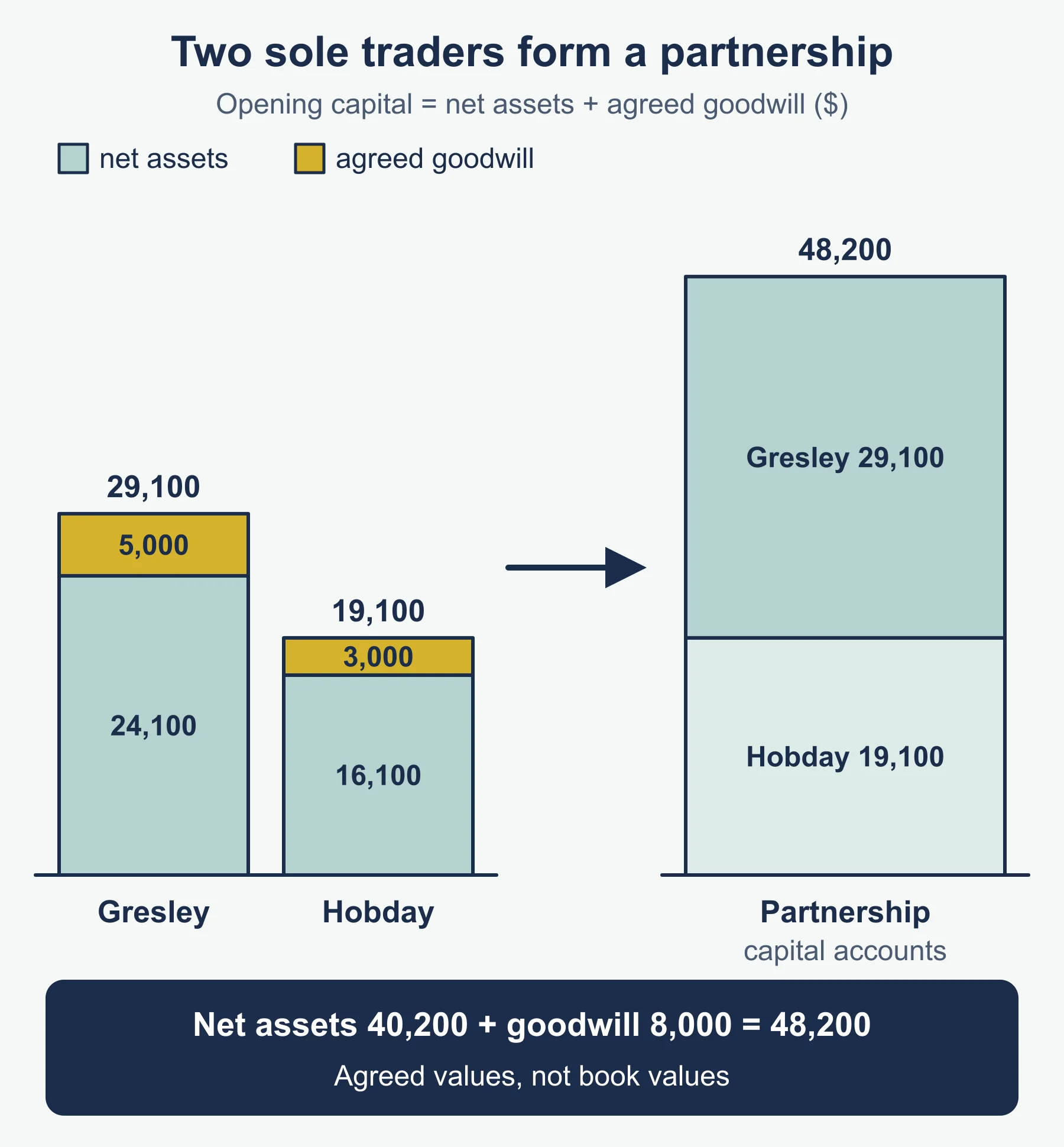
Net assets are 24,100 for Gresley and 16,100 for Hobday. Adding goodwill gives opening capital of 29,100 and 19,100. The journal in the new partnership’s books:
| Account | Dr | Cr |
|---|---|---|
| Equipment | 25,500 | |
| Inventory | 12,900 | |
| Trade receivables | 8,800 | |
| Bank | 1,200 | |
| Goodwill | 8,000 | |
| Bank overdraft | 800 | |
| Trade payables | 7,400 | |
| Capital: Gresley | 29,100 | |
| Capital: Hobday | 19,100 | |
| 56,400 | 56,400 |
Opening statement of financial position: non-current assets are equipment 25,500 and goodwill 8,000; current assets are inventory 12,900, trade receivables 8,800 and bank 1,200; total assets are 56,400. Trade payables and the overdraft are 8,200, leaving net assets of 48,200, which equals the two capital accounts.
If the merger formed a limited company instead, the journal has the same debit side. The credit side shows liabilities taken over and share capital issued to each owner, for example one share per dollar of agreed value at par.
Case B: a sole trader joins an existing partnership
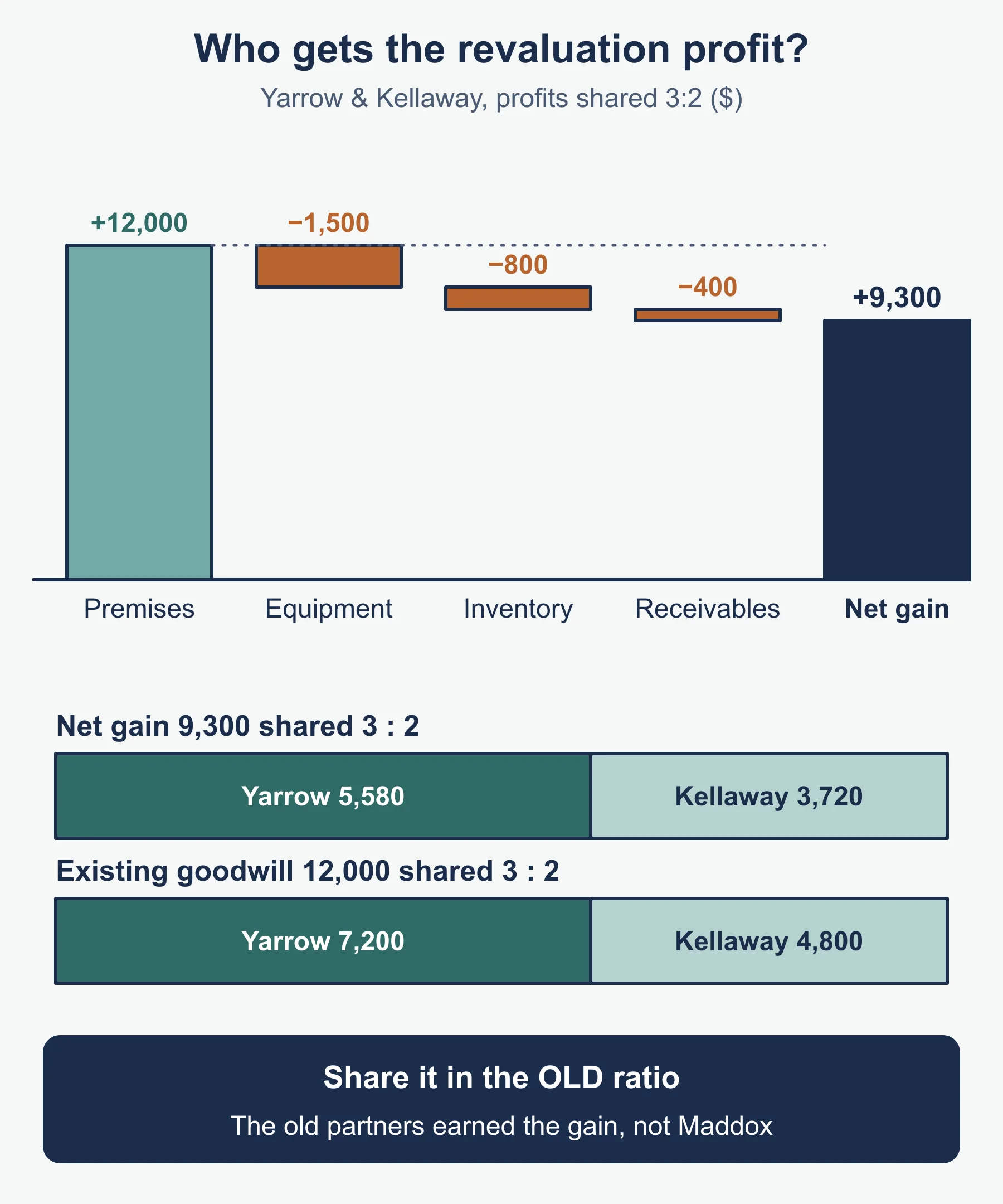
Yarrow & Kellaway Joinery shares profits 3:2. Corin Maddox, a sole trader, joins. The existing assets are revalued first, using a revaluation account.
| Revaluation account | Dr | Cr |
|---|---|---|
| Equipment (14,000 to 12,500) | 1,500 | |
| Inventory (9,000 to 8,200) | 800 | |
| Trade receivables (6,500 to 6,100) | 400 | |
| Profit: Yarrow 5,580 | 5,580 | |
| Profit: Kellaway 3,720 | 3,720 | |
| Premises (40,000 to 52,000) | 12,000 | |
| 12,000 | 12,000 |
The partners value the existing goodwill at 12,000, shared in the old ratio (7,200 and 4,800). Maddox brings equipment 6,000, inventory 3,500, trade receivables 2,200 and trade payables 1,800, and goodwill of 2,000 is agreed for his business.
| Capital accounts | Yarrow | Kellaway | Maddox |
|---|---|---|---|
| Balance b/d | 38,000 | 29,000 | |
| Revaluation profit | 5,580 | 3,720 | |
| Goodwill | 7,200 | 4,800 | 2,000 |
| Net assets introduced | 9,900 | ||
| Balance c/d | 50,780 | 37,520 | 11,900 |
The new statement of financial position shows premises 52,000, equipment 18,500, goodwill 14,000, inventory 11,700, trade receivables 8,300 and bank 2,500: total assets 107,000. Trade payables are 6,800, so net assets and total capital are both 100,200. Future profits are shared in the new agreed ratio.
Case C: a limited company acquires a business
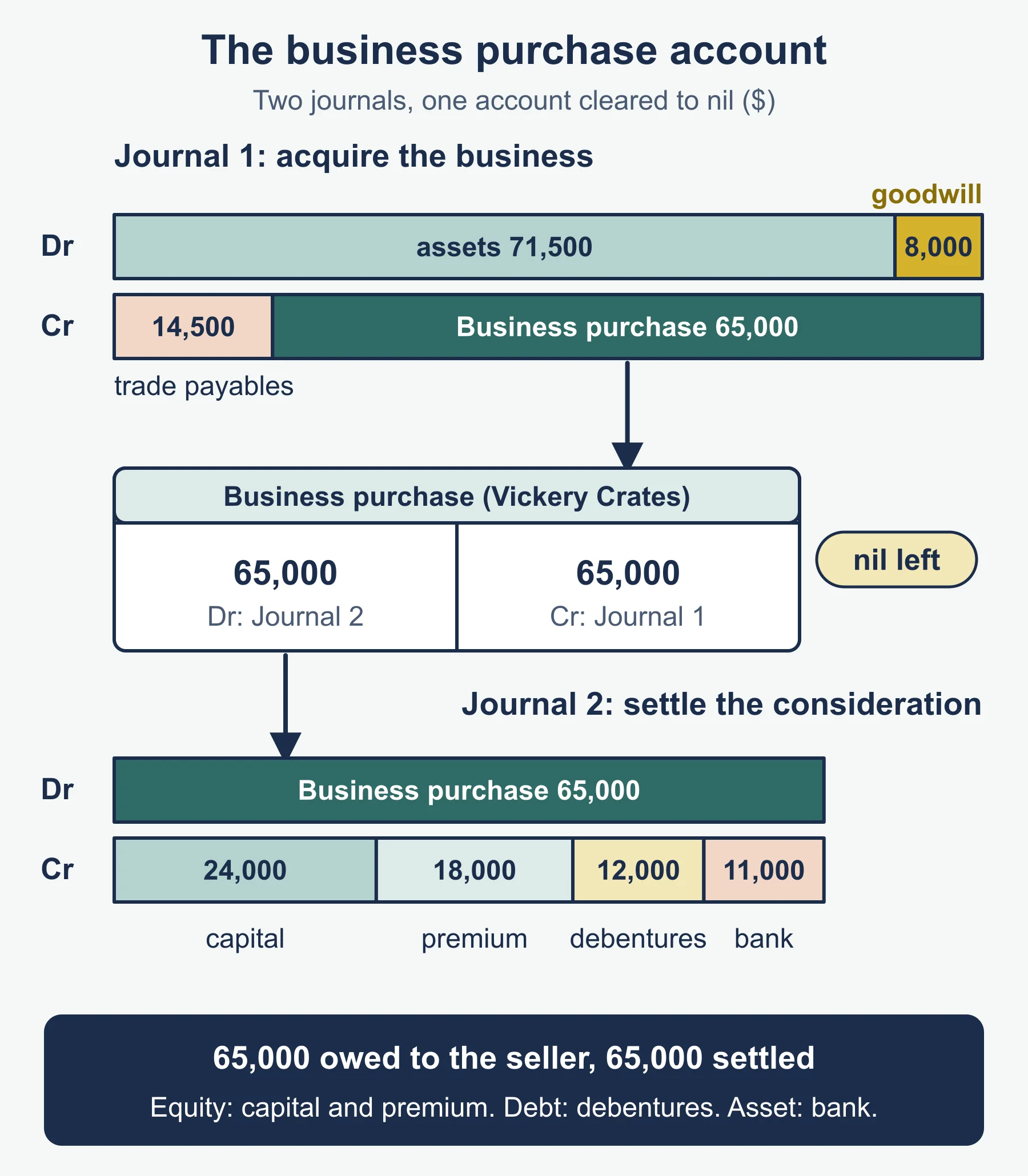
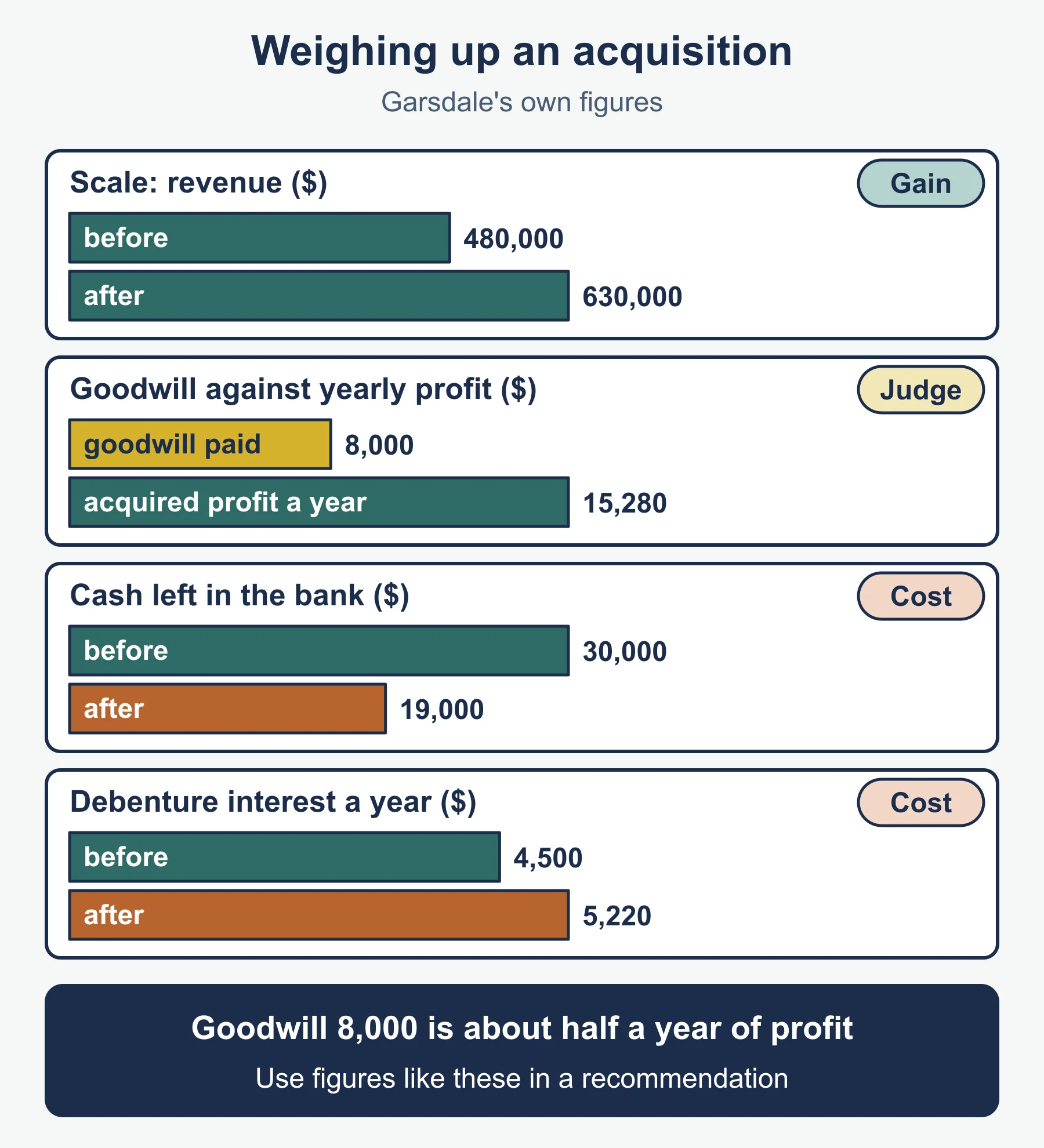
Garsdale Packaging Ltd buys the whole business of Edith Vickery (Vickery Crates). Agreed values: equipment 38,000, inventory 21,000, trade receivables 12,500, trade payables taken over 14,500. Net assets are 57,000. Consideration is 24,000 ordinary shares of 1 issued at 1.75 (42,000), 12,000 of 6% debentures and 11,000 cash: 65,000 in total. Goodwill is 65,000 - 57,000 = 8,000.
| Journal 1: acquire the business | Dr | Cr |
|---|---|---|
| Equipment | 38,000 | |
| Inventory | 21,000 | |
| Trade receivables | 12,500 | |
| Goodwill | 8,000 | |
| Trade payables | 14,500 | |
| Business purchase (Vickery Crates) | 65,000 |
| Journal 2: settle the consideration | Dr | Cr |
|---|---|---|
| Business purchase (Vickery Crates) | 65,000 | |
| Ordinary share capital | 24,000 | |
| Share premium | 18,000 | |
| 6% debentures | 12,000 | |
| Bank | 11,000 |
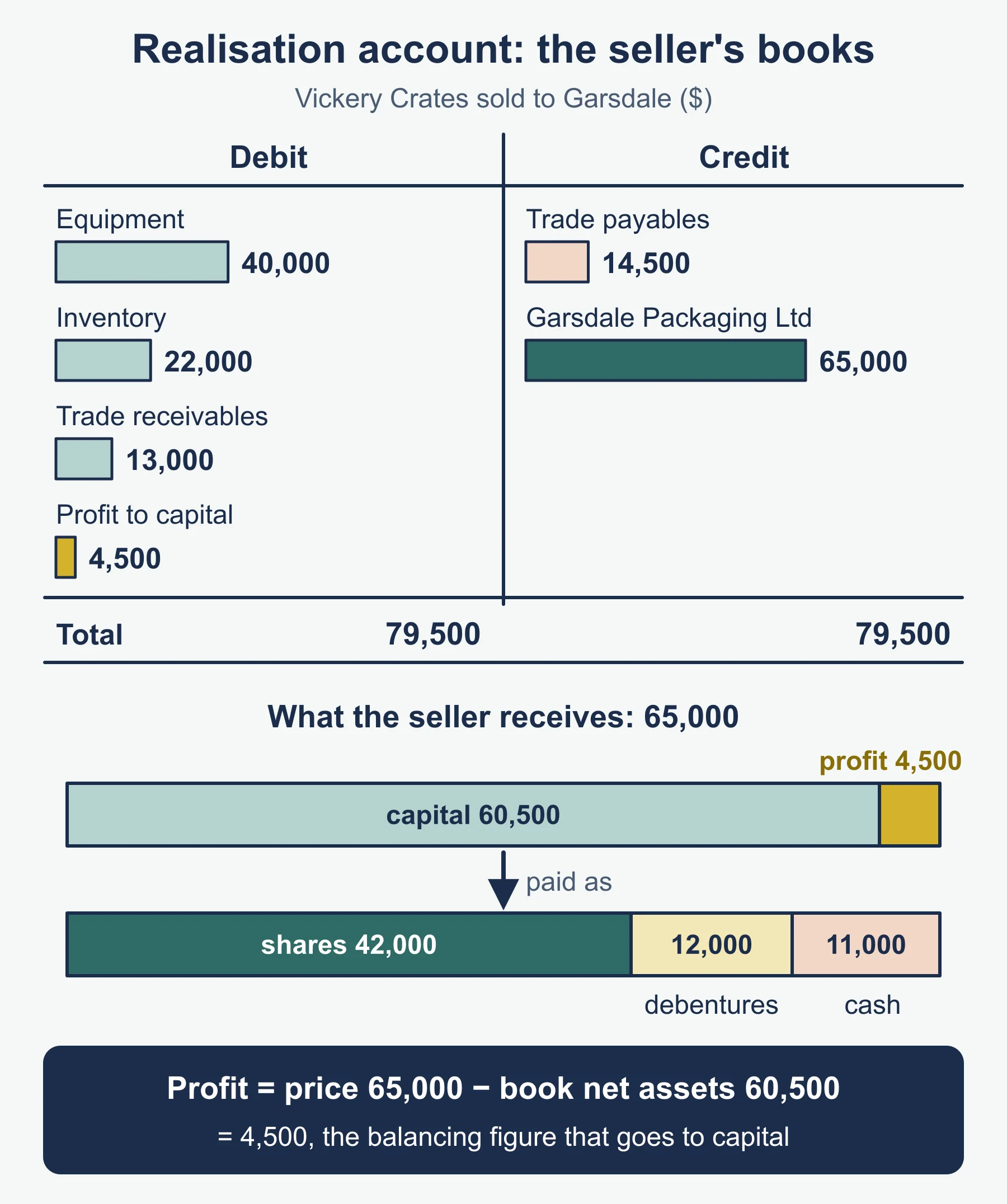
The business purchase account is cleared to nil. In the seller’s books a realisation account records the sale. Vickery’s book values were equipment 40,000, inventory 22,000 and trade receivables 13,000, with the same payables.
| Realisation account | Dr | Cr |
|---|---|---|
| Equipment | 40,000 | |
| Inventory | 22,000 | |
| Trade receivables | 13,000 | |
| Profit to capital | 4,500 | |
| Trade payables | 14,500 | |
| Garsdale Packaging Ltd | 65,000 | |
| 79,500 | 79,500 |
Her capital of 60,500 plus 4,500 profit equals 65,000, which she receives as shares 42,000, debentures 12,000 and cash 11,000. If the seller were a partnership, the profit is shared in the profit-sharing ratio and the consideration is divided between the partners’ capital balances.
The statements after the acquisition
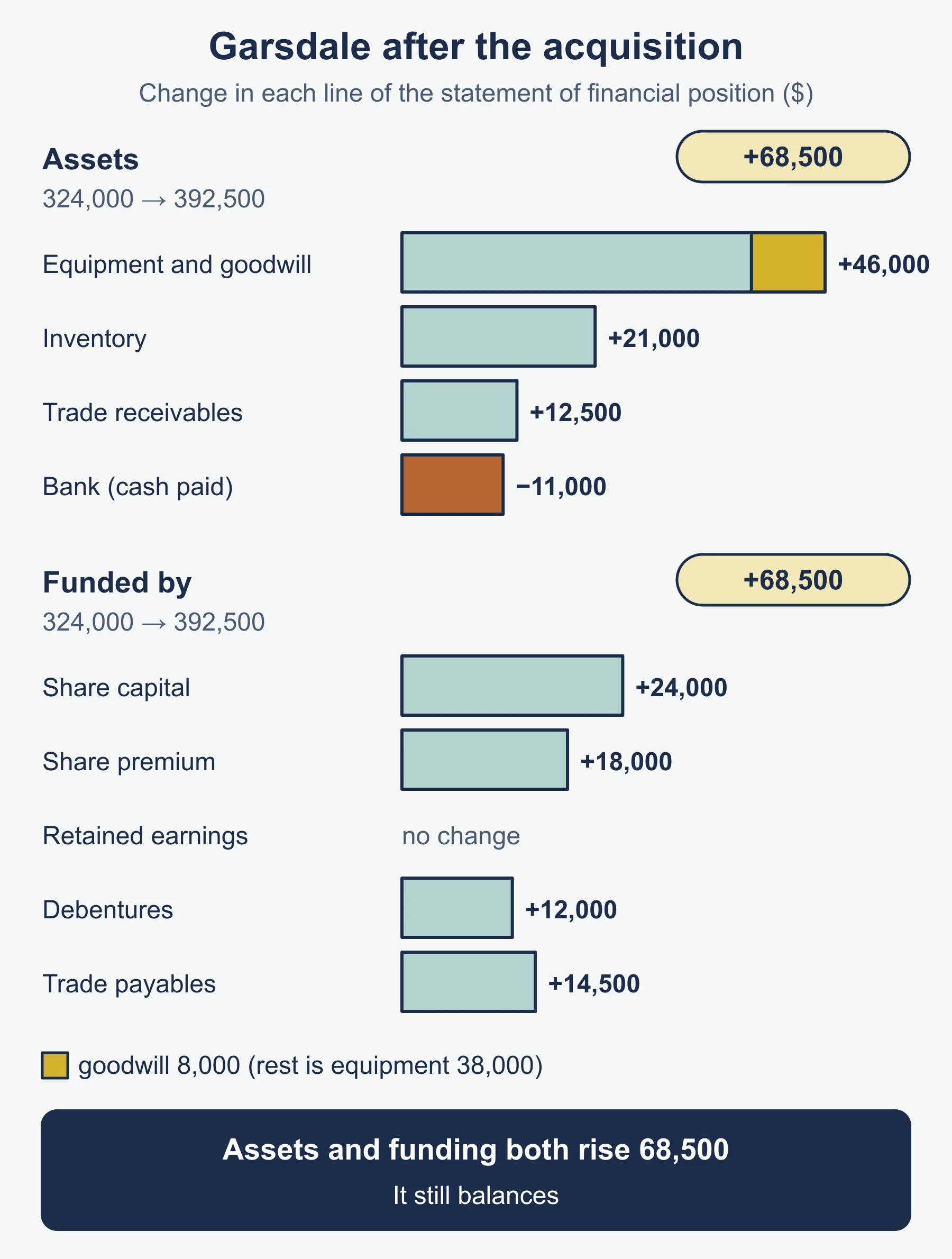
Garsdale’s statement of financial position before and after (retained earnings 73,000 throughout):
| Before | After | |
|---|---|---|
| Non-current assets (including goodwill 8,000) | 210,000 | 256,000 |
| Inventory | 48,000 | 69,000 |
| Trade receivables | 36,000 | 48,500 |
| Bank | 30,000 | 19,000 |
| Total assets | 324,000 | 392,500 |
| Share capital | 100,000 | 124,000 |
| Share premium | 20,000 | 38,000 |
| Retained earnings | 73,000 | 73,000 |
| Debentures | 90,000 | 102,000 |
| Trade payables | 41,000 | 55,500 |
| Total equity and liabilities | 324,000 | 392,500 |
The statement of profit or loss changes too. From the date of acquisition it includes the acquired business’s revenue and expenses, depreciation on the acquired equipment, and debenture interest on the new 12,000 (720 a year at 6%). Dividends are paid on the larger number of shares. If the acquisition happens part-way through the year, include only the post-acquisition period.
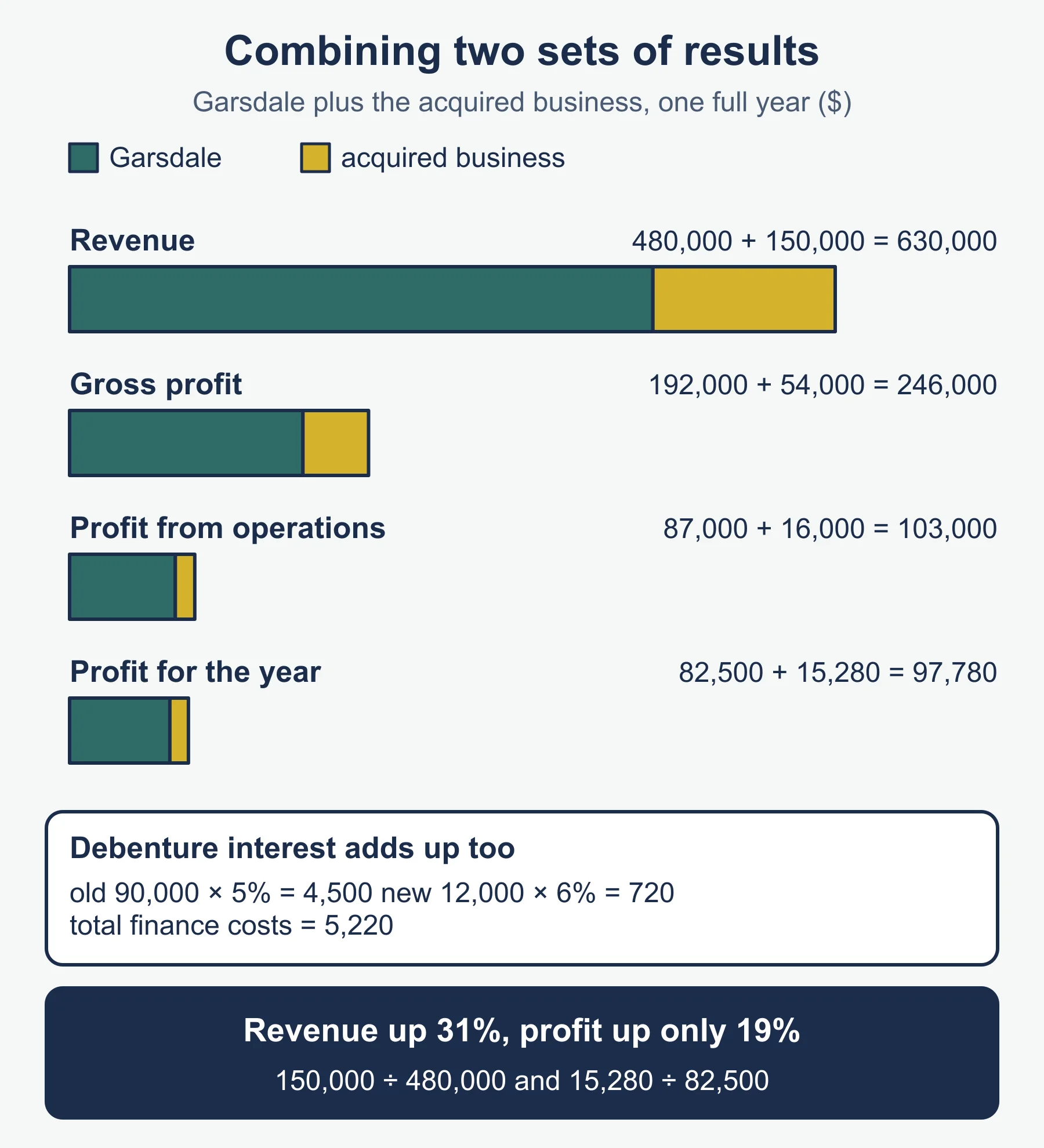
Suppose Garsdale held the acquired business for the whole of its financial year. The statement of profit or loss then combines the two sets of results, with debenture interest on the old debentures (90,000 at 5%) and on the new ones:
| Statement of profit or loss | Garsdale | Acquired business | Combined |
|---|---|---|---|
| Revenue | 480,000 | 150,000 | 630,000 |
| Cost of sales | 288,000 | 96,000 | 384,000 |
| Gross profit | 192,000 | 54,000 | 246,000 |
| Operating expenses, including depreciation | 105,000 | 38,000 | 143,000 |
| Profit from operations | 87,000 | 16,000 | 103,000 |
| Finance costs (debenture interest) | 4,500 | 720 | 5,220 |
| Profit for the year | 82,500 | 15,280 | 97,780 |
Evaluating the decision
| Advantages | Disadvantages | |
|---|---|---|
| Acquirer or new entity | Larger scale and market share; skills and assets combined; competitor removed; access to more capital | Price may be too high; goodwill may never be recovered; integration problems; extra debenture interest |
| Owners of the business sold or merged | Cash or shares realised; limited liability in a company; shared workload | Loss of control and independence; share of profit falls; disagreements between owners |
Weigh the points against the facts given. A good answer uses the figures, for example the size of the goodwill compared with the profit the business earns, or the cash left after paying. Recommendations need a balance of reasons and a justification.
Common errors
- Using the seller’s book values instead of agreed values to calculate goodwill.
- Forgetting that liabilities taken over reduce the net assets acquired.
- Crediting the full issue price to share capital instead of splitting nominal value and share premium.
- Sharing the revaluation profit in the new ratio rather than the old.
- Leaving goodwill off the opening statement of financial position.
- Showing debentures as part of equity.
Frequently asked questions
How do you calculate goodwill on acquisition? Goodwill = purchase consideration − (assets at agreed values − liabilities taken over). It is the excess of what the buyer gives over the fair value of the net assets acquired.
What is the difference between a merger and an acquisition? A merger joins two or more businesses into a new entity. An acquisition is when one entity buys another.
What is the difference between purchased and inherent goodwill? Purchased goodwill is paid for when a business is acquired and can be recorded. Inherent goodwill is built up by a business over time and is not recorded until someone pays for it.
What is purchase consideration? Purchase consideration is what the buyer gives for the business: cash, shares, debentures, or a mixture. Shares issued above nominal value are split between share capital and share premium.
Are debentures part of equity after an acquisition? No. Debentures issued as purchase consideration are shown as non-current liabilities in the statement of financial position, not as equity.
Official syllabus
Cambridge International AS & A Level Accounting 9706 syllabus for examination in 2026, 2027 and 2028, section 3.3 Business acquisition and merger, published by Cambridge University Press & Assessment (Cambridge International).
Get free revision emails (optional)
Occasional emails with practice questions, worked explanations and links to free resources for the qualification and subjects you choose. No spam, and you can unsubscribe from any email. The free tools on this site never need an email.
Related resources
-
Study guides
A Level Accounting: Accounting for Non-Current Assets (Cambridge 9706)
Capital versus revenue spending, why assets depreciate depreciation methods, cost and revaluation models and disposals, for Cambridge 9706 Accounting topic 1.3.
Accounting · Cambridge · AS Level
Read guide -
Practice questions
A Level Accounting: Business acquisition and merger (Cambridge 9706) – Practice Questions
Ten original questions on goodwill, mergers, acquisitions, resulting statements and evaluation for Cambridge A Level Accounting 9706 section 3.3.
Accounting · Cambridge · A Level
Try questions -
Revision notes
A Level Accounting: Business acquisition and merger (Cambridge 9706) – Revision Notes
Condensed notes on goodwill, merger and acquisition entries and evaluation for Cambridge A Level Accounting 9706 section 3.3, with a self-test.
Accounting · Cambridge · A Level
Revise topic
Related articles
-
teaching
A Level tuition in Dubai: Cambridge or Pearson Edexcel International A Level?
Schools in Dubai and Abu Dhabi teach either Cambridge International AS & A Level or Pearson Edexcel International A Level. How the two are structured, why it matters for tuition, and how online classes from Lahore work.
9 October 2026
-
curriculum guides
Choosing subjects at IGCSE and A Level
How subject choices at 14 and 16 affect university options later, and how to keep pathways open without overloading a timetable.
28 July 2026
Studying this with a teacher
Working through Accounting A LEVEL?
This page is free and stays free. If you would rather be taught it, Marlbridge runs Accounting classes one-to-one and in small groups of up to 15, online in your own time zone. The first trial class is free. WhatsApp replies within an hour (8am–11pm Pakistan time, every day); email the same day.
Cambridge Accounting teachers at Marlbridge

