
Revision Notes
A Level Accounting: Regulatory and ethical considerations (Cambridge 9706) – Revision Notes
Condensed recall notes on IAS 1, 2, 7, 8, 10, 16, 36, 37 and 38, ethics, audit and stewardship for Cambridge 9706 A Level Accounting.
- Subject
- Accounting
- Level
- A LEVEL
- Topic
- Financial accounting
- Author
- Marlbridge Academic Team
- Updated
- Reviewed by
- Zain Ud Din Ahmed (what this means)
Aligned to Cambridge A Level Accounting (9706), 2026-2028. Official specification .
Syllabus page (what it covers and how it is assessed): Cambridge A Level Accounting.
Syllabus points this page covers
9706 (A Level)
- 3.2 Regulatory and ethical considerations
Found an error? Report a correction.
Need help with this topic? Request a free trial class for A Level Accounting (9706).
These notes condense section 3.2 Regulatory and ethical considerations of the Cambridge International AS & A Level Accounting 9706 syllabus for 2026, 2027 and 2028 (A Level content). For explanations and worked examples, read the study guide first. Then attempt the practice questions. Other links: course hub, checklist, diagnostics, and non-current assets for depreciation methods. Amounts are in dollars.
Standards at a glance (3.2.1)
| Standard | One-line recall | Key test or formula |
|---|---|---|
| IAS 1 | Fair presentation, going concern, accrual basis, consistency, materiality | Complete set has five parts: financial position, profit or loss and other comprehensive income, changes in equity, cash flows, notes |
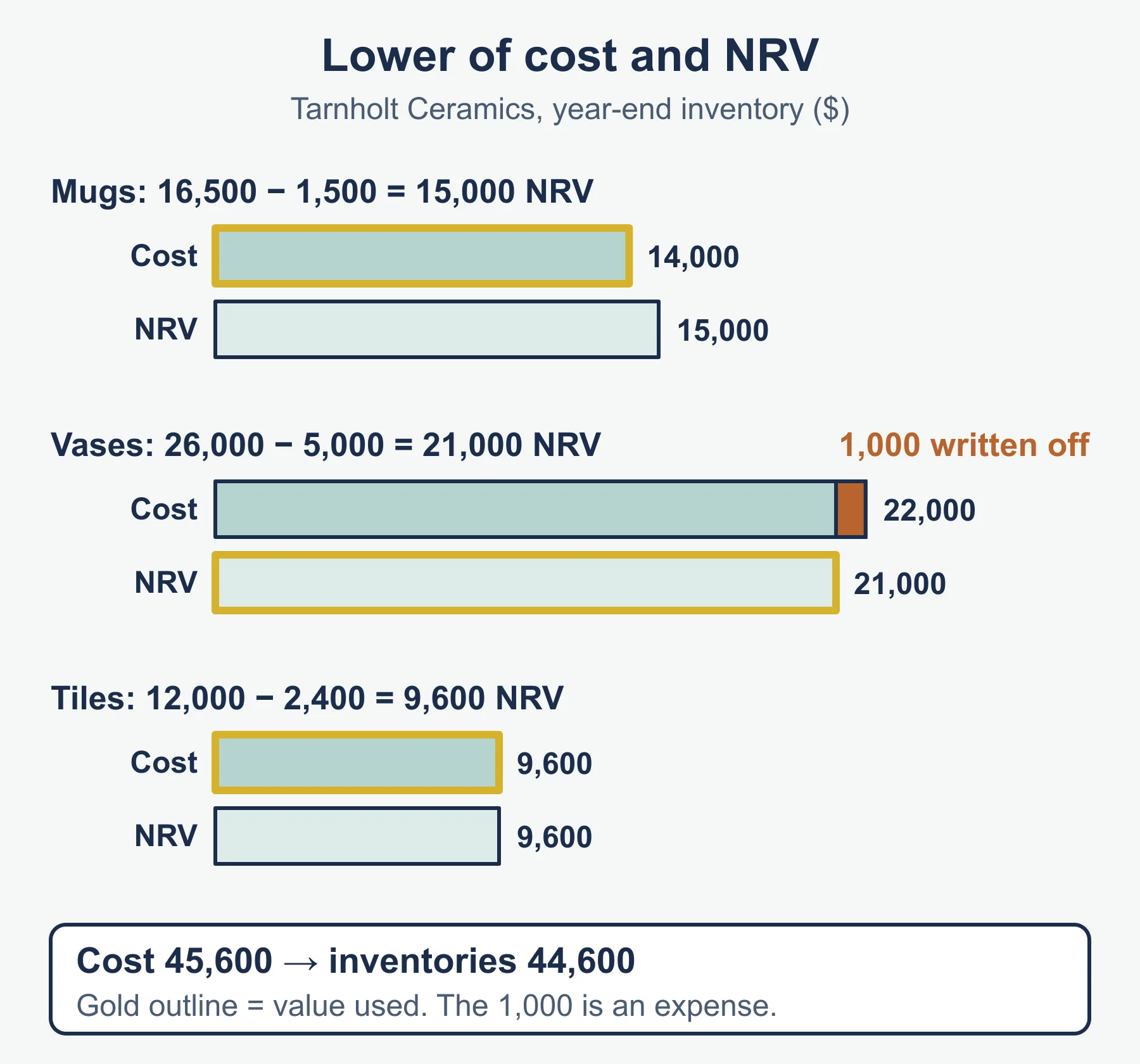
| IAS 2 | Inventories at the lower of cost and NRV | NRV = selling price − costs to complete and sell; FIFO or weighted average; no LIFO |
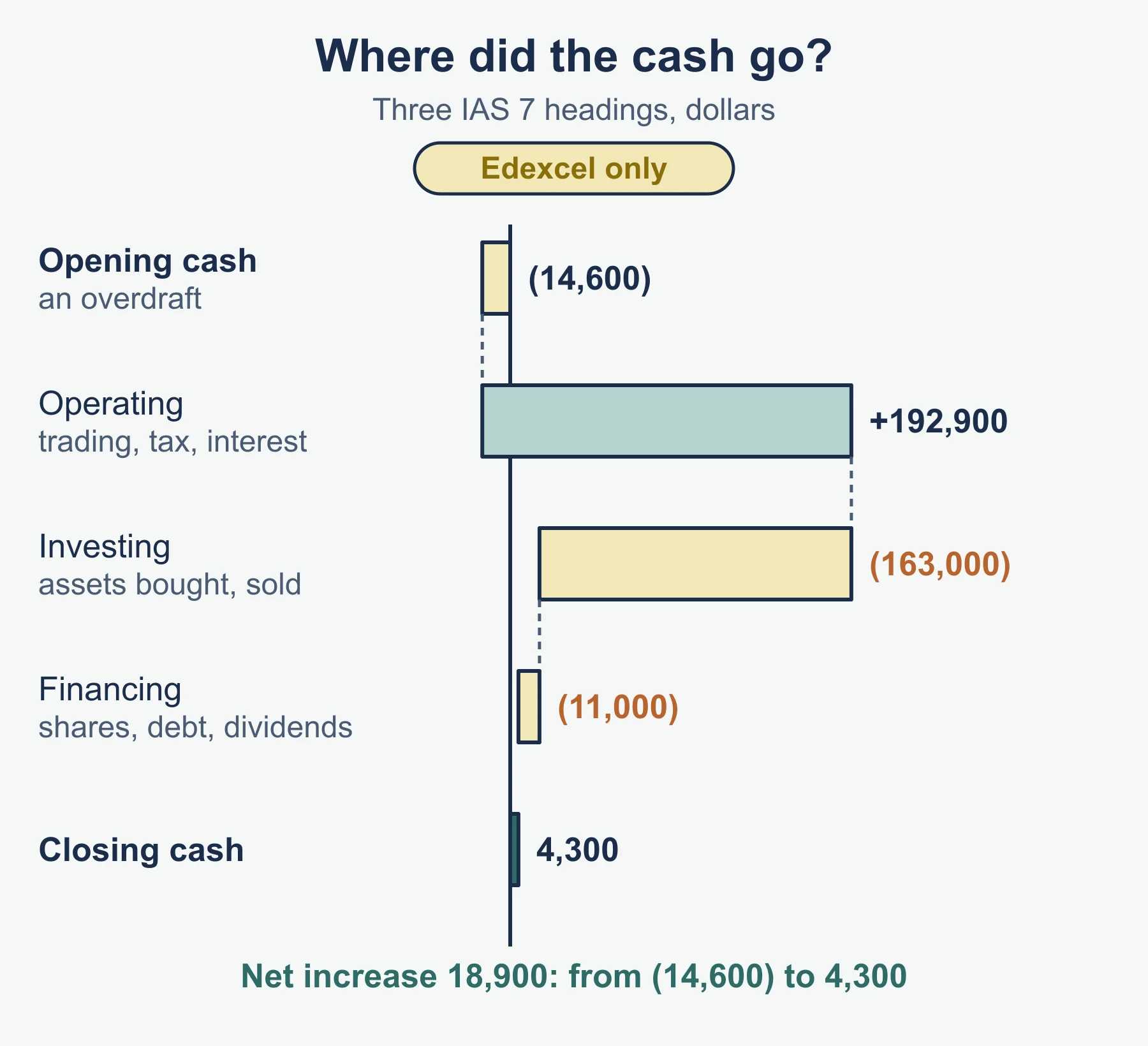
| IAS 7 | Cash flows grouped as operating, investing, financing | Operating: direct or indirect method; non-cash deals excluded |
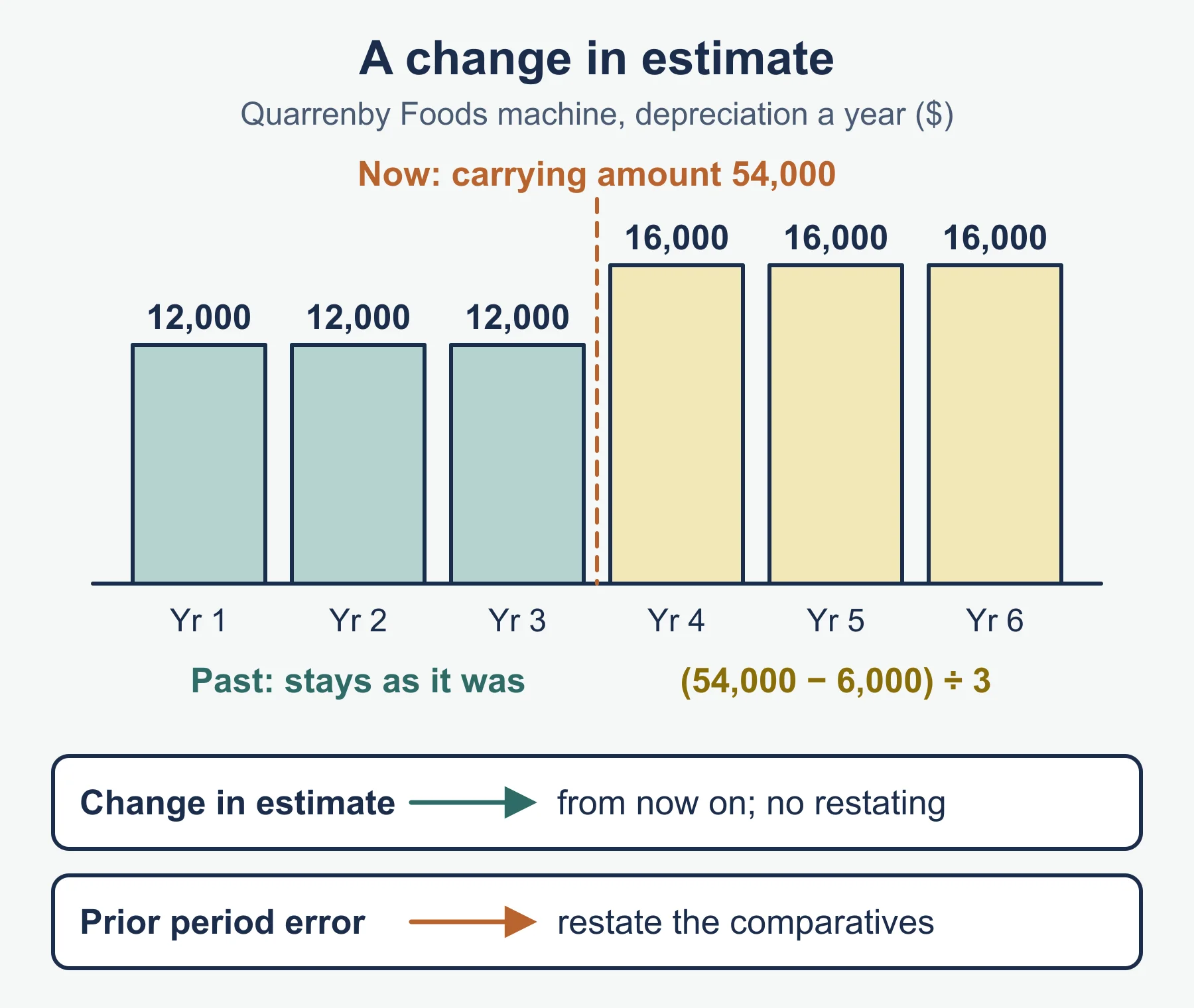
| IAS 8 | Policies consistent; estimates; errors | Policy change: retrospective. Estimate: prospective. Prior period error: restate comparatives |
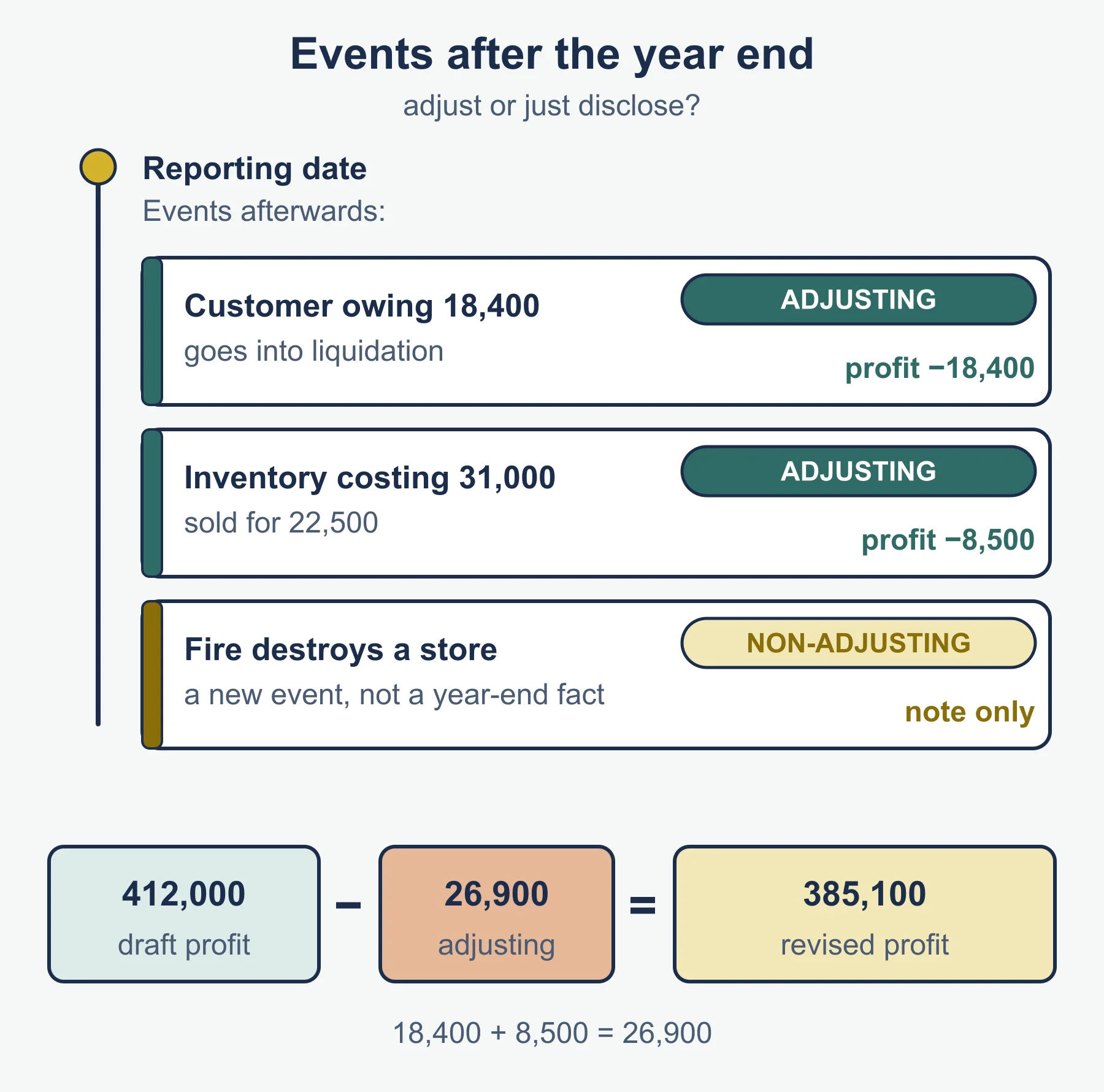
| IAS 10 | Events after the reporting period | Adjusting: change figures. Non-adjusting: disclose if material |
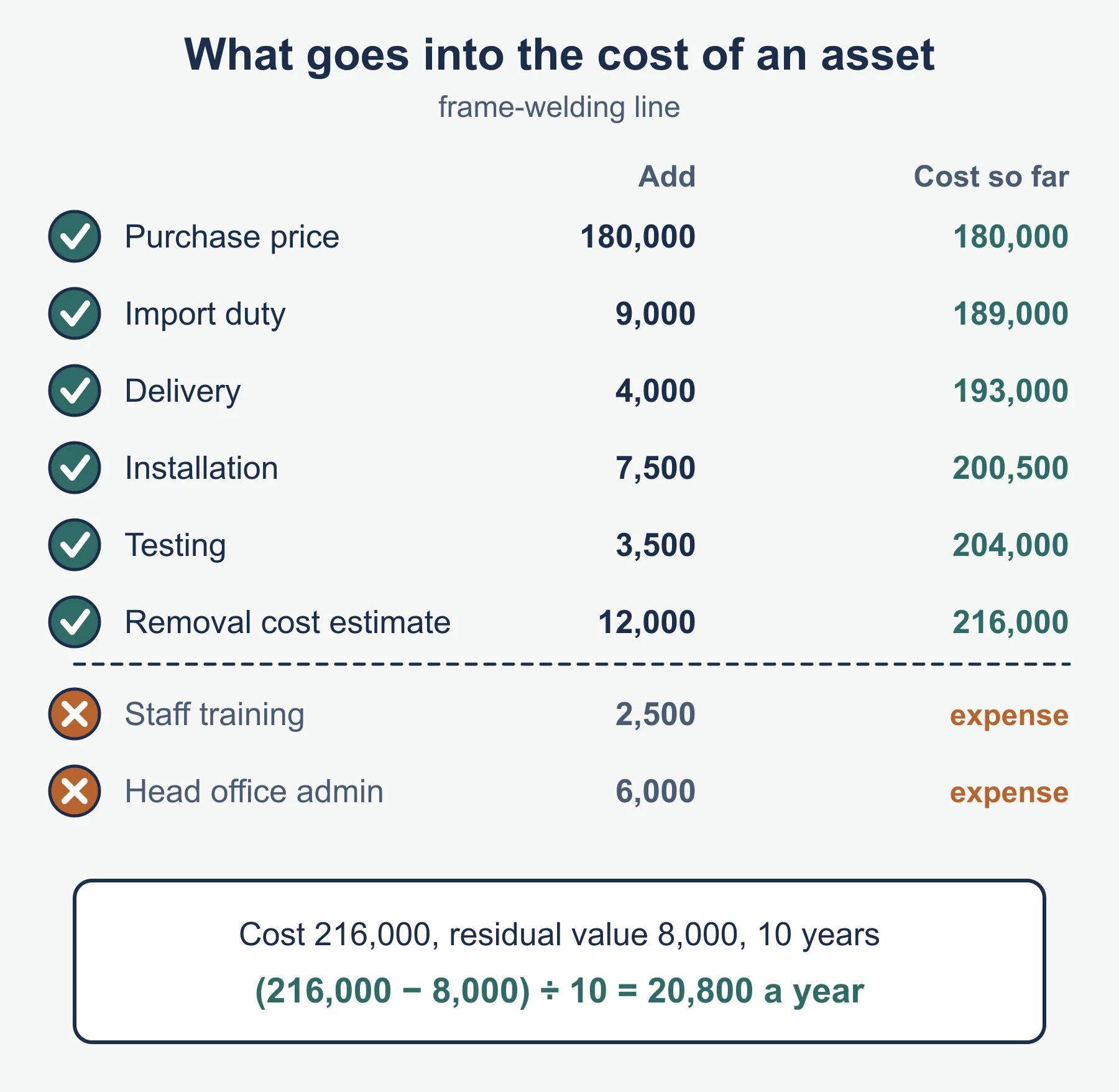
| IAS 16 | Property, plant and equipment | Cost model or revaluation model; depreciate over useful life; review life and residual value |
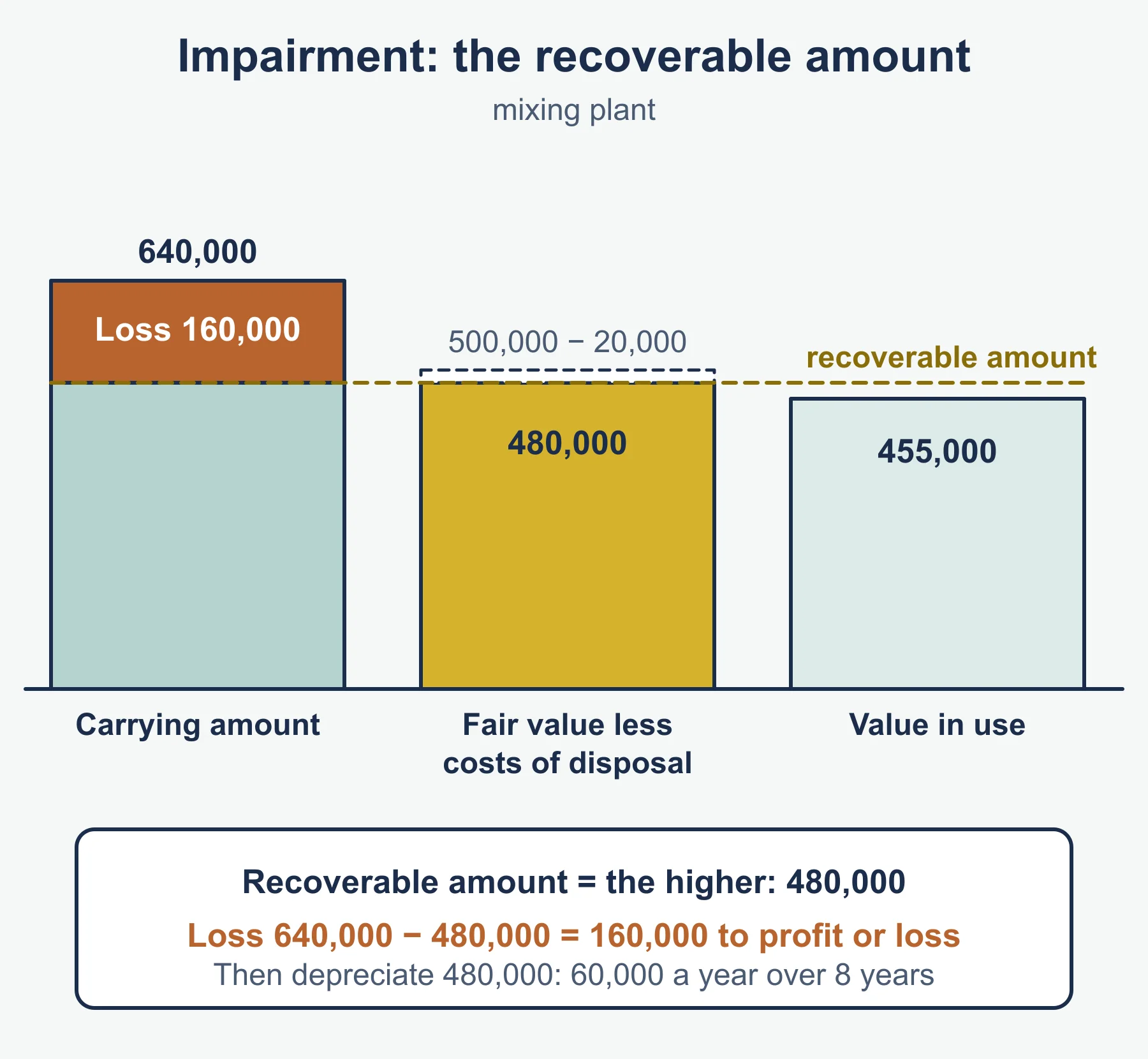
| IAS 36 | Impairment | Recoverable amount = higher of fair value less costs of disposal and value in use |
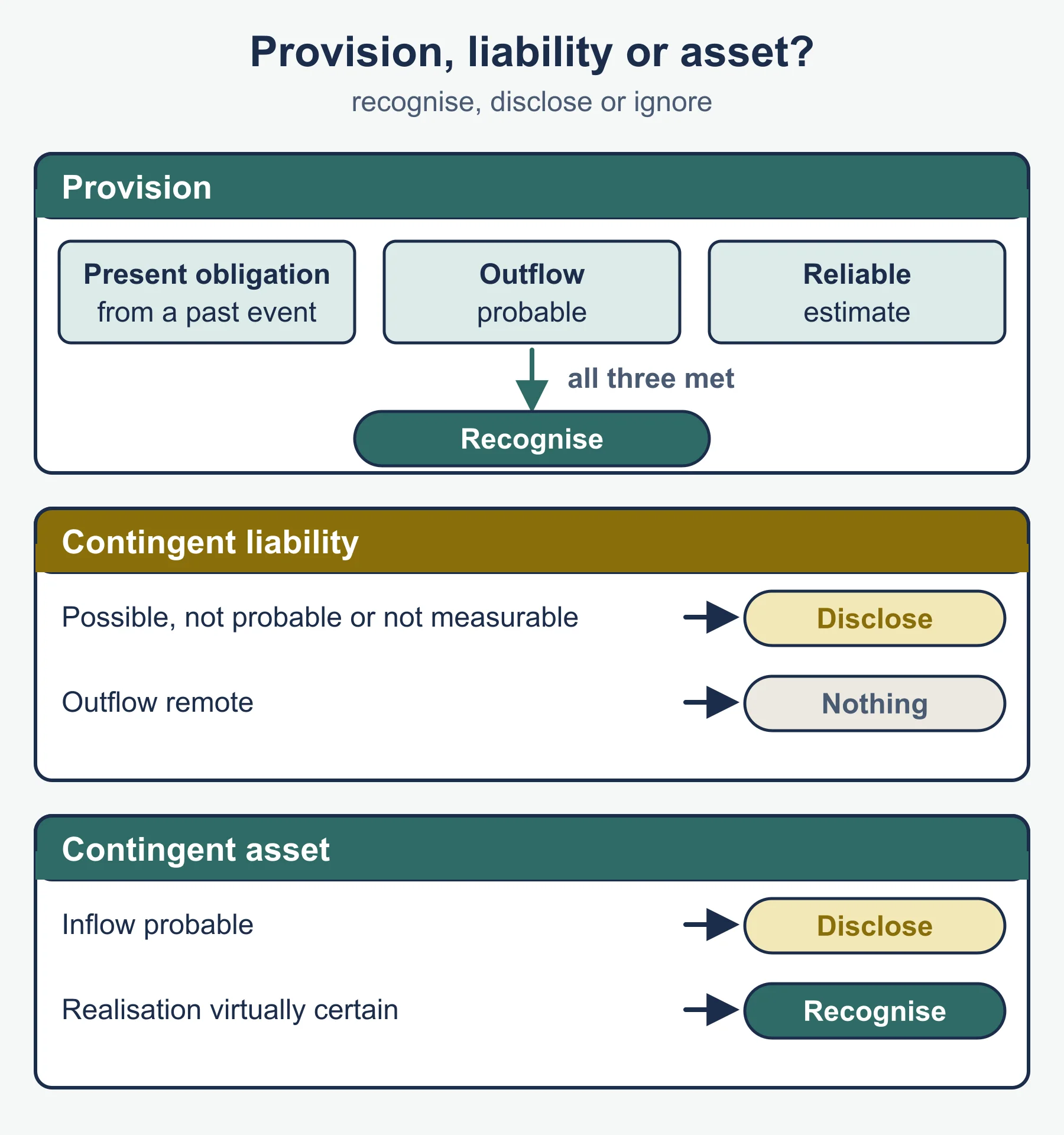
| IAS 37 | Provisions and contingencies | Provision: obligation, probable, reliable estimate |
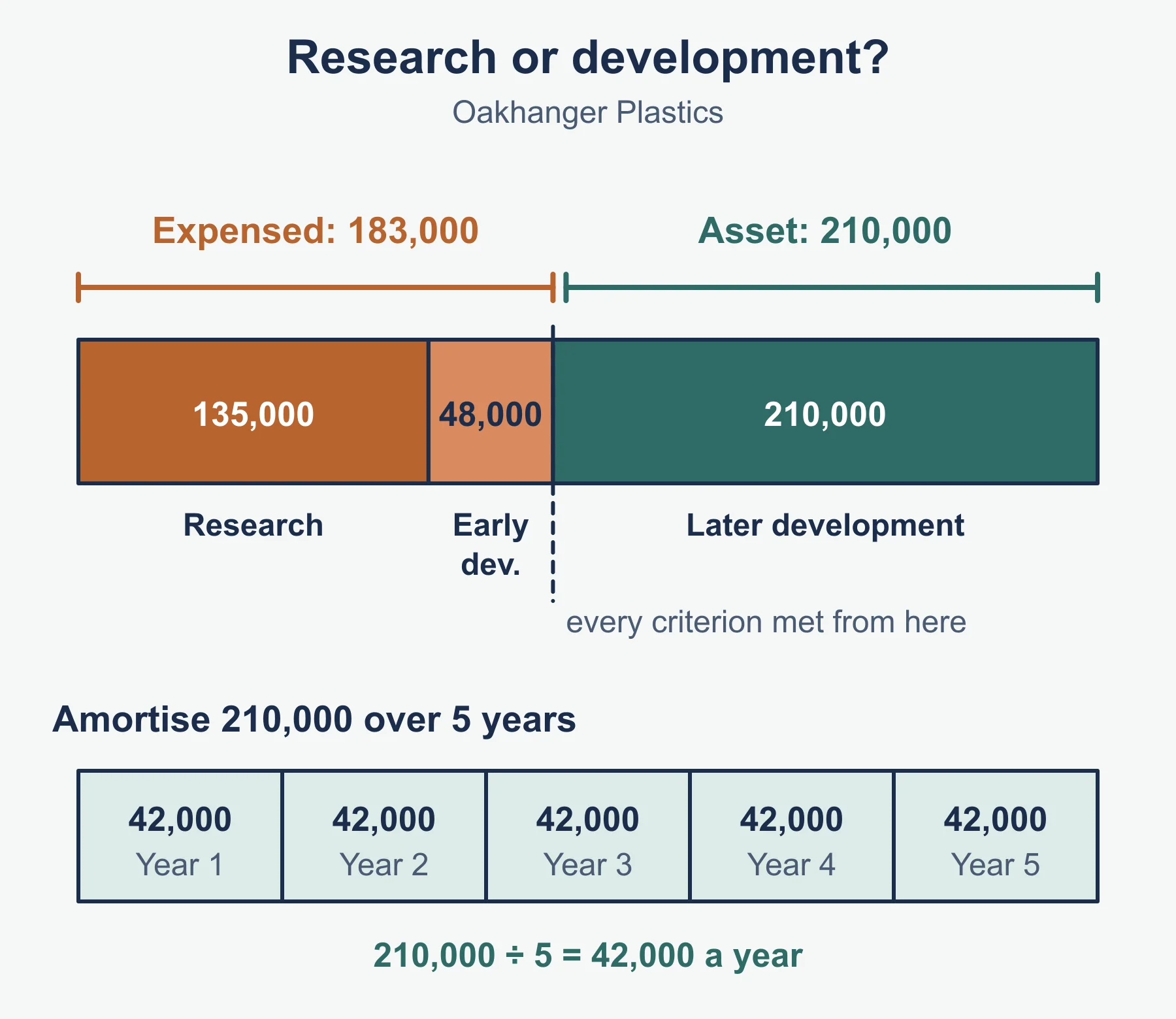
| IAS 38 | Intangible assets | Research expensed; development capitalised if criteria met; no internally generated goodwill |
Method boxes
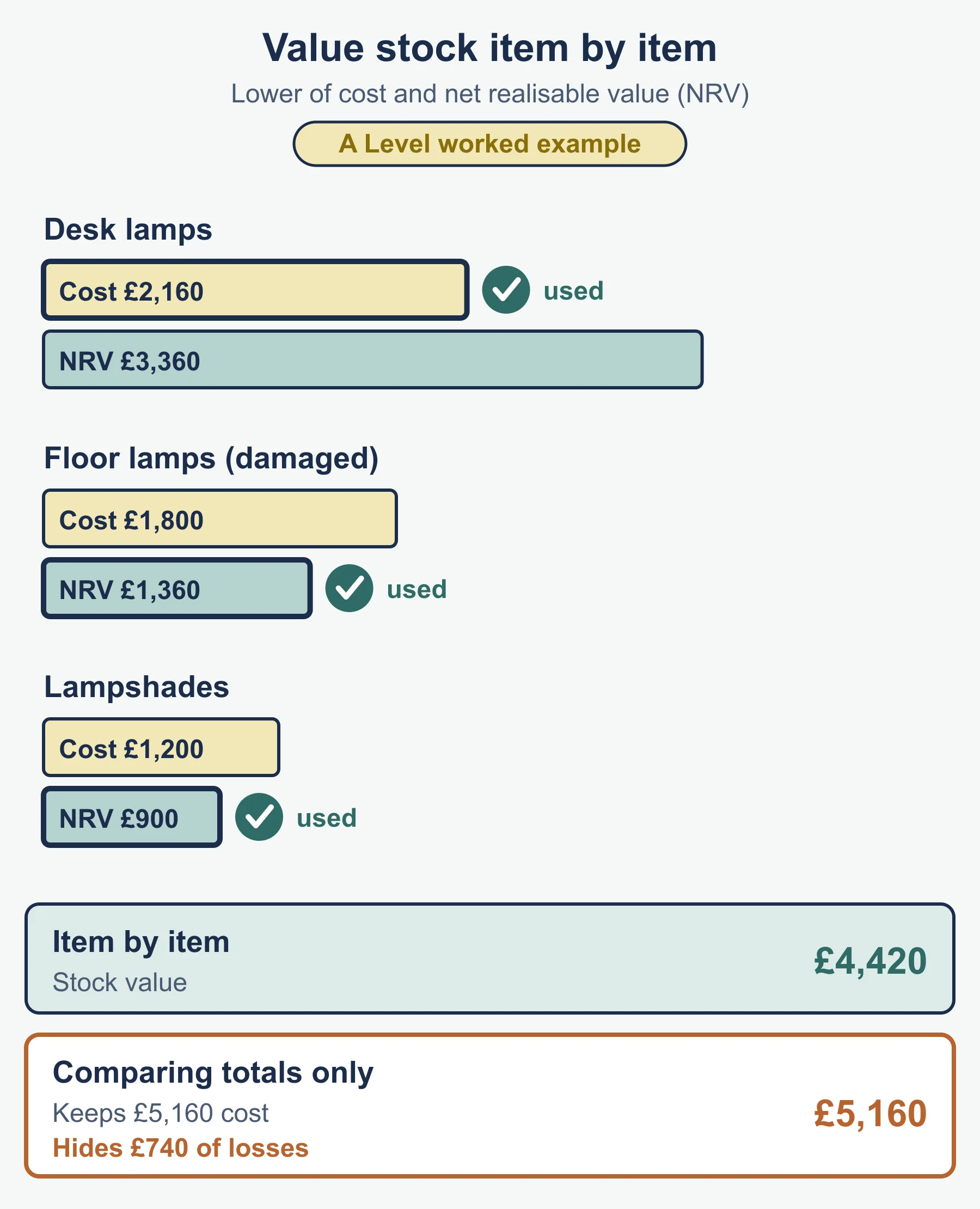
Inventory valuation (IAS 2)
- Take cost for each item or group of similar items.
- Work out NRV: expected selling price less costs still to be incurred.
- Use the lower figure for each.
- Total them. Charge any write-down as an expense.
Impairment test (IAS 36)
- Carrying amount at the date of the test.
- Fair value less costs of disposal.
- Value in use.
- Recoverable amount is the higher of steps 2 and 3.
- If carrying amount is higher, the difference is the impairment loss.
Event after the reporting period (IAS 10)
- Ask: did the event give new evidence about a condition that existed at the reporting date?
- Yes: adjusting, so change the figures.
- No, it arose afterwards: non-adjusting, so disclose if material.
- Dividends declared after the date are never a liability at the date.
Contingencies (IAS 37)
| Probability of outflow or inflow | Liability | Asset |
|---|---|---|
| Virtually certain | Provision | Recognise as an asset |
| Probable | Provision if reliably measurable | Disclose only |
| Possible | Disclose | No disclosure needed |
| Remote | Nothing | Nothing |
Small worked reminders
- Inventory costing 8,400 with NRV 7,650 is carried at 7,650. Write-down is 750.
- An asset with carrying amount 300,000, fair value 210,000, disposal costs 10,000 and value in use 185,000: fair value less costs of disposal 200,000 is higher, so recoverable amount is 200,000 and the impairment loss is 100,000.
- Machine price 95,000 plus installation 5,000, residual value 10,000, life 6 years: cost 100,000, depreciation (100,000 − 10,000) ÷ 6 = 15,000 a year.
- A 72,000 development asset with a 6-year life, available for use on 1 May, has amortisation of 12,000 × 8/12 = 8,000 in a year ending 31 December.
- Cost 60,000, residual value 5,000, 5-year life, so 11,000 a year. After 2 years, carrying amount is 38,000. A revised remaining life of 2 years gives (38,000 − 5,000) ÷ 2 = 16,500 a year from then, with no restatement.
Cash flow groups and IAS 1 features
| Statement of cash flows group | Examples |
|---|---|
| Operating | Cash received from customers, cash paid to suppliers and employees |
| Investing | Buying or selling non-current assets, buying shares in another company |
| Financing | Issuing shares, taking out or repaying loans |
Non-cash deals, such as shares issued in exchange for a building, are not cash flows and are left out.
| IAS 1 feature | What it means in practice |
|---|---|
| Fair presentation | Statements reflect what happened, applying the standards |
| Going concern | Assets and liabilities are valued as if trading continues |
| Accrual basis | Items are recognised when earned or incurred, not when cash moves |
| Consistency | Same presentation and classification year to year |
| Materiality | Separate items that could influence users’ decisions |
| Comparative information | Prior year figures shown beside the current year |
Applying a standard in an answer
- Name the standard and state the rule in one sentence.
- Apply it to the figures in the question. Show the comparison, such as cost against NRV.
- State the accounting entry or the effect on profit, assets or liabilities.
- Say what the result means for users, such as lower profit or an extra note.
Ethics (3.2.2)
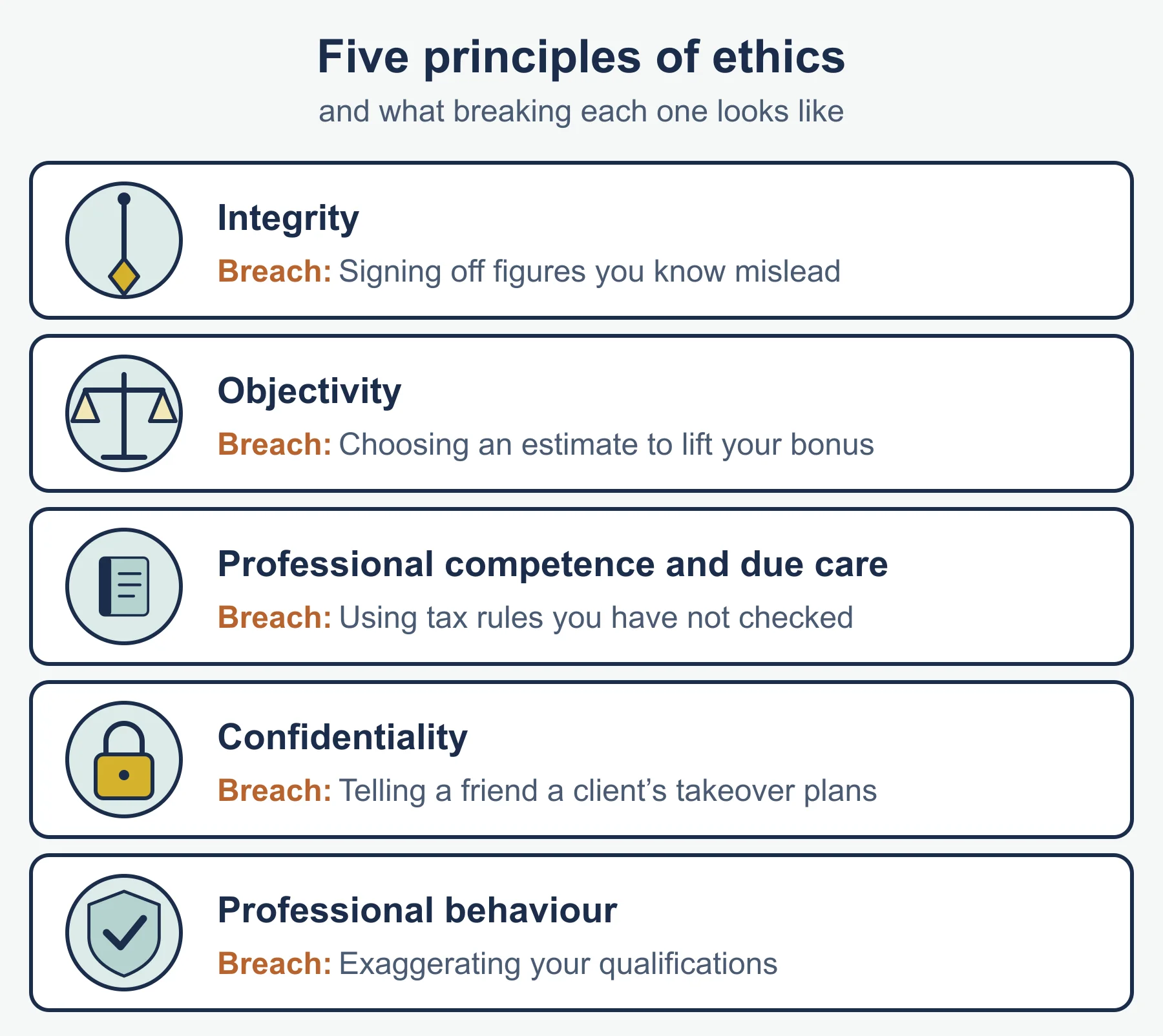
| Principle | Remember it as | Typical breach |
|---|---|---|
| Integrity | Honest and straightforward | Reporting figures you know are false |
| Objectivity | Free from bias and pressure | Auditing a business owned by a relative |
| Professional competence and due care | Skilled, up to date, careful | Applying a standard you have not studied |
| Confidentiality | Do not disclose or use information | Passing client data to a friend |
| Professional behaviour | Obey laws, protect the profession’s name | Helping to hide tax liabilities |
- Need for a framework: rules cannot cover every case, users depend on trust, and the profession’s reputation is at stake.
- Stakeholder effects: investors, lenders, employees, tax authority, suppliers, customers and the business itself.
- Social implications: staff and community (closures), environment, honesty about risks, use of local suppliers.
Audit and stewardship (3.2.3)
| Point | Detail |
|---|---|
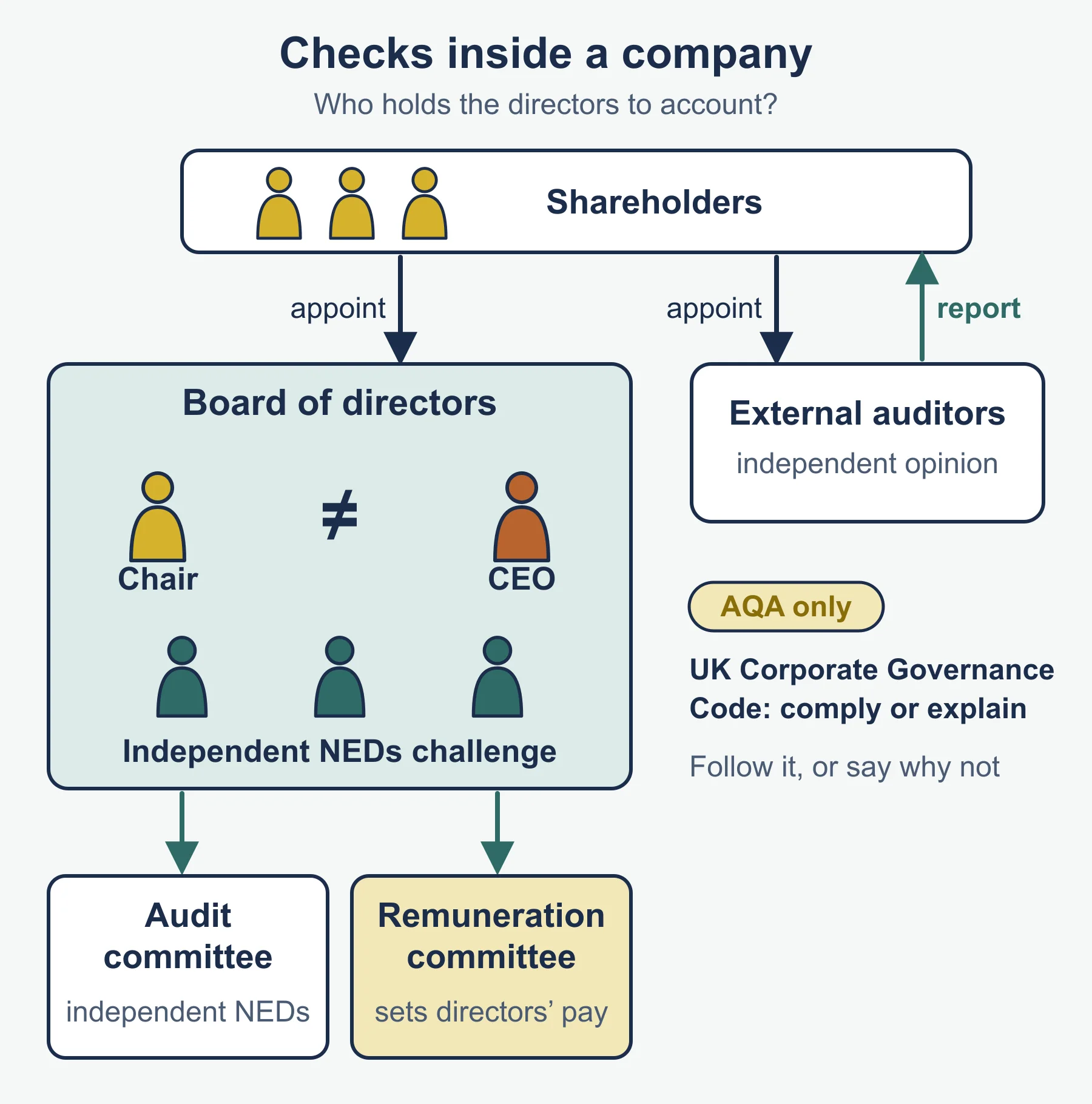
| Stewardship | Directors manage the company for shareholders: safeguard assets, keep records, prepare statements, report |
| True and fair view | Statements present position, performance and changes fairly, free of material misstatement |
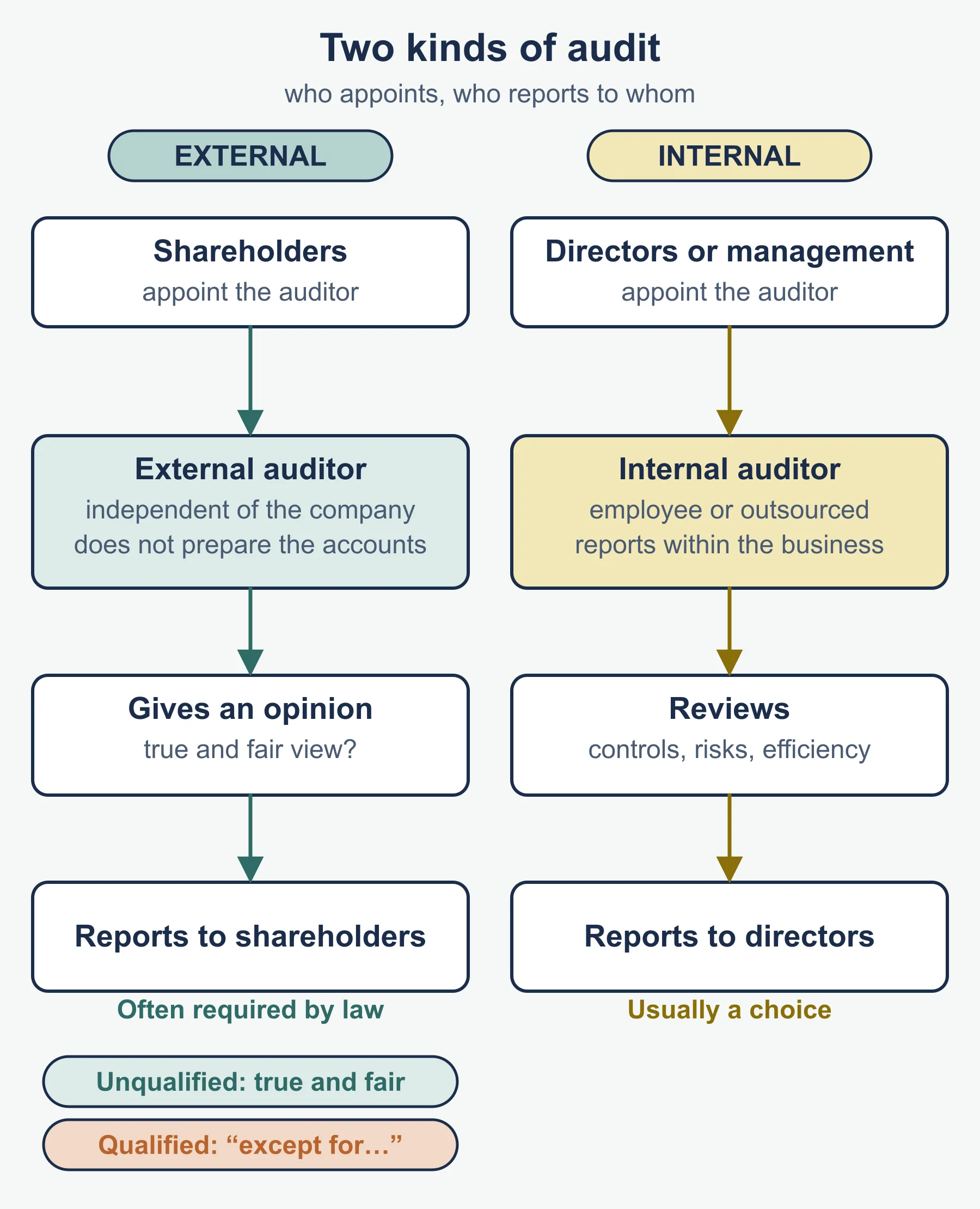
| Auditor’s role | Independent opinion on the statements; not preparing them; not a guarantee against fraud |
| External audit | Appointed by shareholders, independent, reports to them on the statements |
| Internal audit | Within the business, reports to management, reviews controls and efficiency |
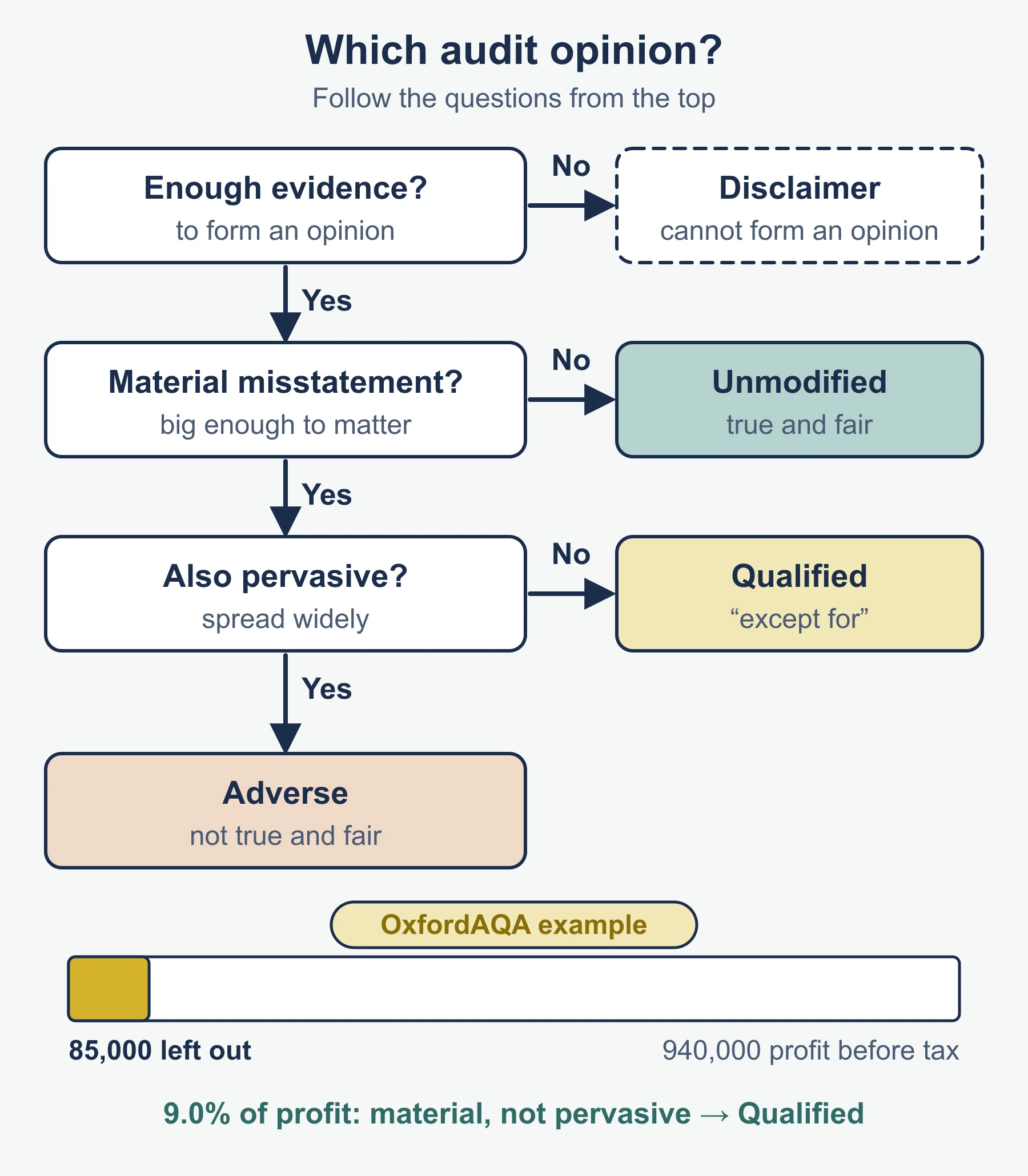
| Unqualified report | Statements give a true and fair view |
| Qualified report | True and fair view “except for” a material matter or missing evidence |
Evaluation points to have ready
- Strengths of standards: comparability between businesses, consistency over time, more reliable information for investors and lenders.
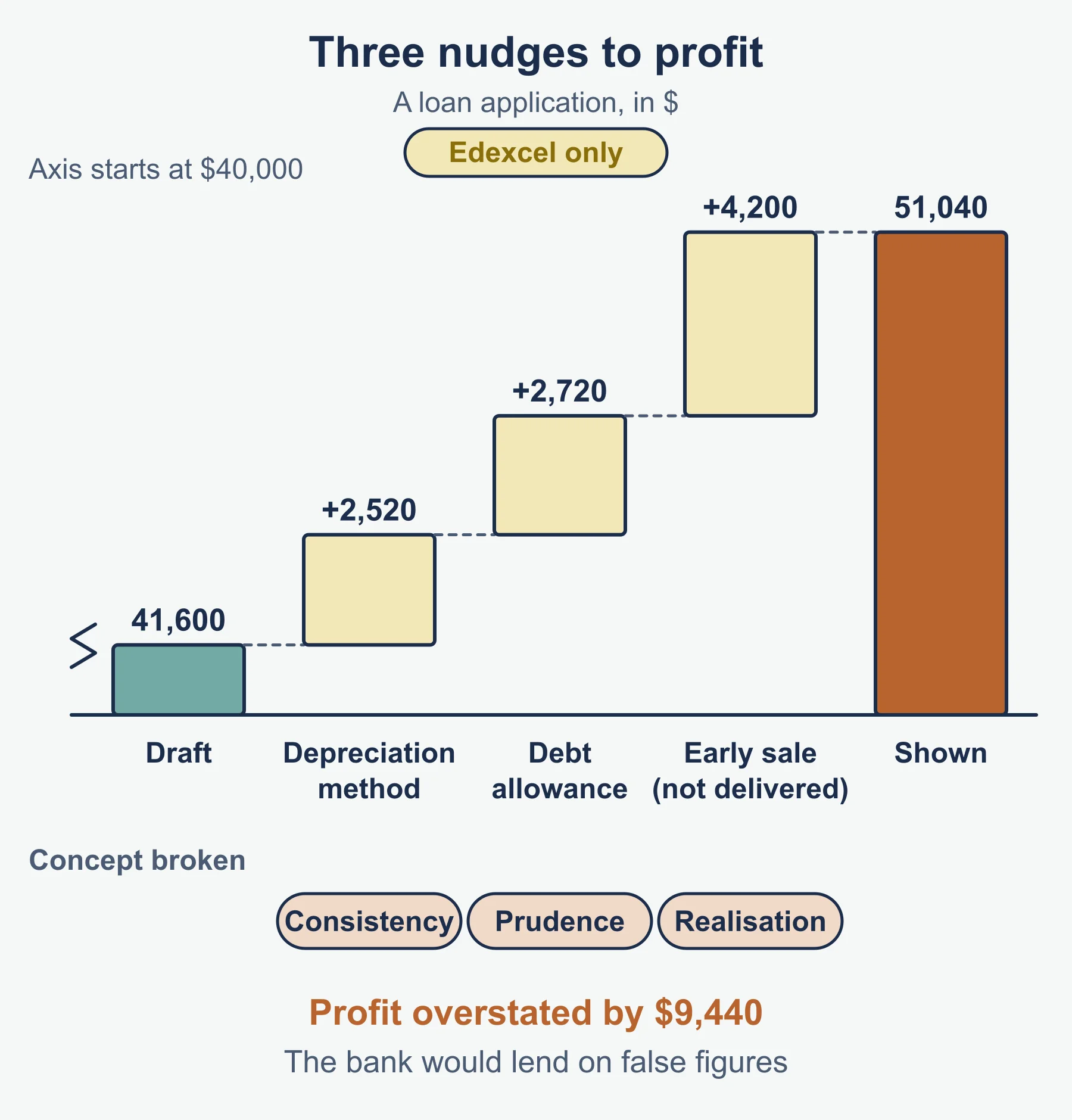
- Limits of standards: they still need judgement, such as estimating NRV or value in use, so profit can be influenced.
- Value of an unqualified report: it gives shareholders independent assurance, but it is not a guarantee that the figures are exact or that fraud is absent.
- Value of internal audit: it can find weaknesses early, but it is less independent because it reports within the business.
- Ethical pressure: the cost of resisting is lost bonuses or a strained relationship with a director, against the longer-term cost of lost trust and penalties.
Must-know distinctions
- Change in policy (retrospective) versus change in estimate (prospective).
- Adjusting versus non-adjusting events.
- Provision (recognised) versus contingent liability (disclosed) versus contingent asset (disclosed only if probable).
- Research (expense) versus development (asset if criteria met).
- Impairment (fall in recoverable amount) versus depreciation (systematic spread of cost).
- External versus internal audit.
Quick self-test
- On what basis are financial statements prepared unless the business will cease trading?
- Inventory has cost 8,400 and NRV 7,650. At what amount is it shown?
- Name the cost flow method that IAS 2 does not permit.
- In which group of the statement of cash flows is cash paid for new machinery?
- How is a change in accounting estimate treated, compared with a change in accounting policy?
- A dividend is declared after the reporting date. Is it a liability at that date?
- Carrying amount 300,000; fair value 210,000; disposal costs 10,000; value in use 185,000. Calculate the impairment loss.
- Price 95,000, installation 5,000, residual value 10,000, life 6 years. Calculate annual depreciation.
- State the five fundamental ethical principles.
- What is the difference between a qualified and an unqualified audit report?
- Who appoints the external auditor, and to whom does the auditor report?
Answers
- Going concern.
- 7,650 (write-down 750).
- LIFO.
- Investing.
- Estimate: applied from now with no restatement. Policy: applied retrospectively.
- No, it is a non-adjusting event.
- Recoverable amount 200,000, so loss 100,000.
- 15,000.
- Integrity, objectivity, professional competence and due care, confidentiality, professional behaviour.
- Unqualified: true and fair view. Qualified: true and fair view except for a stated matter.
- The shareholders appoint; the auditor reports to them.
Where marks are usually lost
- Valuing inventory at cost or at selling price instead of the lower of cost and NRV.
- Forgetting costs to complete and sell when working out NRV.
- Restating past years for a change in estimate.
- Calling a post-year-end event adjusting without linking it to a condition at the reporting date.
- Creating a provision for a possible obligation that is not probable.
- Naming an ethical principle without applying it to the scenario.
- Describing the auditor as responsible for preparing the accounts.
- Giving a one-sided answer to an evaluation question without a justified conclusion.
Frequently asked questions
What does stewardship mean for company directors? Stewardship is the duty of directors to look after the company’s resources on behalf of the shareholders: act in their best interests, safeguard assets, keep proper accounting records, prepare financial statements that give a true and fair view and report to shareholders.
Does a change in accounting estimate restate past years? No. Under IAS 8, a change in estimate, such as a revised useful life, is applied from now on; restating past years for a change in estimate is a common mistake.
When must a provision be made under IAS 37? A provision is made when there is a present obligation, an outflow is probable and the amount can be reliably estimated. A possible obligation that is not probable does not get a provision.
Is the auditor responsible for preparing the accounts? No. The directors prepare the financial statements; the auditor examines them independently and gives an opinion on whether they show a true and fair view. An audit report is not a guarantee of accuracy.
Official syllabus
Cambridge International, AS & A Level Accounting 9706 syllabus for 2026, 2027 and 2028, section 3.2.
Get free revision emails (optional)
Occasional emails with practice questions, worked explanations and links to free resources for the qualification and subjects you choose. No spam, and you can unsubscribe from any email. The free tools on this site never need an email.
Related resources
-
Study guides
A Level Accounting: Accounting for Non-Current Assets (Cambridge 9706)
Capital versus revenue spending, why assets depreciate depreciation methods, cost and revaluation models and disposals, for Cambridge 9706 Accounting topic 1.3.
Accounting · Cambridge · AS Level
Read guide -
Practice questions
Accounting: Business Entities and the Accounting System — Practice Questions
Original exam-style practice questions with full worked answers on sole traders, partnerships, limited companies and books of prime entry.
Accounting · Cambridge · AS Level
Try questions -
Revision notes
Accounting: Business Entities and the Accounting System — Revision Notes
Condensed recall notes on business structures, the accounting system, financial statements and partnership accounts.
Accounting · Cambridge · AS Level
Revise topic
Related articles
-
teaching
A Level tuition in Dubai: Cambridge or Pearson Edexcel International A Level?
Schools in Dubai and Abu Dhabi teach either Cambridge International AS & A Level or Pearson Edexcel International A Level. How the two are structured, why it matters for tuition, and how online classes from Lahore work.
9 October 2026
-
curriculum guides
Choosing subjects at IGCSE and A Level
How subject choices at 14 and 16 affect university options later, and how to keep pathways open without overloading a timetable.
28 July 2026
Studying this with a teacher
Working through Accounting A LEVEL?
This page is free and stays free. If you would rather be taught it, Marlbridge runs Accounting classes one-to-one and in small groups of up to 15, online in your own time zone. The first trial class is free. WhatsApp replies within an hour (8am–11pm Pakistan time, every day); email the same day.
Cambridge Accounting teachers at Marlbridge

