
Study Guides
A Level Accounting: Preparation of financial statements (AS) (Cambridge 9706)
Study guide to adjustments and to sole trader, partnership and limited company accounts, with worked examples, for Cambridge Accounting 9706 section 1.5.
- Subject
- Accounting
- Level
- AS LEVEL
- Topic
- Financial accounting
- Author
- Marlbridge Academic Team
- Updated
- Reviewed by
- Zain Ud Din Ahmed (what this means)
Aligned to Cambridge A Level Accounting (9706), 2026-2028. Official specification .
Syllabus page (what it covers and how it is assessed): Cambridge A Level Accounting.
Syllabus points this page covers
9706 (AS Level)
- 1.5 Preparation of financial statements
Found an error? Report a correction.
Need help with this topic? Request a free trial class for A Level Accounting (9706).
This guide covers section 1.5 Preparation of financial statements (AS Level, Topic 1 Financial accounting) of the Cambridge International AS & A Level Accounting 9706 syllabus for exams in 2026, 2027 and 2028. All businesses and figures are invented, and amounts are in dollars ($). The syllabus says the expected formats are in its Teacher Guidance document, so check the layouts here against your teacher’s copy. See also the revision notes, practice questions, business entities, the course hub, the checklist and the free diagnostics.
What 1.5 asks for
| Point | You must be able to |
|---|---|
| 1.5.1 | Calculate and record adjustments for accruals and prepayments of income and expenses, irrecoverable debts, irrecoverable debts recovered, allowance for irrecoverable debts, depreciation, inventory valuation and correction of errors |
| 1.5.2 | Produce the statement of profit or loss plus the statement of financial position for a sole trader from full or incomplete records |
| 1.5.3 | Prepare partnership statements, appropriation account, capital and current accounts; describe the agreement and the Partnership Act 1890 |
| 1.5.4 | Record shares, bonus and rights issues, debentures, dividends and reserves; prepare the three company statements; match finance to purposes |
Adjustments to a trial balance (1.5.1)
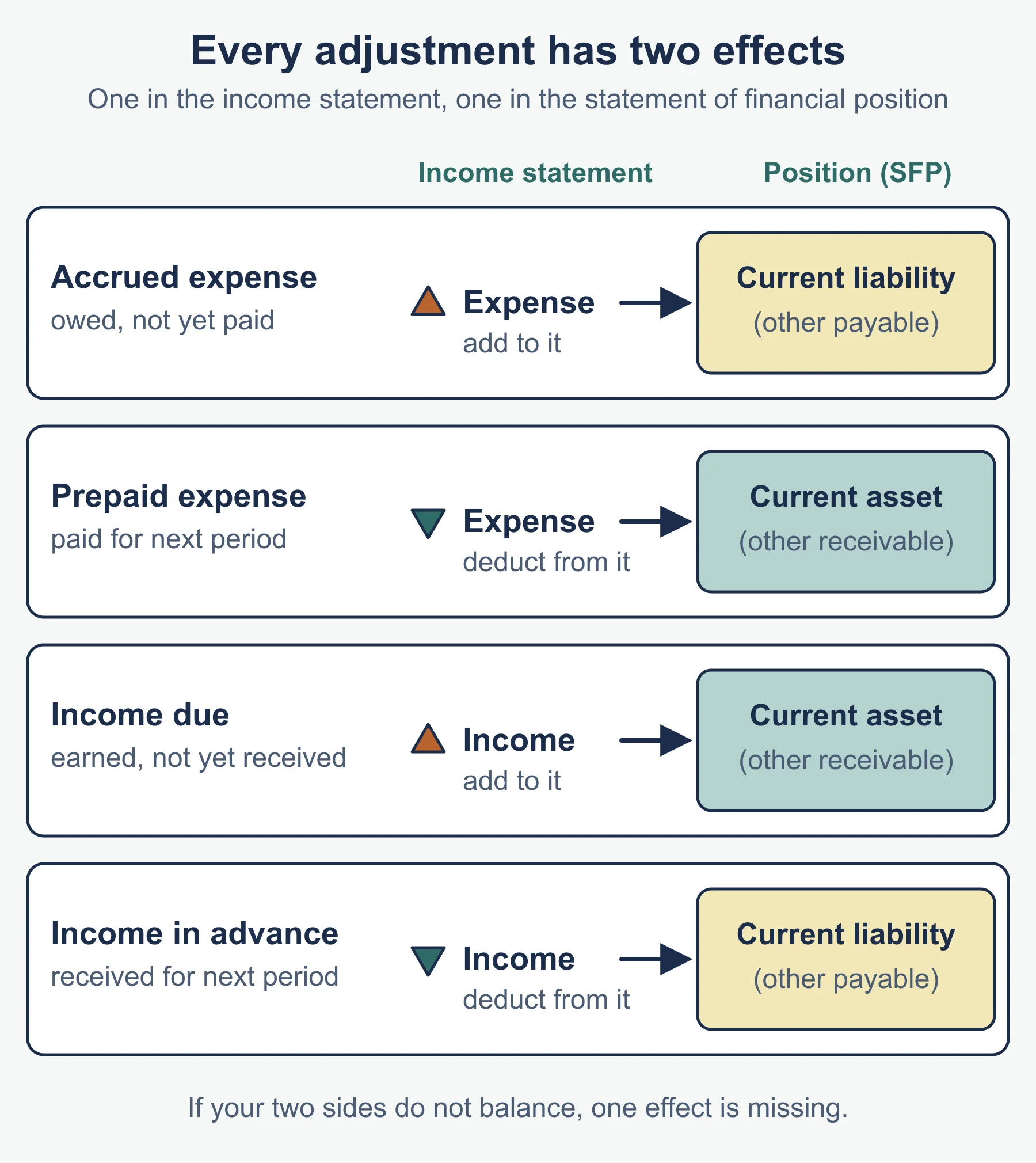
The matching/accruals concept says each period carries the income earned and expenses incurred in it, whenever cash moves. So each adjustment to the trial balance affects both statements.
| Adjustment | Effect on profit or loss | Effect on financial position |
|---|---|---|
| Expense accrued (owed) | Add to expense | Other payable (current liability) |
| Expense prepaid | Deduct from expense | Prepayment (current asset) |
| Income accrued (earned, not received) | Include in income | Current asset |
| Income received in advance | Remove from this year’s income | Current liability |
| Irrecoverable debt | Expense | Cut trade receivables |
| Irrecoverable debt recovered | Income | Cash received |
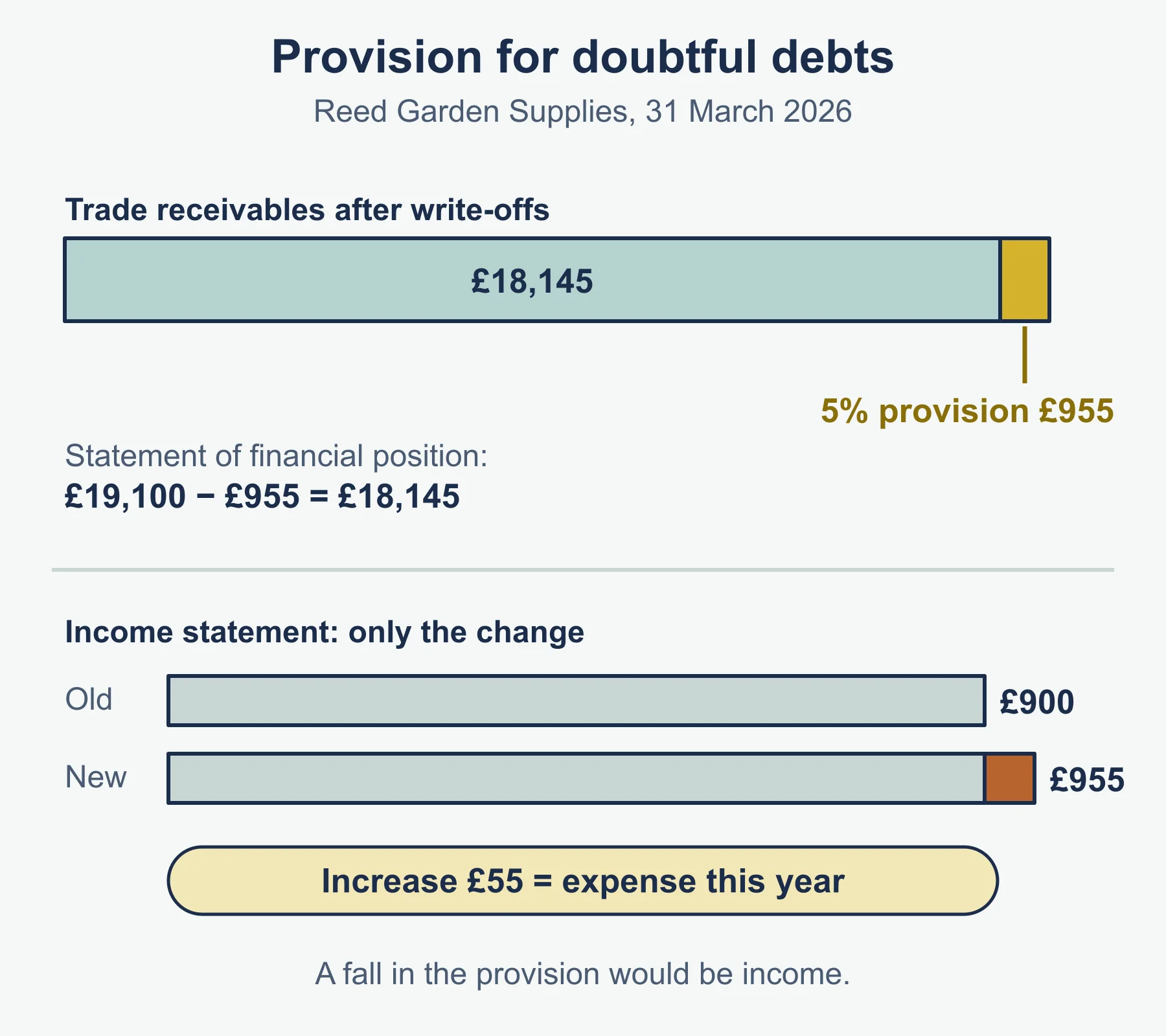
| Allowance for irrecoverable debts | Expense for the increase, or credit for the decrease | Deducted from trade receivables |
| Depreciation | Expense | Added to accumulated depreciation |
| Closing inventory | Deducted in cost of sales | Current asset |
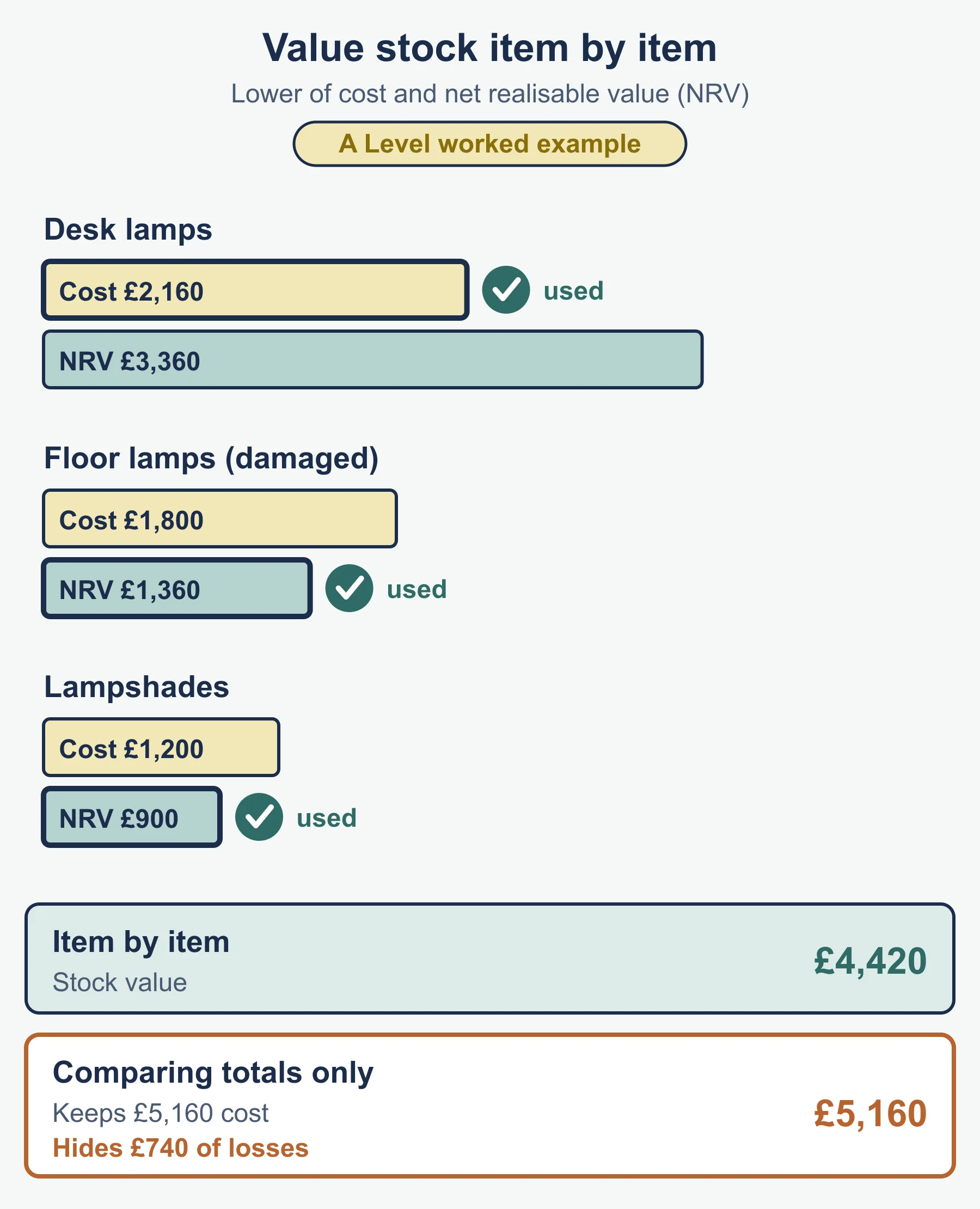
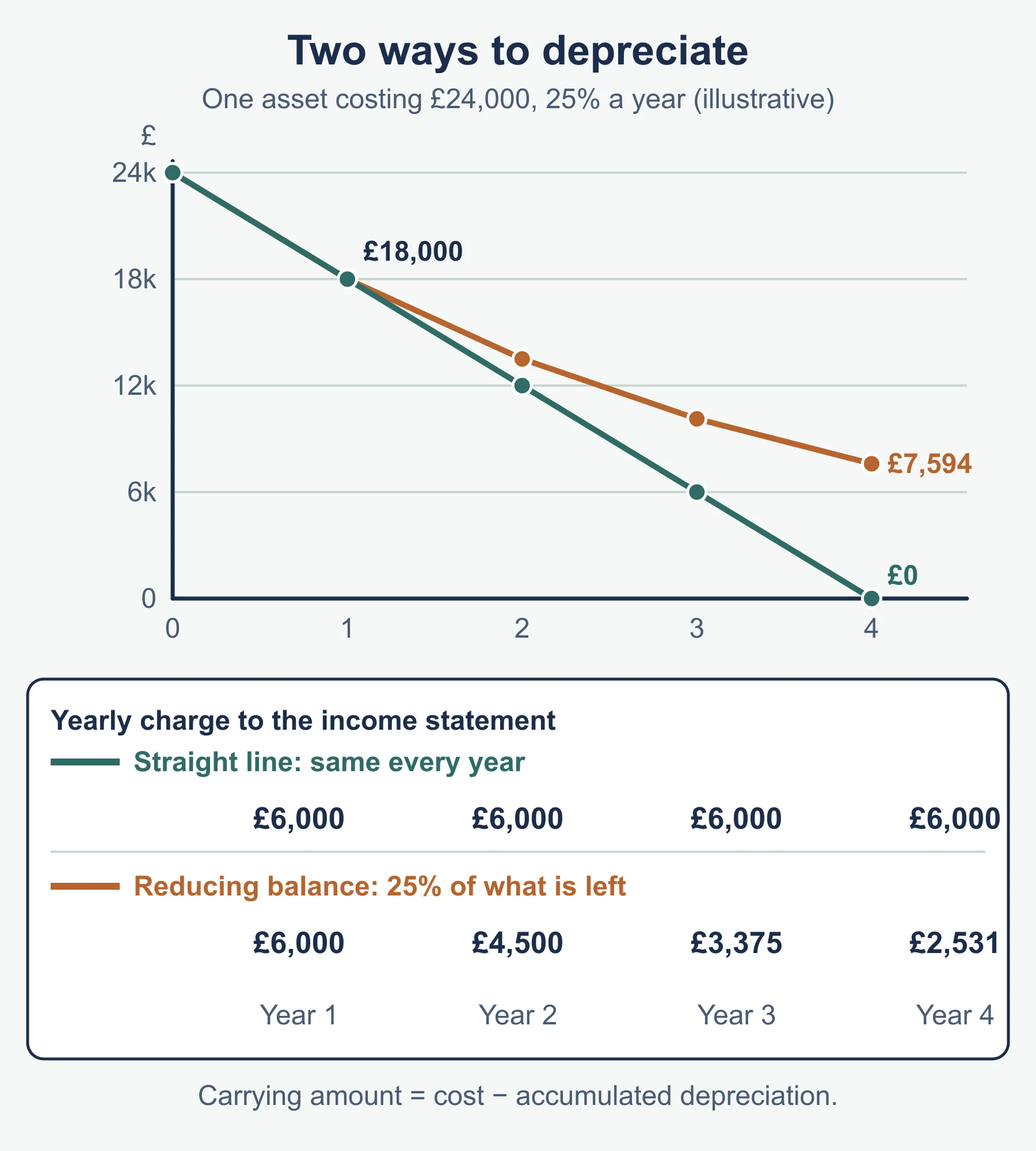
For the allowance, write off irrecoverable debts first, apply the percentage to the receivables that remain, then compare with the existing allowance: only the change goes to the statement of profit or loss. Prudence requires closing inventory to be shown at cost or net realisable value, whichever is lower. Items that cost 4,000 but can only be sold for 3,100 net are valued at 3,100, so inventory and profit both fall by 900. Depreciation methods are in the non-current assets guide.
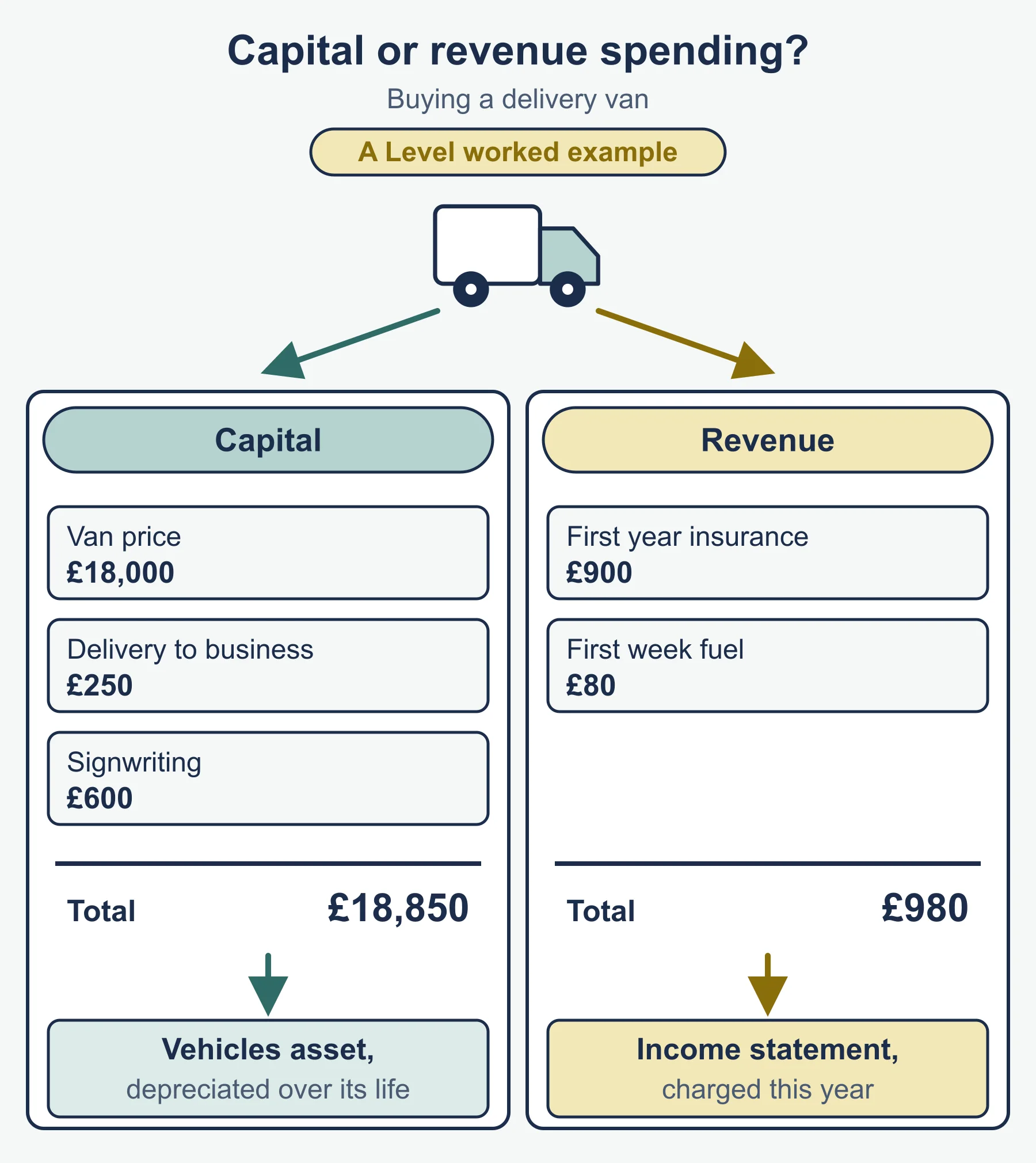
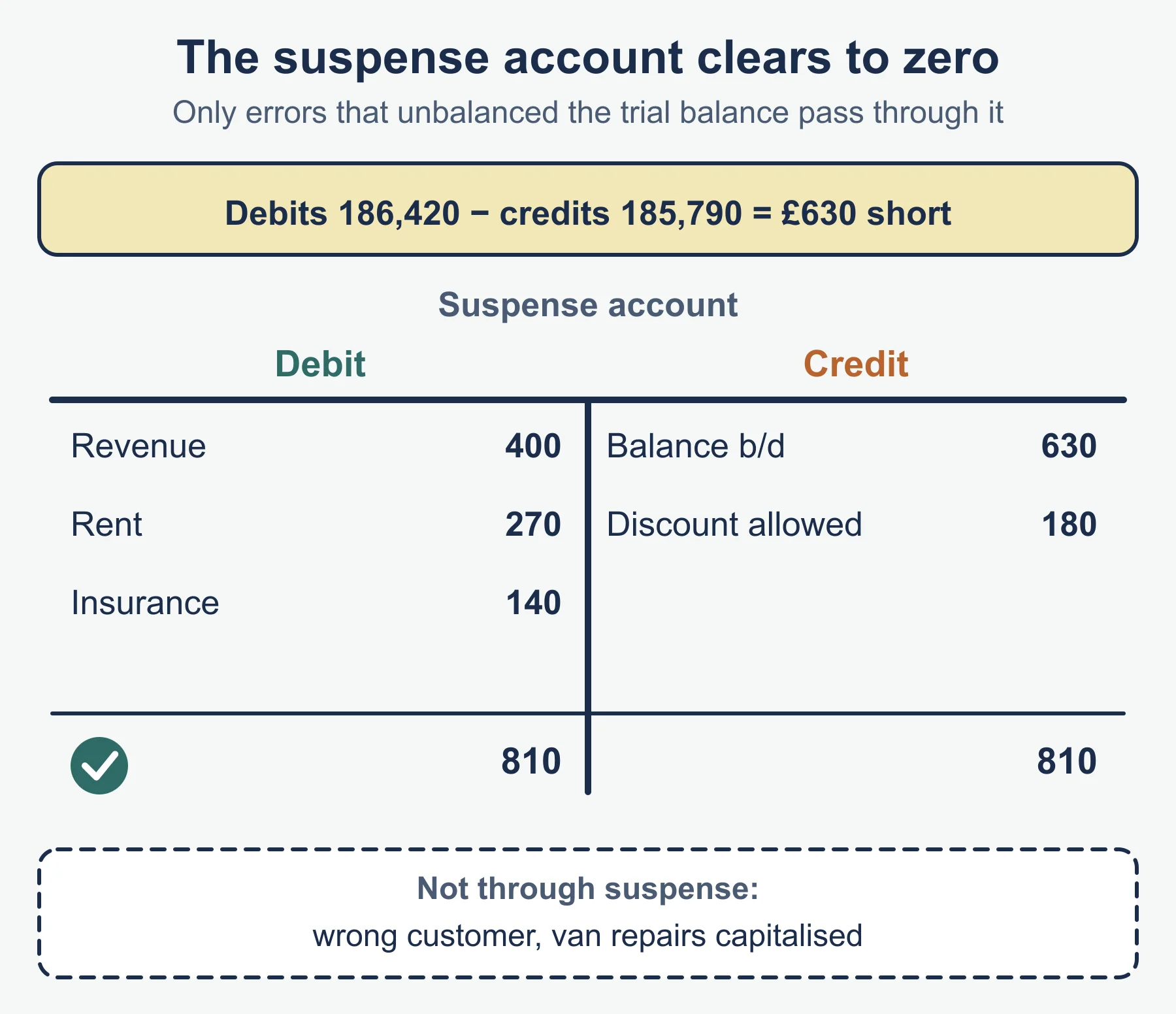
Correction of errors. An error found after the trial balance is corrected by journal. Decide whether it changes profit, assets or liabilities: repairs debited to a van, for example, change both profit and the asset. Errors that unbalance the trial balance go through a suspense account first: see the 1.4 guide.
Sole traders (1.5.2): worked example
Orla Calderbank trades as Calderbank Paints. Trial balance at 31 March 2027:
| Account | Debit | Credit |
|---|---|---|
| Sales | 148,600 | |
| Purchases | 91,200 | |
| Sales returns | 1,800 | |
| Purchases returns | 2,400 | |
| Inventory, 1 April 2026 | 12,500 | |
| Rent | 9,600 | |
| Wages | 23,400 | |
| Insurance | 2,880 | |
| General expenses | 5,480 | |
| Irrecoverable debts | 640 | |
| Irrecoverable debts recovered | 150 | |
| Allowance for irrecoverable debts | 480 | |
| Trade receivables | 14,800 | |
| Trade payables | 9,300 | |
| Bank | 6,430 | |
| Shop fittings at cost | 30,000 | |
| Accumulated depreciation: fittings | 9,000 | |
| Delivery van at cost | 19,200 | |
| Accumulated depreciation: van | 6,000 | |
| Drawings | 14,000 | |
| Capital | 56,000 | |
| Totals | 231,930 | 231,930 |
Adjustments: closing inventory 14,200; wages owing 900; insurance prepaid 720; rent prepaid 1,600; a further 400 of trade receivables irrecoverable; allowance 5% of remaining receivables; fittings depreciated 10% of cost; van 20% reducing balance. The van account includes 1,200 of repairs.
Working: repairs are revenue expenditure, so van cost is 18,000, net book value 12,000 and depreciation 2,400. Receivables become 14,400, so the allowance is 720, an increase of 240.
Statement of profit or loss of Calderbank Paints, year to 31 March 2027
| Dollars | Dollars | |
|---|---|---|
| Revenue (148,600 less returns 1,800) | 146,800 | |
| Opening inventory | 12,500 | |
| Purchases less returns (91,200 less 2,400) | 88,800 | |
| 101,300 | ||
| Closing inventory | (14,200) | |
| Cost of sales | 87,100 | |
| Gross profit | 59,700 | |
| Irrecoverable debts recovered | 150 | |
| Rent | 8,000 | |
| Wages | 24,300 | |
| Insurance | 2,160 | |
| General expenses | 5,480 | |
| Irrecoverable debts | 1,040 | |
| Increase in allowance | 240 | |
| Van repairs | 1,200 | |
| Depreciation: fittings | 3,000 | |
| Depreciation: van | 2,400 | |
| Total expenses | 47,820 | |
| Profit for the year | 12,030 |
Statement of financial position at 31 March 2027
| Cost | Acc. dep. | Net book value | |
|---|---|---|---|
| Shop fittings | 30,000 | 12,000 | 18,000 |
| Delivery van | 18,000 | 8,400 | 9,600 |
| Non-current assets | 27,600 | ||
| Inventory | 14,200 | ||
| Trade receivables less allowance (14,400 less 720) | 13,680 | ||
| Prepayments (720 + 1,600) | 2,320 | ||
| Bank | 6,430 | ||
| Current assets | 36,630 | ||
| Trade payables | 9,300 | ||
| Other payables (wages) | 900 | ||
| Current liabilities | 10,200 | ||
| Net current assets | 26,430 | ||
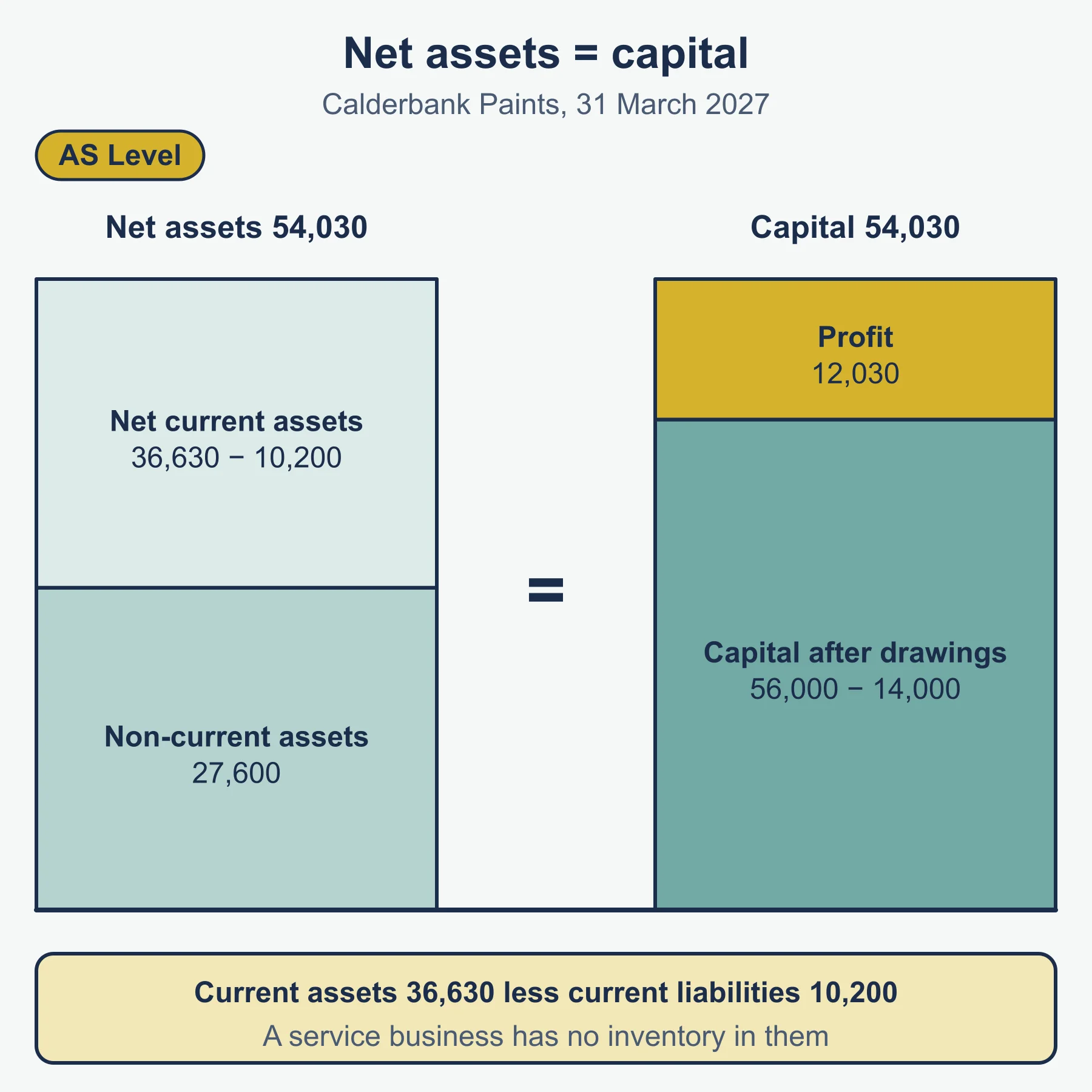
| Net assets = capital (56,000 + 12,030 − 14,000) | 54,030 |
A service business has the same adjustments but no inventory or cost of sales: fees less expenses gives profit.
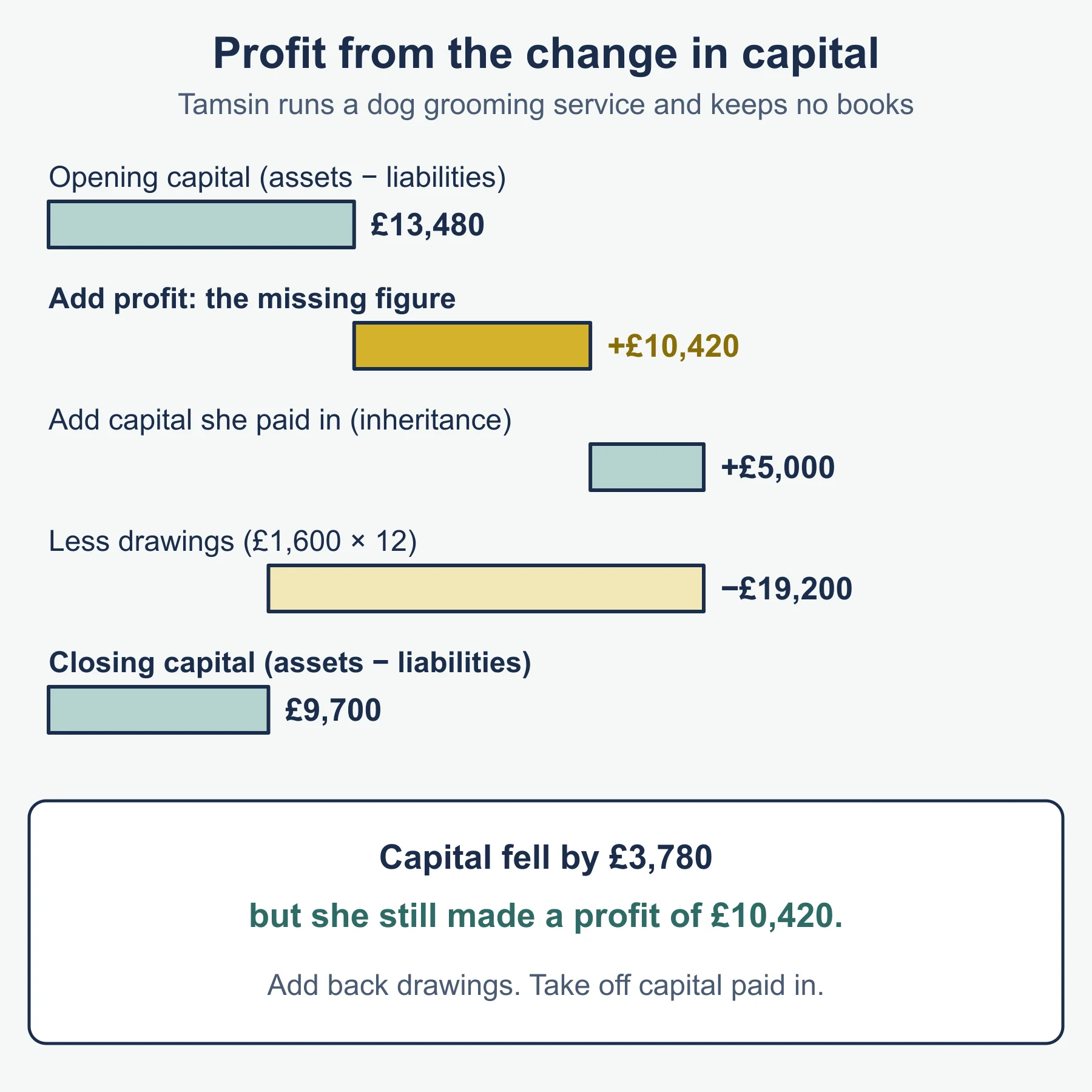
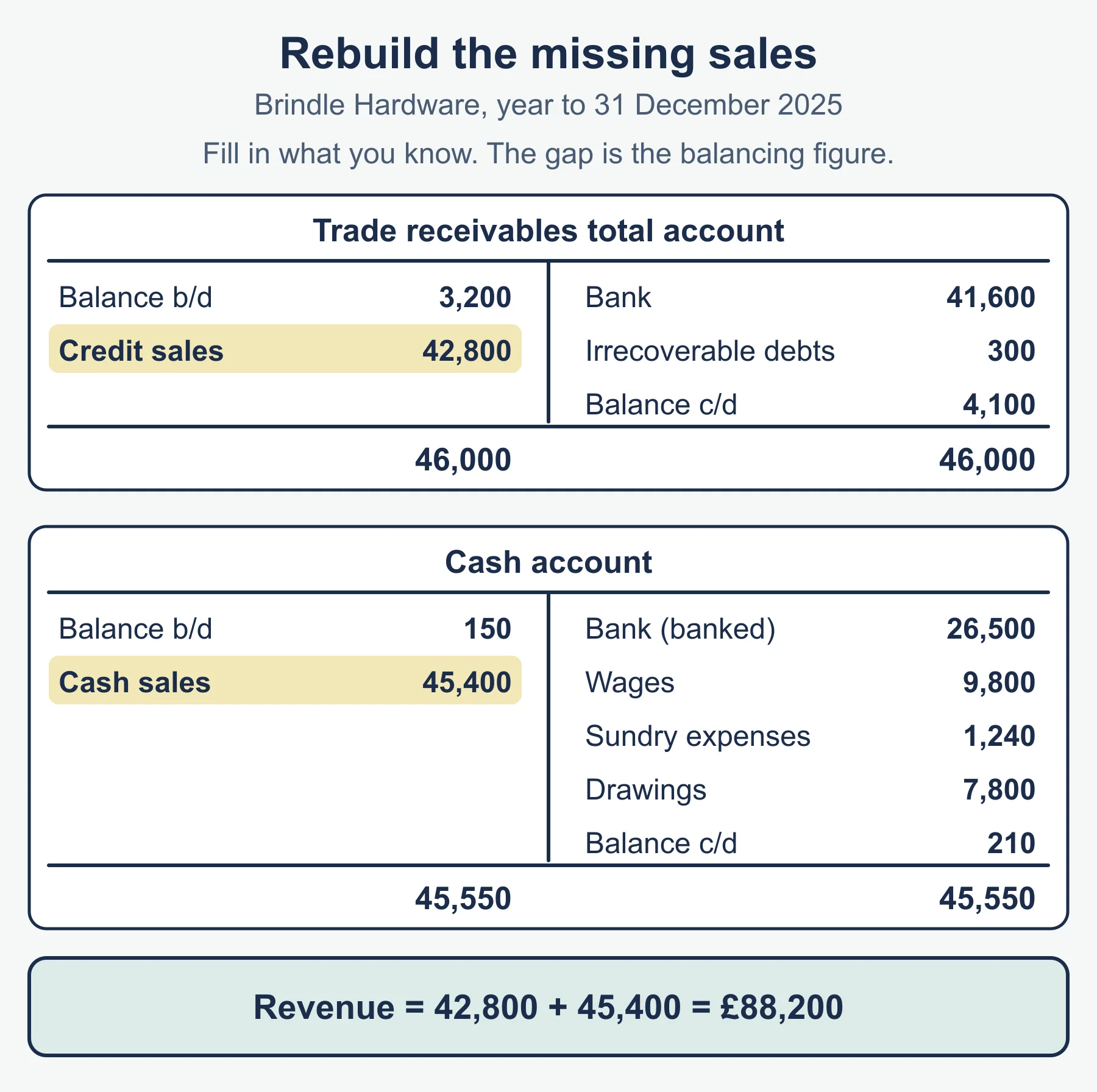
Incomplete records. Rebuild the missing figures. Naveen Rudd runs a market stall. Opening assets 15,000 less liabilities 2,600 give opening capital 12,400; closing assets 17,900 less liabilities 2,200 give 15,700. With drawings of 9,600 and no new capital, profit = 15,700 − 12,400 + 9,600 = 12,900. Credit sales come from a total trade receivables account: receipts 61,000 + closing 2,700 − opening 2,100 = 61,600. Purchases work the same way from trade payables: payments 38,000 + 2,200 − 2,600 = 37,600. Partnerships use the same methods.
Partnerships (1.5.3)
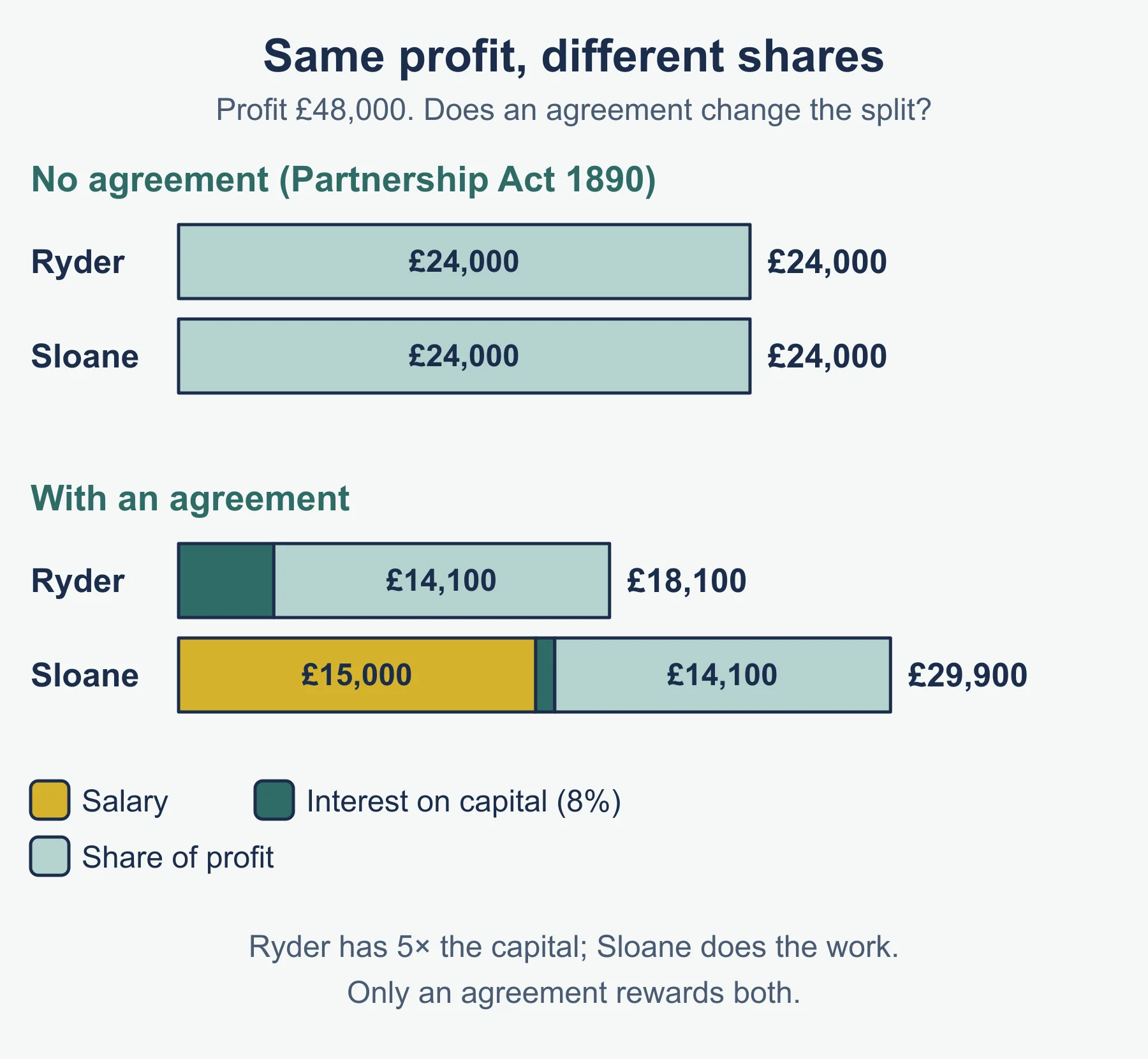
Agreement and the Act. A partnership agreement usually sets out: capital each partner contributes, profit-sharing ratio, partners’ salaries, interest on capital, interest on drawings, interest on loans, and what happens when a partner joins or leaves. Advantages: fewer disputes, written rules, rewards matching capital and effort. Disadvantages: changing it needs everyone to agree, drafting costs time, and terms can become unfair. Without an agreement, the Partnership Act 1890 applies, and it divides profits and losses equally; there are no partners’ salaries; no interest on capital; no interest on drawings; and a partner’s loan to the firm earns 5% a year.
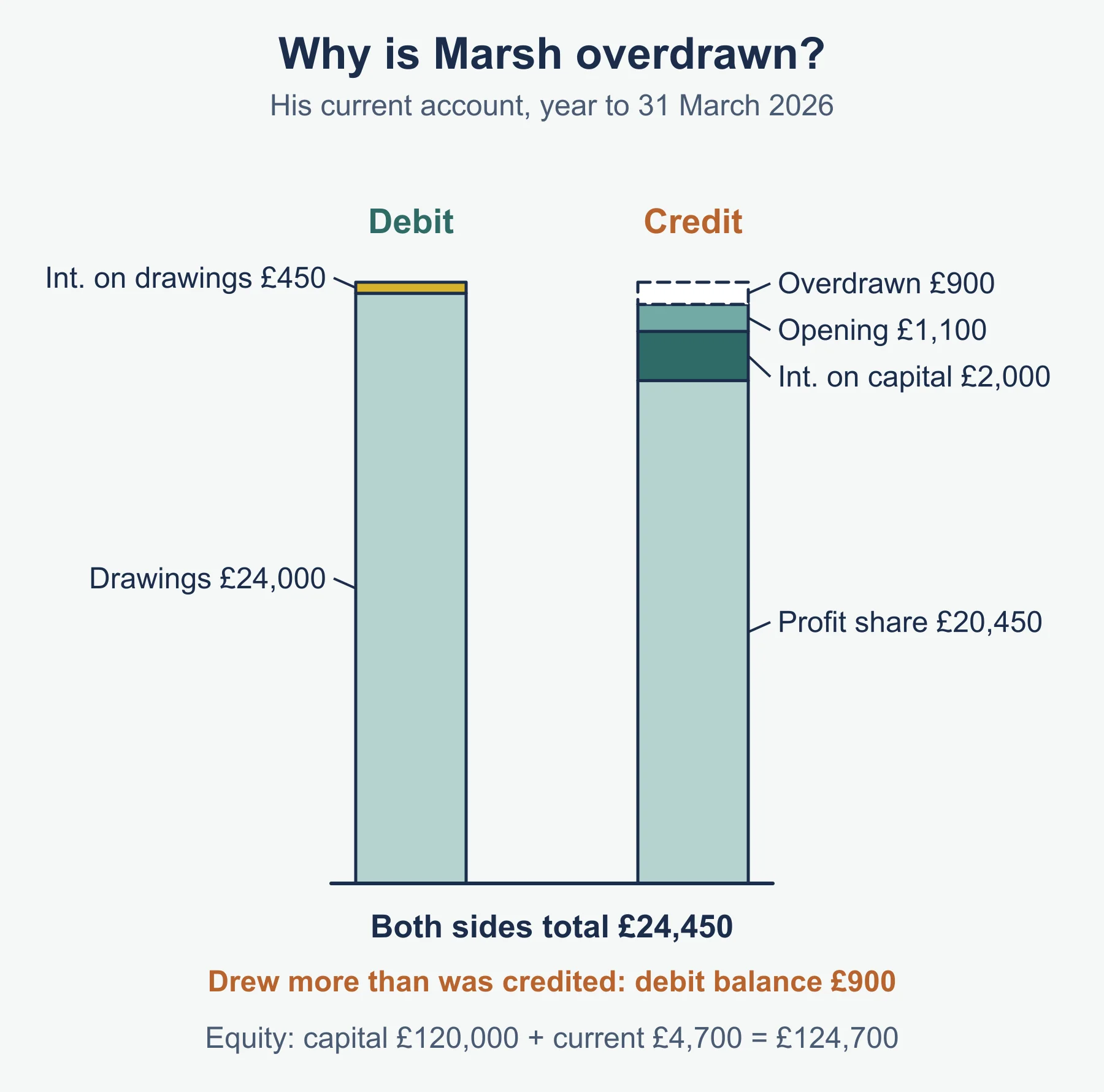
Capital and current accounts. Fixed capital accounts show the permanent investment and change only by agreement. Current accounts record the yearly flow: profit share, salary and interest on capital are credited; drawings and interest on drawings are debited. This keeps investment apart from day-to-day withdrawals. A debit balance on a current account shows a partner has drawn more than earned.
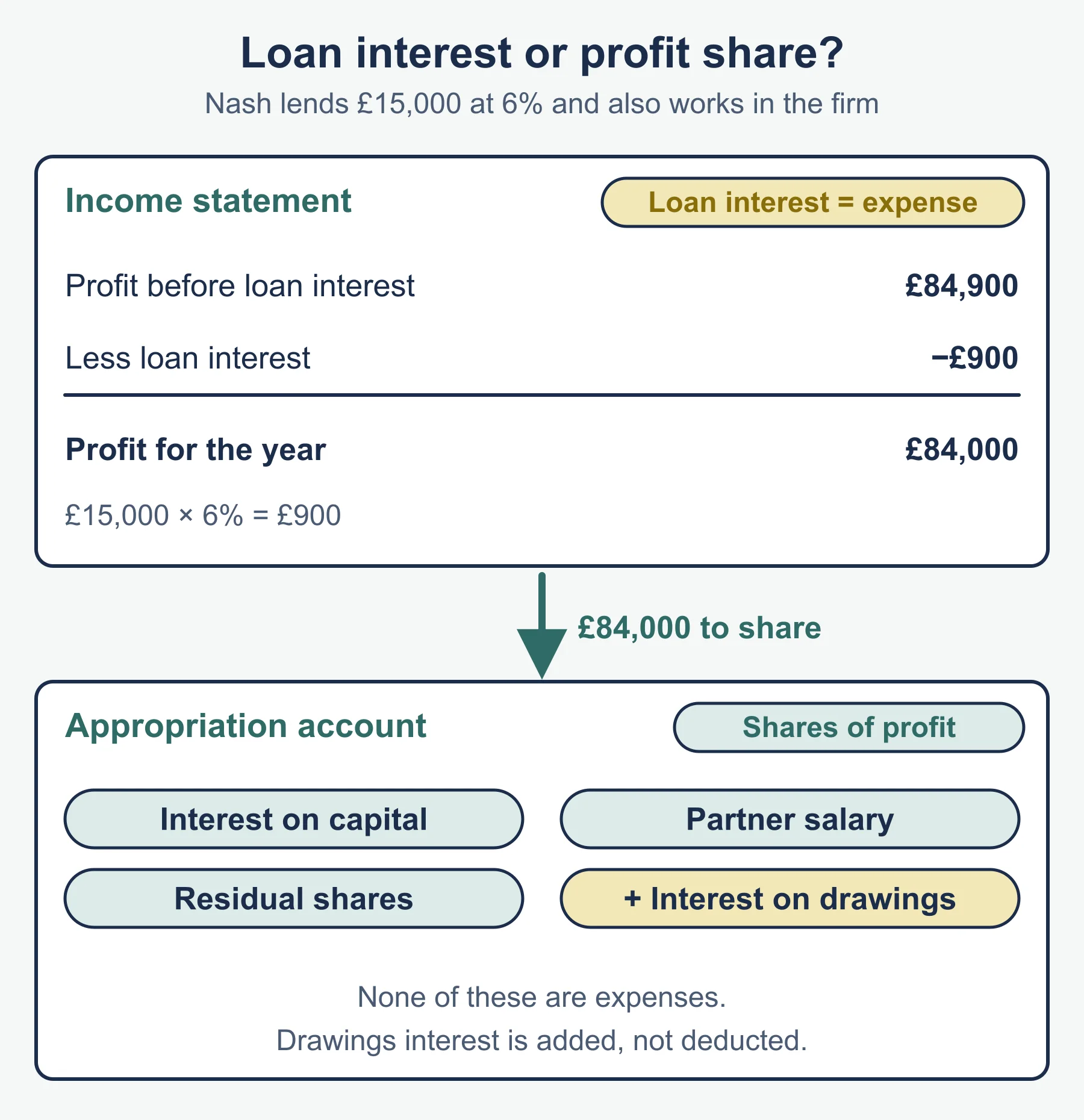
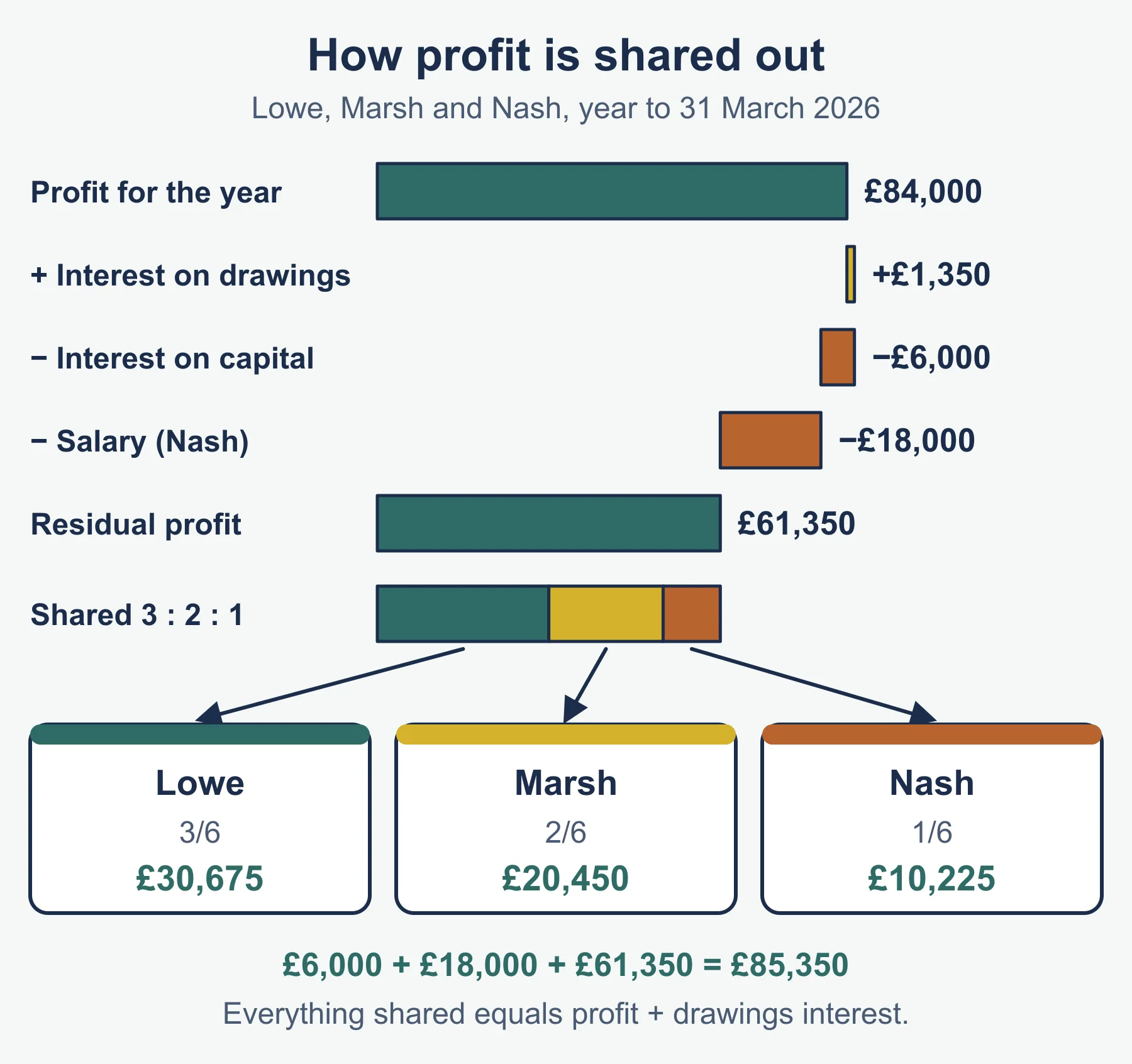
Hana Soames and Tomas Kasprzak run a physiotherapy practice. Their agreement: profits shared 3 : 2, 5% interest on capital (Soames 60,000, Kasprzak 40,000), a salary of 14,000 for Kasprzak and 4% interest on drawings. Kasprzak also lent the firm 20,000 at 5%. Drawings were Soames 18,000 and Kasprzak 15,000, taken evenly through the year, so interest runs for half a year: 360 and 300. Fees were 214,300, expenses 154,960 and loan interest 1,000, which is an expense, not an appropriation.
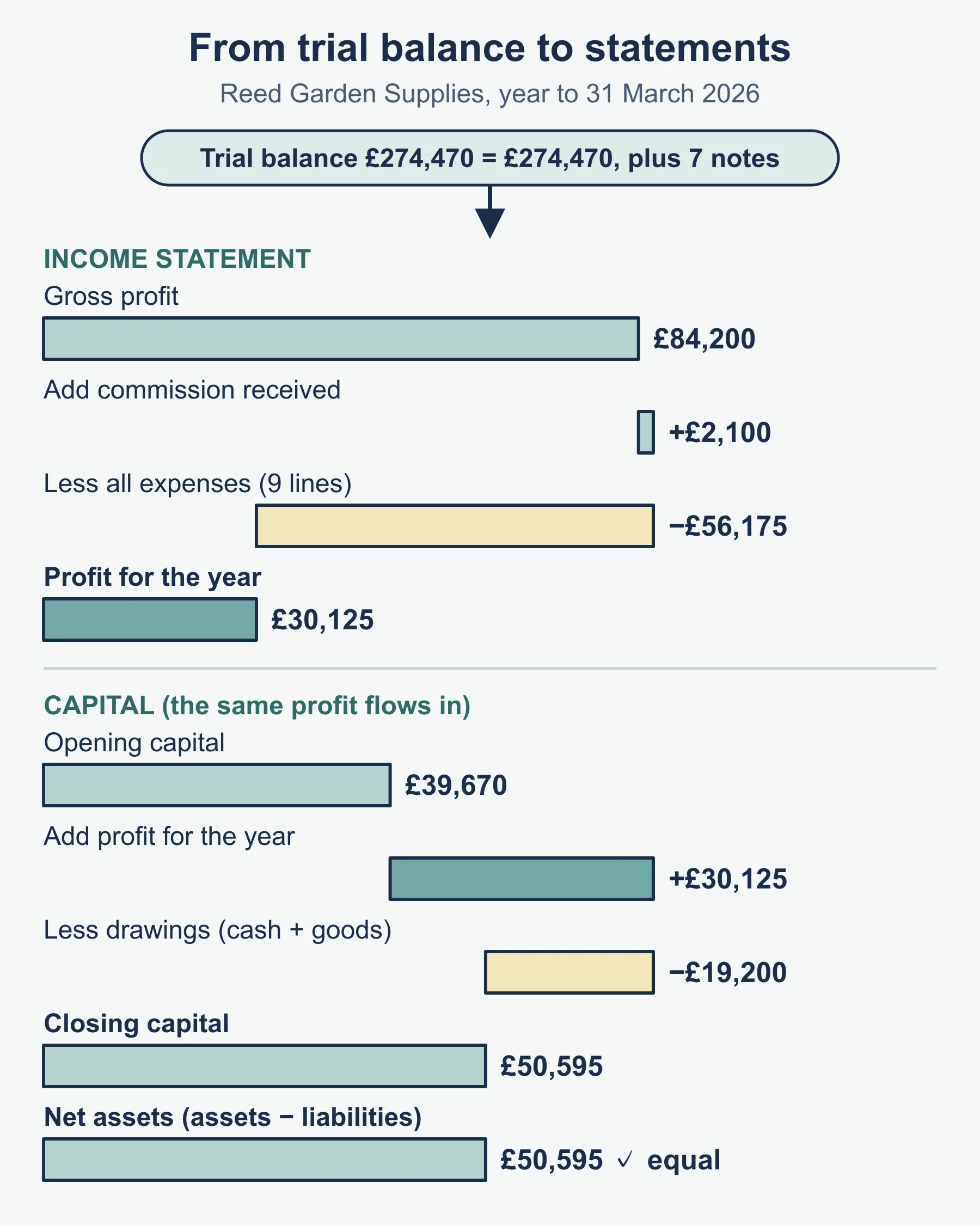
Profit for the year: 214,300 − 154,960 − 1,000 = 58,340.
Appropriation account, year ended 30 June 2027
| Soames | Kasprzak | Total | |
|---|---|---|---|
| Profit for the year | 58,340 | ||
| Interest on drawings | 360 | 300 | 660 |
| 59,000 | |||
| Salary | 14,000 | (14,000) | |
| Interest on capital | 3,000 | 2,000 | (5,000) |
| Residual profit | 40,000 | ||
| Share 3 : 2 | 24,000 | 16,000 |
Current accounts (debit side: drawings and interest on drawings; credit side: the rest)
| Soames | Kasprzak | |
|---|---|---|
| Opening balance | 2,100 Cr | 1,400 Dr |
| Salary | 14,000 | |
| Interest on capital | 3,000 | 2,000 |
| Share of residual | 24,000 | 16,000 |
| Drawings | (18,000) | (15,000) |
| Interest on drawings | (360) | (300) |
| Closing balance (Cr) | 10,740 | 15,300 |
The statement of financial position shows capital 100,000, current accounts 26,040 and the partner’s loan 20,000 (non-current liability): 146,040 in total. Without an agreement, the Act would share the 58,340 equally: 29,170 each.
Limited companies (1.5.4)
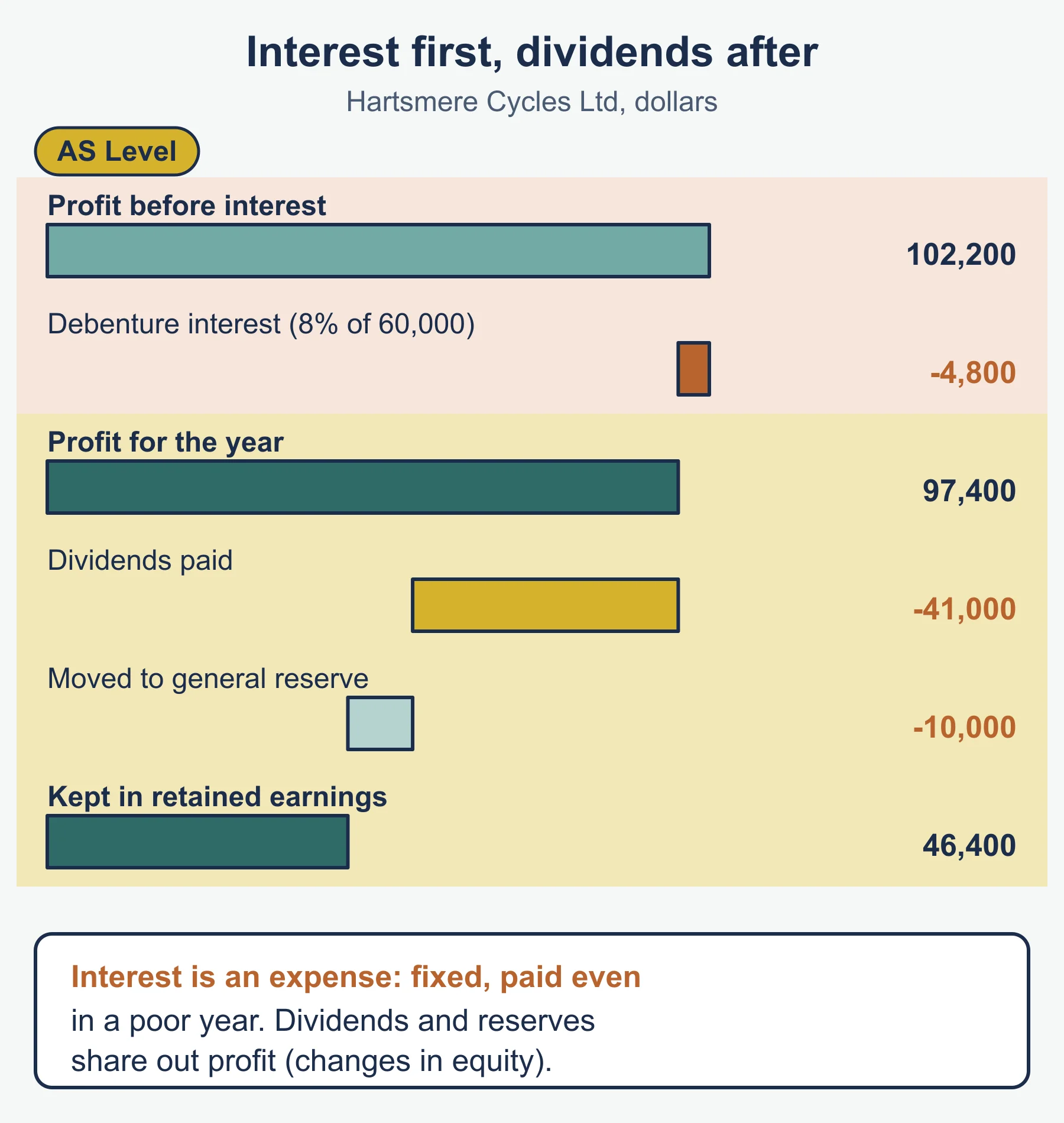
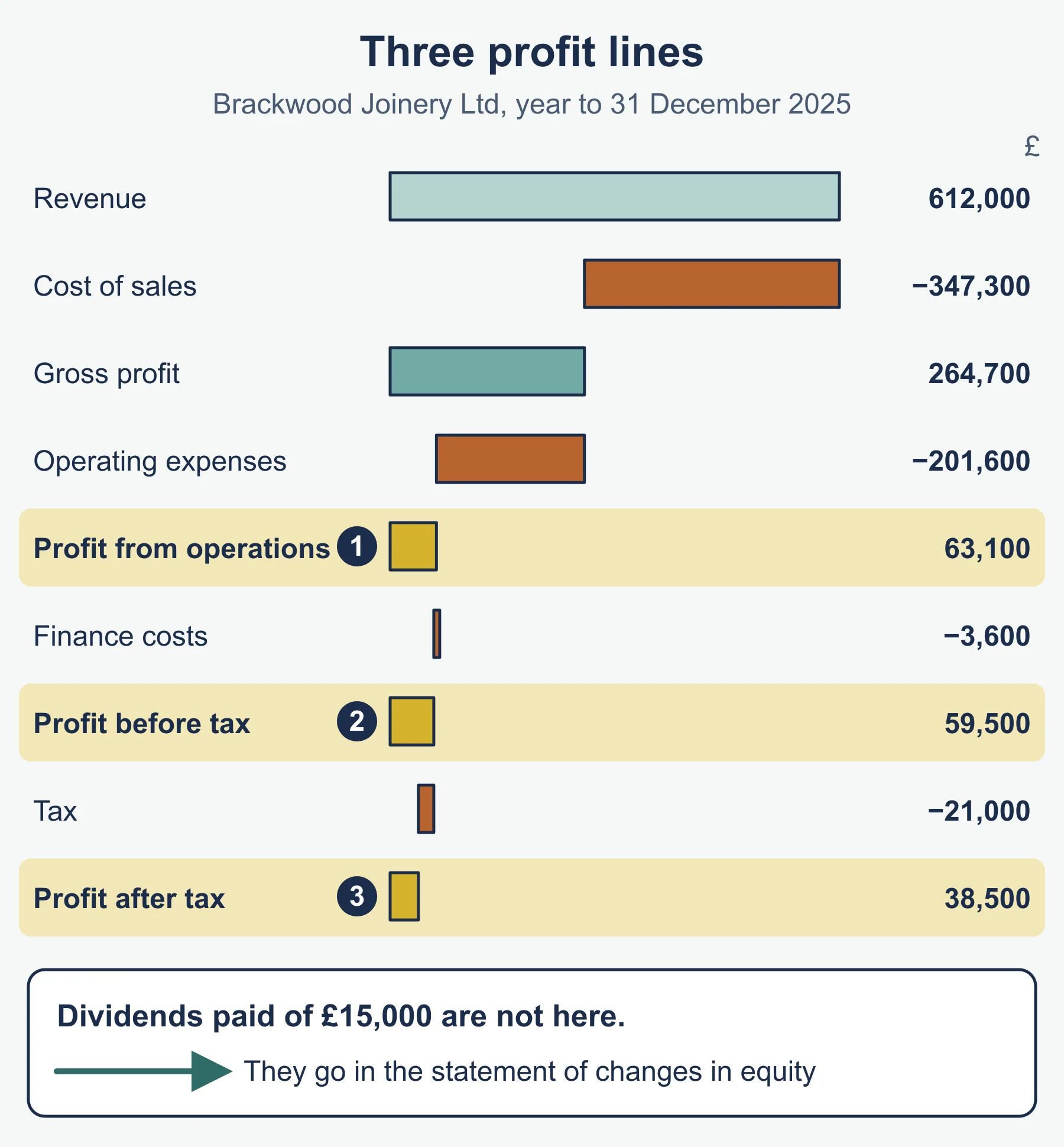
Ordinary shares carry votes and a dividend that varies with profit; holders rank last and bear most risk. The syllabus says questions will not be set on preference shares. A dividend is paid out of profit, so it is shown in the statement of changes in equity and never as an expense when finding profit. Debentures are long-term loans at fixed interest, paid whether or not there is profit, so the interest is charged as a finance cost against profit and the debenture is a liability. Reserves are the shareholders’ stake beyond share capital. Capital reserves (share premium and revaluation reserve) arise from capital events, not trading, and are not normally used for cash dividends. Revenue reserves (retained earnings and general reserve) come from profits kept back.
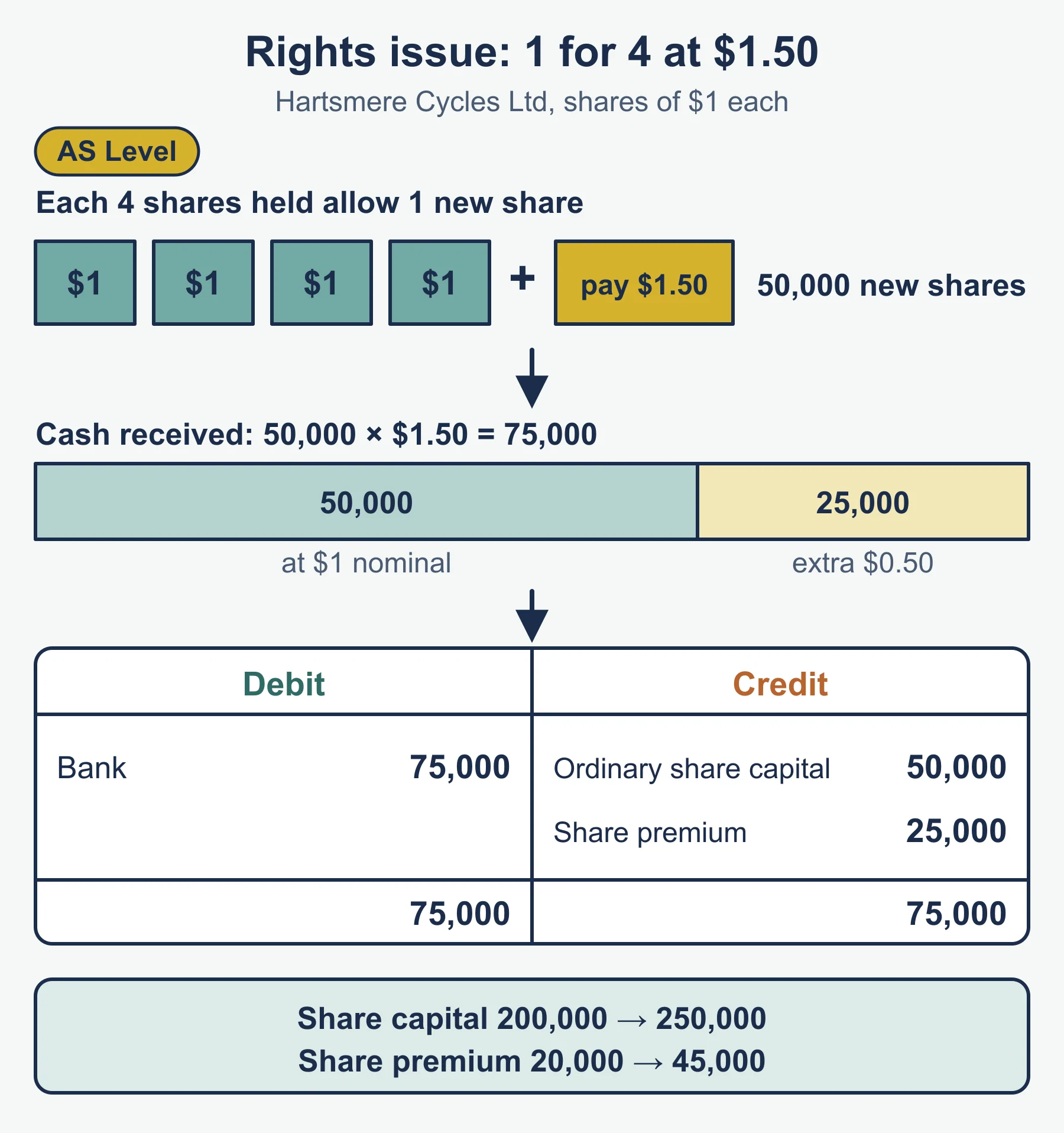
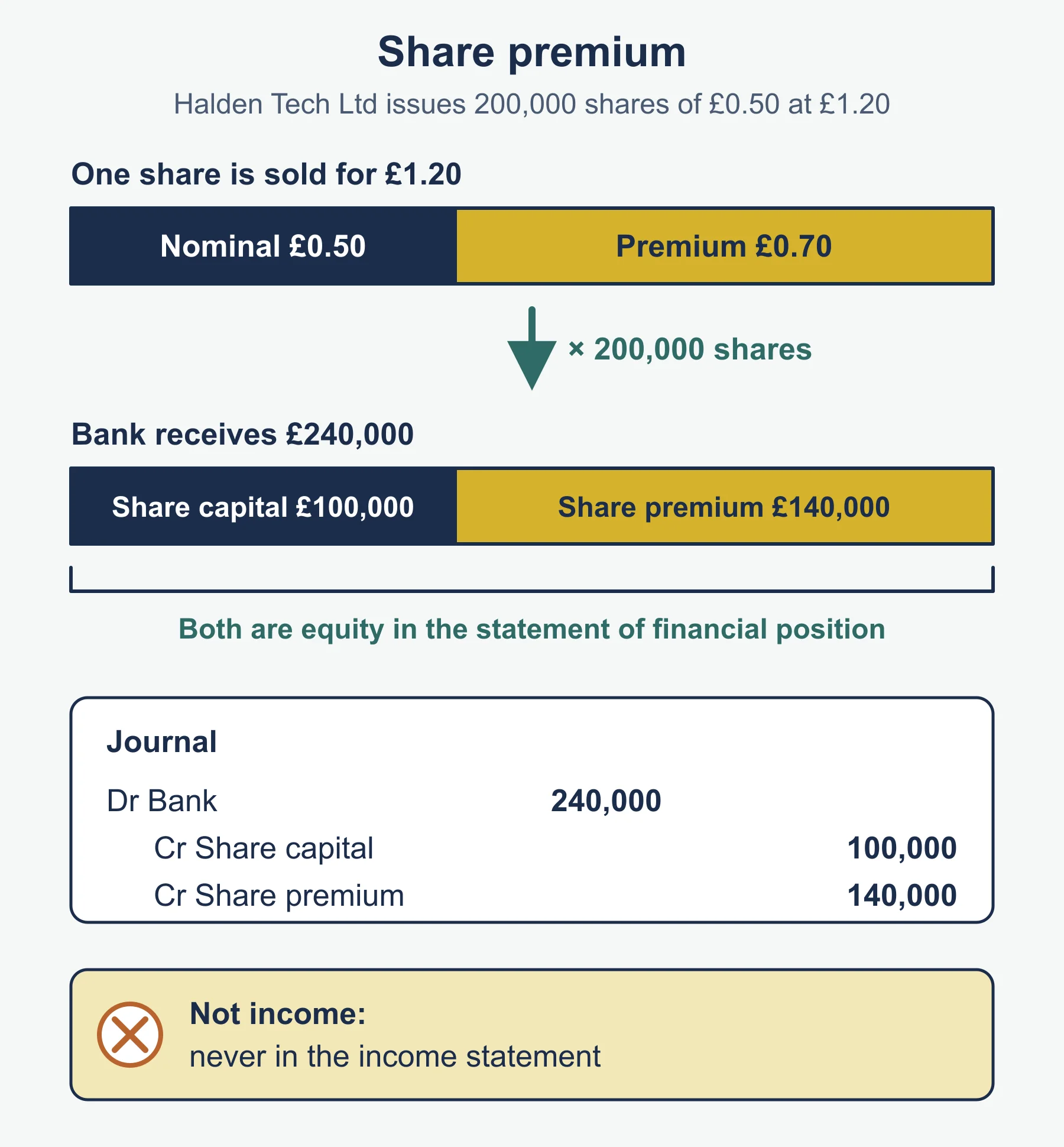
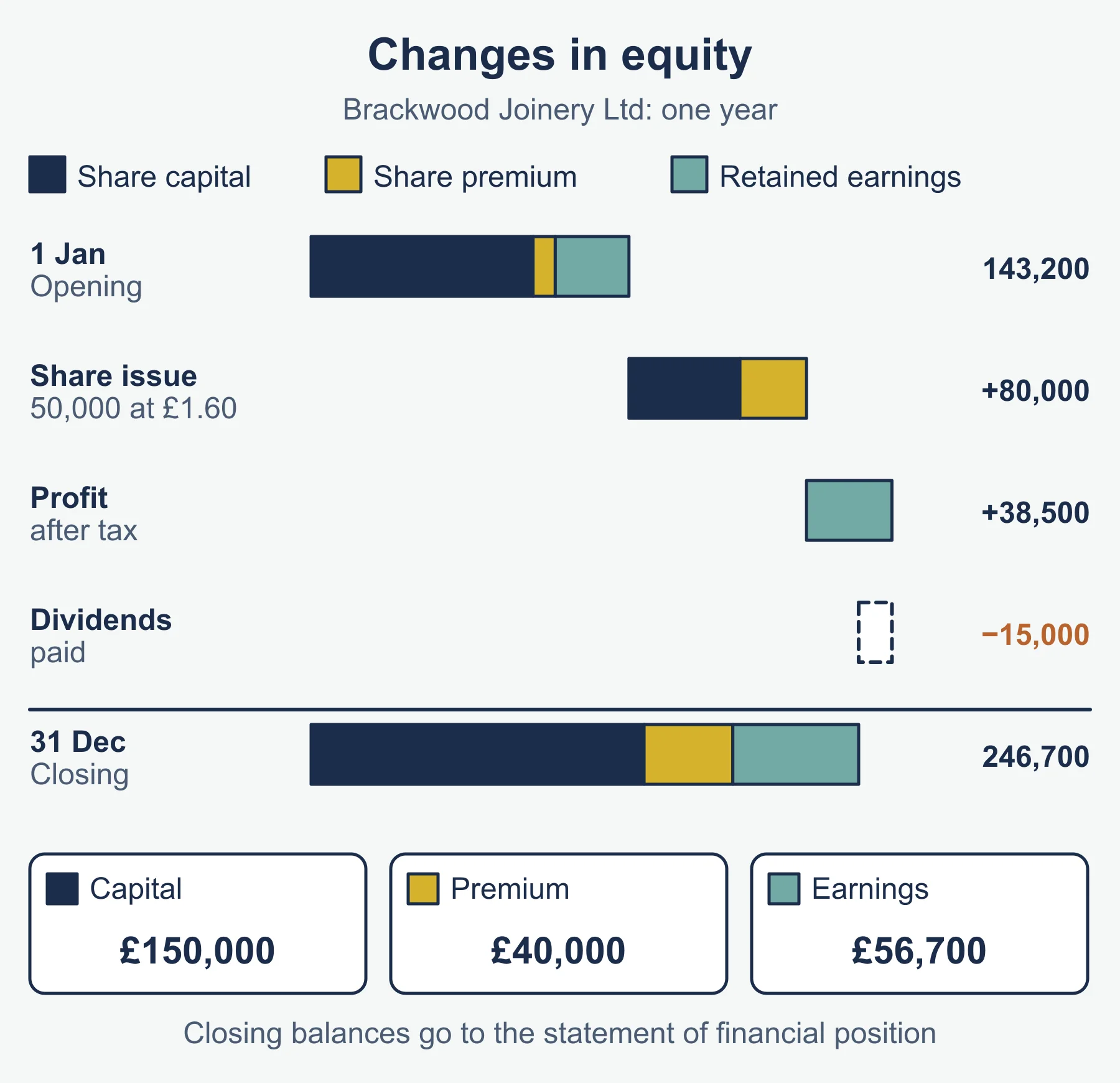
Ledger accounts. Issue at par: debit bank, credit ordinary share capital. At a premium: debit bank with the full cash, credit share capital with the nominal value and share premium with the excess. A rights issue lets current shareholders buy new shares pro rata to what they already hold, usually at a discount. Hartsmere Cycles Ltd has 200,000 ordinary shares of 1 each and issues them 1 for 4 at 1.50. That is 50,000 shares:
| Account | Debit | Credit |
|---|---|---|
| Bank (50,000 × 1.50) | 75,000 | |
| Ordinary share capital (50,000 × 1.00) | 50,000 | |
| Share premium (50,000 × 0.50) | 25,000 |
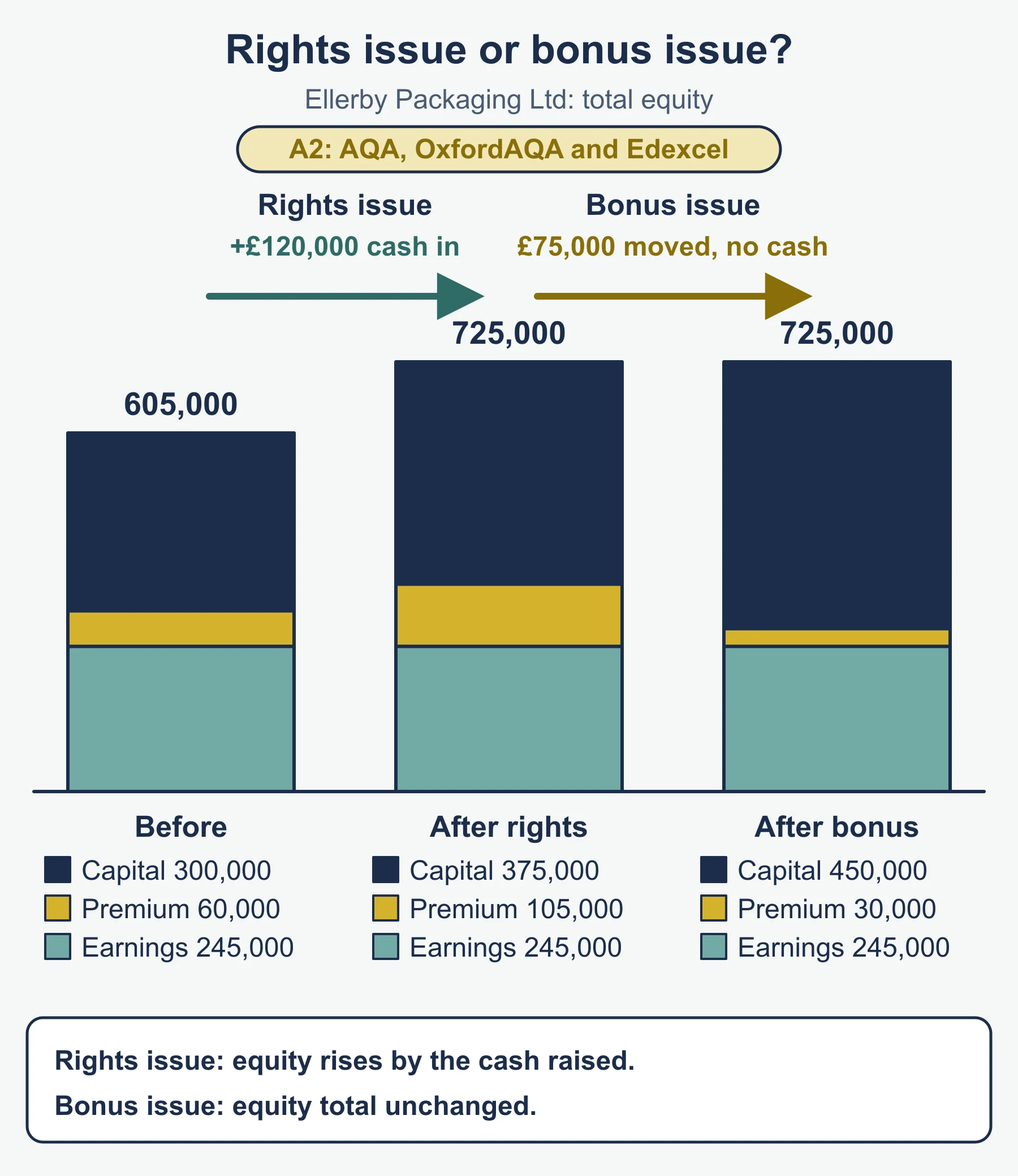
A bonus issue gives free shares by capitalising reserves, with no cash received. A 1 for 10 bonus on 250,000 shares is 25,000 shares: debit retained earnings 25,000, credit ordinary share capital 25,000. The syllabus says the revaluation reserve is not used for a bonus issue. Total equity is unchanged.
Hartsmere Cycles Ltd: statement of profit or loss, year ended 31 December 2027
| Dollars | |
|---|---|
| Revenue | 612,000 |
| Cost of sales | (372,000) |
| Gross profit | 240,000 |
| Distribution costs | (41,500) |
| Administrative expenses | (96,300) |
| Debenture interest (8% × 60,000) | (4,800) |
| Profit for the year | 97,400 |
Statement of changes in equity
| Share capital | Share premium | General reserve | Retained earnings | Total | |
|---|---|---|---|---|---|
| Opening | 200,000 | 20,000 | 15,000 | 48,000 | 283,000 |
| Rights issue | 50,000 | 25,000 | 75,000 | ||
| Profit for the year | 97,400 | 97,400 | |||
| Dividends paid (16,000 + 25,000) | (41,000) | (41,000) | |||
| Transfer to general reserve | 10,000 | (10,000) | 0 | ||
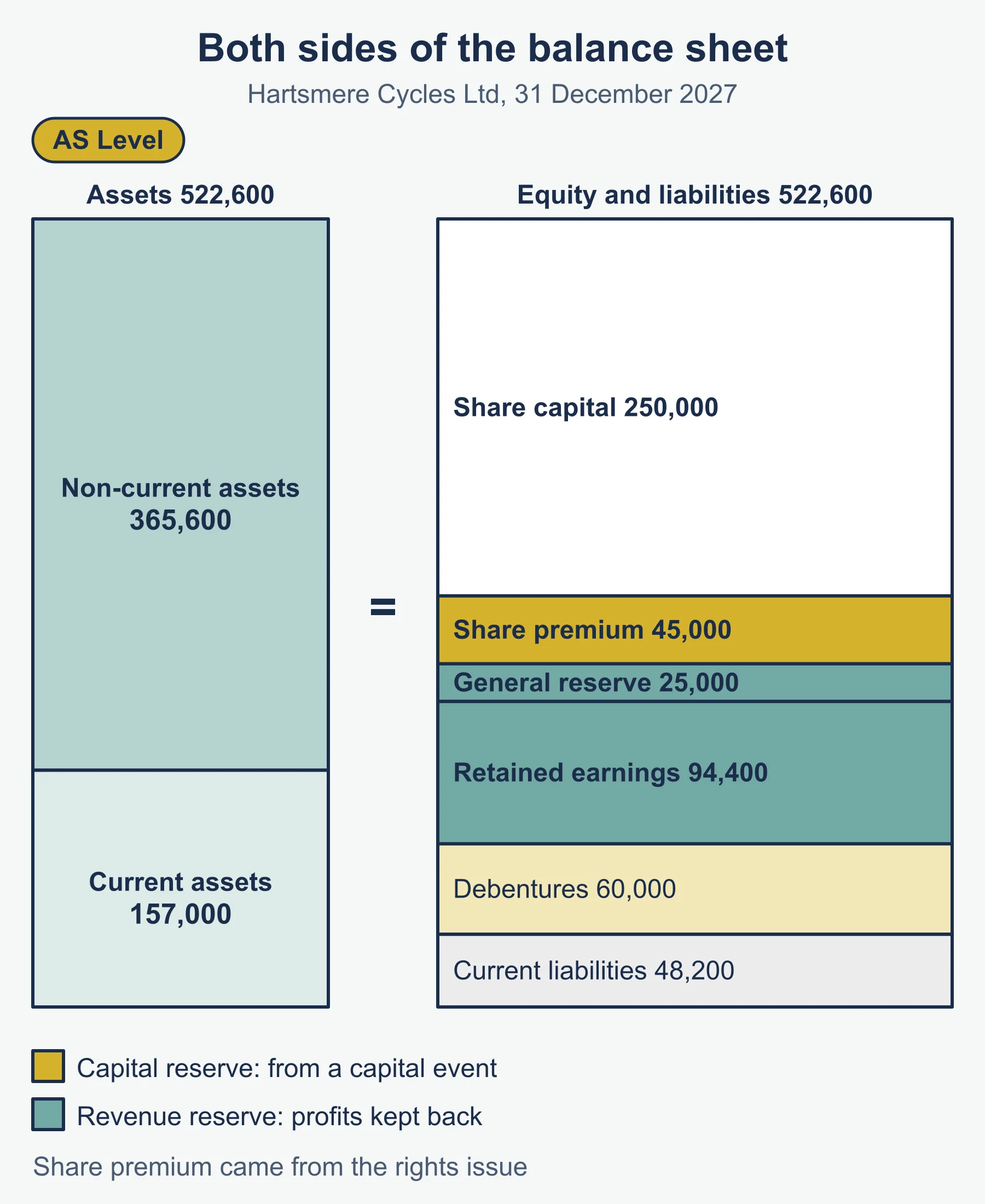
| Closing | 250,000 | 45,000 | 25,000 | 94,400 | 414,400 |
The statement of financial position shows the same closing equity. Adding debentures of 60,000 (non-current liability) and current liabilities of 48,200 gives 522,600, equal to non-current assets of 365,600 plus current assets of 157,000.
Evaluating share issues and finance
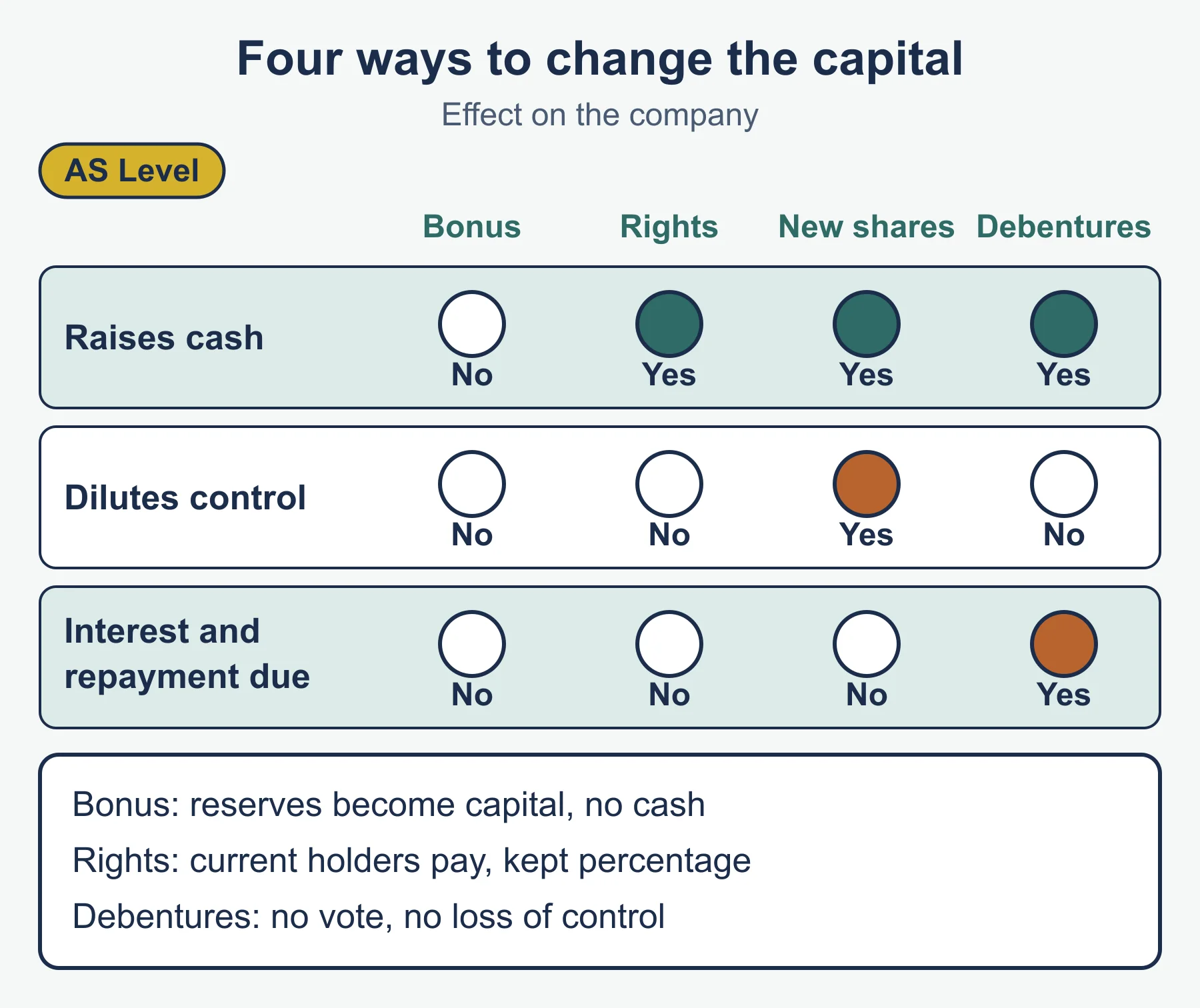
| Option | For the company | For the shareholders |
|---|---|---|
| Bonus issue | No cash paid out; lower share price aids trading | More shares, same total value and percentage; no cash raised |
| Rights issue | Raises cash cheaply, no new owners, no interest | Discounted shares and kept percentage; must find cash or be diluted |
| Issuing shares | No fixed charge or repayment | Dilutes control and dividends |
| Issuing debentures | No loss of control; interest is an expense | Fixed interest and priority, but no vote |
Disadvantages to remember: a bonus issue raises no cash and turns reserves into capital; a rights issue needs shareholders to pay; debentures need interest and repayment even in a poor year.
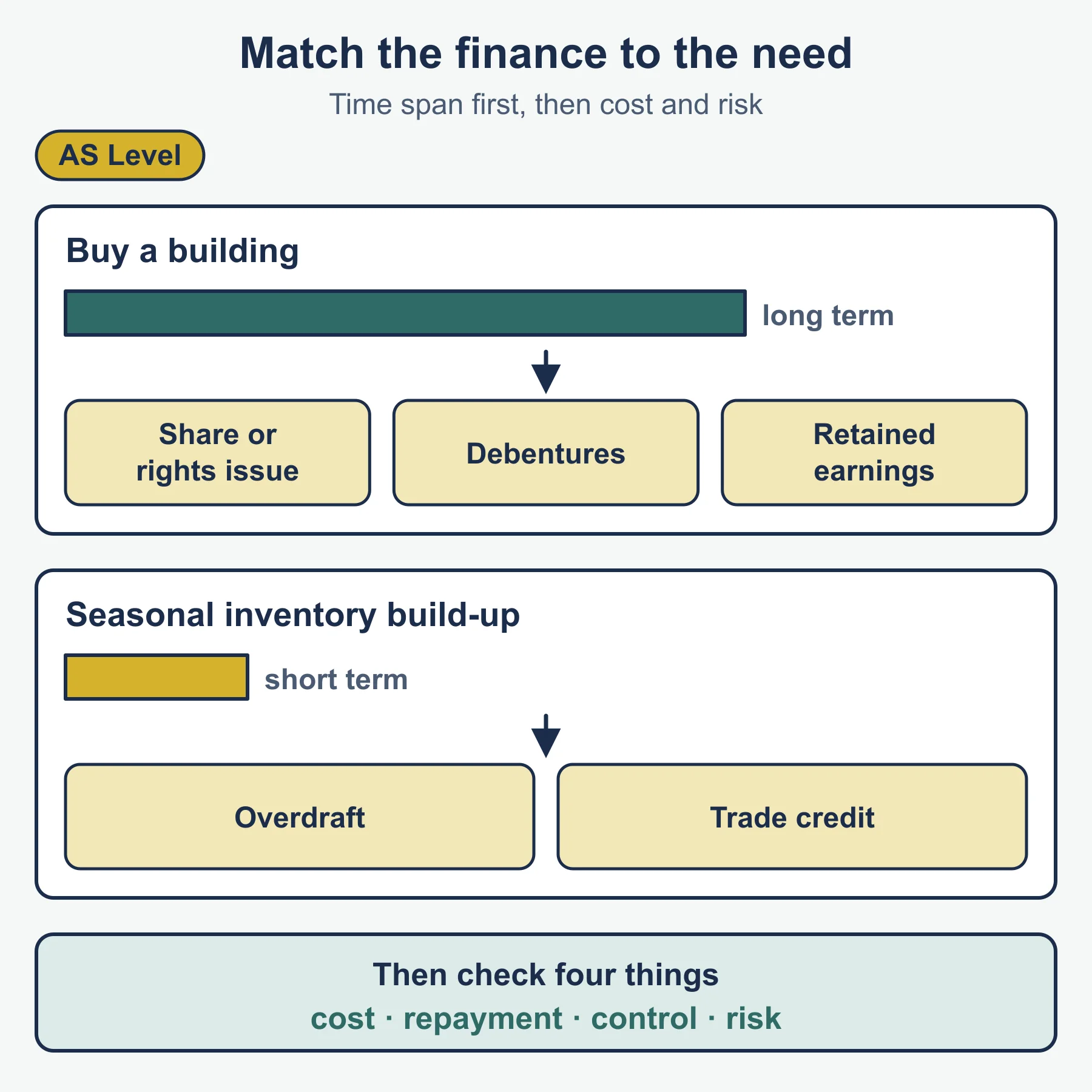
Sources of finance for purposes. Match the finance to the need and its time span. Buying a building: a share or rights issue, debentures or retained earnings. A seasonal inventory build-up: an overdraft or trade credit. Check cost, repayment, control and risk.
Common errors
- Charging the whole allowance instead of the change.
- Treating loan or debenture interest as an appropriation.
- Recording cash in a bonus issue.
Frequently asked questions
How is the allowance for irrecoverable debts calculated? Write off irrecoverable debts first, then apply the percentage to the receivables that remain. Only the change in the allowance is charged or credited in the statement of profit or loss.
What is the difference between ordinary shares and debentures? Ordinary shares carry votes and a dividend that varies with profit, and holders rank last and bear most risk. Debentures are loans: their interest is a finance cost charged whether or not there is a profit, and they are shown as non-current liabilities.
What is a bonus issue? A bonus issue gives existing shareholders free shares by capitalising reserves, so no cash is received. Recording cash in a bonus issue is a common error.
Is loan or debenture interest an appropriation of profit? No. Loan and debenture interest are expenses charged in the statement of profit or loss. Appropriations in a partnership include salaries, interest on capital and interest on drawings.
Which section of Cambridge 9706 covers AS financial statements? Section 1.5 Preparation of financial statements is AS Level content covering adjustments to a trial balance and the accounts of sole traders, partnerships and limited companies.
Official syllabus
Cambridge International AS & A Level Accounting 9706, syllabus for exams in 2026, 2027 and 2028, Cambridge Assessment International Education, section 1.5.
Get free revision emails (optional)
Occasional emails with practice questions, worked explanations and links to free resources for the qualification and subjects you choose. No spam, and you can unsubscribe from any email. The free tools on this site never need an email.
Related resources
-
Study guides
A Level Accounting: Accounting for Non-Current Assets (Cambridge 9706)
Capital versus revenue spending, why assets depreciate depreciation methods, cost and revaluation models and disposals, for Cambridge 9706 Accounting topic 1.3.
Accounting · Cambridge · AS Level
Read guide -
Practice questions
A Level Accounting: Preparation of financial statements (AS) (Cambridge 9706) – Practice Questions
Eleven original questions with worked answers on adjustments and sole trader, partnership and company accounts for Cambridge Accounting 9706 section 1.5.
Accounting · Cambridge · AS Level
Try questions -
Revision notes
A Level Accounting: Preparation of financial statements (AS) (Cambridge 9706) – Revision Notes
Condensed revision notes on adjustments, sole trader, partnership and limited company accounts for Cambridge AS & A Level Accounting 9706 section 1.5.
Accounting · Cambridge · AS Level
Revise topic
Related articles
-
teaching
A Level tuition in Dubai: Cambridge or Pearson Edexcel International A Level?
Schools in Dubai and Abu Dhabi teach either Cambridge International AS & A Level or Pearson Edexcel International A Level. How the two are structured, why it matters for tuition, and how online classes from Lahore work.
9 October 2026
-
curriculum guides
Choosing subjects at IGCSE and A Level
How subject choices at 14 and 16 affect university options later, and how to keep pathways open without overloading a timetable.
28 July 2026
Studying this with a teacher
Working through Accounting AS LEVEL?
This page is free and stays free. If you would rather be taught it, Marlbridge runs Accounting classes one-to-one and in small groups of up to 15, online in your own time zone. The first trial class is free. WhatsApp replies within an hour (8am–11pm Pakistan time, every day); email the same day.
Cambridge Accounting teachers at Marlbridge

