
Revision Notes
A Level Accounting: Preparation of financial statements (AS) (Cambridge 9706) – Revision Notes
Condensed revision notes on adjustments, sole trader, partnership and limited company accounts for Cambridge AS & A Level Accounting 9706 section 1.5.
- Subject
- Accounting
- Level
- AS LEVEL
- Topic
- Financial accounting
- Author
- Marlbridge Academic Team
- Updated
- Reviewed by
- Zain Ud Din Ahmed (what this means)
Aligned to Cambridge A Level Accounting (9706), 2026-2028. Official specification .
Syllabus page (what it covers and how it is assessed): Cambridge A Level Accounting.
Syllabus points this page covers
9706 (AS Level)
- 1.5 Preparation of financial statements
Found an error? Report a correction.
Need help with this topic? Request a free trial class for A Level Accounting (9706).
These notes condense section 1.5 Preparation of financial statements (AS Level, Topic 1) of the Cambridge International AS & A Level Accounting 9706 syllabus for exams in 2026, 2027 and 2028. For full explanations and worked statements, read the study guide; to test yourself, use the practice questions and the free diagnostics. Related notes: 1.3 non-current assets, 1.4 reconciliation and verification, business entities. Course hub: Cambridge A Level Accounting. Printable checklist. The syllabus points to its Teacher Guidance document for the expected formats.
1.5.1 Adjustments: entries and formulas
| Item | Debit | Credit |
|---|---|---|
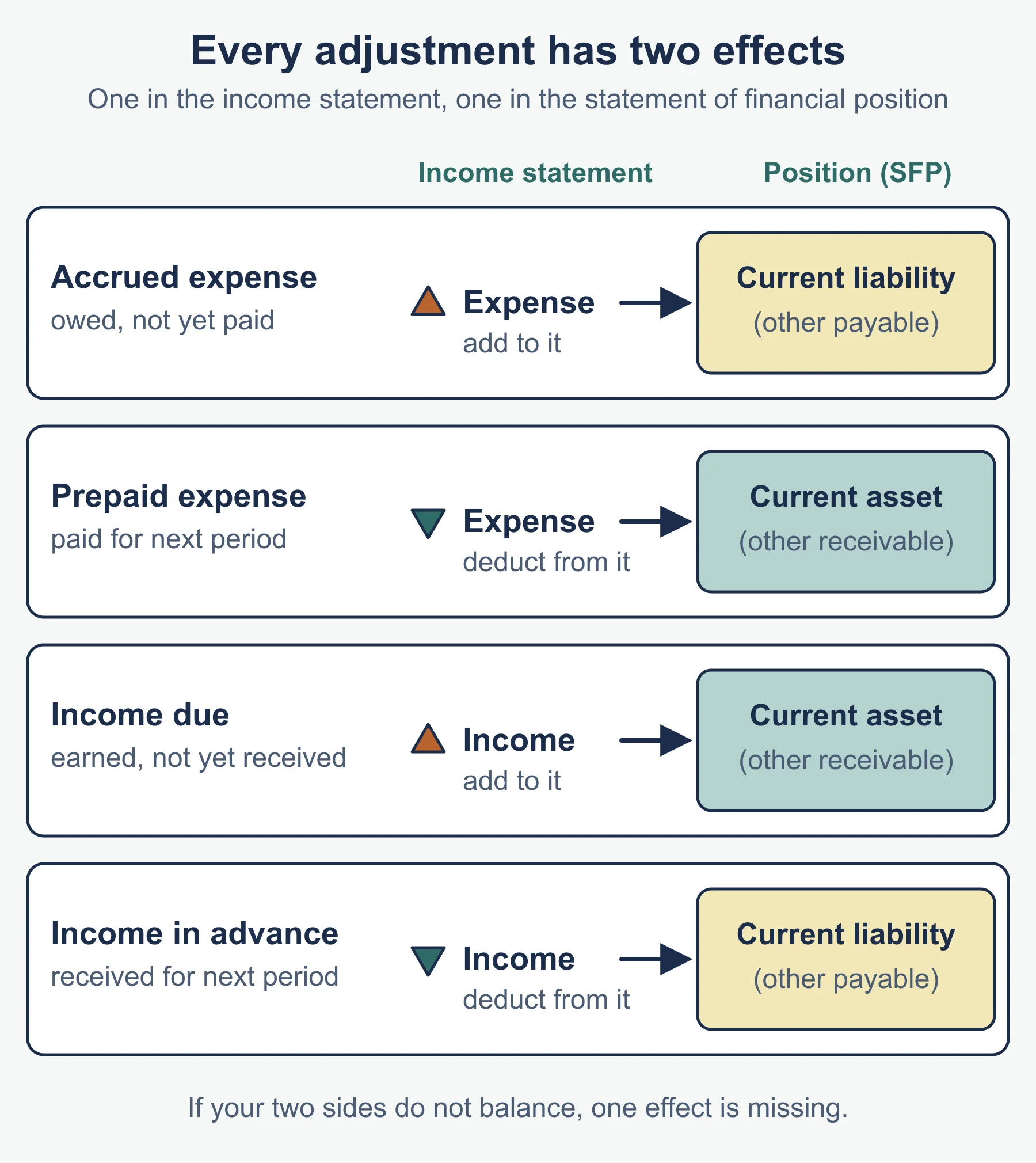
| Expense owing | Expense | Other payables |
| Expense prepaid | Prepayments | Expense |
| Income earned, not received | Other receivables | Income |
| Income received in advance | Income | Other payables |
| Irrecoverable debt | Irrecoverable debts | Trade receivables |
| Debt recovered | Trade receivables, then bank | Irrecoverable debts recovered, then trade receivables |
| Allowance increased | Statement of profit or loss | Allowance for irrecoverable debts |
| Depreciation | Depreciation expense | Accumulated depreciation |
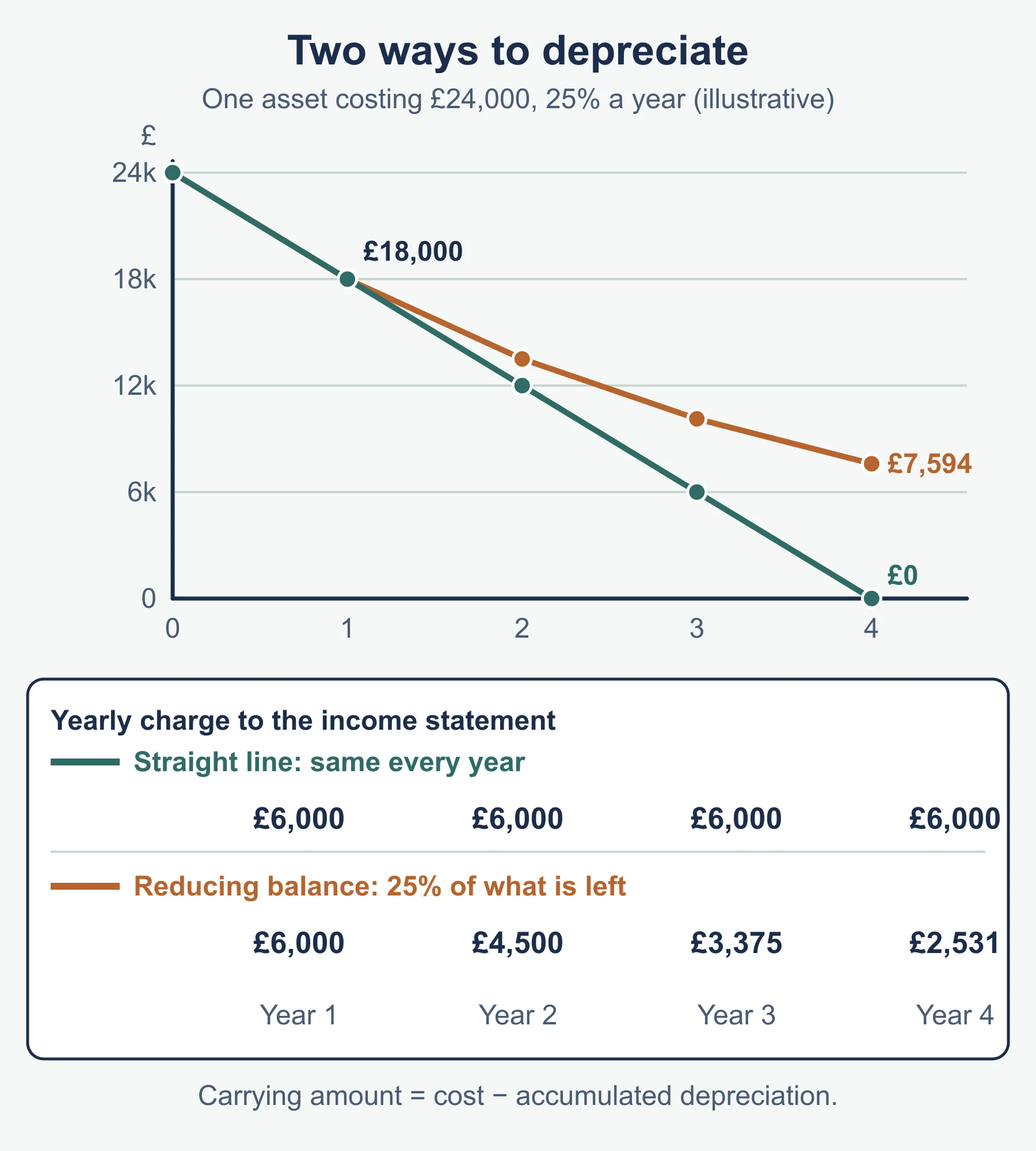
- Expense for the year = cash paid + closing accrual − opening accrual (or − closing prepayment + opening prepayment).
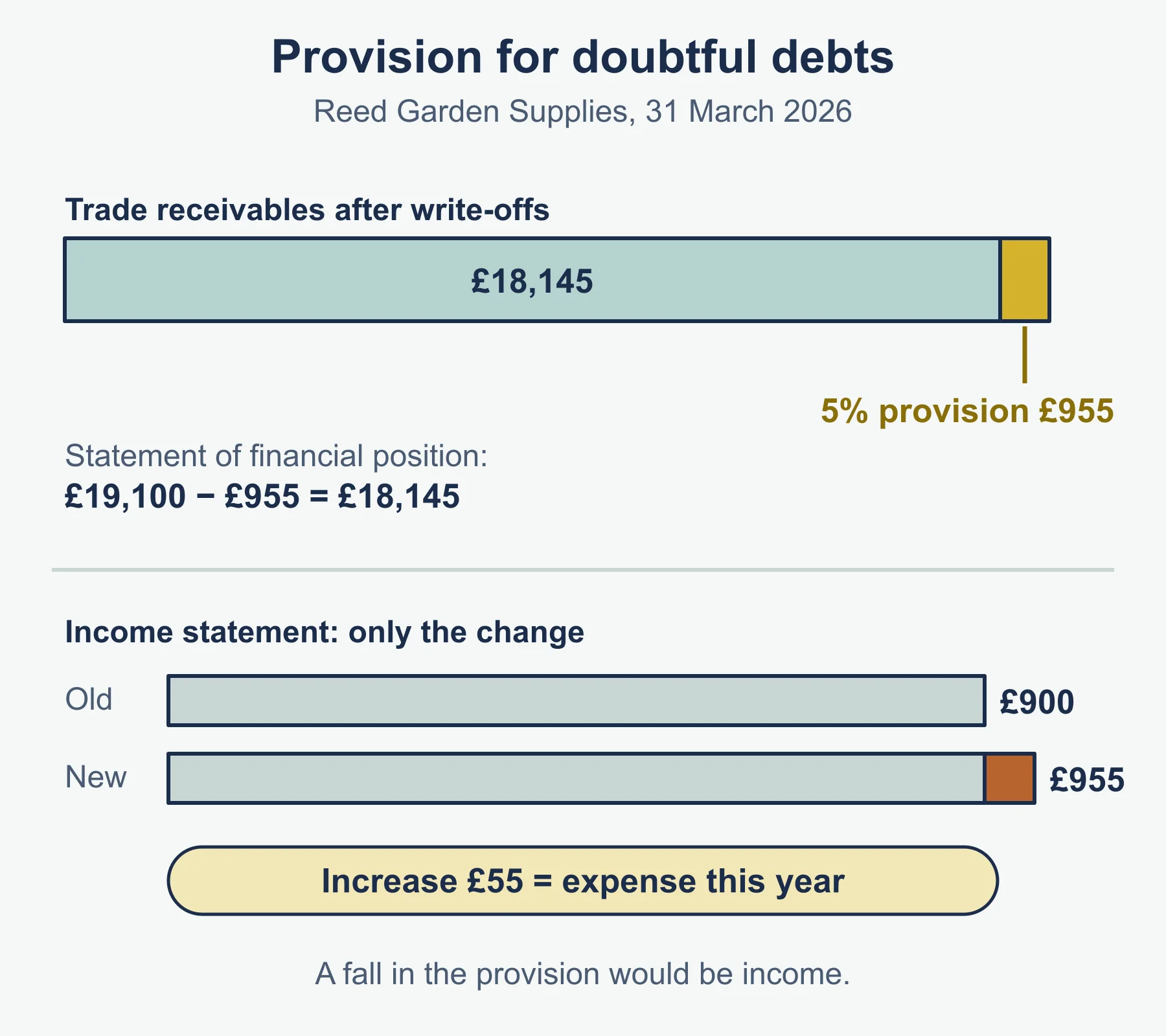
- Allowance: remaining receivables × percentage, minus the old allowance. A positive result is an expense; a negative result is income.
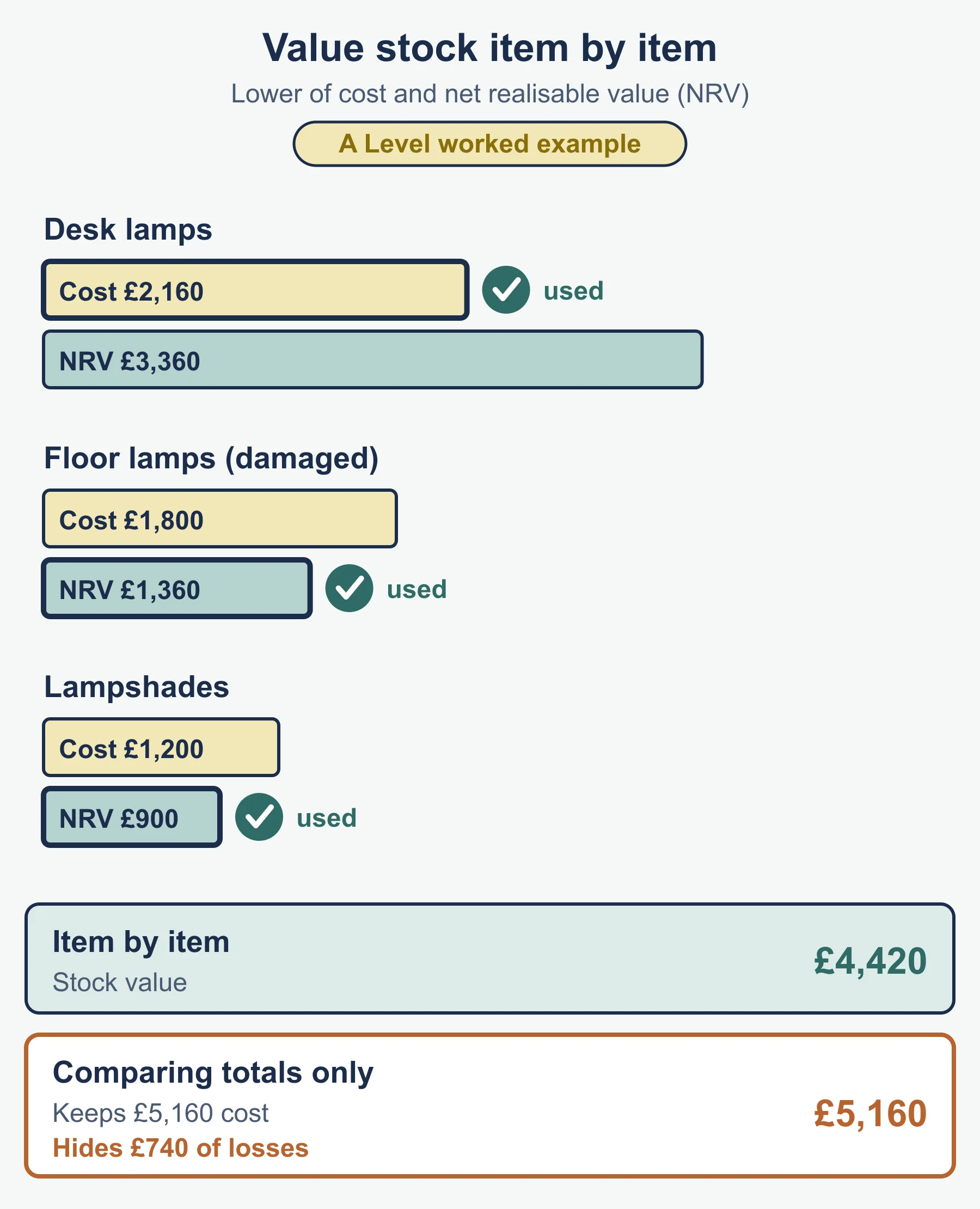
- Inventory: use whichever is lower of cost and net realisable value (NRV). Cost 5,200 with NRV 4,600 means a 600 write-down.
- Counting after the year end: closing inventory = count + cost of goods sold since the year end − purchases received since. A count of 18,400 plus sales of 3,000 at a 25% gross margin (cost 2,250) minus purchases of 1,100 gives 19,550.
- Insurance of 3,600 paid for 12 months from 1 October, with a 31 December year end: expense 900, prepayment 2,700.
Debt recovered, in full. A debt of 300 written off last year is recovered. Reinstate it (debit trade receivables 300, credit irrecoverable debts recovered 300), then record the cash (debit bank 300, credit trade receivables 300). The 300 is income in the statement of profit or loss.
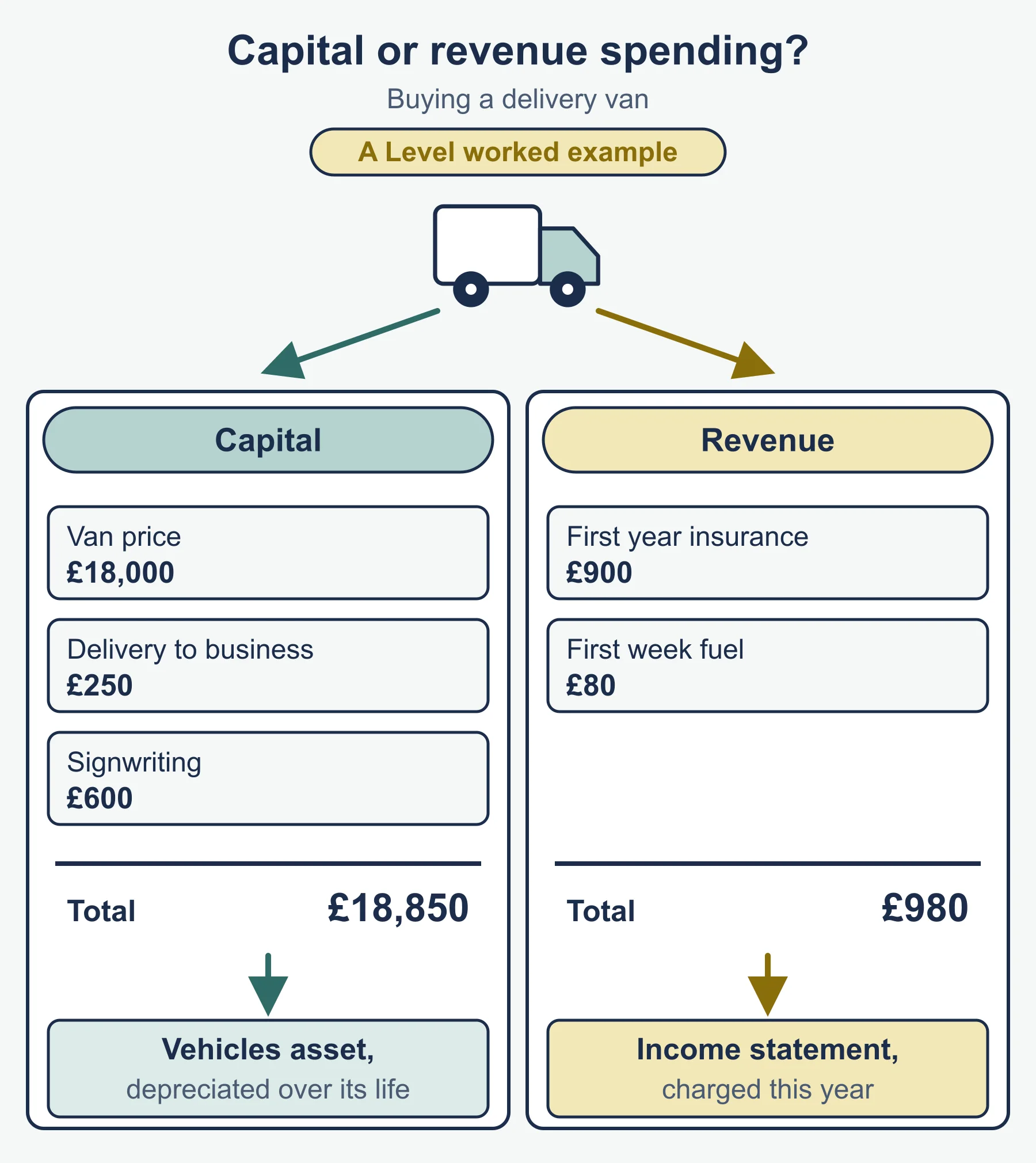
Correction of errors. Steps: (1) identify the wrong and the correct entry; (2) journal the correction, using suspense if the trial balance did not balance; (3) restate profit; (4) restate the affected assets or liabilities. Capital versus revenue mistakes change profit and the asset together.
1.5.2 Sole traders
| Statement | Order of content |
|---|---|
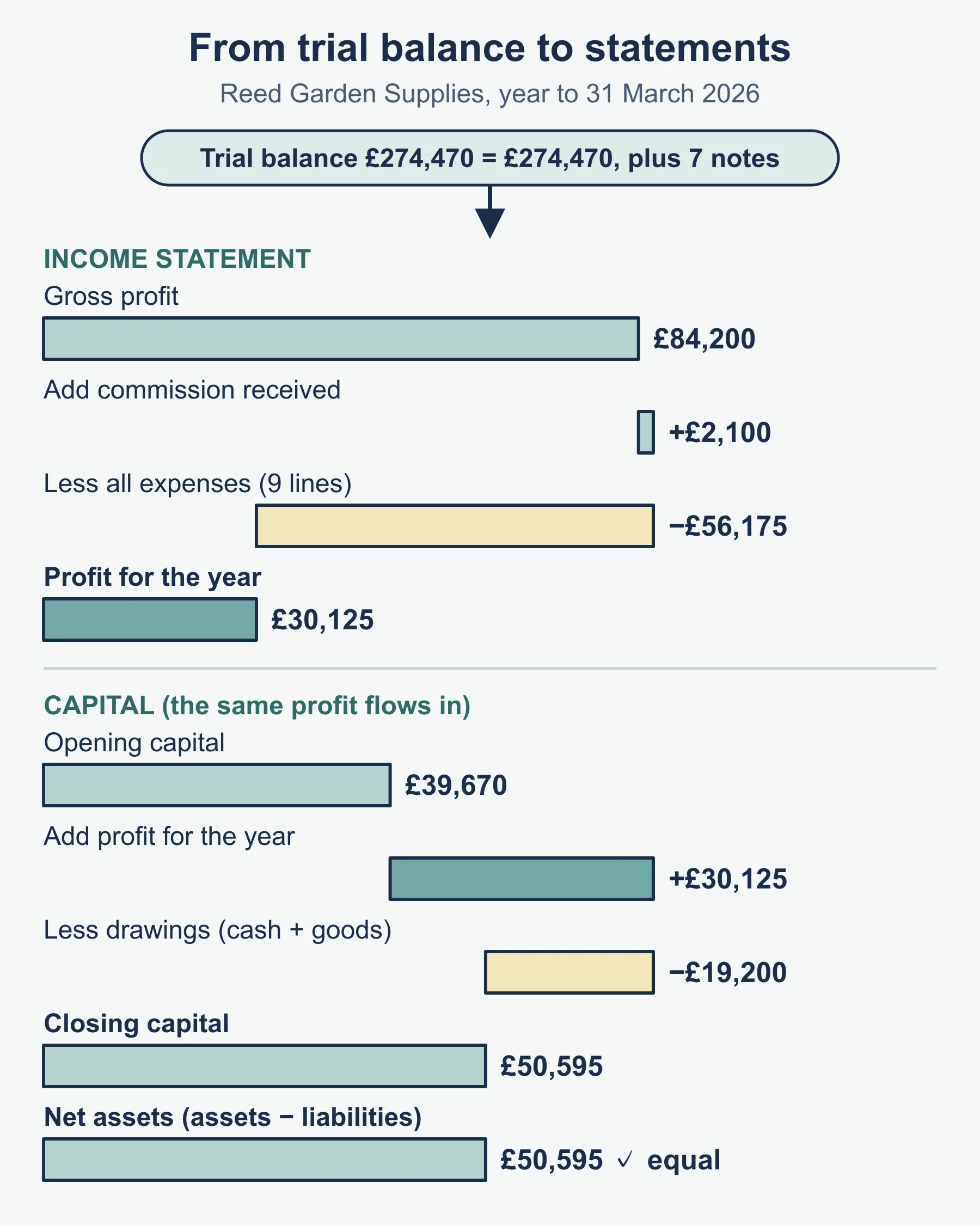
| Statement of profit or loss | Sales net of returns; less cost of sales (opening inventory + net purchases − closing inventory) = gross profit; + other income; − expenses = profit for the year |
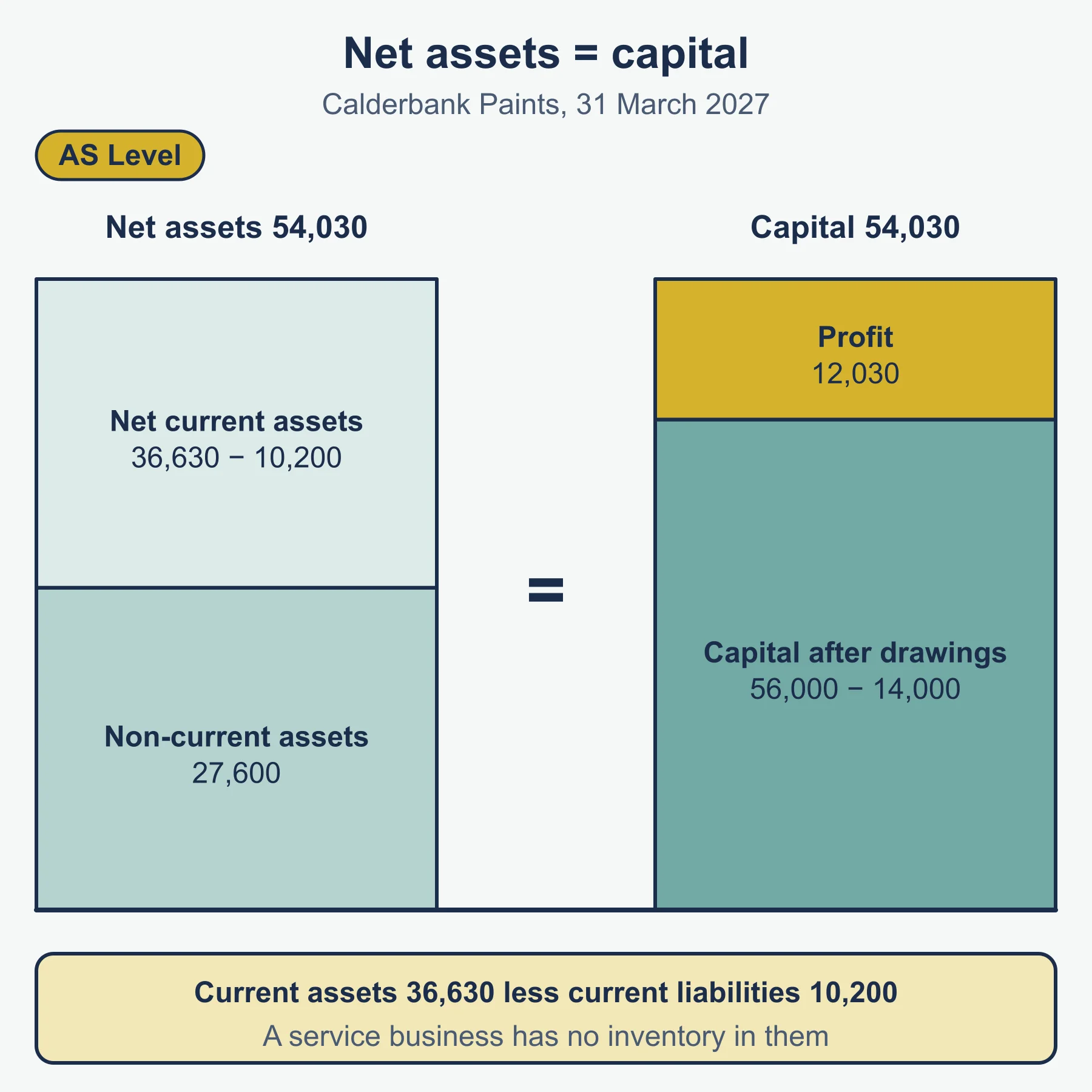
| Statement of financial position | Non-current assets shown at cost less accumulated depreciation (net book value); current assets; current liabilities; net assets = opening capital + profit − drawings |
A service business has no inventory or cost of sales: fees less expenses. A trading business and a service business both include the adjustments above.
Incomplete records, in steps
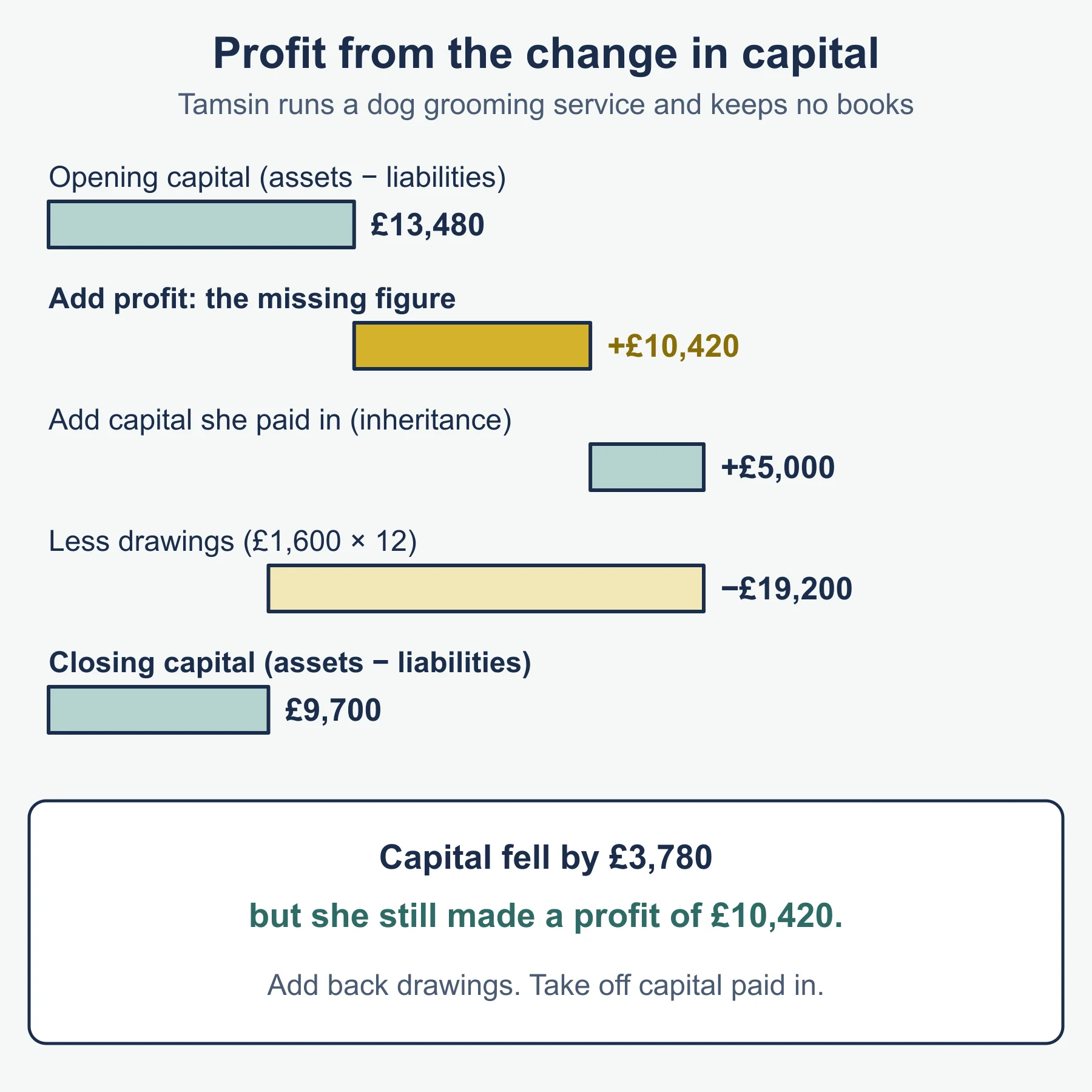
- Opening capital = opening assets − opening liabilities.
- Closing capital the same way.
- Profit = closing capital − opening capital + drawings − capital introduced.
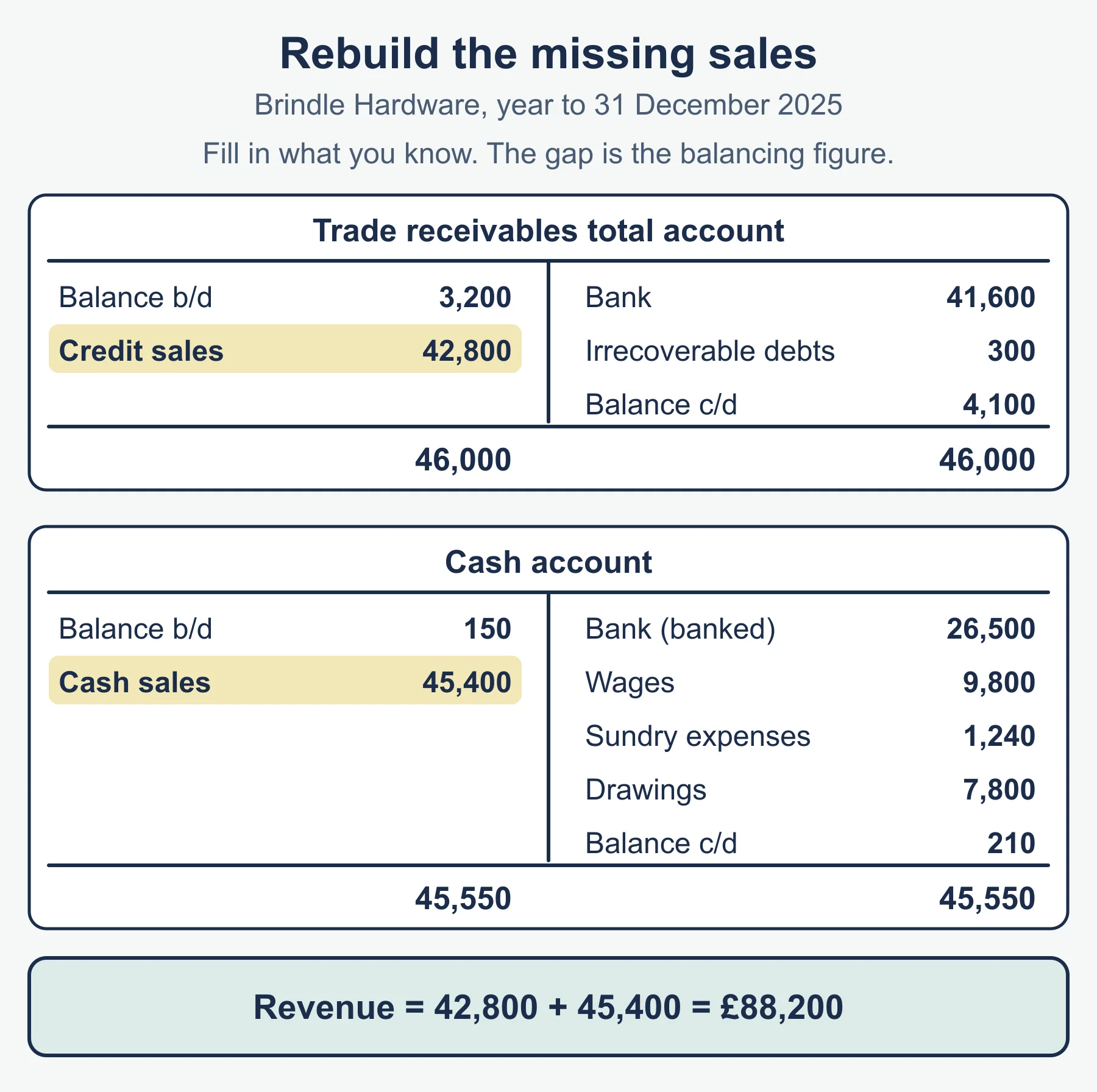
- Credit sales = receipts from customers + closing receivables − opening receivables, from a total trade receivables account.
- Purchases = payments + closing payables − opening payables, from a total trade payables account.
- If mark-up or margin is given, use it to link sales and cost of sales.
1.5.3 Partnerships
| Account | Records | Changes when |
|---|---|---|
| Capital account | Long-term investment | Partners agree to add or withdraw capital |
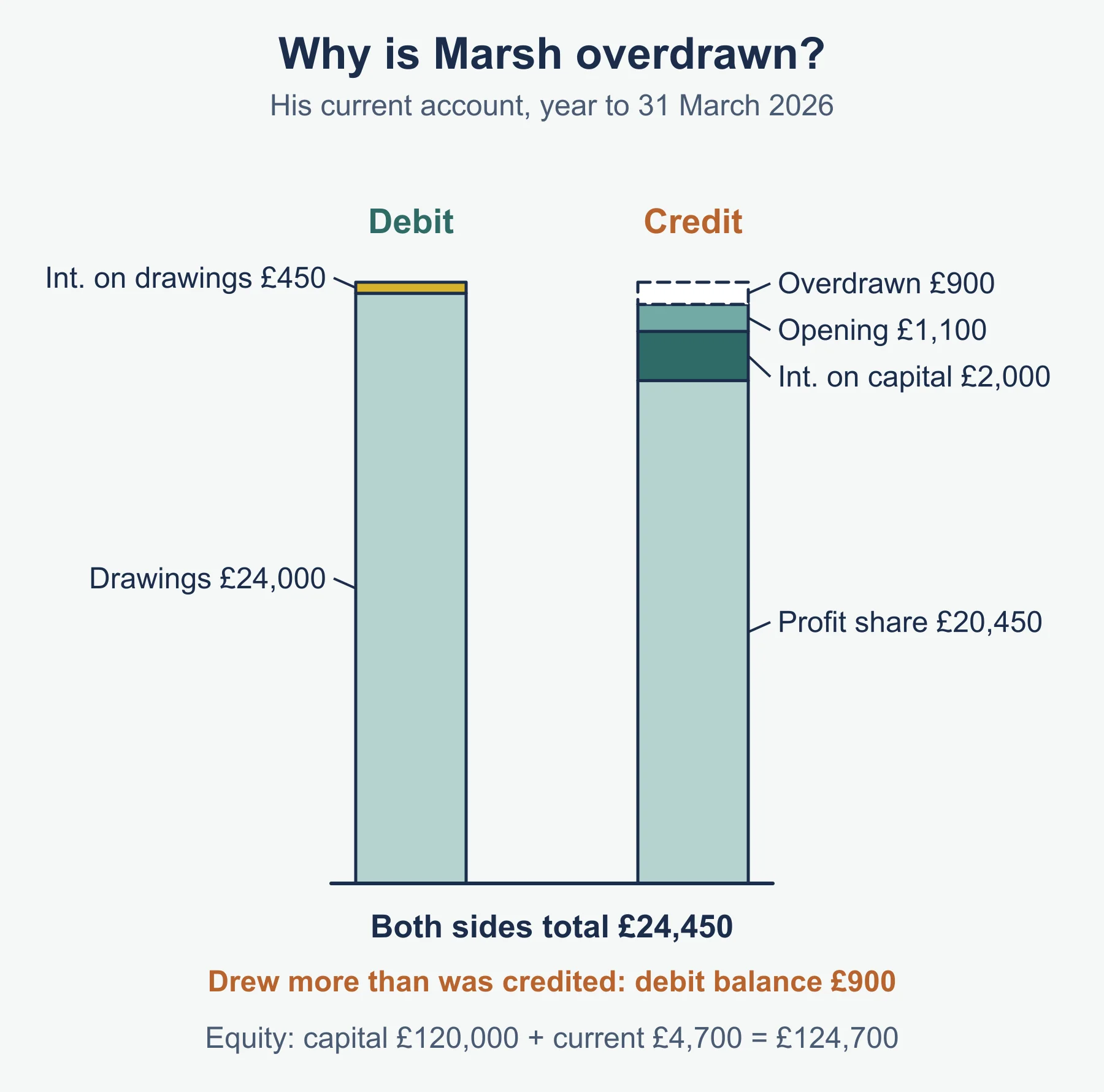
| Current account | Profit share, salary, interest; drawings | Every year |
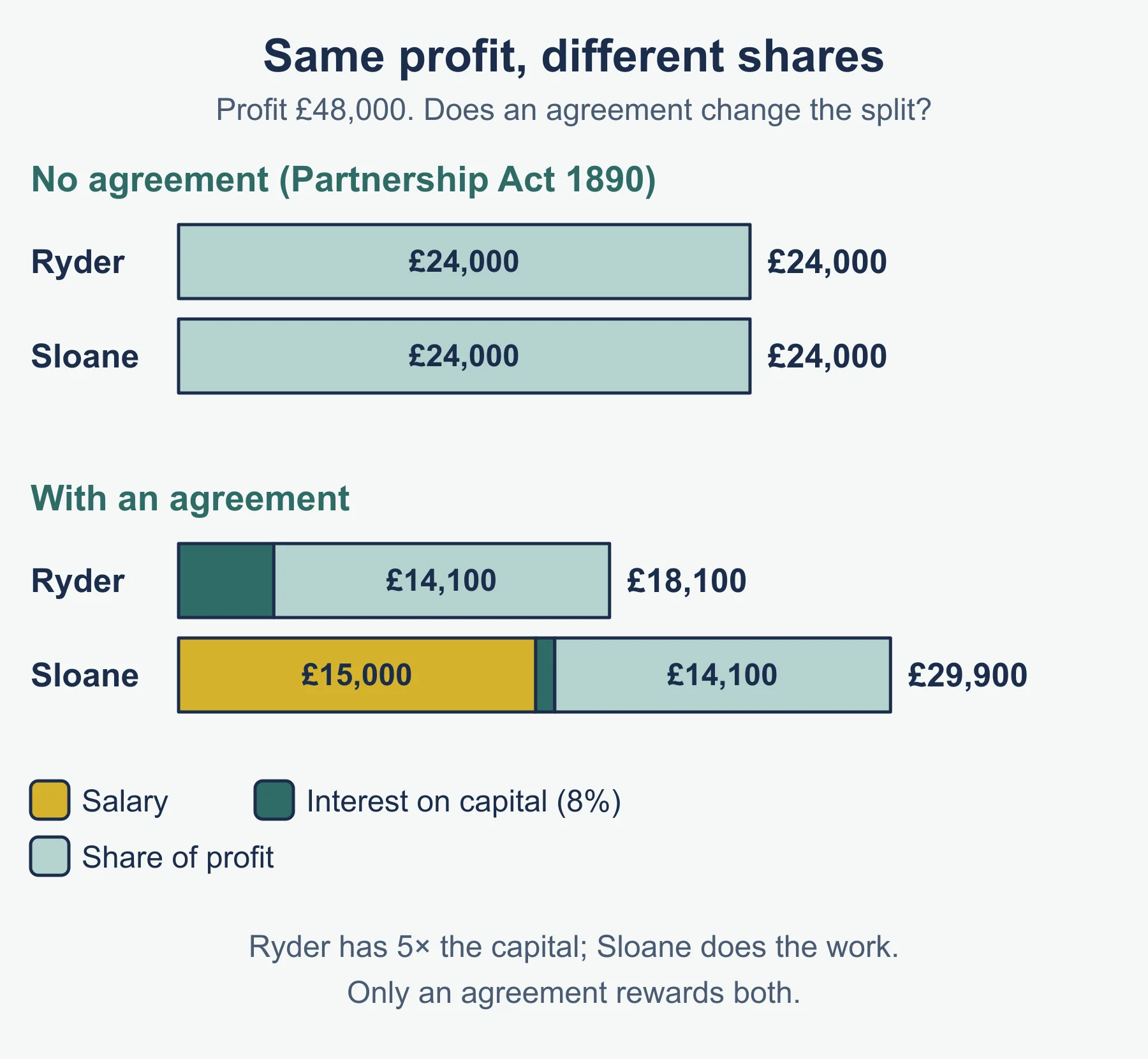
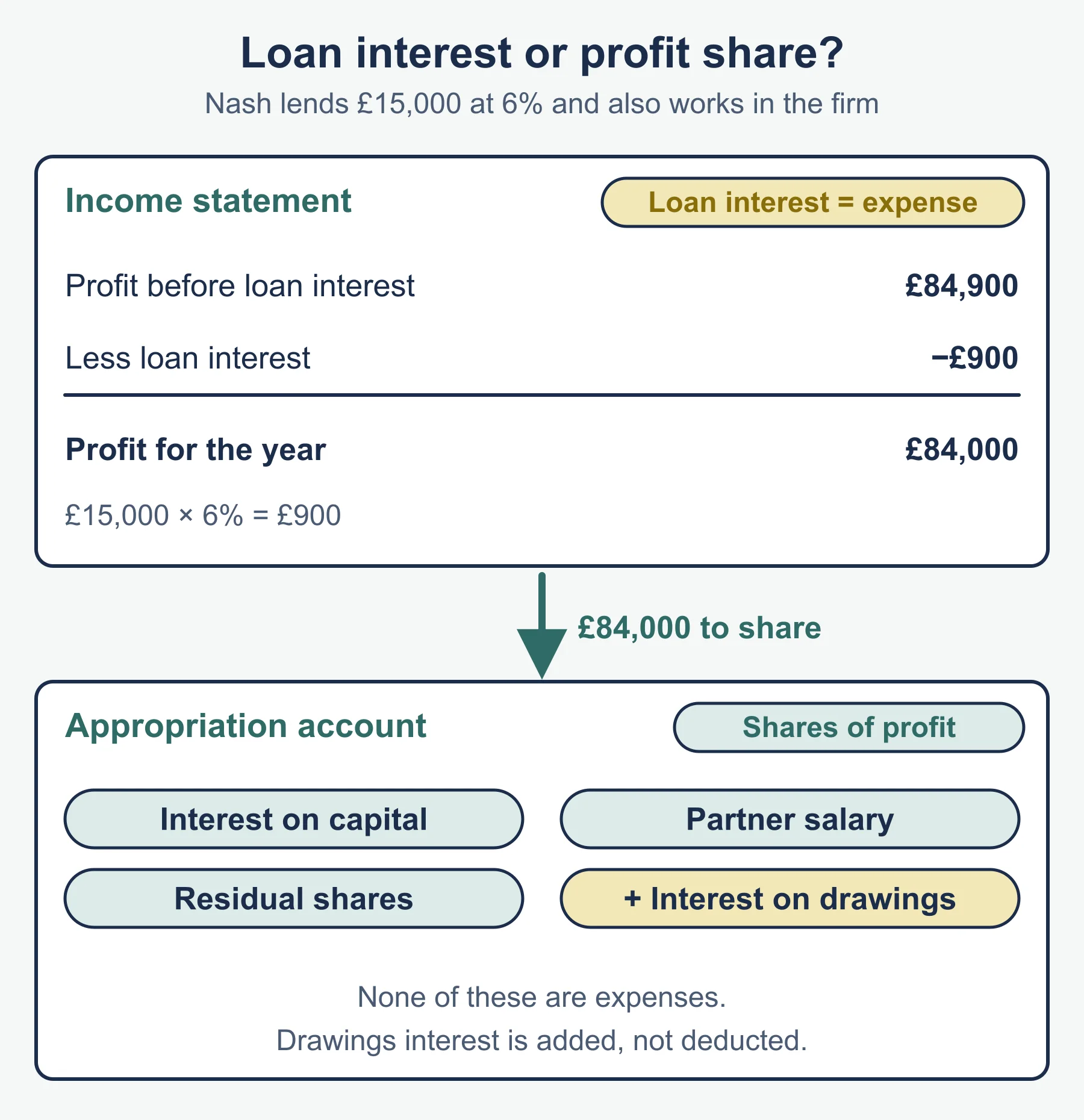
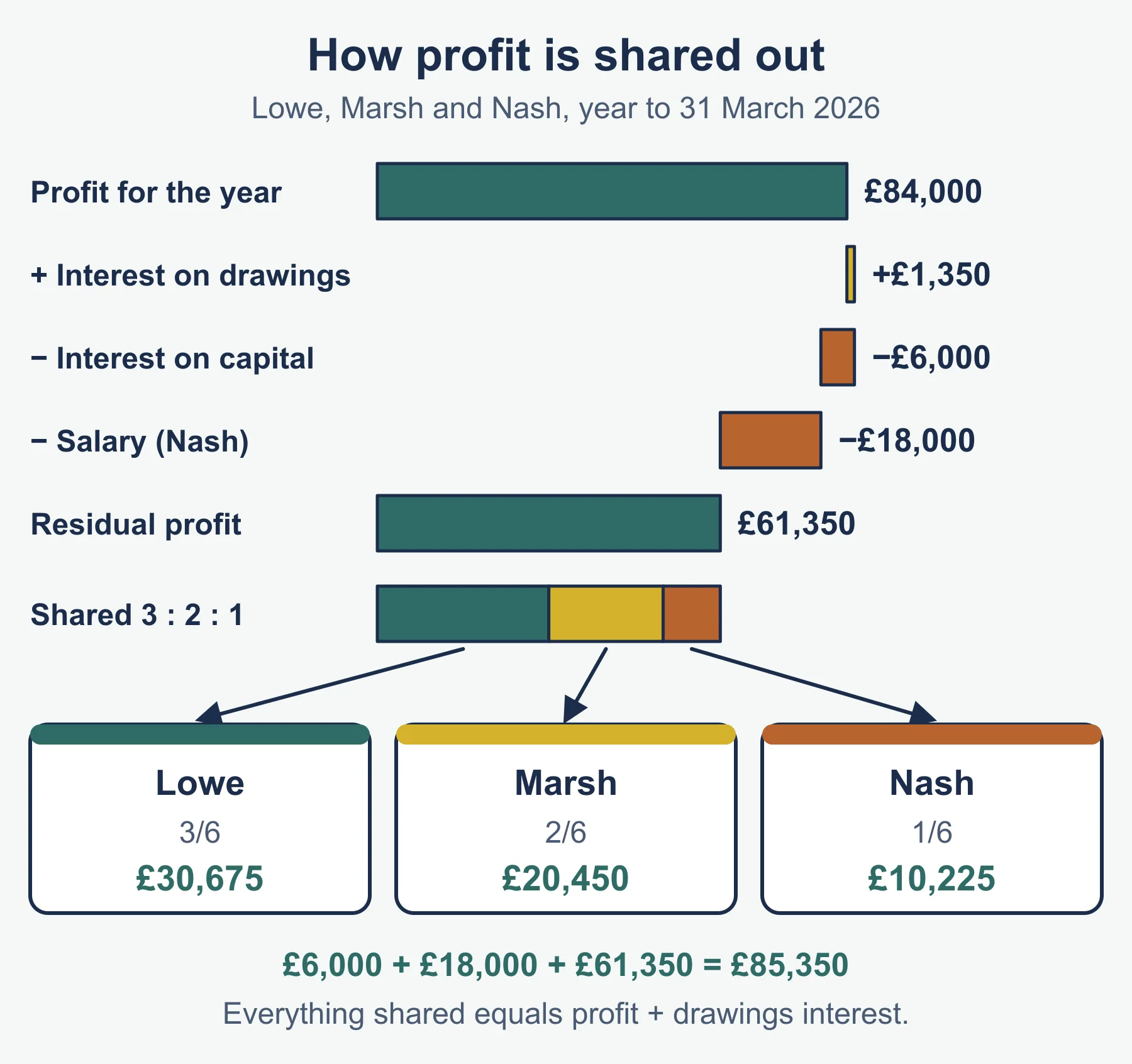
Appropriation account, in order: begin with profit for the year, add interest on drawings, take off salaries and interest on capital, then divide what is left in the agreed ratio. Interest on a partner’s loan is charged as an expense before profit for the year, not appropriated.
| Item | Agreement may say | Partnership Act 1890 (no agreement) |
|---|---|---|
| Profit or loss | Any ratio | Shared equally |
| Salaries | Agreed | None |
| Interest on capital | Agreed rate | None |
| Interest on drawings | Agreed rate | None |
| Interest on partner’s loan | Agreed rate | 5% a year |
Partnership statement of financial position: each partner’s fixed capital and current account are shown in the financing section, with any partner’s loan as a non-current liability. Partnership accounts can also be prepared from incomplete records, using the sole trader steps above, then appropriating the profit.
Contents of an agreement: capital each partner contributes, profit-sharing ratio, salaries, interest on capital, interest on drawings, interest on loans, and arrangements for new or leaving partners.
Advantages of a written agreement: fewer disputes, clear rewards, and flexibility away from equal sharing. Disadvantages: it takes time and cost to draft, it can only be changed by agreement, and fixed terms may stop matching what each partner contributes.
Reminder. X (capital 50,000) and Y (30,000) earn 6% interest on capital. Y has a salary of 9,000. Profit is 40,000 shared equally. Interest is 3,000 and 1,800; residual 26,200; 13,100 each. X receives 16,100 and Y 23,900.
1.5.4 Limited companies
| Term | Notes |
|---|---|
| Ordinary shares | Vote; variable dividend; last to be paid. Preference shares are not set for questions |
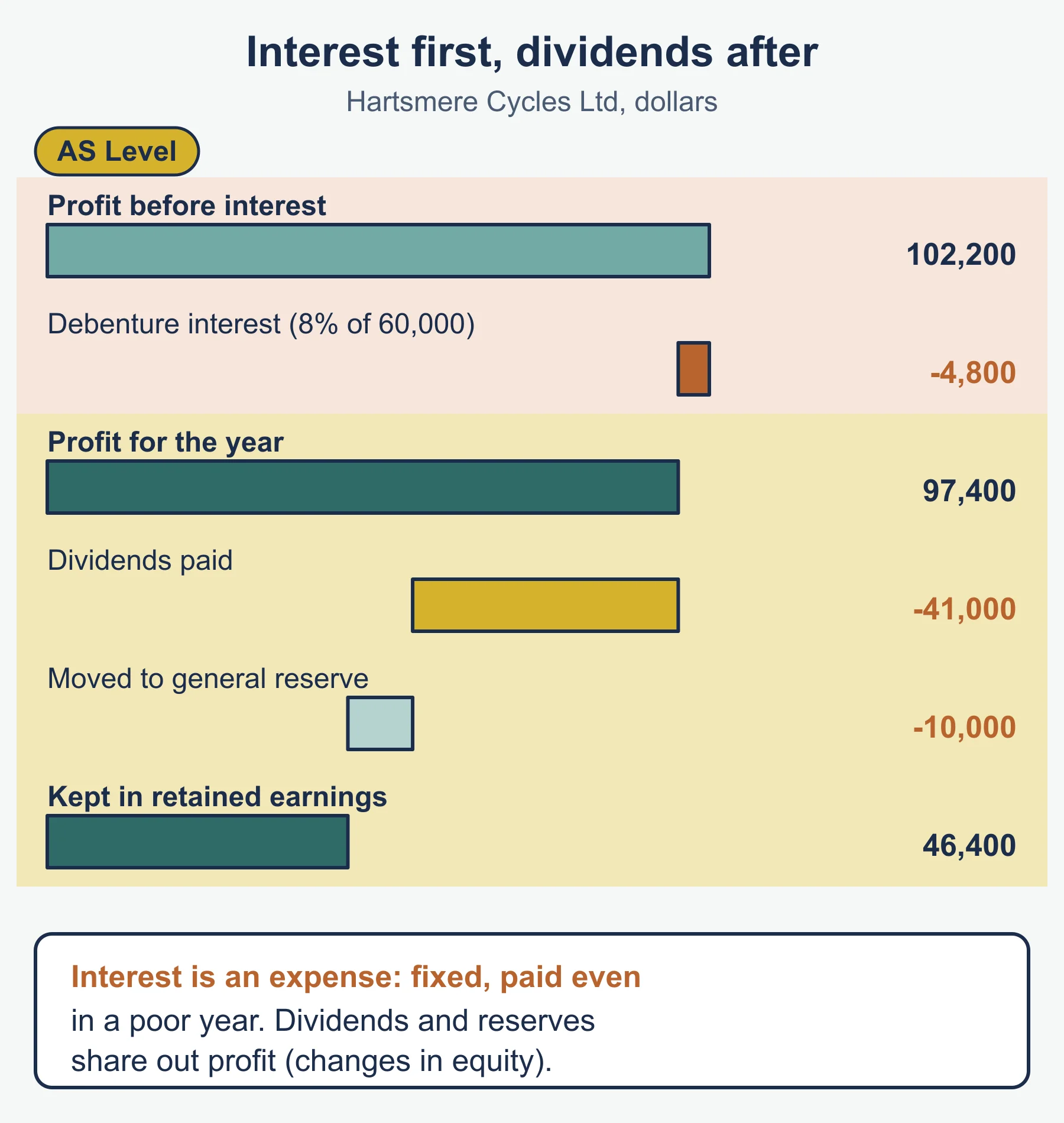
| Debentures | Fixed interest, a liability; interest is a finance cost |
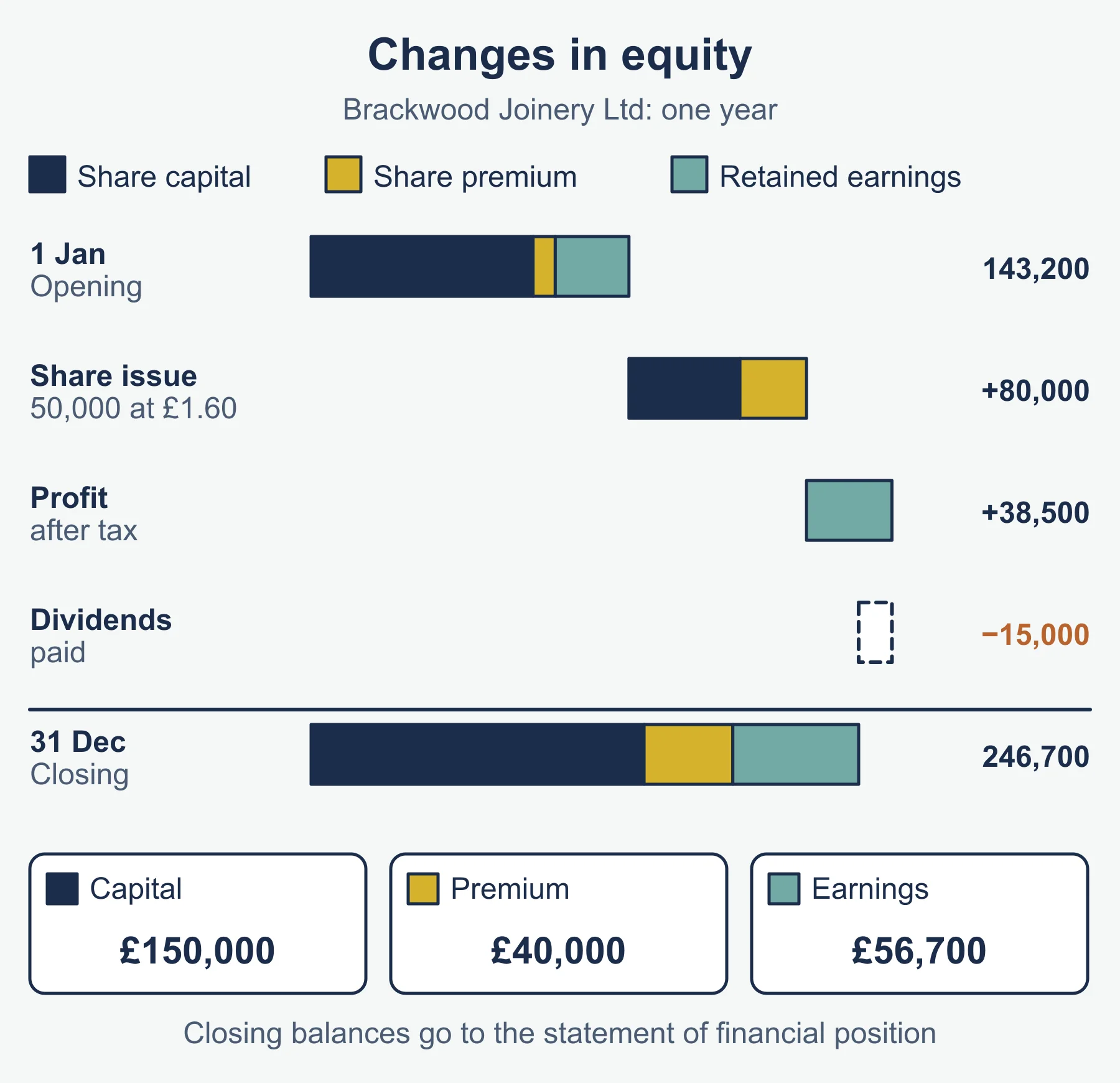
| Dividends | Appropriation of profit, shown in the statement of changes in equity |
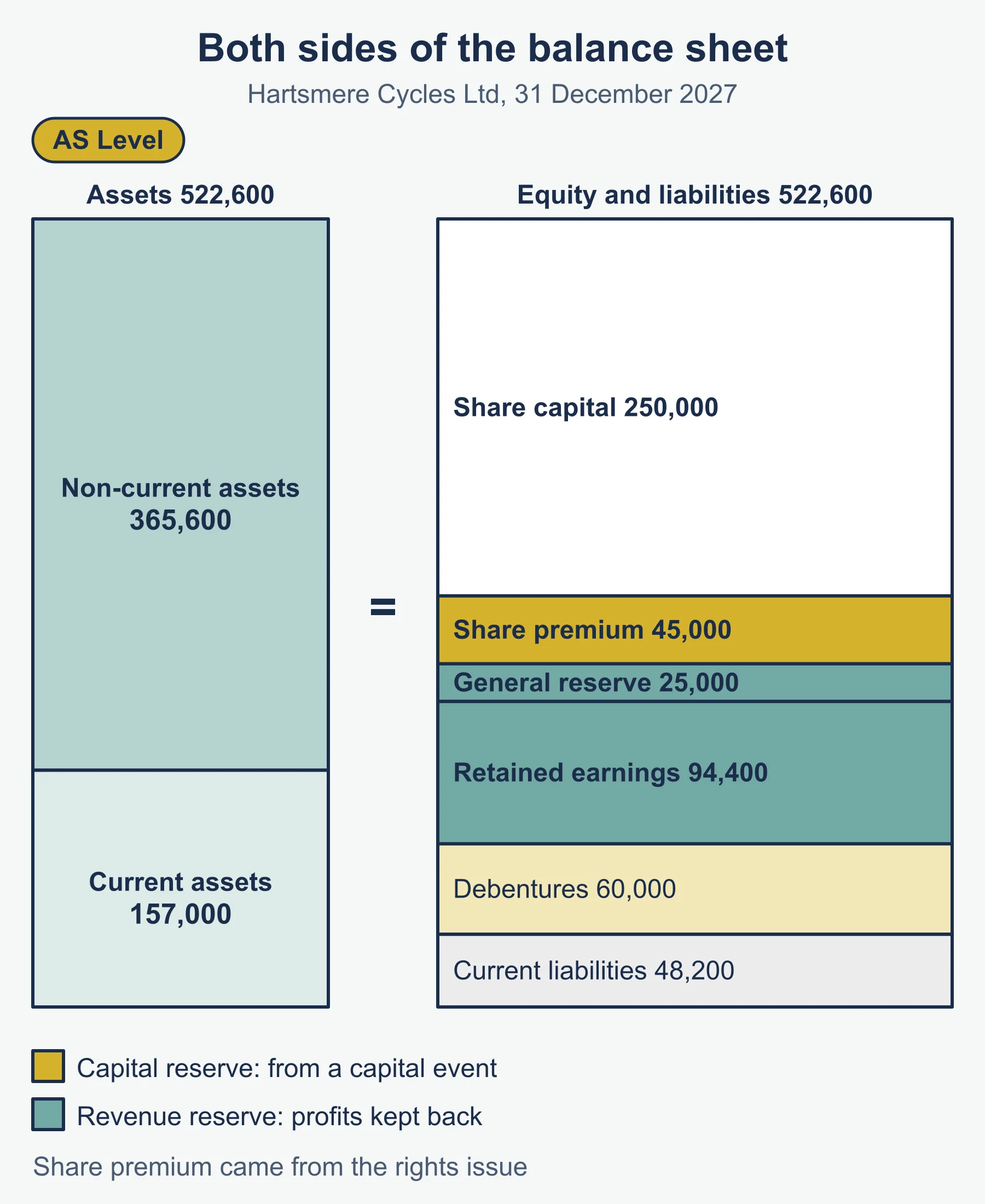
| Capital reserves | Share premium, revaluation reserve |
| Revenue reserves | Retained earnings, general reserve |
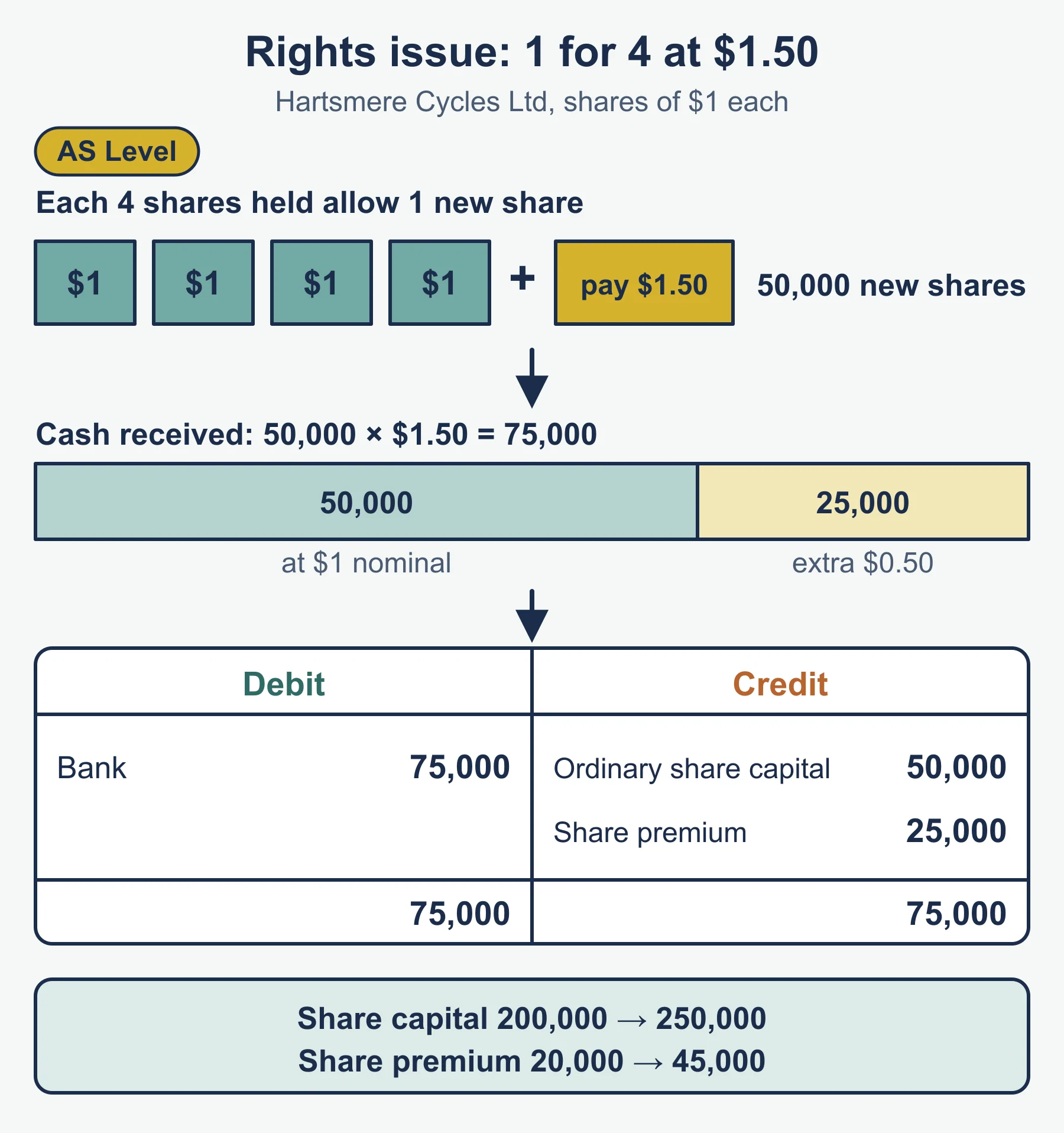
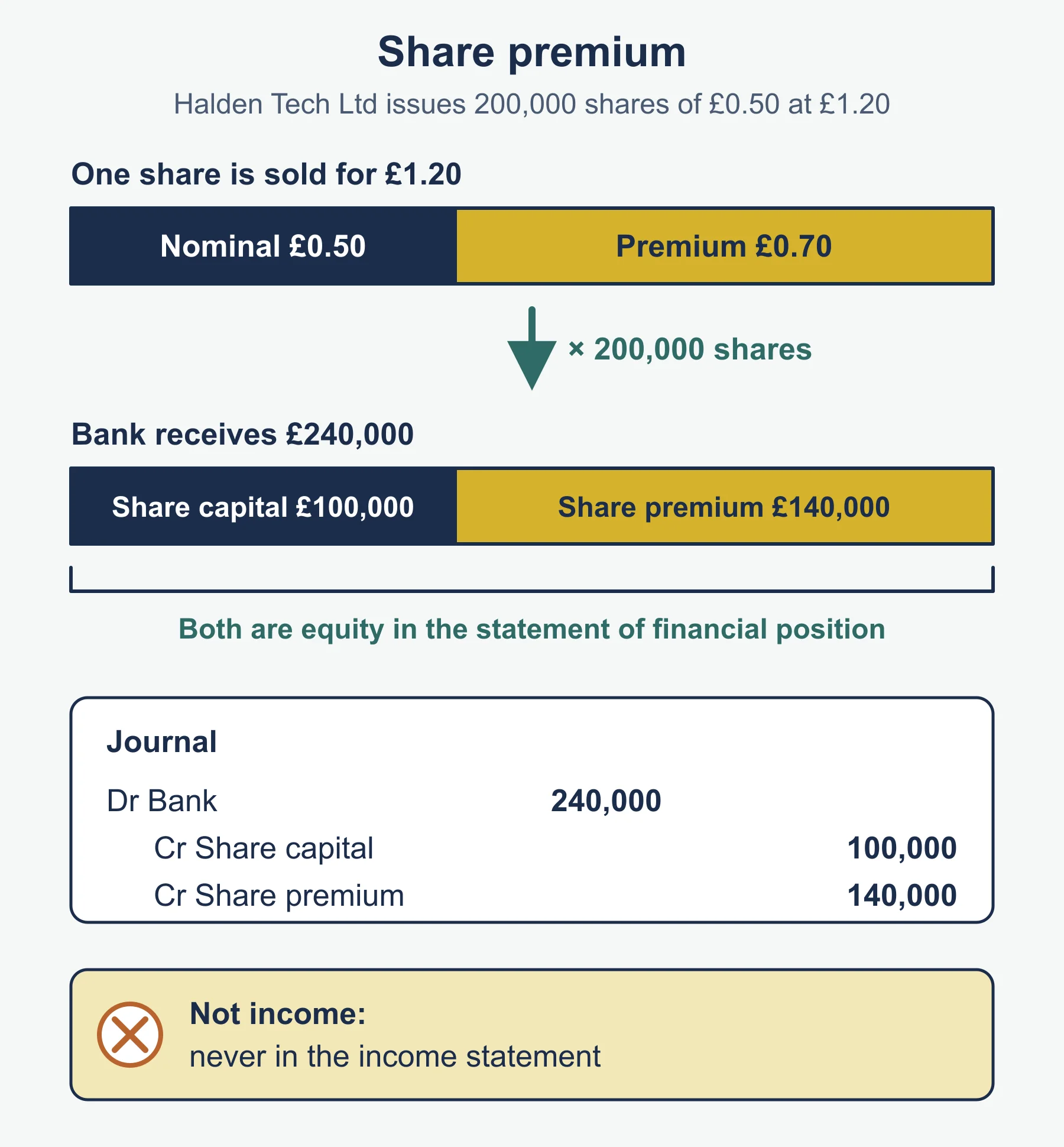
| Share issue entries | Par: debit bank, credit share capital. Premium: credit share capital with nominal value and share premium with the excess. Rights issue: same entries, at the rights price |
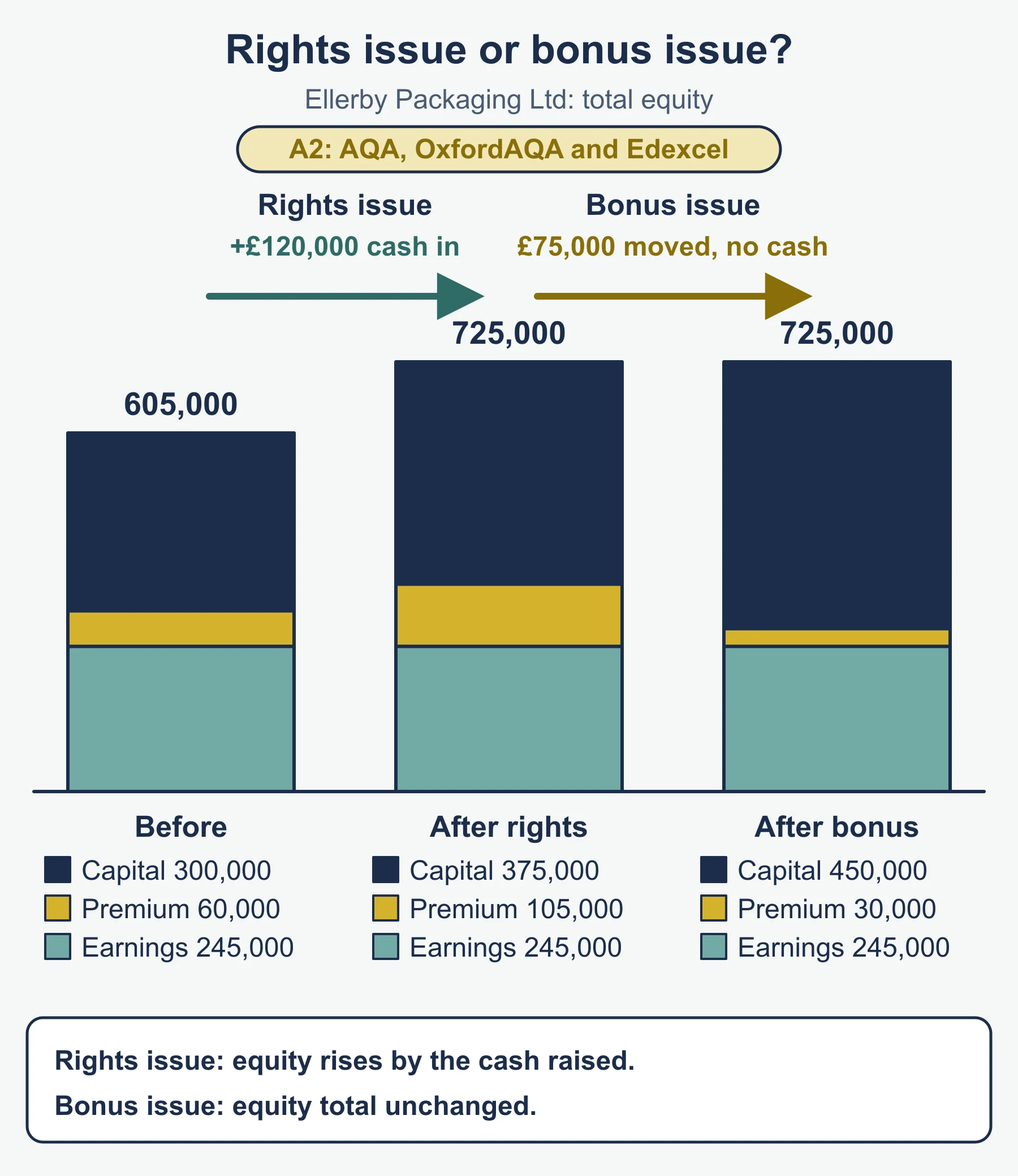
| Bonus issue | Debit a reserve, credit share capital; no cash. The revaluation reserve is not used |
Rights issue worked reminder. A 2 for 5 rights issue on 90,000 shares of 1 at 1.80 creates 36,000 shares: bank 64,800, share capital 36,000, share premium 28,800.
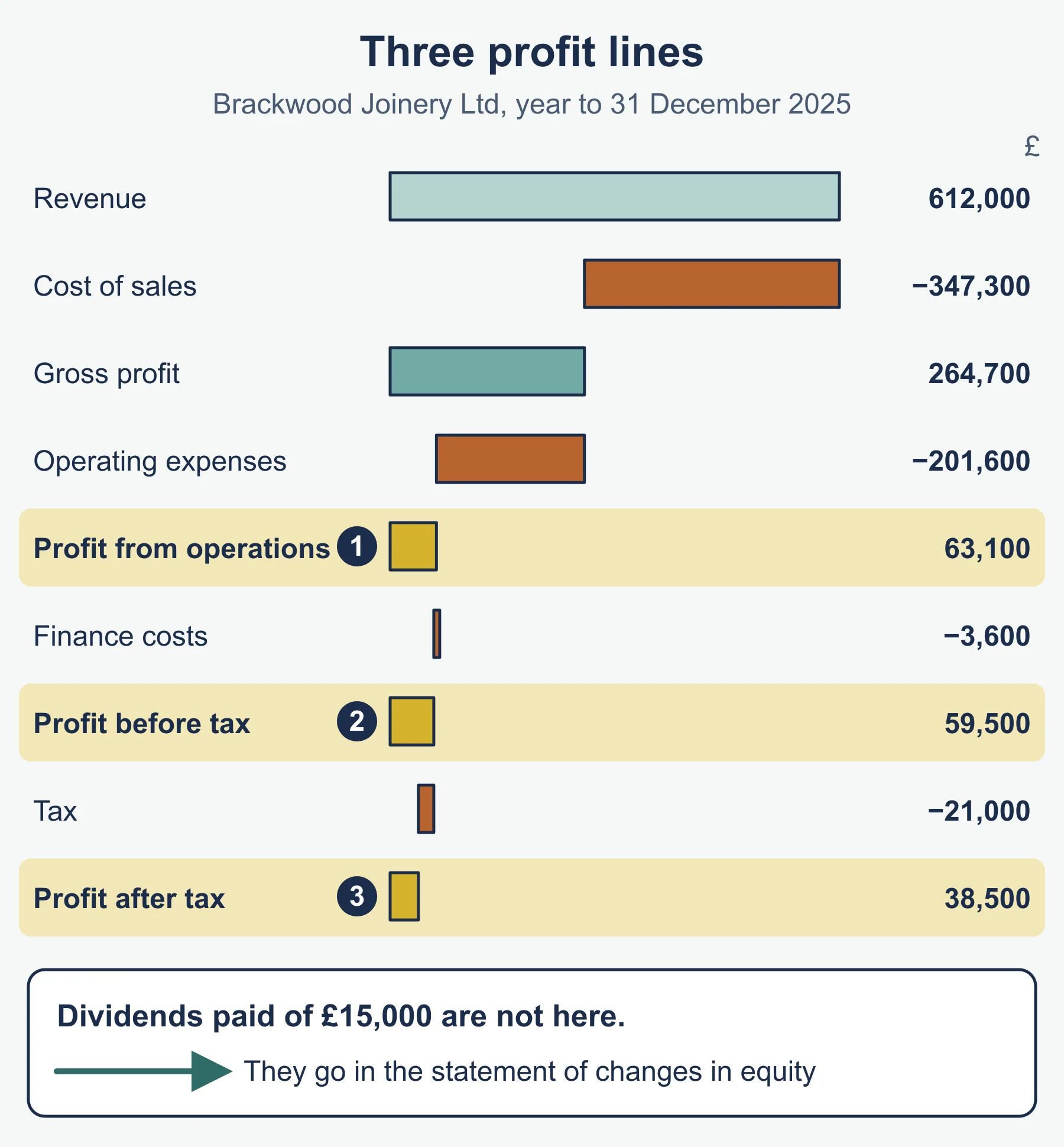
Company statements. The statement of profit or loss ends at profit for the year, after deducting debenture interest. The statement of changes in equity has a column for each component of equity: share capital, share premium, reserves and retained earnings, with rows for the issues, profit, dividends and transfers. The statement of financial position shows equity, non-current liabilities (debentures) and current liabilities. Top to bottom the company profit statement runs: revenue; cost of sales; gross profit; distribution costs; administrative expenses; finance cost; profit for the year.
| Decision | Company | Shareholders |
|---|---|---|
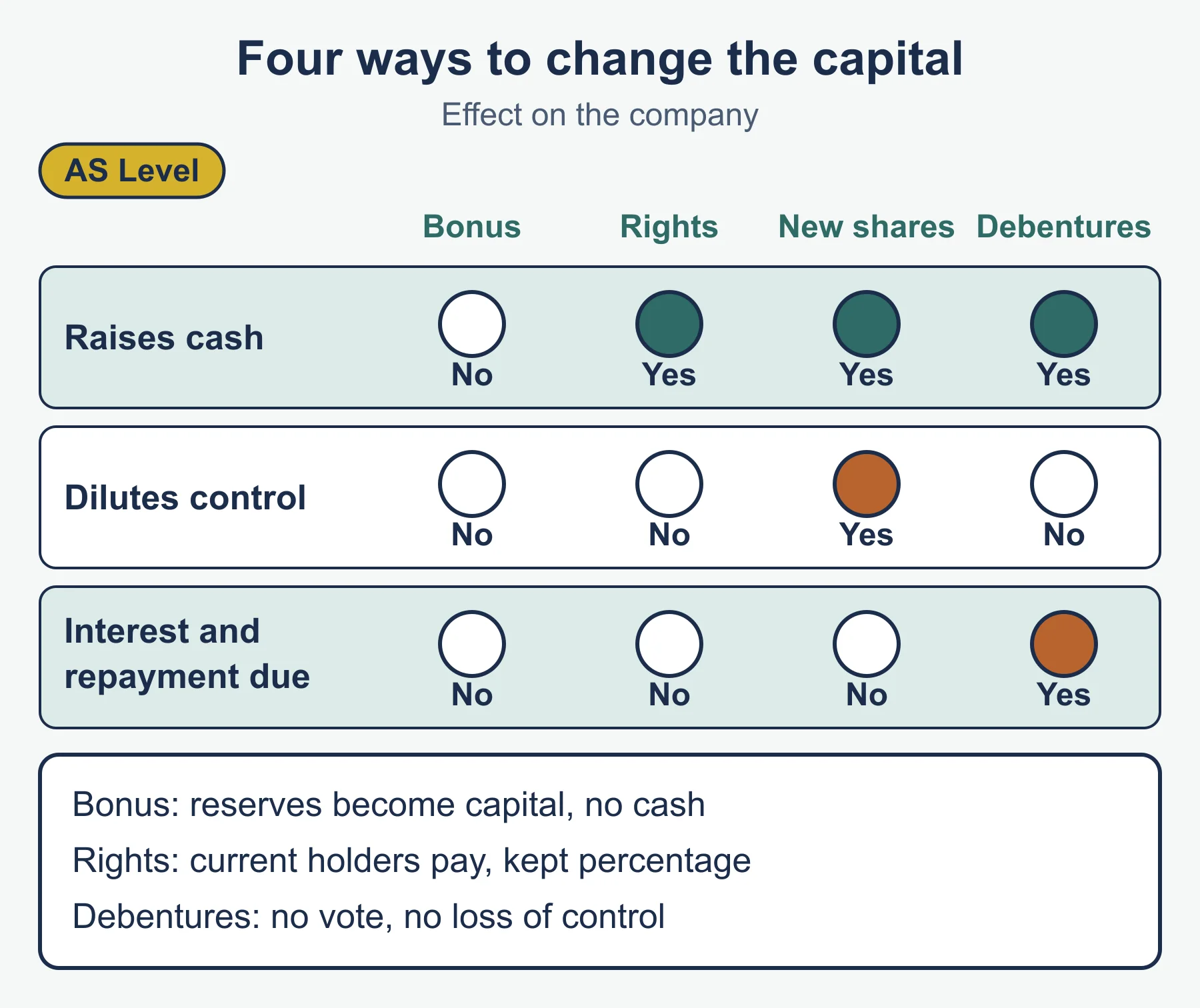
| Bonus issue | Advantage: no cash leaves, and a lower price per share can help trading. Disadvantage: no cash raised | Advantage: more shares, easier to sell part. Disadvantage: total value and share of the company do not change |
| Rights issue | Advantage: raises cash without new owners or interest. Disadvantage: needs shareholder support | Advantage: shares at a discount. Disadvantage: they must pay or be diluted |
| Issue shares | Advantage: no fixed payment. Disadvantage: control shared and dividends spread | Advantage: votes and a share of growth. Disadvantage: last in the queue |
| Issue debentures | Advantage: control kept. Disadvantage: interest and repayment are compulsory | Advantage: fixed income and priority. Disadvantage: no vote and no share of growth |
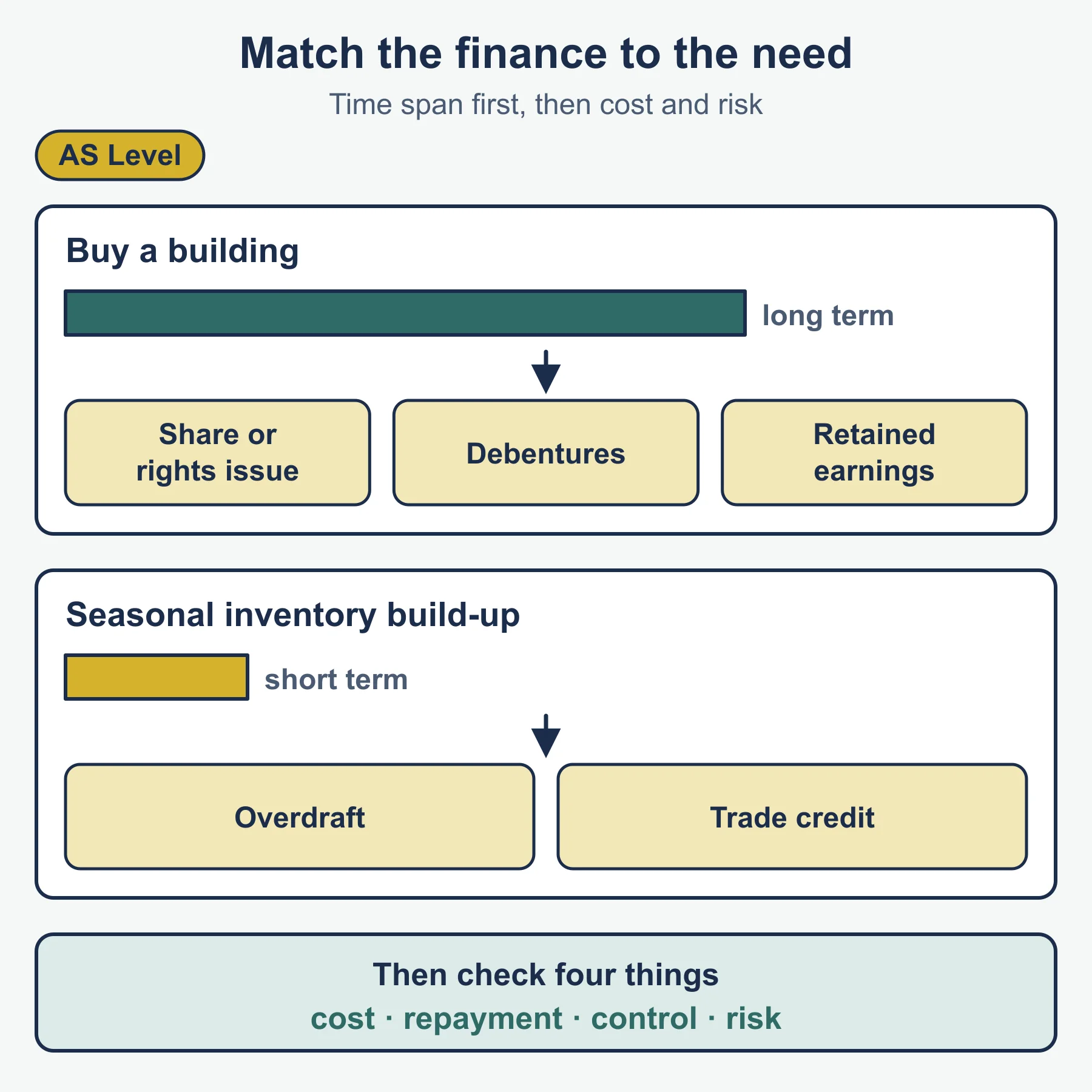
Sources of finance by purpose: long-term assets need long-term finance (shares, rights issue, debentures, retained earnings); short-term cash gaps suit an overdraft or trade credit; a lasting rise in activity needs permanent finance.
Must-know distinctions
- Capital account against current account.
- Interest on a partner’s loan (expense) against interest on capital (appropriation).
- Capital reserve against revenue reserve.
- Bonus issue (no cash) against rights issue (cash received).
- Interest (statement of profit or loss) against dividends (statement of changes in equity).
- Irrecoverable debts against the allowance.
Quick self-test
- Rent paid in the year was 7,200. 600 was owing at the start and 900 at the end. Find the expense.
- Trade receivables are 20,000 before writing off 1,000. The allowance is 4% and the old allowance 650. Find the total charge.
- Three partners with no agreement; one lent 10,000. Profit before the loan interest is 30,500. Find the interest and each share.
- Opening capital 21,500, closing 26,300, drawings 11,000, new capital 2,000. Find profit.
- A 1 for 4 bonus issue on 120,000 shares of 1. Give the entry.
- Name two revenue reserves.
- Where does debenture interest go: the profit statement or the statement of changes in equity?
- Which concept justifies accruals and prepayments?
- Give two things the Act gives a partner with no agreement.
- Why might a company prefer a rights issue to debentures?
- May a revaluation reserve fund a bonus issue?
Answers
- 7,200 + 900 − 600 = 7,500.
- Remaining receivables 19,000; allowance 760; increase 110; charge 1,000 + 110 = 1,110.
- Interest 5% × 10,000 = 500; (30,500 − 500) ÷ 3 = 10,000 each.
- 26,300 − 21,500 − 2,000 + 11,000 = 13,800.
- 30,000 new shares: debit a revenue reserve (such as retained earnings) 30,000, credit ordinary share capital 30,000.
- Retained earnings and general reserve.
- The statement of profit or loss, as a finance cost.
- Matching/accruals.
- Equal shares of profit and 5% on loans (also: no salary, no interest on capital).
- It raises cash with no compulsory interest or repayment.
- No: the syllabus says the revaluation reserve is not used for a bonus issue.
Where marks are usually lost
- Charging the full allowance instead of the change.
- Putting a partner’s loan interest in the appropriation account.
- Forgetting interest on drawings is added to profit available.
- Using the revaluation reserve in a bonus issue.
- Showing a dividend in the statement of profit or loss.
- Taking closing inventory at cost when NRV is lower.
- Leaving prepayments or accruals out of the statement of financial position.
- Not showing the accumulated depreciation as well as net book value.
Frequently asked questions
Is interest on drawings added or deducted in a partnership appropriation account? Interest on drawings is added to the profit available for appropriation, because it is charged to the partners. Deducting it is a common mistake.
Can the revaluation reserve be used for a bonus issue? No. The Cambridge 9706 syllabus says the revaluation reserve is not used for a bonus issue. A bonus issue debits another reserve and credits share capital, with no cash involved.
Where do dividends appear in a company’s accounts? Dividends are shown in the statement of changes in equity, not in the statement of profit or loss.
How should non-current assets be shown in the statement of financial position? Show cost, accumulated depreciation and net book value. Giving only the net book value is a common way to lose marks.
Official syllabus
Cambridge International AS & A Level Accounting 9706, syllabus for exams in 2026, 2027 and 2028, Cambridge Assessment International Education, section 1.5.
Get free revision emails (optional)
Occasional emails with practice questions, worked explanations and links to free resources for the qualification and subjects you choose. No spam, and you can unsubscribe from any email. The free tools on this site never need an email.
Related resources
-
Study guides
A Level Accounting: Accounting for Non-Current Assets (Cambridge 9706)
Capital versus revenue spending, why assets depreciate depreciation methods, cost and revaluation models and disposals, for Cambridge 9706 Accounting topic 1.3.
Accounting · Cambridge · AS Level
Read guide -
Study guides
A Level Accounting: Regulatory and ethical considerations (Cambridge 9706)
Study guide to nine International Accounting Standards, the five ethical principles, audit and stewardship, for Cambridge 9706 A Level Accounting.
Accounting · Cambridge · A Level
Read guide -
Practice questions
A Level Accounting: Regulatory and ethical considerations (Cambridge 9706) – Practice Questions
Ten original questions with worked answers on IAS 1 to 38, ethical principles, audit and stewardship, for Cambridge 9706 A Level Accounting.
Accounting · Cambridge · A Level
Try questions
Related articles
-
teaching
A Level tuition in Dubai: Cambridge or Pearson Edexcel International A Level?
Schools in Dubai and Abu Dhabi teach either Cambridge International AS & A Level or Pearson Edexcel International A Level. How the two are structured, why it matters for tuition, and how online classes from Lahore work.
9 October 2026
-
curriculum guides
Choosing subjects at IGCSE and A Level
How subject choices at 14 and 16 affect university options later, and how to keep pathways open without overloading a timetable.
28 July 2026
Studying this with a teacher
Working through Accounting AS LEVEL?
This page is free and stays free. If you would rather be taught it, Marlbridge runs Accounting classes one-to-one and in small groups of up to 15, online in your own time zone. The first trial class is free. WhatsApp replies within an hour (8am–11pm Pakistan time, every day); email the same day.
Cambridge Accounting teachers at Marlbridge

