
Study Guides
A Level Accounting: Analysis and communication of accounting information (AS) (Cambridge 9706)
Stakeholder information needs, profitability, liquidity and efficiency ratios, evaluation, improvements and limitations for Cambridge AS Accounting 9706.
- Subject
- Accounting
- Level
- AS LEVEL
- Topic
- Financial accounting
- Author
- Marlbridge Academic Team
- Updated
- Reviewed by
- Zain Ud Din Ahmed (what this means)
Aligned to Cambridge A Level Accounting (9706), 2026-2028. Official specification .
Syllabus page (what it covers and how it is assessed): Cambridge A Level Accounting.
Syllabus points this page covers
9706 (AS Level)
- 1.6 Analysis and communication of accounting information
Found an error? Report a correction.
Need help with this topic? Request a free trial class for A Level Accounting (9706).
This guide covers section 1.6, Analysis and communication of accounting information, of the Cambridge International AS & A Level Accounting 9706 syllabus for exams in 2026, 2027 and 2028. It is AS Level content (1.6.1 Users of accounting information and 1.6.2 Calculation and evaluation of ratios) and sits within Financial accounting. For the matching condensed page see the revision notes, and for exam-style questions the practice set. The wider course is at the Cambridge A Level Accounting hub, with a printable checklist and the free diagnostics. Non-current asset values used below come from Accounting for Non-Current Assets.
What you must be able to do
| Syllabus point | What it asks of you |
|---|---|
| 1.6.1 | Explain the differing information needs of owners, managers, employees, investors, lenders, suppliers, customers, government, and public and environmental bodies |
| 1.6.1 | Communicate and analyse the information each group requires |
| 1.6.2 | Calculate profitability, liquidity and efficiency ratios |
| 1.6.2 | Evaluate profitability, liquidity and efficiency by interpreting ratios |
| 1.6.2 | Suggest measures to improve profitability, liquidity and efficiency |
| 1.6.2 | Explain the limitations of accounting information |
The syllabus also expects you to compare a business with similar businesses and industry benchmarks, and to appreciate problems that limit such a comparison. The notes say candidates must use the formulae in the appendix to section 3 of the syllabus, and that these are the only formulae accepted in responses.
1.6.1 Users of accounting information
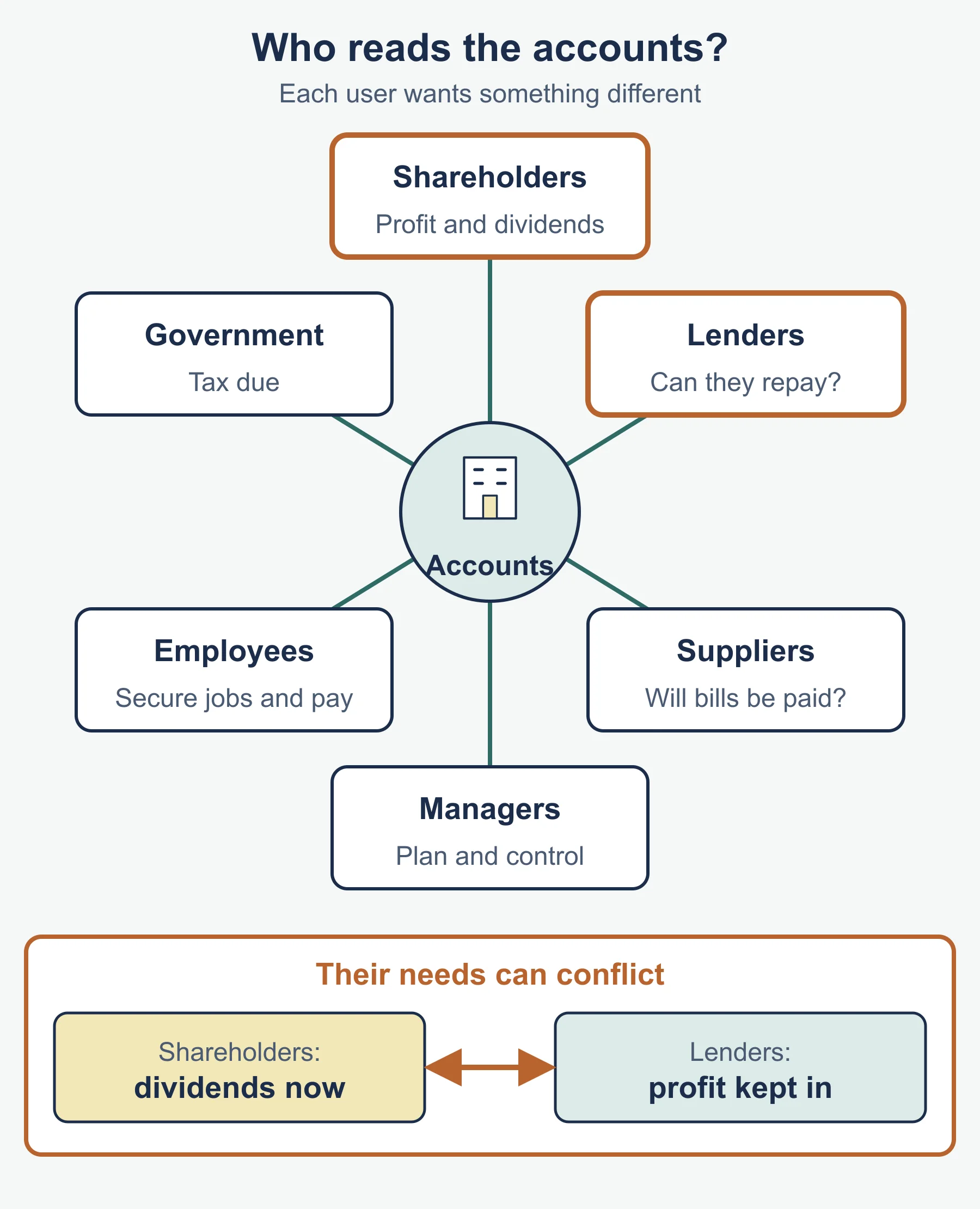
Different readers use the same statements to answer different questions. Your task is to match the information to the question.
| Stakeholder | Typical question | Information that answers it |
|---|---|---|
| Owners | Is my business earning a fair return? | Profit for the year, profit margin, return on capital employed |
| Managers | Where are costs and cash tied up? | Detailed ratios, trends, expense and working capital figures |
| Employees | Is my job secure and is pay affordable? | Profit trend, liquidity, revenue growth |
| Investors | Is this worth buying into or holding? | Return on capital employed, profit trend, comparison with other companies |
| Lenders | Will I be repaid, with interest? | Liquidity, profit from operations, assets available |
| Suppliers | Will I be paid on time? | Current ratio, acid test ratio, trade payables days |
| Customers | Will this business still be trading next year? | Overall stability, liquidity |
| Government | Is the right tax paid and are rules followed? | Profit, revenue, employment cost |
| Public and environmental bodies | What is the effect on the community and surroundings? | Spending on pollution control, jobs provided, local contribution |
Communication matters as much as calculation. Give each reader only what they need, name the ratio and its formula, show the comparison (last year, a similar business or a benchmark), and finish with a one-sentence judgement. A supplier wants one line on payment risk; an owner wants profit and return. Sending a supplier a long profit analysis hides the answer they want.
1.6.2 The ratios
Use the appendix formulae exactly. Ratios are not given in the question paper, so learn them.
| Area | Measure | Calculation |
|---|---|---|
| Profitability | Gross profit margin | Gross profit ÷ Revenue × 100 |
| Profit margin | Profit for the year ÷ Revenue × 100 | |
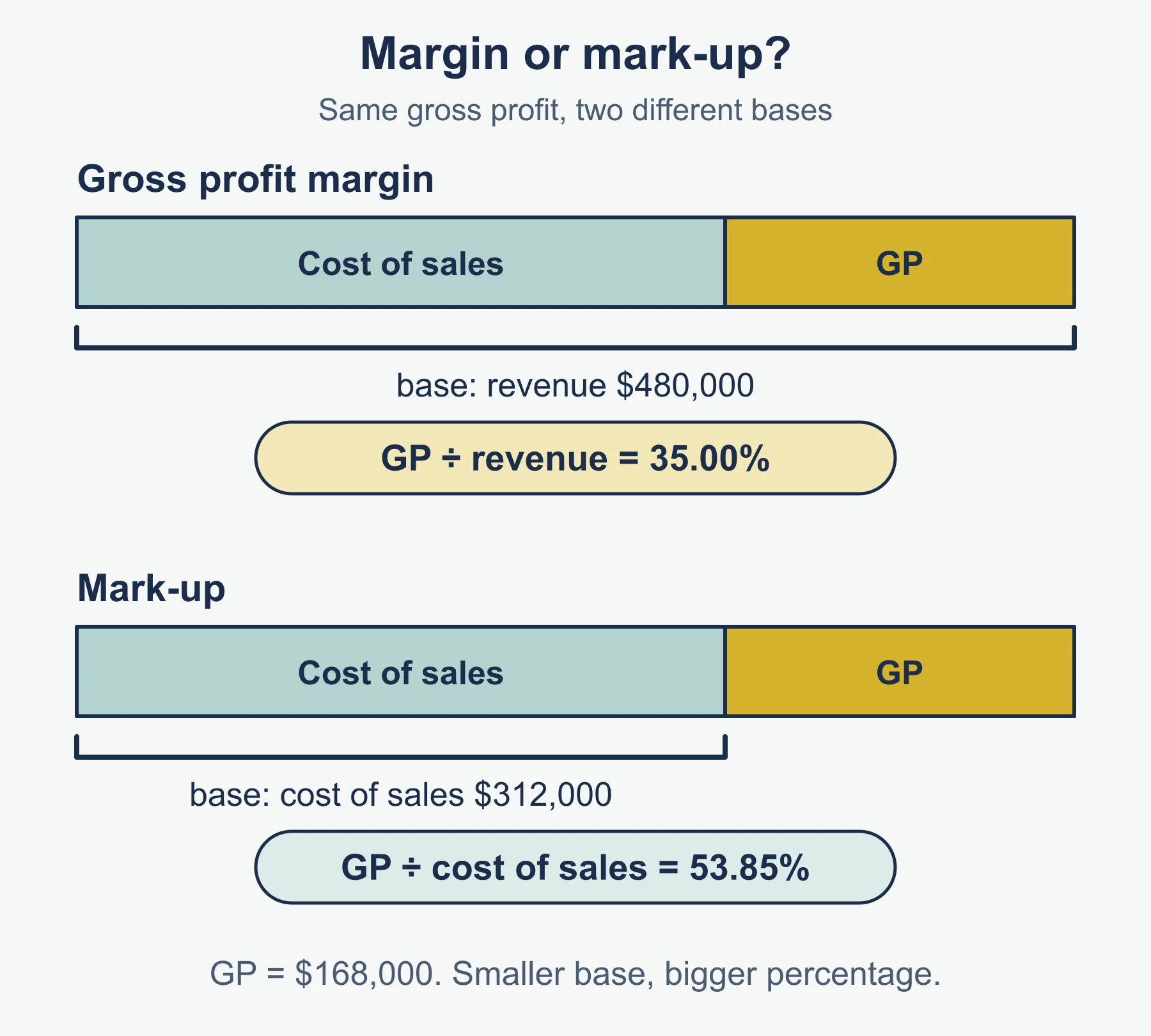
| Mark-up | Gross profit ÷ Cost of sales × 100 | |
| Expenses to revenue | Expenses ÷ Revenue × 100 | |
| Operating expenses to revenue | Operating expenses ÷ Revenue × 100 | |
| Return on capital employed | Profit from operations ÷ Capital employed × 100 | |
| Liquidity | Current ratio | Current assets : Current liabilities, shown as x : 1 |
| Acid test ratio | (Current assets - inventory) : Current liabilities, shown as x : 1 | |
| Efficiency | Non-current asset turnover (times) | Net revenue ÷ Total net book value of non-current assets |
| Trade receivables turnover (days) | Trade receivables ÷ Credit sales × 365 | |
| Trade payables turnover (days) | Trade payables ÷ Credit purchases × 365 | |
| Inventory turnover (days) | Average inventory ÷ Cost of sales × 365 | |
| Rate of inventory turnover (times) | Cost of sales ÷ Average inventory (the reverse fraction) |
Capital employed adds together issued shares, reserves and non-current liabilities. The appendix gives profit margin with profit for the year, and also as profit for the year (after interest). Use the profit figure the question names. Liquidity ratios are presented as ratios, such as 1.7 : 1.
Worked example: Hollin Fold Joinery Ltd
Hollin Fold Joinery Ltd makes fitted kitchens. All amounts are in dollars and cover the twelve months to 31 March 2026.
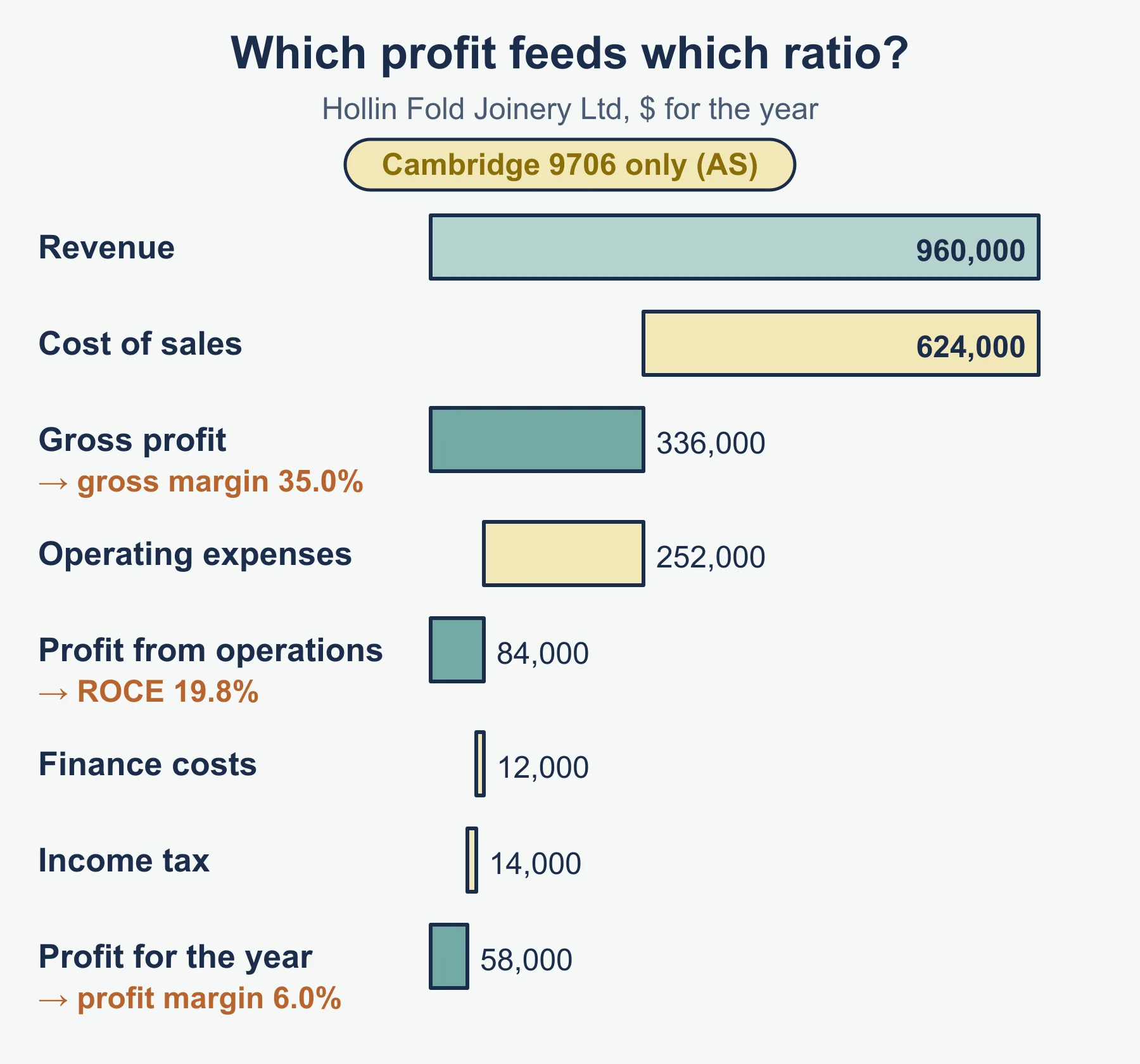
Statement of profit or loss (extract)
| $ | |
|---|---|
| Revenue (credit sales 720,000) | 960,000 |
| Opening inventory | 70,000 |
| Purchases (credit purchases 468,000) | 638,000 |
| Closing inventory | (84,000) |
| Cost of sales | (624,000) |
| Gross profit | 336,000 |
| Operating expenses | (252,000) |
| Profit from operations | 84,000 |
| Finance costs | (12,000) |
| Income tax | (14,000) |
| Profit for the year | 58,000 |
Statement of financial position (extract)
| $ | |
|---|---|
| Non-current assets (net book value) | 340,000 |
| Inventory | 84,000 |
| Trade receivables | 118,000 |
| Bank | 9,000 |
| Current assets | 211,000 |
| Trade payables | 92,000 |
| Tax payable and accruals | 34,000 |
| Current liabilities | 126,000 |
| Bank loan (non-current liability) | 150,000 |
| Issued shares | 180,000 |
| Reserves | 95,000 |
Net assets are 340,000 + 211,000 - 126,000 - 150,000 = 275,000, which equals shares plus reserves. Capital employed = 180,000 + 95,000 + 150,000 = 425,000.
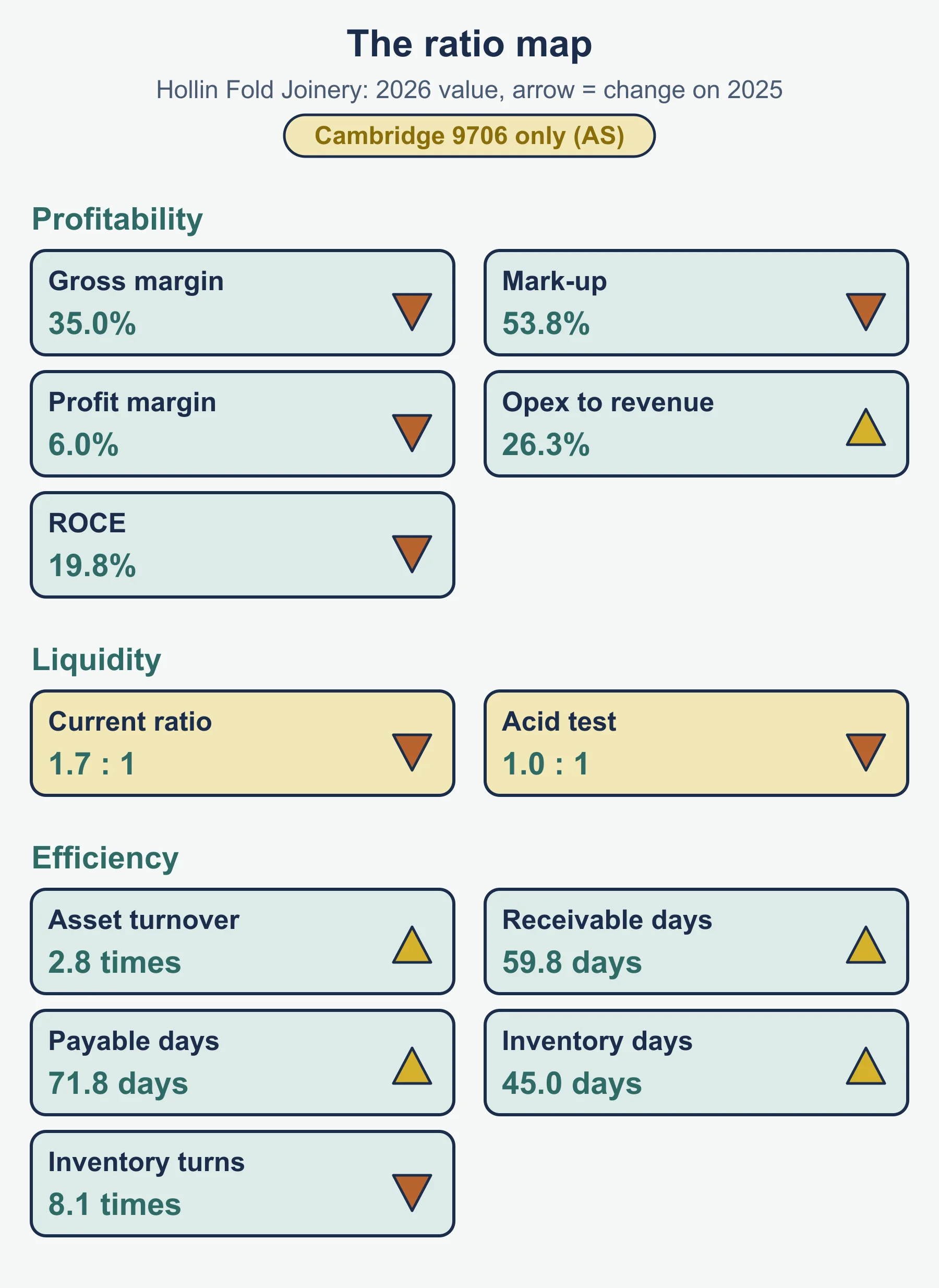
| Ratio | Working | 2026 | 2025 |
|---|---|---|---|
| Gross profit margin | 336,000 ÷ 960,000 × 100 | 35.0% | 36.0% |
| Mark-up | 336,000 ÷ 624,000 × 100 | 53.8% | 56.3% |
| Profit margin | 58,000 ÷ 960,000 × 100 | 6.0% | 7.8% |
| Return on capital employed | 84,000 ÷ 425,000 × 100 | 19.8% | 24.8% |
| Operating expenses to revenue | 252,000 ÷ 960,000 × 100 | 26.3% | 25.0% |
| Current ratio | 211,000 : 126,000 | 1.7 : 1 | 1.9 : 1 |
| Acid test ratio | (211,000 - 84,000) : 126,000 | 1.0 : 1 | 1.2 : 1 |
| Non-current asset turnover | 960,000 ÷ 340,000 | 2.8 times | 2.7 times |
| Trade receivables turnover | 118,000 ÷ 720,000 × 365 | 59.8 days | 51.3 days |
| Trade payables turnover | 92,000 ÷ 468,000 × 365 | 71.8 days | 64.9 days |
| Inventory turnover | 77,000 ÷ 624,000 × 365 | 45.0 days | 43.1 days |
| Rate of inventory turnover | 624,000 ÷ 77,000 | 8.1 times | 8.5 times |
Average inventory for 2026 is (70,000 + 84,000) ÷ 2 = 77,000. The 2025 column is given to you as prior-year information.
Evaluating performance
One ratio on its own tells you little. Set it beside last year, a comparable firm or an industry benchmark, then say what it means and why it may have changed.
Profitability. Revenue grew by 6.7% (from 900,000 in 2025) yet gross profit margin fell from 36.0% to 35.0%, so cost of sales rose faster than revenue: higher material prices or discounting are possible causes. Operating expenses took a larger share of revenue (26.3% against 25.0%). The two effects explain why profit margin and return on capital employed both fell.
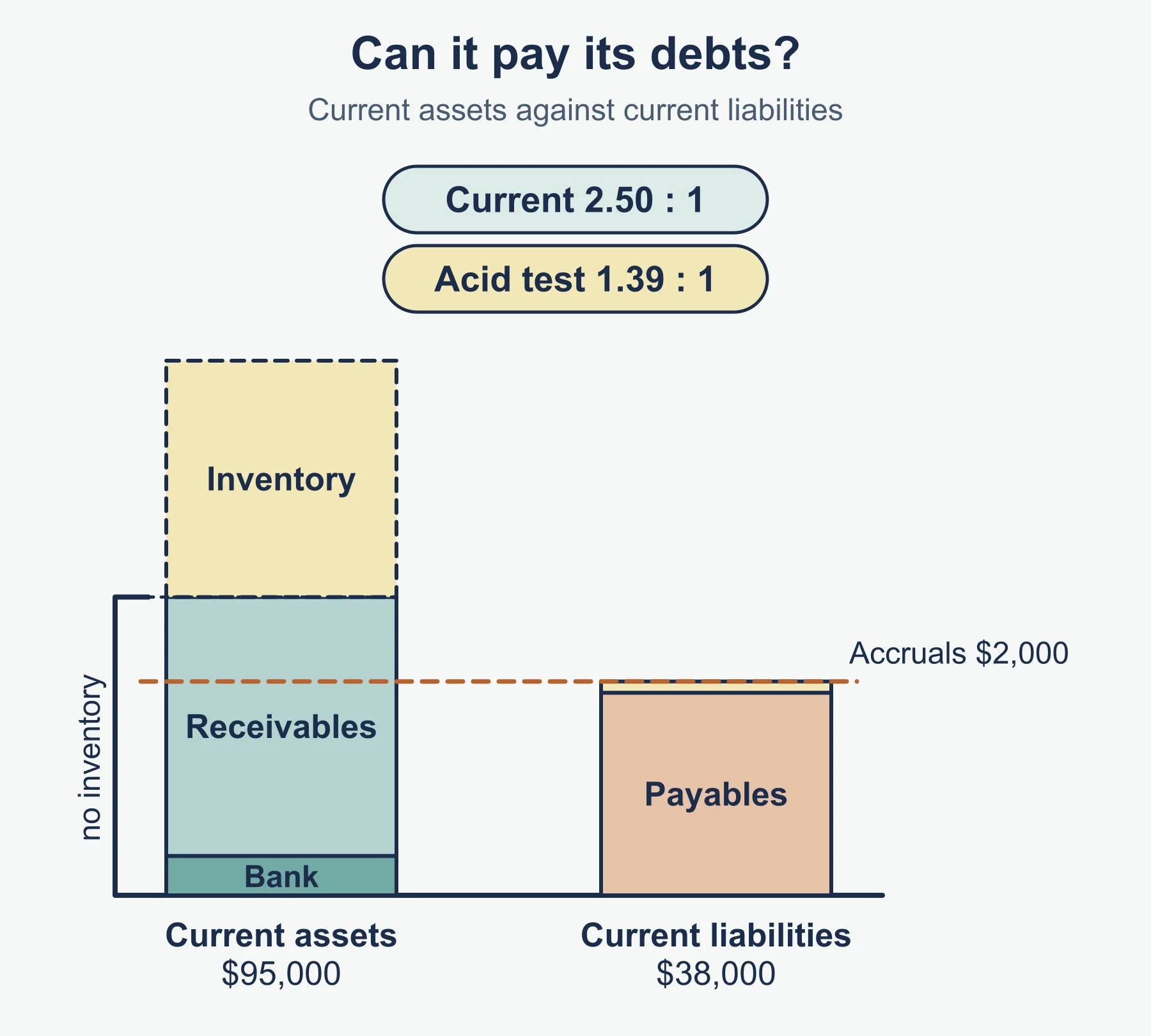
Liquidity. The current ratio and acid test ratio fell, but the acid test ratio is still about 1 : 1, so liquid assets roughly cover current liabilities. Bank is only 9,000, so the company relies on collecting receivables.
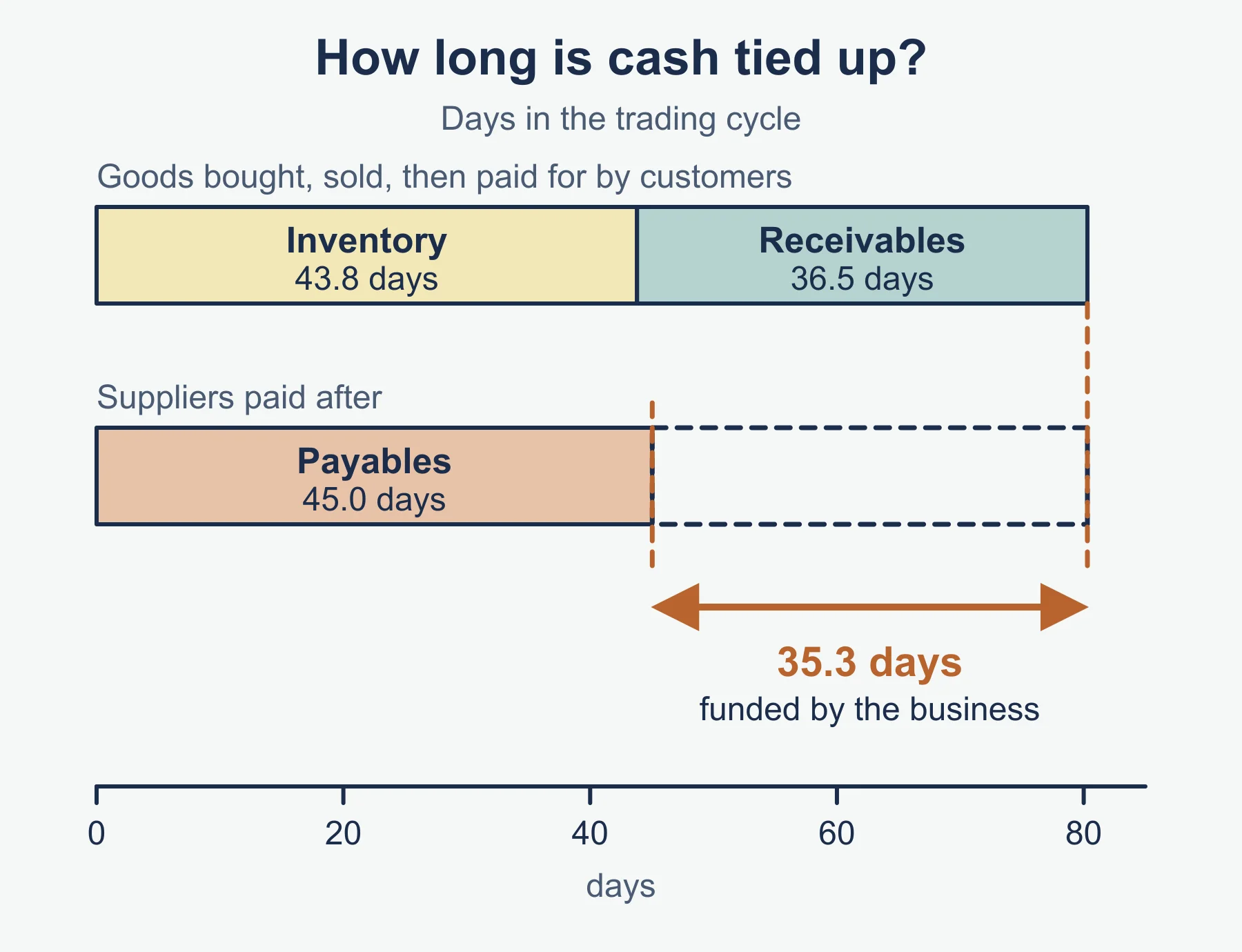
Efficiency. Customers take longer to pay (59.8 days against 51.3), while the company pays suppliers more slowly too (71.8 against 64.9). Slower payment to suppliers is funding slower collection, which is a warning if suppliers tighten terms. Inventory moves at a similar speed.
Comparing with a benchmark
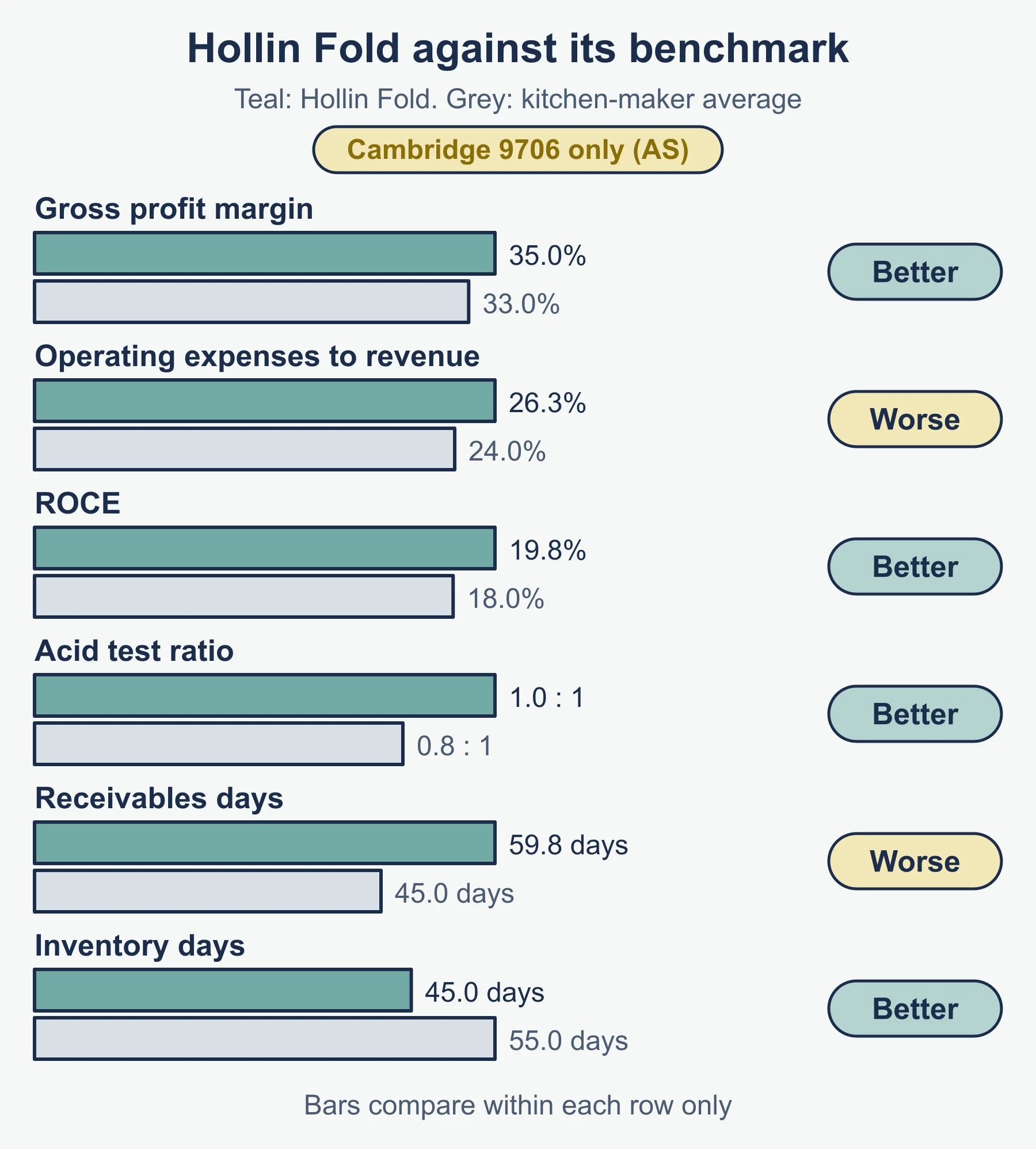
Suppose a trade body reports these averages for kitchen makers.
| Ratio | Hollin Fold | Benchmark | Comment |
|---|---|---|---|
| Gross profit margin | 35.0% | 33.0% | Better |
| Operating expenses to revenue | 26.3% | 24.0% | Worse |
| Return on capital employed | 19.8% | 18.0% | Better |
| Acid test ratio | 1.0 : 1 | 0.8 : 1 | Better |
| Trade receivables turnover | 59.8 days | 45 days | Worse |
| Inventory turnover | 45.0 days | 55 days | Better |
Hollin Fold earns a good gross margin but controls overheads and debt collection less well than the benchmark. Comparison has problems: businesses may use different accounting policies, such as depreciation methods, may have different year ends, sizes and products, and may finance themselves differently. A benchmark is an average, not a target to copy.
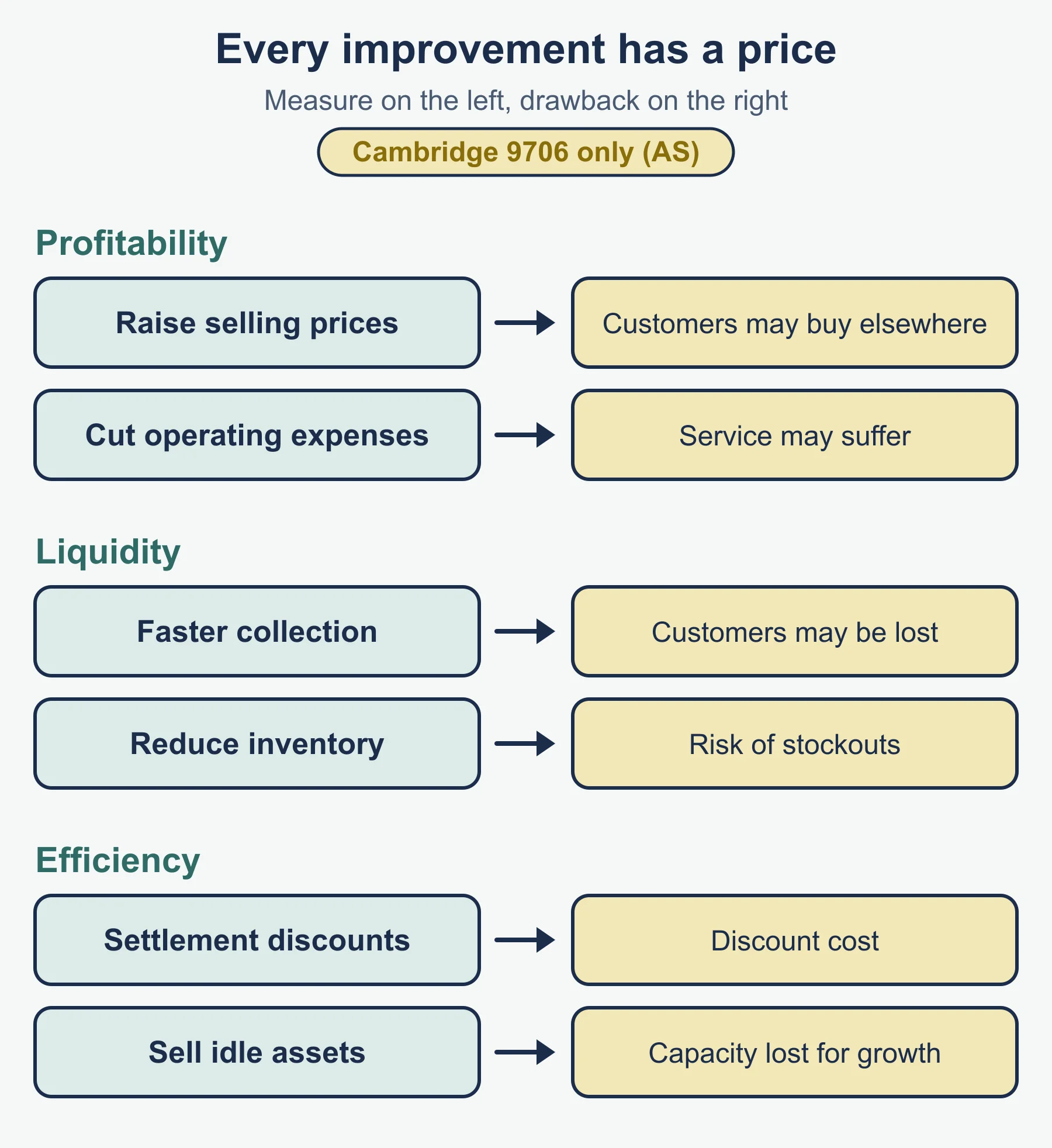
Measures to improve
| Area | Possible measure | Possible drawback |
|---|---|---|
| Profitability | Raise selling prices | Customers may buy elsewhere |
| Negotiate cheaper materials | Quality or reliability may fall | |
| Cut operating expenses | Staff morale or service may suffer | |
| Sell more higher-margin products | Needs marketing spend | |
| Liquidity | Collect receivables faster | Customers may be lost |
| Reduce inventory | Risk of stockouts | |
| Raise long-term finance to replace short-term | Interest costs rise | |
| Reduce drawings or dividends | Owners and investors may object | |
| Efficiency | Tighter credit control, settlement discounts | Discount cost |
| Just in time ordering | Depends on reliable suppliers | |
| Sell idle non-current assets | Capacity lost for later growth |
Worked example: testing a measure
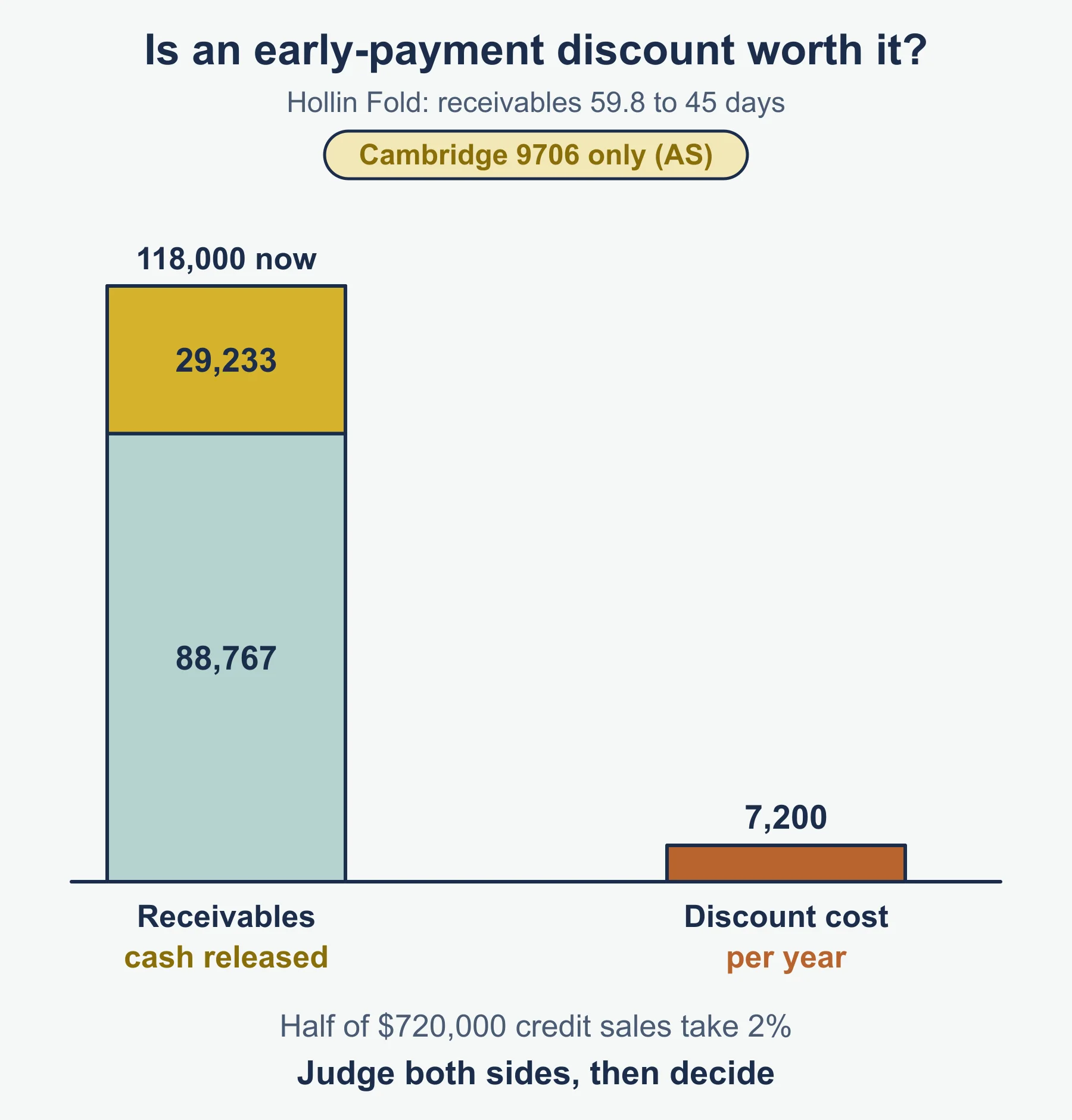
Hollin Fold proposes a 2% discount for early payment, hoping to cut receivables to 45 days of credit sales.
Receivables at 45 days = 720,000 × 45 ÷ 365 = 88,767 (to the nearest dollar). Cash released = 118,000 - 88,767 = 29,233.
If customers owing half of credit sales take the discount, it costs 720,000 × 50% × 2% = 7,200 a year. The company must judge whether 29,233 of released cash is worth 7,200 of lost revenue, perhaps because it would let the company repay overdraft-type borrowing or hold more bank. A balanced answer gives both sides and a justified decision.
Limitations of accounting information
- It records the past at historic cost, so it may not show current values or predict the future.
- Figures rest on estimates and judgements, for example depreciation and inventory valuation, so they can be managed.
- It leaves out non-financial matters: staff skill, reputation, customer satisfaction and environmental effects.
- A year-end snapshot may not be typical, for instance in a seasonal business.
- Ratios depend on how profit, capital employed and other terms are defined, so use the appendix formulae.
- Comparison with other businesses is weakened by different policies, size, products and finance.
Common errors
- Using profit before tax or profit for the year in return on capital employed instead of profit from operations.
- Leaving out non-current liabilities when finding capital employed.
- Using total sales rather than credit sales or credit purchases for days ratios.
- Using closing inventory for inventory days when the formula uses average inventory.
- Subtracting inventory from current liabilities rather than current assets in the acid test.
- Describing a ratio without a reason, a comparison or a consequence.
Frequently asked questions
Are ratio formulae given in the Cambridge 9706 exam? No. Ratios are not given in the question paper, so learn the appendix formulae and use them exactly. Section 1.6 Analysis and communication of accounting information is AS Level content.
How is capital employed calculated for return on capital employed? Capital employed adds together issued shares, reserves and non-current liabilities, and return on capital employed uses profit from operations. Leaving out non-current liabilities or using profit for the year are common errors.
How do you calculate the acid test ratio? Acid test ratio = (current assets − inventory) : current liabilities. Inventory is subtracted from current assets, not from current liabilities, and the answer is written as x : 1.
What are the limitations of accounting information? It records the past at historic cost, rests on estimates such as depreciation, leaves out non-financial matters such as staff skill and reputation, may reflect an untypical year-end, and comparisons are weakened by different policies, size, products and finance.
How should I evaluate a ratio in an AS Accounting answer? Set it beside last year, a comparable firm or an industry benchmark, and give a cause and a consequence. Describing a ratio without a reason, a comparison or a consequence earns little.
Check your skills with the practice questions.
Official syllabus
Cambridge International AS & A Level Accounting 9706 syllabus for exams in 2026, 2027 and 2028, published by Cambridge University Press & Assessment (Cambridge International): section 1.6 and the appendix of ratios.
Get free revision emails (optional)
Occasional emails with practice questions, worked explanations and links to free resources for the qualification and subjects you choose. No spam, and you can unsubscribe from any email. The free tools on this site never need an email.
Related resources
-
Study guides
A Level Accounting: Accounting for Non-Current Assets (Cambridge 9706)
Capital versus revenue spending, why assets depreciate depreciation methods, cost and revaluation models and disposals, for Cambridge 9706 Accounting topic 1.3.
Accounting · Cambridge · AS Level
Read guide -
Practice questions
A Level Accounting: Analysis and communication (AS) (Cambridge 9706) – Practice Questions
Original questions with worked answers on stakeholders, ratio calculation, evaluation, improvements and limitations for Cambridge AS Accounting 9706.
Accounting · Cambridge · AS Level
Try questions -
Revision notes
A Level Accounting: Analysis and communication of accounting info (AS) (Cambridge 9706) – Revision Notes
Condensed recall notes on stakeholders, the AS ratios, evaluation, improvement measures and limitations for Cambridge AS Accounting 9706 section 1.6.
Accounting · Cambridge · AS Level
Revise topic
Related articles
-
teaching
A Level tuition in Dubai: Cambridge or Pearson Edexcel International A Level?
Schools in Dubai and Abu Dhabi teach either Cambridge International AS & A Level or Pearson Edexcel International A Level. How the two are structured, why it matters for tuition, and how online classes from Lahore work.
9 October 2026
-
curriculum guides
Choosing subjects at IGCSE and A Level
How subject choices at 14 and 16 affect university options later, and how to keep pathways open without overloading a timetable.
28 July 2026
Studying this with a teacher
Working through Accounting AS LEVEL?
This page is free and stays free. If you would rather be taught it, Marlbridge runs Accounting classes one-to-one and in small groups of up to 15, online in your own time zone. The first trial class is free. WhatsApp replies within an hour (8am–11pm Pakistan time, every day); email the same day.
Cambridge Accounting teachers at Marlbridge

