
Revision Notes
A Level Accounting: Analysis and communication of accounting info (AS) (Cambridge 9706) – Revision Notes
Condensed recall notes on stakeholders, the AS ratios, evaluation, improvement measures and limitations for Cambridge AS Accounting 9706 section 1.6.
- Subject
- Accounting
- Level
- AS LEVEL
- Topic
- Financial accounting
- Author
- Marlbridge Academic Team
- Updated
- Reviewed by
- Zain Ud Din Ahmed (what this means)
Aligned to Cambridge A Level Accounting (9706), 2026-2028. Official specification .
Syllabus page (what it covers and how it is assessed): Cambridge A Level Accounting.
Syllabus points this page covers
9706 (AS Level)
- 1.6 Analysis and communication of accounting information
Found an error? Report a correction.
Need help with this topic? Request a free trial class for A Level Accounting (9706).
These are condensed notes for section 1.6, Analysis and communication of accounting information, in the Cambridge International AS & A Level Accounting 9706 syllabus for exams in 2026, 2027 and 2028 (AS Level, Financial accounting). Full explanations and a long worked example are in the study guide. Test yourself with the practice questions, then use the Cambridge A Level Accounting hub, the checklist and the free diagnostics.
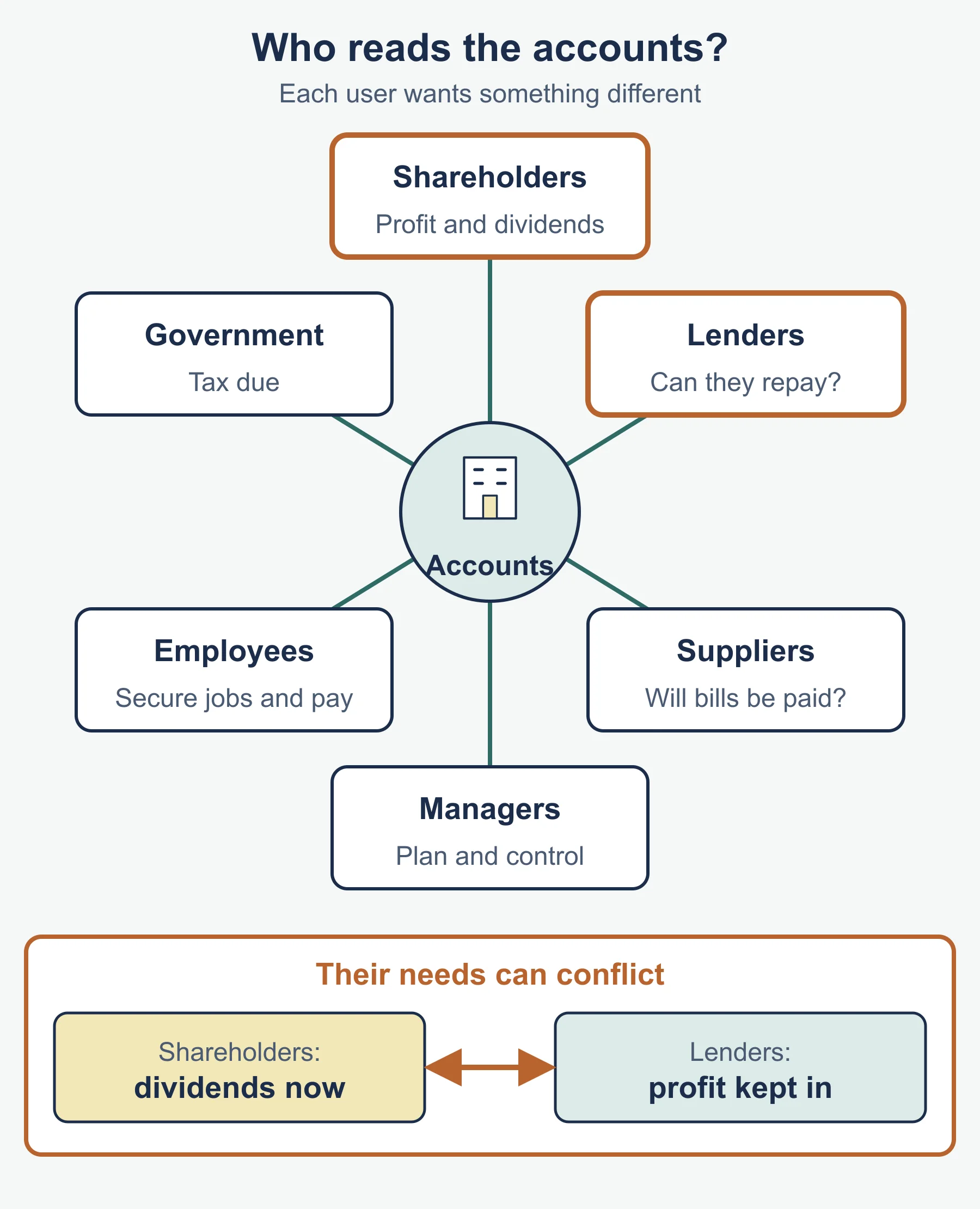
1.6.1 Users: who wants what
| Stakeholder | Main interest | Most useful figures |
|---|---|---|
| Owners | Return on their investment, growth | Profit for the year, profit margin, return on capital employed |
| Managers | Control of costs, cash and performance | All ratios, trends, expense detail |
| Employees | Job security, pay, bonuses | Profit trend, liquidity, revenue growth |
| Investors | Return and risk of buying shares | Return on capital employed, profit trend, comparison with similar companies |
| Lenders | Repayment of loan and interest | Liquidity, profit from operations, assets |
| Suppliers | Prompt payment | Current ratio, acid test ratio, trade payables days |
| Customers | Continuity of supply and service | Stability, liquidity, profit |
| Government | Tax, employment, compliance | Profit, revenue, wages |
| Public and environmental bodies | Effect on the community and surroundings | Spending on pollution control, jobs, local contribution |
Communicating: pick the figures the reader needs, show the formula, add a comparison (last year, similar business, benchmark), and state a short judgement in plain words.
1.6.2 Formulae (appendix formulae only)
| Measure | Calculation |
|---|---|
| Gross profit margin (%) | Gross profit ÷ Revenue × 100 |
| Profit margin (%) | Profit for the year ÷ Revenue × 100 |
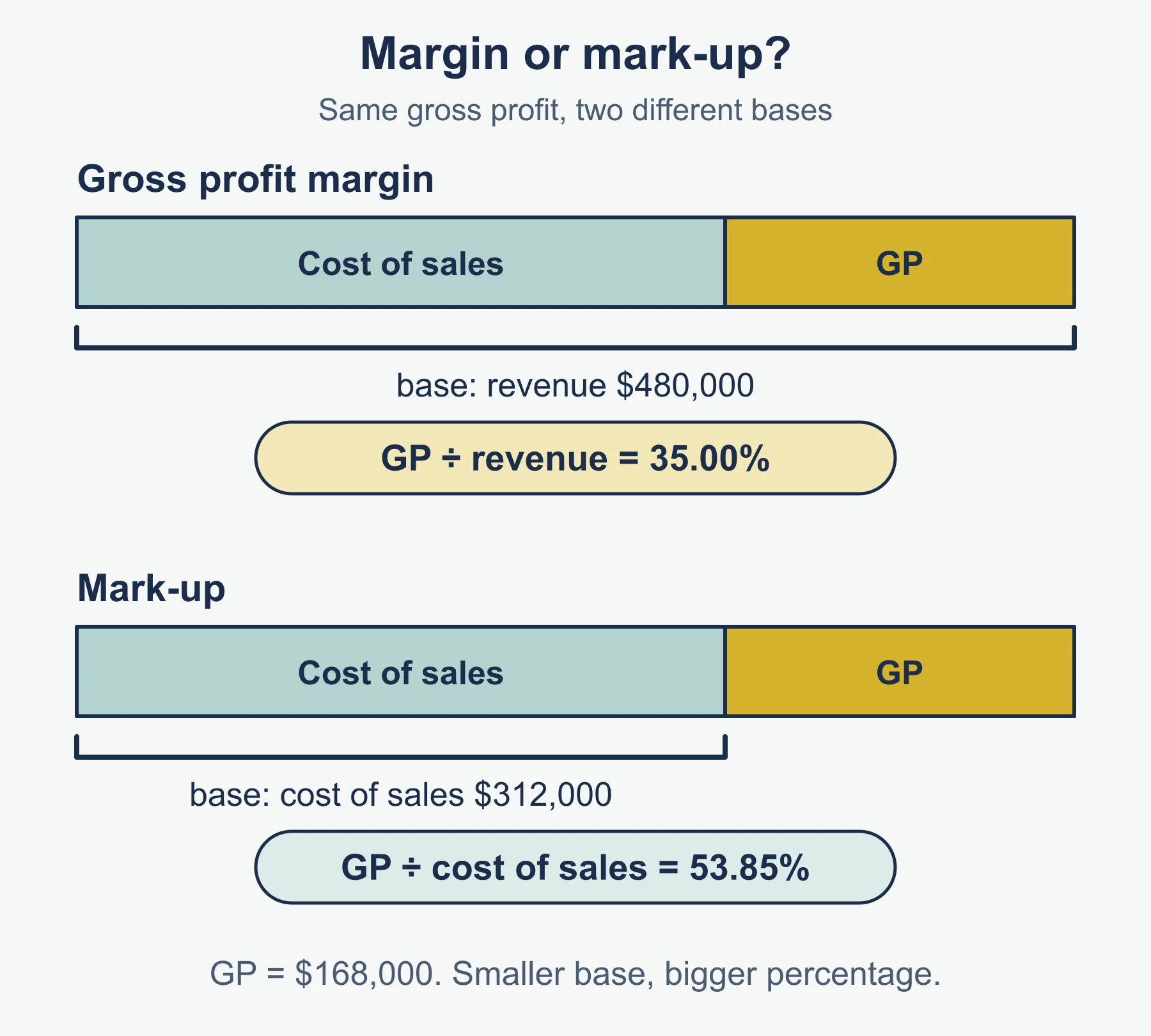
| Mark-up (%) | Gross profit ÷ Cost of sales × 100 |
| Expenses to revenue (%) | Expenses ÷ Revenue × 100 |
| Operating expenses to revenue (%) | Operating expenses ÷ Revenue × 100 |
| Return on capital employed (%) | Profit from operations ÷ Capital employed × 100 |
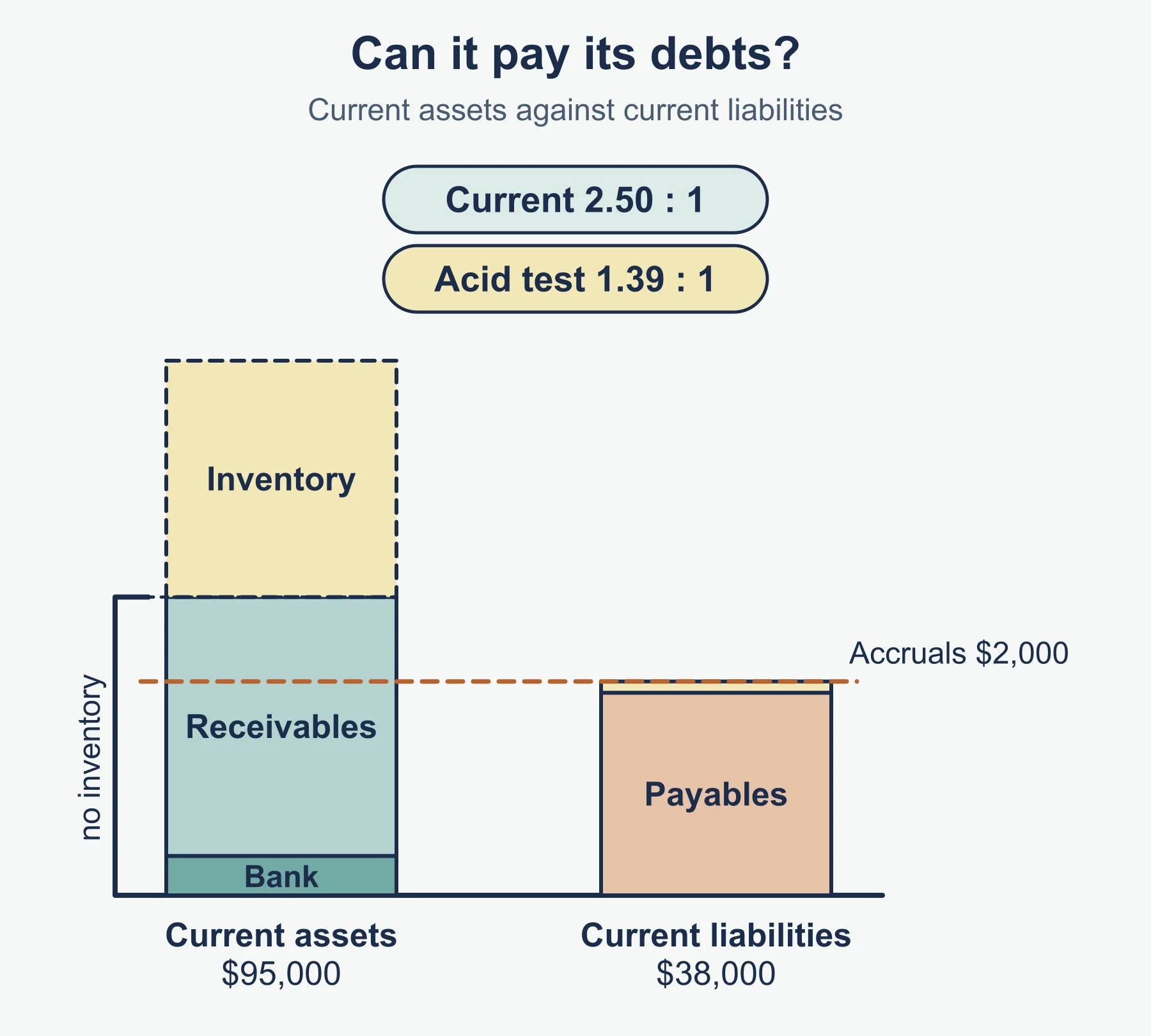
| Current ratio | Current assets : Current liabilities, shown as x : 1 |
| Acid test ratio | (Current assets - inventory) : Current liabilities, shown as x : 1 |
| Non-current asset turnover (times) | Net revenue ÷ Total net book value of non-current assets |
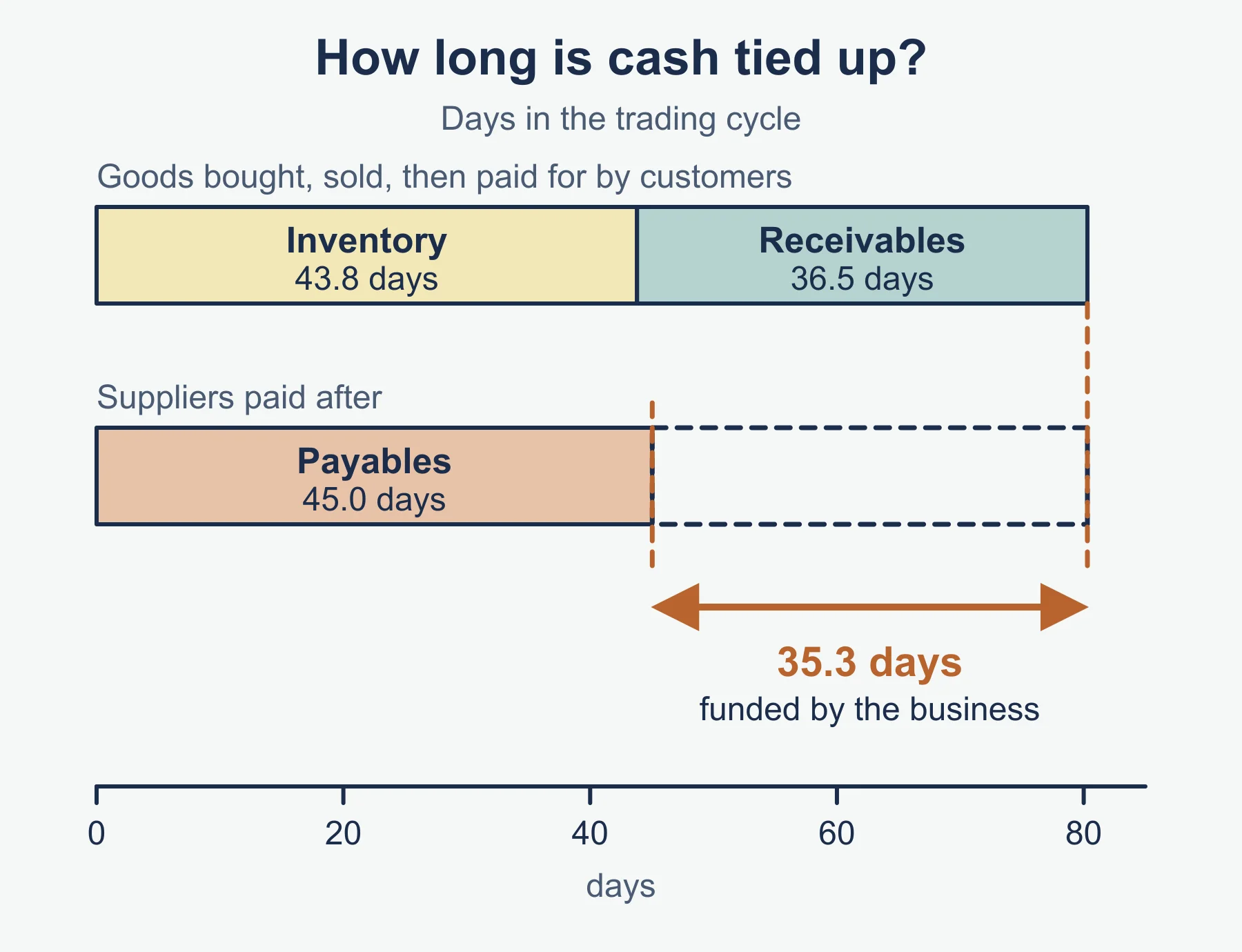
| Trade receivables turnover (days) | Trade receivables ÷ Credit sales × 365 |
| Trade payables turnover (days) | Trade payables ÷ Credit purchases × 365 |
| Inventory turnover (days) | Average inventory ÷ Cost of sales × 365 |
| Rate of inventory turnover (times) | Cost of sales ÷ Average inventory held |
Capital employed: add issued shares, reserves and non-current liabilities. Average inventory: add opening and closing inventory, then halve. The syllabus says the question paper does not give you the ratios.
Method in steps
- Write the formula. Then substitute figures from the statements.
- Choose the right base: revenue for margins, cost of sales for mark-up, credit sales or credit purchases for days.
- Calculate, then state the unit: %, : 1, days or times.
- Compare with something: last year, a similar business or a benchmark.
- Explain the cause, the effect and what the stakeholder should do.
Small worked reminder: Ashgrove Pottery Ltd
Revenue 480,000; cost of sales 288,000; operating expenses 120,000; shares 150,000; reserves 84,000; non-current liabilities 90,000 (all in dollars).
| Step | Working | Result |
|---|---|---|
| Gross profit | 480,000 - 288,000 | 192,000 |
| Gross profit margin | 192,000 ÷ 480,000 × 100 | 40.0% |
| Mark-up | 192,000 ÷ 288,000 × 100 | 66.7% |
| Profit from operations | 192,000 - 120,000 | 72,000 |
| Capital employed | 150,000 + 84,000 + 90,000 | 324,000 |
| Return on capital employed | 72,000 ÷ 324,000 × 100 | 22.2% |
| Operating expenses to revenue | 120,000 ÷ 480,000 × 100 | 25.0% |
Must-know distinctions
- Gross profit margin or mark-up: margin divides by revenue, mark-up divides by cost of sales. Mark-up is always the larger percentage when gross profit is positive.
- Current ratio or acid test ratio: the acid test removes inventory because inventory is the slowest current asset to turn into cash.
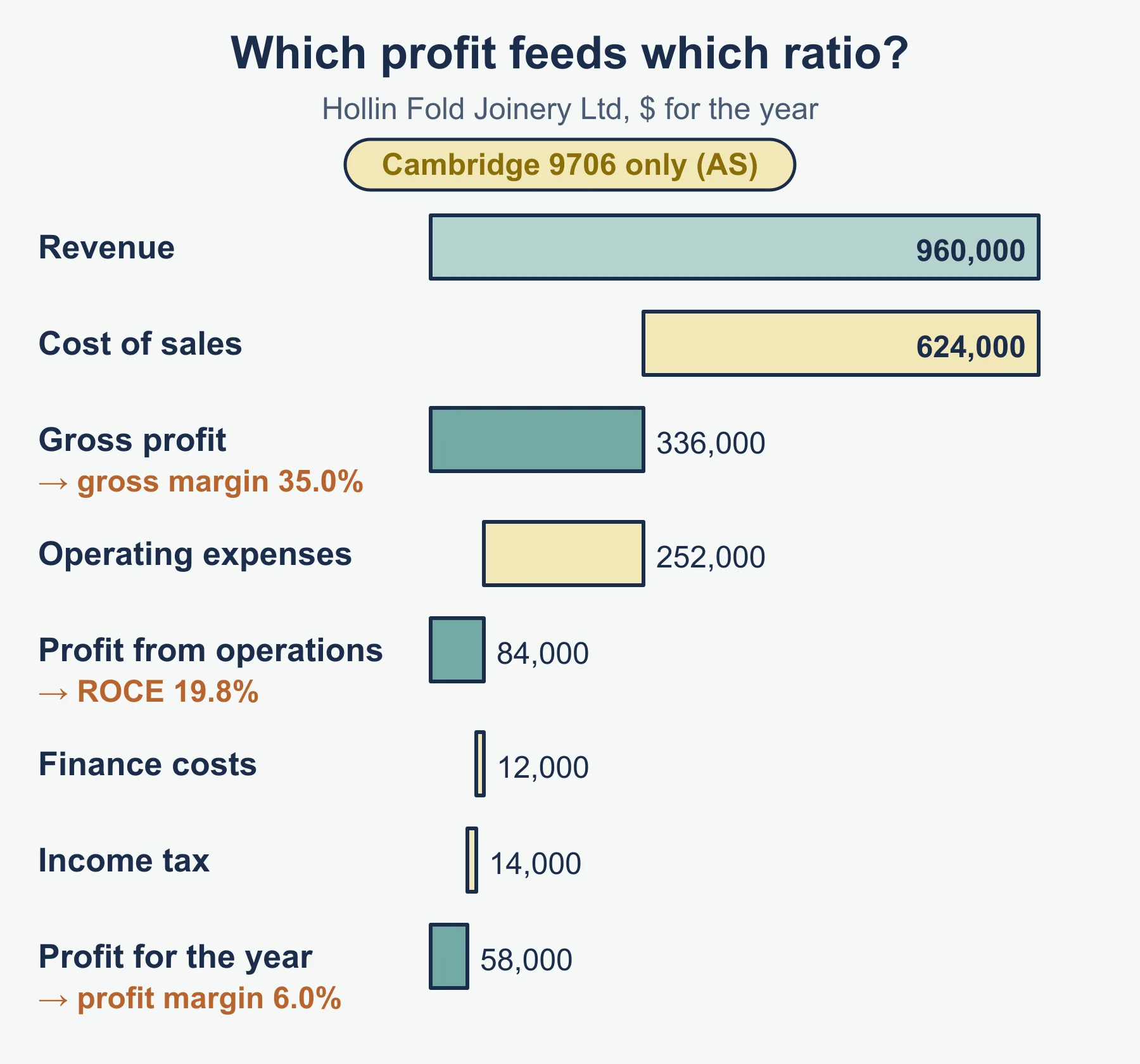
- Profit from operations or profit for the year: return on capital employed uses profit from operations; profit margin uses profit for the year.
- Receivables days or payables days: low receivables days is good (cash arrives soon); high payables days helps cash but may upset suppliers.
- Inventory days or rate of inventory turnover: days is how long stock stays; times is how often it is sold and replaced. Both use average inventory and cost of sales.
- Expenses or operating expenses to revenue: use the group of costs the question names.
Interpreting results
| Result | Possible meaning | Possible causes |
|---|---|---|
| Gross profit margin falls | Lower profit on each sale | Dearer materials, discounts, change in product mix |
| Operating expenses to revenue rises | Overheads growing faster than sales | Higher wages, rent, advertising |
| Return on capital employed falls | Less profit per dollar invested | Lower profit, or more capital employed |
| Current ratio low | Risk of failing to pay short-term debts | Too little cash, overdraft, heavy payables |
| Current ratio very high | Cash or inventory may be idle | Excess stock, slow collection |
| Receivables days rise | Customers pay later | Weak credit control, generous terms |
| Inventory days rise | Stock moves slowly | Over-ordering, falling demand |
| Non-current asset turnover falls | Assets generate less revenue | New assets not yet productive, idle capacity |
Improvement measures
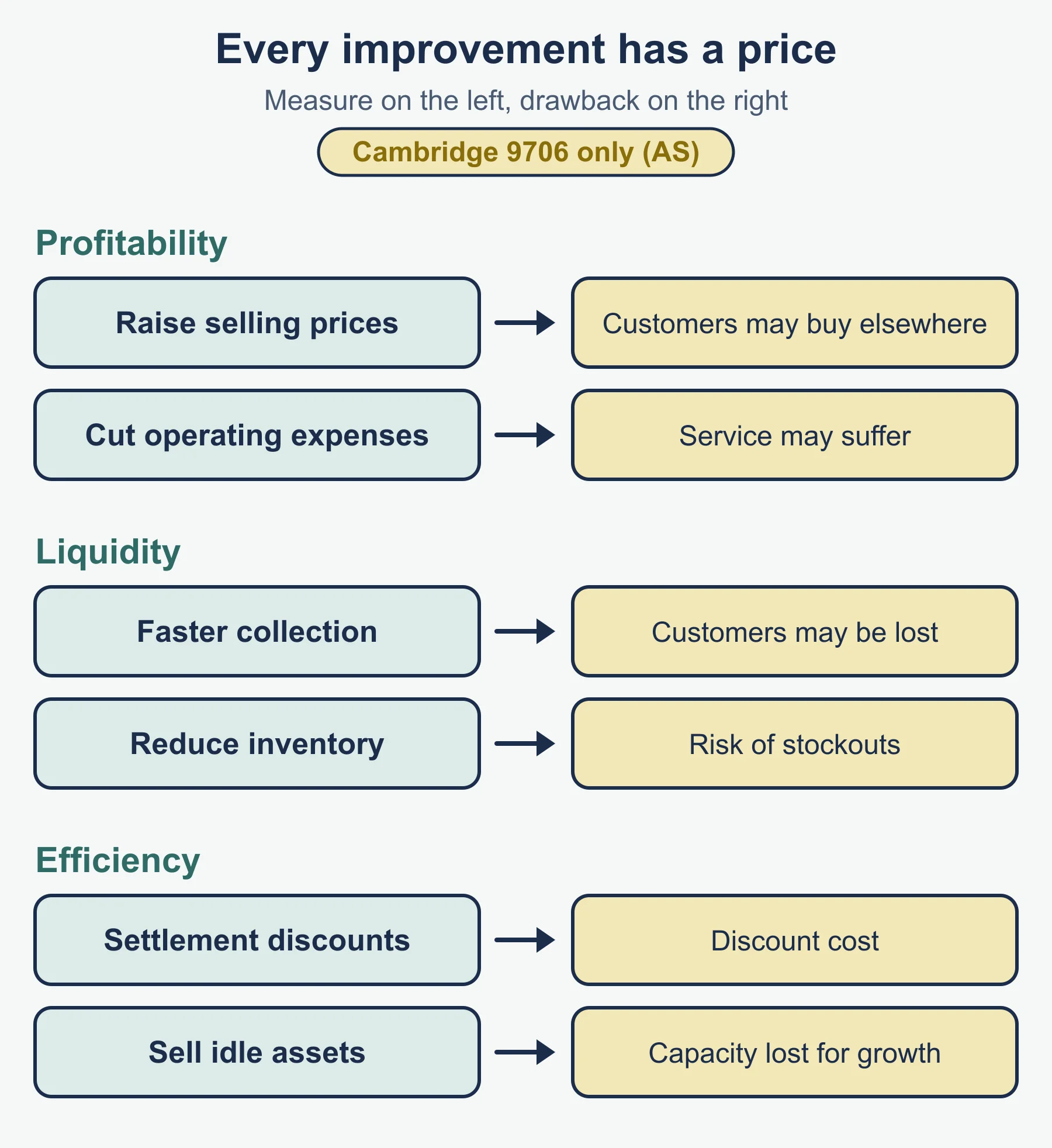
- Profitability: raise prices, buy materials more cheaply, cut waste, trim overheads, sell more high-margin items. Each can hurt demand, quality or morale.
- Liquidity: collect from customers faster, reduce inventory, negotiate longer payment terms, replace short-term borrowing with long-term finance, reduce owner or investor payouts.
- Efficiency: credit control and early settlement discounts, just in time inventory, use assets more fully, sell idle assets.
Always add the drawback. Improvement measures are judged on how well they are justified.
Limitations of accounting information
- Historic cost and past data, not current value or the future.
- Estimates and judgements (depreciation, inventory value) affect profit.
- Non-financial factors are left out: skills, reputation, environmental effects.
- A year-end snapshot may be unrepresentative, for example in seasonal trade.
- Businesses differ in policies, size, products, finance and year end, so comparison is limited.
- A single ratio has little meaning on its own; use trends and comparisons.
Quick self-test
Amounts are in dollars. Round percentages and days to 1 decimal place.
- Gross profit is 150,000 and revenue is 600,000. Find the gross profit margin and the cost of sales.
- Revenue is 420,000 and cost of sales is 273,000. Find the gross profit margin and the mark-up.
- Profit from operations is 56,000, issued shares 120,000, reserves 76,000 and non-current liabilities 84,000. Find the return on capital employed.
- Current assets are 96,000 (inventory 40,000) and current liabilities 56,000. Find the current ratio and the acid test ratio.
- Trade receivables are 45,000 and credit sales 438,000. Find trade receivables turnover in days.
- Opening inventory is 30,000, closing inventory 42,000 and cost of sales 216,000. Find inventory turnover in days and the rate of inventory turnover.
- Revenue is 720,000 and the net book value of non-current assets is 240,000. Find non-current asset turnover.
- Trade payables are 38,000 and credit purchases 253,000. Find trade payables turnover in days.
- Name two ratios a supplier would check before granting credit.
- State two limitations of accounting information when comparing two businesses.
Answers
- Gross profit margin 150,000 ÷ 600,000 × 100 = 25.0%. Cost of sales = 600,000 - 150,000 = 450,000.
- Gross profit = 147,000. Gross profit margin = 147,000 ÷ 420,000 × 100 = 35.0%. Mark-up = 147,000 ÷ 273,000 × 100 = 53.8%.
- Capital employed = 120,000 + 76,000 + 84,000 = 280,000. Return on capital employed = 56,000 ÷ 280,000 × 100 = 20.0%.
- Current ratio = 96,000 : 56,000 = 1.7 : 1. Acid test = (96,000 - 40,000) : 56,000 = 1.0 : 1.
- 45,000 ÷ 438,000 × 365 = 37.5 days.
- Average inventory = 36,000. Days = 36,000 ÷ 216,000 × 365 = 60.8 days. Rate = 216,000 ÷ 36,000 = 6.0 times.
- 720,000 ÷ 240,000 = 3.0 times.
- 38,000 ÷ 253,000 × 365 = 54.8 days.
- Any two of: current ratio, acid test ratio, trade payables turnover (days).
- Any two of: different accounting policies, different size or product range, different year ends, historic cost values, different finance structure, non-financial factors ignored.
Where marks are usually lost
- Writing a ratio with no formula shown, or with a formula that is not the appendix one.
- Using total sales or total purchases in the days ratios when credit figures are given.
- Using closing inventory instead of average inventory in inventory turnover.
- Leaving non-current liabilities out of capital employed, or using profit for the year in return on capital employed.
- Confusing gross profit margin with mark-up and dividing by the wrong base.
- Giving the ratio but no unit, such as days, times or %.
- Reporting only that a figure rose or fell, with no cause, comparison or consequence for the named stakeholder.
- Suggesting an improvement without its drawback.
- Ignoring the stakeholder in the question and giving generic points.
Frequently asked questions
What is the difference between gross profit margin and mark-up? Both use gross profit as the numerator, but gross profit margin divides by revenue and mark-up divides by cost of sales. Dividing by the wrong base is a common mistake.
Which inventory figure is used for inventory turnover? Inventory turnover uses average inventory, (opening + closing) ÷ 2, not closing inventory alone.
Why must I include units with ratio answers? Each ratio has a unit, such as %, : 1, days or times, and giving the ratio with no unit is a common way to lose marks.
What should an improvement measure include? Suggest a measure that fits the ratio in question and state its drawback. Suggesting an improvement without its drawback is a common mistake.
Official syllabus
Cambridge International AS & A Level Accounting 9706 syllabus for exams in 2026, 2027 and 2028, published by Cambridge University Press & Assessment (Cambridge International): section 1.6 Analysis and communication of accounting information, and the appendix of commonly used ratios.
Get free revision emails (optional)
Occasional emails with practice questions, worked explanations and links to free resources for the qualification and subjects you choose. No spam, and you can unsubscribe from any email. The free tools on this site never need an email.
Related resources
-
Study guides
A Level Accounting: Accounting for Non-Current Assets (Cambridge 9706)
Capital versus revenue spending, why assets depreciate depreciation methods, cost and revaluation models and disposals, for Cambridge 9706 Accounting topic 1.3.
Accounting · Cambridge · AS Level
Read guide -
Study guides
A Level Accounting: Business acquisition and merger (Cambridge 9706)
Goodwill, journals and ledger accounts for mergers and acquisitions, and the new entity's statements, for Cambridge A Level Accounting 9706 section 3.3.
Accounting · Cambridge · A Level
Read guide -
Practice questions
A Level Accounting: Business acquisition and merger (Cambridge 9706) – Practice Questions
Ten original questions on goodwill, mergers, acquisitions, resulting statements and evaluation for Cambridge A Level Accounting 9706 section 3.3.
Accounting · Cambridge · A Level
Try questions
Related articles
-
teaching
A Level tuition in Dubai: Cambridge or Pearson Edexcel International A Level?
Schools in Dubai and Abu Dhabi teach either Cambridge International AS & A Level or Pearson Edexcel International A Level. How the two are structured, why it matters for tuition, and how online classes from Lahore work.
9 October 2026
-
curriculum guides
Choosing subjects at IGCSE and A Level
How subject choices at 14 and 16 affect university options later, and how to keep pathways open without overloading a timetable.
28 July 2026
Studying this with a teacher
Working through Accounting AS LEVEL?
This page is free and stays free. If you would rather be taught it, Marlbridge runs Accounting classes one-to-one and in small groups of up to 15, online in your own time zone. The first trial class is free. WhatsApp replies within an hour (8am–11pm Pakistan time, every day); email the same day.
Cambridge Accounting teachers at Marlbridge

