
Study Guides
A Level Accounting: Preparation of financial statements (A Level) (Cambridge 9706)
Partnerships, clubs and societies, manufacturing accounts and limited company statements taught with worked examples for Cambridge A Level Accounting 9706.
- Subject
- Accounting
- Level
- A LEVEL
- Topic
- Financial accounting
- Author
- Marlbridge Academic Team
- Updated
- Reviewed by
- Zain Ud Din Ahmed (what this means)
Aligned to Cambridge A Level Accounting (9706), 2026-2028. Official specification .
Syllabus page (what it covers and how it is assessed): Cambridge A Level Accounting.
Syllabus points this page covers
9706 (A Level)
- 3.1 Preparation of financial statements
Found an error? Report a correction.
Need help with this topic? Request a free trial class for A Level Accounting (9706).
This guide follows the Cambridge International AS & A Level Accounting 9706 syllabus for 2026, 2027 and 2028, section 3.1 Preparation of financial statements (A Level content, assessed on Paper 3, Financial Accounting). It covers 3.1.1 to 3.1.5. AS Level content, including the adjustments in 1.5.1 and basic partnership and company statements, is assumed knowledge. The syllabus points to its Teacher Guidance document for the expected formats. All businesses and figures here are invented and amounts are in dollars. Use the course hub, the printable checklist, the revision notes, the practice questions and the free diagnostics alongside it.
| Syllabus point | You must be able to | Section below |
|---|---|---|
| 3.1.1 | Explain why different entities need financial statements | Purpose |
| 3.1.2 | Goodwill, capital and current accounts, changes in a partnership, appropriation, realisation and revaluation accounts | Partnerships |
| 3.1.3 | Receipts and payments, income and expenditure, accumulated fund, subscriptions, life memberships, donations, finance and fundraising | Clubs |
| 3.1.4 | Manufacturing account, factory profit, unrealised profit | Manufacturing |
| 3.1.5 | Statements of profit or loss, financial position, cash flows, changes in equity, schedule of non-current assets | Companies |
3.1.1 Why each entity needs financial statements
- Partnership: shows each partner’s share of profit and balance owed or owing, so partners can settle disputes, and supports bank loans and tax returns.
- Club or society: members are owners but seek no profit. The statements show how subscriptions and fundraising were used, so officials can be held to account.
- Manufacturing business: separates the cost of making goods from the profit on selling them, so managers can control production costs and judge whether making beats buying.
- Limited company: owners are separate from managers, so shareholders, lenders and regulators rely on statements prepared to international accounting standards.
3.1.2 Partnerships
Goodwill
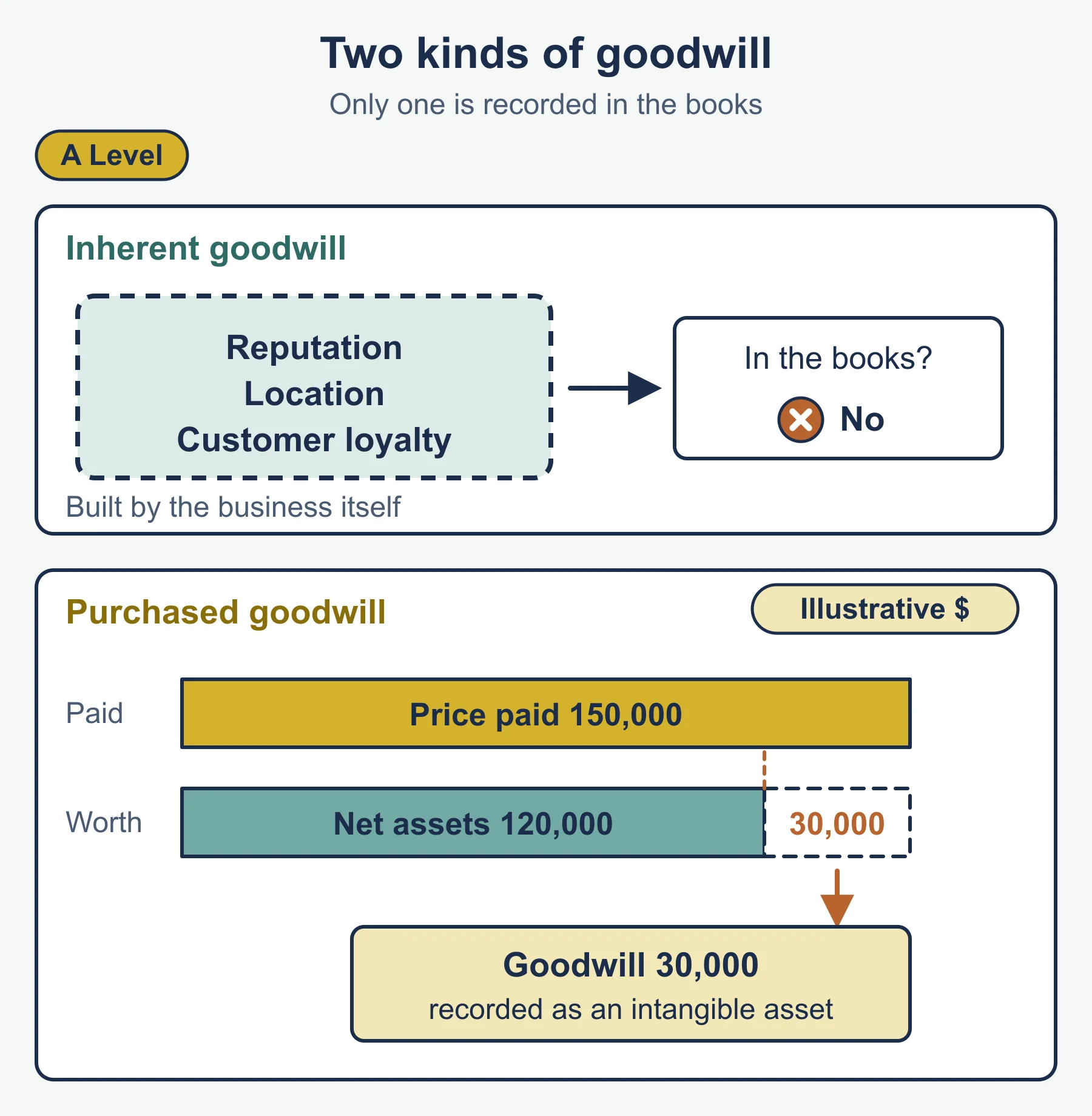
Inherent goodwill is the value of reputation, location and customer loyalty that a business builds itself. It is not recorded in the books. Purchased goodwill is the price paid for a business above the fair value of its identifiable net assets, so it is recorded as an intangible asset. When partners change, they agree a value for inherent goodwill so the outgoing share is fair.
Capital and current accounts
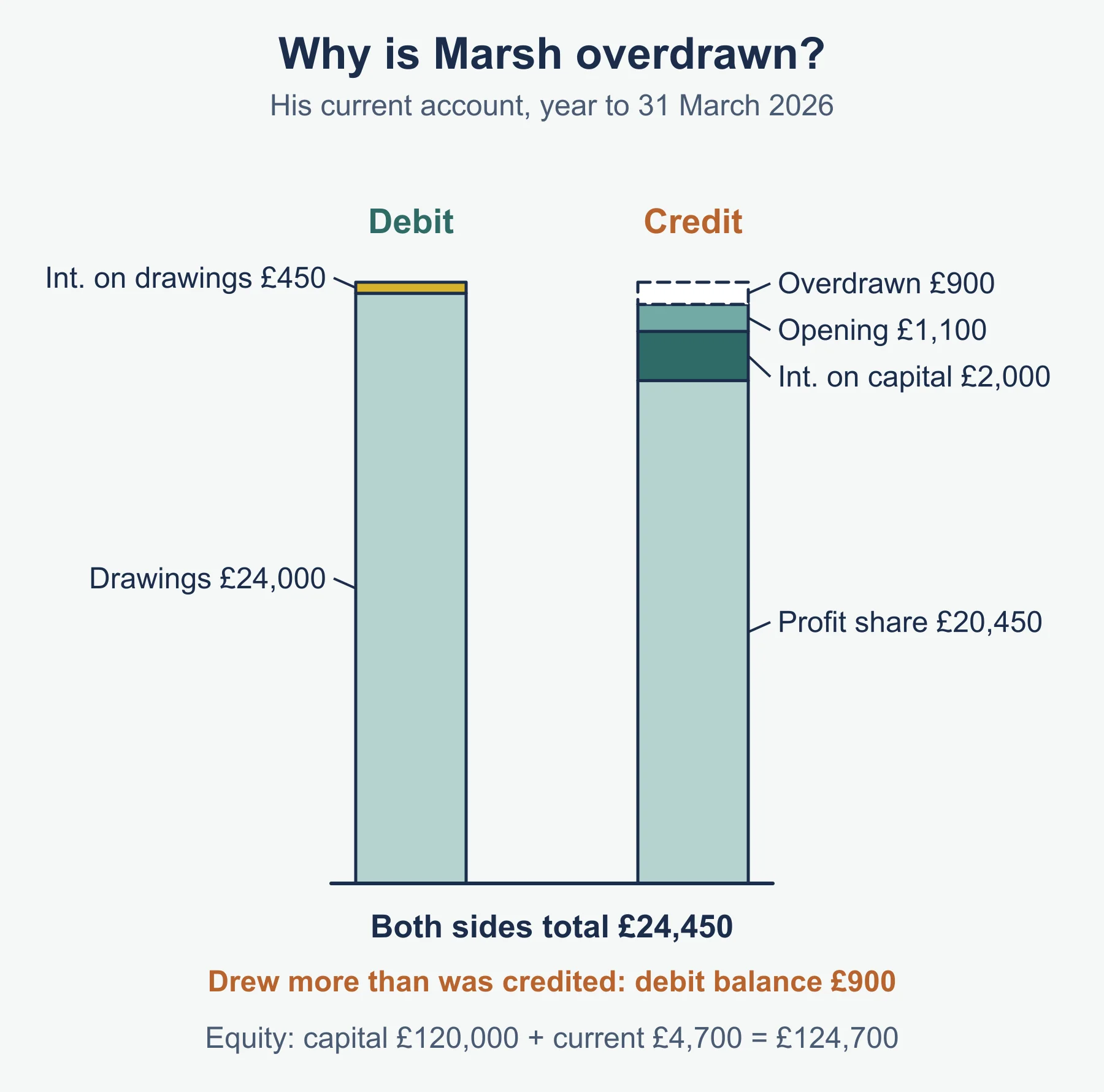
Many agreements keep capital accounts fixed, with a current account for salaries, interest, profit share and drawings. A debit balance on a current account means the partner has drawn more than earned. Changes in a partnership are recorded in the capital accounts below. If the agreement keeps capital fixed, post the same entries to current accounts instead.
Admitting a partner: goodwill and revaluation
Imberley Surveyors: Imran and Delia share profits 3:2 with capitals of 60,000 and 40,000. They admit Colm, who pays 25,000 into the bank. The new ratio is 2:2:1.
- Premises rise from 80,000 to 95,000 and inventory falls by 4,000. The revaluation account is credited 15,000 and debited 4,000, leaving a gain of 11,000 for the old partners in the old ratio: Imran 6,600 and Delia 4,400.
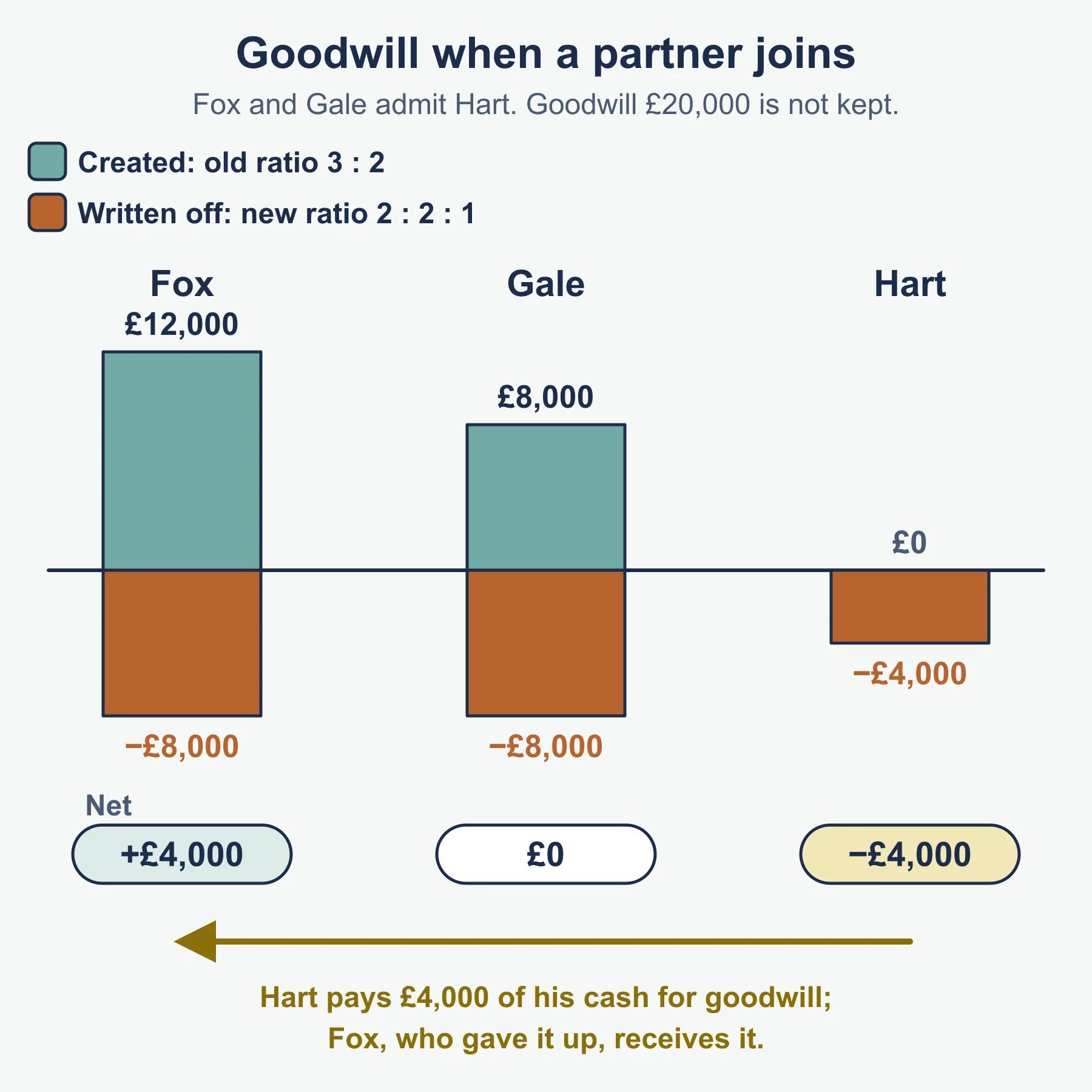
- Goodwill is agreed at 30,000. Credit the old partners in the old ratio (18,000 and 12,000). Debit all three in the new ratio (12,000, 12,000, 6,000). Goodwill is not kept in the books, so the two entries cancel.
| Capital accounts | Imran | Delia | Colm |
|---|---|---|---|
| Balance b/d | 60,000 | 40,000 | 0 |
| Revaluation gain | 6,600 | 4,400 | 0 |
| Goodwill credited (old ratio) | 18,000 | 12,000 | 0 |
| Goodwill debited (new ratio) | (12,000) | (12,000) | (6,000) |
| Cash introduced | 0 | 0 | 25,000 |
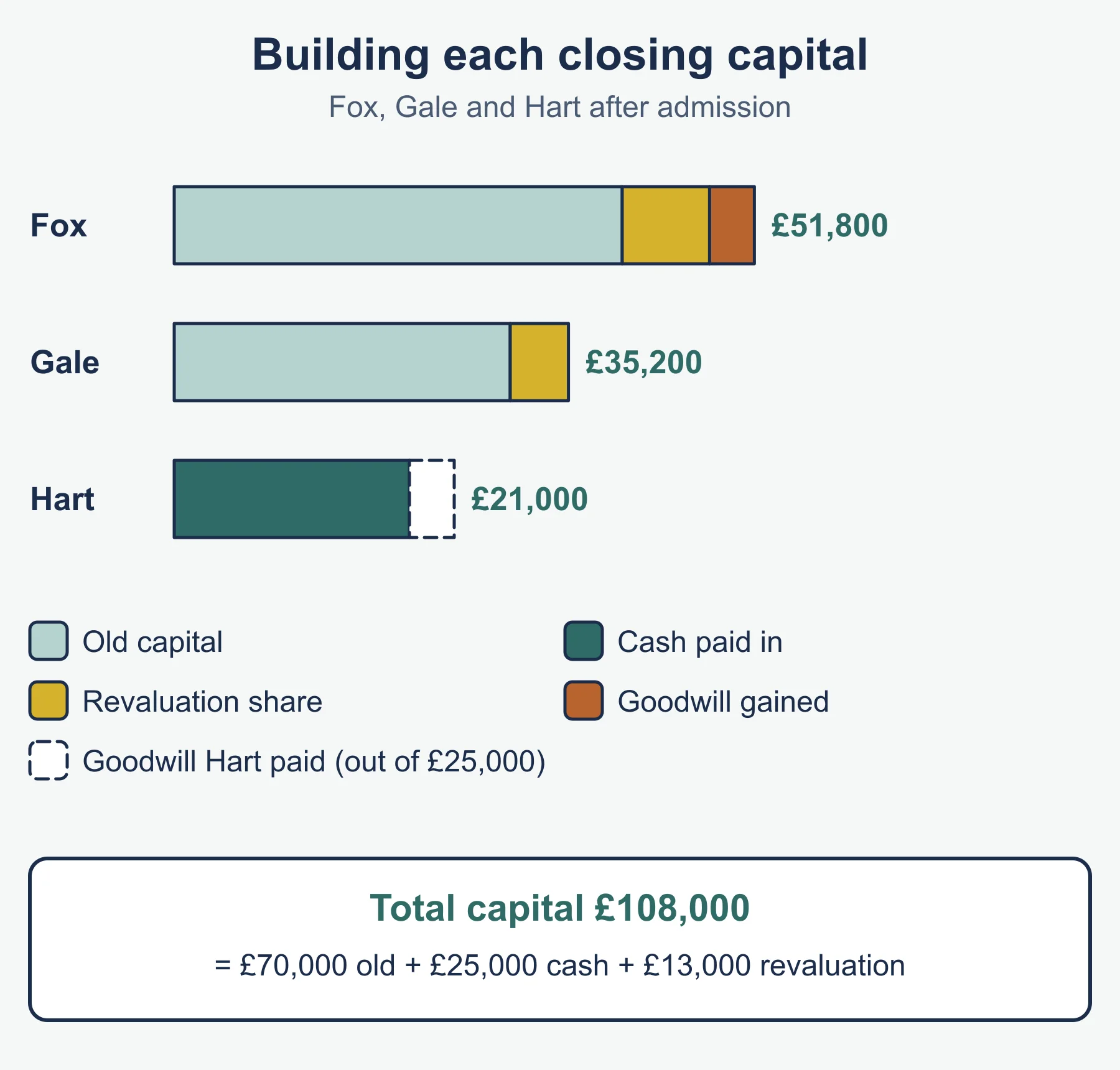
| Balance c/d | 72,600 | 44,400 | 19,000 |
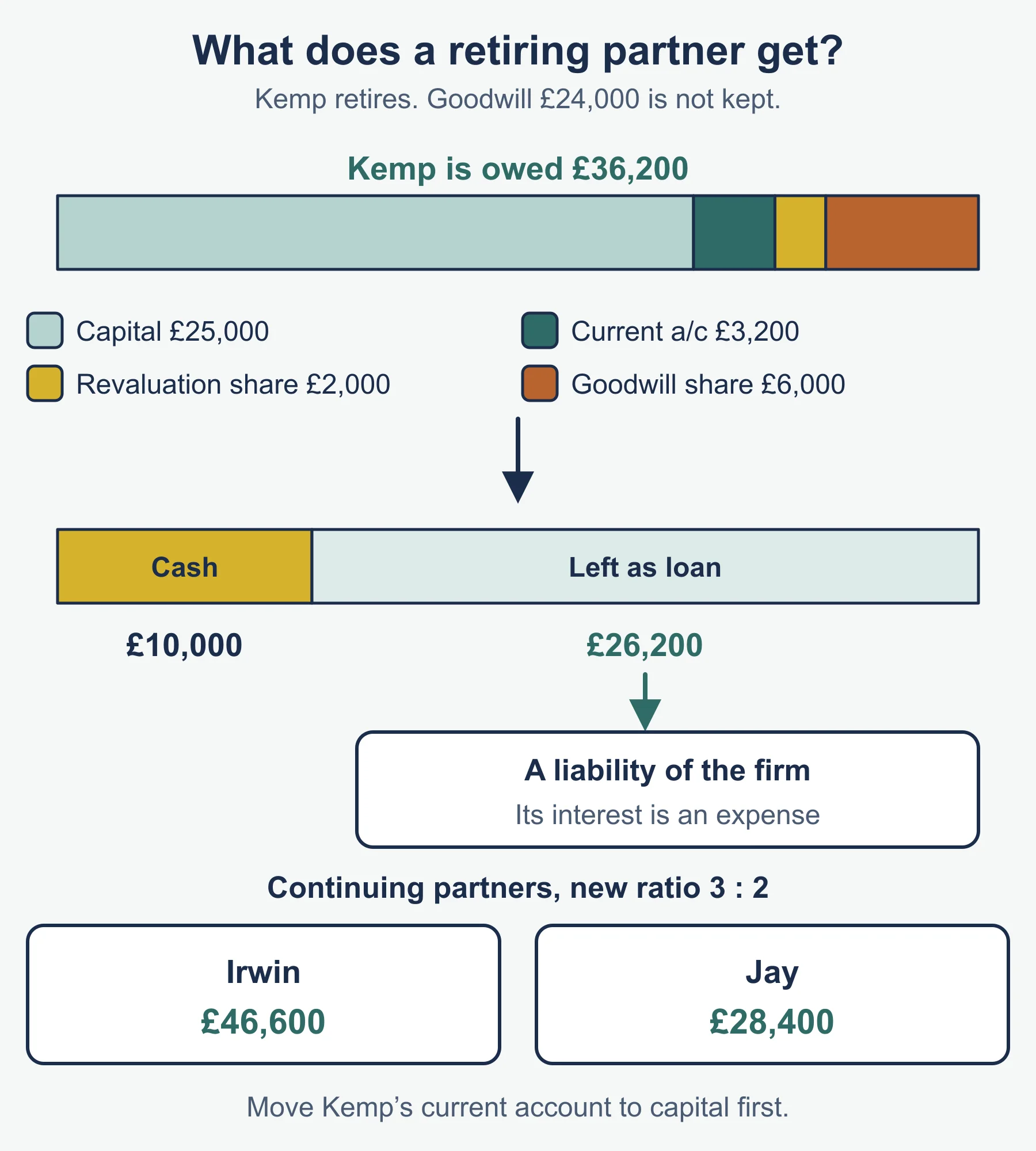
The closing total of 136,000 equals old capital 100,000, plus the 11,000 gain, plus Colm’s 25,000. A change in the profit-sharing ratio uses the same two steps without the cash. On retirement, revalue, bring goodwill in using the old ratio, and write it off using the continuing partners’ ratio. Transfer the retiring partner’s balance to a loan account or pay it out of the bank.
Appropriation and part-year changes
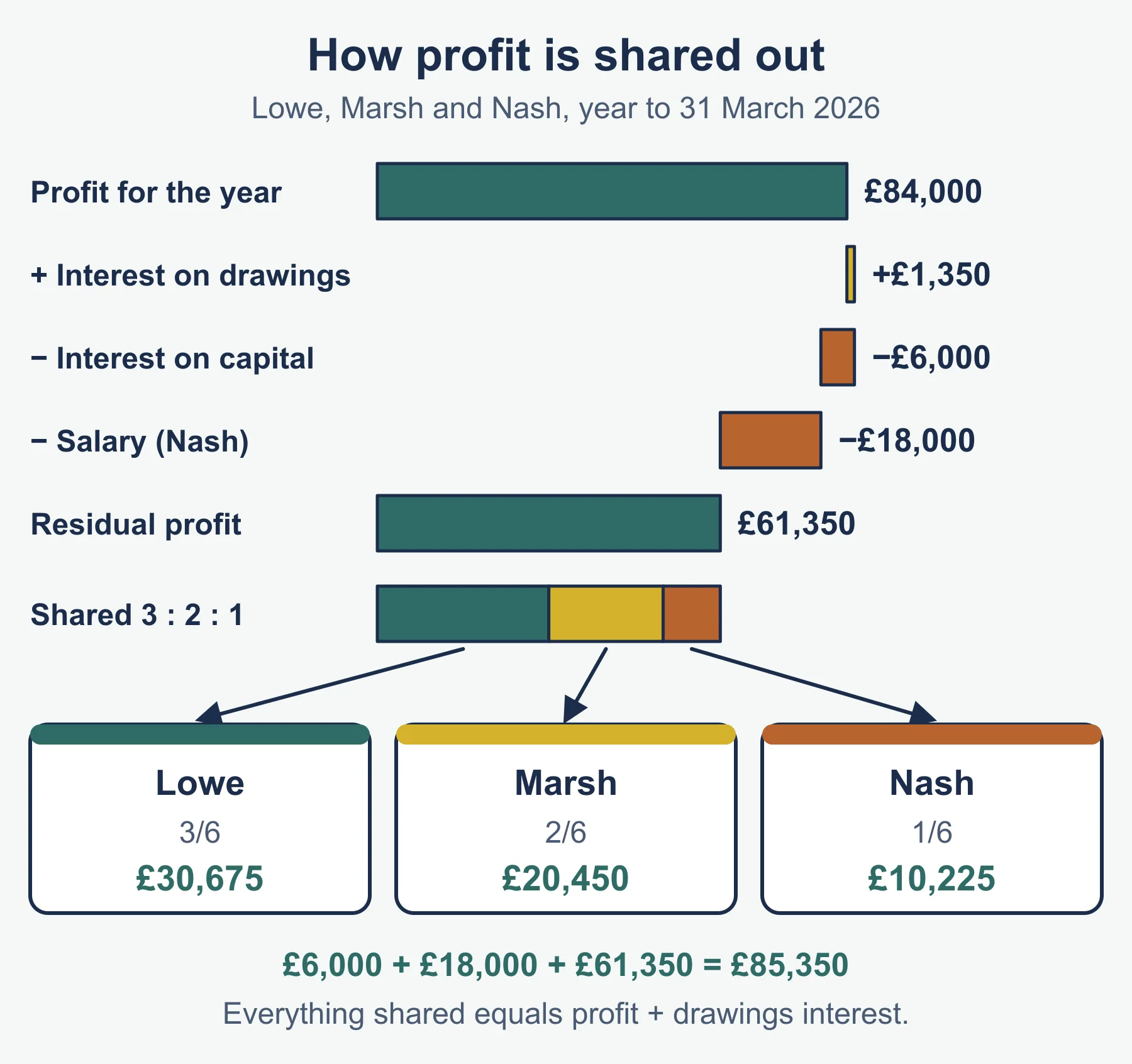
The appropriation account starts with profit for the year from the statement of profit or loss. It deducts partners’ salaries and interest on capital, adds interest charged on drawings, and shares the remainder in the profit-sharing ratio. Each item is credited or debited to the partners’ current accounts. The statement of financial position shows capital and current accounts in the equity section.
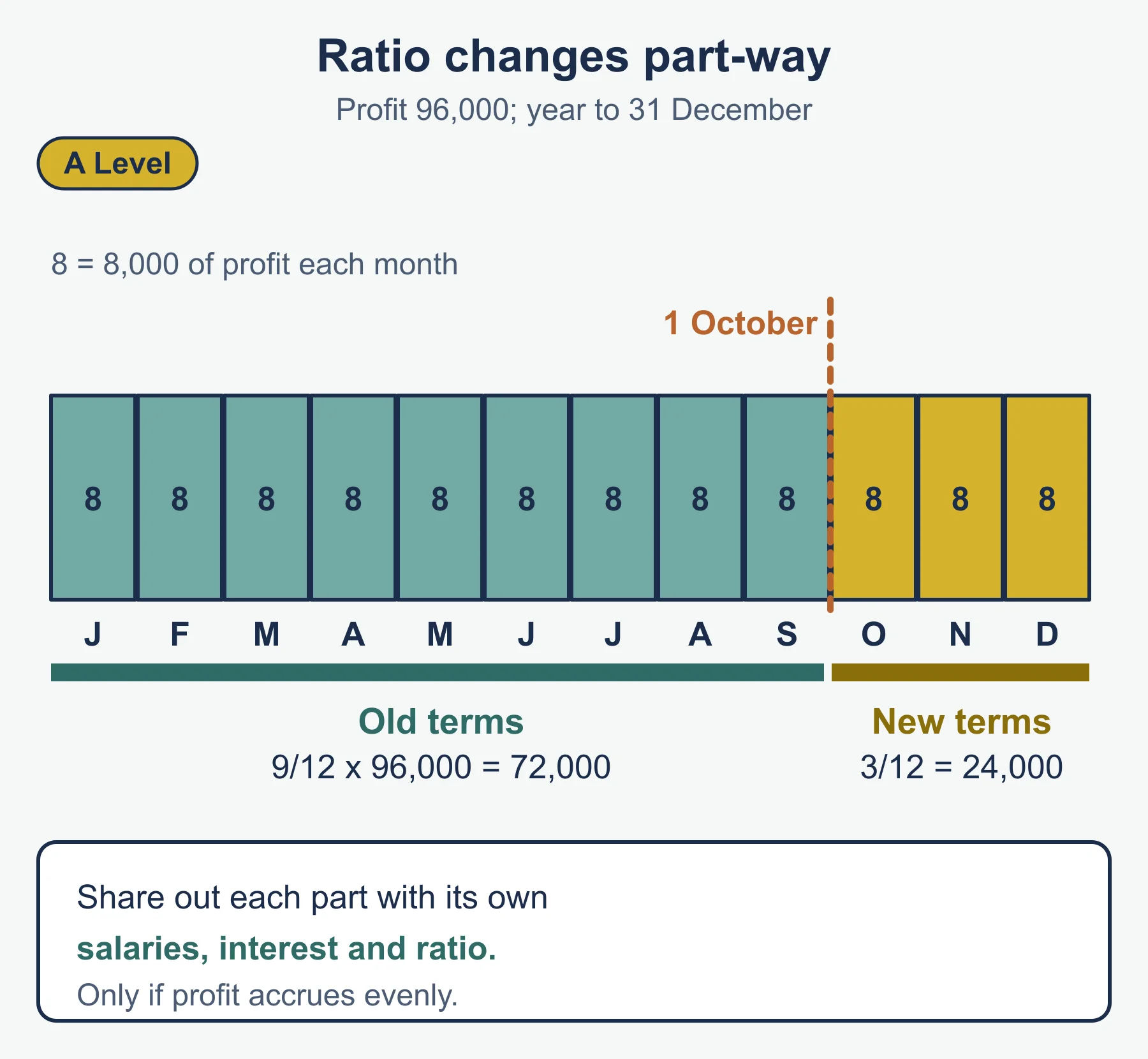
If the ratio changes part-way through the year, split the year. Where profit accrues evenly, apportion it by time and apply each period’s salaries, interest and ratio separately. Example: profit 96,000, with the change on 1 October and a 31 December year end. The old terms apply to 72,000 (9/12) and the new terms to 24,000 (3/12).
Dissolution: realisation account
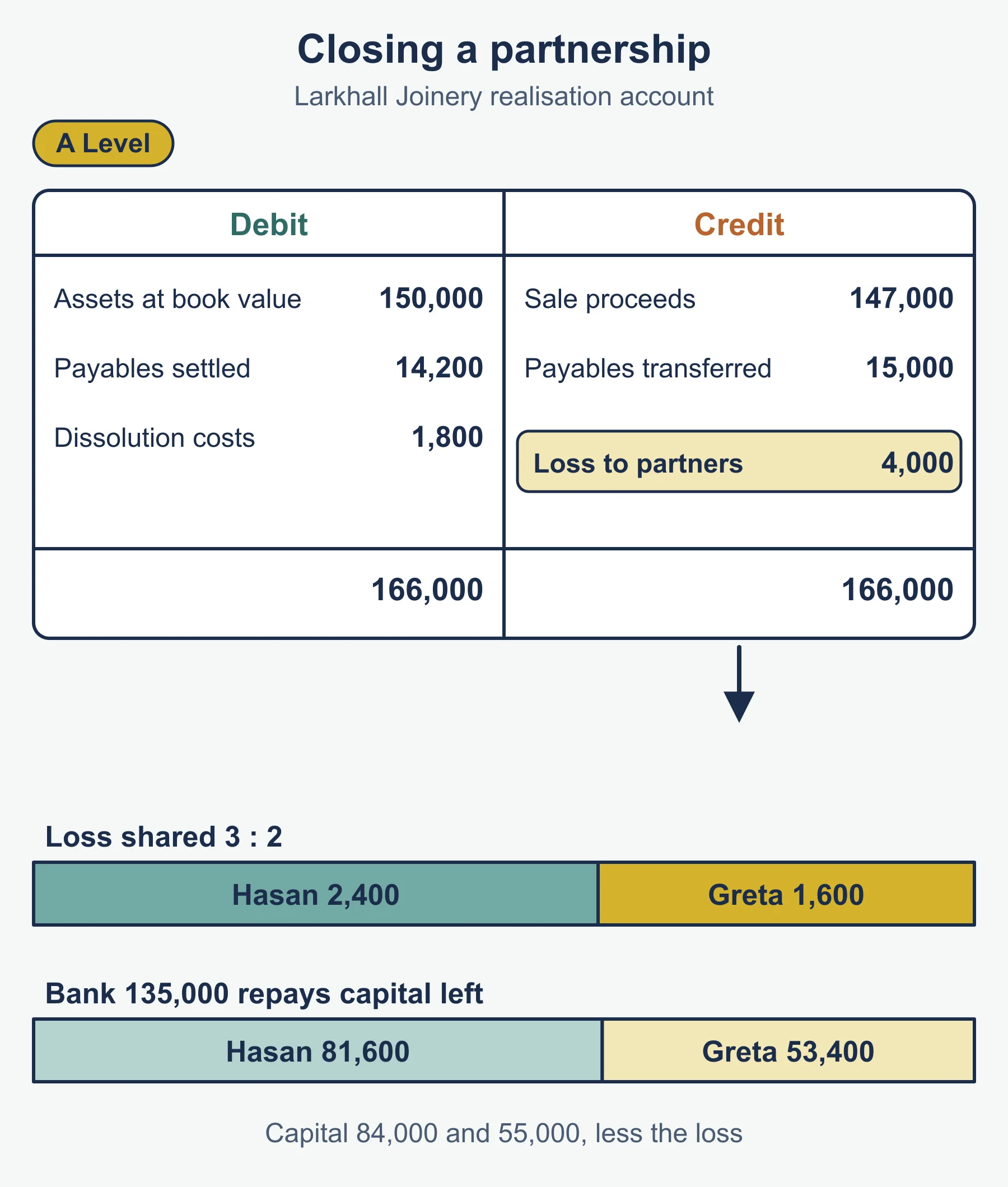
On dissolution, transfer every asset other than bank, at book value, to the realisation account. Credit it with sale proceeds and with liabilities transferred. Debit it with amounts paid to settle liabilities and with dissolution costs. The balance is a profit or loss shared in the profit-sharing ratio. Finally, pay out the remaining bank balance to settle partners’ capital.
Larkhall Joinery: Hasan and Greta share 3:2 with capitals of 84,000 and 55,000. Assets (premises 90,000, equipment 30,000, inventory 18,000, trade receivables 12,000) have a book value of 150,000 and sell or collect 147,000. Trade payables of 15,000 are settled for 14,200, and dissolution costs are 1,800.
- Debits 150,000 + 1,800 = 151,800. Credits 147,000 + 800 discount = 147,800. The loss is 4,000: Hasan 2,400, Greta 1,600.
- Bank: 4,000 + 147,000 − 14,200 − 1,800 = 135,000, paid as Hasan 81,600 and Greta 53,400.
The same revaluation account is used whenever asset values are restated: the gain or loss is shared in the old ratio.
3.1.3 Clubs and societies
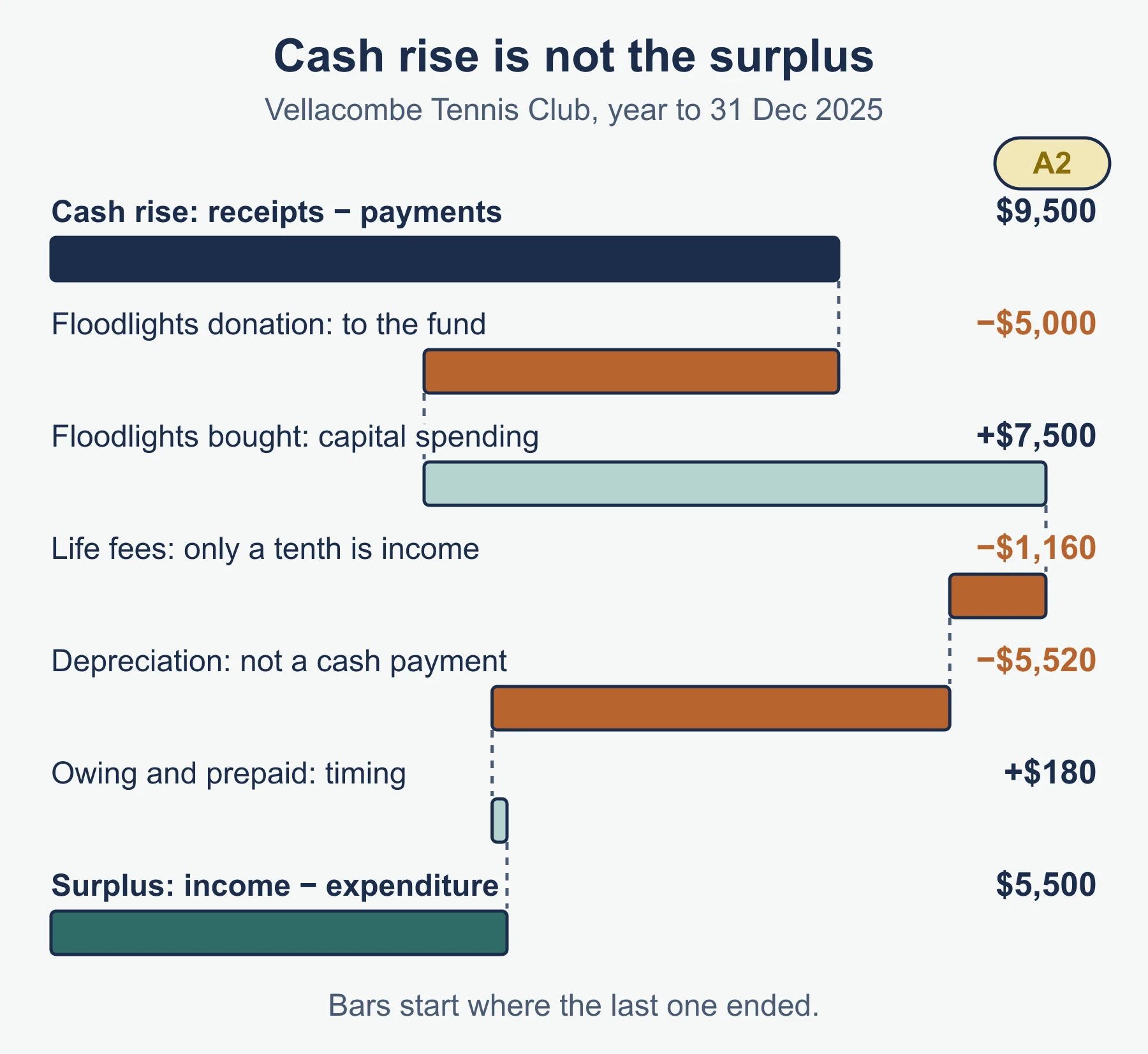
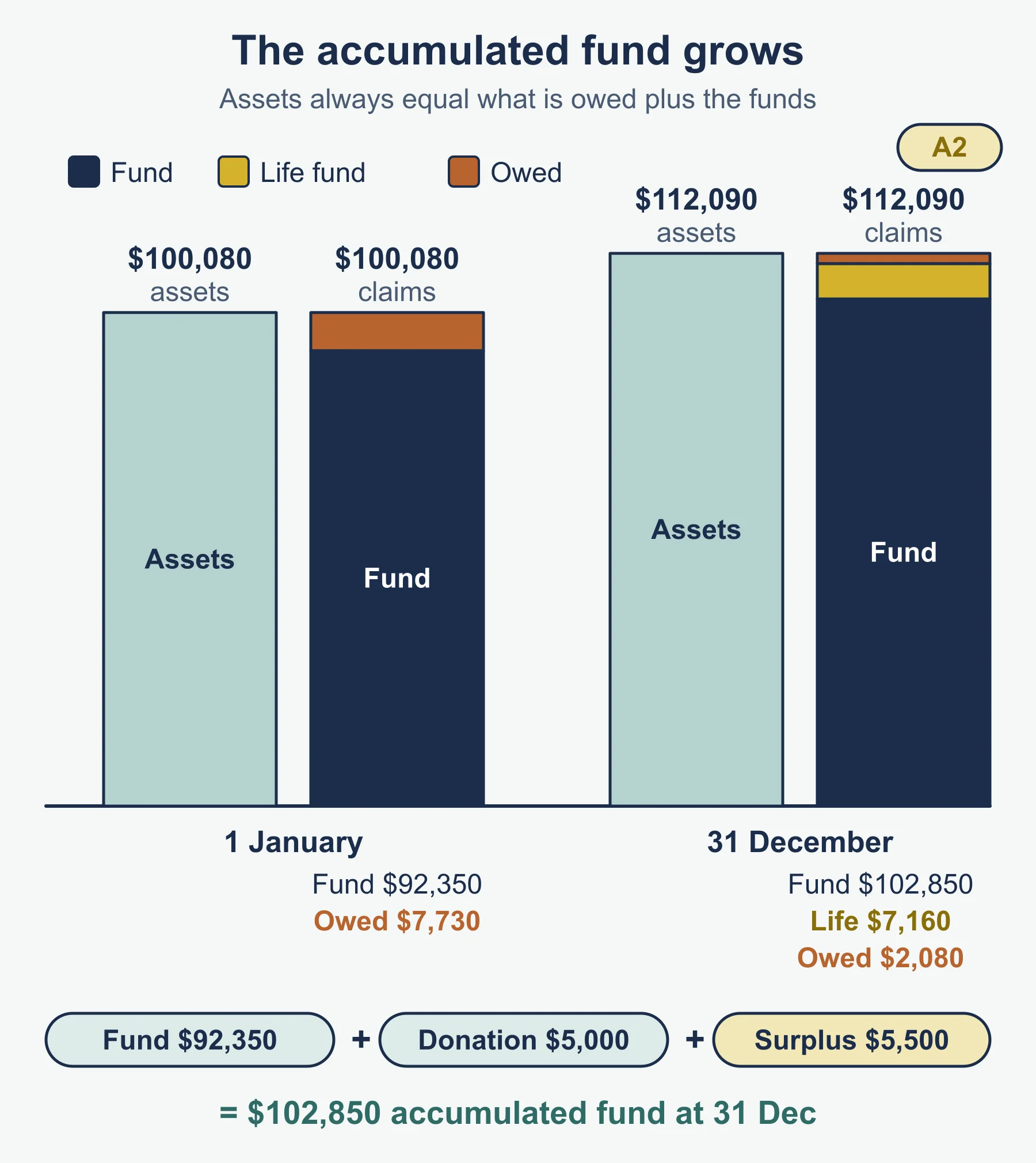
A receipts and payments account summarises the cash book: receipts, starting with the opening bank balance, against payments, ending with the closing balance. It ignores accruals. An income and expenditure account follows accruals and gives a surplus or deficit. The accumulated fund is total assets minus total liabilities, the club’s equivalent of capital. Surpluses are added to it and deficits deducted.
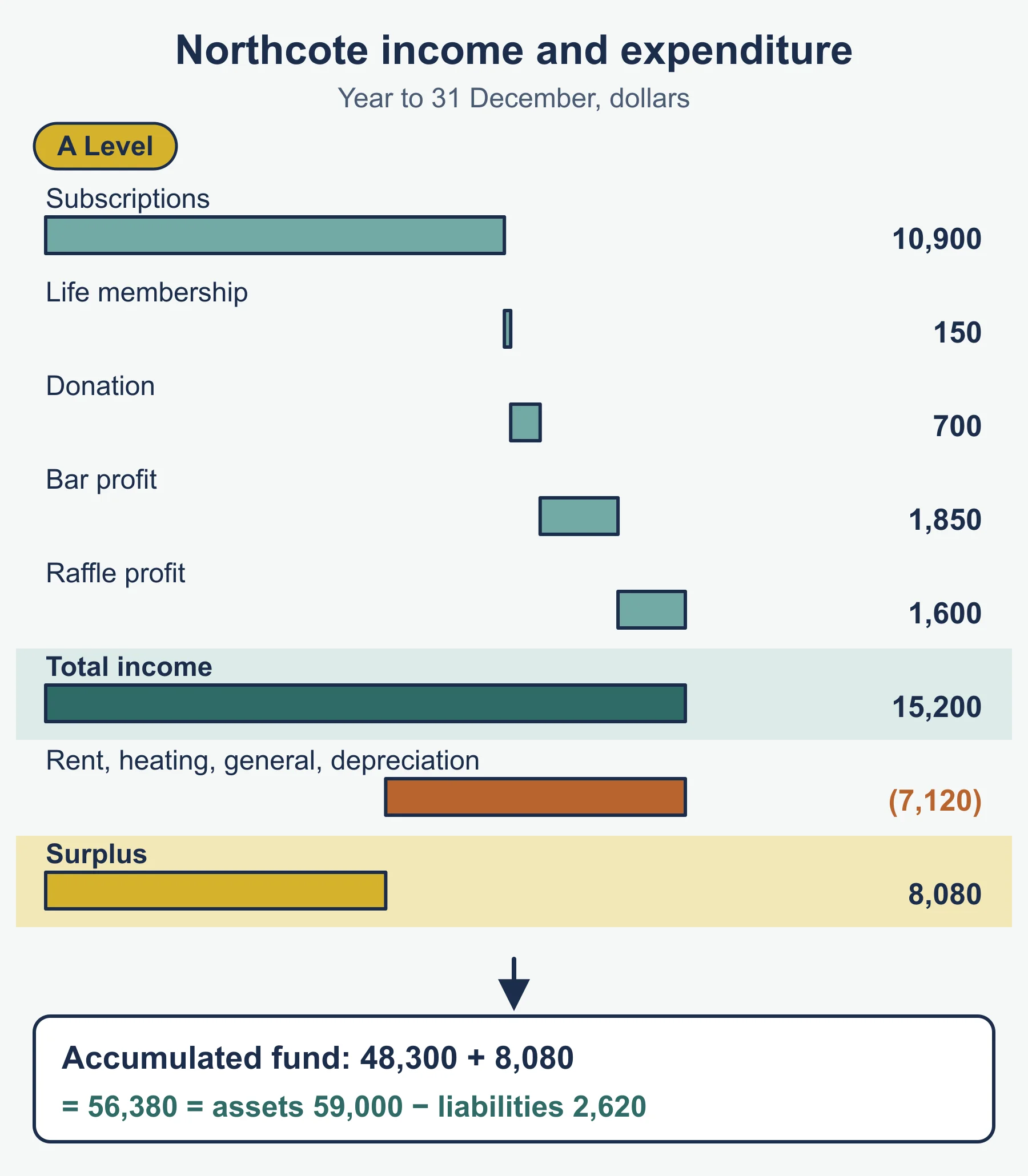
Northcote Archery Club starts the year with clubhouse 40,000, equipment 6,000, bar inventory 600, subscriptions in arrears 600 and bank 2,150. Its liabilities are subscriptions in advance 350 and bar payables 700. Opening accumulated fund: 49,350 − 1,050 = 48,300.
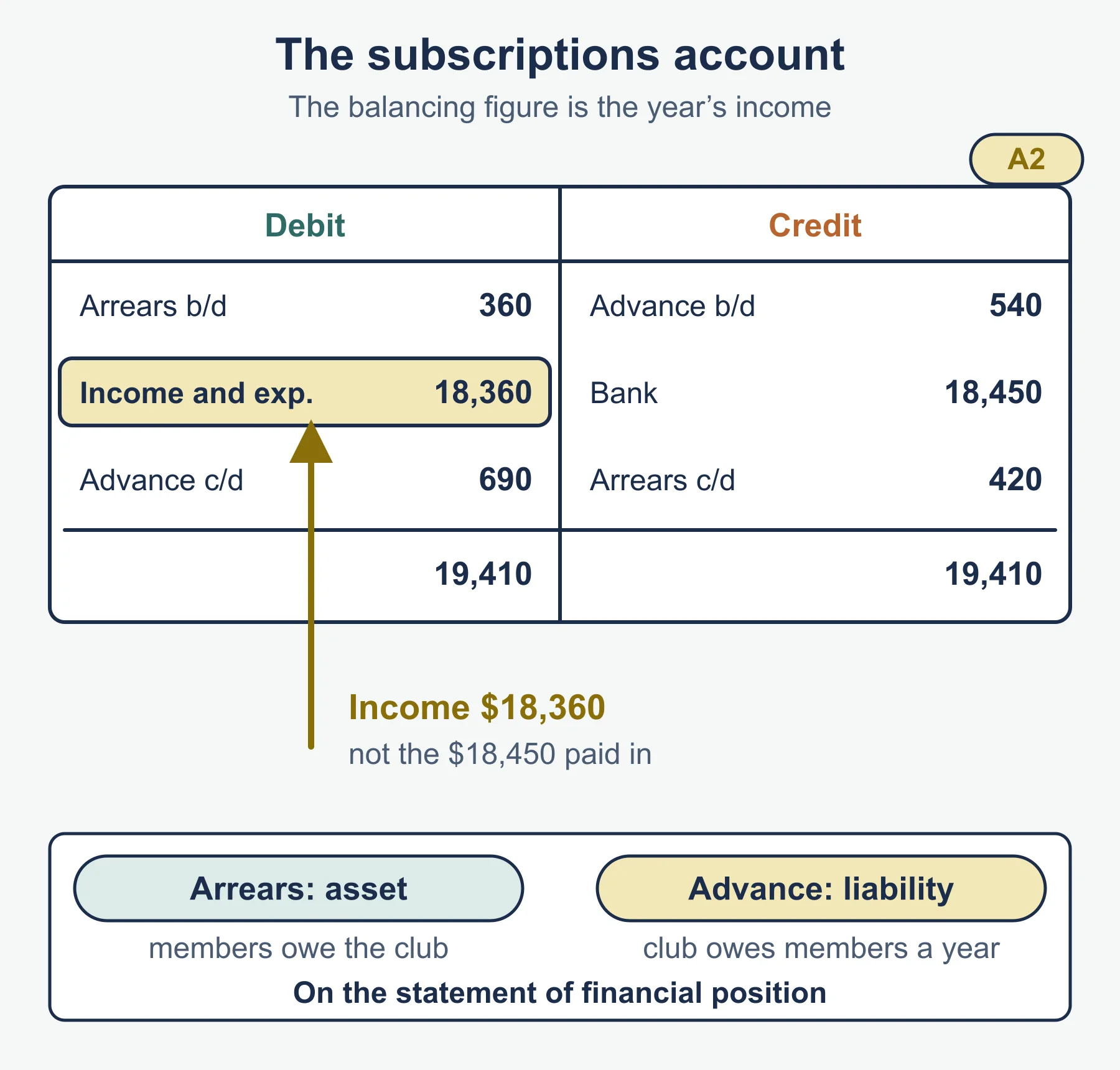
- Subscriptions: received 11,200. Arrears move from 600 to 450 and advance from 350 to 500. Income is 11,200 − 600 + 450 + 350 − 500 = 10,900.
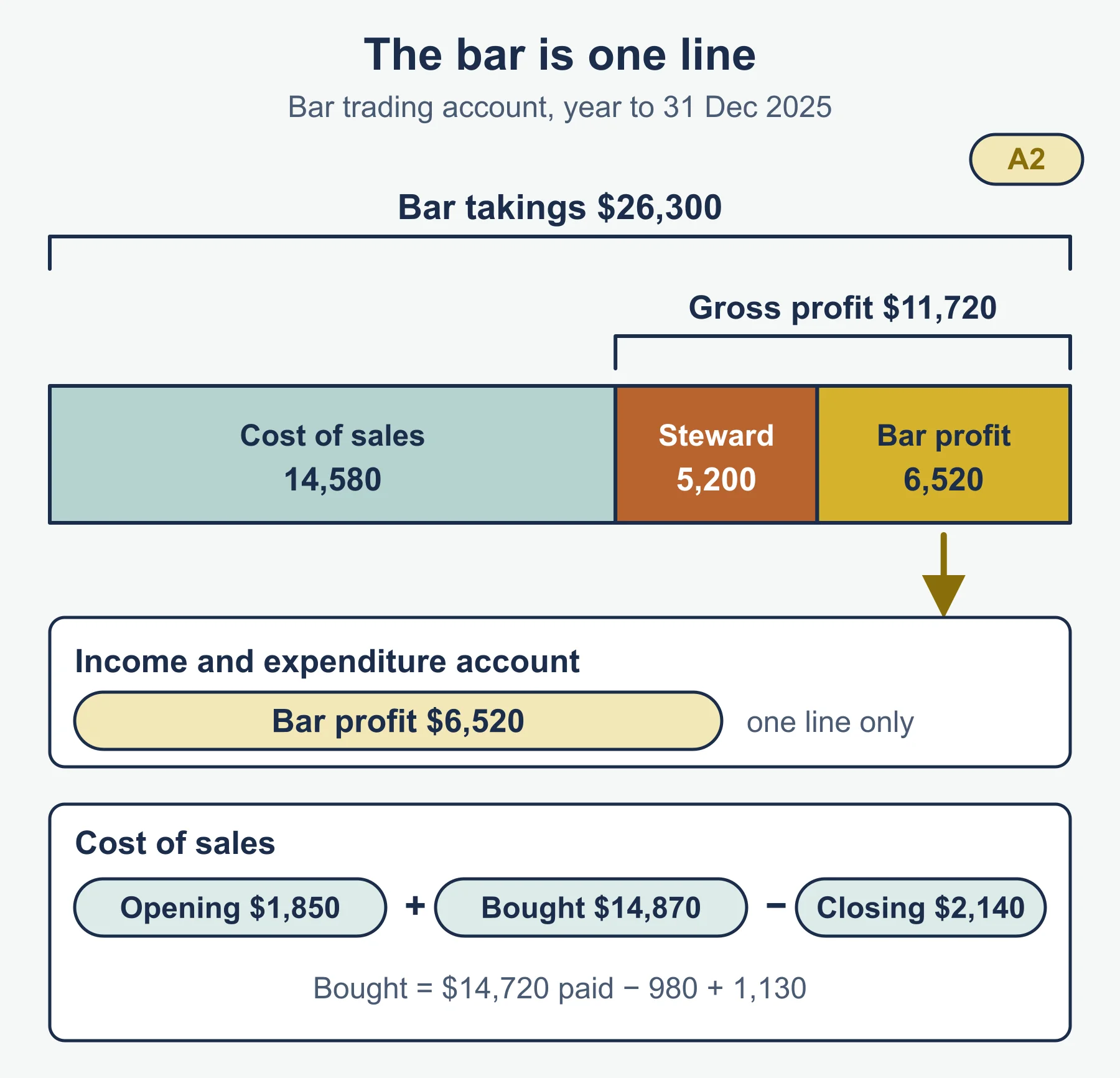
- Bar (a trading activity): sales 7,800. Purchases are 5,000 paid, plus closing payables 650, minus opening 700, giving 4,950. Cost of sales 600 + 4,950 − 800 = 4,750, so gross profit 3,050. Wages 1,200 leave bar profit 1,850.
- Raffle (revenue-generating): takings 2,400 less prizes 800 gives 1,600.
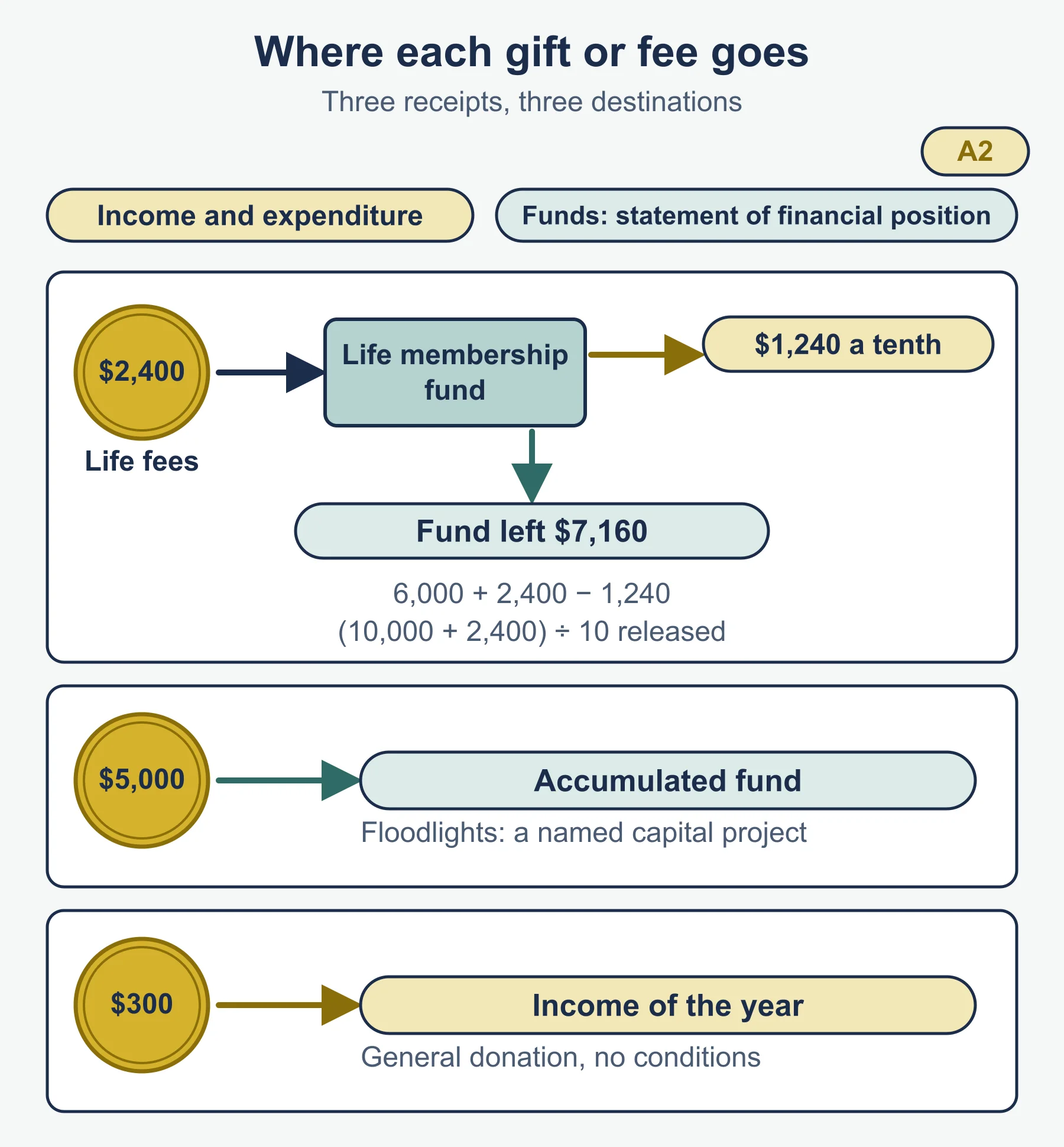
- Life membership: a life member pays 1,500. It goes to a life membership account, and an equal share of 150 a year is released to income. The balance of 1,350 is a liability.
- Donations: a general donation of 700 is income. A donation for a specific purpose, such as a new building, is a capital receipt, kept out of income.
| Income and expenditure, year to 31 December | $ |
|---|---|
| Subscriptions | 10,900 |
| Life membership | 150 |
| Donation | 700 |
| Bar profit | 1,850 |
| Raffle profit | 1,600 |
| Total income | 15,200 |
| Rent 3,600, heating 1,520, general 900, depreciation 1,100 | (7,120) |
| Surplus | 8,080 |
Closing accumulated fund: 48,300 + 8,080 = 56,380. This agrees with net assets: assets 59,000 less liabilities 2,620. Adjustments follow 1.5.1: accrue heating, depreciate equipment, value inventory. With incomplete records, build the opening statement first, then find missing figures with ledger accounts.
Sources of finance and fundraising: subscriptions and donations cost nothing but are unpredictable. Grants may be restricted. A bank loan or mortgage brings structure but interest. Events and raffles raise cash but need volunteers. Evaluate each against the purpose, cost and risk; a recommendation needs reasons on both sides, then a justified choice.
3.1.4 Manufacturing businesses
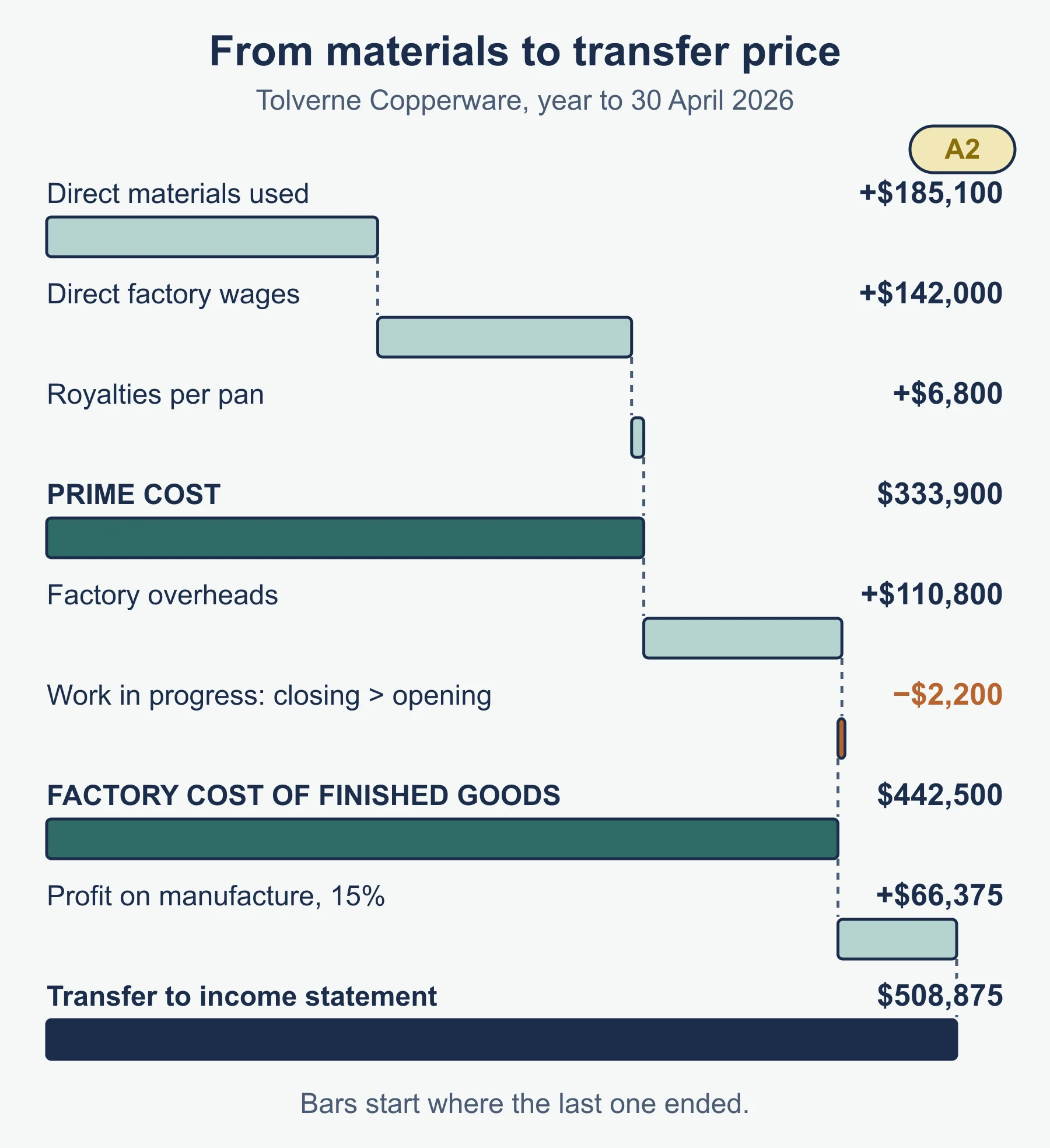
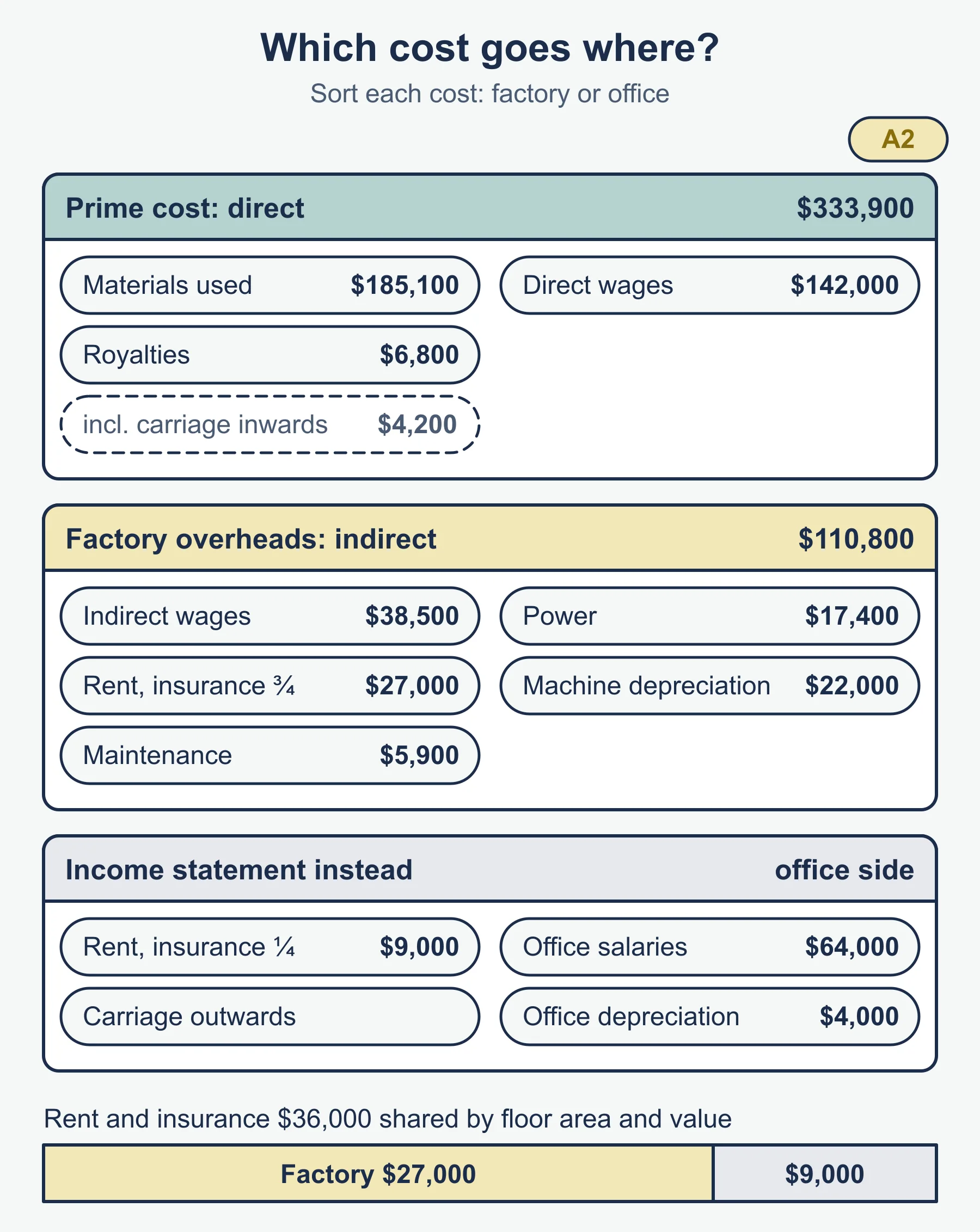
The manufacturing account finds the cost of production. Direct materials, direct labour and direct expenses give prime cost. Indirect expenses such as factory rent and depreciation of machines are factory overheads. Adjust for work in progress to reach cost of production.
Brookvane Cabinets: opening raw materials 12,000, purchases 74,000, carriage inwards 1,500, closing raw materials 14,500, direct wages 48,000, royalties on production 3,000, indirect wages 16,000, factory rent 9,000, machine depreciation 6,000, power 4,000, work in progress 5,000 at the start and 6,500 at the end.
- Raw materials used 73,000. Prime cost 124,000. Overheads 35,000.
- Cost of production 159,000 + 5,000 − 6,500 = 157,500.
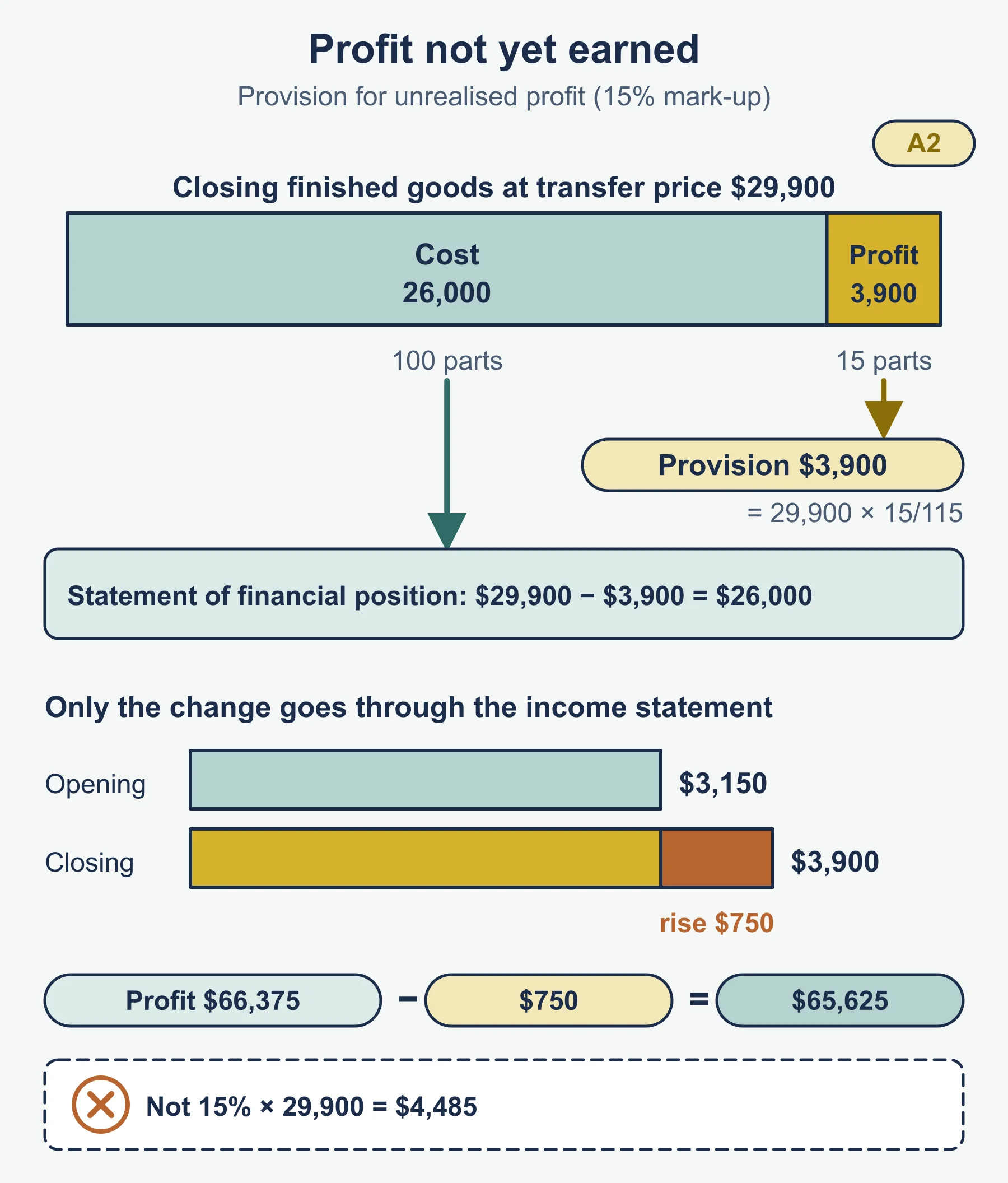
Brookvane transfers goods to the statement of profit or loss at cost plus 20%. Factory profit is 31,500 and the transfer price is 189,000. Opening finished goods at transfer price were 21,600 and closing are 27,000, so cost of sales is 21,600 + 189,000 − 27,000 = 183,600. Closing inventory includes unrealised profit of 27,000 × 20/120 = 4,500, and opening included 3,600. Increase the provision for unrealised profit by 900 (a charge in the statement of profit or loss) and show closing inventory at 22,500 (27,000 − 4,500).
Reasons for showing manufacturing profit: it compares the in-house cost with buying the goods in, it measures the factory’s performance apart from selling, and it can set a transfer price.
3.1.5 Limited companies
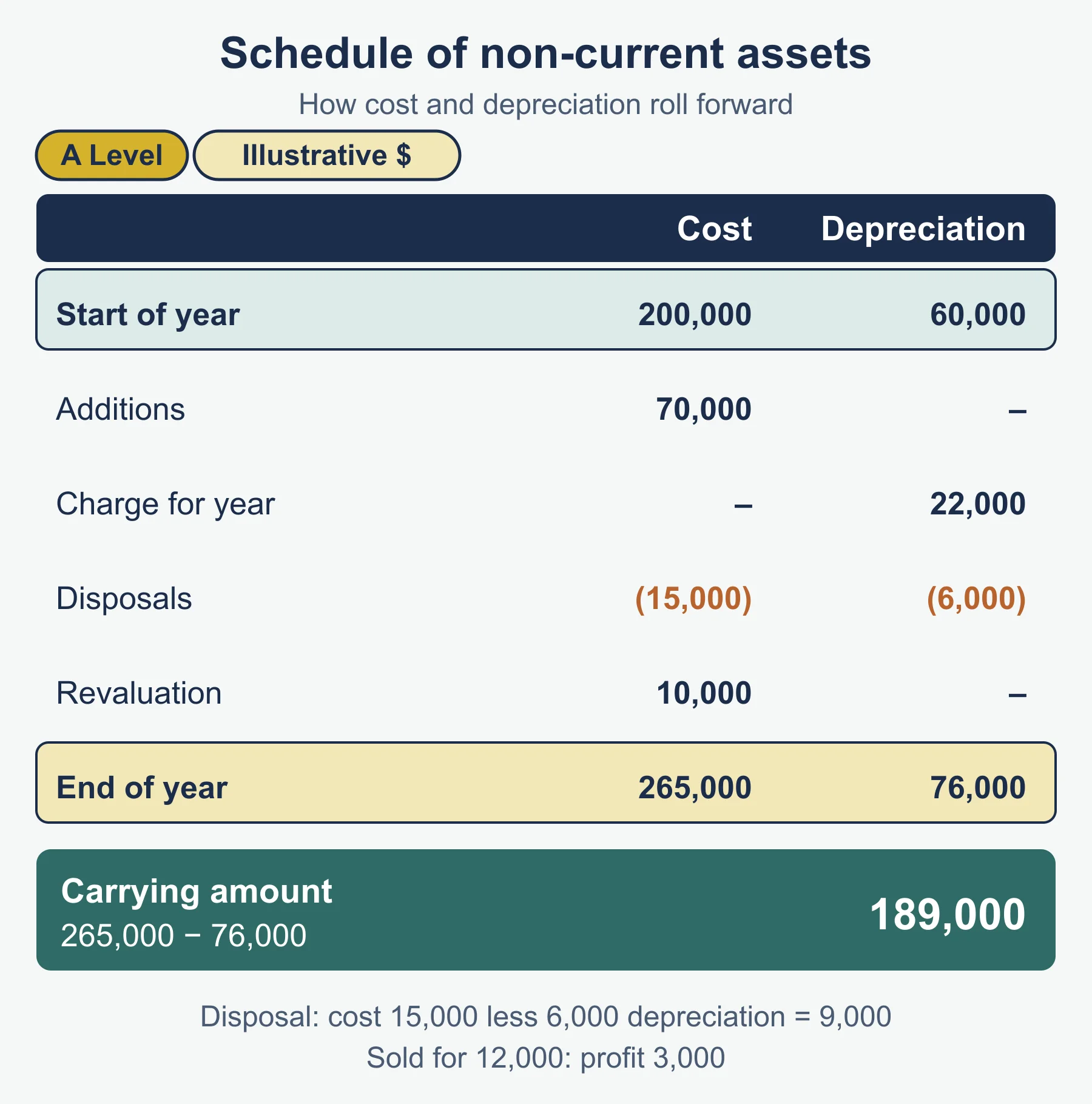
Prepare these in line with international accounting standards (IAS 1 sets presentation, IAS 7 cash flows): the statement of profit or loss, the statement of financial position, the statement of cash flows, the statement of changes in equity and the schedule of non-current assets (cost, depreciation, carrying amount, additions, disposals and revaluations).
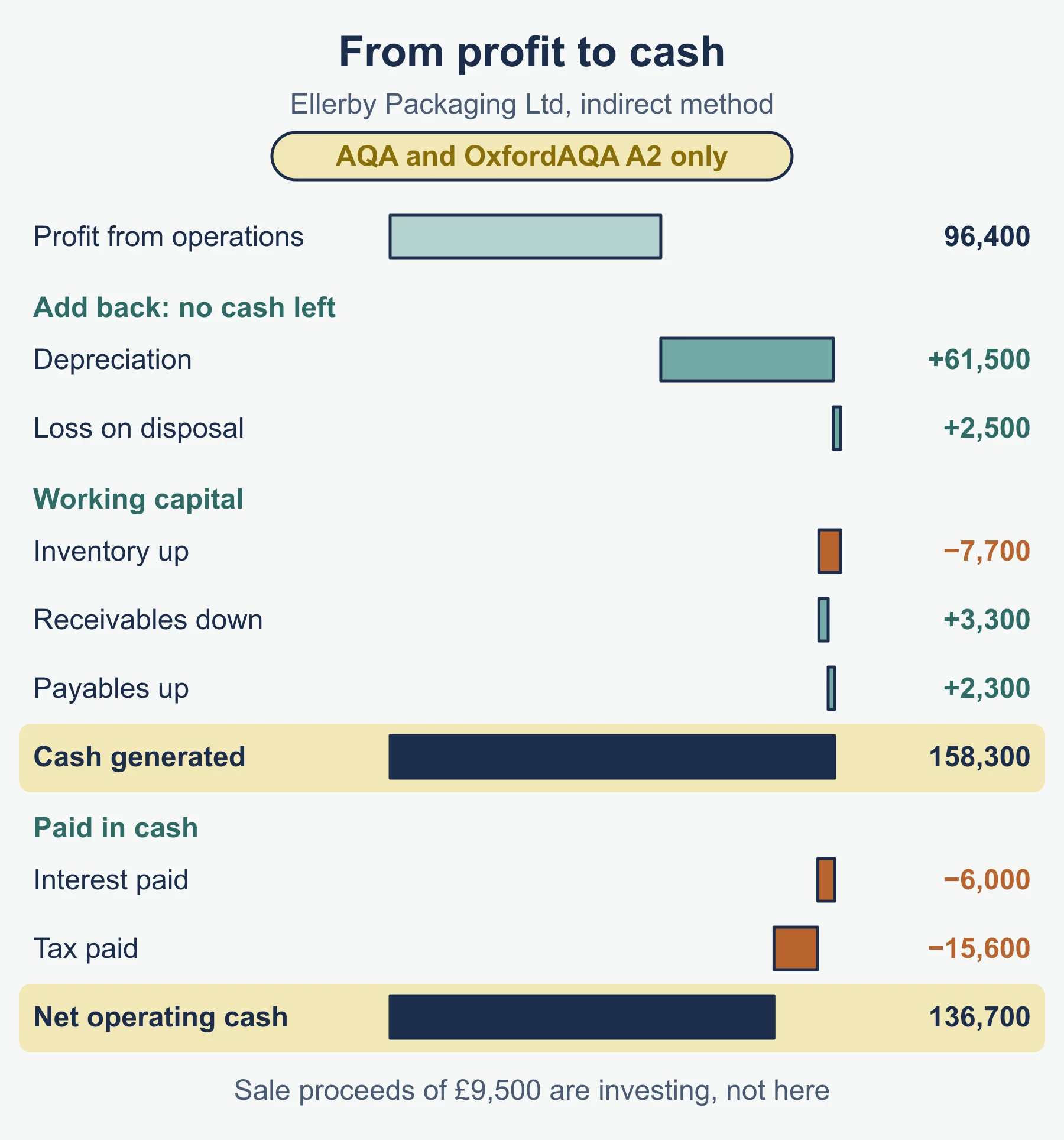
Cranleigh Foods Ltd: profit before tax 84,000 after interest of 6,000, depreciation 22,000, profit on disposal 3,000, inventory up 9,000, receivables up 5,000, payables up 7,000, tax paid 15,000, interest paid 6,000.
| Statement of cash flows (indirect method) | $ |
|---|---|
| Profit before tax 84,000 + interest 6,000 + depreciation 22,000 − profit on disposal 3,000 | 109,000 |
| Working capital changes (−9,000 − 5,000 + 7,000) | (7,000) |
| Cash generated from operations | 102,000 |
| Interest paid and tax paid | (21,000) |
| Net cash from operating activities | 81,000 |
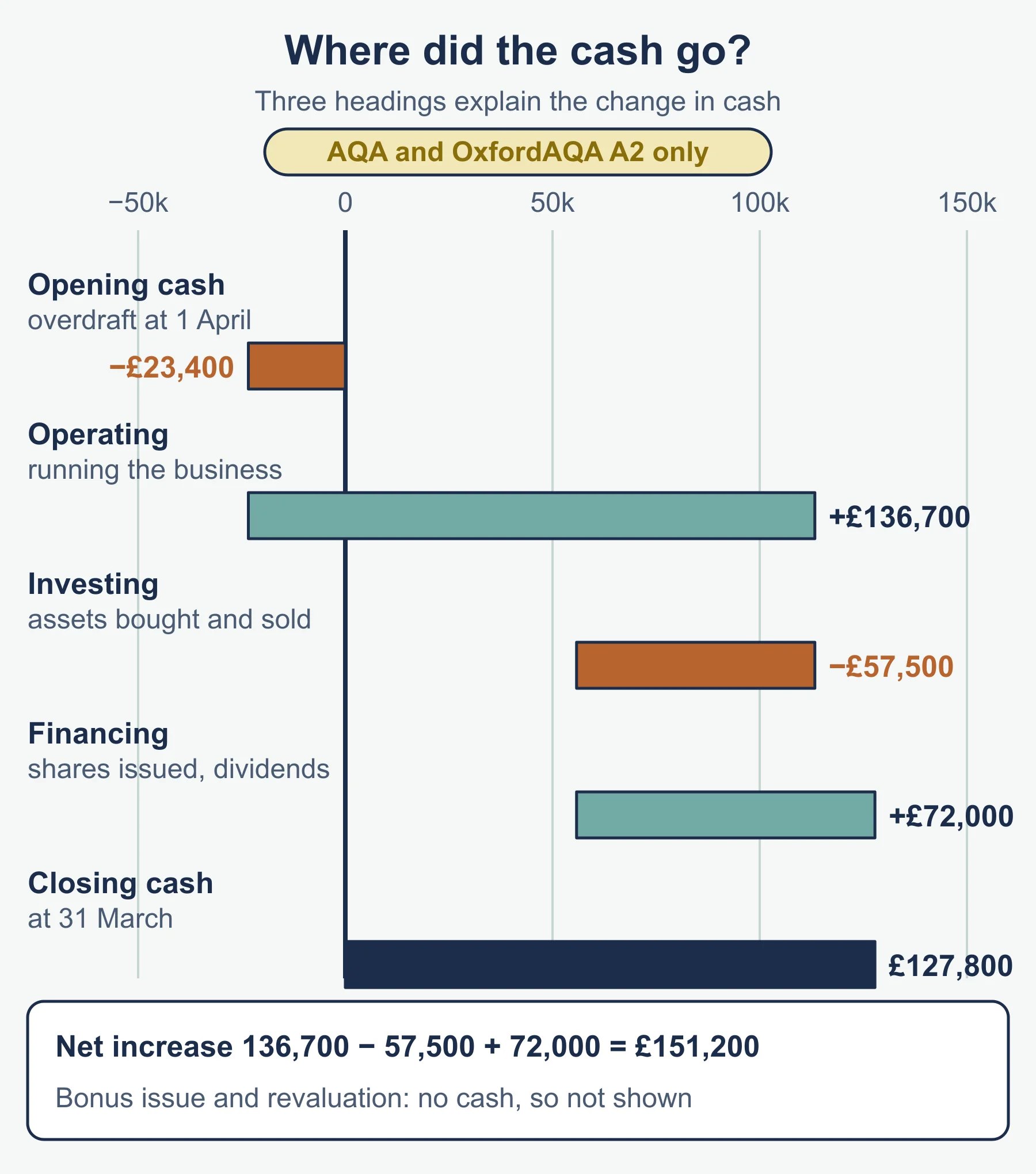
| Investing: purchase (70,000), disposal proceeds 12,000 | (58,000) |
| Financing: shares 40,000, debentures repaid (20,000), dividends (18,000) | 2,000 |
| Net increase in cash | 25,000 |
With opening cash of 10,000, closing cash is 35,000. IAS 7 lets interest and dividends paid sit in operating or financing, so state your choice. Non-cash items such as a revaluation never appear.
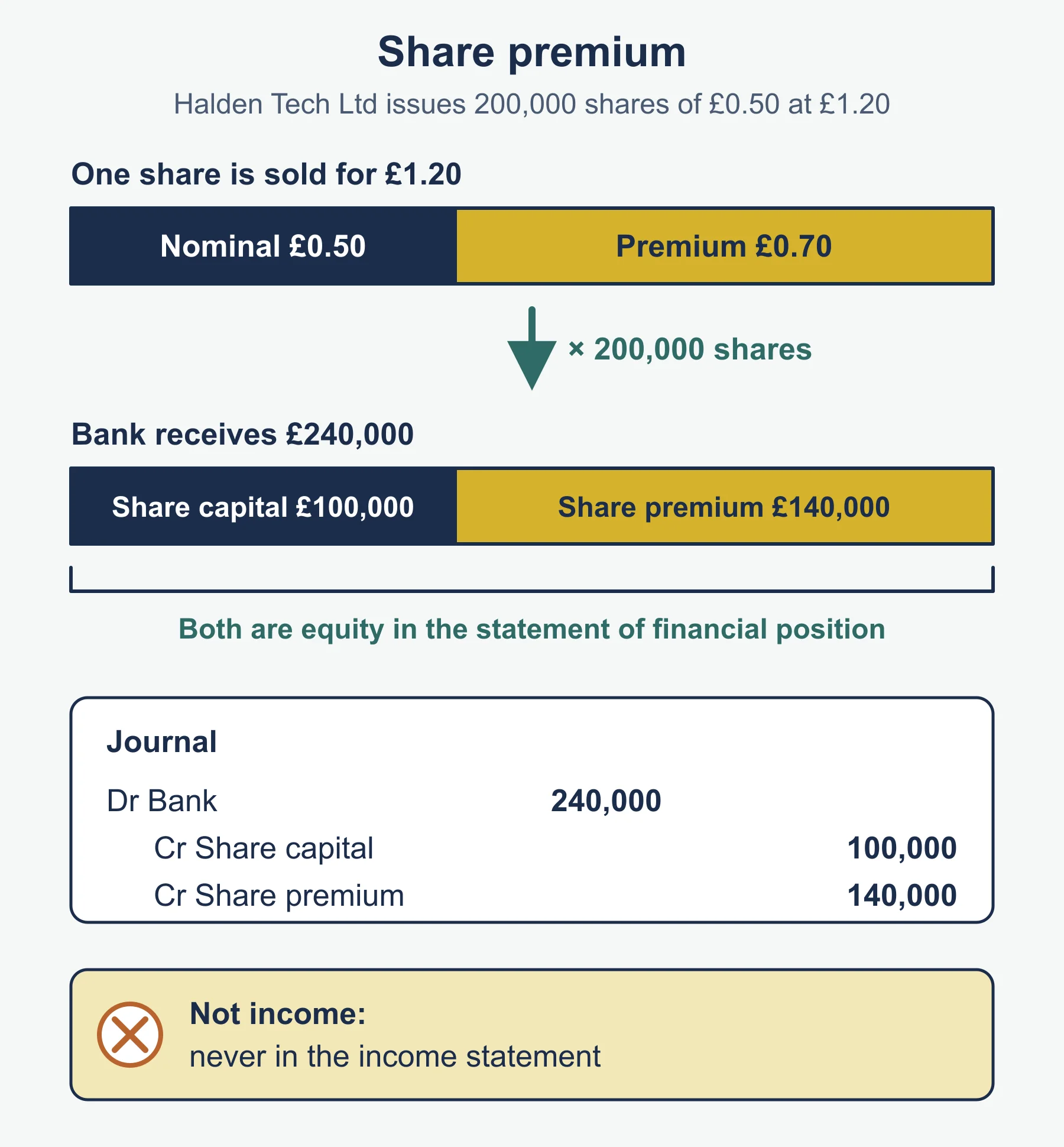
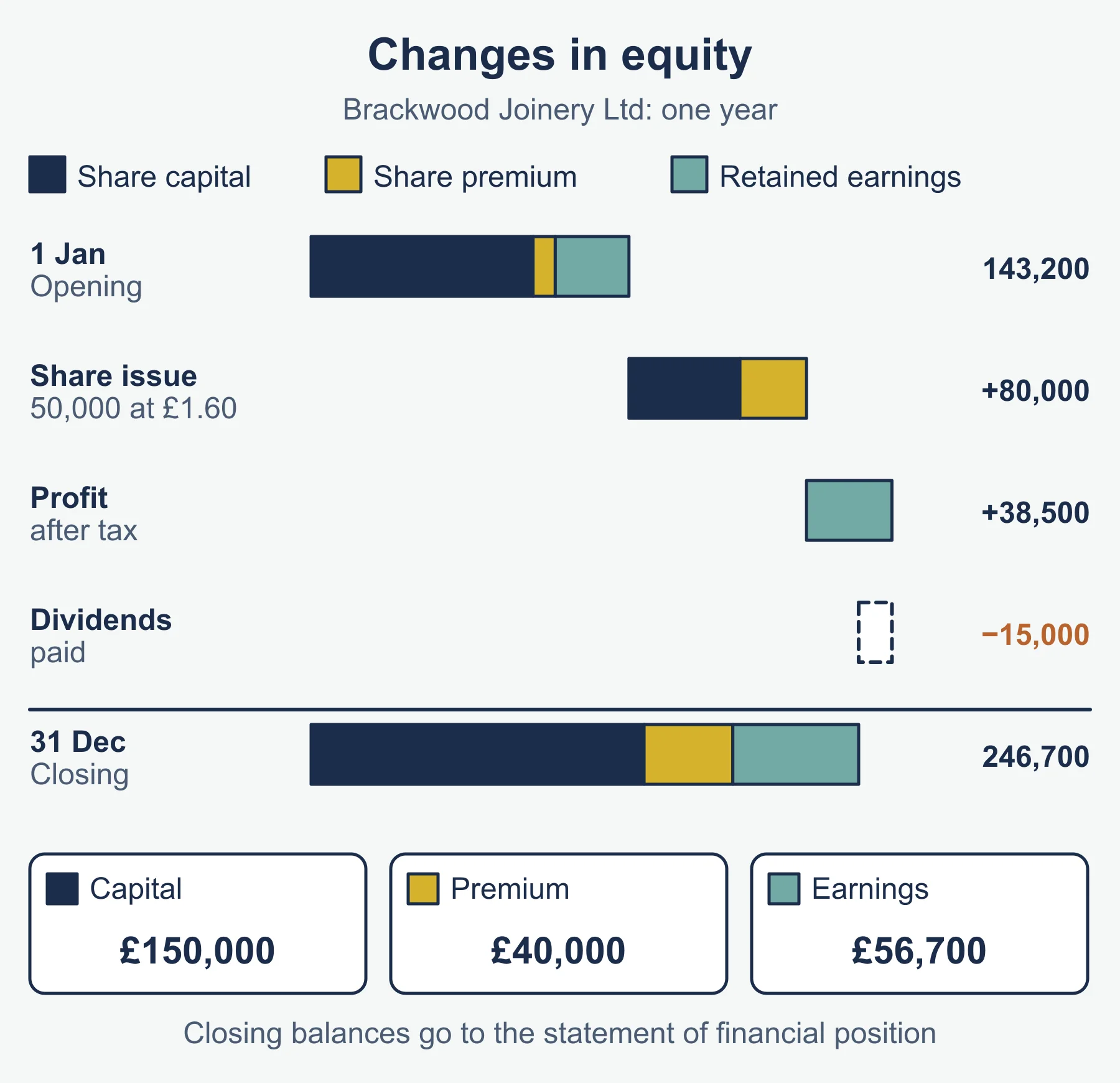
The 40,000 share issue was 25,000 shares of 1 each at 1.60. The statement of changes in equity then adds 25,000 to share capital and 15,000 to share premium. It adds the revaluation gain to the revaluation reserve and profit after tax to retained earnings, and deducts dividends.
Common errors
- Crediting goodwill to the new partner instead of the old partners.
- Forgetting that a closing subscriptions advance reduces income.
- Calling the surplus on the receipts and payments account “profit” or showing capital items in income and expenditure.
- Applying factory profit to the whole of inventory instead of the portion at transfer price.
- Adding depreciation to profit in the statement of cash flows but forgetting to deduct a profit on disposal, which belongs in investing activities.
Frequently asked questions
What is the difference between a receipts and payments account and an income and expenditure account? A receipts and payments account summarises a club’s cash book and ignores accruals. An income and expenditure account follows the accruals concept and gives a surplus or deficit, which is added to or deducted from the accumulated fund.
How is a life membership fee treated in club accounts? A life membership payment goes to a life membership account rather than being treated as income of one year. An equal share is released to income each year, and the unreleased balance is shown as a liability.
What is prime cost in a manufacturing account? Prime cost is the total of direct materials, direct labour and direct expenses. Factory overheads are then added, and the work in progress adjustment made, to find the cost of production.
What is a realisation account used for? On dissolution of a partnership, every asset other than bank is transferred at book value to the realisation account, together with the proceeds and the costs of dissolution. The resulting profit or loss is shared between the partners in their profit-sharing ratio.
Which international accounting standards apply to company statements in Cambridge 9706? Limited company statements are prepared in line with international accounting standards, including IAS 1 for presentation and IAS 7 for statements of cash flows.
Official syllabus
Cambridge International AS & A Level Accounting 9706, syllabus for examination in 2026, 2027 and 2028, section 3.1, published by Cambridge University Press & Assessment.
Get free revision emails (optional)
Occasional emails with practice questions, worked explanations and links to free resources for the qualification and subjects you choose. No spam, and you can unsubscribe from any email. The free tools on this site never need an email.
Related resources
-
Study guides
A Level Accounting: Accounting for Non-Current Assets (Cambridge 9706)
Capital versus revenue spending, why assets depreciate depreciation methods, cost and revaluation models and disposals, for Cambridge 9706 Accounting topic 1.3.
Accounting · Cambridge · AS Level
Read guide -
Practice questions
A Level Accounting: Preparation of financial statements (A Level) (Cambridge 9706) – Practice Questions
Original questions with worked answers on partnerships, clubs, manufacturing accounts and company statements for Cambridge A Level Accounting 9706.
Accounting · Cambridge · A Level
Try questions -
Revision notes
A Level Accounting: Preparation of financial statements (A Level) (Cambridge 9706) – Revision Notes
Condensed notes on partnership changes, club accounts, manufacturing profit and company statements for Cambridge A Level Accounting 9706 Paper 3.
Accounting · Cambridge · A Level
Revise topic
Related articles
-
teaching
A Level tuition in Dubai: Cambridge or Pearson Edexcel International A Level?
Schools in Dubai and Abu Dhabi teach either Cambridge International AS & A Level or Pearson Edexcel International A Level. How the two are structured, why it matters for tuition, and how online classes from Lahore work.
9 October 2026
-
curriculum guides
Choosing subjects at IGCSE and A Level
How subject choices at 14 and 16 affect university options later, and how to keep pathways open without overloading a timetable.
28 July 2026
Studying this with a teacher
Working through Accounting A LEVEL?
This page is free and stays free. If you would rather be taught it, Marlbridge runs Accounting classes one-to-one and in small groups of up to 15, online in your own time zone. The first trial class is free. WhatsApp replies within an hour (8am–11pm Pakistan time, every day); email the same day.
Cambridge Accounting teachers at Marlbridge

