
Revision Notes
A Level Accounting: Preparation of financial statements (A Level) (Cambridge 9706) – Revision Notes
Condensed notes on partnership changes, club accounts, manufacturing profit and company statements for Cambridge A Level Accounting 9706 Paper 3.
- Subject
- Accounting
- Level
- A LEVEL
- Topic
- Financial accounting
- Author
- Marlbridge Academic Team
- Updated
- Reviewed by
- Zain Ud Din Ahmed (what this means)
Aligned to Cambridge A Level Accounting (9706), 2026-2028. Official specification .
Syllabus page (what it covers and how it is assessed): Cambridge A Level Accounting.
Syllabus points this page covers
9706 (A Level)
- 3.1 Preparation of financial statements
Found an error? Report a correction.
Need help with this topic? Request a free trial class for A Level Accounting (9706).
These notes condense Cambridge International AS & A Level Accounting 9706 (syllabus for 2026, 2027 and 2028), section 3.1 Preparation of financial statements, the A Level content assessed on Paper 3. Read the study guide for full explanations and worked examples, then test yourself with the practice questions. Use the course hub, the printable checklist and the free diagnostics to find weak spots. AS Level content is assumed knowledge. Figures are invented, in dollars.
3.1.1 Purpose of financial statements
| Entity | Main reason for its statements |
|---|---|
| Partnership | Show each partner’s profit share and balance; settle disputes; support loans and tax |
| Club or society | Account to members for how receipts were used; show surplus or deficit, not profit |
| Manufacturing business | Show cost of production apart from selling; control cost; compare making with buying |
| Limited company | Owners separate from managers; shareholders, lenders and regulators need standard-based statements |
3.1.2 Partnerships
| Term | Meaning |
|---|---|
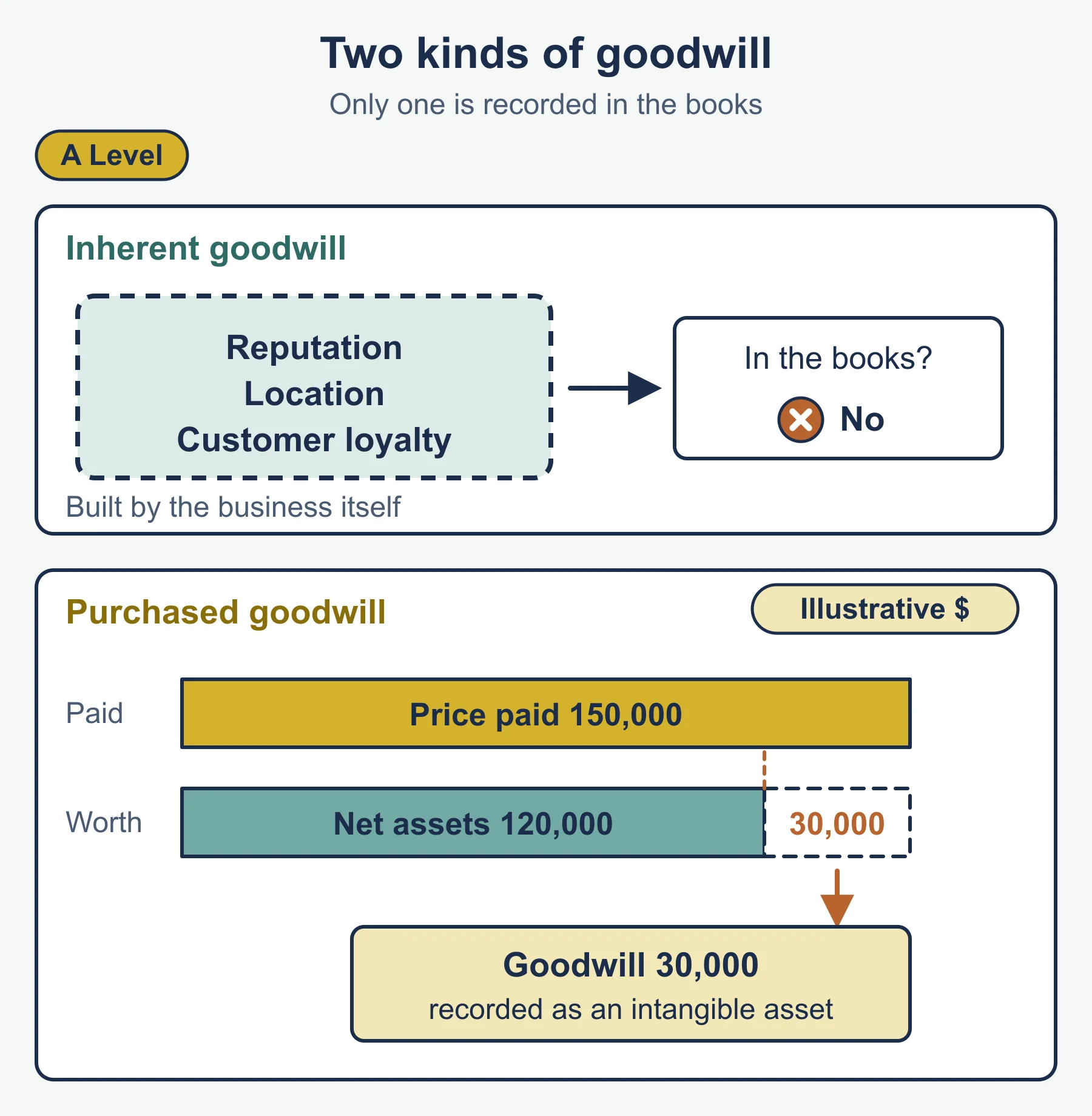
| Inherent goodwill | Self-built reputation, location, customers; not recorded in the books |
| Purchased goodwill | Price paid above fair value of net identifiable assets; recorded as an asset |
| Capital account | Long-term investment; fixed if the agreement says so |
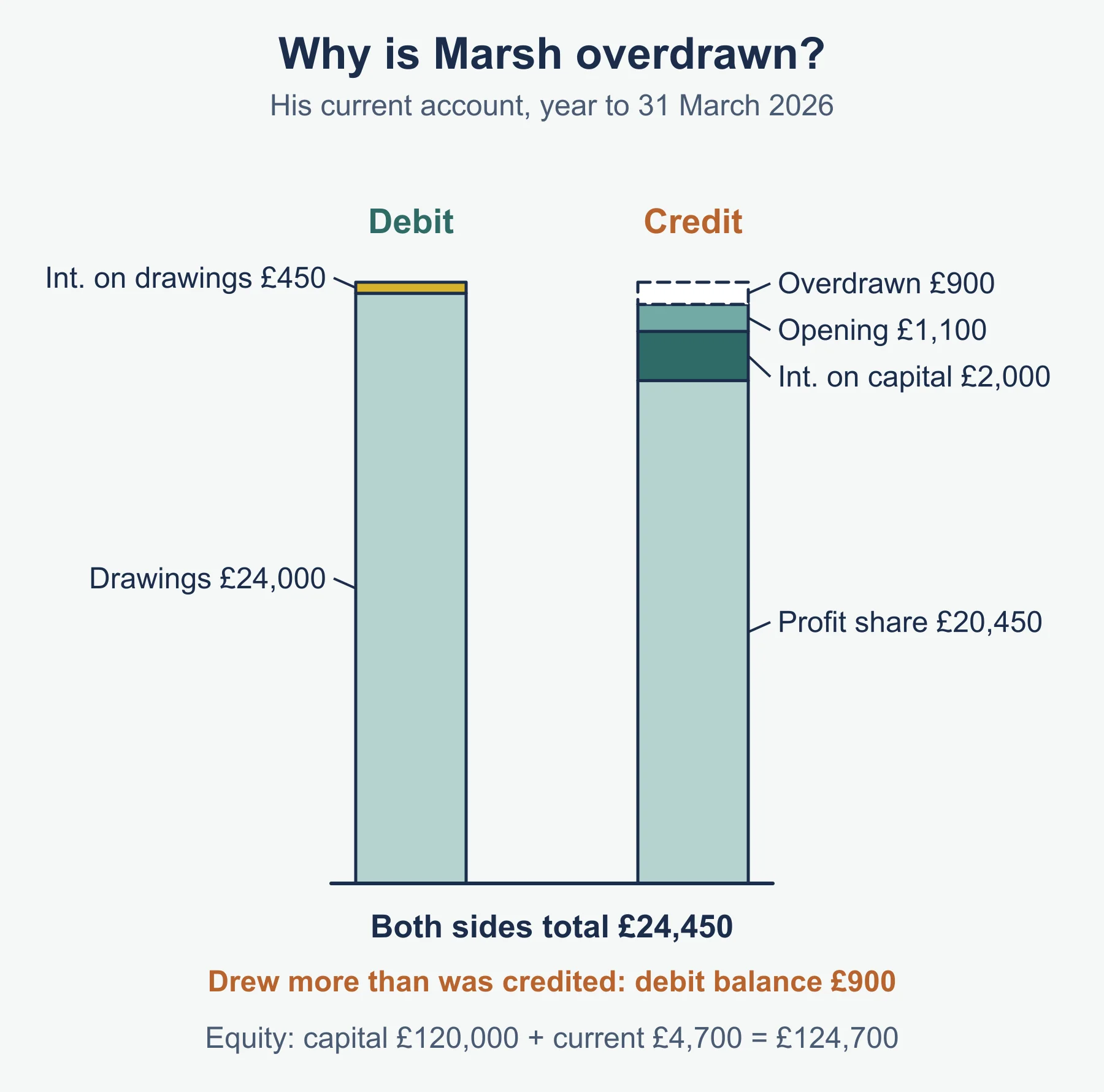
| Current account | Salaries, interest, profit share less drawings; a debit balance means over-drawn |
| Revaluation account | Restates asset values; gain or loss shared in the old ratio |
| Realisation account | Used on dissolution; takes the assets, proceeds and liabilities settled |
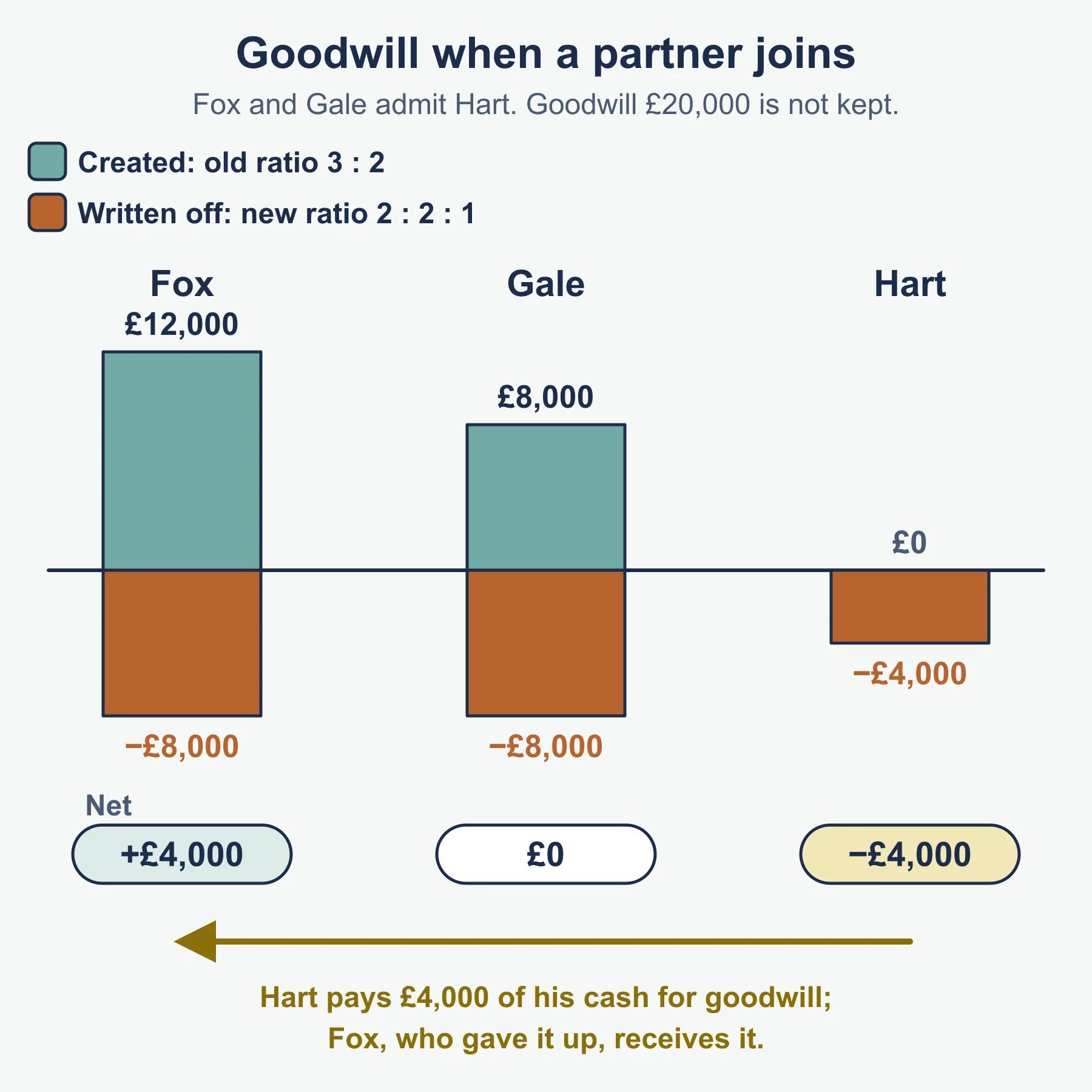
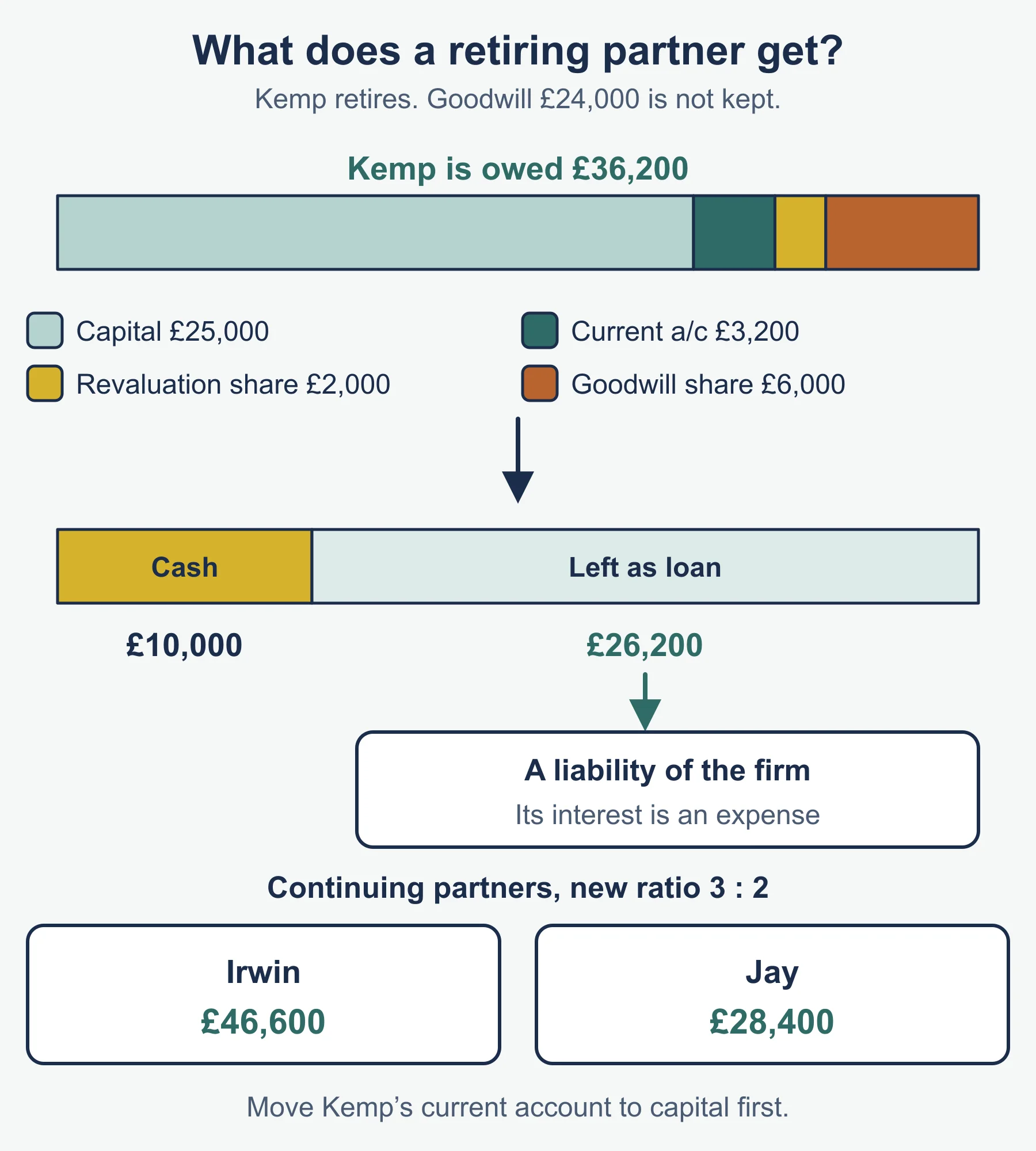
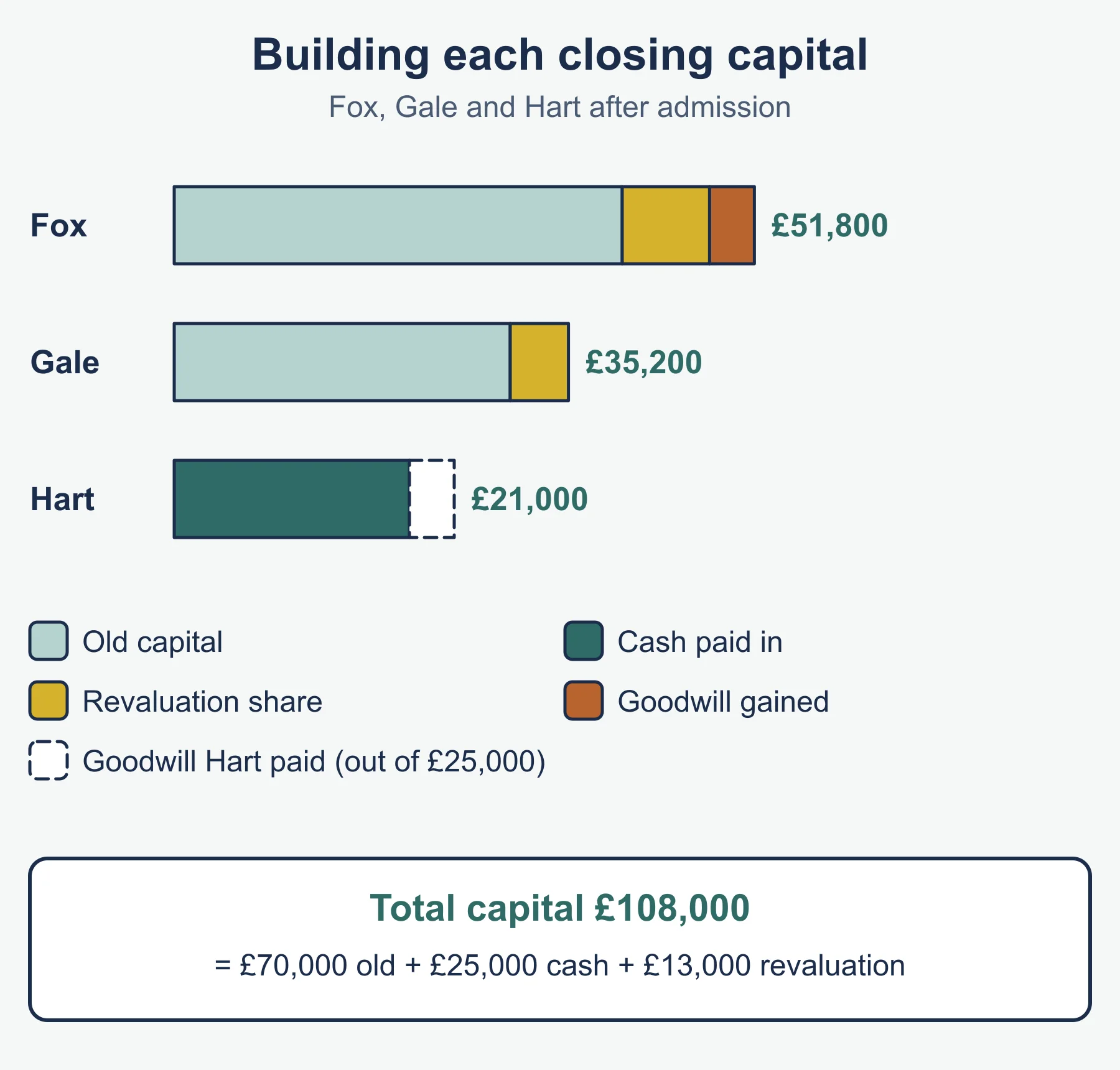
Goodwill shortcut: each existing partner’s net entry is goodwill × (old share − new share). A positive figure is credited, a negative one debited. The new partner is debited with the full new share.
Method for admission, change of ratio and retirement:
- Revalue assets through the revaluation account and share the balance in the old ratio.
- Credit old partners with goodwill in the old ratio.
- Debit all partners after the change in the new ratio, unless goodwill stays in the books.
- Record cash introduced. On retirement, transfer the balance to a loan account or pay it out.
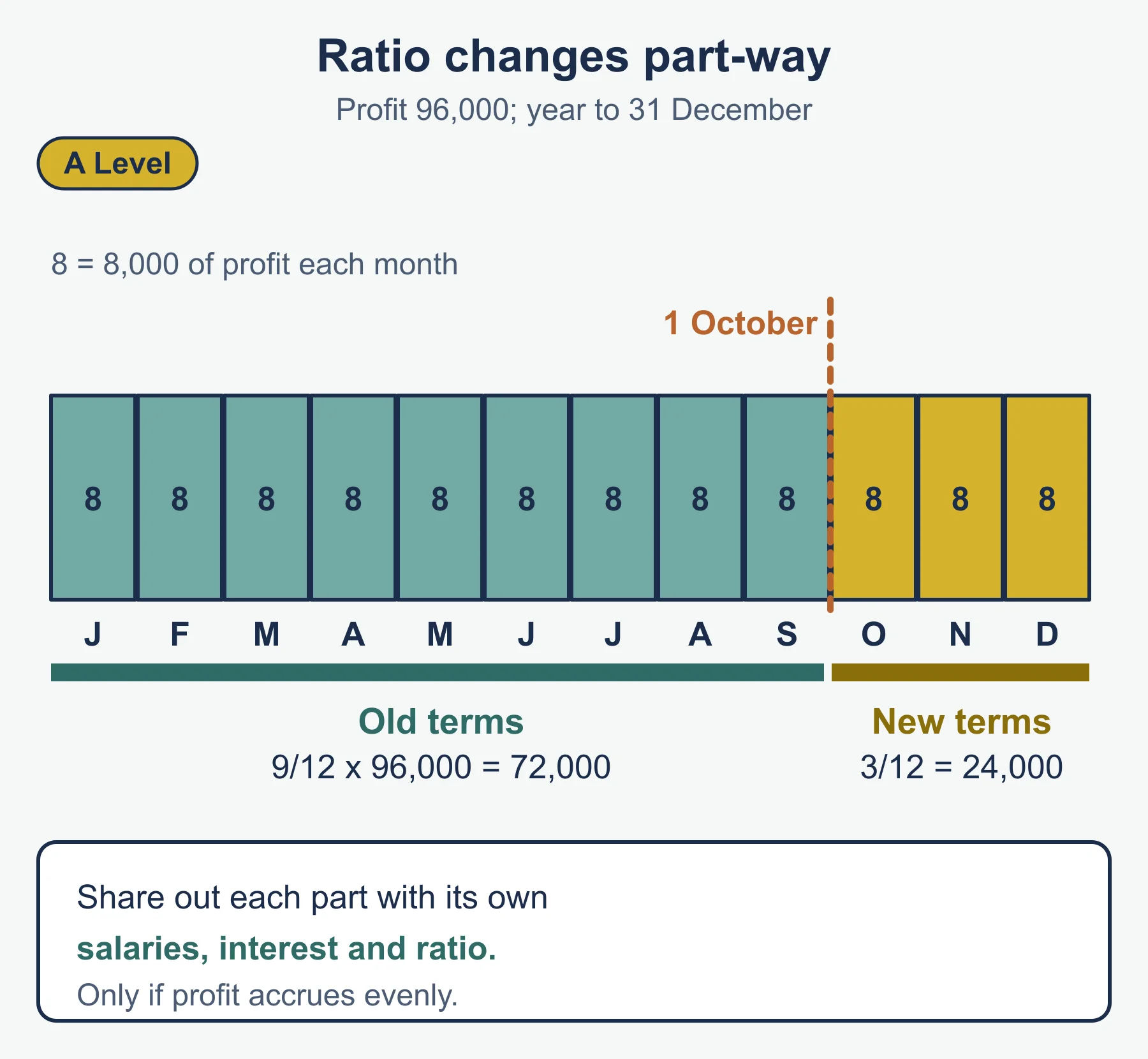
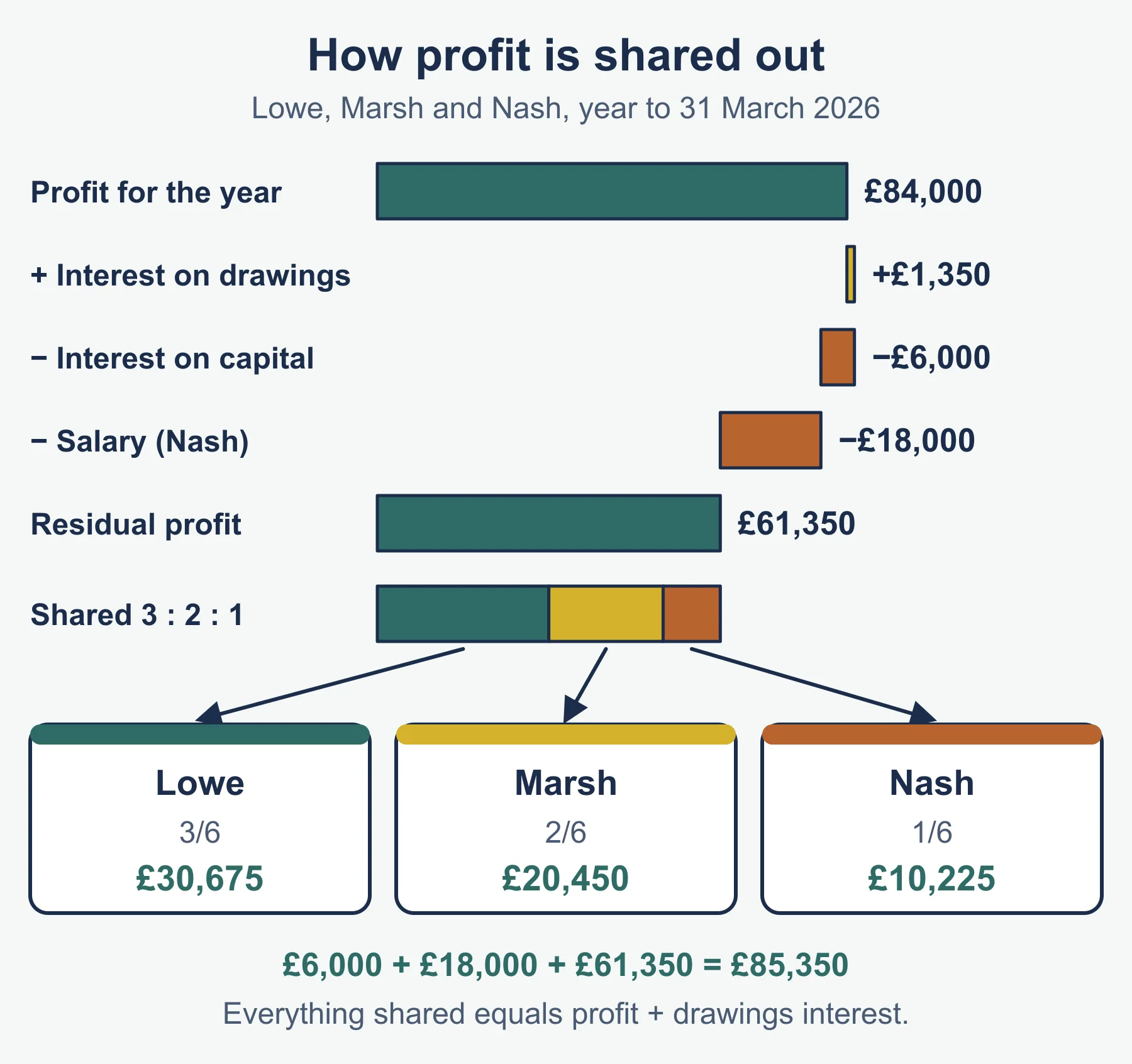
Appropriation account order: profit for the year, less salaries, less interest on capital, plus interest on drawings, equals residual profit shared in the ratio. A part-year change means splitting profit by time and applying each period’s terms.
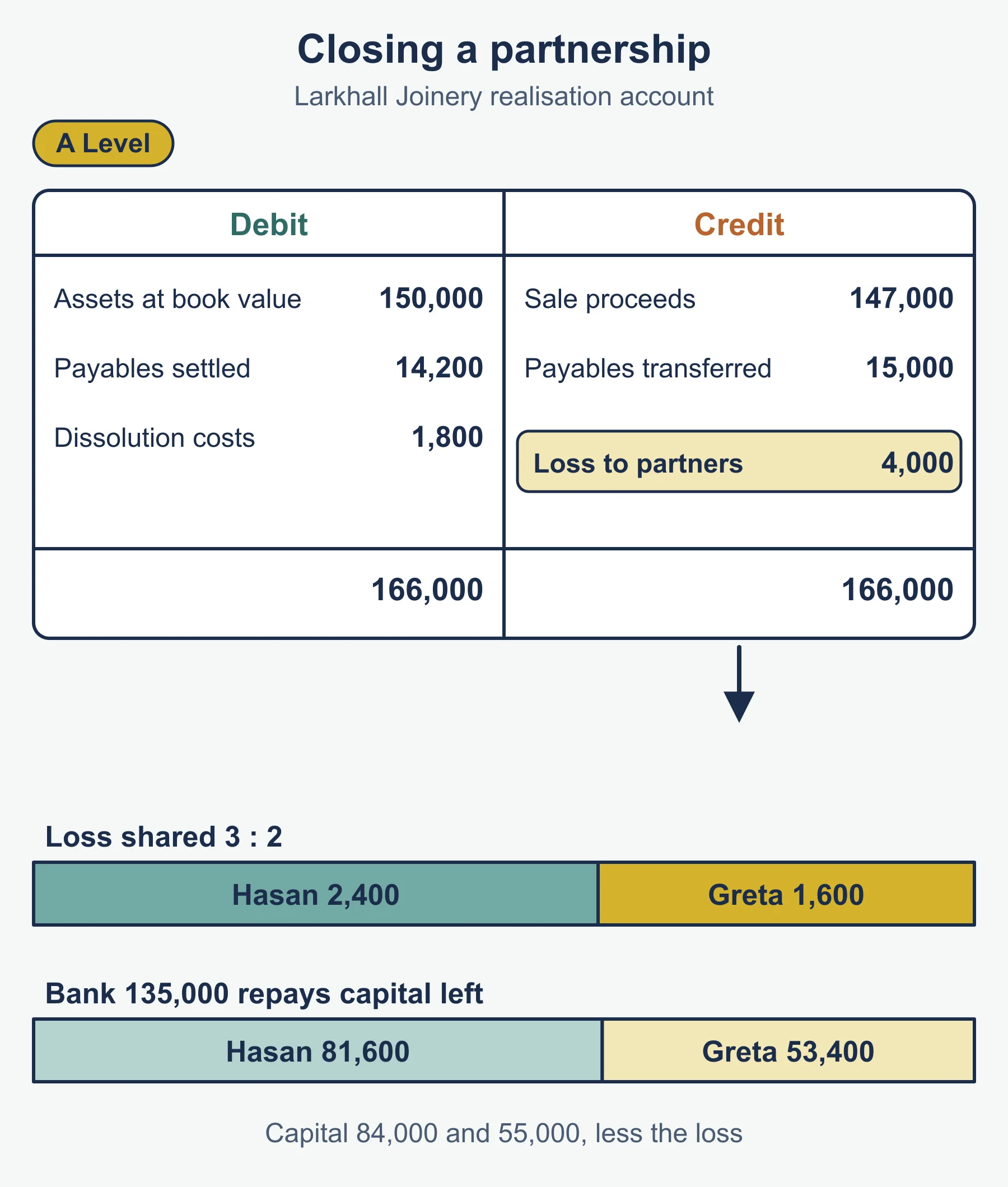
Dissolution order: transfer assets (not bank) to realisation; credit proceeds; settle liabilities (a discount is a credit); debit costs; share the balance in the profit-sharing ratio; close capital accounts through the bank.
3.1.3 Clubs and societies
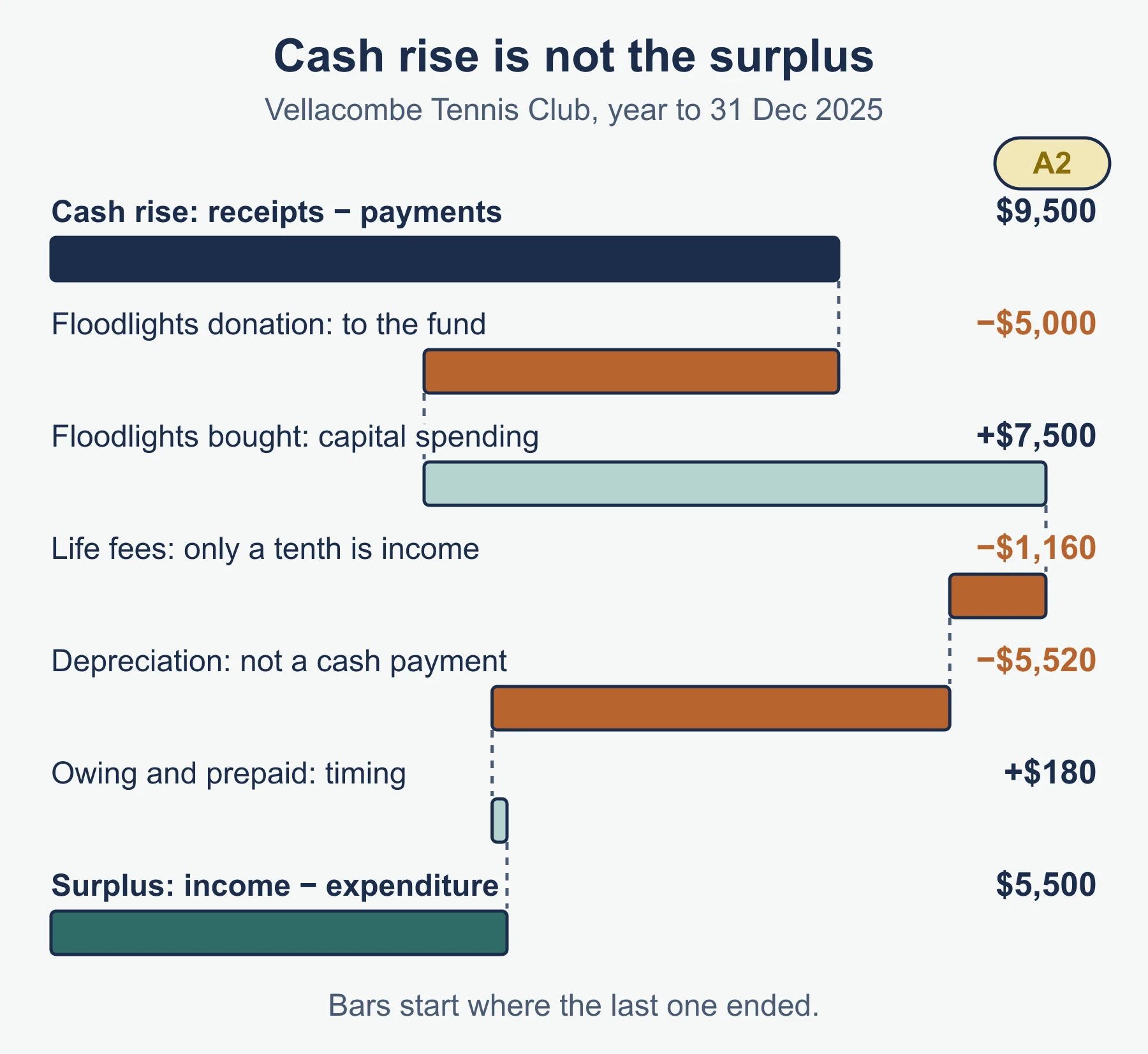
| Receipts and payments account | Income and expenditure account |
|---|---|
| Summary of the cash book | Follows accruals, matches income to the period |
| Includes capital and revenue items | Revenue items only |
| Starts and ends with bank | Ends with surplus or deficit |
| Ignores non-cash items | Includes depreciation, accruals, prepayments |
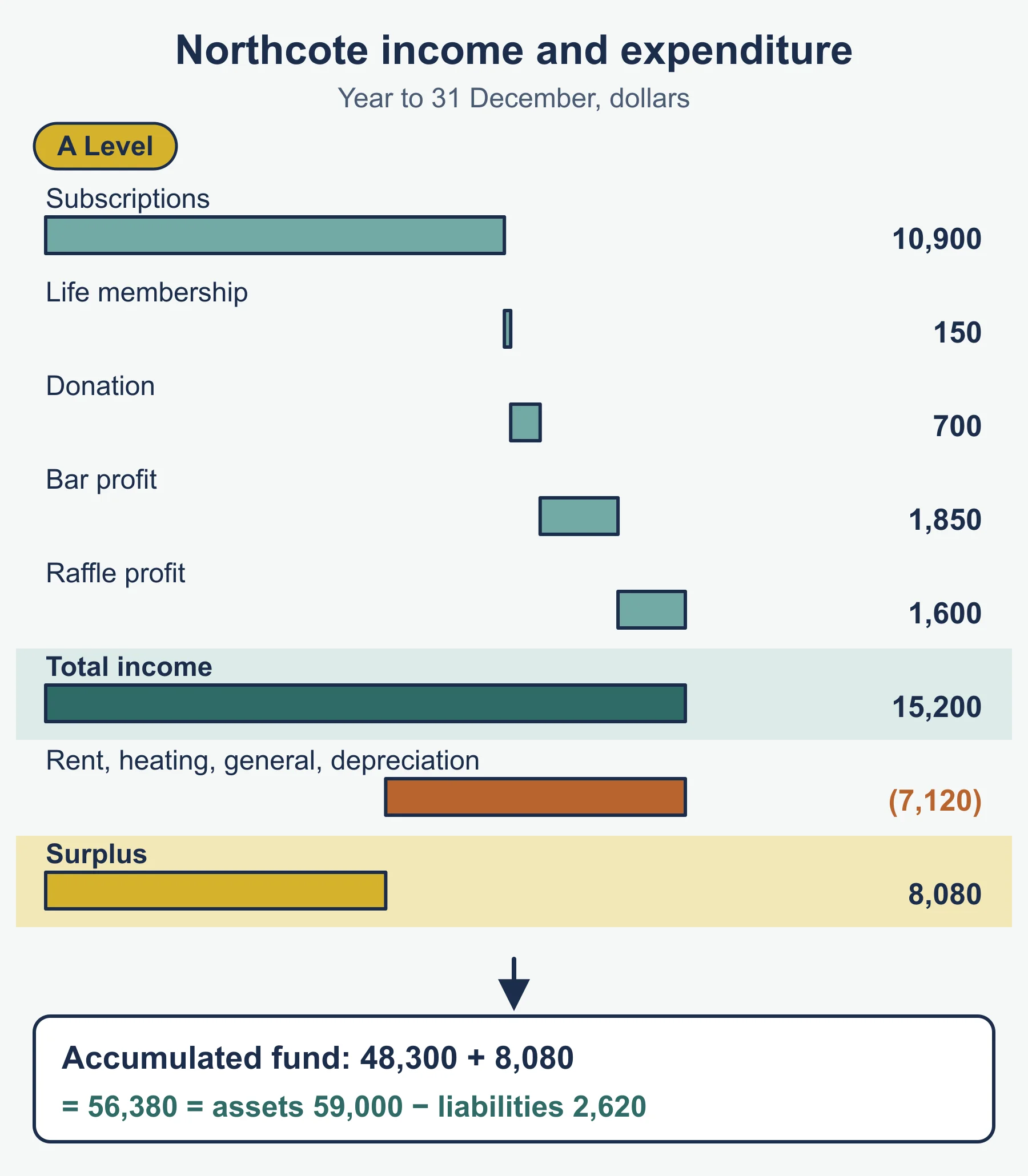
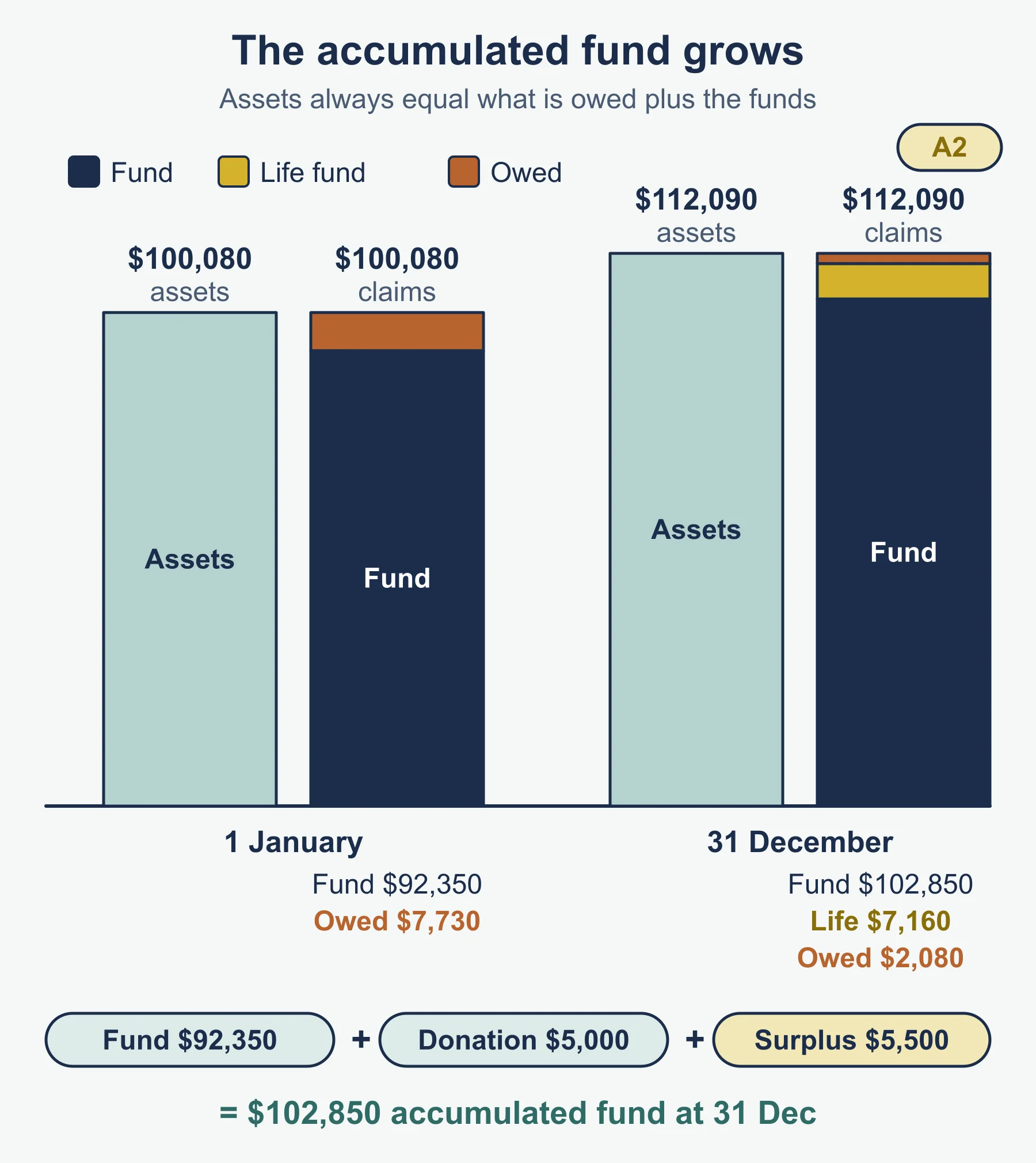
- Accumulated fund = total assets − total liabilities. Surplus increases it and a deficit reduces it.
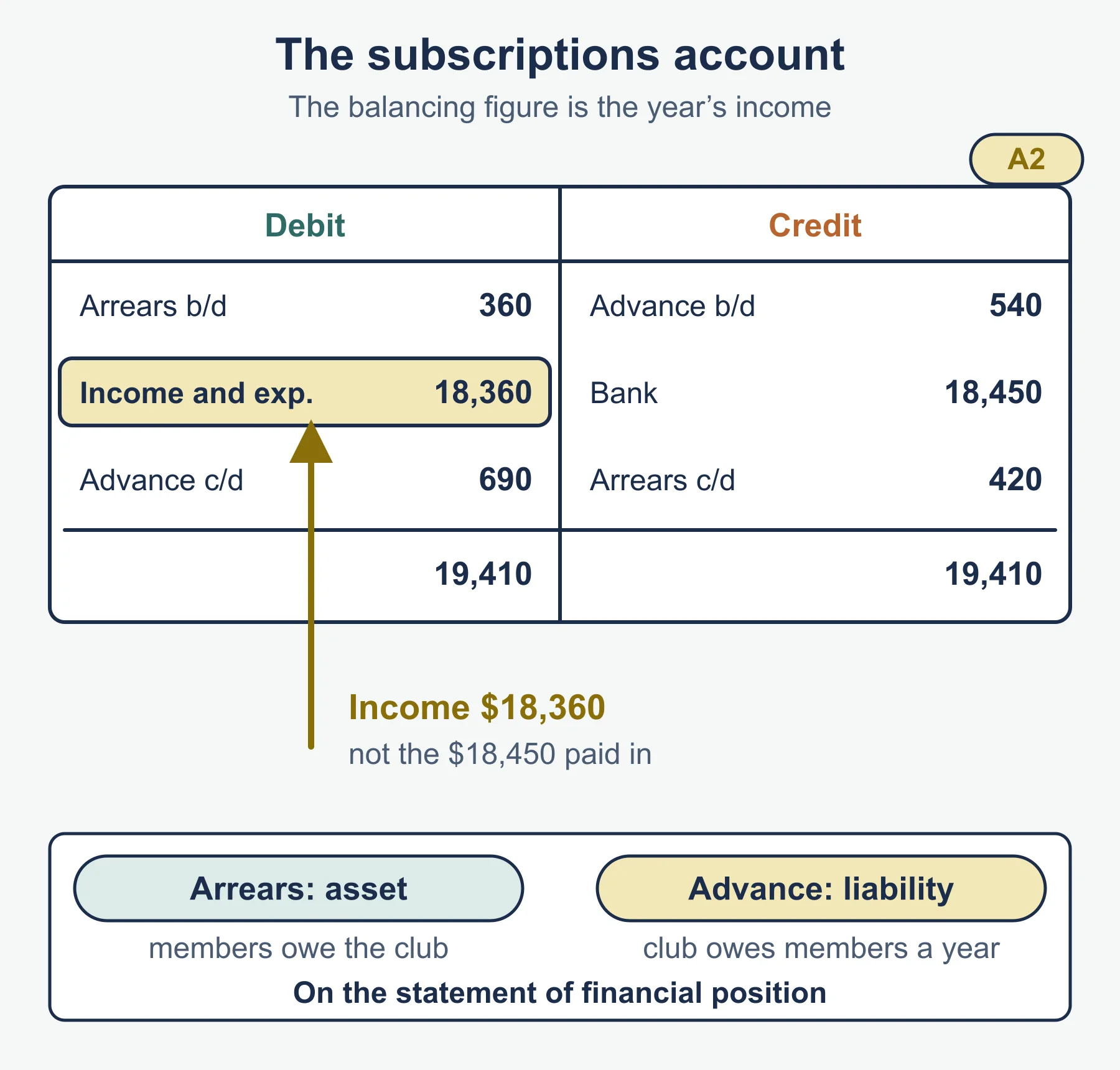
- Subscriptions income = cash received − opening arrears + closing arrears + opening advance − closing advance.
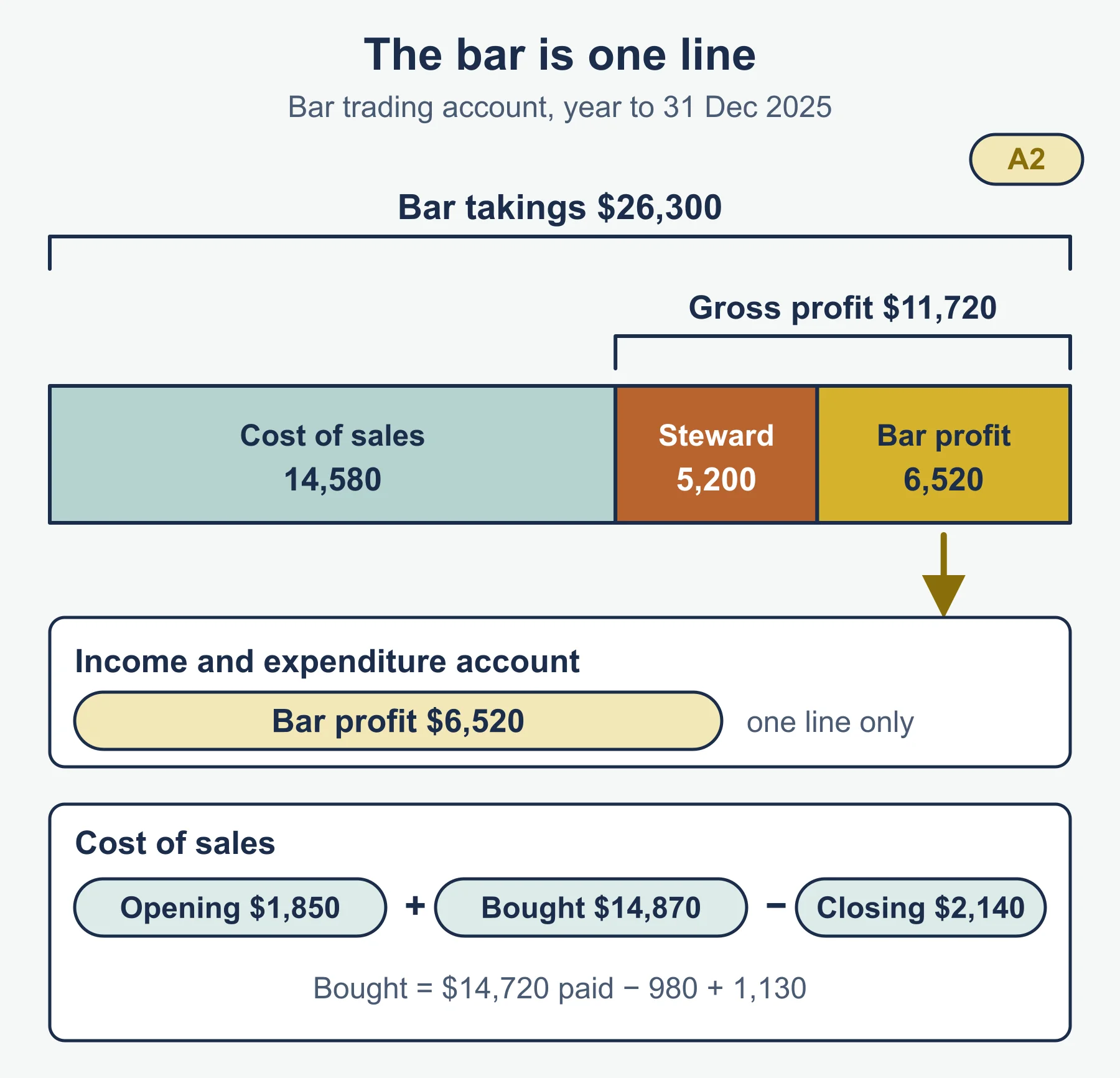
- Trading or revenue-generating activity profit = sales − cost of sales − directly related expenses.
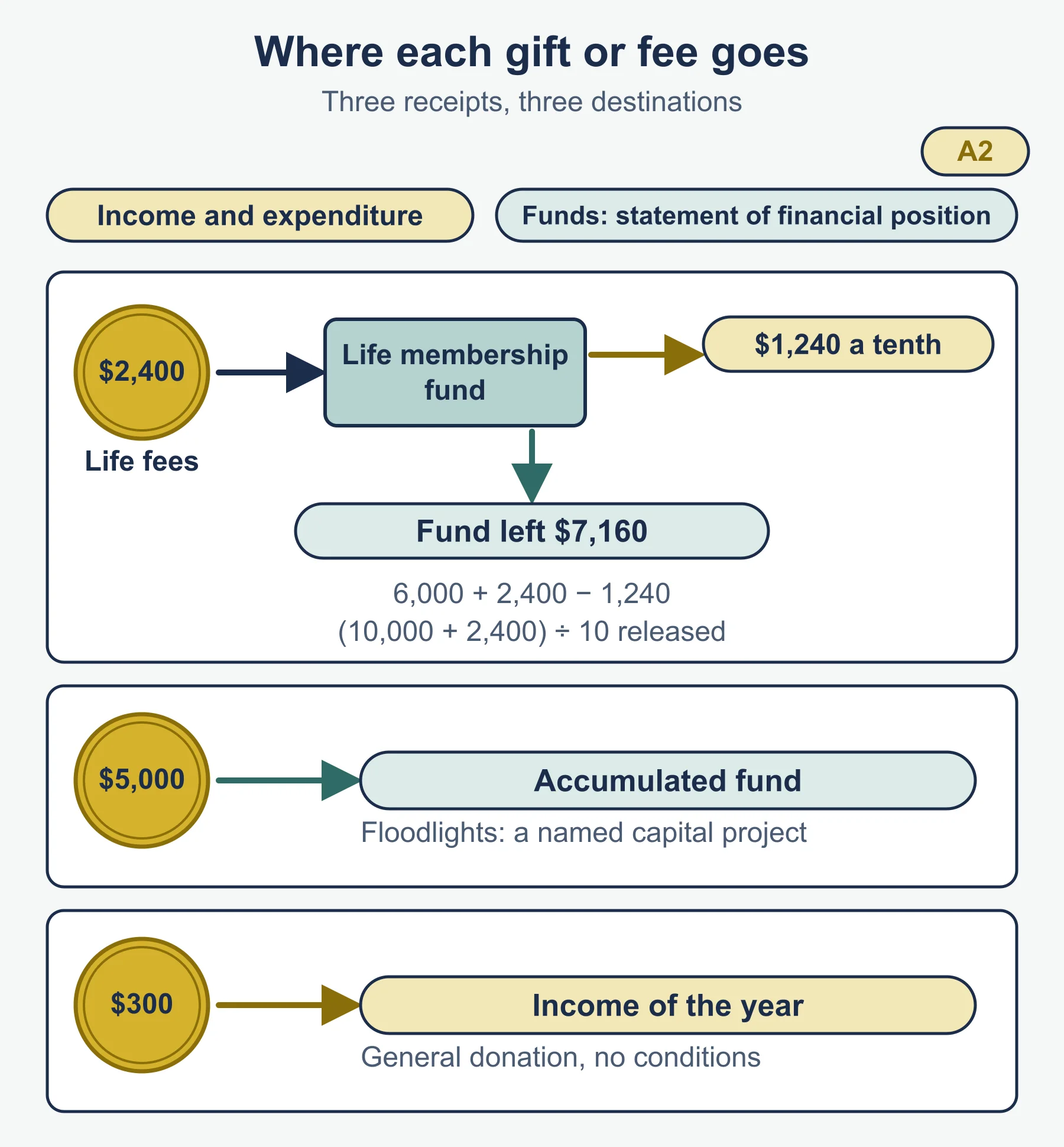
- Life membership: credit a life membership account; release an equal share to income each year; the balance is a liability.
- Donations: general donations are income; donations for a purpose are capital receipts.
- Incomplete records: build the opening statement, rebuild missing totals in ledger accounts, then prepare the statements.
- Finance and fundraising: compare subscriptions, donations, grants, loans and events by amount raised, reliability, cost and effort, then recommend with reasons.
3.1.4 Manufacturing businesses
| Line | How it is found |
|---|---|
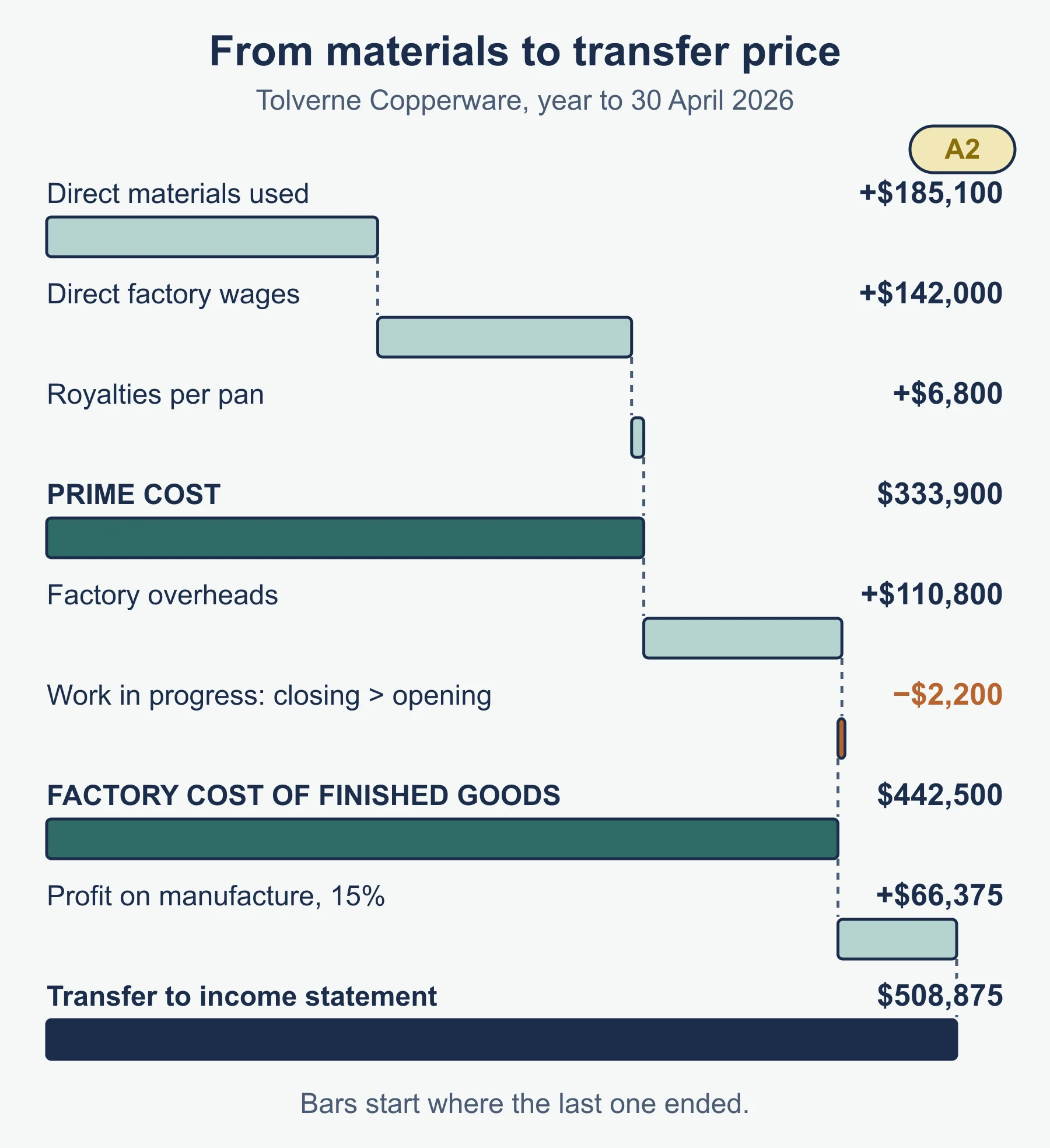
| Raw materials used | Opening + purchases + carriage inwards − closing |
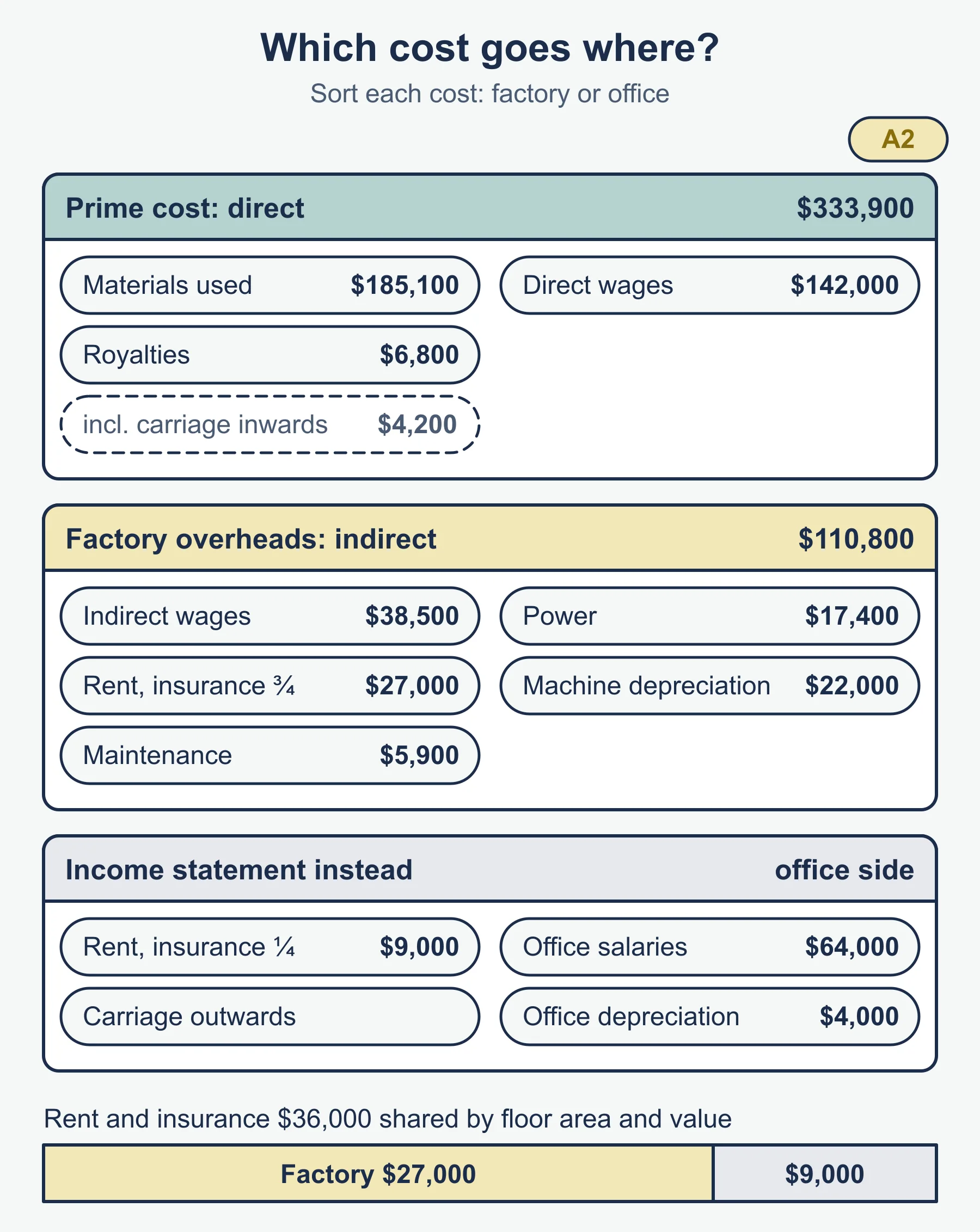
| Prime cost | Raw materials used + direct wages + direct expenses |
| Factory overheads | Indirect wages, factory rent, power, machine depreciation |
| Cost of production | Prime cost + overheads + opening WIP − closing WIP |
| Factory profit | Cost of production × agreed percentage |
| Transfer price | Cost of production + factory profit |
Direct costs vary with units made. Indirect costs support production as a whole.
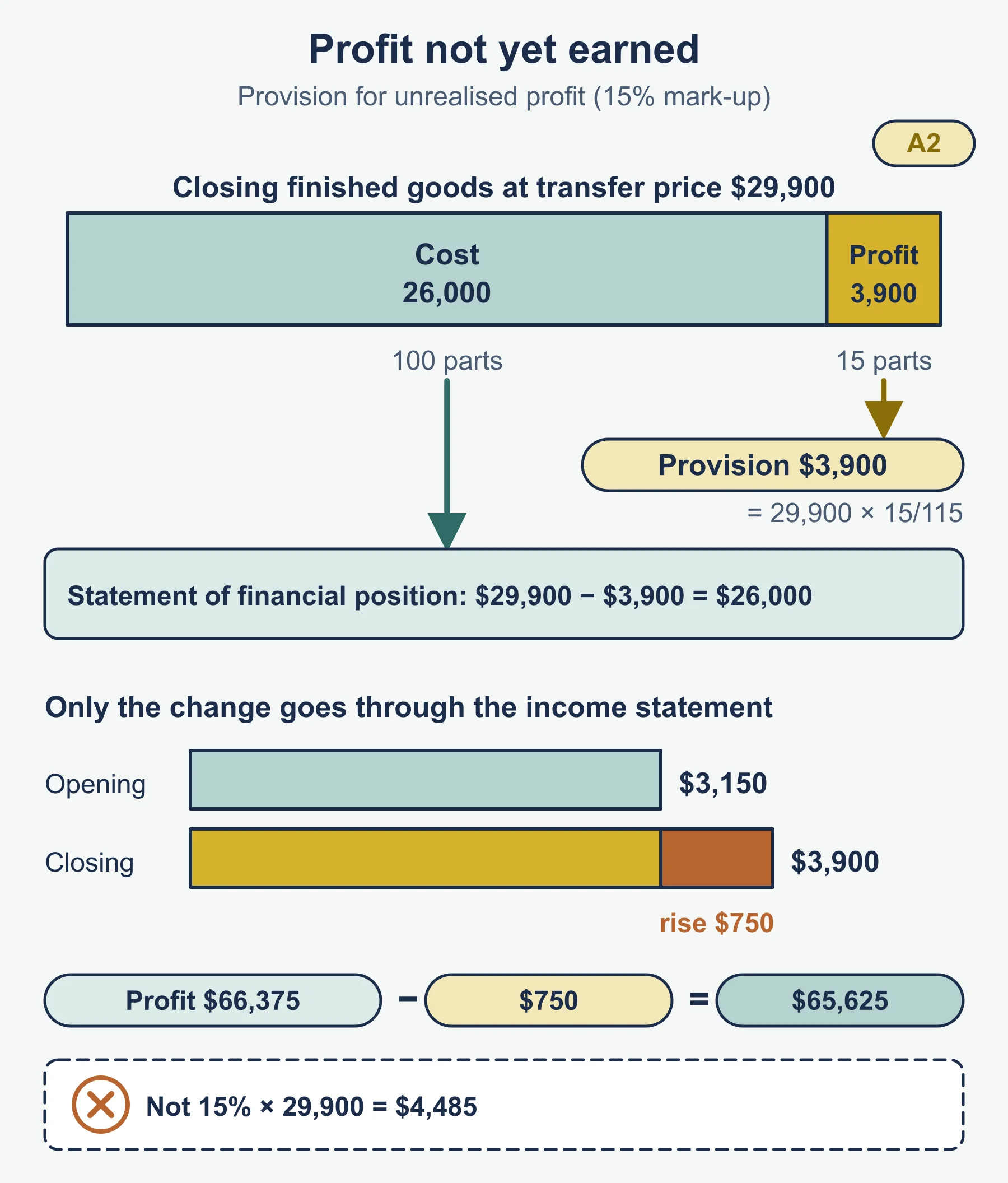
Unrealised profit: closing finished goods carried at transfer price include factory profit not yet earned. Provision = closing inventory × profit ÷ transfer price (for a mark-up of m% on cost, multiply by m/(100 + m)). Charge only the change in the provision in the statement of profit or loss. Show inventory at cost in the statement of financial position.
Reasons for accounting for manufacturing profit: compare in-house cost with the price of buying in; judge the factory apart from the sales side; support pricing.
3.1.5 Limited companies
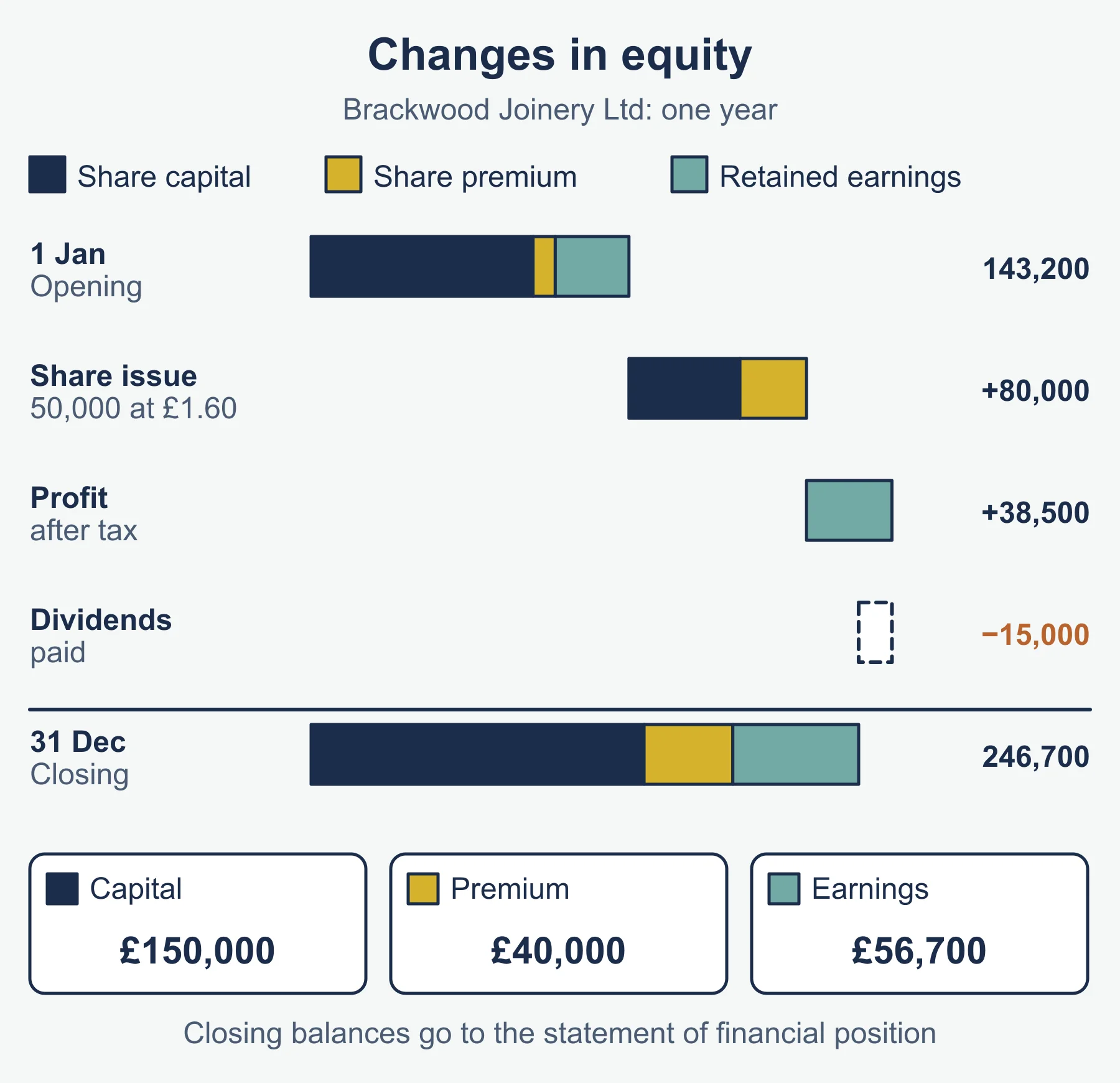
- Statement of changes in equity: columns for share capital, share premium, revaluation reserve, retained earnings and total. Rows: opening, share issue, revaluation, profit for the year, dividends, closing.
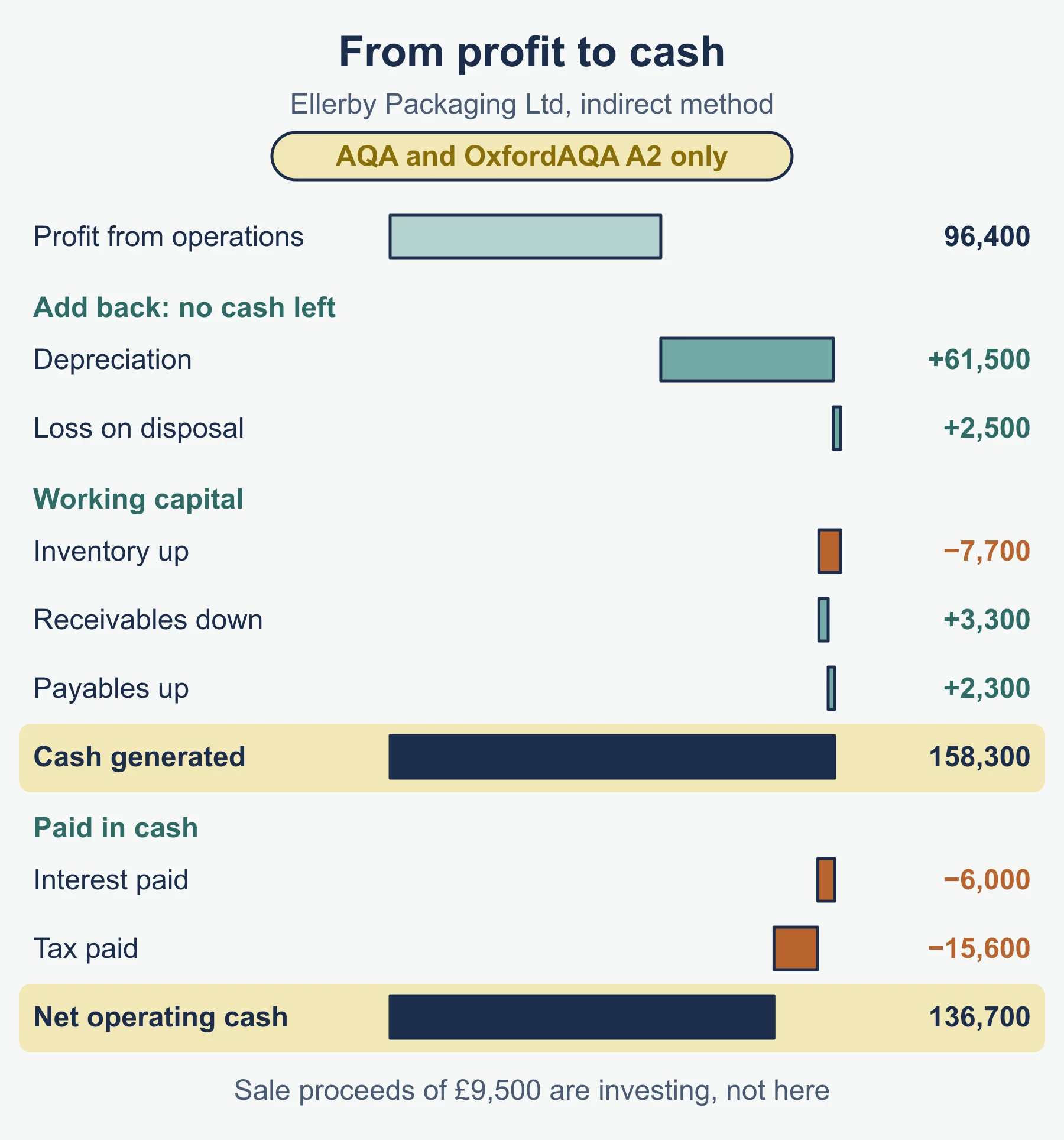
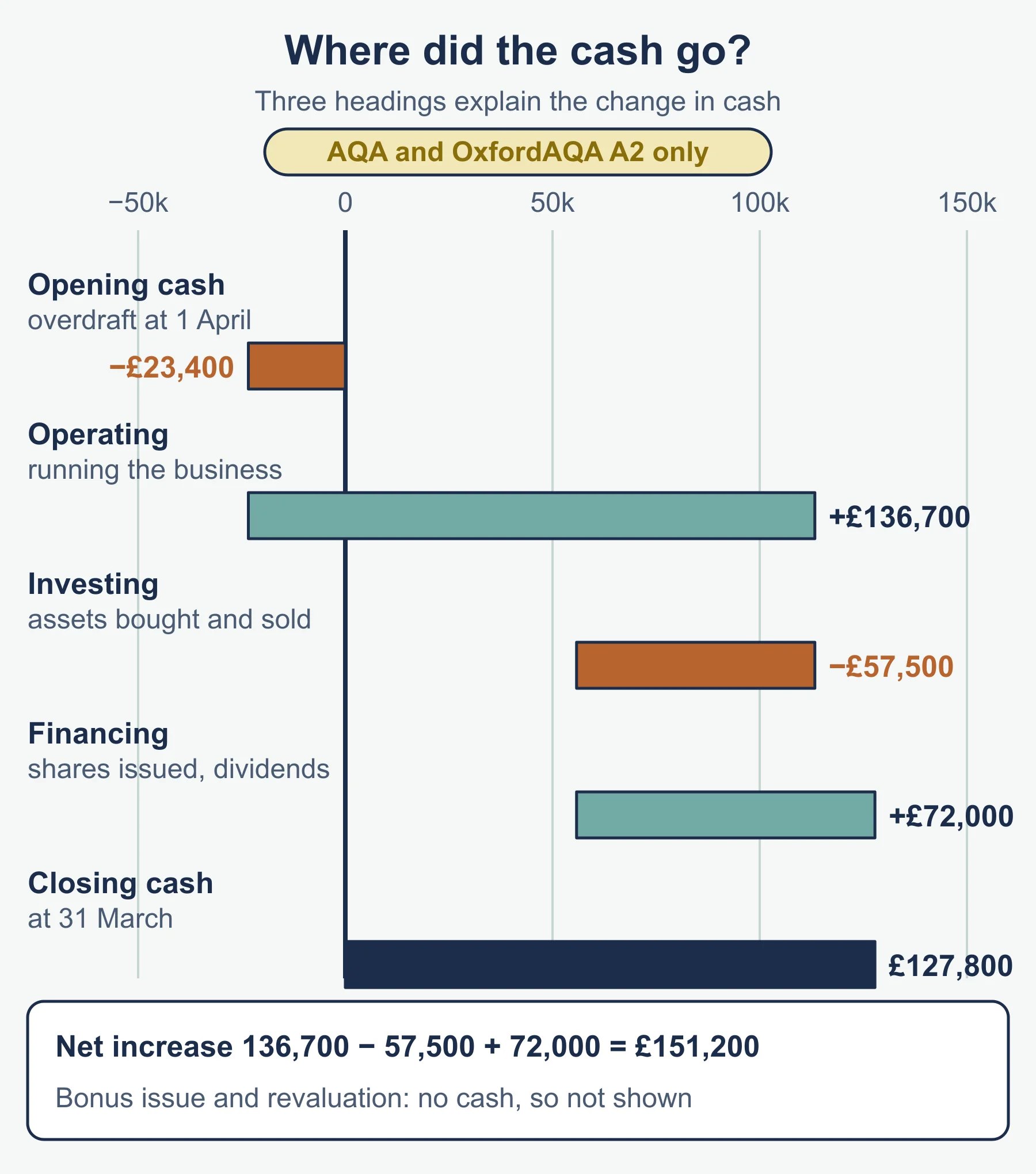
- Statement of cash flows (IAS 7): operating, investing, financing. Start from profit before tax, add back depreciation and interest, deduct profit on disposal, adjust for working capital, then deduct interest and tax paid.
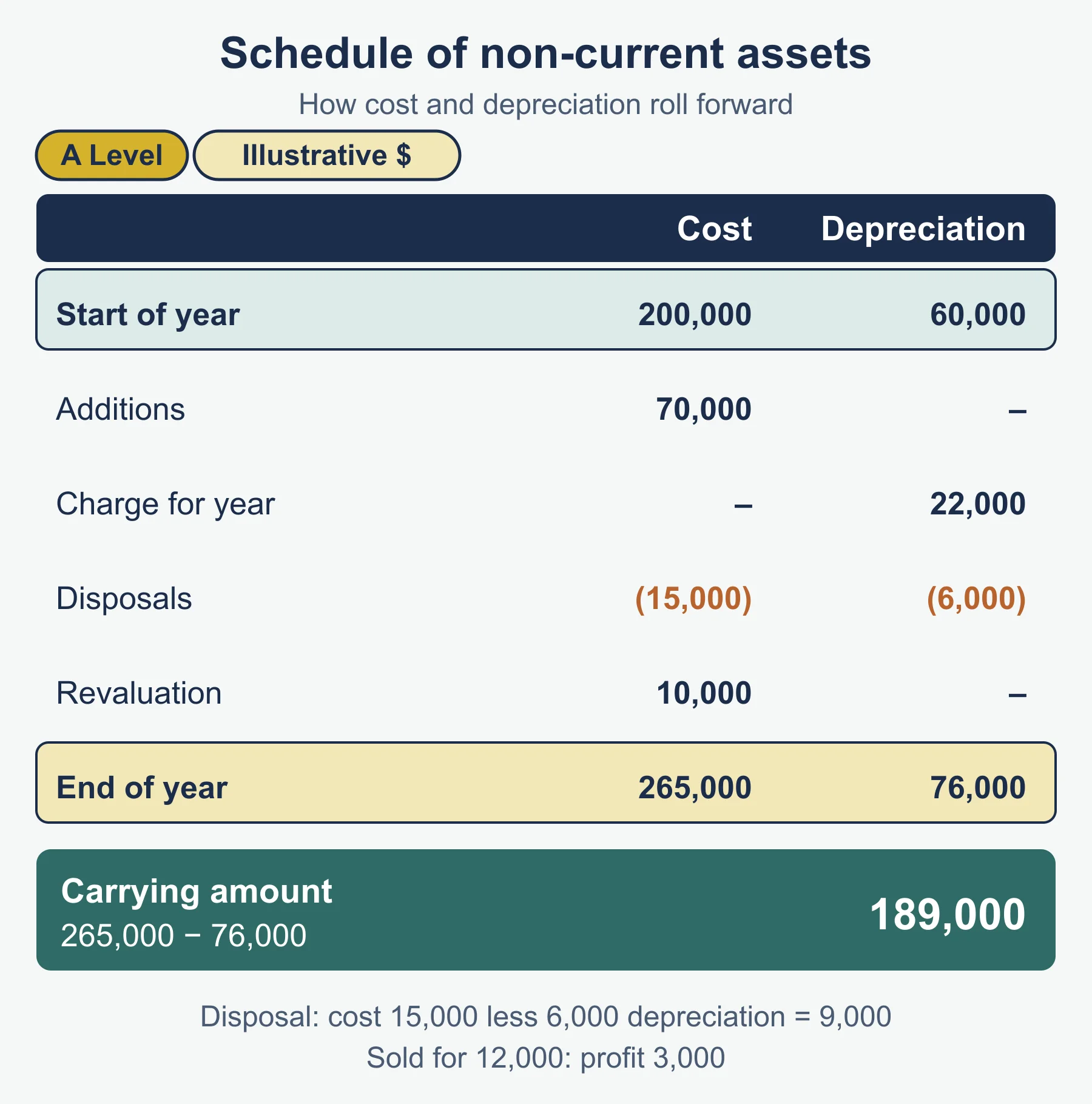
- Schedule of non-current assets: cost or valuation (opening, additions, disposals, revaluation), accumulated depreciation (opening, charge, on disposals), carrying amount.
- Statement of profit or loss (company): revenue, less cost of sales, gives gross profit; less distribution costs and administrative expenses gives operating profit; less finance costs gives profit before tax; less tax gives profit for the year. Dividends are not an expense.
- Statement of financial position (company): non-current assets at carrying amount, current assets, then equity (share capital, share premium, reserves, retained earnings), non-current liabilities (such as debentures) and current liabilities (including tax owing). Total assets equal equity plus liabilities.
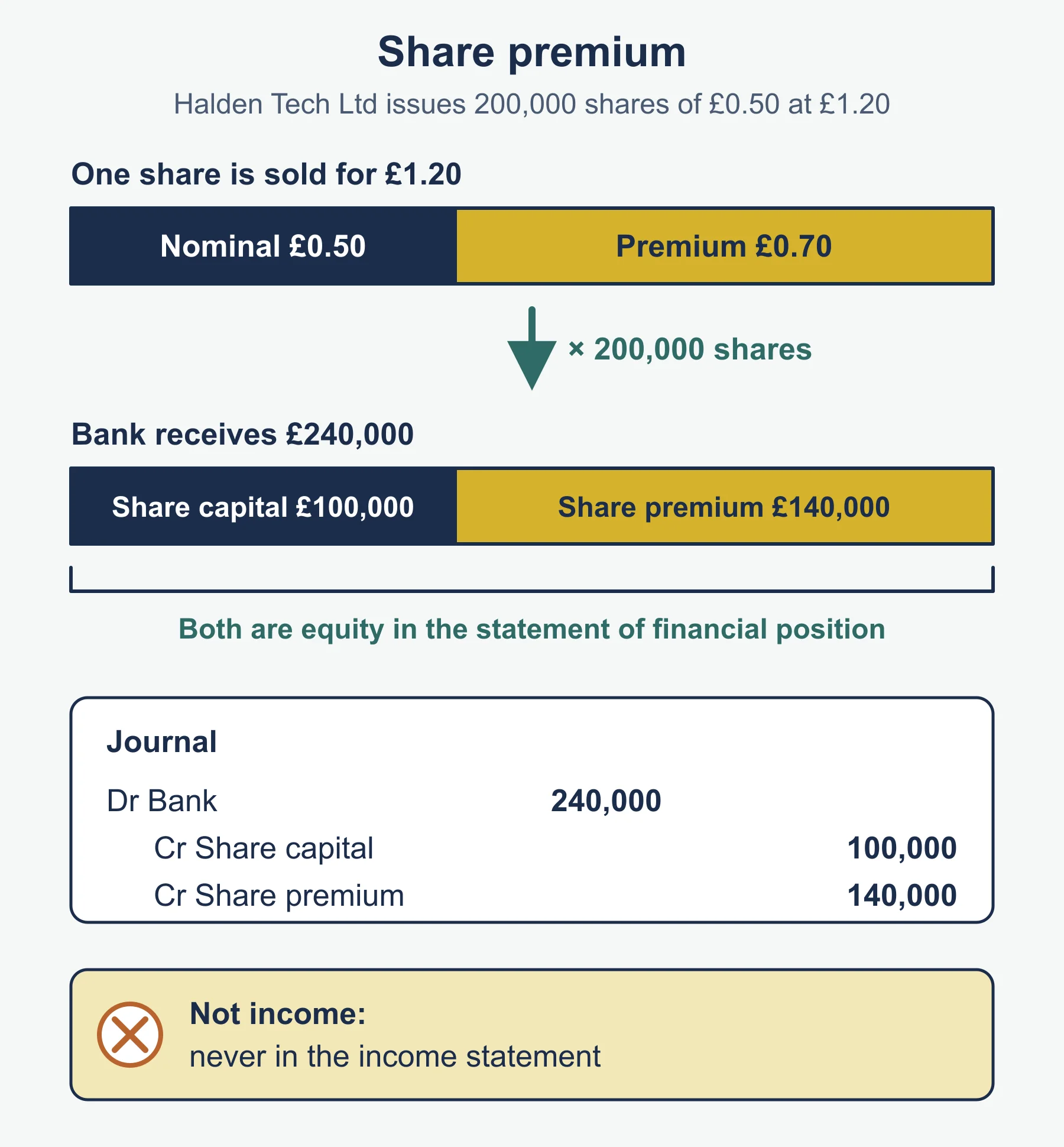
- Ledger entries: a share issue at a premium credits share capital at nominal value and share premium for the rest. A rights issue is a share issue to existing holders, usually below market price. A bonus issue is paid for out of reserves and brings in no cash.
Statements round-up (A Level)
- Partnership: profit for the year comes from the statement of profit or loss. The appropriation account shares it. The statement of financial position shows each partner’s capital and current account in the equity section. After a change, the closing capital accounts feed the statement of financial position.
- Club receipts and payments account: list receipts from the opening bank balance, list payments, and balance to the closing bank. Prepare a subscriptions account as a ledger account: debit opening arrears and closing advance receipts, credit opening advance receipts, closing arrears and cash received; the balancing debit is income. A club’s statement of financial position ends with the accumulated fund (plus any life membership balance as a liability).
- Manufacturing business: the statement of profit or loss starts with sales, then cost of sales built from opening finished goods, the transfer from the manufacturing account, and closing finished goods. Cost of sales is at transfer price, so the change in the provision for unrealised profit removes profit not yet earned. The statement of financial position shows raw materials, work in progress and finished goods at cost.
- Using the statements: compare each entity’s results over time, ask what the figures cannot show, and finish with a recommendation.
Worked reminder: appropriation
Profit for the year 48,000. B has a salary of 6,000. Interest on capital at 5% is 2,000 for A (capital 40,000) and 1,500 for B (capital 30,000). Interest charged on drawings is 400 to A and 250 to B. Profit is shared 3:2.
| Appropriation account | A | B | Total |
|---|---|---|---|
| Salary | 0 | 6,000 | 6,000 |
| Interest on capital | 2,000 | 1,500 | 3,500 |
| Interest on drawings | (400) | (250) | (650) |
| Residual profit (3:2) | 23,490 | 15,660 | 39,150 |
| Credited to current accounts | 25,090 | 22,910 | 48,000 |
Check: 48,000 − 6,000 − 3,500 + 650 = 39,150. Each partner’s total is the current account credit before drawings.
Must-know distinctions
- Inherent goodwill is never recorded; purchased goodwill is.
- Revaluation account while the business continues; realisation account at dissolution.
- Receipts and payments account is cash only; income and expenditure account is accruals.
- Prime cost excludes overheads; cost of production includes them.
- Factory profit is added when goods move to the statement of profit or loss; unrealised profit is removed from unsold inventory.
Quick self-test
- Ana and Bo share profits 2:1 and admit Cy to share equally (1/3 each). Goodwill is 24,000 and is not kept in the books. State the net entry for each partner.
- A and B share 3:2 and move to equal shares. Goodwill is 20,000. State the net entry for each.
- Profit for the year to 30 June is 120,000. The ratio changes on 1 April. Split the profit by time.
- A club has assets of 85,000 and liabilities of 12,500. Find the accumulated fund.
- A club receives 6,300 in subscriptions. Arrears are 400 at the start and 250 at the end. Advance receipts are 150 at the start and 220 at the end. Find subscriptions income.
- A life member pays 2,400, spread over 8 years. State the annual release and the balance after one year.
- Raw materials used 31,000, direct wages 22,000, direct expenses 1,500. Find prime cost.
- Closing finished goods are 33,000 at transfer price, with a 10% mark-up on cost. Find the provision and the inventory value in the statement of financial position.
- Cost of production is 80,000 and the transfer price is cost plus 25%. Find the factory profit.
- Profit before tax is 50,000, depreciation 8,000, receivables up 4,000 and payables up 2,500. Ignore interest. Find cash generated from operations.
- A company issues 10,000 shares of 1 each at a price of 1.40. Give the entries.
- A company has 40,000 shares of 1 each and offers 1 for 4 at 1.20. State the cash raised, share capital and share premium.
Answers
- Ana: credit 8,000 (16,000 − 8,000); Bo: nil (8,000 − 8,000); Cy: debit 8,000.
- A: credit 2,000 (12,000 − 10,000); B: debit 2,000 (8,000 − 10,000).
- 9/12 = 90,000 on the old terms; 3/12 = 30,000 on the new terms.
- 72,500.
- 6,300 − 400 + 250 + 150 − 220 = 6,080.
- 300 a year; 2,100 remains as a liability.
- 54,500.
- 33,000 × 10/110 = 3,000; inventory 30,000.
- 20,000.
- 50,000 + 8,000 − 4,000 + 2,500 = 56,500.
- Debit bank 14,000; credit share capital 10,000; credit share premium 4,000.
- 10,000 new shares: cash 12,000, share capital 10,000, share premium 2,000.
Where marks are usually lost
- Showing goodwill only on one side, so the capital accounts do not balance.
- Using the new ratio to credit old partners, or the old ratio to debit the continuing partners.
- Applying one set of salaries and interest to the whole year after a mid-year change.
- Leaving the discount on settling payables out of the realisation account.
- Using cash received as subscriptions income without adjusting for arrears and advances.
- Treating a life membership or a purpose-specific donation as income of one year.
- Including overheads in prime cost, or omitting work in progress from cost of production.
- Taking unrealised profit from the whole inventory instead of finished goods held at transfer price.
- Mixing up interest paid, tax paid and dividends paid in the statement of cash flows.
- Giving a list of finance options with no recommendation or reasons on both sides.
Frequently asked questions
Which section of Cambridge 9706 covers A Level financial statements? Section 3.1 Preparation of financial statements covers partnerships, clubs and societies, manufacturing businesses and limited companies at A Level. It is assessed on Paper 3.
How do you deal with a change in profit-sharing ratio part-way through the year? Split the year, apportioning profit by time where it accrues evenly, and apply each period’s salaries, interest and ratio to that period only. Applying one set of terms to the whole year is a common mistake.
How is subscriptions income calculated for a club? Start from the cash received and adjust for subscriptions in arrears and in advance at the start and end of the year. A closing advance reduces the year’s income.
What is the provision for unrealised profit in manufacturing accounts? When goods are transferred at cost plus a factory profit, the provision removes the profit included in finished goods inventory held at transfer price. Only the change in the provision is charged each year.
Official syllabus
Cambridge International AS & A Level Accounting 9706, syllabus for examination in 2026, 2027 and 2028, section 3.1, published by Cambridge University Press & Assessment.
Get free revision emails (optional)
Occasional emails with practice questions, worked explanations and links to free resources for the qualification and subjects you choose. No spam, and you can unsubscribe from any email. The free tools on this site never need an email.
Related resources
-
Study guides
A Level Accounting: Accounting for Non-Current Assets (Cambridge 9706)
Capital versus revenue spending, why assets depreciate depreciation methods, cost and revaluation models and disposals, for Cambridge 9706 Accounting topic 1.3.
Accounting · Cambridge · AS Level
Read guide -
Study guides
A Level Accounting: Preparation of financial statements (AS) (Cambridge 9706)
Study guide to adjustments and to sole trader, partnership and limited company accounts, with worked examples, for Cambridge Accounting 9706 section 1.5.
Accounting · Cambridge · AS Level
Read guide -
Practice questions
A Level Accounting: Preparation of financial statements (AS) (Cambridge 9706) – Practice Questions
Eleven original questions with worked answers on adjustments and sole trader, partnership and company accounts for Cambridge Accounting 9706 section 1.5.
Accounting · Cambridge · AS Level
Try questions
Related articles
-
teaching
A Level tuition in Dubai: Cambridge or Pearson Edexcel International A Level?
Schools in Dubai and Abu Dhabi teach either Cambridge International AS & A Level or Pearson Edexcel International A Level. How the two are structured, why it matters for tuition, and how online classes from Lahore work.
9 October 2026
-
curriculum guides
Choosing subjects at IGCSE and A Level
How subject choices at 14 and 16 affect university options later, and how to keep pathways open without overloading a timetable.
28 July 2026
Studying this with a teacher
Working through Accounting A LEVEL?
This page is free and stays free. If you would rather be taught it, Marlbridge runs Accounting classes one-to-one and in small groups of up to 15, online in your own time zone. The first trial class is free. WhatsApp replies within an hour (8am–11pm Pakistan time, every day); email the same day.
Cambridge Accounting teachers at Marlbridge

