
Study Guides
A Level Business: Business finance and Sources of finance (Cambridge 9609)
Study guide to 5.1 Business finance and 5.2 Sources of finance in Cambridge AS & A Level Business 9609: cash, working capital and choosing finance.
- Subject
- Business
- Level
- AS LEVEL
- Topic
- Finance and accounting
- Author
- Marlbridge Academic Team
- Updated
- Reviewed by
- Salman Ahmad (what this means)
Aligned to Cambridge A Level Business (9609), For examination in 2026, 2027 and 2028. Official specification .
Syllabus page (what it covers and how it is assessed): Cambridge A Level Business.
Syllabus points this page covers
9609 (AS Level)
- 5.1 Business finance
- 5.2 Sources of finance
Found an error? Report a correction.
Need help with this topic? Request a free trial class for A Level Business (9609).
This guide teaches sections 5.1 Business finance and 5.2 Sources of finance of the Cambridge International AS & A Level Business 9609 syllabus for examination in 2026, 2027 and 2028. Both sit in Topic 5, Finance and accounting, an AS Level topic that A Level candidates also study. It follows the syllabus order: 5.1.1 The need for business finance, 5.1.2 Working capital, 5.2.1 Business ownership and sources of finance, 5.2.2 Internal and external sources of finance, 5.2.3 Factors affecting the sources of finance and 5.2.4 Selecting the source of finance.
Use it with the revision notes and the practice questions. Course links: the Cambridge A Level Business hub, the printable checklist and the free diagnostics.
What the syllabus lists
| Section | What you must be able to do |
|---|---|
| 5.1.1 | Explain the need for finance to start up, grow and survive; short and long term need; cash and profit; failure from lack of finance (bankruptcy, liquidation, administration) |
| 5.1.2 | Explain working capital and why it matters; manage trade receivables and trade payables; distinguish capital and revenue expenditure |
| 5.2.1 | Link the form of ownership to the sources of finance available |
| 5.2.2 | Explain the internal and external sources of finance the syllabus names |
| 5.2.3 | Apply cost, flexibility, control, use of the finance and existing debt to the choice |
| 5.2.4 | Judge how appropriate each source is in a given situation |
Paper 1 (Business Concepts 1) and Paper 2 (Business Concepts 2) test AS Level content, including application, analysis and evaluation. A list of sources earns little without a reasoned choice for the business in front of you.
5.1.1 The need for business finance
Start up, grow and survive
A business needs finance at three stages.
- To start up: buying premises, equipment and the first inventory, and paying costs before any sales revenue arrives.
- To grow: opening a new site, buying machines, launching products or taking over another firm.
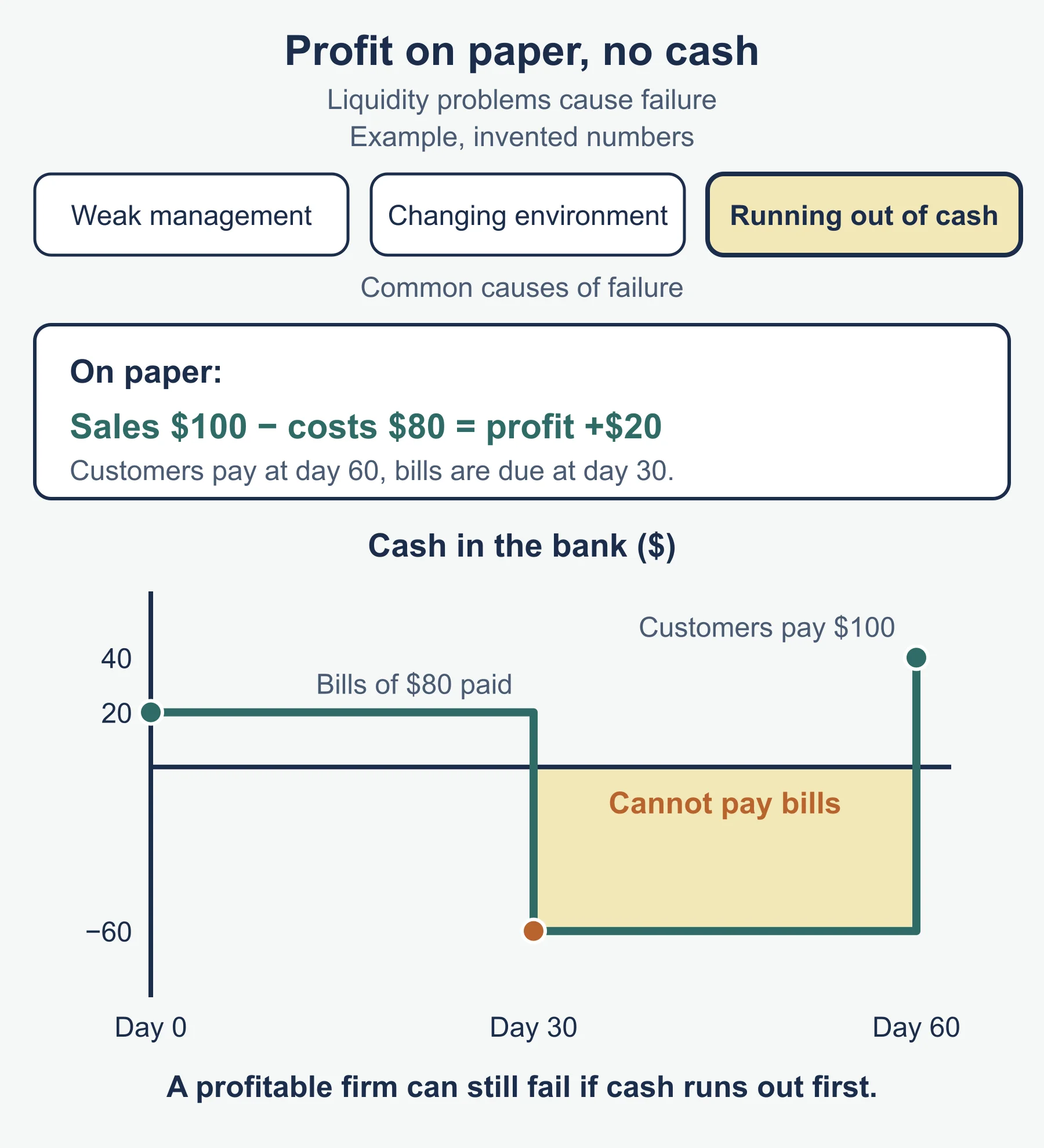
- To survive: paying wages, suppliers and bills when sales revenue is slow or a bad debt, cost rise or new rival squeezes cash.
Short and long term need
A short term need is repaid within a year or so, such as paying suppliers before customers pay you. A long term need lasts for years, such as buying a building. Fit the term of the finance to the term of the need: borrowing short term to buy a factory forces repayment long before it has earned the money back.
Cash and profit
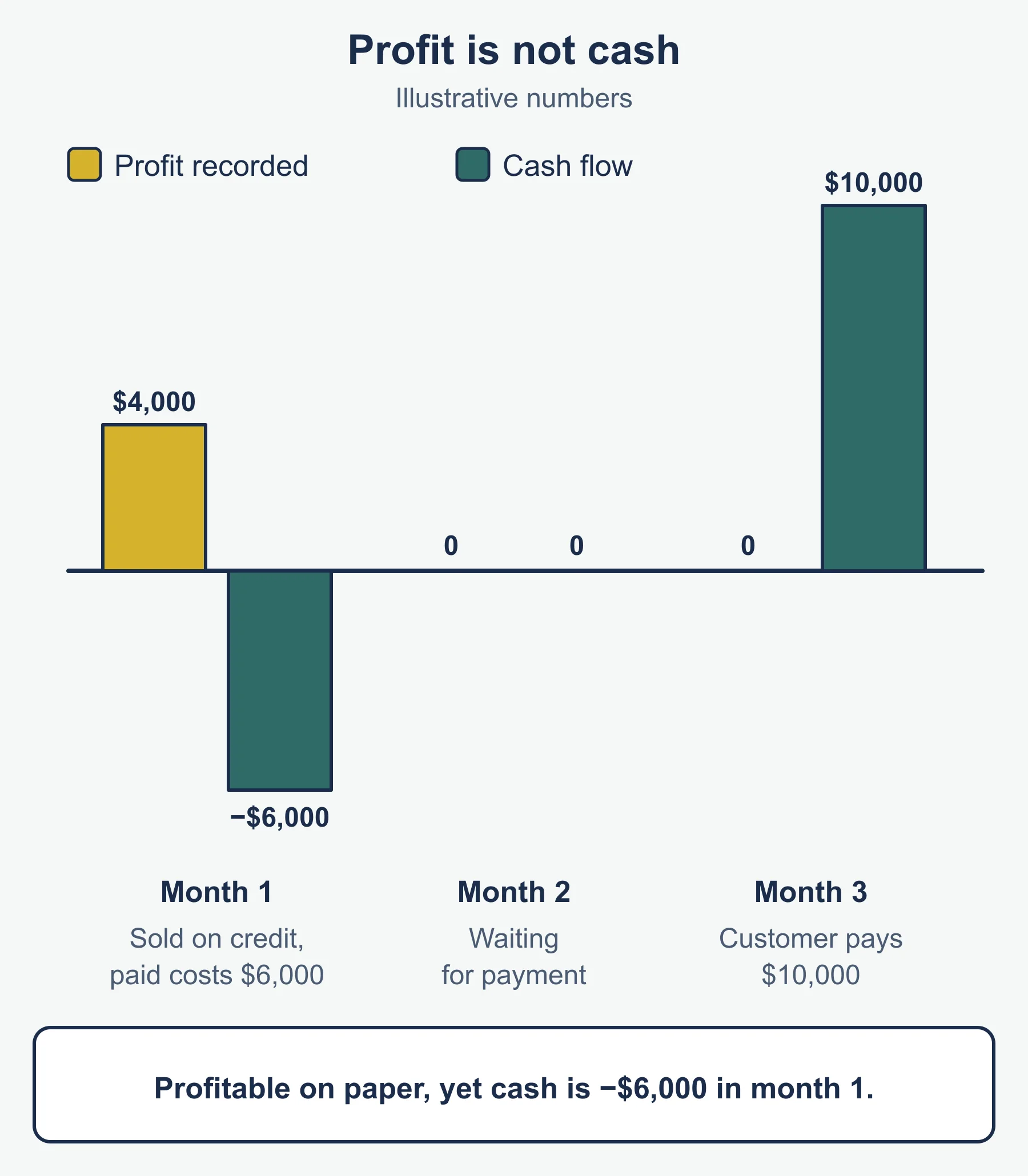
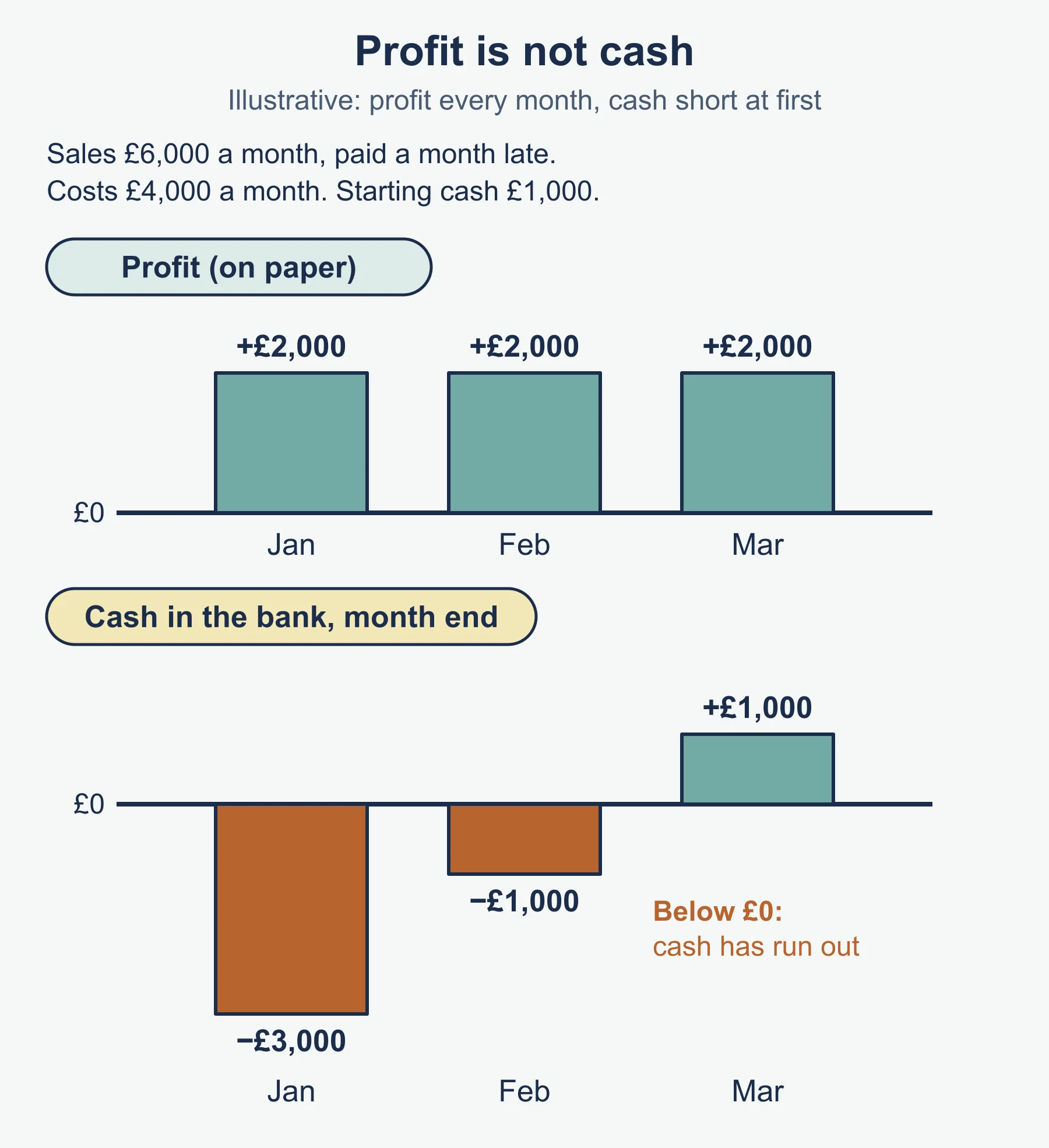
Cash is the money a business holds and can use now. Profit is sales revenue minus costs over a period. They differ because credit sales count as revenue before the money arrives, and buying equipment or repaying a loan moves cash without being a cost of the period in the same way.
Worked example. Pendlemoor Ceramics starts March with £9,000 in the bank. It sells £12,000 of mugs on credit and the customers will pay in May. During March it pays £7,000 for clay, wages and rent.
- Profit for March = £12,000 − £7,000 = £5,000.
- Cash at the end of March = £9,000 − £7,000 = £2,000. No customer has paid yet.
Pendlemoor is profitable on paper, yet its bank balance fell by £7,000.
Failure from lack of finance
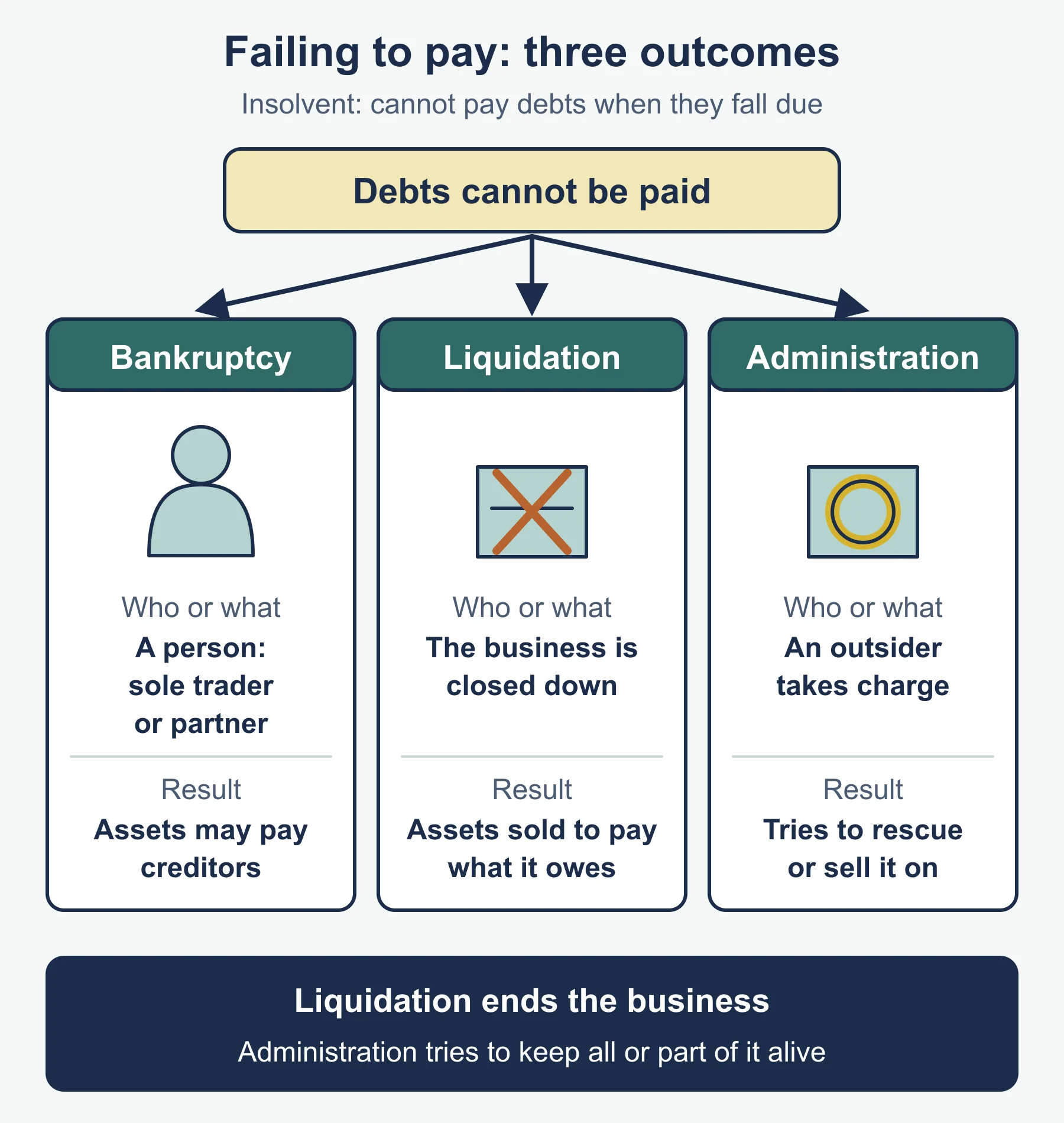
A business that cannot pay its debts when they fall due is insolvent, whatever its profit. The syllabus names three outcomes.
- Bankruptcy: the position of an individual, such as a sole trader or a partner, who cannot pay personal debts. Their assets may be used to pay creditors.
- Liquidation: the business is closed and its assets are sold to pay what it owes, as far as they allow.
- Administration: an outside administrator takes charge to try to rescue the business or sell it as a going concern, which gives it time while creditors are held back.
Liquidation ends the business; administration tries to keep all or part of it alive.
5.1.2 Working capital
Meaning and importance
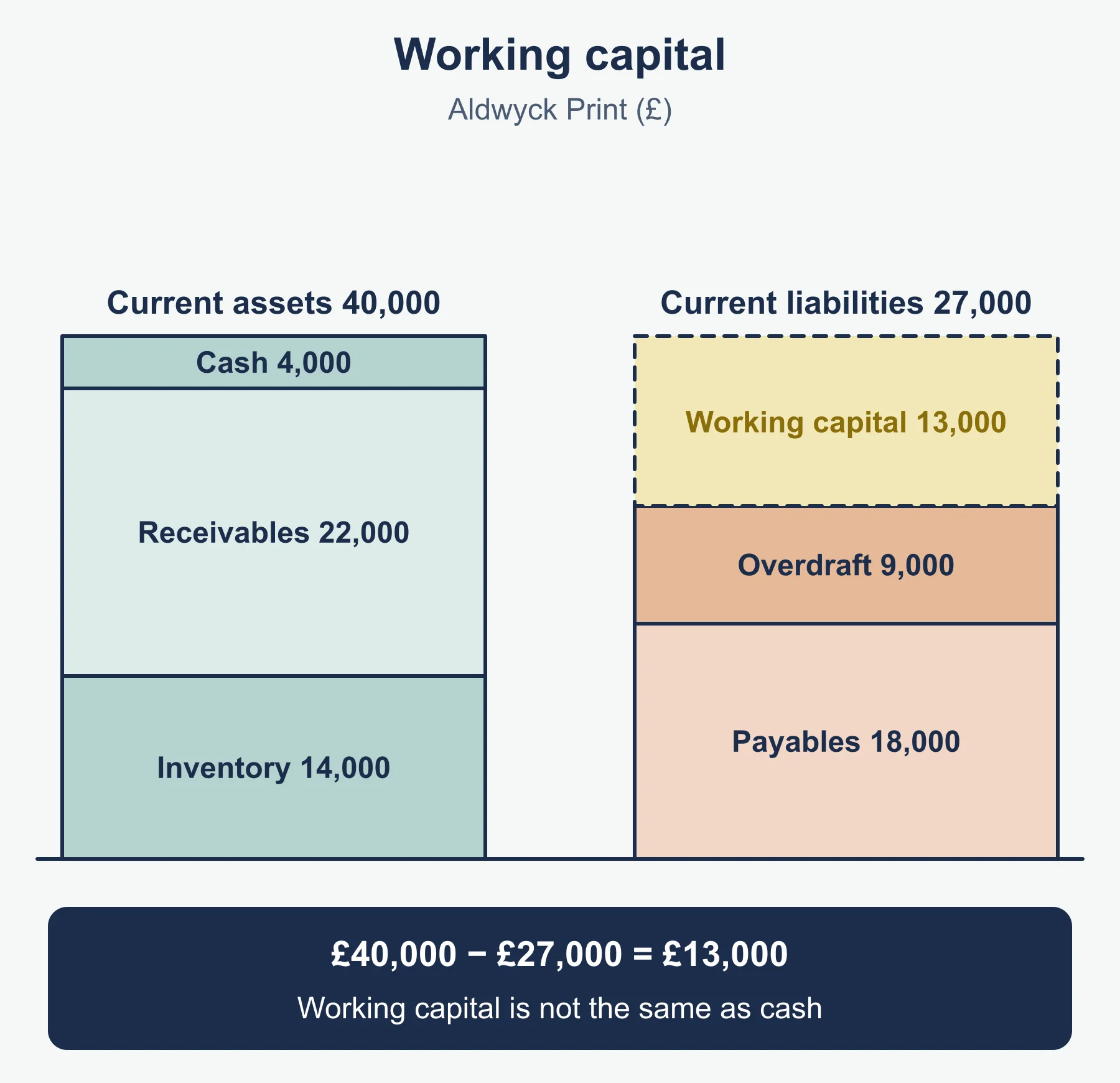
Working capital is the finance available for day-to-day operations. In its standard form it is current assets minus current liabilities. Current assets are items such as inventory, trade receivables and cash. Current liabilities are debts the business must settle within a year, for instance trade payables and an overdraft.
A business must pay wages, suppliers and expenses as they fall due. Too little working capital risks being unable to pay even when profit is good. Too much means money is tied up in idle inventory or unpaid invoices.
Worked example. Aldwyck Print has inventory £14,000, trade receivables £22,000 and cash £4,000. Its trade payables are £18,000 and its overdraft is £9,000.
- Current assets = £14,000 + £22,000 + £4,000 = £40,000.
- Current liabilities = £18,000 + £9,000 = £27,000.
- Working capital = £40,000 − £27,000 = £13,000.
Managing trade receivables and trade payables
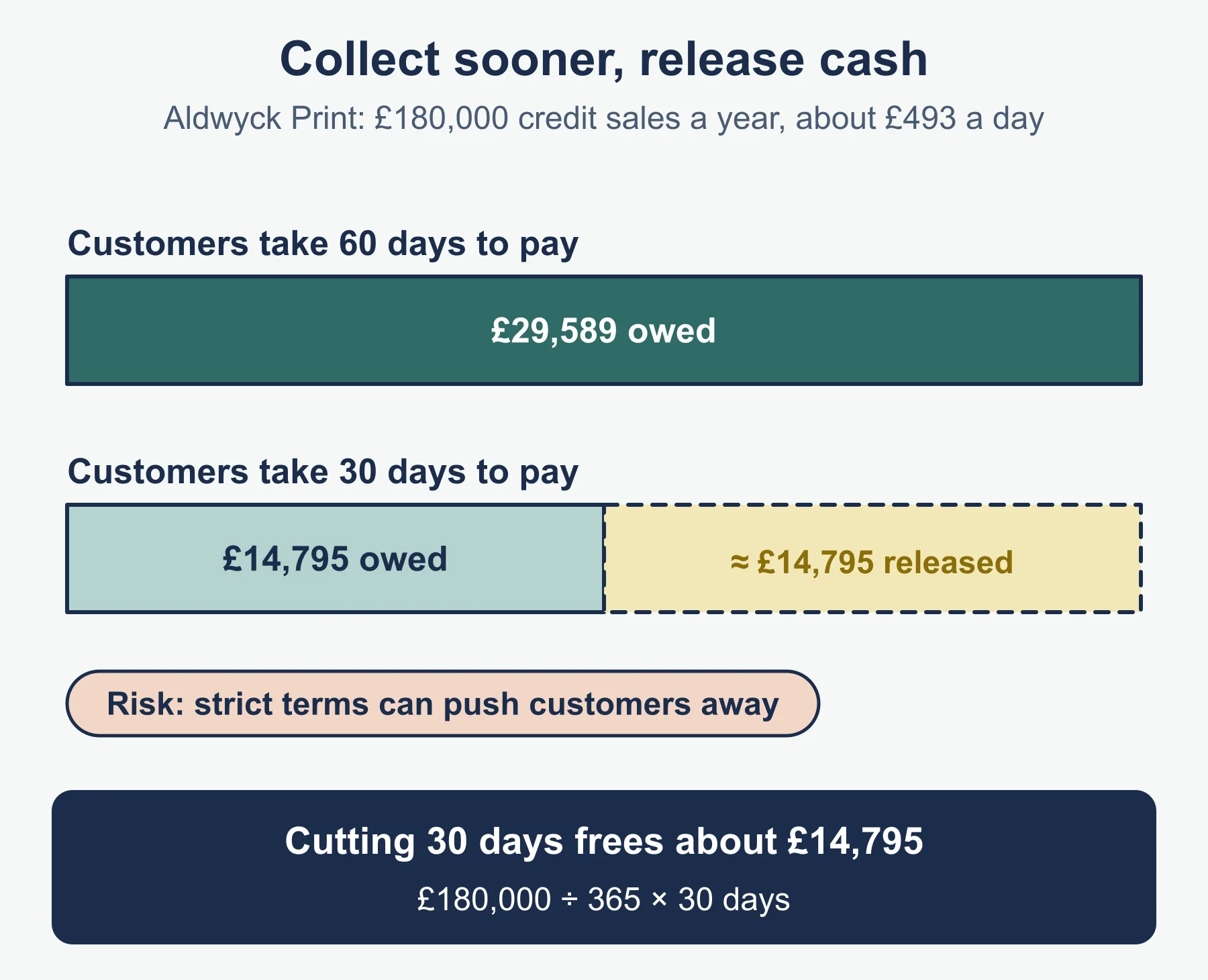
Trade receivables are customers who have bought on credit and not yet paid. Managing them means collecting cash sooner without losing sales. Methods include shorter credit periods, checking customers’ credit first, prompt reminders, a discount for early payment and debt factoring (below). The risk is that strict terms push customers to rivals.
Worked example. Aldwyck Print makes £180,000 of credit sales a year, about £493 a day. If customers take 60 days to pay, about £29,589 is owed at any time. If they pay in 30 days, about £14,795 is owed. Cutting the credit period by 30 days releases about £14,795 of cash.
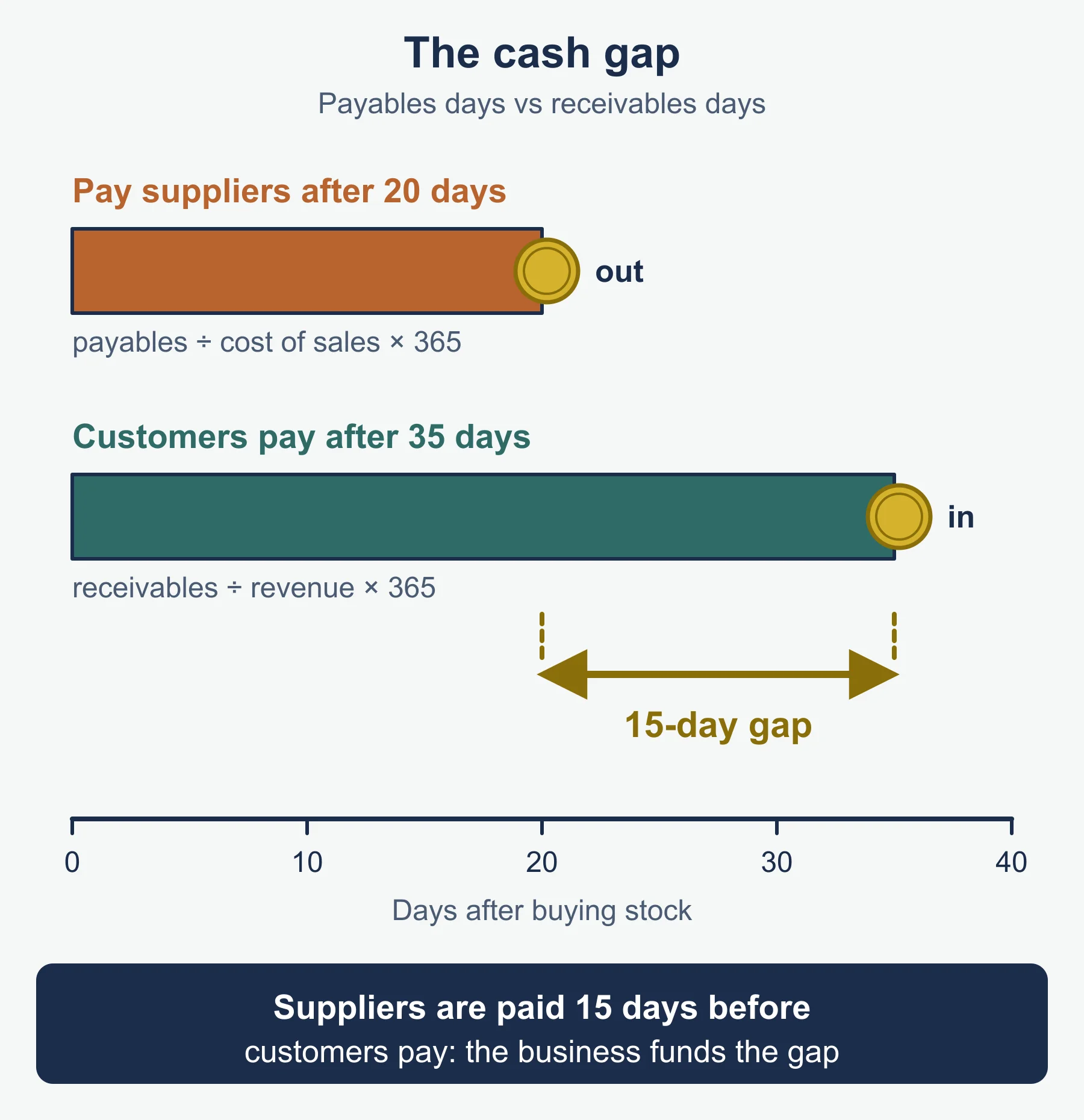
Trade payables are suppliers the business has not yet paid. Managing them means using the credit period offered but not stretching it so far that suppliers refuse to deliver, add charges or lose trust. Paying later holds cash in the business, but lost supplier goodwill is a cost.
Capital expenditure and revenue expenditure
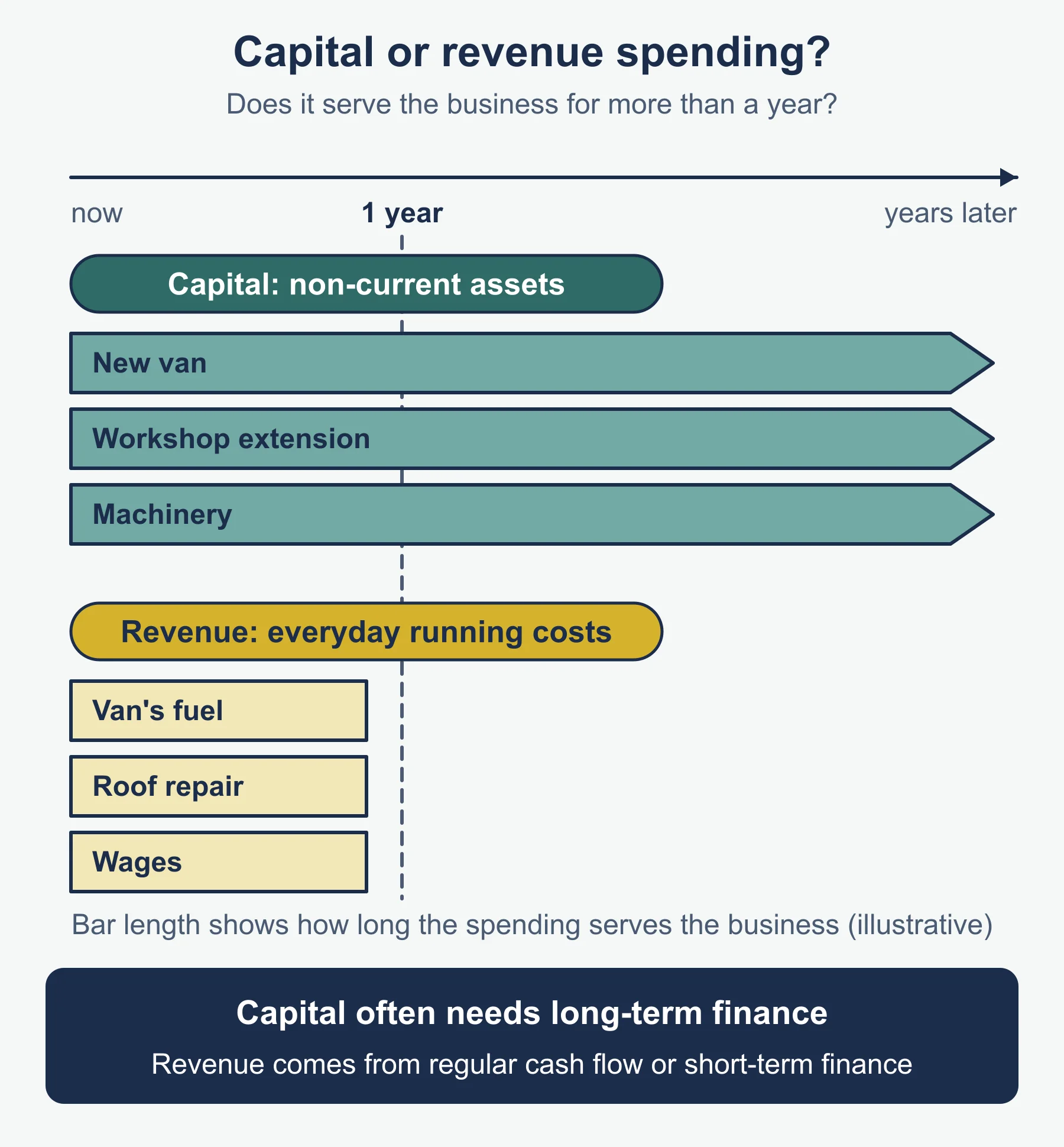
Capital expenditure is spending on non-current assets that will be used for more than a year, such as machinery, vehicles and buildings. Revenue expenditure is spending on the everyday running costs of the business, such as wages, materials, rent and repairs.
A new van and a workshop extension are capital expenditure. The van’s fuel and repairs to a leaking roof are revenue expenditure.
The distinction matters because the two are financed differently. Capital expenditure often needs long term finance. Revenue expenditure comes from the business’s regular cash flow or short term finance.
5.2.1 Ownership and sources of finance
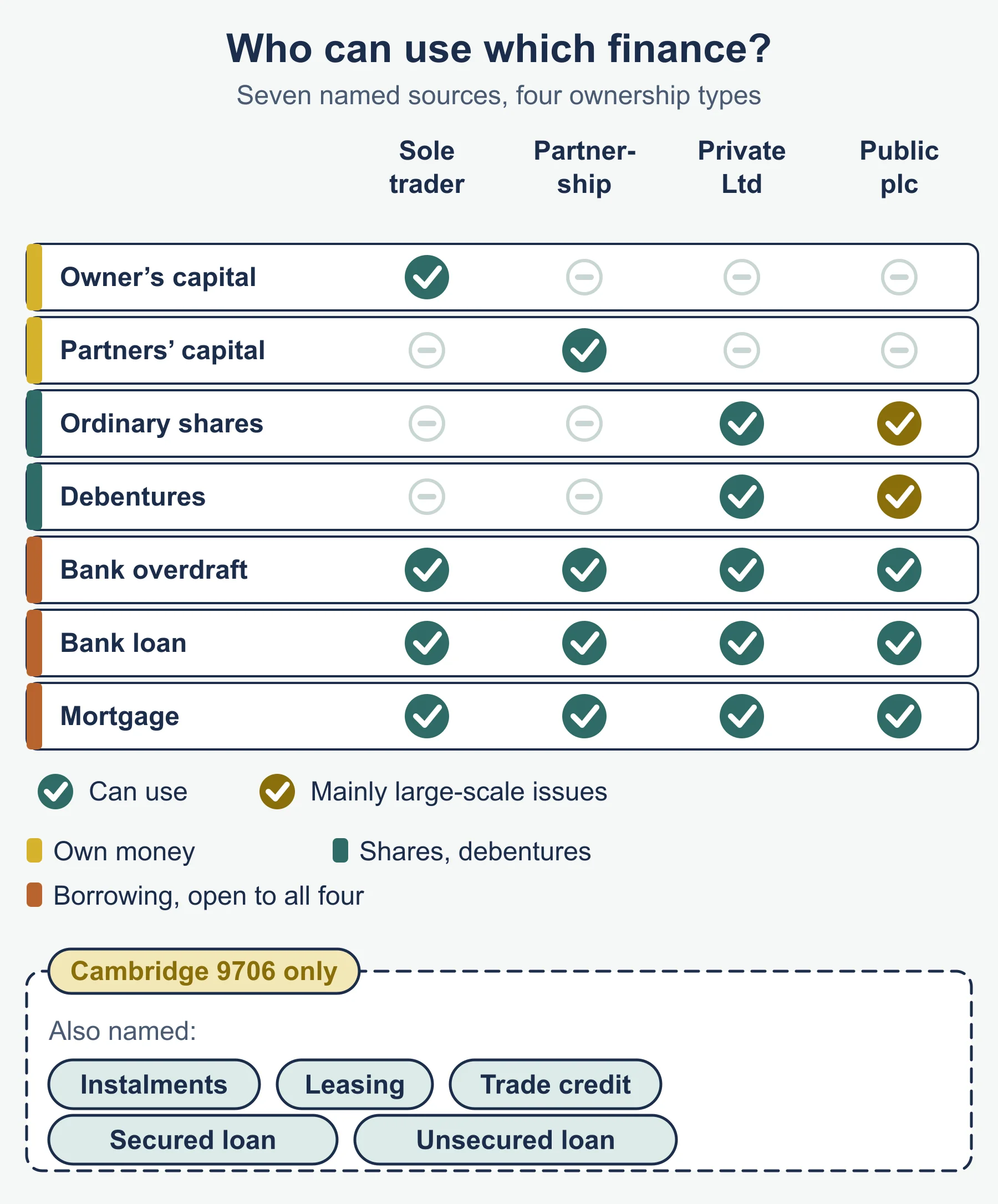
Ownership decides who can supply finance. A sole trader has the owner’s savings, profits kept in the business and loans, and lenders may see the business as risky because it depends on one person. A partnership can add new partners, who bring capital but also share control and profit. A private limited company can raise money by selling shares, but only to chosen people. A public limited company can sell shares to the public, which makes much larger sums possible. Larger, more established businesses usually have more sources open to them.
5.2.2 Internal and external sources
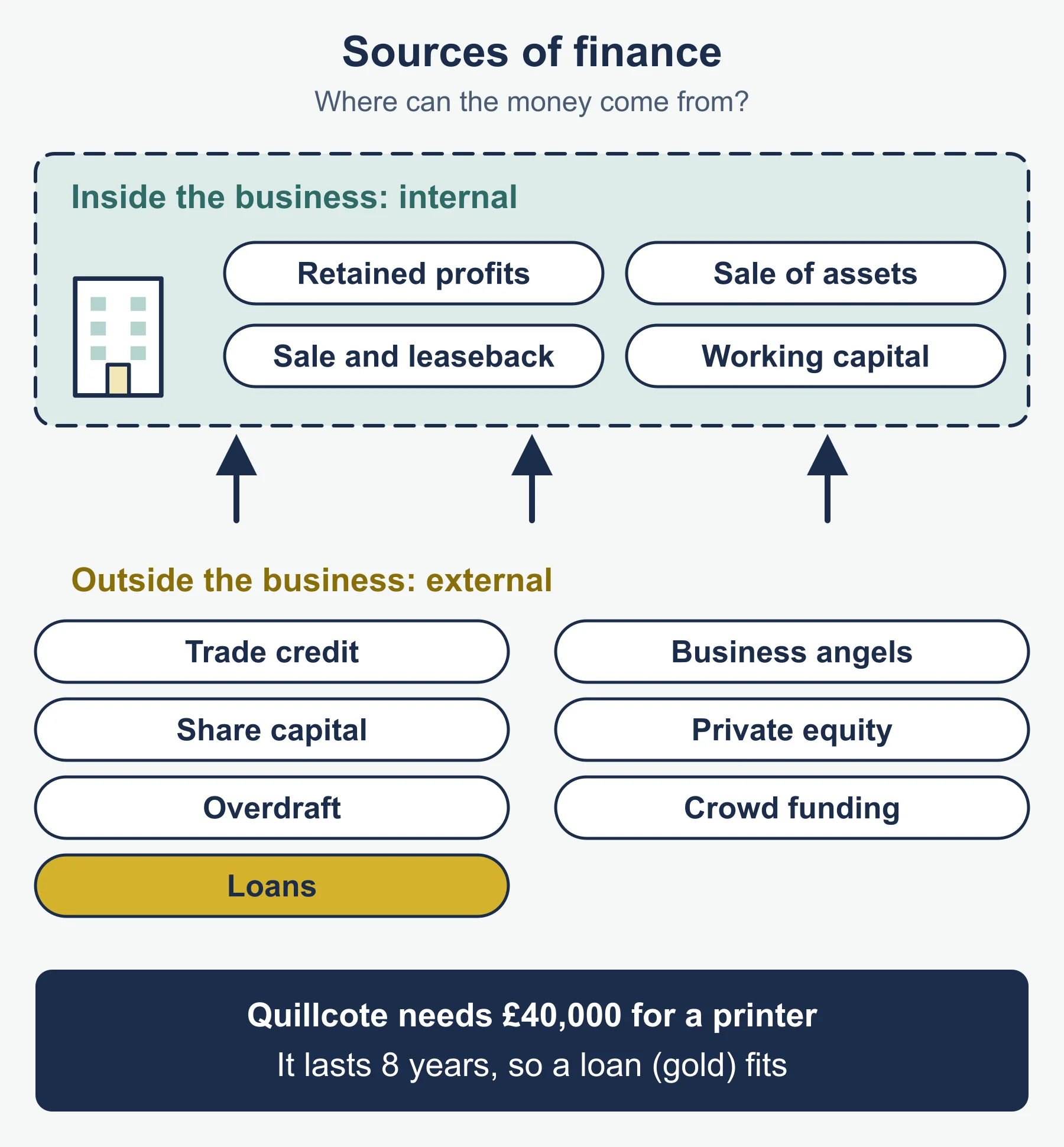
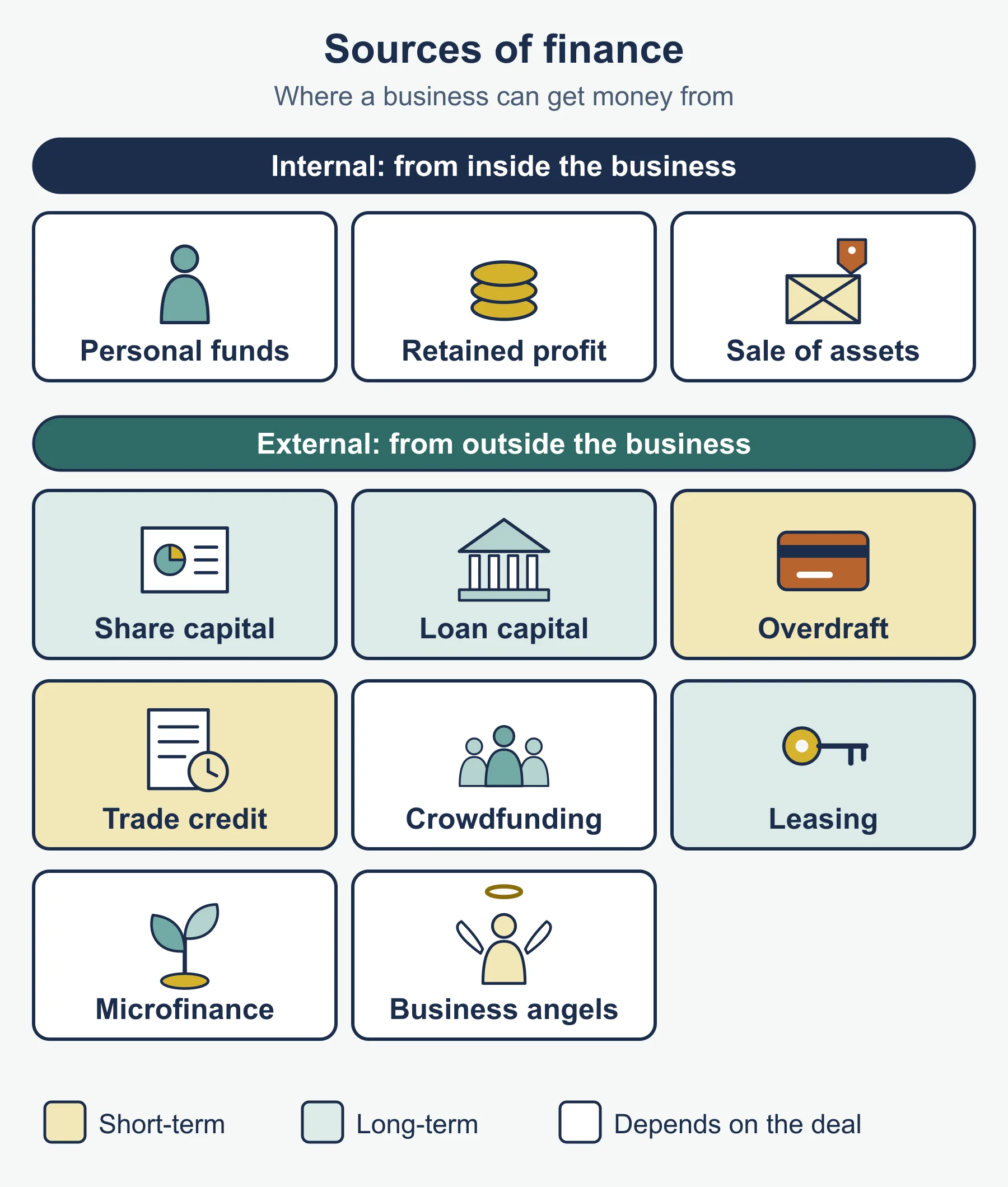
Internal finance comes from inside the business. External finance comes from outside it.
Internal sources
- Owner’s investment: the owner puts in personal savings. No interest, but personal money is at risk.
- Retained earnings: profit kept in the business rather than paid out. No interest and control is kept, but it exists only if the business has been profitable.
- Sale of unwanted assets: selling equipment or premises no longer needed. Quick cash with no repayment, but a one-off sum, possibly below value.
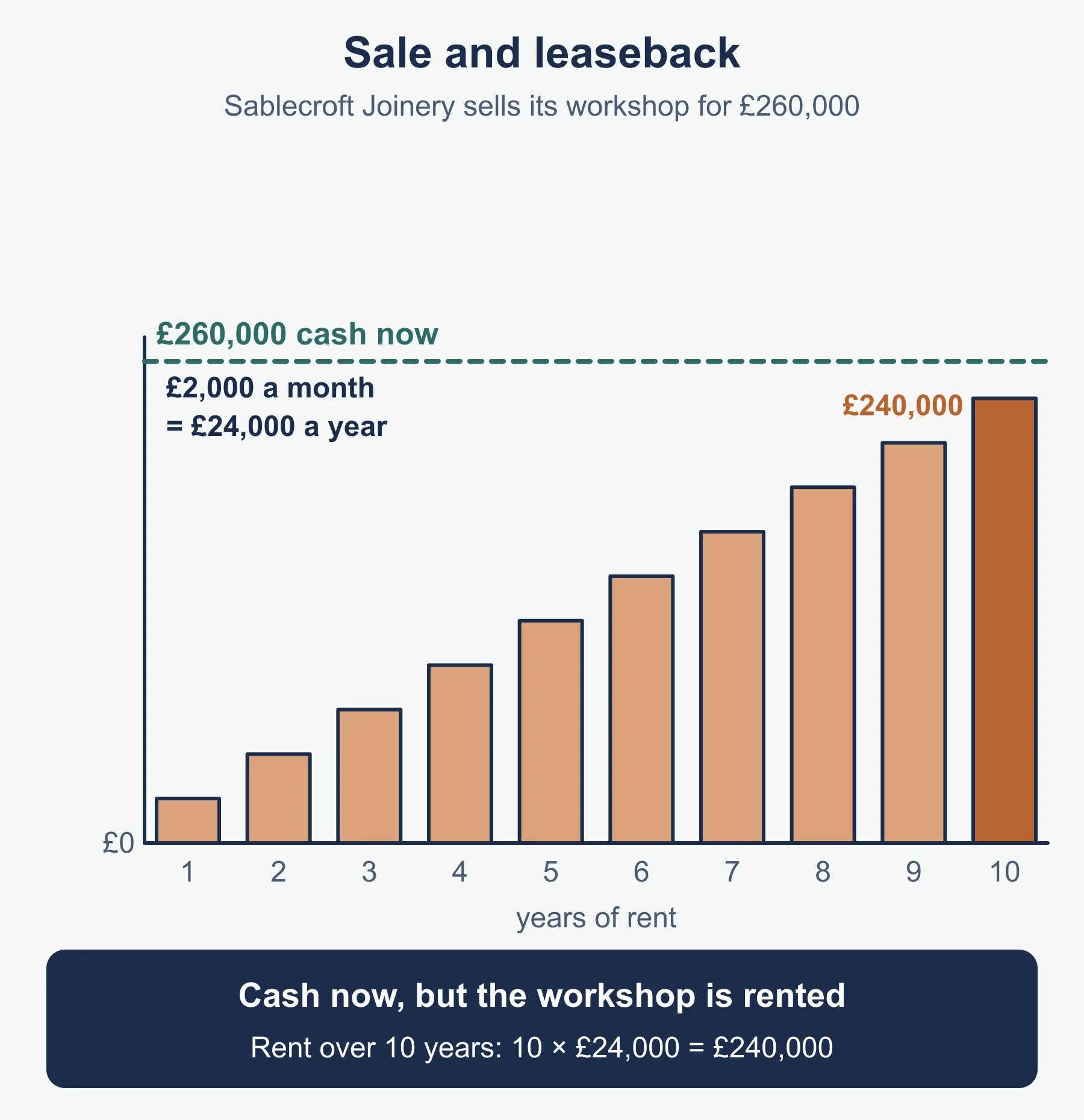
- Sale and leaseback of non-current assets: selling an asset, such as a building, and renting it back. Worked example: Sablecroft Joinery sells its workshop for £260,000 and pays £2,000 a month rent. It gains £260,000 now, but pays £24,000 a year, £240,000 over ten years, and no longer owns the property.
- Working capital: releasing cash by cutting inventory or collecting receivables faster. No outside agreement is needed, but daily payments may be left short.
External sources
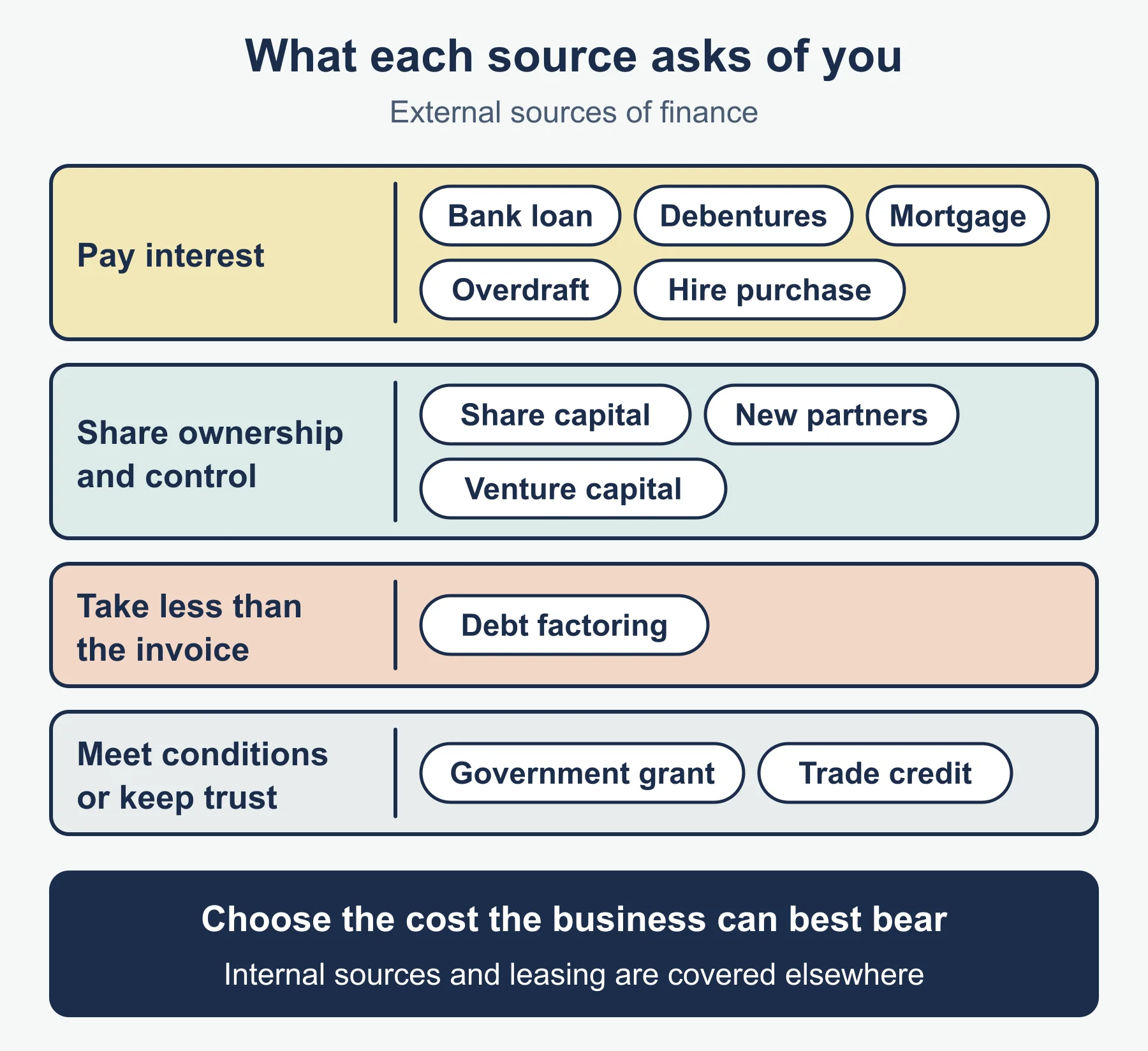
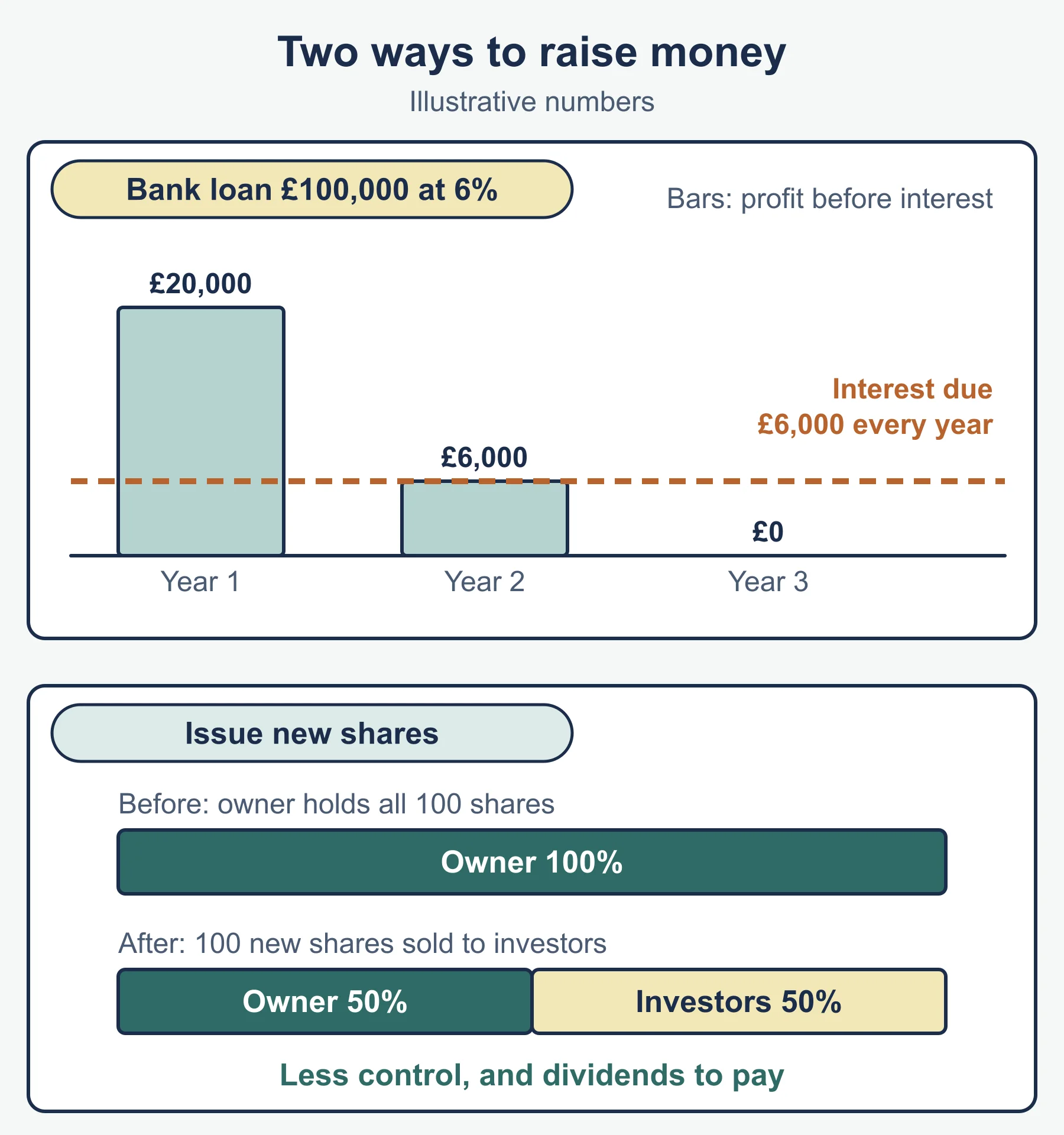
- Share capital: money raised by selling shares to new owners. No repayment or interest, but ownership, control and dividends are shared.
- Debentures: long term loans, often to companies, repaid on a set date with fixed interest.
- New partners: add capital to a partnership, but profit and control are shared.
- Venture capital: investment, usually in a risky new or growing firm, in return for a share of ownership.
- Bank overdrafts: the bank lets the account be overdrawn, up to an agreed limit. Flexible, with interest only on the amount used, but the rate can be high and the bank can ask for repayment.
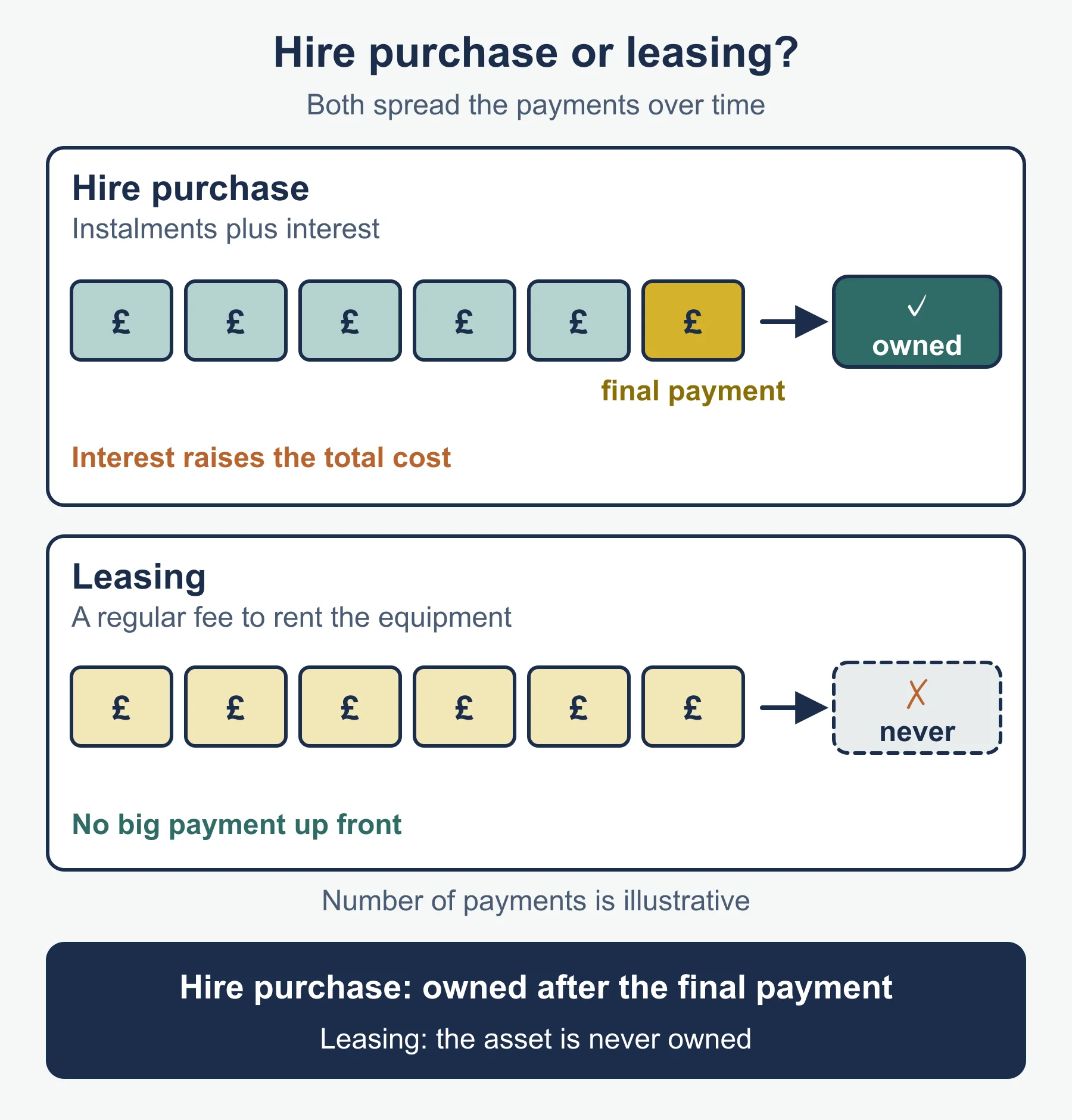
- Leasing: renting equipment for a regular fee. It avoids a big payment, but the asset is never owned.
- Hire purchase: paying instalments for an asset that the business owns after the final payment. Interest raises the total cost.
- Bank loans: a set sum repaid with interest across an agreed term. The bank may ask for security.
- Mortgages: long term loans secured on property, used to buy land or buildings.
- Debt factoring: selling invoices to a factor, who pays most of the value at once and collects from the customers. Cash arrives sooner, but less than the full invoice value.
- Trade credit: buying now and paying the supplier later. Free if terms are met, but stretching it harms supplier trust.
- Micro-finance: very small loans, often for people who cannot use ordinary banks.
- Crowd funding: raising small sums from many people, usually through an online platform, in return for a reward, a product or a share.
- Government grants: money from a government body, often for a stated purpose. It need not be repaid but conditions apply and it is limited.
5.2.3 Factors affecting the choice of source
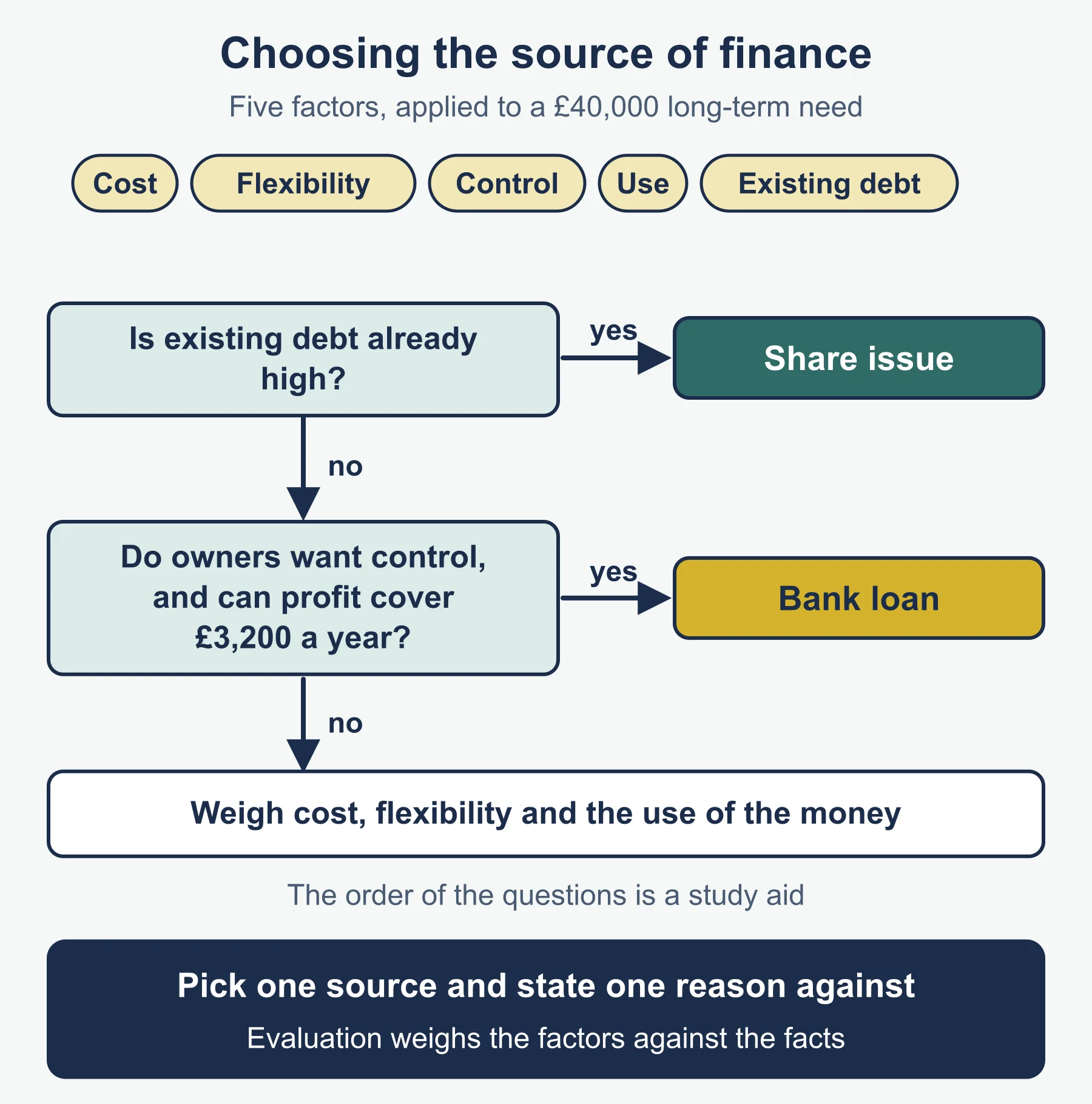
- Cost: interest, fees and the dividends or profit given up. Compare the total cost over the life of the finance.
- Flexibility: whether the business can change repayments and whether the sum can rise or fall with need. An overdraft is more flexible than a fixed loan.
- Need to retain control: share capital, new partners and venture capital bring in owners who may share decisions. Loans and retained earnings do not.
- Use to which it is put: long term assets suit long term finance; short term gaps suit short term finance.
- Level of existing debt: a business already paying heavy interest may find lenders unwilling or the extra interest unaffordable, which pushes it toward share capital or internal finance.
5.2.4 Selecting the source of finance
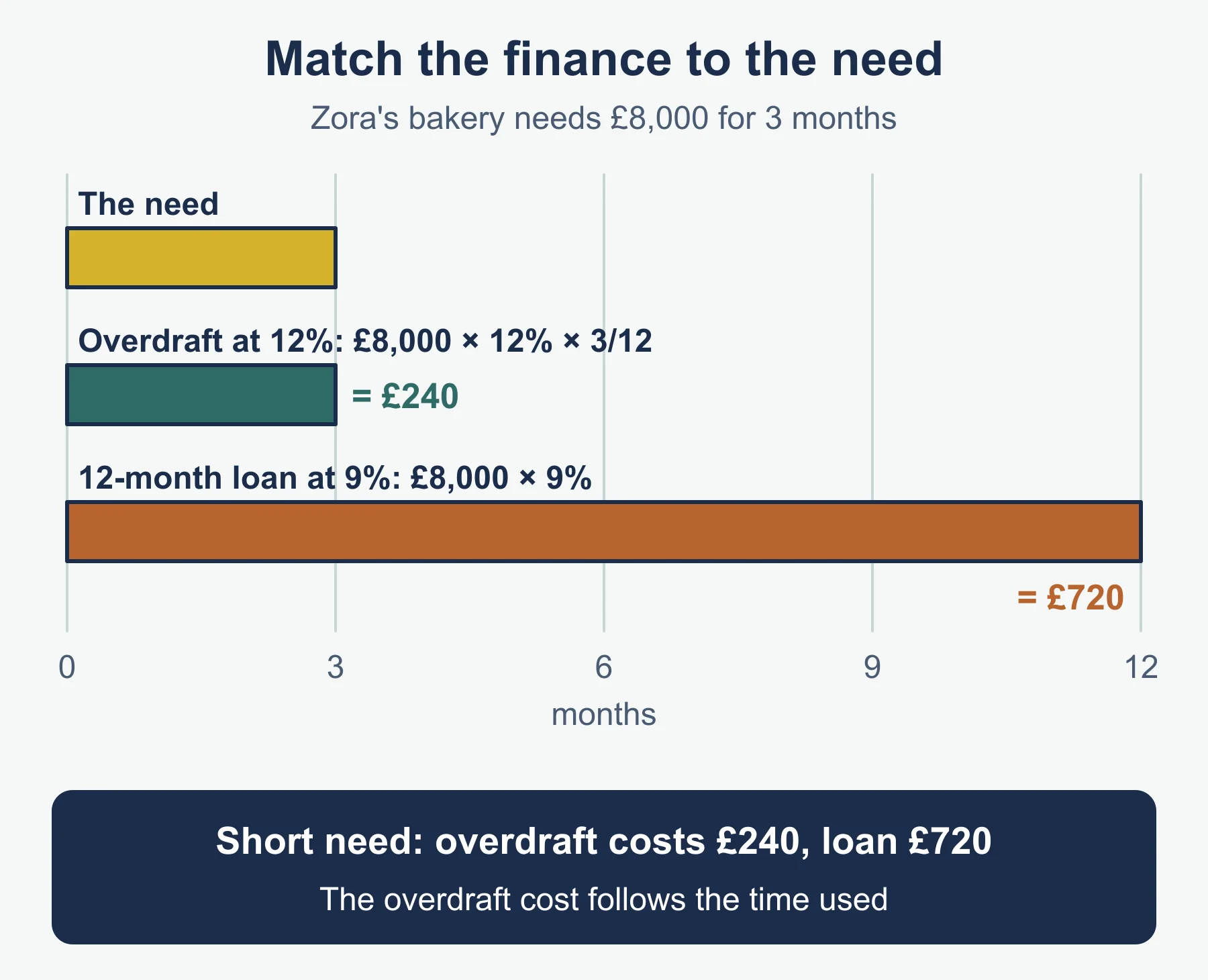
Worked example. Zora runs a small bakery needing £8,000 for 3 months while a large catering order is delivered and paid for. A bank overdraft at 12% a year costs £8,000 × 12% × 3/12 = £240 if the full amount is used for 3 months. A 12-month loan at 9% costs £8,000 × 9% = £720 in interest, though the money is needed only for a quarter. The overdraft is more appropriate because the need is short term and its cost follows the time used.
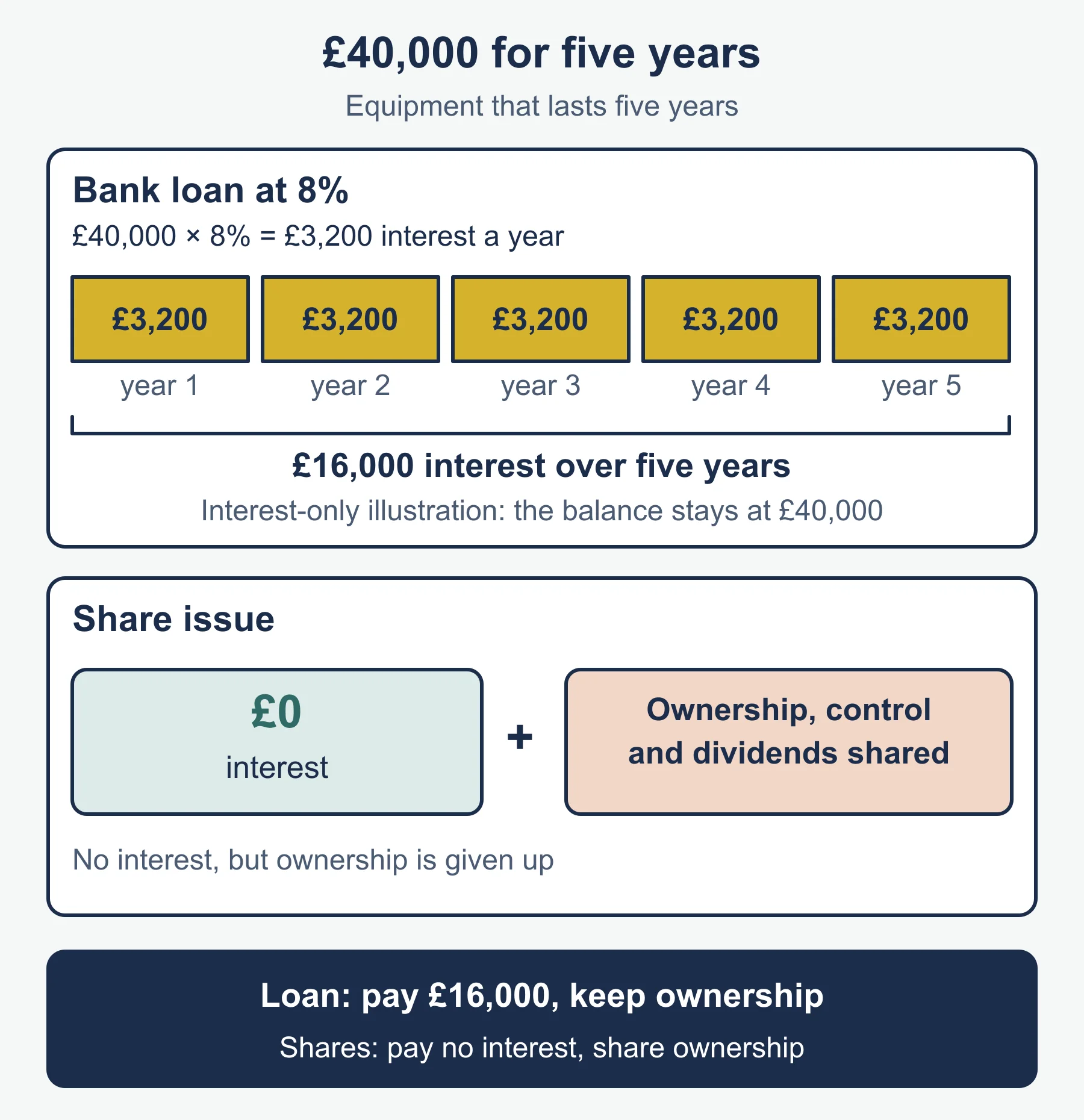
Now a long term need: £40,000 for equipment lasting five years. A loan at 8% costs £3,200 a year in interest if the balance stays at £40,000 (an interest-only illustration), or £16,000 over five years. A share issue has no interest but gives up ownership. Choose the loan if the owners want control and profit can cover interest; choose shares if debt is already high.
An evaluation about finance weighs the factors against the facts. A good answer picks a source, explains why it fits, and states one reason against it.
Common errors
- Treating profit as cash. Credit sales raise profit before they raise cash.
- Writing that working capital is cash.
- Confusing bankruptcy with liquidation. Bankruptcy relates to individuals; liquidation closes the business.
- Naming a source without matching it to the need, such as a mortgage for a wage bill.
Frequently asked questions
What is the difference between capital and revenue expenditure? Capital expenditure is spending on non-current assets used for more than a year, such as a van. Revenue expenditure is spending on day-to-day running, such as the van’s fuel and repairs.
Why does the form of ownership affect sources of finance? Ownership decides who can supply finance. A sole trader relies mainly on savings, profits and borrowing, while a public limited company can sell shares to the public and raise much larger sums.
What is sale and leaseback? Selling a non-current asset, such as a building, and renting it back. The business gets cash now without borrowing but must pay rent and no longer owns the asset.
Which papers test business finance in Cambridge 9609? Sections 5.1 and 5.2 are AS Level content. Paper 1 (Business Concepts 1) and Paper 2 (Business Concepts 2) test AS Level content, including application, analysis and evaluation.
Official syllabus
Cambridge International AS & A Level Business 9609, syllabus for examination in 2026, 2027 and 2028, published by Cambridge University Press & Assessment (Cambridge International Education). Sections 5.1 Business finance and 5.2 Sources of finance.
Get free revision emails (optional)
Occasional emails with practice questions, worked explanations and links to free resources for the qualification and subjects you choose. No spam, and you can unsubscribe from any email. The free tools on this site never need an email.
Related resources
-
Practice questions
A Level Business: Business finance and Sources of finance (Cambridge 9609) – Practice Questions
Original practice questions with worked answers on 5.1 Business finance and 5.2 Sources of finance for Cambridge AS & A Level Business 9609.
Business · Cambridge · AS Level
Try questions -
Revision notes
A Level Business: Business finance and Sources of finance (Cambridge 9609) – Revision Notes
Condensed revision notes for 5.1 Business finance and 5.2 Sources of finance in Cambridge AS & A Level Business 9609, with a self-test.
Business · Cambridge · AS Level
Revise topic -
Study guides
A Level Business: Costs and Budgets (Cambridge 9609)
Study guide to 5.4 Costs and 5.5 Budgets of Cambridge AS & A Level Business 9609: costing, break-even, budgets and variances, with worked examples.
Business · Cambridge · AS Level
Read guide
Related articles
-
teaching
A Level tuition in Dubai: Cambridge or Pearson Edexcel International A Level?
Schools in Dubai and Abu Dhabi teach either Cambridge International AS & A Level or Pearson Edexcel International A Level. How the two are structured, why it matters for tuition, and how online classes from Lahore work.
9 October 2026
-
curriculum guides
Choosing subjects at IGCSE and A Level
How subject choices at 14 and 16 affect university options later, and how to keep pathways open without overloading a timetable.
28 July 2026
Studying this with a teacher
Working through Business AS LEVEL?
This page is free and stays free. If you would rather be taught it, Marlbridge runs Business classes one-to-one and in small groups of up to 15, online in your own time zone. The first trial class is free. WhatsApp replies within an hour (8am–11pm Pakistan time, every day); email the same day.
Cambridge Business teachers at Marlbridge

