
Study Guides
A Level Business: Costs and Budgets (Cambridge 9609)
Study guide to 5.4 Costs and 5.5 Budgets of Cambridge AS & A Level Business 9609: costing, break-even, budgets and variances, with worked examples.
- Subject
- Business
- Level
- AS LEVEL
- Topic
- Finance and accounting
- Author
- Marlbridge Academic Team
- Updated
- Reviewed by
- Salman Ahmad (what this means)
Aligned to Cambridge A Level Business (9609), For examination in 2026, 2027 and 2028. Official specification .
Syllabus page (what it covers and how it is assessed): Cambridge A Level Business.
Syllabus points this page covers
9609 (AS Level)
- 5.4 Costs
- 5.5 Budgets
Found an error? Report a correction.
Need help with this topic? Request a free trial class for A Level Business (9609).
This guide covers sections 5.4 Costs and 5.5 Budgets of the Cambridge International AS & A Level Business 9609 syllabus for examination in 2026, 2027 and 2028. They sit in Topic 5, Finance and accounting, an AS Level topic that A Level candidates also study: the syllabus says AS content is assumed knowledge for Paper 3 and Paper 4. All businesses here are invented.
Use it with the revision notes and the practice questions. Course links: the Cambridge A Level Business hub, the checklist and the free diagnostics.
What you must be able to do
| Section | What the syllabus lists |
|---|---|
| 5.4.1 Cost information | The need for accurate cost information; fixed, variable, direct and indirect costs |
| 5.4.2 Approaches to costing | Full and contribution costing: differences, uses and limitations; contribution versus profit; when each is used |
| 5.4.3 Uses of cost information | Average, marginal and total costs for decisions; pricing; monitoring performance and calculating profit; special order decisions |
| 5.4.4 Break-even analysis | Meaning and importance; break-even output, contribution, margin of safety and profit, numerically and graphically; uses and limitations |
| 5.5.1 Meaning and purpose of budgets | Measuring performance; benefits and drawbacks; incremental, flexible and zero budgeting; allocating resources, controlling and monitoring |
| 5.5.2 Variances | Adverse and favourable variances; calculation and interpretation |
The syllabus does not print formulas for this content. Where a formula appears below, it is the standard form.
5.4.1 Cost information
Decisions rest on cost information, so it must be accurate. If costs are understated, prices may be too low, a loss-making product may look profitable and budgets will be wrong.
Costs are classified in two ways.
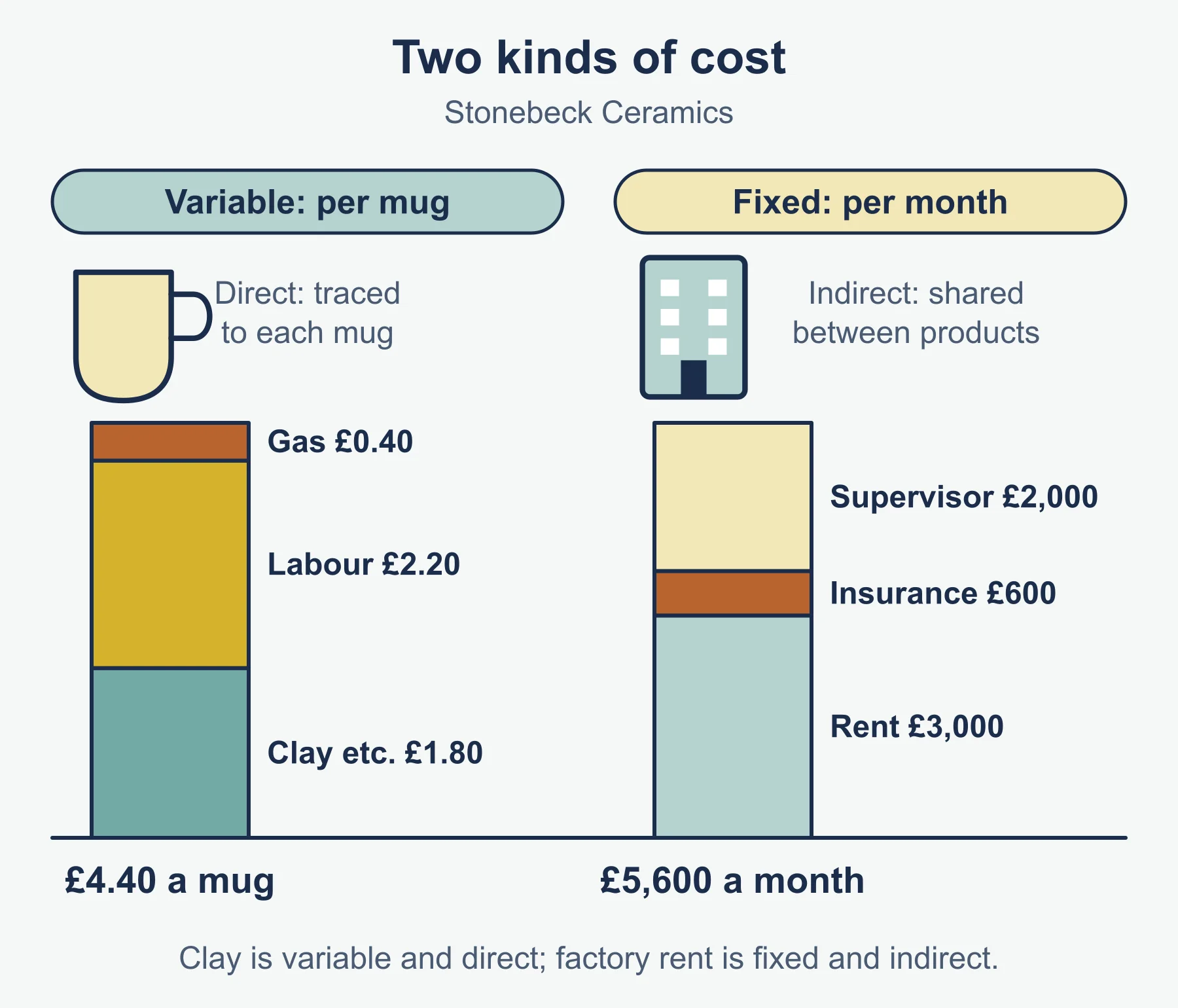
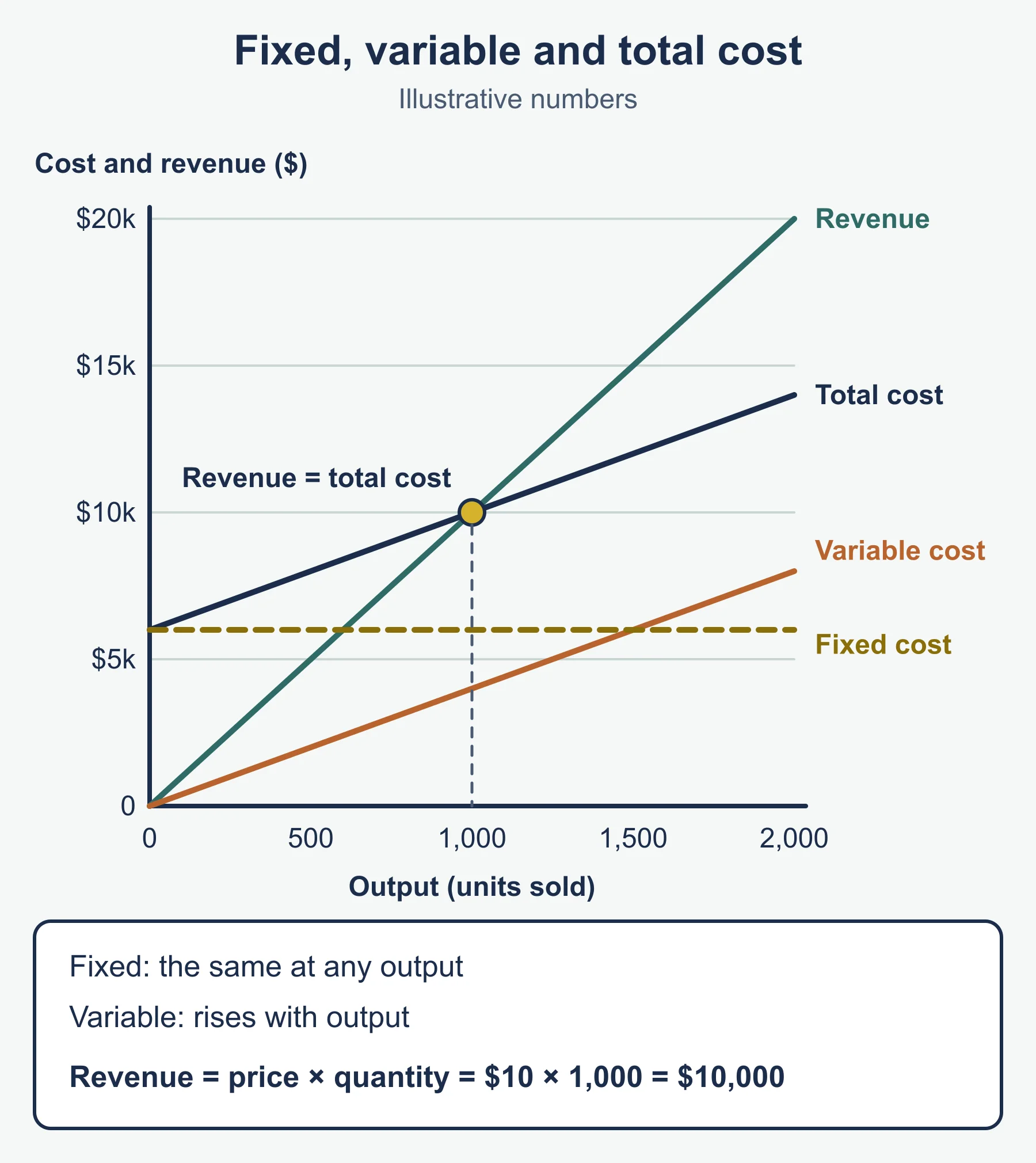
- Fixed costs stay the same however much is made, over the short run (rent, insurance, a supervisor’s salary). Variable costs rise and fall with output (materials, packaging, piece-rate wages).
- Direct costs can be traced to a particular product or cost centre (clay in a mug). Indirect costs cannot be traced to one product and are shared (factory rent, heating).
The two classifications overlap. Clay is variable and direct. Factory rent is fixed and indirect.
Stonebeck Ceramics makes mugs and plates. Its monthly fixed costs are rent £3,000, insurance £600 and a supervisor’s salary £2,000, so £5,600 in total. For each mug, direct materials cost £1.80, direct labour £2.20 and kiln gas £0.40, so the variable cost is £4.40. A mug sells for £8.00. A plate has a variable cost of £6.00 and sells for £11.00.
5.4.2 Approaches to costing
Full costing
Full costing (also called absorption costing) gives each product a share of all costs, including indirect ones. The standard method is to choose a basis, such as direct labour hours, and divide overheads by it.
Stonebeck makes 4,000 mugs (0.25 labour hours each) and 1,500 plates (0.5 hours each).
- Total hours = 4,000 × 0.25 + 1,500 × 0.5 = 1,750.
- Overhead rate = £5,600 ÷ 1,750 = £3.20 per hour.
- Overhead per mug = 0.25 × £3.20 = £0.80. Per plate = 0.5 × £3.20 = £1.60.
- Full cost per mug = £4.40 + £0.80 = £5.20. Per plate = £6.00 + £1.60 = £7.60.
- Profit per unit: mug £8.00 − £5.20 = £2.80; plate £11.00 − £7.60 = £3.40.
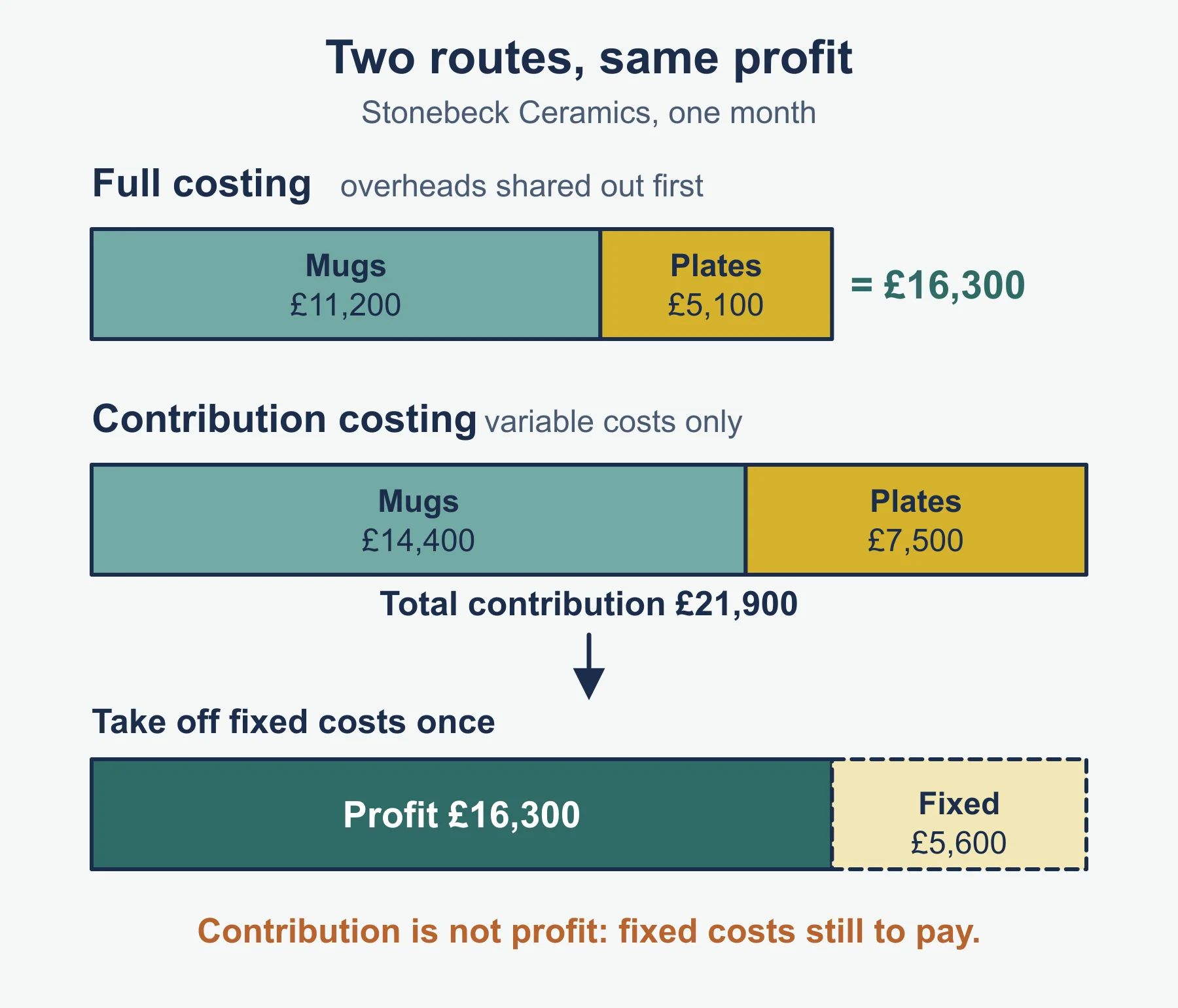
Total profit = 4,000 × £2.80 + 1,500 × £3.40 = £11,200 + £5,100 = £16,300.
Uses: it shows whether each product covers all its costs, supports cost-plus pricing, and gives a full picture of each product’s profitability. Limitations: the split of overheads depends on the basis chosen, which is a judgement. A different basis changes each product’s apparent profit. It can also make a product seem loss-making when it still adds to the business’s total contribution.
Contribution costing
Contribution costing looks only at variable costs. Per unit, contribution is price less variable cost. Total contribution = contribution per unit × units sold. Fixed costs are not shared out; they are deducted from total contribution as a whole.
- Mug: £8.00 − £4.40 = £3.60. Plate: £11.00 − £6.00 = £5.00.
- Total contribution = 4,000 × £3.60 + 1,500 × £5.00 = £14,400 + £7,500 = £21,900.
- Profit = £21,900 − £5,600 = £16,300, the same figure as full costing.
Contribution is not profit. Contribution is what a product, or the whole business, has left to pay towards fixed costs. Profit is what remains after fixed costs are also covered. A product can have positive contribution and still not pay for its share of overheads.
Limitations: it ignores fixed costs, so using it alone could lead to prices that never cover overheads in the long run. It depends on correctly splitting costs into fixed and variable, which is not always clear-cut. Fixed costs can also change if output moves a long way.
When used: contribution costing suits short-term, one-off decisions with spare capacity, such as special orders, or choosing between products when resources are limited. It would not be used alone to set long-run prices, or where a business must show full cost per product, as in some external reporting.
5.4.3 Uses of cost information
Average, marginal and total costs
- Total cost = total fixed costs + total variable costs.
- Average cost = total cost ÷ output.
- Marginal cost = the extra cost of making one more unit.
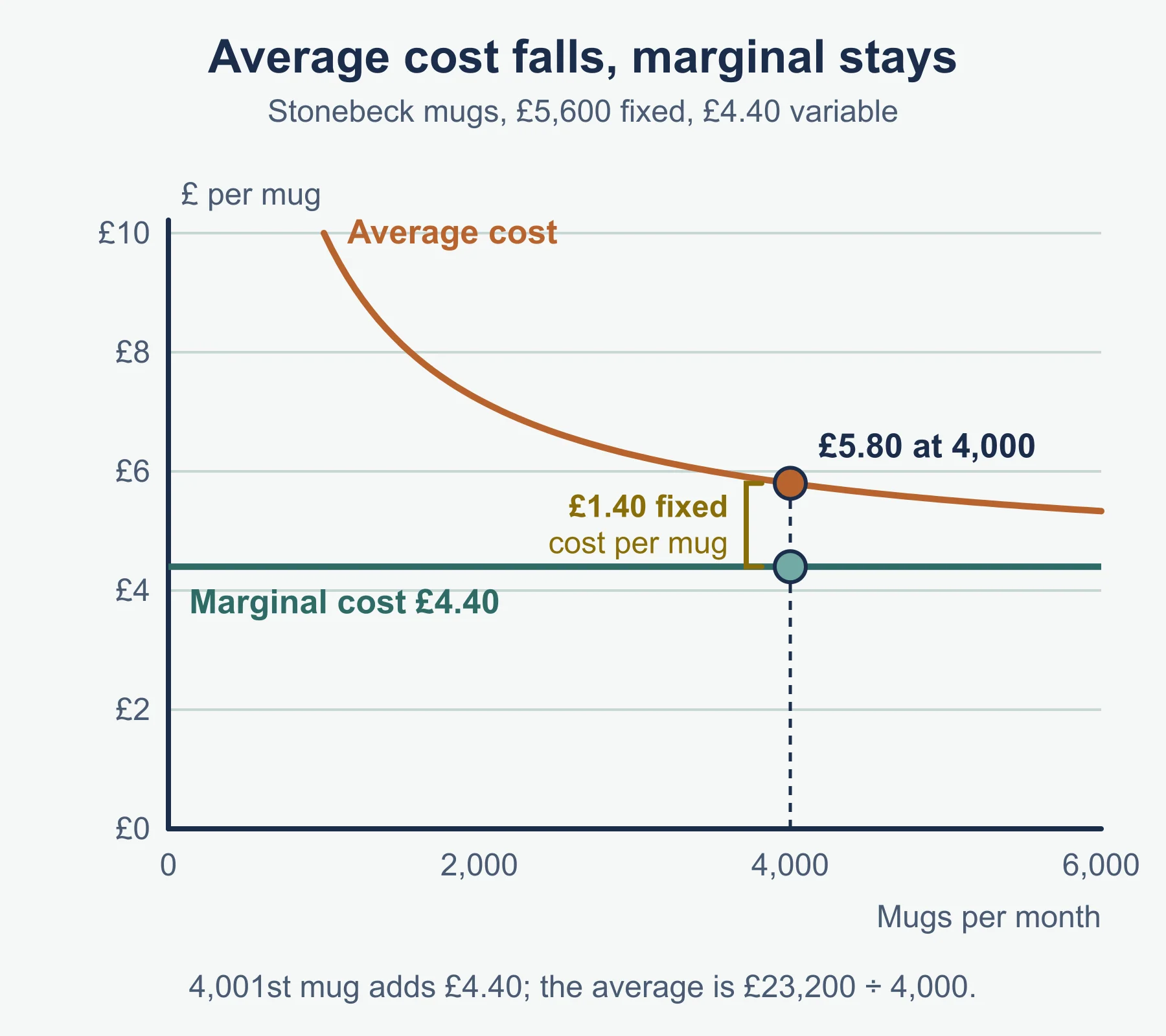
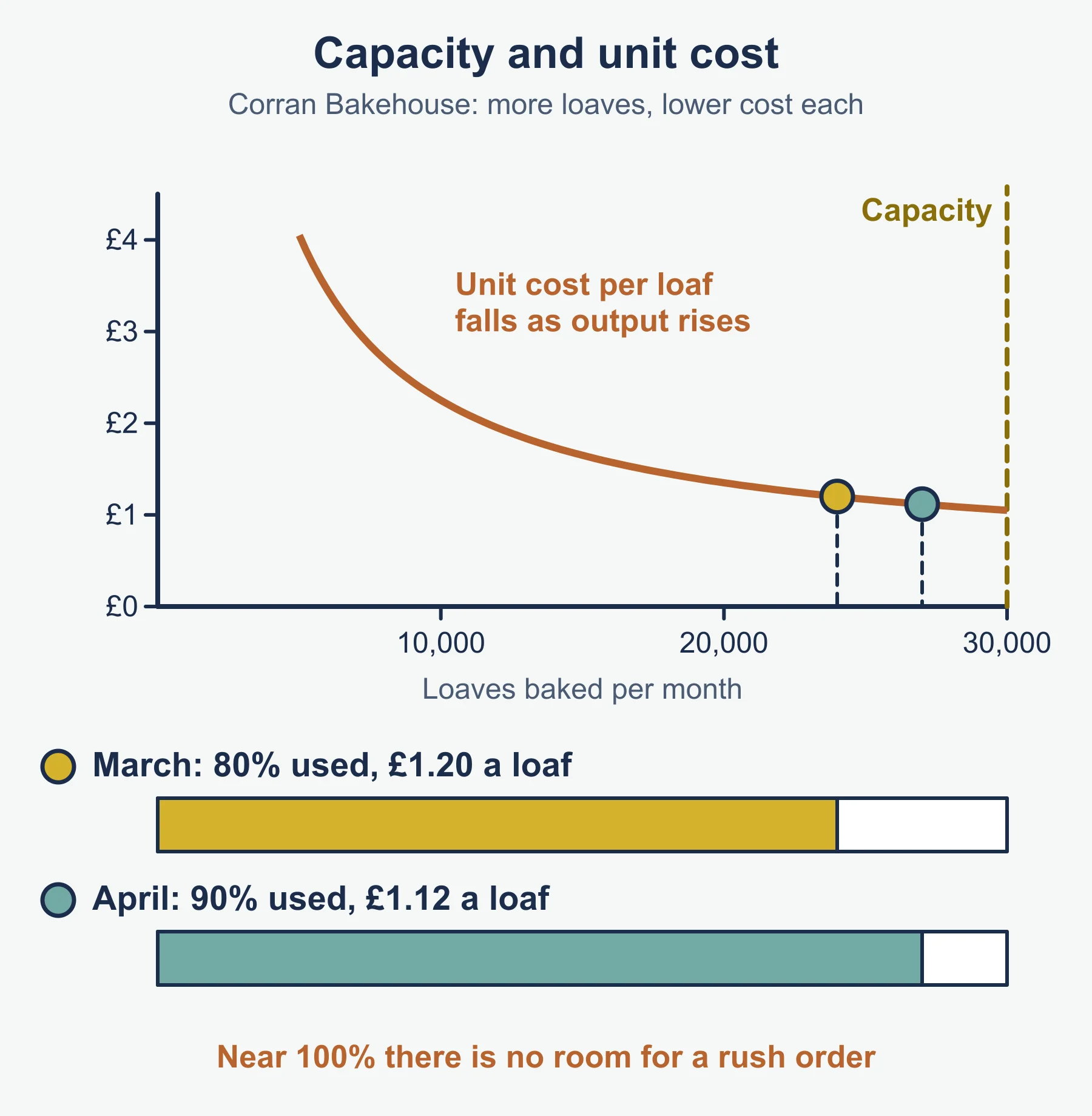
If Stonebeck made only mugs at 4,000 a month, total cost = £5,600 + 4,000 × £4.40 = £23,200, so average cost = £5.80. The marginal cost of the 4,001st mug is £4.40, if fixed costs do not change. Average cost tends to fall with output, since the same fixed costs are divided among more units.
Pricing
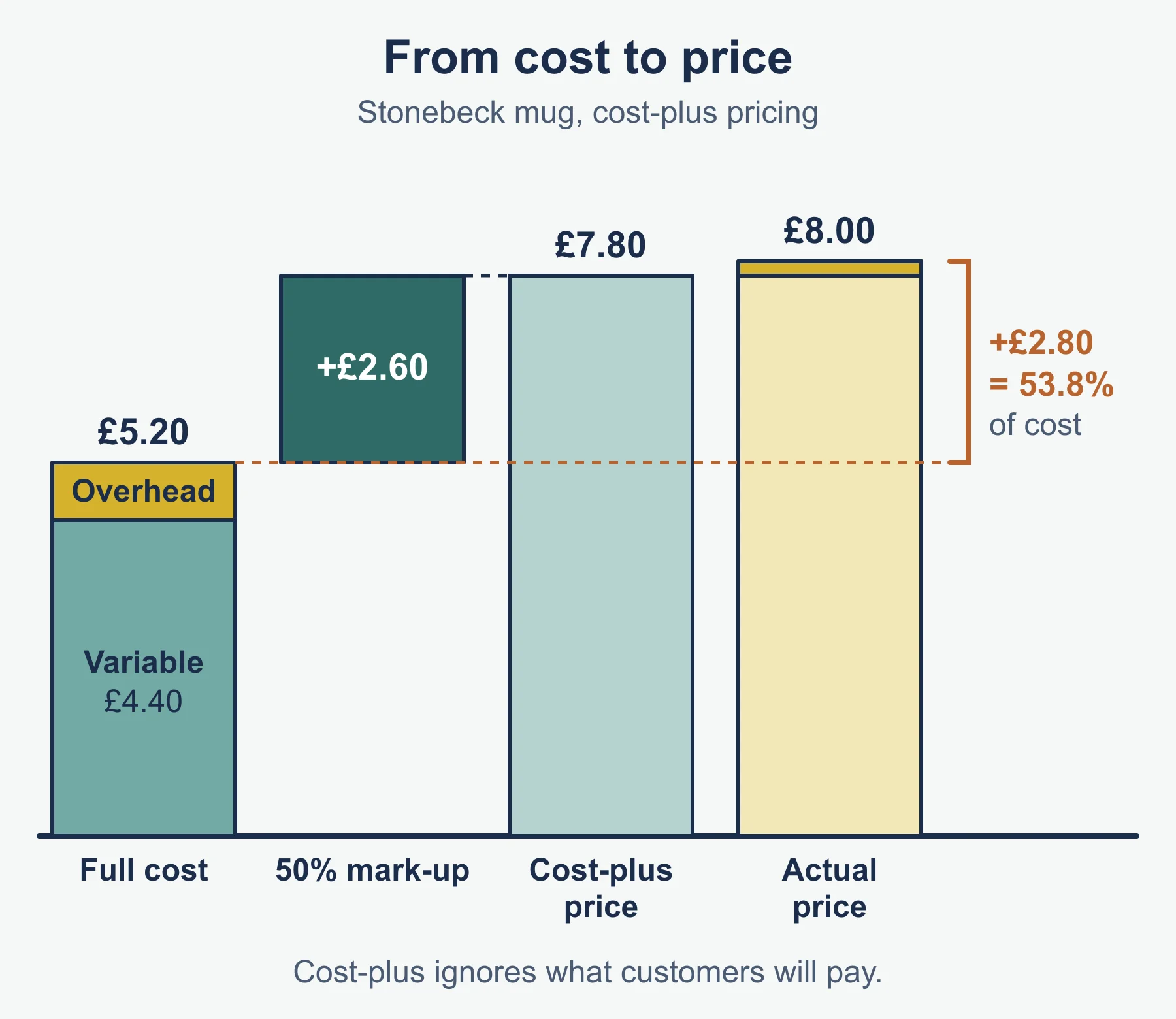
In cost-plus pricing, a mark-up is added to unit cost. A 50% mark-up on the full cost of a mug gives £5.20 × 1.5 = £7.80. The actual price of £8.00 is a mark-up of (8.00 − 5.20) ÷ 5.20 = 53.8%. Cost-plus takes no account of customers’ willingness to pay or of rivals’ prices. Marginal (variable) cost gives a floor for short-term pricing: below £4.40, each mug loses money.
Monitoring and improving performance
Comparing actual unit costs with past or target costs shows where waste occurs. Profit = total revenue − total costs, so tracking cost per unit shows whether profit changes come from price, volume or cost control.
Special order decisions
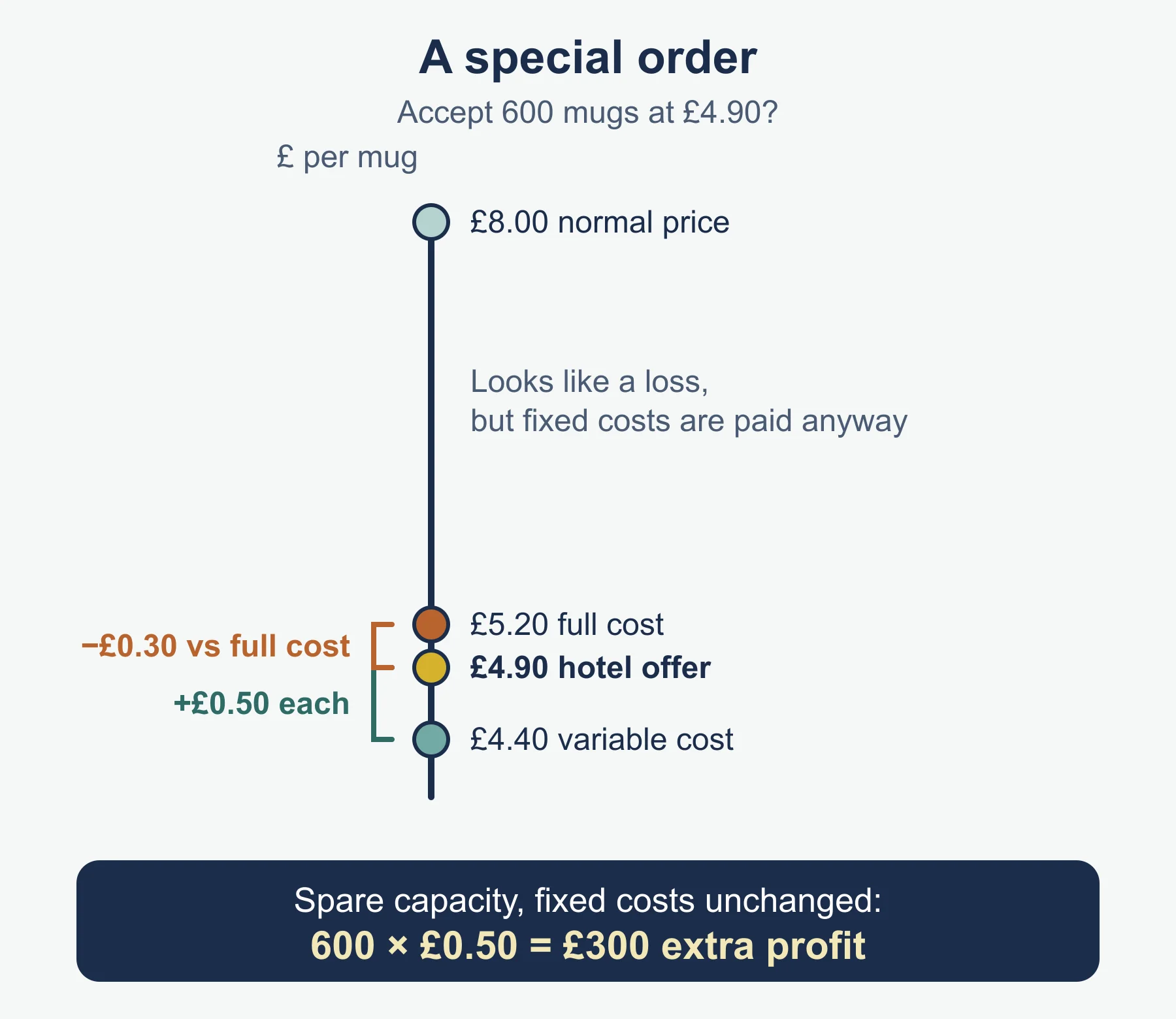
A hotel group offers £4.90 each for a one-off order of 600 mugs. Stonebeck has spare capacity, and fixed costs will not change.
- Full cost per mug is £5.20, so £4.90 looks like a loss of £0.30 a mug.
- Contribution per mug = £4.90 − £4.40 = £0.50. Extra profit = 600 × £0.50 = £300.
On financial grounds only, accept. Non-financial factors matter too: regular customers may hear of the low price and demand it, the order may use capacity needed for full-price work, and it may lead to repeat orders or a good reference.
5.4.4 Break-even analysis
Break-even analysis finds the output at which total revenue equals total cost, so profit is zero. It matters because it shows the minimum sales needed before a profit is made, and it helps in planning, loan applications and judging risk.
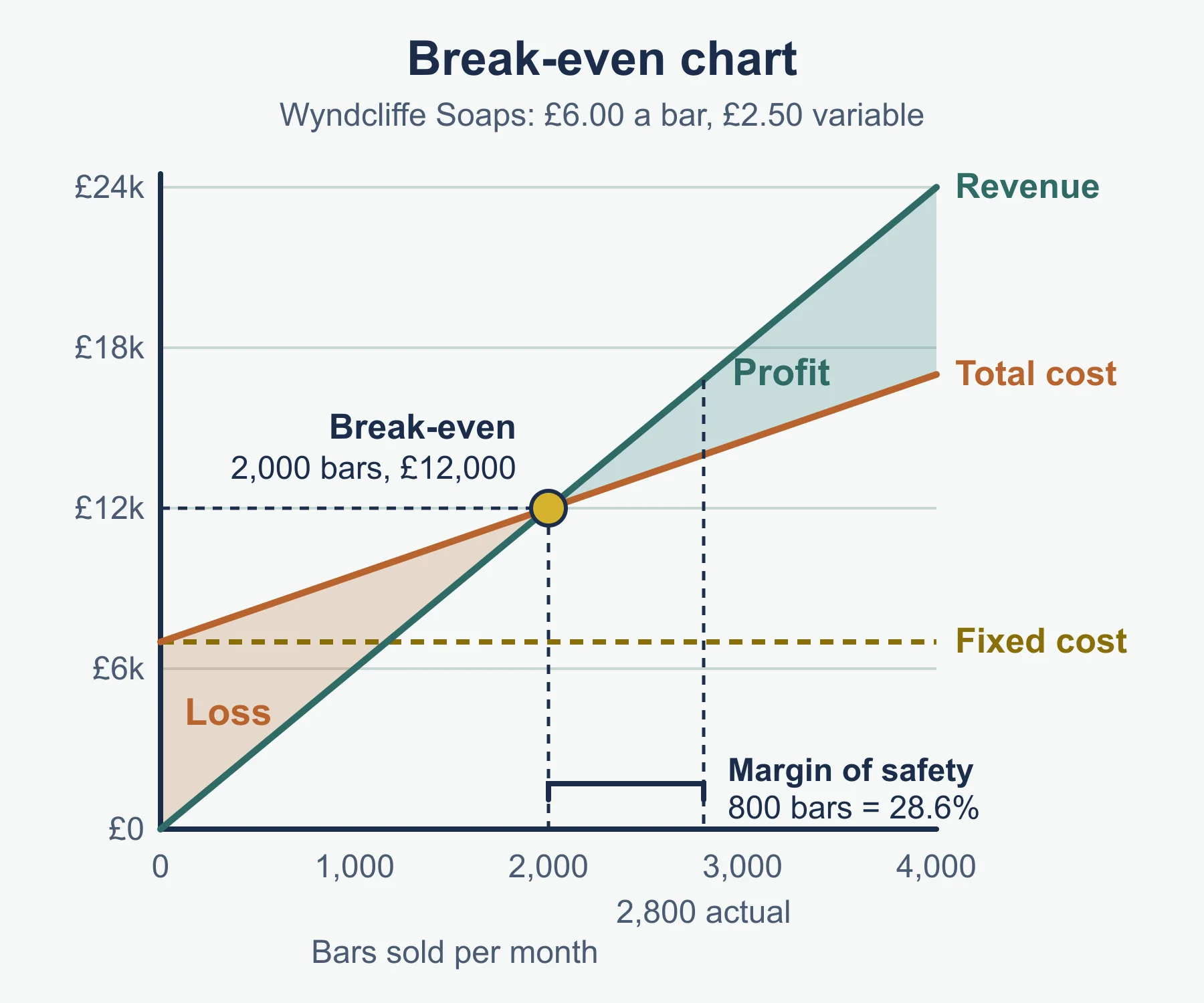
Wyndcliffe Soaps sells bars at £6.00. Variable cost is £2.50 a bar. Fixed costs are £7,000 a month.
- Contribution per bar = £6.00 − £2.50 = £3.50.
- Break-even output = fixed costs ÷ contribution per unit = £7,000 ÷ £3.50 = 2,000 bars. Break-even revenue = 2,000 × £6.00 = £12,000.
- Actual sales are 2,800 bars. Margin of safety = actual − break-even output = 800 bars. As a percentage of actual output: 800 ÷ 2,800 = 28.6%.
- Profit = 2,800 × £3.50 − £7,000 = £2,800.
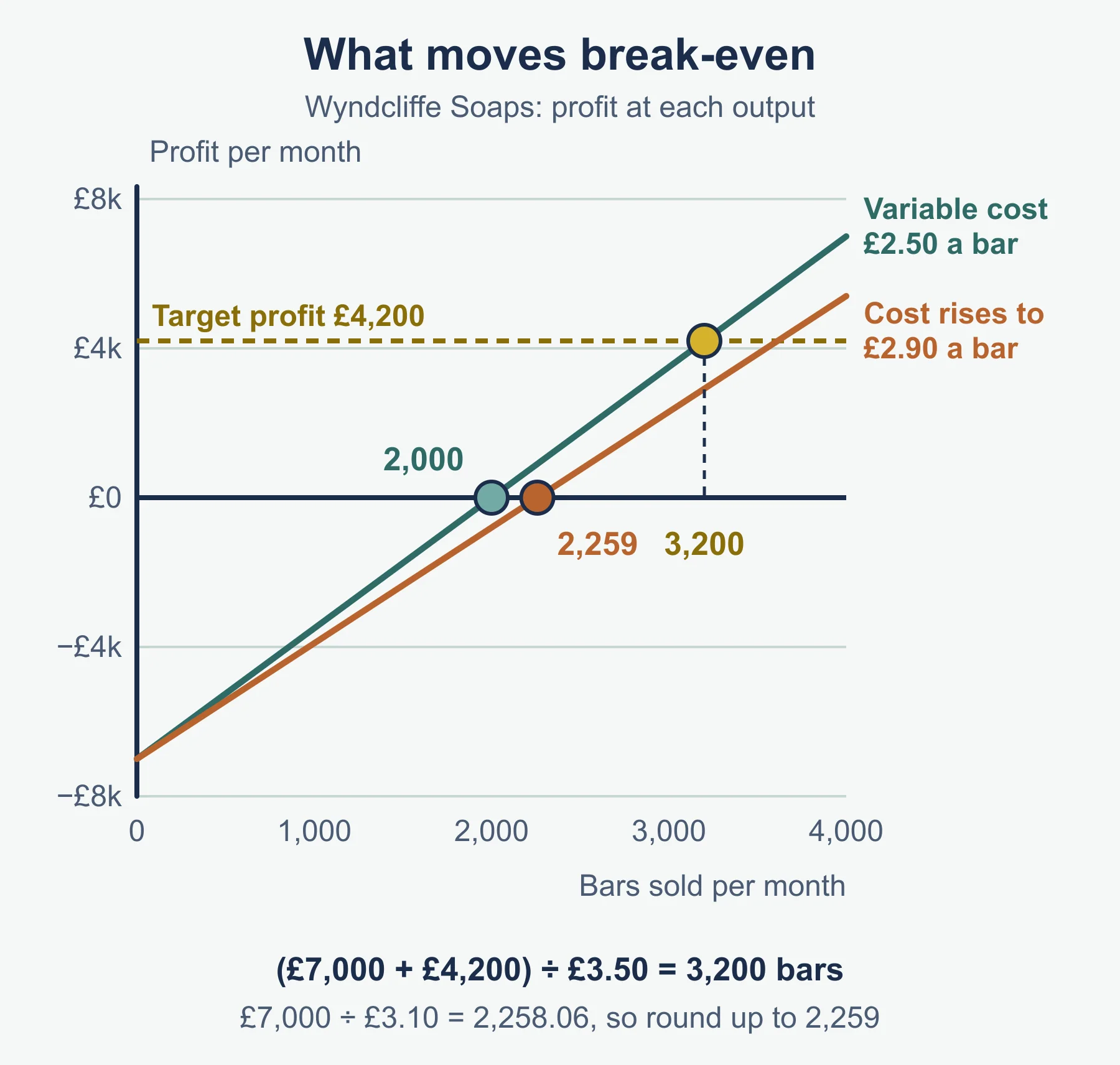
- Output for a target profit of £4,200 = (£7,000 + £4,200) ÷ £3.50 = 3,200 bars.
- If variable cost rises to £2.90, contribution is £3.10 and break-even = £7,000 ÷ £3.10 = 2,258.06. Round up to 2,259 bars.
Break-even chart
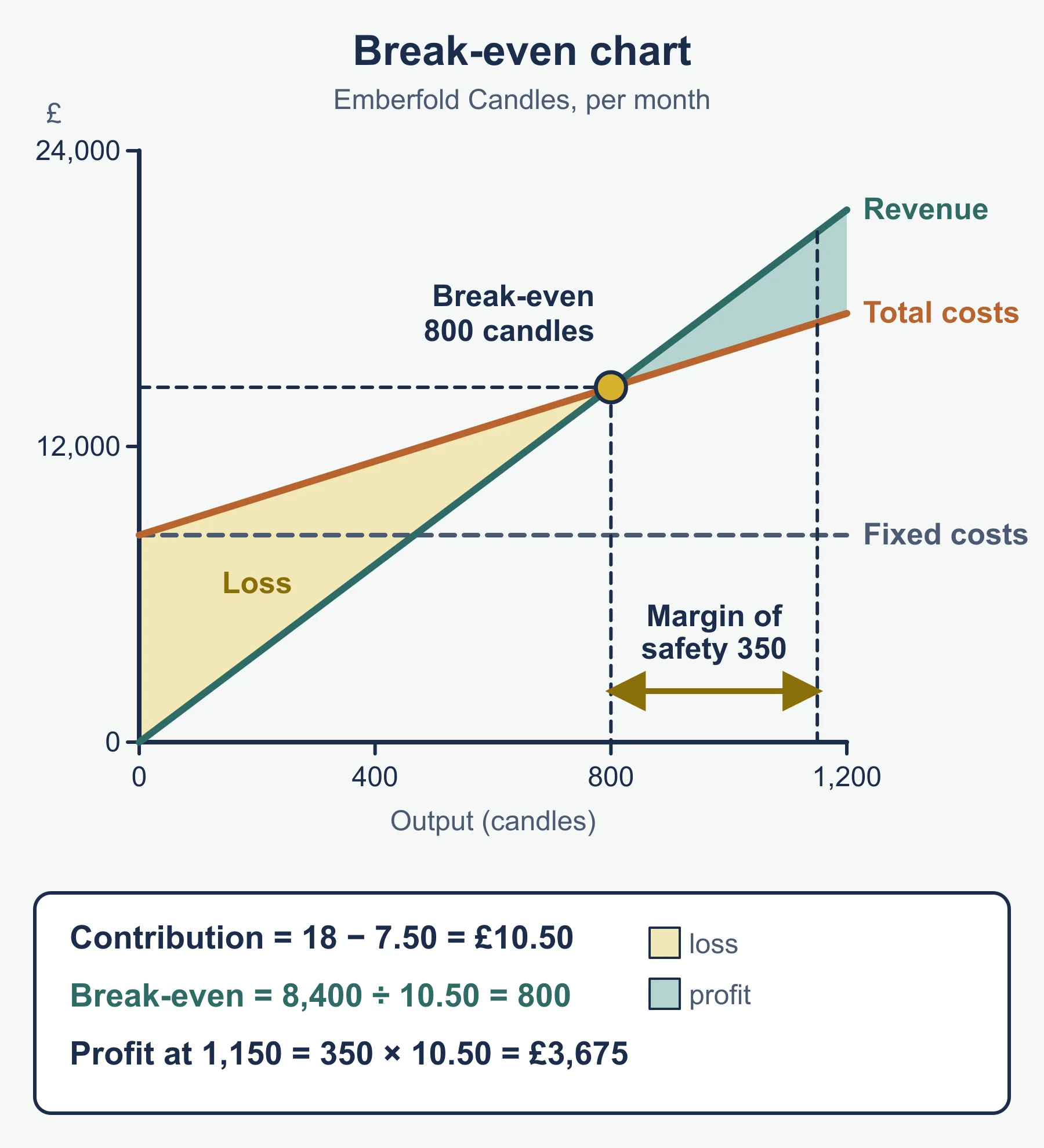
Put output along the bottom and money up the side. The chart has three lines: fixed costs (flat at £7,000), total costs (starts at £7,000 and rises by £2.50 a bar) and total revenue (starts at zero and rises by £6.00 a bar). They cross at break-even.
| Output | Revenue | Total cost | Profit |
|---|---|---|---|
| 0 | £0 | £7,000 | −£7,000 |
| 1,000 | £6,000 | £9,500 | −£3,500 |
| 2,000 | £12,000 | £12,000 | £0 |
| 3,000 | £18,000 | £14,500 | £3,500 |
| 4,000 | £24,000 | £17,000 | £7,000 |
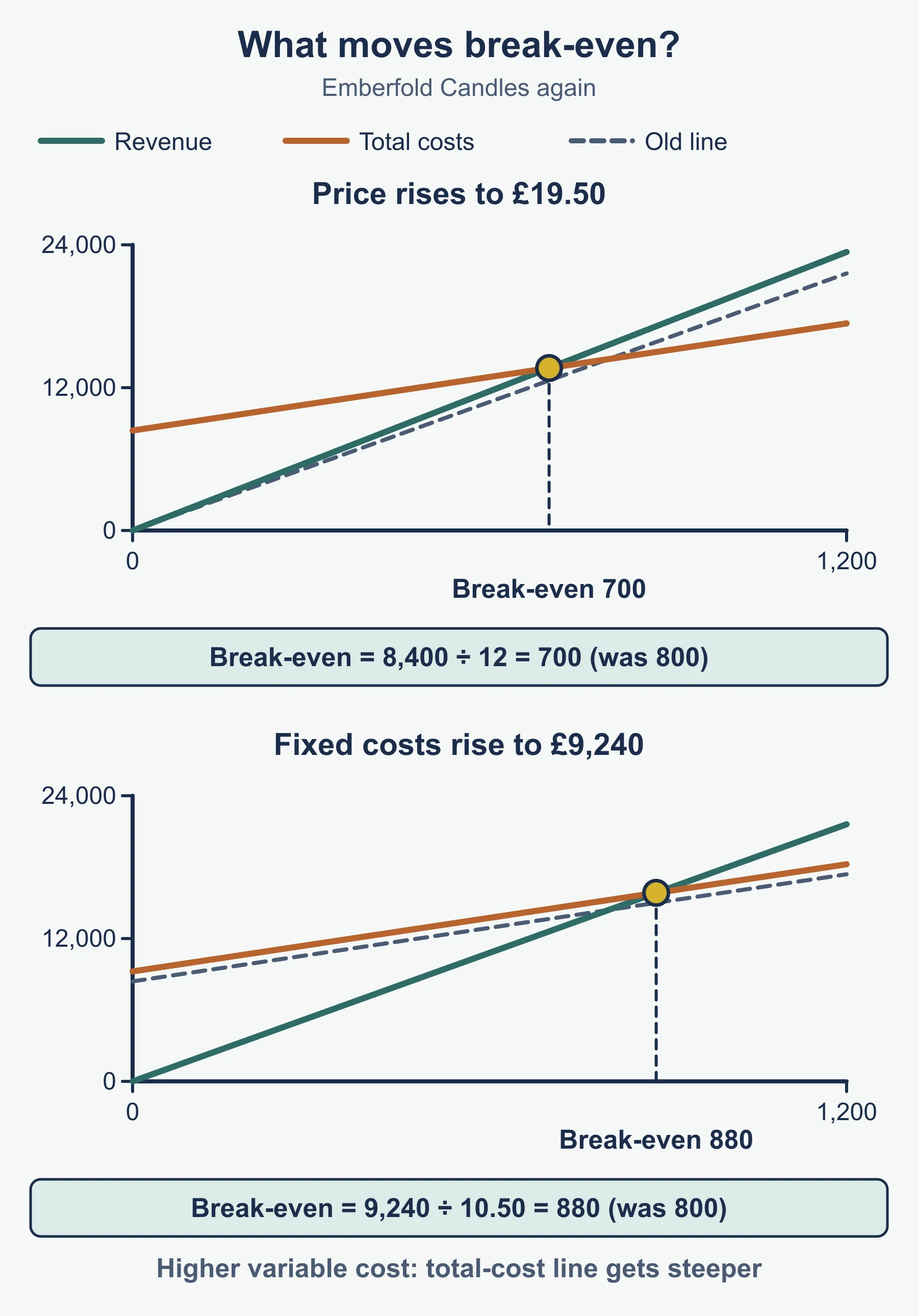
To the left of the crossing the gap between the lines is loss; to the right it is profit. On the chart, the margin of safety is the gap along the output axis between break-even and actual output. Changing price rotates the revenue line; changing fixed costs moves the fixed and total cost lines up or down.
Uses: quick, easy to understand, shows risk, helps set targets and test what-if changes. Limitations: it assumes every unit made is sold, at an unchanged price and an unchanged variable cost per unit. Real firms give discounts, gain bulk-buying savings and sell several products. Fixed costs may step up at higher output.
5.5.1 The meaning and purpose of budgets
A budget sets out planned revenue and costs for a coming period and acts as a target. Budgets are used to:
- allocate resources between departments;
- control and monitor spending by comparing actual results with the plan;
- measure performance, since a department meeting its budget is doing as planned.
Benefits: clear targets, motivation (if staff share in setting them), coordination between departments, and early warning of problems. Drawbacks: they take time to prepare; they can be inaccurate if the forecasts are wrong; managers may focus on meeting budget at the expense of quality or the long term; and rigid budgets can reduce flexibility.
Types of budget
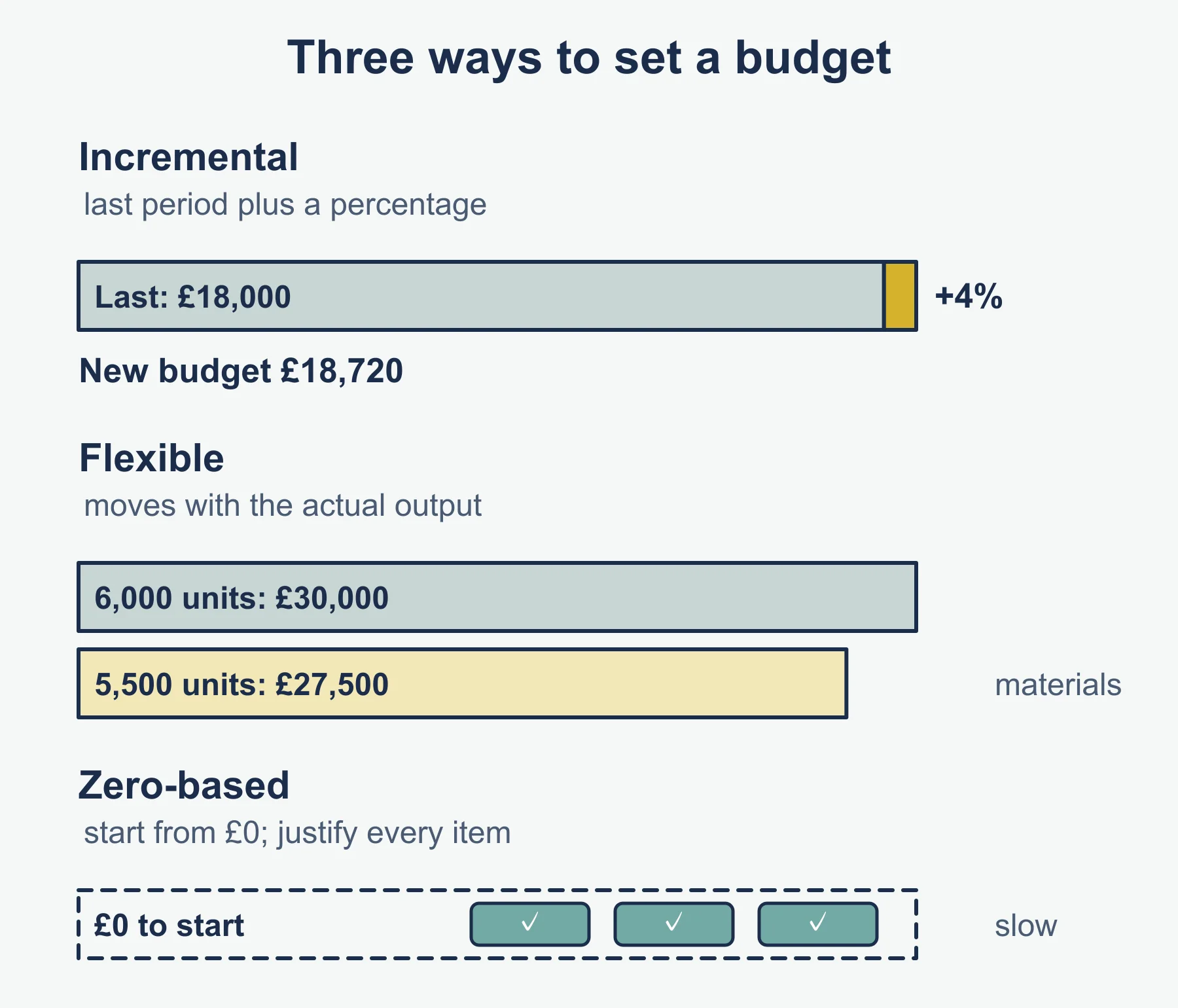
- Incremental budgeting takes last period’s budget and adds or subtracts a percentage. If Kinsley Garden Centre’s labour budget was £18,000 and the new one rises by 4%, it is £18,720. It is simple, but it carries forward old inefficiencies.
- Flexible budgeting adjusts the budget to the actual level of output. Variable cost budgets move with volume; fixed ones do not.
- Zero budgeting starts from £0 each period. Every item must be justified. It forces a full spending review but is slow.
5.5.2 Variances
A variance is the difference between budgeted and actual figures.
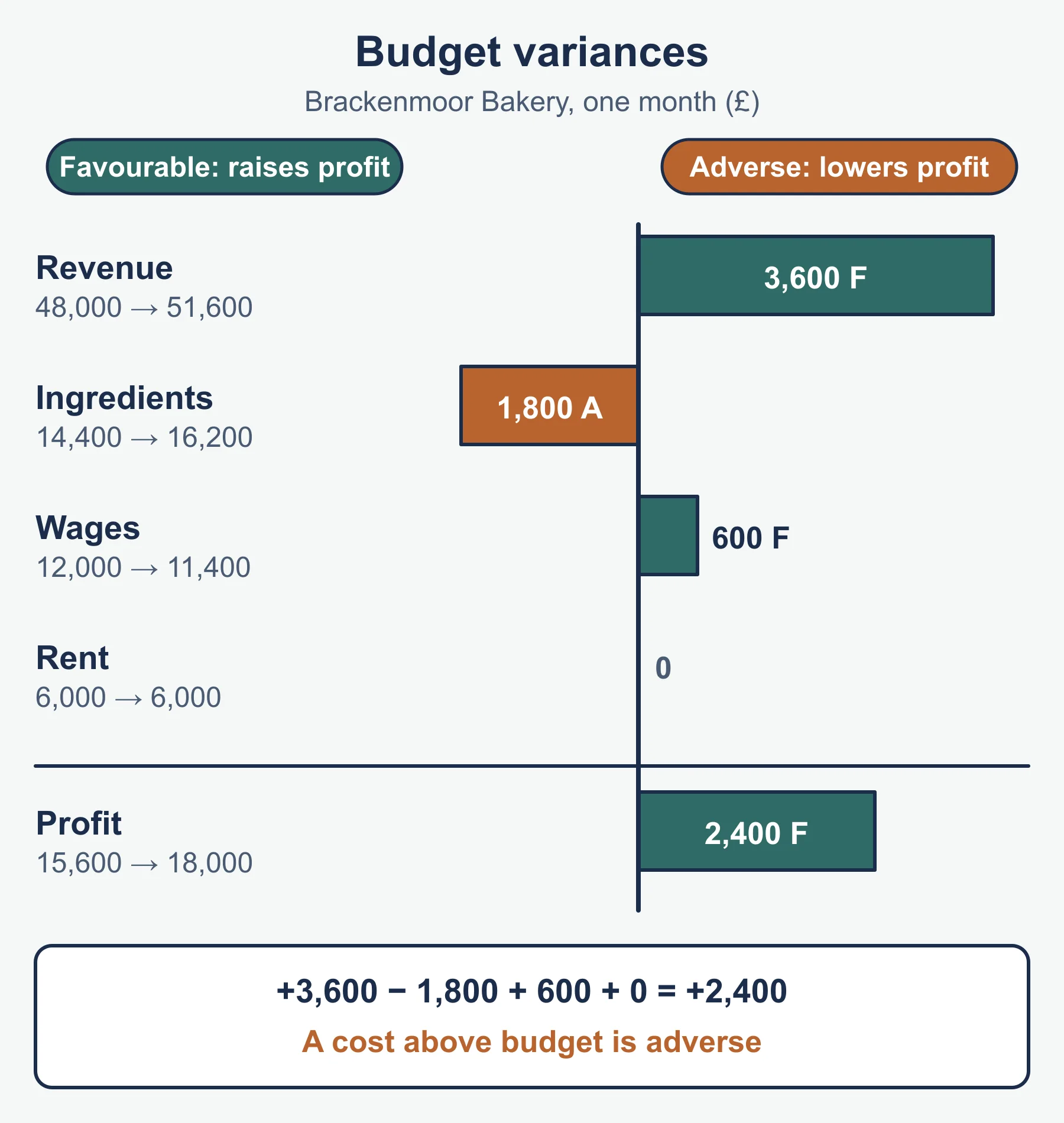
- A favourable variance increases profit (revenue above budget, or costs below budget).
- An adverse variance reduces profit (revenue below budget, or costs above budget).
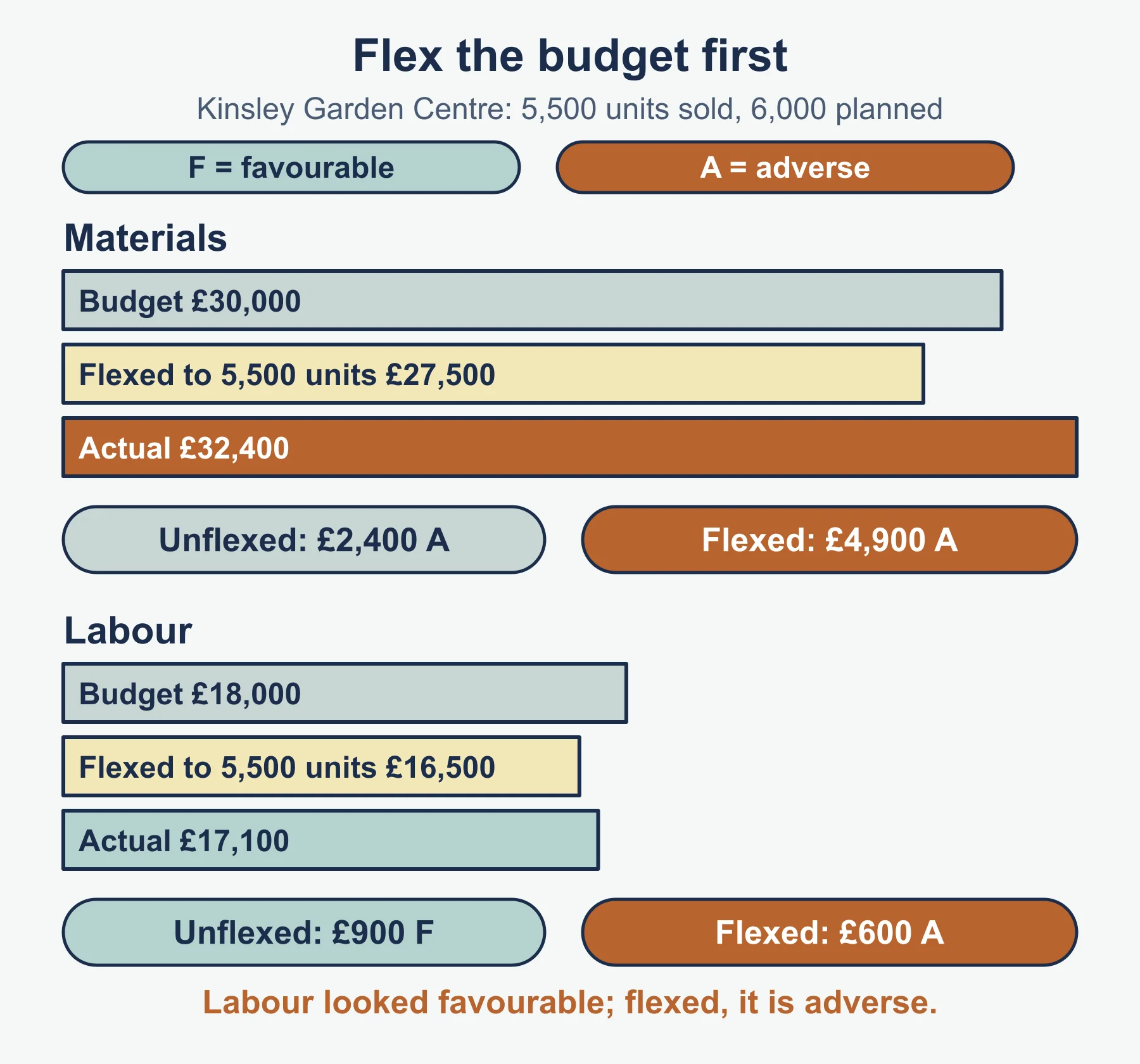
Kinsley Garden Centre budgets for 6,000 units a month; it sells 5,500.
| Item | Budget | Actual | Variance |
|---|---|---|---|
| Sales revenue | £84,000 | £78,500 | £5,500 adverse |
| Materials | £30,000 | £32,400 | £2,400 adverse |
| Labour | £18,000 | £17,100 | £900 favourable |
| Fixed overheads | £20,000 | £20,600 | £600 adverse |
| Profit | £16,000 | £8,400 | £7,600 adverse |
Check: 5,500 + 2,400 − 900 + 600 = £7,600.
Interpretation needs care. Sales volume fell by 500 units, so lower materials and labour bills are expected. Flex the variable budgets to 5,500 units. Materials were £30,000 ÷ 6,000 = £5 per unit, so £27,500 at 5,500 units. Actual £32,400 is £4,900 adverse. Labour was £3 per unit, so £16,500 flexed, and actual £17,100 is £600 adverse, not favourable. The flexed view shows costs were not controlled. Causes could be dearer supplies, waste or overtime.
Common errors
- Calling contribution “profit”, or forgetting to subtract fixed costs.
- Dividing fixed costs by selling price instead of by contribution per unit.
- Giving margin of safety in revenue when units are asked for, or the reverse.
- Giving a variance with no label.
- Comparing actual costs with an unflexed budget when volume has changed.
Frequently asked questions
What is the difference between full costing and contribution costing? Full costing, also called absorption costing, shares all fixed costs between products to give a profit per unit. Contribution costing looks only at variable costs and deducts fixed costs in total.
When should a business accept a special order below full cost? On financial grounds, it can accept if the price is above variable cost and it has spare capacity, because the order adds contribution. Non-financial factors, such as the reaction of regular customers, also need weighing.
What are the limitations of break-even analysis? It assumes all output is sold, that price and variable cost per unit stay constant, and that fixed costs do not step up, and it is based on forecasts for a single product.
What is the difference between a favourable and an adverse variance? A favourable variance increases profit, such as revenue above budget or costs below budget. An adverse variance reduces profit, such as revenue below budget or costs above budget.
Official syllabus
Cambridge International AS & A Level Business 9609 syllabus for examination in 2026, 2027 and 2028, published by Cambridge University Press & Assessment (Cambridge International), sections 5.4 and 5.5.
Get free revision emails (optional)
Occasional emails with practice questions, worked explanations and links to free resources for the qualification and subjects you choose. No spam, and you can unsubscribe from any email. The free tools on this site never need an email.
Related resources
-
Practice questions
A Level Business: Costs and Budgets (Cambridge 9609) – Practice Questions
Original practice questions with worked answers on 5.4 Costs and 5.5 Budgets for Cambridge AS & A Level Business 9609: short, calculation, case study.
Business · Cambridge · AS Level
Try questions -
Revision notes
A Level Business: Costs and Budgets (Cambridge 9609) – Revision Notes
Condensed revision notes for 5.4 Costs and 5.5 Budgets in Cambridge AS & A Level Business 9609: definitions, formulas, methods and a self-test.
Business · Cambridge · AS Level
Revise topic -
Study guides
A Level Business: Financial statements and Analysis of published accounts (Cambridge 9609)
Study guide to financial statements, depreciation, inventory valuation and ratio analysis for Cambridge A Level Business 9609, with worked examples.
Business · Cambridge · A Level
Read guide
Related articles
-
teaching
A Level tuition in Dubai: Cambridge or Pearson Edexcel International A Level?
Schools in Dubai and Abu Dhabi teach either Cambridge International AS & A Level or Pearson Edexcel International A Level. How the two are structured, why it matters for tuition, and how online classes from Lahore work.
9 October 2026
-
curriculum guides
Choosing subjects at IGCSE and A Level
How subject choices at 14 and 16 affect university options later, and how to keep pathways open without overloading a timetable.
28 July 2026
Studying this with a teacher
Working through Business AS LEVEL?
This page is free and stays free. If you would rather be taught it, Marlbridge runs Business classes one-to-one and in small groups of up to 15, online in your own time zone. The first trial class is free. WhatsApp replies within an hour (8am–11pm Pakistan time, every day); email the same day.
Cambridge Business teachers at Marlbridge

