
Revision Notes
A Level Business: Forecasting and managing cash flows (Cambridge 9609) – Revision Notes
Condensed revision notes for 5.3 Forecasting and managing cash flows in Cambridge AS & A Level Business 9609, with a self-test and common mark losses.
- Subject
- Business
- Level
- AS LEVEL
- Topic
- Finance and accounting
- Author
- Marlbridge Academic Team
- Updated
- Reviewed by
- Salman Ahmad (what this means)
Aligned to Cambridge A Level Business (9609), For examination in 2026, 2027 and 2028. Official specification .
Syllabus page (what it covers and how it is assessed): Cambridge A Level Business.
Syllabus points this page covers
9609 (AS Level)
- 5.3 Forecasting and managing cash flows
Found an error? Report a correction.
Need help with this topic? Request a free trial class for A Level Business (9609).
These are condensed notes for section 5.3 Forecasting and managing cash flows (5.3.1) of the Cambridge International AS & A Level Business 9609 syllabus for examination in 2026, 2027 and 2028, an AS Level topic that A Level candidates also study. For full explanations and worked examples, read the study guide. Then try the practice questions. Course links: the Cambridge A Level Business hub, the checklist and the free diagnostics.
Definitions
| Term | Meaning |
|---|---|
| Cash flow forecast | An estimate of the cash a business expects to receive and pay out in future periods, with the expected balance at the end of each |
| Cash inflow | Cash coming in, such as cash sales, customer payments, loans, owner investment, asset sales |
| Cash outflow | Cash going out, such as materials, wages, rent, equipment, loan repayments |
| Net cash flow | Total inflows minus total outflows for the period |
| Opening balance | Cash at the start of the period |
| Closing balance | Cash at the end of the period |
| Trade receivables | Customers who owe the business for goods or services sold on credit |
| Trade payables | Suppliers the business owes for goods or services bought on credit |
The syllabus does not print the balance formulae. These are the standard forms.
| Calculation | Formula |
|---|---|
| Net cash flow | Total cash inflows − total cash outflows |
| Closing balance | Opening balance + net cash flow |
| Next month’s opening balance | This month’s closing balance |
Purposes of a forecast
- Shows shortfalls early, so finance can be arranged in advance.
- Supports requests to lenders and investors.
- Helps time large purchases.
- Gives a standard to compare actual cash with.
- Helps a start-up work out how much finance it needs.
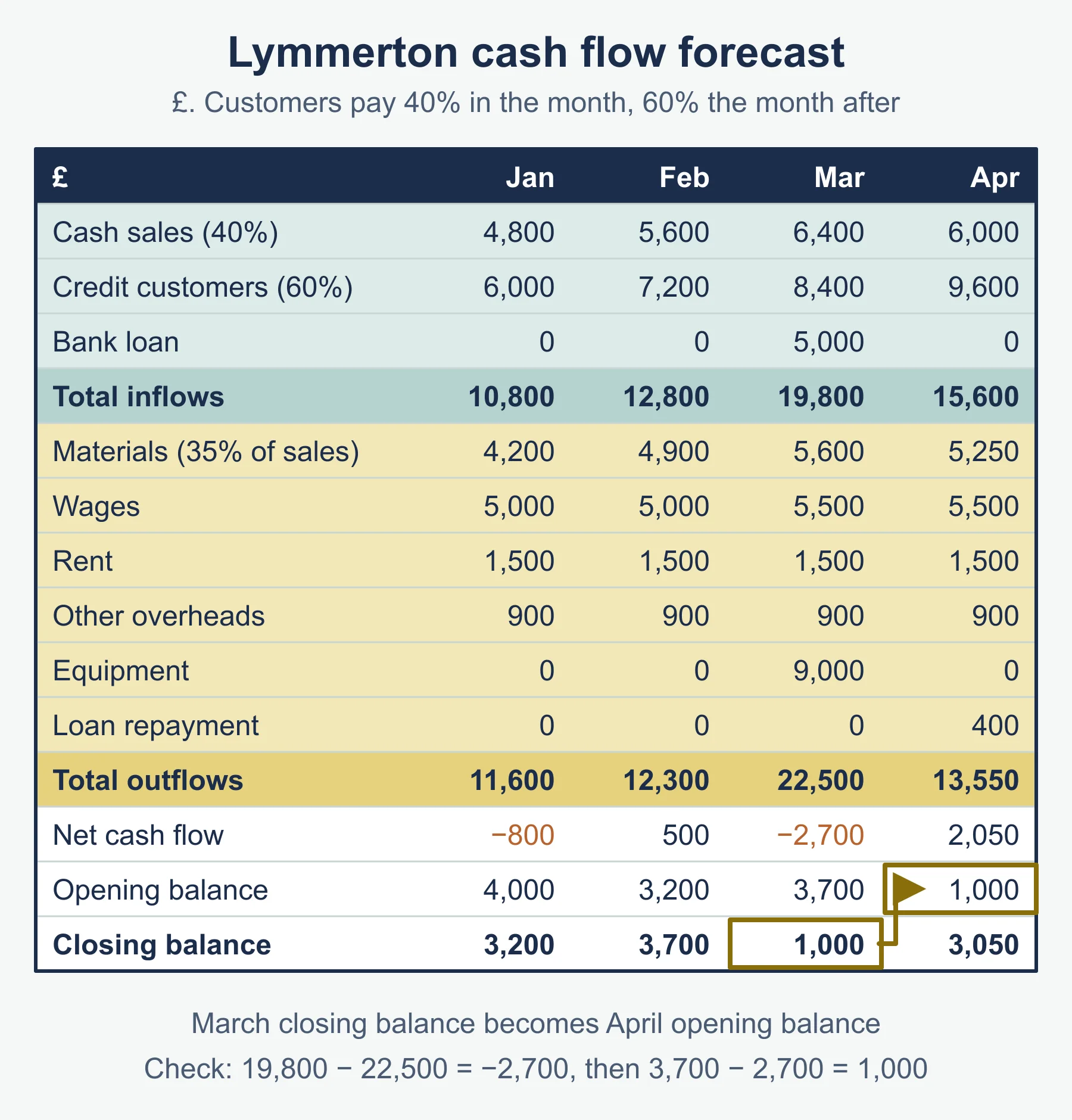
Method: building or completing a forecast
- List the inflows month by month. Put credit sales in the month the customer pays, not the month of sale.
- List the outflows. Put purchases in the month they are paid.
- Leave out non-cash items such as depreciation.
- Total inflows and total outflows for each month.
- Net cash flow = inflows − outflows.
- Closing balance = opening balance + net cash flow.
- Carry the closing balance to the next month as the opening balance.
- Check each month by working back from the final closing balance.
Worked reminder: Dormer Toys
Dormer Toys opens September with £2,500.
| £ | Sep | Oct | Nov |
|---|---|---|---|
| Total inflows | 6,800 | 7,400 | 9,900 |
| Total outflows | 7,300 | 8,900 | 8,200 |
| Net cash flow | −500 | −1,500 | 1,700 |
| Opening balance | 2,500 | 2,000 | 500 |
| Closing balance | 2,000 | 500 | 2,200 |
Reading it: the lowest balance is £500 at the end of October. Two months of negative net cash flow have used up most of the cash. The recovery in November depends on inflows of £9,900 actually arriving.
Interpreting a forecast
Look at four things.
- Lowest balance and when it happens.
- Cause of any deficit: one-off item, seasonal pattern or a weak trend.
- Whether the balance is big enough to cover normal outflows.
- How reliable the assumptions are.
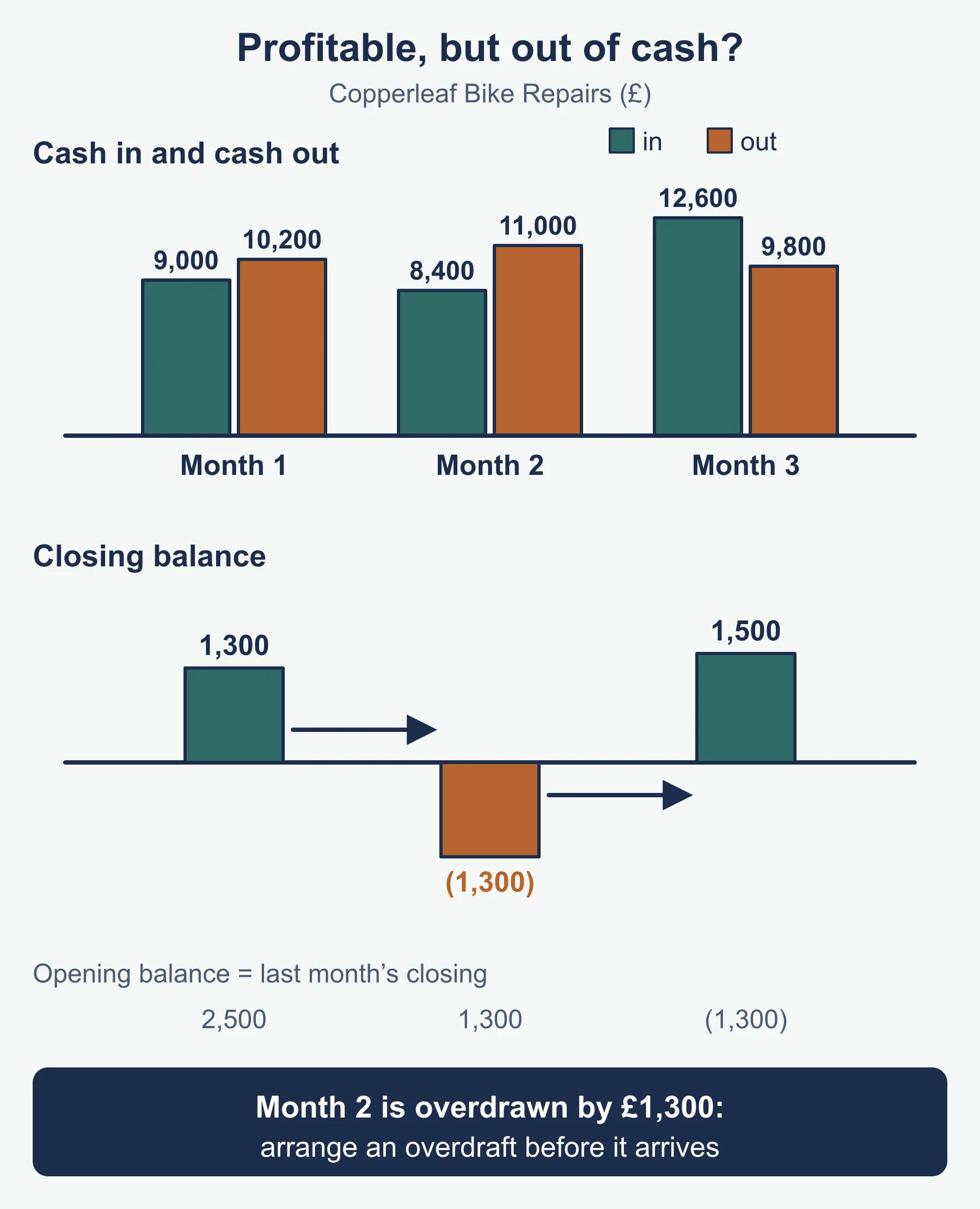
A negative closing balance means the business expects to be overdrawn or without cash unless it finds finance. A very large positive balance may mean cash is not being used well.
Amending a forecast
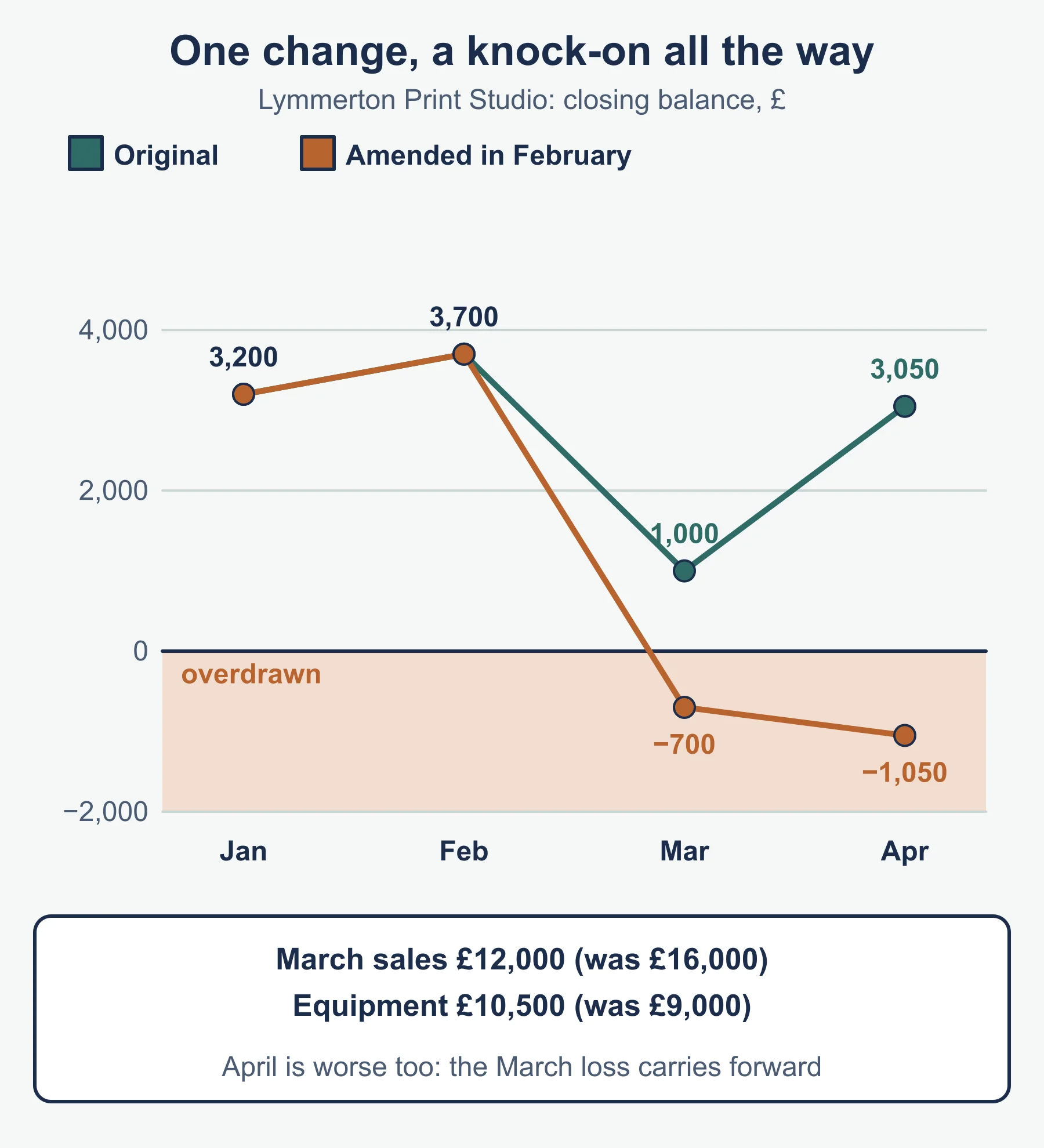
- Change only the lines affected, then recalculate totals.
- Carry the new closing balance forward. Every later opening balance changes.
- Delays in customer payment move cash into a later month. They do not remove it.
- State the effect on the lowest balance and the action needed.
Example: if Dormer’s October inflows fall by £1,000 because a customer pays in November, October closing becomes −£500 and November closing is £2,200 only if November also gains the £1,000. The total over the quarter is unchanged, but the business is overdrawn in between.
Limitations of forecasts
- Based on sales estimates, which are uncertain, especially for a new business.
- Costs and supplier terms can change.
- Customers may pay late or default.
- Managers can be over-optimistic.
- Events outside the business, such as a new competitor, can outdate it.
- Needs regular updating to stay useful.
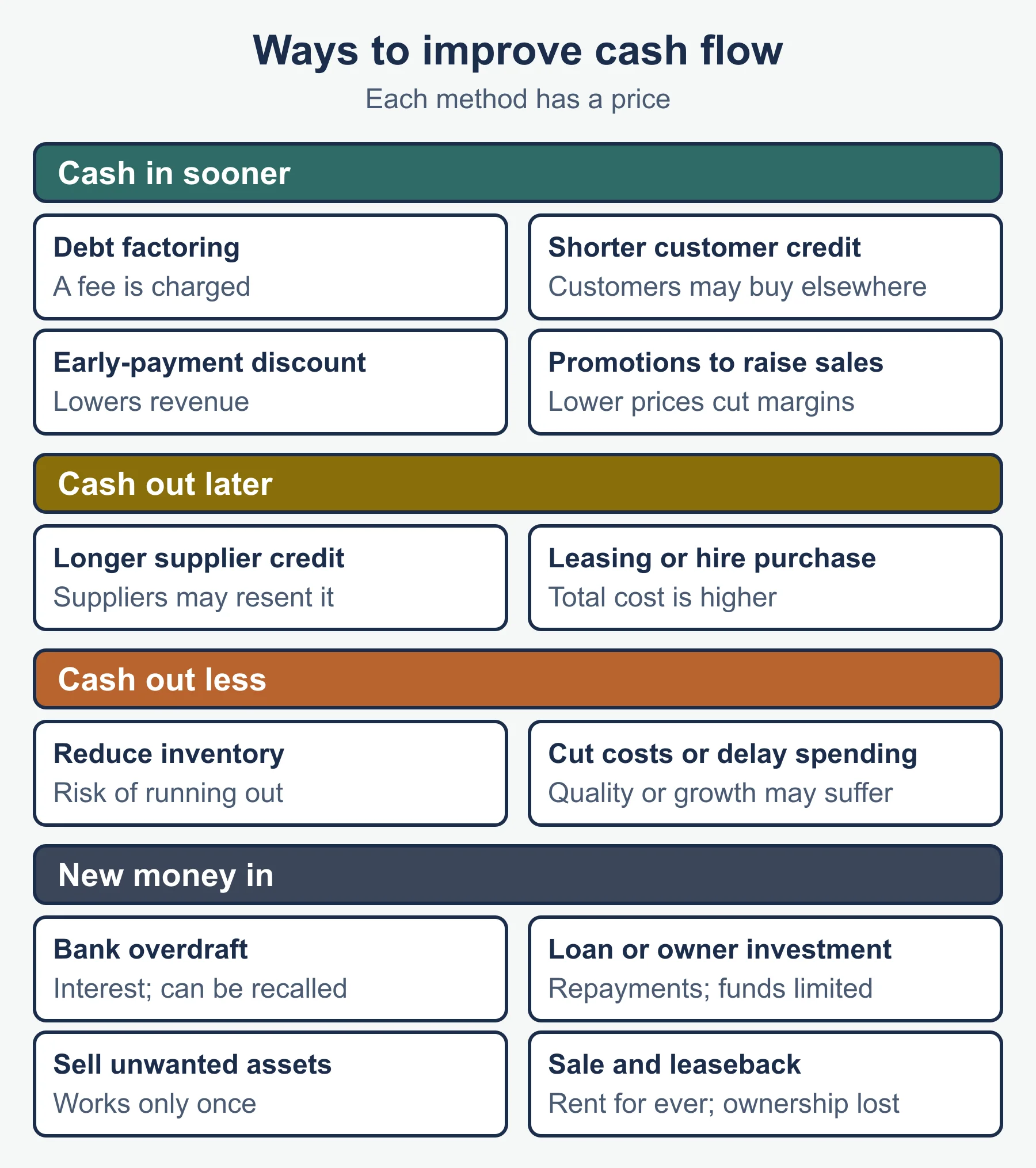
Methods of improving cash flow
| Aim | Methods |
|---|---|
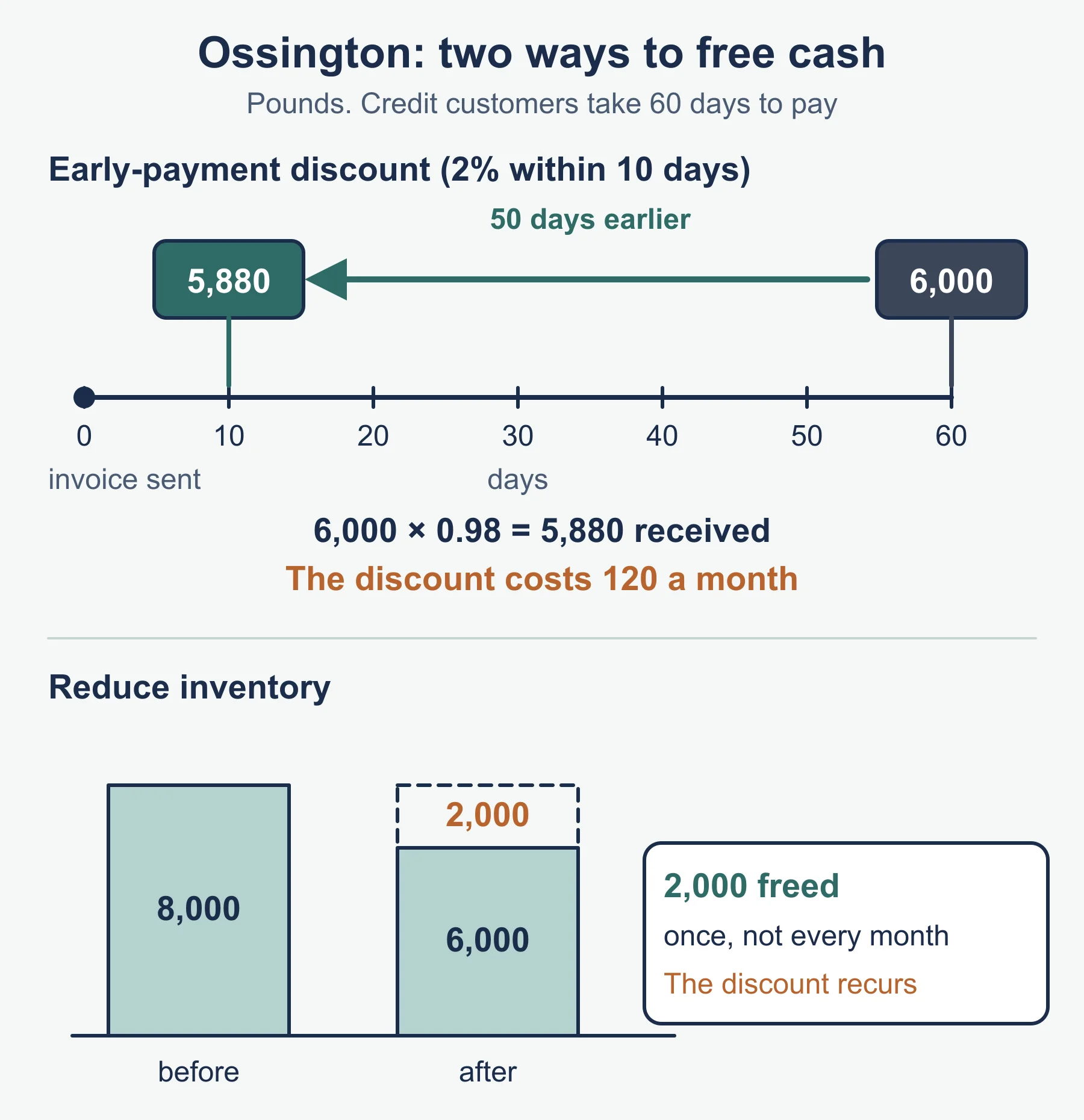
| Bring cash in sooner | Reduce credit period for customers; early-payment discount; debt factoring; promotions; bank overdraft; bank loan; owner investment |
| Raise cash from assets | Sell unwanted assets; sale and leaseback of non-current assets |
| Delay cash going out | Longer credit from suppliers; leasing or hire purchase instead of buying; delay capital spending |
| Reduce cash going out | Cut costs; lower inventory |
Drawbacks to quote
| Method | Drawback |
|---|---|
| Overdraft | Interest; can be recalled; not for long-term need |
| Loan | Interest and repayments |
| Sell assets | One-off; may lose useful assets |
| Sale and leaseback | Ongoing rent; ownership lost |
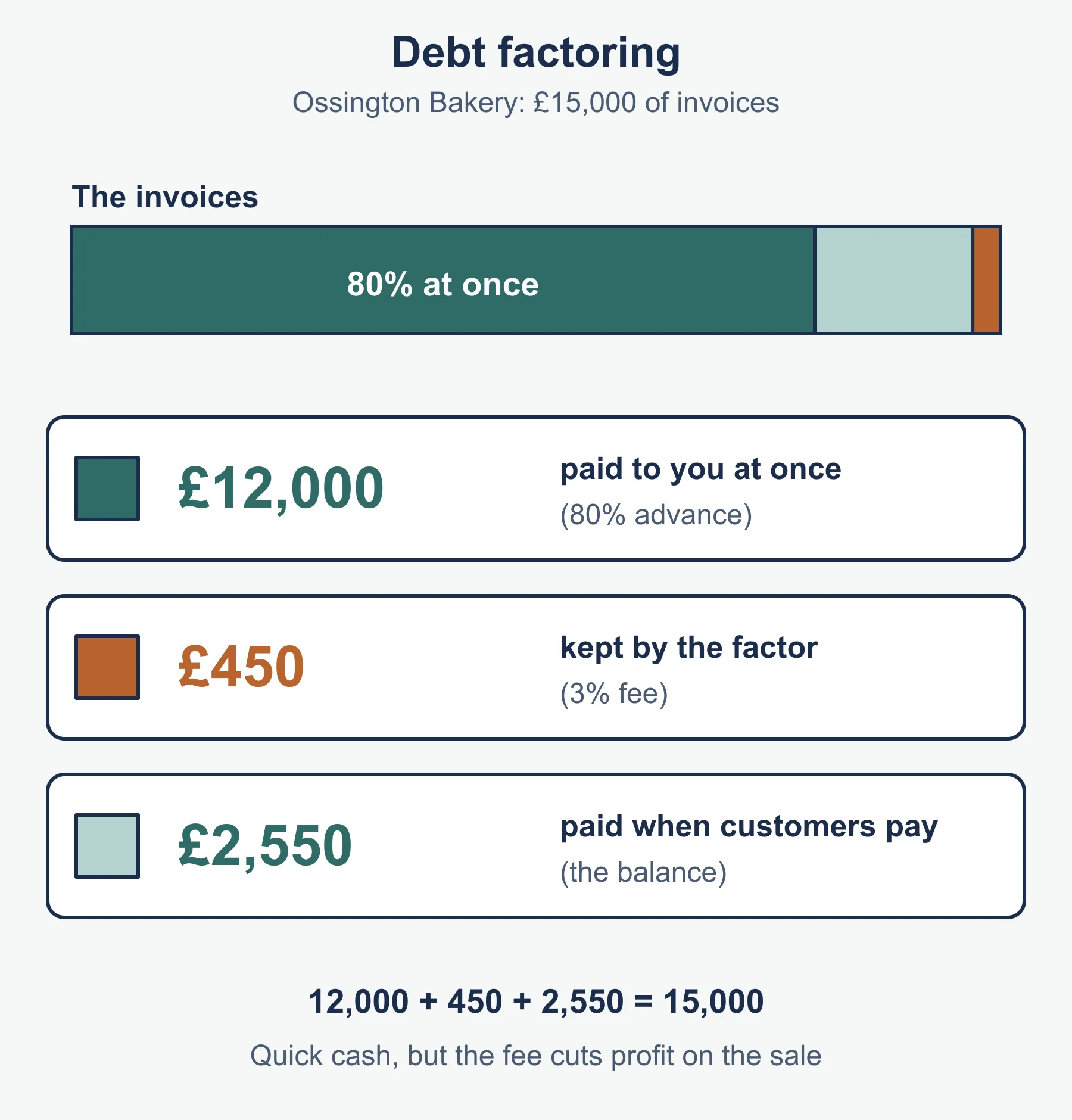
| Debt factoring | Fee; customers deal with the factor |
| Shorter credit to customers | Customers may go elsewhere |
| Early-payment discount | Revenue reduced |
| Longer supplier credit | Supplier relations; lost discounts |
| Lower inventory | Stock-outs and lost sales |
| Leasing or hire purchase | Higher total cost |
| Cut costs | Quality or growth may suffer |
Must-know distinctions
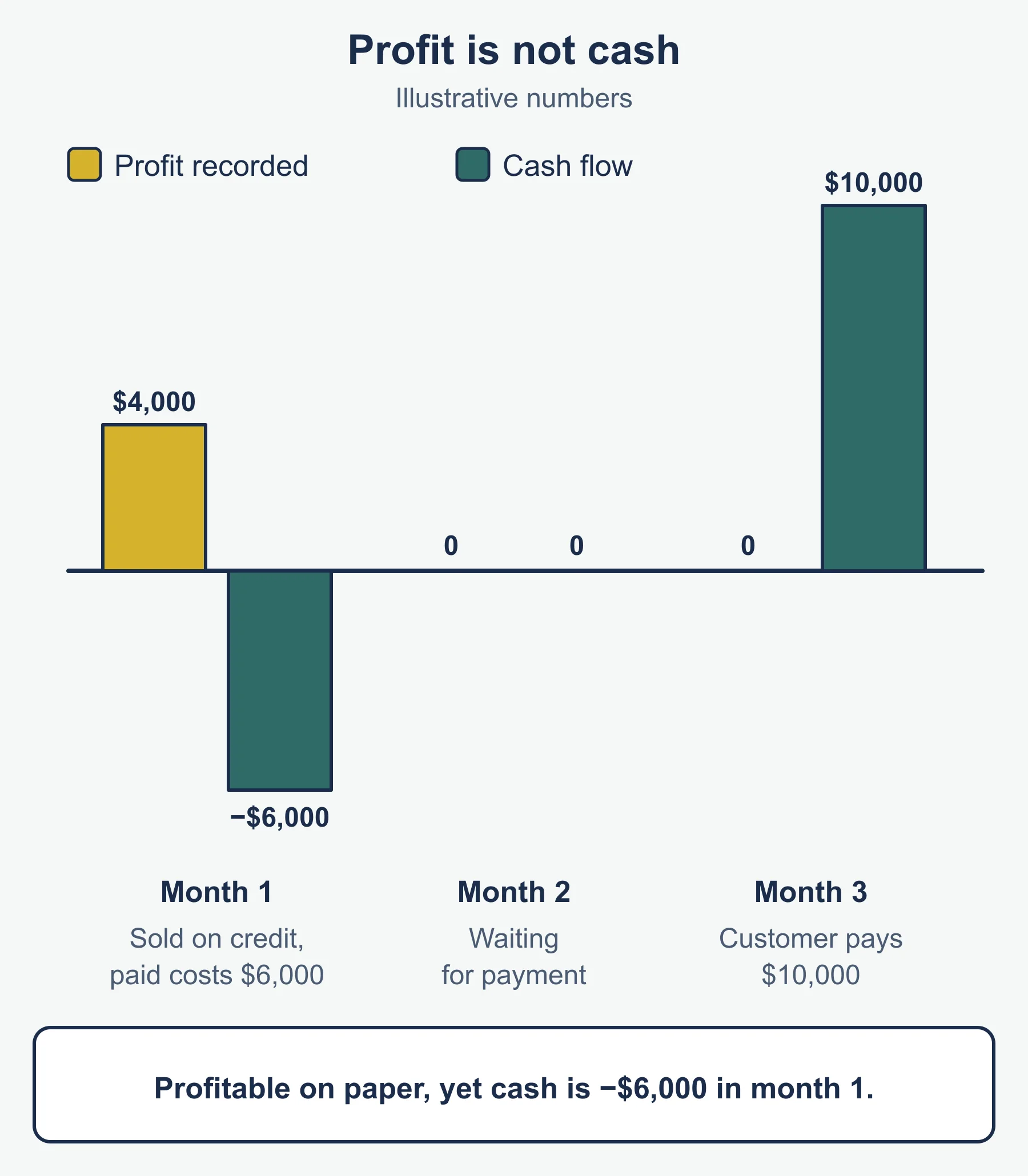
- Cash and profit: profit counts a sale when it is made, cash counts it when money moves. A profitable business can run out of cash.
- Cash flow and working capital: working capital (standard form: current assets less current liabilities) is a position at a point in time. Cash flow is the movement of cash over a period.
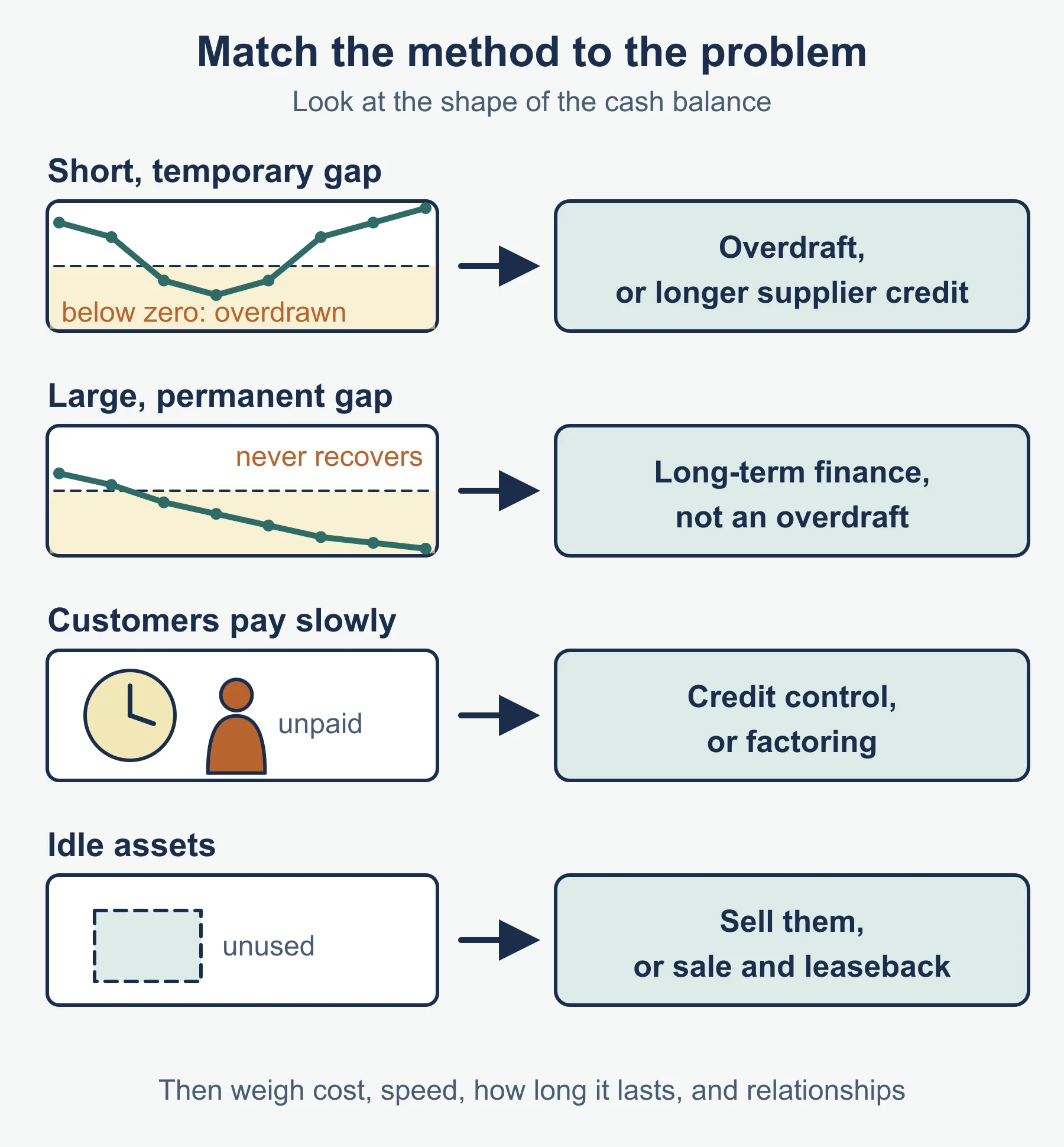
- Short-term and long-term fixes: overdrafts and supplier credit suit short gaps. Loans and owner investment suit longer ones.
- One-off and repeating effects: selling an asset or cutting stock helps once. Faster collection of payments helps again and again.
- Analysis and evaluation: analysis links a cause to a result. Evaluation weighs options against the case and reaches a judgement.
Quick self-test
- Define a cash flow forecast.
- Write the formula for a closing balance.
- A business has an opening balance of £1,200, inflows of £5,400 and outflows of £6,100. What is the closing balance?
- A closing balance in March is −£300 and April net cash flow is £900. What is the April closing balance?
- Why is a credit sale not a cash inflow in the month of sale?
- State two purposes of a cash flow forecast.
- Half of March sales of £8,000 are paid for in April. What April cash receipt does this give?
- State two methods that bring cash in sooner.
- State one risk of delaying payments to suppliers.
- Opening balance £3,500, closing balance £2,000. What was the net cash flow?
- A factor advances 80% of £10,000 of invoices and charges a 2% fee on the invoice value. How much is the advance, the fee and the balance later paid to the business?
- Why does depreciation not appear in a cash flow forecast?
Answers
- An estimate of expected cash inflows and outflows for future periods, showing the expected cash balance at the end of each.
- Closing balance = opening balance + net cash flow.
- 1,200 + 5,400 − 6,100 = £500.
- −300 + 900 = £600.
- The customer has not paid yet, so no cash has moved.
- Any two: spot shortfalls early; support a finance request; plan the timing of spending; compare actual cash with the plan.
- 50% of £8,000 = £4,000.
- Any two: shorter customer credit; early-payment discount; debt factoring; overdraft; sale and leaseback.
- Suppliers may withdraw credit, charge more or refuse future orders.
- 2,000 − 3,500 = −£1,500.
- Advance £8,000; fee £200; balance 10,000 − 8,000 − 200 = £1,800.
- It is an accounting entry that spreads the cost of an asset over time. No cash leaves the business when depreciation is recorded.
Using this in the exam
The syllabus says Paper 1 Section A has four compulsory five-mark questions, and Paper 2 has two data response questions of six parts each, with evaluation expected in the last part. Both papers test AS content, and Papers 3 and 4 assume it.
- Short questions: define, then develop with a consequence.
- Calculations: show every line and carry balances forward.
- Longer answers: apply each point to the business in the stem, weigh the options, and end with a justified judgement.
Where marks are usually lost
- Putting credit sales in the month of sale instead of the month of payment.
- Including depreciation or profit as if they were cash movements.
- Failing to carry the closing balance forward as the next opening balance.
- Getting the sign wrong on a negative balance.
- Stopping at “cash flow improves” without saying why or how.
- Recommending a long-term fix for a short gap, or the reverse.
- Listing methods without applying them to the business in the case.
- Ignoring the drawbacks, so an evaluation is one-sided.
- Mixing up cash flow with profit or with working capital.
Frequently asked questions
How do you calculate a closing balance in a cash flow forecast? Closing balance equals opening balance plus net cash flow, where net cash flow is total inflows minus total outflows. That closing balance becomes the next month’s opening balance.
Why does depreciation not appear in a cash flow forecast? Depreciation is an accounting entry that spreads the cost of an asset over time. No cash leaves the business when it is charged, so it is left out of the forecast.
What are the limitations of cash flow forecasts? They rely on uncertain sales estimates, costs and supplier terms can change, customers may pay late or default, managers can be over-optimistic, and unexpected events can make them out of date.
What is the difference between cash flow and profit? Profit counts a sale when it is made. Cash flow counts it only when the money actually moves, so a business can be profitable while short of cash.
Official syllabus
Cambridge International AS & A Level Business 9609 syllabus for examination in 2026, 2027 and 2028, published by Cambridge University Press & Assessment, section 5.3 Forecasting and managing cash flows.
Get free revision emails (optional)
Occasional emails with practice questions, worked explanations and links to free resources for the qualification and subjects you choose. No spam, and you can unsubscribe from any email. The free tools on this site never need an email.
Related resources
-
Study guides
A Level Business: Investment appraisal and Finance and accounting strategy (Cambridge 9609)
Study guide to payback, ARR, NPV, investment decisions and using accounting data and ratios in strategy, for Cambridge A Level Business 9609.
Business · Cambridge · A Level
Read guide -
Practice questions
A Level Business: Investment appraisal and accounting strategy (Cambridge 9609) – Practice Questions
Original practice questions with worked answers on payback, ARR, NPV, investment decisions and ratio-based strategy for Cambridge A Level Business 9609.
Business · Cambridge · A Level
Try questions -
Revision notes
A Level Business: Investment appraisal and Finance and accounting strategy (Cambridge 9609) – Revision Notes
Condensed revision notes on payback, ARR, NPV, appraisal decisions and ratio-based finance strategy for Cambridge A Level Business 9609.
Business · Cambridge · A Level
Revise topic
Related articles
-
teaching
A Level tuition in Dubai: Cambridge or Pearson Edexcel International A Level?
Schools in Dubai and Abu Dhabi teach either Cambridge International AS & A Level or Pearson Edexcel International A Level. How the two are structured, why it matters for tuition, and how online classes from Lahore work.
9 October 2026
-
curriculum guides
Choosing subjects at IGCSE and A Level
How subject choices at 14 and 16 affect university options later, and how to keep pathways open without overloading a timetable.
28 July 2026
Studying this with a teacher
Working through Business AS LEVEL?
This page is free and stays free. If you would rather be taught it, Marlbridge runs Business classes one-to-one and in small groups of up to 15, online in your own time zone. The first trial class is free. WhatsApp replies within an hour (8am–11pm Pakistan time, every day); email the same day.
Cambridge Business teachers at Marlbridge

