
Study Guides
A Level Business: Investment appraisal and Finance and accounting strategy (Cambridge 9609)
Study guide to payback, ARR, NPV, investment decisions and using accounting data and ratios in strategy, for Cambridge A Level Business 9609.
- Subject
- Business
- Level
- A LEVEL
- Topic
- Finance and accounting
- Author
- Marlbridge Academic Team
- Updated
- Reviewed by
- Salman Ahmad (what this means)
Aligned to Cambridge A Level Business (9609), For examination in 2026, 2027 and 2028. Official specification .
Syllabus page (what it covers and how it is assessed): Cambridge A Level Business.
Syllabus points this page covers
9609 (A Level)
- 10.3 Investment appraisal
- 10.4 Finance and accounting strategy
Found an error? Report a correction.
Need help with this topic? Request a free trial class for A Level Business (9609).
This guide follows the Cambridge International AS & A Level Business 9609 syllabus for examination in 2026, 2027 and 2028. It covers sections 10.3 Investment appraisal and 10.4 Finance and accounting strategy, which are A Level content. All businesses and figures are invented and money is in pounds. Condensed recall is in the revision notes and exam-style questions are in the practice set. Course links: the Cambridge A Level Business hub, the checklist and the free diagnostics. For earlier ratio and appraisal drills, see Finance and Accounting (A Level) practice.
What this unit covers
| Section | What you must be able to do |
|---|---|
| 10.3.1 | Explain the need for investment appraisal |
| 10.3.2 | Explain, calculate and interpret payback and ARR |
| 10.3.3 | Explain, calculate and interpret net present value (NPV) |
| 10.3.4 | Weigh quantitative results, qualitative factors, and compare methods and their limitations |
| 10.4.1 | Use financial statements in developing strategies; describe the contents and usefulness of an annual report |
| 10.4.2 | Use accounting data and ratios to judge performance, and explain how strategies change ratio results |
10.3.1 The need for investment appraisal
Investment appraisal is the process of assessing whether a proposed project, such as new equipment or a new site, is worth its cost. It is needed because capital spending is large, usually hard to reverse and pays back over several years. Appraisal lets a business compare projects that compete for limited funds, check each against its objectives and expose how much depends on forecasts. It does not remove risk. It makes the assumptions visible.
10.3.2 Payback and ARR
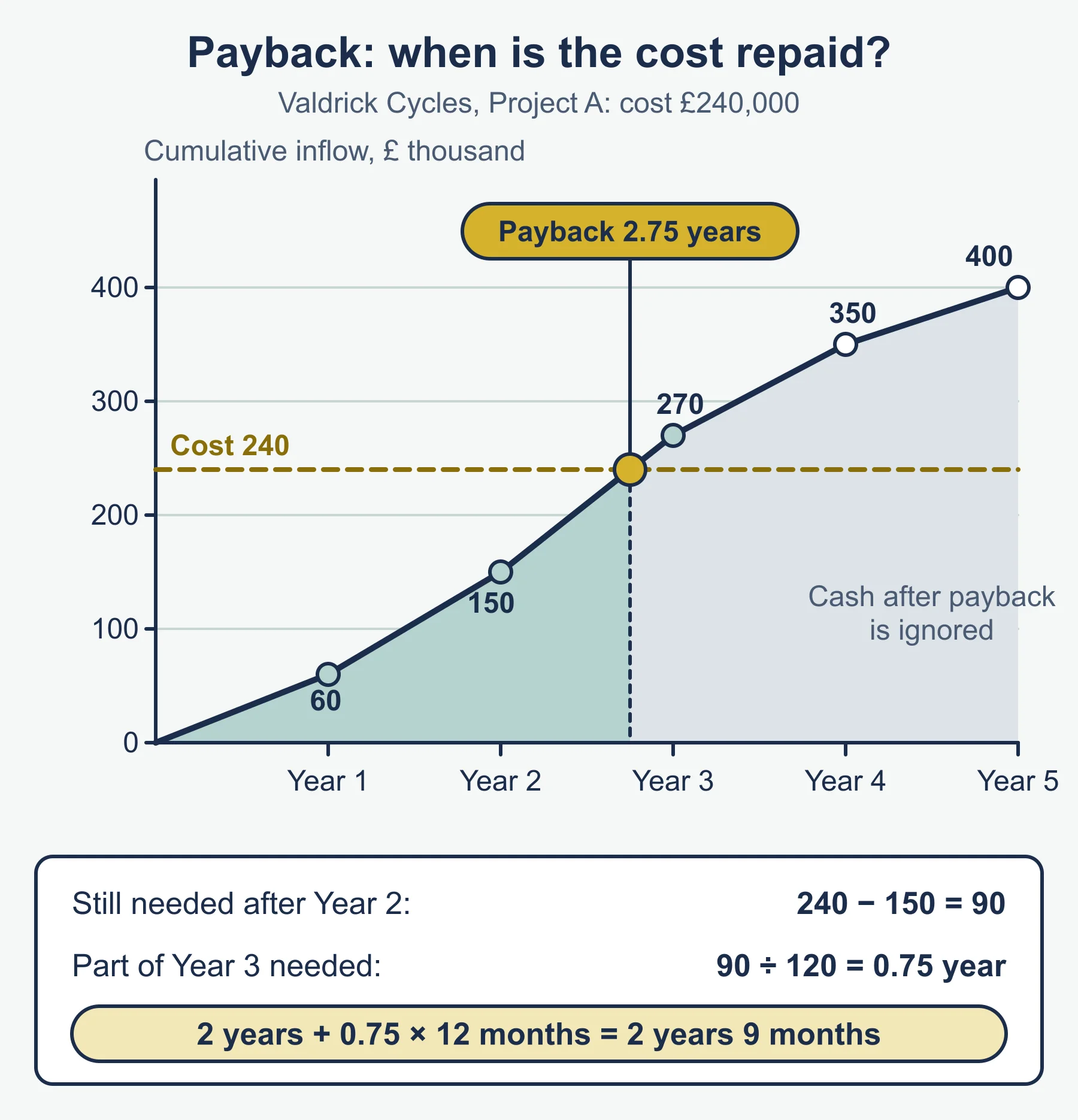
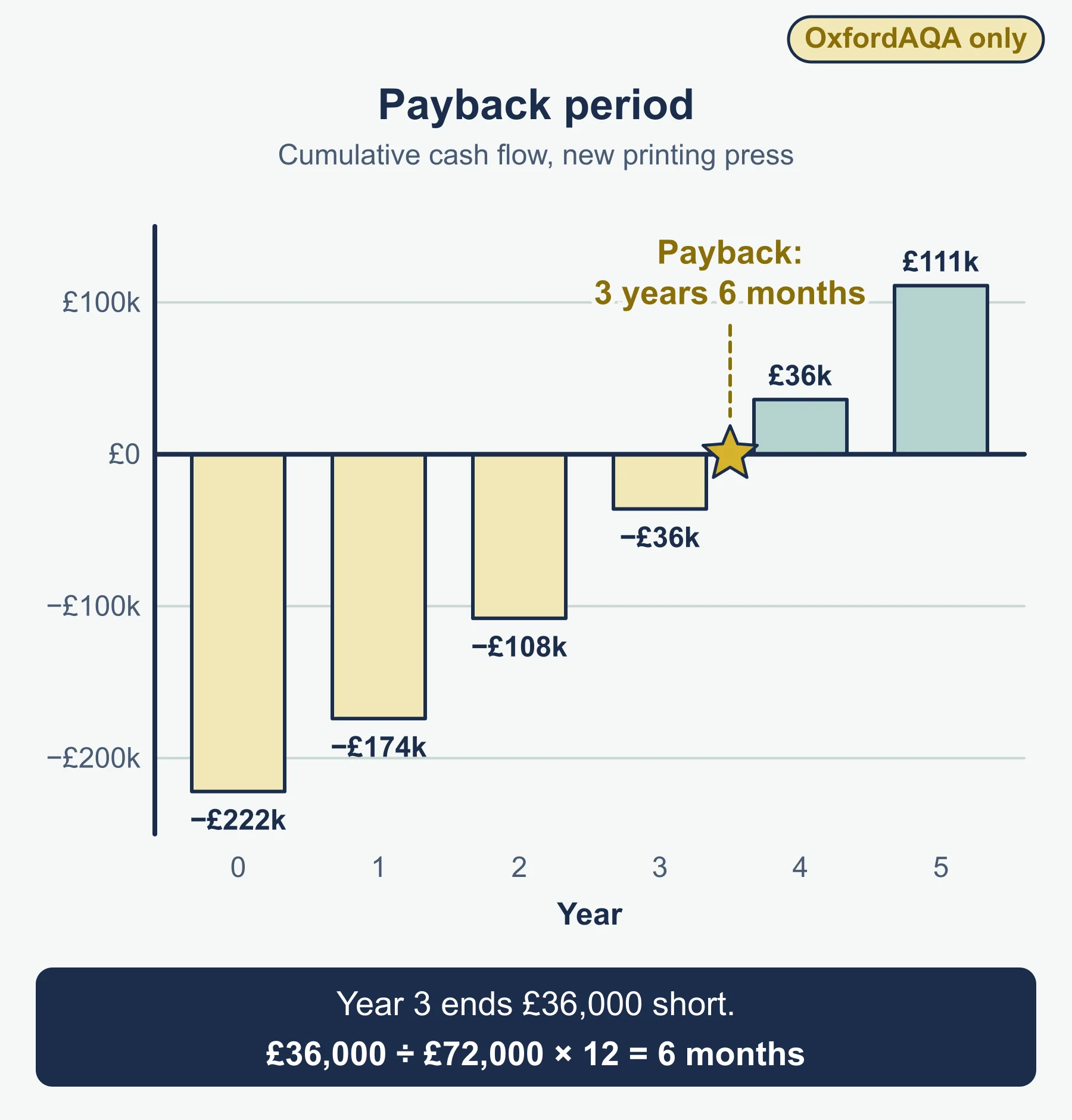
Payback is the time taken for a project’s net cash inflows to repay its initial cost. Build a cumulative cash flow, find the year in which the total passes the cost, then take the fraction of that year needed (assuming inflows arrive evenly).
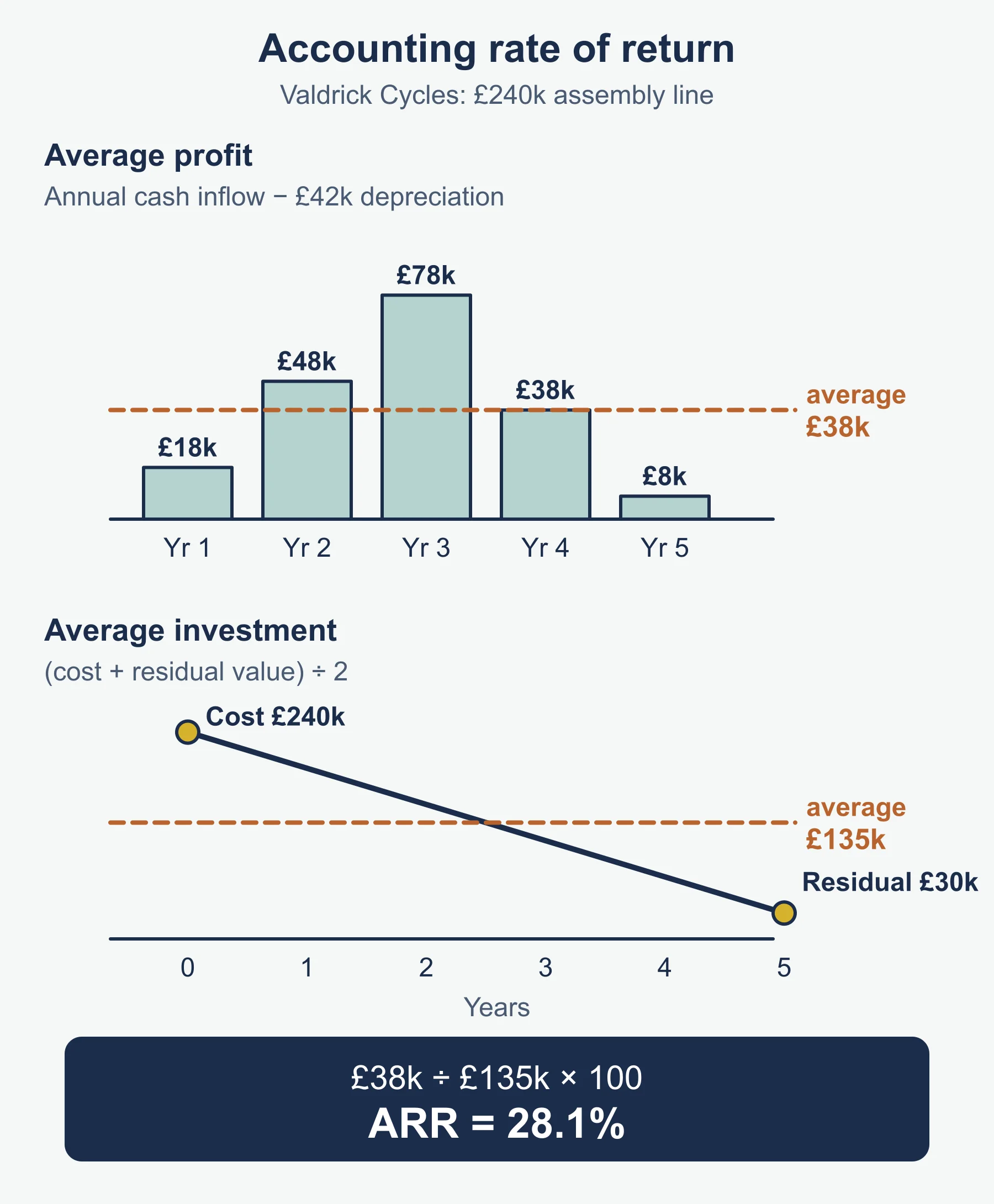
Accounting rate of return (ARR) is given in the syllabus as (average profit / average investment) × 100. The syllabus does not spell out “average investment”, so state your method. The standard form is (initial cost + residual value) / 2. Average profit is total net cash inflows minus total depreciation (cost minus residual value), divided by the years of the project.
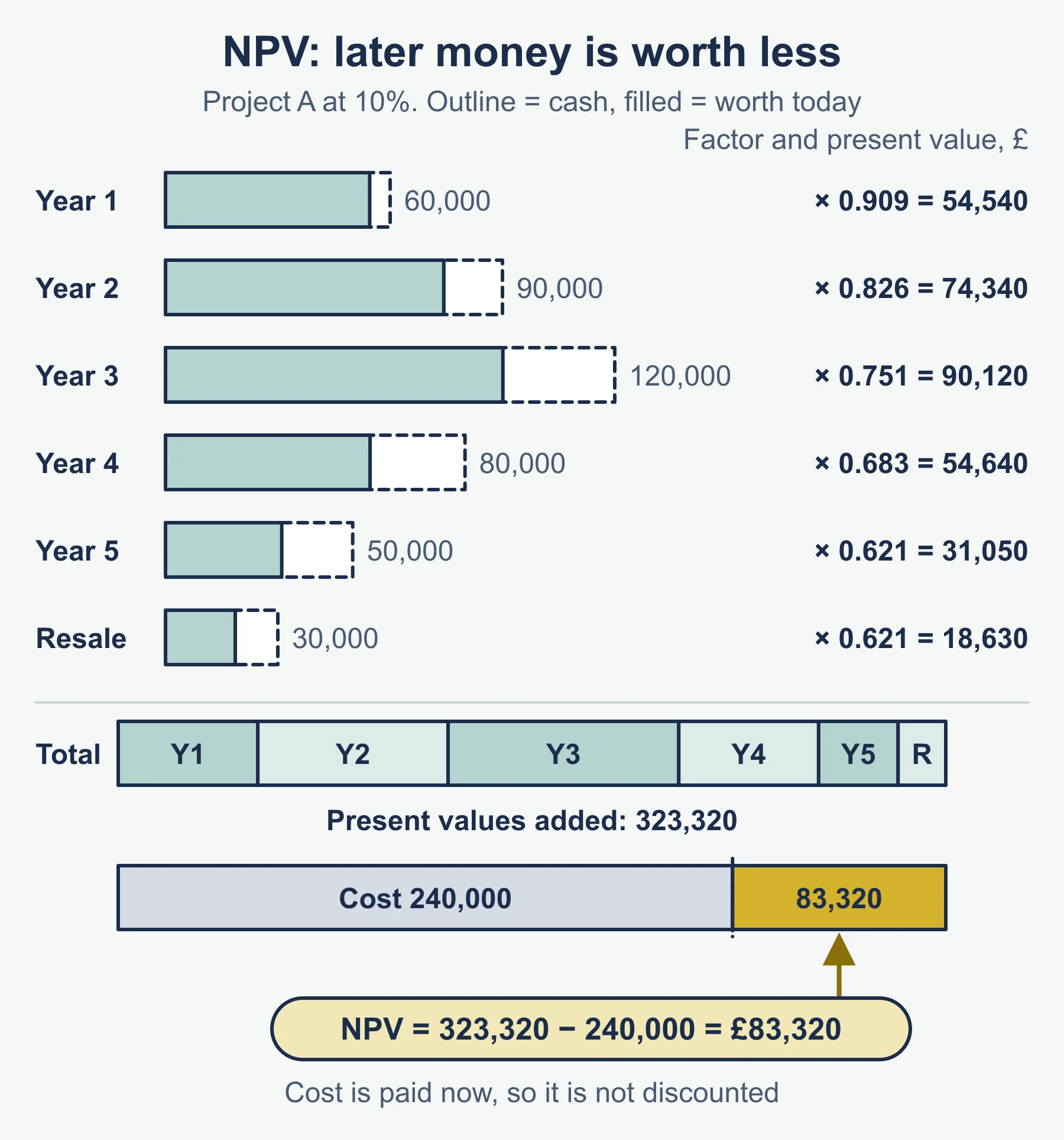
Worked example. Valdrick Cycles can buy an assembly line for £240,000. Project A is expected to give net cash inflows of £60,000, £90,000, £120,000, £80,000 and £50,000 in Years 1 to 5, and the line could then be sold for £30,000 (a residual value).
Payback:
| End of year | Cumulative inflow |
|---|---|
| 1 | £60,000 |
| 2 | £150,000 |
| 3 | £270,000 |
The cost is repaid during Year 3. Still needed after Year 2 is 240,000 − 150,000 = £90,000, and 90,000 / 120,000 = 0.75 of a year. Payback is 2.75 years, or 2 years 9 months.
ARR: total inflows = £400,000. Total depreciation = 240,000 − 30,000 = £210,000. Total profit = 400,000 − 210,000 = £190,000, so average annual profit = 190,000 / 5 = £38,000. Average investment = (240,000 + 30,000) / 2 = £135,000. ARR = 38,000 / 135,000 × 100 = 28.1%.
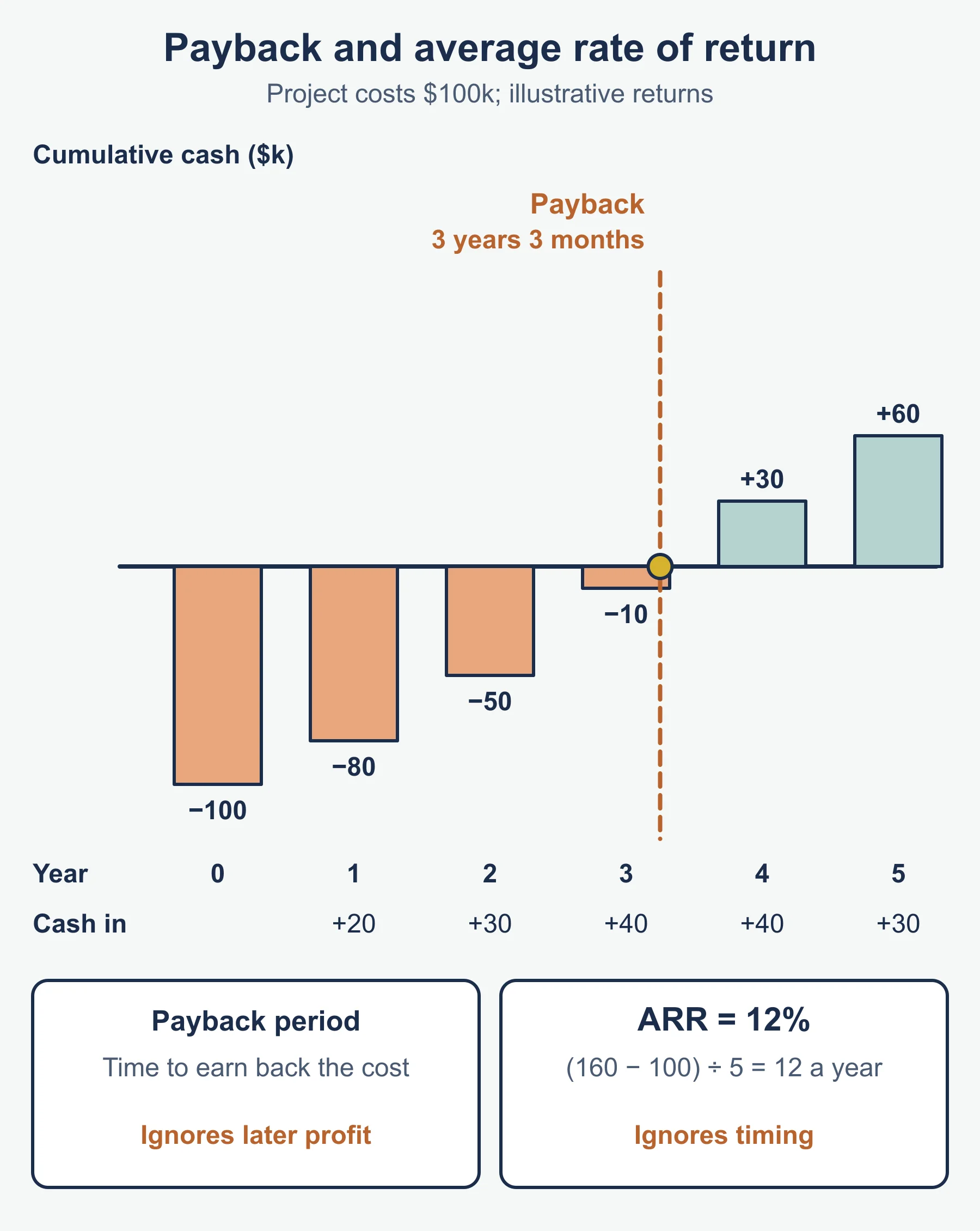
Interpretation: a business usually compares ARR with a target (criterion) rate or with the return on other uses of the money, and with a maximum payback period it will accept. Payback of 2 years 9 months in a five-year project says nothing about the inflows that arrive after the cost is recovered.
10.3.3 Net present value (NPV)
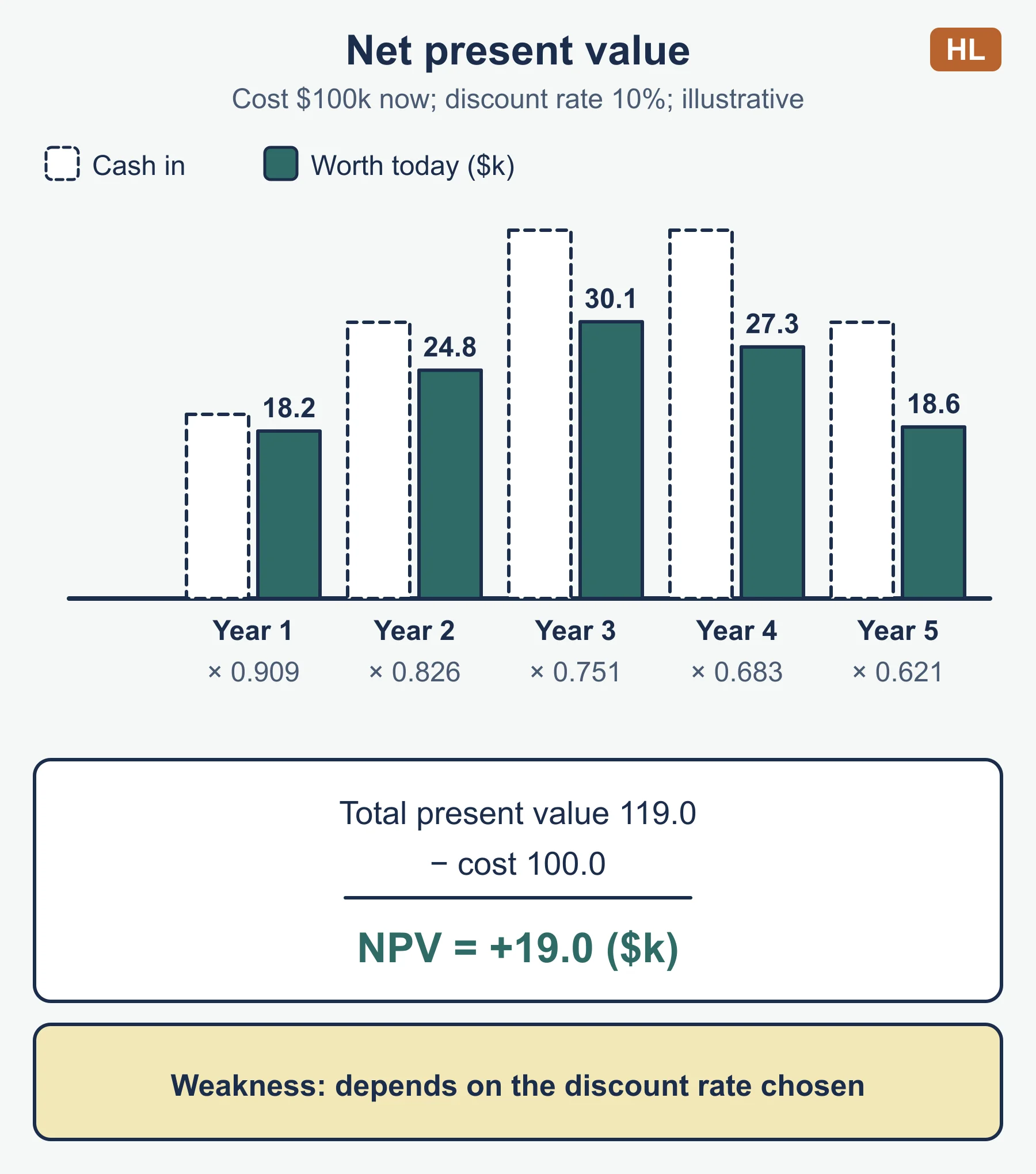
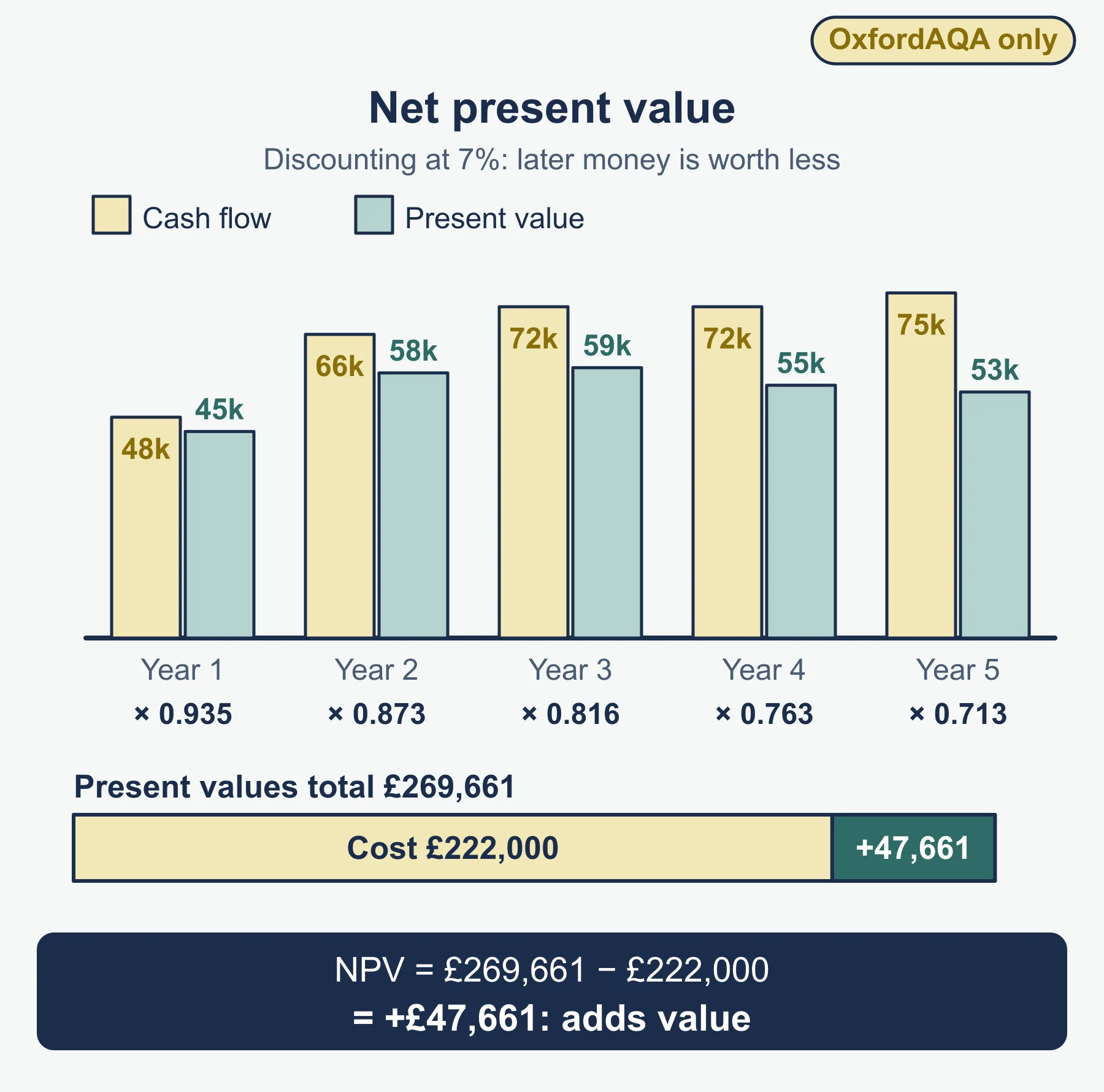
Money received later is worth less than money now, because it could be earning interest, inflation erodes it and it is less certain. Discounted cash flow converts future cash flows to present values. Net present value is the sum of the present values of all net cash inflows minus the initial cost.
Present value = cash flow × discount factor. The standard form of the discount factor for year n at rate r is 1 / (1 + r)^n. In questions, use the discount factors you are given. The initial cost is paid now, so it is not discounted. A positive NPV shows the project earns a return above the discount rate, so it adds value on this measure.
Valdrick Project A at a 10% discount rate (factors 0.909, 0.826, 0.751, 0.683, 0.621):
| Year | Net cash flow | Factor | Present value |
|---|---|---|---|
| 1 | £60,000 | 0.909 | £54,540 |
| 2 | £90,000 | 0.826 | £74,340 |
| 3 | £120,000 | 0.751 | £90,120 |
| 4 | £80,000 | 0.683 | £54,640 |
| 5 | £50,000 | 0.621 | £31,050 |
| 5 | £30,000 residual | 0.621 | £18,630 |
Total present value = £323,320. NPV = 323,320 − 240,000 = £83,320. The project is worthwhile on this measure.
10.3.4 Investment appraisal decisions
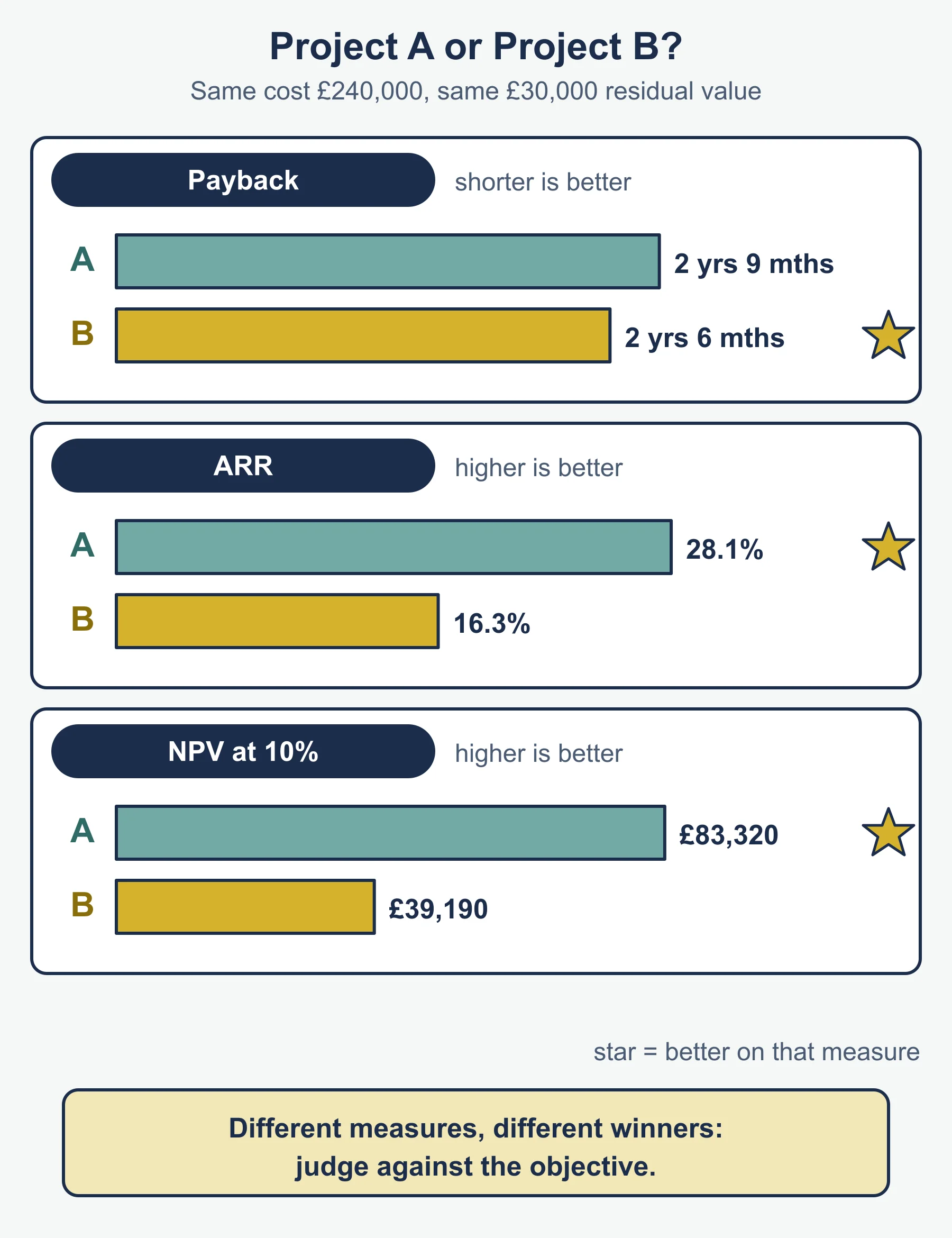
Valdrick also considers Project B, with the same cost and residual value and inflows of £110,000, £100,000, £60,000, £30,000 and £20,000.
| Measure | Project A | Project B |
|---|---|---|
| Payback | 2 years 9 months | 2 years 6 months |
| ARR | 28.1% | 16.3% |
| NPV at 10% | £83,320 | £39,190 |
Quantitative results. Payback favours B because its cash comes early. ARR and NPV favour A because it earns more overall and holds up later. A manager who needs cash quickly may still prefer B. The result depends on the objective, the criterion used and the discount rate. A higher rate cuts both NPVs, and B’s later years matter less.
Qualitative factors. Numbers are not the whole decision. Consider fit with strategy and objectives, effects on employees (training, redundancies), brand and customer perception, environmental impact, the reliability of the forecasts, the risk of competitors’ responses, flexibility to change course, and the way the project is funded.
Comparing the methods and their limits.
| Method | Strength | Limitation |
|---|---|---|
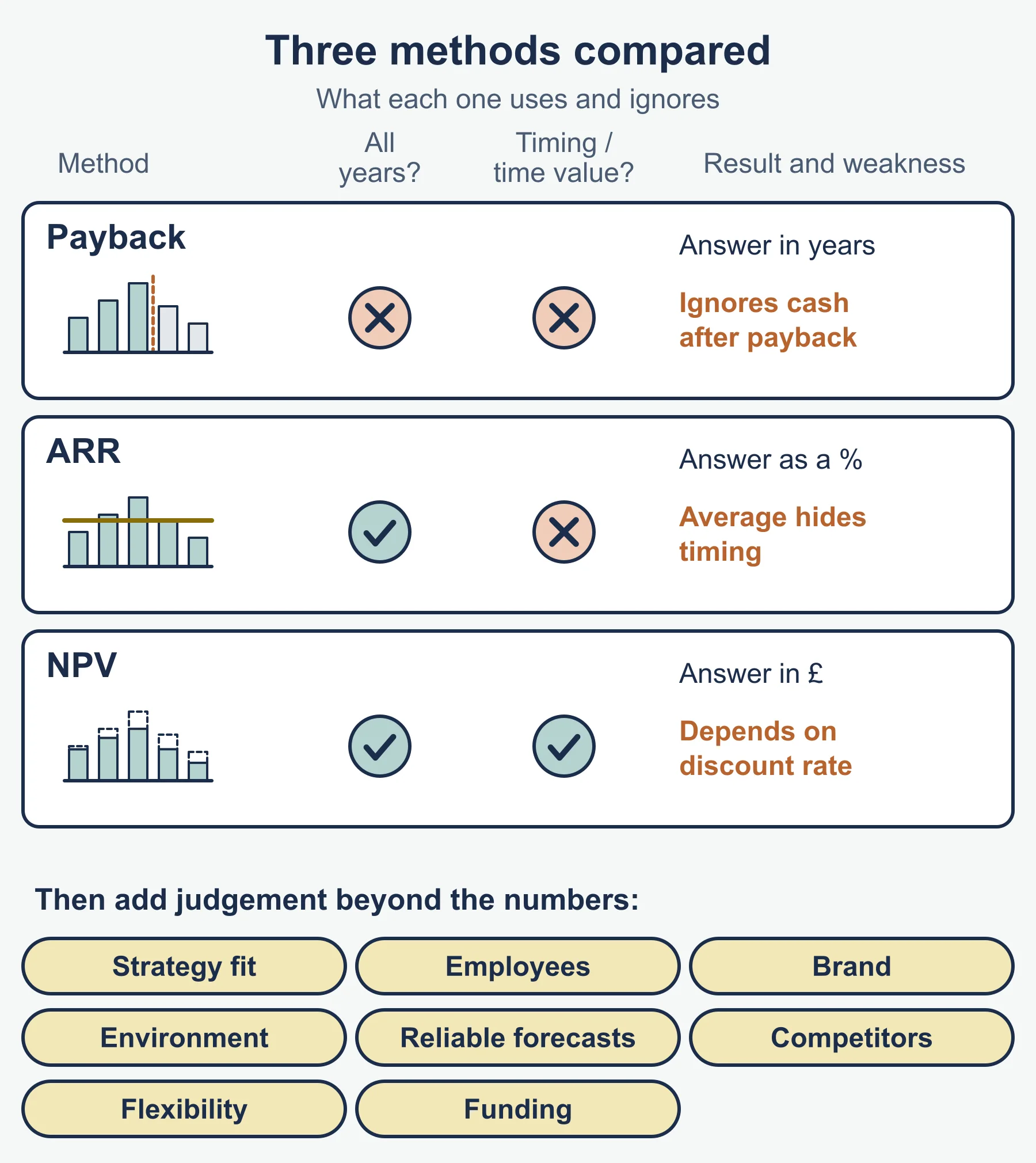
| Payback | Simple; focuses on liquidity and risk | Ignores cash after payback and the timing of earlier cash; ignores the time value of money |
| ARR | Uses all years; gives a percentage to compare with a target | Based on average, so ignores timing; depends on how profit and investment are defined |
| NPV | Allows for the time value of money; uses all cash flows; gives a value in pounds | Harder to calculate; result depends on the chosen discount rate; relies on forecasts |
All three depend on forecast cash flows, which become less reliable the further ahead they look. A sound recommendation uses more than one method, then adds qualitative judgement.
10.4.1 Accounting data in strategy; the annual report
A strategy needs a starting point and a way to check results. The statement of financial position records the assets a business holds and the liabilities it has (its ability to fund growth, repay loans and survive a downturn). The statement of profit or loss shows revenue, costs and profit (which products or years earn well). Together they help managers set targets, choose between growth and consolidation, pick funding, and judge progress.
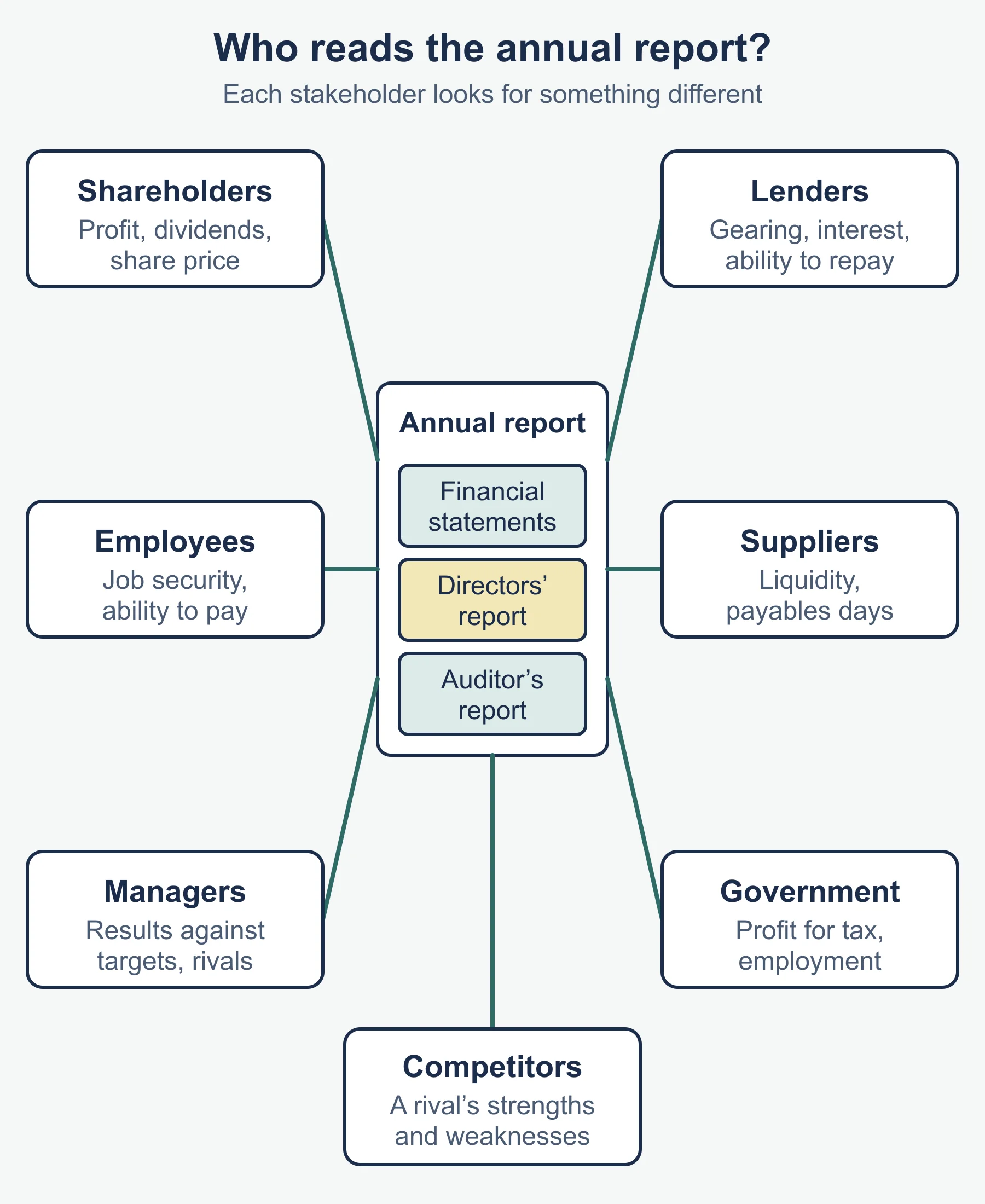
An annual report, published by a company, typically includes the financial statements with notes, a report from the directors or chair about performance and plans, and an auditor’s report. This is a general description. Its usefulness differs by stakeholder:
| Stakeholder | What they look for |
|---|---|
| Shareholders | Profit, dividends, growth prospects, share price |
| Lenders | Gearing, interest costs, ability to repay |
| Employees and unions | Job security, ability to pay, plans for growth |
| Suppliers | Liquidity and payables days: will they be paid on time? |
| Managers | Performance against targets and competitors |
| Government | Profit for tax purposes, employment |
| Competitors | The strengths and weaknesses of a rival |
10.4.2 Ratio analysis in strategic decisions
The ratios, using the syllabus formulas, are: current ratio = current assets / current liabilities; acid test = (current assets − inventory) / current liabilities; gross profit margin = gross profit / revenue × 100; operating profit margin = profit from operations / revenue × 100; ROCE = profit from operations / capital employed × 100; gearing = non-current liabilities / capital employed × 100; dividend yield = dividend per share / market price per share × 100; dividend cover = profit for the year / annual dividend; price/earnings = market price per share / earnings per share. Capital employed = issued shares + reserves + non-current liabilities. Efficiency ratios use receivables, payables, inventory and cost of sales as set out in the syllabus.
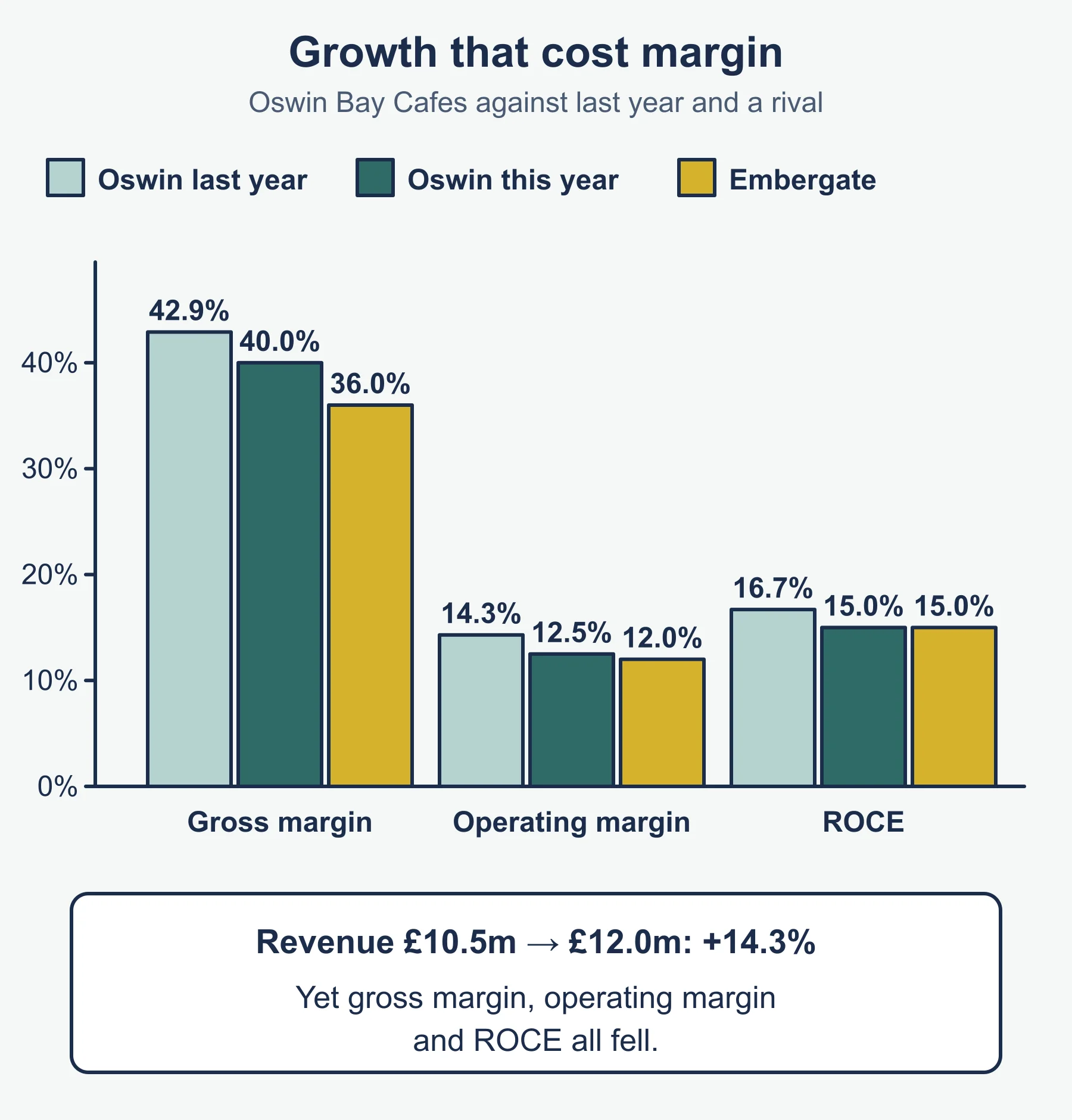
Performance over time and against competitors. Oswin Bay Cafes (revenue £12.0m, cost of sales £7.2m, profit from operations £1.5m, capital employed £10.0m) can be compared with last year and with a rival, Embergate Coffee Houses.
| Measure | Oswin Bay last year | Oswin Bay this year | Embergate this year |
|---|---|---|---|
| Revenue | £10.5m | £12.0m | £15.0m |
| Gross profit margin | 42.9% | 40.0% | 36.0% |
| Operating profit margin | 14.3% | 12.5% | 12.0% |
| ROCE | 16.7% | 15.0% | 15.0% |
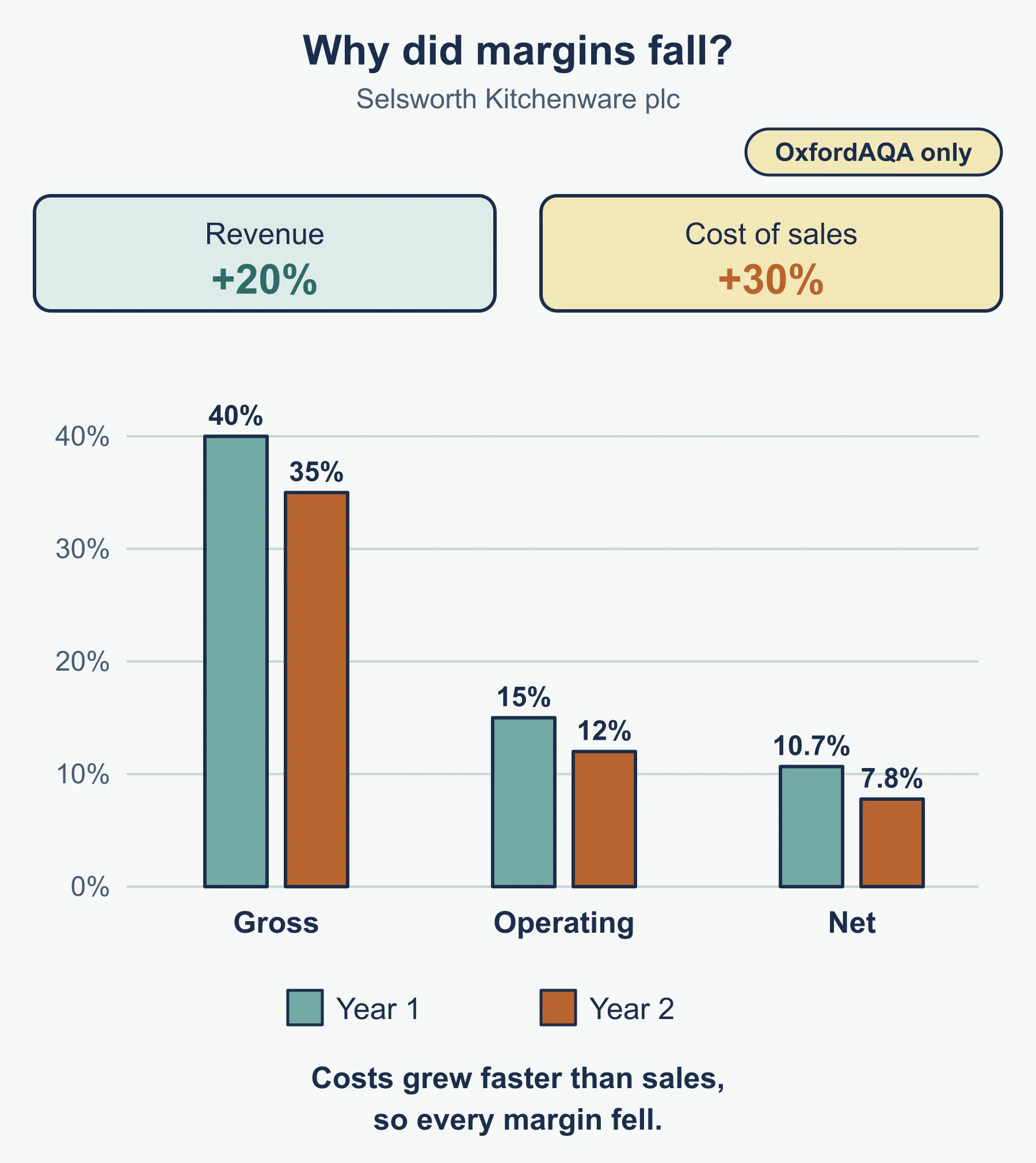
Revenue grew 14.3%, but both margins and ROCE fell, so growth cost margin (perhaps through discounting or dearer ingredients). Against Embergate, Oswin Bay earns a better gross margin but an equal return on capital. A strategic response might be a review of supplier costs before more expansion.
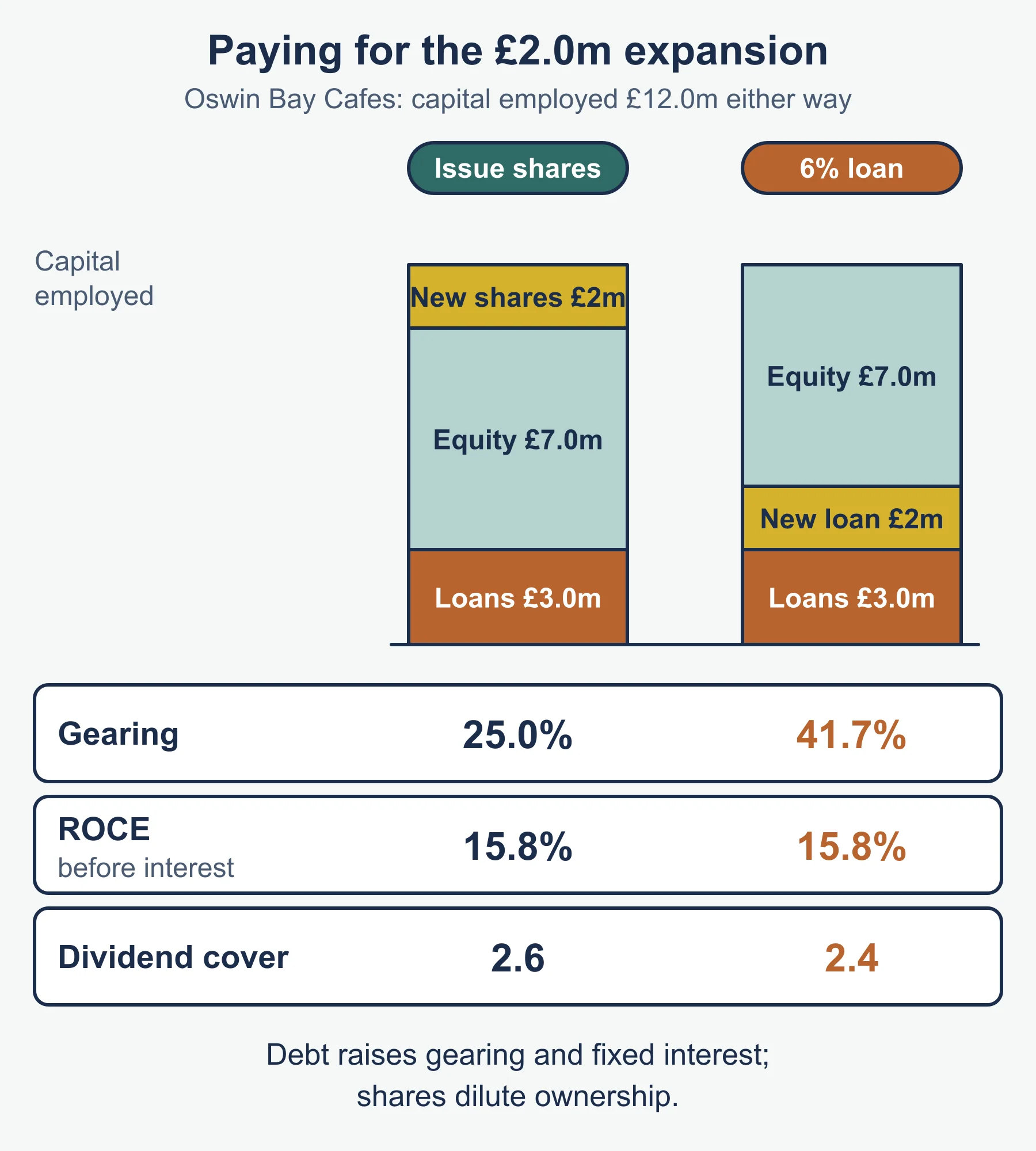
Debt or equity. Oswin Bay plans a £2.0m expansion adding £0.4m to profit from operations. Existing: issued shares £4.0m, reserves £3.0m, non-current liabilities £3.0m, so capital employed is £10.0m and gearing is 30%. Annual dividend is £0.54m, and existing interest is £0.15m.
| After expansion | Share issue | 6% loan |
|---|---|---|
| Capital employed | £12.0m | £12.0m |
| Gearing | 25.0% | 41.7% |
| ROCE | 15.8% | 15.8% |
| Profit for the year (20% tax) | £1.400m | £1.304m |
| Dividend cover | 2.6 | 2.4 |
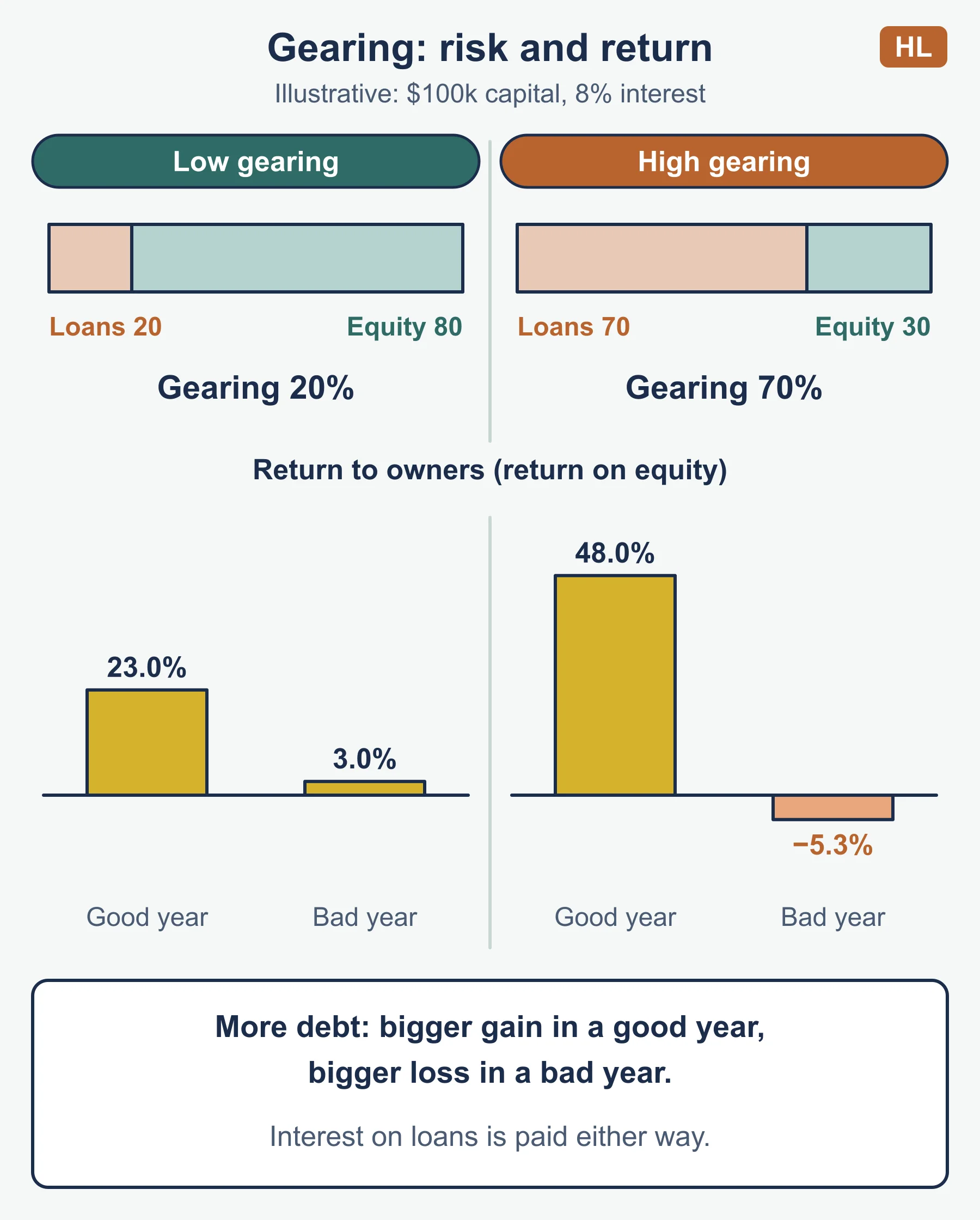
ROCE is the same because it uses profit from operations, before interest. Gearing and cover differ. Debt raises gearing and fixed interest, and shares dilute ownership.
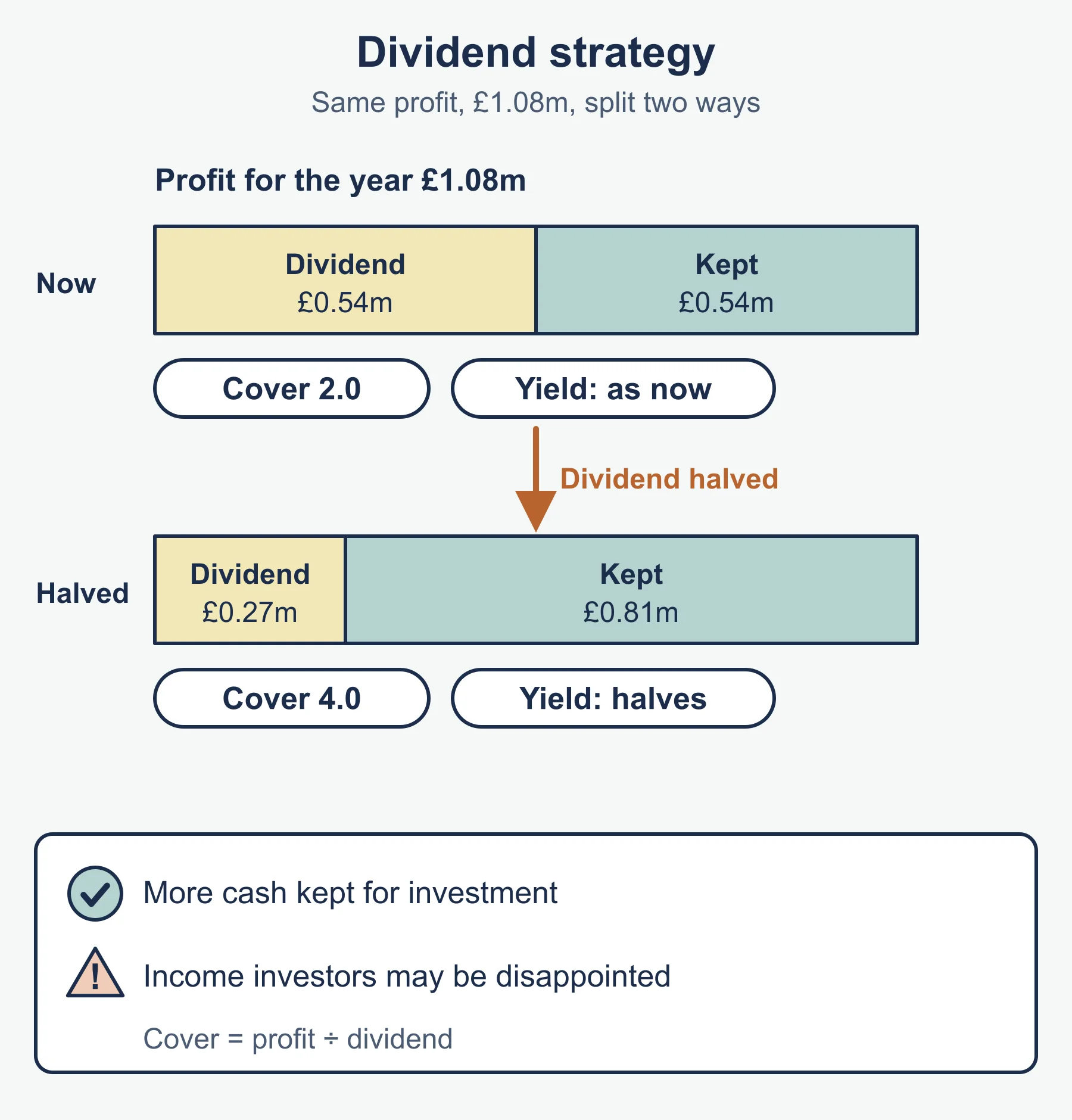
Dividend strategy. Halving the dividend to £0.27m doubles dividend cover (2.0 to 4.0) and halves dividend yield, but keeps cash for investment. Investors who want income may be disappointed. Retained profit raises reserves, so capital employed rises and, other things equal, ROCE and gearing fall slightly.
Growth and other strategies. Growth can push up inventory and receivables, so efficiency ratios and liquidity may worsen, and the cost of expansion can cut margins before it lifts revenue. Cost cutting raises margins; price cuts lower margin but may lift inventory turnover; heavy capital spending lifts capital employed and lowers ROCE until returns arrive. Always link the ratio change to the strategy.
Limitations of published accounts and ratios. They are historical, so they may not predict the future. Different accounting policies and year ends reduce comparability. Ratios ignore non-financial factors such as quality and morale. A single ratio can mislead, window dressing can flatter the statements, and inflation, seasonality and differences in business model distort comparisons. Use several ratios, trends, and context.
Common errors
- Discounting the initial cost, or forgetting to subtract it.
- Using the initial cost alone as average investment without saying so.
- Calling gearing “good” or “bad” without context. It depends on risk, rates and growth plans.
- Saying a higher NPV is always better without mentioning the discount rate and forecast risk.
- Listing stakeholder interests without tying them to the figures in the case.
Frequently asked questions
What is the ARR formula in Cambridge 9609? The syllabus gives ARR as average profit divided by average investment, multiplied by 100. Average profit is total net cash inflows minus total depreciation, divided by the number of years.
What are the limitations of payback? Payback is simple and focuses on liquidity and risk, but it ignores cash after the payback point and does not allow for the time value of money.
What qualitative factors matter in investment decisions? Examples include fit with the business’s strategy, effects on employees, brand and reputation, and environmental impact. Numbers are not the whole decision, because every method relies on forecasts.
Who uses a company’s annual report? Shareholders look for profit and dividends, lenders for gearing and ability to repay, employees for job security, suppliers for liquidity, managers for performance against targets, and competitors for a rival’s strengths and weaknesses.
Official syllabus
Cambridge International AS & A Level Business 9609 syllabus for examination in 2026, 2027 and 2028, published by Cambridge University Press & Assessment, sections 10.3 and 10.4.
Get free revision emails (optional)
Occasional emails with practice questions, worked explanations and links to free resources for the qualification and subjects you choose. No spam, and you can unsubscribe from any email. The free tools on this site never need an email.
Related resources
-
Practice questions
A Level Business: Investment appraisal and accounting strategy (Cambridge 9609) – Practice Questions
Original practice questions with worked answers on payback, ARR, NPV, investment decisions and ratio-based strategy for Cambridge A Level Business 9609.
Business · Cambridge · A Level
Try questions -
Revision notes
A Level Business: Investment appraisal and Finance and accounting strategy (Cambridge 9609) – Revision Notes
Condensed revision notes on payback, ARR, NPV, appraisal decisions and ratio-based finance strategy for Cambridge A Level Business 9609.
Business · Cambridge · A Level
Revise topic -
Practice questions
A Level Business: Finance and Accounting (A Level) — Practice Questions (Cambridge 9609)
Worked practice questions on ARR, payback, net present value, efficiency ratios and investor ratios for Cambridge International AS & A Level Business 9609.
Business · Cambridge · A Level
Try questions
Related articles
-
teaching
A Level tuition in Dubai: Cambridge or Pearson Edexcel International A Level?
Schools in Dubai and Abu Dhabi teach either Cambridge International AS & A Level or Pearson Edexcel International A Level. How the two are structured, why it matters for tuition, and how online classes from Lahore work.
9 October 2026
-
curriculum guides
Choosing subjects at IGCSE and A Level
How subject choices at 14 and 16 affect university options later, and how to keep pathways open without overloading a timetable.
28 July 2026
Studying this with a teacher
Working through Business A LEVEL?
This page is free and stays free. If you would rather be taught it, Marlbridge runs Business classes one-to-one and in small groups of up to 15, online in your own time zone. The first trial class is free. WhatsApp replies within an hour (8am–11pm Pakistan time, every day); email the same day.
Cambridge Business teachers at Marlbridge

