
Revision Notes
A Level Business: Financial statements and Analysis of published accounts (Cambridge 9609) – Revision Notes
Condensed revision notes on financial statements, depreciation, inventory and ratio analysis for Cambridge A Level Business 9609, with a self-test.
- Subject
- Business
- Level
- A LEVEL
- Topic
- Finance and accounting
- Author
- Marlbridge Academic Team
- Updated
- Reviewed by
- Salman Ahmad (what this means)
Aligned to Cambridge A Level Business (9609), For examination in 2026, 2027 and 2028. Official specification .
Syllabus page (what it covers and how it is assessed): Cambridge A Level Business.
Syllabus points this page covers
9609 (A Level)
- 10.1 Financial statements
- 10.2 Analysis of published accounts
Found an error? Report a correction.
Need help with this topic? Request a free trial class for A Level Business (9609).
These are condensed notes for sections 10.1 (Financial statements) and 10.2 (Analysis of published accounts) of the Cambridge International AS & A Level Business 9609 syllabus for examination in 2026, 2027 and 2028. Both sections are A Level content. For full explanations and worked examples, use the study guide. Then test yourself with the practice questions. Investment appraisal is in the finance and accounting practice set. Course links: the Cambridge A Level Business hub, the checklist and the free diagnostics.
The syllabus does not expect you to draw up a set of accounts. It expects you to calculate ratios and use them to inform decisions.
10.1.1 Statement of profit or loss
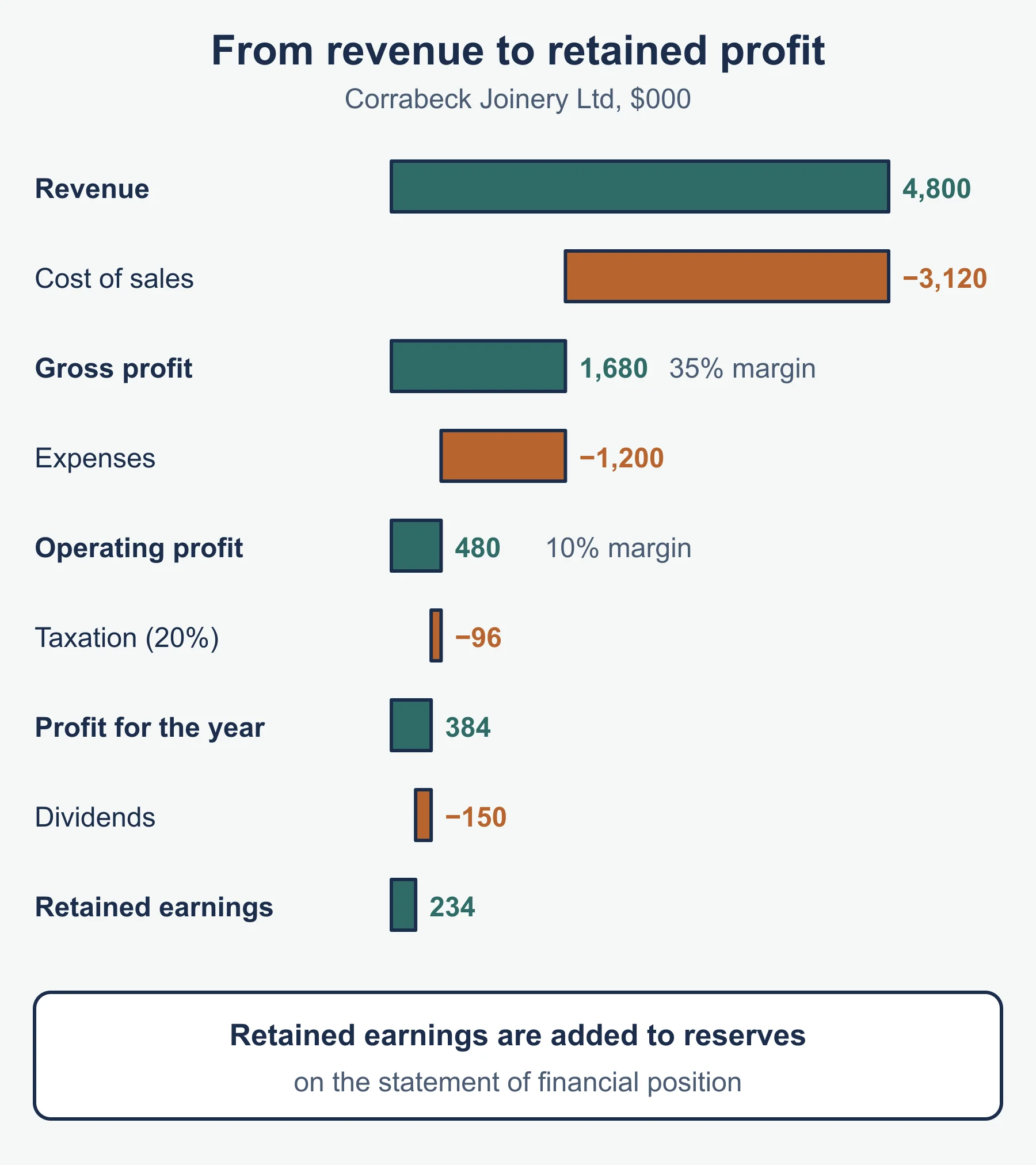
- Meaning: profit made over a period. Purpose: show how revenue becomes profit, for owners, lenders and others.
- Layout: revenue − cost of sales = gross profit; − expenses = profit from operations (operating profit); − taxation = profit for the year; − dividends = retained earnings.
- Amending: change the line affected, then recalculate every line below it, including tax.
- Impact of a change: a price rise or cut changes revenue only. A supplier price change alters cost of sales and gross profit. A new overhead alters expenses and profit from operations. Tax changes with profit.
| Change | First line affected | Then also |
|---|---|---|
| Higher selling price, same volume | Revenue | Gross profit, operating profit, tax, profit for the year |
| Higher material costs | Cost of sales | Gross profit onwards |
| Higher wages in the office | Expenses | Profit from operations onwards |
| Higher dividend | Dividends | Retained earnings only |
10.1.2 Statement of financial position
- Meaning: assets, liabilities and equity on one date. Purpose: show financial strength.
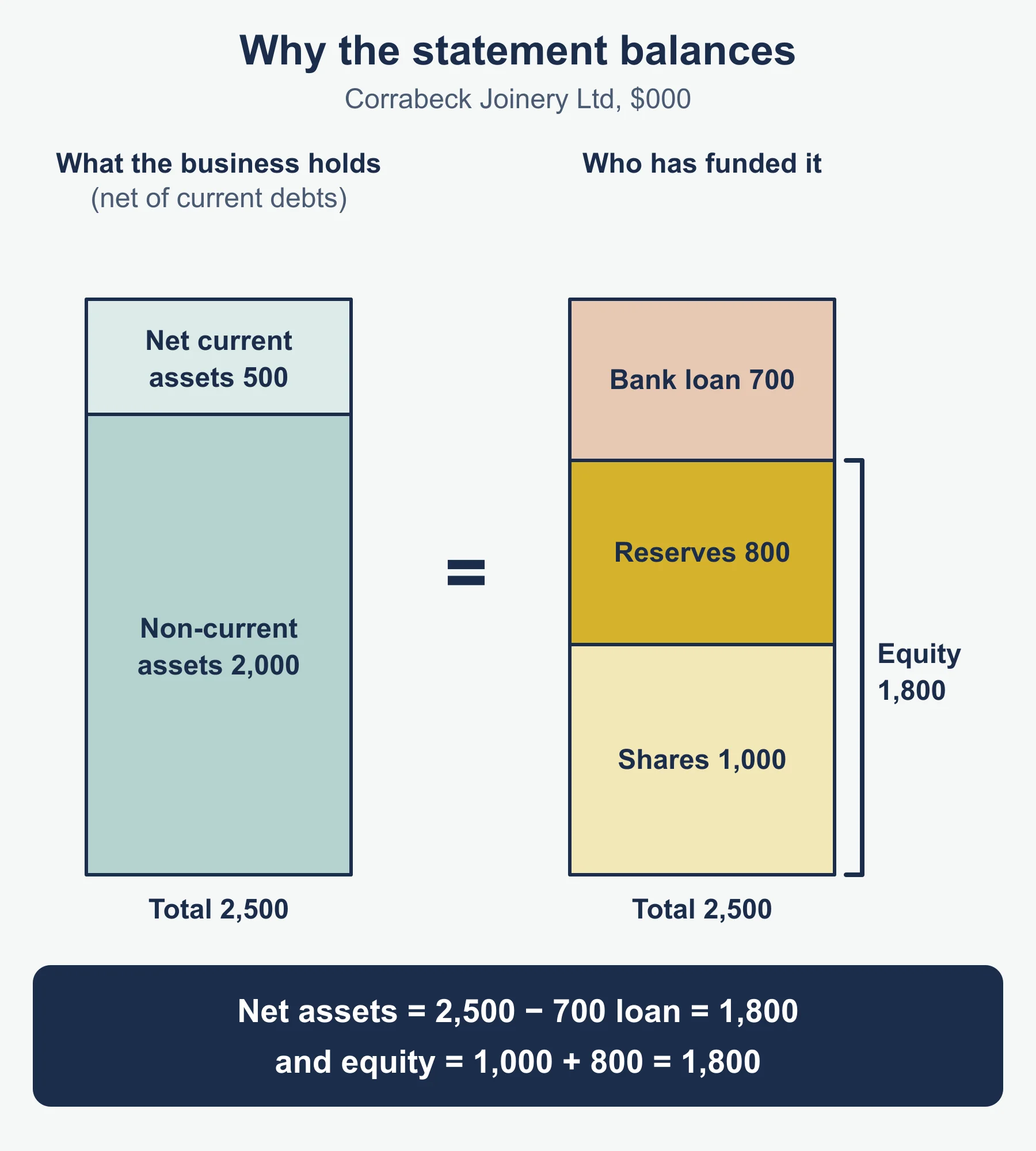
- Contents: non-current assets; current assets; current liabilities; net current assets; non-current liabilities; net assets; reserves and equity (issued shares + reserves).
- Key identities:
- Net current assets = current assets − current liabilities.
- Net assets = non-current assets + net current assets − non-current liabilities.
- Net assets = equity.
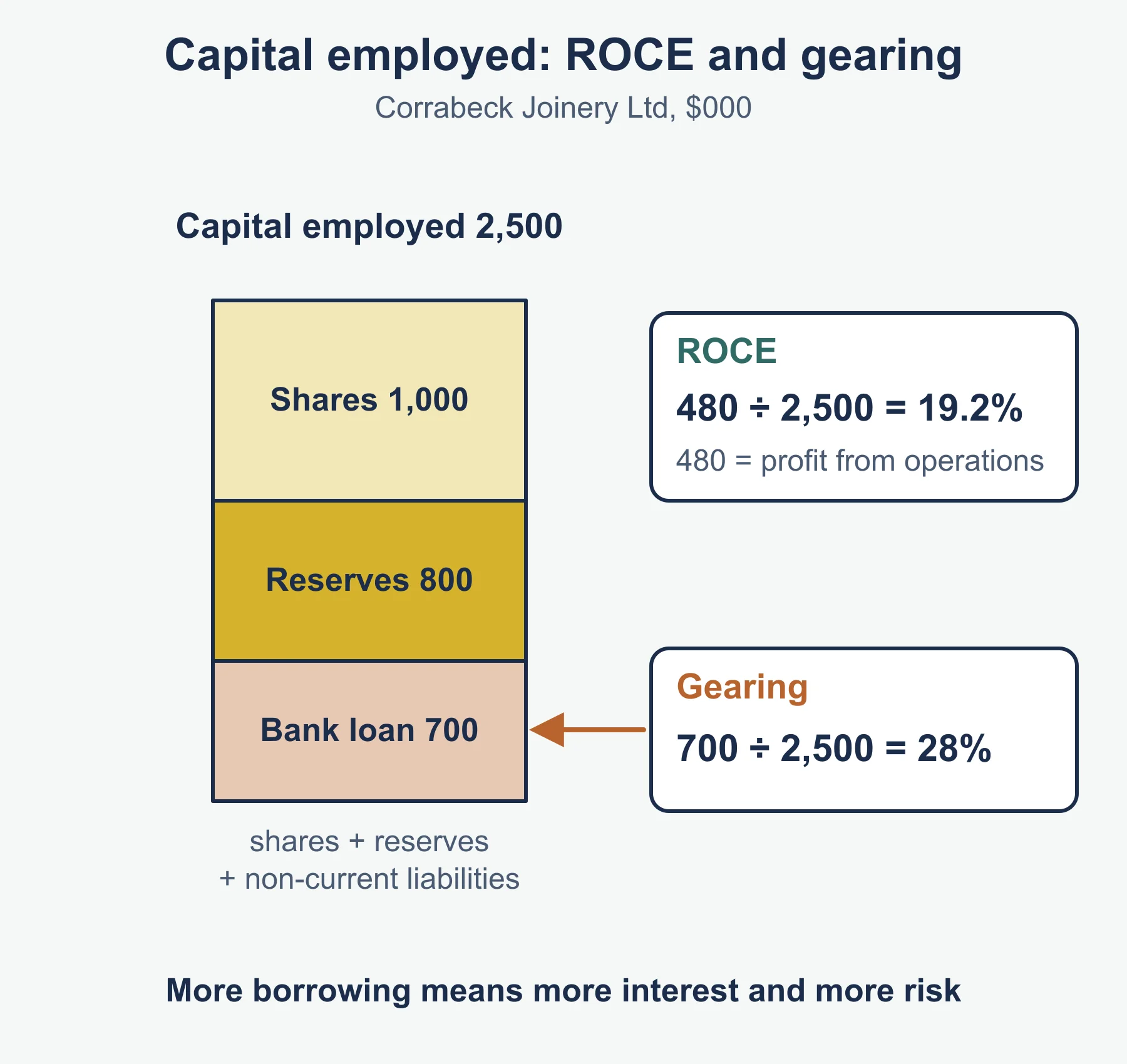
- Capital employed = issued shares + reserves + non-current liabilities.
- Amending: each change has two effects. Buying an asset with cash swaps one asset for another, so net assets do not move. Buying it with a loan raises an asset and a liability. Net assets move only when profit, loss, dividends or new shares change equity.
Links between the statements
| Statement of profit or loss | Statement of financial position |
|---|---|
| Profit for the year less dividends | Added to reserves |
| Depreciation expense | Lowers non-current assets |
| Cost of sales and closing inventory | Inventory in current assets |
| Credit sales | Trade receivables |
| Credit purchases | Trade payables |
| Tax charge | Current liability until paid |
10.1.3 Inventory valuation
- Difficulties: damaged or obsolete stock; changing prices; stock that is hard to count or value; uncertain selling price; judgement is needed.
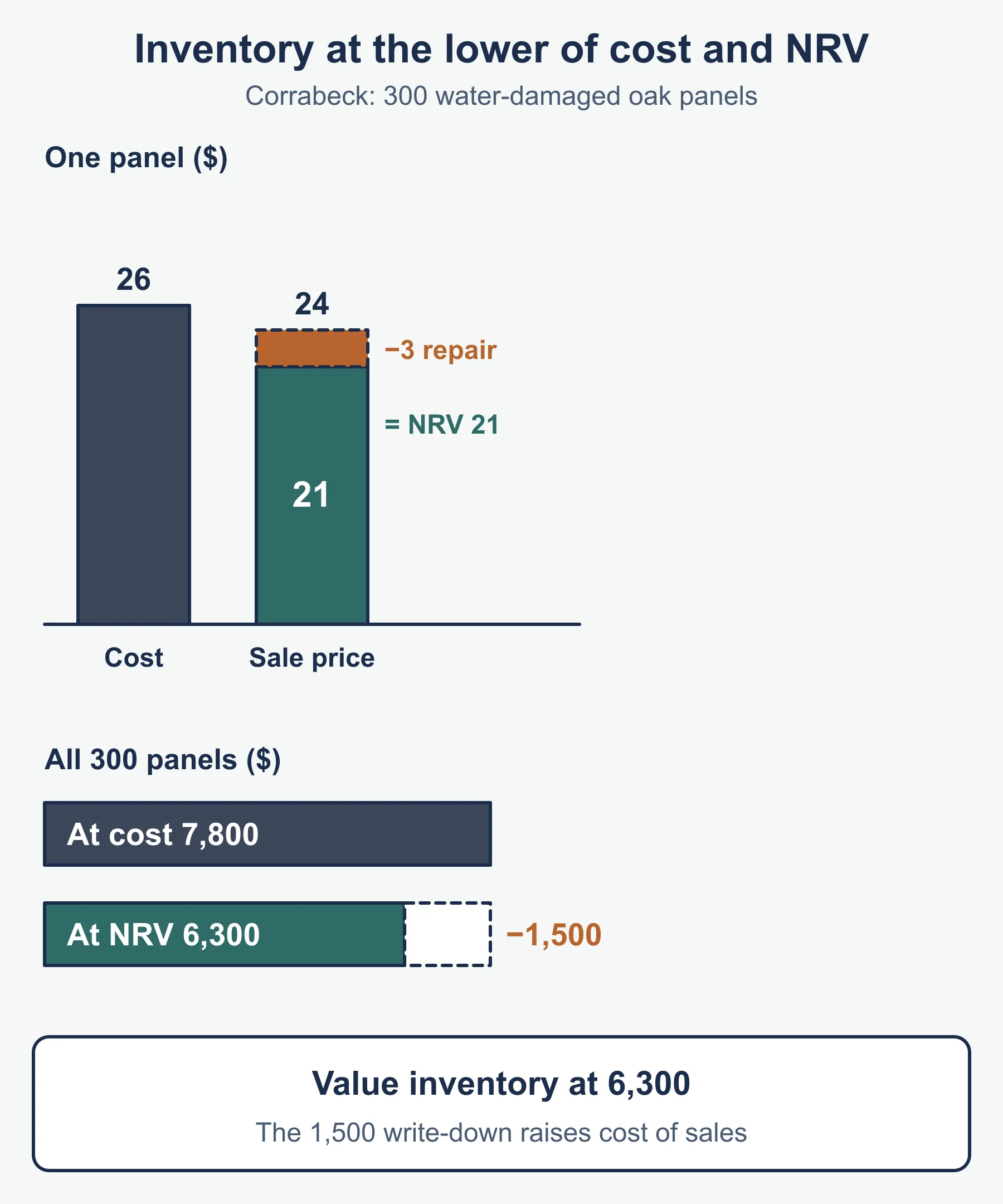
- Net realisable value (NRV) = estimated selling price − costs of selling or finishing. The standard form is to value inventory at the lower of cost and NRV.
- Effect of a write-down: inventory and current assets fall; cost of sales rises; profit falls.
10.1.4 Depreciation
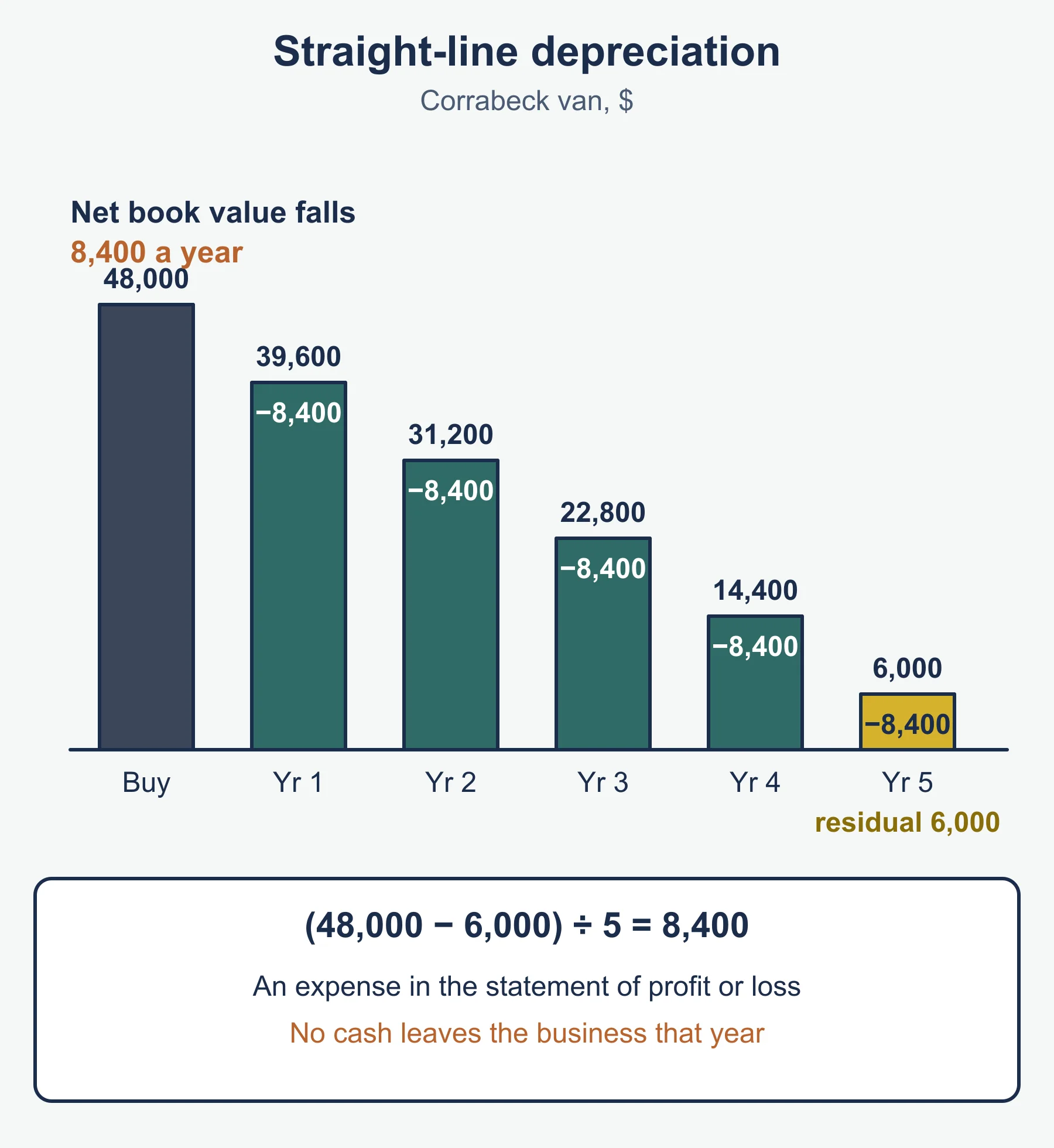
- Role: spreads the cost of a non-current asset over its useful life and matches cost to the revenue it helps earn. It is non-cash.
- Straight-line: (cost − residual value) ÷ useful life. This is the only method in the syllabus.
- Impact: expense in the statement of profit or loss, so profit falls; net book value on the statement of financial position falls by the same amount each year.
10.2 Ratios (formulas as given in the syllabus appendix)
| Ratio | Formula | Presented as |
|---|---|---|
| Current ratio | current assets ÷ current liabilities | a ratio |
| Acid test ratio | (current assets − inventory) ÷ current liabilities | a ratio |
| Gross profit margin | gross profit ÷ revenue × 100 | % |
| Operating profit margin (called profit margin in 10.2.2) | profit from operations ÷ revenue × 100 | % |
| Return on capital employed (ROCE) | profit from operations ÷ capital employed × 100 | % |
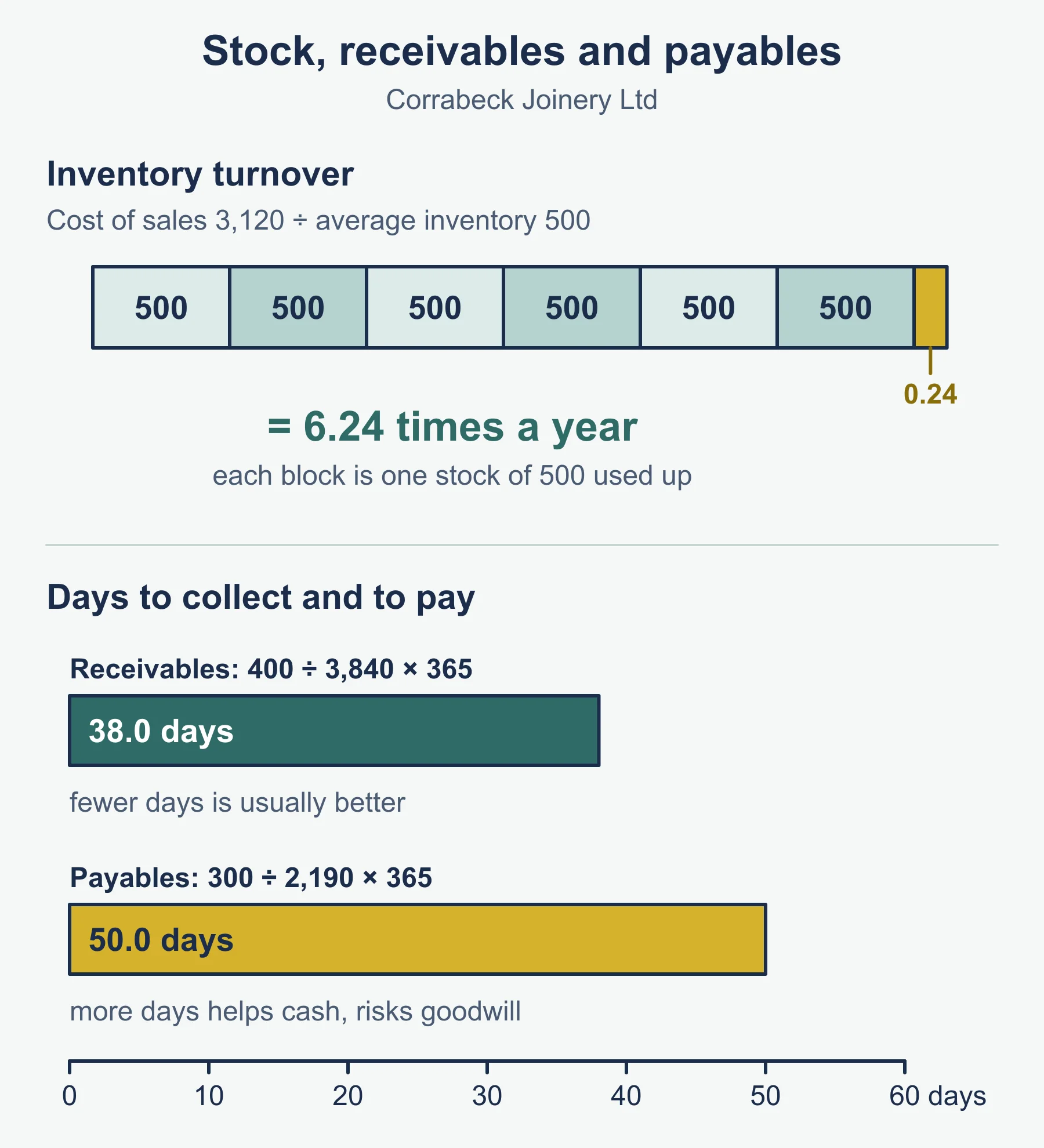
| Trade receivables turnover | trade receivables ÷ credit sales × 365 | days |
| Trade payables turnover | trade payables ÷ credit purchases × 365 | days |
| Rate of inventory turnover | cost of sales ÷ average inventory | times |
| Gearing | non-current liabilities ÷ capital employed × 100 | % |
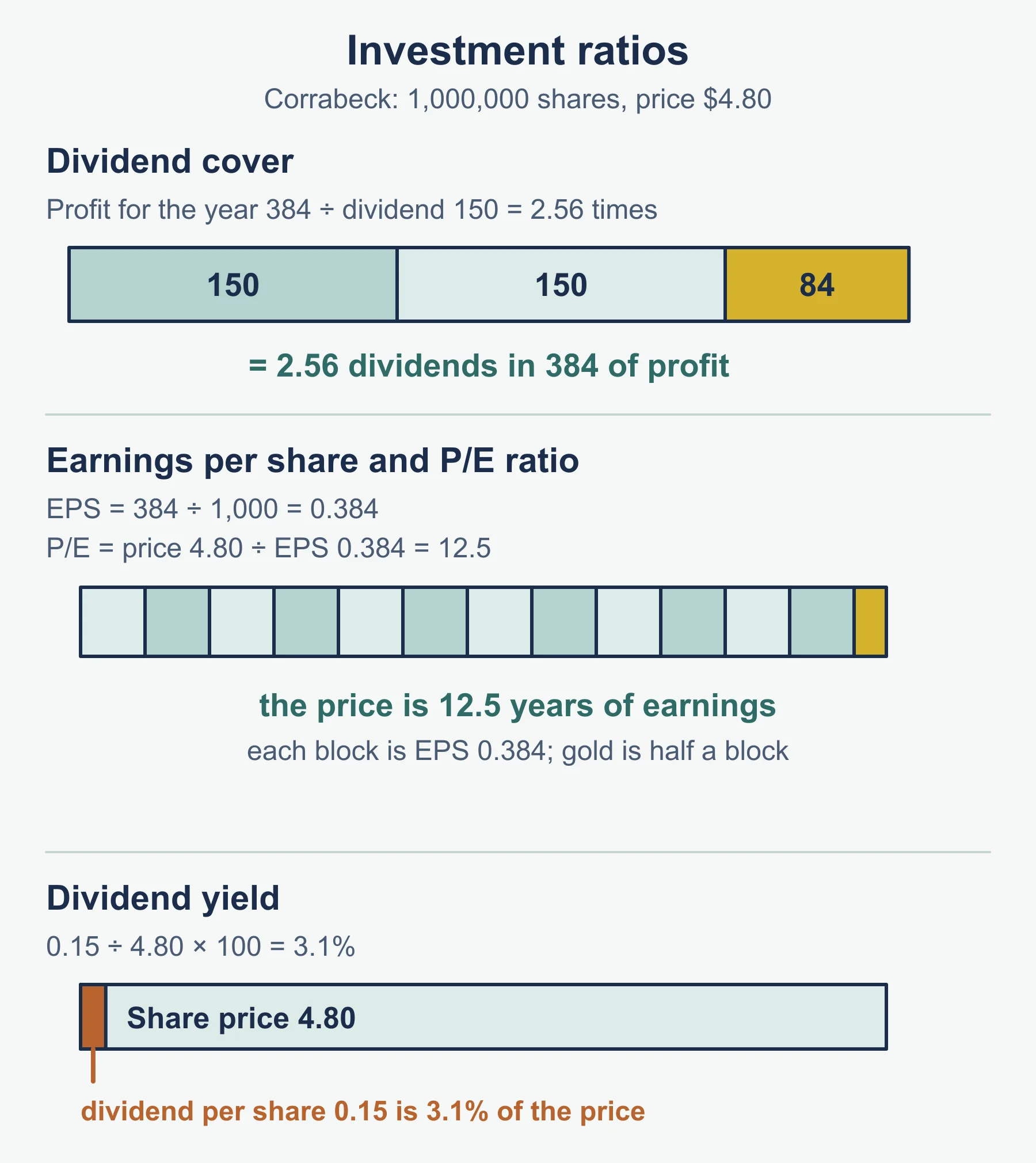
| Price/earnings ratio | market price per share ÷ earnings per share | a number |
| Dividend yield | dividend per share ÷ market price per share × 100 | % |
| Dividend cover | profit for the year ÷ annual dividend | times |
Earnings per share is not in the appendix. The standard form is profit for the year ÷ number of issued shares.
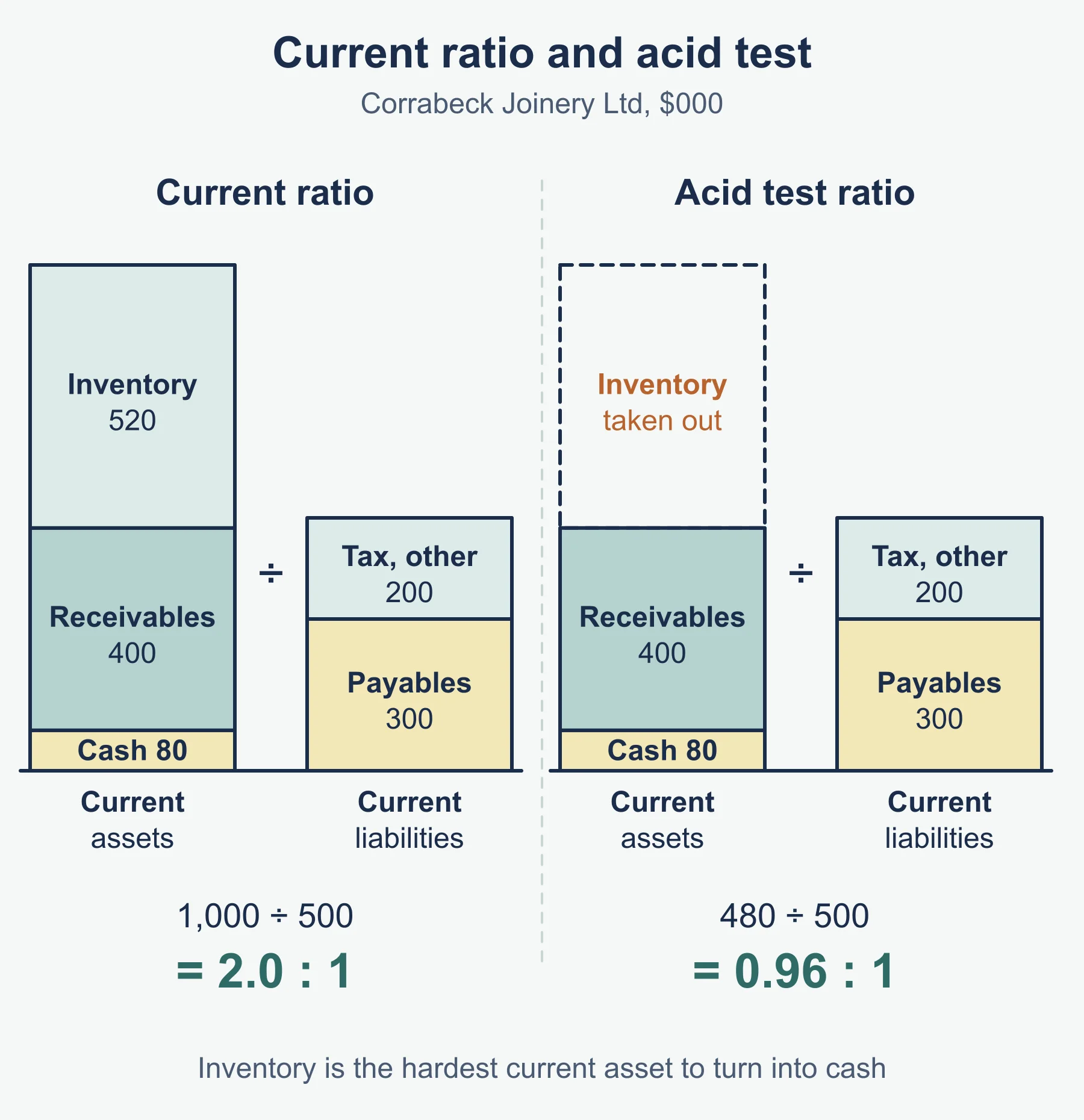
Quick reminder. A cafe chain has current assets 360, of which inventory is 150, and current liabilities 240. Current ratio = 360 ÷ 240 = 1.5 : 1. Acid test = 210 ÷ 240 = 0.875, or 0.88 : 1.
Meaning, importance, improvement
| Group | Meaning and importance | Methods of improving |
|---|---|---|
| Liquidity | Ability to pay short-term debts; firms fail when cash runs out | Cut inventory; collect receivables sooner; longer supplier terms; long-term instead of short-term borrowing; issue shares; sale and leaseback |
| Profitability | Profit earned from sales and from capital used; pays for growth, dividends and survival | Raise price; cut cost of sales; cut expenses; sell more; reduce capital employed |
| Financial efficiency | How well inventory, receivables and payables are managed; frees cash | Just-in-time; credit control; early-settlement discounts; negotiate longer payment terms |
| Gearing | Reliance on long-term borrowing; high gearing raises interest and risk | Repay loans; issue shares; retain profit |
| Investment ratios | Return to shareholders; affects the share price and ability to raise capital | Raise profit; raise dividend; reinvest for growth; build investor confidence |
Method in steps: interpreting a ratio
- State the figure with its unit.
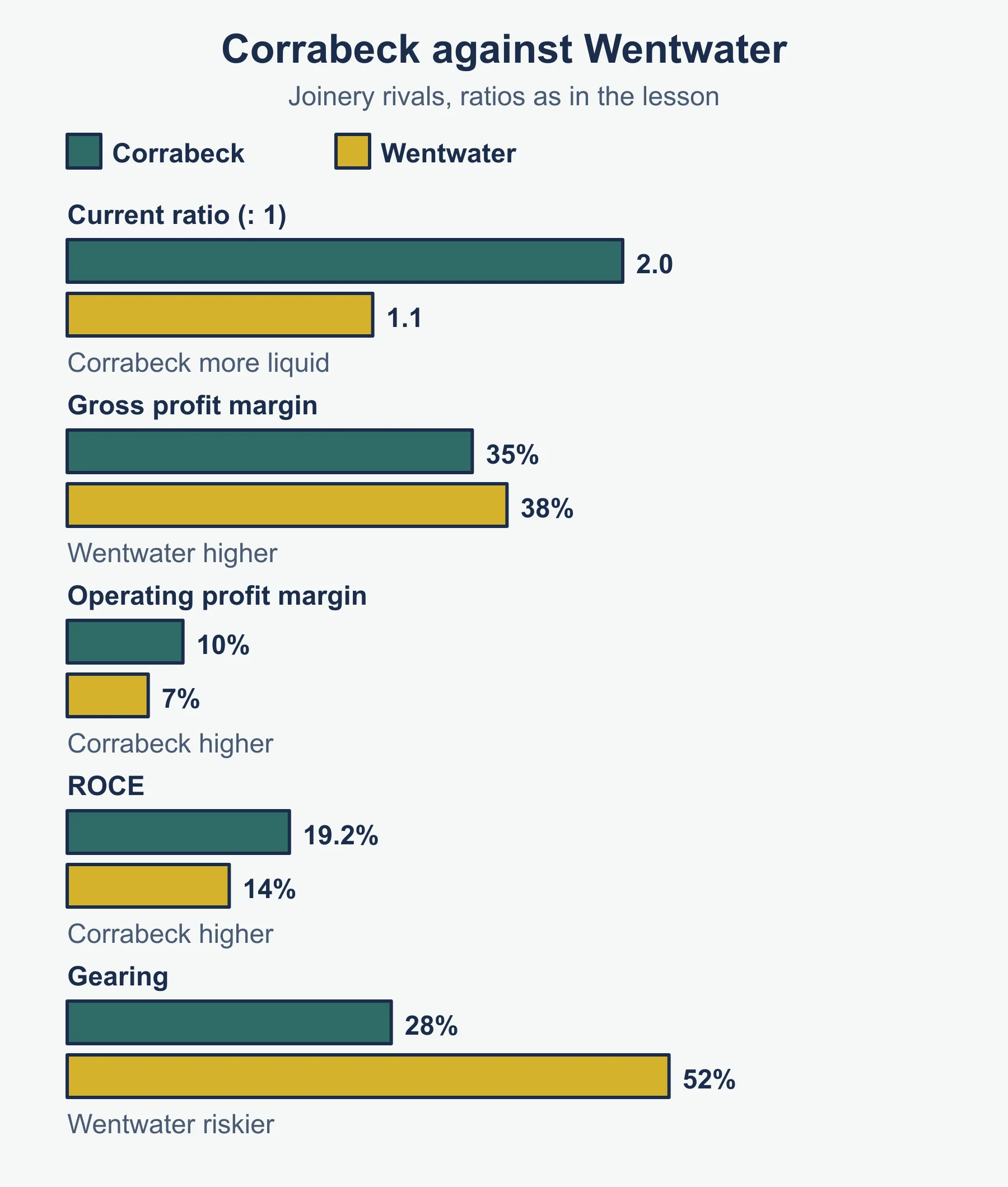
- Compare it: with last year, with a competitor, or with the business’s target.
- Say what it means for this business (use the context in the case).
- Give a reason that might explain it.
- Judge whether it matters, and what other information you would want.
Must-know distinctions
- Gross profit margin vs operating profit margin: the first ignores expenses; the second includes them.
- Current ratio vs acid test: the acid test removes inventory.
- Dividend yield vs dividend cover: yield is return on the share price; cover shows how safely the dividend is paid from profit.
- Receivable days vs payable days: low receivable days and high payable days help cash, but long supplier terms may harm relationships.
- Profit vs cash: depreciation lowers profit but does not move cash.
Quick self-test
- A machine costs 30,000, has a residual value of 3,000 and a life of 6 years. Find the straight-line charge and the net book value after 2 years.
- A shop holds 200 units that cost 16 each. They can be sold at 18, after spending 4 each on repairs. State the NRV per unit, the inventory value and the write-down.
- Non-current assets 1,500; current assets 700; current liabilities 400; non-current liabilities 600. Find net assets.
- Revenue 2,400; gross profit 900; profit from operations 300. Find both margins.
- Issued shares 500; reserves 300; non-current liabilities 200; profit from operations 150. Find capital employed and ROCE.
- Using question 5, find the gearing ratio.
- Receivables 150, credit sales 1,825; payables 90, credit purchases 1,095. Find both day figures.
- Cost of sales 1,440; opening inventory 200; closing inventory 280. Find the rate of inventory turnover.
- Dividend per share 9c; earnings per share 18c; market price 2.25 (dollars); profit for the year 360; annual dividend 180. Find yield, P/E and dividend cover.
- Current assets 600, inventory 240, current liabilities 400. Find both liquidity ratios.
- Give two ways to lower gearing.
- State one reason a depreciation charge does not mean cash has left the business.
Answers
- (30,000 − 3,000) ÷ 6 = 4,500 a year; net book value = 30,000 − 9,000 = 21,000.
- NRV = 18 − 4 = 14; cost 3,200 and NRV 2,800 so value at 2,800; write-down 400.
- 1,500 + (700 − 400) − 600 = 1,200.
- Gross profit margin 900 ÷ 2,400 × 100 = 37.5%; operating profit margin 300 ÷ 2,400 × 100 = 12.5%.
- Capital employed = 500 + 300 + 200 = 1,000; ROCE = 150 ÷ 1,000 × 100 = 15%.
- 200 ÷ 1,000 × 100 = 20%.
- 150 ÷ 1,825 × 365 = 30 days; 90 ÷ 1,095 × 365 = 30 days.
- Average inventory = 240; 1,440 ÷ 240 = 6 times.
- Yield = 9 ÷ 225 × 100 = 4% (using 0.09 ÷ 2.25); P/E = 2.25 ÷ 0.18 = 12.5; cover = 360 ÷ 180 = 2.0 times.
- Current ratio 1.5 : 1; acid test = 360 ÷ 400 = 0.9 : 1.
- Repay a loan; issue new shares; retain more profit.
- The cost was paid when the asset was bought; depreciation only spreads it across years.
Where marks are usually lost
- Using the wrong base: credit sales and credit purchases for the days ratios, not total revenue.
- Using closing inventory when average inventory is the data given.
- Leaving non-current liabilities out of capital employed.
- Forgetting to recalculate tax and later lines after an amendment.
- Quoting a ratio with no comparison or meaning, so there is no interpretation.
- Calling depreciation a cash cost or a fund for replacement.
- Suggesting a method of improvement that makes another ratio worse, with no mention of the trade-off.
- Judging a business on one ratio alone.
Frequently asked questions
Do I need to draw up a full set of accounts for Cambridge 9609? No. The syllabus does not expect you to draw up a set of accounts. It expects you to calculate, amend and interpret the statement of profit or loss, the statement of financial position and the ratios.
Which depreciation method is needed for Cambridge AS and A Level Business 9609? Only the straight-line method: cost minus residual value, divided by useful life. Depreciation is an expense that lowers profit but does not move cash.
What is net realisable value? Net realisable value is the estimated selling price minus the costs of selling or finishing the goods. If it is below cost, inventory is valued at net realisable value.
What is the difference between the current ratio and the acid test ratio? The current ratio divides current assets by current liabilities. The acid test removes inventory from current assets first, because inventory is the hardest current asset to turn into cash.
Official syllabus
Cambridge International AS & A Level Business 9609 syllabus for examination in 2026, 2027 and 2028, published by Cambridge University Press & Assessment (Cambridge International Education): sections 10.1 and 10.2 and the appendix of ratios.
Get free revision emails (optional)
Occasional emails with practice questions, worked explanations and links to free resources for the qualification and subjects you choose. No spam, and you can unsubscribe from any email. The free tools on this site never need an email.
Related resources
-
Study guides
A Level Business: Forecasting and managing cash flows (Cambridge 9609)
Study guide to 5.3 Forecasting and managing cash flows for Cambridge AS & A Level Business 9609, with worked forecasts and ways to improve cash flow.
Business · Cambridge · AS Level
Read guide -
Practice questions
A Level Business: Forecasting and managing cash flows (Cambridge 9609) – Practice Questions
Original practice questions with worked answers on 5.3 Forecasting and managing cash flows for Cambridge AS & A Level Business 9609.
Business · Cambridge · AS Level
Try questions -
Revision notes
A Level Business: Forecasting and managing cash flows (Cambridge 9609) – Revision Notes
Condensed revision notes for 5.3 Forecasting and managing cash flows in Cambridge AS & A Level Business 9609, with a self-test and common mark losses.
Business · Cambridge · AS Level
Revise topic
Related articles
-
teaching
A Level tuition in Dubai: Cambridge or Pearson Edexcel International A Level?
Schools in Dubai and Abu Dhabi teach either Cambridge International AS & A Level or Pearson Edexcel International A Level. How the two are structured, why it matters for tuition, and how online classes from Lahore work.
9 October 2026
-
curriculum guides
Choosing subjects at IGCSE and A Level
How subject choices at 14 and 16 affect university options later, and how to keep pathways open without overloading a timetable.
28 July 2026
Studying this with a teacher
Working through Business A LEVEL?
This page is free and stays free. If you would rather be taught it, Marlbridge runs Business classes one-to-one and in small groups of up to 15, online in your own time zone. The first trial class is free. WhatsApp replies within an hour (8am–11pm Pakistan time, every day); email the same day.
Cambridge Business teachers at Marlbridge

