
Study Guides
A Level Business: Forecasting and managing cash flows (Cambridge 9609)
Study guide to 5.3 Forecasting and managing cash flows for Cambridge AS & A Level Business 9609, with worked forecasts and ways to improve cash flow.
- Subject
- Business
- Level
- AS LEVEL
- Topic
- Finance and accounting
- Author
- Marlbridge Academic Team
- Updated
- Reviewed by
- Salman Ahmad (what this means)
Aligned to Cambridge A Level Business (9609), For examination in 2026, 2027 and 2028. Official specification .
Syllabus page (what it covers and how it is assessed): Cambridge A Level Business.
Syllabus points this page covers
9609 (AS Level)
- 5.3 Forecasting and managing cash flows
Found an error? Report a correction.
Need help with this topic? Request a free trial class for A Level Business (9609).
This guide covers section 5.3 Forecasting and managing cash flows (5.3.1 Cash flow forecasts) of the Cambridge International AS & A Level Business 9609 syllabus for examination in 2026, 2027 and 2028. It is an AS Level topic, and the syllabus says A Level candidates also study the AS content. Use it with the revision notes and the practice questions. Course links: the Cambridge A Level Business hub, the checklist and the free diagnostics. For exam technique across the course, see the 9609 past papers page.
All businesses in this guide are invented. Currency is in pounds, and every figure has been checked.
What the syllabus asks for
| Syllabus point (5.3.1) | What you must be able to do |
|---|---|
| The meaning and purpose of cash flow forecasts | Define a forecast and explain why businesses prepare one |
| Interpretation and amendment of simple cash flow forecasts: calculating opening and closing balances | Read a forecast, find and fill in balances, and change a forecast when circumstances change |
| Different methods of improving cash flow | Explain and weigh up ways to bring cash in sooner, take it out later or spend less |
The syllabus gives no list of methods, so you choose from what you know of 5.1 and 5.2 and judge them for the case. The topic sits beside the difference between cash and profit and the idea of working capital in 5.1.
Meaning and purpose
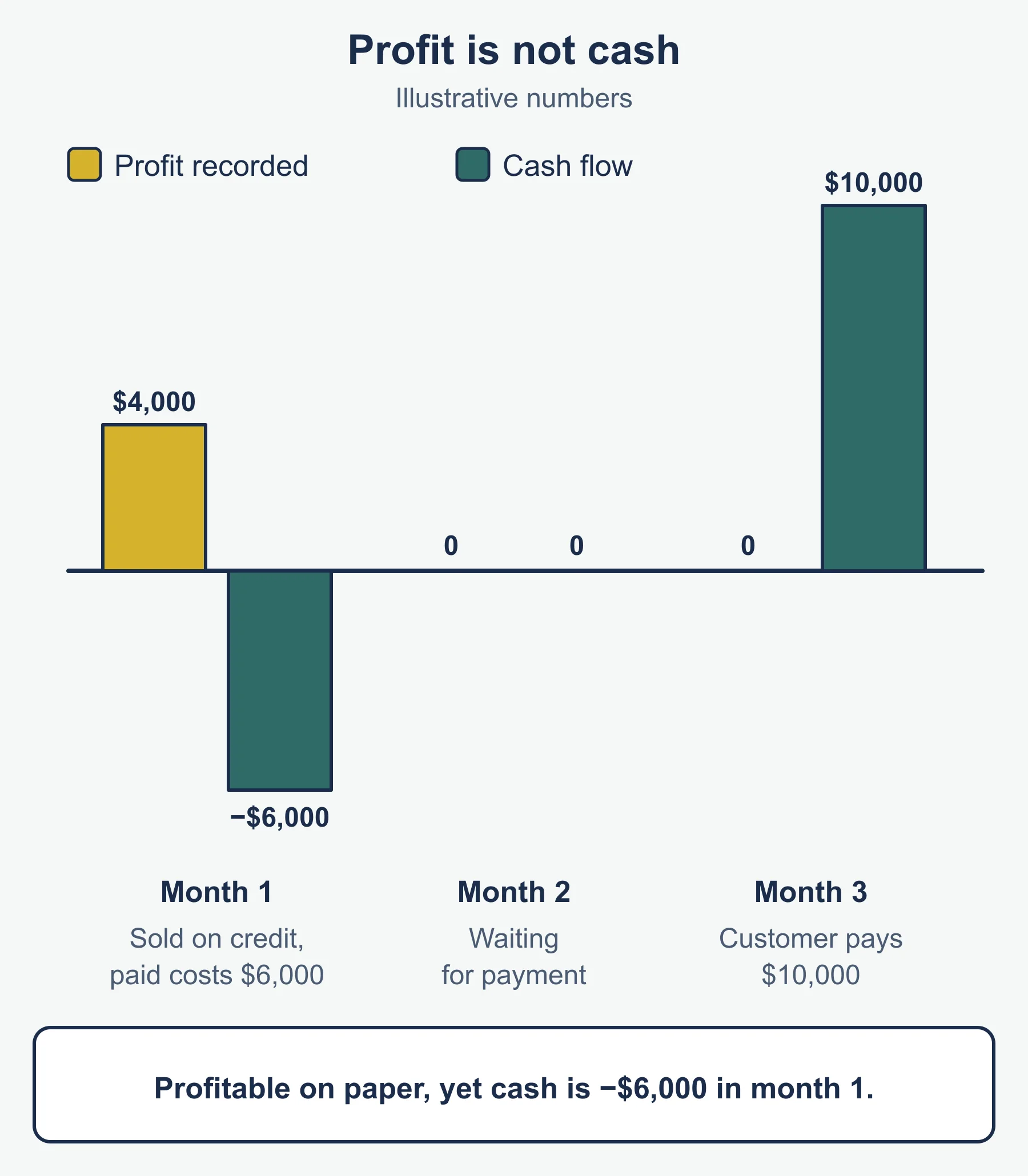
A cash flow forecast is an estimate of the cash a business expects to receive and pay out over a future period, usually month by month, showing the expected cash balance at the end of each month. Cash means money in the bank or in hand, so a sale made on credit is not a cash inflow until the customer pays.
Purposes:
- Spotting shortfalls early, so there is time to arrange an overdraft or a loan before the money runs out.
- Supporting a request for finance, because lenders and investors want to see that the business can meet repayments.
- Planning the timing of big spending, such as equipment, so it does not fall in a weak month.
- Setting a standard to check against. If actual cash differs from the forecast, managers can find out why and act.
- Helping a start-up decide how much finance it needs before it opens.
Forecasts matter because a business can be profitable and still fail if it cannot pay bills when they fall due. The syllabus links lack of finance to business failure: bankruptcy, liquidation and administration (5.1.1).
Layout and balances
A forecast has three blocks: cash inflows, cash outflows and the balances.
Standard form (the syllabus does not print these formulae):
- Net cash flow = total cash inflows − total cash outflows
- Closing balance = opening balance + net cash flow
- Opening balance for a month = closing balance of the previous month
Inflows usually include cash sales, receipts from customers who bought on credit, loans received, owner investment and proceeds of asset sales. Outflows usually include payments for materials, wages, rent and other overheads, equipment, loan repayments and tax. Items that are not cash movements, such as depreciation, do not appear.
Worked example 1: Lymmerton Print Studio
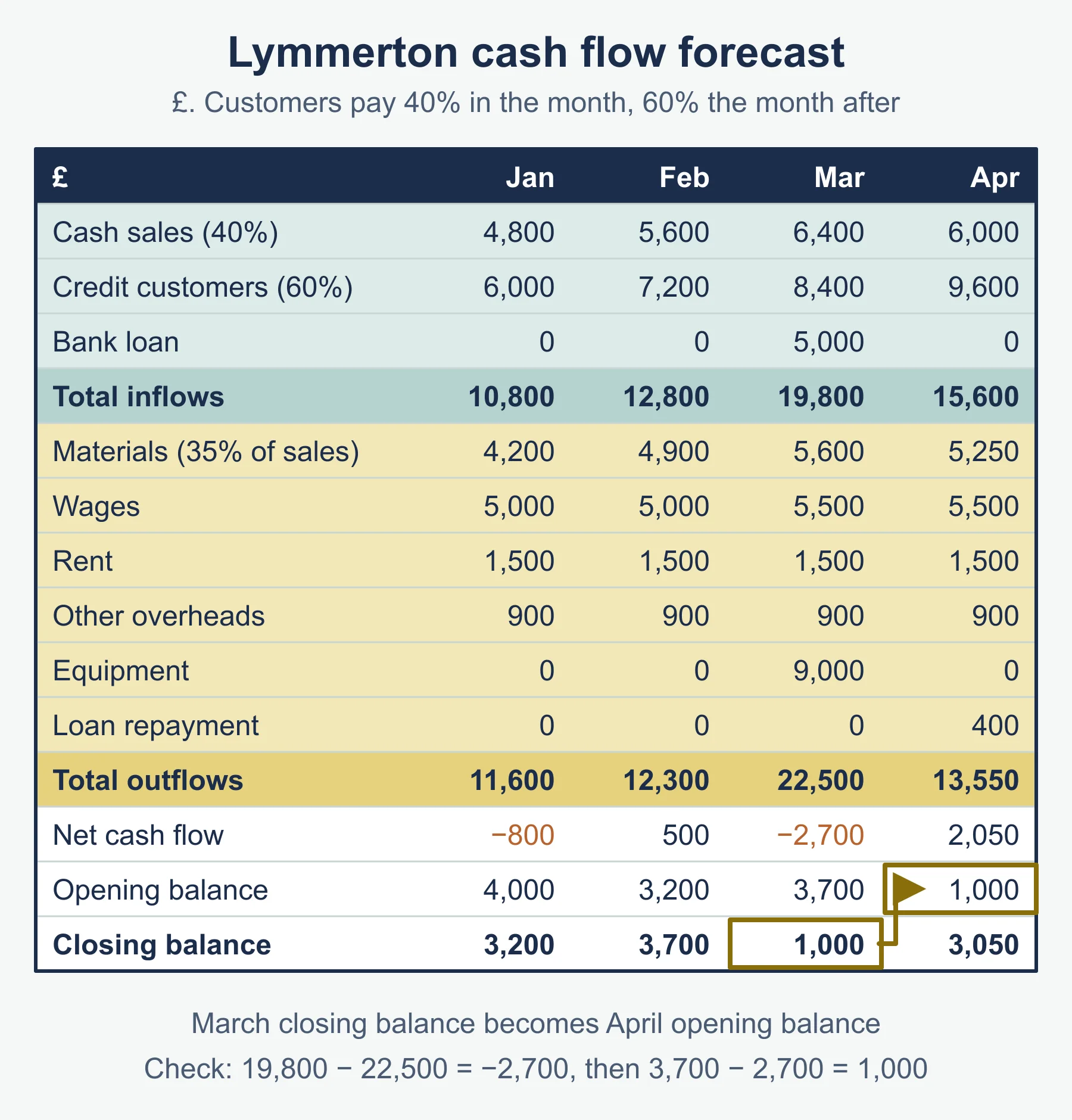
Lymmerton expects sales of £10,000 in December, then £12,000, £14,000, £16,000 and £15,000 in January to April. Customers pay 40% in the month of sale and 60% the month after. Materials cost 35% of that month’s sales and are paid in the month. Wages are £5,000 in January and February and £5,500 after. Rent is £1,500 and other overheads £900 each month. In March it receives a £5,000 bank loan and buys equipment for £9,000. From April it repays £400 a month. The opening balance in January is £4,000.
Building the inflows: January cash sales are 40% of £12,000 = £4,800, and credit receipts are 60% of December’s £10,000 = £6,000.
| £ | Jan | Feb | Mar | Apr |
|---|---|---|---|---|
| Cash sales | 4,800 | 5,600 | 6,400 | 6,000 |
| Credit customers paying | 6,000 | 7,200 | 8,400 | 9,600 |
| Bank loan | 0 | 0 | 5,000 | 0 |
| Total inflows | 10,800 | 12,800 | 19,800 | 15,600 |
| Materials | 4,200 | 4,900 | 5,600 | 5,250 |
| Wages | 5,000 | 5,000 | 5,500 | 5,500 |
| Rent | 1,500 | 1,500 | 1,500 | 1,500 |
| Other overheads | 900 | 900 | 900 | 900 |
| Equipment | 0 | 0 | 9,000 | 0 |
| Loan repayment | 0 | 0 | 0 | 400 |
| Total outflows | 11,600 | 12,300 | 22,500 | 13,550 |
| Net cash flow | −800 | 500 | −2,700 | 2,050 |
| Opening balance | 4,000 | 3,200 | 3,700 | 1,000 |
| Closing balance | 3,200 | 3,700 | 1,000 | 3,050 |
Check one column. March: 19,800 − 22,500 = −2,700, and 3,700 − 2,700 = 1,000. The March closing balance becomes the April opening balance.
Interpreting a forecast
Read a forecast in this order.
- Find the lowest closing balance and the month it occurs. Lymmerton’s lowest balance is £1,000 in March.
- Ask why. March has a one-off equipment purchase of £9,000, which is only partly funded by the loan.
- Look at the trend. The business has positive net cash flow in two of four months, and April recovers.
- Compare the balance with what the business needs. £1,000 against monthly outflows of about £22,500 leaves no cushion.
- Check the assumptions. Is 40% cash sales realistic, and will credit customers pay on time?
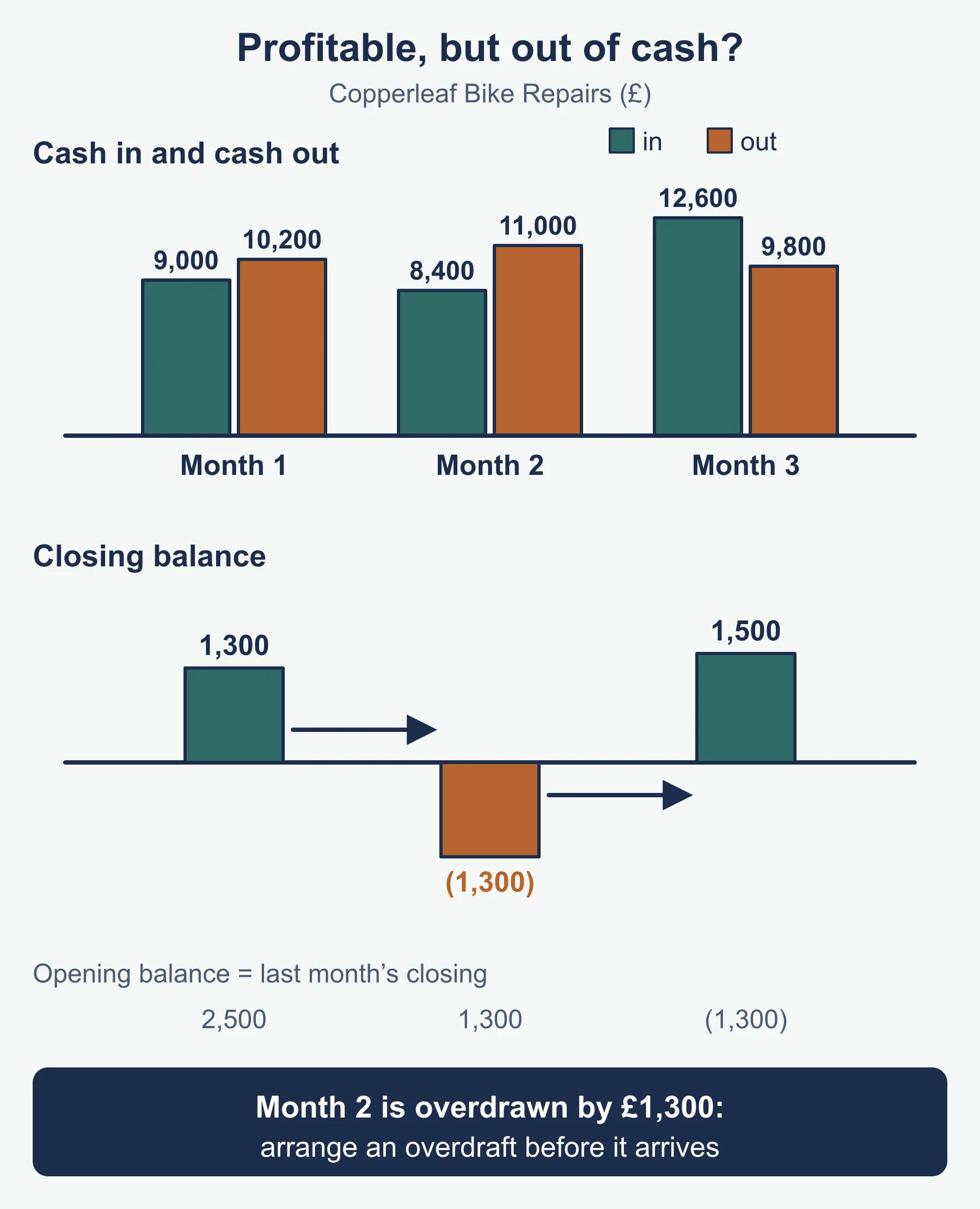
A negative closing balance means the business expects to be overdrawn or to run out of cash unless it finds finance. A large positive balance is not automatically good. Idle cash could be earning a return, repaying debt or funding growth.
Amending a forecast
Forecasts are changed when information changes. Tell the story in numbers: change the affected lines, recalculate the totals, and carry the new closing balance forward, because each later opening balance changes too.
Worked example 2: amending the Lymmerton forecast
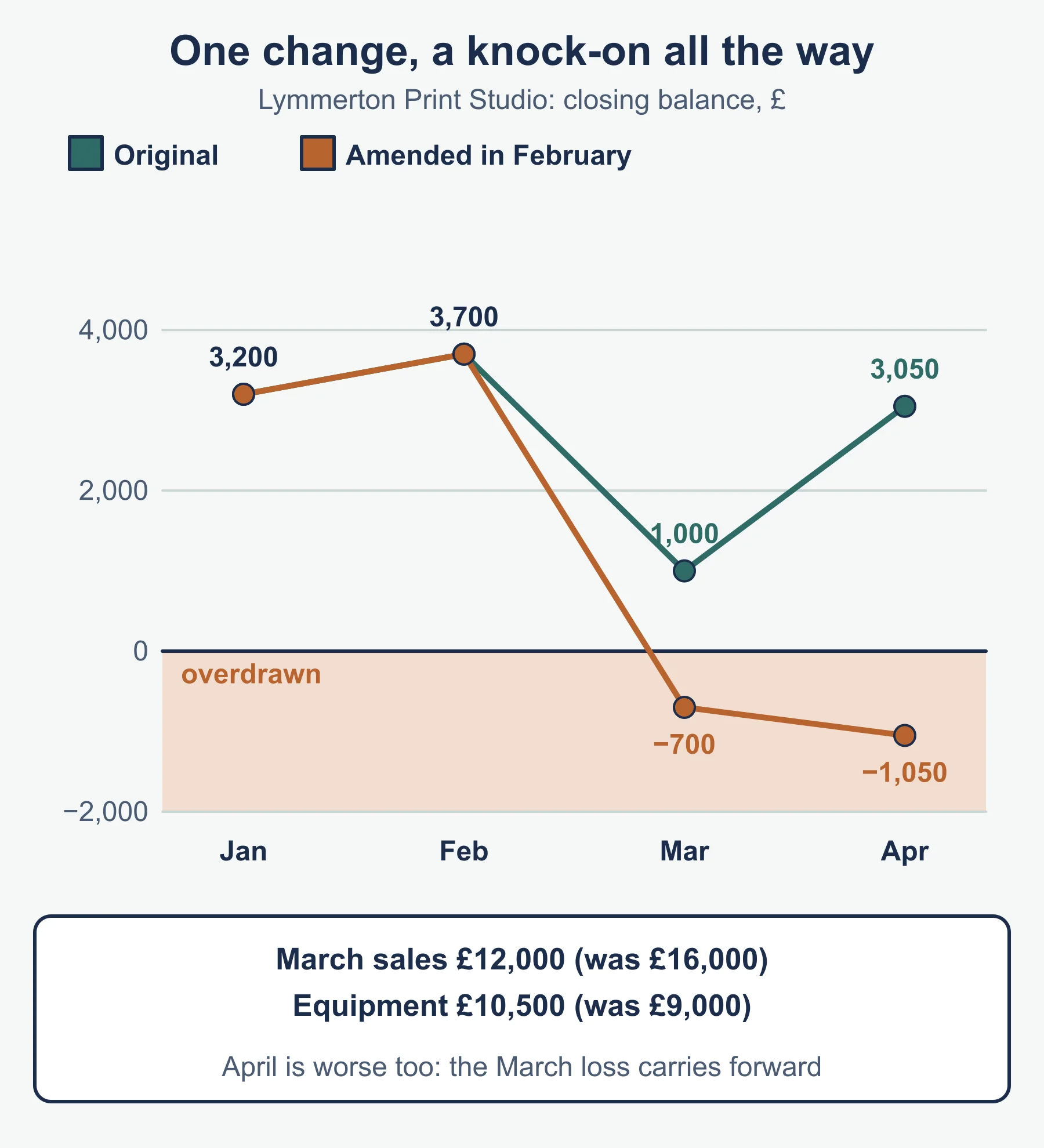
In February the studio learns two things. A large customer cancels, so March sales will be £12,000 rather than £16,000, and the equipment quote has risen to £10,500.
- March cash sales: 40% of £12,000 = £4,800. Credit receipts (60% of February’s £14,000) stay at £8,400. With the loan, inflows are £18,200.
- March materials: 35% of £12,000 = £4,200. Outflows are 4,200 + 5,500 + 1,500 + 900 + 10,500 = £22,600.
- March net cash flow = 18,200 − 22,600 = −4,400. Closing balance = 3,700 − 4,400 = −£700.
- April credit receipts fall to 60% of £12,000 = £7,200, so inflows are 6,000 + 7,200 = £13,200. Outflows are 5,250 + 5,500 + 1,500 + 900 + 400 = £13,550. Net = −350, and the April closing balance is −700 − 350 = −£1,050.
The business now expects to be overdrawn by £700 in March and by £1,050 in April. No April cost changed, yet April got worse because of the March carry-forward and the lower credit receipts. That knock-on effect is a common point to make in analysis.
Limitations of forecasts
Forecasts are estimates, so interpret them with care.
- They rely on sales forecasts, and sales are hard to predict, especially for a new business with no trading history.
- Costs can rise, and suppliers can change their terms.
- Customers may pay late or not at all.
- Managers can be over-optimistic, particularly when the forecast is used to win finance.
- Unexpected events, such as a rival opening nearby, can make the forecast out of date quickly.
- Preparing it takes time and skill, and it is only useful if kept up to date.
Methods of improving cash flow
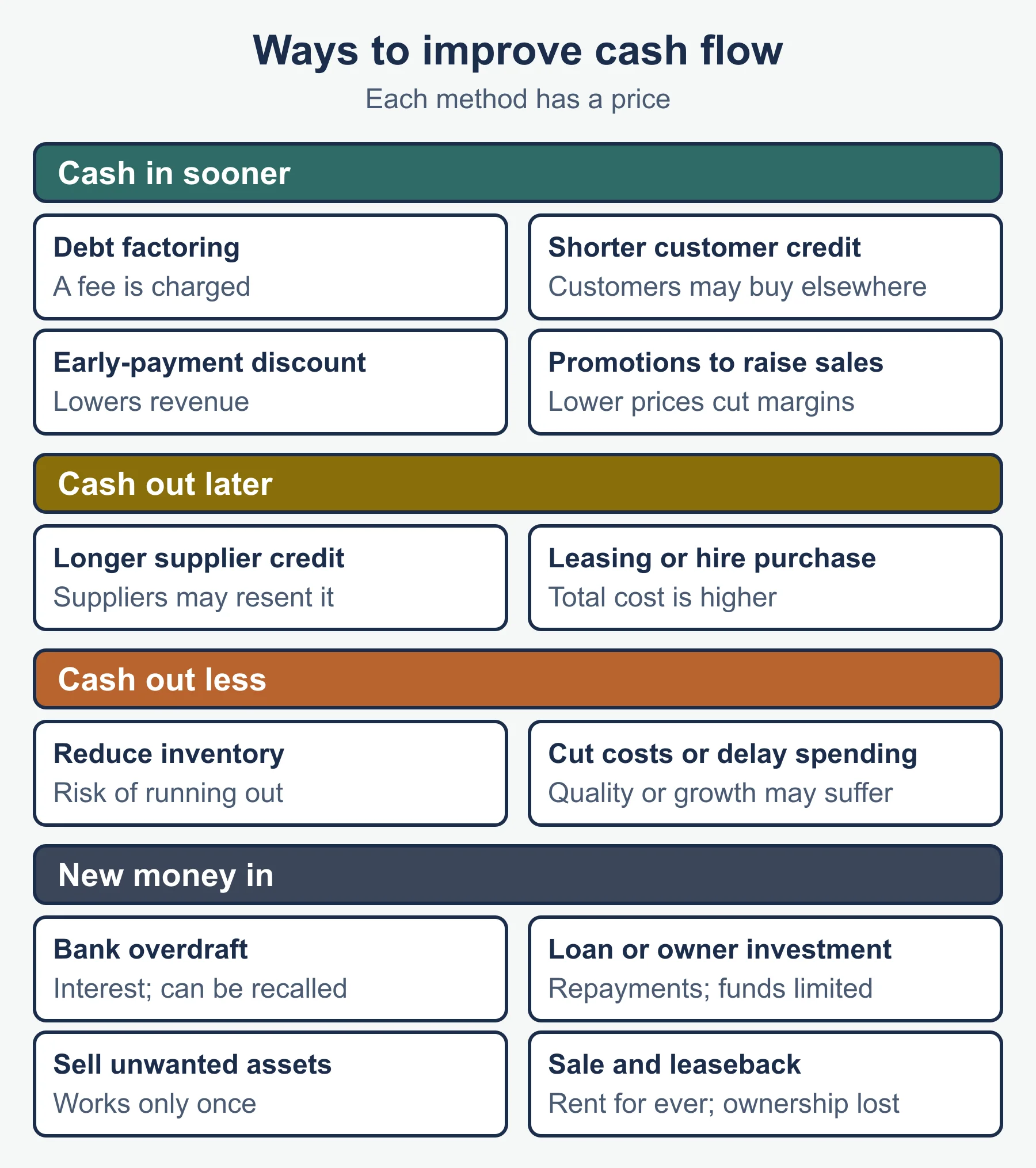
The aim is to bring cash in sooner, delay cash going out, or cut how much goes out. Some methods also link to the sources of finance in 5.2.2.
| Method | How it helps cash flow | Main drawback |
|---|---|---|
| Bank overdraft | Covers short-term gaps quickly | Interest is charged, and the bank can ask for repayment |
| Bank loan or owner investment | Brings in a lump sum | Loan interest and repayments; owner funds may be limited |
| Sale of unwanted assets | One-off cash from items not needed | Only works once; may sell below value |
| Sale and leaseback of non-current assets | Releases cash tied up in an asset while keeping its use | Rent is paid for ever after, and the business loses ownership |
| Debt factoring | Cash is received soon after invoicing | A fee is charged, and the customer deals with the factor |
| Reduce the credit period given to customers | Cash arrives sooner | Customers may buy elsewhere |
| Offer a discount for early payment | Cash arrives sooner | The discount lowers revenue |
| Increase the credit period taken from suppliers | Payments go out later | Suppliers may resent it, or withdraw credit or charge more |
| Reduce inventory | Frees cash tied up in stock | Risk of running out and losing sales |
| Leasing or hire purchase instead of buying | Avoids a large outright payment | Total cost is higher over time |
| Cut costs or delay capital spending | Reduces outflows | Quality or growth may suffer |
| Promotions to raise sales | Brings revenue forward | Lower prices cut margins; costs rise first |
Worked example 3: Ossington Bakery
Ossington sells to cafes on credit. Credit sales are £20,000 a month and customers take 60 days. It holds £8,000 of ingredients and packaging.
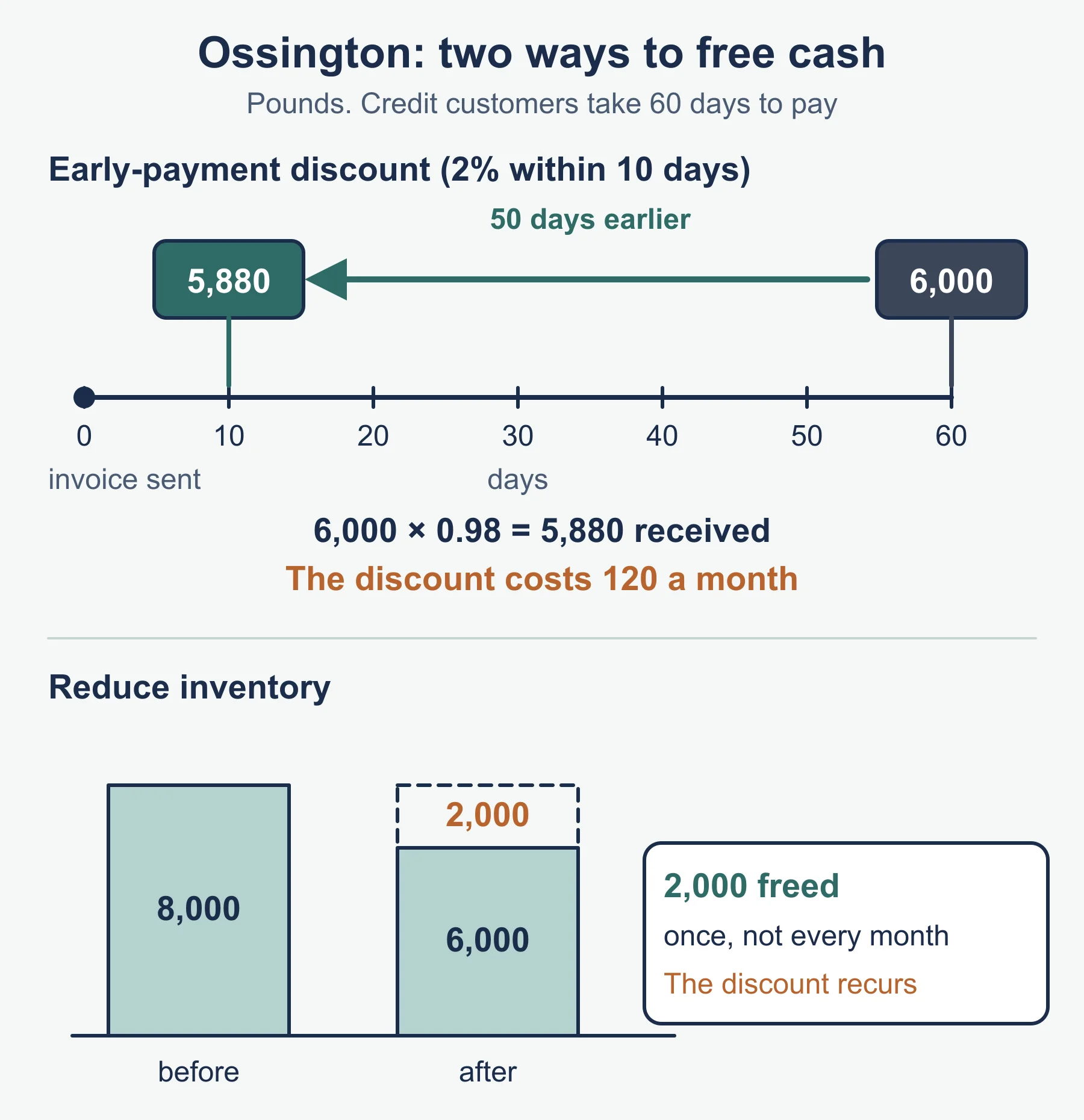
- Early-payment discount: it offers 2% off for payment within 10 days, and customers owing 30% of the value take it. That is £6,000 a month paid about 50 days earlier. Cash received is 6,000 × 0.98 = £5,880, and the discount costs £120 a month.
- Reduced inventory: moving to more frequent deliveries lets stock fall from £8,000 to £6,000. That releases £2,000 once, not every month.
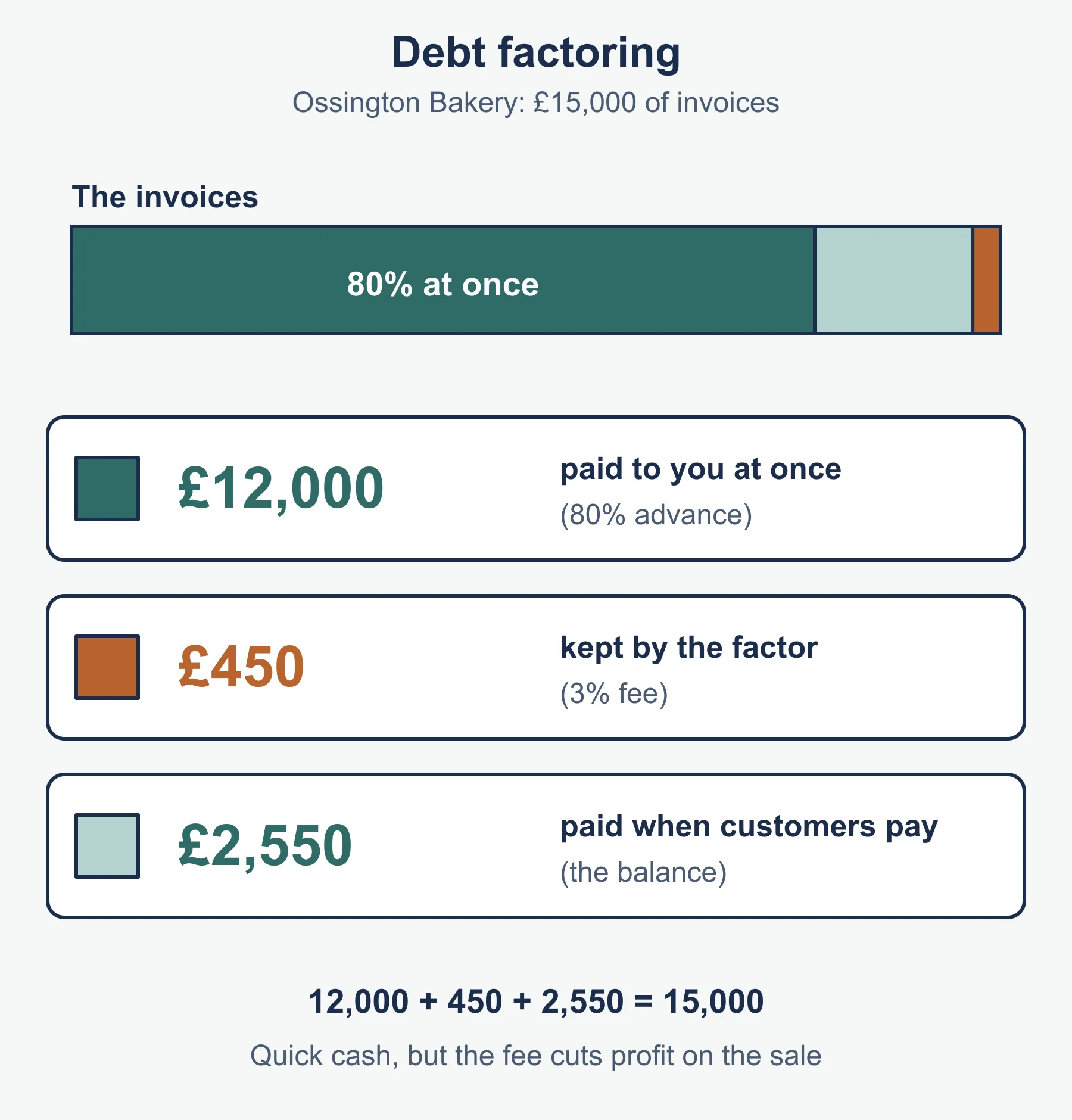
- Debt factoring: on £15,000 of invoices, the factor advances 80% (£12,000) at once and charges a 3% fee (£450). The remaining £2,550 is passed on when the customers pay.
A good answer weighs these. The discount is cheap relative to the cash gained but depends on customers taking it. The stock reduction is a one-off. Factoring gives quick cash but at a cost, and the fee makes the sale less profitable.
Choosing and judging a method
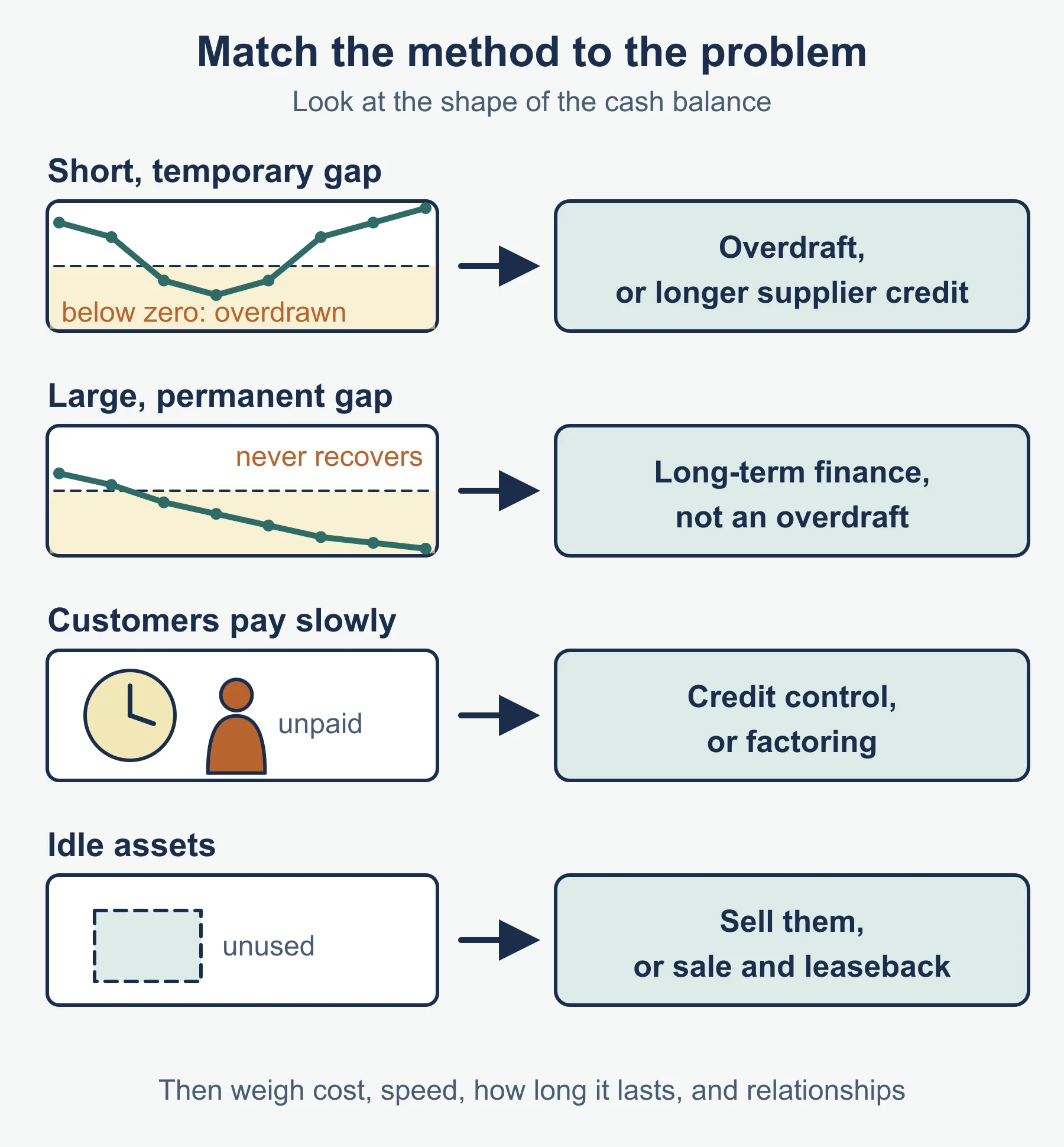
Match the method to the problem.
- A short, temporary gap, such as a seasonal dip, suits an overdraft or longer supplier credit.
- A large permanent gap suits long-term finance, not an overdraft.
- A business short of cash because of slow-paying customers should look at credit control and factoring.
- A business with idle assets could sell or lease them back.
- A method that harms customers or suppliers may fix this month’s cash and damage the business later.
For evaluation, weigh cost, speed, how long the effect lasts, the risk to relationships, and what the forecast shows about the size and length of the problem. Then give a justified judgement.
In the exam
The syllabus says Paper 1 Section A has four compulsory five-mark questions, and Paper 2 has data response questions with six parts and evaluation in the last part. Both test AS content. Papers 3 and 4 assume AS knowledge.
- Calculation: show each figure, because the working shows what you understood.
- Analysis: link a number to a consequence, such as the overdraft, then to the effect on the business.
- Evaluation: weigh at least two options against the context, and say which you would choose and why.
Common errors
- Counting sales as cash inflows when customers have not yet paid.
- Including depreciation or profit as a cash outflow or inflow.
- Forgetting that the closing balance carries forward as the next opening balance.
- Subtracting inflows from outflows and getting the sign wrong.
- Saying “improve cash flow by making more profit”, which ignores timing.
- Recommending an overdraft for a long-term need.
- Listing methods without applying them to the business.
Frequently asked questions
How is cash flow examined in Cambridge 9609? Section 5.3 is AS content. The syllabus says Paper 1 Section A has four compulsory five-mark questions and Paper 2 has data response questions with six parts and evaluation in the last part; Papers 3 and 4 assume AS knowledge.
What are the main ways to improve cash flow? Bring cash in sooner, for example through shorter customer credit, early-payment discounts or debt factoring; delay cash going out, for example through longer supplier credit or leasing; or cut outflows by reducing costs and inventory.
Should an overdraft be used for a long-term cash need? No. An overdraft suits a short, temporary gap such as a seasonal dip. A large, permanent gap needs long-term finance.
Can a business improve cash flow just by making more profit? Not on its own. Cash flow depends on timing, so a business must also manage when customers pay and when it pays suppliers.
Official syllabus
Cambridge International AS & A Level Business 9609 syllabus for examination in 2026, 2027 and 2028, published by Cambridge University Press & Assessment, section 5.3 Forecasting and managing cash flows.
Get free revision emails (optional)
Occasional emails with practice questions, worked explanations and links to free resources for the qualification and subjects you choose. No spam, and you can unsubscribe from any email. The free tools on this site never need an email.
Related resources
-
Practice questions
A Level Business: Forecasting and managing cash flows (Cambridge 9609) – Practice Questions
Original practice questions with worked answers on 5.3 Forecasting and managing cash flows for Cambridge AS & A Level Business 9609.
Business · Cambridge · AS Level
Try questions -
Revision notes
A Level Business: Forecasting and managing cash flows (Cambridge 9609) – Revision Notes
Condensed revision notes for 5.3 Forecasting and managing cash flows in Cambridge AS & A Level Business 9609, with a self-test and common mark losses.
Business · Cambridge · AS Level
Revise topic -
Study guides
A Level Business: Investment appraisal and Finance and accounting strategy (Cambridge 9609)
Study guide to payback, ARR, NPV, investment decisions and using accounting data and ratios in strategy, for Cambridge A Level Business 9609.
Business · Cambridge · A Level
Read guide
Related articles
-
teaching
A Level tuition in Dubai: Cambridge or Pearson Edexcel International A Level?
Schools in Dubai and Abu Dhabi teach either Cambridge International AS & A Level or Pearson Edexcel International A Level. How the two are structured, why it matters for tuition, and how online classes from Lahore work.
9 October 2026
-
curriculum guides
Choosing subjects at IGCSE and A Level
How subject choices at 14 and 16 affect university options later, and how to keep pathways open without overloading a timetable.
28 July 2026
Studying this with a teacher
Working through Business AS LEVEL?
This page is free and stays free. If you would rather be taught it, Marlbridge runs Business classes one-to-one and in small groups of up to 15, online in your own time zone. The first trial class is free. WhatsApp replies within an hour (8am–11pm Pakistan time, every day); email the same day.
Cambridge Business teachers at Marlbridge

