
Revision Notes
A Level Business: Business finance and Sources of finance (Cambridge 9609) – Revision Notes
Condensed revision notes for 5.1 Business finance and 5.2 Sources of finance in Cambridge AS & A Level Business 9609, with a self-test.
- Subject
- Business
- Level
- AS LEVEL
- Topic
- Finance and accounting
- Author
- Marlbridge Academic Team
- Updated
- Reviewed by
- Salman Ahmad (what this means)
Aligned to Cambridge A Level Business (9609), For examination in 2026, 2027 and 2028. Official specification .
Syllabus page (what it covers and how it is assessed): Cambridge A Level Business.
Syllabus points this page covers
9609 (AS Level)
- 5.1 Business finance
- 5.2 Sources of finance
Found an error? Report a correction.
Need help with this topic? Request a free trial class for A Level Business (9609).
These are condensed notes for sections 5.1 Business finance and 5.2 Sources of finance of the Cambridge International AS & A Level Business 9609 syllabus for examination in 2026, 2027 and 2028 (5.1.1 to 5.2.4, an AS Level topic that A Level candidates also study). For full explanations and worked examples, use the study guide, then test yourself with the practice questions. Course links: the Cambridge A Level Business hub, the printable checklist and the free diagnostics.
5.1.1 The need for business finance
| Point | Remember |
|---|---|
| Start up | Premises, equipment, first inventory, costs before sales revenue arrives |
| Grow | New site, machinery, new products, takeover |
| Survive | Wages, suppliers and bills when sales revenue is weak, a customer fails to pay or costs rise |
| Short term need | Repaid within about a year: bridging the gap between paying suppliers and being paid |
| Long term need | Lasts years: buildings, major equipment |
| Matching | Make the finance last as long as the need |
Cash versus profit
| Cash | Profit | |
|---|---|---|
| Meaning | Money held and usable now | Sales revenue minus costs over a period |
| Credit sale | No cash until the customer pays | Counted when the sale is made |
| Equipment bought | Cash leaves at once | Not all counted as a cost of the period |
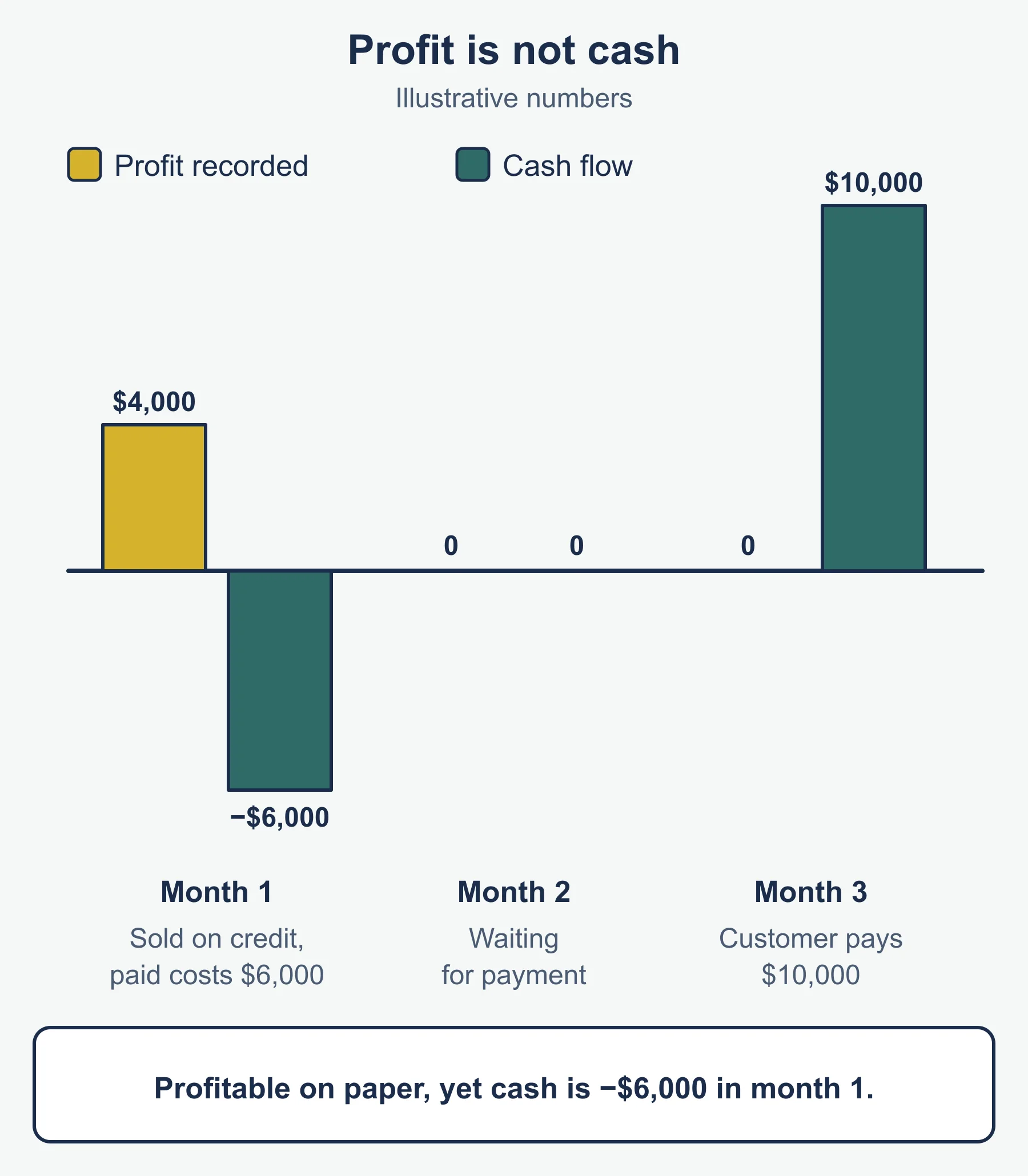
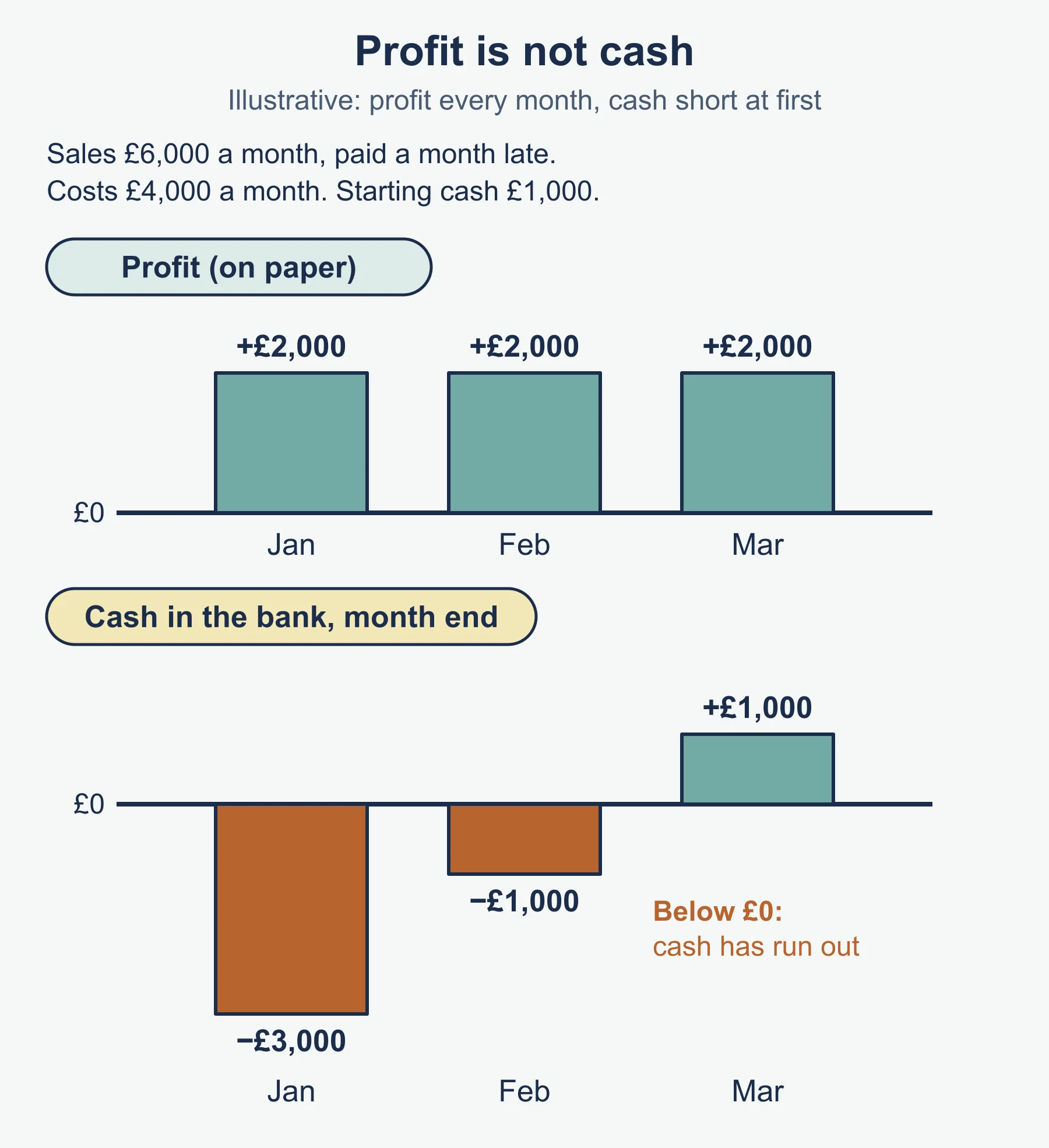
Reminder. Sales on credit of £20,000 with £13,000 of costs paid in the month give a profit of £7,000, but the business is £13,000 down in cash until the customers pay.
Failure from lack of finance
| Term | General meaning |
|---|---|
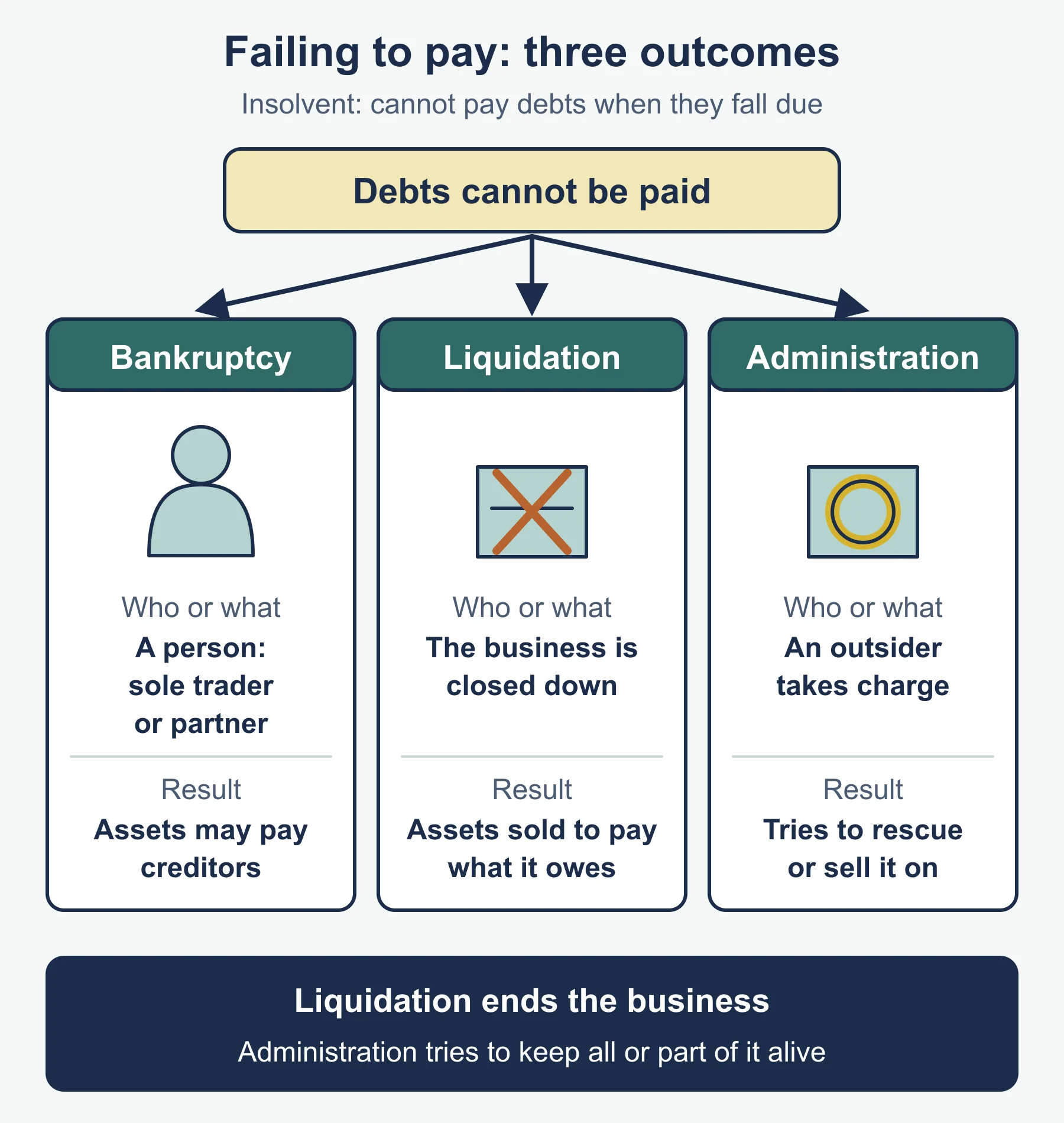
| Bankruptcy | An individual (a sole trader or partner) who cannot pay personal debts |
| Liquidation | The business is closed and its assets sold to pay creditors as far as they go |
| Administration | An outside administrator tries to rescue the business or sell it as a going concern |
Liquidation ends the business. Administration tries to keep all or part of it alive.
5.1.2 Working capital
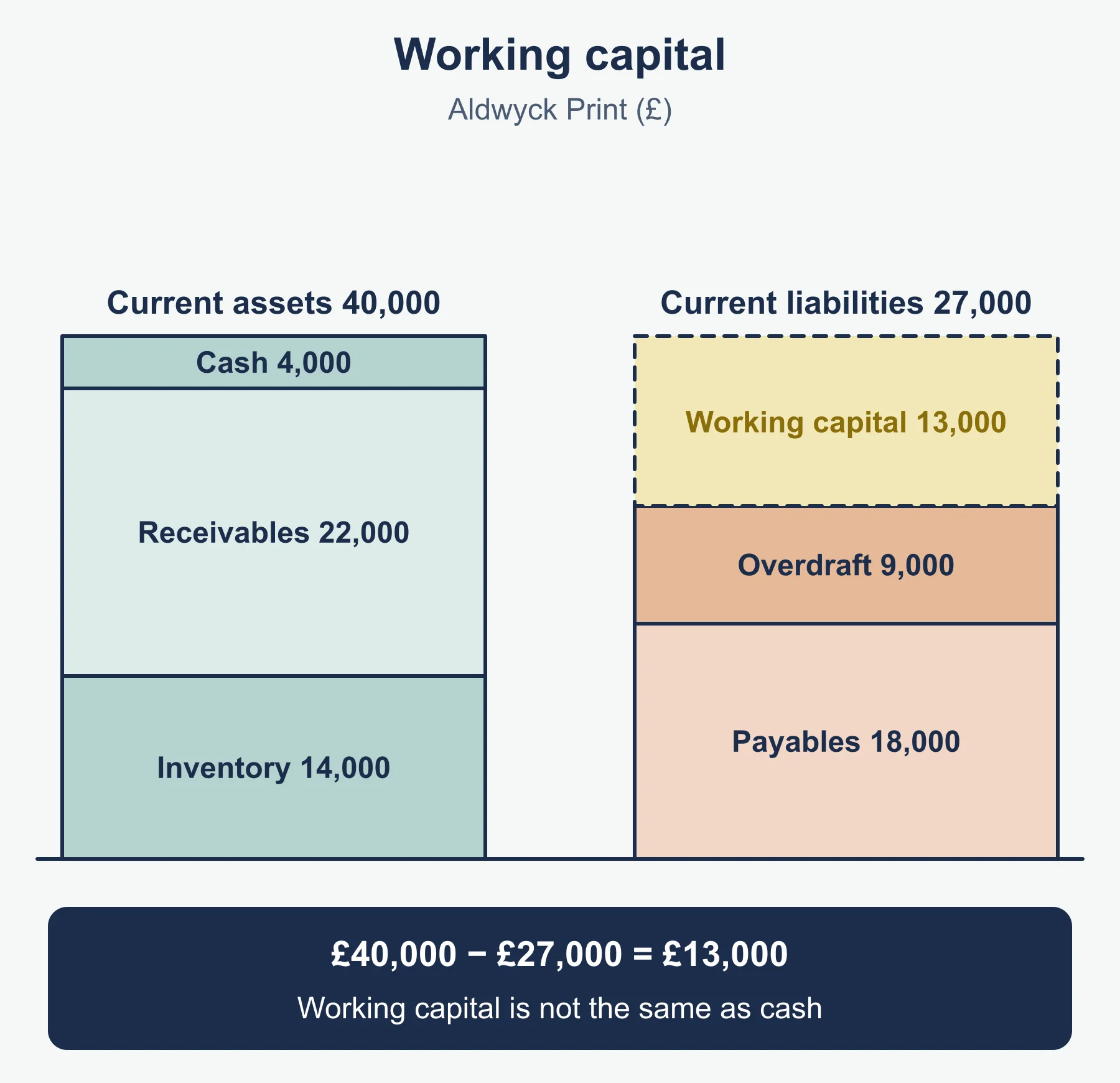
Working capital is current assets minus current liabilities (standard form).
| Current assets | Current liabilities |
|---|---|
| Inventory | Trade payables |
| Trade receivables | Overdraft |
| Cash | Other debts due within a year |
Reminder. Current assets of £31,000 and current liabilities of £22,500 give working capital of £8,500.
- Importance: pays wages, suppliers and expenses as they fall due. Too little risks being unable to pay even when profit is good. Too much leaves money idle in inventory or unpaid invoices.
- Not the same as cash: cash is only one current asset.
Method in steps: improving the management of trade receivables
- Set clear credit terms and check customers before giving credit.
- Send invoices and reminders promptly.
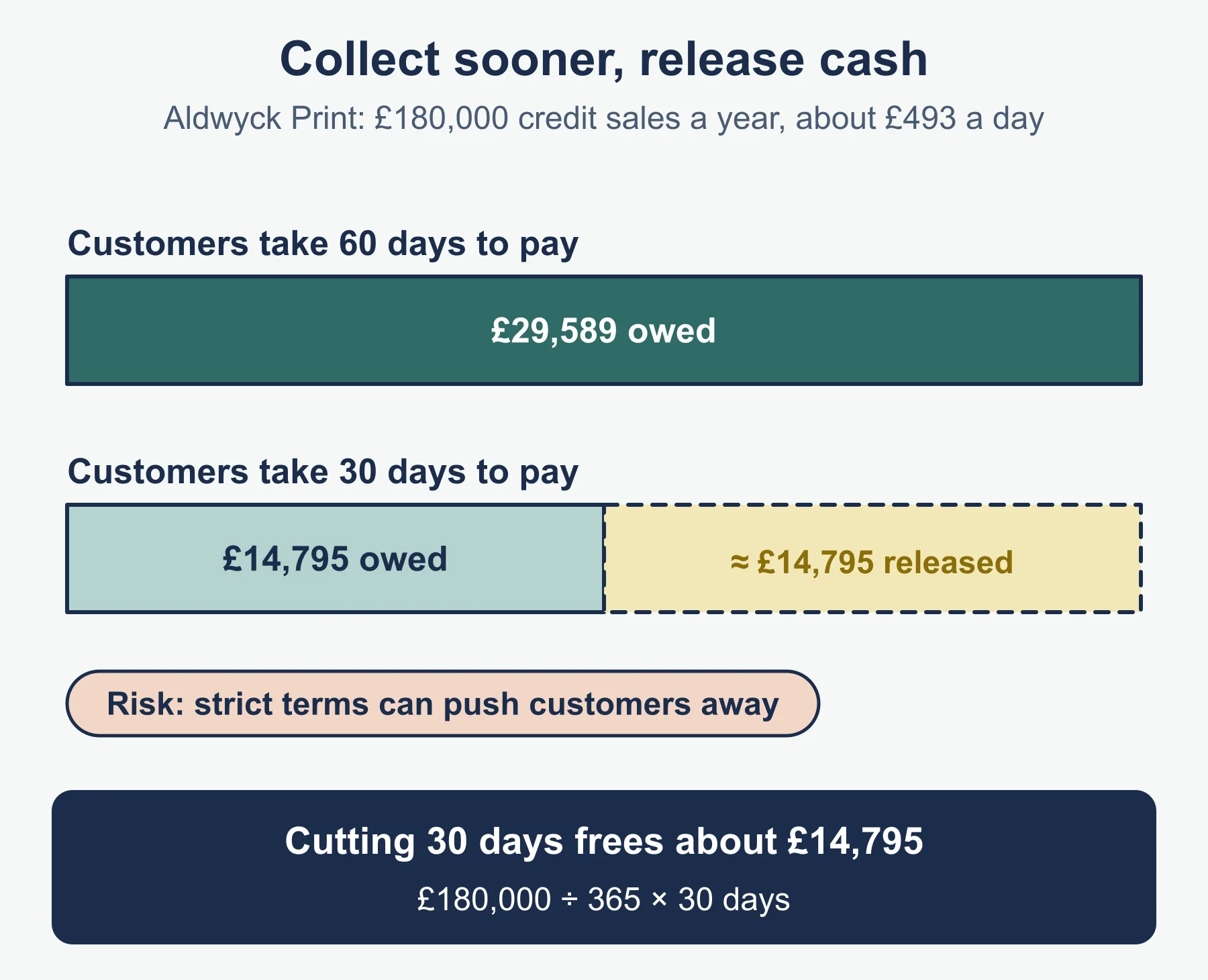
- Offer a discount for early payment, weighing its cost against the cash gained.
- Consider debt factoring.
- Weigh the risk that strict terms push customers to rivals.
Reminder. Credit sales of £96,000 a year are about £263 a day. Cutting the credit period by 12 days releases about £3,156.
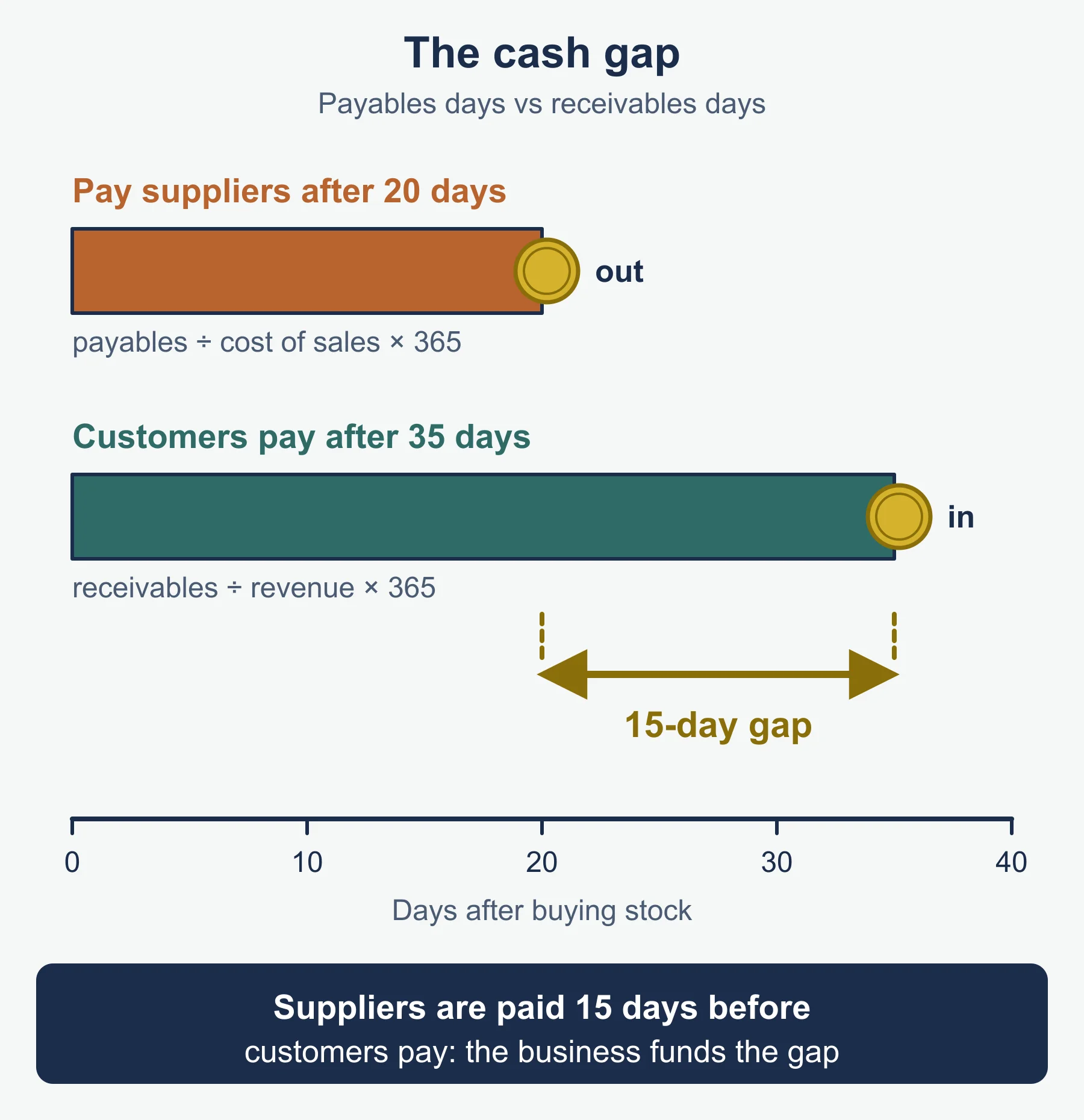
Trade payables
Using the credit period fully keeps cash in the business. Paying late risks lost supplier goodwill, refusal to deliver or extra charges.
Capital and revenue expenditure
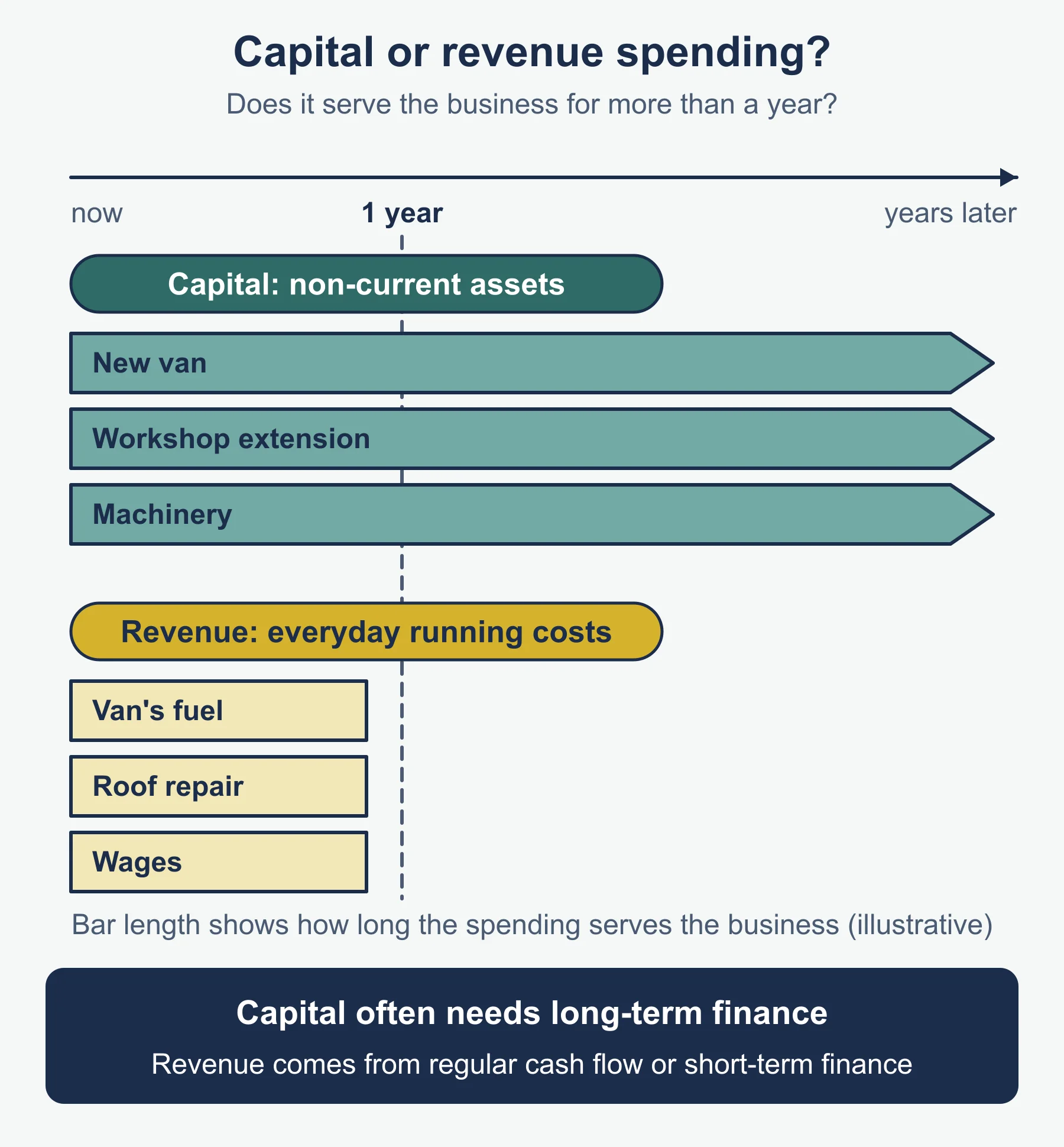
| Capital expenditure | Revenue expenditure | |
|---|---|---|
| What | Spending on non-current assets used for more than a year | Spending on day-to-day running |
| Examples | Machinery, vehicles, buildings | Wages, materials, rent, repairs |
| Usual finance | Long term | Day-to-day cash flow or short term |
5.2.1 Ownership and finance
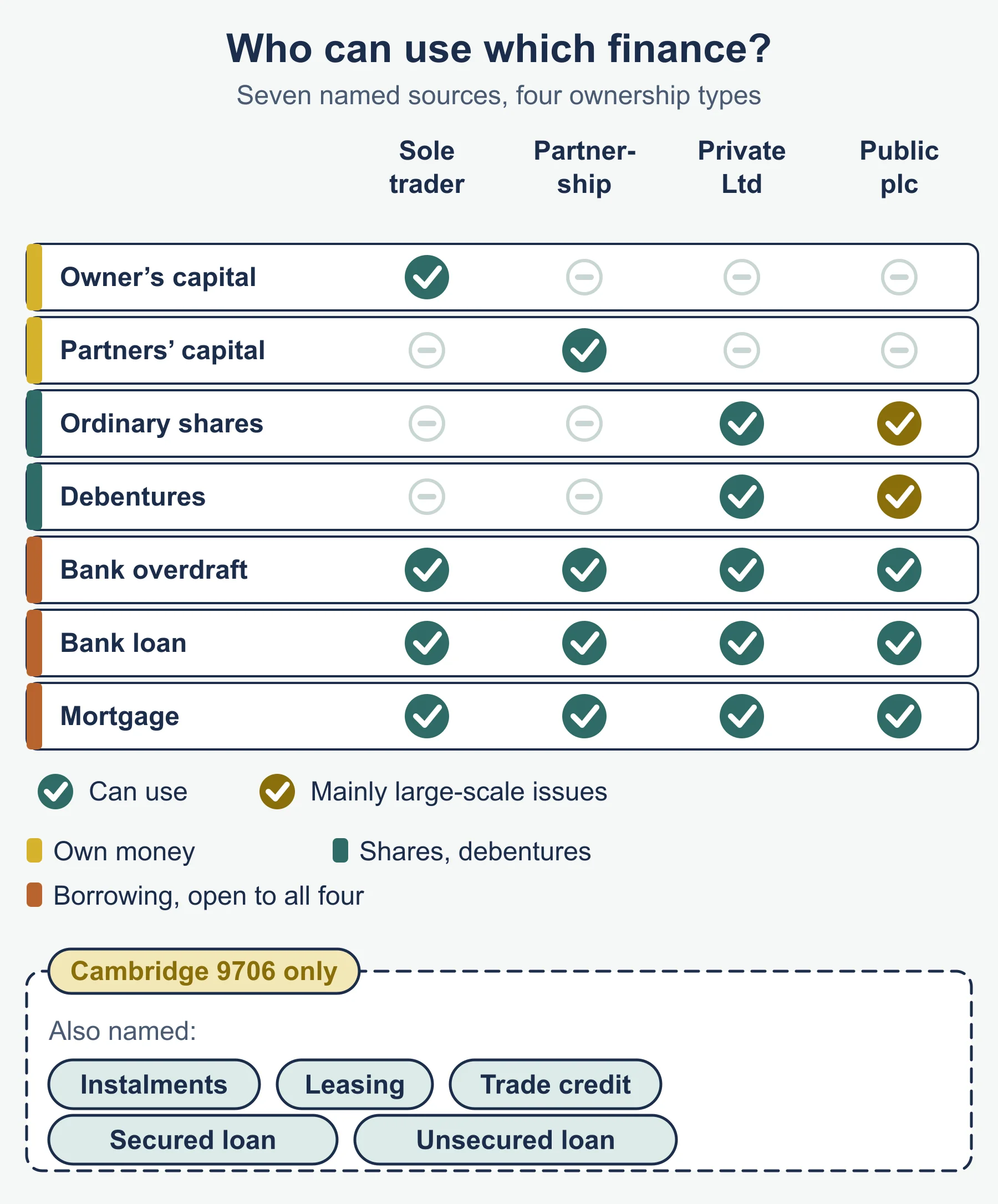
| Form | Typical finance available |
|---|---|
| Sole trader | Owner’s savings, retained earnings, loans, overdraft; lenders may see higher risk because it depends on one person |
| Partnership | As above plus new partners, who share control and profit |
| Private limited company | Can sell shares, but only to chosen people |
| Public limited company | Can sell shares to the public, so much larger sums are possible |
5.2.2 Sources of finance
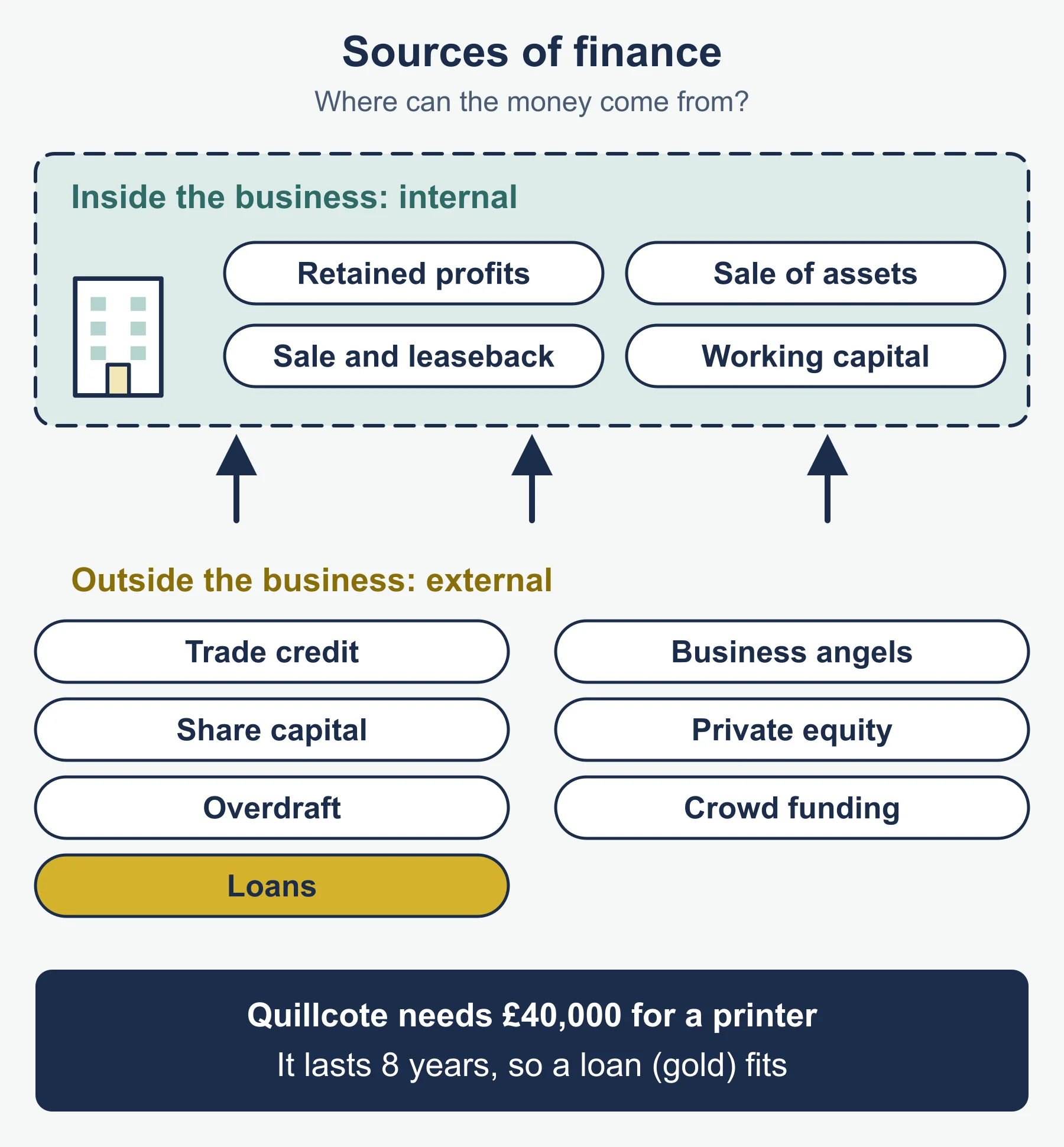
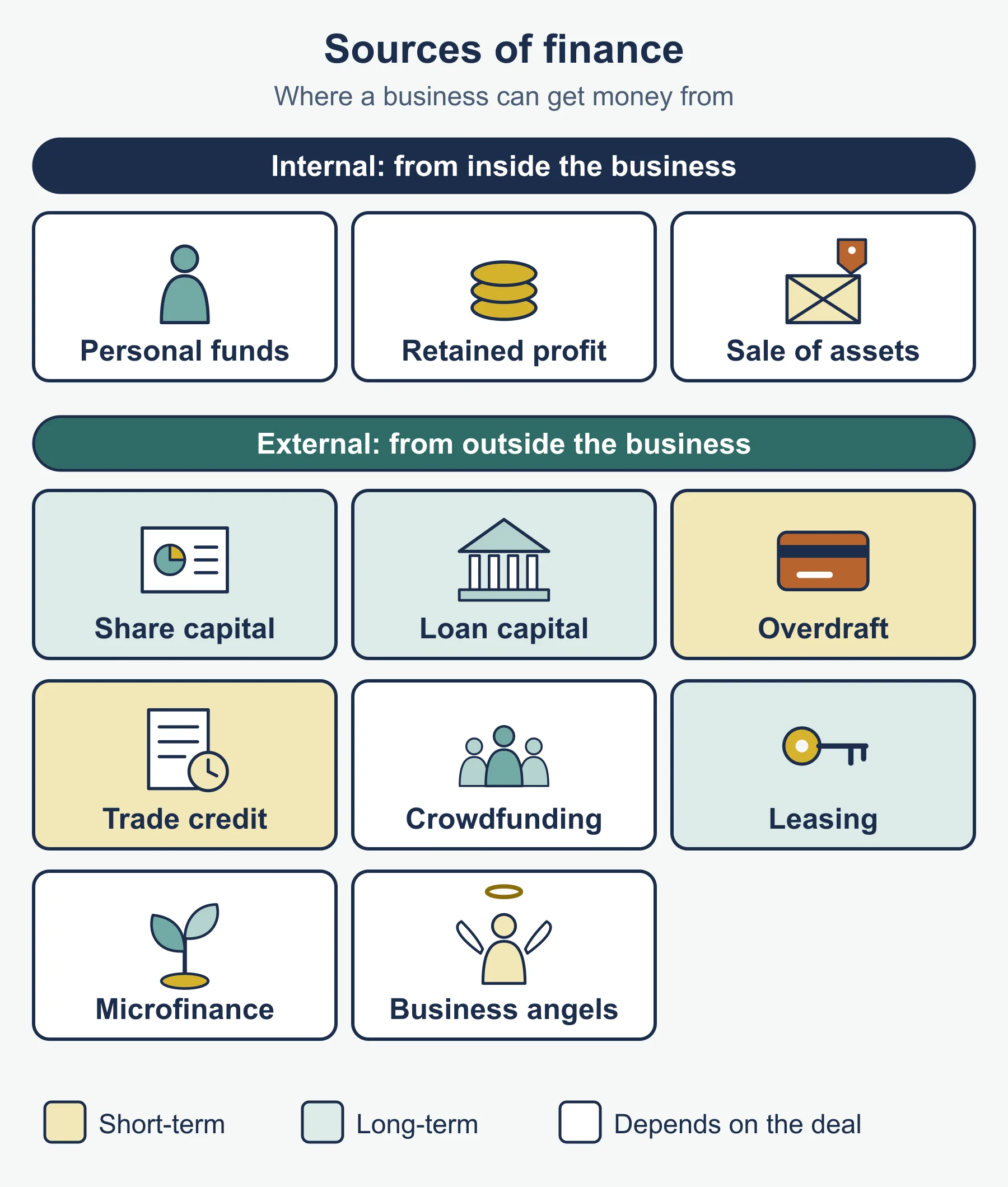
Internal
| Source | For | Against |
|---|---|---|
| Owner’s investment | No interest | Personal money at risk |
| Retained earnings | No interest, control kept | Only exists if profitable |
| Sale of unwanted assets | Quick cash, no repayment | One-off, may sell below value |
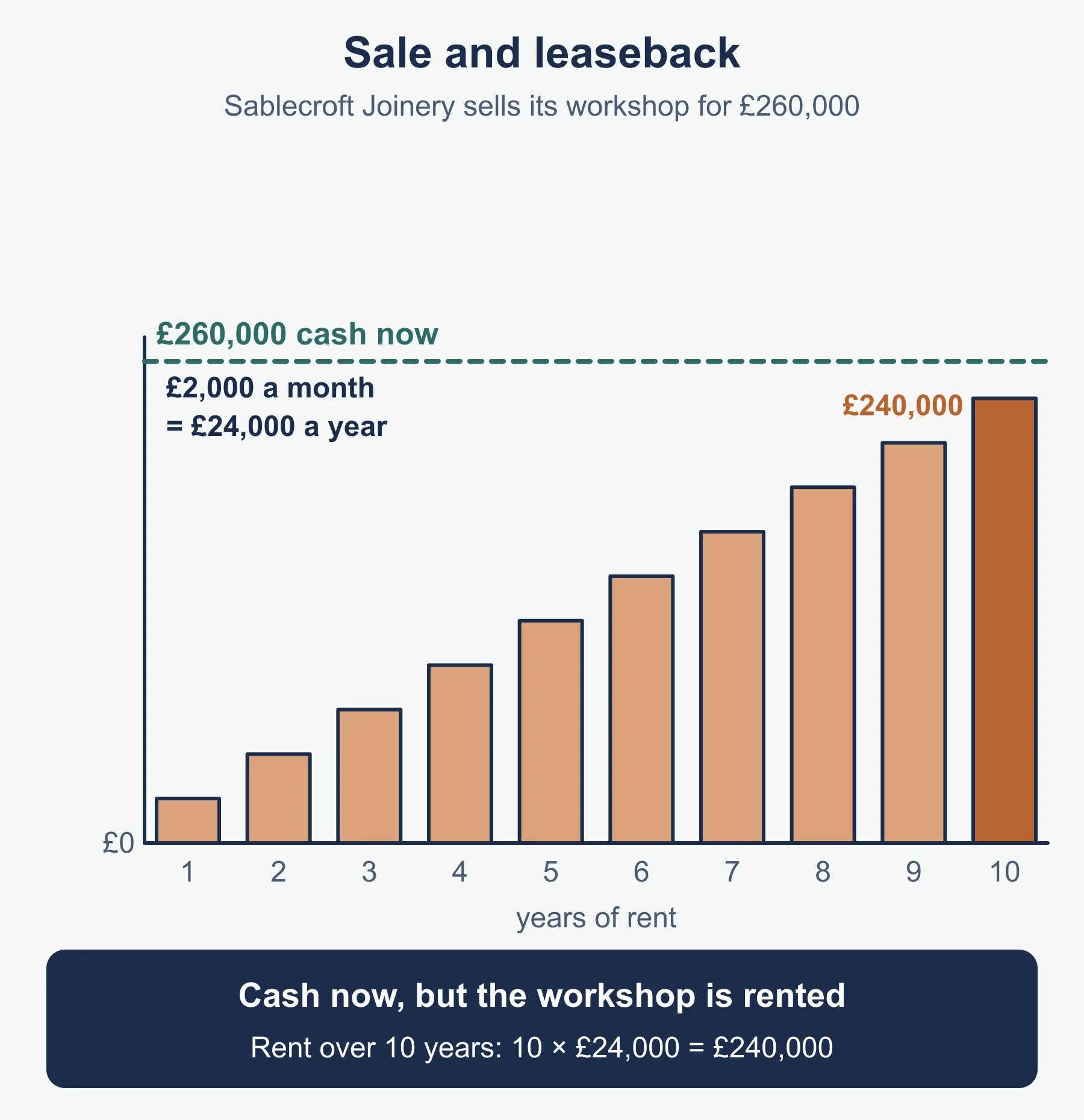
| Sale and leaseback | Cash now from an owned asset | Rent paid, asset lost |
| Working capital | No outside agreement | Daily payments may become hard |
Reminder. Selling a workshop for £90,000 and renting it back at £600 a month costs £7,200 a year, £36,000 over five years.
External
| Source | Key feature |
|---|---|
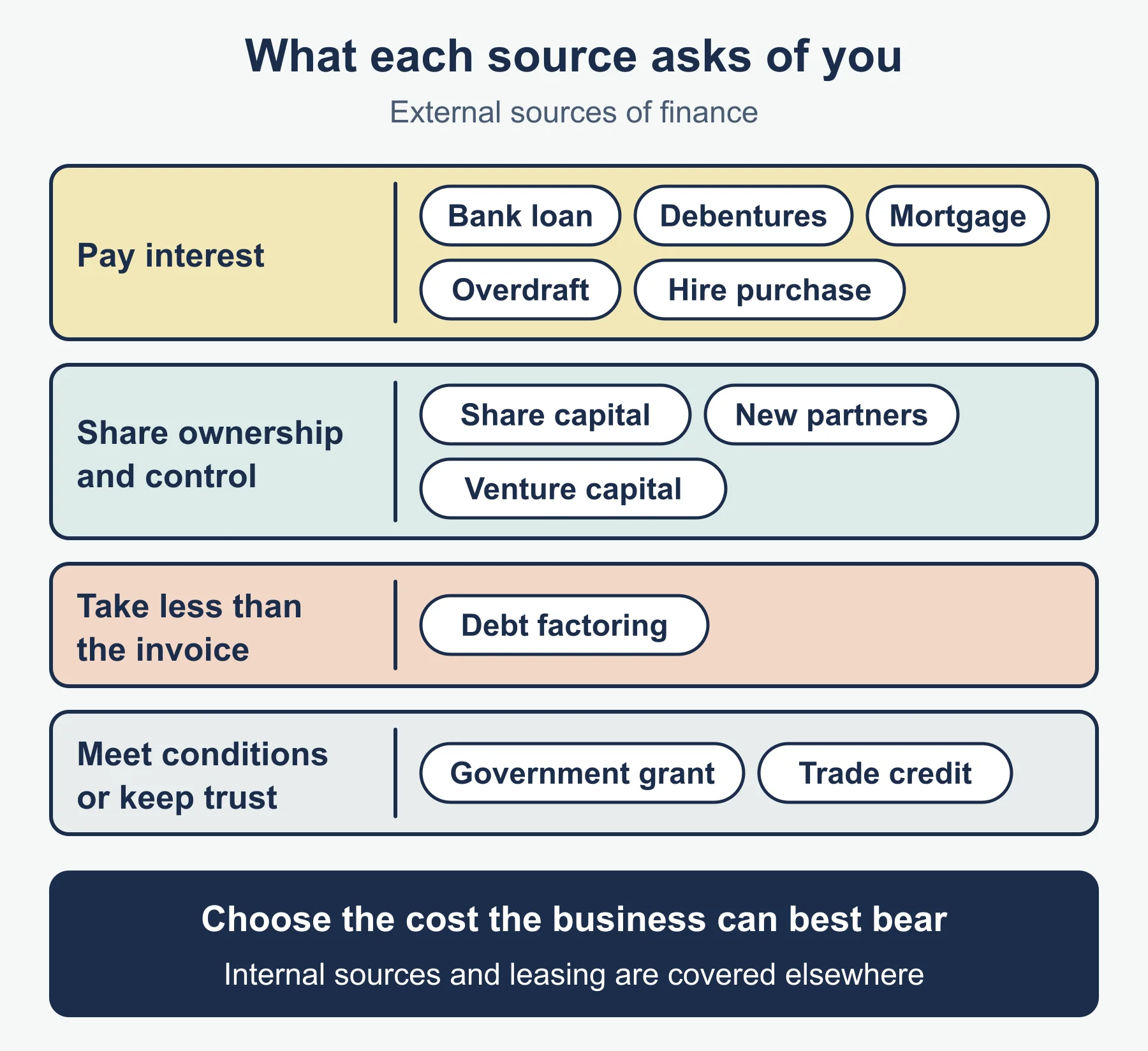
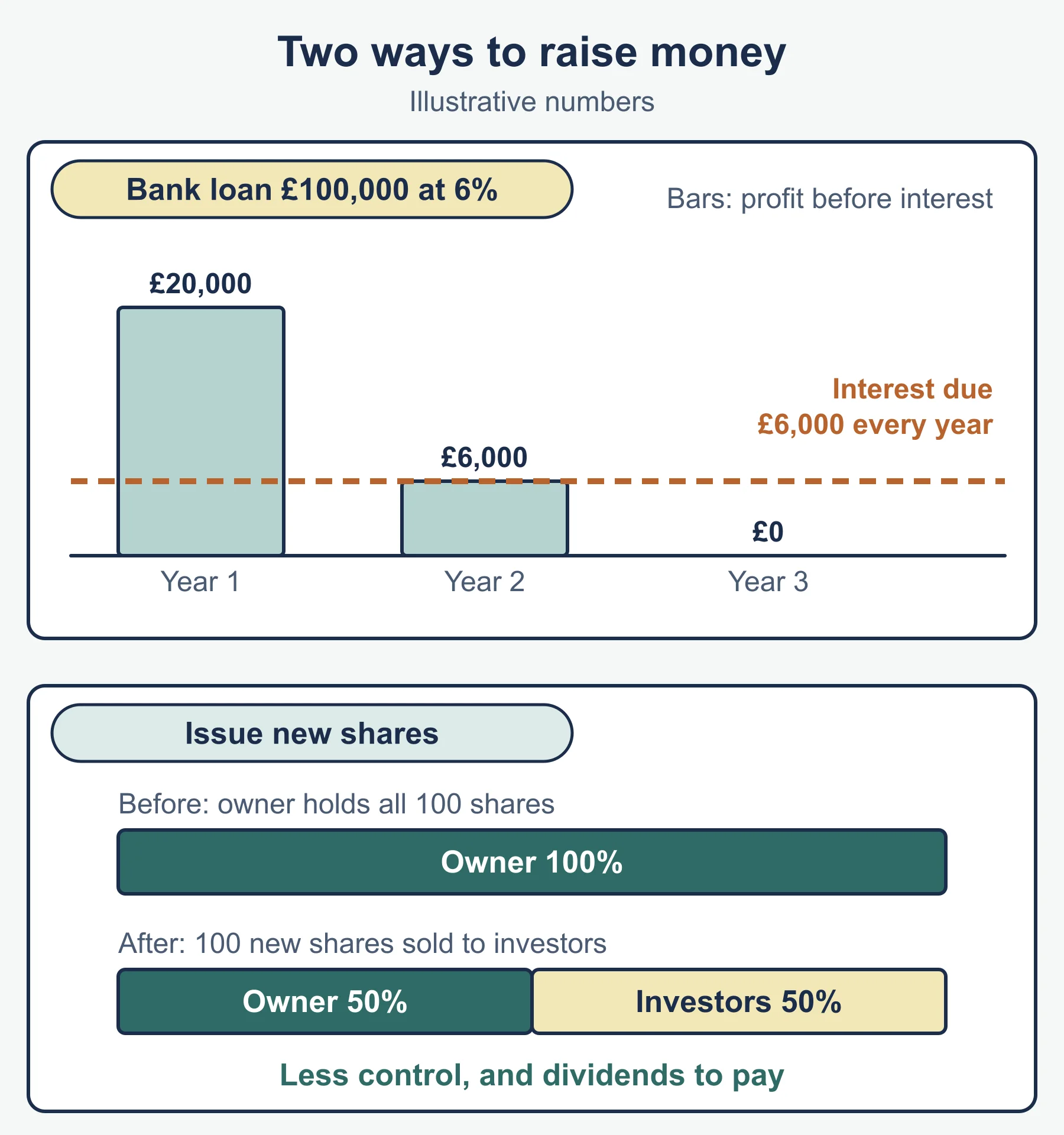
| Share capital | Sold to owners; no repayment; dilutes control; dividends |
| Debentures | Long term loan with fixed interest and repayment date |
| New partners | Capital for a partnership; shared control and profit |
| Venture capital | Investment in a risky or growing firm for a share of ownership |
| Bank overdrafts | Short term, flexible, interest on the amount used, can be recalled |
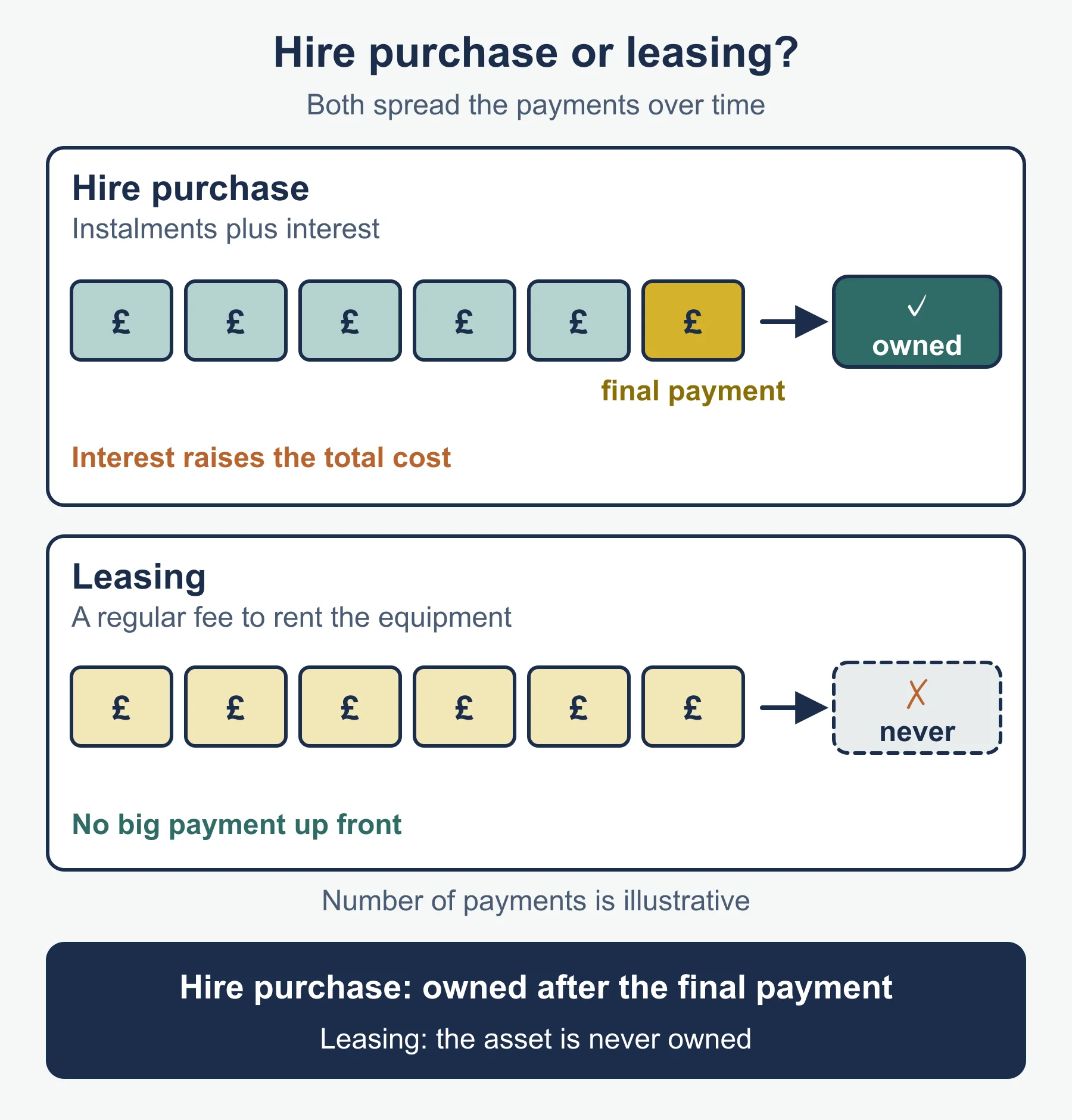
| Leasing | Rent equipment; no big payment; asset not owned |
| Hire purchase | Instalments; asset owned after the last one; interest added |
| Bank loans | Fixed sum, set period, interest, may need security |
| Mortgages | Long term, secured on property |
| Debt factoring | Invoices sold; cash sooner; less than full value |
| Trade credit | Pay the supplier later; free if terms are met |
| Micro-finance | Very small loans, often for those outside ordinary banking |
| Crowd funding | Small sums from many people, usually online |
| Government grants | Need not be repaid; conditions and limited supply |
5.2.3 and 5.2.4 Choosing the source
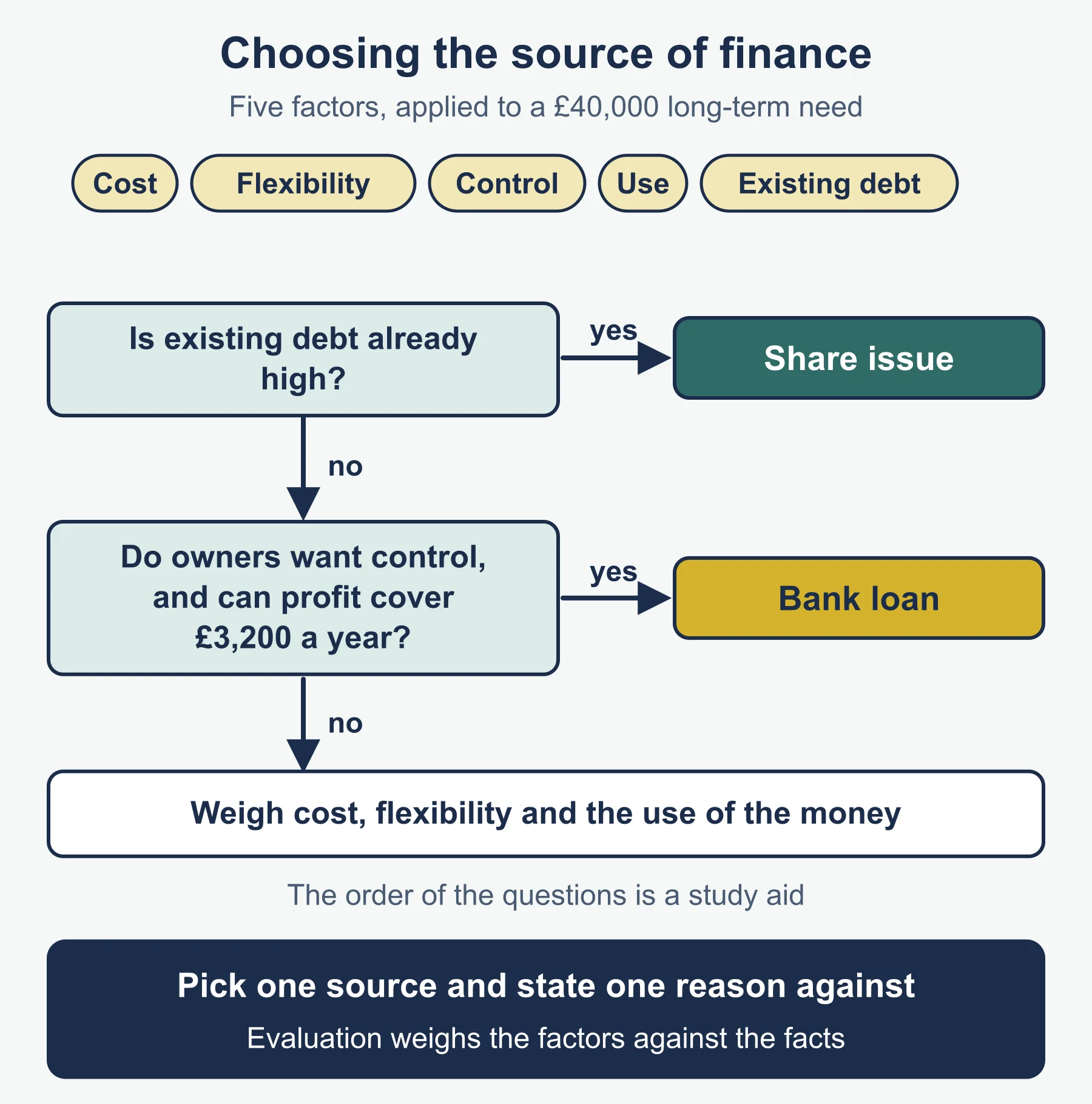
Check each of five factors, then judge the fit.
- Cost: interest, fees, dividends, profit given up.
- Flexibility: can the sum and repayments change?
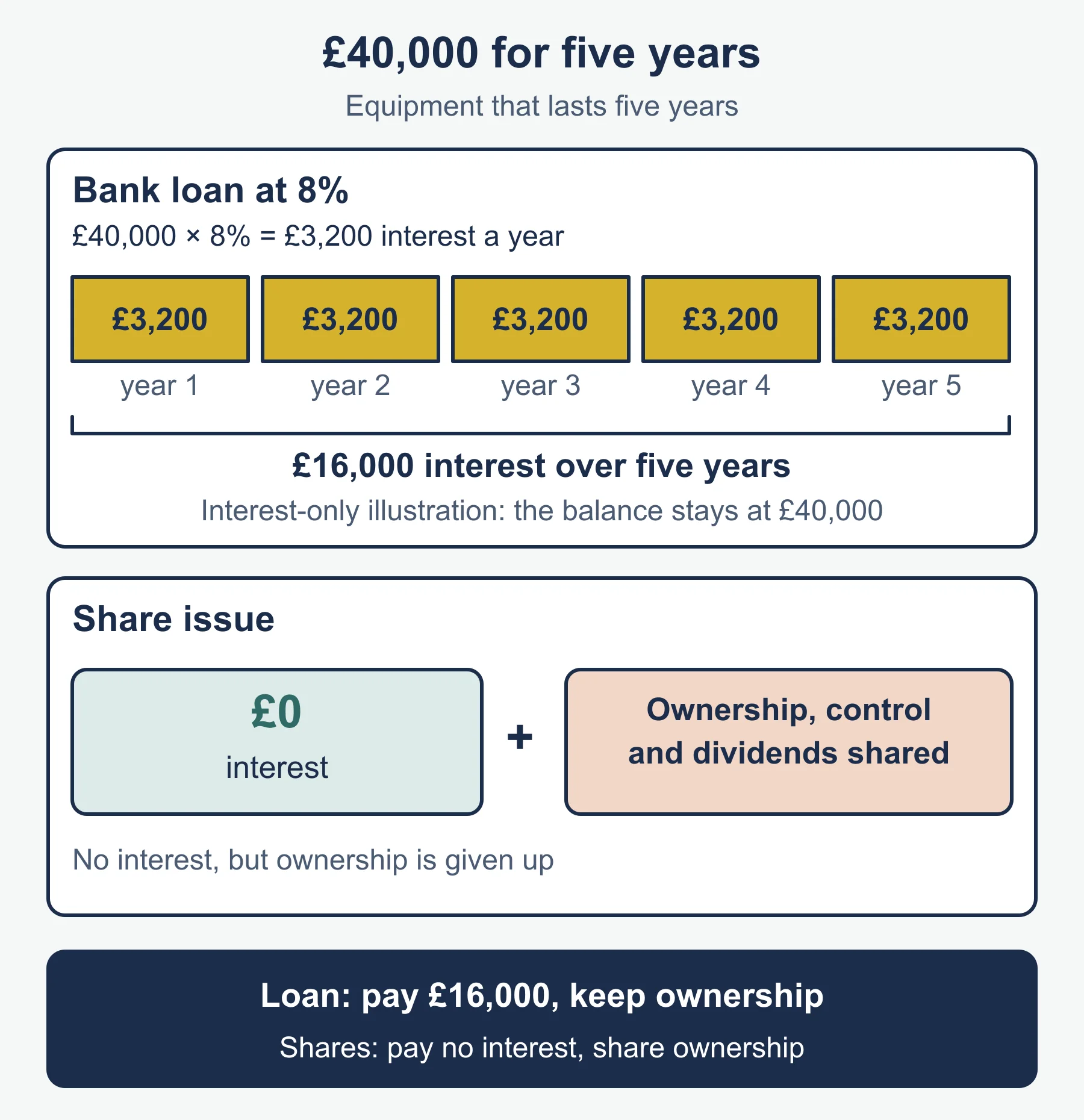
- Control: shares, new partners and venture capital share it; loans do not.
- Use: long term assets need long term finance; short gaps need short term.
- Existing debt: heavy debt limits borrowing and makes interest harder to pay.
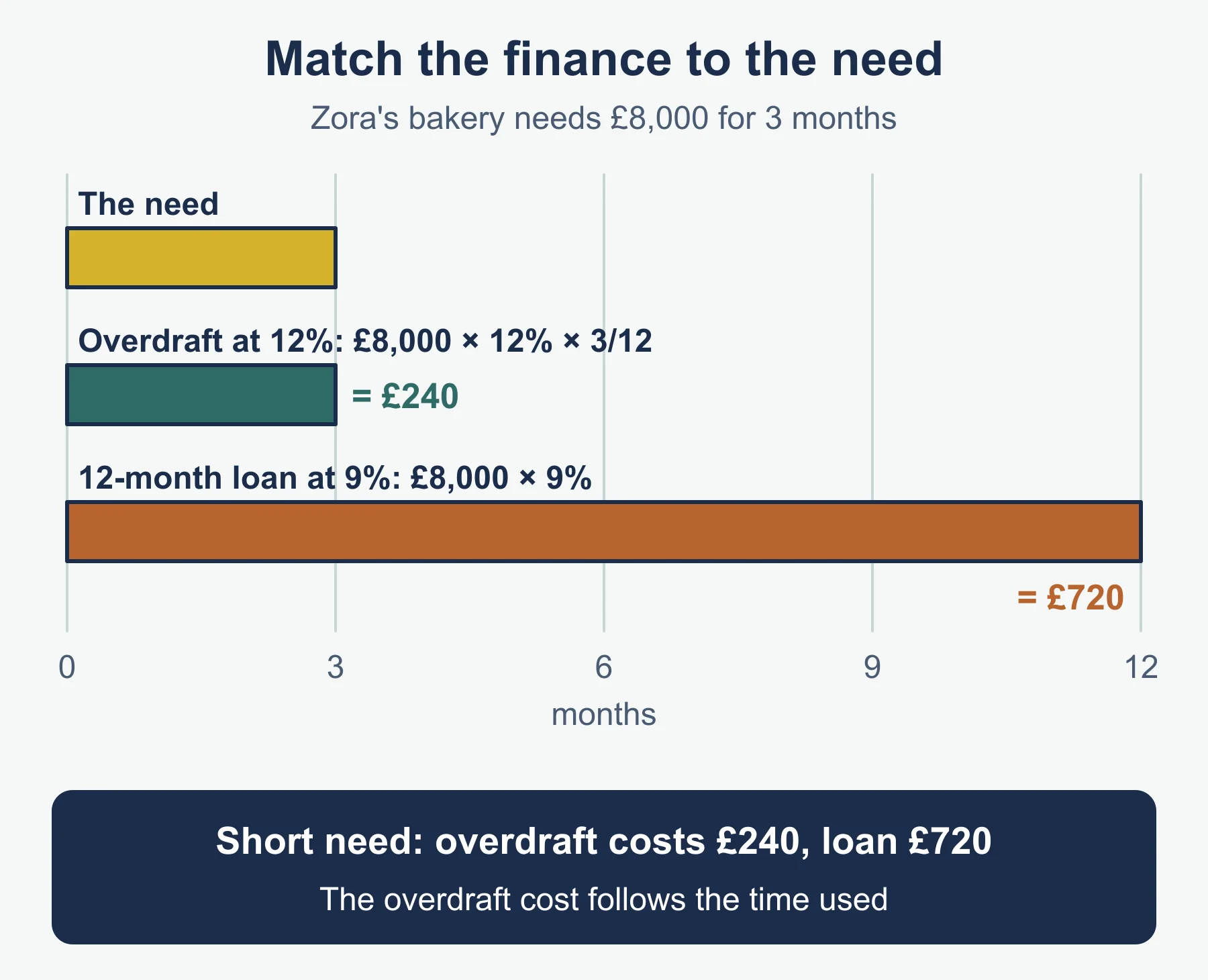
Reminder. A £5,000 overdraft at 15% for 2 months costs £125. A 12-month loan at 10% costs £500. If the need lasts two months, the overdraft is the better fit.
Method in steps: a recommendation on finance
- State the need: how much, for what, and for how long.
- Rule out sources that do not fit, such as a mortgage for a short gap or an overdraft for a building.
- Compare the remaining sources on cost, flexibility and control, using figures from the case.
- Check existing debt: can the business afford more interest?
- Make a clear choice and give one reason against it or one condition (for example, if sales hold up).
Quick links between ideas
- Poor management of trade receivables lowers working capital, which can force a business to use an overdraft.
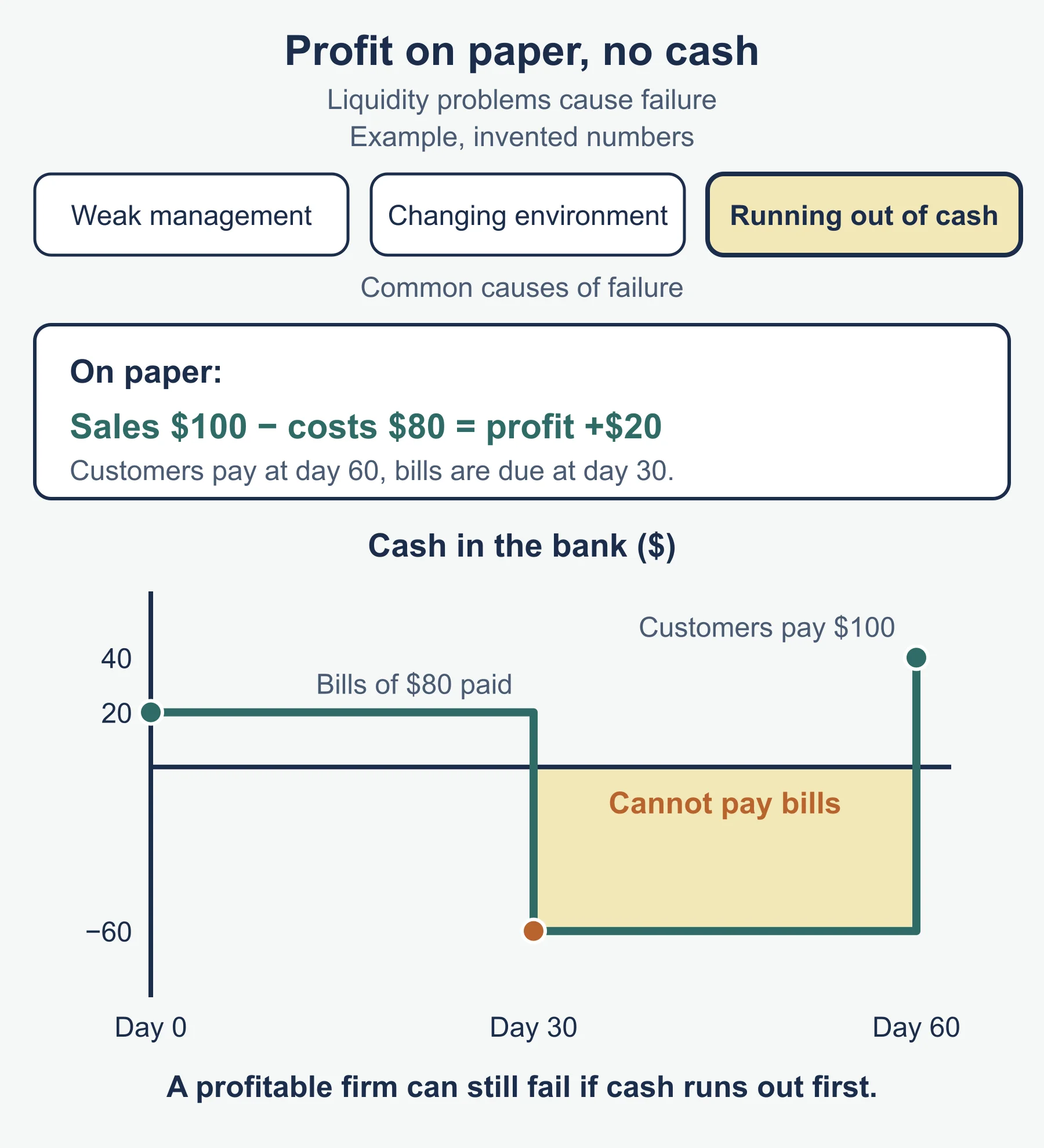
- Failure to match short term finance to a long term need leads to a cash crisis even when the business is profitable.
- Sale and leaseback and debt factoring both turn assets into cash, but each gives something up: ownership of the building, or part of the invoice value.
- Retained earnings avoid interest and keep control, but a business that is not yet profitable cannot use them.
Must-know distinctions
- Cash is not profit, and working capital is not cash.
- Bankruptcy (individuals) versus liquidation (business closes) versus administration (rescue attempt).
- Capital expenditure versus revenue expenditure.
- Internal versus external finance.
- Leasing (never owned) versus hire purchase (owned at the end).
- Debentures and loans (debt) versus share capital (ownership).
Quick self-test
- Define working capital.
- A business makes credit sales of £20,000 and pays £13,000 of costs in a month. State the profit and the effect on cash before customers pay.
- Current assets are £31,000 and current liabilities £22,500. Calculate working capital.
- State whether servicing a machine and buying a new lorry are capital or revenue expenditure.
- Distinguish liquidation from administration.
- State two internal sources of finance.
- A firm sells its workshop for £90,000 and rents it back for £600 a month. Calculate the annual rent.
- An overdraft at 15% a year is used for £5,000 for 2 months. Calculate the interest.
- Which factor in choosing finance explains why a founder may avoid issuing new shares?
- Name the source: selling unpaid customer invoices to a specialist for immediate cash.
Answers
- Current assets minus current liabilities; the finance available for day-to-day operations.
- Profit £7,000; cash falls by £13,000 until customers pay.
- £8,500.
- Servicing: revenue. New lorry: capital.
- Liquidation closes the business and sells its assets to pay creditors. Administration is an attempt to rescue the business or sell it as a going concern.
- Any two of: owner’s investment, retained earnings, sale of unwanted assets, sale and leaseback, working capital.
- £7,200.
- £5,000 × 15% × 2/12 = £125.
- The need to retain control.
- Debt factoring.
Where marks are usually lost
- Writing that profit and cash are the same, or that a profitable business cannot fail.
- Giving working capital as “money in the bank” instead of current assets minus current liabilities.
- Describing liquidation as a rescue, or mixing up bankruptcy and liquidation.
- Listing sources of finance without matching one to the need, cost or control in the case.
- Calling any bank borrowing internal finance, or share capital a loan.
- Forgetting that an overdraft is short term, and a mortgage or debentures are long term.
- Giving only advantages of a source. Evaluation needs a disadvantage and a judgement.
- Dropping the unit or the time period in interest calculations.
Frequently asked questions
What is working capital in Cambridge 9609 Business? Working capital is current assets minus current liabilities, the finance available for day-to-day operations. It is not the same as cash, which is only one current asset.
What is the difference between bankruptcy and liquidation? Bankruptcy applies to an individual, such as a sole trader or partner, who cannot pay personal debts. Liquidation applies to a business, which is closed and its assets sold to pay creditors.
What factors affect the choice of a source of finance? Cambridge AS and A Level Business 9609 names cost, flexibility, the need to retain control, the use to which the finance is put, and the level of existing debt.
What is debt factoring? Debt factoring is selling unpaid customer invoices to a specialist, the factor, for immediate cash. The business gets money sooner but receives less than the full value of the invoices.
Official syllabus
Cambridge International AS & A Level Business 9609, syllabus for examination in 2026, 2027 and 2028, published by Cambridge University Press & Assessment (Cambridge International Education). Sections 5.1 Business finance and 5.2 Sources of finance.
Get free revision emails (optional)
Occasional emails with practice questions, worked explanations and links to free resources for the qualification and subjects you choose. No spam, and you can unsubscribe from any email. The free tools on this site never need an email.
Related resources
-
Study guides
A Level Business: Costs and Budgets (Cambridge 9609)
Study guide to 5.4 Costs and 5.5 Budgets of Cambridge AS & A Level Business 9609: costing, break-even, budgets and variances, with worked examples.
Business · Cambridge · AS Level
Read guide -
Practice questions
A Level Business: Costs and Budgets (Cambridge 9609) – Practice Questions
Original practice questions with worked answers on 5.4 Costs and 5.5 Budgets for Cambridge AS & A Level Business 9609: short, calculation, case study.
Business · Cambridge · AS Level
Try questions -
Revision notes
A Level Business: Costs and Budgets (Cambridge 9609) – Revision Notes
Condensed revision notes for 5.4 Costs and 5.5 Budgets in Cambridge AS & A Level Business 9609: definitions, formulas, methods and a self-test.
Business · Cambridge · AS Level
Revise topic
Related articles
-
teaching
A Level tuition in Dubai: Cambridge or Pearson Edexcel International A Level?
Schools in Dubai and Abu Dhabi teach either Cambridge International AS & A Level or Pearson Edexcel International A Level. How the two are structured, why it matters for tuition, and how online classes from Lahore work.
9 October 2026
-
curriculum guides
Choosing subjects at IGCSE and A Level
How subject choices at 14 and 16 affect university options later, and how to keep pathways open without overloading a timetable.
28 July 2026
Studying this with a teacher
Working through Business AS LEVEL?
This page is free and stays free. If you would rather be taught it, Marlbridge runs Business classes one-to-one and in small groups of up to 15, online in your own time zone. The first trial class is free. WhatsApp replies within an hour (8am–11pm Pakistan time, every day); email the same day.
Cambridge Business teachers at Marlbridge

