
Revision Notes
A Level Business: Costs and Budgets (Cambridge 9609) – Revision Notes
Condensed revision notes for 5.4 Costs and 5.5 Budgets in Cambridge AS & A Level Business 9609: definitions, formulas, methods and a self-test.
- Subject
- Business
- Level
- AS LEVEL
- Topic
- Finance and accounting
- Author
- Marlbridge Academic Team
- Updated
- Reviewed by
- Salman Ahmad (what this means)
Aligned to Cambridge A Level Business (9609), For examination in 2026, 2027 and 2028. Official specification .
Syllabus page (what it covers and how it is assessed): Cambridge A Level Business.
Syllabus points this page covers
9609 (AS Level)
- 5.4 Costs
- 5.5 Budgets
Found an error? Report a correction.
Need help with this topic? Request a free trial class for A Level Business (9609).
These notes condense sections 5.4 Costs and 5.5 Budgets of the Cambridge International AS & A Level Business 9609 syllabus for examination in 2026, 2027 and 2028. Both sections are AS Level content in Topic 5, which A Level candidates also study. For fuller explanations, use the study guide, then test yourself with the practice questions. Course links: the Cambridge A Level Business hub, the checklist and the free diagnostics. The businesses here are invented.
Definitions to know
| Term | Meaning |
|---|---|
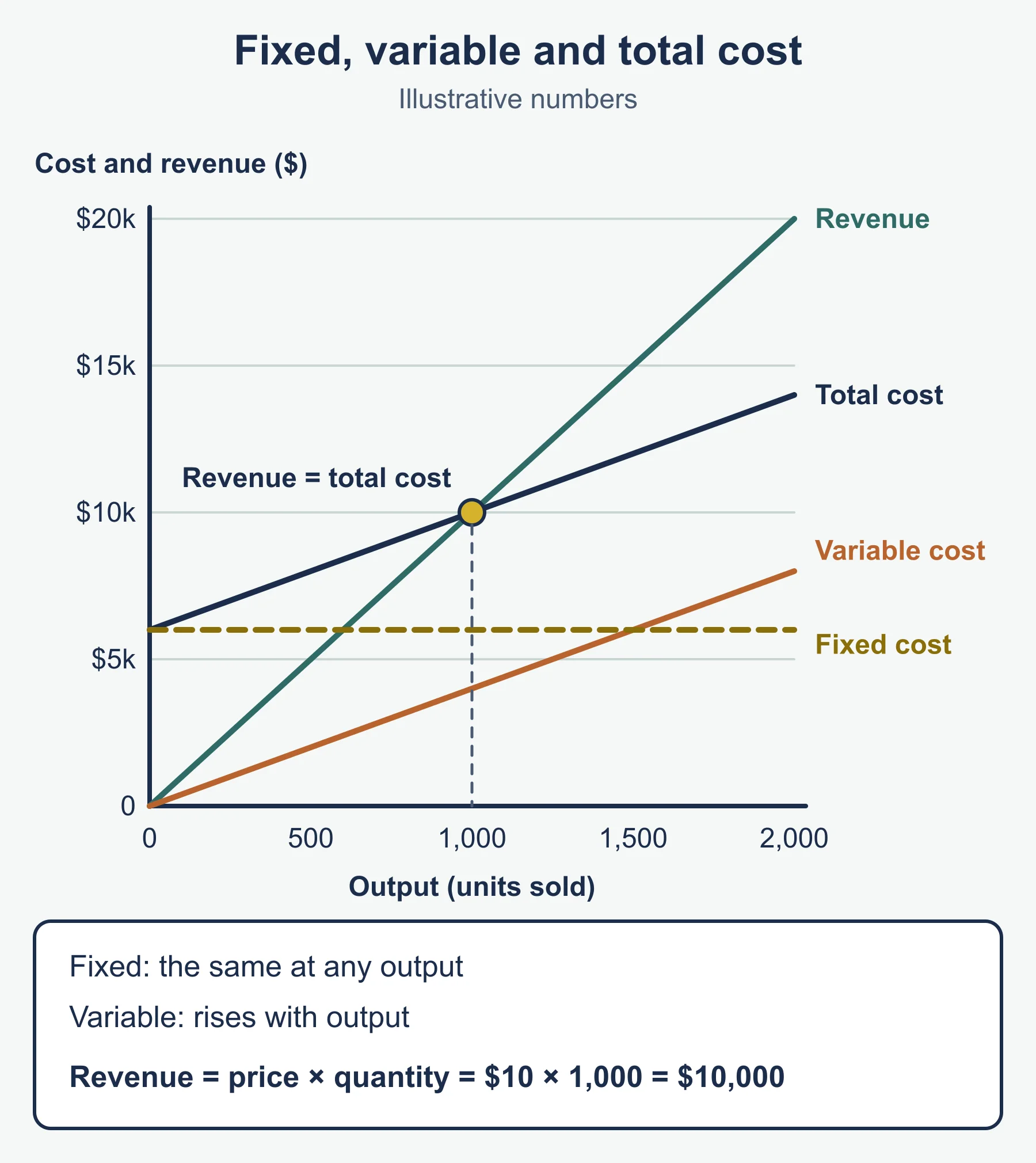
| Fixed cost | Stays the same whatever the output, over the short run (rent, insurance) |
| Variable cost | Changes with output (ingredients, packaging) |
| Direct cost | Can be traced to a product or cost centre |
| Indirect cost | Cannot be traced to one product; shared (overheads) |
| Total cost | Fixed costs + variable costs |
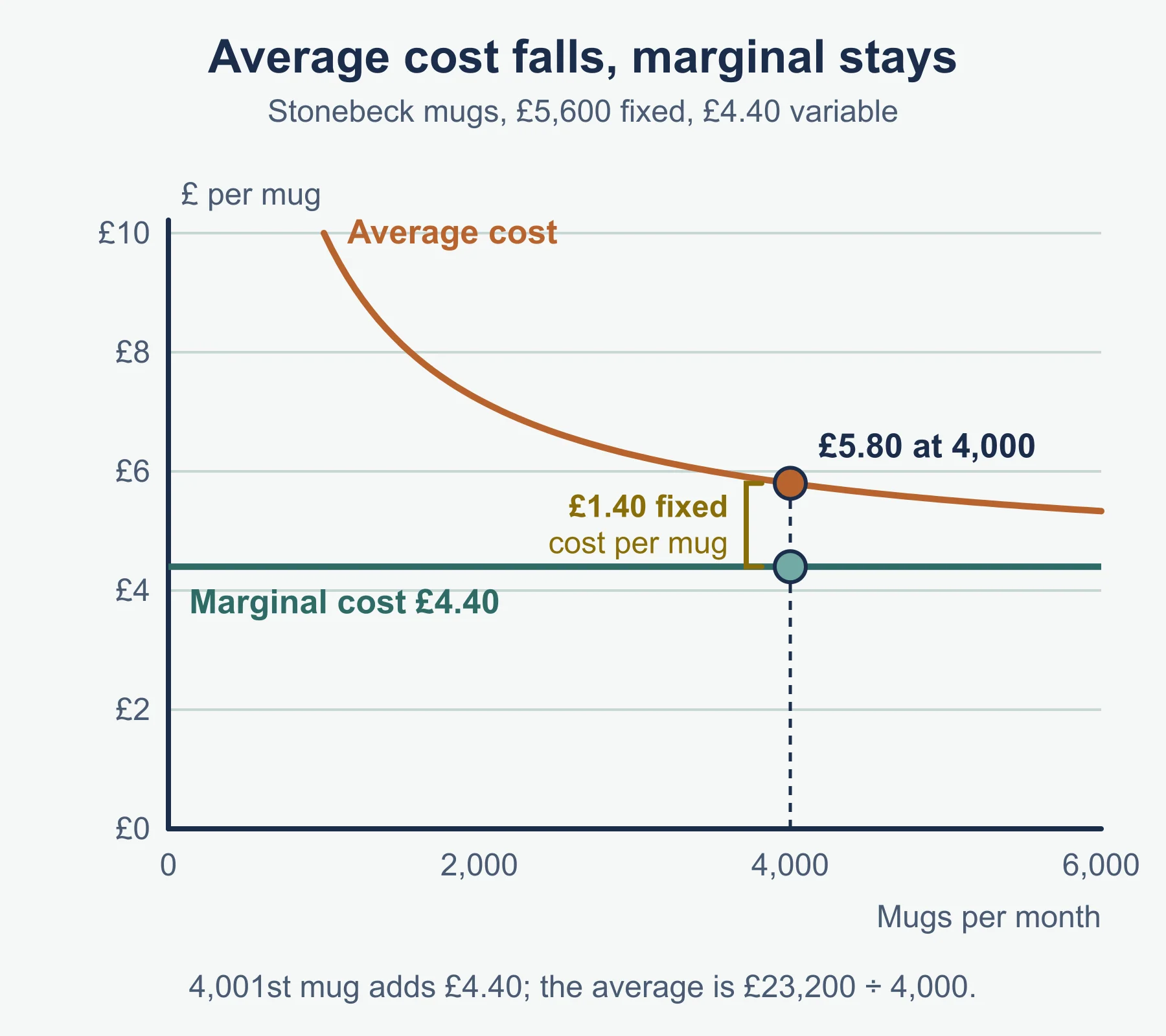
| Average cost | Total cost ÷ output |
| Marginal cost | Extra cost of one more unit |
| Contribution | Selling price − variable cost (per unit), or total revenue − total variable costs |
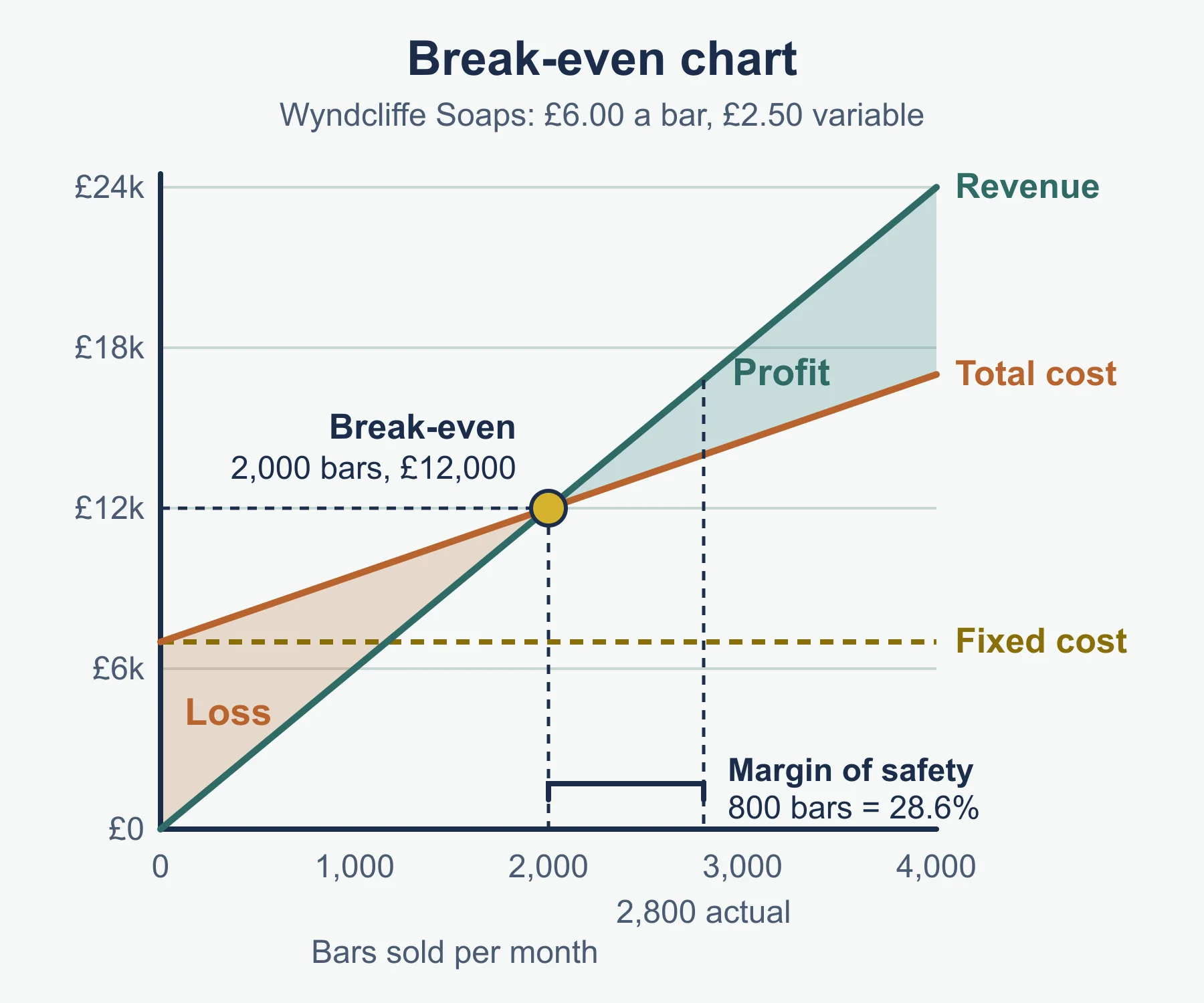
| Margin of safety | How far actual (or forecast) output is above break-even output |
| Budget | Financial plan with targets for a future period |
| Variance | Actual figure compared with budgeted figure |
The syllabus gives no formulas for 5.4 and 5.5. The ones below are the standard forms.
Formulas
| Item | Standard form |
|---|---|
| Total cost | Total fixed costs + (variable cost per unit × output) |
| Average cost | Total cost ÷ output |
| Contribution per unit | Selling price less variable cost for one unit |
| Total contribution | Units sold × contribution per unit |
| Profit | Total contribution − fixed costs (or revenue − total costs) |
| Break-even output | Fixed costs ÷ contribution per unit |
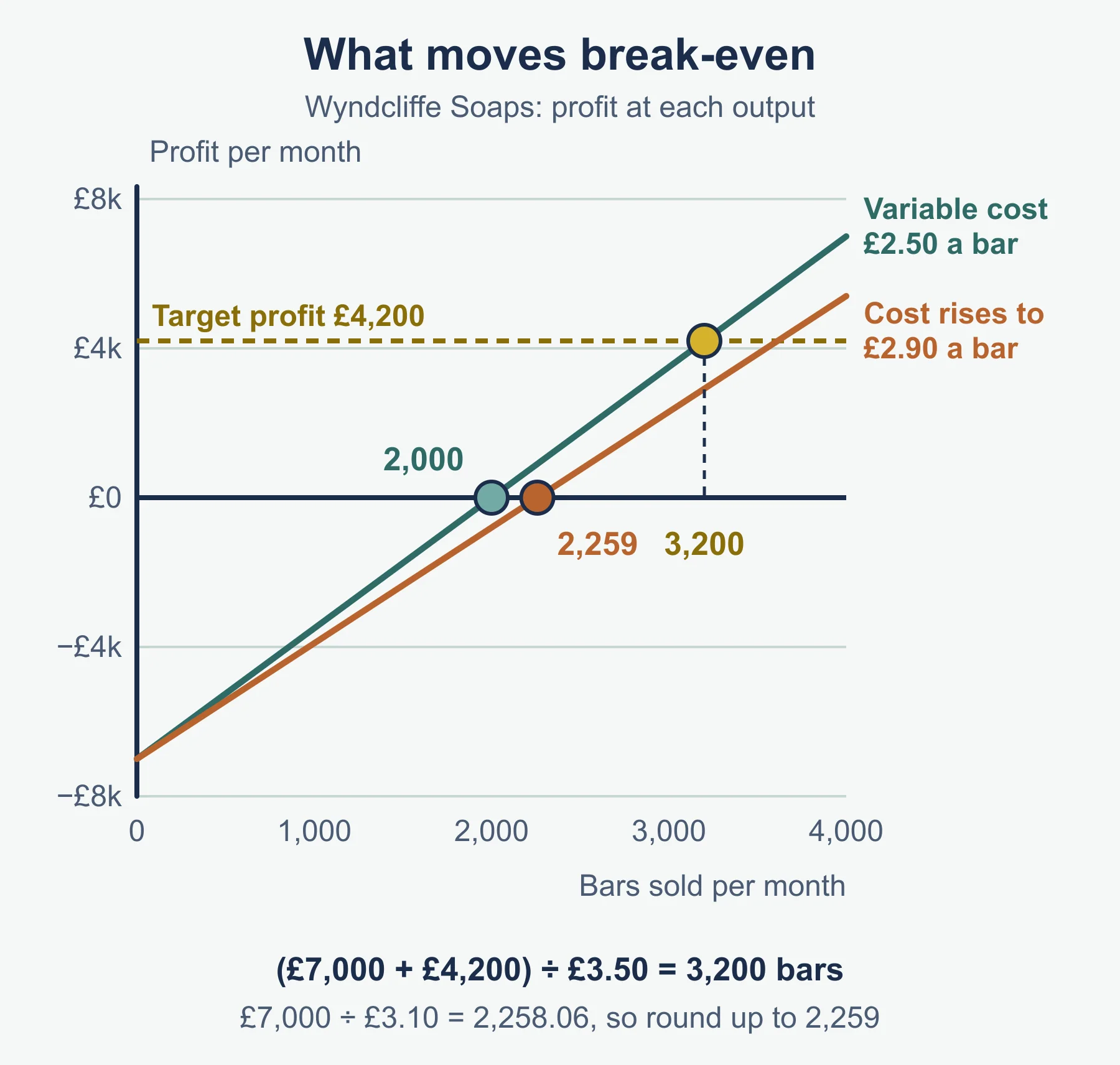
| Output for target profit | Fixed costs plus target profit, divided by contribution per unit |
| Margin of safety (units) | Actual output less break-even output |
| Margin of safety, per cent | Margin of safety as a share of actual output, × 100 |
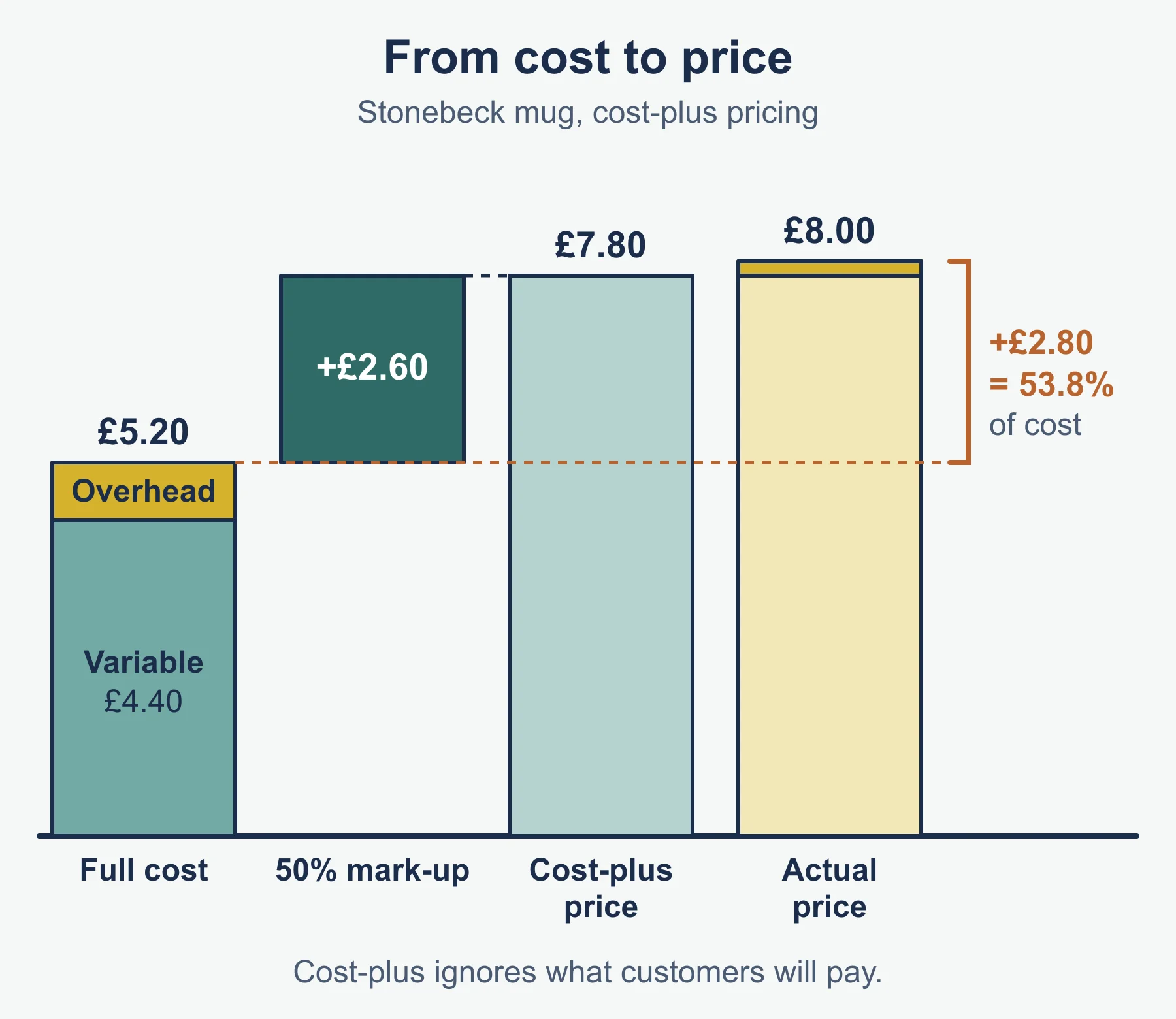
| Cost-plus price | Unit cost × (1 + mark-up as a decimal) |
| Variance | Budgeted figure compared with actual figure, labelled adverse or favourable |
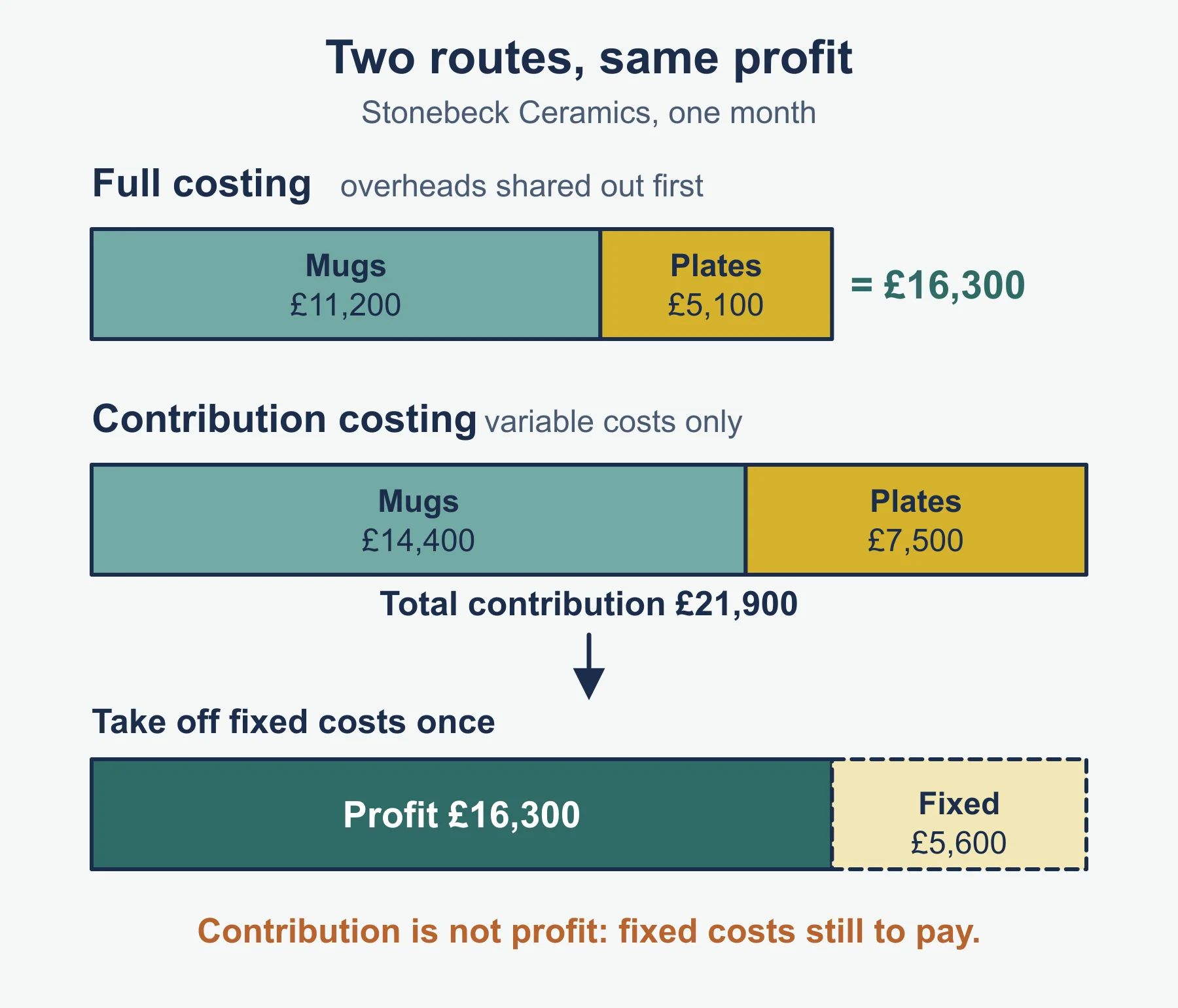
Costing: full versus contribution
| Full costing | Contribution costing | |
|---|---|---|
| Fixed costs | Shared across products (apportioned) | Not shared; deducted in total |
| Key figure | Profit per unit | Contribution per unit |
| Best for | Cost-plus pricing, full picture of profitability | Short-term, one-off decisions such as special orders |
| Main limitation | The overhead basis is a judgement | Ignores fixed costs, so it can hide long-run losses |
Contribution is not profit. Contribution pays towards fixed costs; profit is what is left after them.
Method: full costing in steps
- Add up all overheads.
- Choose a basis (for example, labour hours) and total it across products.
- Overhead rate = overheads ÷ total basis.
- Overhead per unit = rate × units of the basis used per unit.
- Full cost per unit = variable cost + overhead per unit.
Uses of cost information
- Decisions: compare average and marginal cost; if marginal cost is below price, an extra unit adds to profit.
- Pricing: cost-plus adds a mark-up. A floor price in the short run is marginal (variable) cost.
- Monitoring: compare actual unit cost with target to spot waste. Profit = revenue − total costs.
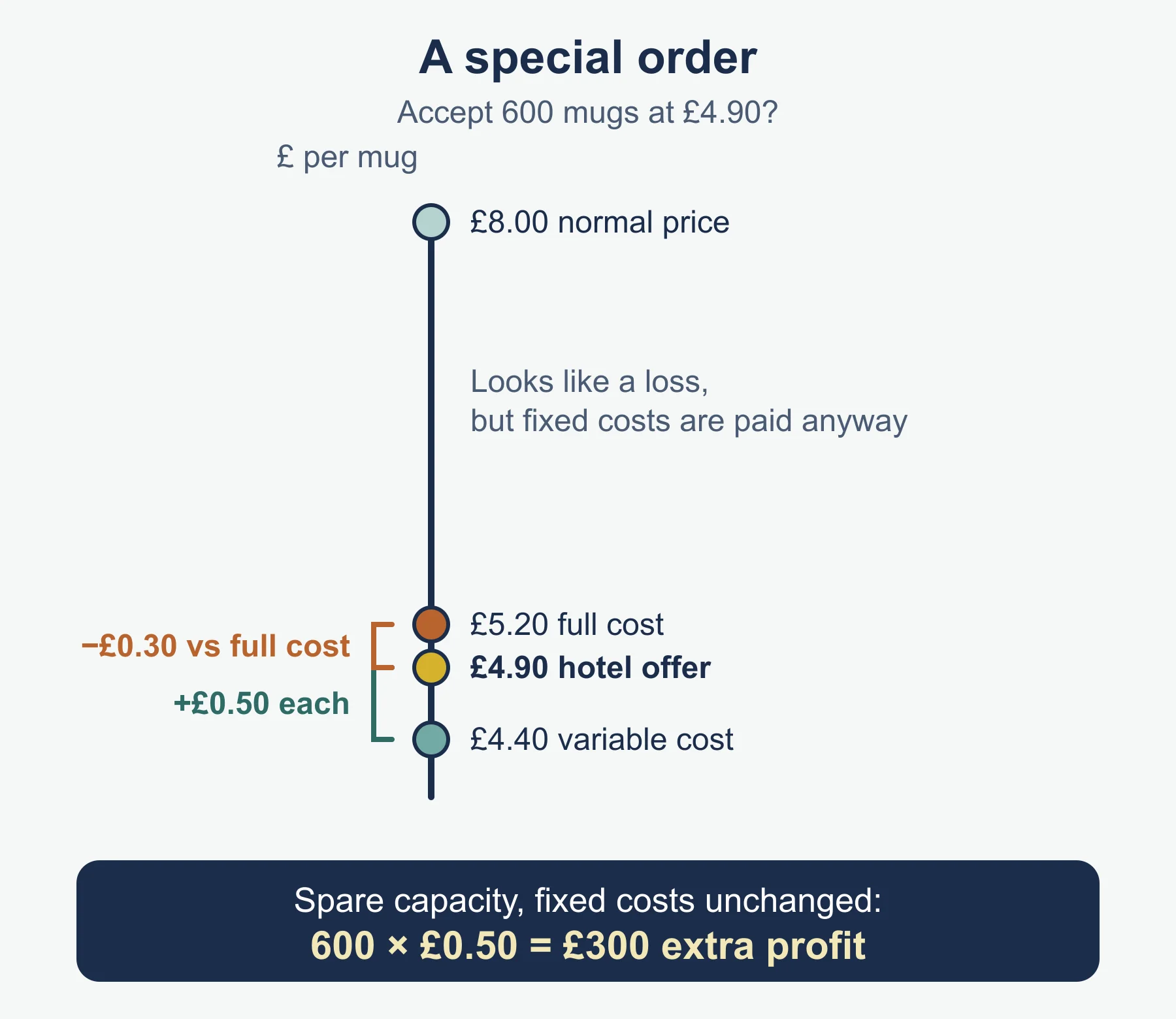
- Special orders: accept if the price is above variable cost, spare capacity exists and fixed costs do not rise, then check non-financial factors.
Worked reminder. Talgarth Tea Rooms gets a one-off order for 200 afternoon teas at £6.50. Variable cost is £4.00 a tea. Contribution = £2.50 × 200 = £500. Accept financially, but ask whether regular customers will expect the same price.
Break-even in steps
Talgarth Tea Rooms sells afternoon teas at £9, with variable cost of £4 and fixed costs of £12,000 a month.
- Contribution per tea = £9 − £4 = £5.
- Break-even = £12,000 ÷ £5 = 2,400 teas (revenue £21,600).
- Actual sales 2,900 teas, so margin of safety = 500 teas (17.2% of actual).
- Profit = 2,900 × £5 − £12,000 = £2,500.
- Target profit £3,000 needs (£12,000 + £3,000) ÷ £5 = 3,000 teas.
The chart in brief
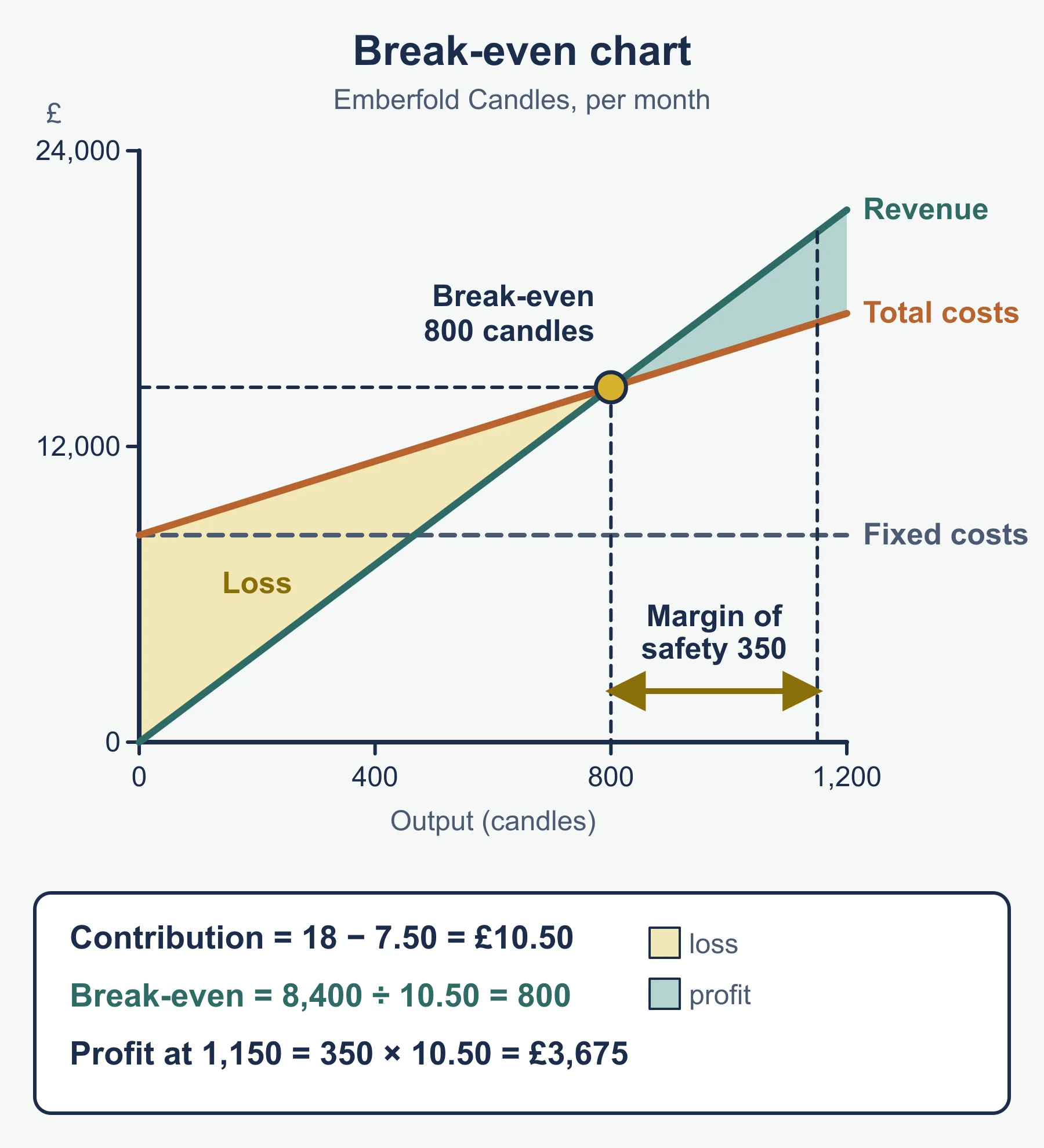
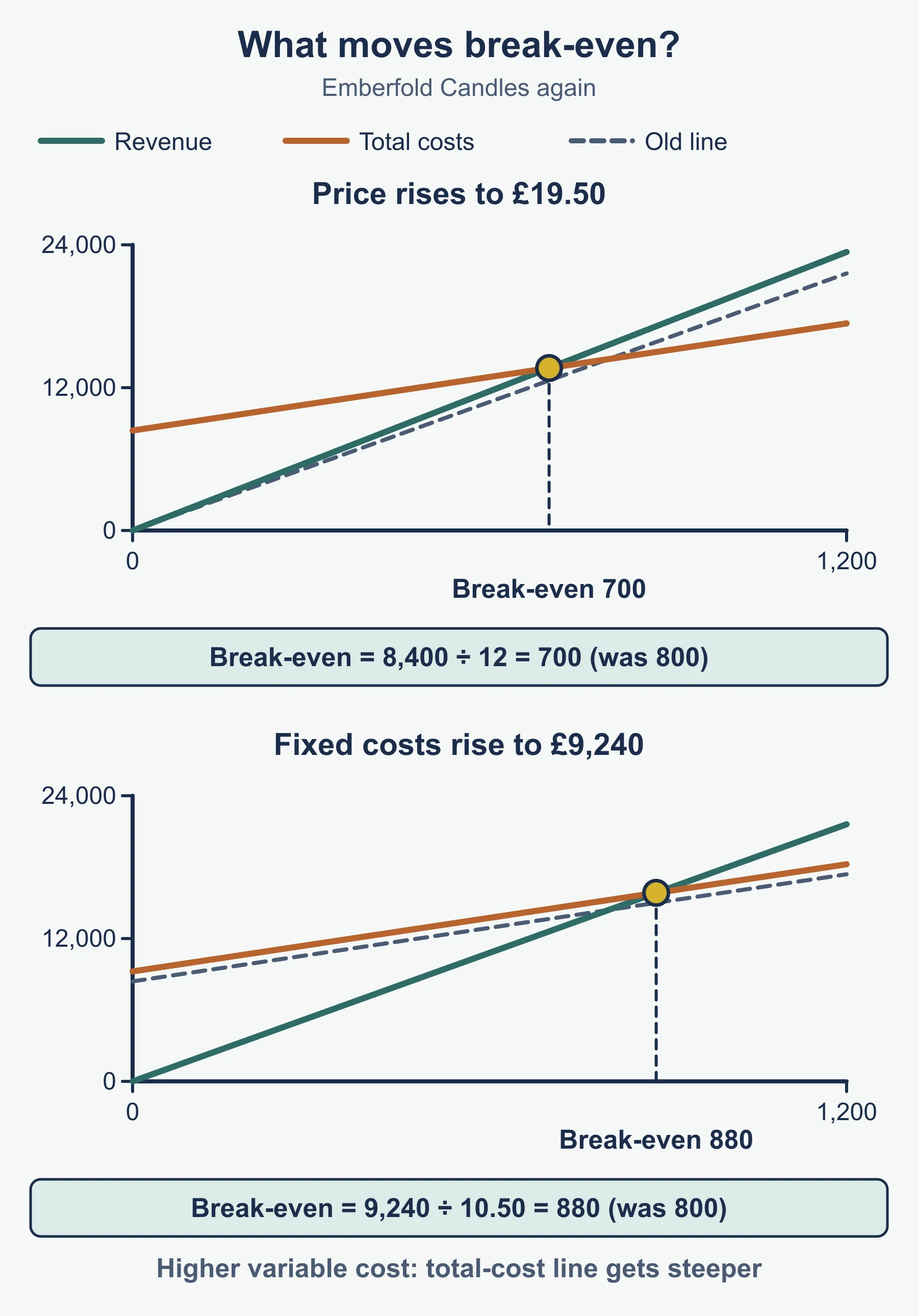
Horizontal axis: output. Vertical axis: money. Lines: fixed costs (flat), total costs (start at the fixed cost level, upward sloping), revenue (starts at origin, steeper). Break-even is where revenue and total costs cross. Margin of safety is the gap along the output axis between break-even and actual output. A higher price steepens the revenue line, so break-even moves left. Higher fixed costs raise the cost lines, so break-even moves right.
Uses and limitations
| Uses | Limitations |
|---|---|
| Shows minimum sales needed | Assumes all output is sold |
| Easy to draw and explain | Assumes constant price and unit variable cost |
| Helps with loan applications and planning | Fixed costs may step up |
| Tests what-if changes | Based on forecasts; one product only |
Budgets
- Purposes: measure performance, allocate resources, control and monitor.
- Benefits: clear targets, coordination, motivation, early warning.
- Drawbacks: time-consuming, forecast errors, short-term focus, can be rigid.
| Type | How it works | Strength | Weakness |
|---|---|---|---|
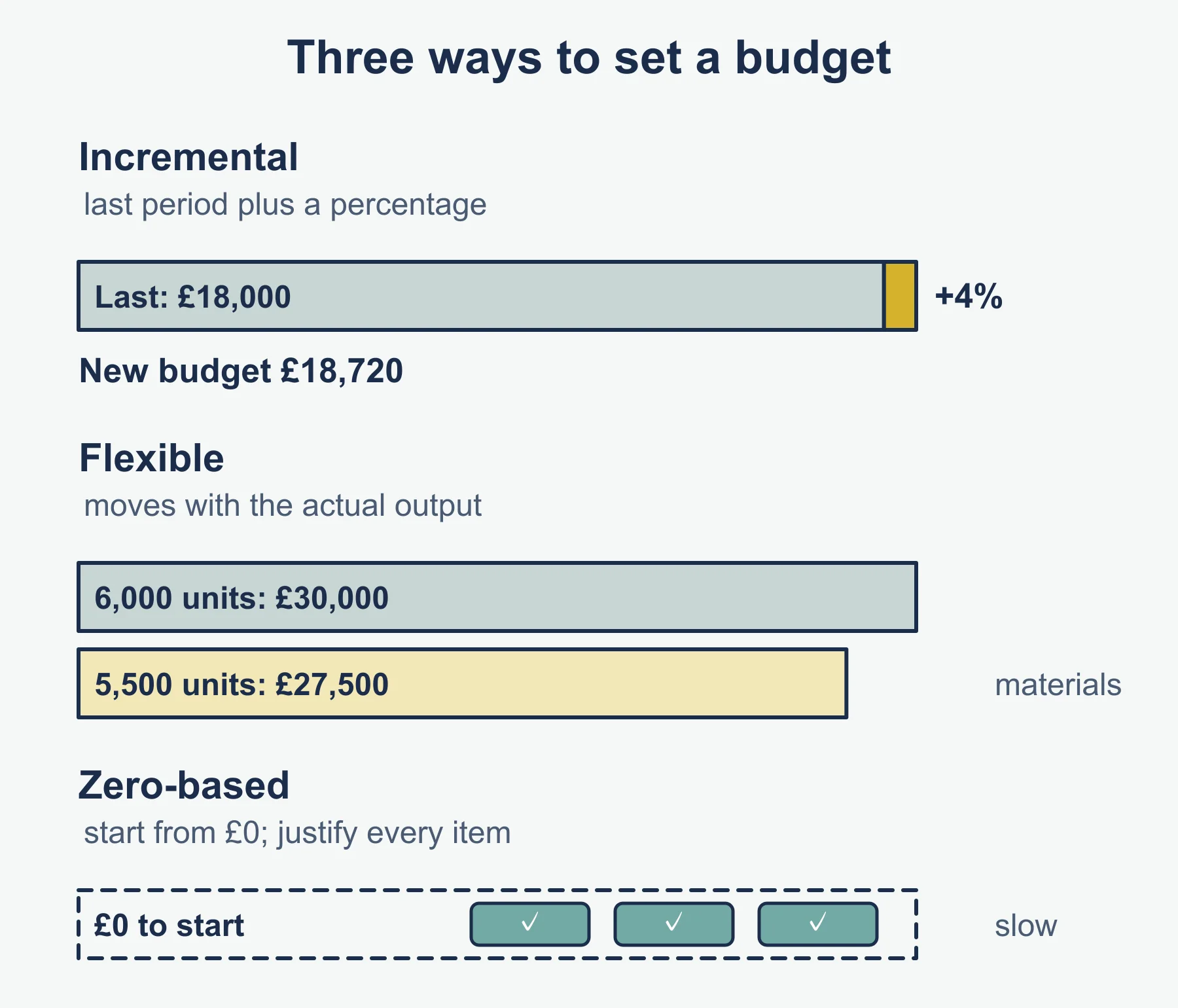
| Incremental | Last period plus or minus a percentage | Quick and simple | Repeats old inefficiency |
| Flexible | Variable items adjusted to actual output | Fairer comparison | More work; needs cost behaviour known |
| Zero | Start from £0 and justify every item | Challenges all spending | Slow and costly |
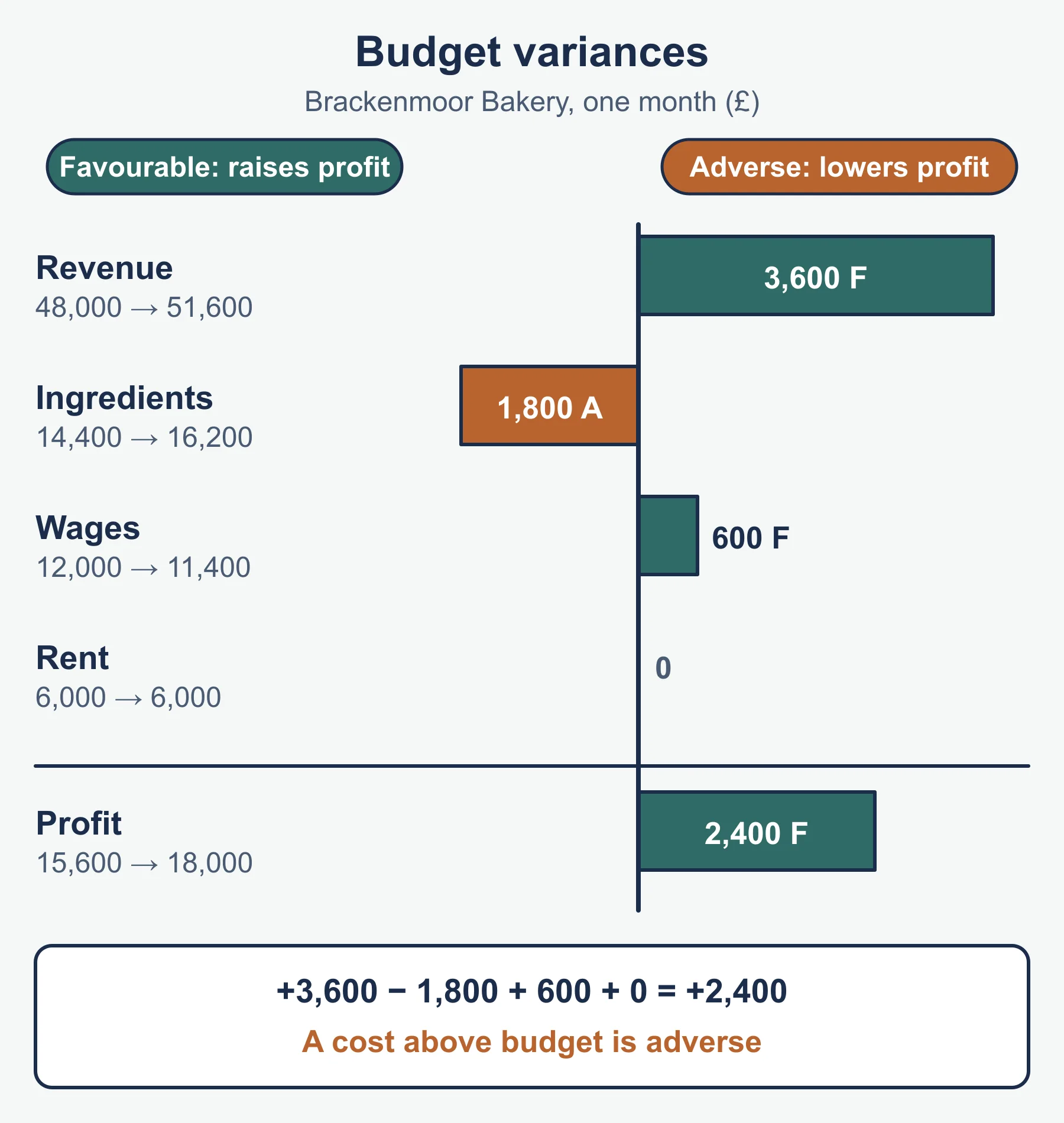
Variances in steps
- For revenue: actual above budget is favourable; below is adverse.
- For costs: actual below budget is favourable; above is adverse.
- State the amount and the label (£1,400 favourable).
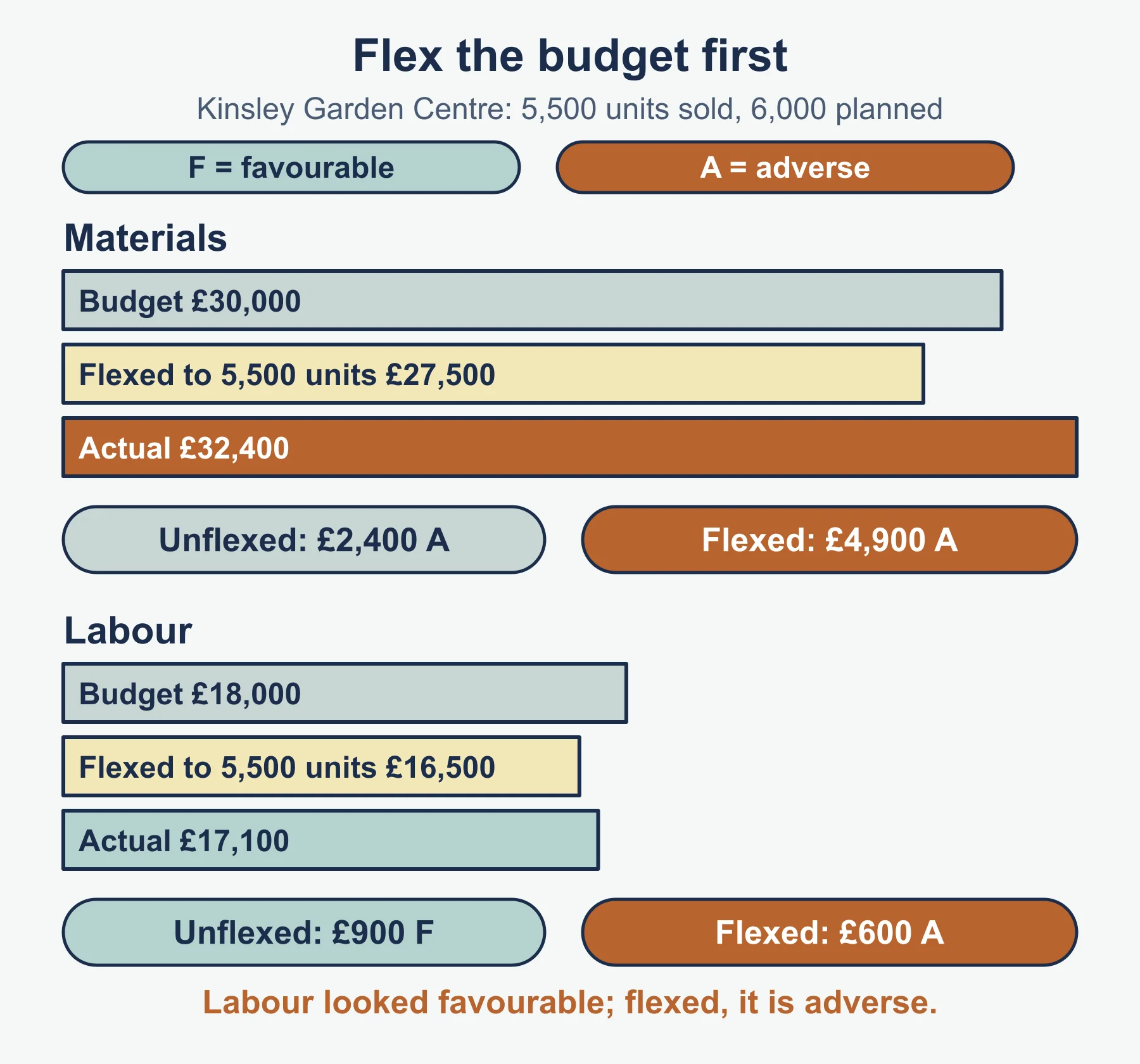
- If output changed, flex the variable costs first.
- Suggest causes and what the manager should do.
Worked reminder: Talgarth budgets for 2,000 covers and £8,000 of food. Food is £4 a cover. Actual covers are 2,400, so the flexed food budget is £9,600. Actual food spend of £9,900 is a £300 adverse variance, not a favourable one against £8,000.
Must-know distinctions
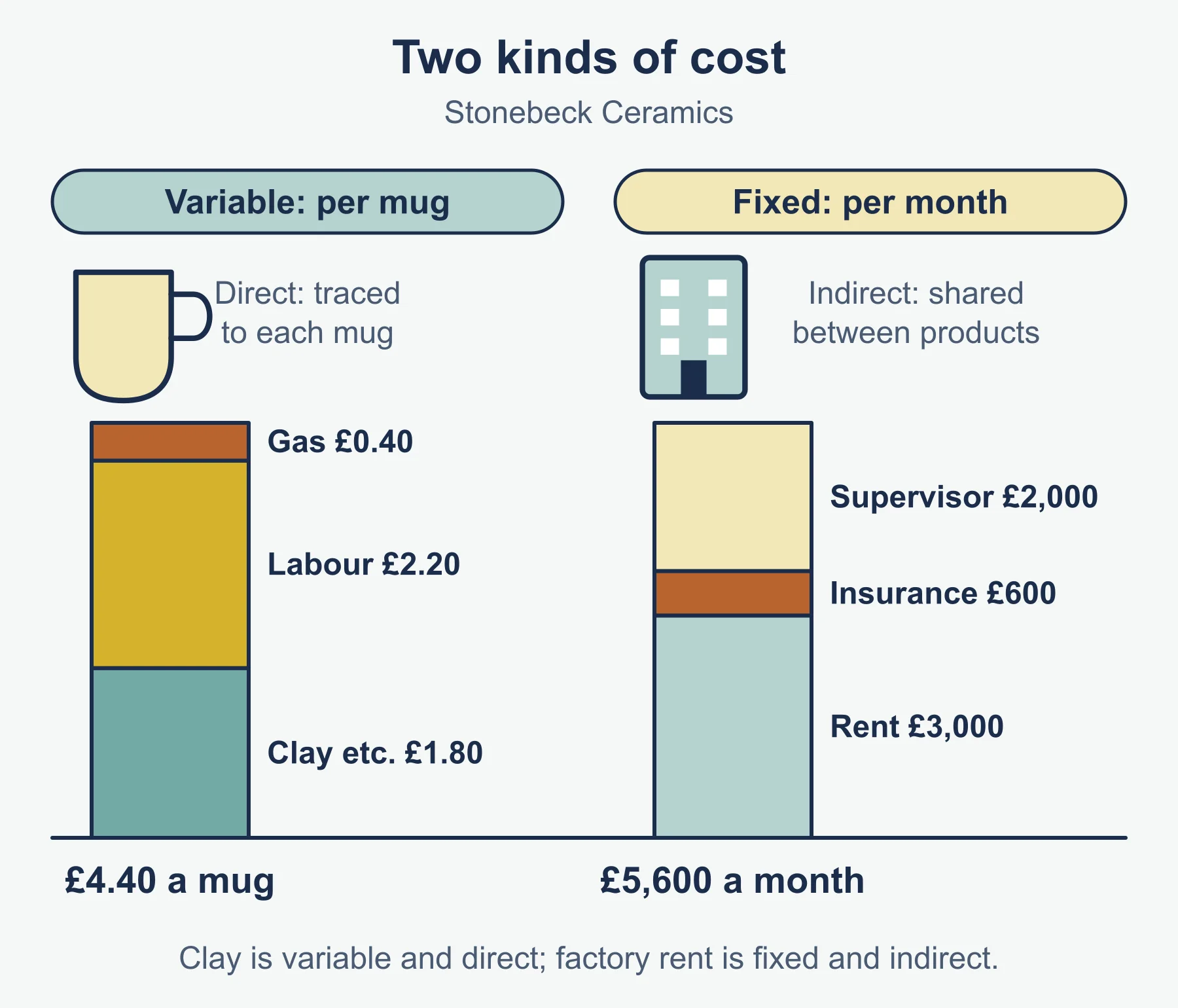
- Fixed versus indirect: fixed concerns behaviour with output; indirect concerns traceability.
- Variable versus direct: a cost can be direct and fixed, or indirect and variable.
- Contribution versus profit: fixed costs separate them.
- Margin of safety versus break-even: one is the buffer above the other.
- Adverse versus favourable: judged by effect on profit, not whether the number is bigger.
Applying it in a case study
Numbers alone earn little in a case study. After a calculation, say what it means for this business: a thin margin of safety means a small fall in demand creates a loss. For an evaluate or justify question, weigh both sides, then reach a judgement that depends on the facts given, such as whether spare capacity exists or whether the firm’s cost data are reliable.
Quick self-test
- Talgarth Tea Rooms has fixed costs of £4,000 a month and a variable cost of £2.50 a cover. Find total cost and average cost for 1,200 covers.
- Define marginal cost.
- Price £9, variable cost £4, fixed costs £12,000. Find break-even output.
- Actual output is 2,900 and break-even is 2,400. Find the margin of safety as a share of actual output, in per cent to 1 d.p.
- How many units give a profit of £3,000 under the figures in question 3?
- Unit cost is £30 and the mark-up is 25%. Find the price.
- Budgeted sales revenue is £15,000 and actual is £16,400. State the variance.
- Budget: 2,000 covers and £8,000 of food. Flex the food budget for 2,400 covers.
- Name one limitation of contribution costing.
- Fixed costs rise to £13,500 (other figures as in question 3). Find new break-even output.
Answers
- Total cost = £4,000 + 1,200 × £2.50 = £7,000. Average cost = £7,000 ÷ 1,200 = £5.83.
- The extra cost of producing one more unit.
- £12,000 ÷ £5 = 2,400 units.
- 500 ÷ 2,900 = 17.2%.
- (£12,000 + £3,000) ÷ £5 = 3,000 units.
- £30 × 1.25 = £37.50.
- £1,400 favourable.
- £8,000 ÷ 2,000 = £4 a cover; £4 × 2,400 = £9,600.
- It ignores fixed costs, so prices set on contribution alone may not cover overheads over time (or it relies on a clear fixed/variable split).
- £13,500 ÷ £5 = 2,700 units.
Where marks are usually lost
- Writing break-even as fixed costs ÷ price instead of ÷ contribution.
- Not rounding break-even output sensibly when it is not a whole number.
- Calling contribution “profit”.
- Giving a variance with no adverse or favourable label.
- Comparing actual costs with an unflexed budget after output has changed.
- Describing a break-even assumption with no link to the case (apply it to the business).
- Listing benefits of budgets without any drawbacks when asked to evaluate.
- Accepting a special order on the numbers alone with no mention of non-financial factors.
Frequently asked questions
How do you calculate break-even output? Divide fixed costs by contribution per unit, where contribution per unit is the selling price minus the variable cost per unit. The Cambridge 9609 syllabus gives no formulas for 5.4 and 5.5, so this is the standard form.
What is the difference between contribution and profit? Contribution is selling price minus variable cost; it goes towards paying fixed costs. Profit is what is left after the fixed costs have been covered.
What is the difference between incremental, flexible and zero budgeting? Incremental budgeting adds or subtracts a percentage from last period’s budget. Flexible budgeting adjusts variable items to actual output. Zero budgeting starts from nothing and every item must be justified.
Can a cost be both fixed and direct? Yes. Fixed and variable describe how a cost behaves as output changes, while direct and indirect describe whether it can be traced to one product, so the two classifications overlap.
Official syllabus
Cambridge International AS & A Level Business 9609 syllabus for examination in 2026, 2027 and 2028, published by Cambridge University Press & Assessment (Cambridge International), sections 5.4 and 5.5.
Get free revision emails (optional)
Occasional emails with practice questions, worked explanations and links to free resources for the qualification and subjects you choose. No spam, and you can unsubscribe from any email. The free tools on this site never need an email.
Related resources
-
Study guides
A Level Business: Financial statements and Analysis of published accounts (Cambridge 9609)
Study guide to financial statements, depreciation, inventory valuation and ratio analysis for Cambridge A Level Business 9609, with worked examples.
Business · Cambridge · A Level
Read guide -
Practice questions
A Level Business: Financial statements and Analysis of published accounts (Cambridge 9609) – Practice Questions
Original practice questions with worked answers on financial statements and ratio analysis for Cambridge A Level Business 9609 sections 10.1 and 10.2.
Business · Cambridge · A Level
Try questions -
Revision notes
A Level Business: Financial statements and Analysis of published accounts (Cambridge 9609) – Revision Notes
Condensed revision notes on financial statements, depreciation, inventory and ratio analysis for Cambridge A Level Business 9609, with a self-test.
Business · Cambridge · A Level
Revise topic
Related articles
-
teaching
A Level tuition in Dubai: Cambridge or Pearson Edexcel International A Level?
Schools in Dubai and Abu Dhabi teach either Cambridge International AS & A Level or Pearson Edexcel International A Level. How the two are structured, why it matters for tuition, and how online classes from Lahore work.
9 October 2026
-
curriculum guides
Choosing subjects at IGCSE and A Level
How subject choices at 14 and 16 affect university options later, and how to keep pathways open without overloading a timetable.
28 July 2026
Studying this with a teacher
Working through Business AS LEVEL?
This page is free and stays free. If you would rather be taught it, Marlbridge runs Business classes one-to-one and in small groups of up to 15, online in your own time zone. The first trial class is free. WhatsApp replies within an hour (8am–11pm Pakistan time, every day); email the same day.
Cambridge Business teachers at Marlbridge

