
Study Guides
A Level Business: External influences on business activity (Cambridge 9609)
Study guide to 6.1 External influences on business activity for Cambridge A Level Business 9609: political, economic, social, technological and more.
- Subject
- Business
- Level
- A LEVEL
- Topic
- Business and its environment
- Author
- Marlbridge Academic Team
- Updated
- Reviewed by
- Salman Ahmad (what this means)
Aligned to Cambridge A Level Business (9609), For examination in 2026, 2027 and 2028. Official specification .
Syllabus page (what it covers and how it is assessed): Cambridge A Level Business.
Syllabus points this page covers
9609 (A Level)
- 6.1 External influences on business activity
Found an error? Report a correction.
Need help with this topic? Request a free trial class for A Level Business (9609).
This guide covers section 6.1 External influences on business activity (6.1.1 to 6.1.7) of the Cambridge International AS & A Level Business 9609 syllabus for examination in 2026, 2027 and 2028. It sits in Topic 6, Business and its environment, which is A Level content. The syllabus bases Paper 3 and Paper 4 on A Level content, with AS knowledge assumed. Use it with the revision notes and the practice questions. Course links: the Cambridge A Level Business hub, the checklist and the free diagnostics.
All businesses below are invented.
What you must cover
| Section | Content |
|---|---|
| 6.1.1 Political and legal | Privatisation and nationalisation; law as a control; impact of change |
| 6.1.2 Economic | Government help, constraint and market failure; macroeconomic objectives; four policy types |
| 6.1.3 Social and demographic | CSR, community and pressure groups, demographic change |
| 6.1.4 Technological | Impact of technological change |
| 6.1.5 Competitors and suppliers | Their impact on decisions |
| 6.1.6 International | Trading links, agreements, technology, multinationals |
| 6.1.7 Environmental | Physical issues, environmental audit, sustainability |
6.1.1 Political and legal
Privatisation and nationalisation
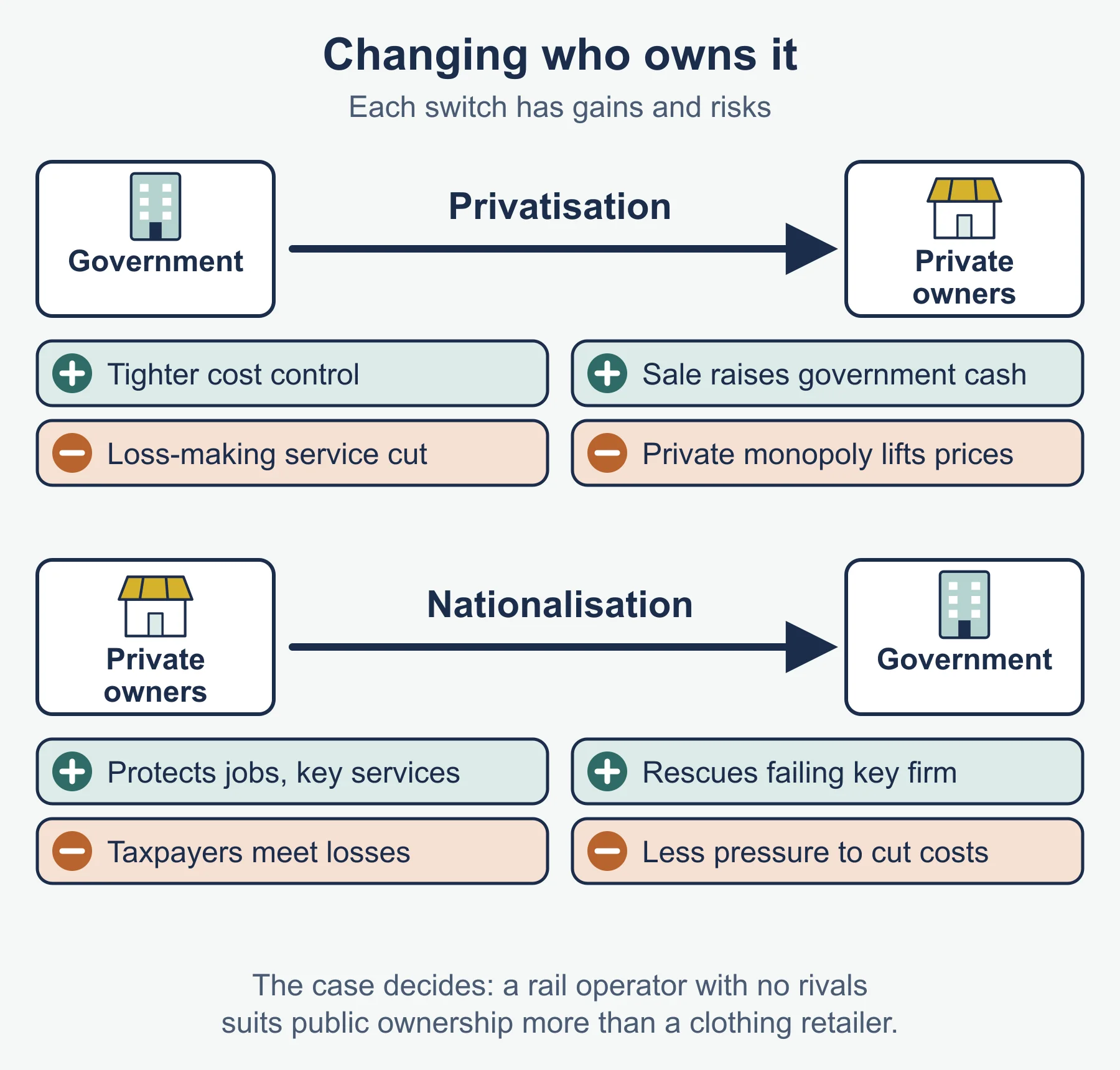
Privatisation moves a business or industry from government ownership to private ownership. Nationalisation moves it the other way. The syllabus asks for the advantages and disadvantages of each “in a given situation”, so the context decides which points matter.
Privatisation:
- Advantages: the owners now gain from cost control, so efficiency may rise; the sale raises money for the government; competition may widen; the business can raise capital from investors.
- Disadvantages: an essential service may be cut if it is unprofitable; a private monopoly may raise prices; jobs may be lost; the business may focus on short-term profit.
Nationalisation:
- Advantages: the government can protect jobs and key services; it can run a natural monopoly for public benefit; it can rescue a failing business of strategic value.
- Disadvantages: taxpayers meet losses; there may be less pressure to cut costs; decisions can follow political aims; competitors lose a fair market.
For a rail operator with no rivals, the case for public ownership is stronger than for a clothing retailer. Always argue from the case.
Law as a form of control
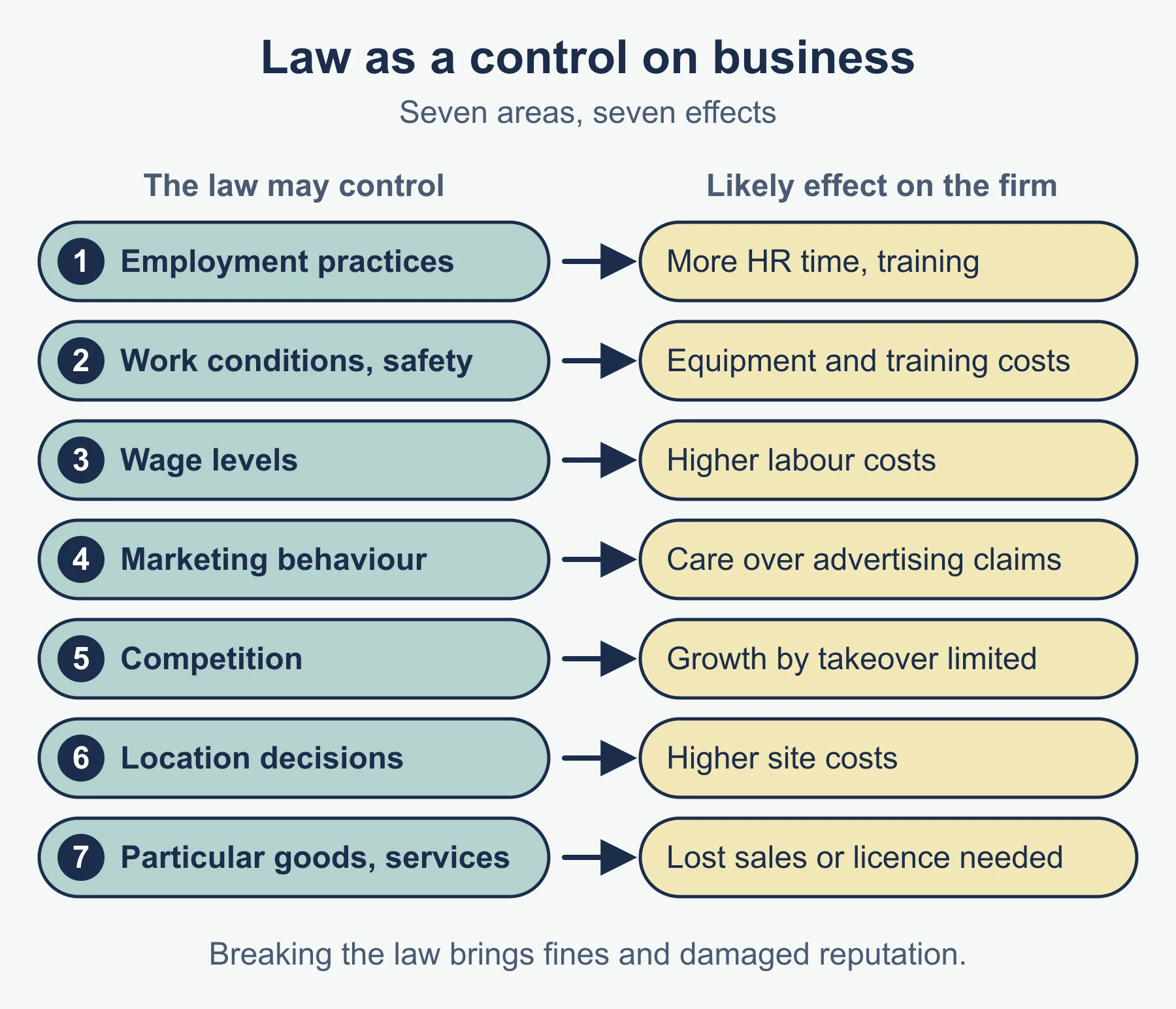
The syllabus lists seven areas where government might use the law to control business. Learn each as a pair: what the law does, and what it costs or changes for the firm.
| Area | What law might do | Likely business effect |
|---|---|---|
| Employment practices | Set rules on hiring, contracts and dismissal | More HR time and training |
| Conditions of work, including health and safety | Set safety standards and inspections | Equipment and training costs |
| Wage levels | Set a minimum wage | Higher labour costs |
| Marketing behaviour | Ban misleading claims | Care over advertising |
| Competition | Limit mergers or price fixing | Restricted growth by takeover |
| Location decisions | Control where firms may build | Higher site costs |
| Particular goods and services | Restrict or ban sales | Lost sales, or a licence needed |
Keep to general descriptions of the law.
Impact of change
Changes in political and legal factors affect decisions. A new safety rule may lead to a capital purchase. A change of government may change tax or trade policy, and uncertainty can delay investment. Legal compliance has a cost, but breaking the law brings fines and damage to reputation.
6.1.2 Economic
Government and business activity
Government might intervene to help business and encourage enterprise, for example through grants, subsidies, lower taxes for new firms, training schemes and advice. It might constrain business activity through taxes, regulation and licences. It might deal with market failure, where free markets give a poor result. Typical cases are goods with costs imposed on others (such as pollution), goods the market under-supplies, and firms with too much market power. The tools are taxes, subsidies, regulation, direct provision and competition rules.
Macroeconomic objectives
The key macroeconomic objectives named in the syllabus are low unemployment, low inflation and economic growth. Performance against them affects businesses:
- Growth raises incomes. Demand rises most for goods with high income elasticity. Recession does the opposite.
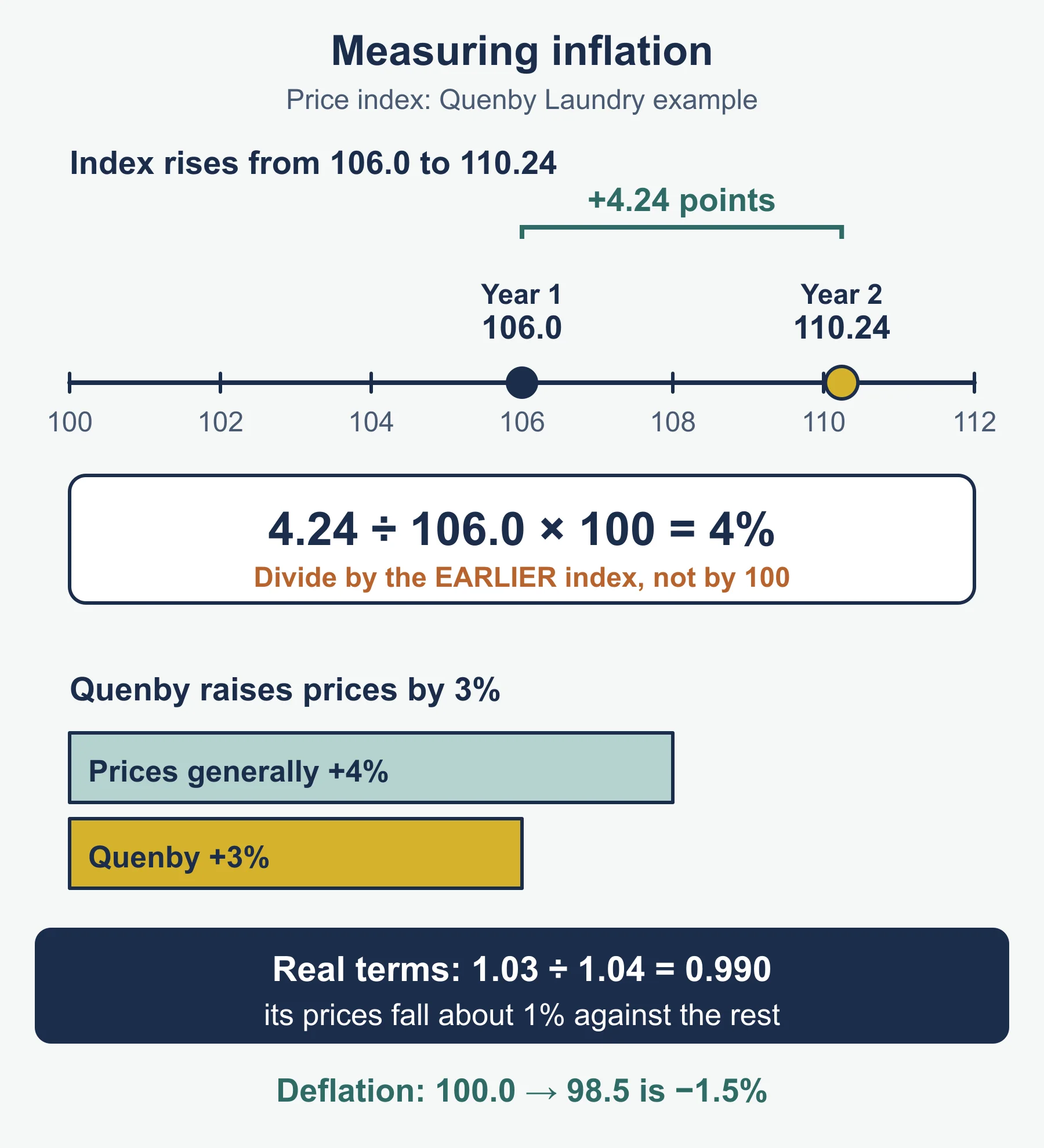
- Inflation raises costs and can erode profit if prices cannot rise as fast. It makes planning harder.
- Unemployment lowers spending, but makes labour easier to recruit and wage demands weaker.
Four types of policy
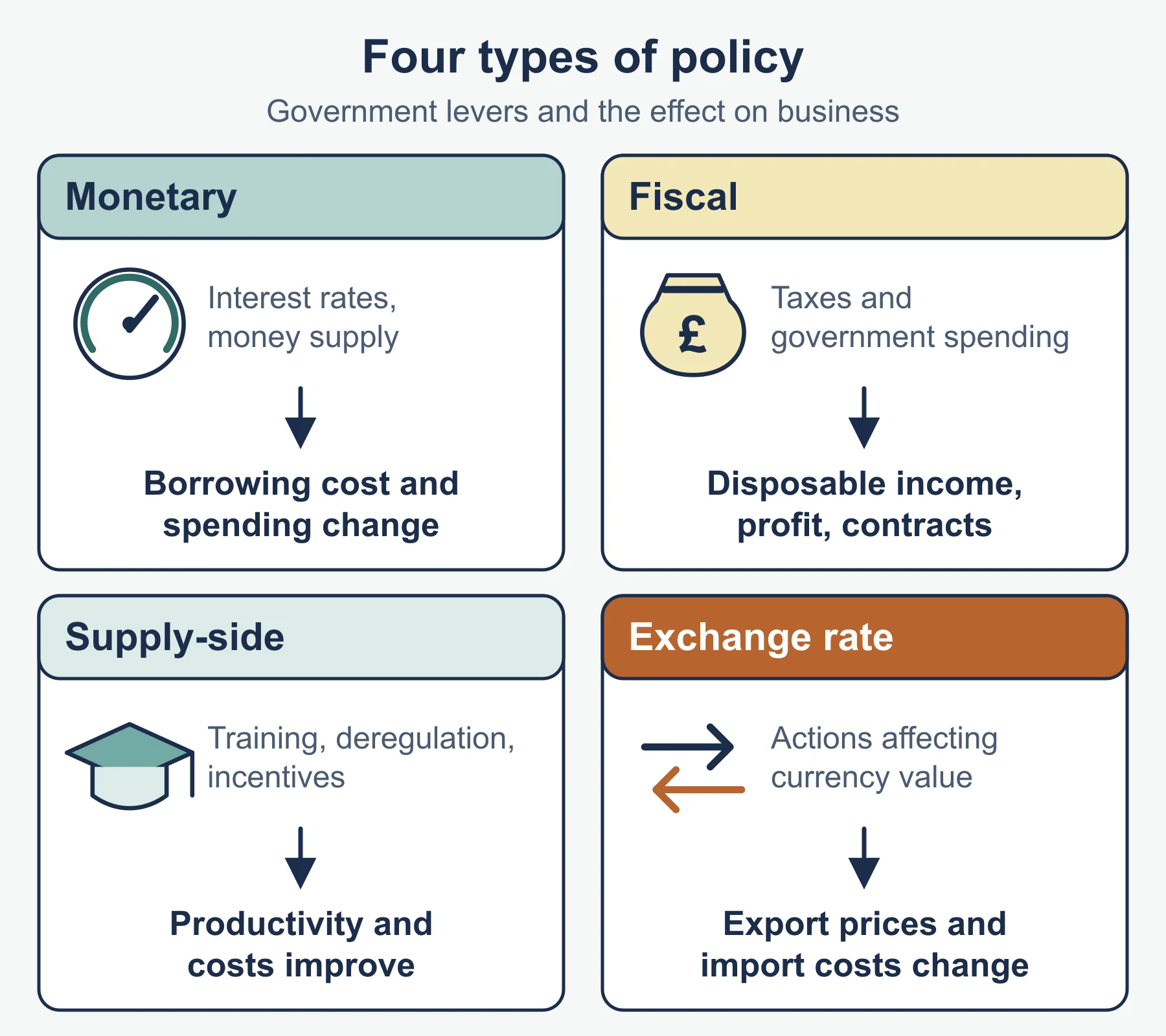
| Policy | Instrument | Typical business effect |
|---|---|---|
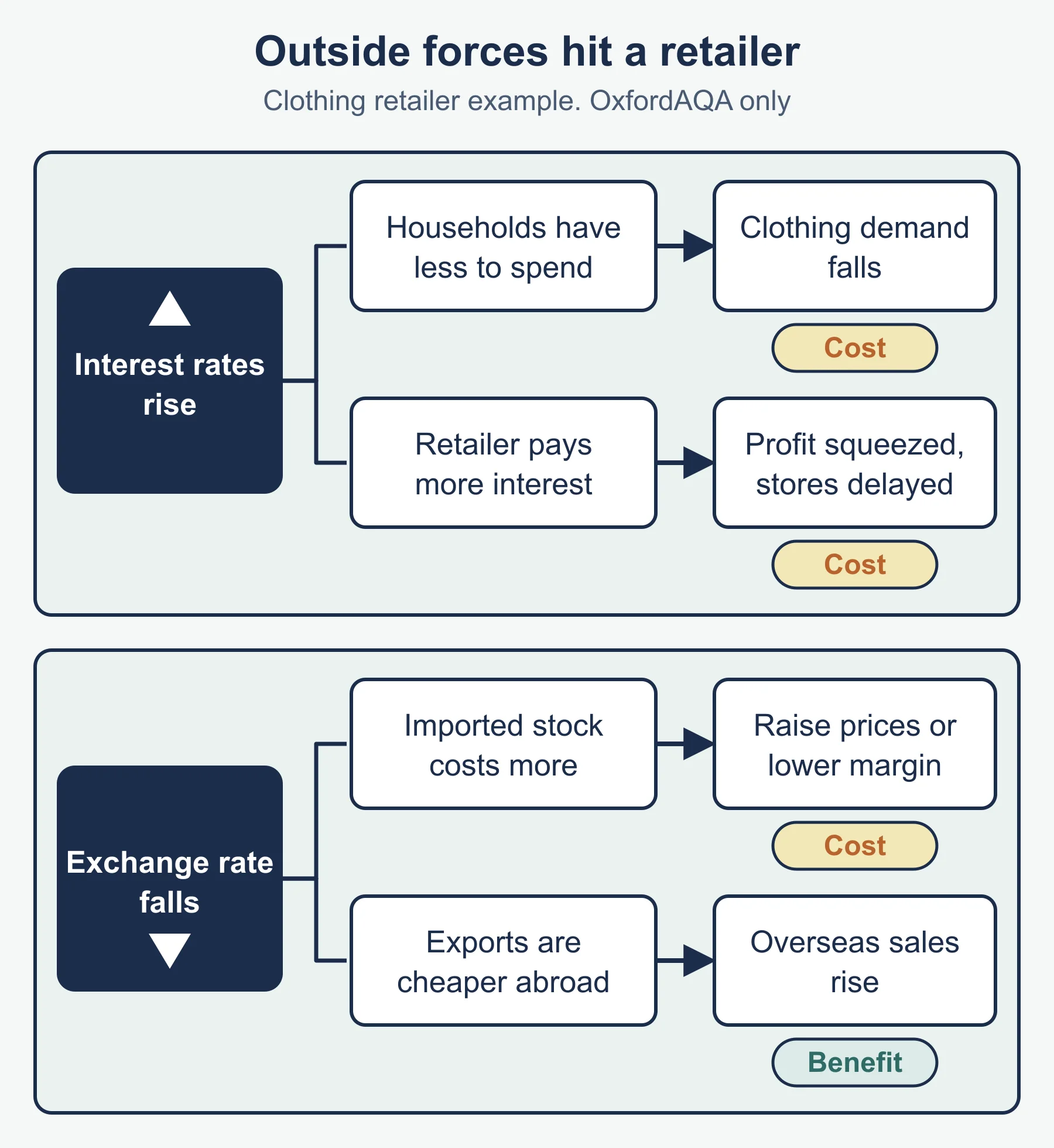
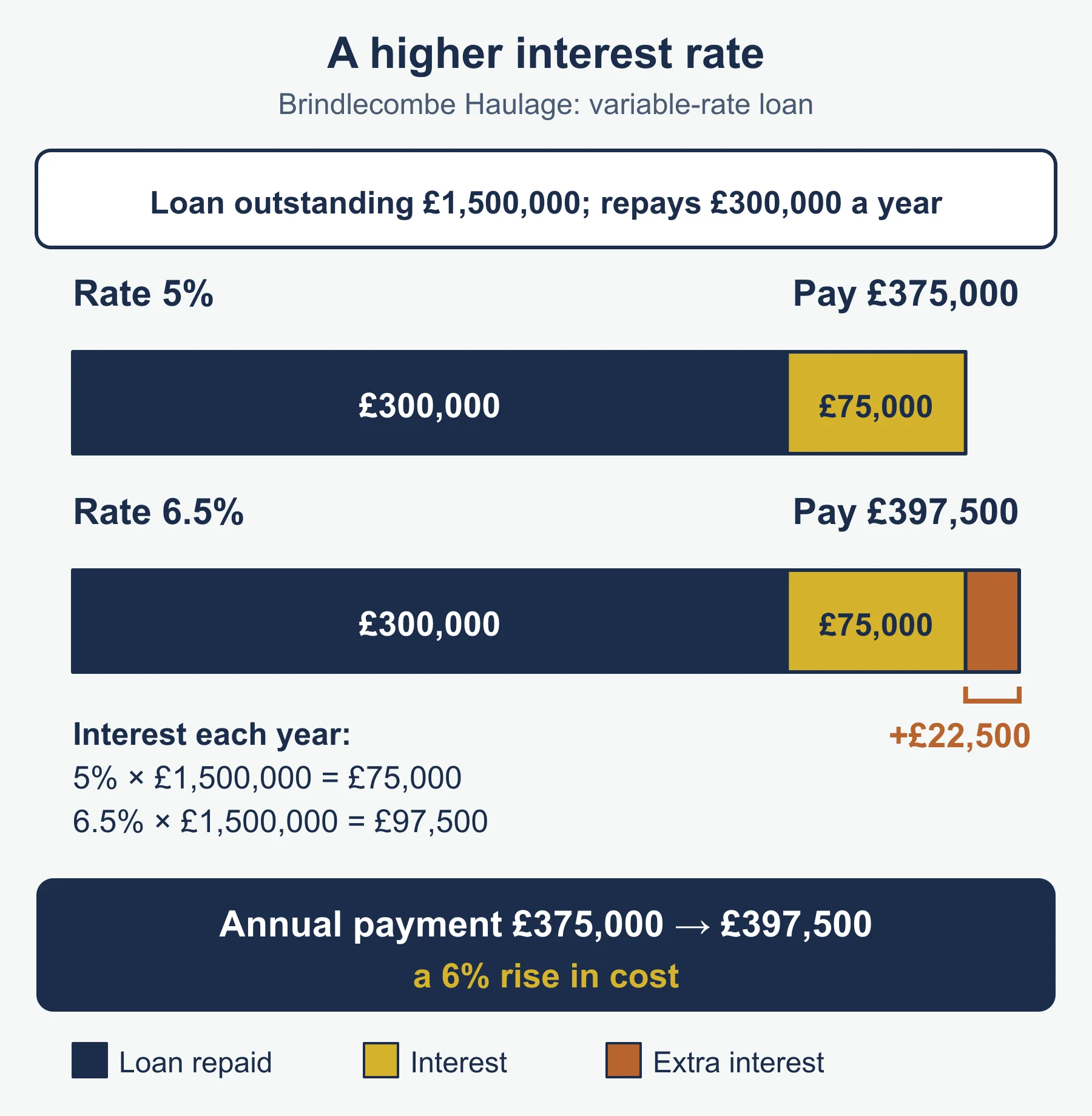
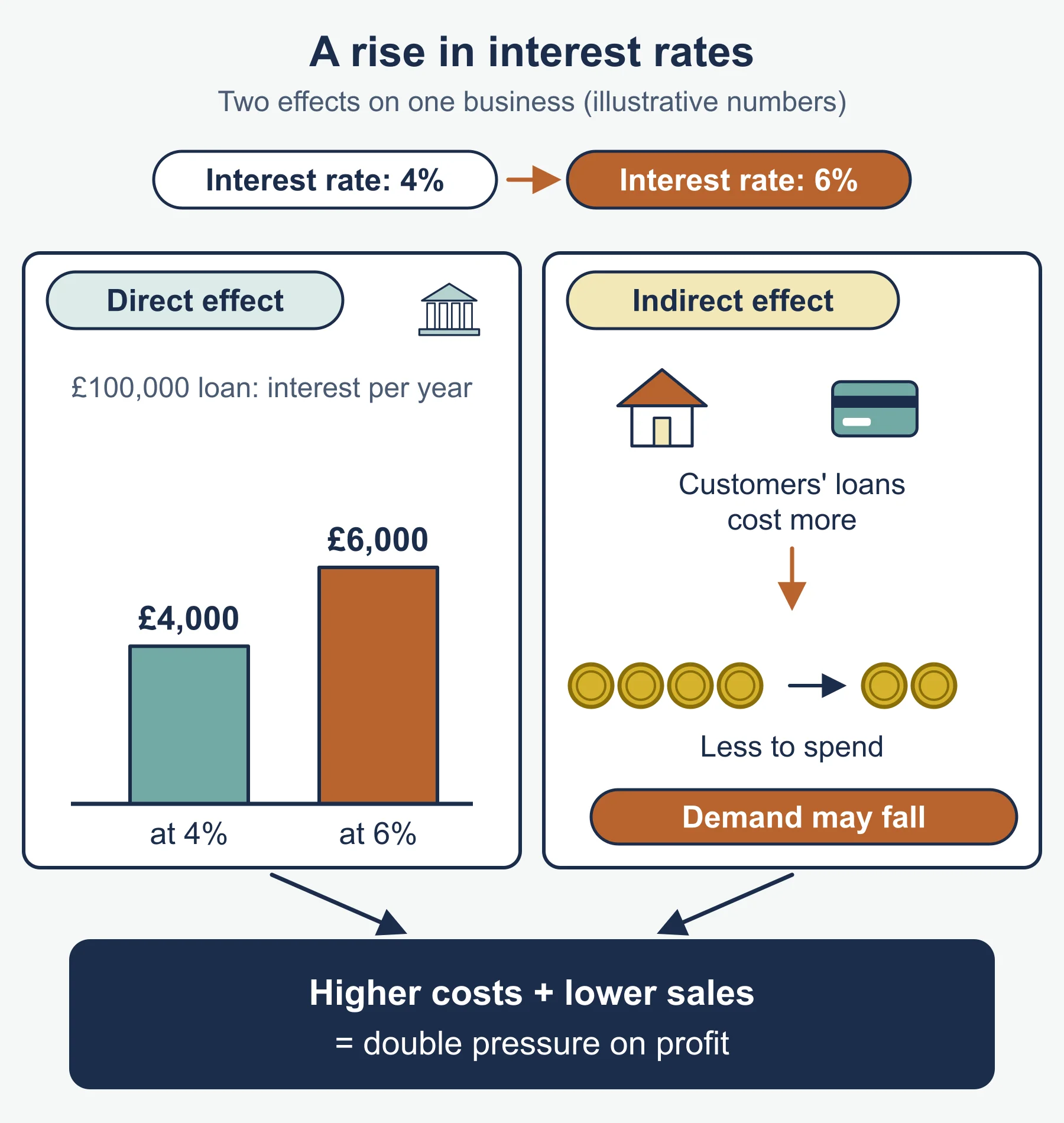
| Monetary | Interest rates, money supply | Borrowing costs and consumer spending change |
| Fiscal | Taxation and government spending | Disposable income, profits and public contracts change |
| Supply-side | Training, deregulation, incentives | Productivity and costs improve over time |
| Exchange rate | Actions that affect the currency’s value | Export prices, import costs and competitiveness change |
Worked example: interest rates
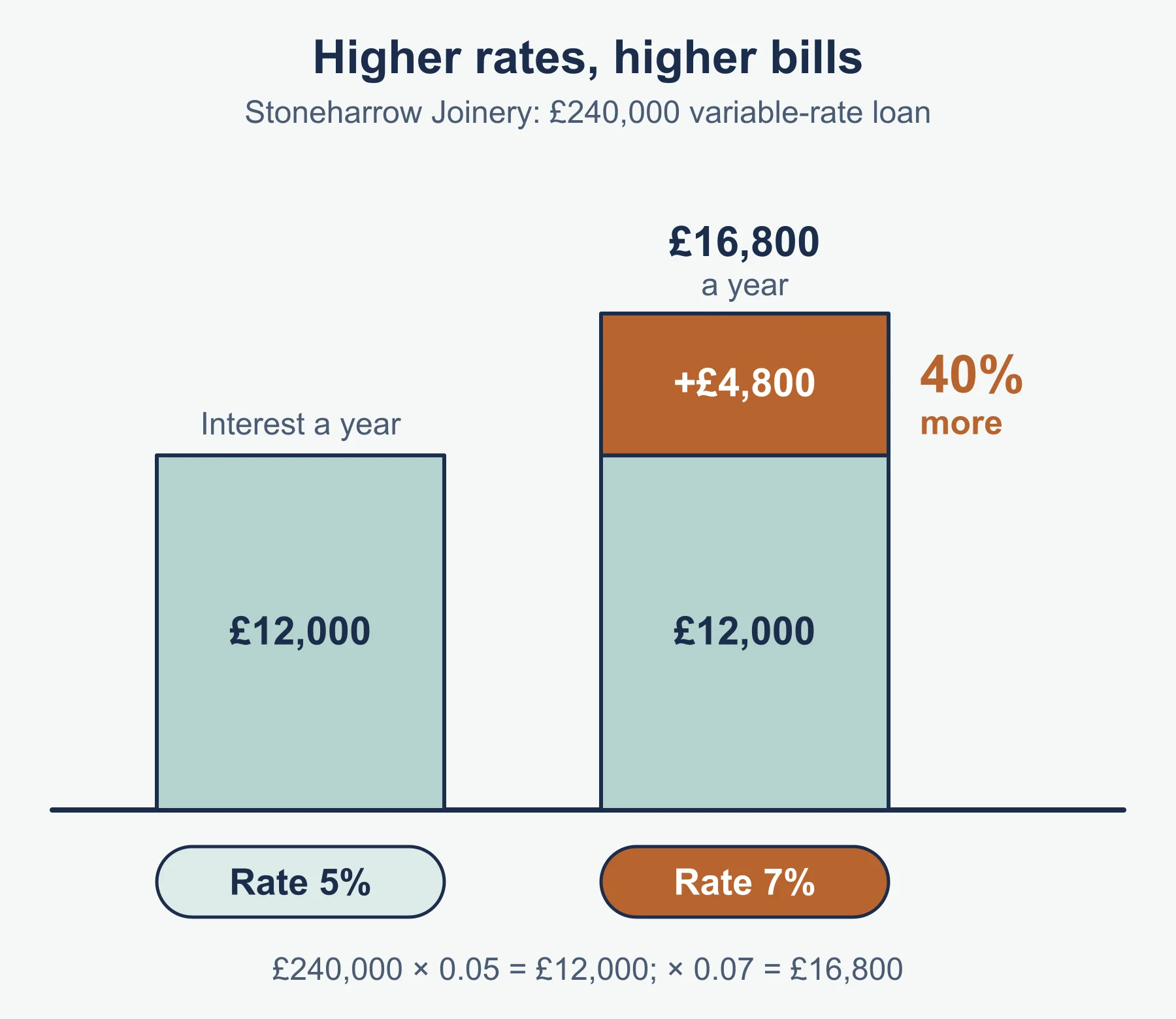
Stoneharrow Joinery has a variable-rate loan of £240,000. The interest rate rises from 5% to 7%.
Annual interest before: 240,000 × 0.05 = £12,000. Annual interest after: 240,000 × 0.07 = £16,800. Rise: £4,800, which is 40% more.
Analysis: the extra cost cuts profit unless prices rise, and higher rates may reduce demand for kitchens bought on credit. A firm with fixed-rate debt would be protected for a time. Judgement: it depends on how much debt is variable and how sensitive customers are.
Worked example: exchange rate
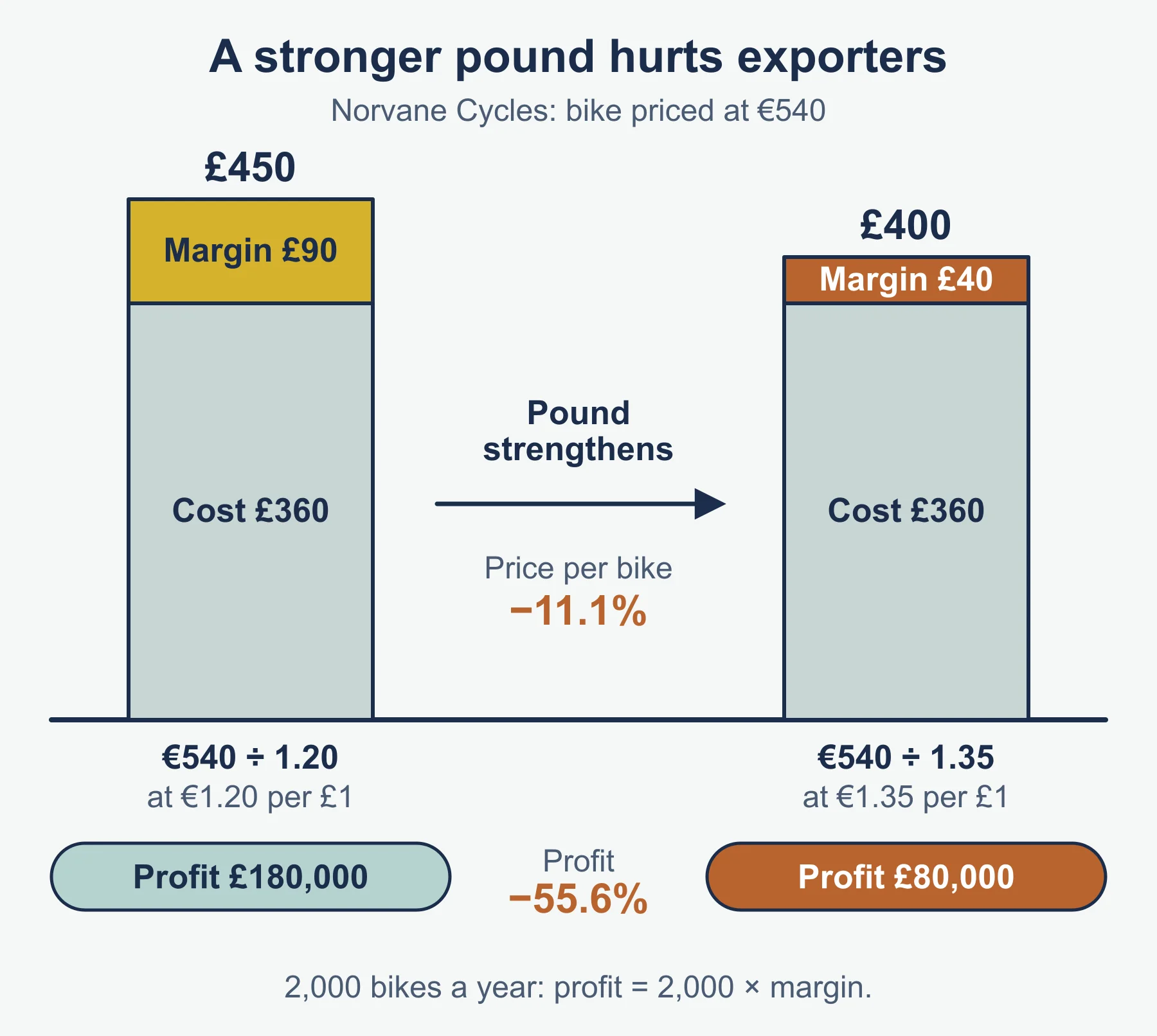
Norvane Cycles exports bicycles priced at €540. Its cost per bicycle is £360 and it sells 2,000 a year.
At €1.20 per £1 the price is 540 ÷ 1.20 = £450. Margin £90. Profit 2,000 × 90 = £180,000. After the pound strengthens to €1.35 per £1, the price is 540 ÷ 1.35 = £400. Margin £40. Profit £80,000.
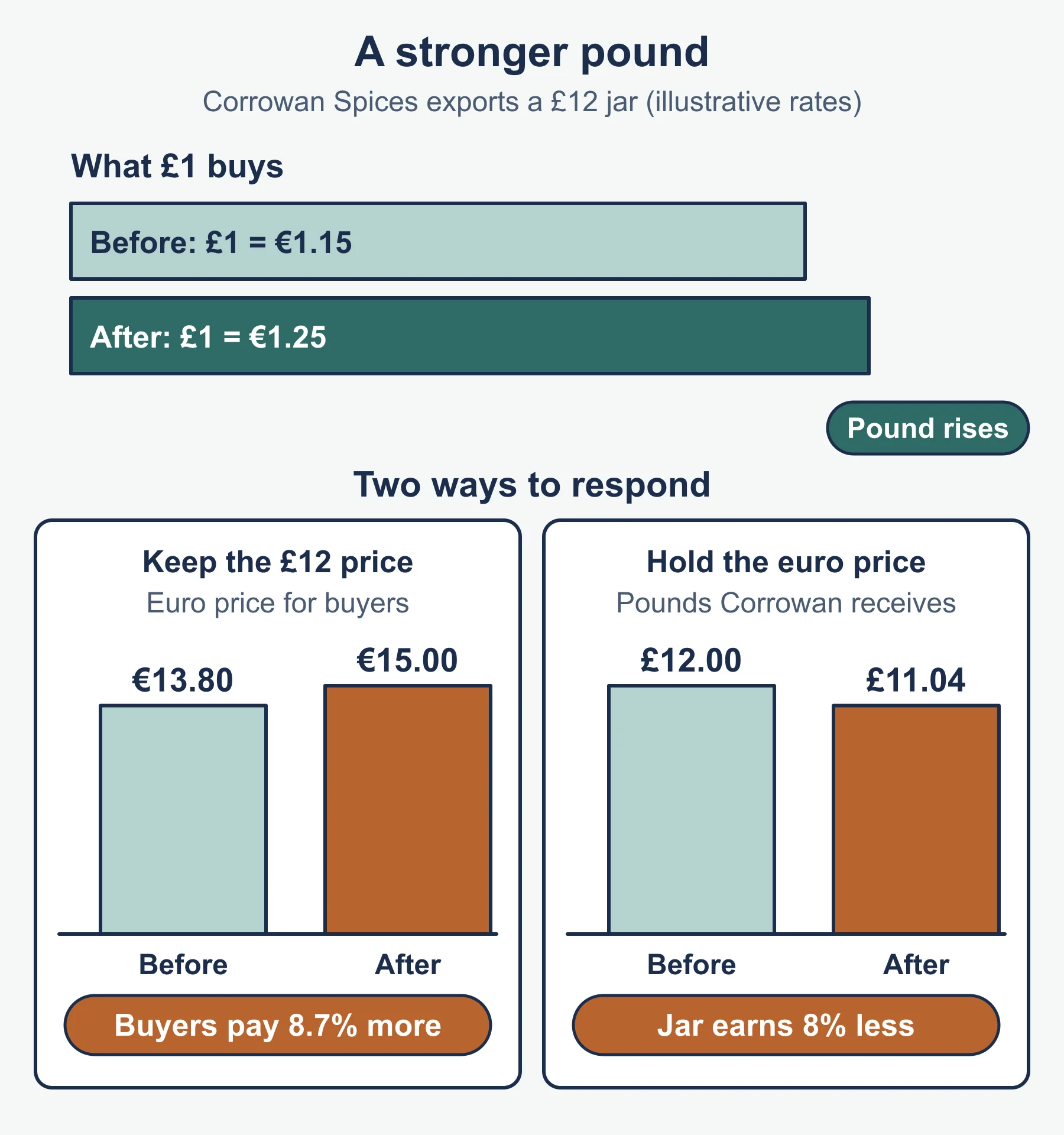
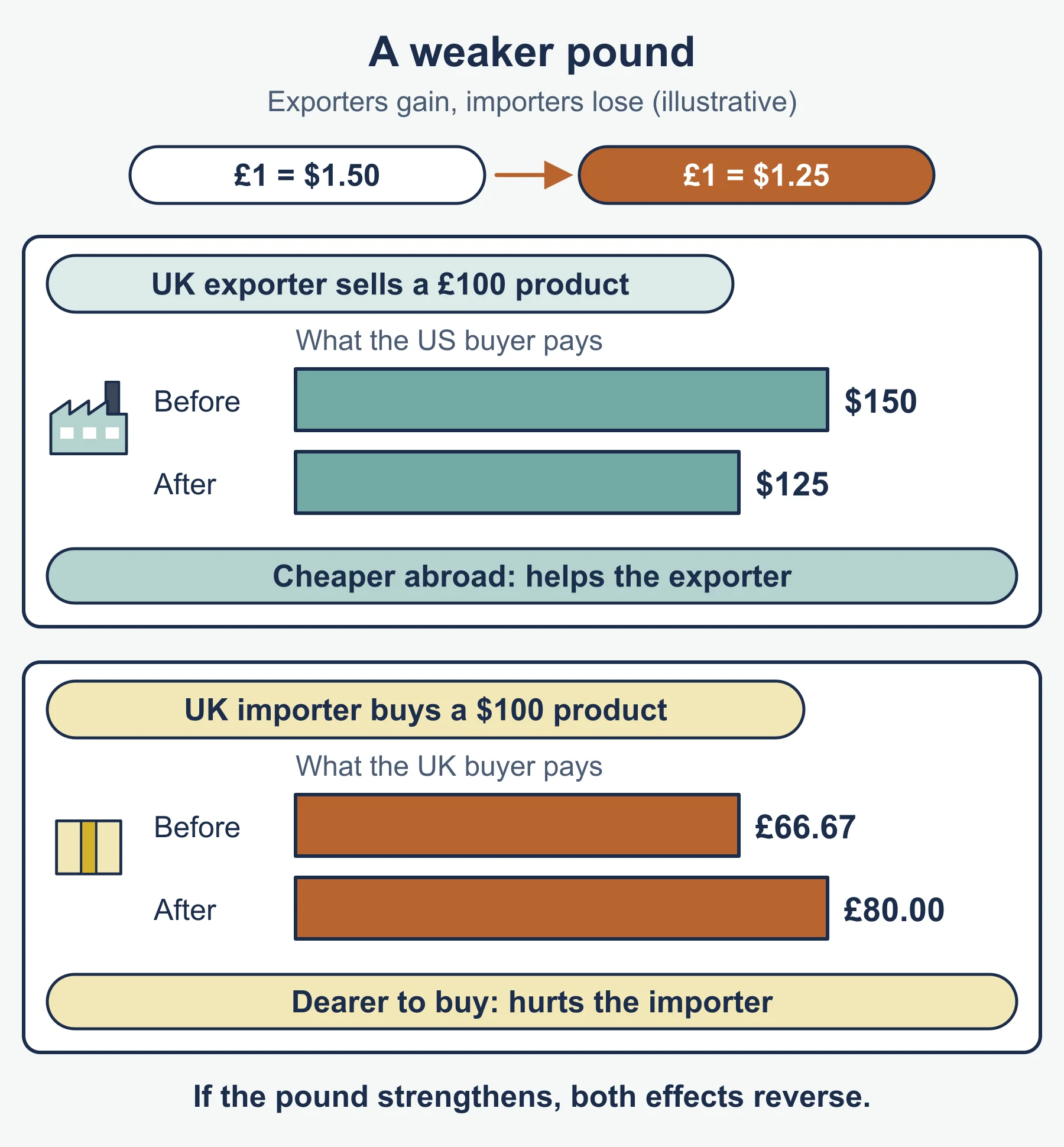
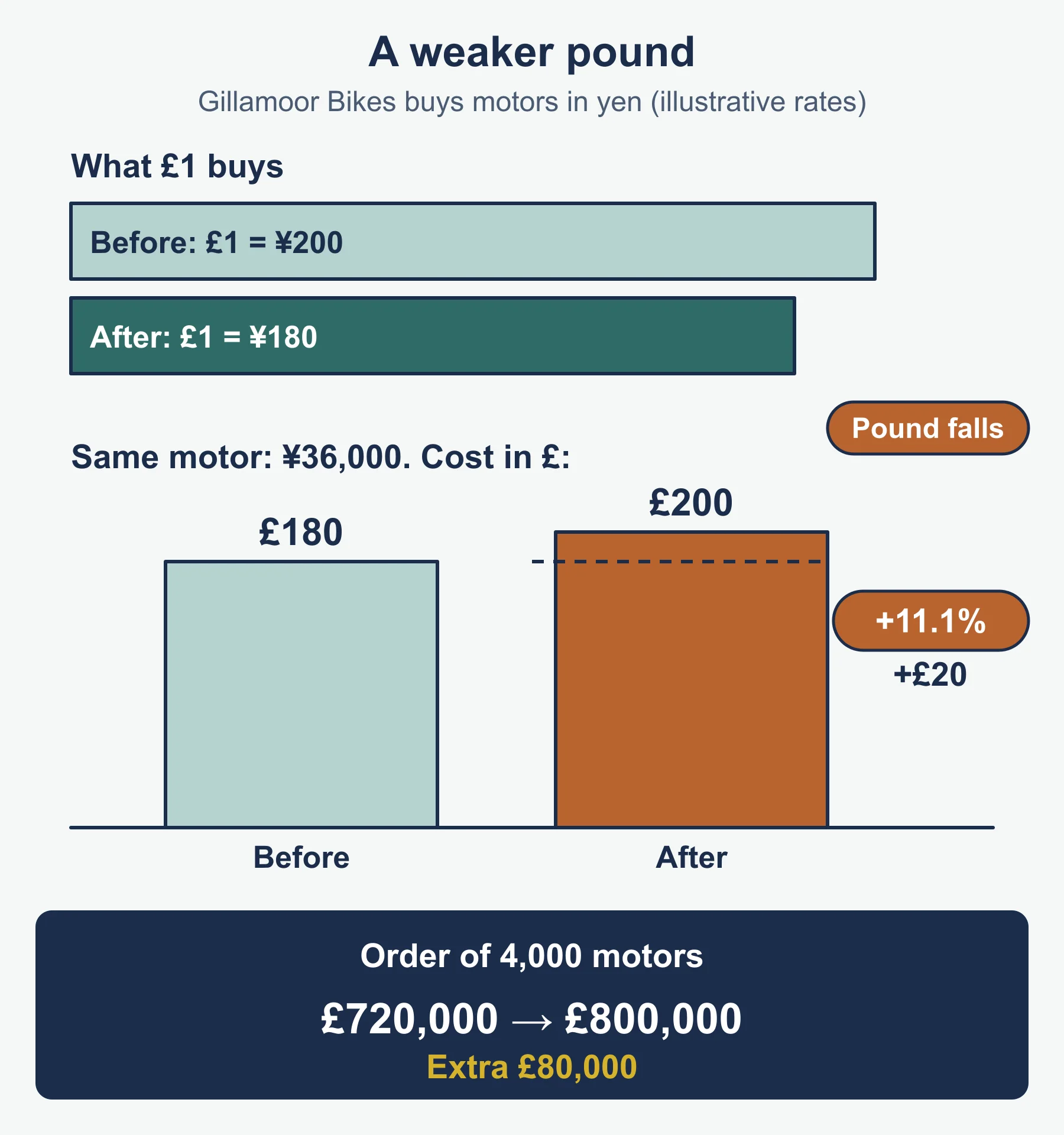
Revenue per bicycle falls by 11.1% and profit by 55.6%. Norvane could raise its euro price (risking lost sales), cut costs, or buy components abroad: a €210 part costs £175 at 1.20 but £155.56 at 1.35. A stronger pound hurts exporters and helps importers.
Worked example: a tax change
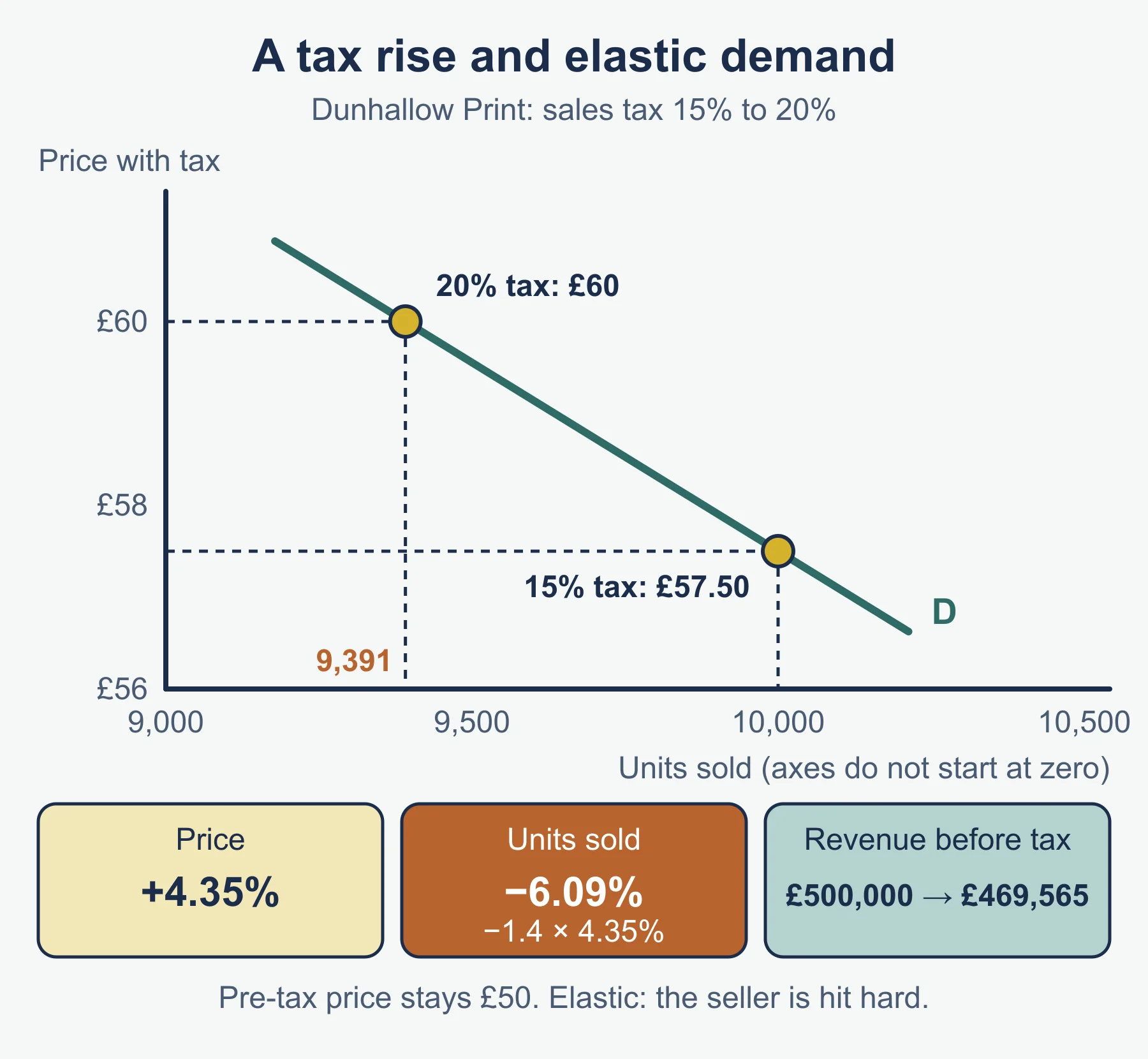
Dunhallow Print sells a product at £50 before sales tax. At 15% the shelf price is £57.50. The tax rises to 20%, making it £60.
Price rise: 2.50 ÷ 57.50 = 4.35%. If price elasticity of demand is −1.4, quantity falls by 1.4 × 4.35 = 6.09%. From 10,000 units, that is 9,391 units. Revenue before tax falls from £500,000 to £469,565 (assuming the pre-tax price stays £50). Elastic demand means the tax rise hits the seller hard.
6.1.3 Social and demographic
Corporate social responsibility (CSR)
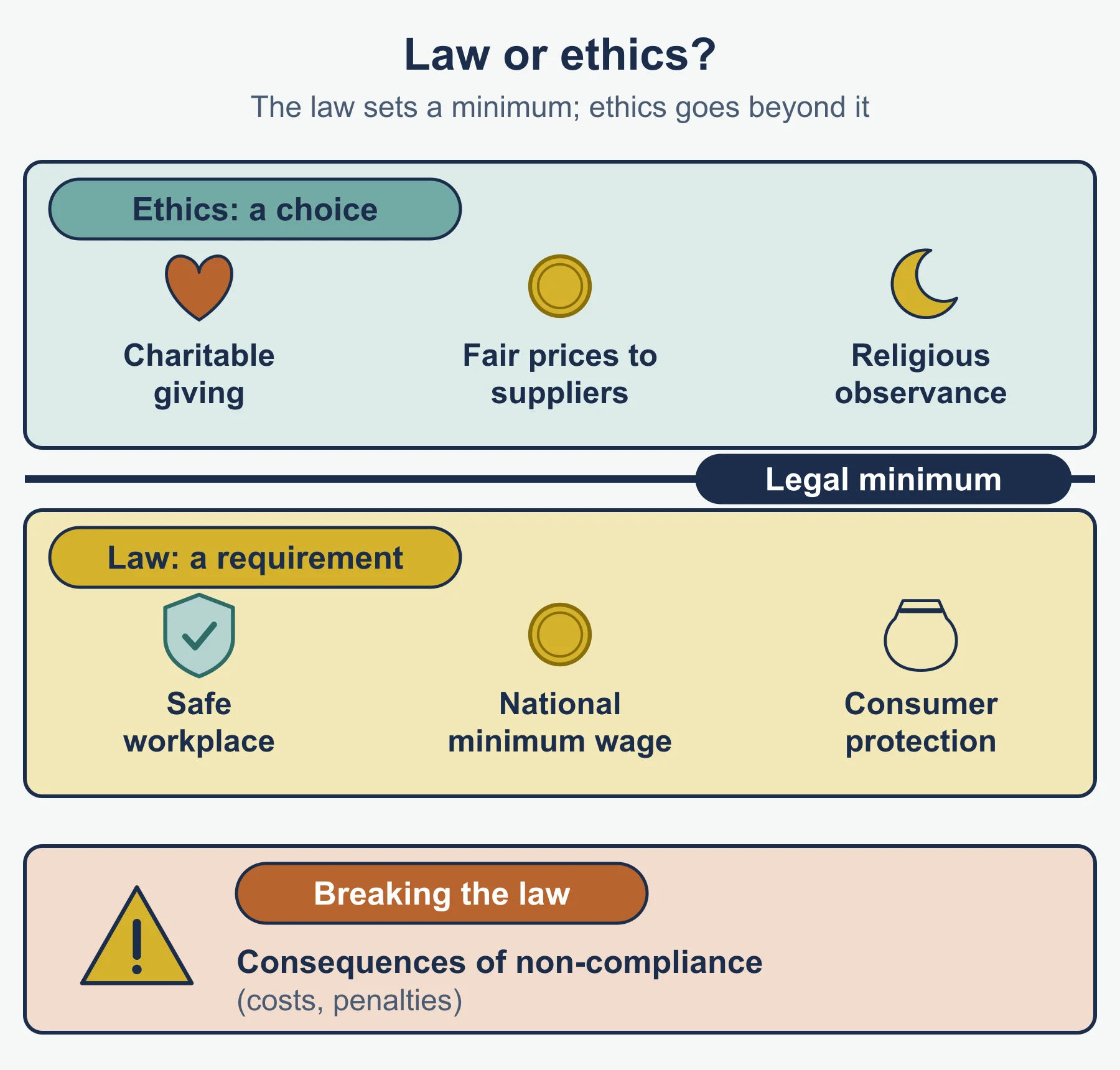
CSR means a business accepting duties to society beyond its legal and profit duties. The syllabus gives examples of areas to consider: accounting practices, paying incentives for the award of contracts, and social auditing.
- Accounting practices: honest reporting, not hiding costs or flattering profit.
- Incentives for contracts: paying bribes or gifts to win work is an ethical issue and is often illegal.
- Social auditing: a review of the firm’s social impact, such as working conditions, supplier treatment and community effects.
Impact: CSR can improve reputation, loyalty and recruitment, but costs money and may raise prices. Issues arise when a claim is empty marketing, or when lower-standard rivals undercut you.
The community and pressure groups
A business needs the community’s goodwill: its labour, its customers, and its permission to expand. Pressure groups campaign on issues such as pollution, labour practices or product safety. They can change customer attitudes through publicity and boycotts, and influence law. A small local firm may react quickly to a petition; a global brand may face coordinated campaigns.
Demographic change
Demographic change is change in the size and make-up of a population: age structure, birth and death rates, migration, and distribution between regions. Look at it locally (a town losing young adults), nationally (an ageing population) and globally (growth in one region).
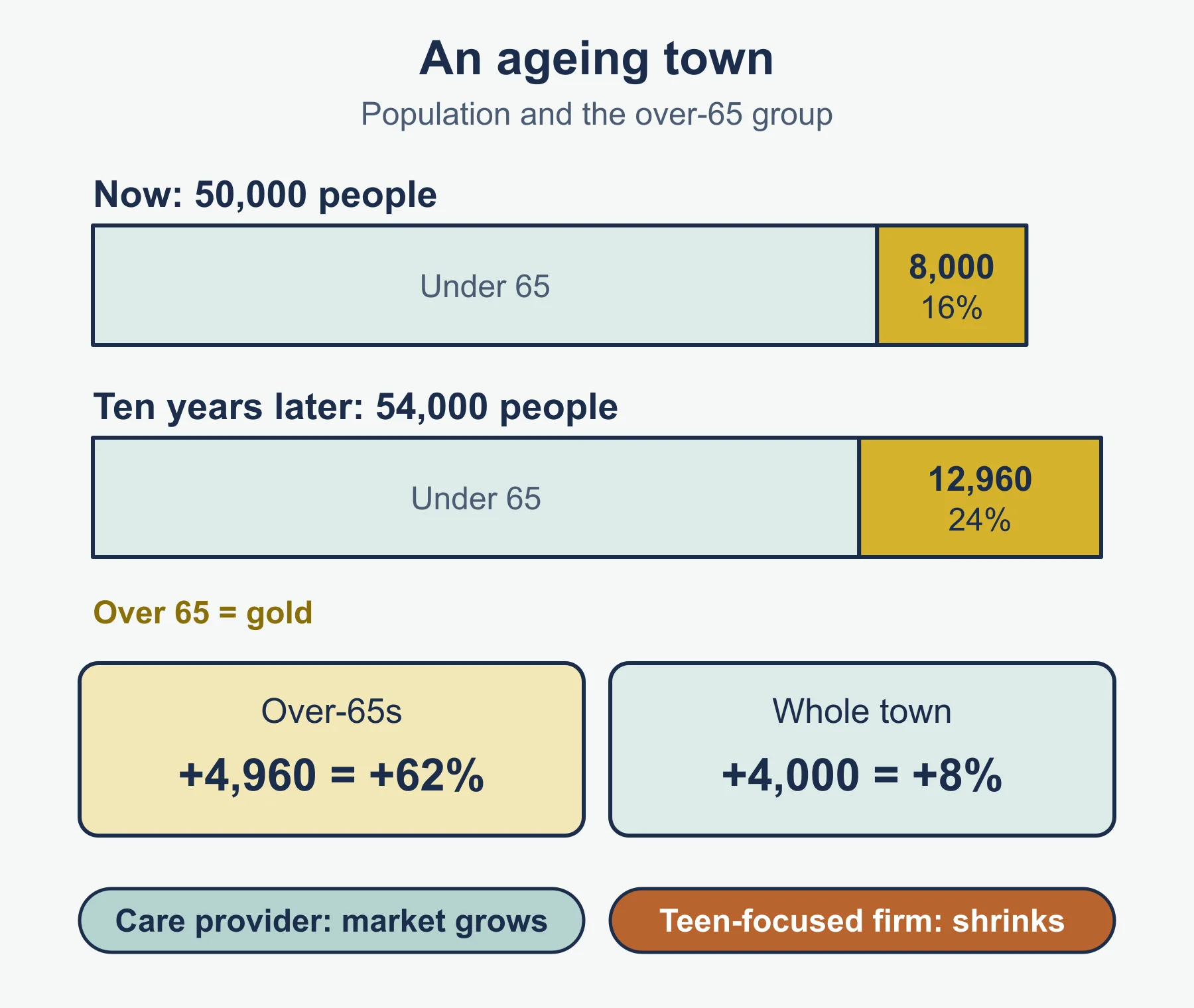
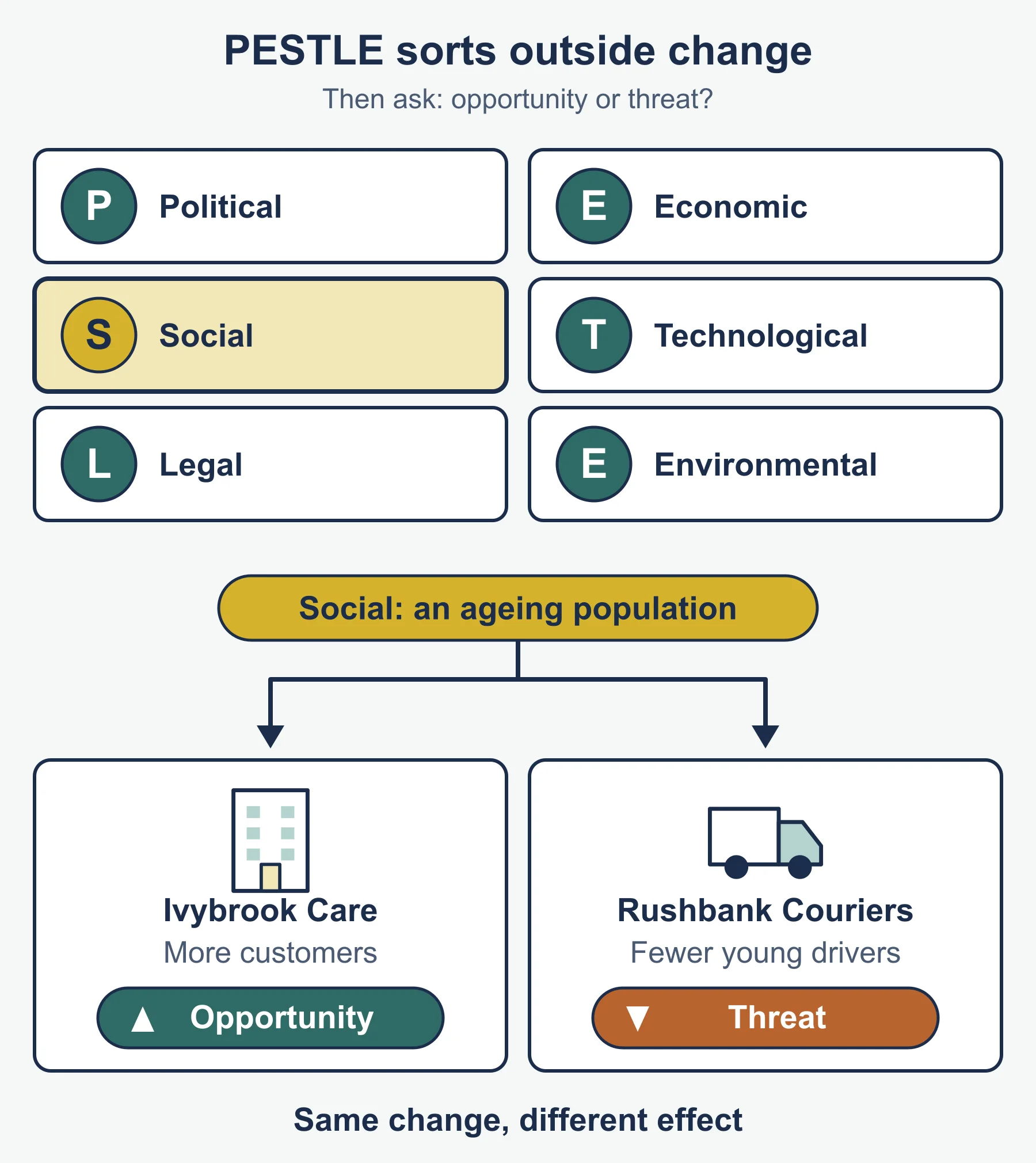
Worked example: a town has 50,000 people, of whom 16% are over 65, so 8,000. Ten years later the town has 54,000 people and 24% are over 65, so 12,960. The over-65 group has grown by 4,960, or 62%, while the whole population grew 8%. A shop or care provider serving older people has a growing market; a firm relying on teenagers has a shrinking one. An ageing workforce may also mean skills shortages and pension costs.
6.1.4 Technological
Technological change affects decisions about products, production and marketing. It can create new products, cut unit costs through automation, open online sales channels and make old products obsolete. It also demands investment, retraining and may cost jobs. Judgement depends on timing, cost, and whether customers and competitors are moving too.
6.1.5 Competitors and suppliers
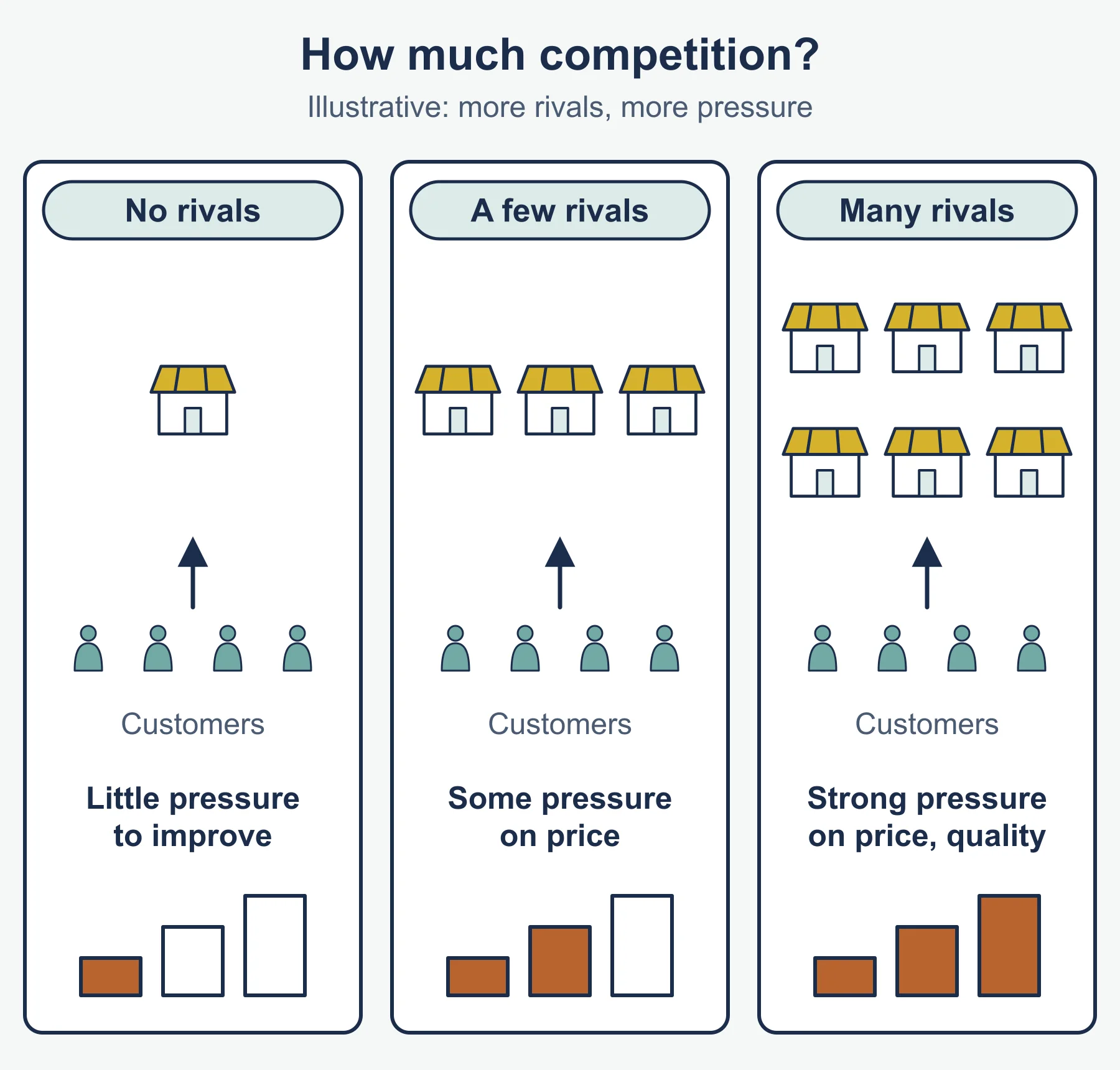
Competitors affect pricing, product features, promotion and entry decisions. Many close rivals mean pressure on price and a need to differentiate. New entrants or a rival’s innovation can force a response. Suppliers affect cost, quality and reliability. A single supplier of a key input holds power over price and delivery. A business can reduce dependence by using several suppliers, signing longer contracts or integrating backwards.
6.1.6 International
Trading links and agreements
International trading links give access to bigger markets, cheaper inputs and economies of scale, but expose the firm to exchange rate risk, competition from abroad, and differences in culture and rules. Trade agreements, such as arrangements that lower tariffs between countries, can widen market access and cut costs for members. They can also expose domestic firms to stronger rivals, and exclude firms outside the agreement.
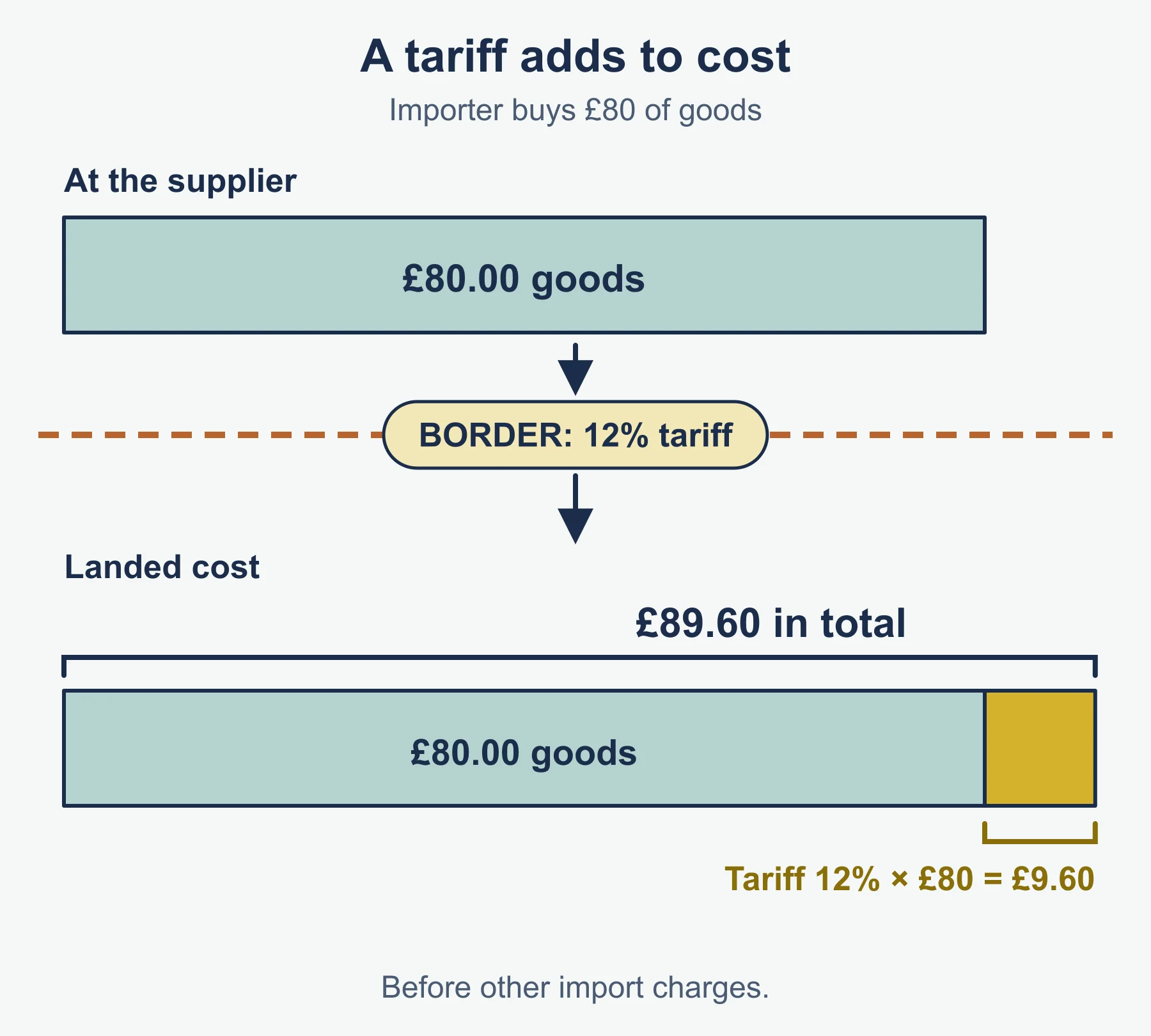
A tariff is a tax on imports. If an importer pays a 12% tariff on goods costing £80, the landed cost is £89.60 before other charges.
Technology in international trade
Technology cuts the cost of trading across borders. Online shops reach foreign buyers, digital payments and tracking speed up exchange, and communication allows design, production and customer service to be spread over several countries.
Multinationals and governments
A multinational operates in more than one country. For a host country the potential advantages are jobs, investment, new skills and technology, tax revenue and export earnings. The disadvantages are profits sent abroad, pressure on local firms, environmental harm, and loss of control if the firm moves elsewhere.
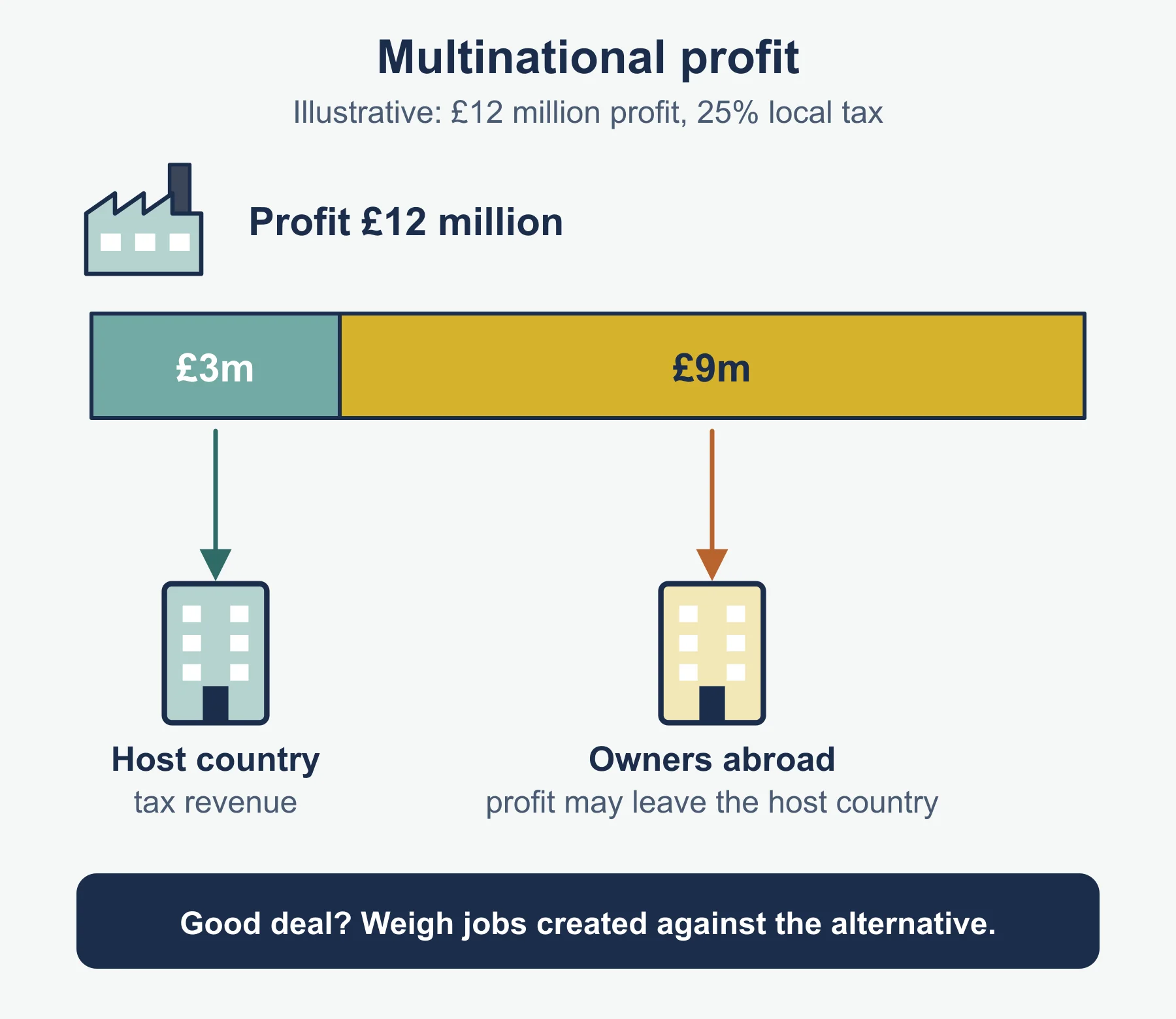
Suppose a multinational makes £12 million profit and pays 25% local tax. The host receives £3 million, and £9 million may leave the country. Whether that is a good deal depends on the jobs created and the alternative.
Relationships run both ways. Governments offer incentives to attract investment; multinationals may bargain for lower taxes by threatening to move; governments can regulate, tax or restrict them.
6.1.7 Environmental
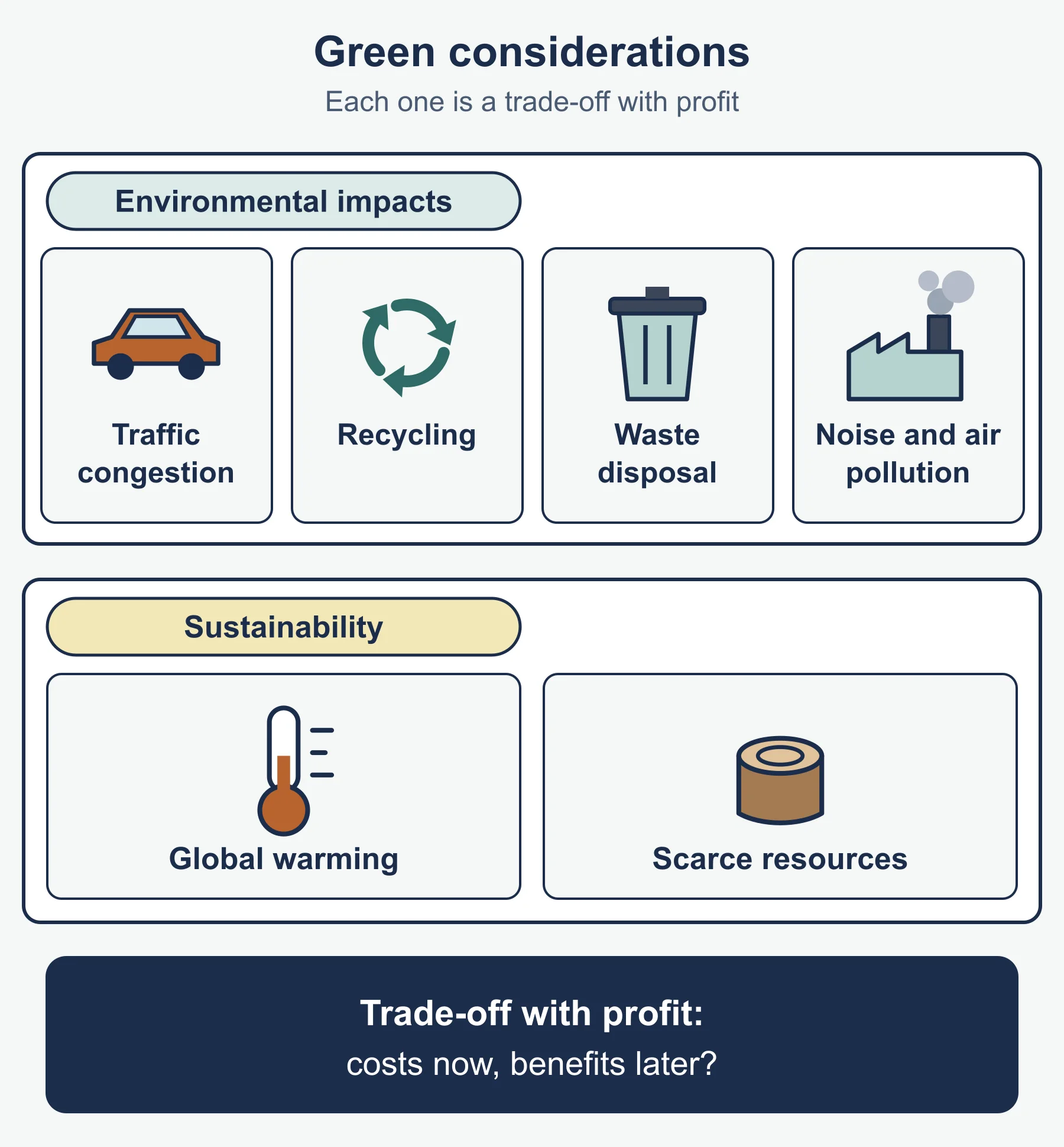
Physical environmental issues include pollution, climate change, resource scarcity, waste and damage to habitats. They influence behaviour through regulation, customer opinion, higher input costs and the risk of disruption, for example from flood.
An environmental audit measures a business’s environmental impact against targets. A business may use it to find waste and cut costs, and to support claims it makes. Stakeholders such as customers, investors, regulators and pressure groups may use it to check those claims.
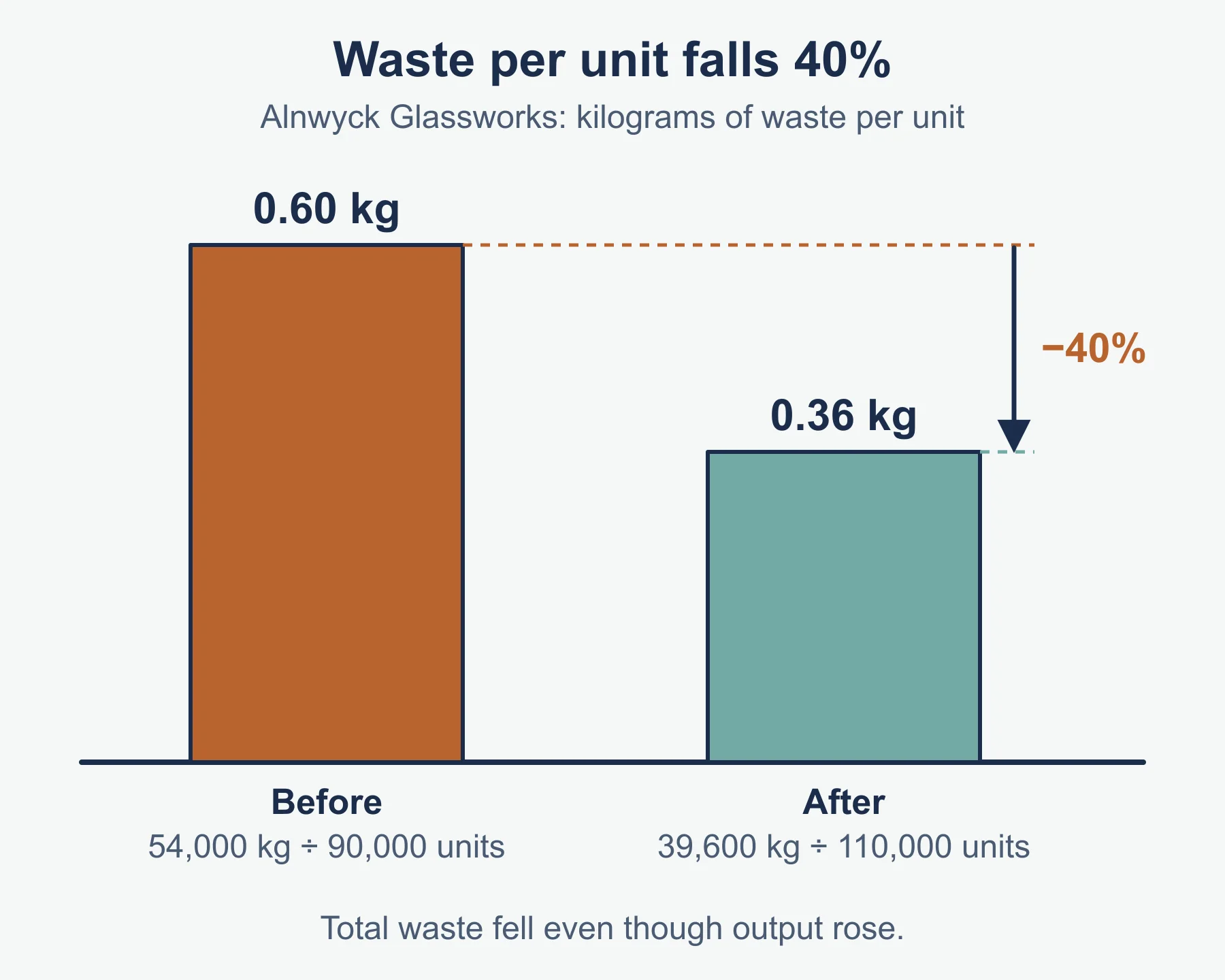
Worked example: Alnwyck Glassworks wasted 54,000 kg across 90,000 units. After changes it wasted 39,600 kg across 110,000 units. Waste per unit fell from 0.60 kg to 0.36 kg, a fall of 40%.
Sustainability means meeting present needs without harming the ability of the future to meet theirs. Its growing importance affects product design, supply chains and reporting. Benefits: lower long-term costs, brand strength. Costs: investment now and possible price rises.
Case-study skills
Select the factor the case points to, apply it with evidence from the stem, analyse the chain (change, then cost or demand effect, then profit, then decision) and evaluate by weighing size, timing and whether the firm can respond.
Common errors
- Writing “inflation is bad” without saying how it affects this firm’s costs and prices.
- Mixing up a stronger currency with a weaker one: a stronger pound makes exports dearer abroad.
- Listing privatisation points without linking them to the business described.
- Saying a tax rise always cuts sales without considering elasticity.
Frequently asked questions
In which areas might a government use the law to control business? The Cambridge 9609 syllabus lists seven: employment practices, conditions of work including health and safety, wage levels, marketing behaviour, competition, location decisions, and particular goods and services.
What is the difference between privatisation and nationalisation? Privatisation moves a business or industry from government ownership to private ownership. Nationalisation moves it from private to government ownership.
Does a tax rise always cut a firm’s sales? No. The effect depends on price elasticity of demand and the type of customer, so a tax rise on a product with inelastic demand may cut sales only slightly.
How can a multinational affect a host country? Potential gains include jobs, investment, skills, tax revenue and exports. Possible drawbacks include profits leaving the country and local firms losing out.
Official syllabus
Cambridge International AS & A Level Business 9609 syllabus for examination in 2026, 2027 and 2028, published by Cambridge University Press & Assessment (Cambridge International), section 6.1.
Get free revision emails (optional)
Occasional emails with practice questions, worked explanations and links to free resources for the qualification and subjects you choose. No spam, and you can unsubscribe from any email. The free tools on this site never need an email.
Related resources
-
Practice questions
A Level Business: External influences on business activity (Cambridge 9609) – Practice Questions
Original practice questions with worked answers on 6.1 External influences on business activity for Cambridge A Level Business 9609.
Business · Cambridge · A Level
Try questions -
Revision notes
A Level Business: External influences on business activity (Cambridge 9609) – Revision Notes
Condensed revision notes on 6.1 External influences on business activity for Cambridge A Level Business 9609, with a self-test and common slips.
Business · Cambridge · A Level
Revise topic -
Practice questions
A Level Business: Business and Its Environment — Practice Questions
Original exam-style practice questions with full worked answers on enterprise, business structure and size, objectives and stakeholders.
Business · Cambridge · AS Level
Try questions
Related articles
-
teaching
A Level tuition in Dubai: Cambridge or Pearson Edexcel International A Level?
Schools in Dubai and Abu Dhabi teach either Cambridge International AS & A Level or Pearson Edexcel International A Level. How the two are structured, why it matters for tuition, and how online classes from Lahore work.
9 October 2026
-
curriculum guides
Choosing subjects at IGCSE and A Level
How subject choices at 14 and 16 affect university options later, and how to keep pathways open without overloading a timetable.
28 July 2026
Studying this with a teacher
Working through Business A LEVEL?
This page is free and stays free. If you would rather be taught it, Marlbridge runs Business classes one-to-one and in small groups of up to 15, online in your own time zone. The first trial class is free. WhatsApp replies within an hour (8am–11pm Pakistan time, every day); email the same day.
Cambridge Business teachers at Marlbridge

