
Revision Notes
A Level Business: Business objectives and Stakeholders in a business (Cambridge 9609) – Revision Notes
Condensed recall notes on business objectives (1.4) and stakeholders (1.5) for Cambridge AS & A Level Business 9609, with a short self-test.
- Subject
- Business
- Level
- AS LEVEL
- Topic
- Business and its environment
- Author
- Marlbridge Academic Team
- Updated
- Reviewed by
- Salman Ahmad (what this means)
Aligned to Cambridge A Level Business (9609), For examination in 2026, 2027 and 2028. Official specification .
Syllabus page (what it covers and how it is assessed): Cambridge A Level Business.
Syllabus points this page covers
9609 (AS Level)
- 1.4 Business objectives
- 1.5 Stakeholders in a business
Found an error? Report a correction.
Need help with this topic? Request a free trial class for A Level Business (9609).
These notes condense sections 1.4 (Business objectives) and 1.5 (Stakeholders in a business) of the Cambridge International AS & A Level Business 9609 syllabus for examination in 2026, 2027 and 2028. They are for AS Level topic 1 and are also needed at A Level. Read the full study guide for explanations and worked examples, then try the practice questions.
Other links: Cambridge A Level Business hub, printable checklist, free diagnostics, and the wider topic 1 revision notes.
1.4.1 Objectives: definitions
| Term | Meaning |
|---|---|
| Objective | A specific goal a business sets itself |
| Private sector | Owned by individuals or shareholders |
| Public sector | Owned and run by the state or local government |
| Social enterprise | Trades to meet a social or environmental purpose; surplus mostly reinvested |
| CSR | Accepting responsibilities to society beyond profit |
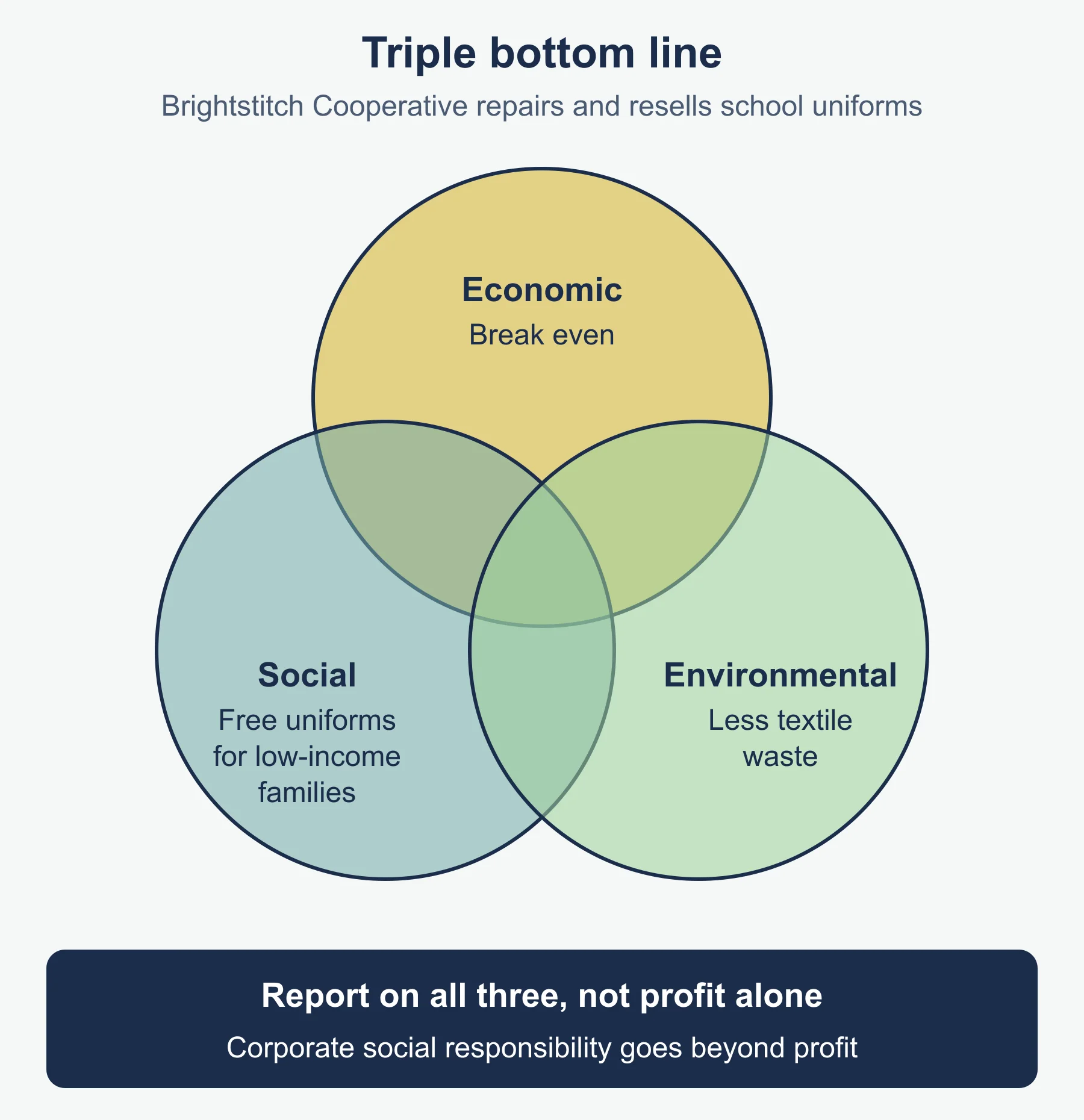
| Triple bottom line | Economic (financial), social and environmental objectives together |
| Ethics | Moral principles that guide behaviour |
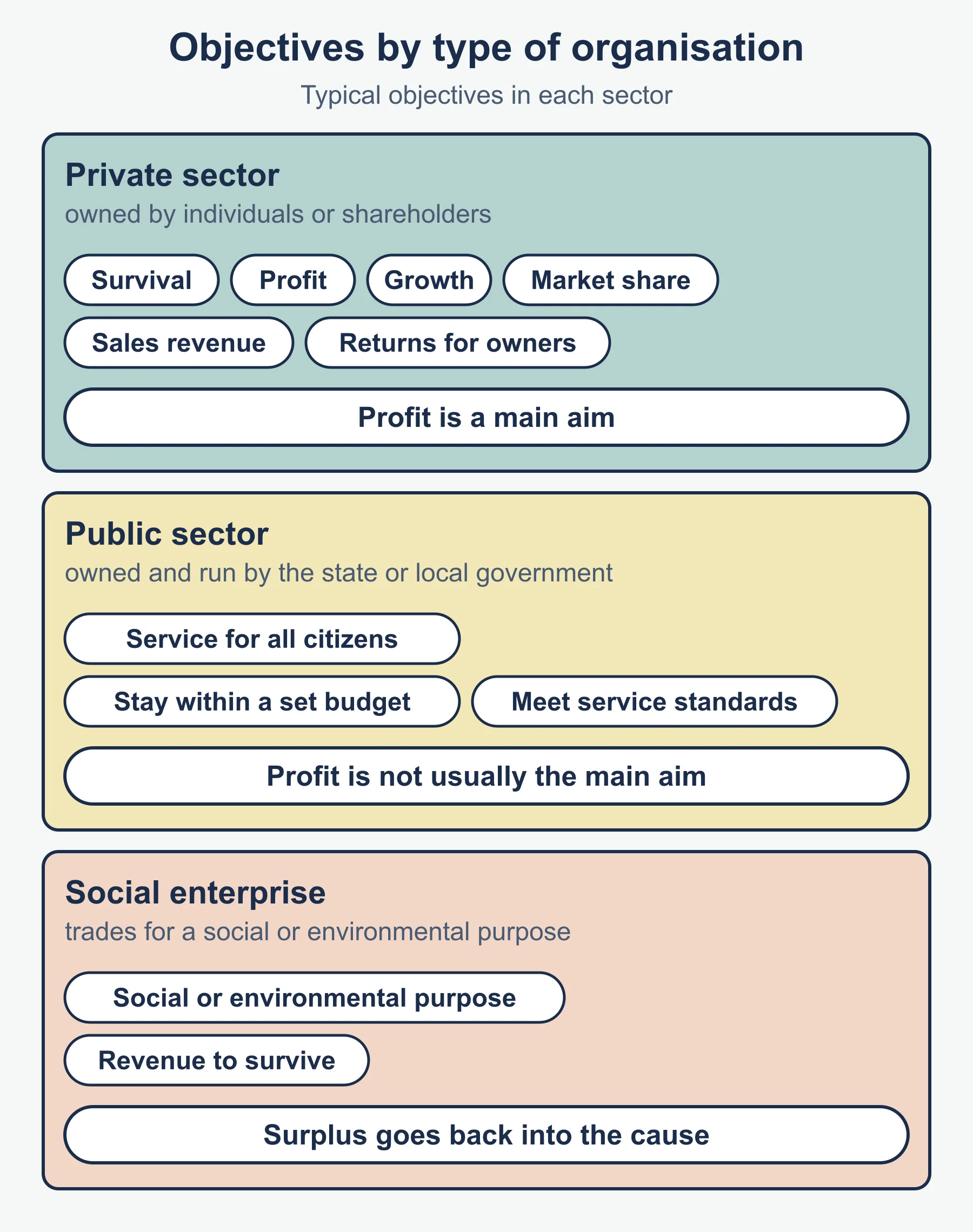
Objectives by organisation
| Organisation | Typical objectives |
|---|---|
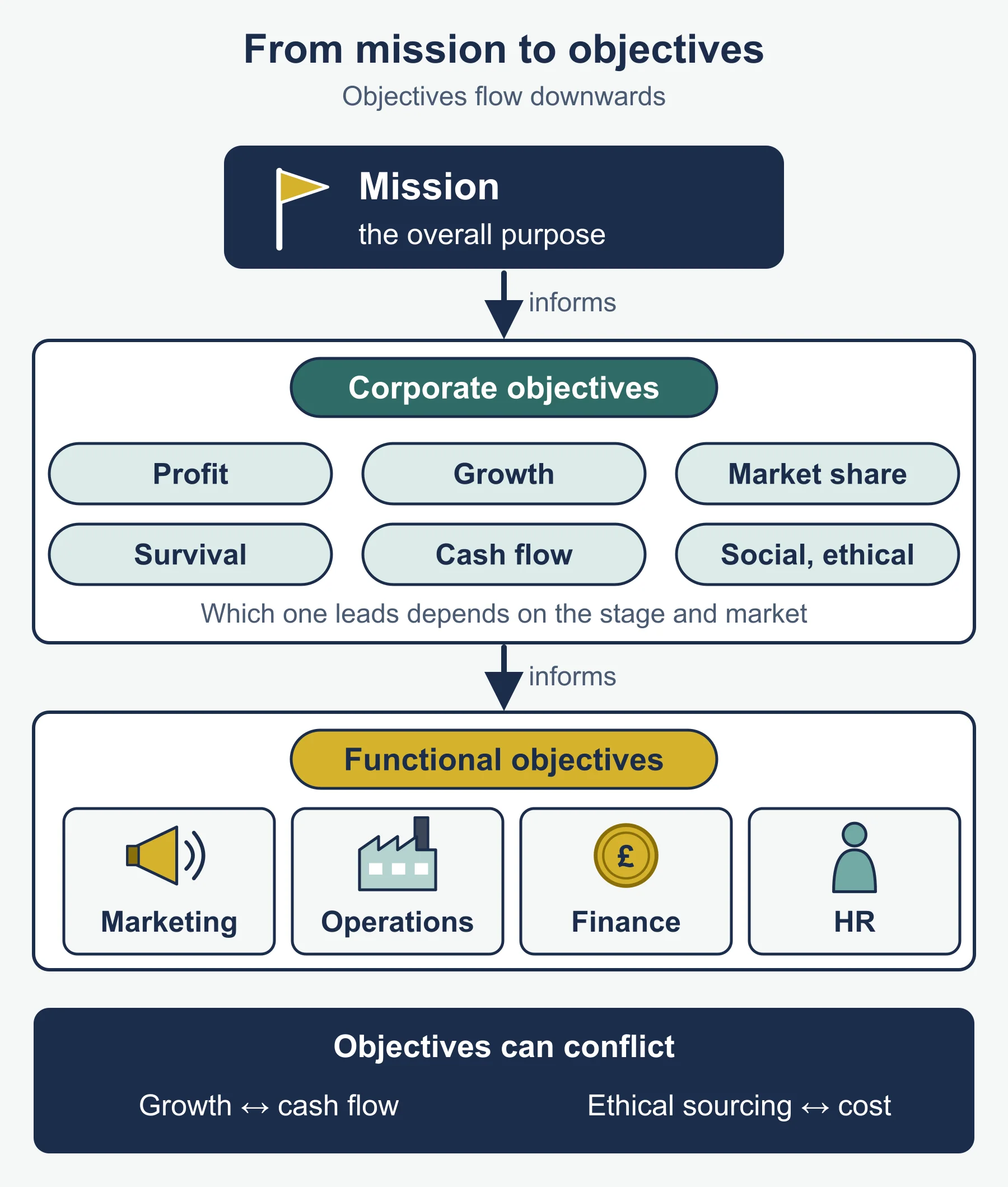
| Private sector | Survival, profit, growth, market share, sales revenue |
| Public sector | Service to all, staying in budget, service standards |
| Social enterprise | Social or environmental aim, break even or small surplus |
Why objectives matter
- Give direction and a common purpose.
- Allow performance to be measured.
- Help motivate staff.
- Provide a test for comparing options.
The chain, from broad to narrow
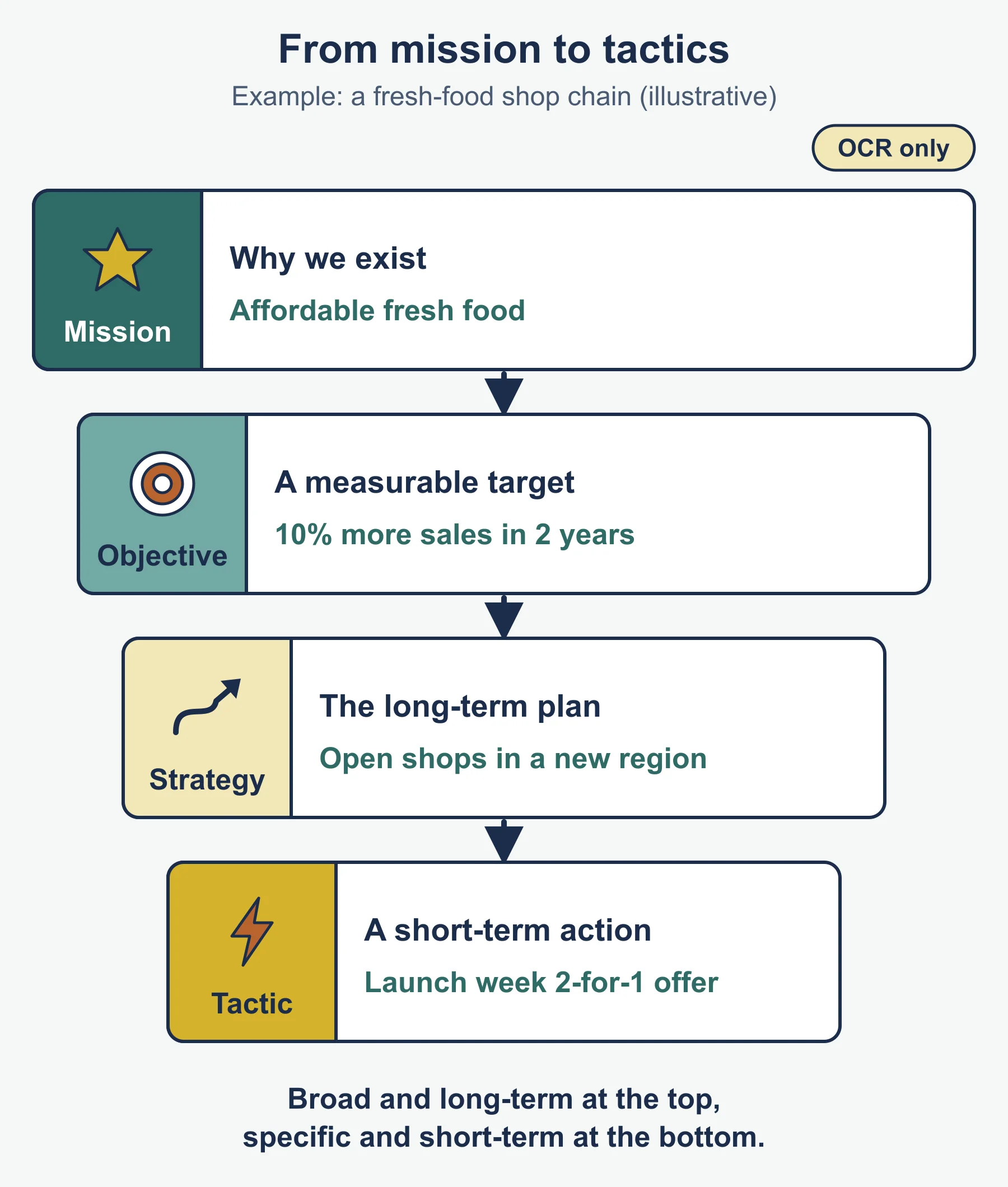
Mission statement, then aims, then objectives, then strategy, then tactics.
| Level | Test to apply | Oakdrift Printworks example |
|---|---|---|
| Mission | Purpose and values, no number | “Print that people keep” |
| Aim | Broad, long term | Be known for quality in the region |
| Objective | Has a measure | Cut waste paper by 10% this year |
| Strategy | Long-term plan | Invest in newer presses |
| Tactics | Short-term action | Train operators on the new press in March |
1.4.2 Decisions, targets and communication
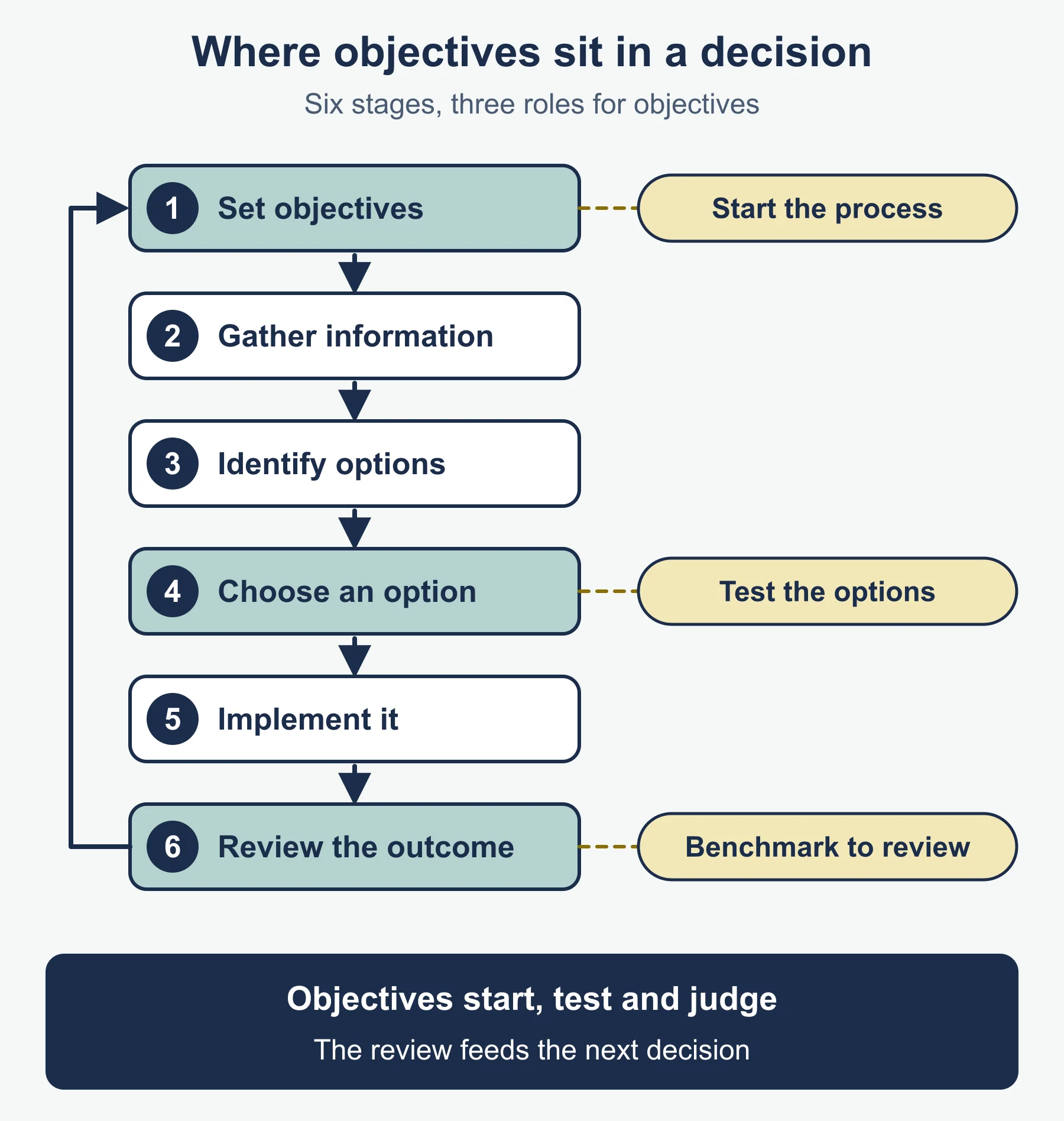
Method: decision-making stages (standard form)
- Set objectives.
- Gather information.
- Identify options.
- Choose an option.
- Implement.
- Review against the objectives.
Objectives start the process, judge the options and act as the benchmark at review.
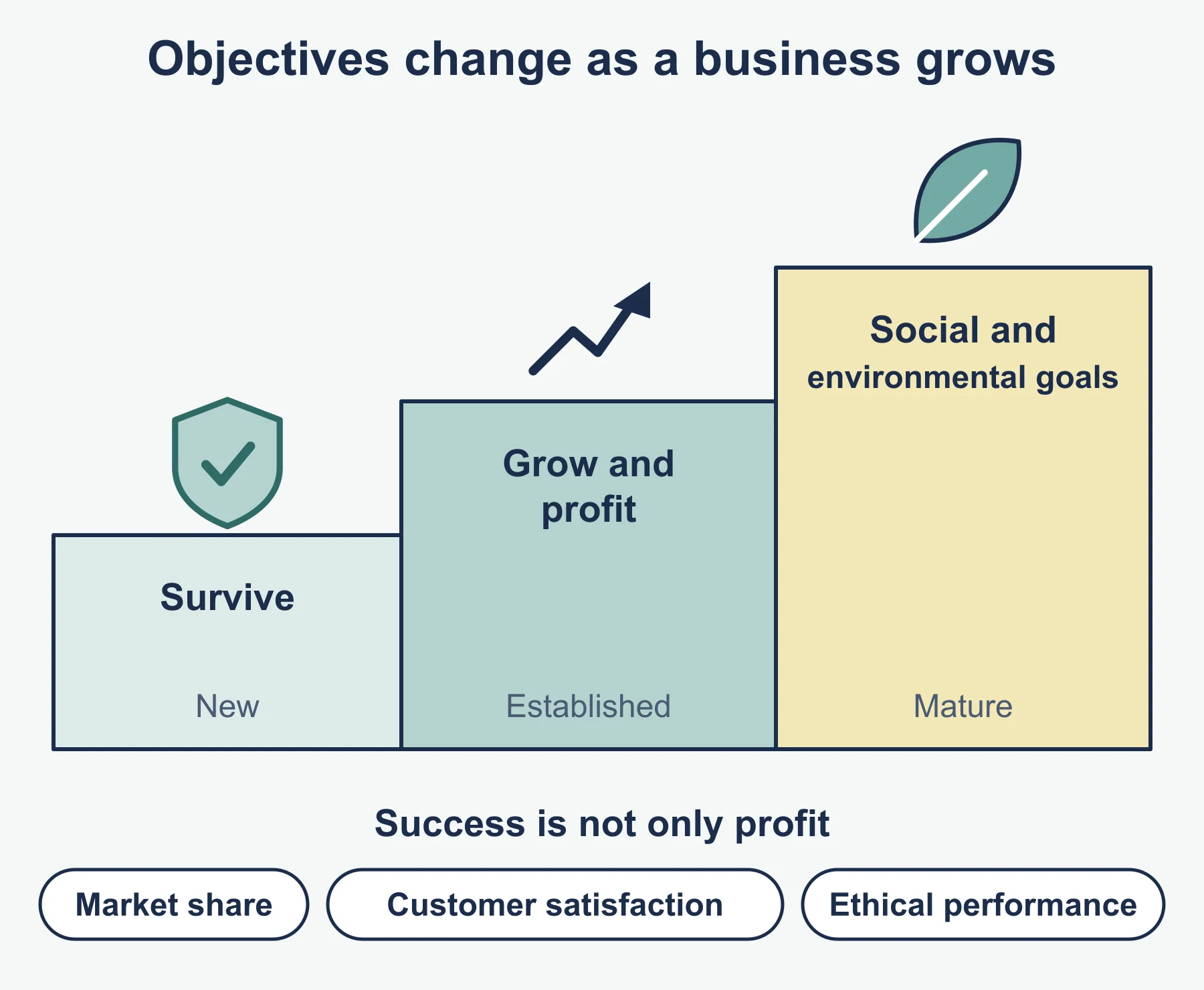
Why objectives change
- Stage of the business (survival, then growth).
- Boom or recession.
- Competitors, technology or law.
- New owners or managers.
- Stakeholder pressure.
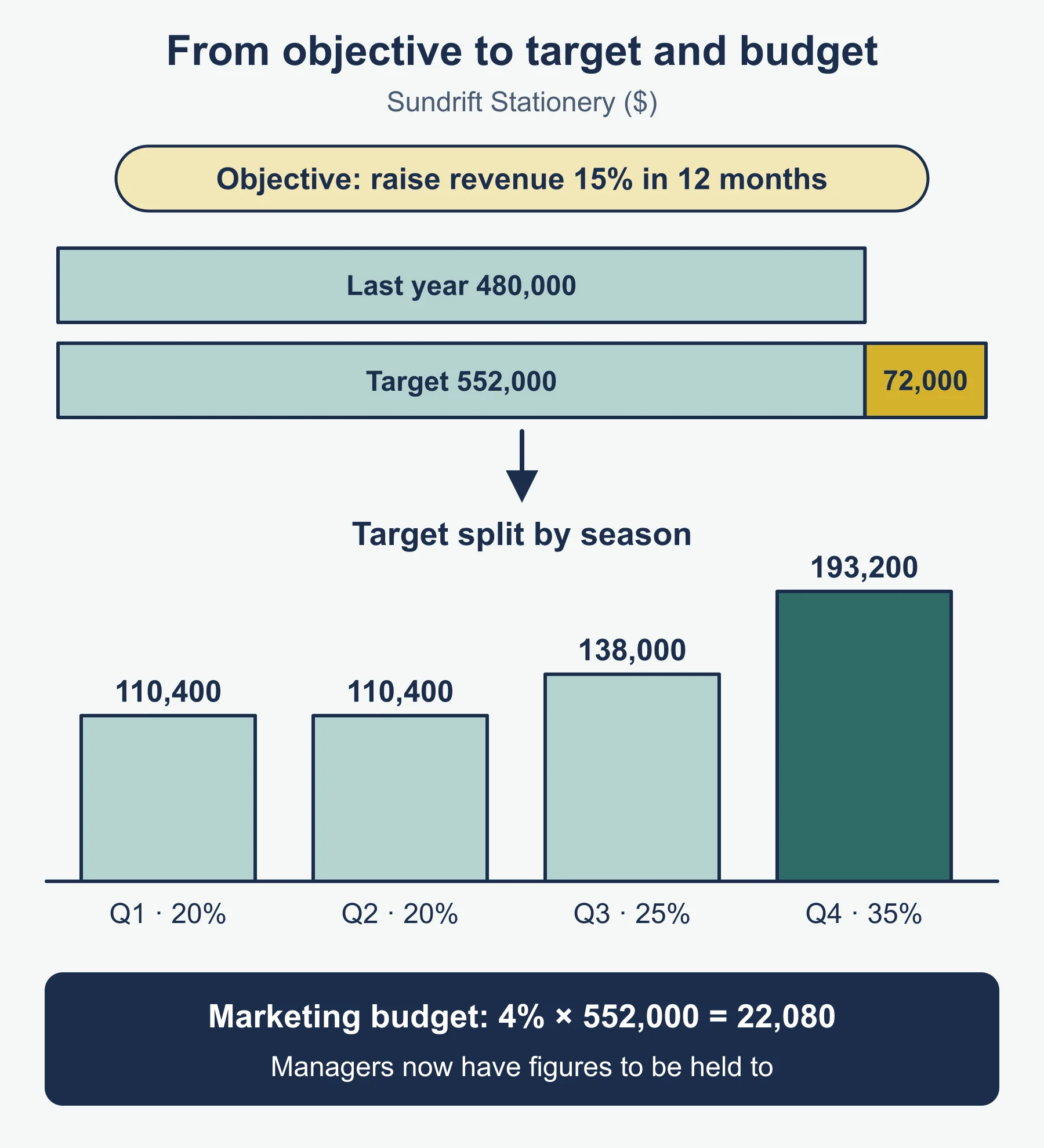
From objective to target to budget
Oakdrift’s sales revenue is 250,000 and the objective is a 10% rise. Target: 250,000 × 1.10 = 275,000. A promotion budget at 3% of target: 0.03 × 275,000 = 8,250.
| Step | Output |
|---|---|
| Objective | Raise sales revenue by 10% |
| Target | 275,000 for the year, split by month or department |
| Budget | Money allocated to reach it, such as 8,250 for promotion |
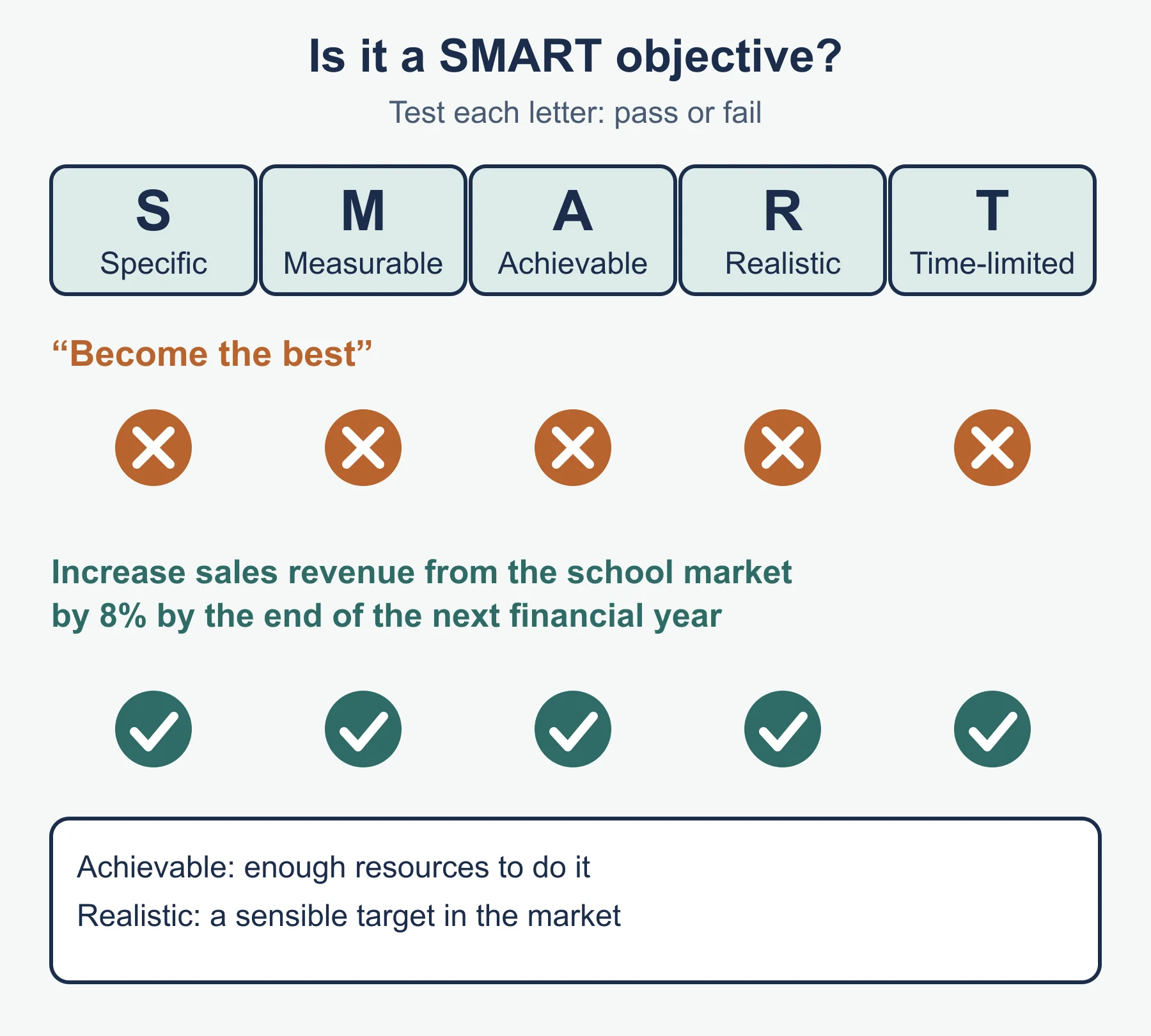
SMART checklist
| Letter | Question to ask |
|---|---|
| Specific | Is it clear what is to be achieved? |
| Measurable | Is there a figure? |
| Achievable | Do we have the resources? |
| Realistic | Is it sensible in this market? |
| Time-limited | Is there a deadline? |
Communication and the workforce
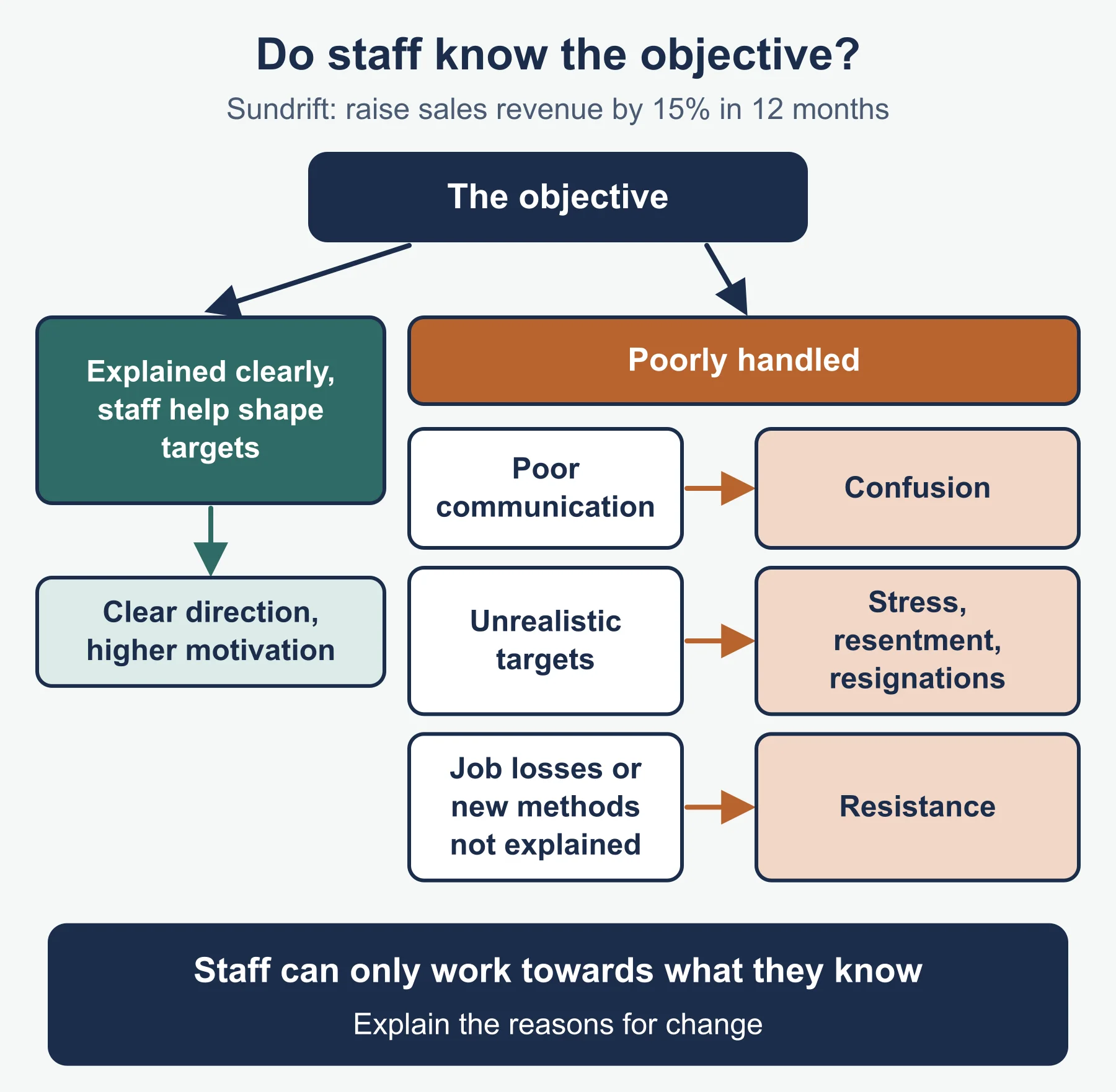
- Clear objectives give direction and can raise motivation.
- Involving staff in setting targets helps commitment.
- Poor communication or unrealistic targets cause confusion, stress and resentment.
- Staff may resist change they do not understand.
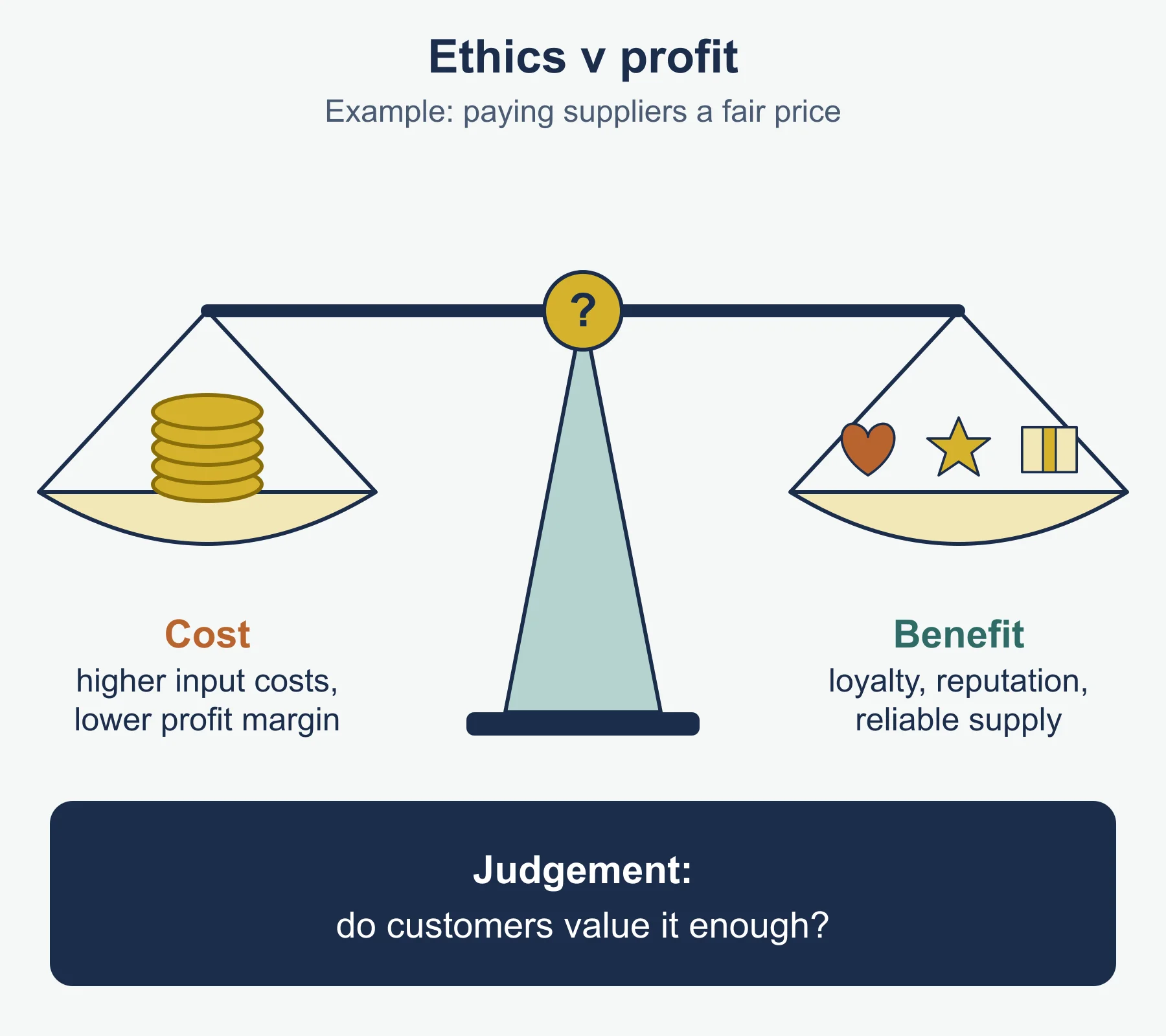
Ethics and objectives
- Can rule out some objectives, such as profit from unsafe products.
- Can shape activities, such as fair treatment of suppliers.
- May raise costs in the short term; may build reputation and loyalty.
1.5 Stakeholders
A stakeholder is an individual or group with an interest in a business.
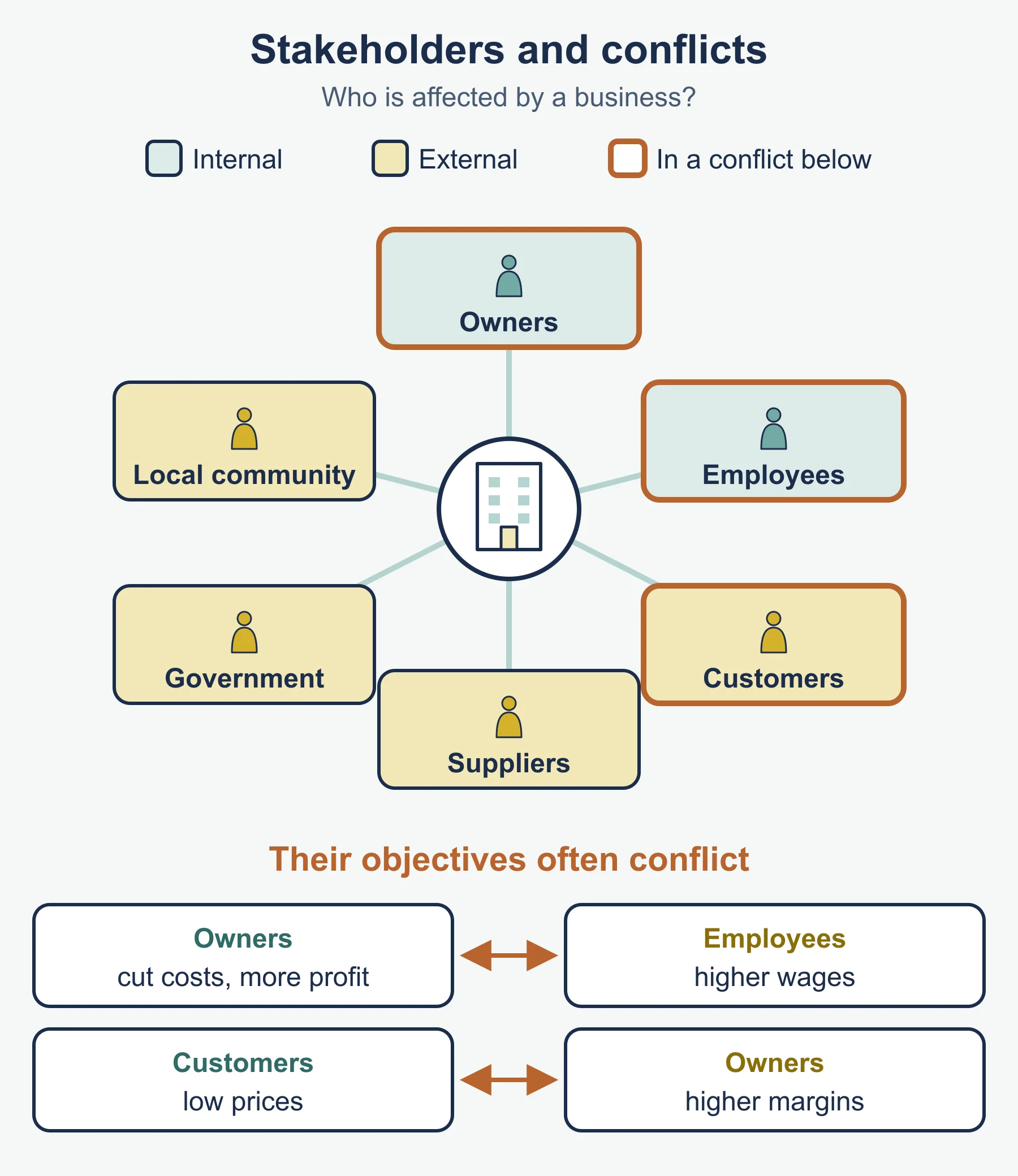
| Internal | External |
|---|---|
| Owners and shareholders, managers, employees | Customers, suppliers, lenders, government, local community, pressure groups |
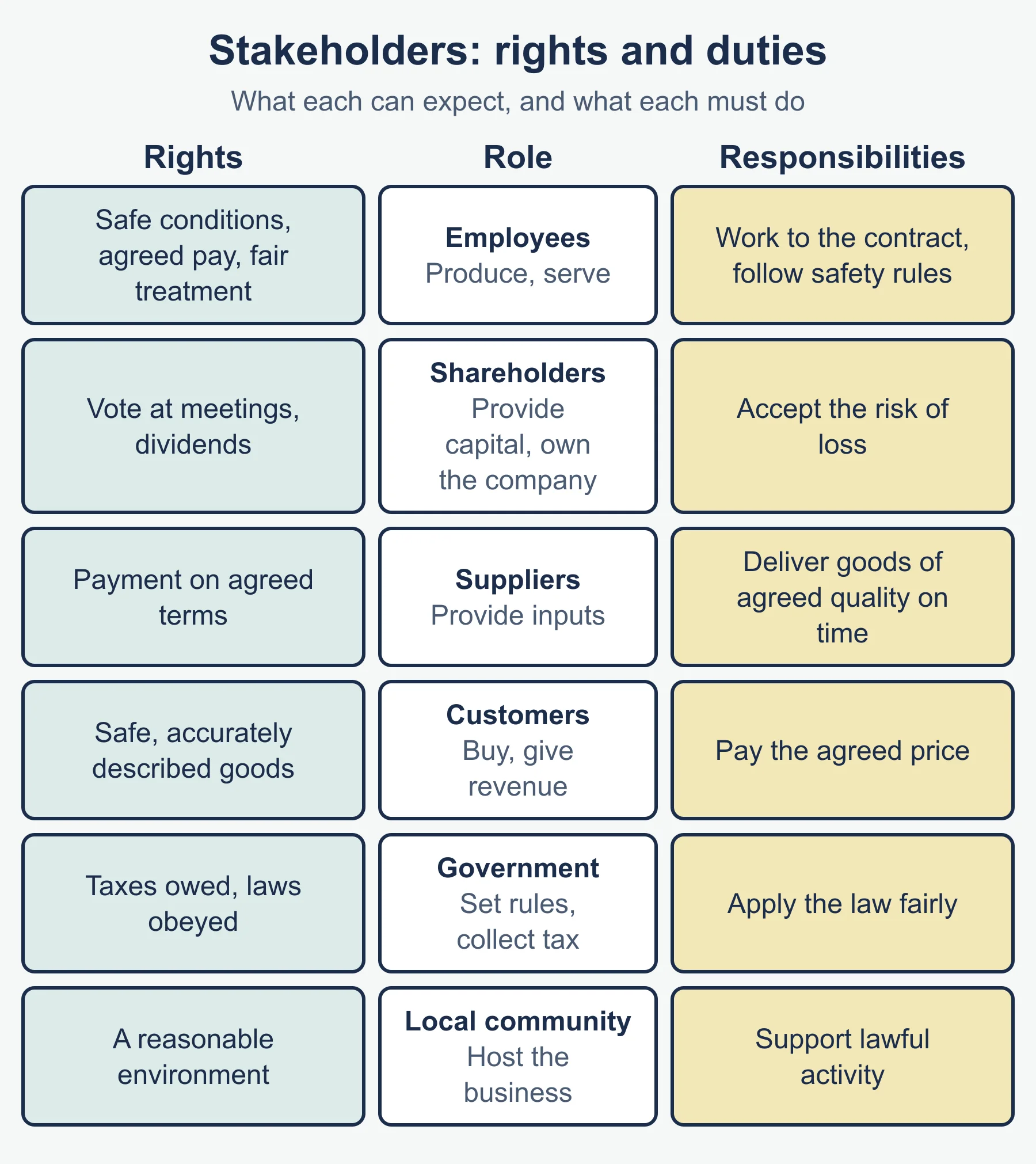
Roles, rights and responsibilities (short form)
| Stakeholder | Right | Responsibility |
|---|---|---|
| Employees | Safe conditions, agreed pay | Work to the contract |
| Shareholders | Vote, dividends | Accept risk |
| Suppliers | Payment on agreed terms | Deliver agreed quality on time |
| Customers | Safe, accurately described goods | Pay the agreed price |
| Government | Tax owed, law obeyed | Apply law fairly |
| Community | Reasonable environment | Support lawful activity |
Influence, accountability and conflict
- Influence depends on the power to affect the outcome, not on the size of the group.
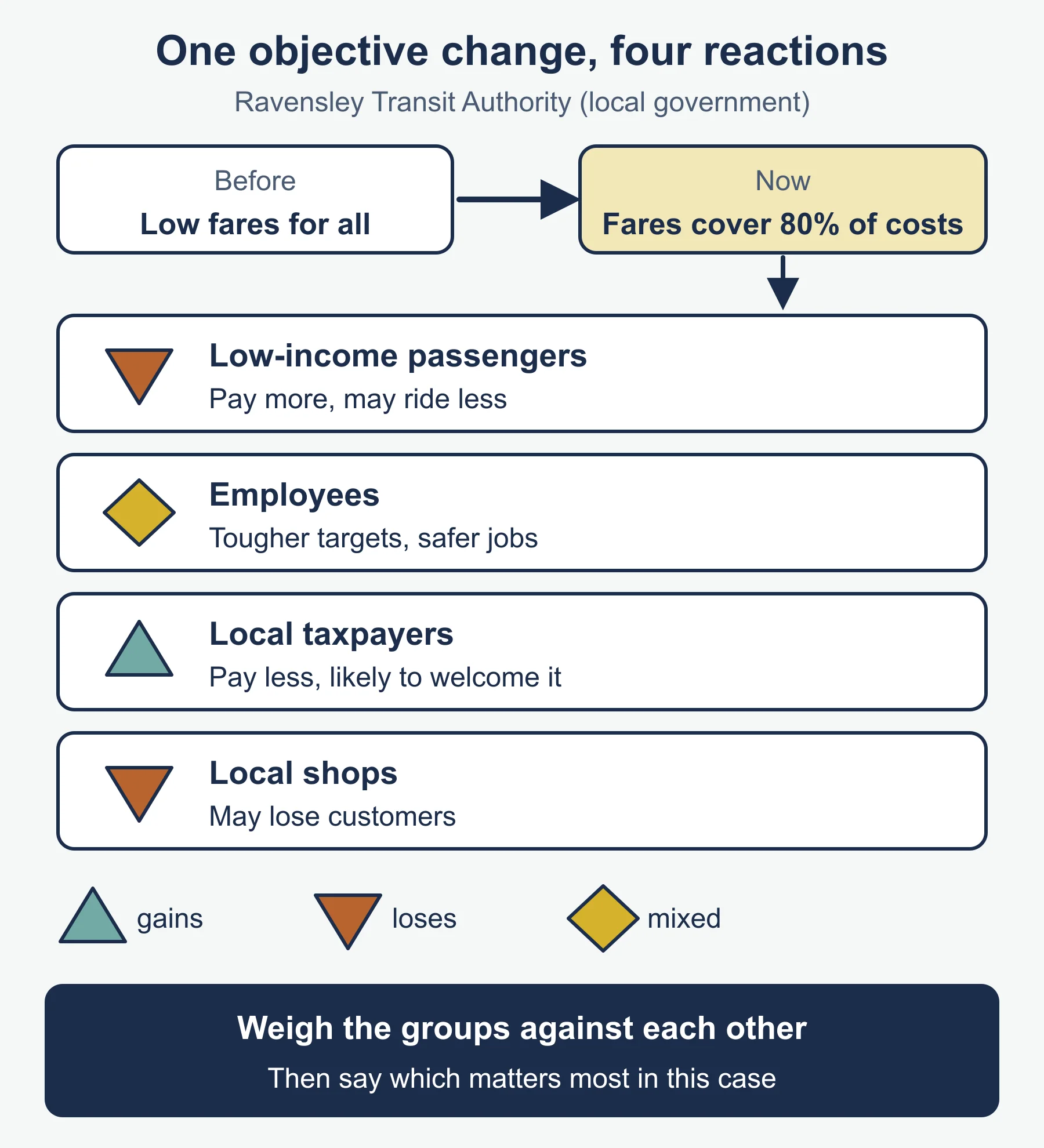
- Impact and reaction: who gains, who loses, and what can they do?
- Stakeholder aims can shape decisions before they are made, for example by refusing credit.
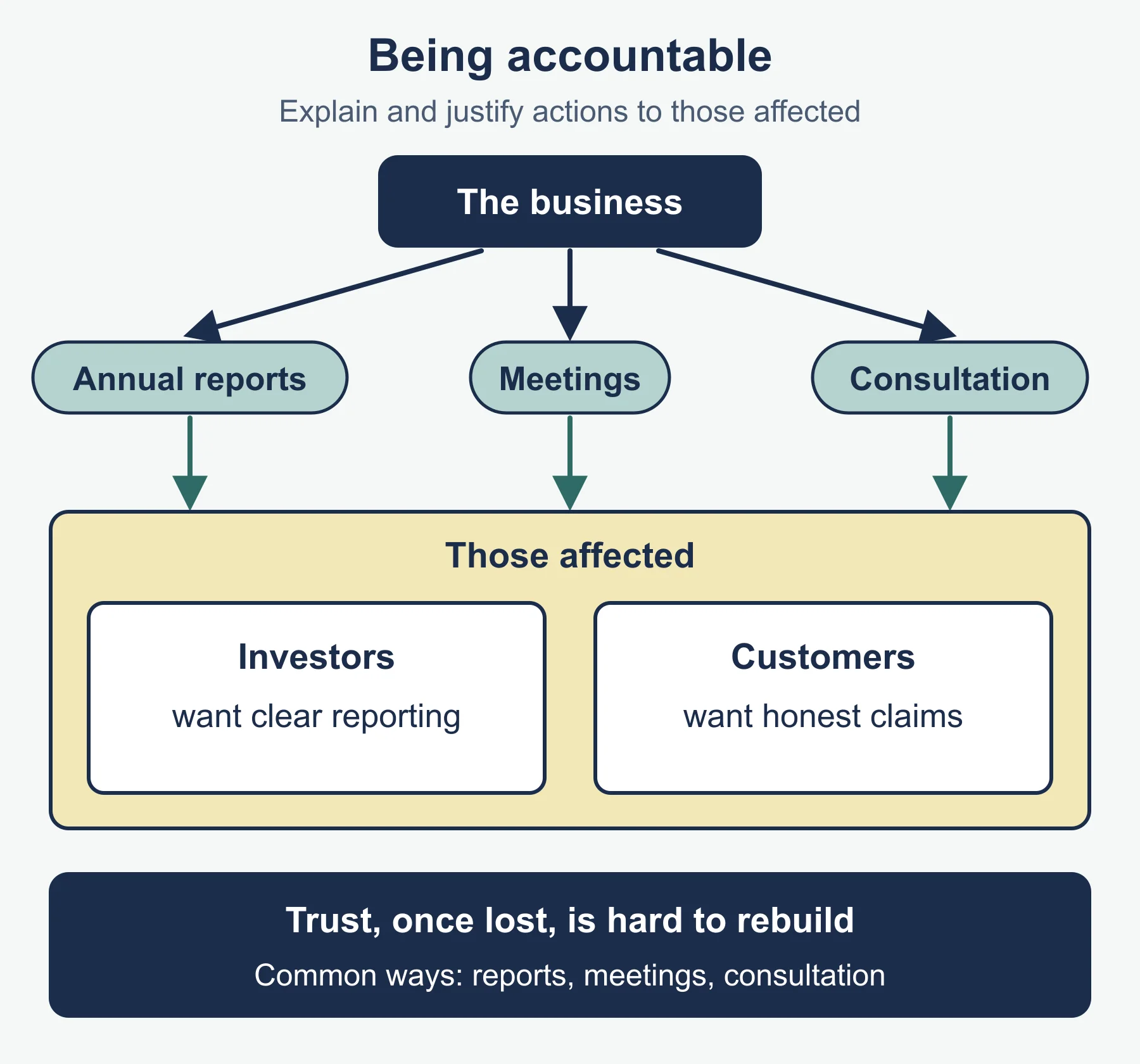
- Accountability means explaining and justifying actions to those affected; it protects trust.
- Conflict arises from different aims: pay against profit, price against margin, growth against local environment.
- Changing objectives (for example from growth to profit) shifts who gains and who loses.
CSR and the triple bottom line: both sides
| Possible benefits | Possible costs |
|---|---|
| Stronger reputation and customer loyalty | Higher costs, such as safer materials |
| Easier recruitment and retention of staff | Lower short-term profit |
| Fewer disputes with the community or government | Benefits may be slow and hard to measure |
| Reporting on all three bottom lines shows wider performance | Risk of being accused of empty claims if actions do not match words |
Judgement tip: say which side is stronger for this business and why. A firm selling to customers who care about the environment gains more from CSR than a firm selling a low-price basic product.
Worked reminder: reaction and conflict
Situation: Hollowmere Bakery plans to replace counter staff with self-service tills to hit a cost-cutting objective.
| Stakeholder | Impact | Likely reaction |
|---|---|---|
| Employees | Fewer shifts or job loss | Resistance, lower morale, union involvement if one exists |
| Shareholders | Lower costs, higher profit | Support |
| Customers | Faster service for some, less personal service for others | Mixed; some may shop elsewhere |
| Local community | Fewer local jobs | Complaints, less goodwill |
Conflict: shareholders gain what employees lose. The judgement depends on the business. If customers value personal service, the cost saving could be offset by lost sales.
Evaluate and justify questions
- State the decision or claim.
- Give a reason for, applied to the business.
- Give a reason against, applied to the business.
- Reach a judgement and say what it depends on, such as time period, size of the business or how strongly a stakeholder can react.
Objectives and stakeholders together
- Each objective favours some stakeholders: growth may suit managers and employees seeking promotion; high profit suits shareholders; low prices suit customers.
- When an objective changes, re-ask who gains, who loses and who can respond.
- Link each point to the business in the case: name the product, the customers and the numbers given, so that the answer could not be pasted into another case.
- Check whether the stakeholder is internal or external before judging how much influence it has, because internal groups often act through the business itself and external groups through pressure or choice.
- Accountability is the link: a business that explains why it changed its objective keeps trust even among groups who lose out.
Must-know distinctions
- Mission statement vs objective: a mission has no number or deadline; an objective does.
- Aim vs objective: an aim is broad; an objective is measurable.
- Strategy vs tactics: strategy is long term; tactics are short-term actions.
- Stakeholder vs shareholder: a shareholder is one kind of stakeholder.
- Target vs budget: a target is a goal figure; a budget is the money plan.
- Internal vs external: inside the business or outside it.
Quick self-test
- Name the three parts of the triple bottom line.
- State one typical objective of a public-sector organisation.
- Put these in order from broadest to narrowest: tactics, mission statement, objective, strategy.
- A business has sales revenue of 320,000 and wants a 5% rise. What is the target?
- Which SMART element is missing from “Improve customer service”?
- Give one reason why objectives change over time.
- Name one internal and one external stakeholder.
- State one responsibility of a supplier.
- Why might a small local group still have high influence?
- Define accountability in a business context.
Answers
- Economic (financial), social and environmental.
- For example, providing a service to all citizens, or staying within budget.
- Mission statement, objective, strategy, tactics (aims sit between the mission statement and the objective).
- 320,000 × 1.05 = 336,000.
- Several: it is not measurable and has no time limit.
- For example, a recession, new competitors or a new owner.
- Internal: employees. External: customers (other answers are fine).
- Deliver goods of the agreed quality on time.
- It may be able to generate publicity or block a plan, even though it is small.
- Explaining and justifying actions to those affected by them.
Where marks are usually lost
- Writing “stakeholders” when the question asks about one named group.
- Listing groups without explaining the impact and reaction.
- Calling a mission statement an objective.
- Giving a SMART objective with no figure or no date.
- Treating profit as the only objective of every business.
- Saying all conflicts can be solved, with no reasoning.
- Forgetting to apply the answer to the business in the case.
- Making a judgement without comparing both sides.
Frequently asked questions
What is the triple bottom line? The triple bottom line means a business sets economic (financial), social and environmental objectives together, rather than judging itself on profit alone.
What are the stages of decision-making in Cambridge 9609 Business? A standard form is: set objectives, gather information, identify options, choose an option, implement, and review against the objectives. Objectives start the process and act as the benchmark at review.
What is the difference between strategy and tactics? A strategy is the long-term plan to reach an objective. Tactics are the short-term actions that carry the strategy out.
Why can a small stakeholder group have a lot of influence? Influence depends on the power to affect the outcome, not on the size of the group. A small local group may be able to generate publicity or block a plan.
Official syllabus
Cambridge International AS & A Level Business 9609 syllabus for examination in 2026, 2027 and 2028, published by Cambridge University Press & Assessment (Cambridge Assessment International Education), sections 1.4 and 1.5.
Get free revision emails (optional)
Occasional emails with practice questions, worked explanations and links to free resources for the qualification and subjects you choose. No spam, and you can unsubscribe from any email. The free tools on this site never need an email.
Related resources
-
Study guides
A Level Business: Business strategy (Cambridge 9609)
Study guide to section 6.2 Business strategy in Cambridge A Level Business 9609: strategic tools, decision trees, corporate planning and crisis management.
Business · Cambridge · A Level
Read guide -
Practice questions
A Level Business: Business strategy (Cambridge 9609) – Practice Questions
Original practice questions with worked answers on 6.2 Business strategy for Cambridge A Level Business 9609: short answer, decision trees, cases.
Business · Cambridge · A Level
Try questions -
Revision notes
A Level Business: Business strategy (Cambridge 9609) – Revision Notes
Condensed revision notes for Cambridge A Level Business 9609 section 6.2: strategic tools, decision tree sums, culture, change and crisis planning.
Business · Cambridge · A Level
Revise topic
Related articles
-
teaching
A Level tuition in Dubai: Cambridge or Pearson Edexcel International A Level?
Schools in Dubai and Abu Dhabi teach either Cambridge International AS & A Level or Pearson Edexcel International A Level. How the two are structured, why it matters for tuition, and how online classes from Lahore work.
9 October 2026
-
curriculum guides
Choosing subjects at IGCSE and A Level
How subject choices at 14 and 16 affect university options later, and how to keep pathways open without overloading a timetable.
28 July 2026
Studying this with a teacher
Working through Business AS LEVEL?
This page is free and stays free. If you would rather be taught it, Marlbridge runs Business classes one-to-one and in small groups of up to 15, online in your own time zone. The first trial class is free. WhatsApp replies within an hour (8am–11pm Pakistan time, every day); email the same day.
Cambridge Business teachers at Marlbridge

