
Study Guides
A Level Business: Business strategy (Cambridge 9609)
Study guide to section 6.2 Business strategy in Cambridge A Level Business 9609: strategic tools, decision trees, corporate planning and crisis management.
- Subject
- Business
- Level
- A LEVEL
- Topic
- Business and its environment
- Author
- Marlbridge Academic Team
- Updated
- Reviewed by
- Salman Ahmad (what this means)
Aligned to Cambridge A Level Business (9609), For examination in 2026, 2027 and 2028. Official specification .
Syllabus page (what it covers and how it is assessed): Cambridge A Level Business.
Syllabus points this page covers
9609 (A Level)
- 6.2 Business strategy
Found an error? Report a correction.
Need help with this topic? Request a free trial class for A Level Business (9609).
This guide teaches section 6.2 Business strategy of the Cambridge International AS & A Level Business 9609 syllabus for examination in 2026, 2027 and 2028. It is an A Level topic, part of Topic 6, Business and its environment. Section 6.2.1 covers developing business strategy and 6.2.2 covers corporate planning and implementation. The syllabus says Topics 6 to 10 are the direct focus of Paper 3 (Business Decision-Making) and Paper 4 (Business Strategy), with the AS content assumed knowledge.
Use it with the revision notes and the practice questions. Course links: the Cambridge A Level Business hub, the printable checklist and the free diagnostics.
What the syllabus lists
| Section | What you must be able to do |
|---|---|
| 6.2.1 | Explain the meaning and purpose of business strategy and of strategic management (analysis, choice, implementation); use blue ocean strategy, scenario planning, SWOT, PEST, Porter’s five forces, the core competence framework, the Ansoff matrix, force field analysis and decision trees |
| 6.2.2 | Explain the meaning and importance of corporate planning; corporate culture and its impact on decisions; transformational leadership; the management and control of strategic change; contingency planning and crisis management |
Paper 4 asks two essay questions, both expecting evaluation, so each tool below ends with its limits. Apply tools to the business in the case rather than reciting them.
6.2.1 Developing business strategy
Meaning and purpose of business strategy
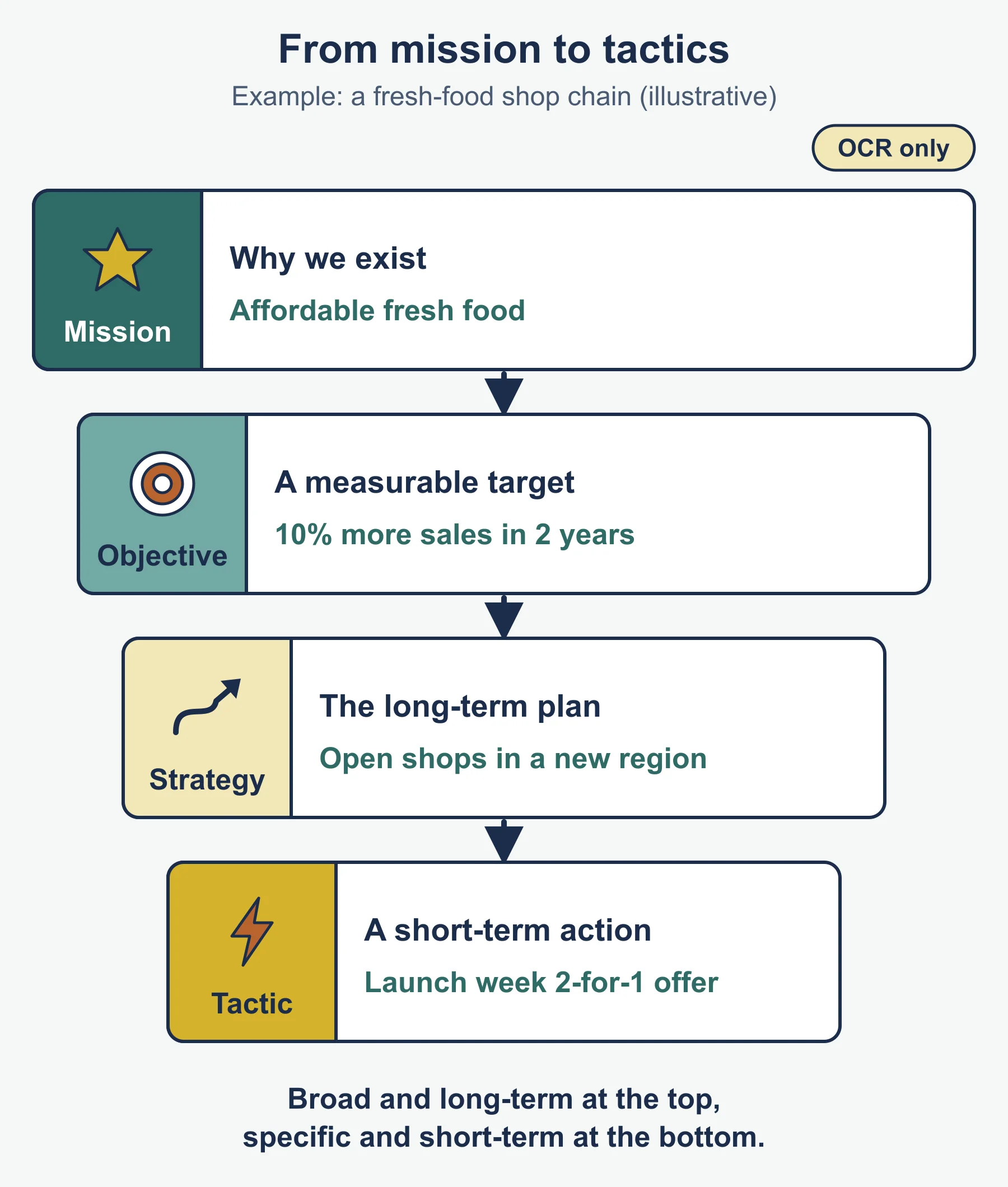
A business strategy is a long-term plan of action that sets the direction of the whole business and how it will use its resources to reach its objectives. It differs from a tactic, which is a short-term action taken to carry out part of the plan. This wording is the standard textbook form.
Its purposes are to give the business direction, to match its resources to its market, to help managers choose between competing uses of scarce funds, and to give everyone the same target so that departments pull together.
Strategic management: analysis, choice and implementation
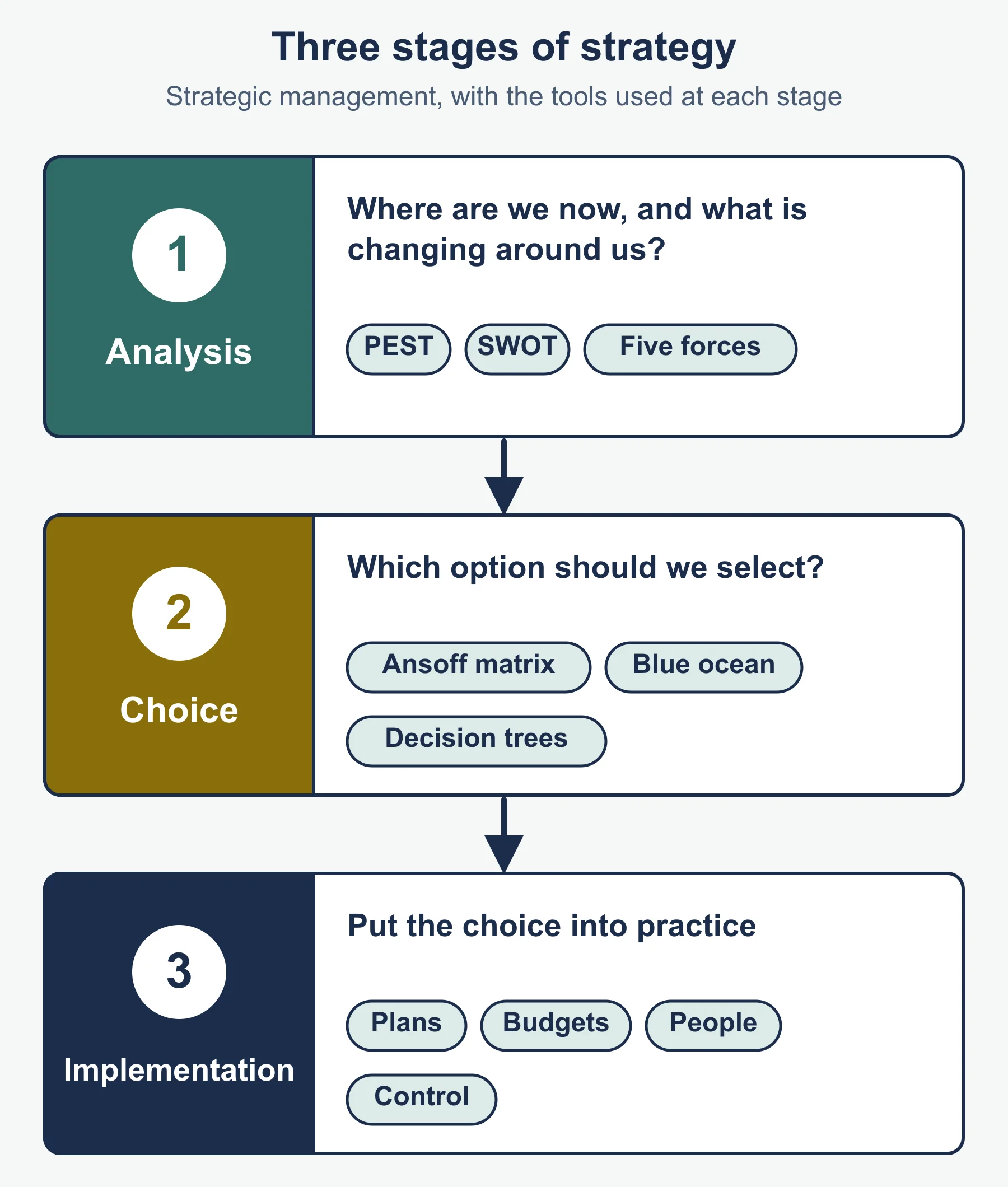
Strategic management is the process of deciding and carrying out strategy. The syllabus gives three stages.
- Analysis: finding out where the business is now and what is changing around it, using tools such as PEST, SWOT and Porter’s five forces.
- Choice: selecting from the options, using tools such as the Ansoff matrix, blue ocean strategy and decision trees.
- Implementation: putting the choice into practice through plans, budgets, people and control. This links to 6.2.2.
SWOT analysis
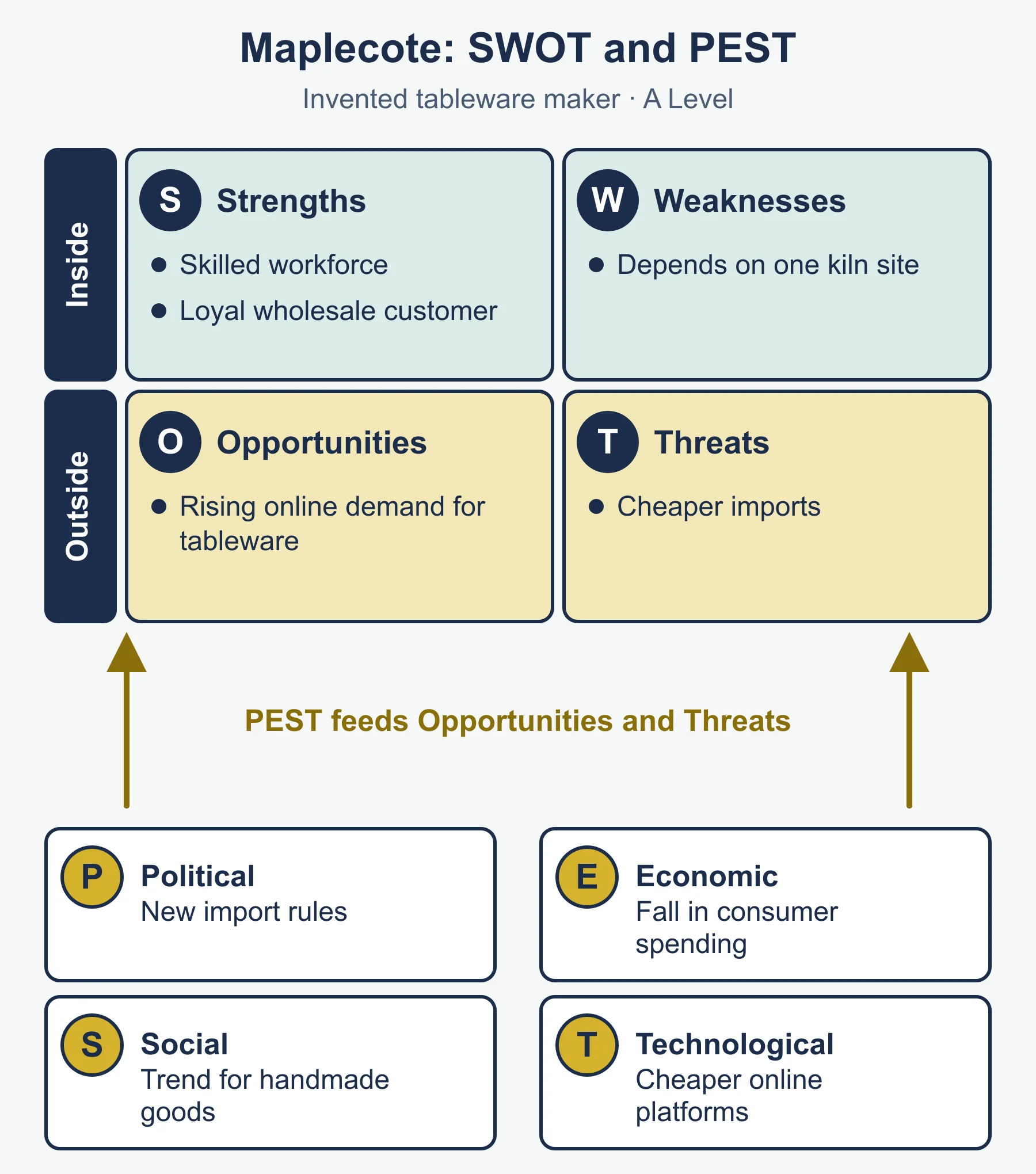
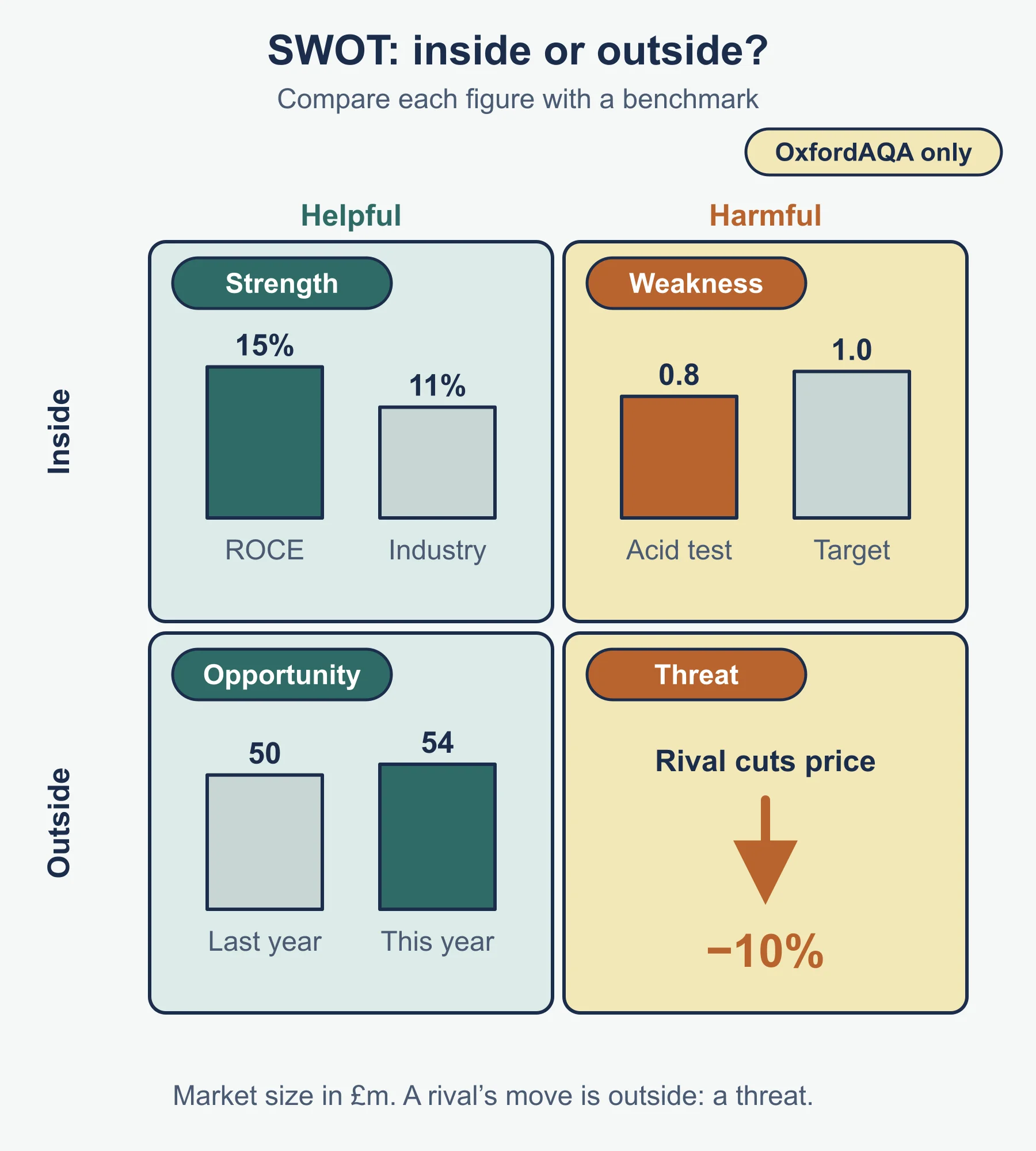
SWOT sorts information into four boxes. Strengths and weaknesses are internal to the business. Opportunities and threats are external.
Maplecote Ceramics is an invented maker of hand-finished tableware. Its strengths are a skilled workforce and a loyal wholesale customer; its weakness is dependence on one kiln site. An opportunity is rising demand for tableware sold online; a threat is cheaper imports.
A SWOT is only a starting point. It is a list that does not rank the items or say what to do, so evaluation should say which two or three factors drive the decision.
PEST analysis
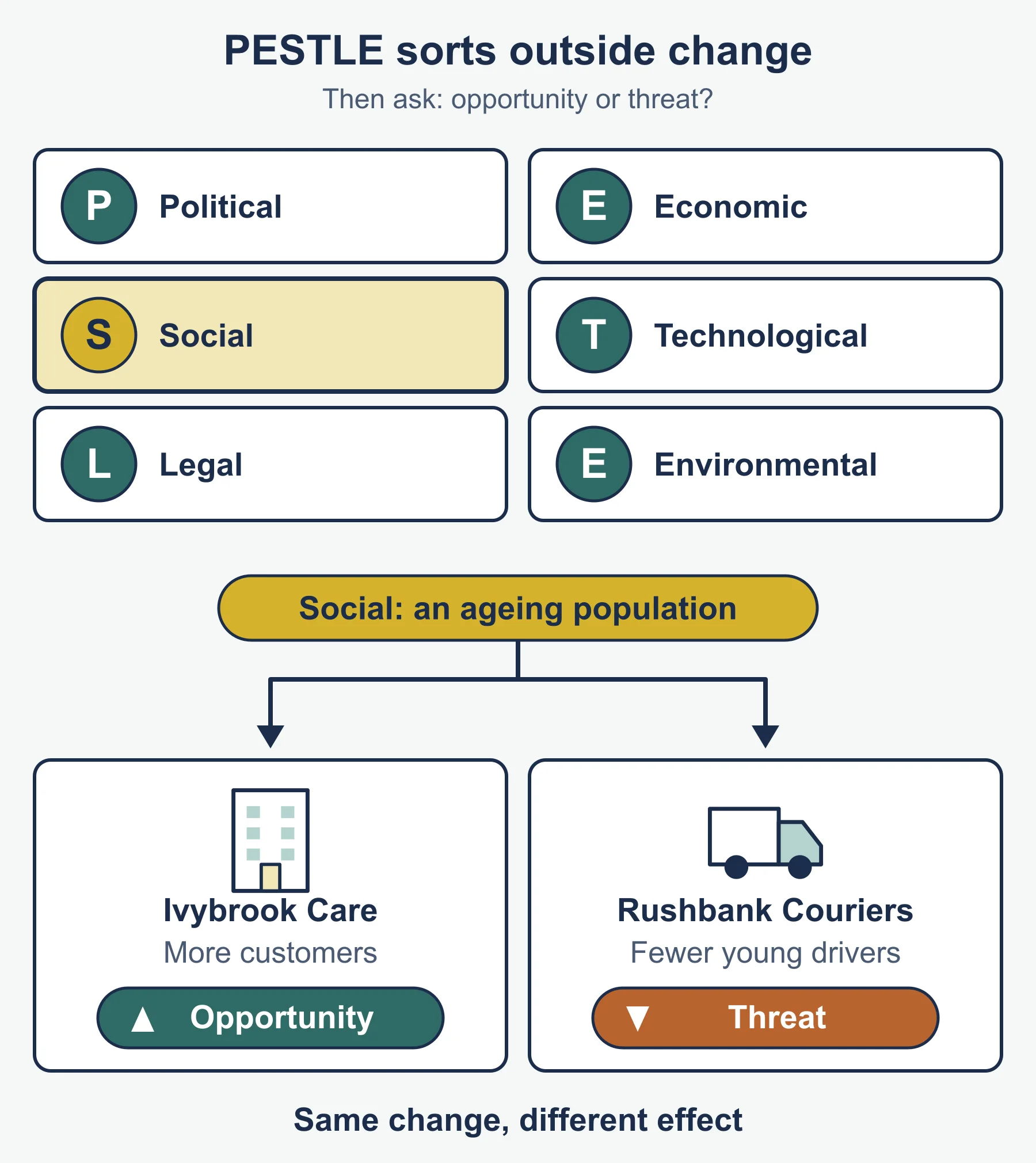
PEST examines the external environment under four headings: political, economic, social and technological. Maplecote might list new import rules (political), a fall in consumer spending (economic), a trend for handmade goods (social) and cheaper online selling platforms (technological).
Its limits: the headings overlap, findings date quickly, and it ignores the business’s own position. Pair it with SWOT: PEST feeds the opportunities and threats boxes.
Porter’s five forces
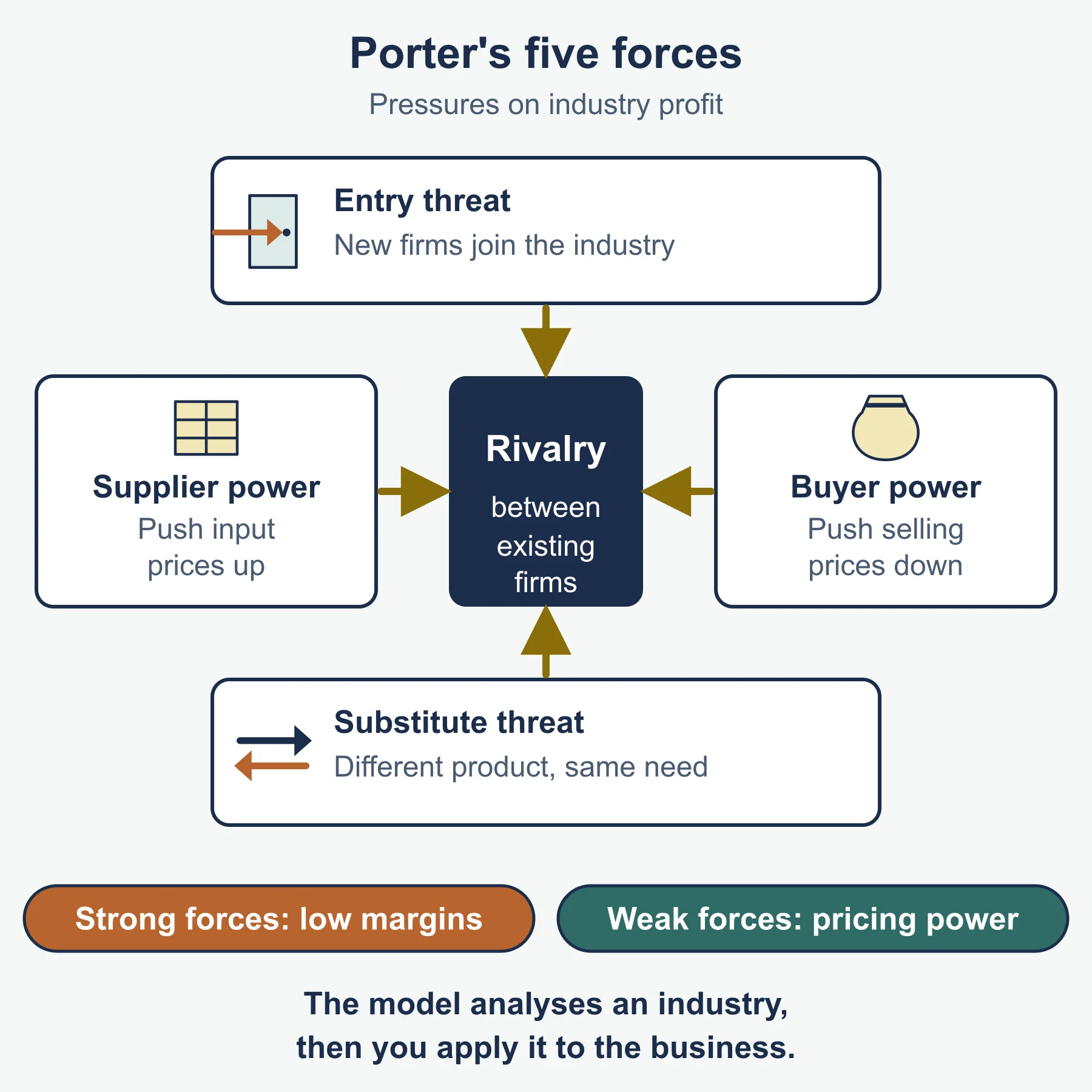
Porter’s five forces assesses how attractive an industry is by looking at five pressures on profit.
| Force | Strong when |
|---|---|
| Rivalry between existing firms | Many similar competitors, slow market growth, little differentiation |
| Threat of new entrants | Low start-up costs and few barriers to entry |
| Threat of substitutes | Customers can switch easily to a different product that meets the same need |
| Bargaining power of buyers | Few large customers or low switching costs |
| Bargaining power of suppliers | Few suppliers or no alternative source of a key input |
Strong forces squeeze prices or push up costs, so profit falls. Apply it by naming the force and the evidence in the case. Its limits are that it describes an industry at one moment, and a business may have little power to change the forces.
Core competence framework
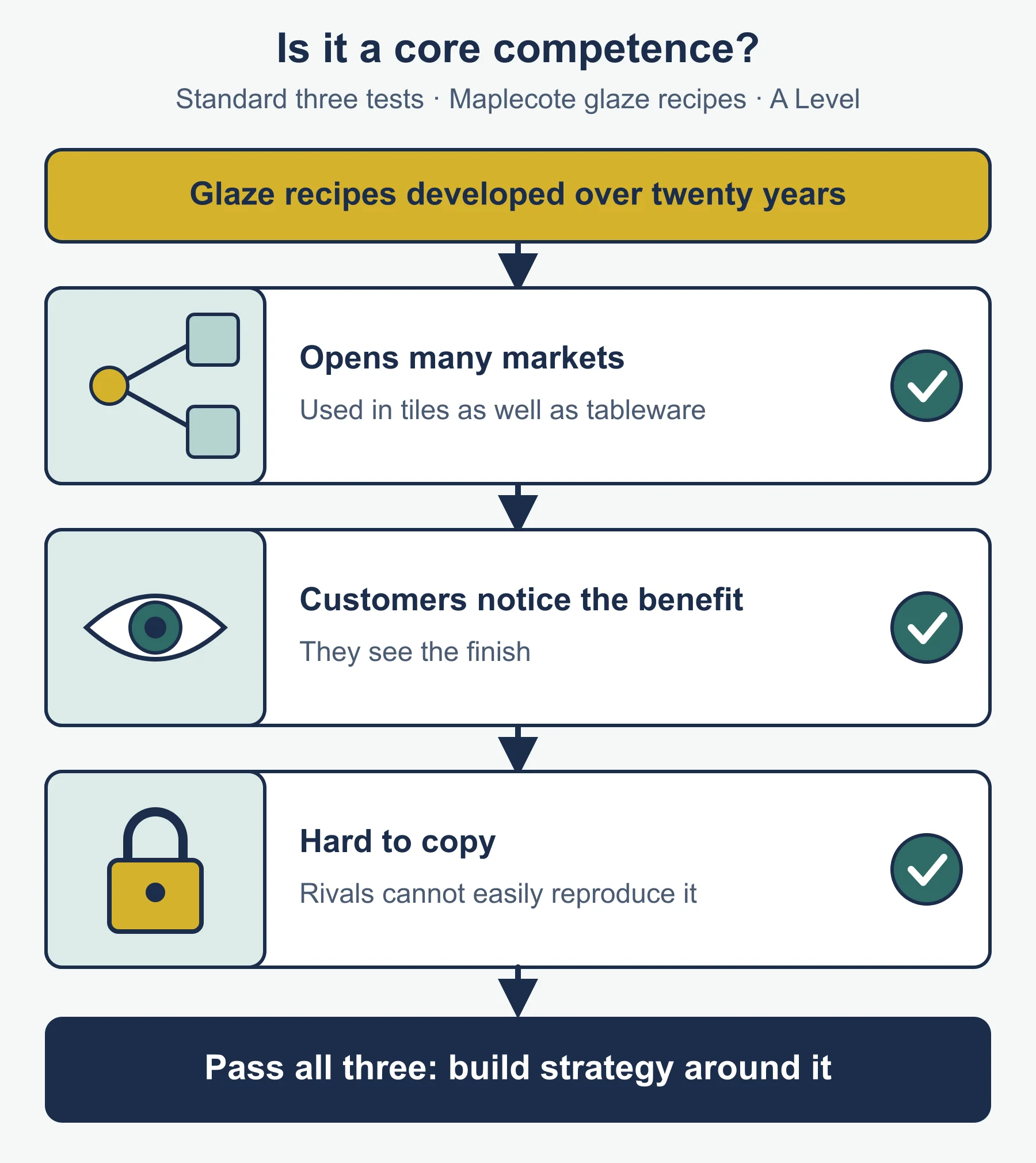
A core competence is something a business does especially well that gives it an advantage over rivals. In the standard framework (Prahalad and Hamel) a competence is core when it gives access to a variety of markets, adds to the benefit customers perceive, and is hard for competitors to copy. The syllabus names the framework but not these three tests, so treat them as the standard form.
Maplecote’s glaze recipes, developed over twenty years, could be a core competence: they could be used in tiles as well as tableware, customers notice the finish, and rivals cannot easily reproduce them. The strategic message is to build strategy around what the business is best at.
Ansoff matrix
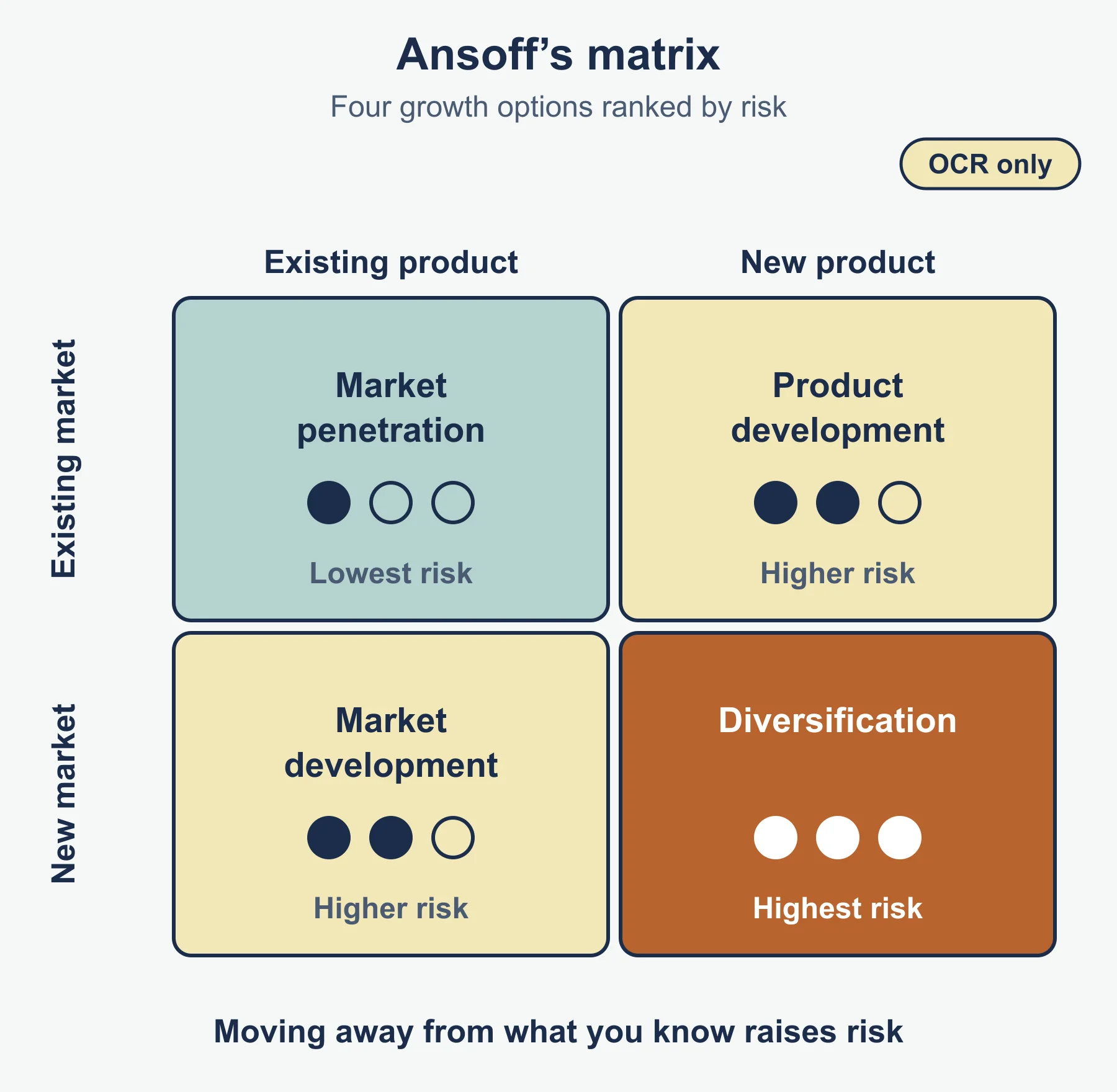
The Ansoff matrix shows four growth strategies, using existing or new products and existing or new markets.
| Existing products | New products | |
|---|---|---|
| Existing markets | Market penetration | Product development |
| New markets | Market development | Diversification |
Risk usually rises as the business moves away from what it knows, so diversification is normally the riskiest. Maplecote could sell more of its current range to current customers (market penetration), launch a thermal mug range (product development), export current ranges (market development) or open a cafe chain (diversification). The matrix lists choices but does not judge fit: finance, skills and timing must be weighed separately.
Blue ocean strategy
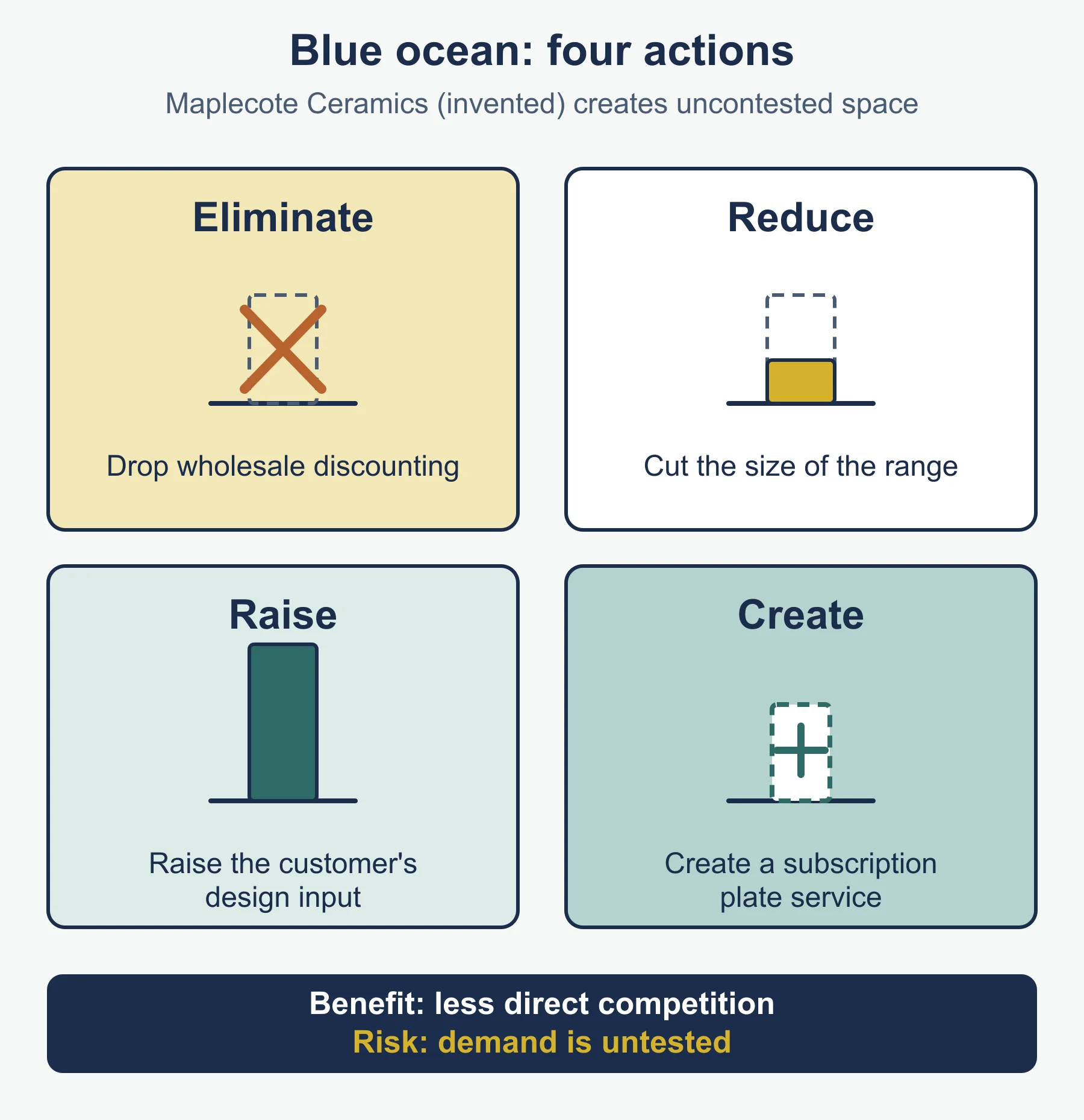
Blue ocean strategy is about creating a new, uncontested market space instead of competing in an existing crowded one (a “red ocean”). The standard approach is value innovation: delivering high customer value at low cost by removing features customers do not value and adding ones they do. Kim and Mauborgne describe four actions: eliminate, reduce, raise and create. As with the core competence tests, the syllabus names the strategy only.
Maplecote could drop wholesale discounting, reduce range size, raise the customer’s design input and create a subscription plate service. The benefit is less direct competition; the risk is untested demand.
Scenario planning
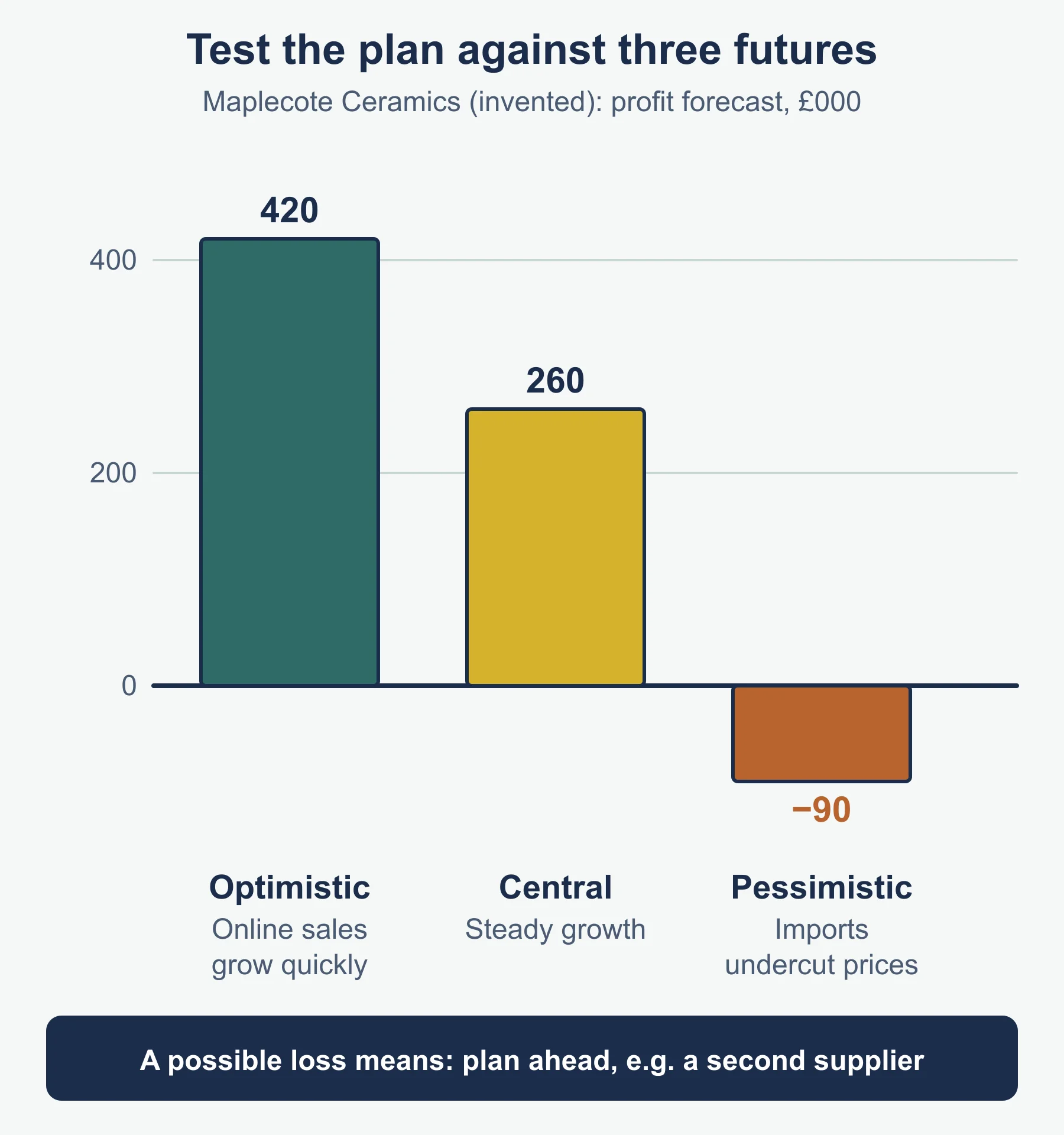
Scenario planning builds a small number of detailed, plausible pictures of the future and tests the strategy against each one. It suits long periods and high uncertainty, where a single forecast is unreliable.
| Scenario | Assumption | Profit forecast |
|---|---|---|
| Optimistic | Online sales grow quickly | £420,000 |
| Central | Steady growth | £260,000 |
| Pessimistic | Imports undercut prices | −£90,000 |
The pessimistic case shows the business needs a plan for a loss, such as a second supplier and a cost-cutting trigger point. Limits: it takes managers’ time, and no scenario set can include every event.
Force field analysis
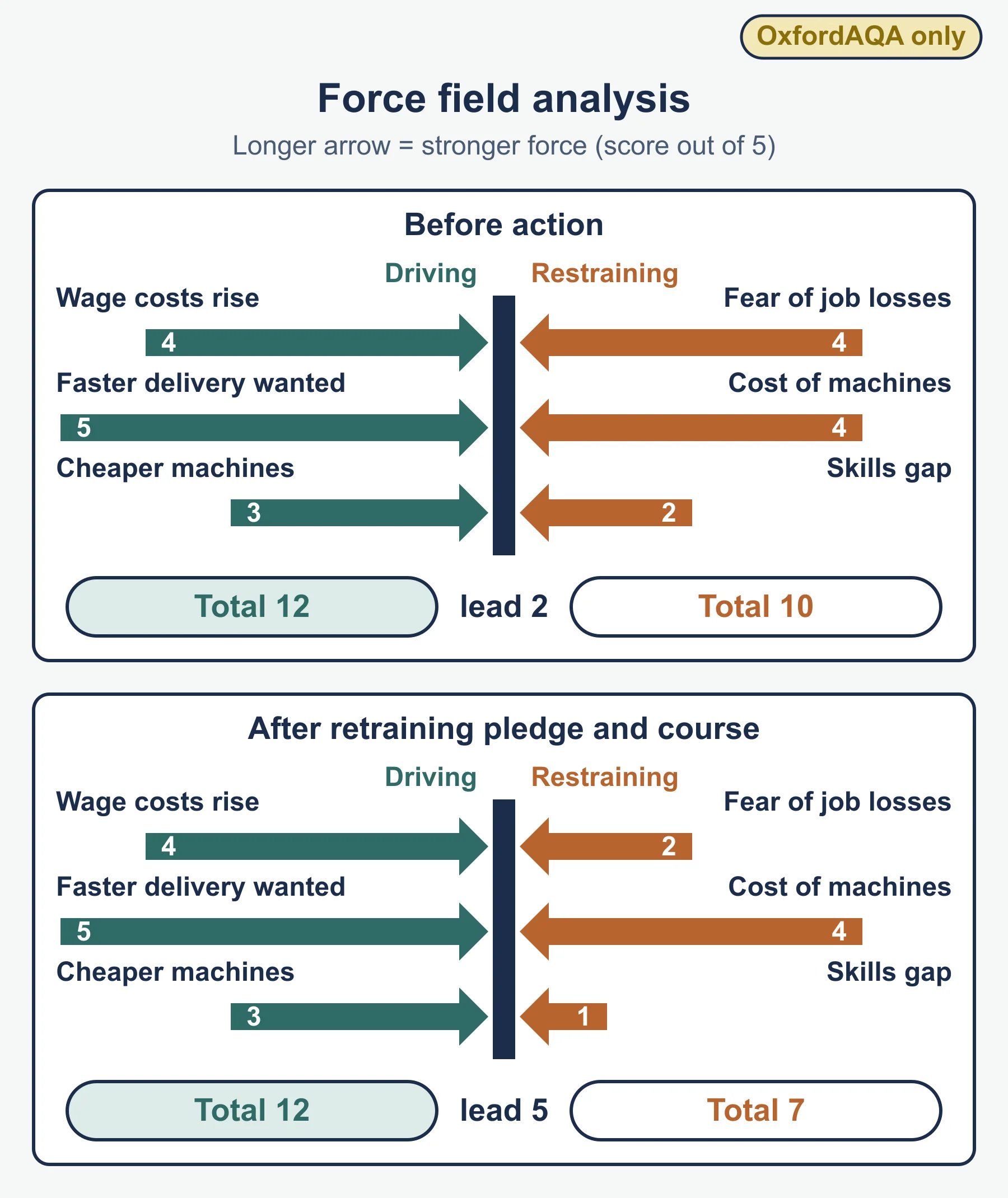
Force field analysis lists the driving forces that support a change and the restraining forces that oppose it, then scores their strength, for example from 1 (weak) to 5 (strong). If the total for driving forces is higher, the change is more likely to succeed.
Maplecote considers a new automated glazing line.
| Driving force | Score | Restraining force | Score |
|---|---|---|---|
| Lower unit cost | 5 | Fear of job losses | 4 |
| Shorter lead times | 4 | Training cost | 3 |
| More consistent quality | 3 | Short-term disruption | 2 |
| Total | 12 | Total | 9 |
The net score is 12 − 9 = +3, so the case for change narrows but holds. Managers can then target the largest restraining force, here job fears. The limit is subjectivity: the scores are judgements and different managers may score differently.
Decision trees
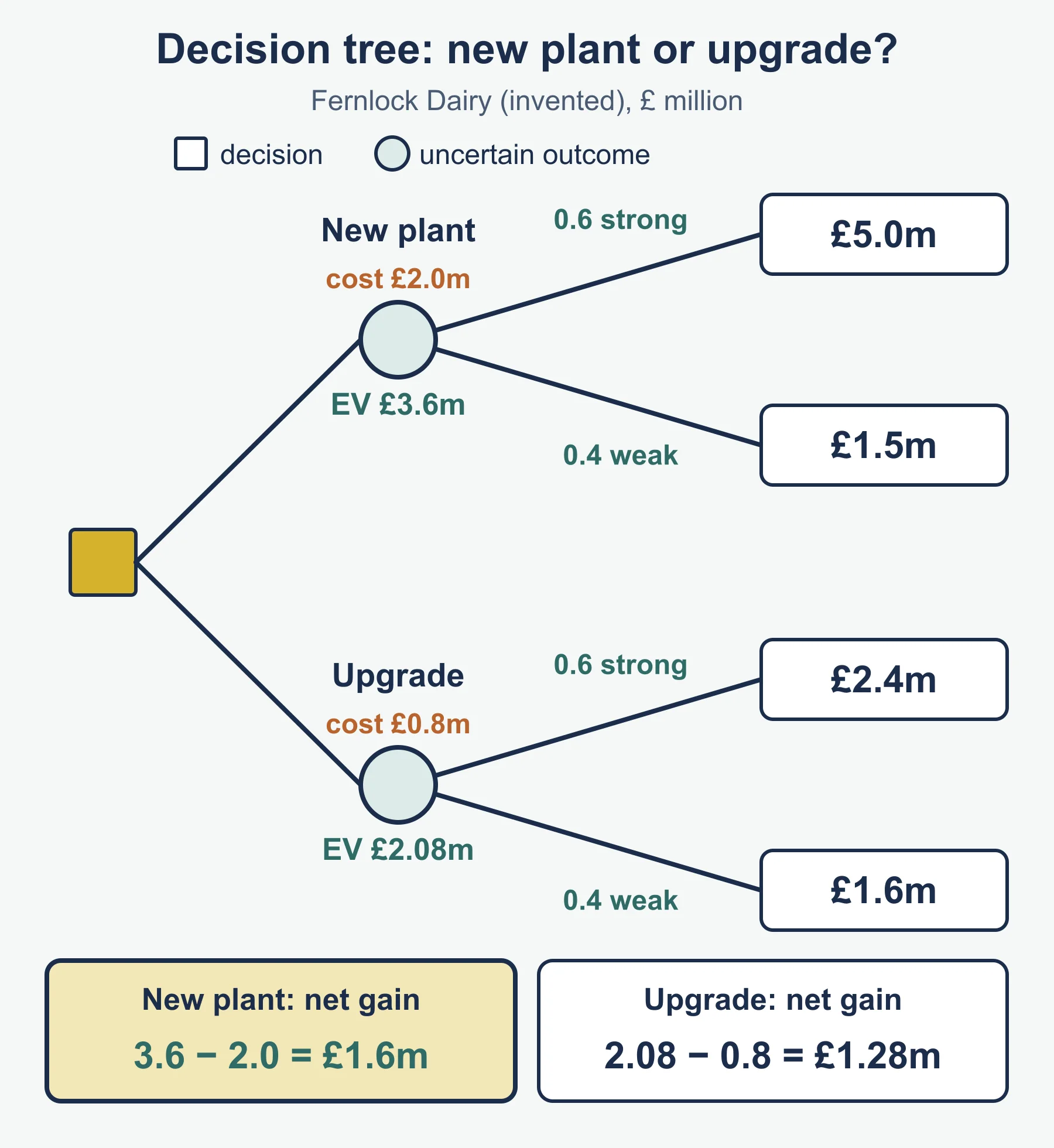
A decision tree sets out options, the possible outcomes of each, their probabilities and their payoffs. A square marks a decision point and a circle marks an uncertain outcome. The expected value of an option is the sum of each payoff multiplied by its probability. The net gain is the expected value minus the cost of the option. These are the standard calculations.
Worked example. Fernlock Dairy (invented) may build a new plant costing £2.0m or upgrade its present one for £0.8m. There is a 0.6 chance of strong demand and 0.4 of weak demand.
| Option | Payoff, strong demand | Payoff, weak demand |
|---|---|---|
| New plant | £5.0m | £1.5m |
| Upgrade | £2.4m | £1.6m |
New plant: expected value = (0.6 × 5.0) + (0.4 × 1.5) = 3.0 + 0.6 = £3.6m. Net gain = 3.6 − 2.0 = £1.6m.
Upgrade: expected value = (0.6 × 2.4) + (0.4 × 1.6) = 1.44 + 0.64 = £2.08m. Net gain = 2.08 − 0.8 = £1.28m.
The new plant has the higher net gain, by £0.32m. A good answer then evaluates. The probabilities are estimates, the upgrade loses less if demand is weak, and the figures ignore non-financial factors and the time value of money.
6.2.2 Corporate planning and implementation
Corporate planning
Corporate planning is the process of setting the long-term objectives of the whole business and deciding the actions and resources needed to achieve them, usually over several years. It matters because it gives direction, co-ordinates departments, shows where money should go, provides targets against which to measure performance and prepares the business for change. Its weakness is that a rigid plan can become out of date if the environment shifts.
Corporate culture and decision-making
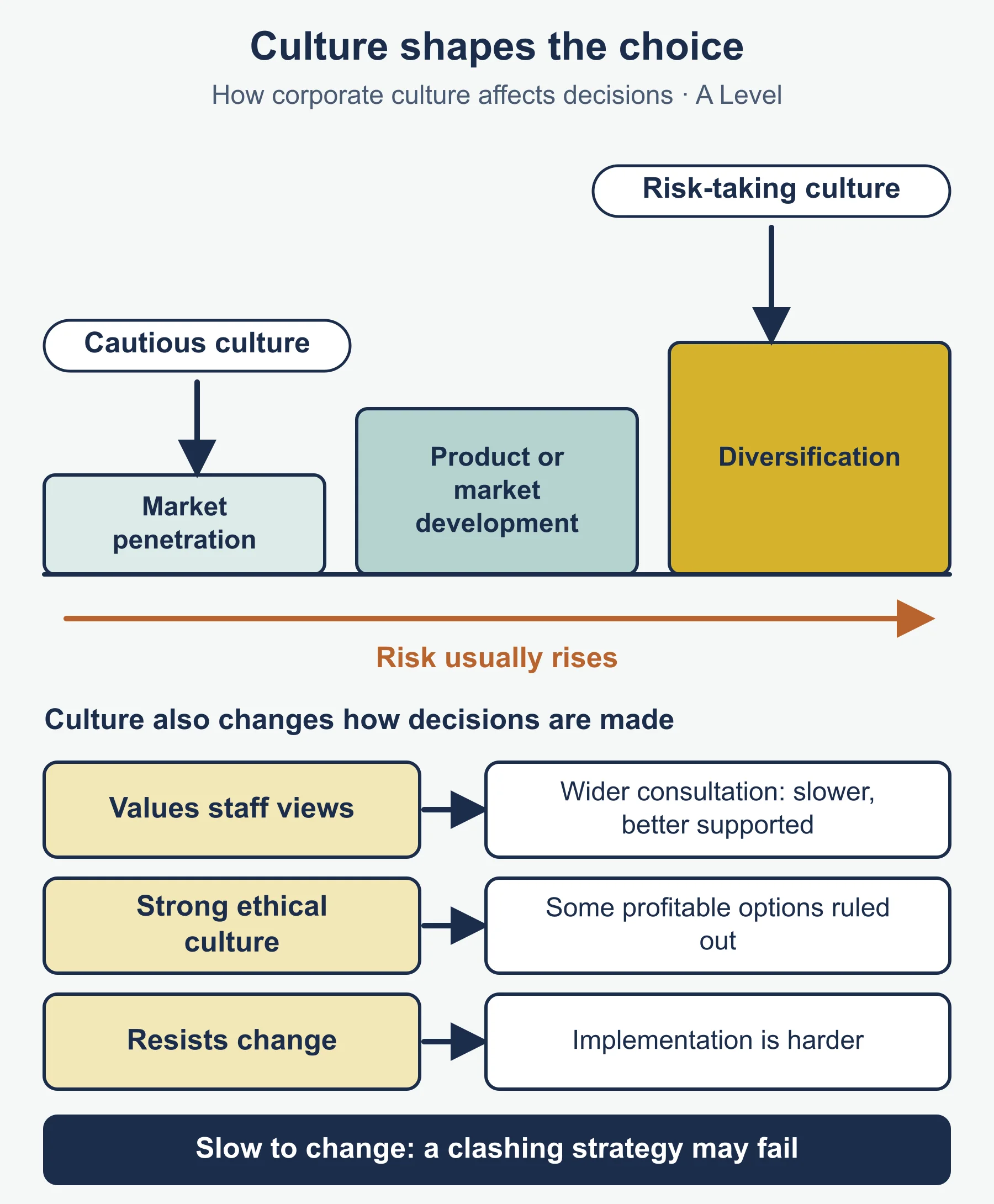
Corporate culture is the shared values, beliefs and accepted ways of behaving in a business: “the way we do things here”. It affects decisions in several ways.
- A risk-taking culture accepts bold choices such as diversification; a cautious one prefers market penetration.
- A culture that values employee views leads to wider consultation and slower, better-supported decisions.
- A strong ethical culture will rule out some profitable options.
- A culture that resists change makes implementation harder.
Culture is difficult and slow to change, so a strategy that conflicts with it may fail.
Transformational leadership
Transformational leadership aims to inspire people to commit to a shared vision and go beyond their own interests. In the usual description, the leader communicates a clear vision, stimulates new thinking, treats individuals as people with different needs, and acts as a role model. It contrasts with transactional leadership, based on rewards and penalties for set tasks.
It is important in strategic change because it builds commitment. The limits are that it relies heavily on one person and it can be draining for staff if change is constant.
Management and control of strategic change
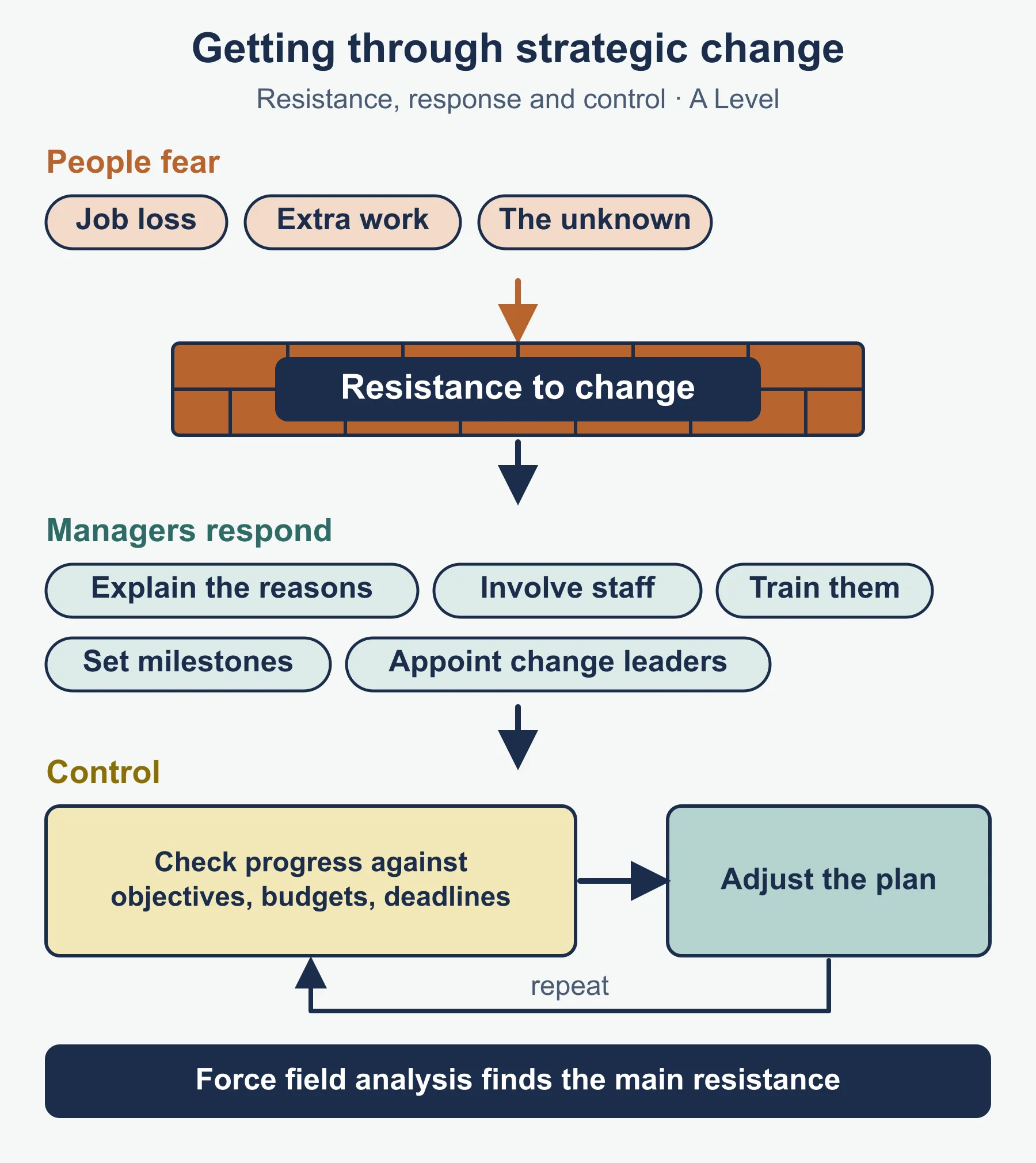
Strategic change is a major shift in direction, such as entering a new market or restructuring. It is often resisted because people fear job loss, extra work or the unknown. Managers can manage it by explaining the reasons clearly, involving staff, training them, setting milestones, and appointing change leaders. Control means checking progress against objectives, budgets and deadlines, and adjusting the plan. Force field analysis (above) gives a way to find the main resistance.
Contingency planning and crisis management
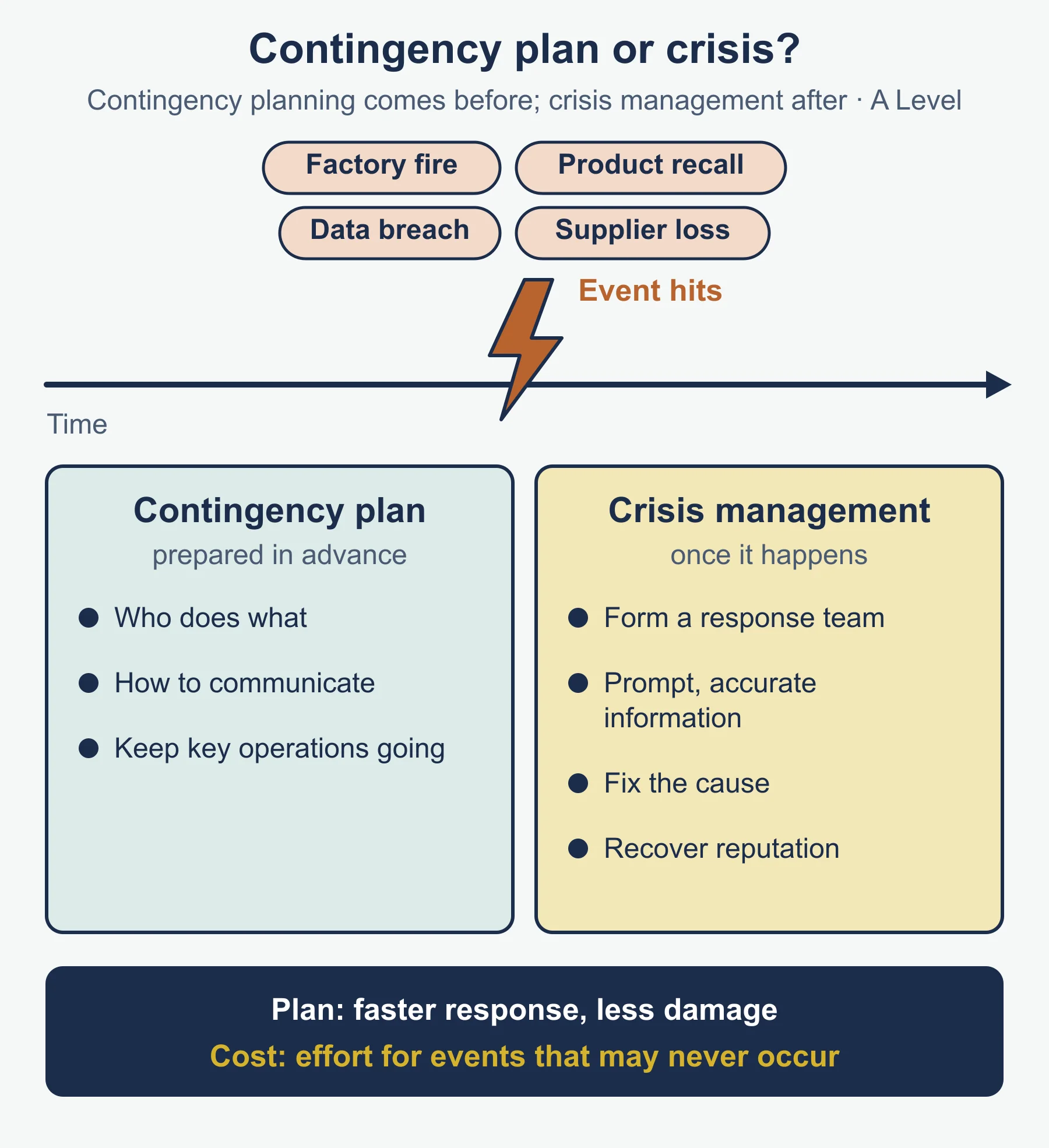
A contingency plan is prepared in advance for a specific unlikely but serious event, such as a factory fire, a product recall, a data breach or loss of a major supplier. It names who does what, how to communicate and how to keep key operations going. Its importance is speed and reduced damage. The cost is effort spent on events that may never occur.
Crisis management is the way a business handles a crisis once it occurs: forming a response team, giving accurate and prompt information to customers, staff and the public, fixing the cause, and recovering reputation. Contingency planning comes before; crisis management happens during and after.
Common errors
- Writing a SWOT with a generic list and no link to the decision.
- Treating PEST as a strategic choice rather than an analysis.
- Calling any new product “diversification” when the market is unchanged.
- Forgetting to subtract the option’s cost to reach net gain.
- Presenting a decision tree answer without questioning the probabilities.
- Describing contingency planning and crisis management as the same thing.
Next steps
Recap with the revision notes, test yourself with the practice questions, and take the free diagnostics. To go further, book a free trial class.
Frequently asked questions
Which Cambridge 9609 paper tests business strategy? Section 6.2 Business strategy is A Level content. Paper 4 asks two essay questions, both expecting evaluation, so each strategic tool should be judged as well as explained.
What is a core competence? A core competence is something a business does especially well that gives it an advantage: it provides access to many markets, adds to the benefits customers perceive, and is hard for rivals to copy.
What is blue ocean strategy? Blue ocean strategy means creating a new, uncontested market space instead of competing head-on with rivals. Its usual actions are to eliminate, reduce, raise and create features to offer new value.
How does corporate culture affect strategic decisions? Culture shapes attitude to risk, how widely managers consult and which options are ruled out on ethical grounds. A strategy that conflicts with the culture may fail, because culture is slow to change.
Official syllabus
Cambridge International AS & A Level Business 9609 syllabus for examination in 2026, 2027 and 2028, published by Cambridge University Press & Assessment (Cambridge Assessment International Education), section 6.2.
Get free revision emails (optional)
Occasional emails with practice questions, worked explanations and links to free resources for the qualification and subjects you choose. No spam, and you can unsubscribe from any email. The free tools on this site never need an email.
Related resources
-
Practice questions
A Level Business: Business strategy (Cambridge 9609) – Practice Questions
Original practice questions with worked answers on 6.2 Business strategy for Cambridge A Level Business 9609: short answer, decision trees, cases.
Business · Cambridge · A Level
Try questions -
Revision notes
A Level Business: Business strategy (Cambridge 9609) – Revision Notes
Condensed revision notes for Cambridge A Level Business 9609 section 6.2: strategic tools, decision tree sums, culture, change and crisis planning.
Business · Cambridge · A Level
Revise topic -
Study guides
A Level Business: Business structure and Size of business (Cambridge 9609)
Study guide to sections 1.2 and 1.3 of Cambridge AS & A Level Business 9609: sectors, ownership, measuring size, small firms and growth.
Business · Cambridge · AS Level
Read guide
Related articles
-
teaching
A Level tuition in Dubai: Cambridge or Pearson Edexcel International A Level?
Schools in Dubai and Abu Dhabi teach either Cambridge International AS & A Level or Pearson Edexcel International A Level. How the two are structured, why it matters for tuition, and how online classes from Lahore work.
9 October 2026
-
curriculum guides
Choosing subjects at IGCSE and A Level
How subject choices at 14 and 16 affect university options later, and how to keep pathways open without overloading a timetable.
28 July 2026
Studying this with a teacher
Working through Business A LEVEL?
This page is free and stays free. If you would rather be taught it, Marlbridge runs Business classes one-to-one and in small groups of up to 15, online in your own time zone. The first trial class is free. WhatsApp replies within an hour (8am–11pm Pakistan time, every day); email the same day.
Cambridge Business teachers at Marlbridge

