
Revision Notes
A Level Business: Business strategy (Cambridge 9609) – Revision Notes
Condensed revision notes for Cambridge A Level Business 9609 section 6.2: strategic tools, decision tree sums, culture, change and crisis planning.
- Subject
- Business
- Level
- A LEVEL
- Topic
- Business and its environment
- Author
- Marlbridge Academic Team
- Updated
- Reviewed by
- Salman Ahmad (what this means)
Aligned to Cambridge A Level Business (9609), For examination in 2026, 2027 and 2028. Official specification .
Syllabus page (what it covers and how it is assessed): Cambridge A Level Business.
Syllabus points this page covers
9609 (A Level)
- 6.2 Business strategy
Found an error? Report a correction.
Need help with this topic? Request a free trial class for A Level Business (9609).
These notes condense section 6.2 Business strategy (6.2.1 Developing business strategy and 6.2.2 Corporate planning and implementation) of the Cambridge International AS & A Level Business 9609 syllabus for examination in 2026, 2027 and 2028. It is A Level content. For full explanations and worked examples, use the study guide, then test yourself with the practice questions.
Course links: the Cambridge A Level Business hub, the printable checklist and the free diagnostics.
Definitions to know
| Term | Meaning |
|---|---|
| Business strategy | Long-term plan setting the direction of the whole business and how resources will be used to meet its objectives |
| Strategic management | Deciding and carrying out strategy in three stages: analysis, choice, implementation |
| Corporate planning | Setting long-term objectives for the whole business and deciding the actions and resources to reach them |
| Corporate culture | Shared values, beliefs and accepted ways of behaving in a business |
| Transformational leadership | Leadership that inspires commitment to a vision and encourages people to look beyond their own interests |
| Strategic change | A major change in the direction or structure of the business |
| Contingency plan | A plan prepared in advance for a specific serious event that may happen |
| Crisis management | The way a business handles a crisis once it is under way |
Strategic management: three stages
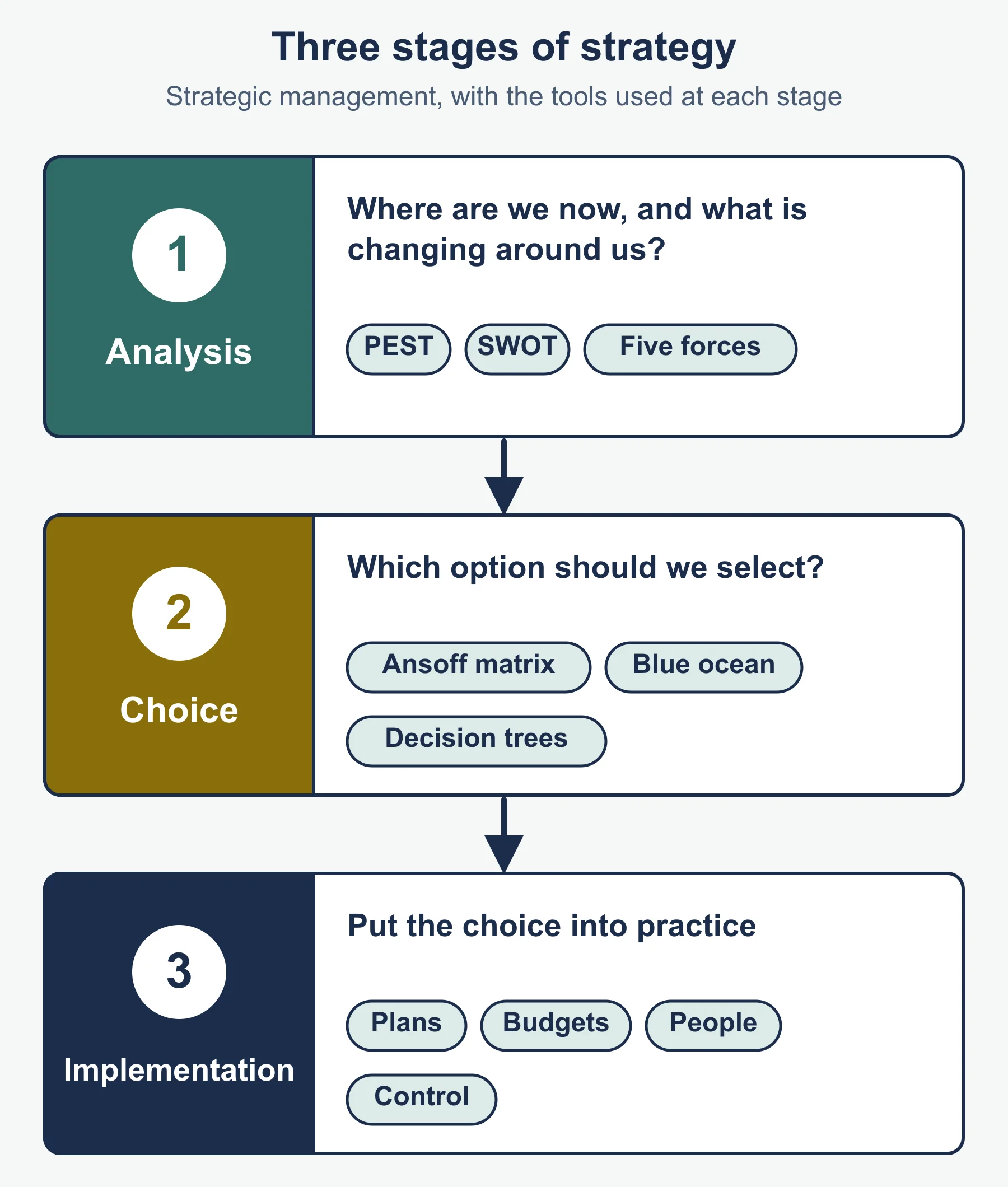
- Analysis: where are we, and what is changing? Tools: PEST, SWOT, five forces, core competence.
- Choice: which route? Tools: Ansoff matrix, blue ocean strategy, decision trees, scenario planning.
- Implementation: make it happen. Needs plans, budgets, leadership and control.
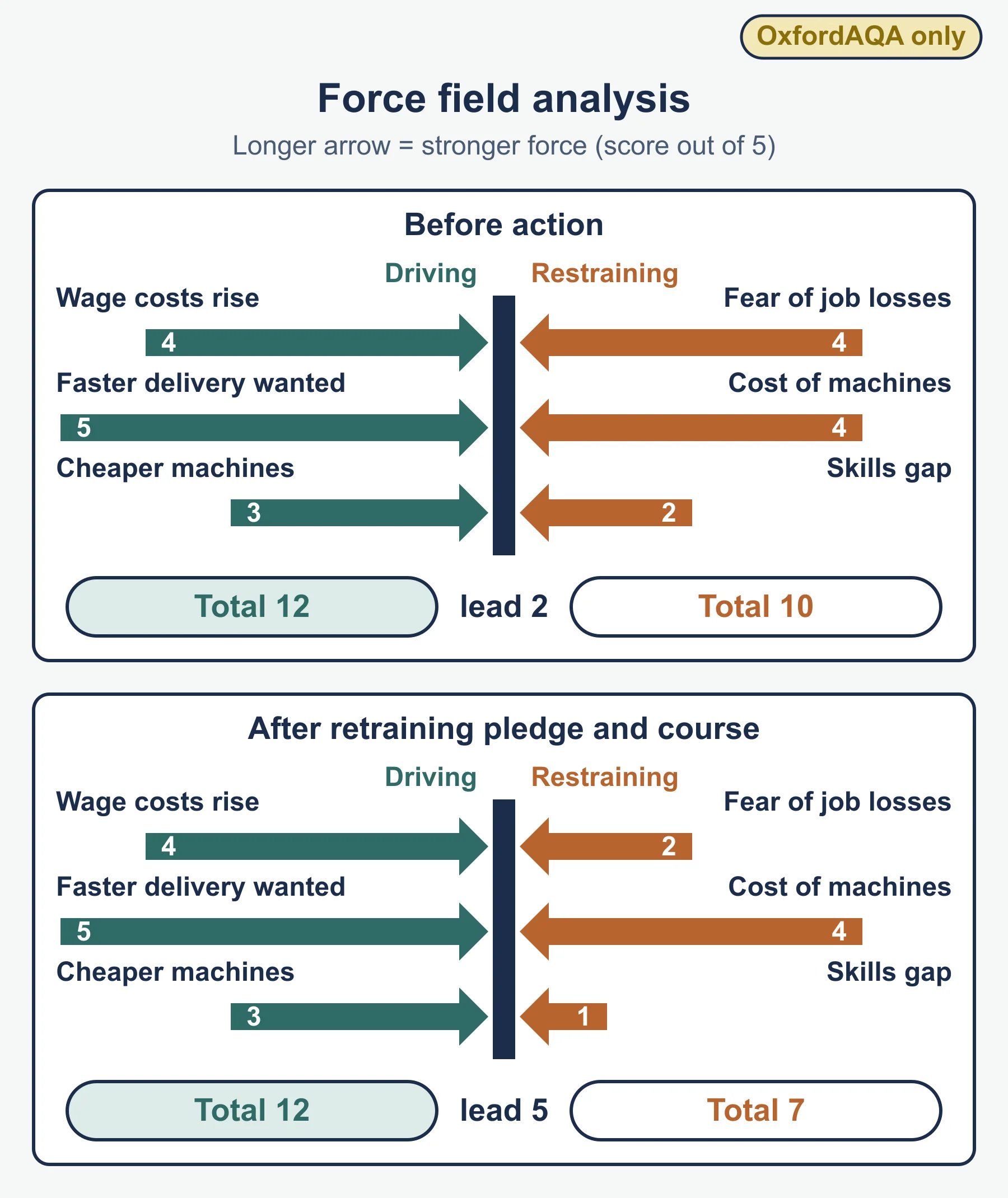
Force field analysis can sit in either of the last two: it tests whether a chosen change will succeed.
The tools at a glance
| Tool | What it does | One limit |
|---|---|---|
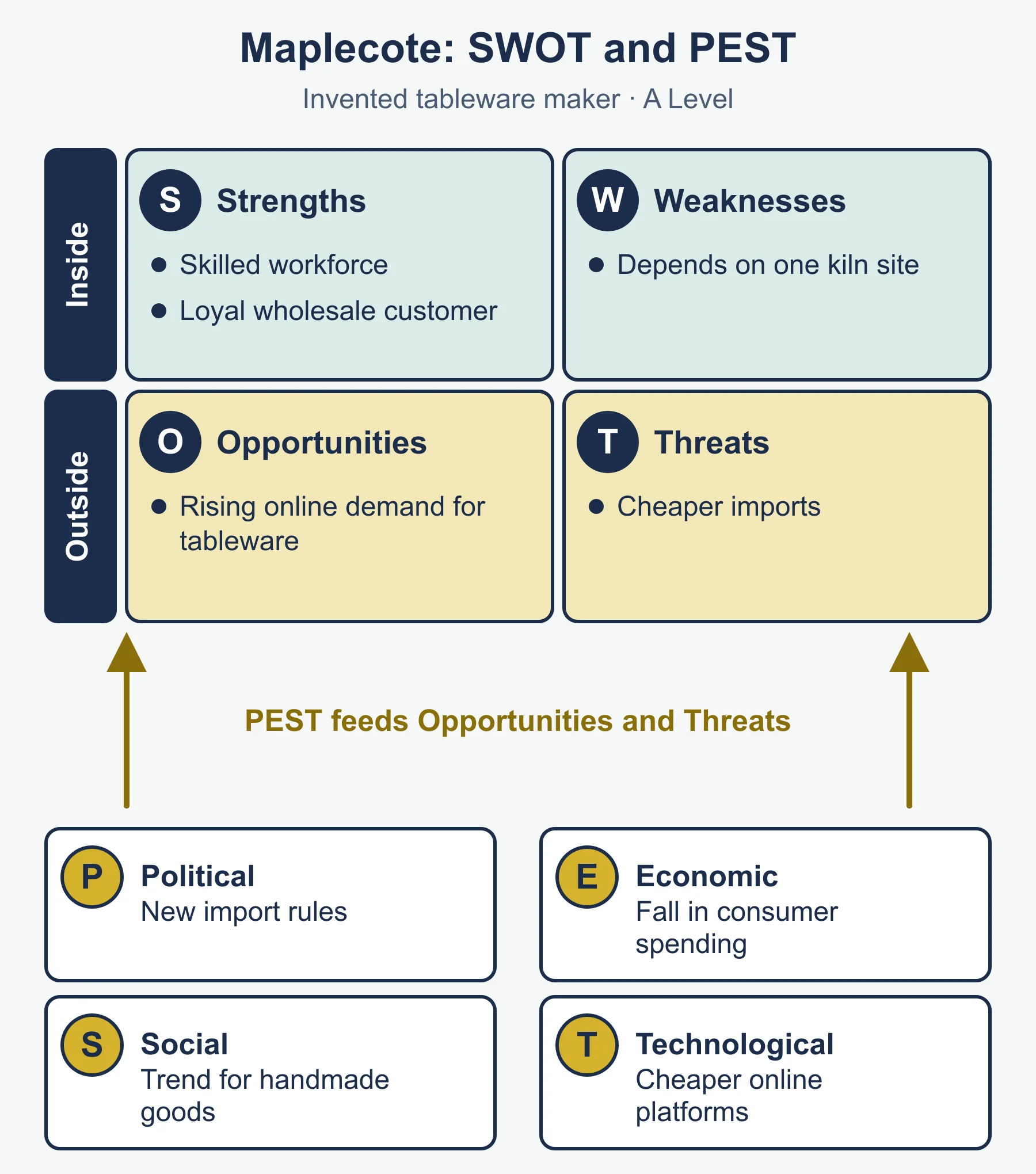
| SWOT | Sorts internal strengths and weaknesses and external opportunities and threats | A list; does not rank or decide |
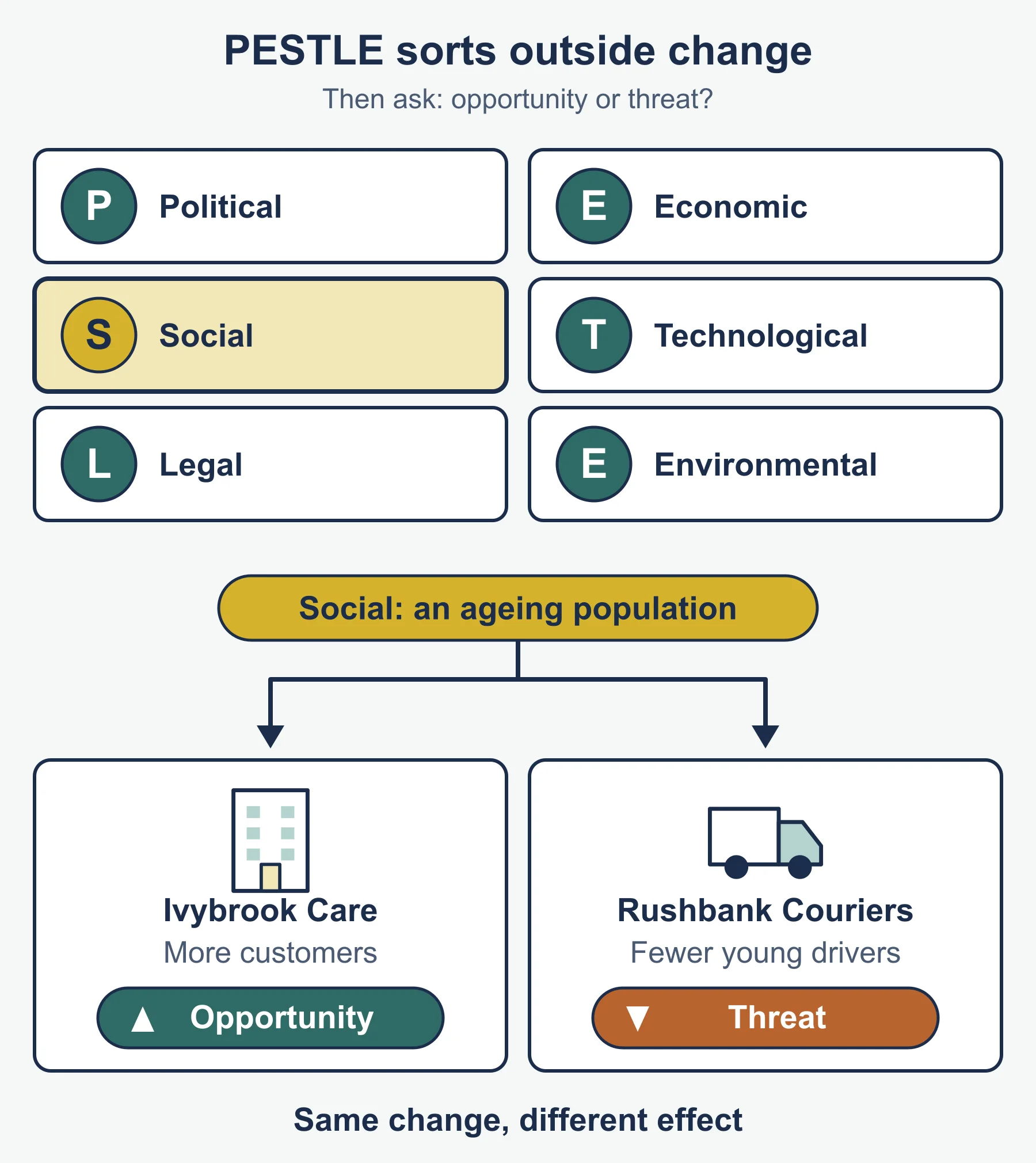
| PEST | Scans political, economic, social and technological factors outside the business | Headings overlap and findings date quickly |
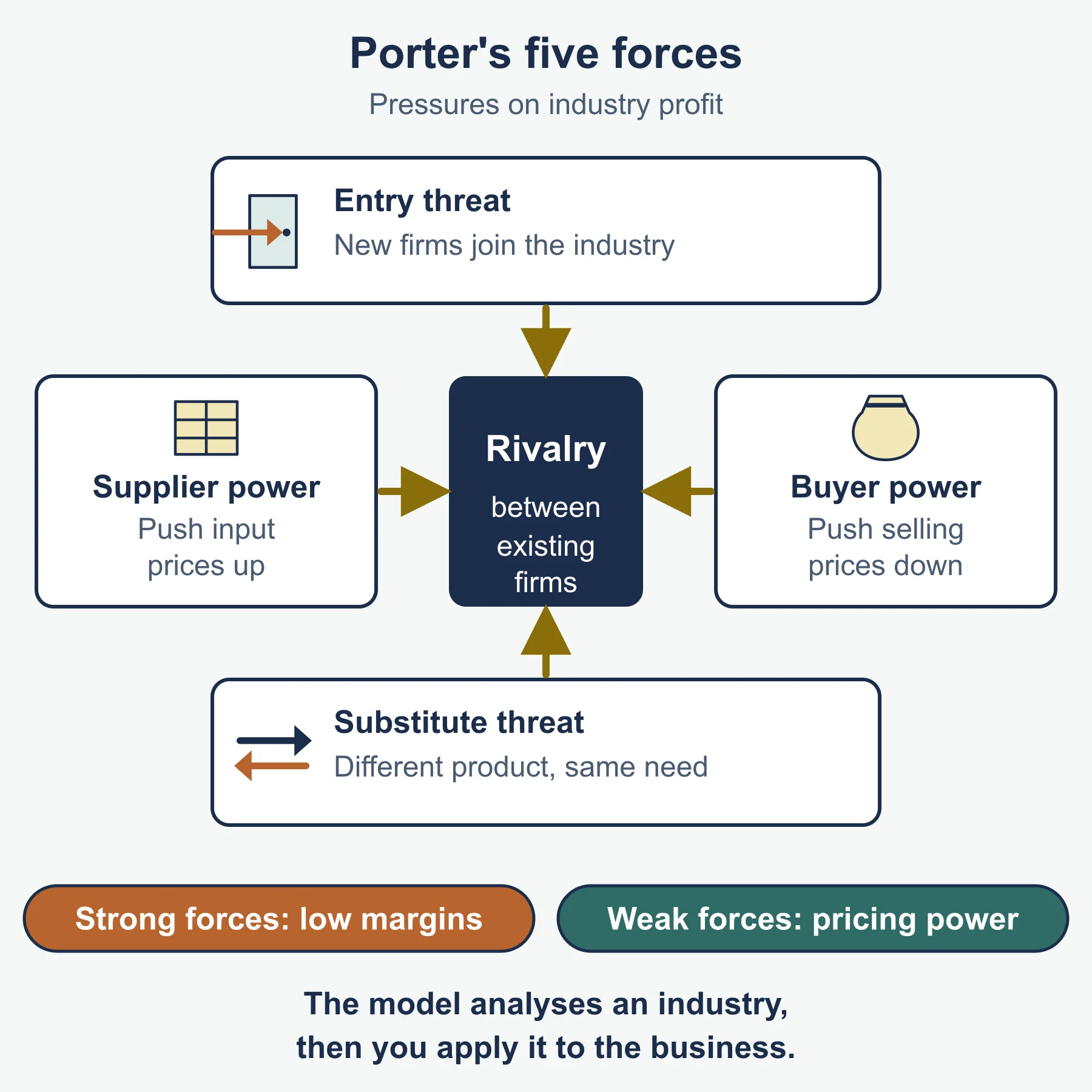
| Porter’s five forces | Judges industry attractiveness through rivalry, new entrants, substitutes, buyers and suppliers | A snapshot of one moment |
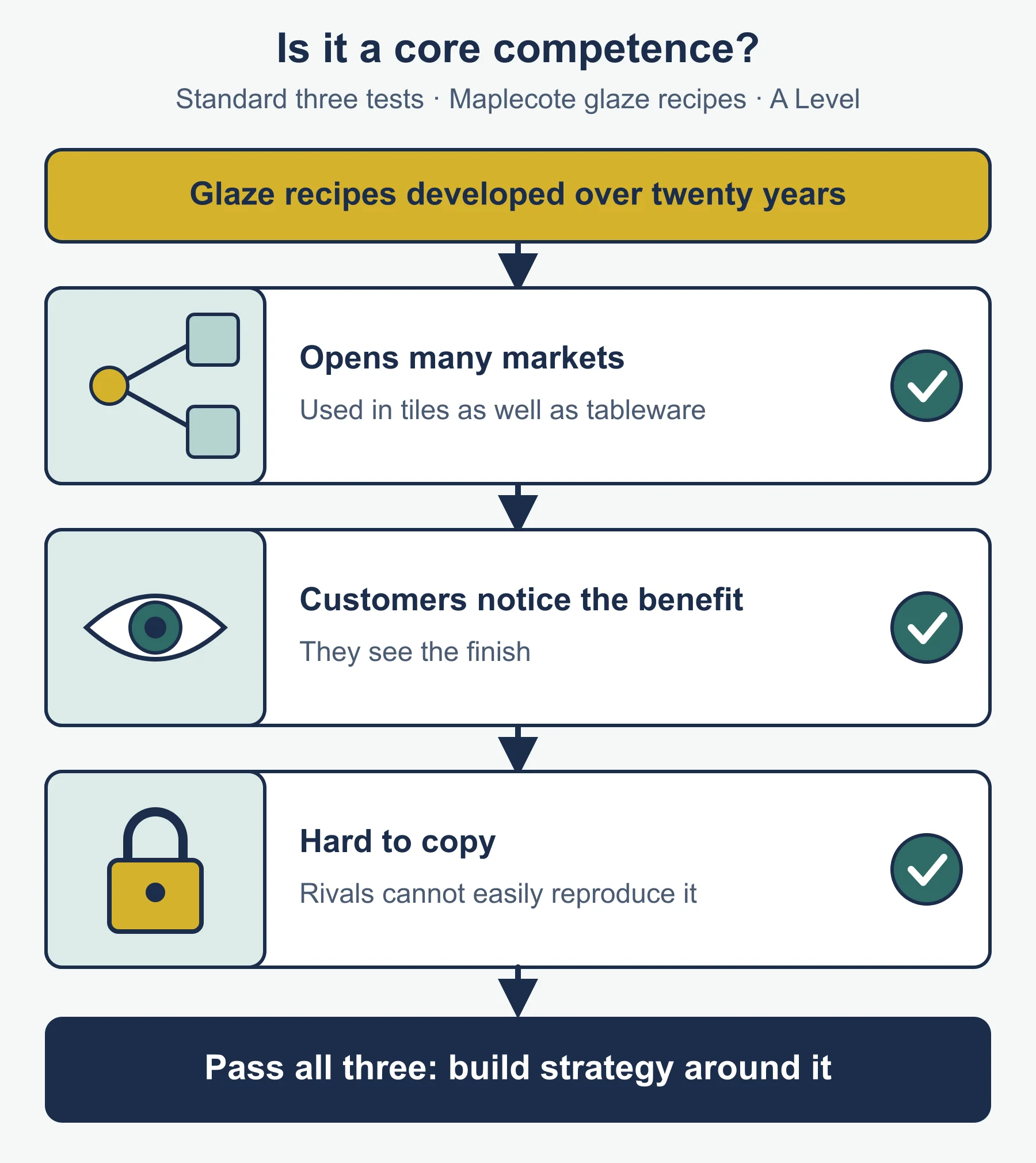
| Core competence framework | Finds what the business does best, hard to copy and valued by customers | Skills can become outdated |
| Ansoff matrix | Four growth routes by product and market | Does not say which fits the business |
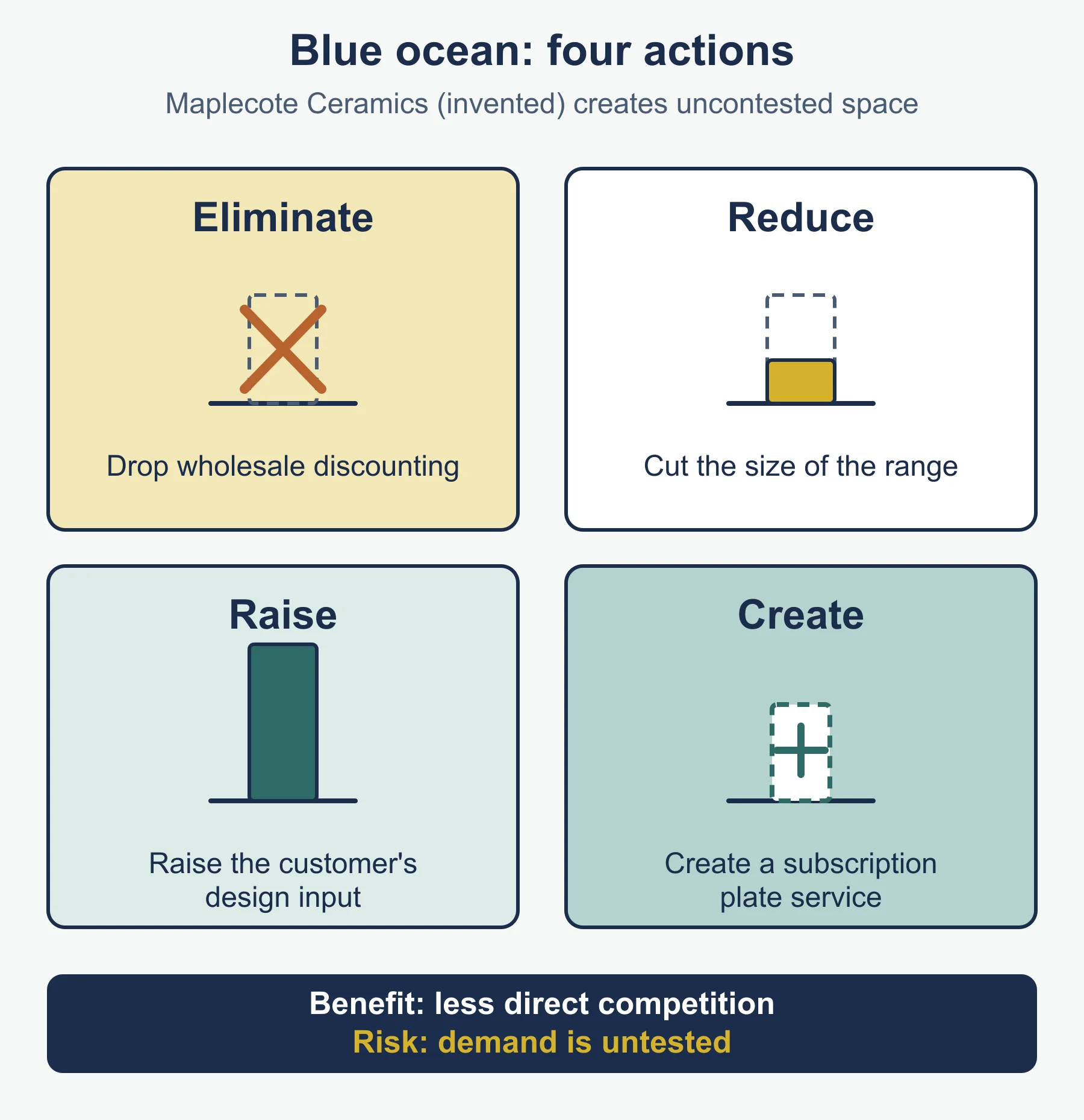
| Blue ocean strategy | Creates an uncontested market through value innovation | Demand in the new space is untested |
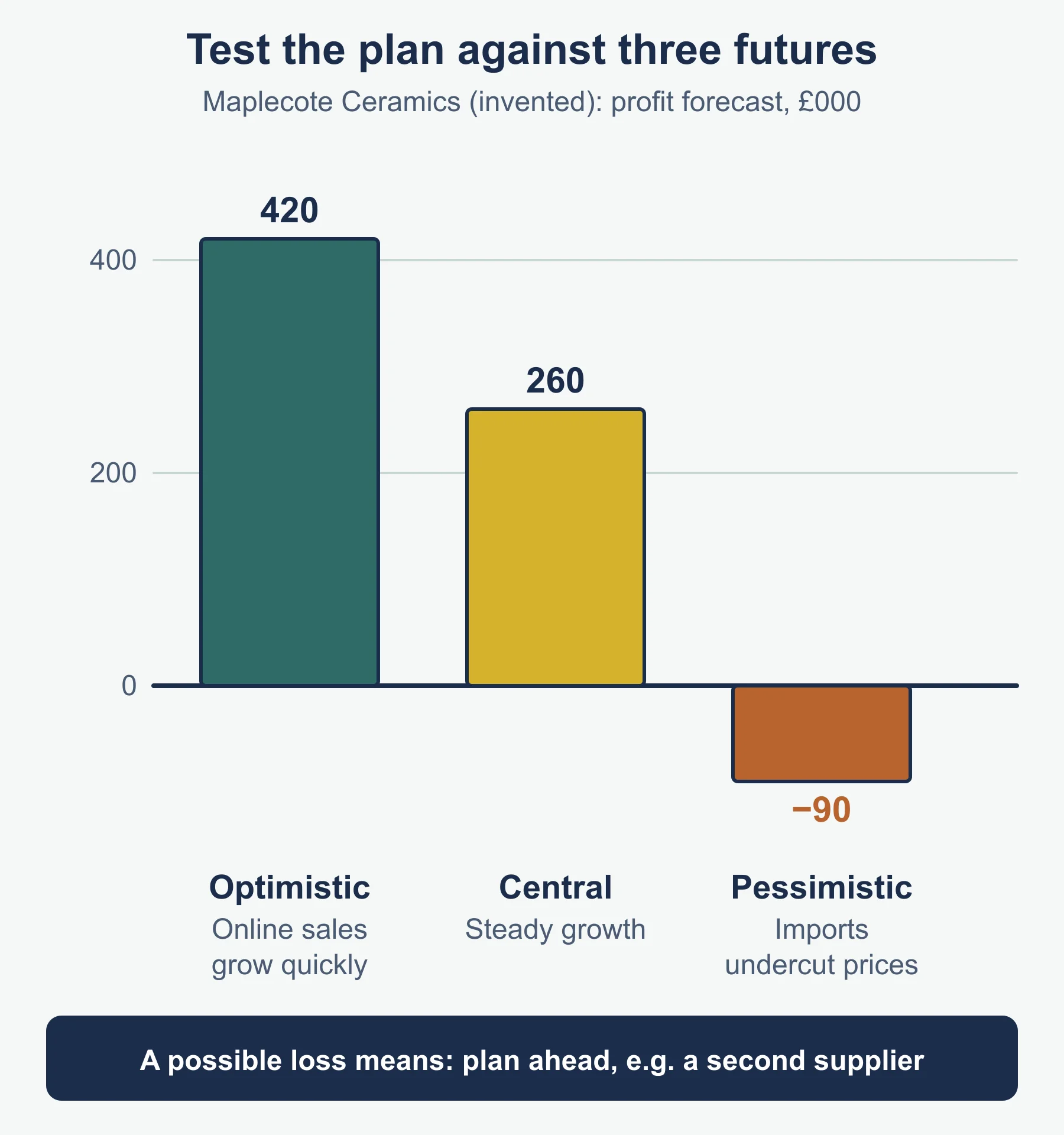
| Scenario planning | Tests strategy against several plausible futures | Time-consuming; cannot cover every event |
| Force field analysis | Scores driving and restraining forces for a change | Scores are subjective |
| Decision trees | Compare options using probabilities and payoffs | Probabilities are estimates; ignores non-financial factors |
Standard forms (the syllabus names the tools only)
The details below are the usual textbook forms, not wording taken from the syllabus.
- Core competence tests (Prahalad and Hamel): access to many markets, adds to perceived customer benefit, difficult for rivals to imitate.
- Blue ocean actions (Kim and Mauborgne): eliminate, reduce, raise, create.
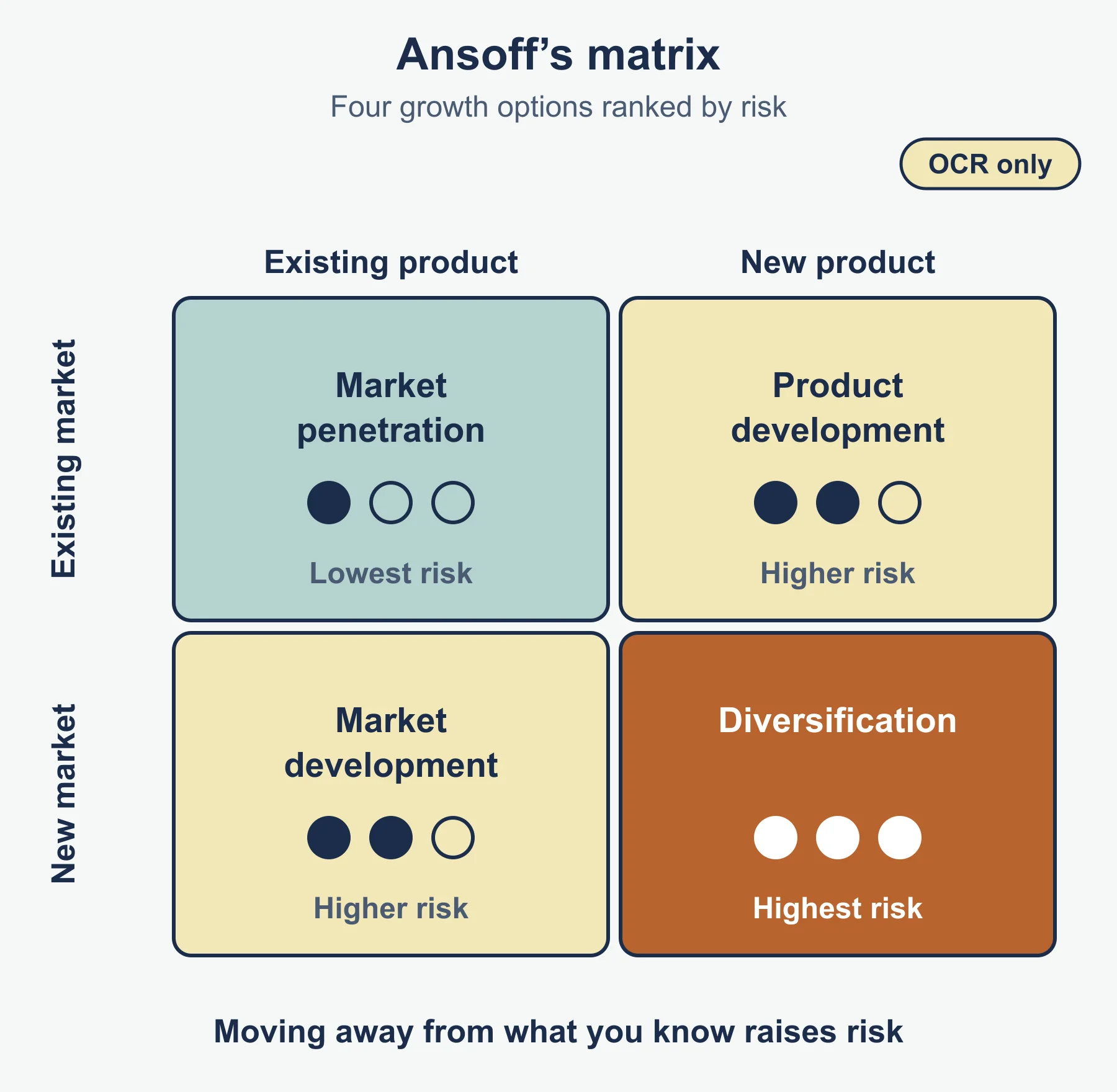
- Ansoff boxes: existing products and markets = market penetration; existing products and new markets = market development; new products and existing markets = product development; new products and new markets = diversification.
Method boxes
Decision tree
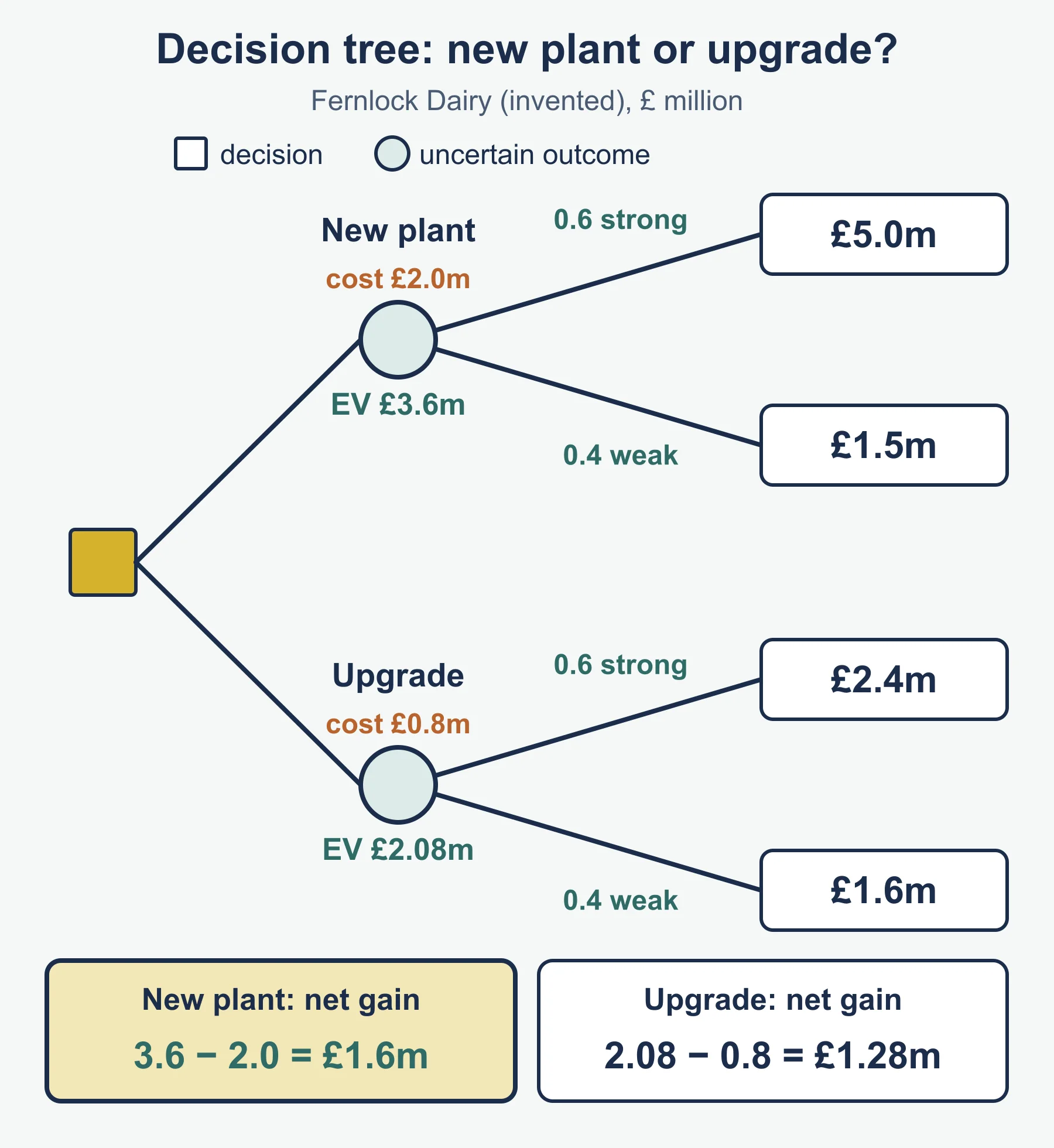
- For each option, list outcomes with their probabilities (they must sum to 1).
- Expected value = sum of (probability × payoff).
- Net gain = expected value − cost of the option.
- Compare net gains, then question the probabilities and consider risk and non-financial factors.
Force field analysis
- Define the change.
- List driving and restraining forces.
- Score each, such as 1 to 5.
- Total each side; net = driving − restraining.
- Plan how to weaken the strongest restraining force or strengthen a driver.
Using a framework in a case answer
- Name the tool or idea.
- Quote case evidence.
- Explain what it means for the decision.
- Weigh it against something else and reach a judgement.
Worked reminder: decision tree
Ilmswick Joinery (invented) can buy a CNC router for £60,000. The chance of strong orders is 0.5, giving a payoff of £90,000; weak orders give £30,000.
Expected value = (0.5 × 90,000) + (0.5 × 30,000) = 45,000 + 15,000 = £60,000. Net gain = 60,000 − 60,000 = £0.
On numbers alone the purchase breaks even in expectation, so the decision turns on risk, other options and non-financial factors.
Worked reminder: classifying with Ansoff
Ilmswick Joinery already sells oak doors to local builders. Selling the same doors to builders in a neighbouring region is market development. Adding a range of staircases for the same local builders is product development. Running a hotel is diversification. Offering a loyalty discount to current builders is market penetration. In each answer, name the strategy, then say what makes it more or less risky than the others.
Scenario planning and blue ocean in brief
Scenario planning: build two to four plausible futures, test the strategy in each, and set trigger points for changing course. Blue ocean strategy: look for a space with no direct rivals by removing what customers do not value and adding what they do. Both need a judgement about how likely, and how costly, the outcome is.
6.2.2 Key points
Corporate planning: importance
Gives direction, co-ordinates departments, allocates resources, sets targets for measuring performance and prepares for change.
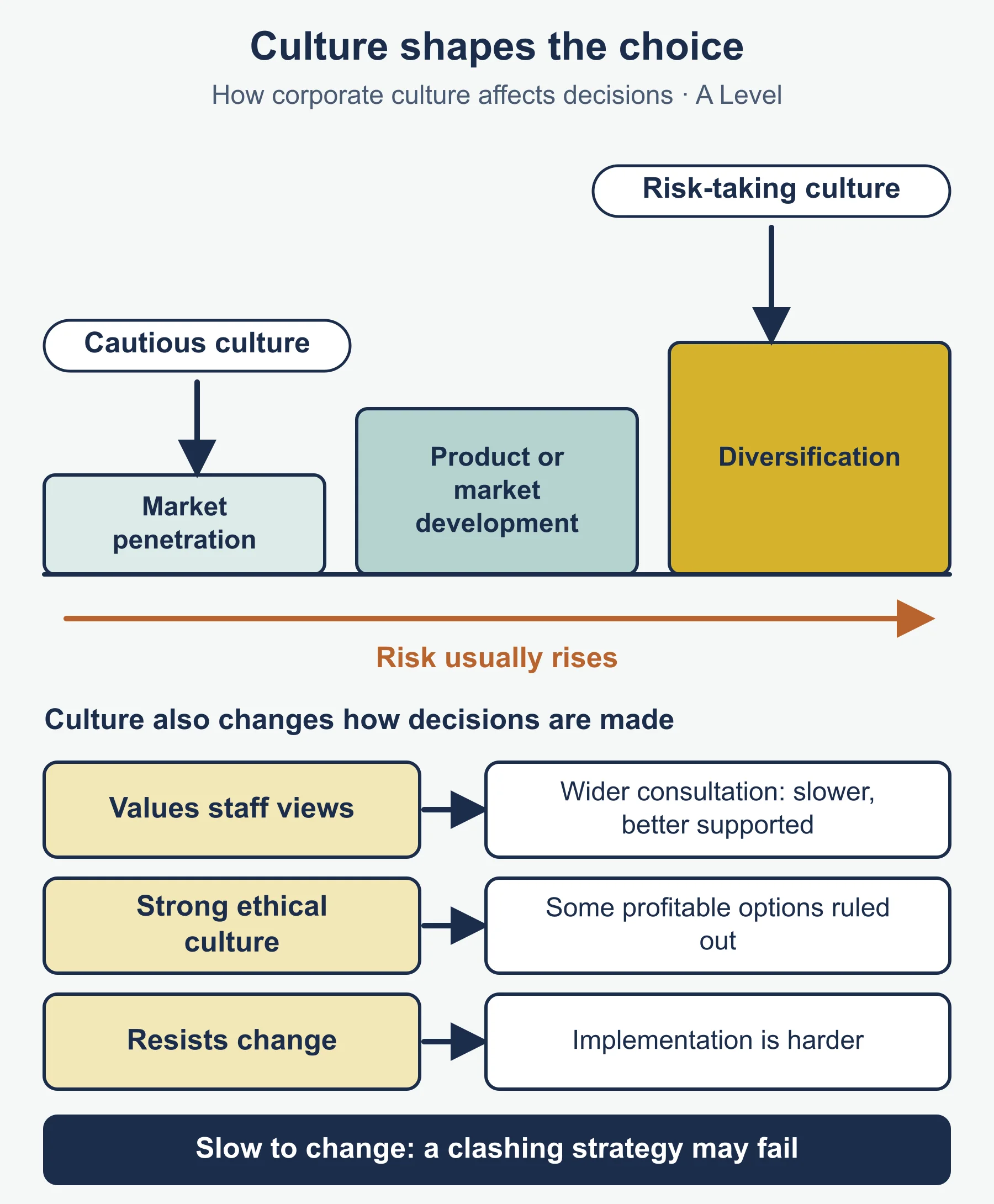
Corporate culture: effects on decisions
Sets attitude to risk, speed and breadth of consultation, ethical limits and willingness to accept change. A strategy that clashes with culture is likely to meet resistance.
Transformational leadership
Vision, inspiration, intellectual challenge, attention to individuals, role-model behaviour. Contrast with transactional (reward and penalty for set tasks).
Managing and controlling strategic change
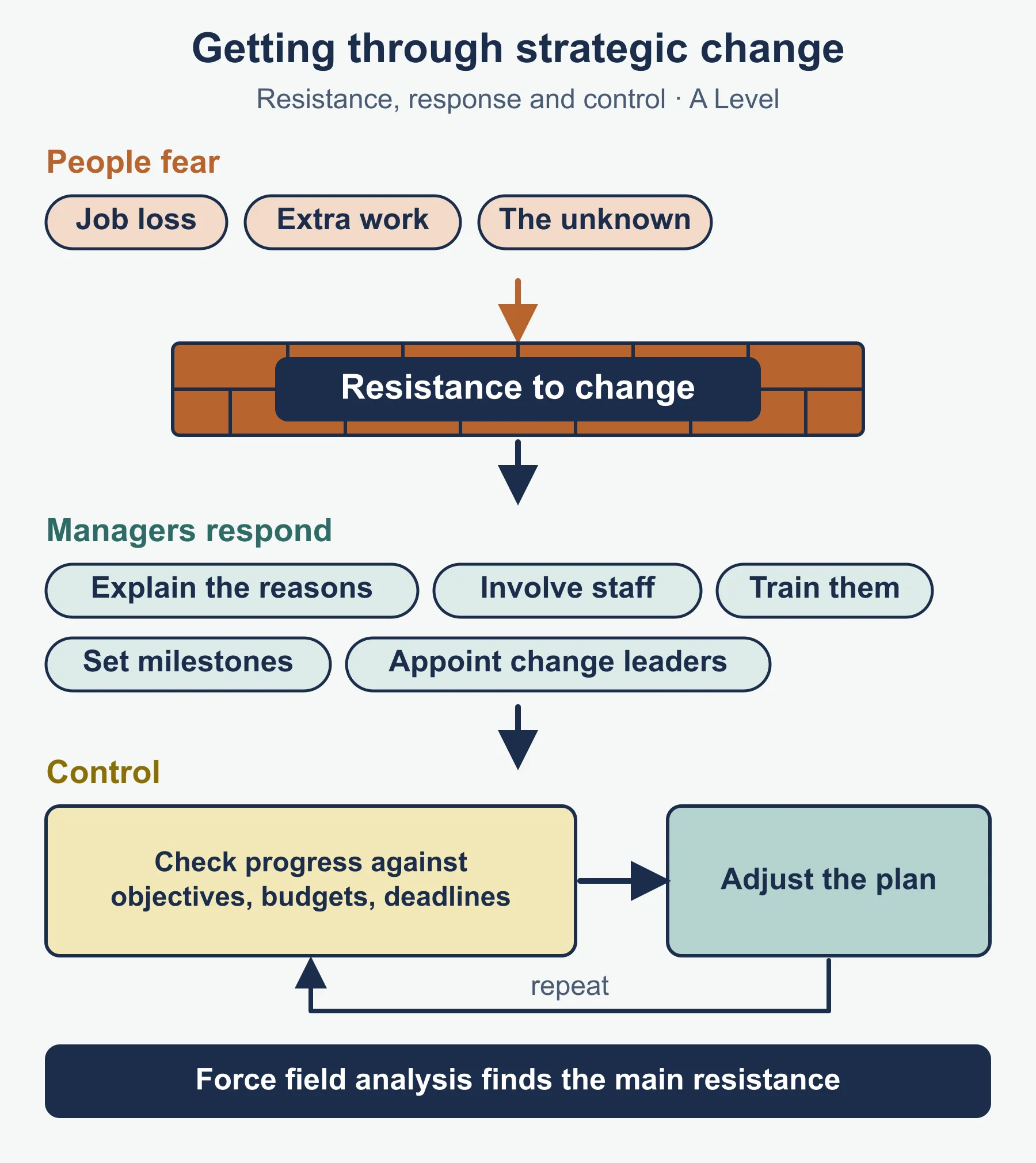
- Reasons for resistance: fear of job loss, extra work, loss of status, the unknown.
- Management: clear reasons, involvement, training, change leaders, milestones.
- Control: compare progress with objectives, budgets and deadlines; adjust the plan.
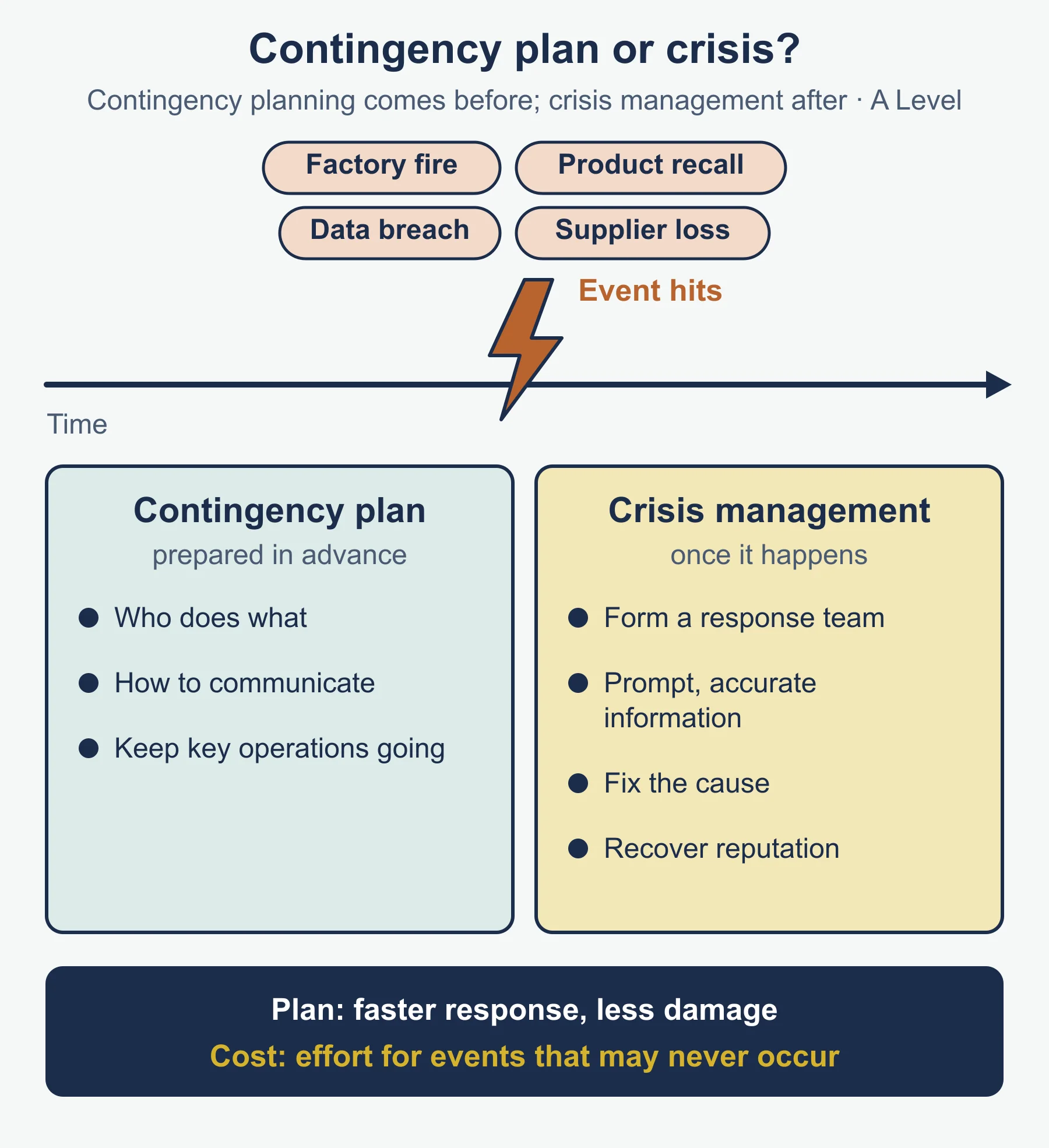
Contingency planning versus crisis management
| Contingency planning | Crisis management | |
|---|---|---|
| Timing | Before an event | During and after |
| Purpose | Prepared responses for named risks | Limit damage and recover |
| Typical content | Roles, communication, back-up arrangements | Response team, prompt information, fixing the cause, restoring reputation |
Must-know distinctions
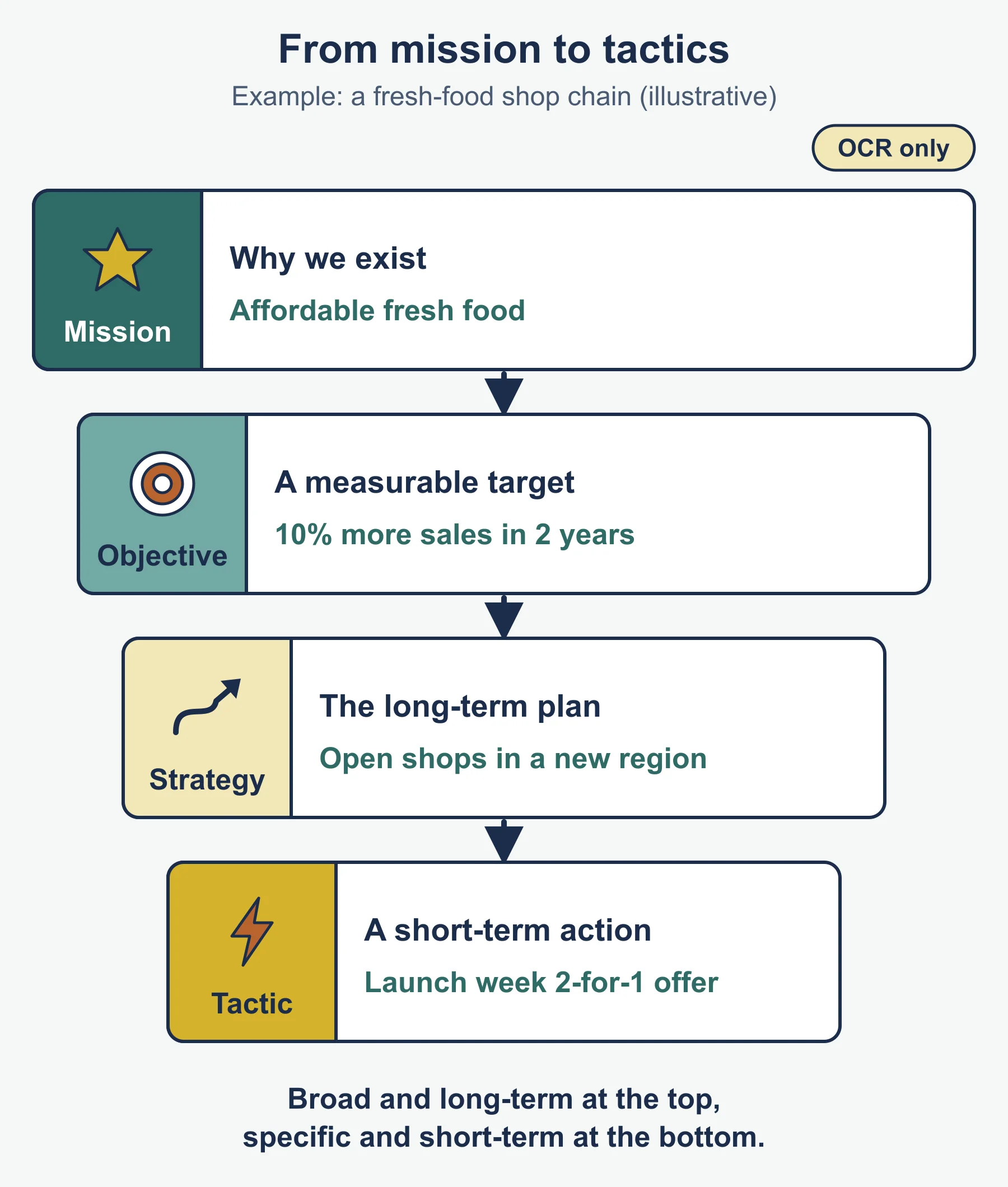
- Strategy (long-term, whole business) versus tactic (short-term, part of the plan).
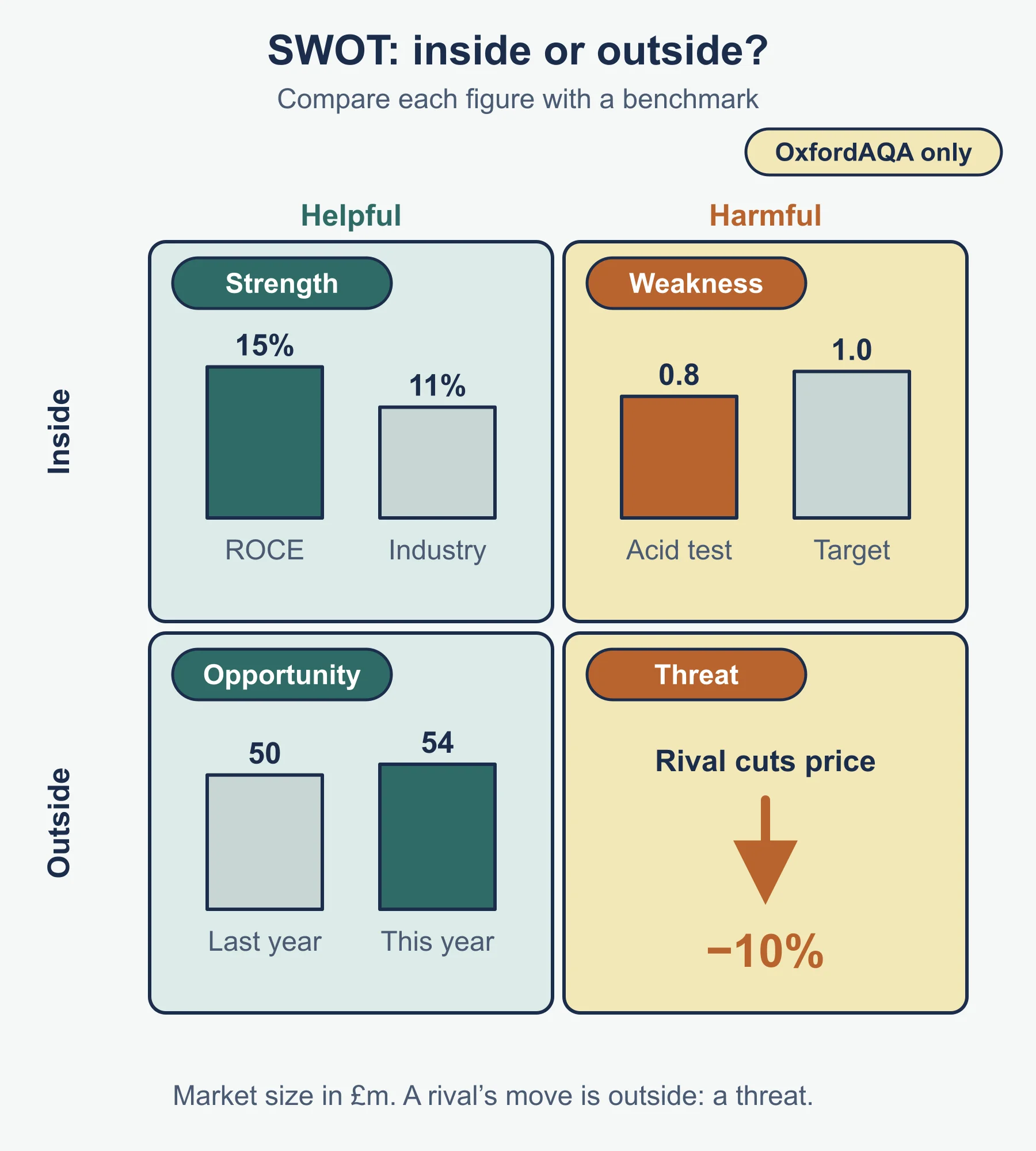
- SWOT internal (strengths, weaknesses) versus external (opportunities, threats).
- PEST (outside factors only) versus SWOT (both inside and outside).
- Market development (same product, new market) versus product development (new product, same market).
- Expected value versus net gain: only net gain subtracts the cost.
- Corporate planning (long-term objectives) versus contingency planning (specific events).
Quick self-test
- State the three stages of strategic management.
- Which two SWOT boxes are internal?
- Name the five forces in Porter’s model.
- A business sells its existing product in a new country. Which Ansoff strategy is this?
- Which Ansoff strategy is usually the riskiest?
- In a decision tree, a firm invests £50,000. Success (probability 0.4) pays £200,000 and failure pays £20,000. Calculate expected value and net gain.
- A force field has driving scores 4, 3, 2 and restraining scores 5, 3. What is the net score, and what does it suggest?
- Give one way a risk-taking culture affects decisions.
- Distinguish a contingency plan from crisis management in one sentence.
- Give two reasons staff resist strategic change.
- A decision tree gives option A a net gain of £25,000 and option B £36,000. Does this prove B is better? Explain briefly.
Answers
- Analysis, choice and implementation.
- Strengths and weaknesses.
- Rivalry between existing firms, threat of new entrants, threat of substitutes, bargaining power of buyers, bargaining power of suppliers.
- Market development.
- Diversification.
- Expected value = (0.4 × 200,000) + (0.6 × 20,000) = 80,000 + 12,000 = £92,000. Net gain = 92,000 − 50,000 = £42,000.
- Driving total 9, restraining total 8, net +1. The change has a slight advantage, so success is possible but resistance is nearly as strong as support; reduce the largest restraining force.
- It makes managers more willing to choose high-risk options such as diversification or entering a new market.
- A contingency plan is prepared before a specific possible event, whereas crisis management is the handling of a crisis as it unfolds.
- Any two: fear of job loss, extra work, loss of status or skills, fear of the unknown, poor communication.
- No. B has the higher expected net gain, but the probabilities are estimates, B might carry a bigger downside, and non-financial factors are ignored.
Where marks are usually lost
- Listing SWOT items without saying which matter most for the decision.
- Mixing up internal and external factors in a SWOT.
- Describing a tool in general terms with no evidence from the case.
- Using diversification for any new product, even when the market is unchanged.
- Quoting expected value as the answer when the question asks for net gain.
- Making the decision tree recommendation with no comment on probabilities.
- Treating culture and leadership as definitions without linking them to decisions.
- Writing about crisis management when the question is about contingency planning.
- Ending an evaluation without a clear, reasoned judgement.
Next steps
Work through the practice questions, re-read the study guide and take the free diagnostics.
Frequently asked questions
What is the difference between PEST and SWOT? PEST scans only factors outside the business: political, economic, social and technological. SWOT covers both inside the business (strengths and weaknesses) and outside it (opportunities and threats).
What is the difference between contingency planning and crisis management? A contingency plan is prepared before a specific serious event that may happen. Crisis management is how the business handles a crisis once it is under way, to limit damage and recover.
Why do employees resist strategic change? Common reasons are fear of job loss, extra work, loss of status or skills, and fear of the unknown. Managers can reduce resistance by explaining the reasons, involving staff, training and setting milestones.
Which Ansoff strategy is usually the riskiest? Diversification, which means selling new products in new markets, because the business moves furthest away from what it knows.
Official syllabus
Cambridge International AS & A Level Business 9609 syllabus for examination in 2026, 2027 and 2028, published by Cambridge University Press & Assessment (Cambridge Assessment International Education), section 6.2.
Get free revision emails (optional)
Occasional emails with practice questions, worked explanations and links to free resources for the qualification and subjects you choose. No spam, and you can unsubscribe from any email. The free tools on this site never need an email.
Related resources
-
Study guides
A Level Business: Business structure and Size of business (Cambridge 9609)
Study guide to sections 1.2 and 1.3 of Cambridge AS & A Level Business 9609: sectors, ownership, measuring size, small firms and growth.
Business · Cambridge · AS Level
Read guide -
Practice questions
A Level Business: Business structure and Size of business (Cambridge 9609) – Practice Questions
Twelve original questions with worked answers on sections 1.2 and 1.3 of Cambridge A Level Business 9609: sectors, ownership, size and growth.
Business · Cambridge · AS Level
Try questions -
Revision notes
A Level Business: Business structure and Size of business (Cambridge 9609) – Revision Notes
Condensed revision notes for sections 1.2 and 1.3 of Cambridge A Level Business 9609: sectors, ownership forms, size measures, small firms and growth.
Business · Cambridge · AS Level
Revise topic
Related articles
-
teaching
A Level tuition in Dubai: Cambridge or Pearson Edexcel International A Level?
Schools in Dubai and Abu Dhabi teach either Cambridge International AS & A Level or Pearson Edexcel International A Level. How the two are structured, why it matters for tuition, and how online classes from Lahore work.
9 October 2026
-
curriculum guides
Choosing subjects at IGCSE and A Level
How subject choices at 14 and 16 affect university options later, and how to keep pathways open without overloading a timetable.
28 July 2026
Studying this with a teacher
Working through Business A LEVEL?
This page is free and stays free. If you would rather be taught it, Marlbridge runs Business classes one-to-one and in small groups of up to 15, online in your own time zone. The first trial class is free. WhatsApp replies within an hour (8am–11pm Pakistan time, every day); email the same day.
Cambridge Business teachers at Marlbridge

